Tagged collaboration

A photo of shelves of paper files in an archive.
0

Narrating Memory through Rhetorical Reflections: CUNY Students and Their Archives

Abstract

This essay analyzes the importance of connection in teaching with archives: connections between our goals for our projects; between students and their research projects; between the past and the present; between students, faculty, and embedded librarians; and between the physical act of archival research and the digital writing to record that research. In this essay, two faculty and one librarian detail their projects assigning archival research in physical archives: the Abraham Lincoln Brigade Archives at the Tamiment Library at New York University and the Hunter College Archives. As our undergraduate students researched in physical archives and shared their research through digital platforms, they became active agents of generational transmission by publicly sharing the life histories and experiences of former CUNY students involved in activist movements. Through analysis of these collaborative, digital archival assignments, we show the role that students can play in transmitting institutional memory while learning about and engaging with primary sources.

“Internet searching doesn’t hold a candle to that visceral feeling of an old primary document. All of my senses were triggered on this archive visit, and I was only there for half a day. I would like to return to the archive—this archive, any archive—without an assignment or mission attached and just have some fun exploring.” —Elyse Orecchio[1]

“During our visit to Tamiment Library, I was moved by the fact that each box contained individual memories of an American volunteer in the Spanish Civil War. I wondered how much of one person’s life could fit in these boxes, and how these documents could help narrating the friendships among young soldiers, the making of improvised families, the experiences of the displaced children, and how some these lives might have survived the war. I wondered, finally, how much legacy can these archives preserve?” —Marcelo Agudo

In a class session announcing a visit to the Hunter College Archives, several students in a class of juniors and seniors admitted that they had never even been inside the Hunter College Library—or any library. We might all shudder at the thought, but it is quite common for students to have no reason for entering a physical library or speaking with a librarian face to face. It is not that students Google everything: they have extensive remote access to scholarly journals and primary sources through electronic databases, and digital holdings now outpace physical holdings at libraries. Furthermore, librarians are available through digital platforms to assist students with their research. As student reflections from our courses show, the experience of entering a library, working with physical primary sources, and interacting with librarians face-to-face became a positive practice that not only introduced students to a new method and approach to research, but also resulted in new attitudes towards libraries, librarians, and the relevance of institutional memory.

The central question of this essay focuses on the role of students in institutional memory: what does it mean for undergraduates to do the work of narrating memory? Here we elaborate our archival research assignments: María Hernández-Ojeda’s Narrating Memory assignment taught in her courses on Spanish literature, and Wendy Hayden’s Rhetorical Reflections assignment, taught in her courses on rhetoric and writing. We both assigned undergraduates at Hunter College-CUNY to perform archival research in physical archives and report on that research on digital platforms (all WordPress based sites): Narrating Memory, Rhetorical Reflections in the Hunter College Archives, and Archival Research and Rhetoric. Iris Finkel, Reference and Instruction Librarian at Hunter College, redefined the role of the librarian in classroom instruction as she assisted students and faculty with research assignments in both physical and digital archives and used her digital humanities expertise to help students and faculty understand the norms and creative approaches to digital presentation. Although the three of us began these projects separately, here we bring them together in order to illustrate the theme of connection in teaching with archives: connections between our goals for our projects; between students and their research projects; between the past and the present; between students, faculty, and librarians; and between the physical act of archival research and the digital writing to record that research.

Over twenty years ago, Randy Bass (1997) promoted active learning pedagogy that incorporated primary sources and new technologies. Bass illustrated how new technologies facilitated engagement and fostered collaboration among students, using examples of assignments where students interacted with “electronic primary source archives (on the World Wide Web, or CD-ROM)” (1997, 15). Through hypertext, then a revolutionary new feature of interactive media, students were readily able to explore outside the source to find other meaning-making connections. Using technologies such as email, listservs, electronic discussion lists, and teleconferencing, students discussed primary sources outside the classroom. Students collaborated, made new connections in the material, and communicated knowledge that added a different perspective. Students moved from knowledge “consumers to producers” (Bass 1997, 33). We show how emerging technologies continue to empower student voices.

Recent scholarship shows that more teachers are assigning physical archival research to undergraduates, a trend Hayden (2017) has called “The Archival Turn’s Pedagogical Turn.” Students have been assigned to research in institutional archives (Brand, Kendall, and Sanders 2012; Johnson and Mulder 2011), community archives (Grobman 2017; Mutnick 2018), and in larger repositories (Devos et al. 2012; Mock 2015). In addition, archivists are reaching out to teachers to form partnerships with specific classes, such as the Brooklyn Historical Society’s TeachArchives.org (Golia and Katz 2018). Recent books, including the collections Pedagogies of Public Memory: Teaching Writing and Rhetoric at Museums, Archives, and Memorials (Greer and Grobman 2016), In the Archives of Composition: Writing and Rhetoric in High Schools and Normal Schools (Ostergaard and Wood 2015), and the textbook Primary Research and Writing: People, Places, and Spaces (Gaillet and Eble 2016), reflect a focus on archival pedagogies in rhetoric and composition studies. This research demonstrates that teaching with archives facilitates active learning. In addition, teaching with archives provides an ideal opportunity to teach information literacy. And from a digital humanities perspective, archival material can be analyzed and repurposed in new ways for new audiences, as our projects demonstrate.

In previous articles, Hayden (2015; 2017) has enumerated the benefits of teaching with archives related to what Susan Wells (2009) calls the “gifts of the archives”: archival research teaches students 1) to resist simple answers to their research questions, 2) to contribute to ongoing conversations in a discipline through publishing undergraduate research, and 3) to connect with their research topics personally. In this essay, we focus on the third, to show what CUNY students learned by researching past CUNY students, and how encounters with archival materials can facilitate student-centered learning experiences in other institutions and contexts.

Composition and Rhetoric graduate students at the CUNY Graduate Center have produced several dissertations on the importance of CUNY to histories of the discipline (Molloy 2016; Savonick 2018). Anthony G. Picciano and Chet Jordan (2018) recently published CUNY’s First Fifty Years: Triumphs and Ordeals of a People’s University, which documents CUNY’s history in the context of free and open-admissions universities. The CUNY Digital History Archive not only aims to document the unique history of CUNY and its role in larger movements in higher education but also invites researchers, teachers, and students to collaborate on developing the archive and its uses for archival and digital humanities assignments in CUNY courses (Brier 2017). The CUNY Digital History Archive reflects both CUNY’s emphasis on archives and on publishing on digital platforms. All of these projects document CUNY’s history and the teachers and students who have shaped it. Students in our courses add to these histories while constructing a unique history of activist students and their roles in larger social movements. And it is important to us that undergraduate students rather than faculty do this work, both to highlight the value of archives and to involve undergraduate students in documenting institutional memory.

According to Ekaterina Haskins (2007), we need to go beyond memory work that is done by those in power. Haskins (2007, 402) notes, “relegating the task of remembering to official institutions and artifacts arguably weakens the need for a political community actively to remember its past.” When current CUNY students use archival research to narrate the memory of former CUNY students, they participate in a “continuous transmission of shared past through participatory performance” (Haskins 2007, 402).

Students in our courses performed research in the institutional archives at Hunter College and the Tamiment Library at New York University, exploring topics such as the efforts of Hunter women to establish free kindergarten in New York City, to organize the Lenox Hill Settlement House, and to become involved in CUNY student activism during the two World Wars and the Spanish Civil War. And in a “meta-analytic” topic, some students have researched and analyzed the research processes of past student researchers at Hunter, whose typewritten, whited-out drafts give insight into the revision processes of earlier generations of students. Whether they were collecting stories of women returning to college, documenting the involvement of students in the Abraham Lincoln Brigade during the Spanish Civil War, or processing archival collections, they were becoming both active agents of generational transmission and digital archivists themselves. These students not only recovered the voices of CUNY students, such as the “returning woman” and Abraham Lincoln volunteers, but they also extended the original goals of these past students in a new digital context, creating their own digital archives, either in written or multimedia form, blending the voices of the past and present students of CUNY.

Goals

Archives enable unique pedagogical approaches to the topics of our courses. María’s undergraduate courses concentrated on twentieth-century Spanish literature, where the Spanish Civil War (SCW) is a constant presence in class discussions, whether through the exiled poets of the 1927 generation, the novels of tremendismo, or the issues of memory and identity in today’s literary Spain. The SCW served as  a common subject uniting historical and fictional narratives in the course. The Abraham Lincoln Brigade Archives (ALBA), which include primary-source documents related to a group of Americans who volunteered to serve in the SCW, helped bring the past to life for contemporary CUNY students. The Lincoln Brigade, the American battalion that participated in the Spanish Civil War within the International Brigades, included about 2800 men and women who left the US between 1936 and 1938 to fight fascism in Spain. The Lincoln Brigade’s commitment was an act of disobedience to the US government, which remained neutral, while other Western nations signed a non-intervention pact when the Spanish Civil War began in 1936. Some of these volunteers were CUNY faculty and students themselves. In the Narrating Memory project, today’s students connected with the stories and experiences of American volunteers in the SCW and began to understand why fellow CUNY students left everything and sailed to Spain to fight a war the US government largely ignored.

Wendy’s undergraduate courses incorporated the Hunter College Archives to show the centrality of recovery of lost voices to the field of rhetoric. Researching activist students, teachers, and writers in a local context allowed students to enter scholarly conversations about historiography and institutional memory. The archive project introduced students to a new method of research and information literacy skills.

Initially, we both hoped assigning archival research would allow undergraduates to make their own historical discoveries, learn the skills of archival research, and reflect on the complexities of history as a subjective concept. The work that students produced in these courses exceeded our expectations.

The Archives

New York City provides teachers access to many physical archives, such as the Brooklyn Historical Society, the Lesbian Herstory Archives, and the Schomburg Center for Research in Black Culture, among others. We concentrate here on the pedagogical opportunities offered by institutional archives: the Hunter College Archives and the ALBA collection at the Tamiment Library at New York University.

The Hunter College Archives include collections dating back to Hunter’s founding in 1870 as the Normal School. Student projects have focused on Hunter College student communities, such as the newsletters Returning Woman (1981–1998) and Lesbians Rising (1976–1983); on writers and teachers at Hunter College, such as Kate Simon (1959–1989) and Helen Gray Cone (1859–1934); and on Hunter students’ roles in larger movements, such as the Women’s City Club (1915–2011) and the Lenox Hill Settlement House (1892–2015). In addition to researching existing materials in the archives, they added to the archives with documents from their own clubs, worked with unprocessed collections, and created a finding aid, all to tell the story of the students of CUNY and their roles in larger social movements.

The Abraham Lincoln Brigade Archives at the Tamiment Library contain materials related to American involvement in the Spanish Civil War. The Tamiment Library is a nationally-recognized space for scholars interested in researching labor history, civil rights movements, and left political ideology. The collection holds about 50,000 books, 15,000 periodicals, and about one million pamphlets and ephemera. The Tamiment Library contains letters, books, photographs, news, interviews, and other compelling information that is imperative to understand the contribution of the Lincolns.

Librarian Collaboration

At the Tamiment, María initially worked with former Public Services and Instruction Librarian Kate Donovan and currently works with Public Service Librarian Sara Moazeni, and Reference Associate Danielle Nista. The librarians reviewed the course syllabus and became familiar with the course goals prior to the first class visit. After introducing the students to the ALBA collection, the librarians provided an information sheet and instructional activities for students to discuss in groups in order to familiarize them with the archival material. In February 2018, librarian Danielle Nista arranged four sets of documents (posters, diaries, and photos) for our analysis. She organized four groups of approximately five students so they could rotate and discuss each item to provide a broad introduction to the archives.

At the Hunter College Archives, former head archivists Julio Hernandez-Delgado and Louise Sherby developed an introductory session where students read several articles on Hunter College history before their visit. During the class visit, the archivists led a discussion of the assigned articles, introduced the collections, and demonstrated how to use a finding aid. More than a “how to” session, the introduction was a discussion of the history of the college as documented in the archives. Students used that discussion to formulate research questions. Iris developed a library guide to the archives that includes general information about the types of materials held in archives, instructions on citing archival material, and links to online exhibitions.

As the project developed, Iris joined Wendy’s classes as an embedded librarian, and in that role integrated a digital humanities focus. Beyond the embedded librarian’s traditional responsibilities such as helping students with research and navigating physical and digital archives, for these archival assignments Iris guided students in using WordPress to communicate their work to a broader audience, thereby acting as knowledge producers. Iris introduced students to digital tools such as the timeline software Tiki Toki and Weebly, a content management system more user friendly than WordPress. She commented on students’ blog posts to point out information gaps and suggested resources to help fill those gaps. From her position within the classroom, Iris established relationships with students and met with them both in groups and individually during class time. Through this process she was able to determine the best fit for individual projects based on each student’s comfort level with new technologies and features of tools. Overall, collaboration among embedded librarians, archivists, students, and faculty was integral to the success of student projects and to the class.

The Assignments

The class visit to the Tamiment helped students to understand the role of the archive in their final project, and from then on they visited the archive on their own. Each student chose one Lincoln volunteer as the subject of their final essay and researched archival material to elaborate their motives to fight in the war. The final paper, posted individually on the Narrating Memory website, represented the culmination of the semester-long research they undertook at the Tamiment.

Students in the rhetoric courses were assigned to find a document or documents in the Hunter archives and tell that document’s story in relation to any theme in the course, such as women’s activism, silencing, writing, education, or civil rights rhetoric. They documented their findings and their research process on the Rhetorical Reflections blog (named by the students). They often detailed how they went into the archives interested in one topic and had to abandon that topic because it lacked material or because they found a more interesting topic. Wendy emphasized in class that they should document their entire process, even when it did not lead to anything. As Lynee Gaillet (2017, 109) points out, “Primary investigation often involves following a fun trail of clues … or a serendipitous find. Unfortunately, however, academicians often manage to stifle this most interesting aspect of our research in publications and rarely explain the process we find so engaging to either readers or students.” Based on these ideas, we asked students to include as many details as possible on their process, even when they found documents not relevant to their research topic, so future students can learn from their process and better locate materials relevant to their own projects. The class focus on process led to a publication in Young Scholars in Writing by student Esra Padgett (2015), whose article “Feminist Research as Journey (Or, Like, Whatever?)” asserts, “Rather than pinning down an answer, [this] essay attempts to follow the trajectory of the research itself, observing how perspectives can shift drastically depending on one’s method of inquiry.”

The digital aspects of our assignments aligned with digital humanities objectives of learning to locate, present, support, and cite research and scholarship. Through these assignments, students engaged with technology and considered different modes of presentation to support their scholarship. In addition to learning new ways to engage with content and enhance their digital literacy, students developed visual awareness through the process of finding appropriate images and media to complement textual content, and sometimes to represent content without text.

Both projects foreground the role of active learning. While we could teach students about the Spanish Civil War or rhetorical traditions using other methods such as assigning anthologies of primary or secondary sources, these methods would not engage students the same way. The true motivation to learn about the course material begins in the archives. From the moment students came into contact with the documents on the ALB volunteers at the Tamiment, everything they studied became meaningful. For example, we found that student writing improves through the projects, whether because of their passion for the topic or the blog format. Students also recognized the relevance of their writing style and accuracy, as their work was accessed by outside readers, some of whom have a connection with the material. All of the students began to understand how their voices were contributing to efforts to interrogate public memory. Writing, here, became a direct form of activism, as well as an academic exercise.

CUNY Connections

The archival visits generated a variety of connections for students and by students. Students connected with the stories and experiences of American volunteers in the SCW and began to understand why fellow CUNY students left everything and sailed to Spain to fight a war the US government largely ignored. Student Ashley Martinez found that the archive lacked information about David McKelvy White, a professor of English at Brooklyn College who unexpectedly left his teaching position in 1937 to fight in the SCW, so she expanded her search well beyond the Tamiment: “I have embarked on a nationwide search for information. I have found letters and stories [McKelvy White] wrote at the NYPL, additional documents from the Ohio Historical Society, which sent me the letters between David and his father, the Governor of Ohio, as well as documents he wrote during his political activism years after the SCW.” While Ashley began her project from an impartial position, keeping McKelvy White’s memory alive turned into an urgent task, a need to memorialize his life. Like many of the fictional characters discussed in the course, such as Lola and Javier Cercas in Soldiers of Salamis (Cercas 2001), Carlos Sousa in The Carpenter’s Pencil (Rivas 1998), or Minaya in Beatus Ille (Muñoz Molina 1986), Ashley became a young receptor of history, an interlocutor to an older generation keeping the memories of those who fought in the SCW alive.

Several students chose to research someone with a connection to their own life and academic interests. For instance, student Cody Butler wanted to study the life of Fernando Gerassi, the father of his professor at Queens College, John “Tito” Gerassi. Leon Ramotar wanted to learn about Hunter College alumna Helene Weissman, who joined the ALB as a medical administrative aid and interpreter. Pre-med student Kathleen Jedruszczuk wrote her final essay on the renowned Dr. Edward K. Barsky, a surgeon, political activist, and graduate from City College. In her project, Kathleen explained, “Reading about Edward Barsky’s life made me realize that he was more than just ‘aid to Spain’; he was an aid to humanity. Anyone who risks their life for people, goes to jail for the people, and becomes a doctor to help those people is an aid to humanity.” Student Rebecca Halff focused on Robert Klonsky and the relevance of Brownsville, Brooklyn, a diverse, working-class, and Jewish community with strong communist leanings, as a catalyst to join the ALB.

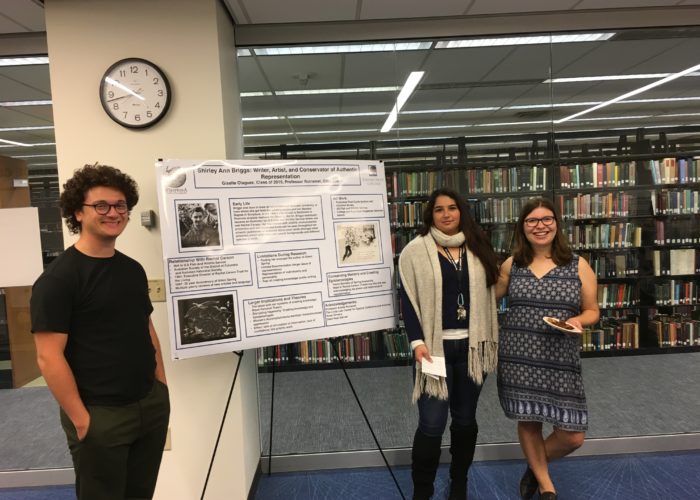
Through their research, students placed themselves into the stories told in the archives, both implicitly and explicitly. For example, Elyse Orecchio and Janice Johnson, both non–traditional-aged “returning women,”  researched the archives of the Returning Woman newsletter at Hunter and reflected on the connections they found. Janice perused the collection until she found work by a Puerto Rican woman like herself who was returning to college. Janice stated, “I was able to look and reflect on my own experience as a returning woman. I am that woman in the newsletter. I am the returning woman, the returning Hispanic woman, the returning student.” Elyse related, “I didn’t expect to get emotional when I looked through the first few issues of the newsletter. There was a lot of supportive, motivational writing that acknowledged this idea that you have a million other things going on, but you are doing this great thing for yourself.” Janice decided to create her own website that showcased her primary archival documents and video interviews with classmates—including Elyse—on the struggles of women returning to college.

The online format of the projects allowed students to write for audiences beyond the classroom and enabled explicit connections with those audiences. For example, student Haley Trunkett wrote her essay on May Levine Hartzman, a New Yorker who worked as an operating nurse during the SCW. She met her husband, Jacob Hartzman, in Spain, where he was an ambulance driver. Their son Peter provided information to Haley. Student Laura Montoya received feedback from Georgia Wever, the coordinator of the Friends and Family of the Abraham Lincoln Brigade Archives. Laura wrote about Jewish involvement in the SCW, and in particular, the story of volunteer Mark Strauss. In her comment, Georgia Wever wrote:

Dear Laura, What an interesting and inspiring story of a great person. With very little information, you manage to capture his humor and courage. I am disappointed that I never met him. I attended many reunions and banquets of the Veterans of the Abraham Lincoln Brigade at which all the veterans would stand, but I don’t recall him. I regret that you did not locate anyone who knew him because I would like to know more about his life after Spain. Perhaps someone will read this essay on our listserv and leave a reply. Thank you again for the affection you put into his story.

Students also wrote to former students and their families. For example, Carl Creighton wrote to the family of the president of the Hunter College Suffrage Clubs, who knew nothing of her suffrage activities. Elyse emailed the Hunter student who wrote the paper she found in the archives and received a response that connected the past and the present. As Deborah Mutnick (2016) explains, “Part of the archive’s appeal to my students is what Lucy Lippard refers to as the ‘lure of the local.’ Students encounter documents that reveal the history of the very streets they walk, and they gain a sense of empathy for the historical actors they study.” For our students, the people whose stories are told in the archives were more than only “historical actors,” but real people they interacted with through digital connections.

Melissa Hutton’s project in Wendy’s fall 2015 class prompted us to think of the blogs themselves as an archive. She responded to scholarship on digital writing by analyzing the writing and research practices of her peers as documented on their blogs. She concluded, “These blog posts are a perfect example of primary documents being born digitally and facilitating a place for online research.” Melissa’s work inspired revisions to the archive assignment. For example, Wendy added a requirement to link to other student blog posts on similar topics and tag the blogs with descriptors such as “World War II” for blogs discussing women’s activism during the war, thus  turning the website into a student-written and -researched history of a tradition at Hunter. In fall 2018, Wendy is approaching the archive assignment differently by having her first-year writing students read student blogs first, and then work with the same documents previous students did and develop new questions about those documents and compare different archival research processes. The blogging technology thus creates an archive of students’ research in archives, useful to future students researching in archives.

Conclusion

In the digital world, research can seem a disembodied and impersonal task for undergraduate students. We found that the physicality of archival research, far from being a burden to students, is the very thing that makes them connect with their research and their institution. Inviting a librarian into the classroom personalizes research and encourages students’ confidence in their work as they receive support to facilitate their research and present it in an appropriate format.

From a librarian’s perspective, the lessons students learn from archival research, particularly understanding the differences between primary and secondary sources and how one can provide support for the other, make them stronger researchers even when they are not researching in archives. Melissa and Iris discussed how this distinction between primary and secondary sources needs to be redefined in a digital context. For example, a student blog post may not be an authoritative source to cite, but Melissa noted the value of these blog posts to researchers in the field of library studies or composition studies: “While regarding student blog posts as secondary sources might not be wholly credible for authenticating an academic paper or constructing a historical narrative, viewing them as primary sources gives them new meaning as legitimate firsthand student accounts. … Student blog posts acquire a currency hard to find in finely-combed scholarly sources. In this case, student blog posts provide us with interpretations of rhetoric and archival research instruction.” They might be used as an archive to explore student research processes from an academic perspective or as a mode of communication between scholars. If someone were doing research on the ALB or on the struggles of women returning to college, the blogs on Narrating Memory or Rhetorical Reflections may be a useful window into those topics.

Researching CUNY students and professors through the ALBA collection and the institutional archives at Hunter placed students within a tradition of student activists as they contributed to the process of memorialization. The act of telling the story of someone unknown and becoming an intermediary of both primary and secondary internet research also meant their work was meaningful in ways that traditional research papers may not be (Keegan and McElroy 2015; Mutnick 2016). Students in our courses became active agents of generational transmission for the ALB volunteers and the history of CUNY by transmitting their life histories and shared experiences.

Our students directly benefited from the collaboration between their instructor and librarians, as well as Hunter College and the Tamiment’s commitment to making their collections available. The accessibility of archives to students, researchers, and the general reader can make them a democratic and pedagogical tool. Unfortunately, many archives are suffering from serious funding cuts and increasingly limited access. The future of archives depends on valuing historical materials and reimagining their purposes in the present. Eighty years after the SCW began, we continue to learn about the crucial role that the ALB volunteers played in the fight against fascism. Delmer Berg, the last Lincoln alive, died on February 28th, 2016. Thanks to the younger American generations who narrate their legacy, voices like Berg’s and those of former CUNY students will remain in history, and in our memory.

Notes

[1] All student work mentioned in this essay is used with permission. Students indicated that they would like their full names used to credit their work.

Bibliography

Abraham Lincoln Brigade Archives. 2018. Accessed June 10th, 2018.
http://www.alba-valb.org/resources/alba-collection.

Bass, Randy. 1997. “Introduction: Engines of Inquiry: Teaching, Technology, and Learner-centered Approaches to Culture and History.” In Engines of Inquiry: A Practical Guide for Using Technology in Teaching American Culture, edited by Randy Bass. Washington, D.C.: American Studies Crossroads Project. Accessed September 21, 2018.
https://ctl.baruch.cuny.edu/files/2013/09/Engines.pdf.

Brand, Cassie, Sarah Kendall, and Arnold Sanders. 2012. “Hands-On Research with Rare Books and Ephemera” Archive Journal 2. Accessed June 12, 2018.
http://www.archivejournal.net/essays/hands-on-research/.

Brier, Stephen. 2017. “Why the History of CUNY Matters: Using the CUNY Digital History Archive to Teach CUNY’s Past.” Radical Teacher 108: 28–35.
https://radicalteacher.library.pitt.edu/ojs/index.php/radicalteacher/article/view/357.

Cercas, Javier. 2001. Soldados de Salamina. Barcelona: Tusquets.

Devos, Dakota, et al. 2012. “Mapping the Provenance of Museum Objects” Archive Journal 2. Accessed June 12, 2018.
http://www.archivejournal.net/essays/mapping-the-provenance-of-museum-objects/.

Gaillet, Lynee Lewis. 2017. “Primary Research in the Vertical Writing Curriculum.” In Writing Pathways to Student Success, edited by Lillian Craton, Renee Love, and Sean Barnette, 109–116. Boulder: The WAC Clearing House, University Press of Colorado. Accessed on June 10, 2018.
https://wac.colostate.edu/docs/books/pathways/success.pdf#page=119.

Gaillet, Lynee Lewis, and Michelle F. Eble. 2016. Primary Research and Writing: People, Places, and Spaces. New York: Routledge.

Golia, Julie and Robin M. Katz. 2018. TeachArchives.org. Accessed June 10, 2018.
http://www.teacharchives.org/.

Greer, Jane and Laurie Grobman, eds. 2016. Pedagogies of Public Memory: Teaching Writing and Rhetoric at Museums, Archives, and Memorials. New York: Routledge.

Grobman, Laurie. 2017. “Disturbing Public Writing in Community Partnerships.” College Composition and Communication 69 (1): 35–60.

Haskins, Ekaterina. 2007. “Between Archive and Participation: Public Memory in a Digital Age.” Rhetoric Society Quarterly 37 (4): 401–422.

Hayden, Wendy. 2017. “And Gladly Teach: The Archival Turn’s Pedagogical Turn.” College English 80 (2): 133–158.

—. 2015. “‘Gifts’ of the Archives: A Pedagogy for Undergraduate Research.” College Composition and Communication 66 (3): 402–46.

Johnson, K. Vicki, and Megan Mulder. 2011. “Lights, Camera, Action! Using Archival Collections in Student Documentary Films at Wake Forest University.” Journal for the Society of North Carolina Archivists 9(1): 35–45.

Keegan, Tom, and Kelly McElroy. 2015. “Archives Alive!: Librarian–Faculty Collaboration and an Alternative to the Five-Page Paper.” In the Library with the Lead Pipe, August 26 2015. Accessed on June 7, 2018.
http://www.inthelibrarywiththeleadpipe.org/2015/archives-alive-librarian-faculty-collaboration-and-an-alternative-to-the-five-page-paper/.

Mock, Geoffrey. 2015. “Archives Alive: Students Dive into the Rubenstein.” Duke Today, August 31, 2015. Accessed June 8, 2018.
https://today.duke.edu/2015/08/archivesalive.

Molloy, Sean. 2016. A Convenient Myopia: SEEK, Shaughnessy, and the Rise of High-Stakes Testing at CUNY. PhD diss., The Graduate Center, CUNY. CUNY Academic Works. Accessed June 8, 2018.
https://academicworks.cuny.edu/gc_etds/1513.

Muñoz Molina, Antonio. 1986. Beatus Ille. Barcelona: Seix Barral.

Mutnick, Deborah. 2016. “The Appeal of the Archives: Engaging Students in More Meaningful Research.” TeachArchives.org. Accessed March 24, 2016.
http://www.teacharchives.org/articles/more-meaningful-research/.

—. 2018. “Pathways to Freedom: From the Archives to the Street.” College Composition and Communication 69 (3): 374–401.

Padgett, Esra. 2015. “Feminist Research as Journey (or, Like, Whatever?).” Young Scholars in Writing 12: 34–44. Accessed August 10, 2015.
https://arc.lib.montana.edu/ojs/index.php/Young-Scholars-In-Writing/article/view/36.

Picciano, Anthony G., and Chet Jordan. 2018. CUNY’s First Fifty Years: Triumphs and Ordeals of a People’s University. New York: Routledge.

Rivas, Manuel. 1998. El lápiz del carpintero. Madrid: Alfaguara.

Savonick, Danica B. 2018. Insurgent Knowledge: The Poetics and Pedagogy of Toni Cade Bambara, June Jordan, Audre Lorde, and Adrienne Rich in the Era of Open Admissions. PhD diss., The Graduate Center, CUNY. CUNY Academic Works. Accessed June 8, 2018.
https://academicworks.cuny.edu/gc_etds/2604.

Wells, Susan. 2009. “Claiming the Archive for Rhetoric and Composition.” The Norton Book of Composition Studies. Edited by Susan Miller, 911–918. NY: W. W. Norton & Co.

About the Authors

Wendy Hayden is Associate Professor of English at Hunter College, CUNY.

María Hernández-Ojeda is Associate Professor of Spanish at Hunter College, CUNY.

Iris Finkel is Reference and Instruction / Web Librarian at Hunter College, CUNY.

""
0

Engaging Women’s History through Collaborative Archival Wikipedia Projects

Abstract

This paper considers the potential of archivist–faculty collaboration to open and build engagement with women’s history–related collections. Collaborative digital scholarship projects built around institutional primary-source collections advance course- and discipline-specific goals and impart critical lessons about research and knowledge production to students. We share and reflect upon a dynamic Wikipedia project carried out in a feminist theory course, highlighting an accessible approach to archival research and digital methods. The project produced work that emphasized academic challenges and debates around sources of knowledge. Over two iterations of the project, students interacted with the library’s archival materials, analyzing and synthesizing this information into Wikipedia articles, and engaging in discussions of archival practice and feminist knowledge production.

We propose that Wikipedia offers a unique set of openings into women’s history for undergraduate students, providing an accessible platform with a low barrier of entry for students coming to a digital project for the first time. Wikipedia provides a compelling base for students to engage with global audiences while struggling with editorial criteria that value objectivity and notoriety. Through the collaboration between students, archivists, faculty, and Wiki Education Foundation staff, this project demonstrates the importance of a team approach to supporting students as they work through a challenging research project for a public audience.

Introduction

Wikipedia is an open access, online resource built on the creative and administrative contributions of thousands of individuals around the world. With more than 35 million articles in 280 languages, Wikipedia is a ubiquitous presence in popular culture and the classroom alike. An immediately familiar resource for students (and often the place where they begin their research), Wikipedia is increasingly recognized as an essential component of the research process, “an essential tool for getting our digital collections out to our users at the point of their information need” (Lally and Dunford 2007; cf. Head and Eisenberg 2010). The openness of the platform to anyone interested in contributing, however, has exposed some biases and deficiencies in the encyclopedia’s coverage and editing community. Wikipedia has a major gender imbalance in contributing editors—women are estimated to make up 9 to 13 percent of them (Wadewitz 2013; Bayer 2015)—and the editing community has largely minimized women’s history, with an estimated 15.5 to 17 percent of the biographical articles focusing on women (Proffitt 2018; Moravec 2018).

Feminist activists and scholars have developed a set of approaches to address the Wikipedia gender gap. In 2012, undergraduate student Emily Temple-Wood founded the WikiProject Women Scientists, which sought to ensure “the quality and coverage of biographies of women scientists.” Alongside Rosie Stephenson-Goodknight, she co-founded WikiProject Women in Red. On Wikipedia, red links mean that “the linked-to page does not exist‍.” The Women in Red project continues to create lists of links that are either about “a woman, or a work created by a woman.” These efforts garnered Temple-Wood and Stephenson-Goodknight the first co-awarded Wikipedian of the Year award. Aaron Halfaker (2017) notes how Temple-Wood’s efforts not only improved the quantity of content related to women on Wikipedia, but also the quality of entries.

Collective gatherings have shown promise for supporting new editors, as groups like Art+Feminism, AfroCROWD, Fembot, and FemTechNet have taken a “do-it-yourself and do-it-with-others” approach. Wiki edit-a-thons hosted by such groups take place in public spaces like coffee shops and museums, and at libraries ranging from New York Public Library’s Schomburg Center for Research in Black Culture to Connecticut College’s Shain Library, the site of this study (Boboltz 2017). Librarians have taken on a key role in facilitating the work of groups seeking to add content about marginalized people and issues to Wikipedia. They have sought out ways to not only support activists doing this work, but also to institutionalize engagement with Wikipedia. For example, at West Virginia University, academic librarians worked to enable students to receive required service credit hours for editing Wikipedia, drawing sorority groups and graduate students into this work (Doyle 2018, 63). Finally, as evidenced by the work of Wiki Education, classes are increasingly bringing together student learning with editing Wikipedia: in the Fall 2018 session, 321 classes participated across a wide range of academic fields.

Over three iterations, a feminist theory class and the Linda Lear Center for Special Collections & Archives at Connecticut College collaborated on an in-depth Wikipedia archival research assignment (Appendix 1) with a twofold goal: first, to address some of these Wikipedia deficiencies by creating and editing articles through a feminist scholarship lens, and second, to engage students in the process of knowledge creation for a public audience (Appendix 2). This project built upon an ongoing collaboration between faculty and archivists to develop project-based learning opportunities in institutional collections, and reflects a growing recognition of Wikipedia’s potential for generating “meaningful service learning experience[s]” for students (Davis 2018, 87). The first iteration of the course allowed students to develop topics that were far ranging, but this initial approach resulted in some issues with their engagement with Wikipedia (e.g. overly specific topics or concepts that were difficult to document). The second and third iterations of this course focused on identifying gaps in Wikipedia that could be directly tied to the Lear Center’s collections. The team reviewed course learning goals and developed a list of relevant material in the Lear Center (Appendix 3) which connected to themes in feminist theory such as women’s leadership, ecofeminism, poverty, and racial and disability justice. Students conducted research using these collections and worked to either generate or modify existing Wikipedia content. Students then summarized their experience in public presentations at the end of the semester. The resulting project represents a collaborative approach between students, faculty, and archivists, and showcases the community of shared interests and values that are fundamental to the digital humanities (Scheinfeldt 2010). This paper argues for the power and potential of this type of collaboration in developing projects that challenge students to engage in practical feminist praxis and to make connections between theory, archives, and public digital engagement.

Digital engagement with Wikipedia offers a unique set of openings into feminist theory and history for undergraduate students. Wikipedia serves as an accessible platform for students to consider questions of evidence, representation, and knowledge creation. While many use Wikipedia as the first stop for information, few understand how this information is created. The project team recognized that the platform’s ubiquity and familiarity could serve a dual purpose: first, to emphasize the importance of contributing reliable, accurate information to a site used by so many, and second, to help mitigate potential nervousness about working with digital technology in the public realm. This pedagogical approach ensures that students understand the historical and political context of Wikipedia and its community. They can draw upon their experience with this platform to ask questions and actively engage with media.

The team partnered with the Wiki Education Foundation (Wiki Ed), a non-profit entity separate from Wikipedia that supports faculty who incorporate Wikipedia into their curriculum. The program emphasizes that students “gain key 21st century skills like media literacy, writing and research development, and critical thinking, while content gaps on Wikipedia get filled thanks to [their] efforts” (Wiki Education, n.d.). Wiki Ed provides tools and resources, including interactive tutorials about the tenets of Wikipedia and basics of editing and adding content. The Wiki Ed Dashboard serves as the digital home for the class, enabling faculty to create and manage their Wikipedia assignment and to monitor student progress. For students, it contains the tutorials and relevant information for the Wikipedia assignment and allows them to track the progress on their article as well as that of their classmates. Faculty and archives staff use the dashboard to design and monitor students’ work in real time.

A key aim of the project was that students experience the process of conducting and presenting research. Much of feminist theory is based in intensive critique of research and representational practices. Students risk becoming either highly critical of all scholarship without engaging the merits of the work or fearful of creating their own work, believing that it will also be easily criticized. In this assignment, students learned to balance rigorous critique with a strong understanding of knowledge production. Editing content for a general audience on Wikipedia raised the stakes for students: the challenge of writing for the public proved more rewarding than the perceived standard of writing for only the instructor (Davis 2018, 88). The team presented Wikipedia’s overlapping gender and racial imbalance as a problem that students had the power to address as part of a broader scholar-activist community. Student feedback about the challenge and meaning of the assignment supports scholars’ arguments that structured opportunities for student interaction with institutional special collections and archives generate deeper engagement with and investment in research and its meaning (Tally and Goldenberg 2005).

Institutional Context

Connecticut College is a private, undergraduate liberal arts institution in New London, Connecticut. It offers 56 majors, minors, and certificates to approximately 1850 undergraduates. As with many liberal arts colleges, Conn’s culture is deeply rooted in teaching and learning. These efforts are supported by several campus resources and partnerships, including the Center for Teaching and Learning and the Technology Fellows Program, as well as by collaborations between faculty and staff in the six academic centers across campus, the campus’ Charles E. Shain Library, and the Linda Lear Center for Special Collections and Archives. The Lear Center is home to Connecticut College’s collections of rare books, manuscripts, and archives. The Center works extensively with faculty to develop projects which engage students in active primary source research, both in the classroom and increasingly as a part of the College’s emerging Digital Scholarship program. The Digital Scholarship program provides technological, project, and platform support for student, staff, and faculty digital projects with a focus on the pedagogical, classroom-based side of digital scholarship. The Lear Center has been involved with the College’s Digital Scholarship efforts from the start, as it sees digital scholarship as a natural extension of outreach and use activities. By combining primary source research with digital methodologies, the Lear Center offers students a unique opportunity to become active producers of knowledge, rather than passive consumers, and to convey this knowledge to a real-world audience.

Wikipedia as a Space for Feminist Praxis and Skill-Building

Gender, Sexuality, and Intersectionality Studies (GSIS) emphasizes feminist praxis, the “philosophy and practice of participatory democracy and situated knowledges” (Naples and Dobson 2001, 117). At its heart, feminist praxis is a call for hands-on engagement with core questions within the field, particularly in how each person can participate in the creation, circulation, and usage of knowledge. While feminist theory can be taught in a manner that solely focuses on theories of gender, sexuality, and other categories of analysis, the course provides an opportunity to enact a praxis-based pedagogical strategy. This approach can deepen students’ understanding of theory, asking them to apply theory to their work and consider its accuracy or limitations when put into practice.

Feminist theory presents a challenge to undergraduate students who are drawn into GSIS through varying avenues. As feminist theory is interdisciplinary, students encounter authors that may be writing from fields or on topics they have yet to study. They also may not have developed necessary reading skills or frustration tolerance (that is, the ability to navigate work that is dense, references unfamiliar ideas and academic jargon, or challenges their perspective). Scholar Gloria Anzaldúa (1991, 252) argues that “[t]heory serves those that create it” and that as a queer woman of color, she had to challenge existing theories to adequately account for her knowledge and experiences. Indeed, students may struggle to see themselves or their concerns in texts that are written in a language and for an audience far removed from themselves, or in the disproportionate amount of scholarship written by white Western cisgender women. However, Anzaldúa also reminds us that works have “doors and windows,” or entradas (1991, 257). As readers come with a need to find themselves in texts, having multiple entradas through diverse course readings and assignments creates a range of opportunities to engage with and find connections to feminist theory. It is imperative for instructors to find ways to address these concerns while ensuring that students directly work with the scholarship that undergirds the field and its contributions more broadly.

The Advanced Readings in Feminist Theory course is a required annual offering for both GSIS majors and minors (see Appendix 4 for the 2017 syllabus). This 300-level class is for some students their first undergraduate course that heavily centers theoretical work. This course draws students from a range of disciplines including English, Music, East Asian Studies, and Psychology. In the 2017 version, McCann’s and Kim’s edited collection, Feminist Theory Reader (2016), and Moraga’s and Anzaldúa’s edited collection, This Bridge Called My Back (2015), served as the core texts, along with additional readings. Key themes included theorizations of inequality, violence, and intersectional feminism along with epistemological frameworks such as standpoint theory and feminist phenomenology. The learning goals for the semester sought to ensure that students would be able to:

  • Knowledgeably discuss key forms of feminist theory in terms of their content and implications
  • Articulate the significance of feminist theories to their own research and education
  • Effectively present their research to a public audience online and in person

It was important to devise course assignments that asked students to put into practice the frameworks they were using so that they could more critically understand the stakes of feminist theory, articulate key ideas in their own words, and apply these concepts to unique projects.

The platform of Wikipedia offered a novel means to take feminist theory out of the ivory tower and illuminate the value of the course content for students. Positioned as editors, students were challenged to make meaning out of theory and archival materials for a broad audience. Working with Wikipedia made coursework relevant by making it accessible to a public at large, thus enabling to students to find a compelling reason to stay engaged throughout.

Collaboration in the Archives, Navigating Wikipedia’s Norms

Coupling the Wikipedia platform with archival research provided a set of connections and resources to facilitate the achievement of these pedagogical aims (see the Fall 2017 course dashboard). Faculty and archives staff reviewed course learning goals and core themes and identified relevant, robust topics in the collection that either had underdeveloped pages or were absent from Wikipedia. Collections were assessed to ensure each had sufficient primary and secondary material to build an entry that would meet Wikipedia’s standards. Students used primary source material such as photographs, correspondence, and reports, while drawing upon secondary sources to verify their claims and authenticate their subject’s notability, a critical standard of Wikipedia.

The practice element of feminist praxis requires skill building and serves to reinforce the content of feminist scholarship. As students worked with Wikipedia, they practiced what feminist theorist Donna Haraway describes as learning the ins and outs of knowledge production and representation. She argues that “understanding how these visual systems work, technically, socially, and physically, ought to be a way of embodying feminist objectivity” (Haraway 1988, 583). Through the process of conducting research in the archives and in secondary sources, drafting and revising content for Wikipedia, and then presenting and reflecting on this work, students were challenged to consider multiple facets of knowledge production. Moreover, they encountered those questions and challenges at the heart of feminist debates about epistemology, as they considered the perspectives included in the archival source material, their own positionality in relation to their research, and the dynamics that exist within Wikipedia vis-à-vis its standards and editing community.

Wikipedia’s policies and practices hold both potential and barriers for its usage in a feminist classroom. The formal policies are expressed most directly through the Five Pillars that address the basics of Wikipedia. While the first and third pillars state basic elements of Wikipedia (it is an encyclopedia; free content that is edited), the second, fourth, and fifth pillars present elements of Wikipedian culture. Pillar two, “Wikipedia is written from a neutral point of view,” contains the key conflicts that are perennially navigated in our feminist theory assignment and have been challenged by feminist scholars (Gauthier and Sawchuk 2017). It states:

We strive for articles in an impartial tone that document and explain major points of view, giving due weight with respect to their prominence. We avoid advocacy, and we characterize information and issues rather than debate them. In some areas there may be just one well-recognized point of view; in others, we describe multiple points of view, presenting each accurately and in context rather than as “the truth” or “the best view.” All articles must strive for verifiable accuracy, citing reliable, authoritative sources, especially when the topic is controversial or is on living persons. Editors’ personal experiences, interpretations, or opinions do not belong. (Wikipedia 2018)

In response to standpoint and situated knowledge theories, it is de rigueur in feminist theory to recognize and acknowledge one’s relationship to a topic (Collins 1986; Haraway 1988; Harding 1992). While feminist scholars range in their approach to academic tone, there is generally an acceptance of taking stances that explicitly embrace values such as antiracism and antisexism, rather than avoiding any direct acknowledgment of their interest in a subject and the stakes of inquiry (hooks 1998; Mohanty 2003). The encyclopedia form of Wikipedia thus at once provides an opportunity to build a broader audience for feminist-themed topics while disavowing the motivation that drives feminist engagement with the platform.

A critical analysis of power and the circulation of knowledge also conflicts with the assertion in the second pillar that as members of Wikipedia, “We strive for articles that document and explain major points of view, giving due weight with respect to their prominence in an impartial tone.” Michelle Moravec’s essay “The Endless Night of Wikipedia’s Notable Woman Problem” provides insight from the field of women’s history about why assumptions about prominence continue to stymie the work of feminist Wikipedians. She argues that it is important to:

consider the difference between notability and notoriety from a historical perspective. One might be well known while remaining relatively unimportant from a historical perspective. Such distinctions are collapsed in Wikipedia, assuming that a body of writing about a historical subject stands as prima facie evidence of notability. (Moravec 2018)

The presumption of prominence fails to address the ebb and flow of cultural memory, and in practice requires that women rise to a level of exceptionality to register as worthy of inclusion in Wikipedia. Moravec cites the reality that the “‘List of Pornographic Actresses’ on Wikipedia is lengthier and more actively edited than the ‘List of Female Poets.’” While arguably both lists could serve as useful sources of information, this gap highlights an editorial priority based on editors’ personal consumption practices rather than the quantity or quality of an artist’s contributions. Wikipedia itself has articles addressing the challenges of notability, and includes discussions of the two camps, deletionists and inclusionists, who struggle over either stringent adherence to the requirement or the allowance of entries that are viewed as “harmless.” The ongoing struggle over how to best balance the intention of Wikipedia to serve as a reliable source of information with the demand for increasing inclusion of diverse content, and editors who echo broader debates within feminist scholarship and our society at large, is critical for students to take on in their learning.

Screenshot of a Wikipedia article featuring poet Eli Coppola.

Figure 1. A student created a new Wikipedia entry for Eli Coppola, a poet whose work addresses disability and sexuality.

Assessment and Outcome

The project’s aims—archives staff’s desire to develop extended, class-based community engagement with library resources and collections, and the faculty member’s desire for students to participate in the collaborative process of planning, conducting, and presenting their research to a public audience—were met. The project’s design allowed students to demonstrate their learning through multiple formats (archival research, work with Wikipedia, a poster presentation, and a reflection essay), as well as to provide feedback through the reflection essay, in-class discussions, and the anonymous, end-of-semester teaching evaluation. While students at times struggled with the assignment, the project team determined that they not only gained skills related to feminist theory, metaliteracy, and critical reading, but recognized the long-term value of their work for their future careers.

Students presented their work publicly in the college library through poster presentations. Along with a final reflection essay, these components served to assist students in recognizing the level of effort that they put into this project and its significance to their understanding of feminist theory. Students’ projects were assessed on their work in the archives, the Wiki dashboard, effort and collaboration with classmates, and their poster presentation and reflection essay (Appendix 5, Appendix 6). This assessment approach emphasized students’ engagement and centered the need to connect their work with archival material and Wikipedia with course readings. The assignment set a clear expectation that students engage in feminist praxis, considering how the work they were doing in researching and creating public-facing content was informed by feminist theory and vice versa.

Course outcomes

Students’ reflection essays[1] provide insight into how they understood the work they did throughout the project and what doors opened for them. They were asked to make a unique argument about the assignment in terms of feminist theory and a core facet of the project. Students highlighted their priorities, including gaining a deeper understanding of key questions in the course content, challenging the limitations of Wikipedia, and preparing for post-graduate life. One student made explicit how the assignment addressed theoretical questions within the field:

Similar to how feminist epistemology seeks to change, redefine, and rewrite mainstream theories which exclude women’s narratives … metaliteracy “challenges traditional skills-based approaches to information literacy” [Mackey and Jacobson 2011, 62].

By putting questions of epistemology into conversation with metaliteracy, the student emphasized the ways that the assignment helped students think and act critically in their project work.

Two students’ responses to engaging with Wikipedia demonstrate the struggles they encountered and their differing attitudes to the project’s outcomes. The first student’s response centered on the importance of working in the archives. They wrote, “Through the use of primary documents and news clippings found in the archives, I was able to navigate the problematic limitations that Wikipedia exhibits.” They found that the collections provided the necessary content to ensure that they were showing notability and to avoid challenges raised by Wiki editors.

Screenshot showing the revision history for a Wikipedia article on Audre Lorde’s “Sister Outsider.” A highlighted revision from 20 December 2016 shows an editor’s challenge to the inclusion of Lorde’s self-described sexuality in the article.

Figure 2. A Wiki editor claimed that naming Audre Lorde’s “sexual preference” was offensive. Lorde was a famously self-described “black, lesbian, mother, warrior, poet” who emphasized the importance of naming herself in her writing. This editing challenge suggests a bias against public identification of LGBTQ people.

In contrast, another student was frustrated by the constraints of Wikipedia. They argued that due to Wikipedia’s neutrality standards “feminist knowledge is neither present in its full unapologetic extent, nor is it accessible to the global web users.” The student recognized the potential of Wikipedia to reach many people and was thus frustrated that the process of composing work for Wikipedia required both a tone and selection of content that did not align with either the student’s understanding of feminist knowledge or course readings that were unapologetically explicit in their political aims. While this response may be viewed as a negative outcome, it showed students’ conscious engagement with a critical question about how feminist knowledge circulates and is constrained, as well as a deeper understanding of how Wikipedia operates.

A final example of student reflection essay suggests why collaboration is key to the assignment. They observed that:

collaborating with the Wiki Education Foundation and the Linda Lear Center gave me confidence… as well as built upon my skills… being able to see the results of our work on such a public and well-known domain, shows that our work as students is valued and relevant to scholarship; we don’t have to wait to enter the professional realm to have our work recognized.

In this case, the student recognized how they were supported by archives and Wiki Ed staff as they worked toward creating a public-facing article. The student identified this assignment as opening a door into a public realm that they had previously assumed would only become available after graduation. Teaching evaluations showed that students thought about the value of the assignment. One student emphasized the role that writing for Wikipedia had in their investment in the project, noting:

The work I did on Wikipedia will be looked at by hundreds of people even after the project is done, instead of just a paper that will only be read by my professor… I was surprised [by] how much it exposed me to new and constructive ways of research.

The student found that knowing that their work would be read by a wide audience rather than simply by a professor for evaluative purposes was motivating. Moreover, the assignment introduced archival research and pushed them to delve into how what they were exploring in the archives could be put into conversation with other sources. For another student, “The Wikipedia project was difficult but it was one of the most important projects I have ever done for a class.” This student echoed a sense among many students that the assignment was higher in difficulty because of the effort required to collect, analyze, and create multiple representations of their findings. By the end of the semester, students recognized the value of learning how to create and share information with an audience beyond the walls of their institution.

Sharing this project with a broader Digital Humanities community through blog posts and conferences produced further positive outcomes. For example, Alex Ketchum, feminist food scholar, tweeted that the description of this digital project at the Women’s History in the Digital World conference in part inspired her own digital project (Ketchum 2018). Each project adds to the network of possibilities, inviting conversations and collaborations that move ideas forward and create a rich community experience.

Archives outcomes

The use of Wikipedia to develop an online presence for underrepresented archival collections offered a meaningful opportunity to generate greater access and exposure to these collections, as well as to create a valuable public-facing resource. Working with faculty and students provided an opportunity to examine collections through a feminist lens, bringing to a global audience the lives and histories of women with little public representation. Through multiple sections of the class, twenty-six entries were created on the work of women whose contributions ranged from environmental and labor activism to civic and institutional leadership. Each entry cites the Lear Center’s collections, increasing exposure of its archives and encouraging engagement on a global scale (Appendix 2).

Staff contribution at each stage of the project emphasized the power and potential of collaboration. Archives staff worked with faculty to develop course outcomes and select appropriate collections, and provided an important support system for students throughout the project. Staff engaged students in the work of primary source research, helping them think through ways of structuring their entries, find additional sources, and cite material appropriately. The intensive one-on-one work opened important avenues for conversations about the complexities of archives and archival research, the ethical issues surrounding privacy, the gaps in our collections, and the resulting archival silences.

Conclusion

The collaboration between faculty, students, archives staff, and Wiki Ed produced a successful project from both pedagogical and archival perspectives. It opened doors for students to engage deeply with feminist scholarship as they created content for Wikipedia on topics related to gender and sexuality. The topics chosen from within the archives were carefully selected to address gaps in Wikipedia. This approach led to important conversations with students about how sexist, racist, and other forms of bias are expressed in Wikipedia. As students became more confident as editors, they were able to identify and address more complex issues of bias: for example, the shortage of articles that focus on women and other underrepresented groups, the types of information certain articles emphasized, and the ways in which all that information was linked within Wikipedia. In individual meetings and in-class sessions, students discussed how these gaps are created and how their role as editors was vital in helping to fill them. Students also benefited from sharing their experiences with the Connecticut College community: they came to see themselves as knowledge-producers, educating others about the biases and gaps in Wikipedia, as well as about the potential of the platform.

This project also provided a supportive environment for students to undertake archival work. By collaborating closely with archival staff, students experienced first-hand the complexities of archival research, engaging with archivists on issues of collection development, privacy, copyright, and gaps in archival records. In addition, the project generated opportunities for discussion about what materials from these collections could be used as citable evidence in Wikipedia articles. These exchanges made working in the archives a richer experience for students and staff.

The ongoing pedagogical value of this project is clear to Connecticut College’s GSIS department. Now in its fourth iteration, under the direction of a new GSIS faculty member, the project has become a core component of the department’s approach to teaching feminist theory. This project is a flexible, extensible way for students to directly engage in feminist praxis, providing students with the opportunity to address real-world inequalities in Wikipedia and to consider how their own research is informed by feminist theory. The project has the flexibility to expand by incorporating the use of digitized collections from other institutions to explore topics and content not held in the Lear Center. This extension has exciting possibilities for students as they explore different collections and learn about the differences and similarities in using analog and digital collections. For faculty and archival staff, this project deepened an already positive working relationship and inspired further exploration of digital humanities work in other classes.

Notes

[1] Quotations in this section come from students’ reflection essays completed at the end of the Wikipedia assignment in Professor Rotramel’s courses in the fall of 2016 and 2017. Names are withheld to maintain student privacy.

Bibliography

Anzaldúa, Gloria. 1991. “To(o) Queer the Writer—Loca, escritora y chicana.” In Inversions: Writing by Dykes, Queers, and Lesbians, edited by Betsy Warland, 249–61. Vancouver: Press Gang.

Bayer, Tilman. 2015. “How many women edit Wikipedia?” WikiMedia (blog), April 30, 2015. https://blog.wikimedia.org/2015/04/30/how-many-women-edit-wikipedia/.

Boboltz, Sara. 2017. “Editors Are Trying To Fix Wikipedia’s Gender And Racial Bias Problem.” Huffington Post, December 6, 2017. https://www.huffingtonpost.com/2015/04/15/wikipedia-gender-racial-bias_n_7054550.html.

Collins, Patricia Hill. 1986. “Learning from the Outsider Within: The Sociological Significance of Black Feminist Thought.” Social Problems 33 (6): S14–S32.

Davis, Lianna L. 2018. “Wikipedia and Education: A Natural Collaboration, Supported by Libraries.” In Leveraging Wikipedia: Connecting Communities of Knowledge, edited by Merrilee Proffitt, 87–104. Chicago: American Library Association.

Doyle, Kelly. 2018. “Minding the Gaps: Engaging Academic Libraries to Address Content and User Imbalances on Wikipedia.” In Leveraging Wikipedia: Connecting Communities of Knowledge, edited by Merrilee Proffitt, 55–68. Chicago: ALA Editions.

Gauthier, Maude, and Kim Sawchuk. 2017. “Not Notable Enough: Feminism and Expertise in Wikipedia.”Communication and Critical/Cultural Studies 14 (4): 85–402.

Halfaker, Aaron. 2017. “Interpolating quality dynamics in Wikipedia and demonstrating the Keilana Effect.” Wikimedia Meta-Wiki. https://meta.wikimedia.org/wiki/Research:Interpolating_quality_dynamics_in_Wikipedia_and_demonstrating_the_Keilana_Effect

Haraway, Donna. 1988. “Situated Knowledges: The Science Question in Feminism and the Privilege of Partial Perspective.”Feminist Studies 14 (3): 575–99.

Harding, Sandra. 1992.“Rethinking Standpoint Epistemology: What is ‘Strong Objectivity?’” The Centennial Review 36 (3): 437–470.

Head, Alison J., and Michael B. Eisenberg. 2010. “Truth Be Told: How College Students Evaluate and Use Information in the Digital Age.” Project Information Literacy Progress Report. Seattle: The Information School, University of Washington.

hooks, bell. 1989. Talking Back: Thinking Feminist, Thinking Black. Cambridge, MA: South End Press.

Ketchum, Alex (@aketchum22). 2018. “Last summer, I had the pleasure to be part of Women’s History in the Digital World #WHDW17. Panelists @rlprm & @AriellaRotramel, Elizabeth Novara + Leslie Fields.” Twitter, May 24, 2018, 4:51 p.m. https://twitter.com/aketchum22/status/999754907329662976.

Lally, Ann M., and Carolyn E. Dunford. 2007. “Using Wikipedia to Extend Digital Collections.” D-Lib Magazine 13, no. 5/6, (May/June): http://www.dlib.org/dlib/may07/lally/05lally.html.

Mackey, Thomas P., and Trudi E. Jacobsen. 2011. “Reframing Information Literacy as a Metaliteracy.” College & Research Libraries 72 (1): 62–78.

McCann, Carole, and Seung-kyung Kim, eds. 2016. Feminist Theory Reader: Local and Global Perspectives. New York: Routledge Press.

Mohanty, Chandra Talpade. 2003. Feminism without Borders: Decolonizing Theory, Practicing Solidarity. Durham, NC: Duke University Press.

Moraga, Cherríe, and Gloria Anzaldúa, eds. 2015. This Bridge Called My Back. Albany, NY: SUNY Press.

Moravec, Michelle. 2018. “The Endless Night of Wikipedia’s Notable Woman Problem.” b2o: an online journal.
http://www.boundary2.org/2018/08/moravec/.

Naples, Nancy A., and Marnie Dobson. 2001. “Feminists and the Welfare State: Aboriginal Health Care Workers and U.S. Community Workers of Color.” NWSA Journal 13 (3): 116–37.

Proffitt, Merrilee. 2018. Leveraging Wikipedia: Connecting Communities of Knowledge. Chicago: ALA Editions, the American Library Association.

Scheinfeldt, Tom. 2010. “Stuff Digital Humanists Like: Defining Digital Humanities by its Values.” Found History (blog), December 2, 2010.
https://foundhistory.org/2010/12/stuff-digital-humanists-like/

Tally, Bill, and Lauren Goldenberg. 2005. “Fostering Historical Thinking with Digitized Primary Sources.” Journal of Research on Technology in Education 38 (1): 1–21.

Wadewitz, Adrianne. 2013. “Wikipedia Is Pushing the Boundaries of Scholarly Practice but the Gender Gap Must Be Addressed.” LSE Impact Blog (blog), The London School of Economics and Political Science. April 9, 2013.
http://blogs.lse.ac.uk/impactofsocialsciences/2013/04/09/change-the-world-edit-wikipedia/

Wiki Education. n.d. “About Us.” Accessed October 17, 2018.
https://wikiedu.org/about-us/.

Wikipedia. 2018. “Wikipedia: Five Pillars.” Last modified September 15, 2018.
https://en.wikipedia.org/w/index.php?title=Wikipedia:Five_pillars&oldid=859616109.

About the Author

Ariella Rotramel is the Vandana Shiva Assistant Professor of Gender, Sexuality and Intersectionality Studies at Connecticut College. Rotramel’s research and teaching interests include social movements, gender and women’s history, women and work, ethnic studies, queer and sexuality studies, community-based learning, and digital humanities and metaliteracy education.

Rebecca Parmer is the Head of Archives and Special Collections at the University of Connecticut. She has previously held positions at Connecticut College, the USS Constitution Museum, and Northeastern University. Her research interests include exploring archival pedagogy in undergraduate and graduate education and examining the impact of inquiry- and project-based engagement in college and university archives.

Rose Oliveira is the Linda Lear Special Collections Librarian at Connecticut College, where she preserves, describes, and provides access to the manuscripts, rare book, and art collections held by the college. She has previously held positions at Tufts University Digital Collections and Archives and The Arthur and Elizabeth Schlesinger Library on the History of Women in America at Harvard University. She holds a master’s degree in Library Science with a concentration in Archives Management from Simmons College in Boston.

""
0

Digital Paxton: Collaborative Construction with Eighteenth-Century Manuscript Collections

Abstract

Digital Paxton is a digital collection, scholarly edition, and, most crucially for this issue, a burgeoning teaching platform devoted to the archives of Pennsylvania’s first major pamphlet war. In this co-authored piece, Will Fenton will introduce the massacre that sparked that debate, the limitations of the existing approach, and the affordances of his digital humanities project. Following Fenton’s comments on collaboration and acknowledgement, Kate Johnson and Kelly Schmidt will provide a case study in digital humanities pedagogy, demonstrating how they used a class transcription assignment as an opportunity to improve and expand the educational offerings of Digital Paxton. Through their analyses, Fenton, Johnson, and Schmidt will show how their collaboration demonstrates the value of digital projects and transcription assignments for students’ critical thinking and media literacy.

The Paxton Massacre

In December 1763, following years of backcountry warfare, a mob of settlers in the Paxton Township—just outside what is today Harrisburg—murdered twenty unarmed Conestoga Indians along the Pennsylvania frontier. Soon after, hundreds of these “Paxton Boys” marched on Philadelphia to menace a group of Moravian Indians who had, in response to the violence, been placed under government protection. Although the confrontation was diffused through the diplomacy of Benjamin Franklin, the incident ventilated long-festering religious and ethnic grievances, pitting the colony’s German and Scots-Irish Presbyterian frontiersmen against Philadelphia’s English Quakers and their Susquehannock trading partners.

Supporters and critics of the Paxton Boys spent the next year battling in print: the resulting public debate constituted one-fifth of the Pennsylvania’s printed material in 1764 (Olson 1999, 31). Pamphlets, which were inexpensive and quick to produce, were the medium of choice—hence the debate is often called the Paxton pamphlet war. But many other printed and unprinted materials circulated simultaneously, including broadsides, political cartoons, letters, diaries, and treaty minutes. Although this debate was ostensibly about the conduct of the Paxton vigilantes, it quickly migrated to other issues facing colonial Pennsylvania, including suspicions of native others, anxieties about porous borders, a yawning divide between urban and rural populations, and the proliferation of what we might today call “fake news.”

While most researchers explore the pamphlet war through John Raine Dunbar’s scholarly edition, The Paxton Papers (1957), much of the debate cannot be found in Dunbar’s edition.[1] There are dozens of alternate editions, answers, and responses to the pamphlets identified by Dunbar, and, if one examines the originals, one uncovers engravings, artworks, and other forms of materiality that could not be examined through textual transcriptions alone. Perhaps most importantly, the current approach to the Paxton debate, which prioritizes printed materials—namely pamphlets, broadsides, and political cartoons— inadvertently reinforces colonial and cosmopolitan biases. That is, much of the Paxton debate happened outside Philadelphia printers. If researchers are to reckon with the massacre’s geographic, ethnic, and class complexities, they ought to consider manuscript collections that give voice to backcountry settlers and the indigenous peoples at the center of this tragic episode.

Digital Paxton

Digital Paxton seeks to expand awareness of and access to such heterogeneous records. The project began as a digital collection of pamphlets available through the Library Company of Philadelphia and Historical Society of Pennsylvania. As partners in the project, those institutions are responsible for digitizing at their own expense more than half of the records available in Digital Paxton. Subsequent partnerships have brought scans of contemporaneous Pennsylvania Gazette issues at the American Antiquarian Society; Friendly Association correspondence from the Haverford College Quaker and Special Collections; letters from the John Elder and Timothy Horsfield Papers at the American Philosophical Society; and congregational diaries from the Moravian Archives of Bethlehem. Each expansion has underscored that the 1764 pamphlet war included much more than pamphlets.[2]

As important as the diversity of materials is the structure of the collection. The design of online publishing platform Scalar encourages researchers to draw connections between and across collections. Specifically, Scalar’s flat ontology enables all objects (images, transcriptions, sequences of images) to occupy the same hierarchy: no object is more of a subject than another object. In practical terms, this means that researchers encounter Governor Penn’s letters in the same pathway as they do letters between Quaker leaders and native partners, accounts of diplomatic conferences, and the writings of Wyalusing leaders. At a technical level, then, the platform supports the philosophical goals articulated by the editors of the Yale Indian Papers Project: the digital collection as a common pot, a “shared history, a kind of communal liminal space, neither solely Euro-American nor completely Native” (Grant-Costa, Glaza, and Sletcher 2012, 2). This is the allure of the digital edition: when thoughtfully structured, digital editions better accommodate a constellation of material forms, voices, and perspectives than traditional print editions.

Although Digital Paxton is foremost a digital collection, the project includes a scholarly apparatus similar to Dunbar’s Paxton Papers. However, whereas Dunbar’s introduction is singular and possesses the patina of definitiveness, this project is multi-authored, interdisciplinary, and less didactic. Practically speaking, each of the project’s twelve historical overviews, lesson plans, and conceptual keyword essays serve as freestanding entry points to the digital collection. That is, if a history student were interested in Conestoga Indiantown, she might choose to read Darvin Martin’s essay, “A History of Conestoga Indiantown,” use its links to explore the digital collection, and perform additional research using the various linked resources listed below further reading. Or, if a literature student wanted to think more carefully about what “elites” meant in the eighteenth-century, she might begin with Scott Paul Gordon’s essay, “Elites.”

Students may use the project’s introduction or interpretative pathways to traverse the project; however, rather than promoting a singular, definitive approach to the massacre and pamphlet war, Digital Paxton embraces what Adele Perry (2005) and others have called polyvocality. By layering materials and contexts, each is made less definitive, more partial, contingent, and subject to scrutiny. This approach guards against rote thinking: the Paxton massacre is a story of genocidal violence and indigenous dispossession, but it is also a story of identity politics, self-governance, resistance, and active peace-making.

As Chimamanda Ngozi Adichie argued in a famous TED talk, narrative multiplicity acknowledges the complexity and dignity of human experience. “Stories matter. Many stories matter. Stories have been used to dispossess and to malign, but stories can also be used to empower and to humanize. Stories can break the dignity of a people, but stories can also repair that broken dignity,” explained Adichie. “[W]hen we reject the single story, when we realize that there is never a single story about any place, we regain a kind of paradise” (Adichie 2009). While regaining paradise is well beyond the scope of this project, grappling with the complexities, erasures, and ambiguities of historical memory falls within its purview, thanks to the generous contributions of scholarly and archival collaborators.

Collaboration and Acknowledgement

Given that Digital Paxton is very much a bootstrap operation—cobbled together without any significant external funding—recognition of labor is the least that can be offered collaborators. To this point, the first two points of the “Collaborators’ Bill of Rights” have informed the project’s approach to collaboration and acknowledgement:

1) All kinds of work on a project are equally deserving of credit (though the amount of work and expression of credit may differ). And all collaborators should be empowered to take credit for their work.

2a) Descriptive Papers & Project reports: Anyone who collaborated on the project should be listed as author in a fair ordering based on emerging community conventions.

2b) Websites: There should be a prominent ‘credits’ link on the main page with primary investigators (PIs) or project leads listed first. This should include current staff as well as past staff with their dates of employment (Clement, Croxall, et al. 2011).

Digital Paxton is the fruition—however nascent—of contributions from dozens of archivists, curators, scholars, and technologists, whose labor is subsidized by archives, cultural institutions, research libraries, and universities. Although this project was sparked by personal research interests, little would be available today without the resources, labor, and expertise of those individuals and institutions. Acknowledgement, on the project’s Credits page and in the publications and talks, is one form of (admittedly paltry) recompense.

Collaborators take many forms, and there is perhaps no cohort more vital to this project’s future—and that of the humanities more broadly—than that of student-collaborators. This project embraces Mark Sample’s notion of “collaborative construction,” through which students produce new knowledge in concert with one another, their professor, and the project, broadly conceived. “A key point of collaborative construction is that the students are not merely making something for themselves or their professor,” explains Sample. “They are making it for each other, and in the best scenarios, for the outside world” (Sample 2011).

The second half of this article seeks to put this philosophy into practice using a case study. In the spring 2017, two faculty members, Benjamin Bankhurst (Shepherd University) and Kyle Roberts (Loyola University Chicago), who were co-teaching an undergraduate history course, “Digitizing the American Revolution,” sought to introduce students to digital humanities tools and methods. They opted to create an assignment through which students would learn to transcribe eighteenth-century letters using scanned manuscript materials from Digital Paxton. Each student was responsible for transcribing a page of manuscript. After Bankhurst or Roberts vetted students’ work, transcriptions were loaded into Digital Paxton, with a credit to each student-transcriber.[3]

The project was successful on several accounts. First, it expanded the number of transcribed (and searchable) resources in Digital Paxton. Second, it required teaching materials that can be repurposed in future transcription assignments. And third, it attracted a new community of researchers to the site. This interest is certainly measurable in the students who participated in the assignment, many of whom now regularly share Digital Paxton updates on social media platforms. Perhaps most importantly, Roberts’s graduate students—Kate Johnson, Marie Pellissier, and Kelly Schmidt—took ownership of the project in ways that made it both more effective and more scalable. Using their experience within the classroom and reviews of transcription pedagogy best practices, they offered recommendations on how to modify the Digital Paxton site to facilitate easier transcription, created documents guiding students through some of the hurdles in the transcription process, and offered feedback on improving the exercise as a classroom assignment. Johnson and Schmidt will now describe their experience with the transcription project, and the challenges and opportunities it provided.

A Case Study in Digital Pedagogy

As members of Roberts’s class, we were asked to transcribe a page from Digital Paxton’s digital collection. We enjoyed the process of learning how to identify and transcribe unfamiliar eighteenth-century characters consistently, as well as the sense that we were contributing to a larger project of significant historical value to scholars and the general public. However, along with our undergraduate classmates, we encountered challenges as we struggled to interpret the manuscripts. We felt that we could help expand the project by creating a guide for people planning to transcribe individually or in a crowdsourced or classroom setting.

The assignment began with an introduction to Digital Paxton from its creator, Will Fenton (via Skype). As a class we explored the site together and received a contextual overview of the Paxton pamphlet war. The contextual information helped us better understand the significance of our assignment in relation both to our course and to the work of historians more broadly. Moreover, the personal touch of talking to the website’s creator cultivated greater interest in the project.

The directions for the assignment were simple: transcribe one page assigned from the Friendly Association manuscripts (Haverford College Quaker and Special Collections) and write a three-paragraph essay about what the page contained, whose voice it was written in, and who it excluded, and how it felt to participate in this transcription process as a historian. Students did not use any transcription aids. We each viewed the manuscript page in a web browser (or printed it out), then typed transcriptions using a word processor. However, these seemingly simple directions proved more complicated to students who were uncertain how to format their transcription consistently or account for peculiar eighteenth-century abbreviations. Some students opted to peer-review one another’s assignments before turning them in, which helped improve consistency and their understanding of the materials with which they were working.

For some students, the public nature of the transcription increased their commitment to the assignment. In her essay on “Teaching the Digital Caribbean,” Kelly Baker Josephs discusses how adding the public as an audience for coursework creates a “performance” aspect that changes the course experience (Josephs 2018). We saw this with our class, as several students put more time and effort into the assignment, such as peer reviewing each others transcriptions, expressly because it would be shared publicly on a website.

Student Responses

Each student turned in a short essay detailing the content of their transcription, its biases, and their experience transcribing it. In addition, we had a class discussion on the greatest challenges in transcribing and practices that might improve the transcription process and make the final product more useful. One student, who described working with the source as both “tedious and exciting,” encapsulated the gist of most anonymous student responses to the assignment.[4] The most frequent obstacles identified were difficulty reading the handwriting, deciphering inconsistent capitalization and spelling, differentiating between vowels as well as lowercase “L’s” and “F’s,” and unfamiliarity with the long “S.” While the scans were clear, some students had trouble reading their assigned text because authors often used both sides of the page, the ink bleeding through from one side to the other. One student suggested that reading the text and then rereading it before transcribing made it easier to understand the content. Others said that they needed more knowledge not only of paleography and period syntax, but also context about the history of the time period, region, and specific event in which these papers were situated. Without such broader knowledge, students sometimes struggled to transcribe local place names, like “Minisinks,” and the names of subjects in the documents, especially Native Americans, such as “Scarroyada.”

Nevertheless, many of the same students who struggled to decipher the eighteenth-century English and handwriting still expressed an appreciation for, and a better understanding of, the work of historians. One student wrote, “I’m quite honored and impressed that I had the opportunity to participate in the understanding and detailing of history, especially in the turn of the Revolution.” Several others professed a “newfound respect for historians” and claimed that they felt like they were “doing the work of a real historian.”

Most of the students were not history majors, and for many, this was the first time they had engaged with primary sources. Most of their previous coursework in history had focused on secondary source readings about big ideas and events, which students assessed through essay-writing assignments. One respondent noted that, “working with primary sources feels much more immersive and enlightening, in terms of being able to see a glimpse of what their life was like and the issues they dealt with in their time.”

While the process of transcribing manuscripts was monotonous, students said that work with handwritten letters changed the way they engaged with materials. One student said, “It felt good to work with a primary source such as this letter, and be able to see the firsthand view of the writer and a glimpse of their world.” Several students also welcomed access to Native American voices, who are often silenced in settlement narratives. This recognition encouraged them to grapple with the possibility that some of these documents may not have been telling the whole truth about the event. One student even mused that soon historians might have to decipher audio sources rather than interpret handwriting.

These student responses align with pedagogical scholarship. Notably, William Kashatus posits that close analysis of primary sources gives students a more personal understanding of history. Because primary sources can “evoke emotional responses,” students are better able to “identify with the human factor in history, including the risks, frailties, courage, and contradictions of those who shaped the past” (2002, 7). According to Kashatus, students are better able to recognize the biases in historical records and assess their own contemporary biases, and those of modern-day media, when they have engaged with close-readings of historical sources in the classroom (2002, 7–8). Student feedback from our classroom assignment reflects that students felt they gained a sense of intimacy with historical writers. Avishag Reisman and Sam Wineburg, writing about the new common core standards, have argued that working with primary source materials challenges students to think carefully about what does and does not count as evidence. Reisman and Wineburg argue that primary source materials compel students to “interrogate the reliability and truth claims” rather than to simply “cull” evidence (2012, 25-26). Through transcription work, students must read the text word-for-word, compelling them to think more critically about what is being expressed and not to take a document’s message at face value.

Gathering Survey Data

Although the students’ comments were helpful, we realized we needed more feedback before we pursued any future crowdsourced transcription projects. To that end, we administered an anonymous one-page survey to the participants of a transcribe-a-thon event at Loyola organized by the Center for Textual Studies and Digital Humanities in conjunction with a nationwide event. Approximately 70 students, staff, and faculty attended, 43 of whom elected to complete the survey. Additionally, we administered the survey to 21 students enrolled in a 100-level “Interpreting Literature” class. For the transcribe-a-thon, participants used a subscription-based transcription program called FromThePage.

The survey consisted of nine total questions, with six multiple choice and three open-ended questions. Questions solicited feedback on the ease of participants’ use of the transcription program and the experience of transcribing itself. Two questions asked about the participants’ perceived value of the experience of transcribing. At the end, participants were asked to provide an email if interested in future transcription projects. The anonymous survey results highlighted what elements of transcription work most engaged participants and what challenges or barriers thwarted their participation. Thus, the survey offered concrete data to support ideas that emerged from student feedback in the Loyola/Shepherd assignment. From these conclusions we gained insights into what would make a successful transcription project for interacting with digitized early American documents, and those insights informed the guides we created for Digital Paxton.

One key difference was experiential: students preferred the communal work of a transcribe-a-thon to the solitary work of a for-credit assignment. While the majority of both sets of students said that they found the experience valuable, more transcribe-a-thon participants recorded satisfaction. Additionally, a much higher percentage of transcribe-a-thon participants expressed interest in future transcription projects (82% of event participants compared to 38% of classroom participants).

We evaluated these discrepancies using responses to the open-ended questions, which included a question about what was the most valuable part of the experience. The classroom included some but not all of the additional contextualizing elements that were included in the event, such as the talks and recitations of historical speeches and songs. These elements, combined with the celebratory atmosphere of the event (held as a birthday celebration for Frederick Douglass), helped to affirm the sense that participants were both learning and contributing to a living project. The survey results and our experience with the transcribe-a-thon show us that transcription projects not only get students working with primary materials, contributing to scholarly work, and learning to use digital tools, but they also inspire students to participate in future projects.

Translating Feedback into Practice

Student feedback and survey responses provided some clear takeaways for Digital Paxton. Although incorporating a transcription project into a class’s curriculum and awarding class credit and public access incentivized students’ contributions, assignments needed to be structured to foreground both historical and logistical context for transcriptions. Additionally, assignments needed to emphasize the importance of student transcriptions to the long-term goals of the project. When we began contributing transcriptions to Digital Paxton, the project did not have guidelines for transcriptions or a built-in transcription platform.

We developed a “Transcription Best Practices” guide for Digital Paxton, now available in both the Transcription and Pedagogy sections of the site for educators who want to introduce similar assignments in their classrooms. In it, we attempted to anticipate contextual questions that might arise during an assignment. We used the feedback from the Loyola/Shepherd assignment to pinpoint the most important contextual clues needed. We included images of eighteenth century writing conventions, such as the elongated “s” and the shortening of common words like “which” to “w/ch.”By equipping potential transcribers with the materials they need to understand the papers in their historical and cultural context—the guidelines, site introduction, and historical overviews—we met a need expressed in our survey results.

Digital Paxton’s overview of the conflict provides contexts for an event with which students are only vaguely familiar, but it does not necessarily supply students with definitive answers. Students build intimacy with the text by describing it, having to assess as they go along the choice of language and style used. Writing out the text seemed to improve students’ reading comprehension. By adding transcription guidelines, we further sought to help students avoid getting bogged down by the complication of language or handwriting. In their response essays, students use the text they transcribed as “evidence” about where the author stood ideologically within the conflict and how the conflict unfolded. As one student described, the source was a piece to their understanding of the larger puzzle.

Selecting a platform and developing a process through which future cohorts could contribute to the project were more complicated. After all, our approach—toggling between a web browser and word processor—would not work well for larger classes or transcription projects. We had three key stipulations for a prospective transcription platform: it had to be easily accessible to and usable for transcribers, well-supported, and interoperable with Scalar. We identified two platforms that met most of our requirements: Scripto and FromThePage. Both enabled users to record transcriptions alongside scanned pages, a priority, for students in the “Digitizing the Revolution” course. Scripto offered a free, open-source transcription tool, but it was not being fully supported by the developers, and we did not know if it would continue to be supported in the future. Moreover, Scripto required scanned pages to be migrated from Scalar to Omeka. We selected FromThePage because it was well-supported, did not require an Omeka installation, and Fenton could use his university library’s subscription (Fordham University).

On a logistical side, the survey responses also helped us understand the barriers to using online transcription tools. The most prevalent issue was readability of the scanned text, followed by challenges navigating the transcription platform. While there are limitations to how much can be done to address manuscript readability, especially when it comes to eighteenth-century manuscript material, we took the latter concern into account when we created “Using FromThePage.” In that documentation we sought to create clear, concise instructions on how to use FromThePage in conjunction with Digital Paxton. This effort included screenshots illustrating how to register as a user and how to locate pages available for transcribing, a key issue for participants at the transcribe-a-thon. By anticipating user experience issues, we hope to enable students to lose themselves in the rich texts and contexts on Digital Paxton, rather than spend valuable time and energy troubleshooting the mechanics of the process.

Future Collaborations

While our experiment in student manuscript transcription was not without its limitations, the process of pursuing student involvement and recording student feedback have made Digital Paxton a more effective teaching tool. Thanks to the labors of Kate Johnson, Kelly Schmidt, and Marie Pellissier, the project now includes best practices for transcribing eighteenth-century manuscripts (Transcription Best Practices), an assignment for integrating a similar exercise into a university classroom (Transcription Assignment), and a platform through which any educator may bring Friendly Association manuscripts into her classroom (Transcriptions).

From our research and practical experience, we have found that transcription of primary sources encourages students to read texts more closely, to view writers as human beings (rather than detached historical figures), to confront archival gaps, silences, and erasures, and to view their work as contributory to a collaborative project. In her recent post at the National Archives, Meredith Doviak wrote that with increased digital access to collections, students now have more opportunity to become “active critics and curators of those literary productions rather than mere explicators of them” (2017). Transcription projects can serve as vehicles through which students act as participants in knowledge creation, honing valuable critical thinking skills and a historically-informed sense of media literacy that will serve them well inside and outside the classroom.

Notes

[1] Nearly every study of the Paxton crisis cites Dunbar’s 60-year-old edition, and for good reason: it collects 28 noteworthy pamphlets and provides a useful introduction to the debate. Time has, however, revealed the edition’s limitations, foremost, its narrow selection of materials. Alison Gilbert Olson (1999) has since identified at least 63 pamphlets and 10 cartoons, and the distinction between pamphlets and political cartoons is itself ambiguous, given that many cartoons were nested inside of pamphlets, many of which circulated in multiple editions.
[2] Students can surface new perspectives from indigenous peoples and backcountry settlers by attending to a diverse set of records, all of which are available as open-access, print-quality images. Today, the project features more than 2,500 images, including 16 artworks, three books, 17 broadsides, 128 manuscripts, 26 newspaper and periodical issues, 69 pamphlets, and nine political cartoons, many of which have never before been digitized.
[3] For example, visitors will find a credit to Emina Hadzic at the bottom of her transcription of “Various Memoranda” (http://digitalpaxton.org/works/digital-paxton/various-memoranda-1760—1-1). She was also acknowledged (and tagged) in social media posts on Facebook, Twitter, and Instagram.
[4] Quotations in this section come from anonymous student answers to a course survey and are reproduced with names withheld by mutual agreement. “Explore Common Sense Survey,” administered by Kate Johnson, Marie Pellissier, and Kelly Schmidt. February 1, 2018.

Bibliography

Adichie, Chimamanda Ngozi. 2009. “The Danger of a Single Story.” Filmed July 2009 at TED Global. TED video, 18:43.
https://www.ted.com/talks/chimamanda_adichie_the_danger_of_a_single_story/transcript.

Clement, Tanya, Brian Croxall, et al. 2011. “Collaborators’ Bill of Rights.” Off the Tracks: Laying New Lines for Digital Humanities Scholars. Media Commons Press.
http://mcpress.media-commons.org/offthetracks/part-one-models-for-collaboration-career-paths-acquiring-institutional-support-and-transformation-in-the-field/a-collaboration/collaborators’-bill-of-rights.

Doviak, Meredith. 2017. “Teaching from the Archives.” Education Updates(blog). National Archives. February 9, 2017.
https://education.blogs.archives.gov/2017/02/09/teaching-from-archives/.

Grant-Costa, Paul and Tobias Glaza, and Michael Sletcher. 2012. “The Common Pot: Editing Native American Materials.” Scholarly Editing: The Annual of the Association for Documentary Editing 33: 1–17.
http://scholarlyediting.org/2012/pdf/essay.commonpot.pdf.

Josephs, Kelly Baker. 2018. “Teaching the Digital Caribbean: The Ethics of a Public Pedagogical Experiment.” The Journal of Interactive Technology & Pedagogy 13.
https://jitp.commons.gc.cuny.edu/teaching-the-digital-caribbean-the-ethics-of-a-public-pedagogical-experiment/.

Kashatus, William C. 2002. Past, Present & Personal: Teaching Writing in U.S. History. Portsmouth: Heinemann Educational Books.

Olson, Alison Gilbert. 1999. “The Pamphlet War over the Paxton Boys.” The Pennsylvania Magazine of History and Biography 123, no. 1/2: 31–55. http://www.jstor.org/stable/20093260.

Perry, Adele. 2005. “The Colonial Archive on Trial: Possession, Dispossession, and History in Delgamuukw v. British Columbia.” Archive Stories: Facts, Fictions, and the Writing of History: 325–50. https://doi.org/10.1215/9780822387046-015.

Reisman, Avishag, and Sam Wineburg. 2012. “Text complexity in the history classroom: Teaching to and beyond the common core.” Social Studies Review 51, no. 1: 24–29.

Sample, Mark. 2011. “Building and Sharing (When You’re Supposed to Be Teaching).” Journal of Digital Humanities 1, no. 1 (Winter).
http://journalofdigitalhumanities.org/1-1/building-and-sharing-when-youre-supposed-to-be-teaching-by-mark-sample.

About the Authors

Will Fenton is the Director of Scholarly Innovation at the Library Company of Philadelphia, the Creative Director of Redrawing History: Indigenous Perspectives on Colonial America, funded by The Pew Center for Arts and Heritage, and the founder and editor of Digital Paxton. Will earned his Ph.D. at Fordham University, where he specialized in early American literature and the digital humanities. He is the recipient of prestigious fellowships from the American Philosophical Society; Haverford College Quaker and Special Collections; the Humanities, Arts, Science, and Technology Alliance and Collaboratory; the Library Company of Philadelphia; the Modern Language Association; and the Omohundro Institute of Early American History & Culture. His writings have appeared in American QuarterlyCommon-Place, and ESQ and in numerous public platforms, including Inside Higher Ed, Slate, and PC Magazine.

Kelly Schmidt, co-creator of ExploreCommonSense.comis Research Coordinator for the Slavery, History, Memory, and Reconciliation Project, co-sponsored by Saint Louis University and the Jesuits of the Central and Southern United States. She is a PhD candidate at Loyola University Chicago, where her research focuses on slavery, race, and abolition. Kelly has pursued her interests in museum work, public history, and digital humanities at several institutions, including the Heritage Village Museum, Cincinnati Museum Center, National Underground Railroad Freedom Center, Auschwitz-Birkenau State Museum, and the Colonial Williamsburg Foundation.

Kate Johnson is an archival assistant at the University of Northern Colorado’s Archives and Special Collections. She earned her M.A. in Public History from Loyola University Chicago, and her B.A. in History and German from the University of Northern Colorado. Her research interests are in women’s history, cultural history, and early America. She has worked in museums and public history institutions for over ten years, including holding positions at the Thomas Jefferson’s Monticello, The Women and Leadership Archives, and the Frances Willard House Museum. She is a co-creator of the site, ExploreCommonSense.com and also currently serves as an appointed member of the National Council on Public History’s Digital Media Group.

Calendar marked with four students’ journal posting dates, with each student color-coded to represent one of the four pacing quality categories: Excellent, Good, Fair, Poor
0

Practicing Digital Literacy in the Liberal Arts: A Qualitative Analysis of Students’ Online Research Journals

Abstract

How can we use digital technologies and pedagogies to foster students’ development as digitally literate researchers? We examine an undergraduate course on new information technologies for which we developed a research journal assignment aimed to develop students’ digital literacies. We conducted a qualitative analysis of students’ research journals as they investigated global internet censorship. Our study contributes to growing interest in digital literacies and how to shape learning opportunities to promote students’ identities as digitally literate researchers and citizens.

Introduction

Information pollution, information overload, and infoglut are some of the most common terms used to describe the “almost infinite abundance” and “surging volume” of information that “floods” and “swamps” us daily (Hemp 2009). Popular media articles appear regularly offering tips and strategies to “cope with,” “conquer,” and even “recover” from information overload (e.g., Harness 2015; Shin 2014; Tattersall 2015). Information Fatigue Syndrome, a term coined in 1996, refers to the stress and exhaustion caused by a constant bombardment of data (Vulliamy 1996). In Data Smog: Surviving the Information Glut, David Shenk (1997) argues that the surplus of information doesn’t enhance our lives, but instead undermines and overwhelms us to the point of anxiety and indecision. According to research conducted by Project Information Literacy researchers, “it turns out that students are poorly trained in college to effectively navigate the internet’s indiscriminate glut of information” (Head and Wihbey 2014, para. 7).

The study presented here emerged from “New Information Technologies,” an undergraduate course in the media and communication department at a small, private, liberal arts college in the northeast United States. The course introduced students to key concepts and tools for thinking critically about new information technology and what it means to live in a digital, global society. Course goals underscored the importance of developing students’ capacities as digitally literate learners and citizens of a global network society. We intentionally articulated course learning goals around both the content area and the practices of digital literacy embedded in course assignments. We asked students to reflectively discover, organize, analyze, create, and share information using digital tools. Our aim was to empower students with the tools and abilities to thrive in the information ecosystem as both consumers and producers, rather than flounder in information overload. We wanted students to experience research as active agents driving the process through their choices and attitudes. With these broad framing objectives in mind, we developed a multiphase research assignment called the Internet Censorship Project.

In this article, we detail our collaborative development of the Internet Censorship Project assignment and discuss a qualitative analysis of the resulting student work. In our analysis, we focus in particular on students’ engagement in and reflection on the research process and their agency and identity therein. Our close look at the assignment and student learning offers an opportunity to consider the possibilities of integrating digital tools and pedagogies to deepen students’ digital literacy in the context of liberal arts education.

Collaborating for digital literacy

This course provided ideal opportunities for collaboration between an information literacy librarian and a media and communication professor with shared interests in digital literacy. Our respective disciplines have a common concern for digital literacy, although we often describe and approach the concept in distinct ways. The library and information science field typically uses the term “information literacy,” while media and communication studies uses “media literacy.” The Association of College and Research Libraries (2016) defines information literacy as “the set of integrated abilities encompassing the reflective discovery of information, the understanding of how information is produced and valued, and the use of information in creating new knowledge and participating ethically in communities of learning” (3). Media literacy, as defined by the National Association for Media Literacy Education (2017), is “the ability to access, analyze, evaluate, create and act using all forms of communication. In its simplest terms, media literacy builds upon the foundation of traditional literacy and offers new forms of reading and writing. Media literacy empowers people to be critical thinkers and makers, effective communicators and active citizens.” We find common ground in these definitions and the values they convey, especially in the degree to which both disciplines prioritize critical thinking about and active engagement with information. In this paper, we invoke a shared definition of digital literacy, referring to the practices, abilities, and identities around the uses and production of information in digital forms.[1]

Our respective understandings of digital literacy have evolved through extensive and ongoing collaboration with each other and with students. Our disciplines both recognize that definitions of literacies are shifting in the digital environment. One premise of our work is that digital technologies afford new possibilities for collaboration across disciplines and fields. We believe that digital teaching and learning benefit from, if not require, connecting diverse ways of knowing. Digital learning emphasizes connectivity and so we have designed our teaching approach to model the same.

What matters most here is how these definitions come to bear on framing student learning outcomes in this course and assignment. There were no digital literacy learning outcomes explicitly embedded within the course syllabus prior to this collaboration. Discussions about how and where to integrate digital literacy goals within existing course assignments gave rise to our collaboration. These discussions revealed that while the course aimed to promote critical thinking and analysis of the so-called information age, it did little to intentionally link theory to critical practice in ways that highlighted development of students’ digital literacy habits and abilities. The library’s statement on information literacy, inspired at the time of its creation by an earlier iteration of the Association of College and Research Libraries information literacy definition, offered a welcome starting point and with very little modification was introduced as a course goal (Trexler Library, Muhlenberg College 2010). Among course objectives, the syllabus newly included this statement: “students in this course will have opportunities to develop capacities as information literate learners who can discover, organize, analyze, create and share information.”

Assignment design and instructional approaches

The Internet Censorship Project required students working in pairs or small groups to investigate the state of internet censorship and surveillance in different countries. The project extended across four weeks in the latter half of the semester. Students shared their research findings in culminating in-class presentations. The entire process was designed to encourage students to link their critical theoretical understanding with digital literacy practices. We purposefully integrated digital tools and pedagogies throughout the assignment to help students move beyond only amassing and describing sources to higher order research activities and more advanced digital literacy behaviors and attitudes.

Our first implementation of this assignment in fall 2013 revealed some of the general challenges of asking students to critically engage with information. Students tended to gather large amounts of information and dump it into their work without clear purpose or analysis. Ultimately, this resulted in lackluster project presentations in which students’ facility with the mode of digital presentation (Prezi) was often more impressive than the story being shared. These issues are not unique to this assignment, course, or campus. Many educators have likely seen evidence of students’ struggles with “information dump.” Information dump demonstrates students have collected relevant data, but they are unable to present it logically or think about it critically and analytically. This challenge relates to larger issues with helping students develop and strengthen their research habits and abilities. There is often a wide gap between where students begin and where we want them to arrive with respect to information gathering, evaluation, analysis, and synthesis. They often do not successfully make the leap from one ledge to the other (Head 2013; Head and Eisenberg 2010). Frequently what seems to be missing is students’ engagement with research as a process and their critical reflection on that process.

Among the many personal benefits students gain from research, they “learn tolerance for obstacles faced in the research process, how knowledge is constructed, independence, increased self-confidence, and a readiness for more demanding research” (Lopatto 2010). Participating in the research process also promotes students’ cognitive development, supporting their transition from novice to expert learners. Undergraduate research encourages students to exercise critical judgment and to make meaning of what they are learning. Such experiences help students construct a sense of themselves as researchers, gaining a sense of agency and ownership of the research process. If today’s students are “at sea in a deluge of data” (Head and Wihbey 2014), carefully crafted research assignments can help them acquire the skills and awareness that serve as life rafts and anchors.

This kind of work presents opportunities to promote students’ metacognition, or awareness of and reflection on their thinking and learning (Livingston 1997). A metacognitive mindset can help students identify their research as a process in which they are located and over which they have agency. “Successfully developing a research plan, following it, and adapting to the challenges research presents require reflection on the part of the student about his or her own learning” (Carleton College 2010, para. 5). By reflecting on their steps and thinking, students can perhaps more easily recognize their choices and beliefs, enhance their ability to plan for and guide their learning, as well as adapt in the face of future challenges or new situations (Lovett 2008). “Seeing oneself as capable of making the crossing to a better understanding can be empowering and even exhilarating….The ability to manage transitional states might be, then, a transferrable learning experience, one that involves increasing self-knowledge and confidence” (Fister 2015, 6).

Close review of Internet Censorship Project student learning outcomes in 2013 informed our revisions to the assignment in fall 2014. (See Appendix A for the assignment.) We strengthened the assignment by gearing it more toward process and reflection. Our goal was to better support students as they worked to bridge the gap, from start to finish, in their research knowledge and abilities. This time around, we emphasized steps within the research process and prioritized the development of critical and reflective thinking about information. We did this by redesigning the project phases and intentionally using carefully selected digital tools.

In the first phase, student partners collaborated to select and organize research sources about internet censorship and surveillance in their selected countries. They used a collaborative, cloud-based word processing application (Google Docs) to gather and share information with each other as they discovered it, working both synchronously and asynchronously. Documents started as running lists of sources with links to original content, but were to evolve into meaningfully and logically organized and annotated texts that demonstrated critical thinking about sources. In fall 2014, we dedicated more in-class time modeling for students how documents might evolve beyond mere lists into collaborative space for organizing, summarizing, assessing, and interrogating information.

We also integrated a crucial new element, a photo journal created in WordPress, into the assignment as a metacognitive bridge to support students’ development from information gathering to presentation. We selected WordPress for this activity for a number of reasons. On a practical level, we have a campus installation of WordPress and strong technology support for it. WordPress is easily customizable, extendable, and enables students to work with the various media types we sought to promote with the assignment. Just as importantly, using WordPress aligned with one of the underlying goals of the course to deepen students’ critical reflection of their own digital presence. We wanted them to gain experience working in a widely-adopted open source environment—approximately 25% of all websites that use a content management system run on WordPress (Lanaria 2015)—so that they might compare this platform to their experiences within commercial social media platforms. Overall, WordPress enabled us to provide students with hands-on experience as information producers that developed digital literacy practices that could serve them well beyond this assignment and course.

The photo journal transformed the assignment in important ways and is the focus of our case study. We described its purpose to students in the following way:

The journal is your individual representation of the process as you experience and construct it. The Photo Journal is created in WordPress and includes photos, images, drawings, screenshots, and narrative text and captions that take the viewer behind the scenes of your research process. Think of this as “the making of” your project, uncovering the questions and thinking behind your project, and documents the “what, why, where, and how” of the research you are producing.

Students were required to create a minimum of 10 posts, the first of which asked students to reflect on their ideal research environment. The final post invited students to contemplate their presentation and completion of the project. In between, the remaining eight journal entries were designed to document and reflect on students’ research experiences. We provided optional prompts to kickstart their posts, including the following:

  • What do you know about the topic? What do you want to know?
  • Why does this source matter?
  • How did you get started?
  • What led you to this source?
  • What questions does the source raise for you?
  • How does the source contribute to other knowledge?
  • What do you know now? What have you learned?

We constructed the photo journal element to activate for students an attitude of critical engagement and a more reflective, metacognitive mindset (Fluk 2015). In documenting their research processes, the photo journal was intended to surface students’ thinking for both themselves and us as instructors. We wanted to promote their reflection on steps in the research process and, therefore, change and deepen that process. By modeling and scaffolding these behaviors and attitudes through the phases of the assignment, we hoped to move students progressively toward stronger engagement and understanding. Rather than drowning in information overload, we hoped to develop students’ sense of agency to be able to comprehend, communicate about, make meaning of, and reflect on their information consumption and production. By asking students to include images as representations of their research, we further hoped to make the research more visible as a process.

Through our qualitative analysis of students’ photo journals in this case study, we attempt to better understand both the connections students make, as well as where they need help to bridge the gaps in their learning. Our case study explores how we can use digital technologies and digital pedagogy to better foster students’ development as digitally literate researchers.

Methodology

In this research, we look closely at student learning outcomes aligned with the digital literacy goals of the Internet Censorship Project. Collectively, the 17 students in fall 2014 generated 170 photo journal entries. Our data collection, coding, and analysis were conducted using Dedoose, a cloud-based platform for qualitative and mixed methods research with text, photos, and multimedia. The program enabled us to organize and code a large set of records.

Each journal entry included a narrative update or reflection on students’ research and a related image. While designated a “photo journal,” students’ posts included a considerable amount of text that is central to this study. Our qualitative content analysis concentrated on students’ description of, and reflection on, their research sources and their research steps and behaviors. We also constructed a series of identity codes to indicate those instances where students self-consciously located themselves within their research and reflected on their research as practice.

Analysis of students’ journals

Students’ journals varied in depth, detail, and critical engagement. Two types of journals emerged clearly: robust and limited. In robust journals, students exhibited a general thoughtfulness and demonstrated a more expansive engagement with content of sources and process. Limited journals were generally more superficial and formulaic, focused primarily on content of sources rather than process. We assign these categories to help improve our pedagogy in order to advance student learning.
In the following sections, we discuss three major areas that emerged from our qualitative analysis of student journal data:

  • Students’ engagement as reflected in project pacing
  • Students’ attention to process and content
  • Students’ identity and agency as digital learners

Students’ engagement as reflected in project pacing

The journal project required that students submit a minimum of ten posts over four weeks at a suggested rate of two to three times per week. Past experience has shown us that students often tend to squeeze their work into a limited time frame. Student Q, for example, described his usual work tendencies in his journal:

“Typically when I study, do research, or write papers, I end up waiting until the last minute. This isn’t really a voluntary practice, I just can’t find the motivation to prioritize long term assignments until the deadline begins closing in.”

By requiring students to post consistently, we aimed to push them beyond their typical practices. We structured the experience so that students could aggregate and analyze information incrementally over time in order to develop more effective research habits—both attitudes and practices—and to avert information overload. We anticipated that students who worked steadily would have more opportunities for progressive development and reflection and therefore would engage more deeply and critically with the sources and the issues addressed in the assignment. We anticipated that students who worked inconsistently, by comparison, would be more likely to engage superficially and minimally achieve project learning goals. Our interest in “students’ engagement as reflected in project pacing,” then, refers both to the timing of students’ journal posts and the pace of students’ work on the project overall.

We characterized students’ journal pacing quality as excellent, good, fair, or poor. Excellent pacing described journals with posts spread evenly throughout the project. Good pacing described journals with posts occurring every week of the project, but with some posts closely grouped on consecutive days or even on the same day. Fair pacing denoted journals with some posts closely grouped on consecutive days or the same days and some multi-day or week-long stretches with no posts. Poor pacing referred to journals with posts primarily grouped on just a few consecutive days or the same days and no posts for long stretches of time.

Robust journals were distributed evenly across all four pacing quality categories: two each in poor, fair, good, and excellent. Limited journals, though, were predominantly in the poor pacing category: seven poor, zero fair, one good, and one excellent.

Calendar marked with four students’ journal posting dates, with each student color-coded to represent one of the four pacing quality categories: Excellent, Good, Fair, Poor

Figure 1. Calendar marked with four students’ journal posting dates, with each student color-coded to represent one of the four pacing quality categories: Excellent, Good, Fair, Poor

Overall, the pattern we saw in the pacing of students’ journals in part supports our intuition. Students who demonstrated lower engagement with content and less reflection on process—that is, students’ whose journals we categorized as limited—appeared to work inconsistently on the project or in a compressed manner. Yet pacing alone is not enough to ensure students’ success, as we saw in the case of robust journals. Their strength was less tied with pacing quality. Perhaps these journals were robust for other reasons such as the students’ developmental levels, their effective integration of our writing prompts, or intrinsic motivation and interest in the assignment. Many factors, then, surely contribute to students’ learning and success, yet students’ reflections suggest that adequate time and project management are among them. Student B, for example, described the positive impact of the assignment’s structure on the pacing of her work:

“The components of the project, the Google Doc, photo journal, and presentation, seemed to work well together to organize our thoughts and pace the research so we did not save it until the last minute. Even though it was a busy week for me, the way the project was set up was very helpful in facilitating the assignment.
This overall experience has taught me a lot about research and organization. It has also given me valuable experience preparing and speaking in front of a class. This project was due during a particularly busy week for me. I had three large assignments due that week, this included, but I learned to cope with that, take things one step at a time, and I am proud of what we were able to accomplish.”

Student C’s comments illustrate how the expectations of a measured pace in the assignments were a challenge for him, but that they contributed to his effectiveness in research and in preparing for his final presentation:

“By the time I finished the research for my journal entries, I had all the information I needed to prepare for my presentation. It was nice to be able to share some of the interesting things I learned about. Meeting with [name removed] a few times before we had to present was helpful, and gave us a chance to organize and practice. . . . The biggest challenge of this project was staying on top of all my journal entries. Trying to organize how to space them out in a way that made sense, while trying to balance all my other work, was difficult. I had to be extra careful not to forget about them and leave them all to the last minute.”

Articulating and modeling for students effective strategies for doing research over time can contribute to their success with organizing and processing large amounts of information, and help students to develop and sustain deeper engagement in their learning.

Students’ attention to process and content

Our assignment aimed to foster students’ metacognitive awareness of their research process which contributes to students’ learning and is essential to digital literacy. Unprompted, however, students often struggle to engage at this level of critical self-reflection. In our first attempt with this assignment, they tended to focus only on amassing and describing their sources, essentially information dump. We hoped that students’ journals, then, would provide visible evidence of their research processes in order to better understand and reflect on their steps and their thinking. By bringing the process to the surface, we hoped students’ attention would shift beyond just the what of the sources and toward the why and the how of their sources, choices, and processes for richer critical thinking. Therefore, our analysis of student journals naturally aligned into two major categories: content and process. Content codes were used to identify journal excerpts in which students commented on sources in the following ways: summary, assessment, interpretation, connection with other information or personal experience, judgment, and reinforcement/challenge of preconceived notions.

In their journals, all students summarized sources with some frequency. For some, it was the focus of an entire post. For others, an initial summary was a foundation from which they built more diversified or reflective posts. In limited journals, we saw that students often paired the description or summary with their opinions or judgments. The following excerpt from Student I’s journal illustrates this common combination. He began with a summary of a source and then segued to his beliefs on the matter:

“After The London Riots, Prime Minister David Cameron wanted to censor social media, and ban rioters from communicating on these platforms. However, this did not pan out as well as he thought. So, it was back to the drawing board. In another one of Cameron’s plans, he wanted to censor emails, texts, and phone calls. According to the article, internet service providers would have to install hardware that would give law official real-time access to users emails, text messages, and phone calls. . . .

This also relates to the fact that Cameron still wants social media sites to censor their users. I think that this really impedes on a persons’ freedom of speech. If people are posting things on social media, they are public, therefore, they can be seen by whomever. So for instance, if people were planning violent rallies on Facebook, authority members could see this, and stop it before it happened by sending troops to the spot of the rally. Still, this is a major shot at peoples’ freedom of speech, therefore, I do not think it is necessary to take away a persons’ right to post on social media.”

In robust journals, by contrast, students more often paired summary with meaning making—that is, they interpreted the sources and attempted to make connections between different sources or with personal experience, as in this excerpt from Student H’s journal:

“This article focuses on the government trying to control what is posted on social media sites like Twitter, Facebook and YouTube. November of the last year, the Russian government created a law that would allow them to blog any internet consent they deemed illegal or harmful to minors. The only website to resist was YouTube which is owned by Google. They removed one video that promoted suicide, but wouldn’t remove a video that showed how to make a fake wound, because YouTube declared it was for entertainment purposes. However, when the Federal service for supervision in telecommunications, information technologies and mass communications in Russia went to Facebook and Twitter, they complied with the bans the government gave them. If they didn’t comply the whole site would have been banned from Russia. This source makes me ask was this law only created to protect minors on the internet? Are there other motives with this new law? Will they ban other content that may be appropriate but not agreeable with the Russian’s views? I want to look into what other sites or content this law has been used to ban. This source definitely gave me insight into more issues of censorship occurring in Russia.”

While judgment and meaning making both require students to interact with sources and insert themselves into the conversation, they require rather different levels of critical thinking and self-awareness. With judgment, as illustrated by Student I above, students took a stand or made a claim, often in ways that promoted or reinforced rather than challenged their assumptions. With meaning making, on the other hand, as illustrated by Student H above, students attempted to interpret, clarify, and probe sources. These are different ways of interacting with information. The latter requires a greater degree of critical awareness and self-reflection on the part of the researcher and, therefore, denotes higher order digital literacy.

Process codes were used to identify journal excerpts in which students described their steps, as well as their metacognitive reflection on those steps. They included searching strategies and behaviors, organization, source selection, information availability, use of assigned digital tools (i.e., Google Docs, WordPress, and Prezi), information needs, next steps, and collaboration with their peers.

In limited journals, students frequently described their research steps. In this excerpt, for example, Student O described transitioning from using Google to library databases in order to locate academic sources:

“After finding several newspaper articles on Google, I started to finally look at the academic journals using the library databases. I was shocked to find that there was not that much information about the internet censorship in Iraq considering it is a big controversy. The few articles that I did find did have a lot of useful information to begin sifting through. Looking at the articles from the database is much different from Google because you can read the abstract to find the significance of the article and if it is worth taking a closer look at. I read through some of the abstracts and found some great information from background to actual laws and regulation. Now that I found out so much more information, I need to read through all of the articles diligently and take notes.”

In robust journals, students described their steps, but many also elaborated on why they took those steps and the questions they raised. In the following example, Student F described her use of library databases to locate scholarly sources, but also reflected on her motivation for doing so, her strategy, and the connections between her past experience and her current research:

“For awhile, the only type of research [name deleted] and I had done was through Google. While this was extremely helpful in gathering information and background facts about the censorship in Russia, we thought it was important to ensure we got some information scholarly sources. Using the Trexler Library website, we searched multiple databases searching for information on cyber censorship in Russia. We used information we found in the articles on Google to get more information into our search.

While I know finding scholarly sources is important, I have not always been the biggest fan of database searches. I always get frustrated when I can’t find sources that match what I am looking for. However, after some research, I found some sources with great information. Although the sources we found on Google were from reputable news sources, sometimes using Internet searches does not always produce the most reliable information. We thought it would be a good idea to get started and use scholarly sources to not only gather new information, but to verify the previous information found.”

The student provided insight not only to her awareness of her information needs, but also how her past research experiences were shaping her current work. She also recognized her ability to overcome obstacles and the intellectual rewards of doing so.

Many students described their steps to organize their sources and their work. In robust journals, some also reflected on the ways their organizational practices helped or hindered their effectiveness in managing information and their project. The examples below illustrate this important contrast.

Excerpt of Student O’s journal illustrating organization:

“I printed out most of the article that [name deleted] and I shared in our google doc of research. I have spent the past few hours reading through all of the articles highlighting key points and writing notes for myself in the margins. The notes have different categories to help me organize the research that I have found such as laws, what’s banned, background, etc. I have found this organization to be very useful so far.”

Excerpt of Student M’s journal illustrating organization plus reflection:

“The most difficult part of this project was definitely the research process—I had trouble with the organization of information. I often go overboard in my research process, gathering more information than I need. Sometimes I go so far in depth that I have trouble keeping things straight in my head (even if these things are written down, it’s hard for me to retrieve the information in my brain because I get jumbled and confused due to the abundance of information). So, although organization was the most difficult, this process helped me find ways to organize information in an efficient and helpful manner.

Keeping things in a Google doc. was a great source for me. By compiling all of my research in one place (the Google doc.) I was inspired to work on the research process every day. I’m not sure why the Google doc. provoked me to work on the research process each day, but color coding my sources and breaking things down into categorizes inspired me to do my work (as corny as that sounds). I think part of the reason for this was because the research process felt less daunting when I worked on it a little bit at a time. By creating categories for myself, and working from the question posed in our rubric for the project, I was more able to deconstruct the process. Rather than spending 4 hours research in the library every week, I spent 30-40 minutes researching every day. This was a much better process for me than what I am usually used to doing. Also, I think there may be a chance that since the Google doc. was online, over time I logged onto my e-mail or Facebook I thought of the Google doc. (and it was in my bookmarks bar) which reminded me to work on it.”

Students in robust journals demonstrated more awareness and understanding of their processes. We also saw more evidence of students’ description of and reflection on more inherently metacognitive themes such as identification of their information needs, charting of their next steps, and rationales for the selection of information sources. The excerpts below show the reflection intrinsic in these areas.

Excerpt of Student B’s journal illustrating rationale for selection of information sources:

“I have learned a lot from the research we have done, not only about censorship in Egypt, but also about research in general. It is important to gather information from a variety of sources, and types of sources, to get a full perspective on the issue. We used some informational sources and some current event/popular sources. This allowed us to find out what was happening at the time of the protest and censorship in Egypt as well as the political aspect and how people felt about it.”

Excerpt of Student H’s journal illustrating description of rationale for selection of information sources:

“I’m at the point in my research where I have enough information to satisfy the requirements for this project. I now have to figure out which information is relevant and which is not, what information should go into the presentation? Do we pick information that just covers the surface of all of our research or do we choose to be more specific and go into depth on one topic? I find all the information important and interesting, so how do I pick? I’m going to look at the most reoccurring themes and terms. Organize the content by those subjects and use that in the presentation. My reasoning behind this, is if this the more popular content among different sources than this must be what is more important.”

In limited journals, then, we saw students engaged primarily with specific tools and practices. In robust journals, by contrast, we saw students negotiating the bigger picture of their project. These students reflected on their choices, discussed their place in the project and in the larger information ecosystem, and generally moved toward more analytic thinking. Such awareness and reflection are crucial to digital literacy development.

Students’ identity and agency as digital learners

When we first implemented this assignment, we noted that students lingered most comfortably in information-seeking mode and struggled with critical analysis and comprehension of the information they were gathering. Recall that our purpose was to integrate and implement digital tools in ways to help students move beyond information-seeking mode to adopt more critical analytic habits and more advanced digital literacy practices. We were especially interested in the possible uses of digital technologies and pedagogies to help demystify research practices for students so that they might identify as researchers. Our goal was to leverage the collaborative, social, and public affordances of digital tools to make research practices more visible. In this iteration, then, we examined journals for instances where students explicitly located themselves within their research and identified themselves as engaged in and driving their research processes. We also included moments where students conveyed their feelings about their research processes—in short, their affective response.

Because we emphasized both the process and product of student research, it was important to pay attention to students’ subjective experiences along the way. We structured the assignment to empower students’ digital literacy practices. As discussed above, students did describe feeling more organized and less overwhelmed with this research project compared to prior experiences. However, we found very little evidence of students overall using their journals to reflect on their identities as researchers. There were little or no differences between robust and limited journals in this category. We did see a difference in students’ remarks concerning their research paths and next steps, though. Students who produced robust journals more often voiced where they were in their research and where they were headed. In this way, they conveyed a sense of self-direction and control over their work.

Students occasionally reflected in their journals about how they were feeling about the research project. This was true in both robust and limited journals. The following excerpts illustrate such instances of affect.

Excerpt of Student M’s journal illustrating description of anxiety:

“I have also included a screenshot of all the tabs I have open on my computer. This is somewhat out of character for me, which is why I thought it would be important to document. Usually, I can’t have more than 4 tabs open at a time or I start to feel disorganized which sometimes makes me anxious. On this particular evening I have so many tabs open they don’t even all show up on the bar itself. These tabs picture the sources I am pulling from while creating my Google doc. The Google doc. is seriously helping me so much—it’s a great organization tool and it’s helping me understand my information in a really efficient way.”

Excerpt of Student A’s journal illustrating description of confidence:

“We were extremely confident and knew that we were talking about.”

Excerpt of Student B’s journal illustrating description of feeling overwhelmed:

“So far, it has been a bit daunting to start finding articles that have good information to use for the project.”

We are wary of conflating students’ affective statements about their research with self-conscious identification as researchers. We do think it is important, though, to note these instances as part of the meaning-making process. The journal provided space for students to give voice to what it feels like to practice research, thereby making public what often remains hidden in undergraduate research.

Research practices are situated in environments, both online and offline. One of the most important choices students make about their research is where it takes place. Our assignment asked students to be attentive to the “spaces” of their research. We asked students to focus on space in the first journal post by reflecting on, describing, and providing photos of their ideal research environments. Our aim was to encourage students to develop awareness that research is situated in contexts and that, to certain degrees, students can make choices that shape where research happens. When students reflect on the place of their research, they locate themselves in place as researchers. There was no difference between robust and limited journals in this category of reflection.

In this excerpt, Student A responds to that initial prompt:

“My ideal place to do research is in my room. It is the only place where I get all of my work done and efficiently at that. I’ll usually play soft music in the background for me to listen to so I don’t get bored while I’m doing my research. I get my work done best when I’m doing it on my own, in my own space, and on my own time. I like to be in control of my environment and if I’m not, I’ll struggle to get my work done. I also like to have a coffee and a water nearby in case I need a drink. When I start my work, I usually have 1 bag of pirates booty or smartpuffs to kickstart my brain and my work. Below is a picture of my desk. Unfortunately, my desk is smaller than it’s been in the past, but it still gets the job done. I’m able to spread out my work as much as I want.”

Beyond the first required prompt about the places where student research happens, we found additional instances where students reflected on the environments of their research. The first post calling students’ attention to place likely helped to train their awareness on this theme later in the project. The following excerpt is from Student M, who paid continuous attention to the contexts of her research throughout the project:

“This has more to do with my working environment right now than my research, but right now as I am doing work my three roommates are in the midst of watching Gilmore Girls (I got their consent to post this picture). I am surprised that I am able to work in this environment, and to be totally honest, I think a lot of the reason is because I do not feel anxious about this information. I know that I still have a lot more research to do and a lot more work on my plate, but rather than finding this overwhelming I am genuinely excited to find a way to put together my information about North Korea so that it makes more sense to me and makes sense to other people.”

Student M’s lack of anxiety stemmed from her ability to control the place and pacing of her research. The excerpt conveys her thoughtfulness about where and when she was doing research. Moreover, it shows her enthusiasm and intention to meaningfully develop her research to benefit her own learning as well as her peers’ learning. Rather than being adrift in a vast sea of information, wading through sources, an awareness of research as situated helps anchor digital literacy practices.

While we understand affect and place as indicators of students’ awareness of themselves as agents within a research activity, there are notably few instances in students’ journals where they explicitly identify themselves as researchers. The following remarks illustrate this infrequent theme.

Excerpt of Student K’s journal illustrating description of feeling like an expert:

“It was also an interesting experience presenting on a topic that no one else in the class had knowledge on besides us, so it made us seem like the experts of subject matter.”

Excerpt of Student P’s journal illustrating description of researcher identity:

“Personally, I try to eliminate all distractions while I’m doing research. Depending upon how pressing the assignment is, I sometimes disable texting and prevent my computer from allowing me to go on Facebook. Ideally, it would be nice to have a private office with a door, but at college, that isn’t really realistic.”

Excerpt of Student Q’s journal illustrating description of connection of research to becoming an informed citizen:

“Researching North Korea’s internet connectivity policies was especially helpful to me in analyzing how our own policies in the USA might parallel. This may help me recognize the consequences of certain laws passed, and ultimately will make me a more informed citizen and voter.”

Beyond research “skills,” our assignment hoped to promote the development of students’ metacognitive awareness of their abilities to effectively engage in research activities using various digital technologies. This includes identifying paths and next steps. When students described their current and future research paths they were locating themselves in the research. Students did not use their journals to explicitly reflect on their development as researchers, but they did frequently identify in detail plans to advance their research. This occurred more frequently in robust than limited journals.

Excerpt of Student H’s journal illustrating description of next steps:

“This time difference has me questioning the relevance of this source and how to related it to my more current sources. Although it is helpful to understanding the background of Russian Internet, I find some of the information contradicting to the current information I have found. From here I think I need to look into more sources about classifications and see if there are more recent publications on this subject.”

Excerpt of Student Q’s journal illustrating description of next steps:

“From here, I think I would like to find out the exact specifics on the restriction imparted on North Koreans in regards to the internet, and look into exactly what the distinctions are between internet users and non-internet users in North Korea (whether it is determined by class, political position, or both). Furthermore, I want to investigate how these restrictions might impact foreigners visiting the country, and how the internet restrictions may also be stemming any information leaks coming from North Korea.”

In these posts, and others like them, students conveyed awareness of where they were in their research processes. They commented on the value and limits of their current searches and sources. They suggested what they needed to do or find next to advance their projects. Often in these posts, they articulated next steps in response to a particular limit or gap in knowledge that they had identified. Such reflection indicates to us an awareness of research as an iterative process, where a student can connect their current information seeking and analysis to their future activities.

Application to practice

Our analysis guided us to make further assignment revisions for fall 2015. (See Appendix B for the revised assignment.) First, it was clear from our analysis that there was opportunity for us to increase the transparency of the project goals and purposes. We were more intentional in articulating these goals both in the written instructions and in our class discussion of the assignment and its elements. We spoke with students about the value of metacognition and our attempt to direct and focus their awareness in the research process. Second, we recognized that students who used the guiding questions were able to dig deeper and demonstrated stronger learning outcomes. Therefore, not only did we more emphatically urge students to employ the prompts in their journals in fall 2015, we also added new prompts and organized them in two categories (content and process) to better motivate their metacognitive awareness. The table below shows the revised prompts.

Content (commenting directly on sources) Process (commenting on your research steps, struggles, goals)
Describe the source. What led you to this source(s)?
How did you get started?
Why does this source matter? What questions does the source raise for you about your research process?
What questions does the source raise for you about the subject matter? Where does this source lead you next?
How does the source contribute to other knowledge or connect to other information? How is the environment of your research impacting your work? How are you using digital tools to promote your development as a researcher?
What voices or perspectives does the source include? exclude? Take stock of your progress to date. How does it look to you, from a bird’s eye view?

Finally, we saw that students who published to their journals inconsistently also demonstrated a lack of engagement with sources and reflection on process. We therefore modified the assignment to make consistent pacing a formal expectation for the project and included it in the evaluation rubric. (See Appendix C for rubrics.) By making this change, we made the benefit of pacing extended research projects more transparent to students. Our future analysis will consider the impact of these changes on student learning outcomes.

Conclusion

The rapid growth of digital technologies and their integration in higher education is spurring conversation about what it means to be literate in the digital age. On a number of liberal arts campuses across the US, educators are asking, what does “the digital” mean for liberal arts education (Thomas 2014)? Some are now speaking of the Digital Liberal Arts (Heil 2014). Our case study contributes to a growing interest in understanding what digital literacies look like and how these abilities and practices can be developed to enhance learning in the liberal arts.

In our work, we saw students grappling with and frustrated by the challenges of information overload online and offline. While information overload may be an issue, it is a well-worn tendency to blame technology for young people’s deficiencies as learners and citizens. As educators, we must design digital pedagogies that create opportunities for students to navigate this complex environment. The digital pedagogies we are developing begin by shifting the locus of agency from technology back to our students, empowering them to manage the multiple contexts of information they traverse in their learning. By integrating digital tools in research projects that foreground pacing, metacognition, and process, we can help students develop their agency and identities as researchers. This agency is central to what it means to practice digital literacy.

Notes

[1] For additional discussion of digital literacy, information literacy, and media literacy conceptualizations, see Jarson (2015).

Bibliography

Association of College and Research Libraries. 2016. “Framework for Information Literacy for Higher Education.” Last modified January 11. http://www.ala.org/acrl/sites/ala.org.acrl/files/content/issues/infolit/Framework_ILHE.pdf.

Carleton College. 2016. “Why Use Undergraduate Research?” Pedagogy in Action: Connecting Theory to Classroom Practice. Last modified November 14. http://serc.carleton.edu/sp/library/studentresearch/Why.html.

Fister, Barbara. 2015. “The Liminal Library: Making Our Libraries Sites of Transformative Learning.” Keynote address at the Librarians’ Information Literacy Annual Conference, Newcastle upon Tyne, United Kingdom. http://barbarafister.com/LiminalLibrary.pdf.

Fluk, Louise R. 2015. “Foregrounding the Research Log in Information Literacy Instruction.” The Journal of Academic Librarianship 41 (4): 488-498. doi:10.1016/j.acalib.2015.06.010.

Harness, Jill. 2015. “How to Deal with Information Overload.” Lifehack. Accessed September 24. http://www.lifehack.org/articles/productivity/how-deal-with-information-overload.html.

Head, Alison J. 2013. “Learning the Ropes: How Freshmen Conduct Course Research Once They Enter College.” Project Information Literacy, December 5, 2013. http://www.projectinfolit.org/uploads/2/7/5/4/27541717/pil_2013_freshmenstudy_fullreportv2.pdf.

Head, Alison J., and John Wihbey. 2014. “At Sea in a Deluge of Data.” Chronicle of Higher Education. July 7. http://chronicle.com/article/At-Sea-in-a-Deluge-of-Data/147477/.

Head, Alison J., and Michael B. Eisenberg. 2010. “Truth Be Told: How College Students Evaluate and Use Information in the Digital Age.” Project Information Literacy. November 1. http://www.projectinfolit.org/uploads/2/7/5/4/27541717/pil_fall2010_survey_fullreport1.pdf.

Heil, Jacob. 2014. “‘Defining’ Digital Liberal Arts.” Digital Projects and Pedagogy: A Digital Projects Initiative of The Five Colleges of Ohio (blog). March 22. http://digitalscholarship.ohio5.org/2014/03/defining-dla/.

Hemp, Paul. 2009. “Death by Information Overload.” Harvard Business Review 87 (9): 82-89.

Jarson, Jennifer. 2015. “Versus / And / Or: The Relationship Between Information Literacy and Digital Literacy.” ACRLog. October 20. http://acrlog.org/2015/10/20/versus-and-or-the-relationship-between-information-literacy-and-digital-literacy/.

Lanaria, Vincent. 2015. “WordPress Is So Big 25 Percent Of All Websites In The World Run On It.” Tech Times. November 9. http://www.techtimes.com/articles/104519/20151109/wordpress-is-so-big-25-percent-of-all-websites-in-the-world-run-on-it.htm.

Livingston, Jennifer A. 1997. “Metacognition: An Overview.” State University of New York at Buffalo, Graduate School of Education. http://gse.buffalo.edu/fas/shuell/cep564/metacog.htm.

Lopatto, David. 2010. “Undergraduate Research as a High Impact Practice.” Peer Review 12 (2). https://www.aacu.org/publications-research/periodicals/undergraduate-research-high-impact-student-experience.

Lovett, Marsha C. 2008. “Teaching Metacognition.” Paper presented at the Educause Learning Initiative Annual Meeting, San Antonio, Texas, January 29. http://net.educause.edu/upload/presentations/ELI081/FS03/Metacognition-ELI.pdf.

National Association of Media Literacy Education. 2017. “Media Literacy Defined.” National Association of Media Literacy Education. Accessed April 10. http://namle.net/publications/media-literacy-definitions/.

Shenk, David. 1997. Data Smog: Surviving the Information Glut. Rev. ed. New York: HarperCollins.

Shin, Laura. 2014. “10 Steps to Conquering Information Overload.” Forbes. November 14. http://www.forbes.com/sites/laurashin/2014/11/14/10-steps-to-conquering-information-overload/.

Tattersall, Andy. 2015. “How to Cope with Information Overload.” CNN. May 13. http://www.cnn.com/2015/05/13/opinions/surviving-information-overload/.

Thomas, William G., III. 2014. “Why the Digital, Why the Digital Liberal Arts?” Lecture at Digital Liberal Arts Initiative at Middlebury College, Middlebury, Vermont, December 8. http://railroads.unl.edu/blog/?p=1149.

Trexler Library, Muhlenberg College. 2010. “Trexler Library Statement on Information Literacy.” Last modified February. http://trexler.muhlenberg.edu/about/policies/information-literacy.html.

Vulliamy, Ed. 1996. “If You Don’t Have the Time to Take In All the Information in this Report You Could be Suffering from a Bout of Information Fatigue Syndrome.” The Guardian, October 15.

Appendices

Note: Appendix materials appear as the original, unmodified versions submitted to students in 2014 and 2015.

Appendix A: Fall 2014 Assignment

Country Internet Censorship & Surveillance Report

This assignment puts students in the driver’s seat by asking you to collaboratively research the state of internet censorship in a specific country and report out to the larger class on your findings. This assignment moves beyond the borders of our local experiences to situate questions about censorship, surveillance, and privacy in a global context.

Recall that the primary goal of this course is to introduce students to some key conceptual tools for thinking critically about new information technologies in a global, technological society. This project also entails developing students’ capacities as digitally literate learners who can discover, organize, analyze, create, and share information in order to achieve their goals as learners and as citizens. Digitally literate students will thereby develop an intellectual framework for critical analysis and reflection on diverse information resources.*

This project extends beyond the borders of our class and relies on critical partnerships with Jen Jarson, Social Sciences Librarian at Trexler Library, and Tony Dalton, Digital Cultures Media Assistant, who are contributing their respective areas of expertise to enrich the learning activity and experience. This assignment has been collaboratively developed with Jen and aims to integrate deeply the digital literacy practices that are central to our learning goals this semester. Additionally, Tony will be visiting class to make sure you have the support necessary to develop the digital literacy skills necessary to work with WordPress and Prezi platforms.

Project Overview

With a partner, you will select in class on October 21 a country to research in class on October 21. Your research is concerned with the following basic issues related to iInternet censorship:

  • Classifications:  Hhow do various reports and organizations rate or rank the country in terms of iInternet freedom? Consult multiple sources for this information, for example: Reporters without Borders’ “Enemies of the Internet” and “Countries Under Surveillance,” Freedom House’s “Freedom on the Net,” OpenNet Initiative, etc.
  • Censorship:  What is the nature of iInternet censorship in the country you are researching? Political, social, other? What are the laws pertaining to iInternet censorship? What sanctions are in place to punish citizens who violate country censorship laws?
  • Surveillance:  What is known about the state of iInternet surveillance in the country? What particular forms of iInternet based surveillance are employed by the government to monitor online activities of citizens? What online activities are most targeted?
  • Advocacy:  What local or international efforts are focused on protecting iInternet freedom in the country? Are there particular examples or cases that have been rallying points for advocacy to protect access to information and the iInternet?

Project Elements

This project is comprised of three elements, each worth 10 points (overall points = 30 points):

1. A shared Google Doc where you will collaborate to select and organize your research sources. Your overall project is only as strong as the research beneath it. An evolving document throughout your research. It may start as a running list of sources, however it should evolve into a document that meaningfully organizes and evaluates your information. We will work with an example in class. (You are creating one document per pair). Include in your doc citations to all sources, and include hyperlinks to original content. More than a compilation of citations, your document should also demonstrate how you are interpreting and evaluating the information included. For example, this might take the form of annotations, asking questions about the source, etc. (Partners receive same points.)

2. An individual Photo Journal where you will document your research process and practices. Although you are researching collaboratively, the journal is your individual representation of the process as you experience and construct it. The Photo Journal is created in WordPress and includes photos, images, drawings, screenshots, and narrative text and captions that take the viewer behind the scenes of your research process. Think of this as “the making of” your project, uncovering the questions and thinking behind your project, and documents the “what, why, where, and how” of the research you are producing. Each student will create their own WordPress blog as the platform for the Photo Journal. During the course of the project, you will document and reflect on your research in a minimum of 10 posts. (Individual points.)

First journal entry prompt (due October 23): What does your ideal research environment look like, what does it include, what does it sound like? And why? Post an image (or images) and your reflection on these first steps.

Eight journal entries are due between October 24 and November 13. Post 2-3 times per week as your research evolves over time. We’re trying to uncover and investigate your research processes and pathways and what you think about them. You may have your own thoughts about how to approach this in your posts, or you may find useful choosing from the following prompts to kickstart your reflections (there is no order to these prompts or limit to how often you can use or adapt them):

  • What do you know about the topic? What do you want to know?
  • Why does this source matter?
  • How did you get started?
  • What led you to this source(s)?
  • What questions does the source raise for you?
  • How does the source contribute to other knowledge?
  • What do you know now? What have you learned?

Last journal entry prompt (due November 20): Post a photo from your class presentation and reflect on your presentation as the culmination of your research project. What do you think was effective and why? Overall, what was the biggest challenge of this project for you?

3. The culminating element is a collaborative presentation, built in Prezi with your partner, sharing your research with your peers. Your 10-12 minute presentation captures your research in text and image and effectively and compellingly shares the story with your peers in class (on either November 11 or November  13). (Partners receive same points)

Tips on Creating a Compelling Presentation

  • More than just a 10 minute delivery of information, your presentation—delivered with Prezi—should demonstrate clear ideas about and a thorough understanding of issues of censorship and surveillance in your specific country. Depth of knowledge, accuracy, and interest of information, are all essential to a compelling presentation.
  • Your presentation should pay close attention to your audience—make eye contact, consider pacing and flow of presentation, use images and multimedia effectively to keep audience engaged.
  • Images, videos, links should be integrated to enhance your presentation but they should not comprise the entire presentation. Videos can add to a presentation, but remember that the presentation is your own original take on the issues at hand:  don’t include a 5 minute video of someone else talking on your topic. Rather, use clips selectively and to serve your main points.
  • Proofread carefully to ensure there are no spelling or grammatical mistakes.
  • It’s your choice whether to provide handouts with your presentation. If you do, make sure they are integrated into your presentation and serve a clear purpose, not just information overload.
* adapted from the Trexler Library statement on information literacy with assistance from Jennifer Jarson.

This work is licensed under a Creative Commons Attribution-NonCommercial-ShareAlike 4.0 International License (http://creativecommons.org/licenses/by-nc-sa/4.0/).

Appendix B: Revised (Fall 2015) Assignment

Country Internet Censorship & Surveillance Report

This assignment puts students in the driver’s seat by asking you to collaboratively research the state of internet censorship in a specific country and report out to the larger class on your findings. This assignment moves beyond the borders of our local experiences to situate questions about censorship, surveillance and privacy in a global context.

Recall that the primary goal of this course is to introduce students to some key conceptual tools for thinking critically about new information technologies in a global, technological society. This project also entails developing students’ capacities as digitally literate learners who can discover, organize, analyze, create, and share information in order to achieve their goals as learners and as citizens. This project helps you develop digital literacy through “the reflective discovery of information, the understanding of how information is produced and valued, and the use of information in creating new knowledge and participating ethically in communities of learning.”*

This project extends beyond the borders of our class and relies on critical partnerships with Jen Jarson, Social Sciences Librarian at Trexler Library, and Tony Dalton, Digital Cultures Media Assistant, who are contributing their respective areas of expertise to enrich the learning activity and experience. This assignment has been collaboratively developed with Jen and aims to integrate deeply the digital literacy practices that are central to our learning goals this semester. Additionally, Tony will be visiting class to make sure you have the support necessary to develop the digital literacy skills necessary to work with WordPress and Prezi platforms.

Project Overview

With a partner, you will select in class on November 4 a country to research. Your research is concerned with the following basic issues related to internet censorship:

  • Classifications:  how do various reports and organizations rate or rank the country in terms of internet freedom? Consult multiple sources for this information, for example: Reporters without Borders’ “Enemies of the Internet” and “Countries Under Surveillance,” Freedom House’s “Freedom on the Net,” OpenNet Initiative, etc.
  • Censorship:  What is the nature of internet censorship in the country you are researching? Political, social, other? What are the laws pertaining to internet censorship? What sanctions are in place to punish citizens who violate country censorship laws?
  • Surveillance:  What is known about the state of internet surveillance in the country? What particular forms of internet based surveillance are employed by the government to monitor online activities of citizens? What online activities are most targeted?
  • Advocacy:  What local or international efforts are focused on protecting internet freedom in the country? Are there particular examples or cases that have been rallying points for advocacy to protect access to information and the internet?

Project Elements

This project is comprised of three elements, each worth 10 points (overall points = 30 points):

1. A shared Google Doc where you will collaborate to select and organize your research sources. Your overall project is only as strong as the research beneath it. An evolving document throughout your research. It may start as a running list of sources, however it should evolve into a document that meaningfully organizes and evaluates your information. We will work with an example in class. (You are creating one document per pair). Include in your doc citations to all sources, and include hyperlinks to original content. More than a compilation of citations, your document should also demonstrate how you are interpreting and evaluating the information included. For example, this might take the form of annotations, asking questions about the source, etc. (Partners receive same points.)

2. An individual Photo Journal where you will document your research process and practices. Although you are researching collaboratively, the journal is your individual representation of the process as you experience and construct it. The Photo Journal is created in WordPress and includes photos, images, drawings, screen shots, and narrative text and captions that take the viewer behind the scenes of your research process. Think of this as “the making of” your project, uncovering the questions and thinking behind your project, and documents the “what, why, where, and how” of the research you are producing. Each student will create their own WordPress blog as the platform for the Photo Journal. During the course of the project, you will document and reflect on your research in a minimum of 10 posts. (Individual points.)  Your photo journal should attempt to creatively represent your research process, in images and text, represent your research process. More than mere illustrations of the content you are working with, the photo journal should document the work itself, what you are doing and thinking to advance your project.

First journal entry prompt (due Monday, November 9):
What does your ideal research environment look like, what does it include, what does it sound like? And why? Post an image (or images) and your reflection on these first steps.

Eight journal entries are due between November 10 and December 7. Post 2-3 times per week, each week, as your research evolves over time. This project cannot be undertaken at the last minute. We’re trying to uncover and support your research processes and pathways and your awareness of those processes. The following prompts will help kickstart your reflections. There is no order to these prompts or limit to how often you can use or adapt them, but your entries should include a balanced mix of “content” and “process” reflections.

Content (commenting directly on sources) Process (commenting on your research steps, struggles, goals)
Describe the source. What led you to this source(s)?
How did you get started?
Why does this source matter? What questions does the source raise for you about your research process?
What questions does the source raise for you about the subject matter? Where does this source lead you next?
How does the source contribute to other knowledge or connect to other information? How is the environment of your research impacting your work? How are you using digital tools to promote your development as a researcher?
What voices or perspectives does the source include? exclude? Take stock of your progress to date. How does it look to you, from a bird’s eye view?

Last journal entry prompt (due December 11): Post a photo from your class presentation and reflect on your presentation as the culmination of your research project. What do you think was effective and why? Overall, what was the biggest challenge of this project for you?

3. The culminating element is a collaborative presentation, built in Prezi with your partner, sharing your research with your peers. Your 10-12 minute presentation captures your research in text and image and effectively and compellingly shares the story with your peers in class (on either December 7 or December 9). (Partners receive same points)

Tips on Creating a Compelling Presentation

  • More than just a 10 minute delivery of information, your presentation—delivered with Prezi—should demonstrate clear ideas about and a thorough understanding of issues of censorship and surveillance in your specific country. Depth of knowledge, accuracy, and interest of information, are all essential to a compelling presentation.
  • Your presentation should pay close attention to your audience—make eye contact, consider pacing and flow of presentation, use images and multimedia effectively to keep audience engaged.
  • Images, videos, links should be integrated to enhance your presentation but they should not comprise the entire presentation. Videos can add to a presentation, but remember that the presentation is your own original take on the issues at hand:  don’t include a 5 minute video of someone else talking on your topic. Rather, use clips selectively and to serve your main points.
  • Proofread carefully to ensure there are no spelling or grammatical mistakes.
  • It’s your choice whether to provide handouts with your presentation. If you do, make sure they are integrated into your presentation and serve a clear purpose, not just information overload.

Evaluation Rubrics
See Appendix C for rubrics.

* Association of College and Research Libraries, Framework for Information Literacy for Higher Education, http://www.ala.org/acrl/standards/ilframework.

This work is licensed under a Creative Commons Attribution-NonCommercial-ShareAlike 4.0 International License (http://creativecommons.org/licenses/by-nc-sa/4.0/).

Appendix C: Revised (Fall 2015) Assignment Rubrics

Internet Censorship Project: Google Docs Rubric (Team)

A. Accesses needed information
Accesses a relevant and diverse pool of information sources.

___ Exceeds expectations   ___ Meets expectations   ___ Does not meet expectations

B. Interprets and evaluates information and its sources critically
Annotations demonstrate interpretation and evaluation of selected sources using multiple criteria (such as relevance to the research question, currency, and authority).

___ Exceeds expectations   ___ Meets expectations   ___ Does not meet expectations

C. Organizes information effectively to accomplish a specific purpose
Communicates, organizes, and synthesizes information from sources. Intended purpose is achieved.

___ Exceeds expectations   ___ Meets expectations   ___ Does not meet expectations

D. Cites information appropriately and effectively
As appropriate: uses citations and references; paraphrases, summarizes, and/or quotes information; uses information in ways true to the original context; distinguishes between common knowledge and ideas requiring attribution. Document is fully hyperlinked.

___ Exceeds expectations   ___ Meets expectations   ___ Does not meet expectations


Internet Censorship Project: Photo Journal Rubric (Individual)

A. Creates/selects representative images
Effectively documents in images research processes and paths.

___ Exceeds expectations   ___ Meets expectations   ___ Does not meet expectations

B. Uncovers and reflects on research
Provides evidence of thoughtful reflection about research processes and paths.

___ Exceeds expectations   ___ Meets expectations   ___ Does not meet expectations

C. Posts at regular intervals (2-3 times per week)
Demonstrates sustained engagement in research process throughout project.

___ Exceeds expectations   ___ Meets expectations   ___ Does not meet expectations


Internet Censorship Project: Presentation and Prezi Rubric (Team)

A. Determines the extent of information need
Defines scope of the research and determines key concepts.

___ Exceeds expectations   ___ Meets expectations   ___ Does not meet expectations

B. Accesses needed information
Accesses a relevant and diverse pool of information sources.

___ Exceeds expectations   ___ Meets expectations   ___ Does not meet expectations

C. Evaluates information and its sources critically
Demonstrates critical evaluation of information using multiple criteria (such as relevance to the research, currency, authority, etc.).

___ Exceeds expectations   ___ Meets expectations   ___ Does not meet expectations

D. Uses information effectively to accomplish a specific purpose
Communicates, organizes, and synthesizes information from text and image sources effectively. Intended purpose is achieved.

___ Exceeds expectations   ___ Meets expectations   ___ Does not meet expectations

E. Cites information appropriately and effectively
As appropriate: uses citations and references; paraphrases, summarizes, and/or quotes information; uses information in ways true to the original context; distinguishes between common knowledge and ideas requiring attribution.

___ Exceeds expectations   ___ Meets expectations   ___ Does not meet expectations

F. Effectively delivers presentation
Delivery is paced appropriately for a 10-12 minute presentation and is well-practiced. Speaks clearly. Presenters wWork in complement to each other, such that presentation is delivered collaboratively. Attentive to the audience and uses a purposeful structure to organize presentation. Tells story in a compelling way.

___ Exceeds expectations   ___ Meets expectations   ___ Does not meet expectations

This work is licensed under a Creative Commons Attribution-NonCommercial-ShareAlike 4.0 International License (http://creativecommons.org/licenses/by-nc-sa/4.0/).

About the Authors

Lora Taub-Pervizpour is Professor of Media and Communication and the Associate Dean for Digital Learning at Muhlenberg College. She teaches courses on documentary research, new media literacies, new information technologies, and youth media. As associate dean, her focus is on developing initiatives in digital learning that value and amplify student voice and empower faculty and students to build a meaningful digital presence.

Jennifer Jarson is the Information Literacy and Assessment Librarian at Muhlenberg College. She is an ardent advocate for the role of libraries and librarians in advancing teaching and learning excellence. Her research interests include information literacy pedagogy and student learning assessment, as well as issues regarding communication, collaboration, and leadership.

1

Making Reading Visible: Social Annotation with Lacuna in the Humanities Classroom

Abstract

Reading, writing, and discussion are the most common—and, most would agree, the most valuable—components of a university-level humanities seminar. In humanities courses, all three activities can be conducted with a variety of digital and analog tools. Digital texts can create novel opportunities for teaching and learning, particularly when students’ reading activity is made visible to other members of the course. In this paper, we[1] introduce Lacuna, a web-based software platform which hosts digital course materials to be read and annotated socially. At Stanford, Lacuna has been collaboratively and iteratively designed to support the practices of critical reading and dialogue in humanities courses. After introducing the features of the platform in terms of these practices, we present a case study of an undergraduate comparative literature seminar, which, to date, represents the most intentional and highly integrated use of Lacuna. Drawing on ethnographic methods, we describe how the course instructors relied on the platform’s affordances to integrate students’ online activity into course planning and seminar discussions and activities. We also explore students’ experience of social annotation and social reading.

In our case study, we find that student annotations and writing on Lacuna give instructors more insight into students’ perspectives on texts and course materials. The visibility of shared annotations encourages students to take on a more active role as peer instructors and peer learners. Our paper closes with a discussion of the new responsibilities, workflows, and demands on self-reflection introduced by these altered relationships between course participants. We consider the benefits and challenges encountered in using Lacuna, which are likely to be shared by individuals using other learning technologies with similar goals and features. We also consider future directions for the enhancement of teaching and learning through the use of social reading and digital annotation.

Introduction

Though reports of the death of the book have been greatly exaggerated, reading and writing are increasingly taking place on screens (Baron 2015). Through these screens, we connect with each other and to the media-rich content of the Web. Within university courses, however, there remain open questions about appropriate tools for students to collaboratively and critically engage with—rather than just view or download—multimedia course materials. The most popular platforms and media are generic tools that are not specifically designed to support the learning goals of humanities or reading-intensive courses. If there were a platform designed specifically to support college-level reading, what features should it have? How would such a platform alter the teaching and learning opportunities in a college humanities course?

In this article, we introduce one such platform, Lacuna, and consider its impact on teaching and learning in a seminar-style literature course. Lacuna is a web-based software platform designed to support the development of college-level reading, writing, and critical thinking. Sociocultural educational theories locate learning in the behaviors and language of individuals as they become adept at participating in the practices of a particular community (Lave and Wenger 1991, Collins et al. 1991, Vygotsky 1980). In addition to providing access to educational content, learning technologies can be designed to make existing expert practices in the community more accessible to novices (Pea and Kurland 1987). In particular, the interactive features in a learning technology can be designed as an embodiment of expert behaviors—for example, the strategies that skilled readers use when they engage with texts, in both print and digital form.

The key example of an expert inquiry practice for our purposes is annotation. Annotation here refers to any kind of “marking up” of a print or digital text, including underlining, highlighting, writing comments in the margins, tagging sections of text with metadata, and so on. Annotation is a practice that may not come as naturally to college students as their instructors would hope. And even when students (and instructors) do engage in annotation, they may not be cognizant of how different kinds of inscribing practices on a text affect their learning.

On Lacuna, course syllabus materials are digitized and uploaded to the platform. These materials can be organized by topic, class date, and other metadata such as medium (text, video, or audio). When students and instructors open up materials, they can digitally annotate selections from any text. Annotation on Lacuna is a social as well as an individual practice, leveraging the participatory possibilities of web-based technologies (Jenkins 2009). Lacuna users can choose to share annotations with one another and hover over highlighted passages to reveal others’ comments or questions. Social annotation makes explicit and visible for students the broad array of annotation practices within an interpretive community such as a classroom and helps students co-create interpretations of texts. Students’ annotation activity on Lacuna is also made visible through a separate instructor dashboard, which helps instructors track engagement throughout the course (using D3.js dynamic javascript visualizations of annotation data). Finally, annotations can be connected across texts using the “Sewing Kit” in order to support intertextual analyses.

Since 2013, the technologists and researchers on the Lacuna team in the Poetic Media Lab have designed and developed the platform collaboratively with humanities instructors, based on the theories of learning and expert reading practices described in the following sections of this article. During this time, Lacuna has been used in over a dozen courses at Stanford and other universities, primarily in the humanities and social sciences. Across the courses, the primary authors of this article (Schneider and Hartman) have used ethnographic approaches, including classroom observations, student surveys and interviews with instructors and students, in order to understand the ways that Lacuna mediates relationships among course participants and course content.[2]

In this paper, our primary goal is to examine the shifts in pedagogical practices, and the related learning experiences, that are enabled by social annotation tools like Lacuna when in the hands of willing and engaged instructors. Learning takes place in a complex system of relationships, resources, and goals (Cole and Engestrom 1993, Greeno 1998). Across the courses which have used Lacuna, instructors have chosen to integrate the tool to various degrees. This was unsurprising, as decades of educational research have shown that introducing a new technology, no matter how well-designed, is an insufficient condition for change unless it is intentionally integrated it into pedagogical practices (Cuban 2001, Collins et al. 2004, Brown 1992, Sandoval 2014). In this paper, we present a case study of a course taught by Amir Eshel and Brian Johnsrud, the co-directors of the Lacuna project, which exemplifies the classroom dynamics that become possible when social annotation is woven into the fabric of the course. While Eshel and Johnsrud were the original designers and first users of Lacuna, they were not involved in the present analysis of their own teaching. Within the course examined in this study, we present the full spectrum of the teaching and learning experience, from the time instructors spend preparing for class to perspectives from the students.

A secondary goal in this paper is to introduce Lacuna to other practitioners and researchers who may be interested in using the tool. As a web-based educational software platform, Lacuna is licensed by Stanford University for free and open-access use. Lacuna is run on the content management system Drupal, and the Stanford Poetic Media Lab has made Lacuna available to download with an installation profile on GitHub. Like other learning management systems, such as edX or Moodle, colleges, universities, or other institutions need to sign an institutional agreement taking responsibility for their use of the software, and students and other users agree to the Terms of Use when creating an account. Lacuna is also an ongoing open-source development project. Collaborating universities, such as Dartmouth and Princeton, are currently building out their own features and contributing them to GitHub, so the platform has ongoing refinement based on code submissions from different partners.

Our final goal for this paper is to develop broader questions about and insights into social annotation practices that could apply not only to Lacuna but also to other, similar tools. We hope that some of these questions and insights will come from readers of this article who are themselves exploring the relationship of technology, pedagogy, and learning in the humanities. Our article opens by describing the design of Lacuna in great detail, and then uses a similarly detailed approach to analyze a specific use of Lacuna. In providing these “thick descriptions” (Geertz 1973) of both the technology and its use, we hope that our readers will have the opportunity to reflect on and compare their experiences, goals, and tools to ours. By so doing, we can increase our collective knowledge about the benefits and tradeoffs of social annotation in the humanities classroom, with implications for other reading-intensive courses beyond the humanities.

Annotation as an Individual and Social Practice

As a reader, annotation serves a very personal role—we make marks in the margin or between the lines as an extension of our reactions at the moment of encountering a text. Annotations are also part of our process in preparing to write a paper, a “scholarly primitive” which becomes a building block of our observations about texts (Unsworth 2000). Annotation is one of the central practices used for critical reading in an academic context, as we identify, interpret, and question the layers of meaning in a single text and across multiple texts (Flower 1990, Scholes 1985, Lee and Goldman 2015). In humanities and seminar-style courses, we hope that our students are actively reading by interacting with texts in this way. Focusing on specific parts of a work, and then articulating why the selected passage is interesting, important, or confusing, are essential steps for students in constructing their own understanding of a text (Bazerman 2010, McNamara et al. 2006). By externalizing their thought processes through annotations, it becomes more likely that students remember what they have read and gives them an artifact to work with later on.

With digital texts, annotations can be shared and made visible to other readers—annotation becomes a social act. While this may cause tensions with the personal nature of the annotation process, social annotation also opens up new channels for learning through dialogue and observation of others’ reading and interpretive practices. One hallmark of the humanities broadly, and seminar-style courses in particular, is the “dialogic” nature of the discussion: students are encouraged to explore multiple perspectives on contemporary issues and the texts under scrutiny (Bakhtin 1981, Morson 2004, Wegerif 2013). Each course member has the opportunity to use academic language and express their own ideas, leading to increasing command over new conceptual frameworks and allowing each student to participate more effectively in a “discourse community” (Graff 2008, Lave and Wenger 1991). The instructor guides negotiation between perspectives without insisting on consensus interpretations. Though there is little rigorous research on the impact of dialogic instruction in university courses, these principles have been associated with higher student performance in multiple large-scale studies of middle and high school language arts courses (Applebee et al, 2003, Nystrand 1997, Langer 1995).

With social annotation, dialogue moves from the classroom (or an online discussion forum) to the moment of reading itself. Multiple perspectives and voices become available on the text, both before the class meets and in subsequent re-readings of the texts. The visibility of these perspectives provides opportunities for students to engage productively with difference and reflect on their own practices. Through the dynamism of these differences emerges the co-construction of meaning, wherein the perspectives of each member, and the negotiations among these perspectives, contribute to a shared understanding of the meaning of the texts and topics under discussion (Morson 2004, Suthers 2006). A sense of my stance, my analyses, my strategies for dealing with difficult texts, can also become more salient in contradistinction to other visible stances (Gee 2015, Lee and Goldman 2015). The asynchronous nature of the online dialogue through annotations can also shift the dynamics of whose voices are heard within the discourse community of the class. Particularly when annotations are mandatory, even a typically quiet student or a non-native English speaker can use annotations to voice their perspective or to show to instructors that they are engaging deeply with texts and ideas.

Social annotation technologies like Lacuna have been an ongoing fascination of researchers and technology developers since networked computing became common in the 1990s. University classrooms were particularly fertile ground for experiments in social annotation, especially as computer science professors at the cutting edge of developing digital systems found themselves in the position of teaching undergraduates through traditional, non-digital means. For example, CoNote was an early social annotation platform developed over twenty years ago at Cornell (Davis and Huttenlocher 1995). Aspects of the interface design and students’ ability to access CoNote were, of course, a product of the time—annotations were only allowed on pre-specified locations in a document, and nearly half of the students used CoNote in a computer lab because their dorms were not yet wired for the Web. The anecdotal experience of these students, however, foreshadows our own design goals with Lacuna. Students successfully used CoNote annotations as a site of document-centered conversations and collaborations. Frequently, the students were able to help each other more quickly than the course assistants. Students also self-reported in surveys that they felt better about being confused about course topics because they could see through annotations that other students were also confused (Davis and Huttenlocher 1995, Gay et al. 1999). The major lesson from this early work is the potential for peer support and community-building when conversations are taking place on the text—at the site where work is actually being done—rather than through other means such a discussion forum. (See also van der Pol, Admiraal and Simons 2006 for an experiment demonstrating that discussions taking place through annotations tended to be more focused and topical, compared to the broad-ranging conversations on a course discussion forum).

Since the 1990s, a large number of social annotation tools have been developed, both as commercial ventures and as academic projects (e.g. Marshall 1998, Marshall and Brush 2004, Farzan and Brusilovsky 2008, Johnson, Archibald and Tenenbaum 2010, Zyton et al. 2012, Ambrosio et al. 2012, Gunawardena and Barr 2012, Mazzei et al. 2013; other systems, such as AnnotationStudio at MIT and MediaThread at Columbia University, have not published any peer-reviewed research on their platforms). Research conducted on these social annotation platforms has largely focused on the experiences of students or on reading comprehension outcomes tested through short reading and writing assignments. These results have ranged from positive to neutral (see Novak et al. 2012 for a meta-analysis), with major themes of students benefiting from one another’s perspectives, being motivated by annotating, and using annotations to guide their exam studying.

Other research has examined specific aspects of the social annotation dynamic in more detail. For example, Marshall and Brush (2004) examine the moment when an annotator chooses to share her annotation, finding that students chose to shared ten percent or less of the annotations that they made on each assignment. When students did choose to share their annotations, they often cleaned them up before making them public—transforming shorthand notes to self into full sentences that would be intelligible to others in the class. These moves demonstrate a level of self-consciousness about the other readers in the course as members of a group conversation. Of course, social norms for sharing online may well have shifted since the early 2000s when the study was conducted. Another key moment in social annotation is when a reader chooses to read someone else’s annotation. Wolfe (2000, 2002, 2008) ran multiple studies manipulating the annotations that students can see, with a focus on exploring the influence of positive or negative (critical) annotations. As would be expected, her subjects paid more attention to the annotated passages than the unannotated parts of the text. Moreover, with positive annotations or unannotated passages, students were more likely to focus on comprehending the text without questioning it. When faced with conflicting annotations on the same passage, however, students were more likely to work to develop their own evaluation of the statement in the text. The fact that annotations help prompt deeper responses to the reading was borne out in other studies on students’ writing from the annotated text. Freshman students who wrote essays based on an annotated text were more likely to seek to resolve contradictions in their essays, and less likely to simply summarize the text. In these studies, the presence and valence of annotations clearly altered students’ sensemaking processes and understanding of the texts.

Finally, from a pedagogical perspective, social annotations can open up new possibilities for instruction. While these possibilities are underrepresented in the prior literature, one exception is Blecking (2014), who used ClassroomSalon to teach a large-scale chemistry course. Her research reports that students’ annotations helped her and her teaching assistants diagnose student misconceptions and make instructional changes in response. In humanities courses where reading strategies are often an instructional goal, instructors can monitor students’ annotations in order to give direct feedback on students’ reading strategies and textual analysis. Instructors can, of course, also enter the dialogue on the text themselves, using annotations to guide students to specific points in the text. Additionally, social annotations can serve as an accountability mechanism for completing assigned reading in a timely fashion, because instructors will see students’ activity on the text and students will know that instructors can see this activity.

One might ask—as colleagues have asked us during talks about Lacuna—why there have been so many social annotation tools recently, and why we need another one. One major reason is that many of these tools have been used for STEM courses, with an emphasis on the question-answer interaction as students help each other comprehend concepts in the text. This type of interaction, with an emphasis on a single correct answer, lends itself to different interface interactions than the type of dialogic sensemaking in humanities courses. Even among tools that lent themselves to the goals of humanities courses, there appeared to be a lack of support for exploring intertextuality and synthesis. When the Poetic Media Lab first began designing Lacuna, there were no interfaces that allowed students to filter, order, sort, and group their annotations across multiple texts. Moreover, most existing digital annotation platforms did not have a way to conveniently make student activity throughout the course visible to instructors, as Lacuna’s instructor dashboard does. Finally, no platform that Lacuna’s initial design team surveyed included features that allowed students to write and publish work on the site. As discussed below, by including these features, Lacuna is designed to support an integrated reading and writing process, allowing students to sort, organize, and visualize their annotations, and then write and publish prose or media in the form of short responses or final papers, with a built-in automatic bibliography creator for materials hosted on the course site.

From a research perspective, prior work has included limited investigations about the day-to-day experiences of teaching with a social annotation platform, and connecting the experience of learners as a result of particular instructional decisions. Learning takes place in a complex system of relationships and resources (Cole and Engestrom 1993, Greeno 1998) and introducing new technologies can lead to unforeseen tensions as well as the expected opportunities. Understanding these dynamics in detail is vital for critically considering the possibilities and trade-offs in practice that social annotation platforms, like Lacuna, introduce. This is the goal of the empirical work presented in the “Teaching with Lacuna” and “Learning with Lacuna” sections, which follow after the in-depth introduction of the platform in the next section.

What Does Lacuna Look Like?

Lacuna is an online platform for social reading, writing, and annotation. Like Blackboard, Canvas, and other familiar learning management systems, Lacuna serves as a central organizing space for a course. Instead of hosting readings to be downloaded, however, Lacuna provides a set of shared texts and other media that students and instructors read and annotate together on a web-based interface.[3] In the vocabulary of software design, Lacuna has a number of “affordances,” platform features that create or constrain possibilities for interaction (Norman 1999). These affordances shape, though do not dictate, the central interactions of the digital learning process, namely learners’ interaction with content and interpersonal interactions among learners and instructors (Garrison, Anderson and Archer 1999; 2010).

This section introduces the reader to the affordances of Lacuna in terms of three central practices of humanities and seminar-style courses: critical reading, dialogue, and writing. Through literature reviews and conversations with our faculty collaborators, the project team identified critical reading, dialogue, and writing as vital to the humanities and thus a shared goal—explicit or implicit—of the majority of courses using Lacuna. As researchers and designers, framing the platform in terms of the major goals of the discipline helps us better understand what we might hope for in teaching and learning activities and learning outcomes.

Annotation as Critical Reading and Dialogue

As discussed above, annotation is one of the central practices that experts use for critical and active reading in an academic context. Research on the reading practices of faculty and graduate students has shown that these readers make arguments about the rhetorical and figurative form of texts, usually by connecting the text to other pieces of literature and theory. As they read, faculty and students annotate the text with observations about potential themes, building evidence across specific moments in the text (Lee and Goldman 2015, Levine and Horton 2015, Hillocks and Ludlow 1984). Learning technologies can be designed to embody expert practices in a way that makes those practices more accessible to novices (Pea and Kurland 1987), which is why annotation is central to the design of Lacuna.

Figure 1 below shows the annotation prompt that appears when a reader on Lacuna highlights a passage.[4] Readers may choose to make a comment or to simply highlight the passage. Lacuna instructors frequently require students to produce a minimum number of written annotations per week towards their participation score in the course.
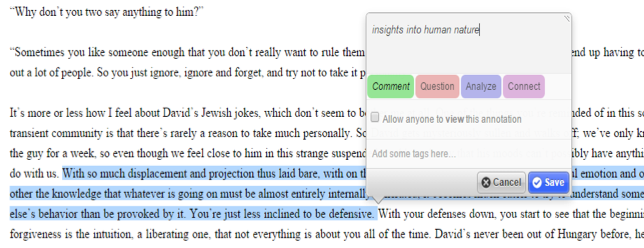
This image shows the annotation prompt that pops up when a reader highlights a passage of text on Lacuna. Three lines are highlighted in blue, and the annotation prompt includes a text box that has been filled with the reader’s comment on the highlighted passage: “insights into human nature”. Below the text comment, there are four possible categories that can be selected by the reader to categorize her annotation activity: Comment, Question, Analyze and Connect. There is also a line for adding tags to the annotation, and a box that may be checked if the reader wants to make the annotation public to others in the course.

Figure 1: Selecting and Annotating a Passage on Lacuna


Lacuna gives students the option to keep their annotations private or share them with the class. When students choose to share their annotations, they are contributing to a form of online dialogue that can also be extended into the classroom (see figure 2). Readers can use the Annotation Filter to choose whether to see one another’s annotations. Faculty who use Lacuna often make note of students’ annotations and adapt their classroom instruction to meet students’ interests or struggles with texts. In the “Teaching with Lacuna” section, we will examine how this blurring of the line between the classroom and the online preparation space affected the experience of the instructors in preparing for and teaching one specific humanities seminar.
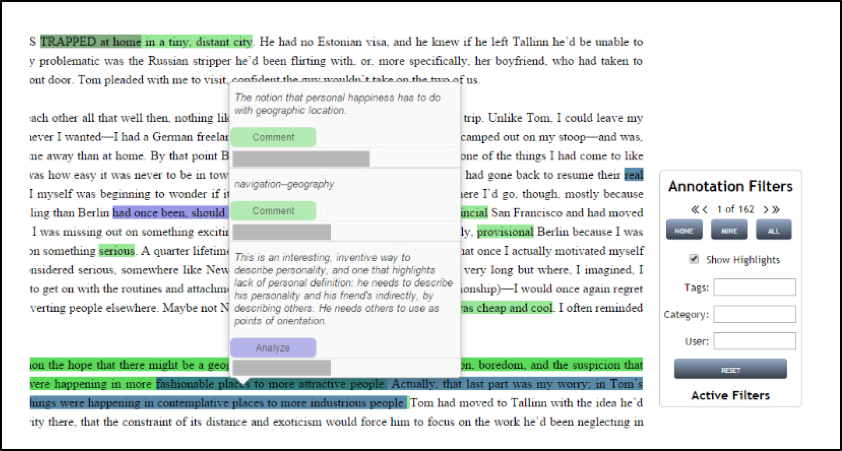
Screenshot shows three annotations on the same passage, from three separate students. On the text, the green used to highlight annotated passages is darker where more students have annotated. The reader has moused-over the highlighted passage to reveal the three annotations, which range in length from two words to multiple sentences. Two of the annotations are categorized as a Comments and a third is categorized as Analyze. To the right of the text appears the Annotation Filter box, where the reader can choose whether to see all the annotations in the class, just their own annotations, or no annotations. The reader can also filter by specific users, or specific metadata on annotations in the form of tags or categories. In this screenshot, “all” annotations are selected on the filter.

Figure 2: Multiple Students Annotating the Same Passage in Lacuna


One of the features that sets Lacuna apart from other social annotation platforms is the “Annotation Dashboard,” which provides an aggregate visualization of students’ use of the platform (see figure 3). The dashboard is updated in real-time and is interactive to allow for multiple ways of viewing the annotation data. Currently, there are three different types of analysis offered by the dashboard. “Filter by Time” is a bar graph that illustrates the relative number of annotations made on any given day of the course. “Annotation Details” shows via pie chart how many of each category of annotation there are, how long the annotations are, and how many of them are shared versus private. Finally, “Network” is broken down further into “Resources” and “Students”; this section allows instructors to see how many annotations each resource received and by which students.
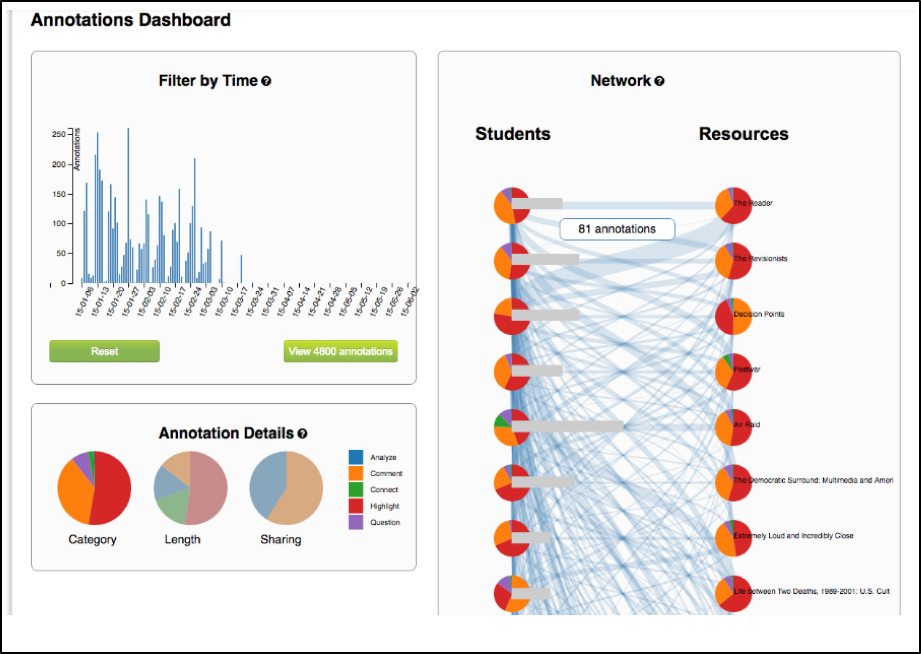
In this screenshot we can see the instructor dashboard for Lacuna. The dashboard is split into three different areas. In the top-left area, there is a blue bar graph labeled “Filter by Time.” The y-axis is labeled with numbers of annotations and the x-axis is labeled with dates. This section also contains a “Reset” button and a “View all annotations” button. Below the Time Filter, in the bottom-left area, there is is the “Annotation Details” section. This contains three pie charts: “Category,” “Length,” and “Sharing.” Finally, on the the right-hand side of the screen there is the “Network” section, with “Students” on the left and “Resources” on the right. Student names are obscured in this screenshot to preserve anonymity. Selections made in the Time Filter and Annotation Details section will dynamically affect the data displayed in the Network section - for example, selecting only the dates of Week 2 of the course in the Time Filter will cause the Network to show only the annotations made during that time period. In the Network section, there are pie charts for each student and each resource showing the number of annotations that each student has made on each resource and the total number of annotations on each resource. There is also a web of connections linking the student pie charts to the resource pie charts to show the number of annotations a student made of a particular resource. One of these connections has been moused-over to reveal that the student has made 81 annotations on the selected resource.

Figure 3: The Instructor Dashboard on Lacuna, showing student annotation activity throughout the Futurity course


Each of the dashboard visualizations interacts with all of the others. For example, clicking on a student name in the “Network” section causes only her data to appear in all three categories. We can then see which texts a student annotated most heavily, how many of her annotations were highlights and how many were comments or questions, and when she did the bulk of her highlighting. Clicking the “View annotations” button not only tells us how many annotations she made in total, it takes us to a table in which we can view all of them. The dashboard therefore makes it quite easy to see not only if students have met a required number of annotations, but also which texts they have found most worthy of annotation, whether students are highlighting or engaging through commenting/questioning, and when students tend to do their reading. As we will see shortly, having this information has a significant impact on the instructor’s experience of teaching the course.

Annotation as Part of the Writing Process

Lacuna also includes features that position the annotating and critical reading process as part of a longer-term project of understanding multiple texts or writing a paper about them. Reading in humanities courses is usually part of an integrated reading-and-writing process, where students produce their own texts about the texts they have read or about the issues raised in the texts (Biancarosa and Snow 2004, Graham and Herbert 2010). Expert readers look for patterns, mapping out a text and drawing explicit connections to other texts they have read (Snow 2002, Lee and Goldman 2015). In Lacuna, annotation metadata allows readers to tag and categorize their annotation as a visible record of the mapping and connection processes (see figure 4). For example, readers can tag annotations with a particular theme or topic (e.g “World War II”, “definition”). Lacuna readers can also categorize their annotations by the activity on the text (e.g. as a “Comment” or a “Question” or “Analysis”). Through these tags and categories, Lacuna readers begin to develop a structured characterization of the text. Tags on Lacuna can be suggested by students, or pre-specified by the instructor. By using both open and pre-specified tags, instructors can guide students’ reading while still allowing students to engage in personalized processes of intellectual discovery.
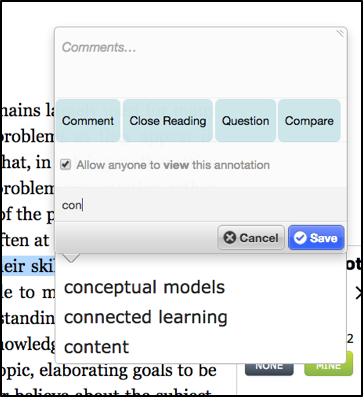
The screenshot shows an annotation box that pops up when a user highlights a passage. The user is tagging the annotation with a tag that begins with the letters “con”, and Lacuna suggests “conceptual models,” “connected learning,” and “content” as possible tags to select from.

Figure 4: Tagging a Passage on Lacuna, with Auto-Suggested Tags


In addition to tags, critical reading in Lacuna is linked with the writing process through two features: Responses and the Sewing Kit. “Responses” are pieces of student writing shared on the Lacuna platform. Responses can be directly linked to the texts and annotations that they reference. Lacuna also lets students annotate Responses, allowing their work to be interacted with in the same way as the work of established authors that is hosted elsewhere on the site. Enabling student writing to be annotated and commented on also creates the ability for peer-review by other students or real-time feedback on student work by the instructor.

The Sewing Kit allows for the automatic aggregation and sorting of all annotations in one place. Students can explore the Sewing Kit based on tags or keywords and create collections, called “Threads,” of quotations organized by theme (see figure 5). Threads can be used by individual readers as a thought-space for initial analyses. They can also be developed collaboratively to compile passages and annotations from multiple readers that are relevant to a theme discussed by the class.

The screenshot shows a Sewing Kit “Thread” from Futurity, in which multiple student annotations on one document have been collected around a single theme of “Memory.” The authors of the annotations are different students (names are obscured to preserve anonymity). The Sewing Kit shows annotations according to five types of metadata: Author of the annotation, the Annotation Text (the actual annotation), Category, Quote (the excerpt from the document), Tags, and Annotated Document. The annotations are all from the same document (a piece called “Putting the Pieces Together Again.) The annotations shown in this screenshot are either Comments or Questions.

Figure 5: A Sewing Kit “Thread” from Futurity, in which multiple student annotations on one document have been collected around a single theme of “Memory.”


The Sewing Kit is one of the most unique features of Lacuna, with few equivalents in other digital annotation tools. From a pedagogical perspective, manipulating online texts in a way that makes the complementary nature of reading and writing visible can support increased metacognition about the relationship between reading, annotating, analysis, and writing. The usefulness of being able to sort and search annotations across many texts will be apparent to anyone who has ever had to organize a large amount of reading for a project. Moreover, the visibility of each of these steps on Lacuna can be used to assess students’ developing understanding of texts, as well as their skills in interpreting and arguing for a particular interpretation of a text.

The features of Lacuna were designed in accordance with the pedagogical ideals of the humanities classroom: close reading, the exchange of ideas through discussion, and analytical writing that is anchored in the text itself. It was the hope of the research and design team that Lacuna would encourage certain expert practices in student users. In the following section, we will provide an in-depth analysis of one use of the tool in a humanities seminar that was co-conducted by Lacuna Co-Directors Amir Eshel and Brian Johnsrud. In this analysis, we will consider in detail the impact of Lacuna on both faculty instructional practices and student learning.

Findings

This section presents two complementary perspectives on the integration of Lacuna into an upper-level literature course. First, we describe the faculty perspective and provide a snapshot of how social annotations can be integrated into a classroom discussion. Second, we describe the student experience, drawing on surveys and interviews with two students in the case study course.

Teaching with Lacuna

There is no single way to teach using Lacuna—or any social annotation tool, for that matter. Of the dozen or more instructors who have used the Lacuna at Stanford and other institutions, each has made his or her own instructional design choices about how deeply to integrate the platform into course activities. On the “light integration” end of the spectrum, some instructors used Lacuna as the equivalent of a course reader. In these classes, students were asked to read and annotate in the shared online space, but there were no clear expectations that they would interact with one another online through their annotations. There was also little acknowledgment of their online activities during class sessions. On the “deep integration” end of the spectrum, instructors read students’ annotations and responses in advance of class and integrated them into class discussion; in these courses, a minimum number of annotations per week were often expected and counted towards a participation score.

In this section, we will closely consider a “deep integration” course: “Futurity: Why the Past Matters”, co-taught by Amir Eshel and Brian Johnsrud, Co-Directors of Lacuna. The integration of Lacuna was evident both in how the instructors prepared for class and in activities and discussion during class. In many ways, “Futurity” exemplifies the ways in which social annotation tools like Lacuna can be intentionally used by instructors to create a more student-centered and learning-centered humanities seminar. By examining in detail the instructional and classroom experience in Futurity, we hope that our readers will have the opportunity to reflect on and compare their experiences, goals, and tools to ours.

The “Futurity” Course

“Futurity” is a comparative literature course deeply concerned with contemporary culture’s engagement with the past in order to imagine different futures. Focusing on specific historical moments of the last sixty years, the course topics explored the relationship between narrative, representation, interpretation, and agency. The course materials included fiction, non-fiction, film, television, and graphic novels[5], making use of Lacuna’s multimedia capabilities and allowing the class to consider how different media representations shape our understandings of the past.

Futurity was first taught using Lacuna in Winter 2014, using an early version of the platform. This article will focus on the 2015 iteration of the course, but it is worth noting that the 2014 version of Futurity played a crucial role in the development of Lacuna itself. Based on feedback from students, features which are often found in online and hybrid learning settings—a wiki and discussion forums—were eliminated in favor of discussion through annotation within the texts. The content of the course also shifted, based partially on the annotations left by students in 2014, which gave the faculty insight into which texts were most generative for discussion.

The 2015 course required 20 annotations per week from each student. This was reduced from the previous year’s requirements based on student feedback indicating that higher requirements led to annotating in order to get a good grade, rather than annotating as a way of increasing comprehension and engagement. The student population of the 2015 class was a small seminar, yet remarkable for its diversity of academic backgrounds and ages of students. Across 10 students, the course participants ranged from postdoctoral fellows in philosophy, to graduate students in comparative literature, to undergraduates in the interdisciplinary Science, Technology, and Society (STS) major, under which Futurity was cross-listed.

Integration of Lacuna into the “Futurity” Course
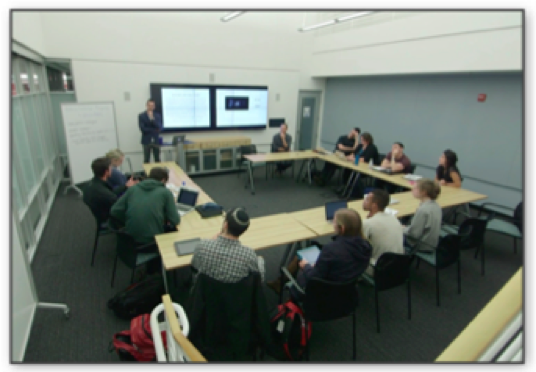
A picture of the Futurity classroom, taken by one of the authors (Hartman). Eleven students are seated around tables arrayed in a horseshoe fashion. They face a double screen at the front of the room. One screen has a PowerPoint projected onto it and one screen has Lacuna projected on to it. The instructors flank the screens, one sitting and one standing. Four students have laptops open, but all appear to be engaged in the conversation.

Figure 6: Teaching with Lacuna in Futurity. Lacuna is projected on the right-hand screen


One of our key research questions was how the visibility of students’ reading with Lacuna changed instructor practices. For Eshel and Johnsrud, a simple yet powerful shift was the ease of ascertaining which students had done the reading and how well they had understood the texts—questions which, as many instructors know, can consume considerable classroom time and assessment work (such as reading quizzes or short reading response papers). With Lacuna, the instructors could easily see whether students had annotated and how they had reacted to the readings. This meant that preparing for a class session of Futurity was significantly different from preparing for courses that did not use Lacuna. In an interview, Eshel noted that it made “class preparation and [his]… intimate knowledge of [his] students” much easier, and that the experience of teaching was intensified. Both Johnsrud and Eshel emphasized that having their students’ thinking rendered visible by the platform ahead of time increased their own engagement with the course. Students also appeared to be more prepared for class. This resulted, according to Eshel, in a “quicker pace” and in conversation that was “more intense and more meaningful.” Based on students’ annotations and written responses to the reading, the instructors were able to immediately dive into lecture or discussion.

Visible annotations also changed the focus of class preparation. Johnsrud described his and Eshel’s process of preparing for class with Lacuna as akin to drawing a Venn diagram, where one circle represented the students’ interests, as evidenced by annotations and responses, and the other was the topics that the instructors wanted to cover. Johnsrud and Eshel generally tried to focus the class discussion and any lecture material on the overlapping area. This approach could be challenging, however, simply for logistical reasons: the students in Futurity were just as likely to complete their reading at the last minute as any other group of students, which meant that not all annotations could be incorporated into the discussion. Other Lacuna instructors have dealt with this by setting a reading deadline twenty-four hours before class. In terms of topics, sometimes students’ interests and questions diverged from the themes that Eshel and Johnsrud wanted to cover. Incorporating students’ perspectives thus required considerable flexibility from Johnsrud and Eshel, as well as a willingness to cede some control of the classroom discussion agenda to the students’ questions or interests as reflected in their annotations.

Examining students’ online work in advance of class sessions was a task primarily taken on by Johnsrud and the course’s teaching assistant (TA). The TA would send emails to Johnsrud and Eshel that included information such as “hot spots” in the reading (that is, places where students had annotated heavily), trouble spots where students had visibly struggled with the text, interesting annotations or responses for starting a conversation, and overall trends he observed in their annotations. The TA frequently used the Sewing Kit to aggregate the annotations of multiple students under themes relevant to the course content, such as “Agency” or “Memory.” This took about 2-4 hours each week (the course met for 1.5 hour sessions, twice a week). Both instructors noted in interviews that such an approach could be demanding without a teaching assistant.

Eshel and Johnsrud also used annotations to get to know their students as readers and thinkers. Johnsrud said, “After Week 1, I could tell you so much about each student, how they think, what they struggle with, what kind of level they are at, that had nothing to do with any class behavior.” In order to bridge online and offline dialogue, Johnsrud or Eshel often focused discussion on a “hot spot” in the text, addressing overall themes in students’ comments. At times, Eshel or Johnsrud would ask a student to expand verbally upon a particular annotation they had written before class. Eshel and Johnsrud generally let the students know ahead of time if they were going to be using one of their annotations to generate discussion, so that the student did not feel they were being cold-called and had time to prepare a few thoughts.

These practices and their pedagogical outcomes are illustrated particularly well by a class session that took place on during the 5th week of the 10-week quarter. For this class, students read a 1989 essay about the dissolution of Communism. Although Futurity was primarily a literature course, Eshel and Johnsrud often paired a literary text with a theoretical one and pushed students to place the two texts in dialogue with each other. For this class session, students annotated the essay 164 times, with just over half of the annotations (92) including comments (the remainder were highlights, which are a signal of engagement with the text, but engagement that may be less reflective than annotations). In their annotations, students took issue with the author’s ideas, particularly as they related to class and race in Western culture. The students’ disagreement with the author led to particularly rich annotations. Two examples of such annotations include:

“This seems completely outlandish and impractical. I disagree with Kojeve… how can he theorize on such a ‘universal homogenous state’ when all of history is speaking against such a utopia. If one can even call it that; isn’t it our differences and varying opinions which make the world fascinating? His theory seems impossible” (Jenna[6])

“This is a highly debatable and suspect statement. I wouldn’t say that US society is a class-less society. Granted its’ [sic] class structure is different from the class structure of, say, India. But there definitely is a class system, which many individuals do not even want to acknowledge. Consider a city like Baltimore and how even its city planning is based on a class categorization.” (Amanthi)

Prior to class, Johnsrud and Eshel had agreed upon certain annotations and themes that they wished to address. They spent the first twenty minutes on a mini-lecture contextualizing the importance of 1989 as a turning point in the end of the Cold War. They then gave students five minutes to look over their own annotations, re-clarify their thoughts about the text, and come up with a few points they wished to discuss. Ryan, a doctoral student, chose to focus on an annotation he had written in which he questioned the author’s phrase “the end of ideological evolution.” Ryan expanded upon his critique of the phrase in class, and Eshel pushed back, asking if an argument that is “wrong” or inaccurate can yet be a productive tool. There followed a discussion between Ryan and Eshel not only about the author’s ideas, but also about how to discuss a piece of criticism that might be at once useful and problematic. Eventually, Ryan welcomed James, an undergraduate in Comparative Literature, into the discussion by way of one of James’s annotations that he made before class, and which Ryan had viewed: “James had a great annotation about that,” Ryan said. James picked up the conversation from there. In this dialogue, both the instructors and the students had an awareness of one another’s online activity, which was elaborated upon during the in-person discussion. As many instructors of discussion-based courses know, one of the most difficult aspects of discussion can be encouraging students to respond to each other, and not solely to the instructor. In this case, Ryan’s awareness of his peers’ ideas prior to entering the classroom encouraged him to expand the conversation beyond his exchange with Eshel.

In addition to encouraging responses and dialogue among and between students, deliberate integration of online discussion into the classroom also appeared to have a democratizing effect. Later in the discussion, Eshel asked Amanthi, a doctoral student in comparative literature, to weigh in on the discussion. Drawing on her annotations, Amanthi neatly summarized her three main problems with the author’s argument about the notion of socioeconomic class. Eshel responded by contextualizing the author’s remarks in terms of the time the piece was written. Both instructors had wished to address the questions about class raised by Amanthi in her annotations, and they were able to do this by asking her to expand upon her online work. While the instructors may have been able to bring the topic into the discussion without looking to a student, doing so served to acknowledge the work the students did while reading and emphasize that the discussion was a dialogue between equals with valid perspectives.

This particular in-class discussion illustrates a few of the practices of integrating social annotations into the classroom. By using Lacuna as a window into students’ reading, Eshel and Johnsrud were able to pinpoint the exact places in the text that generated the most frustration, confusion, or disagreement in their students. While they were not necessarily surprised by students’ reactions to the text, as they had taught this essay previously to students who found it problematic, they were able to use specific criticisms, attached to individual claims and sentences on the text, as a springboard for discussion. To get the conversation rolling, the instructors were able to call on students they knew to have annotated heavily and thought deeply about the text. Those students were, in turn, able to manage the discussion themselves, such as when Ryan asked James to talk about his annotation. Students whose comments built on their annotations were often succinct and articulate, perhaps because they were better prepared to contribute than they would have otherwise been. Finally, the integration of students’ online ideas into the classroom had an equalizing effect; although both instructors had points they wished to raise, they were able to do so by calling on students who had themselves already raised those points in their annotations.

This Week 5 class session also demonstrates a type of negotiation that can take place between the students’ interests and the instructors’ instructional agenda in classes that integrate Lacuna into the classroom conversation. Throughout the conversation, the instructors attempted to steer the conversation away from the shortcomings of the essay and toward the reasons they had had the students read it. Eshel noted early on in the discussion that, “A text like this is nothing but a tool . . . a tool we use to do all kinds of other things.” Eshel stated explicitly that he wanted the students to consider whether the author might be wrong and productive at the same time. But it was clear, from both the students’ annotations and the ensuing discussion, that many of them were resistant to this perspective on the text. The instructors acknowledged and built upon the work that students had done already, thereby creating more authentic dialogue; but the students, being aware of how much work both they and their peers had already done on the text, appeared at times to be less willing to follow where an instructor might lead them. While students’ initial interpretations of a text may also be codified before class with a print text, there is a possibility that digital and social annotation may prime in students more fixed interpretations before class. This trade-off between guidance and discovery will be discussed more thoroughly in the concluding remarks.

Learning with Lacuna

From the foregoing analysis, it is clear that instructors can deliberately leverage students’ online activity with Lacuna to promote intellectual engagement and dialogue within their classrooms. What is the online reading experience like for students? Across surveys of students in Futurity and six other courses using Lacuna (N=45), digital annotation with Lacuna appears to have both benefits and drawbacks. Here, we briefly discuss student survey results before presenting an in-depth analysis of one-on-one interviews with students in the 2015 Futurity course.

For most of the students surveyed, annotation was a familiar strategy which they used frequently, according to self-reported habits. When asked about their goals in annotating, students largely described using annotations to meet a particular goal, such as when they did not understand something as they were reading or to return to at a later point. They also used highlighting and underlining to mark parts of the text that they wanted to remember or which simply seemed notable for their language. When it came to the physical experience of reading and annotating, it is worth noting that over half of the students surveyed expressed a preference for reading on paper, citing eyestrain and the freedom to make multiple types of marks (such as lines, circles, or arrows) as the main benefits. But when comparing Lacuna to other digital reading experiences, students remarked favorably upon the ease of annotating, particularly in contrast with the poorly-scanned PDFs that they had encountered in other courses. They also appreciated the organizational benefit of all-in-one access to online texts.

It was social annotation, however, that emerged through the surveys as the most salient aspect of Lacuna, compared to both paper and digital reading environments. In open text responses describing their experiences, students reported an appreciation of the opportunity to hear one another’s perspectives and learn from one another as well as from the instructor. This was particularly true for less advanced students in courses such as Futurity, which included graduate students along with both major and non-major undergraduates. Students described that seeing others’ annotations drew attention to particular aspects of the text, clarifying aspects of the writing or helping them see what questions would be useful to ask of the text. In a course similar to Futurity, where the instructor frequently brought students’ annotations into class, several students commented appreciatively on the “continuity” between reading before class and the subsequent class discussion.

Survey respondents also emphasized that timing matters when it comes to the social experience. For example, one student said he was usually the first to read and comment, so he didn’t have the opportunity to experience others’ annotation unless he took the time to return to the text after class. On the flip side, one student honestly shared that he appreciated others’ annotations drawing attention to aspects of the text when he was reading last-minute before class. Multiple students preferred exploring others’ comments on a second read-through of the text, rather than the first, so they would have the chance to form their own impressions of the text. The annotation filter in Lacuna facilitates these modes of reading, allowing students and faculty to choose whether to see no annotations; only their own annotations; selected users’ annotations; or annotations from everyone in the course. (See figure 2, above.)

Surveys can provide a high-level perspective on the experience of a group, but interviews accompanied by work products—in this case, annotations on Lacuna—are a powerful research tool for going more deeply into the nuances of an experience. Reflecting the emphasis on social annotation in the surveys, the following section draws on interviews with two students in Futurity, “Jenna” and “Allegra,” in order to explore the processes by which social annotation creates opportunities for peer learning. Jenna and Allegra were selected to be interviewed as part of a larger research project looking across multiple courses using Lacuna. Based on recommendations of faculty and their observed levels of platform and classroom engagement, we felt that Jenna and Allegra were representative of students who were highly engaged with the course and the platform.

Exploring Social Annotation from the Student Perspective

Jenna and Allegra were both seniors at the time they were interviewed. As humanities majors, Jenna and Allegra were experienced annotators, building on years of instruction in high school and use of annotation in previous undergraduate courses. With Lacuna, however, they each noted that the platform allowed them to annotate more extensively than they were accustomed to doing on paper. The “endless” virtual margin and the speed of typing meant that for both students, the material features of the platform augmented aspects of a pre-existing individual practice. Even more salient, however, were the ways that the platform created a stronger sense of community and new opportunities for social learning. Jenna eloquently expressed the connection to other course participants that the platform enabled her to feel: “It’s like all of our head space is kind of in the same area. […] I’ll just be like oh, this is what Amanthi was thinking when she read this part. How interesting, it’s a Sunday afternoon and we’re both reading this. […] It’s like there is constant fluidity, between when I’m in class and outside of class.” Just as the instructors sought to connect online and offline activity, students like Jenna were making these connections themselves.

The collegial nature of the course community appeared to be a crucial element for supporting peer learning. “I have learned just as much from my peers in the course as [from] my instructors,” Jenna noted at two different points in her interview. She described social reading as an additive process, where her own understanding of the text was enhanced by the perspectives of others: “That’s the beauty of it. It’s because we have all of these minds bringing together these very fragmented understandings of the text. Then it just only adds to yours.” Pointing to examples from the course, Jenna clarified that these “understandings” can be references—to a film or to a Bible passage, for example—as well as interpretative statements. Moreover, each of these understandings, including her own, is incomplete – “fragmented” across multiple annotations and across multiple minds. Together, however, they represent a more complete understanding of the text than a single reader would be able to generate by herself.

Unpacking the social annotation process that enables this more complete understanding, however, reveals multiple opportunities for an individual to engage socially, or alternatively, remain solitary in their interpretive process. As explored in the Marshall and Brush (2004) research, the first decision in social annotation whether to share at all. For some students this appears to be a more sensitive issue than for others, with concerns about looking stupid—or, as expressed by some graduate students in surveys and informal conversations, the fear of not looking sufficiently clever and impressive. But as the quarter progressed in Futurity, sharing was the norm, rather than the exception. This was due in part to the default setting of “public” on annotations, which meant that students needed to check a box to intentionally opt out of sharing each time they hit “save” on an annotation. Over time, students also had more practice exposing their opinions without negative feedback. Another incentive may have been the instructors’ use of annotations and students’ written responses in the classroom discussion. As Allegra noted, “It definitely feels good [when they mention my annotations in class]. They acknowledged that you did a good job […] and they also teach the class, like, in accordance to some extent with what you said about the text, which is also really cool.”

Other reasons that students shared their annotations were because they “didn’t care” (Jenna) if someone saw what they wrote—perhaps a typical perspective from the social media generation —or if they had a specific audience in mind. In particular, our interviewees looked for opportunities to provide new information that would enhance the reading experiences of their peers. Allegra explained that she was far more likely to annotate rather than highlight if she was pointing out something that was not “obvious” in the text, such as references to outside texts or events: “[W]ith the Mrs. Dalloway annotation, for example […] I felt the need to point that out to people who might not have made that connection.” Allegra exhibits a relatively high level of awareness of what her peers are likely to know, as well as what kinds of insights count as novel rather than rudimentary. Jenna framed her contributions in a slightly more personal and conversational way. In her interview, she gave examples of annotations that felt important for her to make public on texts that she “disagreed with,” noting that she “really want[ed] people to know” about this opinion so it would “add something to the class discussion.”

The second aspect of social annotation is choosing to read others’ annotations. In the interviews, it became clear that in the dialogue taking place through social annotation, not all utterances are necessarily “heard” by others. If the student is reading early in the week or in the hour before class, there will be a different version of the text with different amounts of annotations available. Moreover, the annotations which are at the time of reading available can be shown or hidden using filters on the text. Then, even if the reader chooses to show annotations with the filter, it is up to that reader to read any particular annotation by hovering over the text to show the annotation. Finally, once an annotation is read, the reader may choose to reply to it or make another note in parallel—or, they can simply notice what the other annotator has written and then move on, rather than actively engaging with it. Each annotator has their own preferences about this, which may also vary by text. Describing their approaches generally, our interviewees had slightly different perspectives. Jenna reads others’ annotations when she gets “curious about what other people wrote on a given page, […] I try to do that pretty often.” Allegra said that she “always makes sure to click ‘all annotations’ [on the filters], when I’m reading so I can see what people have said already. That often informs the way I look at things in the text.” From these students’ experience, it is not clear whether different strategies for reading others’ annotations would be more or less effective for different kinds of texts, or for interpretive practices with different goals.

In discussing what made a “good” annotation, Jenna and Allegra generally focused on the informational content and novelty of the annotation. As an example of a beneficial annotation, Allegra pointed to an annotation on Ian McEwan’s novel Saturday, in which Jason had noted that McEwan is “orientalizing” the word “jihad,” creating distance between the reader and Arabic culture. “That wasn’t something I had thought about,” she explained. Jason’s interpretation added another lens for Allegra to analyze the work being done by the text and the choices made by the author. Even though the annotation was not addressed directly to her, it was another perspective that she could build on in her own interpretation of the text. Sometimes, however, Jenna and Allegra did not view other students’ annotations were not as particularly useful. For example, Allegra described somewhat disparagingly the “pointless,” single-word annotations that some students made, which were a reaction to the text without adding specific analytical detail. Jenna exhibited a similar response to “obvious” annotations, describing “a couple of times where people have been, like, this is a recurring trope, and I’m like…yeah. You didn’t need to tell me that.” Nearly in the same breath, however, both Allegra and Jenna acknowledged that others in the class could have benefited from the annotations that they did not find personally useful at the time. Jenna noted, for example, “Maybe for other people, they didn’t think of that as a trope […] So, it could definitely help someone else.” The unique knowledge and interests of each annotator, who are each readers of one another’s annotations, means that it may be difficult to find annotations that are useful to all readers—a challenge not unique to social annotation but shared with all annotated editions of texts.

With these examples, a vital aspect of social annotation becomes evident: the act of annotating has multiple goals and as a result, there are multiple ways to understand whether annotation is a productive utterance in the online discourse community. Social annotation is a way of reading simultaneously for oneself and for the community. The individual reader, traditionally ensconced in a paper book, thinks entirely of himself. With social annotation, a diverse audience emerges—an audience including an instructor who is in a position of evaluation and other students who can be “told” new information. Moreover, both instructors and students are fellow participants in a dialogue which can be carried out in class as well as online. Finally, the reader is also an audience member herself, for the performances of others in her class. The mental model of the activity of social annotation, then, is multifaceted, requiring a level of self-awareness (and other-awareness) significantly beyond that of being a private reader.

Concluding Remarks

By equipping learners to engage individually and collectively with texts across media, Lacuna and other social annotation platforms are designed to encourage critical thinking and sensemaking, skills which are at the core of disciplinary work in the humanities and vital to 21st-century citizenship. Critical reading has long been a hallmark of the humanities and a skill which the traditional seminar has sought to foster in its students; however, the practice itself has often been all but invisible to instructors. By transforming reading into an activity that is done socially, rather than in solitude, Lacuna created a bridge between the physical classroom and online reading space in Futurity.

Social annotation in the Futurity course allowed the instructors to get to know their students better and to incorporate student perspectives more fully into the dialogue of the course. By glimpsing their peers’ interpretations of a text during class preparation, students were able to start engaging in dialogue before they entered the classroom. They became more comfortable with one another and had increased opportunities to learn from each other as well as from the professor, developing a multi-faceted perspective on texts. These changes in instructor and peer learning practices appear to have created strong student investment in the course and more authentic dialogue during class discussions. The social annotation affordances of Lacuna rendered students’ reading visible to instructors and other students, and thus expanded the dialogic space of the course.

But dialogue isn’t always easy. Social annotation appears to create new demands on students and instructors alike to negotiate one another’s perspectives and reflect on the goals of their participation and practices. For students, this negotiation and self-reflection largely takes place during reading. Encountering a chorus of voices on a text means that these voices must be sorted through, accepted, questioned, or ignored. Being a member of that chorus means constantly choosing whether to sing or be silent. These choices build on skills that students have likely have developed through in-person discussions, as well as pre-existing solitary reading strategies, but combines them in new ways. In educational research, this type of self-monitoring and intentional use of resources is known as “self-regulation” (e.g. Bandura 1991, Schunk and Zimmerman 1994). Self-regulation is a relatively sophisticated set of competencies, which must be taught, practiced, and discussed. Similarly, social annotation is an activity which will likely function best when self-reflection about the practice is encouraged and there are ongoing conversations in a course about how to best engage in it.

Instructors working with social annotation tools like Lacuna are presented with the opportunity to incorporate students’ interests and struggles with texts into teaching, which can include the potentially discomfiting need to cede to the students some measure of control. Even if faculty are comfortable with this, it highlights the tension that must be negotiated between the desire to allow students the space for intellectual discovery and the desire to guide their learning along a pre-specified path. While the tension between student-led discovery and instructor-led guidance is present to some degree in any seminar, pedagogical opportunities to support discovery are heightened by the ways that Lacuna makes reading practices and student voices more visible on the text itself. To balance these goals, instructors who use Lacuna, or similar software which emphasizes student perspectives, would be well-served to reflect on their desired learning outcomes for the class and adjust their use of the platform accordingly. Such self-reflection is also useful when considering how much time an instructor wishes to spend combing through student annotations for use in the classroom; student annotations are effectively an additional text that an instructor needs to prepare each week, and the learning goals of a specific course will dictate how much time an instructor will wish to spend preparing that text.

Generally, the influence of Lacuna on the course dynamics of Futurity appeared to be positive. We observed and heard about high levels of student preparedness, active reading habits, and deep engagement in course topics among both students and instructors. While these changes were certainly shaped by the design and affordances of the platform, they cannot be regarded as given for all users of Lacuna or other social annotation tools. It is likely no coincidence that, of the dozen or so courses that have utilized Lacuna in recent years, the course with the deepest integration of the platform was the only one in which Lacuna was used two years in a row. The lessons learned from the first year of teaching were critical in shaping both the technological changes made to the Lacuna platform and the ways that Eshel and Johnsrud chose to leverage the platform when they taught the course again the following year. This illustrates the importance of intentionality, reflection, and iteration in both the design of the platform and instructors’ use of it—lessons which go beyond Lacuna and social annotation tools to learning technologies broadly. For designers, it is essential to think of instructional technologies as dynamic, rather than static; they must adjust to the pedagogical needs and goals of instructors. Instructors, in turn, must carefully consider how best to use a platform to achieve their goals. Thoughtful and reflective design of the technology, and thoughtful and reflective use of the tool in the classroom, are equally important to achieving a deep level of pedagogical impact.

Future Directions

Our case study has surfaced themes of authority, agency, and new forms of relationships in courses where technology makes student activity visible to instructors. We plan to investigate these themes further as we continue to research and develop the Lacuna platform and engage with researchers investigating comparable learning technologies. While the current study focused on classroom dynamics, a vital question that needs further consideration is the specific way in which student learning is influenced by the pedagogical moves that Lacuna enables. To pursue this avenue of research, we are in the process of developing rubrics for characterizing the reading strategies expressed in online annotations. Using annotations as evidence of critical reading and dialogic practices is an opportunity that is relatively unique to digital learning environments which capture traces of student activity. These data provide critical insights into student thinking, both on an individual and collective level, and can be used as a type of formative assessment for tracking learning over time (Thille et al. 2014).

At Stanford, Lacuna continues to be used for seminar-style courses similar to Futurity, as well as in courses in other departments and larger, lecture-style courses. Lacuna is also being used at a variety of other universities—visit www.lacunastories.com for a full list of our collaborators. Each of these collaborators are doing exciting work to make the platform their own. We are particularly pleased to be supporting local community college instructors who teach composition, as well as reading and writing courses at the basic skills level. In these partnerships, we are building on the insights from this case study and other unpublished case studies and observations. For example, we encourage active reflection about annotation practices and goals. This includes strategies for gradually increasing the level of integration of Lacuna into homework assignments and classroom activities, in order to give both instructors and students the opportunity to adjust their habits.

In our current research and partnerships, we continue to iteratively refine the design of Lacuna, while building our theoretical conceptions of the co-creation of meaning through social annotations. Throughout this work, we seek to support learning and instructional practices in a way that balances the strengths of participatory digital media with the strengths of in-person human interactions.

Notes

[1] Note about authorship and affiliation: This paper presents a case study of a course taught by Amir Eshel and Brian Johnsrud, the co-directors of the Lacuna project in the Poetic Media Lab. While Eshel and Johnsrud were the original designers and first users of Lacuna, they were not involved in the present analysis of their own teaching. Rather, all interviews, surveys, and classroom observations—as well as the subsequent analysis of that qualitative data—were conducted exclusively by the primary authors (Schneider and Hartman). As members of the Poetic Media Lab, Schneider and Hartman are participant-observers who have served as instructional designers to help instructors plan their courses and have analyzed research data to contribute to the ongoing improvement of the platform. This level of involvement is typical for researchers in the “design-based research” paradigm of the learning sciences (Brown 1992, Collins et al. 2004, Sandoval 2014). Some level of bias is inherent in participating in and observing a project at the same time. Nevertheless, in any form of participant-observation, it is always the hope that any considerations that may be overlooked due to close proximity is more than compensated for by the first-hand observations of practice that such inquiry affords.

[2] Please see note 1 above on authorship and affiliation to learn more about the participant-observer relationships of Schneider, Hartman, Eshel, and Johnsrud to the analyses presented in this paper.

[3] The site can also be used for films, videos, audio, and images. The vast majority of media in the course syllabi of our faculty reflect, however, the traditional focus of the academy on written texts. To reflect this trend and maintain clarity in our writing, we will use the term “reading” throughout the paper. But when we say “reading,” note that these claims may be equally important for viewing, listening, etc.

[4] Figure 1 and other screenshots in the paper are from the version of Lacuna used in the case study course described in this paper. The most recent version of Lacuna refines the privacy settings for annotations to allow readers to only share their annotations with an instructor or to share annotations with a specific group of peers, in addition to keeping annotations private or sharing them with the entire class. These changes were made in response to feedback from students and instructors who wanted more fine-grained control over who could see their annotations.

[5] A common question about Lacuna is the copyright status of materials. Lacuna supports the uploading of any digitized course or syllabus material, such as text, images, video, or audio files. As with any Learning Management System (LMS)—such as Canvas, Blackboard, edX, etc.—instructors are responsible for the copyright status of materials they upload. With each upload, instructors are asked to indicate the copyright status of the material, such as open access, Creative Commons, limited copyright for educational purposes, etc. Because the platform has secure logins limited to students enrolled in courses, instructors at Stanford have had a good deal of success getting free or reduced copyright fees for course materials that do not fall under fair use for educational purposes. Publishers seem particularly accepting to digitized materials on Lacuna because they are not easily downloaded and disseminated as PDFs, which is the way that many other LMSs deliver content.

[6] All student names in this article are pseudonyms.

Bibliography

Ambrosio, Frank, William Garr, Eddie Maloney and Theresa Schlafly. 2012. “MyDante: An Online Environment for Collaborative and Contemplative Reading,” Journal of Interactive Technology and Pedagogy, no. 1.

Applebee, Arthur N., Judith A. Langer, Martin Nystrand, and Adam Gamoran. 2003. “Discussion-based approaches to developing understanding: Classroom instruction and student performance in middle and high school English.” American Educational Research Journal 40, no. 3: 685-730.

Bakhtin, Mikhail M. 1981. The dialogic imagination: Four essays by MM Bakhtin (M. Holquist, Ed.; C. Emerson & M. Holquist, Trans.).

Bandura, Albert. 1991. “Social cognitive theory of self-regulation.” Organizational behavior and human decision processes 50, no. 2: 248-287.

Baron, Naomi S. 2015. Words onscreen: The fate of reading in a digital world. Oxford University Press.

Bazerman, Charles. 2010. The Informed Writer: Using Sources in the Disciplines, 5th Edition. Fort Collins: The WAC Clearinghouse.

Biancarosa, Gina, and Catherine E. Snow. 2004. Reading next: A vision for action and research in middle and high school literacy. Alliance for Excellent Education.

Brown, Ann L. 1992. “Design experiments: Theoretical and methodological challenges in creating complex interventions in classroom settings.” The Journal of the Learning Sciences 2, no. 2: 141-178.

Cole, Michael, and Yrjö Engeström. 1993. “A cultural-historical approach to distributed cognition.” Distributed cognitions: Psychological and educational considerations, 1-46.

Collins, Allan, John Seely Brown, and Ann Holum. 1991. “Cognitive apprenticeship: Making thinking visible.” American educator 15, no. 3: 6-11.

Collins, Allan, Diana Joseph, and Katerine Bielaczyc. 2004. “Design research: Theoretical and methodological issues.” The Journal of the Learning Sciences 13, no. 1: 15-42.

Cuban, Larry. 2009. Oversold and underused: Computers in the classroom. Harvard University Press.

Davis, James R., and Daniel P. Huttenlocher. 1995. “Shared annotation for cooperative learning.” In The first international conference on Computer Support for Collaborative Learning, pp. 84-88. L. Erlbaum Associates Inc.

Farzan, Rosta, and Peter Brusilovsky. 2008. “AnnotatEd: A social navigation and annotation service for web-based educational resources.” New Review of Hypermedia and Multimedia 14, no. 1: 3-32.

Flower, Linda. 1990. “Introduction: Studying cognition in context.” Reading-to-write: Exploring a cognitive and social process, 3-32.

Garrison, D. Randy, Terry Anderson, and Walter Archer. 1999. “Critical inquiry in a text-based environment: Computer conferencing in higher education.” The Internet and Higher Education 2, no. 2: 87-105.

Garrison, D. Randy, Terry Anderson, and Walter Archer. 2010. “The first decade of the community of inquiry framework: A retrospective.” The Internet and Higher Education 13, no. 1: 5-9.

Gay, Geri, Amanda Sturgill, Wendy Martin, and Daniel Huttenlocher. 1999. “Document‐centered Peer Collaborations: An Exploration of the Educational Uses of Networked Communication Technologies.” Journal of Computer‐Mediated Communication 4, no. 3.

Gee, James Paul. 2015. Literacy and Education. Routledge.

Graff, Gerald. 2008. Clueless in academe: How schooling obscures the life of the mind. Yale University Press.

Graham, Steve, and Michael Hebert. 2010. Writing to read: Evidence for how writing can improve reading: A report from Carnegie Corporation of New York. Carnegie Corporation of New York.

Greeno, James G. 1998. The situativity of knowing, learning, and research. American psychologist, 53 no. 1: 5-10.

Gunawardena, Ananda and John Barr. 2012. “Classroom salon: a tool for social collaboration.” In Proceedings of the 43rd ACM technical symposium on Computer Science Education, pp. 197-202. ACM.

Hillocks, George, and Larry H. Ludlow. 1984. “A taxonomy of skills in reading and interpreting fiction.” American Educational Research Journal 21, no. 1: 7-24.

Jenkins, Henry. 2009. Confronting the challenges of participatory culture: Media education for the 21st century. MIT Press.

Johnson, Tristan E., Thomas N. Archibald, and Gershon Tenenbaum. 2010. “Individual and team annotation effects on students’ reading comprehension, critical thinking, and meta-cognitive skills.” Computers in Human Behavior 26, no. 6: 1496-1507.

Langer, Judith A. 1995. Envisioning Literature: Literary Understanding and Literature Instruction. New York: Teachers College Press.

Lave, Jean, and Etienne Wenger. 1991. Situated learning: Legitimate peripheral participation. Cambridge university press.

Lee, Carol D., and Susan R. Goldman. 2015. “Assessing literary reasoning: Text and task complexities.” Theory Into Practice just-accepted.

Levine, Sarah, and William Horton. 2015. “Helping High School Students Read Like Experts: Affective Evaluation, Salience, and Literary Interpretation.” Cognition and Instruction 33, no. 2: 125-153.

Marshall, Catherine C. and AJ Bernheim Brush. 2004. “Exploring the relationship between personal and public annotations.” In Digital Libraries, 2004. Proceedings of the 2004 Joint ACM/IEEE Conference on, pp. 349-357. IEEE.

Mazzei, Andrea, Jan Blom, Louis Gomez, and Pierre Dillenbourg. 2013. “Shared annotations: the social side of exam preparation.” In Scaling up Learning for Sustained Impact, pp. 205-218. Springer Berlin Heidelberg.

McNamara, Danielle S., Tenaha P. O’Reilly, Rachel M. Best, and Yasuhiro Ozuru. 2006. “Improving adolescent students’ reading comprehension with iSTART.” Journal of Educational Computing Research 34, no. 2: 147-171.

Morson, Gary Saul. 2004. “The process of ideological becoming.” Bakhtinian perspectives on language, literacy, and learning, 317-331.

Norman, Donald A. 1999. “Affordance, conventions, and design.” Interactions 6, no. 3: 38-43.

Nystrand, Martin. 1997. Opening Dialogue: Understanding the Dynamics of Language and Learning In the English Classroom. New York: Teachers College Press.

Pea, Roy D., and D. Midian Kurland. 1987. “Cognitive technologies for writing.” Review of research in education, 277-326.

Sandoval, William. 2014. “Conjecture mapping: An approach to systematic educational design research.” Journal of the Learning Sciences 23, no. 1: 18-36.

Scholes, Robert E. 1985. Textual power: Literary theory and the teaching of English. Yale University Press.

Schunk, Dale H., and Barry J. Zimmerman. 1994. Self-regulation of learning and performance: Issues and educational applications. Lawrence Erlbaum Associates, Inc.

Snow, Catherine. 2002. Reading for understanding: Toward an R&D program in reading comprehension. Rand Corporation.

Suthers, Daniel D. 2006. “Technology affordances for intersubjective meaning making: A research agenda for CSCL.” International Journal of Computer-Supported Collaborative Learning 1, no. 3: 315-337.

Thille, Candace, Emily Schneider, René F. Kizilcec, Christopher Piech, Sherif A. Halawa, and Daniel K. Greene. 2014. “The future of data-enriched assessment.” Research & Practice in Assessment 9.

Unsworth, John. 2000. “Scholarly primitives: What methods do humanities researchers have in common, and how might our tools reflect this.” In Humanities Computing, Formal Methods, Experimental Practice Symposium, pp. 5-100.

van der Pol, Jakko, Wilfried Admiraal, and P. Robert-Jan Simons. 2006. “The affordance of anchored discussion for the collaborative processing of academic texts.” International Journal of Computer-Supported Collaborative Learning 1, no. 3: 339-357.

Vygotsky, Lev Semenovich. 1980. Mind in society: The development of higher psychological processes. Harvard University Press.

Wegerif, Rupert. 2013. Dialogic: Education for the Internet age. Routledge.

Wolfe, Joanna. 2008. “Annotations and the collaborative digital library: Effects of an aligned annotation interface on student argumentation and reading strategies.”International Journal of Computer-Supported Collaborative Learning 3, no. 2: 141-164.

Zyto, Sacha, David Karger, Mark Ackerman, and Sanjoy Mahajan. 2012. “Successful classroom deployment of a social document annotation system.” In Proceedings of the SIGCHI Conference on Human Factors in Computing Systems, pp. 1883-1892. ACM.

Acknowledgements

Lacuna was built in the Poetic Media Lab, a digital humanities lab in Stanford’s Center for Textual and Spatial Analysis (CESTA). The platform’s development was overseen by Michael Widner, and conducted by him and a number of undergraduate and graduate research assistants at Stanford, with occasional assistance from external developers and project collaborators. The Lacuna project has received funding from the Wallenberg Foundation and the following departments and offices at Stanford University: the Vice Provost for Online Learning; the Vice Provost for Teaching and Learning; the Dean of Research; the Vice Provost for Undergraduate Education; the Division of Literatures, Cultures, and Languages; Stanford Community Engagement grants; and the Robert Bowman Denning Fund for Humanities and Technology. Additional support for Emily Schneider was provided by the Lytics Lab and the Anne T. and Robert M. Bass Stanford Graduate Fellowship.

About the Authors

Emily Schneider is a doctoral candidate in Learning Sciences and Technology Design at Stanford. She is the Director of Research and Pedagogy of the Lacuna project and a co-founder of Stanford’s Lytics Lab. Her work focuses on the design and evaluation of interactive online learning platforms. Currently, she is developing “critical reading analytics” for identifying and supporting the strategies used by learners when they critically engage with digital texts. More broadly, she is passionate about collaboration, open educational resources, and striking a balance between technology-enhanced and human-centered learning. Emily holds a B.A. in English Literature from Swarthmore College.

Stacy Hartman received her PhD in German Studies from Stanford University in 2015. Her dissertation explored the subversion and disruption of readerly empathy in post-1945 German novels and films. More broadly, she is interested in the relationship between reader and text, and in the ways in which readers construct texts both singularly and socially. It was this interest that led her to work on Lacuna as both researcher and instructional designer during her time at Stanford. Currently, she is a project coordinator at the Modern Language Association, where she works on initiatives related to humanities careers.

Amir Eshel is Edward Clark Crossett Professor of Humanistic Studies, Professor of German Studies and Director of the Department of Comparative Literature. His research focuses on contemporary literature and the arts, with emphasis on twentieth and twenty-first century German, Anglo-American and Hebrew. As the faculty director of Stanford’s research group on The Contemporary and of the Poetic Media Lab at Stanford’s Center for Spatial and Textual Analysis (CESTA), he is interested in the contemporary cultural imagination as it addresses modernity’s traumatic past with its philosophical, political and ethical implications. Most recently, he is the author of Futurity: Contemporary Literature and the Quest for the Past (The University of Chicago Press, 2013).

Brian Johnsrud is the Co-Director of the Poetic Media Lab at Stanford University, the digital humanities lab which initially designed and created Lacuna for academic and educational use. Brian received his grades 6-12 teaching certification, along with a Master’s endorsement in Library and Media Science for secondary education, and he has taught middle and high school at a variety of schools and educational settings. His doctoral research focused on how people engage with narratives across media in the 21st century.

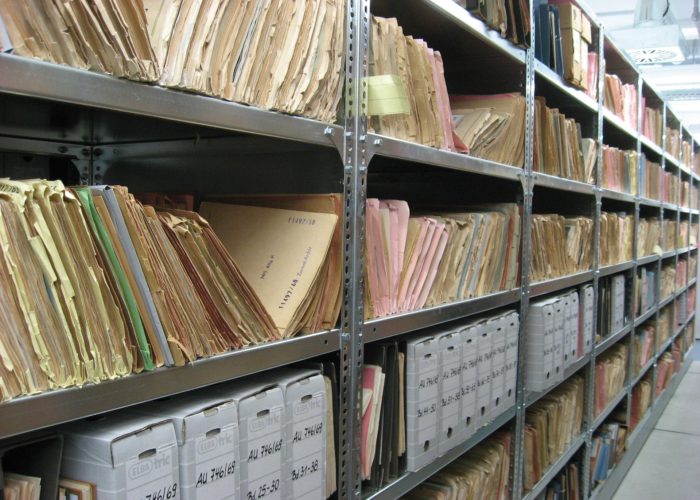
Images are for demo purposes only and are properties of their respective owners. ROMA by ThunderThemes.net

Skip to toolbar