Daily Archives: May 12, 2017

This image is a student examplar of a mindmap created on Lucidchart mindmapping software. The main concept, media messages, is at the centre. Radiating out from media messages are three concepts: targeted advertising, product placement, and stealth advertising. Connected to each of the three terms are examples of student-generated definitions for each.
0

A Constructivist Approach to Teaching Media Studies Using Google Drive

Abstract

In this paper we consider online teaching and learning from a constructivist pedagogic perspective and illustrate how learning theory connects to teaching practice in online contexts. To do this we employ an Ontario Media Studies grade 11 course unit to explain how Google Drive applications provide the necessary tools to facilitate constructivist online learning. The media studies unit is a culmination of years of iterations and reflection on the delivery and efficacy of media lessons online.  First, the Google online learning environment (GOLE) is discussed in relation to constructivist learning theory, and the grade 11 media studies unit objectives and expectations are explained. Second, the applicability of various Google Drive tools for the constructivist teaching and learning activities related to the unit are considered. We then focus on how the media studies unit will be taught using the GOLE. The administration and unit plan are outlined and decisions regarding learning activities and various Google Drive tools are justified. Finally, two lessons are described in detail to illustrate how constructivist learning theory informs the teaching of various unit tasks and activities. It is our hope that in sharing this sample unit and accompanying theory, other educators can learn from, and adapt our work for their own courses.

Introduction

In the past twenty years, a series of profound technological developments has impacted education. Newly emerging technological tools, applications, and online learning environments present opportunities and possibilities for peers to collaborate in new ways, irrespective of location. As seasoned educators, we have experienced the shift towards online learning in the form of blended and flipped classrooms as well as fully online, credited courses. An integral part of this shift is the role online tools play in facilitating learning, and how the implementation and use of these tools impacts instructional design and online pedagogy. As practitioners, we experiment with online tools to establish what does and does not work in a given learning context. This is important work. However, as educators we also have a responsibility to ensure learning theory and research inform our decision making when planning, reflecting on, and evaluating curriculum tasks, activities, and pedagogic practices.

In this paper we examine a sample media studies unit within a constructivist learning theory framework to show how Google Drive tools can be used as an effective online learning environment (OLE). Although Google tools have been discussed here in JITP and in other reputable publications such as Kairos, the aim of this paper is to illustrate how modern online pedagogic practice and tools connect to key founding theories of constructivism and online learning. The sample media studies unit is a culmination of years of iterations and reflection on the delivery and efficacy of media lessons online. The Ontario Media Studies grade 11 course curriculum is used to illustrate how various Google Drive tools provide the appropriate affordances to facilitate constructivist online learning. While this is an elective course for Ontario students, each grade in the secondary school curriculum contains a media studies strand in the mandatory English curriculum, hence the unit can be adapted for Ontario English courses. It is our hope that in sharing this sample unit and accompanying theory, other educators can learn from, adapt, and build on our work for their own use, not only in media-related courses, but in other subject areas as well. Prior to this, an overview of some of the more pertinent constructivist theories and approaches used in the design of the Google online learning environment (GOLE) is provided.

The Theory behind the Practice

Highly influential constructivist education writers and researchers (Dewey 1916; Piaget 1973; Vygotsky 1978; Bruner 1996) all agree that active learning and the construction of new knowledge is based on prior knowledge, and that the role of the instructor is that of facilitator. Moreover, Dewey (1916) argues that the improvement of the reasoning process is a key function of education. Indeed, utilizing problem-solving methods on personally meaningful and real life problems can act as motivation for students, engaging them in process of discovery. With this in mind, the design plan for our GOLE ensures students have every opportunity to utilize their critical thinking skills and prior knowledge, while making personally relevant choices about what topics and themes to investigate in the media studies unit.

Dewey (1938) also argues that interaction is one of the most important elements of a learning experience and that “an experience is always what it is because of a transaction taking place between an individual and what, at the time, constitutes his environment…” (Dewey 1938 cited in Vrasidas 2000, 1). The GOLE design acknowledges the reciprocal nature of learning interaction and the variety of relationships and communicative exchanges required to facilitate meaningful learning (Simpson & Galbo 1986). As the teacher facilitates activities throughout the course, they should consider the nature and types of interaction present in learning environments: learner-learner, learner-teacher, and learner-content (Moore 1989), as well as the ways these interactions translate to an online learning environment. This social constructivist approach stresses the critical importance of interaction with others in cognitive development and emphasizes the role of the social context in learning (Huang 2002).

Vygotsky (1978) details the concept of the Zone of Proximal Development (ZPD) and explains how important social interaction is in the psychological development of the learner. Vrasidas (2000) describes the ZPD as, “the distance between the actual developmental level as determined by independent problem solving and the level of potential development as determined through problem solving under adult guidance or in collaboration with more capable peers” (10). The GOLE features afford students multiple opportunities to learn with others and advance their knowledge through collaboration, working with a variety of learners in different activities using a selection of Google Drive tools.

Class Introduction, Overview of Media Studies Unit, and Expectations

The proposed unit for a media studies course is based on best practices and pedagogy from previous media studies lessons conducted in online learning environments. A Grade 11 English Media Studies course from the Ontario Curriculum is the site of this unit. Figure 1 provides a breakdown of the unit sections and related objectives/expectations.

Unit Sections Unit Objectives
A. Understanding and Interpreting Media Texts 1. Understanding and responding to media texts:

– demonstrate understanding of a variety of media texts;

2. Deconstructing media texts:

– deconstruct a variety of types media texts, identifying the codes, conventions, and techniques used and explaining how they create meaning.

B. Media and Society 1. Understanding media perspectives:

– analyze and critique media representations of people, issues, values, and behaviors;

2. Understanding the impact of media on society:

– analyze and evaluate the impact of media on society.

C. The Media Industry 1. Industry and audience:

– demonstrate an understanding of the ways in which the creators of media texts target and attract audiences;

2. Ownership and control:

– demonstrate an understanding of the impact of regulation, ownership, and control on access, choice and range of expression.

D. Producing and Reflecting on Media Texts 1. Producing media texts:

– create a variety of media texts for different audience;

2. Careers in media production:

– demonstrate an understanding of roles and career options in a variety of media industries;

3. Metacognition:

– demonstrate an understanding of their growth as media consumers, media analysts, and media producers.

Figure 1: Grade 11 English Media Studies from the Ontario Curriculum

Overall expectations addressed in the proposed unit include:

  • Industry and Audience: demonstrate an understanding of the ways in which the creators of media texts target and attract audiences.
  • Producing Media Texts: create a variety of media texts for different audiences and purposes, using effective forms, codes, conventions, and techniques.
  • Metacognition: demonstrate an understanding of their growth as media consumers, media analysts, and media producers.
  • Deconstructing Media Texts: deconstruct a variety of types of media texts, identifying the codes, conventions, and techniques used and explaining how they create meaning.
  • Understanding and Responding to Media Texts: demonstrate understanding of a variety of media texts. (The Ontario Curriculum Grades 11-12: English, 2007)

The Online Learning Environment: Why Google Drive?

When thinking about designing a constructivist OLE it is useful to consider how social constructivist theory can inform which tools to include in it. Vygotsky (1978) argues that people socially construct meaning and cultural norms and that learning is situated. Lave and Wenger (1991) suggest implicit and explicit knowledge is acquired through legitimate participation in situated communities of practice (CoP). Learners participate on the periphery of an activity within a CoP and as they participate and learn they become more knowledgeable. This enables them to move, if they wish, towards the center of the CoP and play a larger role in the communities’ activities. The central idea of situated learning is that learners appropriate an understanding of how to view meanings that are identified with the CoP, and that this process forms a learner’s identity within the learning community. For example, to become a television production assistant a person must appropriate the skills, values, and beliefs required in the practice of working in the television industry.

Hung and Chen (2001) provide a number of design considerations related to situated learning that can help learning designers decide what tools need to be included in an OLE to best support constructivist learning. They argue situatedness can be fostered by contextualized activities that encourage implicit and explicit knowledge acquisition such as projects based on the demands and requirements of the course curriculum. Furthermore, students need to be able to access their OLE in their situated contexts at any time and preferably on portable devices.

Hung and Chen (2001) suggest students also need to learn through reflection and internalize social learning through metacognitive activities such as journaling and asynchronous discussion. Google Drive is available online on portable devices and includes the weblog (blog) software Blogger in its suite of applications. Blogs can be used as interactive online journals, which can be personalized by the learner and used for important metacognitive reflective activities essential for deep learning (Sawyer 2008).

Also as Bereiter (1997) argues, electronic records of learners engaged in discourse on networked computers produce significant knowledge artifacts in and of themselves. These knowledge artifacts are essential for educators because “knowing the state of a learner’s knowledge structure helps to identify a learner’s zone of proximal development” (Boettcher 2007, 4); which in turn allows educators to understand where and when learner scaffolding is required within the OLE.

Hung and Chen (2001) also introduce the concept of commonality, the idea that learning is social and identity is formed through language, signs, and tools in CoPs. They explain that commonality can be fostered through learners having shared interests in books, for example, or having shared assignment problems. Learning designers can leverage commonality and embed tools in their OLEs that enable students to communicate and collaborate on their common interests.

Google Drive has several tools that enable collaboration through computer mediated discourse. These tools include Google Messenger (synchronous and asynchronous text and video messaging), Google Circles (synchronous and asynchronous text messaging and multimedia sharing), and Google Hangouts (synchronous video chat with up to nine people at once, face-to-face-to-face). The interactive nature of blogs also allows them to be used for communicating and sharing ideas within online CoPs. In terms of assessing student engagement and interaction, the revision history tool in Google Docs allows teachers to follow the contributions of each student by observing their writing and editing process, as well as the comments they post to their peers.

Google Drive has several other tools suitable for the online administration of courses. Gmail, the email application, can be used for formal teacher-student correspondence and the distribution of grades and other important announcements. Google Calendar is suitable for updates about the syllabus and deadlines and alerts regarding the course. Google Docs can be used to construct online surveys and polls, often used by constructivist educators to allow learners to vote on aspects of the course they would like to change in some way or for students conducting research of their own. In addition, Google Drive folders can house the course documents; the syllabus, readings, FAQs, and sign up forms can be accessed and updated from anywhere at any time. Student folders can be created on Google Drive for students to upload their work. Educators can use Google Hangouts to discuss group work in online video conferences. Furthermore, YouTube (part of Google) is an ideal platform to present digital artifacts that illustrate project based learning. The affordances Google Drive technology provides learners are numerous (see figure 2).

Quinton (2010) notes that it is essential for student learning that dynamically constructed learning environments be customized to meet the preferences and needs of individual learners in OLEs. The integrated nature of Google Drive enables all course communication, discussion, administration, and student work presentation to be fully integrated and customized to the learners’ needs. Users can personalize their settings and receive updates and notifications about all activity on the course. The GOLE enables students to communicate informally, fostering social presence, either by using one-to-one synchronous messages on Google Messenger, or by setting up their own Google Circle for group chat.

Formal discussions and reflection are afforded by Google Circles, Google Hangouts, and Blogger. Note, Google Hangouts enables synchronous video conferencing. This affordance is particularly useful for teaching and learning because OLEs often do not enable the interactants to see one another’s paralanguage, making the possibility of misunderstanding common, particularly for people from different cultural backgrounds (Dillon, Wang, & Tearle 2007).

An Illustration of the Google Online Learning Environment (GOLE).

Figure 2. An Illustration of the Google Online Learning Environment (GOLE).

Educators and groups of students can see, hear, and talk to each other at scheduled times using Google Hangouts, which has the potential to really boost the social, teaching, and, subsequently, the cognitive presence on GOLE courses. Students have numerous customizable applications to compose and display their learning, such as the Blogger, YouTube, and Google Presentation applications as well as word processing, drawing, and spreadsheet software. All these applications empower users to share and collaborate with each other and determine who can see and contribute to whatever they are working on prior to when it is presented for feedback. Used appropriately, the tools in Google Drive facilitate distributed constructionism, whereby learner knowledge emerges from the distributed discourses and knowledge artifacts they have access to in their OLE (Salomon 1994).

Administration and Unit Plan

From our experience teaching in OLEs, we conceive three key objectives at the course start: acclimatizing students to the online environment, establishing a community of learners, and making explicit the goals and objectives of the course. Early peer to peer and peer to instructor interaction is essential because, as Garrison & Arbaugh (2007, 60) point out, “it takes time find a level of comfort and trust, develop personal relationships, and evolve into a state of camaraderie.” Furthermore, positive social climates promote the rapid mastery of the hidden curriculum and enhances group tasks, self-disclosure, and socio-emotional sharing (Michinov, Michinov, & Toczek-Capelle 2004).

Therefore, one of the first activities in our unit plan requires students to create a biography using general questions and prompts from the teacher, and to share it using Google Docs. For example, we incorporate a simple media studies-related icebreaker using threaded discussions. Students post to the discussion board three personality traits, three favorite television shows, three favorite musicians, and three most used websites. Students are then asked to find at least three other students they have something in common with and write a response. In our experience, sharing commonalities and interests builds rapport and community in peer groups, particularly if this is done at the start of the course.

At the same time, educators must be mindful of critical pedagogy and how identity can play out in online environments. While the opportunity for disembodiment and the de-emphasis on race, class, and gender in virtual environments can lead to many positive possibilities, caution is warranted. As Dare (2011, 3) argues “the constitution of the online classroom as a color-blind space free of raced and sexed bodies is one which deserves greater reflection by examining the implications of ‘disembodying’ students and instructors in the virtual classroom, within the context of classes about race, gender, and globalization.” Such awareness is a necessity and instructors should work to create an inclusive, supportive, and non-threatening community. We have found the best practice is to allow each student to regulate how and what they choose to share about their identity with their peers over time.

During the first week, students are asked to watch an introductory YouTube video created by the instructor using screen capture software such as Jing. The video serves to welcome students and provide a virtual tour of the Google Drive platform, which assists students in locating administrative information to begin the course. All Administrative documents (course outline, assessment and evaluation information, online etiquette, and so on) need to be detailed and explicit to reduce uncertainty, and they should remain in one Google Doc folder for easy reference.

In the administrative section, students should also have access to their grades and feedback through the Google Spreadsheets feature. Students require opportunities to play an active role in their learning process and self-evaluation, through the negotiation of course objectives, content, and evaluation. In previously taught courses, our students have written reflections alongside the teacher-produced grade reports, putting the onus on students to take responsibility for their progress and next steps. Active participation, a central tenet of constructivism, increases the likelihood of embracing and accomplishing tasks used to facilitate learning (Vrasidas 2000).

Finally, a section for technical help should be made available to students using the Google Communities feature. Here, students can post questions and discuss technical issues they may be facing with Google Drive tools, allowing them to collaboratively diagnose problems and find solutions. In our courses, we encourage students to ask course and technical questions in the group forums rather than emailing the instructor. Doing so allows an opportunity for other students to come forward and support others with their knowledge, while also reducing repetitive emails to the instructor with the same questions. This feature “connect[s] people to people and information, not people to machines[,]” and enables students to “engage in collaborative knowledge production and facilitation of understanding—in effect, a connected network of mentors/ interest /practice” (Quinton 2010, 346-47). A high level of teacher presence is required at this stage to monitor the OLE and ensure that any outstanding issues are fully resolved in a timely manner.

Sample Unit Plan: Our Mediated Environment

The sample unit provided below highlights the type of lessons, activities, exercises, and assignments students engage in throughout the course. (Some lesson plans have been adapted from curriculum materials freely available at Mediasmarts.ca and the Association for Media Literacy).

Part One: Marketing to Teens

Throughout the first unit (3-4 weeks), the teacher should moderate class discussions, and explicitly model some of the skills, strategies, and critical thinking techniques that students will need to acquire for moderating future class discussions. As Vrasidas (2000) points out, “having students work in groups to moderate discussions, organize debates, summarize points, and share results will help them achieve their full potential” (10). Following the first unit, pairs of students should select a week to moderate the discussions (based on a topic/ theme of interest) in partnership with the teacher.

In addition to modeling discussion-moderation techniques, the teacher can provide a tip sheet of strategies and offer constructive feedback during their moderation period. As Brown, Collins, and Duguid (1989) conclude, “to learn [how] to use tools as practitioners use them, a student, like an apprentice, must enter that community and its culture. Thus, in a significant way, learning is […] a process of enculturation” (33). Furthermore, research demonstrates that teacher presence plays an important role in enabling students to reach the highest levels of inquiry (Garrison et al. 2001; Luebeck & Bice 2005).

Lesson 1

Students are assigned two readings online: How Marketers Target Teens and Advertising: It’s Everywhere (Media Smarts n.d.) to introduce concepts such as psychology and advertising, targeted advertising, building brand loyalty, ambient and stealth advertising, commercialization in education, and product placement. Students begin the first threaded discussion using Google Circles with a series of questions and prompts regarding the ubiquitous nature of advertisements targeted at youth. For example, guided prompts might ask questions such as “why are youth important targets for marketers?” “how do marketers reach teens?” or “which media advertisements do students feel have the greatest appeal and why?” The quality of guiding questions directly impacts the quality of responses and interactions between students. As evidence shows, the questions initiating online discussion also play an important role in the type of cognitive activity present in online discussions (Arnold & Ducate 2006).

Activity 1: Research

For this activity, students take a 10-15-minute walk in their local neighborhood, and they note the type and location of all advertisements they encounter (on bus shelters, billboards, newspaper boxes, bike racks, people’s clothes, shopping carts, buses, and so on). They then share their Google Map coordinates and a screenshot to highlight their selected route and share their findings with the rest of the class using Google Presentation. Students then form groups of four in a threaded discussion group to further examine one another’s Advertisement (Ad) Walks. Throughout this activity, students should be encouraged to use a selection of knowledge sources such as libraries, museums, and email exchanges with industry professionals. Asking students to engage in learning with activities such as Ad Walks places them in the center of their learning so “teachers will no longer be [seen as] the only source of expertise” or the only resource (Sawyer 2008, 8). Next, students are asked to consider the target audience for the ads and speculate on the rationale for the location of advertisements (i.e. advertisements targeted at teens are often located close to high schools and shopping malls). In a threaded discussion with teacher prompts, students should have an opportunity to examine the difference in advertising tactics on reservations, in rural, suburban, and urban environments; hence sharing “their situated experiences and knowledge with one another (Dare 2011,10).

Dewey (1916) argues that learning results from our reflections on our experiences as we endeavor to make sense of them; therefore, students should also be asked to compare and comment on the extent of media advertisements in their own homes (internet, television, magazines, radio etc.) and reflect on their findings using the blog and guided questions prepared by the teacher. The teacher should also ask students to read at least two student blog posts and to post comments on each other’s reflections. This activity is intended to increase student motivation and provide authenticity to the learning process, as students will know that there is an active online audience for the online artifacts they are creating (Resnick 1996). The use of technology and other cultural tools (to communicate, exchange information, and construct knowledge) is fundamental in constructivism because as Vrasidas (2000, 7) argues “knowledge is constructed through social interaction and in the learner’s mind.”

Activity 2: Connecting Media Concepts

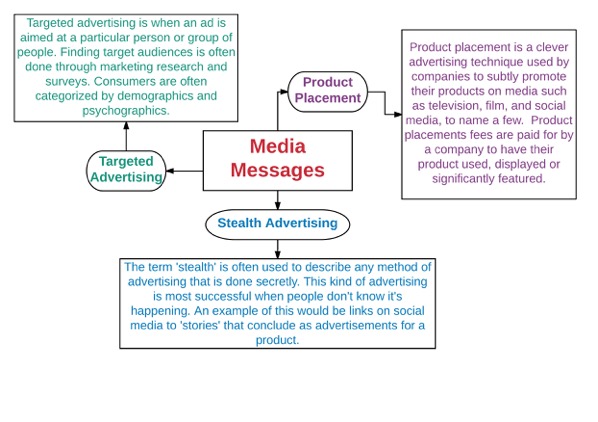
At the beginning of the course, students should be given the choice to select a unit that holds particular interest to them. In small groups (3-4), they are then given the responsibility for creating a mind map that demonstrates the connections and intersections of new concepts they have been exposed to. Using a mind map, the student groups work collectively to define each of the concepts and identify and illustrate connections among meanings. For example, the unit highlighted in this paper introduces stealth advertising and product placement. These concepts can be connected by their approach; both are non-traditional forms of advertising and are often embedded in other forms of media that contain covert messaging (see figure 3 for student exemplar). Mind mapping tools such as Lucidchart can be located in Google Docs add-ons. Teachers are encouraged to review all the add-on features and extensions that will best suit the needs of their students.

This image is a student examplar of a mindmap created on Lucidchart mindmapping software. The main concept, media messages, is at the centre. Radiating out from media messages are three concepts: targeted advertising, product placement, and stealth advertising. Connected to each of the three terms are examples of student-generated definitions for each.

Figure 3. Mind map student exemplar that demonstrates the connections and intersections of new concepts they have been exposed to.

This ongoing constructed resource shifts and grows throughout the course as students manipulate the document to build new meanings together. This nurtures the collective cognitive responsibility of the class, whereby “responsibility for the success of a group effort is distributed across all the members rather than being concentrated in the leader” (Scardamalia 2002, 2). The students are made responsible for their own learning and should ensure that their classmates “know what needs to be known” (ibid.). This is a particularly effective way for knowledge-building communities to form and grow because collaborative activities need to involve the exchange of information and the design and construction of meaningful artifacts for learners to construct and personalize the knowledge (Resnick 1996). To consolidate and distribute learning, this activity should be repeated for each of the five units in the course.

Part Two: Decoding Media Messages

Lesson 2

In this lesson, students explore the values and beliefs hidden behind advertising messages by analyzing a selection of print, audio, and video advertisements. Students watch an introductory video on “values and media messages” on YouTube (created by the teacher). The teacher video should contain an explanation of how the two media frameworks used throughout the course (The Eight Key Concepts of Mass Media and the Eddie Dick Media Triangle; See figure 4) and how they pertain to decoding and deconstructing advertising and marketing messages. The video provides an introductory explanation of the concepts being discussed in the course and adds important elements of teaching presence such as focusing discussion, sharing meaning, and building knowledge (Garrison et al. 2001). Both frameworks should be made available in the class Google Docs folder titled Administration.

To further their understanding of the constructed nature of media advertisements, students are also asked to watch the Dove Evolution Commercial on YouTube, along with one of the parodies for the Dove Evolution Commercial that can also be found on YouTube. Using their online journals, students then write a reflection on their personal reaction to both the commercial and a Dove parody video, and then identify some of the key elements found on the Media Triangle to arrive at intended and unintended meanings. Online journaling is considered an aspect of cognitive presence, defined as “the extent to which learners are able to construct and confirm meaning through sustained reflection and discourse” (Garrison & Arbaugh 2007, 161) in which students work through the stages of inquiry and arrive at their own meanings through reflective practice.


This is a diagram depicting the Eddie Dick Media Triangle. At the centre of the diagram is a triangle shape with the term "media messages" inside. Outside of the triangle are three concepts: production, audience, and text. There are three double-headed arrows just outside of the triangle to signify the interconnectedness of the three concepts. Below each of the concepts are corresponding questions intended to assist students in media deconstruction activities. An example of such questions is, "in what ways does this text tell a story? Does it connect to a larger story?"

Figure 4: The Key Concepts of Mass Media and the Eddie Dick Media Triangle. Adapted from http://frankwbaker.com/mediatriangle.htm

Activity 3: Group Presentation

Through discussion in small groups using Google Circles, students deconstruct one advertisement of their choice to be presented to the class using the prompts on the Media Triangle handout. The objective is for students to deepen their awareness and understanding about the explicit and implicit values and meanings associated with their selected advertisement. The use of Google Circles enables the teacher to view what is being discussed and provides the necessary scaffolding (Vygotsky 1978) for the learners to continue to extend their ZPD. Furthermore, working in groups on collaborative activities facilitates social presence in online courses as it enables learners to “project themselves socially and emotionally” (Garisson & Arbaugh 2007) and develop a sense of community and improve and practice “real life” working relationships in online courses.

Using Google Presentation feature, students upload their work in a shared folder in Google Drive for the rest of the class to evaluate. In an asynchronous exercise, students are asked to view all presentations (about 4-5) and offer a critique for each work in Google Circles. Having peers critique group presentations produces further insights/perspectives the group may have overlooked or not recognized. As a result, students are more likely to gain a deeper understanding from “the expertise (knowledge and skills), perspectives and opinions” of their peers and “draw from each other’s strengths” and “make use of each other’s abilities” (Hung & Chen 2001, 7) to help construct knowledge.

Activity 4: Reflection

Using their blogs, each student repeats the process of activity 3 using a media advertisement that has personal relevance or meaning. Students also respond to guided prompts such as, “Explain one way the advertisement communicates to its audience and what one resulting meaning is for you.” Dewey states that “learning results from our reflections on our experiences, as we strive to make sense of them” (Russell 1999, 2); and through reflection, students “externalize and articulate their developing knowledge, [and] they learn more effectively” (Sawyer 2008, 7).

Activity 5: Parody Advertisement Media Production

In this activity, students work either in pairs, independently, or in a small group to create of a parody advertisement. Using their new knowledge about advertising strategies and their understanding of the media construction frameworks from prior activities, students deconstruct one parody advertisement and then create their own media artifact with a focus on branding: for example, a parody print advertisement of their own, a short commercial, a radio jingle, or an audiovisual slideshow.

To introduce the concept of branding, students view a four-minute segment of the award-winning Canadian documentary, The Corporation. In this segment, Canadian activist Naomi Klein discusses the impact of corporate branding on individuals and culture (Note: This YouTube video is a legal chapter segment shared online by The Corporation Director Mark chbar). In a threaded discussion on Google Circles, the teacher prompts discussion by asking students what comes to mind when they hear the terms ‘brand’ or ‘branding,’ and what they think about the video.

Students should also be provided with the following definitions:

Branding: the process involved in creating a unique name and image for a product in the consumer’s mind, mainly through advertising campaigns with a consistent theme. Branding aims to establish a significant and differentiated presence in the market that attracts and retains loyal customers. (Business Dictionary, n.d.)

Corporate branding: An attempt to attach higher credibility to a new product by associating it with a well-established company name. Unlike a family-branding (which can be applied only to a specific family of products), corporate branding can be used for every product marketed by a firm. (Business Dictionary, n.d.)

As a class, students examine the iconic brand Nike. The teacher forms small groups of students who have not yet worked together and these groups develop responses to the following questions adapted from lessons available on the Association for Media Literacy (AML) website. This can be completed on a collaborative document in Google Docs and later transferred to the threaded discussion to share with the rest of the class. Students respond to the following prompts:

  • List the positive (intended), neutral, and negative values/ messages that come to mind when considering the brand, Nike. (Responses may range from: cool, stylish, youthful, attractive, wealthy, iconic, patriotism and child labor, mass production and the environment, human rights violation, etc.).
  • Using the Media Triangle framework, how does Nike portray their intended values?
  • How have you been informed about the neutral and negative values?

When students have completed the responses in their small groups, they share their findings with the rest of the class on the threaded discussion and respond to other groups.

Students will then explore the concept of parody advertisements using a Nike Adbusters parody advertisement (see figure 5).

A photograph of Tiger Woods the golfer in his Nike branded cap and top on the left. On the right, a photoshopped photograph of Tiger Woods in a suit with the Nike 'swoosh' Logo behind him that looks as if it is going through his head, and his smile has been photoshopped into the Nike 'swoosh' logo.

Figure 5: Nike vs. Tiger Woods: Image shows two different photographs of Tiger Woods. Adapted from: http://www.adbusters.org/spoofads/unswooshing/

As a reflection assignment to be completed on their blogs, the teacher asks students to consider the following statement from the Association of Media Literacy:

Parody advertisements are a fun way to analyze popular advertisements, especially advertisers who are selling products, which have social and political implications.  When you spoof an advertisement, you take elements of the message that give it power and turn the message around to show that it is ridiculous or even untrue. (Association for Media Literacy, March 25, 2017)

Reflection Questions:

  • What elements make this a parody advertisement?
  • What was the first thing you noticed about the advertisement, what is being made fun of? Why is humor an effective way to make a point?
  • What elements are different or the same compared to the real advertisement? (see codes and conventions on Media Triangle Framework)
  • Does the parody advertisement change how you perceive the original advertisers?
  • What is the value message in this parody advertisement? If you could write a statement message for the parody advertisement, what would it be (2-3 sentences)?

To further distribute knowledge, learning, and social and cognitive presence, students are then asked to comment on a student blog they have not visited during the course. As Cole and Engestrom (1993, 15) reason, one person cannot contain all the knowledge or culture of the group that they identify with, thus knowledge can and should be, “distributed among people within a cultural group.”

With background experience in branding and the parody advertisement critique experiences now in place, students are well prepared for the final activity: the creation of a parody advertisement. Students form groups or pairs based on their personal interests (radio jingle, video, magazine advertisement, website etc.). As Resnick (1996) argues, when personally meaningful artifacts are constructed, new knowledge is constructed with greater effectiveness. Students should be encouraged to use freely accessible Google+ applications such as Pixlr (image editing), UJAM (audio editing) and Magisto (video editing). By having students use popular applications from their own cultural context, the task is rendered more authentic, lessening the often ‘transmuted’ activities students may experience in school (Brown, Collins & Duiguid 1989). Student groups create a Google Community to carry out the following tasks:

  • Select a brand to spoof (ideas can be found on Adbusters website)
  • Identify the intended values and value messaging of the brand and their advertisements
  • Select the new value message the group wishes to convey and create a slogan or tagline
  • Using Google+ applications and tools, create parody advertisement in the Google Community.

Once the parody advertisements have been completed, each group signs up for a synchronous video conference with the teacher using Google Hangouts (up to nine participants) to take part in a group critique of their work. Students working independently can be grouped into one critique group. Other students will be encouraged to attend the Google Hangouts session which should also be recorded for students who wish to view the critique afterwards, as well as for teacher evaluation and assessment.

Conclusion

This paper has considered online learning from a constructivist perspective and applied a selection of the key concepts and ideas of influential constructivist thinkers to the design of an online media studies course for 11th graders studying in Ontario. The affordances Google Drive offers to constructivist pedagogic practice have been shown to be numerous. The integrated nature of the suite of applications and the communication, sharing, presentation and administration possibilities the software affords educators planning an online course make Google Drive a very useful pedagogic tool. The central idea of constructivism—that knowledge is constructed in people when incoming information meets and integrates with their existing experience and knowledge—has been discussed and illustrated using authentic current curriculum documents and teaching activities.

To encourage and facilitate constructivist learning, well thought out, student-centered learning tasks and activities that leverage the various affordances of the technology need to be devised, monitored, reviewed, and added to, to ensure the learning experiences of students and educators constantly extend. The construction of knowledge is both an individual and group endeavor that changes from moment to moment and from an educational perspective from course to course. Individual learners that make up the community of any course shape its conversations, its direction, and consequently the learning that happens within it. The fluid nature of this kind of learning makes it an engaging and stimulating way to learn. It is the work of online learning designers to ensure that when they are making pedagogical decisions that they fully exploit the affordances of the technology they use to promote student-centered activities that nurture and sustain learner engagement and stimulation.

Bibliography

Arnold, Nike, and Ducate, Lara. 2006. “Future Foreign Language Teachers’ Social and Cognitive Collaboration in an Online Environment.” Language Learning & Technology 10:1, 42-66. Accessed October 6, 2016. http://llt.msu.edu/vol10num1/pdf/arnoldducate.pdf.

Bereiter, Carl. 1997. “Situated Cognition and How to Overcome it.” In Situated Cognition: Social, Semiotic, and Psychological Perspectives, edited by David Kirshner and James Anthony Whitson. Psychology Press.

Brown, John Seely, Allan, Collins and Duguid, Paul. 1989. “Situated Cognition and the Culture of Learning.” Educational Researcher 18:1, 32-42.

Boettcher, Judith. V. 2007. “Ten Core Principles for Designing Effective Learning Environments: Insights from Brain Research and Pedagogical Theory.” Innovate: Journal of Online Education, 3:3, 2. Accessed October 6, 2016. http://nsuworks.nova.edu/cgi/viewcontent.cgi?article=1099&context=innovate.

Bruner, Jerome S. 1996. The Culture of Education. Harvard University Press.

Business Dictionary (n.d). Branding. Accessed October 6, 2016. http://www.businessdictionary.com/definition/branding.html.

Cole, Michael, and Engeström, Yrjö. 1993. “A Cultural-Historical Approach to Distributed Cognition.” In Distributed cognitions: Psychological and Educational Considerations, edited by Gavriel Salomon, 1-46. NY: Cambridge University Press.

Dare, Alexa. 2011. “(Dis) Embodied Difference in the Online Class: Vulnerability, Visibility, and Social Justice.” Journal of Online Learning and Teaching 7:2, 279-287. Accessed October 6, 2016. http://jolt.merlot.org/vol7no2/dare_0611.htm.

Dewey, John. 1916. Democracy and Education. The Free Press: New York.

Dillon, Patrick, Wang, Ruolan and Tearle, Penni. 2007. “Cultural Disconnection in Virtual Education.” Pedagogy, Culture & Society 15:2, 153-174. Accessed October 6, 2016. http://dx.doi.org/10.1080/14681360701403565.

Garrison, D. Randy, Anderson, Terry, and Walter Archer. 2001. “Critical thinking and computer conferencing: A model and tool to assess cognitive presence.” American Journal of Distance Education 15: 7-23.

Garrison, D. Randy, and J. Arbaugh, Ben. 2007. “Researching the Community of Inquiry Framework: Review, Issues, and Future Directions.” The Internet and Higher Education 10:3, 157-172.

Huang, Hsiu‐Mei. 2002. “Toward constructivism for adult learners in online learning environments.” British Journal of Educational Technology 33:1, 27-37.

Hung, David WL, and Chen, Der-Thanq. 2001. “Situated Cognition, Vygotskian Thought and Learning from the Communities of Practice Perspective: Implications for the Design of Web-Based E-learning.” Educational Media International 38:1, 3-12.

Lave, Jean, and Wenger, Etienne. 1991. Situated Learning: Legitimate Peripheral Participation. Cambridge University Press.

Luebeck, Jennifer L., and Bice, Lawrence R. 2005. “Online discussion as a mechanism of conceptual change among mathematics and science teachers.” Journal of Distance Education 20:2, 21-39.

Lulee, Su Tuan. 2010. “Basic Principles of Interaction for Learning in Web-based Environment.” Educause Review 7:2 1-32. Accessed October 6, 2016. http://www.educause.edu/sites/default/files/Basic%20Principles%20of%20Interaction%20for%20Learning%20in%20Web-Based%20Environment%20-%20feedback%20from%20Fahy-revised.pdf.

Moore, Michael, G. 1989. Three Types of Interaction. The American Journal of Distance Education 3:2, 1-6. Accessed October 6, 2016. http://dx.doi.org/10.1080/08923648909526659.

Michinov, Nicolas, Michinov, Estelle, and Toczek-Capelle, Marie-Christine. 2004. “Social Identity, Group Processes, and Performance in Synchronous Computer-Mediated Communication.” Group Dynamics: Theory, Research, and Practice 8:1, 27-39.

Pea, Roy D. 1993. “Practices of Distributed Intelligence and Designs for Education.” In Distributed Cognitions: Psychological and Educational Considerations. Edited by Gavriel Salomon, 47-87. NY: Cambridge University Press.

Piaget, Jean. 1973. To Understand is to Invent: The Future of Education. Grossman, New York.

Quinton, Stephen, R. 2010. “Principles of effective learning environment design.” In Looking Toward the Future of Technology-enhanced Education: Ubiquitous Learning and the Digital Native, editors Martin Ebner, Mandy Schiefner ,327-352. IGI Global.

Resnick, Mitchel. 1996. “Distributed Constructionism.” In Proceedings of the 1996 International Conference on Learning Sciences, 280-284. International Society of the Learning Sciences.

Russell, B. 1999. “Experience–Based Learning Theories. The Informal Learning Review. Informal Learning Experience.” Informal Learning Website. Accessed October 6, 2016. http://www.informallearning.com/archive/1999-0304-a.htm.

Salomon, Gavriel. 1993. Distributed Cognitions: Psychological and Educational Considerations. Cambridge: Cambridge University Press.

Scardamalia, Marlene. 2002. “Collective Cognitive Responsibility for the Advancement of Knowledge.” In Liberal Education in a Knowledge Society, edited by Barry Smith, 67-98. Chicago: Open Court.

Sawyer, R. Keith. 2008. “Optimising Learning Implications of Learning Sciences Research.” In Innovating to learn, learning to innovate, edited by Centre for Educational Research and Innovation.Organisation for Economic Co-operation and Development. 45-65.

Simpson, Raymond. J., and Galbo, Joseph. J. 1986. Interaction and Learning: Theorizing on the art of teaching. Interchange, 17:4, 37-51.

Ontario Ministry of Education. 2007. The Ontario Curriculum Grades 11-12: English (Revised). Accessed from http://www.edu.gov.on.ca/eng/curriculum/secondary/english1112currb.pdf.

Vrasidas, Charalambos. 2000. “Constructivism Versus Objectivism: Implications for Interaction, Course Design, and Evaluation in Distance Education.” International Journal of Educational Telecommunications 6:4, 339-362. Accessed October 6, 2016. http://vrasidas.com/wp-content/uploads/2007/07/continuum.pdf.

Vygotsky, Lev Semenovich. 1978. Mind in Society: The Development of Higher Psychological Processes. Harvard University Press, Cambridge, USA.

About the Authors

Chris Harwood has taught English for academic purposes, and writing composition for over 20 years in high schools and universities around the world. He recently completed a PhD in Language and Literacies Education at OISE, University of Toronto, and is currently teaching critical reading and writing in Japan.

Alison Mann is an award-winning media and film educator with over 18 years of teaching experience. She is currently pursuing a PhD. at the University of Toronto focusing on critical media literacy, online learning environments at the secondary level and intercultural communication.

Photograph of a course catalog
0

A Survey of Digital Humanities Programs

Abstract

The number of digital humanities programs has risen steadily since 2008, adding capacity to the field. But what kind of capacity, and in what areas? This paper presents a survey of DH programs in the Anglophone world (Australia, Canada, Ireland, the United Kingdom, and the United States), including degrees, certificates, and formalized minors, concentrations, and specializations. By analyzing the location, structure, and disciplinarity of these programs, we examine the larger picture of DH, at least insofar as it is represented to prospective students and cultivated through required coursework. We also explore the activities that make up these programs, which speak to the broader skills and methods at play in the field, as well as some important silences. These findings provide some empirical perspective on debates about teaching DH, particularly the attention paid to theory and critical reflection. Finally, we compare our results (where possible) to information on European programs to consider areas of similarity and difference, and sketch a broader picture of digital humanities.

Introduction

Much has been written of what lies inside (and outside) the digital humanities (DH). A fitting example might be the annual Day of DH, when hundreds of “DHers” (digital humanists) write about what they do and how they define the field (see https://twitter.com/dayofdh). Read enough of their stories and certain themes and patterns may emerge, but difference and pluralism will abound. More formal attempts to define the field are not hard to find—there is an entire anthology devoted to the subject (Terras, Nyhan, and Vanhoutte 2013)—and others have approached DH by studying its locations (Zorich 2008; Prescott 2016), its members (Grandjean 2014a, 2014b, 2015), their communication patterns (Ross et al. 2011; Quan-Haase, Martin, and McCay-Peet 2015), conference submissions (Weingart 2016), and so forth.

A small but important subset of research looks at teaching and learning as a lens through which to view the field. Existing studies have examined course syllabi (Terras 2006; Spiro 2011) and the development of specific programs and curricula (Rockwell 1999; Siemens 2001; Sinclair 2001; Unsworth 2001; Unsworth and Butler 2001; Drucker, Unsworth, and Laue 2002; Sinclair & Gouglas 2002; McCarty 2012; Smith 2014). In addition, there are pedagogical discussions about what should be taught in DH (Hockey 1986, 2001; Mahony & Pierazzo 2002; Clement 2012) and its broader relationship to technology, the humanities, and higher education (Brier 2012; Liu 2012; Waltzer 2012).

This study adds to the literature on teaching and learning by presenting a survey of existing degree and certificate programs in DH. While these programs are only part of the activities that make up the broader world of DH, they provide a formal view of training in the field and, by extension, of the field itself. Additionally, they reflect the public face of DH at their institutions, both to potential students and to faculty and administrators outside of DH. By studying the requirements of these programs (especially required coursework), we explore the activities that make up DH, at least to the extent that they are systematically taught and represented to students during admissions and recruitment, as well as where DH programs position themselves within and across the subject boundaries of their institutions. These activities speak to broader skills and methods at play in DH, as well as some important silences. They also provide an empirical perspective on pedagogical debates, particularly the attention paid to theory and critical reflection

Background

Melissa Terras (2006) was the first to point to the utility of education studies in approaching the digital humanities (or what she then called “humanities computing”). In the broadest sense, Terras distinguishes between subjects, which are usually associated with academic departments and defined by “a set of core theories and techniques to be taught” (230), and disciplines, which lack departmental status yet still have their own identities, cultural attributes, communities of practice, heroes, idols, and mythology. After analyzing four university courses in humanities computing, Terras examines other aspects of the community such as its associations, journals, discussion groups, and conference submissions. She concludes that humanities computing is a discipline, although not yet a subject: “the community exists, and functions, and has found a way to continue disseminating its knowledge and encouraging others into the community without the institutionalization of the subject” (242). Terras notes that humanities computing scholars, lacking prescribed activities, have freedom in developing their own research and career paths. She remains curious, however, about the “hidden curriculum” of the field at a time when few formal programs yet existed.

Following Terras, Lisa Spiro (2011) takes up this study of the “hidden curriculum” by collecting and analyzing 134 English-language syllabi from DH courses offered between 2006–2011. While some of these courses were offered in DH departments (16, 11.9%), most were drawn from other disciplines, including English, history, media studies, interdisciplinary studies, library and information science, computer science, rhetoric and composition, visual studies, communication, anthropology, and philosophy. Classics, linguistics, and other languages were missing. Spiro analyzes the assignments, readings, media types, key concepts, and technologies covered in these courses, finding (among other things) that DH courses often link theory to practice; involve collaborative work on projects; engage in social media such as blogging or Twitter; focus not only on text but also on video, audio, images, games, maps, simulation, and 3D modeling; and reflect contemporary issues such as data and databases, openness and copyright, networks and networking, and interaction. Finally, Spiro presents a list of terms she expected to see more often in these syllabi, including “argument,” “statistics,” “programming,” “representation,” “interpretation,” “accessibility,” “sustainability,” and “algorithmic.”

These two studies form the broad picture of DH education. More recent studies have taken up DH teaching and learning within particular contexts, such as community colleges (McGrail 2016), colleges of liberal arts and science (Alexander & Davis 2012; Buurma & Levine 2016), graduate education (Selisker 2016), libraries (Rosenblum, et al., 2016; Varner 2016; Vedantham & Porter 2016) and library and information science education (Senchyne 2016), and the public sphere (Brennan 2016; Hsu 2016). These accounts stress common structural challenges and opportunities across these contexts. In particular, many underscore assumptions made about and within DH, including access to technology, institutional resources, and background literacies. In addition, many activities in these contexts fall outside of formal degrees and programs or even classroom learning, demonstrating the variety of spaces in which DH may be taught and trained.

Other accounts have drawn the deep picture of DH education by examining the development of programs and courses at specific institutions, such as McMaster University (Rockwell 1999), University of Virginia (Unsworth 2001; Unsworth and Butler 2001; Drucker, Unsworth, and Laue 2002), University of Alberta (Sinclair & Gouglas 2002), King’s College London (McCarty 2012), and Wilfrid Laurier University (Smith 2014), among others. Abstracts from “The Humanities Computing Curriculum / The Computing Curriculum in the Arts and Humanities” Conference in 2001 contain references to various institutions (Siemens 2001), as does a subsequent report on the conference (Sinclair 2001). Not surprisingly, these accounts often focus on the histories and peculiarities of each institution, a “localization” that Knight (2011) regards as necessary in DH.

Our study takes a program-based approach to studying teaching and learning in DH. While formal programs represent only a portion of the entire DH curricula, they are important in several respects: First, they reflect intentional groupings of courses, concepts, skills, methods, techniques, and so on. As such, they purport to represent the field in its broadest strokes rather than more specialized portions of it (with the exception of programs offered in specific areas, such as book history and DH). Second, these programs, under the aegis of awarding institutions and larger accrediting bodies, are responsible for declaring explicit learning outcomes of their graduates, often including required courses. These requirements form one picture of what all DHers are expected to know upon graduation (at a certain level), and this changing spectrum of competencies presumably reflects corresponding changes in the field over time. Third, formal DH programs organize teaching, research, and professional development in the field; they are channels through which material and symbolic capital flow, making them responsible, in no small part, for shaping the field itself. Finally, these programs, their requirements, and coursework are one way—perhaps the primary way—in which prospective students encounter the field and make choices about whether to enroll in a DH program and, if so, which one. These programs are also consulted by faculty and administrators developing new programs at their own institutions, both for common competencies and for distinguishing features of particular programs.

In addition to helping define the field, a study of formal DH programs also contributes to the dialogue around pedagogy in the field. Hockey, for example, has long wondered whether programming should be taught (1986) and asks, “How far can the need for analytical and critical thinking in the humanities be reconciled with the practical orientation of much work in humanities computing?” (2001). Also skeptical of mere technological skills, Simon Mahony and Elena Pierazzo (2002) argue for teaching methodologies or “ways of thinking” in DH. Tanya Clement examines multiliteracies in DH (e.g., critical thinking, commitment, community, and play), which help to push the field beyond “training” to “a pursuit that enables all students to ask valuable and productive questions that make for ‘a life worth living’” (2012, 372).

Others have called on DH to engage more fully in critical reflection, especially in relation to technology and the role of the humanities in higher education. Alan Liu notes that much DH work has failed to consider “the relation of the whole digital juggernaut to the new world order,” eschewing even clichéd topics such as “the digital divide,” “surveillance,” “privacy,” and “copyright” (2012, 491). Steve Brier (2012) points out that teaching and learning are an afterthought to many DHers, a lacuna that misses the radical potential of DH for transforming teaching and professional development. Luke Walzer (2012) observes that DH has done little to help protect and reconceptualize the role of the humanities in higher education, long under threat from austerity measures and perceived uselessness in the neoliberal academy (Mowitt 2012).

These and other concerns point to longstanding questions about the proper balance of technological skills and critical reflection in DH. While a study of existing DH programs cannot address the value of critical reflection, it can report on the presence (or absence) of such reflection in required coursework and program outcomes. Thus, it is part of a critical reflection on the field as it stands now, how it is taught to current students, and how such training will shape the future of the field. It can also speak to common learning experiences within DH (e.g., fieldwork, capstones), as well as disciplinary connections, particularly in program electives. These findings, together with our more general findings about DH activities, give pause to consider what is represented in, emphasized by, and omitted from the field at its most explicit levels of educational training.

Methods

This study involved collection of data about DH programs, coding descriptions of programs and courses using a controlled vocabulary, and analysis and visualization.

Data collection

We compiled a list of 37 DH programs active in 2015 (see Appendix A), drawn from listings in the field (UCLA Center for Digital Humanities 2015; Clement 2015), background literature, and web searches (e.g., “digital humanities masters”). In addition to degrees and certificates, we included minors and concentrations that have formal requirements and coursework, since these programs can be seen as co-issuing degrees with major areas of study and as inflecting those areas in significant ways. We did not include digital arts or emerging media programs in which humanities content was not the central focus of inquiry. In a few cases, the listings or literature mentioned programs that could not be found online, but we determined that these instances were not extant programs—some were initiatives or centers misdescribed, others were programs in planning or simply collections of courses with no formal requirements—and thus fell outside the scope of this study. We also asked for the names of additional programs at a conference presentation, in personal emails, and on Twitter. Because our sources and searches are all English-language, the list of programs we collected are all programs taught in Anglophone countries. This limits what we can say about global DH.

For each program, we made a PDF of the webpage on which its description appears, along with a plain text file of the description. We recorded the URL of each program and information about its title; description; institution; school, division, or department; level (graduate or undergraduate); type (degree or otherwise); year founded; curriculum (total credits, number and list of required and elective courses); and references to independent research, fieldwork, and final deliverables. After identifying any required courses for each program, we looked up descriptions of those courses in the institution’s course catalog and recorded them in a spreadsheet.

Coding and intercoder agreement

To analyze the topics covered by programs and required courses, we applied the Taxonomy of Digital Research Activities in the Humanities (TaDiRAH 2014a), which attempts to capture the “scholarly primitives” of the field (Perkins et al. 2014). Unsworth (2000) describes these primitives as “basic functions common to scholarly activities across disciplines, over time, and independent of theoretical orientation,” obvious enough to be “self-understood,” and his preliminary list includes ‘Discovering’, ‘Annotating’, ‘Comparing’, ‘Referring’, ‘Sampling’, ‘Illustrating’, and ‘Representing’.

We doubt that any word—or classification system—works in this way. Language is always a reflection of culture and society, and with that comes questions of power, discipline/ing, and field background. Moreover, term meaning shifts over time and across locations. Nevertheless, we believe classification schema can be useful in organizing and analyzing information, and that is the spirit in which we employ TaDiRAH here.

TaDiRAH is one of several classification schema in DH and is itself based on three prior sources: the arts-humanities.net taxonomy of DH projects, tools, centers, and other resources; the categories and tags originally used by the DiRT (Digital Research Tools) Directory (2014); and headings from “Doing Digital Humanities,” a Zotero bibliography of DH literature (2014) created by the Digital Research Infrastructure for Arts and Humanities (DARIAH). The TaDiRAH version used in this study (v. 0.5.1) also included two rounds of community feedback and subsequent revisions (Dombrowski and Perkins 2014). TaDiRAH’s controlled vocabulary terms are arranged into three broad categories: activities, objects, and techniques. Only activities terms were used in this study because the other terms lack definitions, making them subject to greater variance in interpretation. TaDiRAH contains forty activities terms organized into eight parent terms (‘Capture’, ‘Creation’, ‘Enrichment’, ‘Analysis’, ‘Interpretation’, ‘Storage’, ‘Dissemination’, and ‘Meta-Activities’).

TaDiRAH was built in conversation with a similar project at DARIAH called the Network for Digital Methods in the Arts and Humanities (NeDiMAH) and later incorporated into that project (2015). NeDiMAH’s Methods Ontology (NeMO) contains 160 activities terms organized into five broad categories (‘Acquiring’, ‘Communicating’, ‘Conceiving’, ‘Processing’, ‘Seeking’) and is often more granular than TaDiRAH (e.g., ‘Curating’, ‘Emulating’, ‘Migrating’, ‘Storing’, and ‘Versioning’ rather than simply ‘Preservation’). While NeMO may have other applications, we believe it is too large to be used in this study. There are many cases in which programs or even course descriptions are not as detailed as NeMO in their language, and even the forty-eight TaDiRAH terms proved difficult to apply because of their number and complexity. In addition, TaDiRAH has been applied in DARIAH’s DH Course Registry of European programs, permitting some comparisons between those programs and the ones studied here.

In this study, a term was applied to a program/course description whenever explicit evidence was found that students completing the program or course would be guaranteed to undertake the activities explicitly described in that term’s definition. In other words, we coded for minimum competencies that someone would have after completing a program or course. The narrowest term was applied whenever possible, and multiple terms could be applied to the same description (and, in most cases, were). For example, a reference to book digitization would be coded as ‘Imaging’:

Imaging refers to the capture of texts, images, artefacts or spatial formations using optical means of capture. Imaging can be made in 2D or 3D, using various means (light, laser, infrared, ultrasound). Imaging usually does not lead to the identification of discrete semantic or structural units in the data, such as words or musical notes, which is something DataRecognition accomplishes. Imaging also includes scanning and digital photography.

If there was further mention of OCR (optical character recognition), that would be coded as ‘DataRecognition’ and so on. To take another example, a reference to visualization and other forms of analysis would be coded both as ‘Visualization’ and as its parent term, ‘Analysis’, if no more specific child terms could be identified.

In some cases, descriptions would provide a broad list of activities happening somewhere across a program or course but not guaranteed for all students completing that program or course (e.g., “Through our practicum component, students can acquire hands-on experience with innovative tools for the computational analysis of cultural texts, and gain exposure to new methods for analyzing social movements and communities enabled by new media networks.”). In these cases, we looked for further evidence before applying a term to that description.

Students may also acquire specialty in a variety of areas, but this study is focused on what is learned in common by any student who completes a specific DH program or course; as such, we coded only cases of requirements and common experiences. For the same reason, we coded only required courses, not electives. Finally, we coded programs and required courses separately to analyze whether there was any difference in stated activities at these two levels.

To test intercoder agreement, we selected three program descriptions at random and applied TaDiRAH terms to each. In only a handful of cases did all three of us agree on our term assignments. We attribute this low level of agreement to the large number of activities terms in TaDiRAH, the complexity of program/course descriptions, questions of scope (whether to use a broader or narrower term), and general vagueness. For example, a program description might allude to work with texts at some point, yet not explicitly state text analysis until later, only once, when it is embedded in a list of other examples (e.g., GIS, text mining, network analysis), with a reference to sentiment analysis elsewhere. Since texts could involve digitization, publishing, or other activities, we would not code ‘Text analysis’ immediately, and we would only code it if students would were be guaranteed exposure to this such methods in the program. To complicate matters further, there is no single term for text analysis in TaDiRAH—it spans across four (‘Content analysis’, ‘Relational analysis’, ‘Structural analysis’, and ‘Stylistic analysis’)—and one coder might apply all four terms, another only some, and the third might use the parent term ‘Analysis’, which also includes spatial analysis, network analysis, and visualization.

Even after reviewing these examples and the definitions of specific TaDiRAH terms, we could not reach a high level of intercoder agreement. However, we did find comparing our term assignments to be useful, and we were able to reach consensus in discussion. Based on this experience, we decided that each of us would code every program/course description and then discuss our codings together until we reached a final agreement. Before starting our preliminary codings, we discussed our understanding of each TaDiRAH term (in case it had not come up already in the exercise). We reviewed our preliminary codings using a visualization showing whether one, two, or three coders applied a term to a program/course description. In an effort to reduce bias, especially framing effects (cognitive biases that result from the order in which information is presented), the visualization did not display who had coded which terms. If two coders agreed on a term, they explained their codings to the third and all three came to an agreement. If only one coder applied a term, the other two explained why they did not code for that term and all three came to an agreement. Put another way, we considered every term that anyone applied, and we considered it under the presumption that it would be applied until proven otherwise. Frequently, our discussions involved pointing to specific locations in the program/course descriptions and referencing TaDiRAH definitions or notes from previous meetings when interpretations were discussed.

In analyzing our final codings, we used absolute term frequencies (the number of times a term was applied in general) and weighted frequencies (a proxy for relative frequency and here a measure of individual programs and courses). To compute weighted frequencies, each of the eight parent terms were given a weight of 1, which was divided equally among their subterms. For example, the parent term ‘Dissemination’ has six subterms, so each of those were assigned an equal weight of one-sixth, whereas ‘Enrichment’ has three subterms, each assigned a weight of one-third. These weights were summed by area to show how much of an area (relatively speaking) is represented in program/course descriptions, regardless of area size. If all the subterms in an area are present, that entire area is present—just as it would be if we had applied only the broader term in the first place. These weighted frequencies are used only where programs are displayed individually.

Initially, we had thought about comparing differences in stated activities between programs and required courses. While we found some variations (e.g., a program would be coded for one area of activities but not its courses and vice versa), we also noticed cases in which the language used to describe programs was too vague to code for activities that were borne out in required course descriptions. For this reason and to be as inclusive as possible with our relatively conservative codings, we compared program and course data simultaneously in our final analysis. Future studies may address the way in which program descriptions connect to particular coursework, and articulating such connections may help reveal the ways in which DH is taught (in terms of pedagogy) rather than only its formal structure (as presented here).

Analysis and visualization

In analyzing program data, we examined the overall character of each program (its title), its structure (whether it grants degrees and, if so, at what level), special requirements (independent study, final deliverables, fieldwork), and its location, both in terms of institutional structure (e.g., departments, labs, centers) and discipline(s). We intended to analyze more thoroughly the number of required courses as compared to electives, the variety of choice students have in electives, and the range of departments in which electives are offered. These comparisons proved difficult: even within an American context, institutions vary in their credit hours and the formality of their requirements (e.g., choosing from a menu of specific electives, as opposed to any course from a department or “with permission”). These inconsistencies multiply greatly in an international context, and so we did not undertake a quantitative study of the number or range of required and elective courses.

Program data and codings were visualized using the free software Tableau Public. All images included in this article are available in a public workbook at https://public.tableau.com/views/DigitalHumanitiesProgramsSurvey/Combined. As we discuss in the final section, we are also building a public-facing version of the data and visualizations, which may be updated by members of the DH community. Thus, the data presented here can and should change over time, making these results only a snapshot of DH in some locations at the present.

Anglophone programs

The number of DH programs in Anglophone countries has risen sharply over time, beginning in 1991 and growing steadily by several programs each year since 2008 (see Figure 1). This growth speaks to increased capacity in the field, not just by means of centers, journals, conferences, and other professional infrastructure, but also through formal education. Since 2008, there has been a steady addition of several programs each year, and based on informal observation since our data collection ended, we believe this trend continues.

A bar chart showing the number of new Anglophone DH programs each year from 1991 to 2015. A line showing the cumulative total of programs increases sharply at 2008.
Figure 1. Digital humanities programs in our collected data by year established

Program titles

Most of the programs in our collected data (22, 59%) are titled simply “Digital Humanities,” along with a few variations, such as “Book History and Digital Humanities” and “Digital Humanities Research” (see Figure 2). A handful of programs are named for particular areas of DH or related topics (e.g., “Digital Culture,” “Public Scholarship”), and only a fraction (3 programs, 8%) are called “Humanities Computing.” We did not investigate changes in program names over time, although this might be worthwhile in the future.

A stacked bar chart comparing the titles of Anglophone DH programs. The segments that make up each bar are color coded by degree type (e.g., doctoral, master’s, bachelor’s, certificate, other).
Figure 2. Titles of digital humanities programs in our collected data

Structure

Less than half of DH programs in our collected data grant degrees: some at the level of bachelor’s (8%), most at the level of master’s (22%), and some at the doctoral (8%) level (Figure 3). The majority of DH programs are certificates, minors, specializations, and concentrations—certificates being much more common at the graduate level and nearly one-third of all programs in our collected data. The handful of doctoral programs are all located in the UK and Ireland.

A stacked bar chart showing the number of Anglophone DH programs at the undergraduate and graduate levels. The segments that make up each bar are color coded by degree type (e.g., doctoral, master’s, bachelor’s, certificate, other).
Figure 3. Digital humanities programs in our collected data (by degree and level)


In addition to degree-granting status, we also examined special requirements for the 37 DH programs in our study. Half of those programs require some form of independent research (see Figure 4). All doctoral programs require such research; most master’s programs do as well. Again, we only looked for cases of explicit requirements; it seems likely that research of some variety is conducted within all the programs analyzed here. However, we focus this study on explicit statements of academic activity in order to separate the assumptions of practitioners of DH about its activities from what appears in public-facing descriptions of the field.
Half of DH programs in our collected data require a final deliverable, referred to variously as a capstone, dissertation, portfolio, or thesis (see Figure 5). Again, discrepancies between written and unwritten expectations in degree programs abound—and are certainly not limited to DH—and some programs may have not explicitly stated this requirement, so deliverables may be undercounted. That said, most graduate programs require some kind of final deliverable, and most undergraduate and non-degree-granting programs (e.g., minors, specializations) do not.

Finally, about one-quarter of programs require fieldwork, often in the form of an internship (see Figure 6). This fieldwork requirement is spread across degree types and levels.

A stacked bar chart showing whether Anglophone DH programs require independent research as a part of their degree requirements. The segments that make up each bar are color coded by degree type (e.g., doctoral, master’s, bachelor’s, certificate, other).
Figure 4. Independent research requirements of digital humanities programs in our collected data


A stacked bar chart showing the final deliverable requirement (dissertation, portfolio, etc.) of Anglophone DH programs. The segments that make up each bar are color coded by degree type (e.g., doctoral, master’s, bachelor’s, certificate, other).
Figure 5. Final deliverable required by digital humanities programs in our collected data


A stacked bar chart showing whether Anglophone DH programs require fieldwork as a part of their degree requirements. The segments that make up each bar are color coded by degree type (e.g., doctoral, master’s, bachelor’s, certificate, other).
Figure 6. Fieldwork requirements of digital humanities programs in our collected data


Location and disciplinarity

About one-third of the DH programs in our dataset are offered outside of academic schools/departments (in centers, initiatives, and, in one case, jointly with the library), and most issue from colleges/schools of arts and humanities (see Figure 7). Although much DH work occurs outside of traditional departments (Zorich 2008), formal training in Anglophone countries remains tied to them. Most DH concentrations and specializations are located within English departments, evidence for Kirschenbaum’s claim that DH’s “professional apparatus…is probably more rooted in English than any other departmental home” (2010, 55).

A bar chart showing location of Anglophone DH programs within an institution (college/school, center, department. etc.)
Figure 7. Institutional location of digital humanities programs in our collected data

The elective courses of DH programs span myriad departments and disciplines. The familiar humanities departments are well represented (art history, classics, history, philosophy, religion, and various languages), along with computer science, design, media, and technology. Several programs include electives drawn from education departments and information and library science. More surprising departments (and courses) include anthropology (“Anthropological Knowledge in the Museum”), geography (“Urban GIS”), political science (“New Media and Politics”), psychology (“Affective Interaction”), sociology (“Social and Historical Study of Information, Software, and Networks”), even criminology (“Cyber Crime”).

The number of electives required by each program and the pool from which they may be drawn varies greatly among programs, and in some cases it is so open-ended that it is nearly impossible to document thoroughly. Some programs have no elective courses and focus only on shared, required coursework. Others list dozens of potential elective courses as suggestions, rather than an exhaustive list. Because course offerings, especially in cross-disciplinary areas, change from term to term and different courses may be offered under a single, general course listing such as “Special Topics,” the list of elective course we have collected is only a sample of the type of courses students in DH programs may take, and we do not analyze them quantitatively here.

Theory and critical reflection

To analyze the role of theory and critical reflection in DH programs, we focused our analysis on two TaDiRAH terms: ‘Theorizing’,

a method which aims to relate a number of elements or ideas into a coherent system based on some general principles and capable of explaining relevant phenomena or observations. Theorizing relies on techniques such as reasoning, abstract thinking, conceptualizing and defining. A theory may be implemented in the form of a model, or a model may give rise to formulating a theory.

and ‘Meta: GiveOverview’, which

refers to the activity of providing information which is relatively general or provides a historical or systematic overview of a given topic. Nevertheless, it can be aimed at experts or beginners in a field, subfield or specialty.

In most cases, we used ‘Meta: GiveOverview’ to code theoretical or historical introductions to DH itself, though any explicit mention of theory was coded (or also coded) as ‘Theorizing’. We found that all DH programs, whether in program descriptions or required courses, included some mention of theory or historical/systematic overview (see Figure 8).

A table of Anglophone institutions and DH programs showing whether researchers coded ‘Theory’ or ‘GiveOverview’ for the program or required course descriptions.
Figure 8. Theory and critical reflection in digital humanities programs in our collected data

Accordingly, we might say that each program, according to its local interpretation, engages in some type of theoretical or critical reflection. We cannot, of course, say much more about the character of this reflection, whether it is the type of critical reflection called for in the pedagogical literature, or how this reflection interfaces with the teaching of skills and techniques in these programs. We hope someone studies this aspect of programs, but it is also worth noting that only 6 of the 37 programs here were coded for ‘Teaching/Learning’ (see Figure 12). Presumably, most programs do not engage theoretically with issues of pedagogy or the relationship between DH and higher education, commensurate with Brier’s claim that these areas are often overlooked (2012). Such engagement may occur in elective courses or perhaps nowhere in these programs.

European programs

All of the 37 programs discussed above are located in Anglophone countries, most of them in the United States (22 programs, 60%). We note that TaDiRAH, too, originates in this context, as does our English-language web searches for DH programs. While this data is certainly in dialogue with the many discussions of DH education cited above, it limits what we can say about DH from a global perspective. It is important to understand the various ways DH manifests around the globe, both to raise awareness of these approaches and to compare the ways in which DH education converges and diverges across these contexts. To that end, we gathered existing data on European programs by scraping DARIAH’s Digital Humanities Course Registry (DARIAH-EU 2014a) and consulting the European Association for Digital Humanities’ (EADH) education resources webpage (2016). This DARIAH/EADH data is not intended to stand in for the entirety of global DH, as it looks exclusively at European programs (and even then it is limited in interpretation by our own language barriers). DH is happening outside of this scope (e.g., Gil 2017), and we hope that future initiatives can expand the conversation about DH programs worldwide—possibly as part of our plans for data publication, which we address at the end of this article.

DARIAH’s database lists 102 degree programs, 77 of which were flagged in page markup as “outdated” with the note, “This record has not been revised for a year or longer.” While inspecting DARIAH data, we found 43 programs tagged with TaDiRAH terms, and we eliminated 17 entries that were duplicates, had broken URLs and could not be located through a web search, or appeared to be single courses or events rather than formal programs. We also updated information on a few programs (e.g., specializations classified as degrees). We then added 5 programs listed by EADH but not by DARIAH, for a grand total of 93 European DH programs (only 16 of which were listed jointly by both organizations). We refer to this dataset as “DARIAH/EADH data” in the remainder of this paper. A map of these locations is provided in Figure 9, and the full list of programs considered in this paper is given in Appendices.

A map of Europe showing the number of DH programs in each country, based on DARIAH/EADH listings.
Figure 9. Geographic location of programs in DARIAH/EADH data


The DARIAH/EADH data lists 93 programs spread across parts of Europe, with the highest concentration (33%) in Germany (see Table 1). We caution here and in subsequent discussions that DARIAH and EADH may not have applied the same criteria for including programs as we did in our data collection, so results are not directly comparable. Some programs in informatics or data asset management might have been ruled out using our data collection methods, which were focused on humanities content.

Table 1. Summary of programs included in our collected data and DARIAH/EADH data
Country Programs in our collected data
N (%)
Programs in DARIAH/EADH data
N (%)
Australia 1 (3%)
Austria 1 (1%)
Belgium 2 (2%)
Canada 6 (16%)
Croatia 3 (3%)
Finland 1 (1%)
France 8 (9%)
Germany 31 (33%)
Ireland 3 (8%) 4 (4%)
Italy 4 94%)
Netherlands 16 (17%)
Norway 1 (1%)
Portugal 1 (1%)
Spain 2 (2%)
Sweden 1 (1%)
Switzerland 6 (7%)
United Kingdom 5 (14%) 12 (13%)
United States 22 (60%)

Program titles

A cursory examination of the DARIAH/EADH program title reveals more variety, including many programs in computer linguistics and informatics (see Appendix B). We did not analyze these titles further because of language barriers. And again, we caution that some of these programs might not have been included according to the criteria for our study, though the vast majority appear relevant.

Structure

Most programs in the DARIAH/EADH data are degree-granting at the level of master’s (61%) or bachelor’s (25%) (see Figure 10). While we are reasonably confident in these broad trends, we are skeptical of the exact totals for two reasons. In DARIAH’s Registry, we noticed several cases of specializations being labeled as degrees. Though we rectified these cases where possible, language barriers prevented us from more thoroughly researching each program—another challenge that a global study of DH would encounter. On the other hand, it’s also possible that non-degree programs were undercounted in general, given that the Registry was meant to list degrees and courses. Based on our inspection of each program, we do not believe these errors are widespread enough to change the general distribution of the data: more European programs issue degrees, mostly at the master’s level.

A stacked bar chart showing the number of European DH programs at the undergraduate and graduate levels, as listed by DARIAH/EADH. The segments that make up each bar are color coded by degree type (e.g., doctoral, master’s, bachelor’s, certificate, other).
Figure 10. Digital humanities programs (by degree and level, DARIAH/EADH data)

Location and disciplinarity

Most European programs are also located in academic divisions called colleges, departments, faculties, or schools (see Figure 11), depending on country. Only a handful of programs are located in institutes, centres, or labs, even less frequently than in our collected data.

A bar chart showing location of European DH programs within an institution (college/department/faculty/school, centre, institute. etc.), as listed by DARIAH/EADH.
Figure 11. Institutional location of digital humanities programs (DARIAH/EADH data)

We did not analyze disciplinarity in the DARIAH/EADH data because the programs span various countries, education systems, and languages—things we could not feasibly study here. However, 43 programs in the DARIAH/EADH data were tagged with TaDiRAH terms, allowing for comparison with programs in our collected data. These speak to what happens in DH programs in Europe, even if their disciplinary boundaries vary.

DH activities

To analyze the skills and methods at play in DH programs, we examined our TaDiRAH codings in terms of overall term frequency (see Figure 12) and weighted frequency across individual programs (see Figures 13 and 14). Several trends were apparent in our codings, as well as DARIAH-listed programs that were also tagged with TaDiRAH terms.

In our data on Anglophone programs of DH programs, analysis and meta-activities (e.g., ‘Community building’, ‘Project management’, ‘Teaching/Learning’) make up the largest share of activities, along with creation (e.g., ‘Designing’, ‘Programming’, ‘Writing’). This is apparent in absolute term frequencies (see Figure 12, excepting ‘Theorizing’ and ‘Meta: GiveOverview’) and in a heatmap comparison of programs (see Figure 13). Again, the heatmap used weighted frequencies to adjust for the fact that some areas have few terms, while others have more than double the smallest. It is worth noting that ‘Writing’ is one of the most frequent terms (11 programs), but this activity certainly occurs elsewhere and is probably undercounted because it was not explicitly mentioned in program descriptions. The same may be true for other activities.

A series of bar charts showing the number of times each TaDiRAH term appeared in the datasets. Terms are listed under their parent terms, and subtotals are given for each parent term. Data collected by researchers (Anglophone programs) are displayed in blue, and DARIAH data are displayed in orange.
Figure 12. TaDiRAH term coding frequency (grouped)


A heatmap of Anglophone DH programs and TaDiRAH parent terms. The saturation of each cell shows the number of times that terms within that parent term were coded for that particular program, whether in program descriptions or course descriptions.
Figure 13. Digital humanities programs in our collected data and their required courses (by area)

Many program specializations seem to follow from the flavor of DH at particular institutions (e.g. the graduate certificate at Stanford’s Center for Spatial and Textual Analysis, University of Iowa’s emphasis on public engagement), commensurate with Knight’s (2011) call for “localization” in DH.

In contrast with the most frequent terms, some terms were never applied to program/course descriptions in our data, including ‘Translation’, ‘Cleanup’, ‘Editing’, and ‘Identifying’. Enrichment and storage activities (e.g., ‘Archiving’, ‘Organizing’, ‘Preservation’) were generally sparse (only 1.9% of all codings), even after compensating for the fact that these areas have fewer terms. We suspect that these activities do occur in DH programs and courses—in fact, they are assumed in broader activities such as thematic research collections, content management systems, and even dissemination. Their lack of inclusion in program/course descriptions seems constituent with claims made by librarians that their expertise in technology, information organization, and scholarly communication is undervalued in the field, whether instrumentalized as part a service model that excludes them from the academic rewards of and critical decision-making in DH work (Muñoz 2013; Posner 2013) or devalued as a form of feminized labor (Shirazi 2014). Ironically, these abilities are regarded as qualifications for academic librarian positions and as marketable job skills for humanities students and, at the same time, as a lesser form of academic work, often referred to as faculty “service” (Nowviskie 2012; Sample 2013; Takats 2013). We suspect that many program descriptions replicate this disconnect by de-emphasizing some activities (e.g., storage, enrichment) over others (e.g., analysis, project management).

Generally, there seems to be less emphasis on content (‘Capture’, ‘Enrichment’, and ‘Storage’ terms) and more focus on platforms and tools (‘Analysis’ and ‘Meta-Activities’ terms) within programs in our collected data. In interpreting this disparity, we think it’s important to attend to the larger contexts surrounding education in various locations. The Anglophone programs we studied are mostly located in the United States, where “big data” drives many decisions, including those surrounding higher education. As boyd and Crawford note, this phenomenon rests on the interplay of technology, analysis, and “[m]ythology: the widespread belief that large data sets offer a higher form of intelligence and knowledge that can generate insights that were previously impossible, with the aura of truth, objectivity, and accuracy” (2013: 663). Within this context, programs advertising analysis, visualization, and project management may appear as more attractive to prospective students and supporting institutions, two important audiences of program webpages. This influence does not mean that such activities do not occur or are not important to DH, but it again turns attention to questions about the way in which these skills are developed and deployed and whether that occurs against a backdrop of critical reflection on methods and tools. How these broad program-level descriptions play out in the context of particular courses and instruction is beyond the scope of this program-level study, but we think that surfacing the way programs are described is an important first step to a deeper analysis of these questions.

When comparing our 37 programs to the 43 TaDiRAH-tagged European ones, several differences emerge—though we caution that these findings, in particular, may be less reliable than others presented here. In our study, we coded for guaranteed activities, explicit either in program descriptions or required course description. In DARIAH’s Registry, entries are submitted by users, who are given a link to another version of TaDiRAH (2014b) and instructed to code at least one activities keyword (DARIAH-EU 2014b). We do not know the criteria each submitter uses for applying terms, and it’s likely that intercoder agreement would be low in absence of pre-coordination. For example, programs in the Netherlands are noticeably sparser in their codings than programs elsewhere—perhaps submitted by the same coder, or coders with a shared understanding and different from the others (see Figure 14).

A heatmap of DH programs and TaDiRAH parent terms, as listed by DARIAH. The saturation of each cell shows the number of times that terms within that parent term were coded for that particular program.
Figure 14. Digital humanities programs (by area, TaDiRAH-tagged subset of DARIAH data)

We tried to compare directly our codings with DARIAH data by looking at five programs listed in common. Only one of these programs had TaDiRAH terms in DARIAH data: specifically, all eight top-level terms. When examining other programs, we found several tagged with more than half of the top-level terms and one tagged with 40 of 48 activities terms. These examples alone suggest that DARIAH data may be maximally inclusive in its TaDiRAH codings. Nevertheless, we can treat this crowdsourced data as reflective of broad trends in the area and compare them, generally, to those found in our study. Moreover, there does not appear to be any geographic or degree-based bias in the DARIAH data: the 43 tagged programs span ten different countries and both graduate and undergraduate offerings, degree and non-degree programs.

Comparing term frequencies in our collected data and DARIAH/EADH data (see Figure 12), it appears that enrichment, capture, and storage activities are more prevalent in European programs, while analysis and meta-activities are relatively less common (see Table 2). While both datasets have roughly the same number of programs (37 and 43, respectively), the DARIAH data has over twice as many terms as our study. For this reason, we computed a relative expression of difference by dividing the total percent of a TaDiRAH area in DARIAH data by the total percent in our study. Viewed this way, ‘Enrichment’ has over five times as many weighted codings in DARIAH as our study, followed by ‘Capture’ with over twice as many; ‘Analysis’, ‘Interpretation’, and ‘Meta-activities’ are less common. Thus, Anglophone and European programs appear to focus on different areas, within the limitations mentioned above and while still overlapping in most areas. This difference might be caused by the inclusion of more programs related to informatics, digital asset management, and communication in the DARIAH data than in our collected data, or the presence of more extensive cultural heritage materials, support for them, and integration into European programs. At a deeper level, this difference may reflect a different way of thinking or talking about DH or the histories of European programs, many of which were established before programs in our collected data.

Table 2. Summary of TaDiRAH term coding frequencies (grouped)
TaDiRAH parent term (includes subterms) In our collected data
N (%)
In DARIAH
N (%)
Factor of difference overall (weighted)
Capture 13 (6.1%) 73 (15.7%) 5.6 (2.55)
Creation 35 (16.5%) 74 (15.9%) 2.1 (0.96%)
Enrichment 4 (1.9%) 48 (10.3%) 12.0 (5.46)
Analysis 47 (22.2%) 77 (16.5%) 1.6 (0.75)
Interpretation 27 (12.7%) 40 (8.6%) 1.5 (0.67)
Storage 11 (5.2%) 43 (9.2%) 3.9 (1.78)
Dissemination 24 (11.3%) 63 (13.5%) 2.6 (1.19)
Meta-Activities 51 (24.1%) 48 (10.3%) 0.9 (0.43)

Reflections on TaDiRAH

Since TaDiRAH aims to be comprehensive of the field—even machine readable—we believe our challenges applying it may prove instructive to revising the taxonomy for wider application and for considering how DH is described more generally.
Most examples of hard-to-code language were technical (e.g., databases, content management systems, CSS, and XML) and blurred the lines between capture, creation, and storage and, at a narrower level, web development and programming. Given the rate at which technologies change, it may be difficult to come up with stable terms for DH. At the same time, we may need to recognize that some of the most ubiquitous technologies and platforms in the field (e.g., Omeka, WordPress) actually subsume over various activities and require myriad skills. This, in turn, might give attention to skills such as knowledge organization, which seem rarely taught or mentioned on an explicit basis.

A separate set of hard-to-code activities included gaming and user experience (UX). We suspect the list might grow as tangential fields intersect with DH. Arguably, UX falls under ‘Meta: Assessing’, but there are design and web development aspects of UX that distinguish it from other forms of assessment, aspects that probably belong better with ‘Creation’. Similarly, gaming might be encompassed by ‘Meta: Teaching/Learning’, which

involves one group of people interactively helping another group of people acquire and/or develop skills, competencies, and knowledge that lets them solve problems in a specific area of research,

but this broad definition omits distinctive aspects of gaming, such as play and enjoyment, that are central to the concept. Gaming and UX, much like the technical cases discussed earlier, draw on a range of different disciplines and methods, making them difficult to classify. Nevertheless, they appear in fieldwork and are even taught in certain programs/courses, making it important to represent them in the taxonomy of DH.

With these examples in mind and considering the constantly evolving nature of DH and the language that surrounds it, it is difficult and perhaps counterproductive to suggest any concrete changes to TaDiRAH that would better represent the activities involved in “doing DH.” We present these findings as an empirical representation of what DH in certain parts of the world looks like now, with the hope that it will garner critical reflection from DH practitioners and teachers about how the next generation of students perceives our field and the skills that are taught and valued within it.

Conclusion and further directions

Our survey of DH programs in the Anglophone world may be summarized by the following points.

  • The majority of Anglophone programs are not degree-granting; they are certificates, minors, specializations, and concentrations. By comparison, most European programs are degree-granting, often at the master’s level.
  • About half of Anglophone programs require some form of independent research, and half require a final deliverable, referred to variously as a capstone, dissertation, portfolio, or thesis. About one-quarter of programs require fieldwork, often in the form of an internship.
  • About one-third of Anglophone DH programs are offered outside of academic schools/departments (in centers, initiatives, and, in one case, jointly with the library). By comparison, most European programs are located in academic divisions; only a handful are offered in institutes, centres, or labs.
  • Analysis and meta-activities (e.g., community building, project management) make up the largest share of activities in Anglophone programs, along with creation (e.g., designing, programming, writing). By contrast, activities such as enrichment, capture, and storage seem more prevalent in European programs. Some of these areas may be over- or under-represented for various cultural reasons we’ve discussed above.

As with any survey, there may be things uncounted, undercounted, or miscounted, and we have tried to note these limitations throughout this article.

One immediate application of this data is a resource for prospective students and those planning and revising formal programs. At minimum, this data provides general information about these 37 programs, along with some indication of special areas of emphasis—a compliment to DARIAH/EADH data. As we discussed earlier, this list should be more inclusive of DH throughout the globe, and that probably requires an international team fluent in the various languages of the programs. Following our inspection of DARIAH’s Registry, we believe it’s difficult to control the accuracy of such data in a centralized way. To address both of these challenges, we believe that updates to this data are best managed by the DH community, and to that end, we have created a GitHub repository at https://github.com/dhprograms/data where updates can be forked and pulled into a master branch. This branch will be connected to Tableau Public for live versions of visualizations similar to the ones included here. Beyond this technical infrastructure, our next steps include outreach to the community to ensure that listings are updated and inclusive in ways that go beyond our resources in this study.

Second, there are possibilities for studying program change over time using the archive of program webpages and course descriptions generated by this study. Capture of program and course information in the future might allow exploration of the growth of the field as well as changes in its activities. We believe that a different taxonomy or classification system might prove useful here, as well as a different method of coding. These are active considerations as we build the GitHub repository. We also note that this study may induce some effect (hopefully positive) in the way that programs and courses are described, perhaps pushing them to be more explicit about the nature and extent of DH activities.

Finally, we hope this study gives the community pause to consider how DH is described and represented, and how it is taught. If there are common expectations not reflected here, perhaps DHers could be more explicit about how we, as a community, describe the activities that make up DH work, at least in building our taxonomies and describing our formal programs and required courses. Conversely, if there are activities that seem overrepresented here, we might consider why those activities are prized in the field (and which are not) and whether this is the picture we wish to present publicly. We might further consider this picture in relationship to the cultural and political-economic contexts in which DH actually exists. Are we engaging with these larger structures? Do the activities of the field reflect this? Is it found in our teaching and learning, and in the ways that we describe those?

Acknowledgements

We are grateful to Allison Piazza for collecting initial data about some programs, as well as Craig MacDonald for advice on statistical analysis and coding methods. Attendees at the inaugural Keystone Digital Humanities Conference at the University of Pennsylvania Libraries provided helpful feedback on the ideas presented here. JITP reviewers Stewart Varner and Kathi Berens were helpful interlocutors for this draft, as were anonymous reviewers of a DH2017 conference proposal based on this work.

Bibliography

Alexander, Bryan and Rebecca Frost Davis. 2012. “Should Liberal Arts Campuses Do Digital Humanities? Process and Products in the Small College World.” In In Debates in the Digital Humanities, edited by Matthew K. Gold. Minneapolis: University Of Minnesota Press. Retrieved from http://dhdebates.gc.cuny.edu/debates/text/25.

boyd, danah and Kate Crawford. 2013. “Critical Questions for Big Data.” Information, Communication & Society 15(5): 662–79. Retrieved from http://dx.doi.org/10.1080/1369118X.2012.678878.

Brennan, Sheila A. 2016. “Public, First.” In Debates in the Digital Humanities, edited by Matthew K. Gold and Lauren F. Klein. Minneapolis: University of Minnesota Press. Retrieved from http://dhdebates.gc.cuny.edu/debates/text/83.

Brier, Stephen. 2012. “Where’s the Pedagogy? The Role of Teaching and Learning in the Digital Humanities.” In Debates in the Digital Humanities, edited by Matthew K. Gold, 390–401. Minneapolis: University Of Minnesota Press. Retrieved from http://dhdebates.gc.cuny.edu/debates/text/8.

Buurma, Rachel Sagner and Anna Tione Levine. “The Sympathetic Research Imagination: Digital Humanities and the Liberal Arts.” In Debates in the Digital Humanities, edited by Matthew K. Gold and Lauren F. Klein. Minneapolis: University of Minnesota Press. Retrieved from http://dhdebates.gc.cuny.edu/debates/text/74.

Clement, Tanya. 2012. “Multiliteracies in the Undergraduate Digital Humanities Curriculum.” In Digital Humanities Pedagogy: Practices, Principles and Politics, edited by Brett D. Hirsch, 365–88. Open Book Publishers. Retrieved from http://www.openbookpublishers.com/product/161/digital-humanities-pedagogy–practices–principles-and-politics.

———. 2015. “Digital Humanities Inflected Undergraduate Programs.” Tanyaclement.org. January 8, 2015. Retrieved from http://tanyaclement.org/2009/11/04/digital-humanities-inflected-undergraduate-programs-2.

DARIAH-EU. 2014a. “Digital Humanities Course Registry.” https://dh-registry.de.dariah.eu.

———. 2014b. “Manual and FAQ.” Digital Humanities Course Registry. Retrieved from https://dh-registry.de.dariah.eu/pages/manual.

“DiRT Directory.” 2014. Retrieved from http://dirtdirectory.org.

“Doing Digital Humanities – A DARIAH Bibliography.” 2014. Zotero. Retrieved from https://www.zotero.org/groups/doing_digital_humanities_-_a_dariah_bibliography/items/order/creator/sort/asc.

Dombrowski, Quinn, and Jody Perkins. 2014. “TaDiRAH: Building Capacity for Integrated Access.” dh+lib. May 21, 2014. Retrieved from http://acrl.ala.org/dh/2014/05/21/tadirah-building-capacity-integrated-access.

Drucker, Johanna, John Unsworth, and Andrea Laue. 2002. “Final Report for Digital Humanities Curriculum Seminar.” Media Studies Program, College of Arts and Science: University of Virginia. Retrieved from http://www.iath.virginia.edu/hcs/dhcs.

European Association for Digital Humanities. 2016. “Education.” February 1, 2016. Retrieved from http://eadh.org/education.

Gil, Alex. “DH Organizations around the World.” Retrieved from http://testing.elotroalex.com/dhorgs. Accessed 10 Apr 2017.

Grandjean, Martin. 2014a. “The Digital Humanities Network on Twitter (#DH2014).” Martin Grandjean. July 14. Retrieved from http://www.martingrandjean.ch/dataviz-digital-humanities-twitter-dh2014.

———. 2014b. “The Digital Humanities Network on Twitter: Following or Being Followed?” Martin Grandjean. September 8. Retrieved from http://www.martingrandjean.ch/digital-humanities-network-twitter-following.

———. 2015. “Digital Humanities on Twitter, a Small-World?” Martin Grandjean. July 2. Retrieved from http://www.martingrandjean.ch/digital-humanities-on-twitter.

Hockey, Susan. 1986. “Workshop on Teaching Computers and Humanities Courses.” Literary & Linguistic Computing 1(4): 228–29.

———. 2001. “Towards a Curriculum for Humanities Computing: Theoretical Goals and Practical Outcomes.” The Humanities Computing Curriculum / The Computing Curriculum in the Arts and Humanities Conference. Malaspina University College, Nanaimo, British Columbia.

Hsu, Wendy F. 2016. “Lessons on Public Humanities from the Civic Sphere.” In Debates in the Digital Humanities, edited by Matthew K. Gold and Lauren F. Klein. Minneapolis: University of Minnesota Press. Retrieved from http://dhdebates.gc.cuny.edu/debates/part/13.

Kirschenbaum, Matthew G. 2010. “What Is Digital Humanities and What’s It Doing in English Departments?” ADE Bulletin 150: 55–61.

Knight, Kim. 2011. “The Institution(alization) of Digital Humanities.” Modern Language Association Conference 2011. Los Angeles. Retrieved from http://kimknight.com/?p=801.

Liu, Alan. 2012. “Where Is Cultural Criticism in the Digital Humanities?” In Debates in the Digital Humanities, edited by Matthew K. Gold, 490–509. Minneapolis, Minn.: University Of Minnesota Press. Retrieved from http://dhdebates.gc.cuny.edu/debates/text/20.

Mahony, Simon, and Elena Pierazzo. 2012. “Teaching Skills or Teaching Methodology.” In Digital Humanities Pedagogy: Practices, Principles and Politics, edited by Brett D. Hirsch, 215–25. Open Book Publishers. Retrieved from http://www.openbookpublishers.com/product/161/digital-humanities-pedagogy–practices–principles-and-politics.

McCarty, Willard. 2012. “The PhD in Digital Humanities.” In Digital Humanities Pedagogy: Practices, Principles and Politics, edited by Brett D. Hirsch. Open Book Publishers. Retrieved from http://www.openbookpublishers.com/product/161/digital-humanities-pedagogy–practices–principles-and-politics.

McGrail, Anne B. 2016 “The ‘Whole Game’: Digital Humanities at Community Colleges.” In Debates in the Digital Humanities, edited by Matthew K. Gold and Lauren F. Klein. Minneapolis: University of Minnesota Press. Retrieved from http://dhdebates.gc.cuny.edu/debates/text/53

Mowitt, John. 2012. “The Humanities and the University in Ruin.” Lateral 1. Retrieved from http://csalateral.org/issue1/content/mowitt.html

Muñoz, Trevor. 2013. “In Service? A Further Provocation on Digital Humanities Research in Libraries.” dh+lib. Retrieved from http://acrl.ala.org/dh/2013/06/19/in-service-a-further-provocation-on-digital-humanities-research-in-libraries.

“NeDiMAH Methods Ontology: NeMO.” 2015. Retrieved from http://www.nedimah.eu/content/nedimah-methods-ontology-nemo.

Nowviski, Bethany. 2012. “Evaluating Collaborative Digital Scholarship (or, Where Credit is Due).” Journal of Digital Humanities 1(4). Retrieved from http://journalofdigitalhumanities.org/1-4/evaluating-collaborative-digital-scholarship-by-bethany-nowviskie.

Perkins, Jody, Quinn Dombrowski, Luise Borek, and Christof Schöch. 2014. “Project Report: Building Bridges to the Future of a Distributed Network: From DiRT Categories to TaDiRAH, a Methods Taxonomy for Digital Humanities.” In Proceedings of the International Conference on Dublin Core and Metadata Applications 2014, 181–83. Austin, Texas.

Posner, Miriam. 2013. “No Half Measures: Overcoming Common Challenges to Doing Digital Humanities in the Library.” Journal of Library Administration 53(1): 43–52. UCLA: 10.1080/01930826.2013.756694. Retrieved from http://www.escholarship.org/uc/item/6q2625np.

Prescott, Andrew. 2016. “Beyond the Digital Humanities Center: The Administrative Landscapes of the Digital Humanities.” In A New Companion to Digital Humanities, 2nd ed., 461–76. Wiley-Blackwell.

Quan-Haase, Anabel, Kim Martin, and Lori McCay-Peet. 2015. “Networks of Digital Humanities Scholars: The Informational and Social Uses and Gratifications of Twitter.” Big Data & Society 2(1): 2053951715589417. doi:10.1177/2053951715589417.

Rockwell, Geoffrey. 1999. “Is Humanities Computing and Academic Discipline?” presented at An Interdisciplinary Seminar Series, Institute for Advanced Technology in the Humanities, University of Virginia, November 12.

Rosenblum, Brian, Frances Devlin, Tami Albin, and Wade Garrison. 2016. “Collaboration and CoTeaching Librarians Teaching Digital Humanities in the Classroom.” In Digital Humanities in the Library: Challenges and Opportunities for Subject Specialists, edited by Arianne Hartsell-Gundy, Laura Braunstein, and Liorah Golomb, 151–75. Association of College and Research Libraries.

Ross, Claire, Melissa Terras, Claire Warwick, and Anne Welsh. 2011. “Enabled Backchannel: Conference Twitter Use by Digital Humanists.” Journal of Documentation 67(2): 214–37. doi:10.1108/00220411111109449.

Sample, Mark. 2013. “When does Service become Scholarship?” [web log]. Retrieved from http://www.samplereality.com/2013/02/08/when-does-service-become-scholarship.

Selisker, Scott. 2016. “Digital Humanities Knowledge: Reflections on the Introductory Graduate Syllabus. In Debates in the Digital Humanities, edited by Matthew K. Gold and Lauren F. Klein. Minneapolis: University of Minnesota Press. Retrieved from http://dhdebates.gc.cuny.edu/debates/text/68.

Senchyne, Jonathan. 2016. “Between Knowledge and Metaknowledge: Shifting Disciplinary Borders in Digital Humanities and Library and Information Studies.” In Debates in the Digital Humanities, edited by Matthew K. Gold and Lauren F. Klein. Minneapolis: University of Minnesota Press. Retrieved from http://dhdebates.gc.cuny.edu/debates/text/81.

Shirazi, Roxanne. 2014. “Reproducing the Academy: Librarians and the Question of Service in the Digital Humanities.” Association for College and Research Libraries, Annual Conference and Exhibition of the American Library Association. Las Vegas, Nev. Retrieved from http://roxanneshirazi.com/2014/07/15/reproducing-the-academy-librarians-and-the-question-of-service-in-the-digital-humanities.

Siemens, Ray. 2001. “The Humanities Computing Curriculum / The Computing Curriculum in the Arts and Humanities: Presenters and Presentation Abstracts.” November 9–10, 2001. Retrieved from https://web.archive.org/web/20051220181036/http://web.mala.bc.ca/siemensr/HCCurriculum/abstracts.htm#Hockey.

Sinclair, Stefan. 2001. “Report from the Humanities Computing Curriculum Conference,” Humanist Discussion Group. November 16, 2001. Retrieved from http://dhhumanist.org/Archives/Virginia/v15/0351.html.

Sinclair, Stèfan, and Sean W. Gouglas. 2002. “Theory into Practice A Case Study of the Humanities Computing Master of Arts Programme at the University of Alberta.” Arts and Humanities in Higher Education 1(2): 167–83. doi:10.1177/1474022202001002004.

Smith, David. 2014. “Advocating for a Digital Humanities Curriculum: Design and Implementation.” Presented at Digital Humanities 2014. Lausanne, Switzerland. Retrieved from http://dharchive.org/paper/DH2014/Paper-665.xml.

Spiro, Lisa. 2011. “Knowing and Doing: Understanding the Digital Humanities Curriculum.” Presented at Digital Humanities 2011. Stanford University.

TaDiRAH. 2014a. “TaDiRAH – Taxonomy of Digital Research Activities in the Humanities.” GitHub. May 13, 2014. Retrieved from https://github.com/dhtaxonomy/TaDiRAH.

———. 2014b. “TaDiRAH – Taxonomy of Digital Research Activities in the Humanities.” July 18, 2014. Retrieved from http://tadirah.dariah.eu/vocab/index.php.
Takats, Sean. 2013. “A Digital Humanities Tenure Case, Part 2: Letters and Committees.” [web log]. Retrieved from http://quintessenceofham.org/2013/02/07/a-digital-humanities-tenure-case-part-2-letters-and-committees.

Terras, Melissa. 2006. “Disciplined: Using Educational Studies to Analyse ‘Humanities Computing.’” Literary and Linguistic Computing 21(2): 229–46. doi:10.1093/llc/fql022.

Terras, Melissa, Julianne Nyhan, and Edward Vanhoutte. 2013. Defining Digital Humanities: A Reader. Ashgate Publishing, Ltd.

UCLA Center for Digital Humanities. 2015. “Digital Humanities Programs and Organizations.” January 8, 2015. Retrieved from https://web.archive.org/web/20150108203540/http://www.cdh.ucla.edu/resources/us-dh-academic-programs.html.

Unsworth, John. 2000. “Scholarly Primitives: What Methods Do Humanities Researchers Have in Common, and How Might Our Tools Reflect This?” Presented at Symposium on Humanities Computing: Formal Methods, Experimental Practice, King’s College London. Retrieved from http://people.brandeis.edu/~unsworth/Kings.5-00/primitives.html.

———. 2001. “A Masters Degree in Digital Humanities at the University of Virginia.” Presented at 2001 Congress of the Social Sciences and Humanities. Université Laval, Québec, Canada. Retrieved from http://www3.isrl.illinois.edu/~unsworth/laval.html.

Unsworth, John, and Terry Butler. 2001. “A Masters Degree in Digital Humanities at the University of Virginia.” Presented at ACH-ALLC 2001, New York University, June 13–16, 2001.

Varner, Stuart. 2016. “Library Instruction for Digital Humanities Pedagogy in Undergraduate Classes.” In Laying the Foundation: Digital Humanities in Academic Libraries, edited by John W. White and Heather Gilbert, 205–22. Notre Dame, Ind: Purdue University Press.

Vedantham, Anu and Dot Porter. 2016. “Spaces, Skills, and Synthesis.” In Digital Humanities in the Library: Challenges and Opportunities for Subject Specialists, edited by Arianne Hartsell-Gundy, Laura Braunstein, and Liorah Golomb, 177–98. Association of College and Research Libraries.

Waltzer, Luke. 2012. “Digital Humanities and the ‘Ugly Stepchildren’ of American Higher Education.” In Debates in the Digital Humanities, edited by Matthew K. Gold, 335–49. Minneapolis: University Of Minnesota Press. Retrieved from http://dhdebates.gc.cuny.edu/debates/text/33.

Weingart, Scott. 2016. “dhconf.” the scottbot irregular. Accessed March 1, 2016. Retrieved from http://www.scottbot.net/HIAL/?tag=dhconf.

Zorich, D. 2008. A Survey of Digital Humanities Centers in the United States. Council on Library and Information Resources.

Appendix A

List of digital humanities programs in our collected data

  • Minor (undergraduate) in Digital Humanities, Australian National University
  • Minor (undergraduate) in Digital Humanities & Technology, Brigham Young University
  • Minor (undergraduate) in Interactive Arts and Science, Brock University
  • BA in Interactive Arts and Science, Brock University
  • MA in Digital Humanities (Collaborative Master’s), Carleton University
  • MA (program track) in Digital Humanities, CUNY Graduate Center
  • Minor (undergraduate) in Digital Humanities, Farleigh Dickinson University
  • BS in Digital Humanities, Illinois Institute of Technology
  • MPhil/PhD in Digital Humanities Research, King’s College London
  • MA in Digital Humanities, King’s College London
  • BA in Digital Culture, King’s College London
  • MA in Digital Humanities, Loyola University Chicago
  • Certificate (graduate) in Digital Humanities, Michigan State University
  • Specialization (undergraduate) in Digital Humanities, Michigan State University
  • MA in Digital Humanities, National University of Ireland Maynooth
  • PhD in Digital Arts and Humanities, National University of Ireland Maynooth
  • Certificate (graduate) in Digital Humanities, North Carolina State University
  • Certificate (graduate) in Digital Humanities, Pratt Institute
  • Certificate in Digital Humanities, Rutgers University
  • Certificate (graduate) in Digital Humanities, Stanford University
  • Certificate (graduate) in Digital Humanities, Texas A&M University
  • Certificate (graduate) in Book History and Digital Humanities, Texas Tech University
  • MPhil in Digital Humanities and Culture, Trinity College Dublin
  • Certificate (graduate) in Digital Humanities, UCLA
  • Minor (undergraduate) in Digital Humanities, UCLA
  • MA/MSc in Digital Humanities, University College London
  • PhD in Digital Humanities, University College London
  • MA in Humanities Computing, University of Alberta
  • Specialization (undergraduate) in Literature & the Culture of Information, University of California, Santa Barbara
  • Concentration (graduate) in Humanities Computing, University of Georgia
  • Concentration (undergraduate) in Humanities Computing, University of Georgia
  • Certificate (graduate) in Public Digital Humanities, University of Iowa
  • Certificate (graduate) in Digital Humanities, University of Nebraska-Lincoln
  • Certificate (graduate) in Digital Humanities, University of North Carolina at Chapel Hill
  • Certificate (graduate) in Digital Humanities, University of Victoria
  • Certificate (graduate) in Certificate in Public Scholarship, University of Washington
  • Minor (undergraduate) in Digital Humanities, Western University Canada

Appendix B

List of programs in DARIAH/EADH data

A table of European institutions and DH programs. For each program, the type (e.g., Bachelor’s, Master’s) is listed, as well as whether the program was listed by DARIAH, EADH, or both.
Figure 15: European institutions and DH programs

Appendix C

Data

In addition to creating a GitHub repository at https://github.com/dhprograms/data, we include the program data we collected and our term codings below. Since the GitHub data may be updated over time, these files serve as the version of record for the data and analysis presented in this article.

Data for “A Survey of Digital Humanities Programs”

About the Authors

Chris Alen Sula is Associate Professor and Coordinator of Digital Humanities and the MS in Data Analytics & Visualization at Pratt Institute School of Information. His research applies visualization to humanities datasets, as well as exploring the ethics of data and visualization. He received his PhD in Philosophy from the City University of New York with a doctoral certificate in Interactive Technology and Pedagogy.

S.E. Hackney is a PhD student in Library and Information Science at the University of Pittsburgh. Their research looks at the documentation practices of online communities, and how identity, ideology, and the body get represented through the governance of digital spaces. They received their MSLIS with an Advanced Certificate in Digital Humanities from Pratt Institute School of Information in 2016.

Phillip Cunningham has been a reference assistant and cataloger with the Amistad Research Center since 2015. He received a BA in History from Kansas State University and MSLIS from Pratt Institute. He has interned at the Schomburg Center’s Jean Blackwell Hutson Research and Reference Division, the Gilder-Lehrman Institute for American History, and the Riley County (KS) Genealogical Society. His research has focused on local history, Kansas African-American history, and the use of digital humanities in public history.

Images are for demo purposes only and are properties of their respective owners. ROMA by ThunderThemes.net

Skip to toolbar
