Tagged case study

An Interdisciplinary Case Study of Cost Concerns and Practicalities for Open Educational Resources at a Hispanic-Serving Institution in Texas

Abstract

Although existing research shows that Open Educational Resources (OER) have numerous educational and financial benefits for university students, there can be cost concerns and practicalities for faculty that affect their day-to-day workloads and career trajectories. The time, labor, and resource burdens that shift to faculty whenever they use, create, and assess OER can have negative professional and personal consequences and even restrict their abilities to accomplish goals related to diversity, equity, and inclusion (DEI). This paper provides an interdisciplinary case study of cost concerns and practicalities from the position of faculty members at a Hispanic-Serving Institution (HSI) in Texas to highlight the ways in which OER might be considered “no-cost” to students but can come at a significant cost to the faculty adopters themselves.

Keywords: open educational resources (OER); cost concerns; Hispanic-Serving Institutions.

Introduction

According to the United Nations Educational, Scientific, and Cultural Organization (UNESCO), “Open Educational Resources (OER) are learning, teaching and research materials in any format and medium that reside in the public domain or are under copyright that have been released under an open license, that permit no-cost access, re-use, re-purpose, adaptation and redistribution by others” (UNESCO 2019). Besides using UNESCO’s definition or similar ones from other sources, advocates of OER as tools for learning, teaching, and research at universities also often characterize OER as “free” in their proposals, policies, and practices. “Free” is not absolute, however, because there are certain cost concerns and practicalities that can limit the type, scope, and scale of OER use, creation, and assessment. Addressing the assumptions and realities about what exactly is “free,” for whom, and under what conditions can clarify the opportunities and risks of OER for different stakeholders and systems for the purposes of improved decision-making, implementation, and evaluation. Addressing the costs of OER also has implications for “open pedagogy,” sometimes referred to as open educational practices (OEP). One feature of OEP is the use of OER to engage with students not just as consumers of information, but also as creators of it. Students can essentially be a part of the process of creating information such that the resources have a greater impact on the community at large (University of Texas-Arlington 2022).

While “free” has multiple meanings and connotations for OER and may necessitate becoming comfortable with the ambiguity that sometimes exists in applying the term (McGowan 2020), of particular interest to the authors of this paper is the cost element. Specifically, what are the professional and personal costs of OER for faculty? As such, this paper understands and frames “free” as “no-cost” in a financial sense (e.g., McGowan 2020; Disu et al. 2022; Henderson and Ostashewski 2018; Jhangiani et al. 2016; Belikov and Bodily 2016) and provides an interdisciplinary case study of cost concerns and practicalities from the position of faculty members at a Hispanic-Serving Institution (HSI) in Texas to highlight the ways in which OER might be considered “no-cost” to students but can come at a significant cost to the faculty adopters themselves.

One of the main financial benefits of OER is not charging students and instructors for the use of openly licensed materials; but what about other potential and actual costs incurred? Cost savings in one process or outcome such as student budgets does not guarantee cost savings in other domains like instructors’ time, labor, and resources for OER endeavors, which can in turn have negative professional and personal consequences for those instructors. In this way, the decision to use, create, and assess OER can be analyzed through the lens of cost shifting. This paper aims to extend the dialogue on what can happen when the burden of cost is removed from students and shifted to faculty who are uncompensated or not incentivized for this effort (Disu et al. 2022), thereby adding to the emerging literature about the lived professional and personal experiences of university faculty who utilize OER (Martin and Kimmons 2020).

Understanding and accommodating for the nuances and limits of “no-cost” in the context of OER is necessary if education stakeholders, especially those situated at Minority Serving Institutions (MSIs), are truly invested in diversity, equity, and inclusion (DEI) and social justice as a set of values and praxis. On the one hand, OER can be no-cost for select user groups and can have the advantages of facilitating open pedagogy or OEP, learner-driven approaches, accessibility, digital literacies, collaboration, etc., which all align with DEI agendas and plans. On the other hand, there can be significant burdens for the individuals who are using, generating, and assessing OER. Two major considerations for education stakeholders and OER adopters are (a) a lack of infrastructure and resources to offset or minimize cost concerns and practicalities related to time and labor for faculty along with (b) missing or insufficient compensation and incentives for faculty. Without careful attention to these considerations, the general framing of OER as an instrument for DEI and redistributive justice is incomplete or incorrect because faculty are being excluded from the equation and negatively impacted. For OER truly to be a public good and for the public good, universities must focus, balance, and support the needs of both students and faculty.

In this interdisciplinary case study, the authors take a multipronged approach in sharing their experiences at an HSI in Texas as well as existing research literature from a range of disciplines to illuminate the professional and personal costs of OER for faculty. Each section describes a set of benefits and challenges for OER at the individual-, unit-, and/or institution-level. Each section also analyzes the ways in which “no-cost” is not totally without cost since OER are directly and indirectly affected by cost concerns and practicalities related to one’s status, positionality, and resources as a faculty member.

Case Study Context

For institutional context, “MSIs” are universities and colleges in the United States (US) that enroll a significant percentage of self-identified minority students from historically underrepresented and marginalized racial and ethnic groups such as American Indian, Alaskan Native, Asian, Pacific Islander, Black (not of Hispanic origin), Hispanic, and two or more of these groups. When determining eligibility for MSI status and access to federal funding and resources, the US government usually classifies MSIs as two-year or four-year, public or private, not-for-profit postsecondary institutions whose minority student enrollment percentages of total enrollment are “significant” or that serve certain populations of minority students under various programs created by Congress.[1] Texas A&M University-Corpus Christi (TAMUCC) is one such MSI with the additional federal designation of “Hispanic-Serving Institution” (“HSI”), which indicates an enrollment of undergraduate full-time equivalent students that is at least 25 percent Hispanic students.

Since 2018, the Carnegie Classification for TAMUCC is “R2,” meaning a doctoral university with “high research activity” (Indiana University Center for Postsecondary Research 2021). Not all colleges within the university are technically “R2,” however, since most programs and departments do not confer master’s degrees or doctoral degrees and instead largely focus on undergraduate students. One of the emergent expectations and pressures related to R2 status is that select faculty groups need to pivot from prioritizing teaching to finding ways to simultaneously prioritize teaching and research or prioritize research above teaching. This expectation and pressure can significantly alter and increase workloads, especially for faculty with existing teaching commitments in first-year programs, core curriculum courses, and/or large lecture courses (i.e., 175 or more students) alongside intensive service obligations, which are customary at TAMUCC.

According to the TAMUCC Data Center (2022), 10,762 students were enrolled at the university during Fall 2021, of which 60 percent (6,438 students) were from underrepresented minority groups. For further context, nearly 50 percent of TAMUCC students self-identified as Hispanic, and almost 50 percent identified as first-generation college students. Furthermore, the five-year trend at TAMUCC shows a steady decrease in the percentage of first-generation students, while the percentage of students from underrepresented minority groups has increased from 58 to 59.8 percent (Texas A&M University-Corpus Christi 2022). The percentage of Hispanic students has remained unchanged in the last three years. The authors were unable to obtain transfer student data, but the Carnegie data set indicates a high transfer-in rate for TAMUCC (Indiana University Center for Postsecondary Research 2021). The authors also did not have institutional data about students’ socioeconomic backgrounds, but their own observations suggest high percentages of students who work part-time or full-time while carrying full course loads. A subgroup of those working students has substantial caregiving responsibilities as well. It is common to see student cohorts carrying heavy professional and personal workloads themselves (with or without adequate resources and preparation), which means TAMUCC faculty often spend a lot of time planning, adapting, and implementing their teaching pedagogies and assessments in ways that best meet the needs and interests of their students. This is additional work for the faculty members in addition to their pre-existing teaching, research, and service workload.

In terms of retention, the TAMUCC Data Center (2022) statistics show the overall one-year retention rate of first-time, full-time students entering TAMUCC in Fall 2020 to be 67.2 percent, which represented nearly a 2 percent decrease from 2019. Underrepresented minority students overall (66.3%), and Hispanic students specifically (66.7%), were retained at slightly lower levels than white students (67.9%). First-generation students (65.2%) were retained at moderately lower rates than non-first-generation students (68.6%). Looking at the 2019 beginning cohort as reported in Summer 2021 to compare TAMUCC with other universities nationally, the overall retention rate at four-year public institutions was 76.3 percent with the retention rate of Hispanic students at 73.2 percent (National Student Clearinghouse 2021, 6), while for TAMUCC, the overall retention rate for that 2019 cohort was 69.1 percent with the retention rate for Hispanic students at 68.3 percent (Texas A&M University-Corpus Christi 2022). With an emphasis in the university’s mission, vision, and strategic plan on “student success” and “closing achievement gaps,” faculty pay close attention to retention rates and actively engage in activities to improve those rates for their courses, programs, and departments, which creates yet another added set of labor expectations and efforts.

One of the ongoing challenges for retention and DEI efforts at MSIs like TAMUCC is textbook costs. Existing research reveals that textbook costs have risen more than 1,000% since the 1970s (Popkin 2015), so not surprisingly, one of the most documented benefits of using OER is cost savings for students (Henderson and Ostashewski 2018; Jhangiani et al. 2016; Belikov and Bodily 2016). Furthermore, prior research describes how the increased burden of textbook costs is a real barrier to education. Students have reported that rising textbook costs have resulted in them not purchasing required course materials, enrolling in fewer courses, receiving worse grades, and even dropping, failing, or withdrawing from courses (Florida Virtual Campus 2019, 4).

While rising textbook costs can hurt students from a wide variety of backgrounds, certain student groups such as racial and ethnic minorities, low-income students, and first-generation students are disproportionately affected (Jenkins et al. 2020, 4). These student groups are less likely to have the textbook on the first day of class (which is strongly linked to performance); they are more likely to drop or avoid taking classes because of cost (in turn delaying graduation); and they are more likely to fail classes due to the inability to pay for textbooks (Florida Virtual Campus 2019, 4; Jenkins et al. 2020, 5). One alarming comparison is first-generation students are twice as likely and Latinx students are three times more likely to fail a class because of textbook costs compared to white students (Jenkins et al. 2020, 5–6).

Because MSIs are concerned about enrollment, retention, and graduation rates in the context of DEI and education economics (e.g., budgets and “the bottom line” for all involved), MSI stakeholders are increasingly searching for interventions and solutions for their student populations who are disproportionately impacted by high textbook costs. Contemporary research on OER’s academic impact delivers inspiring possibilities and pathways. For example, transitioning courses to OER has been associated with higher grades and lower drop, fail, and withdrawal rates, and these associations are most pronounced among Pell-eligible students (Colvard, Watson, and Park 2018, 267–269). Since the COVID-19 pandemic also likely exacerbated the educational disparities caused by textbook costs, there are OER advocates who endorse OER not only as an emergency stopgap, but as a long-term solution to promote equity and inclusive access to educational resources (Bartholomay 2022, 66; Van Allen and Katz 2020, 210; Green and Vézina 2020).

Given that OER help students financially and results in comparable or even improved academic outcomes (Fischer et al. 2015, 168; Jhangiani et al. 2016, 23), there appears to be little to lose and much to gain by endorsing widespread adoption of OER. While these considerations are important to this case study’s authors and their colleagues at other MSIs, the time, labor, and resource burdens associated with using, creating, and assessing OER can have negative career consequences that can potentially outweigh or undo the positive impacts that OER have for students. Moreover, without tangible and substantial institutional support to offset or minimize the costs of OER coupled with a lack of compensation and incentives for faculty, their abilities to actualize DEI visions, goals, programs, and projects are restricted.

For context, all four authors are faculty members at TAMUCC who deeply value DEI and have first-hand experience engaging in labor-intensive efforts in the initial decision-making processes and subsequent implementation stages for using, creating, and assessing OER. The authors hold varied institutional statuses as tenured, tenure-track, and non-tenure track faculty with corresponding teaching, research, and service loads. Their collaborative work on this paper emerged from a shared vision of the power of open pedagogy; regular conversations about the direct and indirect benefits of OER for student learning and outcomes; common experiences at professional development workshops and communities of practice; consultations with one another about “best practices” to incorporate into their respective pedagogies; mutual understanding regarding political and economic constraints related to their positionalities in different settings; and empathy for the challenges and consequences that arise from using, creating, and assessing OER. Over time, the authors decided to formally describe and analyze the costs incurred by faculty in the vetting and use of OER to validate their experiences and those of faculty at other MSIs or HSIs, have a “product” for the purposes of annual reviews and promotions, and increase information sharing and awareness within or between OER communities at TAMUCC and elsewhere.

Cost Concerns and Practicalities for Using OER

To better support TAMUCC’s diverse student body and their financial needs, social science faculty are increasingly exploring the use and adaptation of OER in their courses. Daniel Bartholomay and Jennifer Epley Sanders know firsthand the benefits and challenges of using and adapting OER in their undergraduate core curriculum and upper-level courses. Bartholomay was hired as a tenure-track assistant professor of sociology in Fall 2019 and typically teaches three face-to-face, hybrid, and/or online courses a semester with class sizes ranging from 15 to 200. Since starting at TAMUCC, he has not required students to purchase a textbook. Bartholomay has used and supplemented pre-existing OER as well as assembled his own collection of freely available materials through various online outlets and library resources. Epley Sanders was hired as a tenure-track assistant professor of political science in Fall 2010, was promoted to associate professor in Fall 2016, and became a full professor in Fall 2022. She, too, typically teaches three face-to-face, hybrid, and/or online courses a semester with class sizes ranging from 35 to 250. Like Bartholomay, Epley Sanders has used and supplemented pre-existing OER.

Although OER can be “no-cost” and academically advantageous to students, Bartholomay and Epley Sanders have found that the use and adaptation of OER comes at a cost to them in terms of time, labor, and resources. For example, faculty who choose to use OER may need additional training on pedagogical strategies and technology (Jhangiani et al. 2016, 19; Lantrip and Ray 2021, 897). They may also need specialized training about the distinct types of copyrights and licensing restrictions that determine how OER can be used and edited. Many OER require attribution, some can be modified and adapted, and others can be used commercially. Understanding the nuances of OER licensing typically requires instruction from librarians or other experts in open education. The responsibility of seeking out these trainings and informational resources is often placed upon individual faculty members since institutional support for OER is not a universal practice (Belikov and Bodily 2016, 243). Bartholomay first started using OER while teaching as a graduate student, so he initially had minimal access to OER professional development opportunities. He took it upon himself to research OER and learn strategies from reputable sources, such as the Open Education Network. In Spring 2020, after his first year as an assistant professor at TAMUCC, Bartholomay was identified as an OER advocate and was asked to co-chair the university’s Affordable Learning Tools committee. He continues to co-chair the committee, which involves facilitating monthly meetings, monitoring university textbook policies, maintaining communication with faculty senate and student government regarding textbook pricing, and spreading awareness and education on OER to both faculty and students through various formats.

Even when there are opportunities to get formal training about common strategies, technology, and copyrights or licensing, the process can be time-consuming while lacking corresponding compensation. For instance, Epley Sanders participated in a Communities of Practice in OER Course Unit Redesign during Spring 2019 which involved multiple meetings, workshops, and dedicated time for curating and using OER. The university paid her a $250 stipend at the end of that semester and did not give her additional funds when she later piloted OER during several consecutive semesters. When Epley Sanders co-facilitated a community of practice during Spring 2020 and Spring 2021, the facilitator stipend was $500 each time. Her professional development activities and university service related to OER were on top of the already substantial teaching, research, and service loads that are common at HSIs and schools aspiring to, or that have recently obtained, R2 status like TAMUCC.

Besides the unpaid or underpaid labor involved with OER training, preparation, and implementation, there is an extra related cost and “risk” consideration for faculty because many institutions do not incentivize OER efforts and lack clarity on how such work contributes formal credit for promotion and tenure (Delimont et al. 2016, 10). Current guidelines and policies for annual reviews, merit, and promotion and tenure (P&T) at TAMUCC do not delineate types of OER nor how they should “count” in one’s portfolio even though OER faculty adopters address content delivery, responsiveness to students’ needs, and advancement of the university community in distinct ways. P&T guidelines differ in their criteria both across institutions and within an institution at the college, department, and program levels. Elder et al. (2021) believe OER can fit into all three of the areas that faculty are typically assessed (i.e., teaching, research, and service). Something like the OER Contributions Matrix[2] (Coolidge, McKinney, and Shenoy 2022) might be useful to help incentivize the use of OER and OEP by indicating ways in which the adoption, modification, and creation of materials could fit within a university’s P&T requirements. When Bartholomay and Epley Sanders completed their annual reviews and promotion portfolios, they did not have a reference point like the OER Contributions Matrix nor did they have a standardized, formal, or technical way to report in a physical binder, Faculty Activity Report system, or online portfolio system like Interfolio partial or complete information about the quality and quantity of their OER work in any given class, semester, or as part of a comprehensive teaching pedagogy or DEI framework. It is as if that work did not take place at all. In this way, OER labor can be very costly for faculty members’ professional and financial trajectories.

Despite limited or non-existent OER-related incentives for annual reviews or promotion and tenure, faculty may still decide to proceed with OER to leverage a particular type of academic freedom. Within the realm of Creative Commons[3] licensing, faculty are afforded the autonomy to revise and remix OER to fit their educational needs (Van Allen and Katz 2020, 209). The flexibility and innovative possibilities that accompany adapting OER are often identified as driving factors that motivate faculty to adopt OER (Belikov and Bodily 2016, 242; McGreal 2019, 142; Ren 2019, 3489). This adaptability may be advantageous for faculty at MSIs as it allows them to incorporate timely and culturally relevant content into their courses.

Bartholomay and Epley Sanders appreciate the academic freedom that OER can provide. They are intentional about including OER that matter to their students in order to facilitate learning comprehension, retention, and community, even more so when focused on DEI as a set of values and praxis. However, this pedagogical approach has transactional costs related to their time and labor as faculty members. An example of such costs is having to consistently review and update OER, which can have a cumulative negative effect on faculty. Since many OER are produced independently by individuals who donate their time and talents, updated versions are not guaranteed. Therefore, faculty may be able to use OER for a brief period before the content and references become dated or no longer germane. Because several OER that Bartholomay and Epley Sanders use are now “old” in the social sciences, they will need to revise them directly or curate new collections in the coming years. In those instances, the burden to adapt or create resources falls solely on the instructors. To illustrate this concern and practicality, one open textbook Bartholomay uses has not been updated since 2012. Lacking current examples and scholarly innovations from the past decade, Bartholomay spends much time searching for and creating supplemental instructional materials for his students.

Besides curating or revising existing OER collections for relevant content, Epley Sanders must also carefully consider when and how to make technical updates in her courses because data and multimedia on websites from government institutions (e.g., the White House, the US House of Representatives, and the US Senate), non-profit organizations, mass media, and educational channels (e.g., Khan Academy and YouTube) are frequently changed, moved, or deleted. More websites are creating paywalls, too, that require paid subscriptions or expensive upfront one-time fees by instructors, students, or institutions. The best available resources are then no longer completely open or free. Without institutionalized mechanisms in place to compensate, incentivize, and recognize faculty for their efforts, using and adapting appropriate material that students may use freely becomes extra unpaid and unrewarded labor semester after semester.

The costs imposed upon faculty who use OER are also situated within a broader system of inequality. Faculty at community colleges (Doan 2017, 665) and MSIs (Seaman and Seaman 2021, 38) are more likely to use OER than faculty at other institutions. While an extensive study capturing the demographics of faculty who use OER has yet to be published, research in related areas—such as the finding that women faculty and faculty of color complete disproportionate amounts of underrecognized service work (El-Alyayli, Hansen-Brown, and Ceynar 2018; Joseph and Hirschfield 2011; O’Meara et al. 2019)—would support the hypothesis that faculty who belong to marginalized groups are most likely to use OER. Without institutionalized efforts to compensate, incentivize, and recognize OER work, using OER can worsen pre-existing gender, racial, and other inequalities in academia, as has been the experience of Bartholomay and Epley Sanders.

Cost Concerns and Practicalities for Creating OER

Amanda Marquez began working at TAMUCC in 2011. She presently is a Professional Assistant Professor and the First-Year Seminar Coordinator in the First-Year Learning Communities Program (FYLCP), which is a program designed to support first-year students as they make the transition to university. Established in 1994, the nationally recognized program enrolls all incoming first-year students in learning communities during their first year of college. The FYLCP has previously implemented OER into its First-Year Seminar courses, but Marquez’s journey into OER and OEP emerged from her role as a part-time lecturer for the Humanities Department.

Because of Marquez’s expertise on Mexican American history, she was invited to speak and participate in a Wikipedia Edit-A-Thon during Hispanic Heritage Month in Fall 2018. After that invitation, Marquez began collaborating with Wiki Education[4] and the Wikipedia Education Program[5] to investigate ways to embed a Wikipedia component into her Mexican American Women’s History course. Wiki Education’s commitment to “Equity, Quality, and Reach” (Wiki Education 2022a) aligned with Marquez’s belief that OER created by faculty and students can help close critical gaps in educational experiences.

With a colleague in the Department of Psychology and Sociology, Marquez held a working group in which both instructors agreed to embed a Wikipedia component into their respective undergraduate upper-level courses. Marquez’s goal was to create a project-based assignment that would challenge students to combine “traditional” research methods and “new” technology to enhance their information and digital information literacy skills. However, the decision to use Wikipedia as a teaching tool in an upper-division US History course was not without controversy. Using Wikipedia can be problematic because of perceptions that Wikipedia is not part of the “legitimate” academic canon, so encouraging her colleagues and students to adopt an unfamiliar perspective was initially challenging for Marquez and risky, professionally and personally. As more faculty are increasingly utilizing Wikipedia in their classes, stereotypes of the site are slowly shifting, however. Wikipedia is now being seen less as an untrustworthy site and more as a valuable centralized data repository that simultaneously can function as an effective teaching tool.

Marquez persisted and embedded Wikipedia into her history course as a 15-week, high-stakes longitudinal project. Her “Wikipedia Scholars Project”[6] was not simply treated as an afterthought or superficial supplement to the course. With the support from Wiki Education program managers, students completed mandatory training modules and participated in regular debriefing sessions. Students received support to help them identify gaps in editorship and limited representation in content areas related to Mexican American history, especially Mexican American women’s contributions. Students could either edit an existing page or create a new one. Wikipedia instructional sessions included supplemental materials curated by Marquez, and she integrated those sessions into her traditional lecture classes. Class activities centered on resources from the Wiki Education platform to support student research and writing. Editing standards, guided peer reviews, and content development sessions were also incorporated into the weekly course schedule. A publication showcase of the students’ work on the last day of classes was open to the public and made for a meaningful community experience, too. The shared experience of having their contributions “go live” on Wikipedia led many students to deeply consider the kind of impact their academic work could have beyond the classroom setting. In conjunction with this awareness, students gained applied public service experience as content creators and editors, which are models of OEP and DEI in practice.

In terms of academic benefits, a Wiki Education survey (Wiki Education 2022b) reports high rates of faculty satisfaction with its programs. For example, 97 percent of instructors surveyed agreed that a Wikipedia assignment improved their students’ digital and media literacy skills. Ninety-six percent of instructors agreed that a Wikipedia assignment helped their students develop a sense of digital citizenship. Additionally, 93 percent of instructors agreed that a Wikipedia assignment improved their students’ research skills. Seventy-seven percent of instructors also agreed that a Wikipedia assignment helped their students to become more socially and culturally aware. These survey results match common student learning objectives and outcomes that emphasize the importance of digital literacy and citizenship for twenty-first-century learners. TAMUCC is currently in the process of a Quality Enhancement Plan for digital information literacy, so individual faculty and specific programs increasingly are exploring and implementing innovative teaching practices and assessments such as those centered around Wikipedia.

As a result of Marquez’s participation in the Spring 2021 Wikipedia Education Student program, her course (25 students) was part of a cohort of 344 courses (6,091 student editors). The entire cohort contributed 4.31M words to Wikipedia. The students in Marquez’s course added 12.1K words to Wikipedia, edited seventeen articles, created two new entries, and added 105 references. The impacted article pages received about 78.7K page views in a one-month period. While these metrics are impressive for student and community outcomes, Marquez could have benefited from direct institutional support each step of the way and formal incentives upon project completion.

While a faculty member’s disciplinary expertise can help with the evaluation of students’ contributions to Wikipedia on the backend, vetting and implementing the Wiki Education instructional training resources for students prior to and during a course carries a significant labor cost. Marquez faced similar infrastructure, resource, and incentive challenges for using, adapting, and creating OER as her social science colleagues Bartholomay and Epley Sanders. The aforementioned survey results do not mention faculty feedback about the significant investment of time and effort in planning the sequence of Wikipedia training or navigating and using the course dashboard tools. While each participating faculty member is assigned one program manager to serve as technical support and troubleshooting liaison, faculty must be open to and prepared for the steep learning curve, continuous use of the site’s editing tools, and ongoing enforcement of Wikipedia’s editing guidelines with Wiki personnel and students.

Marquez’s Wikipedia Scholars Project highlights some of the benefits and challenges in the creation of OER but also has implications for open pedagogy and DEI more broadly. Derosa and Jhangiani (2017) note that open pedagogy “as a praxis, is a place where theories about learning, teaching, technology, and social justice enter into a conversation with each other and inform the development of educational practices and structures.” Hegarty (2015) identifies arc-of-life learning, which is “a seamless process that occurs throughout life when participants engage in open and collaborative networks, communities, and openly shared repositories of information in a structured way to create their own culture of learning,” as the foundation for open pedagogy. OER can serve as a complementary tool for open pedagogy and DEI.

For Marquez, open pedagogy and DEI in practice at TAMUCC necessitates a heightened focus on “community” and the shared collective use of resources and knowledge for the purposes of empowerment and social justice. She borrows and builds upon the open pedagogy model of teaching and learning by Hegarty (2015) with a specific emphasis on the attribute of “Connected Community.”[7] Marquez understands the latter to involve acknowledging and supporting the student as a whole person and respecting the knowledge and experiences that they bring to the classroom. Acknowledgment and support must extend to the communities and networks of which the students are members, too. The benefits of employing an open pedagogy alongside using or creating OER in ways that emphasize “connected community” include enhanced collaborations, cross-cultural communications, and cross-cultural understanding. There is an important additional advantage of helping to close the equity gap in education for students and communities that have been excluded because of institutional, structural, and systemic barriers. Marquez’s students were able to leverage their distinct sets of knowledge, experiences, and skills in a “connected community” to add crucial content to Wikipedia and increase its reliability, validity, and public reach while getting real-time support for their professional development and passions at the same time. The process and space for creating OER and “connected community” should not disproportionately burden faculty and take advantage of uncompensated or unrewarded labor, however, because the very orientation of a social justice agenda is to be inclusive and fair. In short, meaningful and substantive DEI requires a focus on students and faculty including more evenly distributed costs and benefits.

Cost Concerns and Practicalities for Assessing OER

Anthony Zoccolillo started working at TAMUCC in Fall 2013 and is now an Associate Professional Professor in the Department of Psychology and Sociology. Despite teaching since 1996 and being formally involved in assessment for almost as long, Zoccolillo’s OER journey is more recent. In 2021, the Department of Psychology and Sociology completed a redesign of their General Psychology course to use OER. The department is in the process of completing their first year of the project. According to the department’s budget estimates, students will save $100,000 in just one year based on the cost of the previously required textbook. Although there was buy-in for redesigning the course because of huge financial savings from which students would benefit, the department soon realized that adopting OER involves multiple considerations and integrated planning for overall curriculum development and assessment which would come at a cost. The latter is what Zoccolillo will focus on in the psychology program in the coming years.
When academics think of assessment in higher education, they often think about student-level outcomes based on metrics that serve institutional goals of continuous improvement. For example, the current assessment of the General Psychology course at TAMUCC involves a rotation of achievement-based skills including critical thinking, written communication, multicultural competence, and empirical and quantitative reasoning. These are assessed using modified versions of the AAC&U Value Rubrics (Association of American Colleges and Universities 2009). While these types of assessment are important for all stakeholders in a higher education setting, it is also important to realize that assessment can serve other purposes.

Assessment can and should be a means of accurately pinpointing areas to increase equity by helping to identify and remove barriers that impact outcomes for students from marginalized groups (Singer-Freeman and Robinson 2020, 8). There are perceptions that using OER, open pedagogy, and OEP increase inclusivity, but how can we be sure that the practices are serving their intended purpose? Like many higher education institutions in the US, Zoccolillo has observed that assessment methods at all levels at TAMUCC do not usually factor in DEI. The biggest challenge Zoccolillo and others involved with assessment face is how to incorporate equity-minded assessment effectively and efficiently into standardized assessment methods. In a recent survey, more than half of all respondents indicated that increasing equity was in their top three challenges with assessment, with a full 21% indicating it was their single biggest challenge (Singer-Freeman and Robinson 2020, 7). Even though there is attention to the social mission of making education available to all, there is little clarity regarding the actual processes of OER and OEP within institutions or any clarity on whether this emphasis indeed serves the needs of disadvantaged learners (Lee 2020, 192–193).

When we view OER and OEP from a DEI standpoint for students and faculty, time cost can mean more than selecting, assembling, and editing content. OER also require a commitment to assessment practices that support using OER in an inclusive way. Data suggests that while traditional assessment of classroom assignments, formal essays, and exams can perpetuate equity gaps (Singer, Hobbs, and Robinson 2019, 15), the more formative types of assessment that are better suited to mitigate these gaps (e.g., frequent low-stakes quizzing/assignments, minute papers, and student response systems) carry with them additional costs. This type of assessment requires extra time, knowledge, and resources both in the creation and maintenance of such assessments, as well as the additional time grading and providing substantive and useful feedback.

Much of the existing research focuses directly on the time commitment to conduct assessment (e.g., Andrade et al. 2011, 160; Belikov and Bodily 2016, 241; Hassall and Lewis 2017, 78). However, a closer look at the research uncovers other barriers that translate into additional time and effort on the part of faculty, including a need for training (Murphy 2013, 214); lack of support, tools, and resources (Andrade et al. 2011, 160; Hassal and Lewis 2017, 79); and a lack of human resources necessary to complete a costly course redevelopment (Murphy 2013, 212). TAMUCC’s redesign of General Psychology was not without these costs. Zoccolillo underwent training as part of an OER Community of Practice to learn the basics of adopting and adapting OER as well as to fulfill training requirements imposed by the grant the department received for the redesign. Evaluating multiple OER textbooks for content and support was time consuming. Given the department’s comprehensive use of the materials released by the traditional textbook publisher with the standard curriculum design, course redevelopment with the chosen OER included adapting all in-class and assessment materials, as well as creating new materials. All of these tasks were done in addition to a full teaching and service load with one other General Psychology faculty member who contributed when they could. The development and deployment of proper assessment methods are being done in addition to the summative assessment that will continue to take place and without the support of additional administrative, research, or teaching assistants, time releases, or financial compensation to offset the real-time burden of faculty members’ investments.

When we consider the cost and inclusion aspects of OER and OEP, we can see the ways in which the affordability of higher education is a social justice issue, and the skyrocketing cost of textbooks is a major part of the escalating expenses. Current methods of assessment lose sight of the social justice component, however. Zoccolillo and his colleagues have not yet been able to solve this assessment matter in General Psychology at TAMUCC. While the redesign project is in its second full year, their sights must soon shift from the adoption and adaptation phase to an assessment phase with an eye toward efficacy, DEI, and sustainability.

Addressing DEI and social justice agendas during assessment phases can be hampered if there are no formal incentives or funding for faculty. Zoccolillo’s department did have grant support of $5,000 to complete the course redesign, but the grant funding only covered implementation and basic assessment. The grant funds were also given after all of the work was completed. The grant did not include funding for ongoing updates or long-term meaningful assessment. The department will have to figure out a way to assess the effectiveness of the redesign based on both traditional (i.e., outcome-based) and non-traditional (i.e., equity-based) approaches without compensating or incentivizing the faculty’s time and effort. It will be labor-intensive because effective and reliable assessment starts at the individual classroom level with a sustainable plan that improves course quality, retention, and grades and then flows up to a program level where the positives of the course redesigns will have to be weighed against the costs. Although OER resources are increasingly available at TAMUCC, those resources are scattered throughout different departments. Starting in 2022, the institution is attempting to centralize OER efforts but is overlooking assessment-related processes, structures, and incentives. It remains to be seen if or when assessment will be comprehensively integrated into the university’s OER strategic plans.

If we view OER and OEP as primarily for the benefit and empowerment of otherwise non-privileged learners (Lambert 2018, 239), then these goals should be reflected in our assessment plans and practices as well. This will require that higher education institutions shift from merely implementing OER either without assessment or with poor assessment practices, to adopting a properly integrated OER-OEP-DEI-Assessment system. Institutional goals should be aligned with transparent equity values and purposeful attempts to minimize the equity gaps that exist (McNair, Bensimon, and Malcom-Piqueux 2020, 17), and assessment is one way to know if institutions have done so, how well, and for whom.

Recommendations and Conclusion

This interdisciplinary case study illustrates how OER adoption and creation can benefit students at an HSI by saving them money and providing them with the skills necessary to become curators and producers of openly accessible knowledge. The time, labor, and resource costs involved for faculty are problematic, however. For long-term viability, sustainability, and DEI goals, institutions will need to provide OER stakeholders with sufficient and ongoing infrastructure, resources, and incentives to use, create, and assess OER in individual courses, within programs and departments, and across universities. Tangible examples include course releases, one-time startup funding, periodic maintenance funding, evaluation funding, revising promotion and tenure guidelines and policies, professional awards, professional recognition, development and training workshops, networking events, advising and mentoring opportunities, structured peer reviews, positive publicity, communities of practice, and technology tools such as software or hardware as needed. These kinds of examples could also help offset or minimize costs to those OER implementers who are tasked with changing the climate and culture of OER on their respective campuses.

TAMUCC is in the preliminary stages of exploring and implementing some of these recommendations, which influences the authors’ viewpoints in this case study. For institutions that have not yet started to build their OER infrastructure, the authors suggest factoring in these building blocks early in a scaffolded strategic plan to avoid the pitfalls of uncompensated and unrewarded labor. Where possible, planning for assessment should be incorporated from the beginning as well. To think about assessment after the fact perpetuates the myth that assessment is only about evaluating outcomes and ignores the fact that assessment should support the learning process.

Additionally, funding agencies should more heavily consider the value of OER as tools of DEI and redistributive justice for underrepresented and marginalized students and prioritize grants for faculty using, adapting, creating, and assessing OER at MSIs. Given that the COVID-19 pandemic likely exacerbated educational achievement gaps for underserved students, incentivizing the use of OER at institutions that disproportionately serve those communities needs to become a prioritized DEI initiative in higher education.

One last consideration is acknowledging the various roles that local, state, and national governments play in the context of shaping or limiting institutional initiatives for OER, open pedagogy, and OEP. If political actors and entities do not support OER and OEP as tools for DEI and redistributive justice, for instance, then public higher education institutions will face even more challenges than they already do in formally supporting their programs, faculty, and students. Future case studies could examine the similarities and differences for OER-related processes and outcomes at MSIs within and between states. Such data could better inform strategic planning, decision-making, and evaluations so that institutions may improve their OER statistics, but more importantly, align and fulfill their promises of DEI for all stakeholders.

Notes

[1] See for example: US Department of Education, US Department of Education – Office of Postsecondary Education, and US Department of the Interior – Office of Civil Rights.
[2] The matrix and downloadable files are available online.
[3] Background information, resources, and training opportunities offered by Creative Commons are available on their website.
[4] Wiki Education became a spin-off of the Wikimedia Foundation, the nonprofit organization that runs Wikipedia, in 2013.
[5] The Wikipedia Education Program supports a variety of projects for diverse communities.
[6] The Wikipedia project page for History 4390: Mexican American Women’s History includes a course summary, timeline, and training module descriptions.
[7] Hegarty (2015) lists eight overlapping attributes of an open pedagogy model of teaching and learning: Participatory Technologies, People, Openness, Trust, Innovation and Creativity, Sharing Ideas and Resources, Connected Community, Learner-Generated, Reflective Practice, and Peer Review. A full description of each attribute is available in the author’s original article.

References

Association of American Colleges and Universities. 2009. Valid Assessment of Learning in Undergraduate Education (VALUE). Accessed May 13, 2022. https://www.aacu.org/initiatives/value.

Andrade, António, Ulf-Daniel Ehlers, Abel Caine, Roberto Carneiro, Grainne Conole, Anna-Kaarina Kairamo, Tapio Koskinen, et al. 2011. “Beyond OER–Shifting Focus to Open Educational Practices: OPAL Report 2011.” Accessed May 12, 2022. https://duepublico2.uni-due.de/servlets/MCRFileNodeServlet/duepublico_derivate_00025907/OPALReport2011_Beyond_OER.pdf.

Bartholomay, Daniel J. 2022. “A Time to Adapt, Not ‘Return to Normal’: Lessons in Compassion and Accessibility from Teaching During COVID-19.” Teaching Sociology 50, no. 1 (January): 62–72.

Belikov, Olga Maria, and Robert Bodily. 2016. “Incentives and Barriers to OER Adoption: A Qualitative Analysis of Faculty Perceptions.” Open Praxis 8, no. 3 (July-September): 235–246. http://doi.org/10.5944/openpraxis.8.3.308.

Coolidge, Amanda, Andrew McKinney, and Deepak Shenoy. 2022. “The OER Contributions Matrix.” Accessed October 3, 2022. https://www.doers3.org/tenure-and-promotion.html.

Colvard, Nicholas B., C. Edward Watson, and Hyojin Park. 2018. “The Impact of Open Educational Resources on Various Student Success Metrics.” International Journal of Teaching and Learning in Higher Education 30, no. 2 (July): 262–276.

Delimont, Nicole, Elizabeth C. Turtle, Andrew Bennett, Koushik Adhikari, and Brian L. Lindshield. 2016. “University Students and Faculty Have Positive Perceptions of Open/Alternative Resources and their Utilization in a Textbook Replacement Initiative.” Research in Learning Technology 24 (June): 29920. https://doi.org/10.3402/rlt.v24.29920.

Derosa, Robin, and Rajiv Jhangiani. 2017. “Open Pedagogy.” in A Guide to Making Open Textbooks with Students, edited by Elizabeth Mays, Zoe Wake Hyde, and Apurva Ashok, 7-20. https://press.rebus.community/makingopentextbookswithstudents/chapter/open-pedagogy/.

Disu, Sami, Joanna Dressel, Jamila Hammami, Marianne Madoré, and Conor Tomás Reed. 2022. “The Amount of Labor We Do for Free” and Other Contradictions.” Accessed October 3, 2022. https://academicworks.cuny.edu/gc_pubs/708/.

Doan, Tomalee. 2017. “Why Not OER?” Portal: Libraries and the Academy 17, no. 4 (October): 665–669. Project MUSE.

Green, Cable, and Brigitte Vezina. 2020. “Education in Times of Crisis and Beyond: Maximizing Copyright Flexibilities.” Creative Commons 31. Last modified March 31, 2020. https://creativecommons.org/2020/03/31/education-in-times-of-crisis-and-beyond-maximizing-copyright-flexibilities/.

Elder, Abbey, Anne Marie Gruber, Mahrya Burnett, and Teri Koch, 2021. “Open Education in Promotion, Tenure, & Faculty Development.” Accessed October 3, 2022. https://oept.pubpub.org/pub/1xl1zqxs.

El-Alayli, Amani, Ashley A. Hansen-Brown, and Michelle Ceynar. 2018. “Dancing Backwards in High Heels: Female Professors Experience More Work Demands and Special Favor Requests, Particularly from Academically Entitled Students.” Sex Roles 79, no. 3 (January): 136–150. https://doi.org/10.1007/s11199-017-0872-6.

Fischer, Lane, John Hilton, T. Jared Robinson, and David A. Wiley. 2015. “A Multi-Institutional Study of the Impact of Open Textbook Adoption on the Learning Outcomes of Post-Secondary Students.” Journal of Computing in Higher Education 27, no. 3 (September): 159–172. https://doi.org/10.1007/s12528-015-9101-x.

Florida Virtual Campus. 2019. “2018 Student Textbook and Course Materials Survey.” Last modified March 8, 2019. https://dlss.flvc.org/documents/210036/1314923/2018+Student+Textbook+and+Course+Materials+Survey+Report+–+FINAL+VERSION+–+20190308.pdf/07478d85-89c2-3742-209a-9cc5df8cd7ea.

Hassall, Christopher, and David I. Lewis. 2017. “Institutional and Technological Barriers to the Use of Open Educational Resources (OERs) in Physiology and Medical Education.” Advances in Physiology Education 41, no. 1 (January): 77–81. https://doi.org/10.1152/advan.00171.2016.

Hegarty, Bronwyn. 2015. “Attributes of Open Pedagogy: A Model for Using Open Educational Resources.” Educational Technology 55, no. 4 (July–August): 3–13. https://www.jstor.org/stable/44430383.

Henderson, Serena, and Nathaniel Ostashewski. 2018. “Barriers, Incentives, and Benefits of the Open Educational Resources (OER) Movement: An Exploration into Instructor Perspectives.” First Monday 23, no. 12 (December). http://dx.doi.org/10.5210/fm.v23i12.9172.

Indiana University Center for Postsecondary Research (2021). Carnegie Classifications 2021 public data file. Accessed October 3, 2022. http://carnegieclassifications.acenet.edu/downloads/CCIHE2021-PublicDataFile.xlsx.

Jenkins, J. Jacob, Luis A. Sánchez, Megan AK Schraedley, Jaime Hannans, Nitzan Navick, and Jade Young. 2020. “Textbook Broke: Textbook Affordability as a Social Justice Issue.” Journal of Interactive Media in Education 1, no. 3 (May): 1–13: https://doi.org/10.5334/jime.549.

Jhangiani, Rajiv S., Rebecca Pitt, Christina Hendricks, Jessie Key, and Clint Lalonde. 2016. “Exploring Faculty Use of Open Educational Resources at British Columbia Post-Secondary Institutions.” BCcampus Research Report. Last modified January 18, 2016. https://eduq.info/xmlui/bitstream/handle/11515/35344/exploring-faculty-use-of-oer-british-columbia-post-secondary-institutions-bccampus-2016.pdf?sequence=2.

Joseph, Tiffany D., and Laura E. Hirshfield. 2011. “‘Why Don’t You Get Somebody New to Do It?’ Race and Cultural Taxation in the Academy.” Ethnic and Racial Studies 34, no. 1 (August): 121–141. https://doi.org/10.1080/01419870.2010.496489.

Lambert, Sarah R. 2018. “Changing our (Dis)course: A Distinctive Social Justice Aligned Definition of Open Education.” Journal of Learning for Development 5, no. 3 (November): 225–244. ERIC.

Lantrip, Jennifer, and Jacquelyn Ray. 2021. “Faculty Perceptions and Usage of OER at Oregon Community Colleges.” Community College Journal of Research and Practice 45, no. 12 (December): 896–910. https://doi.org/10.1080/10668926.2020.1838967.

Lee, Kyungmee. 2020. “Who Opens Online Distance Education, to Whom, and for What?” Distance Education 41, no. 2 (May): 186–200. https://doi.org/10.1080/01587919.2020.1757404.

Martin, Troy, and Royce Kimmons. 2020. “Faculty Members Lived Experiences with Choosing Open Educational Resources.” Open Praxis 12, no. 1 (January–March): pp. 131–144. http://doi.org/10.5944/openpraxis.12.1.987.

McGreal, Rory. 2019. “A Survey of OER Implementations in 13 Higher Education Institutions.” The International Review of Research in Open and Distributed Learning 20, no. 5 (December): 141–145. https://doi.org/10.19173/irrodl.v20i5.4577.

McGowan, Veronica. 2020. “Institution Initiatives and Support Related to Faculty Development of Open Educational Resources and Alternative Textbooks.” Open Learning: The Journal of Open, Distance, and E-Learning 35, no. 1 (January): 24–45.

McNair, Tia Brown, Estela Mara Bensimon, and Lindsey E. Malcom-Piqueux. 2020. From Equity Talk to Equity Walk: Expanding Practitioner Knowledge for Racial Justice in Higher Education. Hoboken, NJ: Jossey-Bass. https://onlinelibrary.wiley.com/book/10.1002/9781119428725.

Murphy, Angela. 2013. “Open Educational Practices in Higher Education: Institutional Adoption and Challenges.” Distance Education 34, no. 2 (September): 201–217. https://doi.org/10.1080/01587919.2013.793641.

National Student Clearinghouse. 2021. “Persistence and Retention: 2019 Beginning Cohort. Snapshot Report, Summer 2021.” Accessed May 11, 2022. https://nscresearchcenter.org/wp-content/uploads/PersistenceRetention2021.pdf.

O’Meara, KerryAnn, Courtney Jo Lennartz, Alexandra Kuvaeva, Audrey Jaeger, and Joya Misra. 2019. “Department Conditions and Practices Associated with Faculty Workload Satisfaction and Perceptions of Equity.” The Journal of Higher Education 90, no. 5 (April): 744–772. https://doi.org/10.1080/00221546.2019.1584025.

Popkin, Ben. 2015. “College Textbook Prices Have Risen 1,041 Percent Since 1977.” Last modified August 6, 2015. https://www.nbcnews.com/feature/freshman-year/college-textbook-prices-have-risen-812-percent-1978-n399926.

Ren, Xinyue. 2019. “The Undefined Figure: Instructional Designers in the Open Educational Resource (OER) Movement in Higher Education.” Education and Information Technologies 24, no. 6 (June): 3,483–3,500. https://doi.org/10.1007/s10639-019-09940-0.

Seaman, Julia E., and Jeff Seaman. 2021. “Digital Texts in the Time of COVID: Educational Resources in US Higher Education, 2021.” Bay View Analytics: 1–56. https://www.bayviewanalytics.com/reports/digitaltextsinthetimeofcovid.pdf.

Singer-Freeman, Karen, Harriet Hobbs, and Christine Robinson. 2019. “Theoretical Matrix of Culturally Relevant Assessment.” Assessment Update 31, no. 4 (July-August): 1–16. https://www.researchgate.net/profile/Karen-Singer-Freeman/publication/335010340_Theoretical_Matrix_of_Culturally_Relevant_Assessment/links/5d4d70114585153e5948e446/Theoretical-Matrix-of-Culturally-Relevant-Assessment.pdf.

Singer-Freeman, Karen E., and Christine Robinson. 2020. “Grand Challenges for Assessment in Higher Education.” Research & Practice in Assessment 15, no. 2 (Winter): 59–78. ERIC.

Texas A&M University-Corpus Christi. 2022. “Data Center.” Accessed May 5, 2022. https://www.tamucc.edu/president/pir/datacenter.php.

UNESCO. 2019. “Open Educational Resources.” Accessed May 5, 2022. https://www.unesco.org/en/communication-information/open-solutions/open-educational-resources.

University of Texas-Arlington. 2022. “Introduction to Open Pedagogy.” Last modified, August 31, 2022. https://libguides.uta.edu/openped.

Van Allen, Jennifer, and Stacy Katz. 2020. “Teaching with OER During Pandemics and Beyond.” Journal for Multicultural Education 14, no. 3 and 4 (June): 209–218. https://doi.org/10.1108/JME-04-2020-0027.

Wiki Education. 2022a. “Teach with Wikipedia.” Accessed May 13, 2022. https://wikiedu.org/teach-with-wikipedia/.

Wiki Education. 2022b. “Increasing the Diversity of Tech on Wikipedia.” Accessed October 4, 2022. https://wikiedu.org/diversity-of-tech/.

Wikibooks. 2016. “Open Education Practices: A User Guide for Organisations/Resources and Practices.” Last modified September 9, 2016. https://en.wikibooks.org/wiki/Open_Education_Practices:_A_User_Guide_for_Organisations/Resources_and_Practices#Open_Courseware_and_Open_Educational_Resources.

About the Authors

Jennifer Epley Sanders is a Professor of Political Science in the Department of Social Sciences at Texas A&M University-Corpus Christi. She received her Ph.D. and M.A. in Political Science from the University of Michigan and a B.A. in Political Science from Vassar College. Epley Sanders uses qualitative and quantitative methods to study the meaning and significance of “identity” in politics to facilitate critical thinking, cross-cultural understanding, and productive learning experiences in different domestic, international, and educational contexts.

Anthony Zoccolillo is an Associate Professional Professor of Psychology in the Department of Psychology and Sociology at Texas A&M University-Corpus Christi. He received his Ph.D. in Educational Psychology from Capella University, his M.A. in Educational Psychology from New Jersey City University, and a B.A. in Psychology from Seton Hall University. Zoccolillo assists with the coordination of the General Psychology course (including all assessment) and the online Psychology program and teaches courses in Cross Cultural Psychology, Research Methods, Writing and Critical Thinking, and Psychology and Film.

Daniel Bartholomay is an Assistant Professor of Sociology and Co-Coordinator of Women’s, Gender, and Sexuality Studies at Texas A&M University-Corpus Christi. He received his Ph.D. in Sociology from the University of Wisconsin-Milwaukee, his M.S. in Sociology from North Dakota State University, and his B.S. in Mass Communications from Minnesota State University Moorhead. In addition to researching social inequalities at the intersections of sexuality, gender, race, and health, Bartholomay is also an American Sociological Association award-winning scholar of teaching and learning and an advocate for educational practices that promote equitable learning opportunities for underrepresented students.

Amanda Marquez is an Assistant Professional Professor and University Seminar Coordinator in the First-Year Learning Communities Program at Texas A&M University-Corpus Christi (TAMUCC). Marquez earned her M.A. and B.A. in History at TAMUCC. A social historian by training, her areas of specialization include Mexican American History, Women’s History, and the History of Gender and Sexuality. Marquez has received several teaching awards as an individual and as part of a team such as the Teaching Excellence Award for the Department of Undergraduate Studies, the university’s Teaching Innovation Award, and the College of Liberal Arts Teaching Excellence Award.

1

Making Reading Visible: Social Annotation with Lacuna in the Humanities Classroom

Abstract

Reading, writing, and discussion are the most common—and, most would agree, the most valuable—components of a university-level humanities seminar. In humanities courses, all three activities can be conducted with a variety of digital and analog tools. Digital texts can create novel opportunities for teaching and learning, particularly when students’ reading activity is made visible to other members of the course. In this paper, we[1] introduce Lacuna, a web-based software platform which hosts digital course materials to be read and annotated socially. At Stanford, Lacuna has been collaboratively and iteratively designed to support the practices of critical reading and dialogue in humanities courses. After introducing the features of the platform in terms of these practices, we present a case study of an undergraduate comparative literature seminar, which, to date, represents the most intentional and highly integrated use of Lacuna. Drawing on ethnographic methods, we describe how the course instructors relied on the platform’s affordances to integrate students’ online activity into course planning and seminar discussions and activities. We also explore students’ experience of social annotation and social reading.

In our case study, we find that student annotations and writing on Lacuna give instructors more insight into students’ perspectives on texts and course materials. The visibility of shared annotations encourages students to take on a more active role as peer instructors and peer learners. Our paper closes with a discussion of the new responsibilities, workflows, and demands on self-reflection introduced by these altered relationships between course participants. We consider the benefits and challenges encountered in using Lacuna, which are likely to be shared by individuals using other learning technologies with similar goals and features. We also consider future directions for the enhancement of teaching and learning through the use of social reading and digital annotation.

Introduction

Though reports of the death of the book have been greatly exaggerated, reading and writing are increasingly taking place on screens (Baron 2015). Through these screens, we connect with each other and to the media-rich content of the Web. Within university courses, however, there remain open questions about appropriate tools for students to collaboratively and critically engage with—rather than just view or download—multimedia course materials. The most popular platforms and media are generic tools that are not specifically designed to support the learning goals of humanities or reading-intensive courses. If there were a platform designed specifically to support college-level reading, what features should it have? How would such a platform alter the teaching and learning opportunities in a college humanities course?

In this article, we introduce one such platform, Lacuna, and consider its impact on teaching and learning in a seminar-style literature course. Lacuna is a web-based software platform designed to support the development of college-level reading, writing, and critical thinking. Sociocultural educational theories locate learning in the behaviors and language of individuals as they become adept at participating in the practices of a particular community (Lave and Wenger 1991, Collins et al. 1991, Vygotsky 1980). In addition to providing access to educational content, learning technologies can be designed to make existing expert practices in the community more accessible to novices (Pea and Kurland 1987). In particular, the interactive features in a learning technology can be designed as an embodiment of expert behaviors—for example, the strategies that skilled readers use when they engage with texts, in both print and digital form.

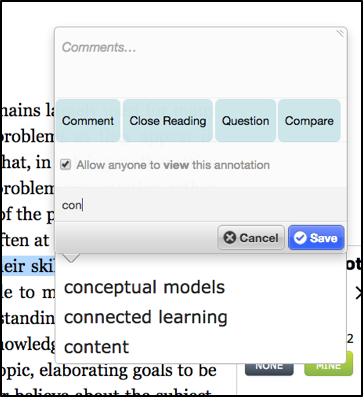
The key example of an expert inquiry practice for our purposes is annotation. Annotation here refers to any kind of “marking up” of a print or digital text, including underlining, highlighting, writing comments in the margins, tagging sections of text with metadata, and so on. Annotation is a practice that may not come as naturally to college students as their instructors would hope. And even when students (and instructors) do engage in annotation, they may not be cognizant of how different kinds of inscribing practices on a text affect their learning.

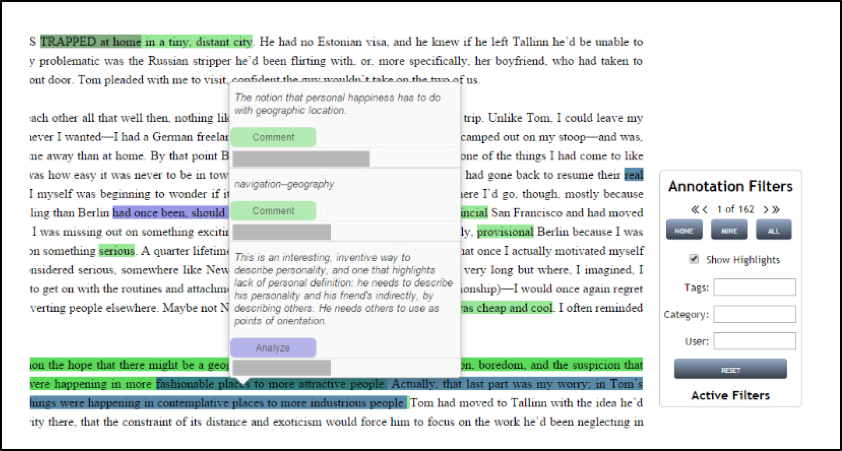
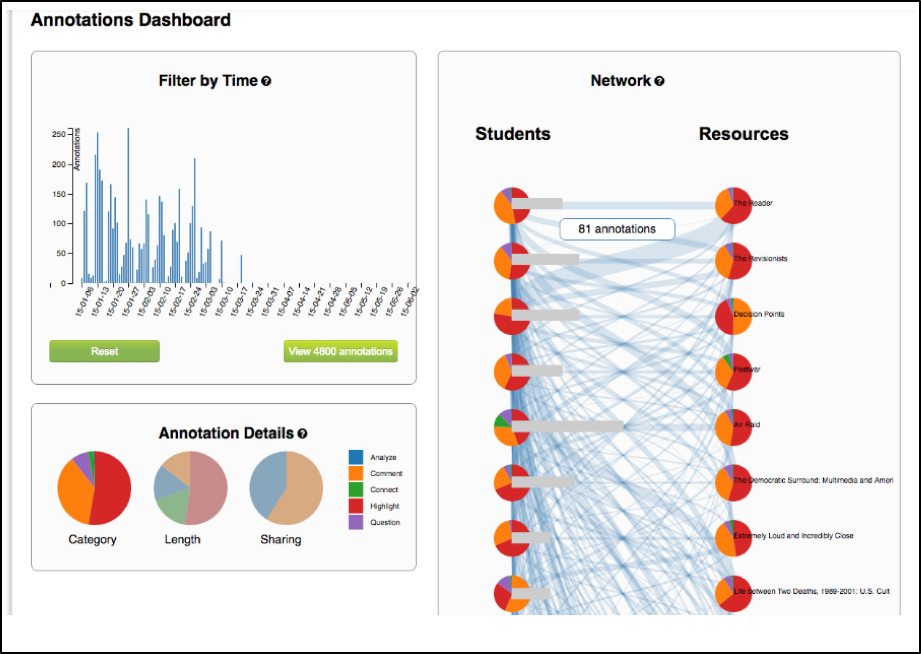
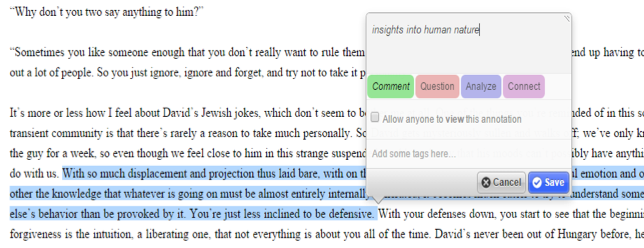
On Lacuna, course syllabus materials are digitized and uploaded to the platform. These materials can be organized by topic, class date, and other metadata such as medium (text, video, or audio). When students and instructors open up materials, they can digitally annotate selections from any text. Annotation on Lacuna is a social as well as an individual practice, leveraging the participatory possibilities of web-based technologies (Jenkins 2009). Lacuna users can choose to share annotations with one another and hover over highlighted passages to reveal others’ comments or questions. Social annotation makes explicit and visible for students the broad array of annotation practices within an interpretive community such as a classroom and helps students co-create interpretations of texts. Students’ annotation activity on Lacuna is also made visible through a separate instructor dashboard, which helps instructors track engagement throughout the course (using D3.js dynamic javascript visualizations of annotation data). Finally, annotations can be connected across texts using the “Sewing Kit” in order to support intertextual analyses.

Since 2013, the technologists and researchers on the Lacuna team in the Poetic Media Lab have designed and developed the platform collaboratively with humanities instructors, based on the theories of learning and expert reading practices described in the following sections of this article. During this time, Lacuna has been used in over a dozen courses at Stanford and other universities, primarily in the humanities and social sciences. Across the courses, the primary authors of this article (Schneider and Hartman) have used ethnographic approaches, including classroom observations, student surveys and interviews with instructors and students, in order to understand the ways that Lacuna mediates relationships among course participants and course content.[2]

In this paper, our primary goal is to examine the shifts in pedagogical practices, and the related learning experiences, that are enabled by social annotation tools like Lacuna when in the hands of willing and engaged instructors. Learning takes place in a complex system of relationships, resources, and goals (Cole and Engestrom 1993, Greeno 1998). Across the courses which have used Lacuna, instructors have chosen to integrate the tool to various degrees. This was unsurprising, as decades of educational research have shown that introducing a new technology, no matter how well-designed, is an insufficient condition for change unless it is intentionally integrated it into pedagogical practices (Cuban 2001, Collins et al. 2004, Brown 1992, Sandoval 2014). In this paper, we present a case study of a course taught by Amir Eshel and Brian Johnsrud, the co-directors of the Lacuna project, which exemplifies the classroom dynamics that become possible when social annotation is woven into the fabric of the course. While Eshel and Johnsrud were the original designers and first users of Lacuna, they were not involved in the present analysis of their own teaching. Within the course examined in this study, we present the full spectrum of the teaching and learning experience, from the time instructors spend preparing for class to perspectives from the students.

A secondary goal in this paper is to introduce Lacuna to other practitioners and researchers who may be interested in using the tool. As a web-based educational software platform, Lacuna is licensed by Stanford University for free and open-access use. Lacuna is run on the content management system Drupal, and the Stanford Poetic Media Lab has made Lacuna available to download with an installation profile on GitHub. Like other learning management systems, such as edX or Moodle, colleges, universities, or other institutions need to sign an institutional agreement taking responsibility for their use of the software, and students and other users agree to the Terms of Use when creating an account. Lacuna is also an ongoing open-source development project. Collaborating universities, such as Dartmouth and Princeton, are currently building out their own features and contributing them to GitHub, so the platform has ongoing refinement based on code submissions from different partners.

Our final goal for this paper is to develop broader questions about and insights into social annotation practices that could apply not only to Lacuna but also to other, similar tools. We hope that some of these questions and insights will come from readers of this article who are themselves exploring the relationship of technology, pedagogy, and learning in the humanities. Our article opens by describing the design of Lacuna in great detail, and then uses a similarly detailed approach to analyze a specific use of Lacuna. In providing these “thick descriptions” (Geertz 1973) of both the technology and its use, we hope that our readers will have the opportunity to reflect on and compare their experiences, goals, and tools to ours. By so doing, we can increase our collective knowledge about the benefits and tradeoffs of social annotation in the humanities classroom, with implications for other reading-intensive courses beyond the humanities.

Annotation as an Individual and Social Practice

As a reader, annotation serves a very personal role—we make marks in the margin or between the lines as an extension of our reactions at the moment of encountering a text. Annotations are also part of our process in preparing to write a paper, a “scholarly primitive” which becomes a building block of our observations about texts (Unsworth 2000). Annotation is one of the central practices used for critical reading in an academic context, as we identify, interpret, and question the layers of meaning in a single text and across multiple texts (Flower 1990, Scholes 1985, Lee and Goldman 2015). In humanities and seminar-style courses, we hope that our students are actively reading by interacting with texts in this way. Focusing on specific parts of a work, and then articulating why the selected passage is interesting, important, or confusing, are essential steps for students in constructing their own understanding of a text (Bazerman 2010, McNamara et al. 2006). By externalizing their thought processes through annotations, it becomes more likely that students remember what they have read and gives them an artifact to work with later on.

With digital texts, annotations can be shared and made visible to other readers—annotation becomes a social act. While this may cause tensions with the personal nature of the annotation process, social annotation also opens up new channels for learning through dialogue and observation of others’ reading and interpretive practices. One hallmark of the humanities broadly, and seminar-style courses in particular, is the “dialogic” nature of the discussion: students are encouraged to explore multiple perspectives on contemporary issues and the texts under scrutiny (Bakhtin 1981, Morson 2004, Wegerif 2013). Each course member has the opportunity to use academic language and express their own ideas, leading to increasing command over new conceptual frameworks and allowing each student to participate more effectively in a “discourse community” (Graff 2008, Lave and Wenger 1991). The instructor guides negotiation between perspectives without insisting on consensus interpretations. Though there is little rigorous research on the impact of dialogic instruction in university courses, these principles have been associated with higher student performance in multiple large-scale studies of middle and high school language arts courses (Applebee et al, 2003, Nystrand 1997, Langer 1995).

With social annotation, dialogue moves from the classroom (or an online discussion forum) to the moment of reading itself. Multiple perspectives and voices become available on the text, both before the class meets and in subsequent re-readings of the texts. The visibility of these perspectives provides opportunities for students to engage productively with difference and reflect on their own practices. Through the dynamism of these differences emerges the co-construction of meaning, wherein the perspectives of each member, and the negotiations among these perspectives, contribute to a shared understanding of the meaning of the texts and topics under discussion (Morson 2004, Suthers 2006). A sense of my stance, my analyses, my strategies for dealing with difficult texts, can also become more salient in contradistinction to other visible stances (Gee 2015, Lee and Goldman 2015). The asynchronous nature of the online dialogue through annotations can also shift the dynamics of whose voices are heard within the discourse community of the class. Particularly when annotations are mandatory, even a typically quiet student or a non-native English speaker can use annotations to voice their perspective or to show to instructors that they are engaging deeply with texts and ideas.

Social annotation technologies like Lacuna have been an ongoing fascination of researchers and technology developers since networked computing became common in the 1990s. University classrooms were particularly fertile ground for experiments in social annotation, especially as computer science professors at the cutting edge of developing digital systems found themselves in the position of teaching undergraduates through traditional, non-digital means. For example, CoNote was an early social annotation platform developed over twenty years ago at Cornell (Davis and Huttenlocher 1995). Aspects of the interface design and students’ ability to access CoNote were, of course, a product of the time—annotations were only allowed on pre-specified locations in a document, and nearly half of the students used CoNote in a computer lab because their dorms were not yet wired for the Web. The anecdotal experience of these students, however, foreshadows our own design goals with Lacuna. Students successfully used CoNote annotations as a site of document-centered conversations and collaborations. Frequently, the students were able to help each other more quickly than the course assistants. Students also self-reported in surveys that they felt better about being confused about course topics because they could see through annotations that other students were also confused (Davis and Huttenlocher 1995, Gay et al. 1999). The major lesson from this early work is the potential for peer support and community-building when conversations are taking place on the text—at the site where work is actually being done—rather than through other means such a discussion forum. (See also van der Pol, Admiraal and Simons 2006 for an experiment demonstrating that discussions taking place through annotations tended to be more focused and topical, compared to the broad-ranging conversations on a course discussion forum).

Since the 1990s, a large number of social annotation tools have been developed, both as commercial ventures and as academic projects (e.g. Marshall 1998, Marshall and Brush 2004, Farzan and Brusilovsky 2008, Johnson, Archibald and Tenenbaum 2010, Zyton et al. 2012, Ambrosio et al. 2012, Gunawardena and Barr 2012, Mazzei et al. 2013; other systems, such as AnnotationStudio at MIT and MediaThread at Columbia University, have not published any peer-reviewed research on their platforms). Research conducted on these social annotation platforms has largely focused on the experiences of students or on reading comprehension outcomes tested through short reading and writing assignments. These results have ranged from positive to neutral (see Novak et al. 2012 for a meta-analysis), with major themes of students benefiting from one another’s perspectives, being motivated by annotating, and using annotations to guide their exam studying.

Other research has examined specific aspects of the social annotation dynamic in more detail. For example, Marshall and Brush (2004) examine the moment when an annotator chooses to share her annotation, finding that students chose to shared ten percent or less of the annotations that they made on each assignment. When students did choose to share their annotations, they often cleaned them up before making them public—transforming shorthand notes to self into full sentences that would be intelligible to others in the class. These moves demonstrate a level of self-consciousness about the other readers in the course as members of a group conversation. Of course, social norms for sharing online may well have shifted since the early 2000s when the study was conducted. Another key moment in social annotation is when a reader chooses to read someone else’s annotation. Wolfe (2000, 2002, 2008) ran multiple studies manipulating the annotations that students can see, with a focus on exploring the influence of positive or negative (critical) annotations. As would be expected, her subjects paid more attention to the annotated passages than the unannotated parts of the text. Moreover, with positive annotations or unannotated passages, students were more likely to focus on comprehending the text without questioning it. When faced with conflicting annotations on the same passage, however, students were more likely to work to develop their own evaluation of the statement in the text. The fact that annotations help prompt deeper responses to the reading was borne out in other studies on students’ writing from the annotated text. Freshman students who wrote essays based on an annotated text were more likely to seek to resolve contradictions in their essays, and less likely to simply summarize the text. In these studies, the presence and valence of annotations clearly altered students’ sensemaking processes and understanding of the texts.

Finally, from a pedagogical perspective, social annotations can open up new possibilities for instruction. While these possibilities are underrepresented in the prior literature, one exception is Blecking (2014), who used ClassroomSalon to teach a large-scale chemistry course. Her research reports that students’ annotations helped her and her teaching assistants diagnose student misconceptions and make instructional changes in response. In humanities courses where reading strategies are often an instructional goal, instructors can monitor students’ annotations in order to give direct feedback on students’ reading strategies and textual analysis. Instructors can, of course, also enter the dialogue on the text themselves, using annotations to guide students to specific points in the text. Additionally, social annotations can serve as an accountability mechanism for completing assigned reading in a timely fashion, because instructors will see students’ activity on the text and students will know that instructors can see this activity.

One might ask—as colleagues have asked us during talks about Lacuna—why there have been so many social annotation tools recently, and why we need another one. One major reason is that many of these tools have been used for STEM courses, with an emphasis on the question-answer interaction as students help each other comprehend concepts in the text. This type of interaction, with an emphasis on a single correct answer, lends itself to different interface interactions than the type of dialogic sensemaking in humanities courses. Even among tools that lent themselves to the goals of humanities courses, there appeared to be a lack of support for exploring intertextuality and synthesis. When the Poetic Media Lab first began designing Lacuna, there were no interfaces that allowed students to filter, order, sort, and group their annotations across multiple texts. Moreover, most existing digital annotation platforms did not have a way to conveniently make student activity throughout the course visible to instructors, as Lacuna’s instructor dashboard does. Finally, no platform that Lacuna’s initial design team surveyed included features that allowed students to write and publish work on the site. As discussed below, by including these features, Lacuna is designed to support an integrated reading and writing process, allowing students to sort, organize, and visualize their annotations, and then write and publish prose or media in the form of short responses or final papers, with a built-in automatic bibliography creator for materials hosted on the course site.

From a research perspective, prior work has included limited investigations about the day-to-day experiences of teaching with a social annotation platform, and connecting the experience of learners as a result of particular instructional decisions. Learning takes place in a complex system of relationships and resources (Cole and Engestrom 1993, Greeno 1998) and introducing new technologies can lead to unforeseen tensions as well as the expected opportunities. Understanding these dynamics in detail is vital for critically considering the possibilities and trade-offs in practice that social annotation platforms, like Lacuna, introduce. This is the goal of the empirical work presented in the “Teaching with Lacuna” and “Learning with Lacuna” sections, which follow after the in-depth introduction of the platform in the next section.

What Does Lacuna Look Like?

Lacuna is an online platform for social reading, writing, and annotation. Like Blackboard, Canvas, and other familiar learning management systems, Lacuna serves as a central organizing space for a course. Instead of hosting readings to be downloaded, however, Lacuna provides a set of shared texts and other media that students and instructors read and annotate together on a web-based interface.[3] In the vocabulary of software design, Lacuna has a number of “affordances,” platform features that create or constrain possibilities for interaction (Norman 1999). These affordances shape, though do not dictate, the central interactions of the digital learning process, namely learners’ interaction with content and interpersonal interactions among learners and instructors (Garrison, Anderson and Archer 1999; 2010).

This section introduces the reader to the affordances of Lacuna in terms of three central practices of humanities and seminar-style courses: critical reading, dialogue, and writing. Through literature reviews and conversations with our faculty collaborators, the project team identified critical reading, dialogue, and writing as vital to the humanities and thus a shared goal—explicit or implicit—of the majority of courses using Lacuna. As researchers and designers, framing the platform in terms of the major goals of the discipline helps us better understand what we might hope for in teaching and learning activities and learning outcomes.

Annotation as Critical Reading and Dialogue

As discussed above, annotation is one of the central practices that experts use for critical and active reading in an academic context. Research on the reading practices of faculty and graduate students has shown that these readers make arguments about the rhetorical and figurative form of texts, usually by connecting the text to other pieces of literature and theory. As they read, faculty and students annotate the text with observations about potential themes, building evidence across specific moments in the text (Lee and Goldman 2015, Levine and Horton 2015, Hillocks and Ludlow 1984). Learning technologies can be designed to embody expert practices in a way that makes those practices more accessible to novices (Pea and Kurland 1987), which is why annotation is central to the design of Lacuna.

Figure 1 below shows the annotation prompt that appears when a reader on Lacuna highlights a passage.[4] Readers may choose to make a comment or to simply highlight the passage. Lacuna instructors frequently require students to produce a minimum number of written annotations per week towards their participation score in the course.

This image shows the annotation prompt that pops up when a reader highlights a passage of text on Lacuna. Three lines are highlighted in blue, and the annotation prompt includes a text box that has been filled with the reader’s comment on the highlighted passage: “insights into human nature”. Below the text comment, there are four possible categories that can be selected by the reader to categorize her annotation activity: Comment, Question, Analyze and Connect. There is also a line for adding tags to the annotation, and a box that may be checked if the reader wants to make the annotation public to others in the course.

Figure 1: Selecting and Annotating a Passage on Lacuna


Lacuna gives students the option to keep their annotations private or share them with the class. When students choose to share their annotations, they are contributing to a form of online dialogue that can also be extended into the classroom (see figure 2). Readers can use the Annotation Filter to choose whether to see one another’s annotations. Faculty who use Lacuna often make note of students’ annotations and adapt their classroom instruction to meet students’ interests or struggles with texts. In the “Teaching with Lacuna” section, we will examine how this blurring of the line between the classroom and the online preparation space affected the experience of the instructors in preparing for and teaching one specific humanities seminar.

Screenshot shows three annotations on the same passage, from three separate students. On the text, the green used to highlight annotated passages is darker where more students have annotated. The reader has moused-over the highlighted passage to reveal the three annotations, which range in length from two words to multiple sentences. Two of the annotations are categorized as a Comments and a third is categorized as Analyze. To the right of the text appears the Annotation Filter box, where the reader can choose whether to see all the annotations in the class, just their own annotations, or no annotations. The reader can also filter by specific users, or specific metadata on annotations in the form of tags or categories. In this screenshot, “all” annotations are selected on the filter.

Figure 2: Multiple Students Annotating the Same Passage in Lacuna


One of the features that sets Lacuna apart from other social annotation platforms is the “Annotation Dashboard,” which provides an aggregate visualization of students’ use of the platform (see figure 3). The dashboard is updated in real-time and is interactive to allow for multiple ways of viewing the annotation data. Currently, there are three different types of analysis offered by the dashboard. “Filter by Time” is a bar graph that illustrates the relative number of annotations made on any given day of the course. “Annotation Details” shows via pie chart how many of each category of annotation there are, how long the annotations are, and how many of them are shared versus private. Finally, “Network” is broken down further into “Resources” and “Students”; this section allows instructors to see how many annotations each resource received and by which students.

In this screenshot we can see the instructor dashboard for Lacuna. The dashboard is split into three different areas. In the top-left area, there is a blue bar graph labeled “Filter by Time.” The y-axis is labeled with numbers of annotations and the x-axis is labeled with dates. This section also contains a “Reset” button and a “View all annotations” button. Below the Time Filter, in the bottom-left area, there is is the “Annotation Details” section. This contains three pie charts: “Category,” “Length,” and “Sharing.” Finally, on the the right-hand side of the screen there is the “Network” section, with “Students” on the left and “Resources” on the right. Student names are obscured in this screenshot to preserve anonymity. Selections made in the Time Filter and Annotation Details section will dynamically affect the data displayed in the Network section - for example, selecting only the dates of Week 2 of the course in the Time Filter will cause the Network to show only the annotations made during that time period. In the Network section, there are pie charts for each student and each resource showing the number of annotations that each student has made on each resource and the total number of annotations on each resource. There is also a web of connections linking the student pie charts to the resource pie charts to show the number of annotations a student made of a particular resource. One of these connections has been moused-over to reveal that the student has made 81 annotations on the selected resource.

Figure 3: The Instructor Dashboard on Lacuna, showing student annotation activity throughout the Futurity course


Each of the dashboard visualizations interacts with all of the others. For example, clicking on a student name in the “Network” section causes only her data to appear in all three categories. We can then see which texts a student annotated most heavily, how many of her annotations were highlights and how many were comments or questions, and when she did the bulk of her highlighting. Clicking the “View annotations” button not only tells us how many annotations she made in total, it takes us to a table in which we can view all of them. The dashboard therefore makes it quite easy to see not only if students have met a required number of annotations, but also which texts they have found most worthy of annotation, whether students are highlighting or engaging through commenting/questioning, and when students tend to do their reading. As we will see shortly, having this information has a significant impact on the instructor’s experience of teaching the course.

Annotation as Part of the Writing Process

Lacuna also includes features that position the annotating and critical reading process as part of a longer-term project of understanding multiple texts or writing a paper about them. Reading in humanities courses is usually part of an integrated reading-and-writing process, where students produce their own texts about the texts they have read or about the issues raised in the texts (Biancarosa and Snow 2004, Graham and Herbert 2010). Expert readers look for patterns, mapping out a text and drawing explicit connections to other texts they have read (Snow 2002, Lee and Goldman 2015). In Lacuna, annotation metadata allows readers to tag and categorize their annotation as a visible record of the mapping and connection processes (see figure 4). For example, readers can tag annotations with a particular theme or topic (e.g “World War II”, “definition”). Lacuna readers can also categorize their annotations by the activity on the text (e.g. as a “Comment” or a “Question” or “Analysis”). Through these tags and categories, Lacuna readers begin to develop a structured characterization of the text. Tags on Lacuna can be suggested by students, or pre-specified by the instructor. By using both open and pre-specified tags, instructors can guide students’ reading while still allowing students to engage in personalized processes of intellectual discovery.

The screenshot shows an annotation box that pops up when a user highlights a passage. The user is tagging the annotation with a tag that begins with the letters “con”, and Lacuna suggests “conceptual models,” “connected learning,” and “content” as possible tags to select from.

Figure 4: Tagging a Passage on Lacuna, with Auto-Suggested Tags


In addition to tags, critical reading in Lacuna is linked with the writing process through two features: Responses and the Sewing Kit. “Responses” are pieces of student writing shared on the Lacuna platform. Responses can be directly linked to the texts and annotations that they reference. Lacuna also lets students annotate Responses, allowing their work to be interacted with in the same way as the work of established authors that is hosted elsewhere on the site. Enabling student writing to be annotated and commented on also creates the ability for peer-review by other students or real-time feedback on student work by the instructor.

The Sewing Kit allows for the automatic aggregation and sorting of all annotations in one place. Students can explore the Sewing Kit based on tags or keywords and create collections, called “Threads,” of quotations organized by theme (see figure 5). Threads can be used by individual readers as a thought-space for initial analyses. They can also be developed collaboratively to compile passages and annotations from multiple readers that are relevant to a theme discussed by the class.

The screenshot shows a Sewing Kit “Thread” from Futurity, in which multiple student annotations on one document have been collected around a single theme of “Memory.” The authors of the annotations are different students (names are obscured to preserve anonymity). The Sewing Kit shows annotations according to five types of metadata: Author of the annotation, the Annotation Text (the actual annotation), Category, Quote (the excerpt from the document), Tags, and Annotated Document. The annotations are all from the same document (a piece called “Putting the Pieces Together Again.) The annotations shown in this screenshot are either Comments or Questions.

Figure 5: A Sewing Kit “Thread” from Futurity, in which multiple student annotations on one document have been collected around a single theme of “Memory.”


The Sewing Kit is one of the most unique features of Lacuna, with few equivalents in other digital annotation tools. From a pedagogical perspective, manipulating online texts in a way that makes the complementary nature of reading and writing visible can support increased metacognition about the relationship between reading, annotating, analysis, and writing. The usefulness of being able to sort and search annotations across many texts will be apparent to anyone who has ever had to organize a large amount of reading for a project. Moreover, the visibility of each of these steps on Lacuna can be used to assess students’ developing understanding of texts, as well as their skills in interpreting and arguing for a particular interpretation of a text.

The features of Lacuna were designed in accordance with the pedagogical ideals of the humanities classroom: close reading, the exchange of ideas through discussion, and analytical writing that is anchored in the text itself. It was the hope of the research and design team that Lacuna would encourage certain expert practices in student users. In the following section, we will provide an in-depth analysis of one use of the tool in a humanities seminar that was co-conducted by Lacuna Co-Directors Amir Eshel and Brian Johnsrud. In this analysis, we will consider in detail the impact of Lacuna on both faculty instructional practices and student learning.

Findings

This section presents two complementary perspectives on the integration of Lacuna into an upper-level literature course. First, we describe the faculty perspective and provide a snapshot of how social annotations can be integrated into a classroom discussion. Second, we describe the student experience, drawing on surveys and interviews with two students in the case study course.

Teaching with Lacuna

There is no single way to teach using Lacuna—or any social annotation tool, for that matter. Of the dozen or more instructors who have used the Lacuna at Stanford and other institutions, each has made his or her own instructional design choices about how deeply to integrate the platform into course activities. On the “light integration” end of the spectrum, some instructors used Lacuna as the equivalent of a course reader. In these classes, students were asked to read and annotate in the shared online space, but there were no clear expectations that they would interact with one another online through their annotations. There was also little acknowledgment of their online activities during class sessions. On the “deep integration” end of the spectrum, instructors read students’ annotations and responses in advance of class and integrated them into class discussion; in these courses, a minimum number of annotations per week were often expected and counted towards a participation score.

In this section, we will closely consider a “deep integration” course: “Futurity: Why the Past Matters”, co-taught by Amir Eshel and Brian Johnsrud, Co-Directors of Lacuna. The integration of Lacuna was evident both in how the instructors prepared for class and in activities and discussion during class. In many ways, “Futurity” exemplifies the ways in which social annotation tools like Lacuna can be intentionally used by instructors to create a more student-centered and learning-centered humanities seminar. By examining in detail the instructional and classroom experience in Futurity, we hope that our readers will have the opportunity to reflect on and compare their experiences, goals, and tools to ours.

The “Futurity” Course

“Futurity” is a comparative literature course deeply concerned with contemporary culture’s engagement with the past in order to imagine different futures. Focusing on specific historical moments of the last sixty years, the course topics explored the relationship between narrative, representation, interpretation, and agency. The course materials included fiction, non-fiction, film, television, and graphic novels[5], making use of Lacuna’s multimedia capabilities and allowing the class to consider how different media representations shape our understandings of the past.

Futurity was first taught using Lacuna in Winter 2014, using an early version of the platform. This article will focus on the 2015 iteration of the course, but it is worth noting that the 2014 version of Futurity played a crucial role in the development of Lacuna itself. Based on feedback from students, features which are often found in online and hybrid learning settings—a wiki and discussion forums—were eliminated in favor of discussion through annotation within the texts. The content of the course also shifted, based partially on the annotations left by students in 2014, which gave the faculty insight into which texts were most generative for discussion.

The 2015 course required 20 annotations per week from each student. This was reduced from the previous year’s requirements based on student feedback indicating that higher requirements led to annotating in order to get a good grade, rather than annotating as a way of increasing comprehension and engagement. The student population of the 2015 class was a small seminar, yet remarkable for its diversity of academic backgrounds and ages of students. Across 10 students, the course participants ranged from postdoctoral fellows in philosophy, to graduate students in comparative literature, to undergraduates in the interdisciplinary Science, Technology, and Society (STS) major, under which Futurity was cross-listed.

Integration of Lacuna into the “Futurity” Course

A picture of the Futurity classroom, taken by one of the authors (Hartman). Eleven students are seated around tables arrayed in a horseshoe fashion. They face a double screen at the front of the room. One screen has a PowerPoint projected onto it and one screen has Lacuna projected on to it. The instructors flank the screens, one sitting and one standing. Four students have laptops open, but all appear to be engaged in the conversation.

Figure 6: Teaching with Lacuna in Futurity. Lacuna is projected on the right-hand screen


One of our key research questions was how the visibility of students’ reading with Lacuna changed instructor practices. For Eshel and Johnsrud, a simple yet powerful shift was the ease of ascertaining which students had done the reading and how well they had understood the texts—questions which, as many instructors know, can consume considerable classroom time and assessment work (such as reading quizzes or short reading response papers). With Lacuna, the instructors could easily see whether students had annotated and how they had reacted to the readings. This meant that preparing for a class session of Futurity was significantly different from preparing for courses that did not use Lacuna. In an interview, Eshel noted that it made “class preparation and [his]… intimate knowledge of [his] students” much easier, and that the experience of teaching was intensified. Both Johnsrud and Eshel emphasized that having their students’ thinking rendered visible by the platform ahead of time increased their own engagement with the course. Students also appeared to be more prepared for class. This resulted, according to Eshel, in a “quicker pace” and in conversation that was “more intense and more meaningful.” Based on students’ annotations and written responses to the reading, the instructors were able to immediately dive into lecture or discussion.

Visible annotations also changed the focus of class preparation. Johnsrud described his and Eshel’s process of preparing for class with Lacuna as akin to drawing a Venn diagram, where one circle represented the students’ interests, as evidenced by annotations and responses, and the other was the topics that the instructors wanted to cover. Johnsrud and Eshel generally tried to focus the class discussion and any lecture material on the overlapping area. This approach could be challenging, however, simply for logistical reasons: the students in Futurity were just as likely to complete their reading at the last minute as any other group of students, which meant that not all annotations could be incorporated into the discussion. Other Lacuna instructors have dealt with this by setting a reading deadline twenty-four hours before class. In terms of topics, sometimes students’ interests and questions diverged from the themes that Eshel and Johnsrud wanted to cover. Incorporating students’ perspectives thus required considerable flexibility from Johnsrud and Eshel, as well as a willingness to cede some control of the classroom discussion agenda to the students’ questions or interests as reflected in their annotations.

Examining students’ online work in advance of class sessions was a task primarily taken on by Johnsrud and the course’s teaching assistant (TA). The TA would send emails to Johnsrud and Eshel that included information such as “hot spots” in the reading (that is, places where students had annotated heavily), trouble spots where students had visibly struggled with the text, interesting annotations or responses for starting a conversation, and overall trends he observed in their annotations. The TA frequently used the Sewing Kit to aggregate the annotations of multiple students under themes relevant to the course content, such as “Agency” or “Memory.” This took about 2-4 hours each week (the course met for 1.5 hour sessions, twice a week). Both instructors noted in interviews that such an approach could be demanding without a teaching assistant.

Eshel and Johnsrud also used annotations to get to know their students as readers and thinkers. Johnsrud said, “After Week 1, I could tell you so much about each student, how they think, what they struggle with, what kind of level they are at, that had nothing to do with any class behavior.” In order to bridge online and offline dialogue, Johnsrud or Eshel often focused discussion on a “hot spot” in the text, addressing overall themes in students’ comments. At times, Eshel or Johnsrud would ask a student to expand verbally upon a particular annotation they had written before class. Eshel and Johnsrud generally let the students know ahead of time if they were going to be using one of their annotations to generate discussion, so that the student did not feel they were being cold-called and had time to prepare a few thoughts.

These practices and their pedagogical outcomes are illustrated particularly well by a class session that took place on during the 5th week of the 10-week quarter. For this class, students read a 1989 essay about the dissolution of Communism. Although Futurity was primarily a literature course, Eshel and Johnsrud often paired a literary text with a theoretical one and pushed students to place the two texts in dialogue with each other. For this class session, students annotated the essay 164 times, with just over half of the annotations (92) including comments (the remainder were highlights, which are a signal of engagement with the text, but engagement that may be less reflective than annotations). In their annotations, students took issue with the author’s ideas, particularly as they related to class and race in Western culture. The students’ disagreement with the author led to particularly rich annotations. Two examples of such annotations include:

“This seems completely outlandish and impractical. I disagree with Kojeve… how can he theorize on such a ‘universal homogenous state’ when all of history is speaking against such a utopia. If one can even call it that; isn’t it our differences and varying opinions which make the world fascinating? His theory seems impossible” (Jenna[6])

“This is a highly debatable and suspect statement. I wouldn’t say that US society is a class-less society. Granted its’ [sic] class structure is different from the class structure of, say, India. But there definitely is a class system, which many individuals do not even want to acknowledge. Consider a city like Baltimore and how even its city planning is based on a class categorization.” (Amanthi)

Prior to class, Johnsrud and Eshel had agreed upon certain annotations and themes that they wished to address. They spent the first twenty minutes on a mini-lecture contextualizing the importance of 1989 as a turning point in the end of the Cold War. They then gave students five minutes to look over their own annotations, re-clarify their thoughts about the text, and come up with a few points they wished to discuss. Ryan, a doctoral student, chose to focus on an annotation he had written in which he questioned the author’s phrase “the end of ideological evolution.” Ryan expanded upon his critique of the phrase in class, and Eshel pushed back, asking if an argument that is “wrong” or inaccurate can yet be a productive tool. There followed a discussion between Ryan and Eshel not only about the author’s ideas, but also about how to discuss a piece of criticism that might be at once useful and problematic. Eventually, Ryan welcomed James, an undergraduate in Comparative Literature, into the discussion by way of one of James’s annotations that he made before class, and which Ryan had viewed: “James had a great annotation about that,” Ryan said. James picked up the conversation from there. In this dialogue, both the instructors and the students had an awareness of one another’s online activity, which was elaborated upon during the in-person discussion. As many instructors of discussion-based courses know, one of the most difficult aspects of discussion can be encouraging students to respond to each other, and not solely to the instructor. In this case, Ryan’s awareness of his peers’ ideas prior to entering the classroom encouraged him to expand the conversation beyond his exchange with Eshel.

In addition to encouraging responses and dialogue among and between students, deliberate integration of online discussion into the classroom also appeared to have a democratizing effect. Later in the discussion, Eshel asked Amanthi, a doctoral student in comparative literature, to weigh in on the discussion. Drawing on her annotations, Amanthi neatly summarized her three main problems with the author’s argument about the notion of socioeconomic class. Eshel responded by contextualizing the author’s remarks in terms of the time the piece was written. Both instructors had wished to address the questions about class raised by Amanthi in her annotations, and they were able to do this by asking her to expand upon her online work. While the instructors may have been able to bring the topic into the discussion without looking to a student, doing so served to acknowledge the work the students did while reading and emphasize that the discussion was a dialogue between equals with valid perspectives.

This particular in-class discussion illustrates a few of the practices of integrating social annotations into the classroom. By using Lacuna as a window into students’ reading, Eshel and Johnsrud were able to pinpoint the exact places in the text that generated the most frustration, confusion, or disagreement in their students. While they were not necessarily surprised by students’ reactions to the text, as they had taught this essay previously to students who found it problematic, they were able to use specific criticisms, attached to individual claims and sentences on the text, as a springboard for discussion. To get the conversation rolling, the instructors were able to call on students they knew to have annotated heavily and thought deeply about the text. Those students were, in turn, able to manage the discussion themselves, such as when Ryan asked James to talk about his annotation. Students whose comments built on their annotations were often succinct and articulate, perhaps because they were better prepared to contribute than they would have otherwise been. Finally, the integration of students’ online ideas into the classroom had an equalizing effect; although both instructors had points they wished to raise, they were able to do so by calling on students who had themselves already raised those points in their annotations.

This Week 5 class session also demonstrates a type of negotiation that can take place between the students’ interests and the instructors’ instructional agenda in classes that integrate Lacuna into the classroom conversation. Throughout the conversation, the instructors attempted to steer the conversation away from the shortcomings of the essay and toward the reasons they had had the students read it. Eshel noted early on in the discussion that, “A text like this is nothing but a tool . . . a tool we use to do all kinds of other things.” Eshel stated explicitly that he wanted the students to consider whether the author might be wrong and productive at the same time. But it was clear, from both the students’ annotations and the ensuing discussion, that many of them were resistant to this perspective on the text. The instructors acknowledged and built upon the work that students had done already, thereby creating more authentic dialogue; but the students, being aware of how much work both they and their peers had already done on the text, appeared at times to be less willing to follow where an instructor might lead them. While students’ initial interpretations of a text may also be codified before class with a print text, there is a possibility that digital and social annotation may prime in students more fixed interpretations before class. This trade-off between guidance and discovery will be discussed more thoroughly in the concluding remarks.

Learning with Lacuna

From the foregoing analysis, it is clear that instructors can deliberately leverage students’ online activity with Lacuna to promote intellectual engagement and dialogue within their classrooms. What is the online reading experience like for students? Across surveys of students in Futurity and six other courses using Lacuna (N=45), digital annotation with Lacuna appears to have both benefits and drawbacks. Here, we briefly discuss student survey results before presenting an in-depth analysis of one-on-one interviews with students in the 2015 Futurity course.

For most of the students surveyed, annotation was a familiar strategy which they used frequently, according to self-reported habits. When asked about their goals in annotating, students largely described using annotations to meet a particular goal, such as when they did not understand something as they were reading or to return to at a later point. They also used highlighting and underlining to mark parts of the text that they wanted to remember or which simply seemed notable for their language. When it came to the physical experience of reading and annotating, it is worth noting that over half of the students surveyed expressed a preference for reading on paper, citing eyestrain and the freedom to make multiple types of marks (such as lines, circles, or arrows) as the main benefits. But when comparing Lacuna to other digital reading experiences, students remarked favorably upon the ease of annotating, particularly in contrast with the poorly-scanned PDFs that they had encountered in other courses. They also appreciated the organizational benefit of all-in-one access to online texts.

It was social annotation, however, that emerged through the surveys as the most salient aspect of Lacuna, compared to both paper and digital reading environments. In open text responses describing their experiences, students reported an appreciation of the opportunity to hear one another’s perspectives and learn from one another as well as from the instructor. This was particularly true for less advanced students in courses such as Futurity, which included graduate students along with both major and non-major undergraduates. Students described that seeing others’ annotations drew attention to particular aspects of the text, clarifying aspects of the writing or helping them see what questions would be useful to ask of the text. In a course similar to Futurity, where the instructor frequently brought students’ annotations into class, several students commented appreciatively on the “continuity” between reading before class and the subsequent class discussion.

Survey respondents also emphasized that timing matters when it comes to the social experience. For example, one student said he was usually the first to read and comment, so he didn’t have the opportunity to experience others’ annotation unless he took the time to return to the text after class. On the flip side, one student honestly shared that he appreciated others’ annotations drawing attention to aspects of the text when he was reading last-minute before class. Multiple students preferred exploring others’ comments on a second read-through of the text, rather than the first, so they would have the chance to form their own impressions of the text. The annotation filter in Lacuna facilitates these modes of reading, allowing students and faculty to choose whether to see no annotations; only their own annotations; selected users’ annotations; or annotations from everyone in the course. (See figure 2, above.)

Surveys can provide a high-level perspective on the experience of a group, but interviews accompanied by work products—in this case, annotations on Lacuna—are a powerful research tool for going more deeply into the nuances of an experience. Reflecting the emphasis on social annotation in the surveys, the following section draws on interviews with two students in Futurity, “Jenna” and “Allegra,” in order to explore the processes by which social annotation creates opportunities for peer learning. Jenna and Allegra were selected to be interviewed as part of a larger research project looking across multiple courses using Lacuna. Based on recommendations of faculty and their observed levels of platform and classroom engagement, we felt that Jenna and Allegra were representative of students who were highly engaged with the course and the platform.

Exploring Social Annotation from the Student Perspective

Jenna and Allegra were both seniors at the time they were interviewed. As humanities majors, Jenna and Allegra were experienced annotators, building on years of instruction in high school and use of annotation in previous undergraduate courses. With Lacuna, however, they each noted that the platform allowed them to annotate more extensively than they were accustomed to doing on paper. The “endless” virtual margin and the speed of typing meant that for both students, the material features of the platform augmented aspects of a pre-existing individual practice. Even more salient, however, were the ways that the platform created a stronger sense of community and new opportunities for social learning. Jenna eloquently expressed the connection to other course participants that the platform enabled her to feel: “It’s like all of our head space is kind of in the same area. […] I’ll just be like oh, this is what Amanthi was thinking when she read this part. How interesting, it’s a Sunday afternoon and we’re both reading this. […] It’s like there is constant fluidity, between when I’m in class and outside of class.” Just as the instructors sought to connect online and offline activity, students like Jenna were making these connections themselves.

The collegial nature of the course community appeared to be a crucial element for supporting peer learning. “I have learned just as much from my peers in the course as [from] my instructors,” Jenna noted at two different points in her interview. She described social reading as an additive process, where her own understanding of the text was enhanced by the perspectives of others: “That’s the beauty of it. It’s because we have all of these minds bringing together these very fragmented understandings of the text. Then it just only adds to yours.” Pointing to examples from the course, Jenna clarified that these “understandings” can be references—to a film or to a Bible passage, for example—as well as interpretative statements. Moreover, each of these understandings, including her own, is incomplete – “fragmented” across multiple annotations and across multiple minds. Together, however, they represent a more complete understanding of the text than a single reader would be able to generate by herself.

Unpacking the social annotation process that enables this more complete understanding, however, reveals multiple opportunities for an individual to engage socially, or alternatively, remain solitary in their interpretive process. As explored in the Marshall and Brush (2004) research, the first decision in social annotation whether to share at all. For some students this appears to be a more sensitive issue than for others, with concerns about looking stupid—or, as expressed by some graduate students in surveys and informal conversations, the fear of not looking sufficiently clever and impressive. But as the quarter progressed in Futurity, sharing was the norm, rather than the exception. This was due in part to the default setting of “public” on annotations, which meant that students needed to check a box to intentionally opt out of sharing each time they hit “save” on an annotation. Over time, students also had more practice exposing their opinions without negative feedback. Another incentive may have been the instructors’ use of annotations and students’ written responses in the classroom discussion. As Allegra noted, “It definitely feels good [when they mention my annotations in class]. They acknowledged that you did a good job […] and they also teach the class, like, in accordance to some extent with what you said about the text, which is also really cool.”

Other reasons that students shared their annotations were because they “didn’t care” (Jenna) if someone saw what they wrote—perhaps a typical perspective from the social media generation —or if they had a specific audience in mind. In particular, our interviewees looked for opportunities to provide new information that would enhance the reading experiences of their peers. Allegra explained that she was far more likely to annotate rather than highlight if she was pointing out something that was not “obvious” in the text, such as references to outside texts or events: “[W]ith the Mrs. Dalloway annotation, for example […] I felt the need to point that out to people who might not have made that connection.” Allegra exhibits a relatively high level of awareness of what her peers are likely to know, as well as what kinds of insights count as novel rather than rudimentary. Jenna framed her contributions in a slightly more personal and conversational way. In her interview, she gave examples of annotations that felt important for her to make public on texts that she “disagreed with,” noting that she “really want[ed] people to know” about this opinion so it would “add something to the class discussion.”

The second aspect of social annotation is choosing to read others’ annotations. In the interviews, it became clear that in the dialogue taking place through social annotation, not all utterances are necessarily “heard” by others. If the student is reading early in the week or in the hour before class, there will be a different version of the text with different amounts of annotations available. Moreover, the annotations which are at the time of reading available can be shown or hidden using filters on the text. Then, even if the reader chooses to show annotations with the filter, it is up to that reader to read any particular annotation by hovering over the text to show the annotation. Finally, once an annotation is read, the reader may choose to reply to it or make another note in parallel—or, they can simply notice what the other annotator has written and then move on, rather than actively engaging with it. Each annotator has their own preferences about this, which may also vary by text. Describing their approaches generally, our interviewees had slightly different perspectives. Jenna reads others’ annotations when she gets “curious about what other people wrote on a given page, […] I try to do that pretty often.” Allegra said that she “always makes sure to click ‘all annotations’ [on the filters], when I’m reading so I can see what people have said already. That often informs the way I look at things in the text.” From these students’ experience, it is not clear whether different strategies for reading others’ annotations would be more or less effective for different kinds of texts, or for interpretive practices with different goals.

In discussing what made a “good” annotation, Jenna and Allegra generally focused on the informational content and novelty of the annotation. As an example of a beneficial annotation, Allegra pointed to an annotation on Ian McEwan’s novel Saturday, in which Jason had noted that McEwan is “orientalizing” the word “jihad,” creating distance between the reader and Arabic culture. “That wasn’t something I had thought about,” she explained. Jason’s interpretation added another lens for Allegra to analyze the work being done by the text and the choices made by the author. Even though the annotation was not addressed directly to her, it was another perspective that she could build on in her own interpretation of the text. Sometimes, however, Jenna and Allegra did not view other students’ annotations were not as particularly useful. For example, Allegra described somewhat disparagingly the “pointless,” single-word annotations that some students made, which were a reaction to the text without adding specific analytical detail. Jenna exhibited a similar response to “obvious” annotations, describing “a couple of times where people have been, like, this is a recurring trope, and I’m like…yeah. You didn’t need to tell me that.” Nearly in the same breath, however, both Allegra and Jenna acknowledged that others in the class could have benefited from the annotations that they did not find personally useful at the time. Jenna noted, for example, “Maybe for other people, they didn’t think of that as a trope […] So, it could definitely help someone else.” The unique knowledge and interests of each annotator, who are each readers of one another’s annotations, means that it may be difficult to find annotations that are useful to all readers—a challenge not unique to social annotation but shared with all annotated editions of texts.

With these examples, a vital aspect of social annotation becomes evident: the act of annotating has multiple goals and as a result, there are multiple ways to understand whether annotation is a productive utterance in the online discourse community. Social annotation is a way of reading simultaneously for oneself and for the community. The individual reader, traditionally ensconced in a paper book, thinks entirely of himself. With social annotation, a diverse audience emerges—an audience including an instructor who is in a position of evaluation and other students who can be “told” new information. Moreover, both instructors and students are fellow participants in a dialogue which can be carried out in class as well as online. Finally, the reader is also an audience member herself, for the performances of others in her class. The mental model of the activity of social annotation, then, is multifaceted, requiring a level of self-awareness (and other-awareness) significantly beyond that of being a private reader.

Concluding Remarks

By equipping learners to engage individually and collectively with texts across media, Lacuna and other social annotation platforms are designed to encourage critical thinking and sensemaking, skills which are at the core of disciplinary work in the humanities and vital to 21st-century citizenship. Critical reading has long been a hallmark of the humanities and a skill which the traditional seminar has sought to foster in its students; however, the practice itself has often been all but invisible to instructors. By transforming reading into an activity that is done socially, rather than in solitude, Lacuna created a bridge between the physical classroom and online reading space in Futurity.

Social annotation in the Futurity course allowed the instructors to get to know their students better and to incorporate student perspectives more fully into the dialogue of the course. By glimpsing their peers’ interpretations of a text during class preparation, students were able to start engaging in dialogue before they entered the classroom. They became more comfortable with one another and had increased opportunities to learn from each other as well as from the professor, developing a multi-faceted perspective on texts. These changes in instructor and peer learning practices appear to have created strong student investment in the course and more authentic dialogue during class discussions. The social annotation affordances of Lacuna rendered students’ reading visible to instructors and other students, and thus expanded the dialogic space of the course.

But dialogue isn’t always easy. Social annotation appears to create new demands on students and instructors alike to negotiate one another’s perspectives and reflect on the goals of their participation and practices. For students, this negotiation and self-reflection largely takes place during reading. Encountering a chorus of voices on a text means that these voices must be sorted through, accepted, questioned, or ignored. Being a member of that chorus means constantly choosing whether to sing or be silent. These choices build on skills that students have likely have developed through in-person discussions, as well as pre-existing solitary reading strategies, but combines them in new ways. In educational research, this type of self-monitoring and intentional use of resources is known as “self-regulation” (e.g. Bandura 1991, Schunk and Zimmerman 1994). Self-regulation is a relatively sophisticated set of competencies, which must be taught, practiced, and discussed. Similarly, social annotation is an activity which will likely function best when self-reflection about the practice is encouraged and there are ongoing conversations in a course about how to best engage in it.

Instructors working with social annotation tools like Lacuna are presented with the opportunity to incorporate students’ interests and struggles with texts into teaching, which can include the potentially discomfiting need to cede to the students some measure of control. Even if faculty are comfortable with this, it highlights the tension that must be negotiated between the desire to allow students the space for intellectual discovery and the desire to guide their learning along a pre-specified path. While the tension between student-led discovery and instructor-led guidance is present to some degree in any seminar, pedagogical opportunities to support discovery are heightened by the ways that Lacuna makes reading practices and student voices more visible on the text itself. To balance these goals, instructors who use Lacuna, or similar software which emphasizes student perspectives, would be well-served to reflect on their desired learning outcomes for the class and adjust their use of the platform accordingly. Such self-reflection is also useful when considering how much time an instructor wishes to spend combing through student annotations for use in the classroom; student annotations are effectively an additional text that an instructor needs to prepare each week, and the learning goals of a specific course will dictate how much time an instructor will wish to spend preparing that text.

Generally, the influence of Lacuna on the course dynamics of Futurity appeared to be positive. We observed and heard about high levels of student preparedness, active reading habits, and deep engagement in course topics among both students and instructors. While these changes were certainly shaped by the design and affordances of the platform, they cannot be regarded as given for all users of Lacuna or other social annotation tools. It is likely no coincidence that, of the dozen or so courses that have utilized Lacuna in recent years, the course with the deepest integration of the platform was the only one in which Lacuna was used two years in a row. The lessons learned from the first year of teaching were critical in shaping both the technological changes made to the Lacuna platform and the ways that Eshel and Johnsrud chose to leverage the platform when they taught the course again the following year. This illustrates the importance of intentionality, reflection, and iteration in both the design of the platform and instructors’ use of it—lessons which go beyond Lacuna and social annotation tools to learning technologies broadly. For designers, it is essential to think of instructional technologies as dynamic, rather than static; they must adjust to the pedagogical needs and goals of instructors. Instructors, in turn, must carefully consider how best to use a platform to achieve their goals. Thoughtful and reflective design of the technology, and thoughtful and reflective use of the tool in the classroom, are equally important to achieving a deep level of pedagogical impact.

Future Directions

Our case study has surfaced themes of authority, agency, and new forms of relationships in courses where technology makes student activity visible to instructors. We plan to investigate these themes further as we continue to research and develop the Lacuna platform and engage with researchers investigating comparable learning technologies. While the current study focused on classroom dynamics, a vital question that needs further consideration is the specific way in which student learning is influenced by the pedagogical moves that Lacuna enables. To pursue this avenue of research, we are in the process of developing rubrics for characterizing the reading strategies expressed in online annotations. Using annotations as evidence of critical reading and dialogic practices is an opportunity that is relatively unique to digital learning environments which capture traces of student activity. These data provide critical insights into student thinking, both on an individual and collective level, and can be used as a type of formative assessment for tracking learning over time (Thille et al. 2014).

At Stanford, Lacuna continues to be used for seminar-style courses similar to Futurity, as well as in courses in other departments and larger, lecture-style courses. Lacuna is also being used at a variety of other universities—visit www.lacunastories.com for a full list of our collaborators. Each of these collaborators are doing exciting work to make the platform their own. We are particularly pleased to be supporting local community college instructors who teach composition, as well as reading and writing courses at the basic skills level. In these partnerships, we are building on the insights from this case study and other unpublished case studies and observations. For example, we encourage active reflection about annotation practices and goals. This includes strategies for gradually increasing the level of integration of Lacuna into homework assignments and classroom activities, in order to give both instructors and students the opportunity to adjust their habits.

In our current research and partnerships, we continue to iteratively refine the design of Lacuna, while building our theoretical conceptions of the co-creation of meaning through social annotations. Throughout this work, we seek to support learning and instructional practices in a way that balances the strengths of participatory digital media with the strengths of in-person human interactions.

Notes

[1] Note about authorship and affiliation: This paper presents a case study of a course taught by Amir Eshel and Brian Johnsrud, the co-directors of the Lacuna project in the Poetic Media Lab. While Eshel and Johnsrud were the original designers and first users of Lacuna, they were not involved in the present analysis of their own teaching. Rather, all interviews, surveys, and classroom observations—as well as the subsequent analysis of that qualitative data—were conducted exclusively by the primary authors (Schneider and Hartman). As members of the Poetic Media Lab, Schneider and Hartman are participant-observers who have served as instructional designers to help instructors plan their courses and have analyzed research data to contribute to the ongoing improvement of the platform. This level of involvement is typical for researchers in the “design-based research” paradigm of the learning sciences (Brown 1992, Collins et al. 2004, Sandoval 2014). Some level of bias is inherent in participating in and observing a project at the same time. Nevertheless, in any form of participant-observation, it is always the hope that any considerations that may be overlooked due to close proximity is more than compensated for by the first-hand observations of practice that such inquiry affords.

[2] Please see note 1 above on authorship and affiliation to learn more about the participant-observer relationships of Schneider, Hartman, Eshel, and Johnsrud to the analyses presented in this paper.

[3] The site can also be used for films, videos, audio, and images. The vast majority of media in the course syllabi of our faculty reflect, however, the traditional focus of the academy on written texts. To reflect this trend and maintain clarity in our writing, we will use the term “reading” throughout the paper. But when we say “reading,” note that these claims may be equally important for viewing, listening, etc.

[4] Figure 1 and other screenshots in the paper are from the version of Lacuna used in the case study course described in this paper. The most recent version of Lacuna refines the privacy settings for annotations to allow readers to only share their annotations with an instructor or to share annotations with a specific group of peers, in addition to keeping annotations private or sharing them with the entire class. These changes were made in response to feedback from students and instructors who wanted more fine-grained control over who could see their annotations.

[5] A common question about Lacuna is the copyright status of materials. Lacuna supports the uploading of any digitized course or syllabus material, such as text, images, video, or audio files. As with any Learning Management System (LMS)—such as Canvas, Blackboard, edX, etc.—instructors are responsible for the copyright status of materials they upload. With each upload, instructors are asked to indicate the copyright status of the material, such as open access, Creative Commons, limited copyright for educational purposes, etc. Because the platform has secure logins limited to students enrolled in courses, instructors at Stanford have had a good deal of success getting free or reduced copyright fees for course materials that do not fall under fair use for educational purposes. Publishers seem particularly accepting to digitized materials on Lacuna because they are not easily downloaded and disseminated as PDFs, which is the way that many other LMSs deliver content.

[6] All student names in this article are pseudonyms.

Bibliography

Ambrosio, Frank, William Garr, Eddie Maloney and Theresa Schlafly. 2012. “MyDante: An Online Environment for Collaborative and Contemplative Reading,” Journal of Interactive Technology and Pedagogy, no. 1.

Applebee, Arthur N., Judith A. Langer, Martin Nystrand, and Adam Gamoran. 2003. “Discussion-based approaches to developing understanding: Classroom instruction and student performance in middle and high school English.” American Educational Research Journal 40, no. 3: 685-730.

Bakhtin, Mikhail M. 1981. The dialogic imagination: Four essays by MM Bakhtin (M. Holquist, Ed.; C. Emerson & M. Holquist, Trans.).

Bandura, Albert. 1991. “Social cognitive theory of self-regulation.” Organizational behavior and human decision processes 50, no. 2: 248-287.

Baron, Naomi S. 2015. Words onscreen: The fate of reading in a digital world. Oxford University Press.

Bazerman, Charles. 2010. The Informed Writer: Using Sources in the Disciplines, 5th Edition. Fort Collins: The WAC Clearinghouse.

Biancarosa, Gina, and Catherine E. Snow. 2004. Reading next: A vision for action and research in middle and high school literacy. Alliance for Excellent Education.

Brown, Ann L. 1992. “Design experiments: Theoretical and methodological challenges in creating complex interventions in classroom settings.” The Journal of the Learning Sciences 2, no. 2: 141-178.

Cole, Michael, and Yrjö Engeström. 1993. “A cultural-historical approach to distributed cognition.” Distributed cognitions: Psychological and educational considerations, 1-46.

Collins, Allan, John Seely Brown, and Ann Holum. 1991. “Cognitive apprenticeship: Making thinking visible.” American educator 15, no. 3: 6-11.

Collins, Allan, Diana Joseph, and Katerine Bielaczyc. 2004. “Design research: Theoretical and methodological issues.” The Journal of the Learning Sciences 13, no. 1: 15-42.

Cuban, Larry. 2009. Oversold and underused: Computers in the classroom. Harvard University Press.

Davis, James R., and Daniel P. Huttenlocher. 1995. “Shared annotation for cooperative learning.” In The first international conference on Computer Support for Collaborative Learning, pp. 84-88. L. Erlbaum Associates Inc.

Farzan, Rosta, and Peter Brusilovsky. 2008. “AnnotatEd: A social navigation and annotation service for web-based educational resources.” New Review of Hypermedia and Multimedia 14, no. 1: 3-32.

Flower, Linda. 1990. “Introduction: Studying cognition in context.” Reading-to-write: Exploring a cognitive and social process, 3-32.

Garrison, D. Randy, Terry Anderson, and Walter Archer. 1999. “Critical inquiry in a text-based environment: Computer conferencing in higher education.” The Internet and Higher Education 2, no. 2: 87-105.

Garrison, D. Randy, Terry Anderson, and Walter Archer. 2010. “The first decade of the community of inquiry framework: A retrospective.” The Internet and Higher Education 13, no. 1: 5-9.

Gay, Geri, Amanda Sturgill, Wendy Martin, and Daniel Huttenlocher. 1999. “Document‐centered Peer Collaborations: An Exploration of the Educational Uses of Networked Communication Technologies.” Journal of Computer‐Mediated Communication 4, no. 3.

Gee, James Paul. 2015. Literacy and Education. Routledge.

Graff, Gerald. 2008. Clueless in academe: How schooling obscures the life of the mind. Yale University Press.

Graham, Steve, and Michael Hebert. 2010. Writing to read: Evidence for how writing can improve reading: A report from Carnegie Corporation of New York. Carnegie Corporation of New York.

Greeno, James G. 1998. The situativity of knowing, learning, and research. American psychologist, 53 no. 1: 5-10.

Gunawardena, Ananda and John Barr. 2012. “Classroom salon: a tool for social collaboration.” In Proceedings of the 43rd ACM technical symposium on Computer Science Education, pp. 197-202. ACM.

Hillocks, George, and Larry H. Ludlow. 1984. “A taxonomy of skills in reading and interpreting fiction.” American Educational Research Journal 21, no. 1: 7-24.

Jenkins, Henry. 2009. Confronting the challenges of participatory culture: Media education for the 21st century. MIT Press.

Johnson, Tristan E., Thomas N. Archibald, and Gershon Tenenbaum. 2010. “Individual and team annotation effects on students’ reading comprehension, critical thinking, and meta-cognitive skills.” Computers in Human Behavior 26, no. 6: 1496-1507.

Langer, Judith A. 1995. Envisioning Literature: Literary Understanding and Literature Instruction. New York: Teachers College Press.

Lave, Jean, and Etienne Wenger. 1991. Situated learning: Legitimate peripheral participation. Cambridge university press.

Lee, Carol D., and Susan R. Goldman. 2015. “Assessing literary reasoning: Text and task complexities.” Theory Into Practice just-accepted.

Levine, Sarah, and William Horton. 2015. “Helping High School Students Read Like Experts: Affective Evaluation, Salience, and Literary Interpretation.” Cognition and Instruction 33, no. 2: 125-153.

Marshall, Catherine C. and AJ Bernheim Brush. 2004. “Exploring the relationship between personal and public annotations.” In Digital Libraries, 2004. Proceedings of the 2004 Joint ACM/IEEE Conference on, pp. 349-357. IEEE.

Mazzei, Andrea, Jan Blom, Louis Gomez, and Pierre Dillenbourg. 2013. “Shared annotations: the social side of exam preparation.” In Scaling up Learning for Sustained Impact, pp. 205-218. Springer Berlin Heidelberg.

McNamara, Danielle S., Tenaha P. O’Reilly, Rachel M. Best, and Yasuhiro Ozuru. 2006. “Improving adolescent students’ reading comprehension with iSTART.” Journal of Educational Computing Research 34, no. 2: 147-171.

Morson, Gary Saul. 2004. “The process of ideological becoming.” Bakhtinian perspectives on language, literacy, and learning, 317-331.

Norman, Donald A. 1999. “Affordance, conventions, and design.” Interactions 6, no. 3: 38-43.

Nystrand, Martin. 1997. Opening Dialogue: Understanding the Dynamics of Language and Learning In the English Classroom. New York: Teachers College Press.

Pea, Roy D., and D. Midian Kurland. 1987. “Cognitive technologies for writing.” Review of research in education, 277-326.

Sandoval, William. 2014. “Conjecture mapping: An approach to systematic educational design research.” Journal of the Learning Sciences 23, no. 1: 18-36.

Scholes, Robert E. 1985. Textual power: Literary theory and the teaching of English. Yale University Press.

Schunk, Dale H., and Barry J. Zimmerman. 1994. Self-regulation of learning and performance: Issues and educational applications. Lawrence Erlbaum Associates, Inc.

Snow, Catherine. 2002. Reading for understanding: Toward an R&D program in reading comprehension. Rand Corporation.

Suthers, Daniel D. 2006. “Technology affordances for intersubjective meaning making: A research agenda for CSCL.” International Journal of Computer-Supported Collaborative Learning 1, no. 3: 315-337.

Thille, Candace, Emily Schneider, René F. Kizilcec, Christopher Piech, Sherif A. Halawa, and Daniel K. Greene. 2014. “The future of data-enriched assessment.” Research & Practice in Assessment 9.

Unsworth, John. 2000. “Scholarly primitives: What methods do humanities researchers have in common, and how might our tools reflect this.” In Humanities Computing, Formal Methods, Experimental Practice Symposium, pp. 5-100.

van der Pol, Jakko, Wilfried Admiraal, and P. Robert-Jan Simons. 2006. “The affordance of anchored discussion for the collaborative processing of academic texts.” International Journal of Computer-Supported Collaborative Learning 1, no. 3: 339-357.

Vygotsky, Lev Semenovich. 1980. Mind in society: The development of higher psychological processes. Harvard University Press.

Wegerif, Rupert. 2013. Dialogic: Education for the Internet age. Routledge.

Wolfe, Joanna. 2008. “Annotations and the collaborative digital library: Effects of an aligned annotation interface on student argumentation and reading strategies.”International Journal of Computer-Supported Collaborative Learning 3, no. 2: 141-164.

Zyto, Sacha, David Karger, Mark Ackerman, and Sanjoy Mahajan. 2012. “Successful classroom deployment of a social document annotation system.” In Proceedings of the SIGCHI Conference on Human Factors in Computing Systems, pp. 1883-1892. ACM.

Acknowledgements

Lacuna was built in the Poetic Media Lab, a digital humanities lab in Stanford’s Center for Textual and Spatial Analysis (CESTA). The platform’s development was overseen by Michael Widner, and conducted by him and a number of undergraduate and graduate research assistants at Stanford, with occasional assistance from external developers and project collaborators. The Lacuna project has received funding from the Wallenberg Foundation and the following departments and offices at Stanford University: the Vice Provost for Online Learning; the Vice Provost for Teaching and Learning; the Dean of Research; the Vice Provost for Undergraduate Education; the Division of Literatures, Cultures, and Languages; Stanford Community Engagement grants; and the Robert Bowman Denning Fund for Humanities and Technology. Additional support for Emily Schneider was provided by the Lytics Lab and the Anne T. and Robert M. Bass Stanford Graduate Fellowship.

About the Authors

Emily Schneider is a doctoral candidate in Learning Sciences and Technology Design at Stanford. She is the Director of Research and Pedagogy of the Lacuna project and a co-founder of Stanford’s Lytics Lab. Her work focuses on the design and evaluation of interactive online learning platforms. Currently, she is developing “critical reading analytics” for identifying and supporting the strategies used by learners when they critically engage with digital texts. More broadly, she is passionate about collaboration, open educational resources, and striking a balance between technology-enhanced and human-centered learning. Emily holds a B.A. in English Literature from Swarthmore College.

Stacy Hartman received her PhD in German Studies from Stanford University in 2015. Her dissertation explored the subversion and disruption of readerly empathy in post-1945 German novels and films. More broadly, she is interested in the relationship between reader and text, and in the ways in which readers construct texts both singularly and socially. It was this interest that led her to work on Lacuna as both researcher and instructional designer during her time at Stanford. Currently, she is a project coordinator at the Modern Language Association, where she works on initiatives related to humanities careers.

Amir Eshel is Edward Clark Crossett Professor of Humanistic Studies, Professor of German Studies and Director of the Department of Comparative Literature. His research focuses on contemporary literature and the arts, with emphasis on twentieth and twenty-first century German, Anglo-American and Hebrew. As the faculty director of Stanford’s research group on The Contemporary and of the Poetic Media Lab at Stanford’s Center for Spatial and Textual Analysis (CESTA), he is interested in the contemporary cultural imagination as it addresses modernity’s traumatic past with its philosophical, political and ethical implications. Most recently, he is the author of Futurity: Contemporary Literature and the Quest for the Past (The University of Chicago Press, 2013).

Brian Johnsrud is the Co-Director of the Poetic Media Lab at Stanford University, the digital humanities lab which initially designed and created Lacuna for academic and educational use. Brian received his grades 6-12 teaching certification, along with a Master’s endorsement in Library and Media Science for secondary education, and he has taught middle and high school at a variety of schools and educational settings. His doctoral research focused on how people engage with narratives across media in the 21st century.

Images are for demo purposes only and are properties of their respective owners. ROMA by ThunderThemes.net

Skip to toolbar