Tagged student engagement

0

Truly Immersive Worlds? The Pedagogical Implications of Extended Reality

Abstract

This article provides an overview of the extended reality applications virtual reality (VR) and augmented reality (AR) and examines the affordances and constraints of each with regards to their application in the humanities. The interactive nature of these extended realities engages their audiences in new and compelling ways. VR and AR applications have moved beyond gaming and are proving particularly effective and engaging for historic recreations. However, these technologies also present new challenges, precisely because they create immersive worlds so captivating that these environments may be perceived as “real” rather than as simulacra, especially by students and the general public. Using both VR and AR projects based in medieval Europe (Bologna 3D Open Repository and 3D Paris Saga) as case histories, we discuss some of the issues that these technologies pose to their creators and to their consumers—from how they might be used to make a heritage site more meaningful, to how they pose dangers of an excess of verisimilitude. As these technologies become more ubiquitous in academic settings, these early ventures into extended realities highlight some perhaps hitherto unconsidered pitfalls as well as demonstrate the promise that these new technologies offer in terms of pedagogy and community outreach.

Introduction

In the summer of 2016, the world was introduced to the emerging technology of augmented reality (AR) in the form of Pokémon Go, a location-based, AR-enhanced game that became one of the most popular mobile apps of the year. Many people were already familiar with virtual reality (VR), “a medium composed of interactive computer simulations that sense the participant’s position and actions and replace or augment the feedback to one or more senses, giving the feeling of being mentally immersed in the simulation (a virtual world)” (Sherman and Craig 2003, 13). As a popular gaming environment, VR has four key elements: it is a virtual space for the participant; it is immersive on both a physical and mental level for the participant; it provides sensory feedback directly to the participant; and it is interactive, responding to the participant’s actions (Sherman and Craig 2003, 6–11).[1] VR, in its most effective form, requires the user to be isolated from a conscious awareness of the real world by some sort of head-mounted display, such as Oculus Rift, Microsoft HoloLens, or HTC Vive. Alternatively, the user can experience VR in an enclosed, projection-based or flat-monitor-based environment, such as a CAVE.[2] Typically, the experience must be held in a static, controlled space; otherwise, the user might collide with real-world objects in the effort to participate fully in the virtual world. And, for many individuals, the VR experience results in motion sickness, sometimes known as VR sickness or cybersickness.[3] In contrast, AR is a medium in which digital information is overlaid on the physical world that is in both spatial and temporal registration (i.e., alignment) with the physical world and that is interactive in real time (Craig 2013, 36). Consequently, AR is much more accessible because the required equipment, usually a smart device (iPad, iPhone, Android tablet, or Android phone), is minimal. The fact the user remains cognizant of the real world around them while using the technology reduces the possibility of motion sickness and does not typically limit the user to a static, controlled space for the experience.

Both technologies have applications beyond gaming and are proving particularly effective and engaging for historic recreations. Such recreations can have a significant impact on learning, for they engage viewers—both the general public and students—in an educational immersive experience. Many of these viewers may never visit the actual historic site in their lifetime, so accuracy is important. Consequently, we need to keep in mind that a 3D digital model is a re-creation and not the real place. And as we move forward with VR and AR, we must give serious consideration to the goals we need and/or wish the technologies to meet, particularly with respect to pedagogy. At this point in time, VR and AR are very successful in engaging audiences for both entertainment and educational purposes:

The increasing development of VR technologies, interfaces, interaction techniques and devices has greatly improved the efficacy and usability of VR, providing more natural and obvious modes of interaction and motivational elements. This has helped institutions of informal education, such as museums, media research, and cultural centers to embrace virtual technologies and support their transition from the research laboratory to the public realm. (Rousso 2002, 93)

For the user visiting a virtual heritage site, the experience can be highly engaging and educational as long as expert guidance is provided. VR and AR cannot substitute for pedagogical instruction. It is not so much that the user must be reminded that the virtualization is not real; rather, supporting documentation must be easily accessible within the virtual world to help the participant understand the meaning and significance of the 3D models they encounter. And content builders must take an interdisciplinary, if not transdisciplinary, approach to the creation of the 3D models and their VR- or AR-enhanced worlds if the learning experience of the participant is to be as significant and valuable.

These technologies have the promise not only of engaging students in the history itself, but also of inviting them to consider how the work of history is done. As scholars and experts, we require the 3D models and their environments to be historically accurate, but that accuracy is necessarily limited. All models are inevitably interpretations of available evidence, and making that process more transparent to the student leads not only to a better understanding of the subject matter but of the process as well. As Willard McCarty has noted,

The best model [e.g., digital humanities tool] of something, that is, comes as close as possible to what we think we know about the thing in question yet fails to duplicate perfectly that knowledge. Failure of the model in an engineering sense is its success as an epistemological instrument of research, because skillfully engineered failure shows us where we are ignorant. (McCarty 2003, 1232)

Failing to create the perfect 3D model of an object in terms of historical authenticity is to be expected and appreciated for what it can teach us not just about the technology but about the 3D model itself in terms of our understanding of its historic accuracy. As teaching tools, VR and AR force the historical experts, as content creators, and their students, as content consumers, to think very carefully and intentionally about the recreation. For example, precise verisimilitude of a medieval English village could only be achieved by travelling back in time to the Middle Ages to conduct the kind of fieldwork envisioned by Connie Willis in her 1992 science fiction novel The Doomsday Book—an unlikely prospect by anyone’s standards.[4] However, it is important that we think beyond what VR and AR can do today. Even if we fail to achieve what we want the technology to do, we will learn from our mistakes and, in so doing, improve both the technology and our students’ understanding of the historical method.

Historical Accuracy: A Theoretical Approach

Virtual constructions of historical objects and architecture raise very real concerns about verisimilitude. To what extent are such 3D models accurate representations of the original? In many ways, VR serves to validate Jean Baudrillard’s understanding of simulacra and concerns about the hyperreal. In Simulacra and Simulation, he argues that the loss of distinction between reality and its representation results in the hyperreal—a world “without origin or reality” (Baudrillard 1994, 1–7). It is pure simulation and, as a result, creates an anxiety of origin and authenticity. Virtual worlds, including those associated with VR, can evoke an apprehension about the hyperreal, especially if the 3D model is used to substitute for the original. The current interest by computer graphic experts and enthusiasts in the creation and redistribution of virtual historic sites illustrates the problem. “Archaeological illustration and reconstruction is not new,” as Clifford L. Ogleby notes,

but the advent of high-speed affordable computers and the associated graphics capability gives people the opportunity to create better looking imagery. The imagery, however, is often the result of the technology, not archaeological or historical research. When this imagery is distributed without the accompanying research that explains the decisions made in the reconstruction, it is open to a variety [of] interpretations. This problem is compounded when the imagery is posted on the [world wide web], as the image can be extracted from the surrounding text and interpreted as an artifact rather than as a diagram. (Ogleby 2007)

Ogleby demonstrates this issue using easily obtainable images from the web that purport to portray accurate reconstructions (some computer generated) of the mausoleum at the ancient Greek city of Halicarnassus.[5] The images are imprecise and even erroneous, yet accepted by the general public as real: “Many people will tend to ‘see’ a photo-like image to be more like a photograph, and therefore a record of a real place in time” (Ogleby 2007). Not surprisingly, these online images almost always fail to include provenance, authorship, and veracity—information that would help the viewer to determine the authenticity of each 3D model and would serve as a reminder that the image being viewed is just that, an image, and not the original. The problem is only exacerbated when these models are incorporated into a virtual environment such as Google Earth or Second Life (Ogleby 2007).[6] These immersive and interactive worlds can encourage the non-expert user, such as a student, to accept the computer-generated model as an overly realistic recreation of the original.

Nevertheless, we should not be dissuaded from using the technology for pedagogical purposes both in the classroom and the community at large. Pierre Lévy argues convincingly against viewing the virtual as simply unreal: “The virtual, strictly defined, has little relationship to that which is false, illusory, or imaginary. The virtual is by no means the opposite of the real. On the contrary, it is a fecund and powerful mode of being that expands the process of creation, opens up the future, injects a core of meaning beneath the platitude of immediate physical presence” (Lévy 1998, 16). It is an actualization rather than a realization, one that involves “the production of new qualities, a transformation of ideas, a true becoming which nourishes the virtual in a feedback process” (Lévy 1998, 15).[7] The virtual and the real are not binary opposites. Rather, they exist on a continuum that supports a complete range of realness from the fully real to the fully virtual. Such a reality-virtuality continuum was first proposed by Paul Milgram and his colleagues. They suggest that everything in between is a mixture of reality and virtuality, including AR in which the real world is augmented by virtual enhancements and AV (augmented virtuality) in which the virtual world is augmented by the real (Milgram et al. 1995, 282–92).[8] The more obviously artificial nature of AR/VR visualizations may be used in a classroom setting to illustrate the sorts of choices that historians make in any evaluation/representation of historical data. What becomes important is not the degree of artificiality but rather the transparency of the method. Just as the creator of the virtual representation must make choices about how “real” to make their visualization (what to include and exclude), so the historian makes choices regarding what data to include and how that data is represented. The artificiality of extended reality technologies thus opens the door to conversations about not only the material being studied, but also the means by which it is studied.

The appeal of VR and AR is not new. Humanity has long held a fascination for trying to create a virtual experience of reality. In the nineteenth and early twentieth centuries, panoramic paintings became particularly popular, including the development of 360º murals that were intended to fill the entire field of vision and make the viewer feel as if he or she were in the virtual world depicted by the paintings (Thompson 2015).[9] The nineteenth century also saw the development of the stereoscopic[10] viewer and images, precursors to the View-Master and, more recently, Google Cardboard (Virtual Reality Society 2016). Experimentation in film also contributed to the development of the technology, particularly the widescreen camera lens. French filmmaker Abel Gance introduced “polyvision,” a specialized widescreen film format that involved the simultaneous projection of three reels of film in a lateral montage, in his 1927 silent epic Napoléon (Cuff 2015, 24). Polyvision, as well as the later development of CinemaScope and Panavision using widescreen lenses, gave the audience a panoramic and, subsequently, more immersive film experience. It was not until 1929 and the development of the flight simulator (Virtual Reality Society 2016) that a virtual environment was designed for teaching rather than for entertainment purposes. This focus on the pedagogical potential of virtual environments has become even more important today as VR and AR evolve from game platforms to teaching tools.

Both technologies exemplify the concerns faced by experts building virtual heritage sites.[11] For historians, archaeologists, and other scholars, the photorealism of the 3D models is the primary goal. In general, there are ten principles of 3D photorealism: clutter and chaos; personality and expectations; believability; surface texture; specularity; aging dirt, rust, and rot; flaws, tears, and cracks; rounded edges; object material depth; and radiosity (light reflections off diffused surfaces) (Fleming 1998, 3). To achieve photorealism, the computer-generated object should demonstrate at least seven of these ten principles (Fleming 1998, 3–4). The virtual world should not be pristine and unblemished because reality is messy and dirty. This concern for photorealism does not, however, apply in the same way to human 3D models. In fact, few virtual heritage reconstructions include human figures and for good reason. Firstly, creating realistic human models is time consuming and expensive since it requires a digital artist with considerable skill in drawing and modelling figures from life. Architectural and cultural artifacts are usually less difficult to build as 3D models. Secondly, living models, unlike objects, are expected to move in some way. Animation adds a complex layer of technology that is usually not the primary focus of the recreated physical environment. Thirdly, and most importantly from a pedagogical point of view, human 3D models can complicate the virtual experience by encouraging the user to try and interact with them rather than focus on the physical reconstruction of the heritage site. Finally, there is the consideration of how exactly “real” such human figures should be. The more realistic the 3D model of the living figure, the more likely that it will become an example of the uncanny valley phenomenon described in social robotics: that is, the 3D model will be almost too real so that the minor imperfections of the recreation become disturbing and even repulsive.[12] Thus a caricature of a human figure may be more appealing and effective than a truly realistic and complex representation in VR or AR.

Two Historic Recreations: Modelling Challenges

Bologna 3D Open Repository is the result of a collaborative project between the municipality of the city of Bologna and CINECA Interuniversity Consortium, an academic supercomputing group that offers technological support to education, business, and the community. The project’s primary goal was to build 3D models for the creation of a virtual Bologna that the municipality could use to promote the candidacy of the city’s historic porticoes, or arcades, as a UNESCO World Heritage Site. The repository is now maintained as a site dedicated to the collection and sharing of the 3D models for didactic purposes—namely teaching students about the city and its history. Figures 1 through 3 show some of the 3D models created by the consortium:

View of 3D model of the Portico of San Luca in Bologna

Figure 1. Portico of San Luca.

Aerial view of 3D model of the hilly landscape south of Bologna

Figure 2. Hilly landscape south of the city.

3D model of the medieval character, Apa, leaning against a desk with an open book on it

Figure 3. Scene of a medieval university lecture.

Through these visualizations, students can learn about the architectural history of Bologna from the medieval period through to the 18th century. The computer graphics are high quality and demonstrate a number of the principles of digital photorealism. In particular, the architecture and landscapes exhibit great attention to detail and authenticity. The project includes human figures, not typical of most historic recreations, and these figures are generally caricatures rather than realistic representations of people. Certainly, such a use of humor in a virtual historic re-creation emphasizes the project’s desire to appeal to a broad, public audience (Guidazzoli, Liguori, and Felicori 2013, 58–65).[13] And the less-than-realistic style of the human figures avoids the potential issue of the uncanny valley.

Like the Bologna 3D Open Repository, the 3D Paris Saga project uses AR and VR to tell the narrative of the architectural history of Paris. Their approach, however, differed considerably. Dassault Systèmes, a European software company that specializes in 3D design, built a complex virtual world that traces the history of the city through almost 2,000 years with a special focus on a 3D reconstruction and interactive experience of the fourteenth-century Palais de la Cité and the Sainte-Chapelle (“Voici” 2015). The project originally included a 90-minute television documentary, a CAVE experience of the virtual world using 3D glasses (Vitaliev 2013), a PC-compatible interactive 3D website, and an AR-enhanced print book (Dassault Systèmes 2012). The visual accuracy and detail of the 3D architecture, topography, and atmosphere enrich the photorealism of the virtual world (see Figure 4). The fact that familiar monuments are shown in various stages of construction transforms the virtual experience into a deeper educational one. Considerable attention is also given to the appearance of the skies, reflecting typical Parisian weather rather than an idealized and eternal perfect sunny day (see Figure 5). Again, 3D human models that inhabit the virtual city are not a common feature of such historic recreations. They are merely shadowy figures and remind the viewer that Paris was always inhabited; however, because the figures are so ethereal, they avoid the uncanny valley phenomenon and encourage the viewer to explore the historic constructions rather than try to interact with the animated models themselves.

Aerial view of 3D model of the Grande Cour and Trésor de Chartres in Paris

Figure 4. View of the Grande Cour and Trésor de Chartres with shadowed human figures in the courtyard (Dassault Systèmes).

Despite its initial success, the VR element of the project is no longer easily accessible: the CAVE environment is only available at Dassault’s Paris headquarters by appointment to select visitors.

View of 3D model of the rose window on the west façade of Notre Dame Cathedral in Paris

Figure 5. View of the rose window on the west facade (Dassault Systèmes).

Virtual reconstructions such as these help students understand cultures, histories, and artifacts that are physically, temporally, or culturally distant. While it may be difficult for American students to visit Notre Dame, extended realities can help them experience it in a way that more traditional media cannot.[14]

The AR-Enhanced Text

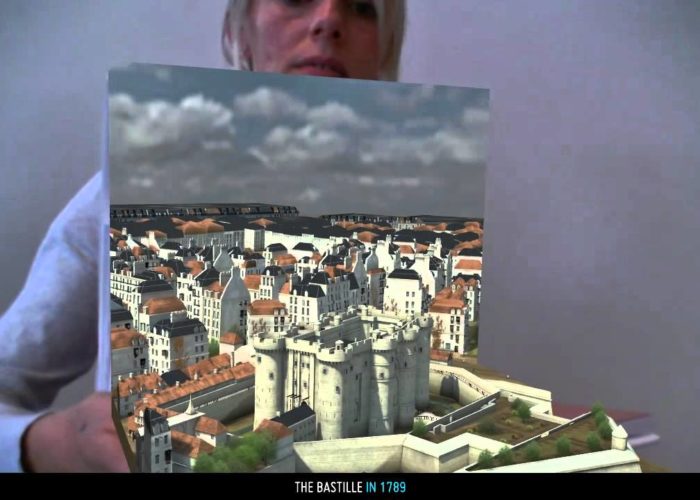
The most successful component of the 3D Paris Saga has been the AR-enhanced companion print book published by Flammarion. Whereas current AR technology uses a mobile application on a smart device to trigger the digital enhancements embedded in the printed page, Dassault requires the user to hold select pages from the print volume up to the web camera on a PC.[15] Like a virtual pop-up book, the 3D models appear on the page as viewed through the computer screen (see Figure 6).

AR-enhanced book opened to show the 3D model of Paris emerging from the printed page

Figure 6. AR-enhanced print text (Dassault Systèmes).

The user may turn the book in order to see all sides of the 3D model, thereby gaining a greater appreciation of Parisian architecture throughout history, including the Middle Ages. However, interacting with the book and the technology is awkward and lacks the mobility that a smart device offers. It is also counterintuitive to the standard reading process since the user holds the book but looks away from it at the computer screen.

AR-enhanced texts are not new. Mark Billinghurst and his team at HitlabNZ (the Human Interface Technology Lab at the University of Canterbury, New Zealand) created some of the first examples in the early 2000s. Called “MagicBooks,” the texts are designed to encourage children to read:

The computer interface has become invisible and the user can interact with graphical content as easily as reading a book. This is because the MagicBook interface metaphors are consistent with the form of the physical objects used. Turning a book page to change virtual scenes is as natural as rotating the page to see a different side of the virtual models. Holding up the AR display to the face to see an enhanced view is similar to using reading glasses or a magnifying lens. Rather than using a mouse and keyboard based interface users manipulate virtual models using real physical objects and natural motions. Although the graphical content is not real, it looks and behaves like a real object, increasing ease of use. (Billinghurst, Kato, and Poupyrev 2001, 747)

Although early forms of AR used abstract, specifically designed images (often QR codes) to trigger enhancements, the technology has advanced to the point that any complex, informationally dense image may serve as a fiducial marker. The use of mobile apps and smart devices makes interaction with the text easy and intuitive.

A new wave of AR technology seems to be driven by the increased capability and ubiquity of our mobile devices. Jordan Frith notes that early theories about the internet hypothesized that humanity (or at least that bit of it that could afford computers) would become more isolated and private—living their lives at home—we assume spending their time (and money) ordering from Amazon (Frith 2002, 136). Mobile computing has diverted us from this possible future. Instead, we are bringing our private lives into public spaces, attempting to control these spaces through our AirPods or earbuds, our Google maps, and Four Square—all the while curating our experience of the urban environment on social media.

It is to this mobile landscape that AR brings such promise. AR’s ability to overlay the physical world with digital information offers a new kind of experience and understanding of our world. Victoria Szabo argues that AR may be used to make the site of cultural history more meaningful to their visitors through the layering of digital information over the physical space. As she explains, “Mobile AR systems have the potential to help users create situated knowledge by bringing scholarly interpretation and archival resources in dialog with the lived experience of a space or object” (Szabo 2018, 373). In so doing, she argues, the visitors move from comprehension of the site which entails historical distance and critical interpretation—in other words traditional educational materials that might guide visitors through the site—to apprehension. Apprehension is more experiential learning and “relies on the tangible and felt qualities of the immediate experiences” (Martin 2017, 837; quoted in Szabo 2018, 374). The ability of AR to merge the “real” physical world of the historical site with digital material such as reconstructions, interpretive data, etc. facilitates both apprehension and comprehension.

When we consider an AR publication, however, we are moving away from Szabo’s paradigm to its inverse. With the book form, we are beginning not with the physical space—which already brings with it the tangible learning central to apprehension—but with the more traditional way of making meaning within education: the book. AR is still in its infancy in the publishing industry, but interest in its possibilities is growing. According to one 2017 poll, only 9% of Americans have experienced an AR application (Martin 2017, 20). Yet in this same year, five major tech companies, including Apple, launched AR frameworks or apps following the surprising success of the AR game Pokémon Go in 2016 (Tan 2018, 22). According to Digital Capital, an investment group, AR and VR are poised to become major players in technology. They estimate an AR/VR market of $108 billion with AR as the primary force and with predicted revenues of $90 billion by 2022 (Tan 2018, 22). This market data may seem irrelevant to academia, but what it means is that publishers are beginning to move into AR as well, creating new opportunities for academic AR publications. Major news media such as The New York Times, The Guardian, The Wall Street Journal, BBC, CNN, Hulu, and Huffington Post have all experimented with some form of Virtual, Augmented, or Mixed Reality (VAMR) media (Martin 2017, 21). Deniz Ergurel, technology journalist and founder of the media start-up Haptical, asserts that VAMR marks the next major technological shift. According to Ergurel, “Every 10–15 years, the technology landscape is reshaped by a major new cycle. In 1980s, it was the PC. In 1994, it was the Internet. And in 2007, it was the smartphone. By 2020, the next big computing platform will be virtual reality” (Martin 2017, 20).

AR text, because it is multisensory, can bring some of the features of experiential learning to its readers including the visual features of the text, historical contextualization, images, audio, video, data visualizations, supplementary text, and most importantly, 3D AR augmentations. The multimodal possibilities of AR texts make them particularly useful to teachers of literature that is culturally or historically distant because, through such reading environments, students may be more easily introduced to the material culture that surrounds and creates the texts they are studying. Furthermore, this approach allows the students to engage with the material in a multimodal fashion, appealing not only to the language centers of the brain, but to the visual and aural centers as well. The digital environment encourages the reader (and even the author) to “play” with the text in terms of design and interactive engagement (Douglas 2000, 65). The brain’s ability to play is something we, like many animals, are hardwired to do for survival; consequently, the process of reading text, especially digital text, has neurological value precisely because it encourages the brain’s playfulness (Armstrong 2013, 26–53).

Conclusion: The Future of VR and AR

The argument can be made that neither VR nor AR offers a truly immersive experience because not all five primary senses of the participant are engaged. Certainly, computer technology can generate both visual and aural enhancements in the form of 3D models and recorded sound. However, touch, smell, and taste are more challenging. Haptic tools, such as gloves or a stylus device, are becoming more popular and offer both the VR and AR user the ability to touch and sense physical contact with virtual objects. AR actually has the advantage of offering much more real-world haptic information by default than VR can. With AR, the user can feel the actual book because it can be a real-world object, but, in VR, the technology must do something to allow the participant to feel such an object because the entire environment is computer created. Demand has been less so far for smell and taste, although there have been some experiments, largely unsuccessful, in adding odors to virtual worlds. Recent developments in the creation of technological tools to trigger the sensation of taste in an individual, such as the “digital lollipop” (Ramasinghe and Do 2016) and Electronic Food Texture System (Niijima and Ogawa 2016, 48–9), show promise for the eventual incorporation of this primary sense into the VR experience.

If full sensory engagement is required for a virtual world to be completely realized, then perhaps the most immersive and interactive experience of the Middle Ages may be one that is not computer-generated at all: Jorvik Viking Centre. Located in York, England, the museum and tourist attraction was created in 1984 and has long been famous for its appeal to the senses of its visitors, most significantly the sense of smell. A quick glance at such online review sites as Trip Advisor, Virtualtourist.com, etc. makes it clear that the intentional smells associated with the exhibit are not just memorable but also a significant factor in recommending the Jorvik Viking Centre. The exhibit’s use of scents to enhance the Viking experience has even generated scholarship exploring the effectiveness of odor in retrieving the memory of the tourist experience. Apparently, it is very effective (Aggleton and Waskett 1999, 1–7).[16] The Centre, in fact, intentionally engages all the senses of its visitors in order to make the historic re-creation a memorable and educational experience. In 2015, it actively promoted its non-digital exhibit in the language of virtual and augmented technologies, inviting guests to have a 4D Viking encounter rather than a mere 3D one. In this campaign, the Centre emphasized that all five primary senses of its visitors will be fully engaged (Jorkvik Viking Centre 2015):

  • Touch: Handling collection of Viking Age artefacts, including bone, antler and pottery, on offer to visitors in the queue—participants will be blindfolded and asked to identify the object/material.”
  • Sight: Binoculars are available in the ‘Time Capsules’ that take visitors around the recreated Viking city. These are to be used to spot the various animals that inhabit the scenes of the ride experience. A ‘spotter’s guide’ will be issued, allowing visitors to score themselves against their finds.”
  • Taste: A Viking Host will be on hand to explain the Viking diet and offer up tasters of unsalted, dried cod (a Norse delicacy) and for visitors over 18, Mead, a beverage made of fermented honey, will be available.”
  • Smell: JORVIK is already famed for its re-creation of the smells of the 10th century York but this will be taken a step further with the introduction of ‘smell boxes’ in the ‘Artefacts Alive’ gallery. A new aroma will be located next to a display of object, with the smell paired to match the contents. [Four] smells will be available: Iron (for the Iron working display), Leather (next to the leather and shoemaking), Beef (for the general living display), and wood (for our wood finds).”
  • Sound: A Viking will entertain visitors with period-specific musical instruments (including a recreation of the panpipes found at Coppergate) and retellings of some favourite Viking sagas.”

But as entertaining as the Jorvik Viking Centre clearly is, do we really want, or even need, a fully immersive and interactive experience? From the perspective of pedagogical effectiveness and student engagement, perhaps not. AR may, in fact, be the technology that has greater potential as a pedagogical tool precisely because it allows the user to learn in a digital environment while always keeping a strong foothold in the physical world—a reminder that the 3D world is not, ultimately, a real place.

Notes

[1] For further discussion of these key elements, see Søraker 2011, 44–72.

[2] Cave Automatic Virtual Environment: an immersive video theatre experience in which a participant wearing shuttering glasses views stereoscopic images as they are projected on the walls of a self-contained space in response to the participant’s position and actions.

[3] Such motion sickness may be caused by display and technology issues, sensory conflict, or postural instability; see LaViola, Jr. 2000, 47–56.

[4] Curiously, in 1935, a version of what we consider to be VR glasses was, in fact, envisioned by science fiction writer Stanley Grauman Weinbaum in his short story “Pygmalion’s Spectacles”; see Project Gutenberg http://www.gutenberg.org/files/22893/22893-h/22893-h.htm.

[5] Given the current interest in VR and AR, it is tempting to turn to 3D model sites, such as TurboSquid, to purchase ready-to-use models; however, evaluating these models for historical accuracy is essential. For example, searching on “medieval castle” brings up a wide selection of 3D models from fairly realistic structures to fantasy, fairytale confections that should be avoided for virtual historic sites; searching on “medieval woman” is even more problematic in terms of the results.

[6] Rousso expresses similar concerns about virtual heritage representation: “First, the issue of validity of information, commonly referred as authenticity. Second, the importance of accuracy in the representation of this information. Authenticity and accuracy are characteristics that archeologists, historians, and museum people strive to achieve and that the general public comes to expect from them. On the other hand, technologists dealing with the visualization of certain content are more concerned with the technical issues that pertain to implementation of the visualization and less concerned with authenticity and accuracy of the content itself” (Rousso 2002, 93).

[7] For a fuller analysis of Lévy’s understanding of actualization, see Ryan 1999, 78–107.

[8] For a detailed analysis of Milgram’s concept, see Craig 2013, 28–35.

[9] For an example of a 360º mural, see the Mural Room of the Santa Barbara County Courthouse which depicts the history of Santa Barbara, California, painted by Daniel Sayre Groesbeck in the early twentieth century: https://www.billheller.com/vr/Santa-Barbara-County-Courthouse-Mural-Room-360/.

[10] Stereoscopic imaging is the technique of creating an illusion of depth by using two offset images, one for the left eye and the other for the right, so that the brain processes both as a single, 3D image.

[11] We are making a distinction here between virtual heritage sites, which are 3D reconstructions of archaeological sites, architecture, or any other type of object, and 3D “real virtual worlds,” which combine 3D with “community, creation, and commerce,” such as World of Warcraft and Second Life; see Sivan 2008, 1–32.

[12] The phenomenon was first described by Masahiro Mori in 1970 and translated as “uncanny valley” by Jasia Reichard (Mori 1978).

[13] The project team has, in fact, used the 3D models to produce an award-winning stereoscopic short film, APA Etruscan (2012), for the Museum of the History of Bologna in which APA, an Etruscan character (see Figure 3), takes the viewer through a virtual history of the city.

[14] It is perhaps worth noting that, even though such virtual reconstructions are typically informed by the real world, the 3D digital exterior model of Notre-Dame de Paris created by Dassault Systèmes for the 3D Paris Saga as well as the 3D interior model created by Unisoft for the game Assassin’s Creed Unity may prove to be valuable resources for the rebuilding of the Cathedral after it was severely damaged by fire on April 15, 2019. Ironically, the real may now be informed by the virtual; see Wong 2019.

[15] For an example of how the book works, please see the following video: https://www.youtube.com/watch?v=sbZuQcXchkM.

[16] Capitalizing on the Centre’s success with odor and its notoriety, York’s tourism board published Britain’s first scented tourist guidebook in 2014 (Gordon 2014).

Bibliography

Aggleton, J.P., and L. Waskett. 1999. “The Ability of Odors to Serve as State-Dependent Cues for Real-World Memories: Can Viking Smells Aid the Recall of Viking Experiences?” British Journal of Psychology 90.

Armstrong, Paul B. 2013. How Literature Plays with the Brain: The Neuroscience of Reading and Art. Baltimore, MD: The Johns Hopkins University Press.

Baudrillard, Jean. 1994. Simulacra and Simulation. Trans. Sheila Faria Glaser. Ann Arbor: University of Michigan Press.

Billinghurst, Mark, Hirokazu Kato, and Ivan Poupyrev. 2001. “The MagicBook: A Transitional AR Interface.” Computers & Graphics 25, no. 5.

Craig, Alan B. 2013. Understanding Augmented Reality: Concepts and Applications. Waltham, MA: Elsevier.

Cuff, Paul. 2015. A Revolution for the Screen: Abel Gance’s Napoleon, Film Culture in Transition. Amsterdam: Amsterdam University Press.

Dassault Systèmes. 2012. “Revivez Paris en 3D! Dassault Systèmes nous raconte l’histoire fascinante de la Ville Lumière.” EXALEAD Blog. September 27, 2012. Accessed December 17, 2019, https://blogs.3ds.com/exalead/fr/2012/09/27/revivez-paris-en-3d-dassault-systemes-nous-raconte-lhistoire-fascinante-de-la-ville-lumiere/.

Dieleman, Hans, and Donald Huisingh. 2006. “Games by which to Learn and Teach about Sustainable Development: Exploring the Relevance of Games and Experiential Learning in Sustainability,” Journal of Cleaner Production 14.

Douglas, J. Yellowlees. 2000. The End of Books-Or Books without End: Reading Interactive Narratives. Ann Arbor, MI: The University of Michigan Press.

Fleming, Bill. 1998. 3D Photorealism Toolkit. New York: John Wiley & Sons.

Frith, Jordan. 2012. “Splintered Space: Hybrid Spaces and Differential Mobility.” Mobilities 7, no. 1.

Gordon, Sarah. 2014. “The scratch ‘n sniff tourist guide! York issues the UK’s FIRST scented guidebook to tempt the noses of tourists.” DailyMail.com, March 7, 2014. Accessed December 17, 2019. http://www.dailymail.co.uk/travel/article-2575496/York-releases-UKs-scented-guidebook-tempt-noses-tourists.html.

Guidazzoli, Antonella, Maria Chiara Liguori, and Mauro Felicori. 2013. “Open Creative Framework for a Smart Cultural City: Bologna Porticoes and the Involvement of Citizens for a UNESCO Candidacy.” Information Technologies for Performing Arts, Media Access, and Entertainment Lecture Notes in Computer Science, Vol. 7990: 58–65.

Jorvik Viking Centre. 2015. “Forget 3D – Discover Vikings in 4D this Summer.” Jorvik Viking Centre. Accessed December 17, 2019. http://www.thejorvikgroup.com/press/press-releases/forget-3d-discover-vikings-in-4d-this-summer/.

LaViola, Jr., Jospeh L. 2000. “A Discussion of Cybersickness in Virtual Environments.” SIGCHI Bulletin 32, no. 1: 47–56.

Lévy, Pierre. 1998. Becoming Virtual: Reality In The Digital Age. Trans. Robert Bononno. New York: Plenum Press.

Martin, Erik J. 2017. EContent Magazine. May/June 2017.

Masahiro, Mori. Robotics: Fact, Fiction, and Prediction. Trans, Jasia Reichard. Viking Press, 1978.

McCarty, Willard. 2003. “Humanities Computing.” Encyclopedia of Library and Information Science. New York: Marcel Dekker.

Milgram, Paul, et al. 1995. “Augmented Reality: A Class of Displays on the Reality-Virtuality Continuum.” Proceedings of the SPIE Conference on Telemanipulator and Telepresent Technologies 2351: 282–92.

Niijima, Arinobu and Takefumi Ogawa. 2016. “Virtual Food Texture by Electrical Muscle Stimulation.” Proceedings of the 2016 ACM International Symposium on Wearable Computers. New York: ACM.

Ogleby, Clifford. 2007. “The ‘Truthlikeness’ of Virtual Reality Reconstructions of Architectural Heritage: Concepts and Metadata.” 3D-ARCH 2007: 3D Virtual Reconstruction and Visualization of Complex Architectures. International Society for Photogrammetry and Remote Sensing (ISPRS). 36, no. 5: n.p. Accessed December 17, 2019, https://www.semanticscholar.org/paper/THE-%22-TRUTHLIKENESS-%22-OF-VIRTUAL-REALITY-OF-%3A-AND-Ogleby/87533316e22a172b015d10e67cd69f758f18c887.

Ramasinghe, Nimesha, and Ellen Li-Yuen Do. 2016. “Digital Lollipop: Studying Electrical Stimulation on the Human Tongue to Simulate Taste Sensations.” ACM Transactions on Multimedia Computing, Communications, and Applications 13, no. 1.

Rousso, Maria. 2002. “Virtual Heritage: From the Research Lab to the Broad Public.” Virtual Archaeology: Proceedings of the VAST Euroconference. Ed. Franco Niccolucci (BAR International Series 1075.

Ryan, Marie-Laure. “Cyberspace, Virtuality, and the Text.” Cyberspace Textuality: Computer Technology and Literary Theory. Ed. Marie-Laure Ryan. Bloomington: Indiana University Press. 78–107.

Sherman, William R., and Alan B. Craig. 2003. Understanding Virtual Reality: Interface, Application, and Design. The Morgan Kaufmann Series in Computer Graphics. San Francisco: Morgan Kaufmann Publishing.

Sivan, Yesha. 2008. “3D3C Real Virtual Worlds Defined: The Immense Potential of Merging 3D, Community, Creation, and Commerce.” Journal of Virtual Worlds Research 1, no. 1: 1–32.

Søraker, Johnny Hartz. 2011. “Virtual Entities, Environments, Worlds and Reality: Suggested Definitions and Taxonomy.” Trust and Virtual Worlds: Contemporary Perspectives. Eds. Charles Ess and May Thorseth. New York: Peter Lang Publishing. 44–72.

Szabo, Victoria. 2018. “Apprehending the Past: Augmented Reality, Archives, and Cultural Memory.” The Routledge Companion to Media Studies and Digital Humanities. Ed. Jentery Sayers. New York: Routledge.

Tan, Teri. 2018 “Making AR and VR Work in Publishing.” Publishers Weekly. July 2, 2018.

Thompson, Seth. 2015. “VR Panoramic Photography and Hypermedia: Drawing from the Panorama’s Past.” ISEA 2015: Proceedings from the 2015 International Symposium on Electronic Art. n.p. Accessed December 19, 2019. http://isea2015.org/proceeding/submissions/ISEA2015_submission_46.pdf.

Vitaliev, Vitali. 2013. “AR and 3D in Travel and History Applications, “ Engineering and Technology Magazine 8, no. 4. Accessed December17, 2019, https://eandt.theiet.org/content/articles/2013/04/ar-and-3d-in-travel-and-history-applications/.

Virtual Reality Society. 2016. “The History of Virtual Reality.” Virtual Reality Society. Accessed December 17, 2019. http://www.vrs.org.uk/virtual-reality/history.html.

“Voici à quoi ressemblait le Sainte-Chapelle au 14e siècle.” 2015. Sciences et Avenir. June 25, 2015. Accessed December 17, 2019, http://www.sciencesetavenir.fr/voyage/20150622.OBS1313/voici-a-quoi-ressemblait-la-sainte-chapelle-au-14eme-siecle.html.

Wong, Kenneth. 2019. “Dassault Systèmes, Ubisoft Pledge to Help Rebuild Notre-Dame.” Digital Engineering 247. April 17, 2019.
https://www.digitalengineering247.com/article/dassault-systemes-unisoft-pledge-to-help-rebuild-notre-dame/simulate.

Acknowledgments

We are extremely grateful to Alan B. Craig for reading and commenting on an earlier version of this article and for drawing our attention to the Bologna 3D Open Repository.

About the Authors

Tamara F. O’Callaghan is a Professor of English at Northern Kentucky University where she teaches medieval literature, history of the English language, and introductory linguistics as well as digital humanities approaches to literature. She received a Ph.D. in medieval studies from the Centre for Medieval Studies, University of Toronto, with a specialization in Middle English and Old French literature and medieval manuscript studies. She is the co-author of the textbook Introducing English Studies (Bloomsbury, 2020) and has published on medieval literature and manuscript studies as well as on the digital humanities and teaching. She also co-directs The Augmented Palimpsest Project, a digital humanities tool which explores how the medium of AR can be used in teaching medieval literature.

Andrea R. Harbin is an Associate Professor of English at the State University of New York, Cortland where she teaches medieval literature, the history of English, and Shakespeare and serves as department chair.  She has worked as a digital humanist since 1998 as curator/editor of NetSERF: an Internet Database of Medieval Studies. She received a Ph.D. in Medieval English Literature with a specialization in medieval drama from The Catholic University of America, and has published articles on digital humanities, pedagogy in medieval studies, and medieval drama. She is likewise a co-director of The Augmented Palimpsest Project.

0

Designing ‘Authenticity’ in Digital Learning Environments

Allan Johnson, University of Surrey

Abstract

This article reports on a study into the integrative use of social media tools to create an ‘authentic digital learning environment’ for undergraduate literature teaching at City University of Hong Kong. An authentic digital learning environment is one that is created—rather than adopted or adapted—by student cohorts. The findings of the study suggest that the use of digital media in the classroom can create higher levels of student engagement, but only when it is embedded systematically in module design. This article outlines the rationale for moving to a digital learning environment composed of social tools, thereby situating learning in a context that is more authentic to students while seamlessly integrating digital literacy education into traditional subject areas.

Introduction & Context

This research commences from a position held by Laurillard (2012) that teaching is a design science and, as such, can be described, created, and evaluated through consideration of the patterns which contribute to the complex relationship between learning and teaching. These patterns can become even more apparent in digital pedagogies, where the correlation between content and form is often highly significant. This investigation studied how learning activities conducted in ‘authentic digital learning environments’ impacted student experience in an English literature course in the Department of English at City University of Hong Kong. An authentic digital learning environment is one that is created—rather than adopted or adapted—by student cohorts. In practice, this means that the functions normally fulfilled by a learning management system (LMS) such as Blackboard or Moodle (e.g. content delivery, lecturer-student communication, student-student communication, work submission, assessment) are accomplished inside an environment that students incrementally and collaboratively build through their sustained connections within web 2.0 tools such as Twitter, WordPress, and RSS.

Proprietary LMSs have been shown to be important tools for enhancing student learning, particularly in literature and language studies (e.g. Gimmel, 2007; Levy, 2009; Lancashire, 2009); however, they are specific only to educational contexts (and particularly to higher education contexts) and students will ultimately leave them behind following graduation. This research examined the impact of learning activities and materials that are assigned, created, and assessed within an environment that more closely mirrors students’ own authentic engagements with collaborative technology. The findings from this study suggest the importance of full integration between material design and implementation in digital pedagogy, and underline the importance of holistic instructional design with equal consideration of task and material creation.

Authentic tasks & authentic materials

Previous research has focused on ‘authenticity’ as a quality of the discrete learning task or assessment tool (Cronin (1993), Young & McNeese (1993), Lebow & Wager (1994), Herrington & Herrington (1998), Oliver & Omari (1999), Barab, Squire, & Dueber (2000), and Herrington, Reeves, and Oliver (2006)). Lombardi (2007) defines authentic learning as the focus on ‘real-world, complex problems and their solutions, using role-playing exercises, problem-based activities, case studies, and participation in virtual communities of practice’ (2). This type of engaged, participatory learning task can lead to what Ramsden (1992) refers to as ‘deep learning’, a mode of learning marked by long-term retention and genuine critical application of concepts, ideas, and theories. This interest in ‘authenticity’ as a possible attribute of a learning task or assessment tool supports learning that operates within meaningful and consequential learning contexts by situating the task as the elemental feature of teaching.

A related use of ‘authenticity’ in pedagogical design comes from Lave & Wenger (1991) and Wenger (1998), whose influential ‘situated learning’ and ‘communities of practice’ models emphasize the need for learning, teaching, and assessment methods that replicate the demands of the professional environments students will ultimately enter. These understandings of authentic tasks and authentic materials reflect Piagetian models of constructivist learning in the way they seek to encourage learning that centers on and bolsters schemata, that is, the patterns of knowledge that students construct and continue to build on through the educational process. Because LMS bear little resemblance, particularly in terms of information architecture, to software that students will be likely to use in their professional lives (e.g. Customer Relationship Management software [CRM], Project Management Information Systems [PMIS], and Content Management Systems [CMS]), there is the suggestion that alternative, authentic modes of learning management which mirror those used in professional environments can benefit student experience and achievement.

Although the majority of research on authenticity in pedagogical design underlines the significance of authenticity in assessment and learning tasks, a further body of research in the field of English language teaching portrays authenticity as a feature of learning materials and content delivery. In modern language education, ‘authentic materials’ are examples drawn from the real world such as magazines, newspapers, and advertisements, which provide language learners an unmediated exposure to the target language. In this context, authentic materials can be contrasted with ‘graded materials,’ readings which appear in textbooks and other prepared course documents which have been designed specifically—in terms of vocabulary, complexity, and grammatical formation—to be appropriate for the student group and learning objectives. As Berwald (1987) and Peacock (1997) argue, authentic materials are an important element of student motivation because they give examples of how the language is used outside of the constraints of the classroom. Bardovi-Harlig et al. (1991) point out the importance of authentic materials in developing pragmalinguistic competencies and Gilmore (2007) underlines the importance of the coherence of authentic materials in developing discourse competencies. Gilmore (2007) also reminds that authentic materials can present a greater challenge to students than graded materials, a challenge which may have significant impacts upon learning goals and objectives.

Both of these strands of investigation—on authentic tasks and on authentic materials—have described ‘authenticity’ as a feature of isolated patterns of pedagogy rather than part of broader holistic systems of learning and teaching. The desirability of what may be termed ‘authentic’ learning is restrained to one aspect of learning and teaching design. Neither of these views on pedagogical authenticity unite both task and material to consider an authentic learning environment that supports and engages students in ways that reflect genuine uses of both course content and the application of course content to life beyond the lecture hall. It seems clear that the advances of web 2.0 connectivity has made this style of learning and teaching possible in a way that it never has been before.

Digital writing and assessment in English as a Second Language (ESL) contexts

As Berwald’s (1987) and Peacock’s (1997) comments on ‘authentic materials’ suggest, the relationship between material design and teaching design is a critical element of modern language education. Conducting this study on ‘authentic learning managements systems’ in Hong Kong—a semi-autonomous Cantonese-speaking region, which Schneider (2011) describes as ‘a classic ESL country where knowledge of English is typically associated with middle-class identity and a modern, international outlook on life’ (p. 139)—brought a number of pedagogical issues to the fore. Literature is an important part of the ESL classroom, and can provide a unique and distinctive development of both linguistic and cultural competencies (Lazar 1990; Nance 2010). However, the teaching of literature in ESL contexts generally minimizes the uses of writing tasks. Language teachers’ weariness over the use of literature—and, particularly, writing about literature—seems well-founded. A point that Dixon made in 1983 seems to remain true for many ESL literature students: ‘often, it seems, they are learning to substitute intellectual sophistry for the effort to give authentic articulation to their literary response’ (p. 219). Brown, Bull, and Pendlebury (1997) suggest that ‘a good case could be made for arguing that [essays] are the most useful way of assessing deep learning’ because they require students ‘to integrate knowledge, skills and understanding’ into a cohesive written work (p. 58). While it seems that the university essay is a good way to assess student work and, indeed, a key element of the learning process of students, Bourdieu and Passeron (1977) famously point out in Reproduction in Education, Society and Culture that the essay is a privileged, institutionalized genre, one that reflects little of the type of writing that students will undertake in their future professional lives. Educators thus might be wise to consider the strength of alternative forms of written assessment, a shift with significant applications in ESL learning and teaching contexts.

Authentic digital learning environments

Instructional design for distance, blended, or distributed learning must recognize the relationship between learning and teaching, and integrate learner, task, and technology into a coherent design system (Herrington, Reeves, and Oliver, 2006). Jenkins (2009) further develops this point:

Rather than dealing with each technology in isolation, we would do better to take an ecological approach, thinking about the interrelationship among different communication technologies, the cultural communities that grow up around them, and the activities they support. (7)

Although some work has been done on the importance of student customization in instructional design (Vovides, Sanchez-Alonson, Mitropoulou and Nickmans, 2007; Mason & Rennie, 2008), the majority of research has focused on social media tools in isolation and their particular implications within the classroom. The view has almost universally been that social media tools can provide important learning opportunities as long as their uses are appropriately aligned with course learning objectives and intended outcomes. For instance, Facebook can help to better engage students in learning because of its familiarity and ubiquity, but students can still be hesitant to ‘friend’ lecturers or to open up a largely private digital network to classroom purposes (Bosch, 2009; Irwin, Ball, and Debsbrow, 2012; Lee, Teng, Hsueh, and Li, 2013). However, other research (e.g. Sapargaliyev, 2012) suggests that students show little engagement in closed Facebook groups for learning materials, and can be resistant to the use of Facebook in learning and teaching because of privacy concerns (e.g. Wang, Woo, Quek, Yang, and Liu, 2012). The uniqueness of Twitter inheres in the fact that it offers the potential for a greater amount and greater variety of teacher-student, student-teacher, and student-student interaction in lectures (Tyma, 2011; Andrade, Castro, & Ferreira, 2012; Tiernan, 2013). And as Lowe & Laffey (2011) and Rinaldo, Tapp, and Laverie (2011) point out, the use of Twitter can be especially relevant in fields such as marketing where students will likely be using Twitter in their future jobs.

Social networking can play a significant role in the development of community and a shared community of inquiry (Sinnappan & Zutshi, 2011) and lead to a participatory culture that extends beyond the classroom (Jenkins, 2009). By their very nature, social media tools are not isolated, but are defined by their relationships and connectivity as much as by their individual affordances. As this article defines it, authentic digital learning environments are the spaces that are created when students collectively and consistently interact through web 2.0 tools such as Twitter, WordPress, and RSS. When this type of engagement is embedded systematically within module design, the authentic digital learning environment fulfills nearly all roles of a traditional LMS and does so in a way that can lead to new learning opportunities for students.

Methodology

This research took place in an English literature course called Literature in Our Lives at City University of Hong Kong during Spring 2014. Literature in Our Lives is an introductory General Education course available to all students at the university. There were 56 students enrolled in the course, which was delivered through a 3-hour weekly mixed seminar/lecture. Before this course began, students all had at least one semester experience of using Blackboard to handle class discussions, file sharing, announcements, and work submission. Literature in Our Lives moved away from Blackboard to locate all discussions, file sharing, announcements, and work submission in authentic digital tools best suited for these purposes, including WordPress and Twitter.

Students completed approximately 3,000 words of assessed writing during the semester which was uploaded to individual portfolios in the form of weekly responses to the primary texts. Students were given basic training on WordPress during the first lecture and many participants would go on to use this platform for their blogs, although a small number of alternative blogging sites and CMS were also used. Examples of student work each week was re-blogged on a private module website and students had the option to make their own blogs either public or assessable only to me and their classmates. To facilitate peer-to-peer review, students were required to find and comment on two other pieces of work each week. Because of the authentic deployment of these written responses, students had to share links to their writing to the target audience of class peers through tools such as Twitter, Facebook, RSS or semi-structured blogging circles. In addition, they had to work in groups to produce a creative reimagining of one of the primary texts on the courses. These took the form of films, websites, eBooks, animations, and poetry which could be integrated into their personal blogs for final assessment.

At the beginning of the semester a survey was administered which asked students to evaluate the differences between Blackboard and social media for educational purposes; a similar survey was delivered at the end of the semester to gauge students’ perceptions following the course. Both surveys relied on an array of structured and unstructured question types. At the end of the semester, small discussion groups were held with students in order to observe reactions to the use of an authentic digital learning environment, and student writing and communication within this environment was analyzed with reference to the stated intended learning outcomes for the course.

Findings & Discussion

Two surveys were delivered to the 56 students in Literature in Our Lives to measure their perceptions of integrative social media usage in the classroom at the beginning and end of the semester. Both surveys included two questions which aimed to gather insight into students’ comparative understanding of the affordances of traditional LMS and social media: 1) ‘Which of the following functions in Blackboard do you believe are better than other social media websites?’ and 2) ‘Which of the following functions of social media websites do you believe are better than Blackboard?’ For both questions students had a list of six affordances and were able to select multiple answers:

  • Group Collaboration
  • Class Communication
  • Notification of Grades
  • Work Submission
  • File Sharing
  • Announcements

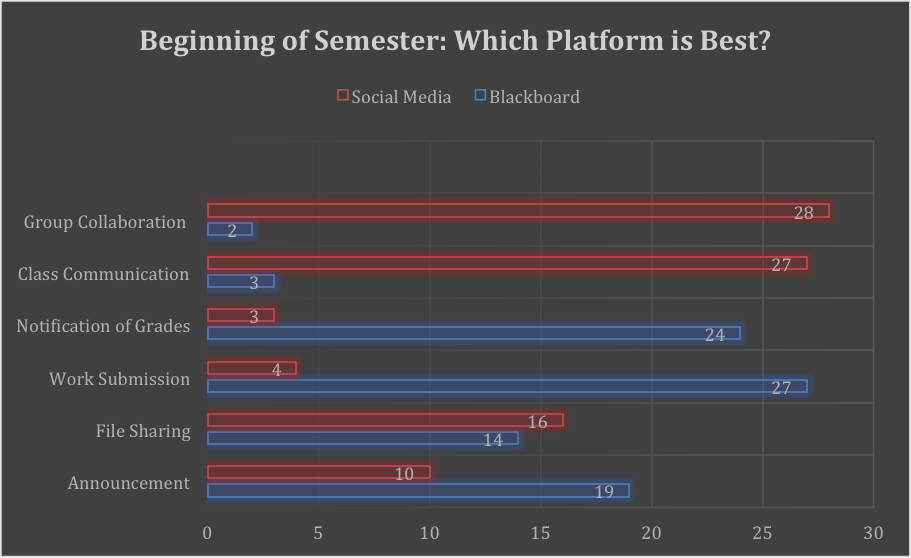
Results from the first survey at the beginning of the semester demonstrate that many students possessed a clear and well-defined understanding of the potential role of digital media in education. Respondents considered Notification of Grades, Work Submission, and Announcements as tasks best achieved by LMS and Group Collaboration, Class Communication, and File Sharing as best achieved through social media channels (Table 1).

Table 1: Results from survey conducted at the beginning of the semester in bar chart format as described in the body of the essay.

Table 1: Beginning of Semester: Which Platform is Best?


While File Sharing received a close split of 16 responses favoring social media and 14 responses favoring LMS, the spread was much more pronounced for several categories: for Group Collaboration, 28 respondents chose social media versus only 2 for LMS; for Class Communication, 27 respondents chose social media versus 3 for LMS; and for Work Submission, only 4 respondents chose social media while 27 chose LMS.

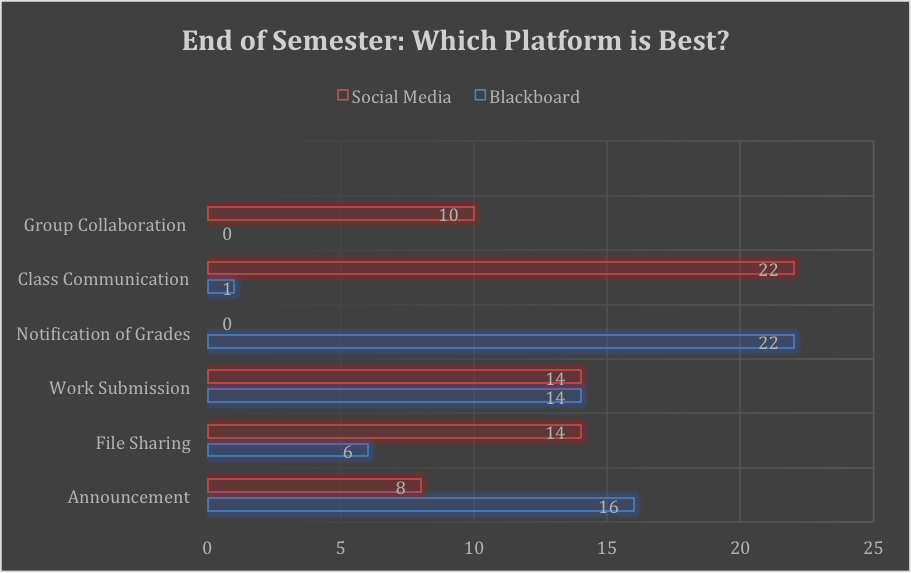
Following a semester of using social media as an integrated element of learning design and assessment, the second survey captures several changed perceptions. Most notably, by the end of the semester an equal number of students indicated that social media and LMS were most suitable for Work Submission, suggesting a growing awareness of how social media could be used effectively to submit work for assessment (Table 2).

Table 2: Results from survey conducted at the end of the semester in bar chart format as described in the body of the essay.

Table 2: End of Semester: Which Platform is Best?


The majority of students selected fewer categories than in the first survey, showing a more focused indication of their preferences. Although the preferred channel of engagement in the remaining categories remained the same as in the first survey results, the data further emphasizes student perceptions that Notification of Grades is still best achieved through LMS (zero students selected social media in this category) and reflects a growing awareness of using social media for File Sharing (16 against 14 at the beginning of the semester as opposed to 14 and 6 at the end). Students perceptions on the educational use of social media is thus not altered dramatically by its inclusion in teaching design; however, there is evidence of modest shifts in perception particularly related to the possibilities of submitting work through a social media channel.

Furthermore, the survey results do not suggest that students found the increased use of social media to be detrimental to the learning environment, and further focus group discussions suggest that students found the use of an authentic digital learning environment to be a positive experience that improved both engagement and content understanding. As one student described:

I do believe digital media can change students’ perspective on as well as approach to literature and most importantly, help them make sense of the art of reading so that it no longer seems like a daunting process.

There were, however, a number of objections. One student suggested that ‘digital media is for entertainment’ while another student felt that the walled structure of LMS played a significant role in gaining and maintaining student attention:

Blackboard, even though a bit bland, keeps the students focused on their tasks rather than wasting time reading about Kayne West and Kim Kardashian’s wedding plans.

Several students sensed that the ubiquity of Blackboard within higher education is a key element of its value: ‘I think Blackboard is still a major platform in education, but if more courses are using digital media, it could be more convenient.’ This point was echoed by other students, who thought there might be a tipping point for the wide-scale move away from propriety LMS, although perhaps that tipping point has not yet been reached.

Serendipitous & Collateral Learning

This data does not represent significant shifts in student perception of social media as a learning tool; however, the assessed written work indicates some advances in metacognition. There can be a secondary objective in pedagogical design that moves beyond the intended learning outcomes. Literature in Our Lives was not digitally-themed in its content, and it was important that the digital components didn’t overpower the literary studies focus. While the topic of the learning objectives in literature pedagogy is far beyond the scope of this article, this research does flag a number of interesting points about the particularities of literature education within a digital environment, and particularly within an ESL context. These relate largely to the way in which students behaved within the authentic platform utilized, and the serendipitous or collateral learning that their work demonstrated.

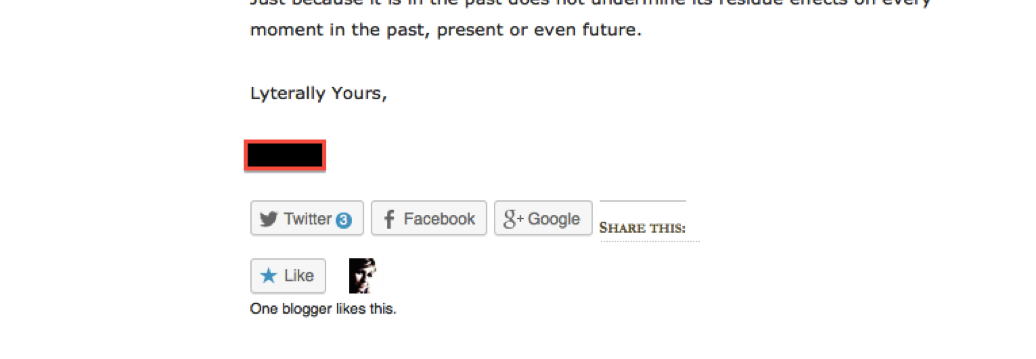
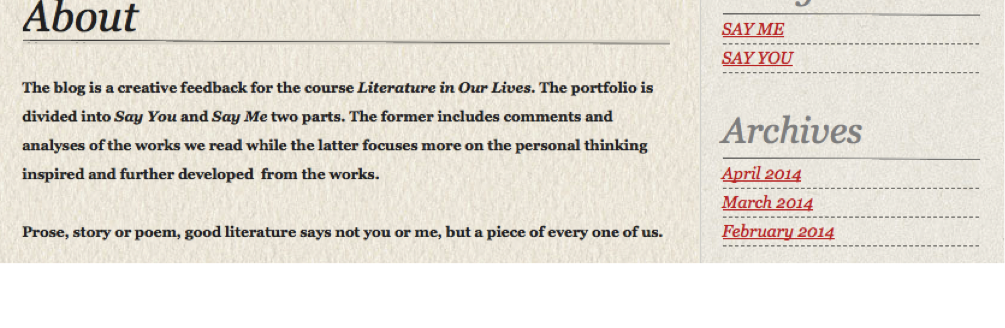
In their portfolios, several students began to take on unique private personas: one student signed off posts like a letter with ‘Lyterally Yours’ (Figure 1)—a pun on ‘literal’ which draws attention to the role of the reader and critic in literary analysis—and another began a tagging convention using ‘Say Me’ and ‘Say You’ to distinguish between posts determined to be more reflective versus more analytical (Figure 2). In both cases, the students’ behavior in the digital environment reflected a unique understanding of the role of the critic in literary studies and the relationship of the critic both to literary history and to a present audience.

Figure 1: Example of student blog post which signs off ‘Lyterally Yours’ like a letter

Figure 1: ‘Lyterally Yours’ and the relationship between reader and writer.


Figure 2: Close-up of navigation pane of a student blog which uses ‘Say Me’ and ‘Say You’ as category structure

Figure 2: Category structure that reveals relationship between critical and reflective approaches to literary analysis.


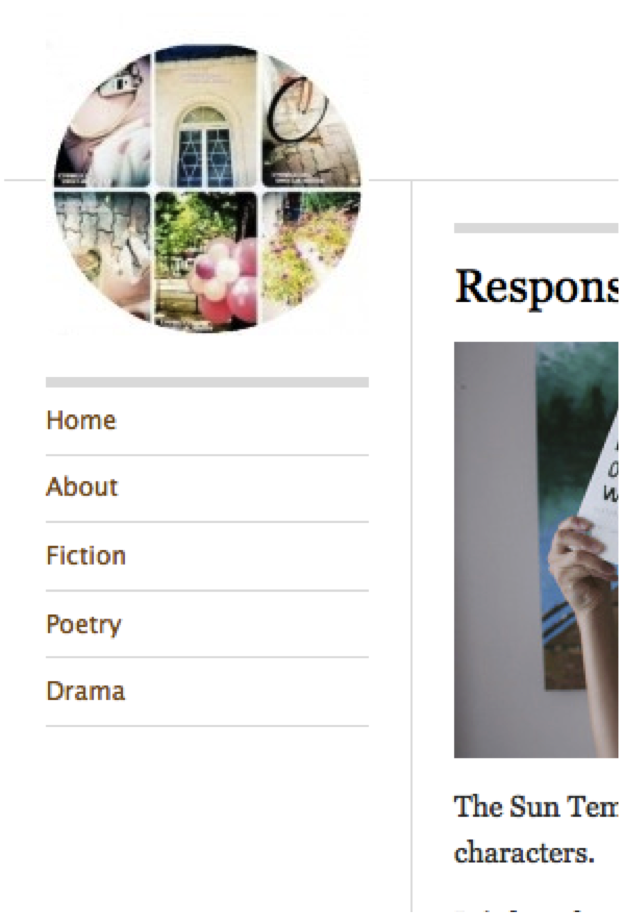
Student use of tagging and categories also reflected unique collateral learning effects that registered their individual understandings of the literary texts in a critical/analytical matrix not otherwise observable in a formal essay.  Eleven students organized their posts into the three genres of ‘Fiction,’ ‘Poetry,’ and ‘Drama’ through either top-level navigation, or tagging, a seemingly obvious and appropriate information architecture, which, nevertheless, represents an important awareness of genre form in an ESL literature course (Figure 3).

Figure 3: Example of top level navigation menu in a student blog which is divided into Fiction, Poetry, and Drama

Figure 3: Top level navigation that reflects interest in genre.


Tagging conventions also regularly revealed interesting insights. For example, one student used the tag ‘sexual awakening’ for posts on Brokeback Mountain, Interpreter of Maladies, and As You Like It, indicating a clear sense of comparison between these three works which appear on the surface to have little in common (Figure 4). Another student was evidently drawn to the role of history within the texts studied, using ‘past’ and ‘present’ as a tagging convention; both tags appear, appropriately, in a post on The Cherry Orchard (Figure 5). In total, 21 students expressed metacognitive awareness of the relationship between texts through tagging conventions and information architecture.

Figure 4: Example of a tagging cluster on an individual student post which include the tag ‘sexual awakening'

Figure 4: Tagging conventions that reveal relationships between literary texts.


Figure 5: Example of a tagging cluster on individual student post which include ‘conflicts, ‘past,' and ‘present’

Figure 5: Tagging conventions that reveal relationships between past and present.


Whether these digital performances reflect new learning created by the platform or record learning that would have otherwise gone unnoticed remains unclear. However, while operating in this way students were able to demonstrate skills and competencies that would have gone unnoticed in a regular delivery, and were rewarded for them appropriately. They were able to demonstrate the way in which they thought about literature using affordances unavailable outside of an authentic digital learning environment. Perhaps unexpectedly, three students turned their blog into a professional portfolio, which included relevant sections on education and work experience and portrayed the blog entries as evidence of high levels of English-language proficiency. What began as a form of written assessment had thus been made truly authentic with relevance and meaning in the professional world.

Conclusions & Recommendations

Jenkins (2009) emphasizes the need for a participatory culture in social media, with students learning how to effectively and productively participate in the vast digital world around them. Within such a learning environment the design of content delivery, collaboration, and assessment allows for and rewards collateral and serendipitous learning. Using tools that already exist within the frame of reference for the student and are perhaps already being used by them is (as research on authentic tasks and authentic materials has demonstrated) messy, unpredictable, and potentially frustrating for student and teacher. However, it remains a necessary component of helping students understand how the content they are studying relates, even if only superficially, to a world that continues to exist outside of the lecture hall. While propriety LMS have been shown to be valuable tools in education, there is evidence that authentic digital learning environments—comprised of tools that students will continue to use beyond graduation—allow them to perceive new connections between content material and lead to helpful collateral and serendipitous learning which can contribute to final module assessment and professional development.

Bibliography

Andrade, A., Castro, C., & Ferreira, S. A. 2012. “Cognitive communication 2 .0 in Higher Education: to tweet or not to tweet?” The Electronic Journal of e-Learning 10(3): 293–305.Barab, S.A., Squire, K.D., & Dueber, W. 2000. “A co-evolutionary model for supporting the emergence of authenticity.” Educational Technology Research and Development. 48(2): 37–62.

Bardovi-Harlig, K., et al. 1991. “Developing pragmatic awareness: Closing the conversation.” ELT Journal 45(1): 4–15.

Bosch, T. E. 2009. “Using online social networking for teaching and learning: Facebook use at the University of Cape Town.” Communicatio. 35(2): 185–200.

Bourdieu, P. & Passeron, J-C. 1977. Reproduction in Education, Society and Culture. London: Sage.

Brown, G., Bull, J., and Pendlebury, M. 1997. Assessing Student Learning in Higher Education. London: Routledge.

Chambers, E., & Gregory, M. 2006. Teaching & Learning in English Literature. London: Sage.

Cronin, J.C. 1993. “Four Misconceptions about authentic learning.” Educational Leadership. 50(7): 78–80.

Gilmore, A. 2007. “Authentic materials and authenticity in foreign language learning.” Language Teaching. 40: 97–118.

Gimmel, M. 2007. “A Report on On-Line Discussions in an Upper-Level Spanish Literature Class.” Hispania. 90(4): 724–727.

Herrington, J., & Herrington, A. 1998. “Authentic assessment and multimedia: how university students respond to a model of authentic assessment.” Higher Education Research and Development. 17(3): 305–322.

Herrington, J., T. Reeves, R. Oliver. 2006. “Authentic Tasks Online: A Synergy Among Learner, Task, and Technology.” Distance Education. 27(2): 233–247.

Hew, K. F. (2011). “Students’ and teachers’ use of Facebook.” Computers in Human Behavior. 27(2): 662–676.

Irwin, C., Ball, L., Desbrow, B., & Leveritt, M. 2012. “Students’ perceptions of using Facebook as an interactive learning resource at university.” Australiasian Journal of Educational Technology. 28(7): 1221–1232.

Jenkins, H. et al. 2009. Confronting the Challenges of Participatory Culture: Media Education for the 21st Century. London: MIT Press.

Lancashire, I. (Ed.). 2009. Teaching Literature and Language Online. New York: Modern Language Association.

Lave, J. and Wenger, E. 1991. Situated learning: Legitimate peripheral participation. Cambridge: Cambridge UP.

Lazar, G. 1990. “Using novels in the classroom.” ELT Journal, 44(3): 204–214.

Lebow, D., & W.W. Wager. 1994. “Authentic Activity as a Model for Appropriate Learning Activity: Implications for Emerging Instructional Technologies.” Canadian Journal of Educational Communication. 23(3): 231–244.

Lee, W., Teng, C., Hsueh, N., & Li, Y. 2013. “Using Facebook to Better Engage College Students.” Advances in Intelligent Systems and Applications: Proceedings of the International Computer Symposium, ICS 2012, 403–408.

Levy, M. 2009. “Technologies in Use for Second Language Learning.” The Modern Language Journal. 93: 769–782.

Lombardi, M. 2007. “Authentic Learning for the 21st Century: An Overview.” ELI Paper 1. Educause Learning Initiative.

Lowe, B., & Laffey, D. 2011. “Is Twitter for the Birds?: Using Twitter to Enhance Student Learning in a Marketing Course.” Journal of Marketing Education, 33(2): 183–192.

Nance, K. 2010. Teaching Literature in the Languages. Pearson: Upper Saddle River, NJ.

Oliver, R., & Omari, A. 1999. “Using online technologies to support problem based learning: Learners responses and perceptions.” Australian Journal of Educational Technology. 15: 158–79.

Peacock, M. 1997. “The Effect of Authentic Materials on the Motivation of EFL Learners.” ELT Journal. 51(2): 144–156.

Ramsden, P. 1992. Learning to Teach in Higher Education. London: Routledge.

Reeves, T., Herrington, J. & Oliver, R. 2002. “Authentic activities and online learning.” Quality Conversations: Proceedings of the 25th HERDSA Annual             Conference, Perth, Western Australia, 7–10 July 2002.

Rinaldo, S. B., Tapp, S., & Laverie, D. 2011. “Learning by Tweeting: Using Twitter as a Pedagogical Tool.” Journal of Marketing Education. 33(2): 193–203.

Sapargaliyev, D. 2012. “Using a Facebook Closed-Group as Part of an Online Course.” Engaging Learners Through Emerging Technologies: International Conference on ICT in Teaching and Learning, ICT 2012: 59–68.

Schneider, E. 2011. “English into Asia: From Singaporean Ubiquity to Chinese Learners’ Features” in Contours of English and English Language Studies, ed. Michael Adams and Anne Curzan. Ann Arbor: U of Michigan P. 135–156.

Sinnappan, S., & Zutshi, S. 2011. “A Framework to Enrich Student Interaction via Cross-Institutional Microblogging.” Advances in Web-Based Learning, ICWL10th International Conference Proceedings. 102–111.

Tiernan, P. 2013. “A study of the use of Twitter by students for lecture engagement and discussion.” Education and Information Technologies. 19(4).

Tyma, A. 2011. “Connecting with What Is Out There!: Using Twitter in the Large Lecture.” Communication Teacher. 25(3): 175–181.

Wang, Q., Woo, H. L., Quek, C. L., Yang, Y., & Liu, M. 2012. “Using the Facebook group as a learning management system: An exploratory study.” British Journal of Educational Technology. 43(3): 428–438.

Wang, R., Scown, P., Urquhart, C., & Hardman, J. 2012. “Tapping the educational potential of Facebook: Guidelines for use in higher education.” Education and Information Technologies.

Wenger, E. 1998. Communities of Practice: Learning, Meaning, and Identity. Cambridge: Cambridge UP.

Young, M.F., & McNeese, M. 1993. “A situated cognition approach to problem solving with implications for computer-based learning and assessment.” In G. Salvendy & M.J. Smith (Eds.), Human-computer interaction: Software and hardware interfaces. New York: Elsevier Science Publishers.

About the Author

Allan Johnson is Lecturer in English Literature at the University of Surrey and previously Assistant Professor of English at City University of Hong Kong. He is the author of Alan Hollinghurst and the Vitality of Influence (Palgrave Macmillan, 2014) as well as articles and chapters on an array of modern and contemporary writers including James, Stoker, Conan Doyle, Shaw, Forster, Woolf, Eliot, Cather, Waugh, Doctorow, and Hollinghurst.

Building a Place for Community: City Tech’s OpenLab

Charlie Edwards, New York City College of Technology

Jody Rosen, New York City College of Technology

Maura A. Smale, New York City College of Technology

Jenna Spevack, New York City College of Technology[1]

Abstract

For the Fall 2011 semester, New York City College of Technology (City Tech) launched the OpenLab, an open digital platform for teaching, learning, and collaboration that everyone at the college—students, faculty, and staff—can join. Built by a City Tech-based team using the open source software WordPress and BuddyPress, it provides a space where members can connect with one another in an academic social network, create profiles and portfolios, and collaborate in courses, projects, and clubs, sharing their work with others at City Tech and beyond. As its name suggests, the OpenLab is both open on the web and a place for experimentation. It is also experimental itself, in its goals to increase student engagement and reduce fragmentation at a large, diverse, and sometimes impersonal commuter institution. What we have seen so far is promising: in only two years the OpenLab has already become an essential part of the life of the college with, at this writing, over 9,400 members. This article traces the path that led to the creation of the OpenLab, shares successes, challenges, and lessons learned along the way, and outlines future plans. We invite readers, and visitors to the OpenLab, to consider what creating such a space—open, shared, experimental, and democratic—might achieve at their own institutions.  


The OpenLab in Context

Institutional challenges

City Tech is a senior college of the City University of New York (CUNY), the largest urban public university in the U.S. The college has gone through several transformations since its founding in 1946 as a trade school, most importantly when it joined the CUNY system in 1964 and when it became a senior college—awarding both Associate and Baccalaureate degrees—in 1983 (New York City College of Technology n.d.b). City Tech offers a wide range of professional and technical programs including engineering, computing, architectural and construction technologies, hospitality and tourism, communication design, and the allied health sciences, as well as a variety of general education and upper-level courses in the liberal arts and sciences.

Students at City Tech differ from the popular media image of the traditional American undergraduate in several important ways. There are no residence halls available at the college, and, like most CUNY undergraduates, the majority of City Tech students live in New York City with their parents, guardians, or other family members. The college is a majority-minority serving institution, with self-reported race/ethnicity at 34% Hispanic, 32% Black, 20% Asian/Pacific Islander, and 11% White students. Just over half of City Tech students report a household income of less than $30,000 per year, and just under half are in the first generation of their families to attend college. Like undergraduates at other commuter colleges, City Tech students often have responsibilities in addition to their studies; they may work part- or full-time, or provide care for children or other family members (CUNY Office of Institutional Research 2012, New York City College of Technology 2012).

Enrollment at the college has soared in recent years; by Fall 2012 the college enrolled over 16,000 undergraduate students, almost two-thirds of whom attend full-time (CUNY Office of Institutional Research 2012). While its location, in busy Downtown Brooklyn adjacent to the Brooklyn and Manhattan bridges, facilitates easy access via public transportation, the density of the neighborhood constrains opportunities to enlarge the college campus. A much-needed new building is currently under construction, though its completion is not anticipated until Spring 2017. Meanwhile there is a lack of attractive, communal gathering space at City Tech: there are few lounges for students to use to socialize, relax, or study, no quadrangle or lawns, and only one small outdoor space.

City Tech’s student body, then, is constantly in motion between home, work, and school, with limited opportunities to make connections with and at the college—though such connections are key to student success.


OpenLab_Homepage-1024x725Figure 1. OpenLab Home Page (click for full-size image)


A living lab

The OpenLab is a major component of “A Living Laboratory: Revitalizing General Education for a Twenty-First Century College of Technology,” a five-year project (2010-2015) funded by a grant from the U.S. Department of Education’s Title V Strengthening Hispanic-Serving Institutions program.[2] The Living Lab project aims to improve student engagement, specifically by addressing the difficulties that students encounter in making connections between their required General Education courses and the highly specialized coursework in their majors, even as these courses function as gateways to their fields. The project seeks to collaborate with groups throughout the college to re-envision General Education across the disciplines by using City Tech’s Brooklyn waterfront location as a living laboratory, employing place-based learning and the hands-on modes familiar to our students in their majors to increase student achievement, measured by grades and persistence, retention, and graduation rates.

The OpenLab was conceived as a key element of the Living Lab project that would both support the Living Lab’s goals and seek to address these larger institutional challenges of disconnection and fragmentation by strengthening the college’s social and intellectual fabric. As an open digital platform the OpenLab can make the college curriculum visible to City Tech students, and encourage them to make connections among their strengths, interests, and goals. The OpenLab creates avenues for community members in different classes, departments, and schools to connect with one another. It offers a virtual place for students, faculty, and staff to meet and work and an opportunity to strengthen the college community unfettered by the limitations of our physical plant. The OpenLab provides virtually through its online platform what the City Tech campus cannot always provide physically: a beautiful, inspiring space for communities to gather and grow.


Why Open? Why Lab?

The name OpenLab speaks to two important and pervasive themes of this initiative. Its open nature fosters community and connection. Unlike closed online systems such as Blackboard, the learning management system available throughout CUNY, the OpenLab allows members across the college to communicate with one another and the world outside City Tech. OpenLab membership is available to everyone at City Tech through a simple registration process. Members can see what other members are doing, as can visitors from outside of the City Tech community. Such openness has great potential. This open-by-default design provides greater transparency for students looking to see what goes on in other courses, offering them a unique insight into their choices for registration and choosing a focus or major. Faculty members can benefit from the innovative pedagogies their colleagues employ, and can see not merely which courses their students have enrolled in but also what they study in those classes. Staff members can get a glimpse into course activities that would not otherwise be accessible to them. For all members, the possibility of observing and participating in curricular, co-curricular, and extracurricular activity is an exciting prospect, one that is only possible because the system is open.

As a college of technology, City Tech uses throughout its curriculum a laboratory model that is both familiar to and successful for its students. The OpenLab fosters the kind of learning espoused in the City Tech mission statement, developing both intellectual curiosity and practical experience in career fields by creating active, hands-on, and process-oriented experiences. In so doing it pairs with the college’s educational goals for the students to apply problem-solving skills to their work in their professions and develop communication skills (New York City College of Technology n.d.a), fostering intellectual curiosity and practical experience in career fields. All members of the OpenLab—students, faculty, and staff alike—benefit from the opportunities for experimentation available to them through use of the tools it provides: blogging capabilities, collaborative documents, shared discussions, and the ability to integrate external tools easily and seamlessly. By using WordPress for content creation, OpenLab members gain valuable experience with software they will likely encounter again, whether for work or in their own extracurricular pursuits. We encourage students specifically—and all OpenLab members in general—to take advantage of the expertise they can develop in using WordPress, and to promote it as a skill when they move on from City Tech.

The OpenLab, in adopting the open source software WordPress and BuddyPress as its foundation, joins a worldwide laboratory of open source design and development. In creating the OpenLab, the team has been fortunate to build on the experiments and experiences of others at City Tech, CUNY, and beyond who have implemented WordPress and BuddyPress as open pedagogical tools over the past decade. The open digital platform that the OpenLab is most similar to is the CUNY Academic Commons, an academic social network launched in 2009 that connects faculty, staff, and graduate students across all 24 campuses of CUNY (the team has recently released the Commons In A Box, which puts a full-featured WordPress and BuddyPress implementation within reach for any institution). The OpenLab team also counts as inspiration UMW Blogs, built at the University of Mary Washington by Jim Groom and his team, and the University of British Columbia’s WordPress installation spearheaded by Brian Lamb. We have learned from WordPress projects at other CUNY colleges as well, including Baruch College’s Blogs@Baruch, Macaulay Honors College’s and York College’s student ePortfolio platforms, and Queens College’s undergraduate writing initiative. In building the OpenLab as a place for community at City Tech, then, we are proud to join a community of educators and technologists dedicated to opening education through the use of free and open source software and a commitment to open pedagogical practices.


The OpenLab in Theory

In addition to the strong lineage of inspiring open source projects that paved the way for the OpenLab, the project has theoretical grounding centered on the idea of student engagement as critical to ensuring that students are successful in their college careers (Kuh et al. 2007, xi). Certain pedagogical and social practices contribute to and bolster student engagement; these include frequent interaction between students and faculty, especially outside of class time, both academic and social interaction with peers, feedback received from faculty in a timely manner, and “time on task”—the amount of time students spend on their academic work (Kuh et al. 2007, 43). Further, a strong engagement with the college community may be especially important for commuter students such as those at City Tech, who spend less time on campus than do undergraduates at residential colleges (Krause 2007, 29).

Research also indicates that technological interventions like the OpenLab have the potential to strengthen student engagement at commuter institutions (Krause 2007, Kinzie et al. 2008). The OpenLab offers a platform for faculty-student and student-student interaction in courses and extracurricular activities, as well as multiple avenues for faculty and peer feedback on student work in a variety of media. Since the OpenLab is a web-based platform, the ability to accomplish coursework while off-campus may also increase the amount of time that students spend on their academic work. With the multiple responsibilities that our students navigate throughout their days in addition to their coursework, the opportunities for 24-hour, off-campus access to the OpenLab may be especially beneficial.

The OpenLab can also have an impact on student engagement beyond flexible access to coursework. Recent data collected for the National Survey of Student Engagement (NSSE), which samples over one million students at hundreds of four-year colleges and universities about their participation in programs and activities for learning and professional development, reveals that engagement rose among “[f]irst-year students who frequently used social media to interact with peers, learn about campus events and opportunities, and interact with faculty and advisors” (National Survey of Student Engagement 2012, 18). While the NSSE asked students about proprietary social media platforms, this finding corresponds with the observations of those working with open academic social networks. Matthew K. Gold, for example, notes that these platforms provide multiple pathways for connection via what he terms “low-stakes engagement”: “Students may visit the course site because they receive a friend request from a fellow student, and in visiting the site, they may quickly respond to a status update, contribute a link to a group, respond to a forum post, send a private message, or update their own status” (Gold 2011, 70-1). These academic social networks provide multiple avenues to attract students into a course, and in doing so can strengthen their ties to the college community.

The OpenLab can foster opportunities for our students to work and study together, to encourage each other, and to support each other’s success, which is far less likely when students do not know or feel connected to one another. Beyond this, though, as Gold and Otte report in their discussion of the CUNY Academic Commons, faculty and staff members too can similarly benefit from working with a platform that encourages collaboration, a networked structure that encourages interdisciplinary, intercollegial, and nonhierarchical conversations (2011, 10). Such a structure, however, does not come about automatically when WordPress is installed; rather, it is the result of conscious design choices made with community-building in mind.


Design of Place: Structure and Features

Customizing for community

The OpenLab and much of its user-created content is open and visible to the public, allowing prospective members and site visitors to browse and comment. Although only members of the City Tech community can join the site and actively create content, the site structure and home page content feed invite visitors to experience the dynamic learning environment and community that is not always visible on the physical campus.

BuddyPress, the open source social networking software integrated into the OpenLab’s WordPress Multisite installation, allows us to define a virtual place that supports City Tech’s community-building needs and provides the infrastructure necessary for an active, high-impact, connected learning environment. It offers social networking features like activity streams, member profiles, group and site creation, discussion, and collaborative document editing, and is at the core of sibling sites such as the CUNY Academic Commons. BuddyPress powers one of the most distinctive features of the Commons, its home page, which highlights recent activity by members, groups, and blogs, and gives visitors an instant snapshot of the vibrant Commons community. This integration of members and their activity, and the collaboration and cross-pollination it fosters, inspired the OpenLab’s home page design and organization.


OpenLab_Navigation-1024x725Figure 2. OpenLab “Group” configuration: Courses, Projects, Clubs, and Portfolios


There are, however, significant differences between the OpenLab and its sibling installations. The biggest modification, implemented in partnership with our consulting developers, was to customize BuddyPress and subdivide its default “Group” configuration into several discrete types, Courses, Projects, Clubs, and Portfolios:

  • Projects on the OpenLab can range from student research projects and collaborations to college committees to grant-funded academic journals, and can be created by individual or multiple members.
  • Clubs allow any member of the College community to grow an online space related to a particular social or academic interest.
  • Courses are set up to offer faculty members the tools to facilitate class collaborations, engage students in meaningful peer-to-peer learning, and provide a digital repository for course documents.
  • Portfolios are an extension of the College’s student ePortfolio initiative and allow for personal portfolio development for all OpenLab members, including faculty and staff. The member Portfolio is a WordPress or external site linked to the member Profile page. Members are encouraged to use the site to present their teaching, academic, or creative work.

These appear prominently in the navigation, along with People, the OpenLab’s directory of members. This organizational architecture supports usability and navigational aesthetics and facilitates group creation, interaction, and findability by separating groups into defined areas of focus that are familiar to our college community. This important customization helps to communicate a clear path for visitors and offers a foothold for members less experienced in open, collaborative systems.


OpenLab_People-1024x725Figure 3. OpenLab People Page


The People section of the OpenLab brings together all our members—students, faculty, and staff—and provides access to their Profiles. Any member of the campus community with a City Tech email address may sign up and create a Profile on the OpenLab.[3] The member Profile presents the member’s academic interests, department or area of study, and contact information, as well as recent activity on the OpenLab including posts, comments, and discussion topics. Profile visitors can view the Projects, Clubs, and Courses that the member participates in, allowing them to make connections with others who have similar interests and providing opportunities to share learning, social, and research experiences with the greater OpenLab community. The member Profile also allows for a pseudonymous display name and allows the member to choose the information they share with others. Use of pseudonyms allows members to protect their identities without compromising the public nature of the OpenLab. We believe that giving members control over their self-presentation is an essential component of any open platform.


OpenLab_Profile-1024x725Figure 4. OpenLab Member Profile


The benefit of the OpenLab’s customized navigational sections is that it gives new or prospective members a place to start: browsing these general areas guides the member who might be interested in joining a campus club or seeing an example of a member Portfolio. Although not all groups on the OpenLab are public, those that are present the most recent data on the group Profile page. Although the OpenLab encourages openness, it also supports a range of fine-grained privacy options that enable groups to have public or private spaces as desired, and even a combination of the two. Each group Profile, similar to the member Profile, displays recent posts, discussions, collaborative document activity, group membership, and a link to the group’s associated WordPress site.


Listening to Campus Voices

The OpenLab team follows an iterative approach to design and development, the standard open source software methodology. After releasing a version of the site, we listen for feedback from members and observe how they embrace or ignore new features. Critical here is the work of the OpenLab’s Community Team.[4] All are advanced graduate students with expertise in both the technical and pedagogic aspects of using open source platforms in an educational context. Some of their work takes place behind the scenes: testing site updates, reporting bugs, evaluating and recommending plugins and themes, and developing the OpenLab’s Help content. They are also the friendly faces of the OpenLab, answering members’ questions via email and online, running workshops, visiting classrooms and offices, and maintaining open channels of communication between the OpenLab’s members and the rest of the team.

This community-minded method of development accepts the unpredictability of member needs and behaviors and allows the OpenLab to evolve as the community grows and develops. Following are several examples in which member requests and actions have translated directly into exciting new functionality and have greatly improved the design of the OpenLab as place to learn, work, and share.


My OpenLab

In the early releases of the OpenLab, its navigation and usability needed significant enhancement. Members repeatedly requested easier access to their personal settings and dashboards. A simple name, My OpenLab, was adopted for the member’s logged-in state, which was identified in headings and dropdown menus. My OpenLab makes the member’s content more readily available and improves overall usability, but also conveys a sense of place and ownership.


OpenLab_MOL_External_Portfolio-1024x725Figure 5. My OpenLab navigation, Portfolio integration, external site linking


External site linking

The ability to link a WordPress site to a group is available in BuddyPress, but this functionality did not extend to sites outside the OpenLab’s network. Many faculty members, some students, and a few campus clubs had however already developed web sites and were hesitant to start a site on the OpenLab if it meant recreating their sites there. Customizing the OpenLab’s BuddyPress install with the ability to link an external site to a group’s Profile now allows members with sites on other platforms to become part of the OpenLab community space, making this externally hosted content visible in activity feeds and on the home page. This seemingly small customization is actually a powerful intervention that simultaneously promotes member agency and inclusion. It allows the OpenLab to support those who are committed to maintaining a “domain of their own” (more formally, a “personal cyberinfrastructure,” Campbell 2009). We see this as particularly important for encouraging OpenLab participation among adjunct faculty, who may have their own independent teaching sites to accommodate their teaching on a number of campuses.


Cloning courses

As the number of courses on the OpenLab continued to grow, to over 600 current and past courses by the spring of 2014, it was clear that faculty needed tools to replicate their previous course structures, rather than starting from scratch. One key feature of the OpenLab is that course content remains available after the course ends; consequently, it was important to develop an alternative so faculty members would not empty courses for reuse by deleting past student data. This BuddyPress customization now offers faculty the opportunity to clone a course and establishes a best practice of maintaining an archive of past OpenLab courses available for student and department reference.


Portfolio integration

When the OpenLab was initially developed, the college was also looking for a new platform to host its student ePortfolios. The OpenLab was able to provide a home for this project, incorporating student ePortfolios into the site structure. A year later an initiative was launched to digitize faculty teaching portfolios and, once again, the OpenLab was the obvious place to turn. In response, we now offer all members of the college community the opportunity to create an online Portfolio, linked to the individual member’s Profile. Student ePortfolios, faculty teaching portfolios, and staff professional portfolios can now all be found together in the Portfolios section of the OpenLab. Through such design choices, the OpenLab becomes not only a solution to a logistical problem but a place for sharing, since students, faculty, and staff can see and learn from one another’s work.

These examples demonstrate our efforts to work toward a method of inclusionary innovation that encourages meaningful growth. We rely on member input to make the OpenLab the best it can be, with the aim of creating an inspiring, supportive gathering place that everyone at City Tech can share. The OpenLab’s designers strive to support this aim through compelling visual design that reflects well-considered information architecture and usability heuristics. Visitors and members alike regularly praise the OpenLab for its beautiful design. This is a tribute to the efforts not only of the current team but of the (now former) City Tech students who worked on the OpenLab’s original look and feel. Their design vision supports the hope that creating a beautiful place for learning, sharing, and belonging will foster community engagement and increase retention both within the OpenLab and at City Tech.


The OpenLab in Practice

Since the first semester of its use in beta, the OpenLab’s ambitious goals continue to be fulfilled in practice. The member-generated content of the OpenLab is a testament to the value of openness and of the laboratory model, and makes evident the OpenLab’s contribution to the college community. Examples of the benefits of the open, shared, democratic, and experimental avenues abound on the OpenLab.


Open

Charting new territory with a site on the OpenLab is a great opportunity for anyone interested in making content more visible. The OpenLab can offer a new and very real audience for that work because of its open nature. The openness of the platform encourages browsing through the shared materials, both in formal and informal ways—exemplified by a student who asked our Community Team why some courses were available for her to see whereas others required membership. She was following some of the courses in her major that she had not yet taken, or had taken with different professors, found reading these course sites a valuable resource, and began conversing with the faculty member to expand her education further.

Some courses assign what this student did voluntarily: to draw on the OpenLab’s openness as a source for learning. For example, a professor asked his Introduction to Poetry students to explore the OpenLab and to comment on materials on other courses’ sites. This not only challenged students to move beyond the comfort of their class’s community, but also reminded others that the OpenLab is open for this kind of cross-pollination. An English Composition professor asked students to examine other members’ avatars and report back about how they perceived members based on their avatars. This served the course as an introduction both to visual literacy and to the construction of an online persona. Another faculty member in Restorative Dentistry used the fact that the OpenLab is readily available to non-members by inviting colleagues from an international professional organization in the field of restorative dentistry to view his students’ work and comment on it. Here, students were exposed to an audience beyond the college, professionals with expertise to benefit their growth in the field.

Courses are not the only venues to benefit from being open. The needs of various college committees and organizations have been met by sharing information on the OpenLab. These additions have not been top-down, but rather reflect the community’s adoption of this much-needed place to collaborate. For instance, the college-wide Assessment Committee, in an effort to increase transparency and inform and involve more of the community, established an OpenLab Project that includes reports from the most recent assessment cycle for all participating departments. College Council has had a public site on a college server but is now developing its OpenLab presence. Committees that are open to all college faculty members might wonder what added value there could be in sharing their materials in the open forum of the OpenLab, rather than just with its voluntary members. In both of these examples, the openness of the site matters because the sites are part of the network, not hidden away from their potential audiences. Unlike stand-alone sites, the networked nature of OpenLab sites creates a broader audience for the work of these committees and organizations. Not only can faculty and staff members benefit from seeing what other committees are doing, but students as well can begin to see a clearer picture of the college, its infrastructure, and its concerns.


Shared

Community building is a central component of the OpenLab, creating venues for shared spaces in courses, among courses, and across the college. Learning Communities are a natural fit for the shared spaces of the OpenLab. These communities enroll a cohort of students in two or three courses that collaborate on a shared project or consider overlapping themes. In one of the first learning communities on the OpenLab, two professors in Hospitality Management and one in English connected their courses using the OpenLab via custom menus that seamlessly linked students from one course to the next. This connection fostered the sense that all three faculty members collaborated to create this more dynamic, more engaging experience for these first-year students. In another Learning Community, professors from Humanities and English similarly linked courses using custom menus in that first semester, and then subsequently began sharing their space in one Course site to facilitate their community’s joint project, a place-based endeavor that drew on semester-long projects that culminated in a virtual walking tour. This tour used various external technologies as it collated students’ on-site speech videos by embedding them in a shared Google map that was itself embedded on the shared OpenLab site.

The open nature of the platform can easily facilitate the development of unofficial learning communities. One instance came when two math professors joined efforts when each taught a section of the same course in the same time slot. They shared one OpenLab site for students to exchange reflections on their joint field trip, a walk across the Brooklyn Bridge to provide the basis for mathematical calculations, and even booked a larger classroom for one class session to accommodate both classes in a discussion of the results from their joint field trip. Other faculty members have experimented with unofficial learning communities, such as one bringing together a hybrid section with a fully online section of the same course. The opportunity to communicate and collaborate with other students is so important for the otherwise disconnected online students; pairing them with students who do have the chance to get to know each other face-to-face enhances the learning experience overall among the members of the created community.


Experimental

With the capability to expand educational opportunities through incorporating multimedia components into posts and pages, the OpenLab fosters the hands-on, active learning so many in our community strive to integrate into their courses. The availability of spaces to contribute content in a variety of media on the OpenLab can inspire disciplines not traditionally thought of as visual to make use of the site’s capability to incorporate images and videos, or those not typically considered writing-intensive to include expository blog-posts or collaborative-document assignments. In one math course on the OpenLab, students were asked to reflect on the term infinity both in its colloquial usage and as a mathematical term. To further support their understanding of these definitions, students were asked to relay a story about when they first learned about the term, and to incorporate a photograph that encapsulated the meaning. Writing, visual literacy, and a sense of play became vital skills to complete this math assignment, a great example of how the OpenLab creates a place for creative expression and innovative pedagogy.

In an Introduction to Hospitality Management course, students were asked to consider Brooklyn as the site of tourism. Imagining they were each the concierge in a boutique hotel in Brooklyn, students were asked to develop videos that guests would watch to pique their interest in a nearby location. Students could creatively cast their videos, considering not only the details of a location, but also the intended audience of the video and how they would want to represent the location to the clientele. This project took advantage of YouTube as a resource for storing videos that were then easily embedded into posts. It also identified for students their role and their audience, and offered a creative medium for students to consider the role of the concierge, and to experiment with place-based learning in a field-specific way.

In each of these examples, students had opportunities to use openly available digital tools and to transfer knowledge and skills from their college experience to work in their disciplines. Faculty members could continue to cover course content while expanding their pedagogical practices and affording students additional avenues for experimentation and creative expression. One student took on this challenge independently, conceiving of her ePortfolio not merely as a way to record her achievements in Restorative Dentistry but also as a customizable, thoughtful reflection of her approach to her field. Using the extended metaphor of a city to describe the mouth full of teeth, she showcased her dedication to her work and her interest in experimenting both in the lab and in her representation of that work.


OpenLab_ePortfolio-1024x725Figure 6. Student ePortfolio: Restorative Dentistry


Democratic

All members have the ability to create Projects, Clubs, and Portfolios—only faculty can create Courses, which is the only difference in permissions among the types of members—and to read or actively participate on public sites throughout the OpenLab. This means that in addition to officially sanctioned committees and clubs, there are numerous unofficial, unchartered, or even previously unformed groups coalescing in OpenLab Projects and Clubs. In a recent survey of OpenLab Clubs, the Community Team found that more were unchartered than officially City Tech-sanctioned, indicating that the OpenLab has given a place for students—and all members—to gather around common interests regardless of official support. Thus, in addition to the notable presence of the Student Government Association and the City Tech newspaper, there are also unchartered clubs such as Anime Gaming Underground, or the Mobile Application Developers. We are eager to provide support—both technical and community-building—for these ventures to become fully realized.

Projects such as the First Year Writing and Developmental Writing Resource Archive, which offer resources for faculty teaching the college’s sequence of composition courses and developmental writing, respectively, encourage full-time and adjunct faculty to join, share, and benefit from the wealth of resources that have been compiled. Providing opportunities for full-time and adjunct faculty members to share space and resources has been one of our main goals for the OpenLab, making it a space for all to get involved, regardless of rank or position. Many new projects are being developed to collate materials for faculty working on a given course or initiative, and to share discussion space to collaborate on the issues at the heart of that endeavor. These spaces open the conversation to adjunct faculty, creating avenues for their involvement that have not existed before. OpenLab workshops also create such shared spaces, since they provide support for faculty and staff, full-time and part-time alike, and can facilitate collaboration across and among departments and offices. As part of the Title V grant, adjunct faculty members receive a stipend to participate in OpenLab workshops; this further facilitates their inclusion in the OpenLab.


The OpenLab in Progress

These are just a few examples of the kind of work that the OpenLab enables; every day visitors to the site can find more. It has been exciting to see how the OpenLab’s members have grasped its potential for connection and collaboration, openness, sharing, and community-building. But of course technologies do not determine outcomes. Indeed, as Gold and Otte note in their discussion of the CUNY Academic Commons, any intervention in the mode and means of social interaction—and perhaps especially in education—is potentially disruptive and destabilizing (Gold and Otte 2010, 10). Inevitably, then, with all the OpenLab’s successes, there have been challenges along the way. Below are three of these and the approaches taken to address them.


Growing pains, growing community

The first challenge has actually been the OpenLab’s success: its dramatic rate of adoption. As the Living Lab’s external evaluator noted, the project’s original usage target (1,000 active members by the end of the grant) quickly looked “quaint.” Such vertiginous growth naturally brought technical concerns: with the site rapidly becoming essential to many of its members, we hardened its infrastructure for reliability and have recently optimized the database to ensure it can support this rate of growth for years to come. The biggest impact, though, has been experiential—a site with thousands of members simply feels different, and the individual members and the work they create can easily be lost in the sheer volume of activity and content. If we fail to attend to the affective dimension of site use, we could find ourselves simply replicating online the problems of disconnection and fragmentation that the OpenLab hopes to address.

Early in the development process, we made adjustments to the site design to showcase member content more effectively and make it more readily findable: the home page now shows the four most recently active groups of each type (Courses, Projects, Clubs, and Portfolios), and search and filtering capabilities have been added. Another important addition to the home page is the “In the Spotlight” section, which allows us to call attention to a different example of the exceptional work on the OpenLab each week. Members have reported their excitement at having their work recognized so prominently; when we featured the Restorative Dentistry student’s ePortfolio described above, its author responded that this appreciation of her work had not only provided encouragement but also “made it something real” for her, “something that a living person actually looked at and read (as opposed to an odd exercise similar to jotting things down, folding them into paper airplanes, and launching them into the cybervoid)” (Jes Bernhard, pers. comm.). We are planning other ways to celebrate member contributions and enable all members to participate in the selection process.

Evident in the above is the interplay between software and social. A social network should not be conflated with community;[5] building a sense of community among OpenLab members is an ongoing process that requires conscious and intentional individual and collective effort. The Community Team plays an important role here in helping members feel welcome on the site. With such a large member population, though, the Community Team cannot interact with everyone—members must create community by and for themselves. And they are. Many members complete public profiles and make “friend” connections. New faculty have set up a private space where they can share their experiences, ask questions, and discuss concerns. Faculty members continue to use the OpenLab to share ideas and resources, and discuss best practices with colleagues; adjunct faculty, who often find themselves marginalized at their institutions, are joining these conversations. Important student-facing administrative offices—Veterans Affairs, for instance—see the OpenLab’s potential for giving the students they serve a space of their own to communicate. Students have created initial presences on the site for key organizations and informal interest groups, too.

We believe, though, that there is more we can do to foster community on the site. We will be working to understand, through quantitative and qualitative approaches, how the OpenLab’s members (especially its less vocal members) use and experience the site, what works and does not work for them. We will be creating ways to bring members together on the OpenLab for shared activities—including, simply, fun.


A place for students

We are particularly interested in understanding the perspectives of one key group: students. Students make up the majority of OpenLab members (over 90% at this writing). However, despite the success of Courses on the OpenLab, the wide array of individual and group Projects created by students for their coursework, and strong adoption of student ePortfolios, we have yet to see widespread adoption of the site for extracurricular activities. There are many external factors that undoubtedly influence student use of the OpenLab. In addition to the time and space constraints we know affect City Tech students, another factor that may have an impact on their voluntary use of the OpenLab is access to technology. Although many own or have access to their own computers, tablets, or smartphones and Internet access from off-campus, others do not, and must rely on shared computers in their homes or at the college. As enrollment has risen, campus computer labs, like the campus overall, strain to accommodate the increasing number of students who wish to use them (Smale and Regalado, 2011). Thus, students may not always be able to access the OpenLab at a time and location that is convenient for them and conducive to using the OpenLab for extracurricular reasons. Additionally, while there are convincing arguments for using the OpenLab rather than closed, proprietary platforms, students may see Facebook or other social networks as more appropriate for co-curricular and extracurricular activities since they already socialize there.

We have no desire to construct a “creepy treehouse” to lure in students (see Gold 2011 for a discussion of this term [73-4]), but are concerned to help them understand that the OpenLab enables them to create places of their own, and that they can be co-creators of the OpenLab itself by participating in our collaborative development process. In response, we are making concerted efforts to engage City Tech’s students beyond the classroom. We have recently recruited a group of Student Community Team members who contribute regularly to a site they have named “The Buzz,” and are looking to expand the team to continue to provide dynamic content by and for our student population. Student team members have also begun working with our Community Team to conduct proactive outreach to student clubs and other organizations and provide them with help and guidance on incorporating the OpenLab into their activities. We hope that these efforts will encourage deeper integration of the OpenLab into student life at City Tech.


OpenLab_Buzz-1024x725Figure 7. Student Community Team Blog “The Buzz.”


Understanding the OpenLab

We are deeply committed to the OpenLab as a democratic space where students, full-time and adjunct faculty, and staff are equally welcome and valued, a space that they own and which is shaped by their needs, that encourages openness, connection, and experimentation while respecting its members’ privacy and their right to share, hide, create, or delete their work as they see fit. We have found, however, that conveying this vision requires continued work. Although many members have been with us for months or even years, each semester brings new students and faculty to City Tech and new members to the OpenLab. This means that, just as we explain the site’s features and functionality to new members, we must also seek to convey the aims and ethos of the project. Some members regard the site as another Blackboard or Facebook and complain that its features are lacking in comparison. We explain that their missions could not be more different—that Blackboard is a learning management system primarily focused on courses whereas the OpenLab is a space that anyone at City Tech can use (and that the platforms can readily co-exist). In regards to Facebook, we might observe that our efforts to build a social network at City Tech are ultimately aimed at improving student outcomes, not monetizing their data.

Members can certainly use the OpenLab without knowing or perhaps even endorsing its underlying argument. Accustomed to working with closed, rigid, and proprietary products over which they have little control, many people are not likely to expect educational and social media software to be open, flexible, and dedicated to enhancing their agency. We have learned, though, that the lack of a shared understanding of the project can limit its potential. For instance, if faculty members do not know the pedagogic benefits of the OpenLab’s open and collaborative features, they are less likely to use them; students will be reluctant to provide feedback if they have no expectation that their concerns will be heard and acted on; adjunct faculty may not join an open interest group if it is unclear that it is truly open to all.

Finding effective ways to build this shared understanding, then, is critical to our outreach activities. We have created a brainstorming game that faculty members can use to generate assignments that employ the affordances of open platforms such as the OpenLab to support specific learning objectives. This game has been used for City Tech professional development, and we have run interactive sessions at conferences to further promote open digital pedagogical practices. We are continuing to enhance the OpenLab’s Help content, and we have established an Open Pedagogy Project as a place to discuss and share best practice examples of OpenLab usage—explicitly articulating the project’s goals and guiding principles in spaces such as this allows us to hone them and debate them with the OpenLab’s members, and challenges us all to live up to them.


Sharing the OpenLab: at City Tech and with you

Each new semester allows us to revisit, revise, and improve. Not only our development approach but our entire project process is iterative, so the next few years promise to be as eventful as the last. We will continue to evolve the OpenLab in response to member feedback. A generative platform generates ideas; members are constantly coming up with new ways to use the site. One recent and exciting request is to provide support for alumni mentoring of current students. Additionally, the student team has come up with important suggestions that could help build community on the site, such as highlighting members with similar interests and mutual friends. Finally, like any active development project, we have a laundry list of improvements, large and small, that would benefit the OpenLab’s members.

Key for the project’s relationship with the college is the idea that members can work with the OpenLab, not just on the OpenLab. In other words, an open platform, built by and for City Tech, offers opportunities for collaboration, participation, and co-creation that are unthinkable with closed, proprietary software solutions. For example, the OpenLab creates rich possibilities for curricular integration across a wide range of disciplines. We have already developed an internship program in partnership with our consulting developers and City Tech’s Advertising Design and Graphic Arts department that has given students real-world experience in documenting and enhancing the OpenLab. We can imagine other synergies: students in City Tech’s new professional and technical writing major could create Help content that would be read by thousands of people; classes in web development could create plugins for the OpenLab and thus for the BuddyPress and WordPress communities; students in education fields could analyze and learn from best practices they find on the site. Thus, in addition to reaching out to student organizations, we are also working with academic and administrative departments, other grant-funded projects, committees, and so on, to help them explore what the OpenLab can mean for their work.

Looking beyond City Tech, we are also committed to sharing both what we have built and what we have learned along the way in creating, using, supporting, and sustaining the OpenLab. We have begun that process here, and welcome questions and comments. We have identified discrete items of OpenLab functionality that can be packaged as software plugins for release within the scope of the current grant funding. Our plans for future development include contributions that will benefit the wider WordPress and BuddyPress communities. Most excitingly, we are seeking to partner with others to make the OpenLab’s key features—such as, for instance, our customizations of BuddyPress group functionality—freely available to all.

The OpenLab has joined other dynamic initiatives in offering members opportunities for opening education. With the strength of this experience behind us, we close with a challenge. Free and open source software is proven, robust, and sustainable. A community of practice freely shares recommendations and advice, and the OpenLab team benefits from and seeks to give back to this growing and generous group. Every day the OpenLab provides a living demonstration of what students, faculty, and staff can achieve with an open platform that is built for community. Members across the college have seized the opportunities that the OpenLab provides to create open and shared spaces, to experiment and innovate, and have provided innumerable examples of the benefits of using and contributing to an open platform. We ask readers, and visitors to the OpenLab, to imagine what the use of open digital tools can do to strengthen their communities. The tools to open education are already at hand.


Acknowledgements

The authors would like to thank all members of the OpenLab team, present and past, for their contributions to the project. We are grateful to the OpenLab’s many supporters at City Tech, including all our colleagues in the Living Lab initiative. Finally, our deepest thanks go to the OpenLab’s members—without whom, of course, the site would be an empty shell. The OpenLab is enabled by “A Living Laboratory: Revitalizing General Education for a 21st-Century College of Technology” (2010-2015), a $3.1 million project funded by the U. S. Department of Education under its Strengthening Hispanic-Serving Institutions (HSI) Title V Program.

Bibliography

Campbell, Gardner. 2009. “A Personal Cyberinfrastructure.” EDUCAUSE Review 44 (5): 58-9. Accessed October 20, 2013, http://www.educause.edu/ero/article/personal-cyberinfrastructure. OCLC 42937303.

CUNY Office of Institutional Research. 2012. “2012 Student Experience Survey.” Accessed October 20, 2013, http://www.cuny.edu/about/administration/offices/ira/ir/surveys/student/SES2010FinalReport.pdf.

Gold, Matthew K. 2011. “Beyond Friending: BuddyPress and the Social, Networked, Open-Source Classroom.” In Learning Through Digital Media Experiments in Technology and Pedagogy, edited by R. Trebor Scholtz, 69–77. New York: Institute for Distributed Creativity. Accessed October 20, 2013, http://learningthroughdigitalmedia.net/beyond-friending-buddypress-and-the-social-networked-open-source-classroom.

Gold, Matthew, and George Otte. 2011. “The CUNY Academic Commons: Fostering Faculty Use of the Social Web.” On the Horizon 19 (1): 24–32. OCLC 39502849.

Gorges, Boone B. 2012. “Sowing the Seeds.” Teleogistic. Accessed October 20, 2013, http://teleogistic.net/2012/03/sowing-the-seeds/.

Kinzie, Jillian, Robert Gonyea, Rick Shoup, and George D. Kuh. 2008. “Promoting Persistence and Success of Underrepresented Students: Lessons for Teaching and Learning.” New Directions for Teaching and Learning (115): 21–38. OCLC 6541567.

Krause, Kerri-Lee D. 2007. “Social Involvement and Commuter Students: The First-Year Student Voice.” Journal of The First-Year Experience & Students in Transition 19 (1): 27–45. OCLC 40245359.

Kuh, George D., Jillian Kinzie, Jennifer A. Buckley, Brian K. Bridges, and John C. Hayek. 2007. Piecing Together the Student Success Puzzle: Research, Propositions, and Recommendations. ASHE Higher Education Report v. 32, no. 5. San Francisco: Jossey-Bass. OCLC 123013011.

National Survey of Student Engagement. 2012. “Promoting Student Learning and Institutional Improvement: Lessons from NSSE at 13”. Bloomington, IN: Indiana University Center for Postsecondary Research. Accessed October 20, 2013, http://nsse.iub.edu/html/annual_results.cfm.

New York City College of Technology. n.d.a. “About City Tech: Consumer Information.” Accessed October 20, 2013, http://www.citytech.cuny.edu/aboutus/consumer_info.shtml.

———. n.d.b. “About City Tech: Heritage & History.” Accessed October 20, 2013, http://www.citytech.cuny.edu/aboutus/heritage_history.shtml.

———. 2012. “Facts 2012-2013.” Accessed October 20, 2013, http://www.citytech.cuny.edu/files/aboutus/facts.pdf.

Smale, Maura A., and Mariana Regalado. 2011. “‘Sometimes I Type Papers on My Cell Phone:’ Mobile Digital Technologies and CUNY Students.” Paper presented at MobilityShifts: An International Future of Learning Summit, The New School, New York, New York, October 10-16. Accessed October 20, 2013, https://ushep.commons.gc.cuny.edu/results/.


[1]The OpenLab is the work of many hands, as will be evident here and the Credits page shows. The “we” used in this article thus seeks to represent not only the authors but the entire OpenLab team.

[2]The Living Lab includes three activities in addition to the creation of the OpenLab: conducting a faculty development seminar focused on using place-based learning and high-impact educational practices to infuse general education into courses; integrating the assessment of general education student learning outcomes across the curriculum; and building an endowment for the Brooklyn Waterfront Research Center. More information is available on the Living Lab project site.

[3]A valid City Tech email account is required to register with the site. Members retain access to their accounts during periods of inactivity and even after leaving City Tech; we believe members should have agency in controlling the content they have created on the site.

[4]Note that the Community Team concept is borrowed from the CUNY Academic Commons. We also benefit from the OpenLab’s other sibling installations in that our team members gained their experience by working with several of these initiatives. Additional support for students and ePortfolios is provided by the college’s Student Help Desk and ePortfolio teams.

[5] Boone Gorges, one of the lead developers of BuddyPress and a member of our team, has also made this observation (2012).


About the Authors

Charlie Edwards is Program Manager of the “Living Laboratory” initiative at NYC College of Technology, CUNY. After twenty years in commercial IT, she is now also a graduate student in the English PhD and Interactive Technology & Pedagogy Certificate programs at The Graduate Center, CUNY, with research interests in the Digital Humanities and Victorian popular fiction. She can be reached at [email protected].

Jody Rosen is an Assistant Professor of English and OpenLab Co-Director at NYC College of Technology, CUNY. Her research focuses on communication-intensive instructional practices in the classroom and in professional development, as well as representations of gender and sexuality in early twentieth century Anglo-American literature. She can be reached at [email protected].

Maura Smale is Associate Professor/Coordinator of Library Instruction and OpenLab Institutionalization Lead at NYC College of Technology, CUNY. Her research interests include undergraduate academic culture, game-based learning, open access publishing, and critical information literacy. She can be reached at [email protected].

Jenna Spevack is Associate Professor of Creative Media and OpenLab Co-Director at NYC College of Technology, CUNY. As an artist, designer, and educator, her projects and practices explore how interactions with and connections to ecological systems support resilience in the shifting natural-social-political landscapes. She can be reached at [email protected].

Images are for demo purposes only and are properties of their respective owners. ROMA by ThunderThemes.net

Skip to toolbar