Daily Archives: October 31, 2016

Interview: Bret Eynon, Joseph Ugoretz, Laura Gambino

Editorial Note

This interview took place on July 7th, 2016 at LaGuardia Community College in Long Island City, NY. The transcript below has been edited for readability and for length and the 90-minute conversation has been edited down to a 66-minute recording. For those who may want to skip to specific topics in the interview, we have provided section headers and time markers to allow for more efficient listening. However, we also wanted to give our readers and listeners the opportunity to experience both the recorded interview and the written transcript in their entirety.

Link to archived content on archive.org

Getting Started: Launching ePortfolio at CUNY

Dominique:
I’d like you to start with a brief introduction about your institution and how you’ve used ePortfolio–your campus ePortfolio history.
Bret Eynon:

I’ve been at LaGuardia since 2000. In 2001, I helped Paul Arcario write the first grant that supported our ePortfolio work. When we got that grant, we first focused on pedagogy, influenced in part by the work I’d done with the New Media Classroom Project[1] and the Visible Knowledge Project[2]. In those projects we emphasized linking constructivist pedagogies with multimedia authoring as a way to help students take ownership of their learning and develop their identities as learners. As our ePortfolio work at LaGuardia grew, we started taking on assessment. We did little around assessment for the first eight years. Around 2009, as our Middle States visit approached, Paul asked us to strengthen our work with the assessment side of ePortfolio, so that grew in importance.

The development of our new First Year Seminar has in some ways shifted the balance back to pedagogy, and has added new emphasis on advisement. Each year 10,000 to 14,000 LaGuardia students are active on their portfolios. ePortfolios are used in some way in most credit programs, and to some extent in Adult and Continuing Ed.

In 2008 we held our first national conference. That same year we launched the first of six years of grant-funded work through our Making Connections National Resource Center. We worked with 70 to 80 colleges and universities nationwide around ePortfolio pedagogy and practice and built the Catalyst for Learning site (http://c2l.mcnrc.org/).

Joseph Ugoretz:

When I came to Macaulay in 2007, I found a really unique institutional structure. It’s a consortial program where the students are on eight different CUNY campuses. We don’t have our own faculty. We draw faculty from the different campuses. We don’t have our own curriculum except for four seminars. So it was an unstructured and flexible setup that required an unstructured and flexible ePortfolio solution. I came with the same orientation Bret mentioned from the Visible Knowledge Project; I was focused on pedagogy and on reflection for students, and especially on students taking ownership of their own learning and being able to design the representation of their learning. And that was a nice match for the Honors College. So we launched with all our incoming freshmen in 2008, 500 at once, and grew from there.

What has characterized ePortfolio at Macaulay is this flexibility, opening to many different pathways. It’s rhizomatic in a way, because we weren’t able to impose a structure or a plan. As a result, we’ve seen the flowering of things we didn’t expect and that may not even fit a strict definition of ePortfolio. “What is an ePortfolio?” is an interesting question that we ask all the time.

It’s been fun to see the way that students have taken hold of the concept in order to create different approaches: literary journals, travel blogs, curriculum plans, career placement portfolios, poetry collections, etc. The other exciting thing is the number of students who use the platform for group or collaborative work. There’s a large number of class ePortfolios or small groups within a class, or clubs, or student groups that put together a portfolio based on their interests that are shared. Many voices can be included, with a consensus on overall design.

I’ll say one more thing: From the beginning, we felt that visual graphic design was critical, that students express their individuality that way, and that they make the portfolio itself be a representation. A paper portfolio tends to be a black binder. But then we see someone putting stickers on it. They want it to be more than a container, to be a thing that has meaning in itself, as an object.

Laura Gambino:

I’m at Guttman Community College, which opened in 2012 as the New Community College. I joined the college two weeks before we opened. One of the great opportunities we had was to rethink the community college experience for urban students. We built on a lot of the great work that we saw at LaGuardia and Macaulay and elsewhere across CUNY. And one of the things we did was to implement ePortfolio at scale, right from the start. So on the second day of our Summer Bridge program for our first cohort of students, every student created an ePortfolio.Because we’re a little newer, we focused on all different aspects of ePortfolio at once. So we’re very focused on the pedagogy and having students create a learning portfolio that spans their entire academic experience from Bridge right through commencement, connecting their curricular, co-curricular and experiential learning activities that take place out in the city. It’s also the primary vehicle for our assessment of student learning.

All students submit their portfolios at three milestones: the end of Bridge, the end of the first year, and the end of the second year. And all faculty engage in assessment where we look at not just the artifacts of student work in the portfolios, but also the reflections that go along with them. That’s the most engaging piece for faculty: the reflections. ePortfolio is also our course content delivery system. (We use Blackboard only in limited ways.) Most faculty maintain professional ePortfolios. Our student clubs and student government use it. But we also use it as an institutional repository– course teams share assignments and materials through ePortfolio. So, we’ve had that same experience where its use has blossomed in ways we didn’t foresee. But it’s safe to say ePortfolio is central to our learning culture; and that presents great opportunities and great challenges.

Joseph Ugoretz:
Laura makes a good point. People are hungry for ways to bring things together and publish and share them. When you give people something that allows them to do that, they seize it and run with it.
Laura Gambino:
In Bridge, students create a group ePortfolio. They’re doing a group research project, and they construct a portfolio together, synthesizing different components into one, collaborating and sharing it. And it really engages them. It doesn’t just introduce them to ePortfolio; it engages and shows them what the Guttman learning experience will be like.

Pedagogy first, platform second

(11:50)

Bret Eynon:

I want to pick up on a couple of things. First, Laura and Joe’s emphasis on collaboration shows how our practice has changed over the past 10 to 15 years. The notion of a social pedagogy for ePortfolio has transformed our notion of portfolio practice. When we first encountered ePortfolio, it was private and individual. People were wary about going public. That has really changed. We now know that the more portfolios are used as a site of exchange, communication, conversation, and collaboration, the more powerful they are. I also want to comment on Joe’s point about visual expressiveness. I’ve long been a believer in the importance of visual design in ePortfolios, and have seen that as crucial for student ownership. But it’s now more difficult than it used to be.

Our first platform required all students to learn HTML authoring. They created visually stunning portfolios, but it took a huge amount of work to train them, and that was a barrier to broad adoption. So we moved to a platform that emphasized ease of use and promised the possibility of interaction–but that required templates and came, to some extent, at the cost of visual expressiveness.

There are complex factors around the platform, related to visual expressiveness, ease of use, interaction and organization for assessment. As a result, there is no such thing as the ideal platform.

Laura Gambino:
When we speak at conferences, the question we always get is: What platform should my campus use? As Bret was saying, there is no perfect platform, and there will never be a perfect platform. ePortfolio is so much more than that technology. But that’s what people get stuck on.
Joseph Ugoretz:
The question of which platform to use is sort of a “how long is a piece of string” question. The point is to start with the philosophical goals, and the pedagogical goals, and really think those through. And then see what kinds of technologies are going to best meet those needs. We’re all saying the same thing here, that the solution that’s best for one college is not best for another.
Bret Eynon:
I’ve seen an interesting tension as institutions take on portfolio. To understand your goals for ePortfolio is difficult without experience. I’m a deep Deweyan and I believe in experiential learning. But you can’t get the experience you need without a platform. So it’s a chicken and egg conundrum. I guess the solution is to jump in some place and be willing to adapt.
Joseph Ugoretz:
One of the things I admire about LaGuardia is that you started with a model and weren’t afraid to radically alter the approach as you learned. And I think that’s really critical. We don’t have to commit everything to one approach or one platform and then stick with it. But we do have to have something to work on. And then we can learn from it and see what the next best step will be.

What’s unique about ePortfolio as an educational technology?

(18:18)

Dominique Zino:
What exactly have you seen change in terms of the technology? What have been the most beneficial changes? Do you see other changes on the horizon in terms of platforms and technology?
Laura Gambino:

ePortolio technology is different from other educational technologies or learning management systems because of its ability to span courses, semesters, and co-curricular spaces. It can bring together the entire student learning experience. Most educational technology is course-centric. But a student can create an ePortfolio and carry it with them across all of their learning experiences, and see the way those experiences fit together and integrate. And they can reflect on the integration of all of those different pieces. As far as I know, no other software or educational technology is designed to do that. That, to me, is what it makes it so unique and so valuable to the student learning experience.

Joseph Ugoretz:
And I’ll double confirm that. It’s always infuriated me that our learning management systems think of learning as something that starts in September and ends in December, and then you can never see that course again ever. That’s not the way that people learn. It’s not the way people want to learn. Learning goes across courses, across time, and across institutions.
Bret Eynon:

Over the last fifteen years we’ve seen growing recognition, across higher education, that we must help students build their abilities to integrate their learning. Fifteen years ago, I don’t remember anybody talking about that. But now it’s a common discussion. We were just down at the US Department of Ed for this big national symposium on the future of higher education, and everyone in the room was talking about it: how do we help students connect their learning? How do we help them use what they’re learning? How does education add up to more than a set of discreet, isolated experiences?” It’s a big change. That’s one reason why I think the moment for ePortfolios is arriving. To some extent, at our three schools we’ve been ahead of the curve on this. But for most educators, the need for the portfolio, the need for integration, is only now becoming clear. That puts us at a really interesting moment. It’s not to say that the ePortfolio will solve all problems–the challenge of integration is not just a matter of the software. It even goes beyond the pedagogy and practice of individual faculty members. Integrative education requires a different level of institutional integration and collaboration, a common envisioning of the educational project.

We have a long way to go on that front. But integrative ePortfolio technology can help. And, as more educators recognize the need for integration, I think our integrative portfolio practice can grow increasingly sophisticated and powerful.

Laura Gambino:
One of the biggest technological changes is related to what Bret was talking about earlier, the rise of social pedagogy. The ability to comment on other folks’ portfolios, to have conversations in portfolios, and connect to other social media–we didn’t see that ten years ago. So that’s emerged and it’s great because it has helped facilitate a new and effective classroom pedagogy.
Joseph Ugoretz:

As the web has developed, we’ve seen a move to curation, pulling in lots of different sources, evaluating them and mashing them up. ePortfolios are a place where that can happen. That includes curating videos and images quickly and easily. Students want to be able to put something up right away and maybe reflect on it later. Portfolios are places where we can, through comments and interaction with peers and professors, push them to go beyond the first response to the deeper learning.

Laura Gambino:
Another facet that’s evolved is the assessment system. Think about assessment systems ten years ago. Now, in many platforms, you can easily capture snapshots of student portfolios, store them for as long as you want, distribute them to different faculty, score them with rubrics, and get the data easily and quickly–wow, I’m sounding like a real geek! That’s a huge advantage.
Joseph Ugoretz:
We’ve moved to a broader and deeper view of assessment. The portfolio platform we developed at BMCC focused on filling in boxes for specific tasks. You get the box filled in, boom, that’s a positive assessment. That’s no longer an interesting form of assessment for anyone–if it ever was.
Bret Eynon:

I’d mention two other technology developments. One is the intersection of badging, and portfolios. Badging seeks to capitalize on the motivational skill-building, level-conquering processes found in digital gaming. It can also create discreet pathways into the portfolio for external viewers. The badge lives in the portfolio, and provides a way to spotlight a particular part of the portfolio, a salient skillset, let’s say, for a particular audience. We’re now experimenting with this at LaGuardia. In the digital learning environment, students have the opportunity to “learn everywhere.” Take a course on another campus, or online. The key is, don’t leave it disconnected. Connect it with a common repository of learning. I think that’s part of what the portfolio is going to offer, that place of intersection, where diverse learning experience is connected. Badges and ePortfolios could be a part of facilitating and representing that integration.

The other thing to mention is the connection between portfolios and analytics. Clearly, learning analytics and algorithmic analysis of student data is upon us. But as of now, it’s happening at a pretty superficial level–how many clicks here and how many clicks there. That doesn’t actually tell us very much.

I see the potential for a more interesting form of analytics, linked to portfolios. Doing a machine reading of portfolios, and surfacing data patterns could support a more integrative understanding of analytics. That could be a very interesting area to explore in the future. But we have a ways to go on this.

Asking Students to Make Choices about their Digital Identities

(31:05)

Joseph Ugoretz:

My friend Patrick Masson says “I’ve been enrolled in this really fascinating MOOC for the past 20 years. It’s called the internet.” People don’t necessarily go to institutions to learn anymore. They don’t necessarily go to sources that the academy decides are credible. Many of our students go to YouTube as their first source of information. And often they learn more from YouTube than they do from college. So the important skill for students going forward is learning the right kinds of questions to ask, and how to evaluate answers; how to look for sources, and how to judge sources. That’s really critical. If I’m in a science fiction mind, the idea of intelligent agents assisting that process is both brilliantly utopian and a bit frightening.

I don’t want a Siri to give me the answers based on what I’ve always found before. Because the loss in such directed searching is the serendipity and discovery we used to get by browsing library shelves. For our students, the skill to learn is how to ask questions and how to judge sources.

The other skill is becoming aware that these are choices. That what Google gives you is not a transparent, unmotivated choice. Help them think about who’s controlling their information and how they can control their own information.

When we start with our incoming first year students and introducing portfolios, we do an exercise about digital identity because students come to us, 17, 18 years old, and they’re nervous about being out there. And portfolios can help them learn that the best way to have a positive digital identity is to make your own digital identity. You don’t keep yourself off the web. That can’t be done. But you make yourself searchable in ways that you approve of by putting yourself out there in ways that you approve of.

Laura Gambino:

We do the same thing, and we ask: What do you want that identity to look like? How might your academic identity be different from your Facebook identity or your Instagram identity? Your ePortfolio is the place where you get to design and construct and develop who you are as a learner and a scholar. And that can be a powerful thing to students, and for many of our students. And that’s a key part of the portfolio: they own it. It’s not institutionally owned. They’re the owners. Back to that idea of customization and ownership. The goal is helping students not just own the portfolio, but become owners and agents of their own learning process.

Bret Eynon:

We mentioned digital identity and learning identity. Both are increasingly salient needs for today’s students. For me, the idea of digital identity goes back to the early ’90s, wanting students to be more than consumers of knowledge, wanting them to be creators of knowledge; more than consumers of the web, creators of the web. That idea–linking constructivist learning and multimedia authoring—was part of what was behind the portfolio. Now we also understand that your identity as a learner is crucial to the learning process. We’ve seen a broad shift in our understanding of learning: first it was just content acquisition; then it was cognitive skills development; and now we increasingly understand that affective dimensions are involved as well. The whole person is engaged in the learning processes.

As students learn, they craft a new sense of self, engaged with the world, engaged with the knowledge of the world. We now realize that we must help them develop their capacity to do that throughout their lives. That’s increasingly clear as a goal. That’s another reason we may be on the cusp of an ePortfolio moment.

ePortfolio practice is well suited to address this need. ePortfolio practices can help students engage in this critical process: making choices about who I am, who I want to be, what I need to know, how to learn it. How to become an adaptive critical thinker and always coming back to that sense of self: the deeper question of who I am and how I take ownership of myself.

The scholar who helped me think about that is Marcia Baxter Magolda, who talks about purposeful self-authorship. All three of those words are important: purposeful, self, and authorship. That concept helped me think about what is going on at the most sophisticated level of portfolio practice.

Maybe it’s a LaGuardia thing, or CUNY community colleges, or community college more broadly; or maybe it’s CUNY, I don’t know. But when you work with first-generation students, you see how the process of self-authorship is crucial for their success. It makes a big difference for students. There is very solid evidence on this.

Our LaGuardia data–and data from other campuses–shows that the ePortfolio process has a significant positive impact on retention and student success. Other factors matter, too: pedagogy, peer mentoring, etc. But I think that the process of self-authorship is a powerful factor for our students.

Joseph Ugoretz:
It’s a good point. We’ve all had the experience of being at a national conference or at places where students have a different level of home education, experience with college, academic skills and privilege in the world. It’s sometimes hard for people on other campuses to understand the reality of CUNY and CUNY students.
Laura Gambino:
When we introduce ePortfolio to students, as I mentioned before we intentionally use that language: This is the space to construct and develop and create who you are as learners and scholars. And it’s powerful, because our students often don’t see themselves that way. The ePortfolio becomes the space for them to do that.

Specific examples of faculty and student work

(40:59)

Dominique Zino:
Can you talk about a case where you’ve seen this sense of self emerge? Maybe in a bridge program, or maybe in a capstone course, where a student has done something with portfolio that fulfills this vision?
Bret Eynon:

I’d point to our Graduation Plan. In our First Year Seminar, we use ePortfolio to introduce all students to a process of self-examination, self-assessment, and purposeful planning. It starts with simple steps–identifying and reflecting on your goals in life, your values, strengths and interests. Then we ask them to connect that to real choices, thinking about career, transfer, and ultimately, “What courses should I take next semester? How am I going to move forward in this building my education in concordance with my goals and values?” The ePortfolio template gives faculty and peer mentors a set of prompts to use with students. It’s a practical exercise in purposeful self-authorship. Done well, this process is very powerful. And some faculty go further. In Natural Sciences, after doing the Graduation Plan, Preethi Radhakrishnan has her students do a video of a digital story. And the videos students create are incredible. In their own voices, students connect their education to their new sense of self. This opens the opportunity for a recursive examination, as students revisit this process, looking at how they’re changing over time.

Joseph Ugoretz:

So while we were talking about this, I looked up one student’s ePortfolio, called “The Utopia of Daniel” (http://macaulay.cuny.edu/eportfolios/utopiaofdaniel/). So Daniel is the student. If you look across the top, Daniel has his categories for what is in his portfolio, and it’s Home, In The News, Cars, College, Gaming, Technology, TV and Movies, and Random. And so you notice, college is one tiny little piece of him and his learning. And then he’s got this rich list of subcategories for each one, and experiences that led him to internships. Daniel was interested in cars and went to Texas to visit the Delorean factory. And boom, he got an internship with Delorean, in part because he had been thinking about how his interest in cars matched his interest in filmmaking and digital production and computer science.

Looking at his ePortfolio you get a real picture of Daniel as a person. Lots of movie reviews, and technology reviews, like which external hard drive is the best for video editing. And he gets questions from people interested in buying technology.

Here’s one: “How to Upgrade Your Ram on Your Mac Book Pro: Super Simple and Dirt Cheap.” That’s not something that he learned in school, but it connects to everything he’s interested in learning and doing. The idea is to collect and integrate all these different pieces of student learning and then make that available to a wider audience, so that you can engage with that audience. That’s been a key advantage for our students.

Another example is a student who was assigned to write a review of a play without seeing it just by reading other critics’ reviews. She did it, she posted it, and the playwright saw it, and left a comment saying, “Wow, I’m really interested in your ideas. There will be two tickets waiting for you at the box office. Please come talk to me afterwards, and so we can discuss what you thought.” So that changes the learning–it’s very different from just learning in an insulated way. It makes the learning process permeable to the outside world. That’s very powerful for students.

Laura Gambino:

I’ll tell you two quick stories. First, I had student a couple of years ago whose initial goal in Bridge–he was very, very clear–was to get his degree and become an auto mechanic. That’s just what he thought he should do, and what his family thought he should do. He took our First Year Seminar, our Ethnographies of Work course, and learned that he could be a successful student. And we got him to delve into his goals a little more, to do some career exploration. Meanwhile, he started to share his drawings in his ePortfolio. We started to see them, and then I saw him doing them in class too. And we started to talk about that. Students in his class and his advisor and I encouraged him to talk to someone in the art field and what his possibilities could be.

Over the course of the year, as he was doing his journaling in his portfolio, and getting all this feedback, he did this research project in his portfolio about what art careers are. And he realized that art was something you could actually pursue as a career. He’s now finishing his Bachelor’s in Graphic Design.

And here’s a second story that’s a little different. Back when I was at Tunxis Community College in Connecticut, I taught an Intro to Programming class, a very tough class. One year I had a very quiet young woman who would sit in the back. She never really spoke in class. It seemed like she wasn’t sure if this is what she wanted to do. In their ePortfolios, I had them do reflective journaling on their design process; I had them use the portfolio to share with each other and comment on how they solved particular problems.

I remember looking at this student’s portfolio–she had changed the color; she put up all this comic artwork. It was one of the most beautiful portfolios I‘ve ever seen. She’d done this all on her own.

So they all did their group portfolio review process. And I come in the next day, and there are all of these students sitting around her going, “Show us how to do that.” “How did you do that?” “That is like the coolest thing I have ever seen.” And you could see her mindset shift: I can do this, I can be one of them, I can hold my own, I can be a computer scientist. It was an amazing experience that helped craft her sense of self and her sense of purpose in this field. And I will never forget that moment walking in and seeing that, and then just watching her grow and move through the program all because of what she had done on her portfolio and the social interaction it supported.

And I guess there’s ways you can replicate that without the portfolio. But here, the portfolio was the vehicle that helped her craft her identity, because she had taken ownership and put that sense of herself in her portfolio. That helped her see how she could connect to the work she was doing, connect to a place in the field.

Key ePortfolio practices: making, sharing, integrating

(51:13)

Dominique Zino:
What pedagogy produced such rich experiences and products,? If you had to name two or three tenets of ePortfolio pedagogy, what would you point to?
Joseph Urogetz:

That’s tough for us because our ePortfolios are 100 percent student driven, student motivated, student designed. It’s sort of build and they will come. Or let them build it, and then they’re there. It’s a respect for the individual student as a creator and as a person and as a learner. And whether that happens in the classroom or somewhere else, the message that comes across is that you can make something here. I think one of the things that make us human beings is that we like to make things. It’s like if you give a child a set of Legos, they want to make something with it. So it’s making that set of Legos available and usable. And then maybe showing them a few examples of what other people have made.

Laura Gambino:

I would add reflection to that, the reflective pedagogy. To me, that’s where students articulate their learning and see it for themselves. One of my students talked about this in their portfolio more eloquently than I can–I wish I could quote him here– but he said what he loved about ePortfolio was its ability to combine process and product. Doing the work is interesting, but reflecting on it and thinking about how he got that product and the process he went through to get there, that’s much more interesting. Carol Rodgers and others say reflection is where learning takes place. We need to stop and think and to articulate our learning process. Portfolio practice builds the ability to do that, to reflect and share reflection. Reflection is not always a solitary process because we need to reflect in community and share as well.

Joseph Ugoretz:
Like Laura said, it’s not just sitting alone and reflecting on your work. It’s saying, “Bret, let me show you this,” and then Bret asking questions, and then me answering these questions. And that’s really where a social pedagogy for ePortfolio motivates and multiplies the reflection.
Bret Eynon:

The core of what’s pedagogically valuable about portfolios is the way it makes learning visible. It makes the learning visible to students themselves, supporting the reflective process. It also makes the learning visible to peers, for a social pedagogy. And it makes the learning visible to faculty for individual and collective assessment. Engaging in this process collectively, using ePortfolios can help faculty better understand that what students learn in my course connects to what they learn in your course, and how it all adds up. Finally, by making learning visible, it opens the way for integrative pedagogy. That’s the frontier we’re working on. Seeing how students learn over time, across courses and disciplines, how what’s happening in one area connects to another. Integration between the learning experience and the evolving sense of self.

Integrative pedagogy points to all those connections. Of course, it’s a deeply challenging pedagogy. It’s an unfamiliar pedagogy, in that it asks faculty to step outside their area of expertise and think about all these other things happening outside their classroom.

There’s a learning curve for faculty, for students, and for everyone else, too. It’s a slow learning curve, but an essential one.

Integration won’t happen for students unless faculty scaffold and support it, help them see the connection: how does this class relate to you?  To who you are?  To who you’re becoming?

It takes faculty a while to learn how to do that. It’s kind of scary, risky. It requires us to provide scaffolding and support to faculty as they think it through, learn how to do it, step by step. We need to encourage it. Reward it. Support faculty as they learn from others and try it out themselves. Get used to looking at students’ portfolios as they enter the class, seeing who they are, what they bring to the class, what they’re doing in other classes. It’s really building a culture where it’s widely understood – yeah, this is what we do here. We as a campus are working together to support the learning and growth of these complex individuals, our students, who we value so much. That takes time and practice.

That’s why building meaningful ePortfolio practice is challenging. The technology is simple.  But the pedagogy is not easy to learn.  It requires an extended process of engagement and professional learning, a sustained collective engagement.

That’s difficult to do in higher education.  Our institutions are not set up to do this.  We’re not set up as integrative institutions.  Faculty are not familiar with or prepared for an integrative approach.  And students aren’t accustomed to it, either.  It’s a paradigm shift, across the board, that requires a high degree of institutional support, institutional intentionality, institutional integration.  That’s what we’re working on now.  We’re all inventing a new practice for higher education, and it takes time.

Integrating ePortfolio pedagogy and assessment

(1:00:15)

Dominique Zino:
Is there a tension between that kind of pedagogy and the need for assessment?
Joseph Ugoretz:
This doesn’t have to be, no. There isn’t if the assessment is authentic and really feeds back into the teaching and learning enterprise.
Laura Gambino:

I don’t see them in tension at all. In fact, I think it’s just the opposite. They complement each other nicely. When we have our Assessment Days, where all of our faculty are getting together, it’s not just looking at artifacts of the work. The work is great. But faculty find the greatest value in the reflections, and looking for integration. Because that’s one of our core outcomes. We want students to integrate and apply and critically think. Because we have the portfolio, because we have not only the artifacts, but also the reflections and all the different pieces of their learning, we’re getting a much richer picture of the student learning experience. And we’re able to see what students are learning and how they’re learning it, which enables us to do a better assessment of our learning outcomes.

Bret Eynon:

When we think about assessment, it’s important to distinguish between assessment for accountability and assessment that’s designed to enhance student learning, faculty learning, and institutional learning. When we talk about assessment at LaGuardia we’re talking about that latter category. Assessment for accountability can be done more simply in ways that are ultimately not very satisfying or meaningful. But we’re talking about assessment that has a deeper purpose–to help us work more collectively and effectively with students to transform the learning experience.

Grounding assessment in the real work of the classroom makes it more authentic, makes it easier to connect the insights generated by the assessment back to the practice that generated them. “Okay, here’s the work, here’s the assignment, here’s the result–let’s go back and redesign the assignment. Let’s go back and look at the work again so that we’ll see a real adaptive cycle.”

The portfolio can facilitate that by making the artifacts available. And it can facilitate the next step of that, which I think Laura is pointing to, which is thinking about those discreet components of the work as part of a larger picture with the student. That’s powerful for educators–seeing the whole student, seeing the evolution of the whole student.

Laura Gambino:
The ePortfolio brings the student into the process. I heard a colleague at Tunxis say this a long time ago, and I’ve used it many times since: the Latin root of the word “assess” means to sit beside. So assessment really means to sit beside the student. We can’t physically have the students sit beside us. But through their ePortfolios, they are sitting beside us, because their voice is now in the process. And they are more active in the process through the story they’re telling us in their ePortfolios. So to me, it’s the truest form of assessment, where students are sitting beside us.
Joseph Ugoretz:
Reflection includes a kind of self-assessment. Putting that power in the hands of the students is really valuable.
Bret Eynon:

Pedagogy should inform assessment and vice versa. They have to dovetail. Integrative reflection is key to both. Reflection is the site of connection and crossing boundaries. It opens all sorts of possibilities for learning and change. We’re asking students to reflect and learn about themselves as learners, to think about how they learn best, how they can get stronger as learners. We’re asking faculty to reflect and understand what’s happening in the learning process, what students bring into the classroom, and how they’re changing. And we’re asking the institution to reflect and learn on a broad scale: who are our students? Are we serving them well? Are we meeting their needs? Are we really doing what we say we’re doing? And when we ask those questions, we must constantly bring it back to action: “What does this tell us about what we should do?”So assessment is not an end unto itself. It’s really about thoughtful change. How should we change what we’re doing to make it better? That’s essential if we’re going to be successful as 21st century educational institutions. We have to do that. We’re not given the choice to just stay as we’ve been. We must adapt to very new situations. The new learning ecosystem is filled with powerful new players. If we’re not figuring out how we can best help our students–what we have to offer them and how we can do it better–we’ll be left behind. To my mind, it’s imperative that we in higher education figure out how to do that. There are lots of facets to that work, but it’s now increasingly clear that ePortfolio can play a crucial role in helping higher education rise to this moment.
Notes

[1] A pioneering, teaching-with-technology faculty development program coordinated by CUNY’s American Social History Project from 1996-2002, the NEH-funded New Media Classroom served educators from schools, colleges/universities, and cultural institutions nationwide. Under Eynon’s leadership, NMC helped educators develop strategies for using new digital resources in history and culture classrooms.

[2] Co-led by Eynon and Georgetown University’s Randy Bass, coordinated by Georgetown’s Center for New Designs in Learning and Scholarship, and funded by Atlantic Philanthropies from 2000-2005, the Visible Knowledge Project engaged 70 faculty from 22 campuses nationwide in Scholarship of Teaching and Learning projects focused on the use of new digital resources to support adaptive, embodied, and situated learning. For more info, see: https://blogs.commons.georgetown.edu/vkp/

About the Participants

Bret Eynon is a historian and Associate Provost at LaGuardia Community College (CUNY), where he is responsible for strategic planning and oversight of collegewide educational change initiatives related to learning, teaching, curriculum, technology, advisement, and assessment. The founder of LaGuardia’s Center for Teaching and Learning and its internationally known ePortfolio project, Eynon also co-directed (with Georgetown’s Randy Bass) the national Visible Knowledge Project and directed the FIPSE-funded Connect to Learning project, which from 2010 to 2014 worked with twenty-four diverse campuses nationwide and produced a unique international resource site, Catalyst for Learning: ePortfolio Resources & Research (http://c2l.mcnrc.org).

Eynon’s many articles and books include The Difference that Inquiry Makes (with Randy Bass); Freedom’s Unfinished Revolution: An Inquiry into the Civil War and Reconstruction; and 1968: An International Student Generation in Revolt; as well as Who Built America?, an award-winning series of textbooks, films, and CD-ROMs created with CUNY’s American Social History Project. His most recent book, co-authored with Randy Bass, Open and Integrative: Designing Liberal Education for the New Digital Ecosystem, was published in June 2016. High Impact ePortfolio Practice: Catalyst for Student, Faculty, and Institutional Learning, co-authored with Laura M. Gambino, will be released in January 2017. A national faculty member for the Association of American Colleges and Universities since 2006, Eynon has been honored for his work by the American Association for Higher Education, the American Council on Education, the Community College Futures Association, and the Carnegie Foundation for the Advancement of Teaching. The national Community College Humanities Association has recognized him as a Distinguished Humanities Educator.

Laura M. Gambino is Associate Dean for Assessment and Technology and Professor of Information Technology at Guttman Community College (CUNY).  In her role as Associate Dean, Dr. Gambino oversees the College’s institution-wide ePortfolio program and the Integrated Planning and Advising for Student Success (iPASS) initiative. She serves as Principal Investigator for Guttman’s EDUCAUSE/Achieving the Dream iPASS, GradNYC College Completion Innovation Fund and Title V grants.  She also leads the assessment of Guttman’s institutional student learning outcomes; her work in this area focuses on the intersection of assessment, pedagogy, and assignment design.  Gambino, a leading ePortfolio and assessment practitioner and researcher, serves as a DQP/Tuning Coach for the National Institute for Learning Outcomes Assessment (NILOA).  She is co-author with Bret Eynon of High Impact ePortfolio Practice: A Catalyst for Student, Faculty, and Institutional Learning.

Joseph Ugoretz is currently Senior Associate Dean for Teaching and Learning (and Interim Chief Academic Officer) at Macaulay Honors College of the City University of New York (CUNY). He is also an adjunct faculty member of the CUNY Graduate Center’s Certificate Program in Interactive Technology and Pedagogy. Dr. Ugoretz has taught high school English, served as a professor of English at a large urban community college and has led initiatives across the liberal arts, particularly in the STEAM (Science, Technology, Engineering, Arts and Mathematics) disciplines. He has taught fully online courses, first-year honors seminars, graduate courses, and high school English, as well as faculty development programs from workshops to retreats to unconferences. He currently serves on the board of the Association for Authentic, Experiential and Evidence-Based Learning (AAEEBL) and is a leader in open flexible eportfolios and the scholarship of teaching and learning.

At Macaulay, Dr. Ugoretz supervises the Instructional Technology Fellows, the faculty and curriculum of all the Macaulay seminars, and frequently teaches the Arts in New York Seminar as well as upper level seminars in Science Fiction and the Future of Education. Events and activities like the Night at the Museum, Snapshot NYC, BioBlitz and the Science Forward video series are examples of what he and his team provide to Macaulay students.

Aside from the scholarship of teaching and learning, Dr. Ugoretz’ research interests include Urban Legends and Internet Lore, Science Fiction, and Oral Performance Art (the subject of his fieldwork with pitchmen at county fairs and carnivals, and of his essay, “Quacks, Yokels, and Light-Fingered Folk: Oral Performance Art at the Fair” in the 2006 collection Americana: Readings in American Popular Culture).
He blogs at https://prestidigitation.commons.gc.cuny.edu.

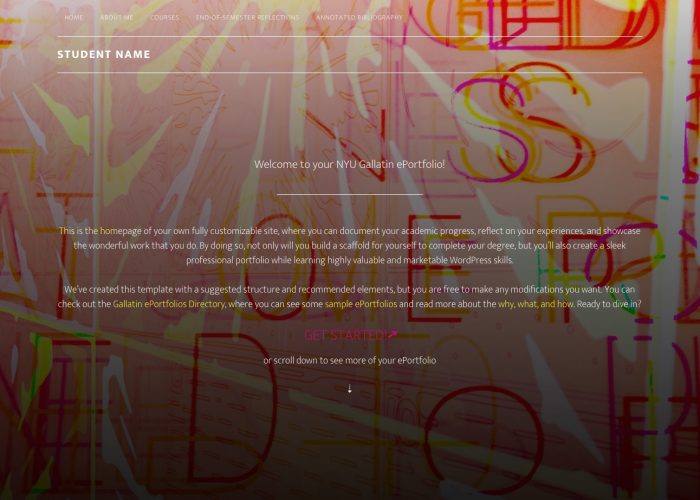
Screenshot of Gallatin ePortfolio template, displaying the main navigational elements and the homepage welcome message.
0

ePortfolios and Individualized, Interdisciplinary Learning: A Case Study

Abstract

Individualized, interdisciplinary degree programs carry a unique set of challenges and opportunities that can be addressed by ePortfolios. This is especially true for New York University’s (NYU) Gallatin School of Individualized Study, where students must construct their own academic concentrations while taking courses in most of the seventeen schools that comprise the University. In this article, we describe an ongoing project to explore the use of ePortfolios as a means to create coherence for students across courses and semesters, and to help them articulate an intellectual and professional agenda through synthesis and reflection. The project spans three distinct iterations of ePortfolios, and describes how lessons learned from two of the previous iterations helped guide faculty and staff in the development and implementation of a new ePortfolio template, which is currently being piloted. We explore how an overly wrought first iteration led to an excessively focused second version, and finally, a third iteration, that may be just right.

Introduction: The Origins of a Gallatin ePortfolio

The Gallatin School of Individualized Study at New York University (Gallatin) offers a Bachelor of Arts and a Master of Arts in individualized study. The ePortfolio project focuses on the BA program. Students at Gallatin develop their own programs of study by combining Gallatin’s core curriculum of small, interdisciplinary seminars and workshops with courses in other NYU schools. Additionally, students pursue independent studies (one­-on­-one projects with faculty), tutorials (small group projects), private lessons, and internships. This course of study culminates in a final oral exam, called the colloquium, in which students demonstrate their knowledge about a select number of significant texts.

With just over 1,600 undergraduate students and approximately 150 graduate students, Gallatin is a relatively small school housed within a large research university. Being an individualized study major in a small school that is part of a very large university, on a distributed urban and global campus, can be an isolating experience. Because of this, Gallatin has used active, focused faculty advising as a cornerstone of its curriculum from the very first formative years as a program in 1972, and then as a division in 1976. But in 1976, Gallatin had only 200 students (London 1992, 7). By 2008, with a much larger student body, there was agreement among faculty members that students could benefit from a platform that encouraged reflection and collaboration.

This paper outlines three distinct ePortfolio platforms the school developed in an attempt to facilitate this student need for reflection and collaboration. The first was a shared, multi­-university initiative to build out the promising Sakai OAE (Open Academic Environment) into an academic­-social-networking system with ePortfolios as a main component. The second was based entirely on Google Drive, and centered around the collection of course assets. And the final, still ongoing, platform is built around WordPress, which attempts to account for the limitations of the the first two.

During the Fall of 2009, several factors led to the consideration of an ePortfolio for Gallatin students: social media; advancements in ePortfolio and learning management system (LMS) software; digitally native content; and the expansion of the arts and experiential learning at Gallatin. Moreover, many students were coming upon their culminating experience, the colloquium, underprepared, specifically in the integration of coursework spanning their entire academic career. Students, now accustomed to platforms like Facebook and Google Docs, were wondering why there was not an academic corollary.

During a focus group with students concerning the enhancement of the school’s LMS, several ePortfolio-­related themes emerged. Where students used to be satisfied focusing on their individual concentrations and learning goals, they were now interested in community. Several students at the Fall 2009 LMS focus group asked for a way to find other students with similar academic interests. Additionally, participants mentioned how they would like to share their academic work across courses, in ways that would surface meaningful connections between students. These students’ comments were aligned with the research on ePortfolios. Bryant and Chittum (2013, 189­197) note that successful ePortfolios enable students to share and collaborate on work spanning their entire program. This finding is consistent with trends in ePortfolio use at the time, where less course-­ and program­-based, and more collaborative ePortfolios were gaining in popularity (Brown, Chen, and Gordon 2012, 129-­138).

This focus group conversation became one about effective ePortfolios. The students recognized the need for a tool to capture, synthesize, and share their academic careers, a way to “utilize Facebook[-like]…prefab micro-­sites…So that people could upload different documents” (personal communication). Several students advocated for a platform that encourages self­-assessment and peer assessment, foundational elements of good ePortfolio design (Wade, Abrami, and Sclater 2005, under “Student Self­-regulation”).

The author, Likos, in conversation with the faculty, was also coming to a similar conclusion: a tool was needed that could help scaffold the development of the individualized concentration; encourage the synthesis of experiential, performative and academic learning; and allow for the communication and articulation of the students’ work. Hayward et al. explain how ePortfolios can help achieve just these goals, emphasizing the tool’s ability to help integrate different modes of learning (2008, 140–­159). Additionally, the ePortfolio is specifically valuable in interdisciplinary studies. Field and Stowe explain that the “the longitudinal nature of the process,” which provides explication of an entire learning journey, “can be used effectively to validate the interdisciplinary process and to communicate the process to internal, and external audiences” (2002, 268).

As a result of our student focus group, faculty discussion, and research on ePortfolios, a specific articulation of the requirements for a Gallatin ePortfolio platform emerged:

  1. The system must allow for text­-based and digitally native content.
  2. Assets must be flexibly shareable—to students in a course, the school, the University, and the outside world.
  3. Assets must be taggable in a manner that encourages searching, browsing, filtering, and sorting.
  4. The ePortfolio must evolve from a student’s first year through their life after college.
  5. The platform must allow for the creation of attractive public-facing websites.

A landscape survey of existing software at the time found that none could satisfy all of these criteria. Most ePortfolio platforms were still focused on assessment (Clark and Eynon 2009, 18­–23), which was not the core requirement of a Gallatin ePortfolio. With this in mind, we broadened our search beyond specific ePortfolio software to platforms that could act more as a development toolkit. This led to Gallatin’s, and later NYU’s, significant engagement with Sakai.

Sakai OAE and ATLAS: A Grand Vision Leads to Loss of Focus

Just as the benefits of an a ePortfolio system were becoming clear to the Gallatin community, so too were these benefits being recognized by another department at the University, the Liberal Studies Program. Confronted with similar requirements, an ePortfolio project was initiated in 2008 with the help of a National Endowment for the Humanities (NEH) Digital Humanities Start-­Up Grant (Apert 2011). Like Gallatin, the Liberal Studies Program was aiming for a system that would support content authoring, management and tagging, private­ and public-facing ePortfolios, and academic networking. Gallatin was thus a natural partner, and joined the initiative in 2008. By 2009, Liberal Studies and Gallatin were joined by 8 additional NYU entities.[1]

With this infusion of interest and capital, a new ambition grew, and a new, more robust platform was needed to meet these ambitions. Liberal Studies, already using Sakai CLE (Collaboration and Learning Environment) for the first iteration of its ePortfolio, recognized the potential of the then nascent Sakai OAE (Open Academic Environment). The promise of OAE was a user­-, group­-, and content-­centered system. As Apert explains, Sakai OAE “uses the…concept of groups to replace the more rigid structure of sites in traditional learning management systems (LMS)….In Sakai OAE…tools are ‘widgetized,’ meaning they exist as free-­floating modules that can be pulled into any page” (2011). This is in contrast to Sakai CLE, and most LMSs at the time, which were built with the course at the core.

After several months of collaboration, a working group of faculty and staff members representing the ten schools and departments committed to this project were so enthusiastic about the promise of a user- ­and content-­centered academic networking platform, that by mid­-2010 NYU had become the most significant partner in a multi-university alliance to build the next generation LMS (Hill 2012). Along with Cambridge University, the University of California, Berkeley, Indiana University, Georgia State University, and Charles Sturt University, NYU shared a seat on the Sakai OAE steering committee, and NYU’s Chief Digital Officer, David Ackerman, was appointed to the position of Sakai Board Chair.

But by the end of 2010, this was already something very different than the ePortfolio project on which Gallatin had first partnered with NYU’s Liberal Studies Program. The Gallatin ePortfolio had very specific requirements around content and sharing, which though part of the roadmap for Sakai 3, would now have to share space with all of the traditional functions of an LMS. With Sakai CLE representing five percent of the higher­-education LMS market at this time, legacy tool support and development was no small matter (Green 2013, 23). As a member of the NYU Sakai 3 working group, Likos had to collaborate with representatives from nine other schools and departments at NYU to set priorities that would then compete with those from the six other Sakai steering committee member universities. Predictably, this produced a very large set of requirements.

By Spring 2011, nearly two years after the first discussions about ePortfolios for Gallatin students occurred, the first beta iteration of NYU’s version of Sakai 3, ATLAS (Advanced Teaching, Learning, and Scholarship) network, was running. Though our initial plan was to help undergraduates synthesize and share their concentrations, we decided our first pilot would be with graduate students for two reasons. First, this initial iteration of ATLAS had severe performance and feature shortcomings. It simply could not handle more than dozens of users at a time, and many of the features supporting content creation, tagging, and sharing were not yet built. The second reason was that our graduate students were beginning to ask for a simplified platform for finding each other. That is, they were happy to have an enhanced directory of students that could be filtered according to academic interest. Given the limitations of ATLAS, it made more sense to pilot a more condensed feature set to a smaller group of 150 students. While supporting this pilot for graduate students, we continued to push for development of features that would turn this into a true ePortfolio for our BA students.

By Spring 2012, with the 1.1 version of ATLAS released, we were not significantly closer. The platform was now more capable of handling larger numbers of users, the content authoring interface was better, but it was not an ePortfolio. The centrifugal force of multiple schools’ and universities’ competing requirements and features continually pulled at the center until there was barely a center at all. In the end, it was neither a fully functional LMS or an ePortfolio. This, combined with the emergence of Google Apps for Education and the Universities’ adoption of it, and new LMSs like Canvas and D2L, spelled the end for ATLAS and the larger Sakai OAE project. By the Spring of 2012, all of the remaining large university funding partners left the project, and NYU soon followed suit, officially sun­-setting the pilot on January 22, 2013.

In its final iteration, Gallatin’s version of ATLAS included academic profile information for 150 graduate students, as well as a tag cloud (see Figure 1) to help visualize the weight of academic interest areas. It contained no other ePortfolio assets, though technically, it could have. Our assessment of the platform was that it failed in at least some way in each of the five categories of requirements initially laid out. The most successful feature was the academic interest tag cloud, and if extended to content, as originally envisioned, it could have been a valuable way for students to share and collaborate.

Screenshot of Atlas tag cloud for Gallatin MA students, showing the top 20 tags, with Cultural Studies heavily weighted in the center.

Figure 1: ATLAS tag cloud.

There are many lessons to be learned from Gallatin’s Sakai OEA/ATLAS journey, foremost of which is that Gallatin handed over its agency in developing an ePortfolio platform in the hope of being part of something that would be much more. The project grew so large, so quickly, that the competing requirements of multiple universities and schools became increasingly difficult to manage and fund. Another takeaway was that the mass of the “academic social networking” feature set was so great that it pulled almost all the development and pedagogical energy into its gravity well. The promise of a “Facebook for the academy” was so alluring that we shifted too much attention from the core elements of a successful student ePortfolio.

Google Drive: Familiarity without Scalability

It was from this place that a re-conceived ePortfolio platform was born. In the spring of 2013, a reconfigured Gallatin steering committee was assembled to review the failures of the ATLAS project and to recommend a new way forward. One of the first issues we uncovered was that ATLAS privileged technology over good pedagogical design. We hoped the technology would allow for robust connections among students without specific prescriptions, as was the case in other social networks. The idea was that students would upload any assets they thought relevant to their concentrations, and the metadata would do the magic of surfacing the relevant, connected information. This proved to be technically very difficult, and not clear at all to the student participants. Additionally, Gallatin had prescriptions that could and should be applied to ePortfolios:

  • Course documents: syllabi, papers, readings.
  • The booklist and rationale: documents prepared in advance of the colloquium that contain 20 to 25 texts that cover multiple disciplines and historical periods related to the student concentration, and a five­- to eight-­page essay that articulates the central themes that are represented by the booklist.
  • The Intellectual Autobiography and Plan for Concentration (IAPC): a two-­ to three-­page essay, completed at the end of a student’s sophomore year, in which students reflect on their educational progress and describe their areas of interest.
  • Plans of Study: forms filled out every semester outlining the students’ registration plans for the following semester, and how these relate to their individualized course of study.

Starting from these assets, the committee recognized an opportunity to focus the scope of a project that had become so large with ATLAS to a simpler set of requirements. This new conception asked, what is the easiest and most stable system that students can use to store and share their course and concentration documents? Taking this together with the original prerequisites from 2009, and the lessons learned from ATLAS, an updated requirement set asked that:

  1. The system allows for text-­based, as well as multimedia content.
  2. All assets be shareable to faculty, advisers, other students, and the public.
  3. Assets in the ePortfolio be accessible to students after they graduate.
  4. The platform already be built, stable, technically vetted, and inexpensive.

Taking these into account, it was a very easy decision to pilot a new ePortfolio project with Google Drive. NYU’s investment in Google Apps for Education was increasing, and a University­-led ePortfolio landscape survey indicated that Google Drive was a viable ePortfolio alternative for simple projects. Additionally, it was a familiar product, with a support and training structure in place. In terms of storage and performance, we already knew that it could handle thousands of students and assets, and we knew those assets could be securely shared with individuals and groups using existing NYU credentials. Furthermore, there was no direct cost to Gallatin. The platform and the central support was free, and students would keep their Google accounts, including their ePortfolios, after graduation. With the benefits of a Google Drive ePortfolio clear, and the cost to adoption low, it was decided that a new pilot would launch in the Fall of 2013. Gallatin would pre-­populate the following folders and documents in all students’ drives:

  • Courses
    • Syllabi
    • Papers
    • Readings
  • Brainstorming
    • Bibliography (citations of key texts)
    • “Concentration” document (notes from adviser meetings, thoughts on classes, ideas about one’s concentration)
    • Plans of Study (saved copies of the Plan of Study forms)

With both the ATLAS and the Google pilots, the steering committee considered making the ePortfolio mandatory, but both times it was decided that the administrative burden on faculty was too great. With ATLAS, the ePortfolio component was not well defined, and the system not robust enough. The Google Drive ePortfolio was well defined, and the system was robust enough, but if we were going to utilize course registration holds—or use some other constraint—it meant either the faculty advisers or some other academic staff would need to review and approve ePortfolios. It was felt that Gallatin did not at the time have the resources to incent, train, and support the faculty and staff to perform this task well. Instead, beginning in the Spring of 2013, we undertook a marketing and training campaign. This included presentations at faculty meetings, online video demonstrations, and orientation training sessions for students.

The technical administration of the ePortfolios was fairly simple, but not straightforward. Because the University’s implementation of Google Apps could not ingest school and class directory information, there was no way to automate the group creation of the “Gallatin ePortfolio,” or easily generate unique ePortfolio URLs. This all required additional manual work.

In early Fall 2013, the first set of student ePortfolios were provisioned. These included all 269 Gallatin first­-year students. An email from the dean was sent to these students with a link to their ePortfolios and instructions on how to use them. Simultaneously, messaging went out to faculty encouraging them to remind students about the ePortfolio. The same basic structure for the ePortfolios remained in place through the Fall 2014 semester, but by the third semester of the pilot we had added sophomores and juniors.

From the student perspective, the system worked well. Students that chose to create an ePortfolio reported no issues creating and storing content. There was also very little student training required. But by the second semester, the University began to have trouble provisioning the accounts and setting permissions. The Google Apps administrators had to do this with a series of scripts, and there was concern that any change Google made to the product, which was not uncommon, could break the scripts. Additionally, it was at this time that we realized there were little to no options for getting data from the system. Even something as simple as getting a count of how many students were placing content into their ePortfolios was only possible by manually, visually checking each student’s ePortfolio folder. In the end, we used a randomly generated number set to choose a statistically significant sample of ePortfolios to manually check for content. By the final pilot semester, Fall 2014, only 1.9% of students had placed any content into their ePortfolios.

In summation, the Google Drive ePortfolio platform failed in several areas. Most compelling was the modest adoption rate, but the difficulty in extracting metrics from the system, and increasing difficulty provisioning accounts and permissions were also important. For these reasons, it was decided that Fall 2014 would mark the end of this pilot. Though there were technical limitations, it was the adoption rate that had the most impact in our final assessment. In discussions with students and faculty, it became clear that this pilot offered little in the way of incentive or injunction. Their use rate was very low in part because there was no appealing public-­facing aspect of the ePortfolios, but even more significantly because of the way the ePortfolios were presented and taught. It had been decided to market the ePortfolio to students and faculty, instead of train faculty to actively engage with students around the ePortfolio in their courses; we now see that decision as a mistake. These two key issues we hoped to address in the next pilot.

WordPress: Re­-centering on Reflection

Taking into account the lessons learned from our ATLAS and Google Drive experiences, we are now in the midst of our third iteration of ePortfolios at Gallatin, this time using NYU’s WordPress installation, Web Publishing, which launched in August of 2014. Like Google Drive, Web Publishing comes with NYU IT support and training, provides adequate storage for our multimedia needs, is integrated with our user-­authentication system, and is a no-­cost, portable platform. Unlike Google Drive, however, Web Publishing enables us to create a template tailored to the needs of our students, so that we are now able to easily deploy sites as needed. More important than the authentication and storage benefits, however, is the built-­in reflective space Web Publishing offers, as well as the ability to create visually appealing, customizable, public-­facing websites with granular control over visibility. Our hope is that the personalization achieved through reflective blog posts and customization features will give students a strong sense of ownership over their ePortfolios, thereby incentivizing adoption rates.

With a renewed focus on reflection, the committee has decided to diverge from the structure adapted for Google Drive, which functioned primarily as a repository of work. Our new template thus contains areas for four main types of reflective content: the “about me” bio page, the course descriptions and expectations blog, the end-of-semester reflections, and an annotated bibliography (see Figure 2).

Screenshot of Gallatin ePortfolio template, displaying the main navigational elements and the homepage welcome message.

Figure 2: The Gallatin ePortfolio template.

In addition to these pre­-packaged content areas, students are encouraged to customize their ePortfolios in order to document all of their Gallatin­-related experiences, including internships, study-­abroad, and extracurricular activities, thereby creating a comprehensive repository that gives viewers both a general sense of the breadth and scope of a student’s intellectual trajectory, and the ability to drill down into the details of a particular term, course, or activity.

Participating faculty are being asked to integrate several activities into their courses that are designed to both kick­start student engagement with their ePortfolios, and to encourage students to begin thinking metacognitively about themselves as learners. Advisers are participating in the pilot by asking their advisees to see their ePortfolios. We believe that active involvement on the part of faculty and advisers will be a critical component to the success of the program.

On the first day of class, faculty ask their students to write a short bio for the About Me page. Not only is the ability to write a compelling bio a skill that will benefit students personally and professionally, it is also an exercise in narrating selfhood that should always precede engagement with digital identities, of which ePortfolios are a part. Moreover, sharing and discussing bios in a classroom environment promotes the development of learning communities that are so important to students’ mental health and wellness, and so critical to long-­term academic success. Early in the semester, students are also asked to write a blog post containing the course descriptions for each class they take, accompanied by their expectations for these courses. By doing so, students will not only create a chronological record of the courses they take, they will be setting up personal learning goals that will help sustain their focus throughout the semester. These initial reflective posts are then connected to the reflections they are asked to write on the last day of class. In their “end­-of-­semester reflections,” students are asked to compare what they had expected to learn with what they actually learned, and to make a list of key texts from the semester. The blog is a space to assist students in reflecting on their learning as they develop over the course of each term, and to help suggest a direction for the coming term. Such reflections will allow students to document the evolution of their intellectual pathways, to make connections, and to generate questions for future research and for their advisers.

These reflections will act as a pre-­writing activity, providing material for the IAPC, the booklist/rationale, and the colloquium, all of which require students to articulate their research interests and to identify thematic correspondence between the various areas of study. This, ultimately, is at the core of what we are trying to achieve: to help our students connect the dots. As the “school of individualized study,” Gallatin requires its students to design their own curriculum, in conjunction with an adviser. This self-­directed learning model empowers students to actively engage in the development of their own education, and allows them to take a wide variety of courses, both at Gallatin and at other NYU schools (and beyond). But this learning model also comes with unique challenges. Because students are exploring many different subject areas, it is often difficult for them to articulate the connections and/or tensions between them. Milestone requirements, such as the IAPC due at the end of sophomore year, and the booklist/rationale required before the final senior colloquium, have been put in place as scaffolding, preparing students for the kind of scholarly synthesis that will be expected of them during their final oral examination. Yet these milestones are themselves rigorous requirements that will also, we believe, benefit from the kind of sustained reflection built into the design of our ePortfolios. The designated Annotated Bibliography page, for instance, is something students can build up over time, and can eventually become a direct precursor to the booklist and rationale.

Taken as a whole, the design of our ePortfolio template works to engage students in an ongoing reflective process that can best be described as active, inquiry-­based learning. As Wozniak writes, “Reflection connects the components of the inquiry cycle and serves as the catalyst to move to the next level of learning and discovery. Information is transformed to knowledge and fragmented pieces of knowledge are connected through reflection” (2012, 221). Used as an advising tool, Gallatin’s ePortfolio provides a collaborative space in which to make those connections. By incrementally archiving, curating, and reflecting upon their coursework, students will essentially be self-­scaffolding their learning, progressively building toward a stronger understanding of their own concentration. Wozniak also notes that reflection promotes integrative learning, a pedagogical approach in which students apply “multiple areas of knowledge and multiple modes of inquiry” (2012, 210) to real-­world situations: “These learning experiences consider the whole student and foster lifelong learning skills. They engage students in making their own learning connections between their courses, professional career goals, co­-curricular activities, campus involvement, community service, job experiences, and personal interests” (2012, 210). An integrative learning approach that considers the whole student is foundational to the mission at Gallatin, making a reflective ePortfolio system a natural addition to our program.

In order to ensure the successful implementation of an ePortfolio program that would be both meaningful for students and helpful to their advisers, we opted for an incremental, three-­phase roll out plan:

3-Phase Implementation Plan
Phase Phase Title Duration Dates Primary Purpose
1 Targeted Pilot One Semester 12/2015 to 5/2016
  • Assess the usability of the WordPress template
  • Obtain student feedback
2 Extended Pilot Two Years 9/2016 to 5/2018
  • Assess the adoption rate by students and advisors
  • Evaluate the success of the pedagogical goals of the program
3 Gallatin­Wide Implementation Indefinite 9/2018 +
  • Implement a successful school­wide ePortfolio program

We have completed Phase 1, the Targeted Pilot, which included eight students hand­-selected by their advisers. Our initial assessment of the Targeted Pilot is based on attendance, anecdotal feedback, questionnaire results (see Appendix), and completion rates. Although attendance at our group meetings was low, students responded positively to both the platform and the program. Our students had varying degrees of technological skills, yet all of them felt that WordPress was easy to learn and has long­-term value. Participants responded favorably to the template’s design. Most of the students commented that the information architecture was intuitive, and several participants confirmed that the ePortfolio should be a space for highly curated materials, rather than a repository for all content, which may be best suited for Google Drive.

In terms of the ePortfolio program itself, the belief that a school­-wide digital portfolio service would be valuable to Gallatin students was unanimous. Our primary purpose was to equip students with a tool with which to reflect on their progress, map out the next steps in their plan of study, and build towards future milestones. And to that end, the pilot succeeded. Not only did students report that an ePortfolio would have helped them complete specific milestones, they also expressed the belief that communication with their advisers would be improved. The surprising discovery was that students are increasingly expected to include ePortfolios in their application materials for graduate schools, internships, and other professional opportunities. This anecdotal information is confirmed in a study by Fowler (2012), who notes that an ePortfolio provides a better demonstration of student learning and skills than a standard resume because it represents a range of work, contextualized over time, and because it can be customized for multiple audiences. Our students likewise saw an opportunity either to use their Gallatin ePortfolio for such applications, or to become familiar with the process in order to create a separate ePortfolio.

Based on our assessment of the Targeted Pilot, we have entered Phase 2 of our implementation plan, which will run from September 2016 to May 2018. Our Extended Pilot currently includes our entire incoming first­-year cohort, as well as 31 transfer students, for a total of 328 students and 19 faculty. Our ultimate goal is to seamlessly integrate ePortfolios into Gallatin’s curriculum, such that the incoming class of 2016 and all successive cohorts will view their ePortfolios as a dynamic, evolving, and natural component of the individualized and life­-long learning goals at the core of Gallatin’s philosophy.

Conclusion

There have been vast cultural and technological developments since our first discussions about ePortfolios in 2009, including advancements in open­-source technology, broader use of website building platforms, and shifting boundaries between social media and other web-authoring sites. These developments, in conjunction with an increasingly technologically sophisticated and visually literate student population, build an even stronger case for the implementation of ePortfolios at Gallatin. Having learned much over seven years of exploration, experimentation, and investment in ePortfolios, we have refocused our energy on the individualized philosophy at the core of Gallatin, prioritizing user experience over technical sophistication; focused, purposeful design over broad, generalized application; and, most importantly, pedagogy over technology. The emphasis on curation over archive and reflection over assessment promotes the kind of inquiry­-based, integrative learning that is aligned with Gallatin’s mission, and that comprise the most promising pedagogical aspects of ePortfolios. Although early in our third ePortfolio iteration at Gallatin, we are encouraged by the enthusiasm with which our pilot participants received their customizable digital showcases, and hopeful that by the time our incoming class of 2016 becomes our graduating class of 2020, ePortfolios will have become a part of the fabric of Gallatin life.

Notes

[1] The College of Nursing, the Faculty of Arts and Science, NYU Abu Dhabi, NYU Wagner, the NYU School of Medicine, NYU Steinhardt, NYU Information Technology Services, and the NYU Libraries (Apert 2011).

Bibliography

Apert, Lucy. 2011. “The ATLAS Network Pilot: NYU’s Sakai Open Academic Environment Initiative.” NYU Connect: Information Technology at NYU. https://wp.nyu.edu/connect/2011/01/21/the-atlas-network-pilot/.

Brown, Gary, Helen L. Chen, and Aifong Gordon. 2012. “The Annual AAEEBL Survey at Two: Looking Back and Looking Ahead.” International Journal of ePortfolio 2 (2): 129­38. http://theijep.com/pdf/IJEP93.pdf.

Bryant, Lauren H., and Jessica R. Chittum. 2013. “ePortfolio Effectiveness: A(n Ill­fated) Search for Empirical Support.” International Journal of ePortfolio 3 (2): 189­98. http://www.theijep.com/pdf/ijep108.pdf.

Clark, Elizabeth J., and Bret Eynon. 2009. “E­-portfolios at 2.0—Surveying the Field.” Peer Review: Emerging Trends and Key Debates in Undergraduate Education 11 (1): 18­23. http://www.aacu.org/sites/default/files/files/peerreview/Peer_Review_Winter_2009.pdf.

“Fall 2009 NYU Gallatin LMS Focus Group.” 2009. Interview by author.

Field, Michael, and Donald Stowe. 2002. “Transforming Interdisciplinary Teaching and Learning through Assessment.” In Innovations in Interdisciplinary Teaching American Council on Higher Education, edited by Carolyn Haynes, 256­274. Connecticut: Oryx Press.

Fowler, Matthew. 2012. “Developing a Template for Electronic Portfolios in Career and Technical Education.” PhD diss., The University of Nebraska–Lincoln. ProQuest/UMI (3503365).

Hayward, Lorna M., Betsey Blackmer, Alicia Canali, Rosemarie Dimarco, Alicia Russell, Susan Aman, Jessica Rossi, and Lucia Sloane. (2008). “Reflective electronic portfolios: A design process for integrating liberal and professional studies and experiential education.” Journal of Allied Health 37 (3), 140­159.

Hill, Phil. 2012. “Now UC Berkeley and Charles Sturt University Leave Sakai OAE.” e-­Literate. http://mfeldstein.com/now-uc-berkeley-and-charles-sturt-university-leave-sakai-oae/.

London, Herbert I. 1992. “A Gallatin Chronology.” The Gallatin Review 11 (1): 7.

Green, Kenneth C. 2013. “The National Survey of Computing and Information Technology.” http://www.campuscomputing.net/sites/www.campuscomputing.net/files/CampusComputing2013_1.pdf.

Wade, Anne, Philip C. Abrami, and Jennifer Sclater. 2005. “An Electronic Portfolio to Support Learning.” Canadian Journal of Learning and Technology 31 (3). https://www.cjlt.ca/index.php/cjlt/article/view/26489/19671.

Wozniak, Nancy McCoy. 2012. “Enhancing Inquiry, Evidence­-Based Reflection, and Integrative Learning with the Lifelong ePortfolio Process: The Implementation of Integrative ePortfolios at Stony Brook University.” Journal of Educational Technology Systems 41 (3): 209­30. doi:10.2190/ET.41.3.b. EBSCO (ATT 88230618).

Appendix


In response to prompt, “Please check off all areas of the ePortfolio that you worked on,” 83% checked homepage, about me, and courses pages.
In response to a question about how much time students spent on their ePortfolios, 83% indicated 2 to 5 hours.

In response to the question, “Did you feel as though the time spent was useful,” 67% checked “yes.”

In response to the question, “Was it difficult for you to develop your ePortfolio,” 83% checked “no.”

Students elaborate on answers to Q4, citing platform limitations, prior experience with WordPress, and time investment as considerations.

In response to a question about barriers to engagement, 100% said “lack of time,” while “unfamiliarity with WordPress” and lack of interest/motivation were also cited.

In response to a question about how to increase engagement, students cited deadlines, mandates, starting early, and making it more professional.

In response to the question, “Did you use the resources at https://wp.nyu.edu/gallatin­eportfolios/,” 83% indicated “yes.”

In response to the question, “Do you think the portfolio should be mandatory for all students,” 33% said “yes,” 17% said “no,” and 50% said “other.”

Additional comments: other systems for saving work, ePortfolios should be mandatory, and favorable thoughts about the design.

About the Authors

Nick Likos is NYU Gallatin School’s Chief Information Officer. He is responsible for the oversight of technology, operations, and compliance. Likos’ career has spanned fifteen years as a leader in for­-profit and nonprofit management, focusing on the efficient use of educational technologies. Likos’ most recent work has been in the academic social networking sphere, developing strategies and systems for integrating pedagogical and social technologies. His research interests include experiential mediation, interface, actor network theory and boundary theory.

Jenny Kijowski is NYU Gallatin’s Educational Technologist. She is responsible for facilitating the development of pedagogically driven, technology­-enhanced teaching practices in the classroom and beyond. She previously taught English Literature, Creative Writing, and Composition courses at BMCC and Queens College, and received her doctorate in English from the Graduate Center of the City University of New York. Her research examines war, trauma, gender, and technology.

The image features a person, viewed from behind on the right side, reading a paper titled "ePortfolio Project: Reflective Writing." Behind the paper, a laptop is open. Several other students work in the background.
0

More Than Assessment: What ePortfolios Make Possible for Students, Faculty, and Curricula

Abstract

To disrupt the notion that ePortfolios are primarily an assessment tool, this article-as-ePortfolio invites readers to consider what is made possible when ePortfolio initiatives lead with student learning in their structure and implementation. In addition to descriptions of both faculty and student support, we offer extended examples of ePortfolio implementation in three disparate programs at our university: Biosystems Engineering, English Education, and Nursing. To conclude, we reflect on the pedagogical challenges and opportunities that have emerged as a result of the structure and implementation of our ePortfolio initiative. Ultimately, we aim to demonstrate what is made possible for students, faculty, and curricula when ePortfolio initiatives prioritize student learning.

Editor’s Note

Lesley Erin Bartlett, Heather Stuart, Justin K. Owensby, and Jordan R. Davis have created an ePortfolio about ePortfolios. At JITP, we celebrate such confluence of form and content. After exploring various options for rendering this work on our site, we found the iframe to be the best solution. We recognize that an iframe may not render the contents of this piece correctly on all devices and apologize for any inconvenience; for a full-screen experience, please see https://jitpstaging.commons.gc.cuny.edu/wp-content/static/JITP-Bartlett-et-al/.

About the Authors

Lesley Erin Bartlett is Assistant Director of University Writing at Auburn University. Her primary responsibility is the ePortfolio Project, which is housed in the Office of University Writing. She received her PhD in Composition and Rhetoric with a specialization in Women’s and Gender Studies from the University of Nebraska-Lincoln in 2014. She has developed and taught courses in composition, rhetorical theory, literature, and women’s and gender studies. Her research interests include composition theory and pedagogy, inclusive pedagogies, feminist rhetorical theory, and rhetorical performance.

Heather Stuart is the Program Administrator for the ePortfolio Project at Auburn University. In her current role she provides support for students by facilitating workshops, teaching classes, creating resources, and advising students in the ambassador program. She received her M.Ed. in Administration of Higher Education.

Justin K. Owensby is a graduate assistant for the ePortfolio Project in the Office of University Writing at Auburn University. His work with the ePortfolio Project involves facilitating ePortfolio presentations and workshops and focuses on visual and ethical literacy in ePortfolios. He is also a PhD candidate in the department of Health Outcomes Research and Policy, where he is interested in integrating mobile health technology into healthcare. He is also interested in teaching, faculty development, and technologies (such as ePortfolios) associated with student learning.

Jordan R. Davis is a graduate assistant for the ePortfolio Project in the Office of University Writing at Auburn University. He is currently a candidate for the Master of Technical and Professional Communication, where he has found an interest in the use of rhetoric to capture the attention of readers. His current research focuses on the reliability of product reaction cards as a data collection instrument for usability tests. He tweets @courageousdavis.

Anderson and Shepherd – "I Lit: An E-Poetry, E-Portfolio Exhibit"
0

I Lit: An E-Poetry, E-Portfolio Exhibit

Editors’ Note

Daniel Anderson and Emily Shepherd have created an ePortfolio to curate student examples within a framework of theory and context. This submission provides an example of the kind of scholarship we hope to see more of at JITP, i.e. scholarship that leverages the affordances of technology to present its theses, analyses and evidences more effectively. After exploring options, we found the iframe to be the best way to render this work on our site. We recognize that an iframe may not render the contents of the piece correctly on all devices and apologize for any inconvenience; for a full-screen experience, please see http://ilit.altscholarship.com/.

About the Authors

Daniel Anderson is Professor of English, Director of the Carolina Digital Humanities Initiative, and Director of the Studio for Instructional Technology and English Studies at The University of North Carolina at Chapel Hill. He studies digital rhetoric, teaching with technology, and alternative approaches to scholarship. His books on teaching include Connections: A Guide to Online Writing, Writing About Literature in the Media Age, and Beyond Words: Reading and Writing in a Digital Age. He also creates new media performance art and scholarship using the computer screen as a composing space. A full biography and more information can be found at http://iamdananderson.net/.

Emily Shepherd is an undergraduate student at The University of North Carolina at Chapel Hill. She studies History, English, and Education. She wants to become a middle school teacher and is interested in literacy and working with English Language Learners. She is particularly interested in incorporating multimedia composition in the classroom, which can be an effective method of engaging ELL students.

Images are for demo purposes only and are properties of their respective owners. ROMA by ThunderThemes.net

Skip to toolbar