Daily Archives: April 23, 2021

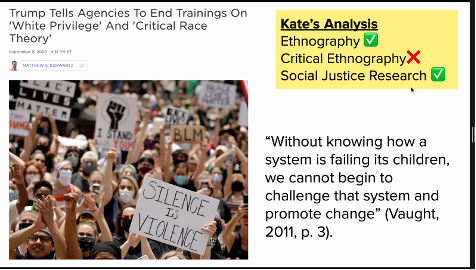
Screenshot of protestors with signs. An excerpt from a course reading is to the right of the image.
0

“The Future Started Yesterday and We’re Already Late”: The Case for Antiracist Online Teaching

Abstract

Using Black critical theoretical perspectives and pedagogical examples from our experiences teaching in online learning environments, this article articulates a case for antiracist online education. In the midst of the deadliest convergence of three devastating global “pandemics”— the COVID-19 pandemic, the continued murdering of Black bodies, and abnormal environmental disasters precipitated by global warming—educational technology could be a vehicle of liberation yet it remains an apparatus of control, further exacerbating inequality, especially for Black students. The absence of specific references to antiracist pedagogical orientations in the extant literature and theory of online education is emblematic of the normativeness of anti-Black racism and white normativity in online education. An antiracist pedagogy for online education begins with creating spaces that bring attention to race, class, gender, and ability. The authors conclude with a call to action for a shift to antiracist online teaching for all learners.

If you hear this message, wherever you stand
I’m calling every woman, calling every man
We’re the generation
We can’t afford to wait
The future started yesterday and we’re already late
—John Legend, “If You’re Out There”

Due to technology’s rapid innovations and reimagining in the social sphere, each time education makes a strong push forward, it seems we’re already late. Even in the midst of the deadliest convergence of three devastating global “pandemics”—the COVID-19 pandemic, the continued murdering and “fungibility” (la paperson 2017, 15) of Black bodies, and abnormal environmental disasters precipitated by global warming—educational technology could be a vehicle of liberation yet it remains an apparatus of control, further exacerbating inequality, especially for Black students. It is the goal of this paper to shake educators out of the slumber of white heterosexist monotonous and disembodied teaching and offer a vision for antiracist online teaching. As two critical Black scholars (one cis-het woman, one cis-het man) with doctorates in Critical Education Policy Studies and Educational Technology, we are convinced that online teaching is either antiracist and liberating or racist and dehumanizing; there is no in-between (hooks 1994; Love 2019; Kendi 2019). This paper will articulate a case for antiracist online education using both Black critical theoretical perspectives and pedagogical examples from our experiences teaching in online learning environments. We conclude with a call to action for a shift to antiracist online teaching for all learners.

The COVID-19 pandemic has forced most teaching and learning to online platforms. At many institutions, this shift has been met with anxiety, frustration, and in some cases stubborn refusal to conform to the virtual realities, limitations, and possibilities that online teaching provides. Many K–12 school districts continue to struggle to equip their teachers to make the shift to online teaching, leaving teachers to fend for themselves (Lambert and Rosales 2020). The shift to a virtual space has also left ill-prepared teachers, parents, and students fatigued (Holladay 2020). Higher education spaces are not exempt from these issues. Some believe the sudden shift to online teaching and learning is having both negative affective and cognitive effects on students as they work to negotiate the newness of it all (Burke 2020). But the fact still remains that the shift online has not removed the racist norms that were normative in face-to-face classrooms.

Cathy Davidson wrote a blog post entitled “The Single Most Essential Requirement in Designing a Fall Online Course.” In her post, she made an impassioned plea for educators to radically change their approach to (online) teaching during fall 2020, in light of all of the things students will be carrying into their classes because of the social situation. She argued that effective fall 2020 teaching required that summer preparation foreground the reality that “our students are learning from a place of dislocation, anxiety, uncertainty, awareness of social injustice, anger, and trauma” (Davidson 2020). Moreover, she added that informed solutions to creating a more humane and student-centered learning environment during the pandemic would mean “being sensitive to the devastating historical moment in which we are now living and offering students a way forward beyond it.” While the year 2020 will certainly go down as a unique point in the annals of history, many Black students would have entered the fall classrooms from a space of “dislocation, anxiety, uncertainty … anger, and trauma” as well as perpetual “awareness of social injustice” even if the COVID-19 pandemic had not occurred. The pandemic merely heightened what has always been there. Black people in the US continue to live in what Saidiya Hartman called “the afterlife of slavery—skewed life chances, limited access to health and education, premature death, incarceration, and impoverishment” (2007, 6). Any way forward that does not account explicitly for the normativeness of anti-Black thinking in education will merely ensure a racist and anti-Black future in education.

Inspired by the words of Cathy Davidson, while at the same time, captivated by the ancestral rhythm of resistance and freedom inherent in blackness (Cone 2018; Moten 2013; Dillard 2006; Morrison 1993), we argue for a deeper response to the current historical moment. In this article, we address Black non-being and exclusion that is the norm for education in general, but online education more specifically, in the US. This conversation is critical for online education because it is an irrefutable mode of all education moving forward and a space ripe with possibility for antiracist innovations that could unbound the limitations of physical classrooms.

What is Critical Black Theory and Why Is It Important for Online Schooling in the US?

For the sake of this article, critical Black theory will be used to zero in on the signification of blackness in historical and contemporary considerations of online schooling in the US. While other critical theories, like critical race theory (CRT), provide in-depth and intersectional analysis on race and racism, critical Black theory, or “BlackCrit” focuses on a “theorization of blackness” (Dumas and ross 2016, 416). BlackCrit is a “metatheory,” used to explicate the hidden whitened discursive context that undergirds and drives most theories, even theories that consider themselves to be “critical” (Wilderson III 2020, 14). Put simply, the goal of BlackCrit is to shine light on the anti-Black soul of the United States: to lay bare the levers that drive the racist, sexist, classist engine of capitalism. BlackCrit provides an avenue to see past the elusive and often confusing racially ambiguous language such as “people of color,” “diverse group” or person, “minority,” or “underrepresented group” when one is speaking explicitly about Black people (Wilderson III 2020, 41). It compels us to name things for what they are instead of using racially ambiguous or colorblind language, metaphors, or figures of speech that mask, under-emphasize, or erase Black pain and suffering. As Fred Moten (2016) eloquently put it, “We can’t go around this. We gotta go through this” BlackCrit argues that the keys to being liberated out of this racial caste system is acknowledging that it still exists; that the episteme and libidinal nature of the plantation continues unhindered and fundamentally shapes society.

At the same time, BlackCrit also speaks to the ways that blackness signifies a being and deep embodied knowing. Fred Moten (2013) argued that there lives a rich and emancipating hope out of the hopeless condition in understanding blackness. Moten believes that in the signification of blackness outside of the discourse of humaneness, and therefore the realm of being, theorizing blackness exceeds understanding and therefore cannot be reduced to a single thing. Its rich, unmappable essence carries with it the “absolute overturning, the absolute turning of this motherfucker out” (2013, 742). Therefore, BlackCrit forces a consideration of what is possible out of the binary and either/or constraints inputted by a white western colonial imaginary and instead invites an orientation that positions being and knowing as circular (Spillers 2003). Online learning remains an uncharted and underutilized discursive space for addressing anti-blackness and engaging in antiracist praxis (Asenbaum 2019; Bonilla and Rosa 2015; Bondy, Hambacher, Murphy, Wolkenhauer, and Krell 2015; Guthrie and McCracken 2010). In fact, decolonizing and antiracist visions are already embedded within the colonized racist machines of online learning (la paperson 2017; Collins and Bilge 2016).

Online Classrooms Are Not Race-Neutral: How Online Education Eludes Race

The use of technology as a mode of learning has been a part of the US educational infrastructure since the beginning of the nineteenth century (Reiser 2001)—a beginning during which it was criminal for Black people to be formally educated. In the US historically, schoolhouses were created by power-holding whites to sanction and reify anti-Black racism, sexism, white Anglo-Saxon Protestant values, and later prepare a docile workforce to maintain economic disparities (Rury 2009). While American society has come a long way from nineteenth-century schools, traditional public schools have fundamentally maintained nineteenth-century learning practices and structures committed to anti-blackness.

In a historical overview of the structure of schooling between 1890–1900, Larry Cuban reminded educators “the apparent uniformity in instruction irrespective of time and place appears connected to the apparent invulnerability of classrooms to change” (1995, 1). Cuban identified minuscule change in the structures of schooling over time and observed that innovation in schools tended to be reserved for a subcategory of students such as the gifted, but not implemented with the main  population (1995). Cuban’s analysis neglects to detail the ways schools’ documented invulnerability to change maintains anti-blackness in structures, curricula, and personnel. These realities are transposed into online learning environments and digital learning tools that are assumed to be race-neutral. For example, Borje Holmberg formed a theory of distance teaching that advocates for personalized distance education but avoids the ways race informs individual learners, tech tools, or online environments (1995). The major players in online education still hold tightly to racist Enlightenment ideals of rugged individualism and the belief in the disembodied articulation of the self (Asenbaum 2019). In other words, white supremacy and its chief actor, whiteness, still maintain a hegemonic hold on online learning.  More explicitly, race-neutral language transposes whiteness to educational technology as normative, reifying that white people are the standard for humanity, thus relegating blackness to sub-human. Online education operates with race-neutral rhetoric that obscures how race informs everything.

Despite the prevalence of anti-blackness in online education, collaborative technology platforms like Twitter, Snapchat, and Facebook have provided disruptive spaces of resistance due to their ability to transcend traditional forms of networking and collaboration. This is largely due to these technologies’ user-centered platforms, which allow users to design social communities and develop and disseminate their own innovations. Facebook and other Web 2.0 collaborative platforms have become impactful spaces to negotiate and transform the traditional “boundaries of the classroom,” where the teacher directs and designs all learning and students merely respond to often irrelevant, dated content within the confines of the physical classroom space (Dennen 2018, 239). Disruptive social media platforms on the other hand allow learners to design thinking, select relevant topics of interest, and engage in expedient dialogue and response to real world issues. For example, with the widely-publicized killings of unarmed Black people at the hands of law enforcement and security personnel—Daunte Wright, Rayshard Brooks, George Floyd, Breonne Taylor, Atatiana Jefferson, Trayvon Martin, Philando Castile, Tamir Rice, Yvette Smith, Rekia Boyd, and Botham Jean, and Michelle Cusseaux, just to name a few—people form across the globe organized through online activism to resist racial injustice. Online activism is indicative of the power of digital tools to fight racism, yet online education broadly has yet to seriously move toward antiracist pedagogies.

Valcarlos, Wolgemuth, Haraf, and Fisk (2018) queried all peer-reviewed articles from the past 11 years to ascertain the presence of anti-oppressive pedagogies in scholarship related to online education. Of three thousand articles, they found ten that dealt specifically with anti-oppressive pedagogies in online education. Out of those ten articles, four common themes emerged: legitimizing students’ epistemologies (personal narratives, emotions, and culture), requiring reflection and discussion, establishing expectations of critical awareness, and democratizing educator and student roles (351). With the exception of these articles, the online learning community has been almost mute on critical social justice concerns (Valcarlos, Wolgemuth, Haraf, and Fisk 2020). Even fewer articles explicitly name the role of antiracist pedagogy in online education.

Bridging the Gap: The Potential of an Antiracist Future in Online Education

The absence of specific mention to antiracist pedagogies in the extant literature and theory of online education is emblematic of the normativeness of anti-Black racism and white normativity in online education. A corrective is essential to equip students with the requisite forms of racial literacy to constantly reflect upon their world in a responsible manner (Tarrant and Thiele 2014). Racism is a system of historical oppression that is built on an hegemony of power and domination that privileges certain groups as inferior to the dominant group (Harrell 2000). In the hegemony of racism, certain ideas shape the construction of the constituent parts of society (business, education, law,  and medicine) and give rise to accepted behaviors and belief systems (Gramsci 1989). To be neutral on racism is to be complicit in racist ideas; there is no in-between (hooks 1994; Kendi 2019). In what follows we will provide a framework for thinking through an antiracist pedagogy for online education.

We take up Zachary Casey’s (2016) framing of pedagogy to help shape our understanding of an antiracist pedagogy. In his book, A Pedagogy of Anticapitalist Antiracism: Whiteness, Neoliberalism, and Resistance in Education, Casey defined pedagogy as an action to “foster (political, partial, humanizing) learning, in ways that acknowledge the political nature of human interactions and the varying context(s) in which we live” (18). Shaped by the liberatory visions of Paulo Freire, bell hooks, Audre Lorde, and others, Casey argues that every choice is political: that each action, each choice we make requires making particular judgements and conceptualizations about reality and knowledge that emanate  from our ethical framework. An antiracist pedagogy acknowledges the political and partial nature of teaching; there is no such thing as neutrality. When we separate our being from our doing, our knowing from our doing, we are adhering to a racist, colonialist imagination. How we teach is a byproduct of how we were taught to view the world.

David Gillborn posited that “Anti-racism has not failed—in most cases; it simply has not been tried yet” (2006, 17). He observed that antiracist work in education arose as a response to the performative liberal practices used to serve Black children and their families but were deeply conservative in nature, contained no awareness of the systemic nature of oppression, and were actually rooted in deficit perspectives of Black people. Antiracism work is about dismantling racism, but it is much more than that. Racism takes many forms and so antiracist actions must be flexible and constantly adapt to the complex nature of reality. To be antiracist means to constantly be about the work of dismantling the racist ingrained nature of teaching.

Nevertheless, without a clear framework for antiracism, the use of antiracism becomes empty rhetoric, what Sara Ahmed (2004) calls non-performative. Often, antiracist statements themselves become the only actions that an institution takes. Or they become the very barrier to developing an antiracist ethos in an institution or classroom and provide no actionable way to diagnose racist versus antiracist praxis. When this happens, explicitly naming racist practices, and examining complicity in racist ideas become non-existent because the institution and the people in it have branded themselves as antiracist. To continue calling the institution racist after the institution has made a commitment to being antiracist becomes undesirable. Likewise, racism then becomes the boogey woman. No one wants to utter its name. But taking up antiracism is a process not a destination. You can act in antiracist ways one day and the next day act in racist ways or uphold racist ideas (Kendi 2019).

Antiracist education accepts the presence of bias and stereotypes but requires employing diligent and consistent investigation into the source of racism and how racist ideas manifest structurally, culturally, politically, and interpersonally (Troyna 1987; Collins 2017). An antiracist pedagogy for online education begins with creating spaces that bring attention to race, class, gender, and ability. An antiracist online environment begins first with an articulation of online learning as an embodied digital discursive space. In other words, enacting an antiracist pedagogy in online learning begins in the body. It requires students and teachers alike to bring their full selves (this is a collective self, not an individual self) into the online learning environment (Dillard 2006).

Specific Antiracist Pedagogies for Online Education

In this section, we describe classroom practices, activities, and experiences we employ in our online classrooms as examples of antiracist pedagogy for online education.

Showing up and the power of the aesthetic: Jazz, freedom dreaming, and liberatory teaching

In each of my (David’s) courses, I start with an artifact exercise that can be done synchronously on the first day of class or asynchronously using a video platform such as Flipgrid or YouTube to facilitate sharing, and a discussion board prompt to debrief the activity (Figure 1). The artifact exercise is also coupled with several modes of engagement: pre-course survey, at least two readings that provide context for a discussion on identity, a related video, and a few thoughts that foreground group values for the course. Providing this level of scaffolding for the artifact exercise is essential to create an environment that encourages authenticity and transparency and ensures students have adequate context for the ensuing dialogue. This exercise serves multiple purposes. First, it is an icebreaker, an opportunity for students to ease into the new semester and get to know each other. Secondly, the goal of the exercise is to foreground very early in the course that teaching and learning are not neutral acts. That to show up in embodied ways means to give attention to the weight that your raced, gendered, and classed selves takes up in the classroom. This exercise invites all parties involved to see each other in embodied ways (Hill 2017).

Finally, the activity is an opportunity for students to share something from their life-world that is important to them and reveals an aspect of their culture they believe is important for our sacred learning experience. For example, after everyone has shared, I invite the class to identify connections or themes across the shared stories. After the connection phase, I emphasize the uniqueness and interconnected nature of our stories. I also point to how the stories reveal values passed down to us and therefore the “presence” of our ancestors;many students actually share pieces of jewelry and pieces of cloth that were given to them by their now deceased grandparents and great grandparents. I inform students that the fact these values still shape how we will interact and engage content in the course is what makes the learning environment sacred and also a space of potential conflict.

Screenshot of computer screen with words detailing course announcements.
Figure 1. Screenshot taken from the Canvas learning management system of one of David’s pre-course announcements to students about the artifact exercise and supported activities.

The types of artifacts that students bring are often connected to certain values their parents, grandparents, and others have passed down to them. These values and worldviews shape how the students engage each other and make sense of course material—this point is also consistently made by students as they share during the artifact exercise. For example, in one of my classes I had a student share an artifact from a grandparent that emphasized the idea of collectivity. In that same class, another student shared an artifact that a great aunt gave them which  reinforced the value of individualism—the exact words were, “pulling yourself up by the bootstraps and getting your work done.” Both students offered conflicting values that were central to their unique worldviews and approaches to learning. The artifact exercise makes it explicit that the online classroom experience is an intergenerational contested space full of imaginations, images, cultures, and values that shape the ontological, epistemic, and ethical visions of the learning space for the teacher and students (Sheppard 2017). The intergenerational contested reality of the classroom necessitates that cultural wars are constantly being waged, most of them occurring undetected behind the scenes.

Antiracist pedagogies are anticipatory in nature. To be antiracist is to anticipate and welcome conflict as a companion in the learning process. As conflict occurs, antiracist pedagogues must be intentional in explicitly naming what is happening. In the example above with the two students, I used their examples to invite students into a connections and synthesis phase of the artifact activity where we engaged in dialogue about issues of identity, power, and perspective taking—we reference the articles they would have read before class to support this movement—in order to understand and draw connections between the values expressed by students and the ways of knowing and being that are privileged in education (e.g. rugged individualism vs. collectivism).

I also begin each class session with approximately five minutes of an invocation. The invocation experience—which is actually done first at the very beginning of class—and the artifact exercise flow together to concretize the sacredness of our collective learning task and the fact that learning is an intergenerational experience. One of the amazing Black women in my research who identified as womanist first introduced a “pedagogy of invocation” to me (Humphrey Jr. 2020, 93). Often this first five minutes will consist of a song, something soulful and rhythmic like Nina Simone’s “I Wish I Knew How It Would Feel to Be Free” or Thelonious Monk’s “Round Midnight.” Invocation simply means to invoke someone or something for assistance or authority. In the Black prophetic tradition, this act is used to acknowledge that what we are about to embark upon is bigger than ourselves. That we are not alone in this moment. That this moment is fixed in dialectical union with the present and future. That we bring our full selves (a collective self) into this space including our mind, our body, our memories, dreams, and the sacred witness of our ancestors (their lessons passed down to us, both good and bad, whether we want to admit to it or not and whether we realize or remember these messages or not). During the invocation, I instruct students to do the following: “Please take this moment and listen to the words, rhythm, and melody of the song. Meditate on what you are hearing; be sensitive to what your mind and body are saying to you as you listen. After the song concludes, we will begin our collective task.” After the second or third class, I invite students to share their favorite songs and lead the invocation. I always bridge the mindfulness moment with the course content of the day. While most effective in the synchronous online class, this activity can be adapted for asynchronous learning environments by posting the invocation as a required first task in a module using YouTube or any other video platform that allows you to pre-record video and a discussion post-feature.

Collaboratively innovating content with students

By pairing collaborative digital tools with contemporary, relevant racial justice content through an embodied pedagogy, online education can become antiracist. An effective antiracist approach in online learning is to connect all content to the racialized reality every student and teacher is traversing. In my classroom, I (Camea) do this by inviting students to make real-world connections between course content and racial justice. This is central to my antiracist teaching strategies and not a cursory exercise or attempt at culturally relevant gimmicks (Love 2019).  This is exemplified in my online spring 2021 doctoral qualitative research methods course titled, “Critical Ethnographic Methods for Social Justice Research,” in which student researchers used critical ethnography research tools to design research studies that contributed to changing conditions toward greater freedom and equity; to amplify minoritized participant experiences; and to humanize the research act. This course was created in response to COVID-19 and the anti-Black violence and other social unrest occurring in the US, and was delivered synchronously with weekly meetings on zoom. In this course, students were invited to make sense of their own racial identities by exploring researcher positionality, rapport with research participants in the field, and accessing and exiting the field.

For example, a white woman student researcher in a midterm presentation made connections between the 2020 presidential executive order banning critical race theory in federally funded trainings and the critical ethnographic research to demonstrate that the latter  was an effective example of social justice research. Figure 2 is a screenshot from the student’s Zoom presentation that details her analysis. In doing this presentation, the student researcher reflected on her own whiteness and how it informed the choice of book she selected for her midterm and how it impacted her positionality as a researcher. By inviting student researchers to make connections between the course content, themselves, and the real world in class, I created space for authentic engagement with race and racism, and allowed students to innovate paths towards antiracism. This is the work.

Screenshot of protestors with signs. An excerpt from a course reading is to the right of the image.
Figure 2. Screenshot of student presentation on race and real world connections to course content.

The pedagogical elements of the assignment design and the creation of a classroom community that could hold this type of learning were grounded in student choice, criticality, and a learning community where students were safe to introspectively reflect on how race impacts all we do and learn.

Creating an antiracist online-class Zoom ethos

Additionally, when attempting to employ antiracist pedagogy in an online context it’s imperative that the ethos of the digital space exude the brilliance and intellectual rigor of Black and other minoritized peoples and cultures. The class ethos is apparent by the way students are made  to feel. My online courses center an ethos of Black creativity by playing an upbeat song from various Black music traditions such as hip hop, pop, neo-soul, or gospel as students log onto Zoom. During this time the music plays in the background and students welcome one another verbally or in the chat. This is a tone-setting exercise that grounds the space in Black aesthetics to communicate that Blackness is celebrated here. The songs are not discussed; they just exist like the wall decor in a physical classroom. Similarly, when I use slides (which is rare because my pedagogy is dialogic and interactive in nature) I intentionally use slides that have artwork of Black and Brown faces and use cultural icons in the designs. Again, this is an aesthetic choice that communicates that celebrating Black culture is a part of how we do everything; nothing is race-neutral. This practice invites students to feel safe to share their own cultural artifacts when they present.

Furthermore, I co-create an antiracist class-zoom ethos with students by setting norms that are particularly valuable for antiracist praxis such as: “own our subjectivity,” “challenging each other with respect,” and “ question your own lens/perspectives without fear.” These norms are essential to disrupt the notion that race is a taboo or scary topic in the classroom. Likewise, I lead the class agenda from an Africanist (King 2019) perspective of time grounded in abundance. I remind students there is always enough time. In my fluidity I use a structure that always includes space for intuition and possibility. I require all cameras be on during discussion therefore I can gauge if students are confused, excited, or tired, and I always have the time to respond to those human aspects of their learning in the moment.

My class-zoom ethos is strengthened because students are positioned as co-facilitators.The syllabus includes student voice and choice in each assignment and each student is required to co-facilitate a discussion. Students are encouraged to fuse their own identities and interests with interactive technological tools. For example, one bi-lingual Latinx student used www.getepic.com to share the children’s e-book “Salsa” by Jorge Argueta, which depicted visual art and a “cooking poem” about a Mexican-American family creating salsa as a metaphor for engaging Mexican-American research participants. The student screen-shared the e-book pages and read the book to the class in Spanish unapologetically to model the purpose and need for research participants being their authentic selves. Beyond the content of his presentation, the fact that this doctoral student felt safe and welcomed enough to share his home culture and language is evidence of an embodied pedagogy from which all learners can grow.

Drawing of 2 children sitting around a table.
Figure 3. Screenshot of Epic digital resource.

Conclusion

To thrive in the afterlife of COVID-19, abnormal environmental disasters, and the continued murdering of Black bodies, all education—especially online education—must become antiracist. Neither online education nor digital tools are exempt from the deeply anti-Black racism that are the bones of US education systems. Educators in online contexts collaborating with students are well-positioned to create digital learning spaces that intentionally (above all else) work to eradicate the insidiousness of racial violence perpetuated through the myth of race-neutral learning theories and pedagogical practices.

This is great teaching for all students. We use BlackCrit to guide this discussion, we invite our readers to understand that the imaginative resistance and freedom in blackness is a guiding light for all educators and learners in all contexts. In the spirit of Dubois, we believe that addressing the issues that perpetuate racism and anti-blackness are the key to liberating all humanity. The pedagogical principles shared in this paper are meant to reconcile the disembodied nature of online education as it exists.

Writing as two scholars who frequently facilitate antiracist spaces occupied by white colleagues, we anticipate the oppressive question,  “Can white people use these pedagogical tools?” We invite these well-intended inquirers to ask themselves  what about their socialization and relationship to teaching and learning prompts them to center whiteness? Moreover, we point out this question is never asked about white scholars or scholarship that originates from Eurocentric locations. What if the answer to this question was grounded in decentering whiteness? Instead of needing to center anything and employing hierarchical language, we challenge (online) educators to think interstitially (Spillers 2003). This invites a vision of learning that is not governed by power but is motivated by humanizing the community through an embodied teaching approach.

We can’t afford to wait. The future started yesterday and we’re already late.
Bibliography

Ahmed, Sara. 2004. “Declarations of Whiteness: The Non-Performativity of Anti-Racism.” Borderlands E-Journal 3, no. 2.

Asenbaum, Hans. 2019. “Rethinking Digital Democracy: From the Disembodied Discursive Self to New Materialist Corporealities.” Communication Theory qtz033: 1–33. https://doi.org/10.1093/ct/qtz033.

Bernard, April, and Onwubiko Agozino. 2012. “Free Space and Inner Space: A Place for Reconstructing Self and Other.” Journal of Pan African Studies 5, no. 6: 56–66.

Bonilla, Yarimar, and Jonathan Rosa. 2015. “#Ferguson: Digital Protest, Hashtag Ethnography, and the Racial Politics of Social Media in the United States.” American Ethnologist 42, no. 1: 4–17.

Bonilla-Silva, Eduardo. 2009. Racism without Racists: Colorblind Racism and the Persistence of Racial Inequality. 3rd ed. Lanham, Maryland: Rowman & Littlefield.

Bonk, Curtis J. 2009. The World is Open: How Web Technology is Revolutionizing Education. San Francisco: Jossey-Bass.

Burke, L. 2020. “Moving Into the Long Term,” Inside HigherEd, October 27, 2020. https://www.insidehighered.com/digital-learning/article/2020/10/27/long-term-online-learning-pandemic-may-impact-students-well.

Casey, Zachary A. 2006. A Pedagogy of Anticapitalist Antiracism: Whiteness, Neoliberalism, and Resistance in Education. Albany: State University of New York Press.

Collins, Patricia H. 2017. “The Difference that Power Makes: Intersectionality and Participatory Democracy.” Investigaciones Feministas 8: 21–41.

Collins, Patricia H., and Sirma Bilge. 2016. Intersectionality. Cambridge, UK: Polity Press.

Cone, James H. 2018. Black Theology and Black Power. Maryknoll, New York: Orbis Books.

Cuban, Larry. How Teachers Taught: Constancy and Change in American Classrooms, 1890-1990. New York: Teachers College Press, 1993.

Davidson, Cathy. 2020. “The Single Most Essential Requirement in Designing a Fall Online Course.” Hastac, May 11, 2020.https://www.hastac.org/blogs/cathy-davidson/2020/05/11/single-most-essential-requirement-designing-fall-online-course.

Dillard, Cynthia B. 2006. On Spiritual Strivings: Transforming an African American Woman’s Academic Life. Albany: State University of New York Press.

Dumas, Michael J., and kihana m. ross. 2016. “‘Be Real Black for Me’: Imagining BlackCrit in Education.” Urban Education 51, no. 4: 415–442. https://doi.org/10.1177/0042085916628611.

Gillborn, David. 2006. “Critical Race Theory and Education: Racism and Antiracism in Educational Theory and Praxis.” Discourse: Studies in the Cultural Politics of Education 27, no. 1: 11–32.

Gramsci, Antonio. 1989. Selections from the Prison Notebooks. New York: International Publishers Co.

Harrell, Shelley P. 2000. “A Multidimensional Conceptualization of Racism-Related Stress: Implications for the Well-Being of People of Color.” American Journal of Orthopsychiatry 70, no. 1: 42–57.

Hartman, Saidiya. 2007. Lose Your Mother: A Journey Along the Atlantic Slave Route. New York: Farrar, Straus, and Giroux.

Humphrey, David L., Jr. 2020. “In the Wake of our Womanist Foremothers: Resistance as Signif(y)er Among Self-Identified Womanist Scholars in Higher Education.” Ph.D. dissertation, Educational Studies, Ball State University (2413531391).

Hill, Dominique C. 2017. “What Happened When I Invited Students to see me? A Black Queer Professor’s Reflections on Practicing Embodied Vulnerability in the Classroom.” Journal of Lesbian Studies 21, no. 4: 432–442.

Holladay, Hilary. 2020. “OC Teachers Speak of Frustration, Exhaustion at School Board Meeting.” Orange County Review, September 17, 2020. https://dailyprogress.com/community/orangenews/oc-teachers-speak-of-frustration-exhaustion-at-school-board-meeting/article_30543406-f848-11ea-b95a-eff92d9c054d.html.

Holmberg, Borje. 1995. Theory and Practice of Distance Education. New York, NY: Routledge.

hooks, bell. 1994. Teaching to Transgress: Education as the Practice of Freedom. New York: Routledge.

Kendi, Ibram X. 2019. How to Be an Antiracist. New York: One World.

King, Joyce, Thais Council, Janice Fournillier, Valora Richardson, Chike Akua, Natasha Mcclendon, Adrian Neely, Glenda Chisholm,  Tiffany Russell, Fernanda Vieira da Silva Santos, and Mikala Streeter. 2019. “Pedagogy for Partisanship: Research Training for Black Graduate Students in the Black Intellectual Tradition.” International Journal of Qualitative Studies in Education. 32: 1–22.

la paperson. 2017. A Third University Is Possible. Minneapolis: University of Minnesota Press.

Lambert, Diana, and Betty M. Rosales. 2020. “California School Districts Struggled to Prepare Teachers for Distance Learning this Fall.” EdSource, October 13, 2020. https://edsource.org/2020/california-school-districts-struggled-to-prepare-teachers-for-distance-learning-this-fall/641442.

Love, Bettina L. 2019. We Want to Do More Than Survive: Abolitionist Teaching and the Pursuit of Educational Freedom. Boston: Beacon Press.

Mbembe, Achille. 2019. Necropolitics. Durham: Duke University Press.

Morrison, Toni. 1993. Playing in the Dark: Whiteness and the Literary Imagination. New York: Vintage.

Moten, Fred. 2013. “Blackness and Nothingness (Mysticism in the Flesh).” The South Atlantic Quarterly 112, no. 4. https://doi.org/10.1215/00382876-2345261.

Moten, Fred, Saidiya Hartman , J. C. Carter, and Sarah J. Cervenak. 2016. “The Black Outdoors: Humanities Futures after Property and Possession.” John Hope Franklin Humanities Institute, Duke University, 2:04:02.
https://fhi.duke.edu/videos/black-outdoors-fred-moten-saidiya-hartman.

Palmer, Parker. J. 2017. The Courage to Teach: Exploring the Inner Landscape of the Teacher’s Life. San Francisco: Jossey-Bass.

Reiser, Robert A. 2001. “A History of Instructional Design and Technology: Part I: A History of Instructional Media.” Educational Technology Research and Development 49, no. 1: 53–64.

Rury, John L. 2009. Education and Social Change: Contours in the History of American Schooling. New York: Routledge.

Sheppard, Phillis I. 2017. “Hegemonic Imagination, Historical Ethos, and Colonized Minds in the Pedagogical Space: Pastoral Ethics and Teaching as if our Lives Depended on it.” Journal of Pastoral Theology 27, no. 3: 181–194.

Simonson, Michael, Charles Schlosser, and Anymir Orellana. 2011. “Distance Education Research: A Review of the Literature.” Journal of Computing in Higher Education. 124–142.

Spillers, Hortense J. 2003. Black, White, and in Color: Essays on American literature and Culture. Chicago: The University of Chicago Press.

Troyna, Barry. 1987. “Beyond Multiculturalism: Towards the Enactment of Antiracist Education in Policy, Provision, and Pedagogy.” Oxford Review of Education 13, no. 3: 307–320.

Valcarlos, María M., Jennifer R. Wolgemuth,  Samantha Haraf,  and Nathan Fisk. 2020. “Anti-Oppressive Pedagogies in Online Learning: A Critical Review.” Distance Education 41, no. 3: 345–360. https://doi.org/10.1080/01587919.2020.1763783.

About the Authors

David L. Humphrey, Jr. is a jazz and justice-loving scholar-practitioner, who is guided by a radical love ethic. He currently serves as the Chief Diversity and Inclusion Officer for the School of Education at the University of Michigan, Ann Arbor. In his current role, David is a strategic partner and thought leader for the work of diversity, inclusion, justice, and equity (dije) in the SoE. David’s research sits at the nexus of curriculum theory, BlackCrit (fugitive) and liberatory traditions, and student learning and development.

Camea Davis is the assistant director of the Center for Equity and Justice in Teacher Education and a research assistant professor at the College of Education & Human Development, in the Department of Middle and Secondary Education. Her research focuses on racial justice in teacher education, critical collaborative ethnography, and critical poetic inquiry. Davis has published in Qualitative Inquiry; Equity & Excellence in Education; The Journal of Middle School Education; Art/Research International: A Transdisciplinary Journal; Ubiquity: The Journal of Literature, Literacy, and the Arts; The Journal of Hip Hop Studies; and The Journal of School and Society.

0

Classmates, Family, Friends, Followers, Allies, Opponents, Enemies, Bosses, Trolls, Haters, Users, and Google: Understanding Digital Audiences On YouTube

Abstract

For well over a decade now, college writing teachers have recognized a “digital imperative” to empower and guide students to compose and publish digital work. The choice to publish to the complex audiences of the internet offers remarkable opportunities, raises critical issues, and involves some real risks. Since 2013, students in Sean Molloy’s college writing classes have posted their “3-minute movie” video essays to YouTube and thought about the kinds of audiences they might reach there. (Carissa Kelly posted her video in 2016.) Some of these video essays have now reached growing audiences for eight years. By sharing these publicly posted movies with new writing classes, we have built an academic conversation about intended and unintended YouTube audiences which has extended across classrooms, semesters, and two colleges. Gradually, we have developed a YouTube audience model that we share and discuss here, including some new insights based on Carissa’s case-study analysis of YouTube’s creator studio data for her video. We offer this report of our eight-year conversation about reaching YouTube audiences as one way to transcend the constraints of the writing classroom and semester—while also critically examining Google/YouTube’s power to mediate access to these audiences.

With two billion current users, the potential YouTube audience is huge and complex. In 2010, anthropologist Michael Wesch argued YouTube videos could reach millions of viewers, build participatory networks, enact change, and empower every voice. Now a few videos even reach billions of views. But while YouTube has embraced a social media culture that values “community, openness and authenticity,” this same “participatory culture is also YouTube’s core business” (Burgess and Green 2018, vii). View counts track both rhetorical and financial success in this massive digital marketplace, as engineers quit NASA for careers creating squirrel obstacle course videos. The competition for eyes is fierce: five hundred hours of video are uploaded every minute. And viewers are often fickle; twenty percent may leave if they are not hooked in the first ten seconds. Unintended audiences are complex too. Videos can anger or alienate family, friends, followers, colleagues, and employers. Copyright claimants can intervene to edit, monetize, or delete videos. Trolls lurk everywhere. And behind the scenes, YouTube/Google manipulates everything to maximize its profit and its power.

YouTube as a Site For Studying Digital Persuasion and Audiences

About sixteen years ago, new Web 2.0 platforms began to encourage mass audiences to join in new participatory and collaborative digital dialogues. In 2004, NCTE guidelines urged writing teachers to “accommodate the explosion in technology from the world around us” (7). A growing sense of urgency developed about the growing gap between school writing and students’ lives as digital composers and publishers (Richardson 2009, 5). Kathleen Yancey issued a “call for action” to writing teachers to “join the future” (2009, 1). Liz Clark argued that writing teachers faced a “digital imperative” (2010, 27). By 2014, Kristine Blair observed a “tectonic shift from alphabetic to multimodal composing at all levels of the writing curriculum.”

Some writing teachers began to focus on video and YouTube. By 2009, Brian Jackson and Jon Wallin saw the “informal, messy process” of “back-and-forthness” on YouTube as a model for teaching digital rhetoric (375). In 2010, Michelle Barbeau saw the powerful potential for YouTube as an object of study in college writing courses that could “appeal to digital natives, increase awareness of contemporary rhetorical communities, lessen the gap between teacher and student, and spark excitement in the classroom” (2). By 2013, Sarah Arroyo recognized that online video was “becoming the prototypical experience” of the internet, cultivating a culture that was “already permeating the institutions of our daily lives,” especially on YouTube; she called for a “participatory composition” pedagogy to interrogate that culture (2). In 2018, Christina Colvin found that assigning collaborative video essays offered her students broad opportunities to study process, mediation, and argument.

Since 2013, students in Sean Molloy’s college writing classes have been posting their “3-minute movie” video essays to YouTube and thinking about the kinds of audiences they might reach there. (Carissa Kelly posted her video in 2016.) In an informal longitudinal study, Sean has tracked the monthly view counts for all those students who chose to make their videos “Public.” He also shared the publicly posted videos with new writing classes, building an extended academic conversation about YouTube audiences. Gradually, our classes developed the YouTube audience model that we share here, together with some new insights based on Carissa’s case study of her video’s audiences using her data from YouTube’s creator studio. We offer this report of our eight-year conversation about reaching YouTube audiences as one way to transcend the constraints of the writing classroom and semester—while also critically examining Google/YouTube’s power to mediate access to these audiences.

Studying YouTube Audiences at Hunter and WPU 2013–2020

Sean began to ask first-year writing students to “reimagine” a text essay as a “3-minute-movie” in 2009. Most students submitted those movies on DVDs and the assignment focused largely on multimodal composing processes. In the Spring of 2013, Sean revived the movie assignment at Hunter College. In this “writing about writing” course model with an inquiry focus, students developed their own individual writing projects and research studies. They addressed the same thesis question for both a text-based and a video essay. Students posted all drafts to their own YouTube accounts. First and second drafts were all “Unlisted” to allow for teacher comments, peer review, and revision. Each student then chose whether to go “Public,” as well as how long to stay public after the semester. In Fall 2016, Sean brought the same writing course model and three-minute-movie assignment to William Paterson University.

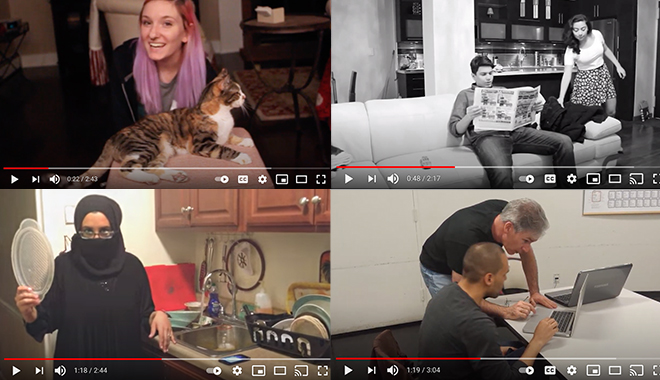
Although they worked on other essays, many students at both colleges chose to reimagine their research studies as videos. We soon saw that many videos tended to move from inquiry toward direct arguments and/or public advocacy. Isabella (2014) challenged gender stereotyping in commercials. Hannah (2019) demonstrated the harmful effects of Cosmopolitan ads on young women. Rehma (2014) mocked stereotypical portrayals of Muslim families. Tanya (2014) concluded that Sean’s writing class did not meet all of Friere’s requirements for praxis. Ashley (2017) conducted a self-study to prove veganism can be affordable. Gregory (2013) argued against gender barriers in nursing. Meredith (2019) offered college students tips for professional success.

An array of screenshots from YouTube videos of movie essays. One shows women sitting at a table with a copy of Cosmopolitan magazine, the next a picture of a male nurse in front of the statistic: 'Men in nursing, 9.6%, 333,000,' the next a black and white image of a man sitting on a couch reading a newspaper while a woman in a skirt picks up his coat; the bottom row features a mock portrayal of a student's mother wearing a niqab while washing dishes in the kitchen,  a chart labeled 'Experience' with four labeled dots underneath pointing to each other, labeled 'practice,' 'learning,' 'experience,' and 'success,' a shopping cart with produce and groceries inside, and an image of Sean standing near a seated student and they are both looking at a laptop.
Figure 1. Screenshots from student movie essays. Top row, left to right: Hannah, Gregory, and Isabella. Bottom row, left to right: Rehma, Meredith, Ashley, and Tanya.

Composing, publishing and studying video essays changed how students saw themselves, their teacher, and their work. Sean offered extra credit to students who chose to go public and also to promote their movies to substantial audiences. Publishing videos for audiences beyond our classroom raised new questions. (Do I want my brother to see this movie about our dad? Will I lose followers? What will my boss think?) The video medium and the “movie” genre often allowed, suggested, or even required students to shift away from some constraints of academic/school writing. (Can I be funny? How do I add a creative commons or public domain soundtrack? How about animation? How many words can I put on text slides if viewers watch on phones? Can I create a mock movie trailer? Should I narrate face to camera? Should I add other faces or voices? How do I get informed permission? Should I use my real name?) Peer review exercises soon demonstrated that classmates were sophisticated consumers and creators of social media and video arguments with sharp instincts for adding power.

In 2013–14, many Hunter students chose not to go public. Over the years since, others deleted their movies, or relisted them as private/unpublished. But in March of 2021, eleven were still up and public; most were still adding new viewers.[1] For example, Nicole (2014) used her rhetorical analysis of dorm room decorations to explain Kenneth Burke’s ideas about arguments of identification.

This line graph shows Nicole's movie essay views started at 0 in January 2015 and have steadily climbed to 3,500 views in July 2020.
Figure 2. Nicole’s Burke Essay’s YouTube Views chart from January 2015 to March 2021.

Her audience has consistently grown since 2014. And a clear pattern has emerged: this serious academic subject draws more new viewers during the fall and spring academic semesters and fewer during summer and winter breaks (Figure 2).

Gradually, Sean began to see how the videos shattered the constraints of both the classroom and the semester. First, they reached growing audiences around the world for months or years. Second, the lessons learned from videos carried over to later semesters as new classes reanalyzed their situations and audiences. Third, we began to spread the conversation to other teachers and students. Between 2014 and 2021, six Hunter and WPU students have presented insights about their videos to groups of students and teachers. Sean also posted his related assignment on avoiding intellectual property and copyright problems to a CUNY graduate student website in 2014. He co-published a gallery of public student movies with introductions by the student composers in 2015. He published an online package of teaching materials for his “3-Minute Movie” assignment in 2016.

Our Fall 2016 Writing Class

Carissa took Sean’s first year writing course in Fall 2016. She was a new paraprofessional at a school for children and young adults with autism and she wanted to pursue teaching. While she enjoyed her job, Carissa saw students being treated in ways that didn’t make sense. A nonspeaking student was told to stop singing in class. A boy rocking in his chair was told to have a “quiet body.” A girl scripting to soothe herself was told to have a “quiet mouth.” Why suppress these students’ natural ways of communicating or interacting with the world? The answer was the Applied Behavioral Analysis (ABA) therapy model used by the school. After doing some research on the topic and looking for the opinions of those in the Autistic community, Carissa learned that ABA was rooted in ableism, or “the discrimination of and social prejudice against people with disabilities based on the belief that typical abilities are superior” (Olson 2019). ABA therapy was developed from the 1960s through the 1980s by behavioral psychologist Ivar Lovaas who believed that “you start pretty much from scratch when you work with an autistic child. You have a person in the physical sense—they have hair, a nose and a mouth—but they are not people in the psychological sense… You have the raw materials, but you have to build the person” (Kronstein 2018).

Carissa thought Sean’s independent research project would be a good way to learn more about ABA. With her school’s permission, she conducted a rhetorical analysis of their in-house ABA procedures manual. She wrote a formal academic report, concluding that the ABA manual contributed to ableism in her school and published it to the website she created for Sean’s writing course, which she chose to make “Public.”[2]

With her classmates, Carissa watched some of the Hunter student movies and discussed the situations those students had faced. She chose to reimagine her ABA manual analysis as an advocacy piece, hoping to alert educators and parents about the potential harm from ABA therapy. Although she was passionate about the idea, she was still new to the topic and wary of sharing her criticism about such a widely accepted therapy, especially since her own workplace used it. Suddenly, the idea of “audience” was much more authentic: she risked losing her job if her bosses watched her video.

Carissa composed her video in four drafts. In the first draft, she talked through a plan on camera. In the second draft, she added a scripted narration, citing research and using technical jargon. Unable to include children due to ethical concerns, Carissa used her cats to model the therapy. In draft three, she used the cats more and moved them up to the first twenty seconds to hook viewers and lighten the overall tone. In this draft Carissa also cut the jargon way down, added citations to research studies to build credibility, and edited the running time down to 3:02. Small edits in the fourth (and final) version cut the video down to 2:43. After weighing the pros and cons, Carissa decided to go “Public,” expecting she would reach only a few dozen viewers.

Our YouTube Audience Model

As we learned more about YouTube audiences for our movies, Sean’s classes began to develop an audience chart model and revise it across semesters.[3] As the assignment developed over time, students read Laura Bolin Carroll’s (2010) “Backpacks and Briefcases,” together with the developing chart and a selection of student movies. (In the last year, Sean has assigned drafts of this article.) We quickly realized that these audiences were not separate tiers but one ecosystem—all interacting in different ways in each situation as soon as we click “Public.”

Audience Types Potential Size Examples Time Arc
Classroom 1–20 Teacher, Class Days or weeks.

[Views end with semester.]

Promoted 1 to 4000+ Family, Friends,

Social Media

Days.

[Views spike and then flatten.]

Sponsored

(Academic)

30 to 300+ Other Writing Classes

Teachers/Educators

Other college students

From time to time.

In person screenings

[Views make small jumps.]

Intended/Ideal/

Target/Organic

1 to 7000+ Effective Agents (Bitzer)

Partners/Collaborators

Affected Communities

Academic Communities

Months or Years.

[Views grow steadily.]

Suggested by Google/YouTube 1 to 6000+ Also Organic—but views are initiated by YouTube Years

[Views grow in spurts.]

By Device 1 to 7000+ Mobile, Desktop, Tablet, TV, Game Console Years.
Online Hostile 1 to 200+ Hostile Views,

Trolls and Haters

Until you delete or go “Private”

But videos can be copied.

Real Life Hostile/Unintended Not many but possible big impacts Copyright Claimants, Employers, Family, Friends,

future life partners, etc.

Until you delete or go “Private”

But videos can be copied.

Corporate One YouTube/Google Google has it forever.
Table 1. Types of YouTube audiences.

Classroom Audiences

Most college writing assignments have an audience of one teacher and maybe one or two peer-reviewer classmates. Each student video starts with that audience too, first with teacher and peer reviews of drafts, and then in a “movie night” where creators introduce and screen their final movies to the whole class.

Promoted Audiences

If students go Public, they can also choose to promote their movie and build a quick base of viewers by the semester-end, perhaps also becoming more visible to search engines. A three-minute movie is often a lot easier and more comfortable to share on Facebook or Instagram than a ten-page study or essay, even one posted to a blog or website. But self-promotion to friends, family, followers, and work colleagues can feel trickier than sharing work with two billion strangers just by marking a video “Public.”

Direct promotion can also reach members of your intended audience. Abdus (2017) designed and ran a study that administered a “push” survey to warn fifty customers in his donut shop about the harmful effects of sugary sodas and sweetened coffees. His survey was effective: forty of fifty subjects (80 percent) chose a healthier drink.

This line graph shows Abdus's movie essay views started at 0 in January 2018 and made a sharp increase to approximately 3,500 within a month. After that initial jump, the line flattens out and stays around 4,000 views up until July 2020.
Figure 3. Abdus’s Sugary Drinks Essay’s YouTube Views chart from December 2017 to March 2021.

But YouTube offered Abdus a chance to warn many more people. In a single week, Abdus used social media (with a big assist from his brother) to promote his video version of his study to over one thousand viewers. When Sean created a small winter-break promotion contest, Abdus added over 2,500 additional views. Even with 3,500 total views in its first month, this movie did not get much help from YouTube’s search and suggestion systems, and new views soon flattened out. In October 2019, another one of Sean’s writing classes decided to promote Abdus’s movie again as a team project; their promotion added another 270 views. In all, the three promotion efforts enabled Abdus to warn almost 4,000 people about harmful sugary drinks—all with almost no help from YouTube.

On the other hand, promotion may also push a movie toward unintended and/or hostile audiences. Carissa wanted to get her message out but she decided to not promote her video on social media where her coworkers might see it. It felt important to consider not just whether they saw it—but also how they found it. She did not want to appear to be pushing her criticism of a therapy they used in their faces. However, she saw less risk if they happened to come across it on their own.

Maybe Google/YouTube won’t suggest a movie with one hundred views to larger audiences. But some of our videos with a couple of hundred views have gone on to find new eyes month after month. At the same time, videos with only a handful of initial views (even excellent ones) often draw no new eyes over time. And even if a video’s audiences flatten out after a short promotional spike, reaching any real-world audience beyond the classroom is still a powerful choice that breaks free from the normal constraints of classroom writing.

Sponsored (Academic) Audiences

Every semester Sean shares old videos with new classes. This sponsorship creates a type of academic audience somewhere between promoted and organic. These students are not choosing to watch due to their needs and interests, except as a model for their own videos, a way to study audiences, and/or to get course credit. But they can be organic in some ways too. Carly’s (2016) study traced how her NJ high school failed to prepare students for writing expectations at a number of colleges. Many of Carly’s four-hundred–plus viewers have been Sean’s writing students. This past summer, Carly’s movie (with her consent) was added to WPU’s writing teacher resource website. This is, in one sense, another form of sponsorship by WPU writing teachers. But the line between sponsored and organic growth gets pretty blurry.

“Organic” Intended Audiences

When ancient Greek rhetors studied persuasion 2,400 years ago, their audiences and situations were small and simple. A persuader spoke to a single, visible “Public” or audience at one time and in one place. They could see each other and interact; they often knew each other; they had similar privileges, beliefs, and values. But as Phillip Gallagher (2019) notes, today’s digital audiences are far more complicated, “redefined by attributes of digital spaces and online communications.” Gallagher observes that as digital platforms “blur the boundaries between private and public domains,” they also splinter any single Public/audience into many different “knowledge cultures” each of which is an “organic assemblage of individuals into a group around a particular topic of interest.” Melanie Gagich (2018) also focuses on finding the ideal organic audience for any particular argument. She replaced an “imagined audience” assignment with digital composing and publication, which urged students “to address a ‘real’ community that they know from experience.”

Defining organic YouTube audiences early on (Who is this for? What work will it do?) has led students to often find multiple organic audiences. Like Gallagher’s knowledge communities, some of these audiences share a “topic of interest.” But others feel more like Gagich’s description of real communities that they know. For example, the intended audience for Sil’s (2018) anti-gang movie was complicated.

This line graph shows Silvester's movie essay views which begin at 0 in April 2018 and reach approximately 1,600 by July 2020.
Figure 4. Silvester’s Movie Essay’s YouTube Views chart from April 2018 to March 2021.

He wanted to warn young people and parents in his home town of Atlantic City, as well as families in similar communities. But he was also speaking to people who did not understand the struggles of families in towns like Atlantic City. A steady audience found Sil’s video every month for over two years. But in June 2020, as Black Lives Matter protests erupted across the nation and focused increased attention on the devastating effects of structural racism, Sil’s new views spiked up. He has again seen sharper growth in early 2021 (Figure 4).

Deanna’s (2019) conversation with her mom about converting to Judaism had, in one sense, a large potential organic audience of people considering conversion. But Deanna’s main purpose soon became to create an oral history for her own family. Nakia’s (2019) interviews about the “talks” black parents give their children to try to keep them safe also began with her family as her organic audience. But Nakia also promoted her movie to almost two hundred viewers at the end of our Fall 2019 class and its organic audience has grown slowly since, including a noticeable jump in the month after George Floyd’s murder.

The movie assignment can also draw audiences in “writing about literature” courses, at least in Sean’s horror-themed sections. But the organic audiences feel much closer to the “knowledge cultures” focused “topics of interest” proposed by Gallagher. These essays can discuss less serious issues of broad interest to large organic audiences of pop culture fans. Matt (2019) analyzes the monster in Bird Box (2019), arguing that it is H.P. Lovecraft’s Cthulhu. He did not promote his movie and its audience grew slowly for two months. But starting in September, an audience began to find it and his monthly views increased for seven months before slowly declining in early 2021— possibly as interest in the Birdbox movie waned (Figure 5).

Matt's YouTube views chart shows his views starting at 0 in May 2019 and having a slow increase up until September 2019 where it reaches about 100 views. After September they increase to about 90 views a month reaching 1,000 views by March 2020.
Figure 5. Matt’s Birdbox Essay’s YouTube Views chart from May 2019 to March 2021.

We have been surprised by how much of the organic audience growth for different movies is close to linear over months or even years. Sometimes organic audiences curve up for a few months or slowly level out. But we are also increasingly aware that explanations about audience growth based on real world factors must be understood as refracted and distorted through the sheer power that is exerted by Google itself. A closer look at Carissa’s audience growth since 2016 demonstrates this power.

Two Views of Carissa’s Organic Audience

In 2017, Sean could see Carissa find a growing organic audience. From March to September 2017, her growth rate was viral, climbing to over five hundred views a month. Then her rate of new viewers gradually declined, with a small surge in early 2021 (Figure 6). Sean could only guess as to why Carissa’s audience grew so quickly during 2017 and then slowed.

Carissa's movie views chart starts at 0 views in December 2016 and begins to make viral growth from March to September 2017. After September her views continue to grow but at a much lower rate. As of June 2020, the chart shows her video has surpassed 7,000 views.
Figure 6. Carissa’s ABA Essay’s YouTube Views chart from December 2019 to March 2021.

When Carissa studied the data available to her in YouTube’s creator studio through mid-2020, she was able to learn a lot more about how her organic audience found her video. YouTube breaks viewer sources into five key categories: YouTube searches, YouTube suggestions, external sources (like websites or Facebook), other YouTube features, and browse features (these last two are also suggestions and features inside YouTube.) The largest source of what YouTube calls “traffic” (3,765 of total 7,355 views) came directly from YouTube searches, most often “aba therapy.” YouTube’s suggestions to viewers of other videos generated 1,577 more views. (We discuss Suggested Audience below.) Carissa had hoped that audiences would find her video through searches. But she didn’t anticipate how much the internal YouTube searches and suggestions—as opposed to general Google searches or human referrals—would dominate audiences’ access to her movie. And it turned out that the YouTube search algorithm treated her video very differently over time.

External recommendations sometimes appeared to influence YouTube search results and suggestions. In January 2017, a Facebook advocacy group dedicated to “better ways than ABA” found and recommended her video which generated three small 2017 viewership bumps: about twenty in January, fifteen in May, and about sixty-five in August and September. (See the blue dotted line in Figure 7.)

This chart breaks down the places where the external views on Carissa's video came from: 1. Google/Google Search, 2. Facebook, and 3. Rutgers. The Facebook line has three small 2017 viewership bumps: about 20 in January, 15 in May, and about 65 in August and September. Rutgers has a bump of about 15 in June 2017. And Google/Google Searches has a peak of ten alongside Rutgers in June 2017 and another bump of about 18 views in November 2017.
Figure 7. External Traffic Sources chart for Carissa’s movie essay from December 2016 to December 2017.

Before the first bump, YouTube’s search, suggestions, and other features did not seem to offer or suggest Carissa’s movie to viewers. But right after the Facebook group voiced their support, new views from YouTube searches, YouTube suggested videos, and other YouTube features all spiked up (Figure 8).

The data in this “traffic sources” chart is taken directly from YouTube’s creator studio and breaks down the sources of where the views come from: 1. YouTube searches, 2. Suggested Videos, 3. External Sources and Direct and Unknown sources, 4. Other YouTube features, 5. Browse features, Channel pages, Playlists, Notifications, playlist pages, and the End Screen. YouTube Searches and Suggested Videos peaks to about 250 and 180 views respectively in September 2017. The chart shows the first bump in views came from YouTube Searches and External sources in January 2017.
Figure 8. Traffic Sources chart for Carissa’s movie essay from December 2016 to June 2020.

YouTube’s support added significant new viewers, peaking in September 2017. Viewers from YouTube suggestions and other features dropped off after only a few months. But new viewers from YouTube searches decreased more gradually over three years as YouTube stopped including it in search results.

Later referrals from credible human sources did not revive the algorithm’s support. A George Mason University recommendation has added about thirty views every September, January, and May, coinciding with Fall, Spring, and Summer semesters beginning in 2018. Rutgers University and Seneca College also sent viewers to Carissa’s movie. Another external recommendation came from a Slovakian forum for expectant mothers which generated thirty-four views in May of 2019. In the end, this more detailed analysis reaffirms the power of YouTube as a bridge or a gatekeeper to Carissa’s organic audience.

Audiences By Device

Although this does not measure a kind of audience community, we were surprised when Carissa studied her own YouTube data that over half of her total views over four years were on mobile devices. Computer views were only 39 percent, with 8 percent on tablets and smaller slices on TVs and game consoles (Figure 9). We’ve added this category to the audience chart to inform future composing choices.

This pie chart breaks down what device the total 7,345 viewers were using. 3720 were from mobile devices, 2862 were from desktops, 588 were from tablets, 122 were from TVs and 53 were from game consoles.
Figure 9. Carissa’s Movie Views by Device pie chart from June 2020.

Unintended/Hostile Audiences

As creators and advocates, we often focus on organic audiences—the eyes we want to reach, the minds we can persuade to act, the people who can identify with our interests and struggles. But we have learned that thinking about unintended audiences can be just as important. Every creator who borrows content must consider possible copyright claims. Students who could not resist a Lady Gaga soundtrack or Disney video clip risked having ads inserted in their videos or having the videos muted or deleted. So, we review creative commons content, public domain rules, and murky “fair use” considerations. Both going “Public” and choosing to promote videos presses many students to think carefully about how people in both their real lives and in their online lives will react.

Trolls and haters have been an unavoidable part of YouTube’s ecosystem from its birth. Some harsh and even antagonistic comments can be forms of sincere engagement. But Burgess and Green observe that it has become evident in recent years that some trolls mount coordinated campaigns of disinformation or harassment, even “weaponizing” comments to silence diverse and progressive voices (2018, 120). They argue that learning to manage trolls, “both practically and emotionally, is one of the core competencies required” for successful YouTubers (2018, 119).

This is a screenshot taken from the comment section of Carissa’s video. The first commenter, user Iassus prophetam, says: This was a very cute way to show people in a non offensive way some very offensive things they’re done by the APA. User Laura Markland replies, y’all are so ignorant and quotes Iassus’s misspelling: “Thinks that are done by the APA.” Then she says, “You guys have no idea what ABA practitioners are taught to do as I am about to complete my degree and take the board exam to be licensed. It is a scientifically proven method. User Barfo281 replies to Laura, It’s not scientifically proven, you liar. User Homo Sapiens Logicus replies, “Scientifically ‘proven’ method” … I.E. Scientists, that is social scientists, used captive institutionalized children, 60–70 years ago, to prove that with enough torture you can get some of those children to obey commands some of the time. We had to tone it down a bit, after there were no more institutions to hide what we were doing, but the technique has never really been refined and we never follow up on the ‘patients’ to find out.
Figure 10. A view of the comment section on Carissa’s ABA YouTube movie.

In theory, robust, heated, and even hostile comments may change how we think about the original videos as finite and fixed arguments by a single creator. But in practice, student creators/advocates may face abuse and trauma. The comments on Carissa’s movie started coming in early 2017. She expected opposition; in a way it marked her success. For a while, she tried to peacefully engage with skeptical and even hostile viewers, choosing to become a public advocate in a new way. But she soon became overwhelmed and took a step back. Returning months later, Carissa noticed that the comment section had taken on a life of its own as her viewers began to debate each other. To this day, the comments grow with new debates, even though Carissa has not rejoined them.

Suggestions and Our Corporate Audience: YouTube/Google

Purchased by Google in 2006, YouTube is an arm of one the world’s largest four corporations, with Amazon, Apple and Microsoft. Together These “big four” dominate internet commerce and our digital lives. In 2017, John Herrman criticized the ways in which these “all-encompassing internet platforms” assume innocent “costumes of liberal democracies,” while they are in fact “always a commercial simulation,” inducing us all to entrust increasing portions of our “private and public” lives to “advertising and data mining” firms. In this complex new reality, we two billion users are also two billion products. YouTube/Google mines our data to sell targeted ads and instant purchase buttons—earning $15 billion in 2019 (Duffy 2020).

YouTube always fills your screen with suggested videos to lure you to stay on the platform as long as possible. As Carissa’s video began to find its organic audience, YouTube began to suggest it to viewers of similar videos. Over time, what YouTube describes as “views from suggestions appearing alongside or after other videos” added 1,577 viewers, her second largest audience. We realized we had not considered this side to YouTube’s “participatory culture.” Classroom views are mostly initiated by the teacher. Promoted views are initiated by the creators, their families, friends, and followers. External recommendations come from interested communities. Google and YouTube searches are initiated by organic audiences—even if Google controls the actual search results.

But video suggestions are initiated directly by Google. Like any other form of promotion, that is partly a good thing for creators who can reach more eyes. Carissa’s video appeared alongside suggested videos that were also questioning the use of ABA, most notably the video, “Is ABA Therapy Child Abuse?” But the degree of control that YouTube exercises over its suggestions is a troubling reminder that the most important, powerful audience on YouTube is often YouTube itself.

Conclusion

Over eight years now, we have learned a few things about YouTube audiences and how we can think about them in useful ways. We are happy to share that here, maybe as a starting point for further discussion, or for similar conversations about digital audiences. We continue to learn every semester and we welcome creators in other classrooms to join us in thinking about these and similar questions. How do we balance public digital advocacy and protection from abuse? How do we assert our fair use rights in systems that give so much power to copyright claimants? How do we resist and oppose the power of Google to limit our audiences, even as we use its platform and tools? How can we build similar classroom conversations on other platforms that reach thousands of eyes?

We have not unlocked Google’s search algorithms to figure out how to turn serious college video essays into viral sensations. Google/YouTube suggests that the success of our videos is in our hands, based essentially on the quality and rhetorical sophistication of our work—even as it only vaguely describes its “search and recommendation systems [as using] hundreds of signals to determine how to rank videos.” Of course, quality and persuasive power do matter. And adding enticing titles, interesting thumbnail images, compelling video descriptions, thorough lists of tags, and other searchable metadata—all that may help too. Promotion to build an early audience has often seemed to matter for us, although a few videos (like Carissa’s) still find growing audiences with very little creator promotion.

But Carissa’s case study of her video also demonstrates that Google/YouTube’s algorithm computers are faithless friends. YouTube did not promote her video. Then it did. Then it didn’t. And those mercurial decisions held great power: at least 83 percent of her total audience through March 2021 has been due to Google/YouTube referral sources. YouTube is a rigged game, and it is the only game in town. As critical thinkers and creators, we keep that reality in mind as we call it out and resist it.

Yet, we also remain excited and hopeful. This flawed corporate platform still gives all of us a chance to reimagine the work we do in writing courses and why we do it. We can practice and study how to compete to reach audiences far beyond one teacher, one classroom, one semester, and one college. We can all publish work that may find a growing audience around the world for years to come.

Notes

[1] The WPU IRB confirmed on August 26, 2020 that this research and article did not require formal IRB review. We cite only public videos whose creators have reviewed a draft of this article and agreed in writing to be included.

[2] Carissa’s website has lived beyond the classroom and semester as well. She has reedited and updated it with new information gathered over the years.

[3] The “suggested” and “device” categories are new here, added based on Carissa’s case study. The “audience size” column uses Carissa’s and Abdus’s audiences for these estimates.

Bibliography

Arroyo, Sarah J. 2013. Participatory Composition: Video Culture, Writing, and Efficacy. Carbondale: Southern Illinois University Press.

Barbeau, Michelle. 2010. “Teaching Writing with YouTube.” Lore Journal 8: 1–10. http://www.lorejournal.org/wp-content/uploads/2014/11/Barbeau-Teaching-Writing-with-YouTube.pdf.

Blair, Kristine. 2014. “Letter from the Editor.” Computers and Composition 32 (June 2014): v–vi.
https://doi.org/10.1016/S8755-4615(14)00030-9.

Burgess, Jean and Joshua Green. 2018. YouTube: Online Video and Participatory Culture. Cambridge: Polity Press.

Burzynski, Matthew. 2019. “Is Cthulhu really the monster in Bird Box?” May 7, 2019. YouTube Video. https://youtu.be/C4jL8kQO75k.

Carcich, Hannah. 2019. “The Effects Cosmopolitan Magazine Ads Have On Women.” December 17, 2019. Video. https://youtu.be/7O_WibaDyXg.

Carroll, Laura B. 2010. “Backpacks vs. Briefcases: Steps toward Rhetorical Analysis.” In Writing Spaces: Readings On Writing, Volume One, edited by Charles Lowe and Pavel Zemliansky, 45–58. Parlour Press. https://writingspaces.org/essays/backpacks-vs-briefcases.

Clark, Elizabeth J. 2010. “The Digital Imperative: Making the Case for a 21st-Century
Pedagogy.” Computers and Composition 27, no. 1: 27–35.
https://doi.org/10.1016/j.compcom.2009.12.004.

Colvin, Christina M. 2018. “Video Essays and Virtual Animals: An Approach to Teaching
Multimodal Composition and Digital Literacy” The Journal of Interactive Technology &
Pedagogy
13. https://jitp.commons.gc.cuny.edu/video-essays-and-virtual-animals-an-approach-to-teaching-multimodal-composition-and-digital-literacy/

Divilova, Isabella. 2014. “Gender Stereotyping in Commercials.” December 9, 2014. YouTube Video. https://youtu.be/7LI6OLVOqy4.

DeVoss, Dànielle Nicole, Ellen Cushman and Jeffrey T. Grabill. 2005. “Infrastructure and
Composing: The When of New Media Writing.” College Composition and Communication 57, no. 1 (September): 14–44. https://www.jstor.org/stable/30037897.

Duffy, Clare. 2020. “How much money does YouTube make? We just learned for the first time.” CNN Business, February 3, 2020. https://www.cnn.com/2020/02/03/tech/google-youtube-earnings/index.html.

Fonsi, Luis. 2017. “Luis Fonsi – Despacito ft. Daddy Yankee.” January 12, 2017. YouTube Video. https://youtu.be/kJQP7kiw5Fk.

Fonville, Silvester. 2018. “How Does Gang Life Crush Dreams In Atlantic City?” April 3, 2018. YouTube Video. https://youtu.be/DnJ6-fkWoTs.

Gagich, Melanie. 2018. “Using Digital Rhetoric in a Multimodal Assignment to Disrupt Traditional Academic Writing: Conventions in a First-Year Writing Classroom.” The Journal of Interactive Technology & Pedagogy 13. https://jitp.commons.gc.cuny.edu/using-digital-rhetoric-in-a-multimodal-assignment-to-disrupt-traditional-academic-writing-conventions-in-a-first-year-writing-classroom/

Gallagher, Philip B. 2019. “Changing Culture, Changing Public: Redesigning the Rhetorical Public.” The Journal of Interactive Technology & Pedagogy 16.
https://jitp.commons.gc.cuny.edu/changing-culture-changing-public-redesigning-the-rhetorical-public/.

Herrington, Anne and Charles Moran. 2009. “Challenges for Writing Teachers: Evolving Technologies and Standardized Assessment.” In Teaching the New Writing: Technology, Change, and Assessment in the 21st-Century Classroom, edited by Anne Herrington, Kevin Hodgson and Charles Moran, 1–17. New York: Teachers College Press.

Herrman, John. 2017. “How Hate Groups Forced Online Platforms to Reveal Their True Nature.” The New York Times Magazine, August 21, 2017. https://www.nytimes.com/2017/08/21/magazine/how-hate-groups-forced-online-platforms-to-reveal-their-true-nature.html?_r=0.

Jackson, Brian and Jon Wallin. 2009. “Rediscovering the ‘Back-and-Forthness’ of Rhetoric in the Age of YouTube.” College Composition and Communication 61, no. 2: 374–396.

Kelly, Carissa. 2016. “The Harmful Effects of ABA Therapy.” December 12, 2016. YouTube Video. https://youtu.be/DZTNJlyvQyQ.

Kelly, Carissa. 2016. “How is ABA Harmful and Ableist?” https://carissakellywritingportfolio.weebly.com/research.html

Kittle, Peter. 2009. “Student Engagement and Multimodality.” In Teaching the New Writing: Technology, Change, and Assessment in the 21st-Century Classroom, edited by Anne Herrington, Kevin Hodgson and Charles Moran, 164–180. New York: Teachers College Press.

Krishtul, Nicole. 2014. “Kenneth Burke’s Theory of Identification: Dorm Edition.” December 6, 2014. Video. https://youtu.be/t4uCxzE3Y5s.

Kronstein, Alex. 2018. “Treating autism as a problem: The connection between Gay Conversion Therapy and ABA.” The Nova Scotia Advocate, July 11, 2018. https://nsadvocate.org/2018/07/11/treating-autism-as-a-problem-the-connection-between-gay-conversion-therapy-and-aba/

Martinez, Ashley. 2017. “How to Eat Vegan for $40 a Week.” December 8, 2017. YouTube Video. https://youtu.be/JJsg3l2R5QE

Molloy, Sean. 2016. “3 Minute Movie That Reimagines a Text Essay.” CUNY Composition Community. https://compcomm.commons.gc.cuny.edu/43-2/.

Molloy, Sean. 2014. “IP Path to Green Light.” CUNY Composition Community. https://compcomm.commons.gc.cuny.edu/ip-path-to-green-light/.

Molloy, Sean, Nicole Kristul, Naima Zahid, Isabella Divilova, Danielle St. Ramy, Judy Kang, Mario Ismailanji, Jisela Mendez, Prima Manandhar-Sasaki, Sara Panitz, and Tanya Tavaris. 2015. “A Gallery of Student Digital Compositions.” CUNY Composition Community. https://compcomm.commons.gc.cuny.edu/student-writing-and-composing/.

NCTE Executive Committee. 2004. “NCTE Beliefs about the Teaching of Writing.” Accessed September 28, 2009. http://www.ncte.org/positions/statements/writingbeliefs.

Olson, Emma. 2019. “Ableism 101: What it is, what it looks like, and what we can do to fix it.” Access Living (blog). https://www.accessliving.org/newsroom/blog/ableism-101/.

Omnicore. 2020. “YouTube by the Numbers: Stats, Demographics & Fun Facts.” Last modified February 10, 2020. https://www.omnicoreagency.com/youtube-statistics/.

Perrotta, Carly. 2016. “Is High School Preparing Students For College Writing?” December 7, 2016. YouTube Video. https://youtu.be/r6po_mS_QJw.

Richardson, Will, ed. 2009. Blogs, Wikis, Podcasts, and Other Powerful Web Tools for Classrooms. 2d ed. Thousand Oaks: Corwin Press.

Rober, Mark. 2020. “Building the Perfect Squirrel Proof Bird Feeder.” May 24, 2020. YouTube Video. https://youtu.be/hFZFjoX2cGg.

Rousseau, Gregory. 2013. “Male Nurses Movie.” December 10, 2013. YouTube Video.
https://youtu.be/6FtKQUgMeIM.

Salam, Abdus. 2017. “Sweet Drinks, Bitter Truth.” December 19, 2017. YouTube Video.
https://youtu.be/5MSFmIptZv8.

Saleem, Rehma. 2014. “Stereotypical Portrayal of a Muslim Family Final Movie.” December 16, 2014. YouTube Video. https://youtu.be/Nro0-VaZ3vs.

Schwartz, Jeffrey. 2009. “Integrating Video, Verbal and Audio Texts.” In Teaching the New Writing: Technology, Change, and Assessment in the 21st-Century Classroom, edited by Anne Herrington, Kevin Hodgson and Charles Moran, 92–123. New York: Teachers College Press.

Tavaris, Tanya. 2014. “How Does my writing class at Hunter College satisfy Freire’s idea of praxis in The Pedagogy of the O.” May 28, 2014. YouTube Video. https://youtu.be/EuwUyc9D4j4.

Theobald, Meredith. 2019. “10 Tips For Post-Graduation Success Pre-Graduation.” December 14, 2019. YouTube Video. https://youtu.be/iqGXN-njYYg.

Vassell, Nakia. 2019. “The Talk: A Black Family’s Guide to Survival.” December 18, 2019. YouTube Video. https://youtu.be/W8bSE_bzgNA.

Walker, Deanna. 2019. “What led my Mom from Catholicism to Judaism?” December 16, 2019.
Video. https://youtu.be/HsBLJVnzxpk.

Wesch, Michael. 2010. “From Knowledgeable to Knowledge-able.” Filmed August 2010 TEDxKC, Kansas City, Missouri. Video. https://youtu.be/LeaAHv4UTI8.

Yancey, Kathleen. 2009. “Writing in the 21st Century.” A Report from the National Council of Teachers of English. Accessed July 28, 2009.
https://secure.ncte.org/library/NCTEFiles/Press/Yancey_final.pdf.

Your Morning. 2020. “Former NASA engineer @Mark Rober makes incredible obstacle course for squirrels | Your Morning.” May 27, 2020. YouTube Video. https://youtu.be/8gQ84a273Wg.

YouTube Creators. 2020. “How Long Should Your Videos Be?” January 16, 2020. YouTube Video. https://youtu.be/G1tHzUGdMwY.

Acknowledgments

We thank Alexis Bennett and Hyacinth Rios, who assisted us as sensitivity readers for this article, as well as the student video creators who allowed us to share their work and their stories. This research was supported (in part) by a Summer Stipend from the Research Center for the Humanities and Social Sciences at William Paterson University.

About the Authors

A college writing teacher since 2003, Sean Molloy is an Assistant Professor of English and Director of the Writing Center at William Paterson University. His work has been published by the Journal of Basic Writing, College English, the CUNY Digital History Archive, on YouTube, and recently in two edited collections: Writing Assessment, Social Justice, and the Advancement of Opportunity (2018) and Talking Back: Senior Scholars and Their Colleagues Deliberate the Future of Writing Studies (2020).

Carissa Kelly will graduate from William Paterson University in May of 2021, majoring in Art and Secondary Education and minoring in Teaching Students with Disabilities. After college, she hopes to continue working with neurodiverse students. In her free time she enjoys making stained glass and spending time with her cat, Chippy.


A diagram showing the development cycle with four components: specification, design, development, and deployment. Each component is further divided into ideate, solidify, and implement. The four components form one iteration of the cycle.
0

Interdisciplinary Approach to a Coping Skills App: A Case Study

Abstract

Rich learning opportunities exist when academic departments reach beyond their discipline. During the COVID-19 pandemic, we organized an interdisciplinary team to create a mobile app to measure and support mental health through better coping skills education in the local community of Erie County, Pennsylvania. Guidance on how to develop a professional level organization at an undergraduate academic institution for app creation is sparse. Best practices in developing this environment are needed. This article describes how we, a team of four educators and three students, created the mobile app. The process mimicked a professional development team with many adjustments. The arrangement of the team and the process taught the students teamwork and gave the educators an opportunity to collect meaningful data on the local population. The methodology included adaptations from industry in a project planning guide, requirements gathering processes, user testing processes, prototyping and iterations. Development encountered several unanticipated challenges with the need for two institutional review board approvals, consultation with an attorney, hosting challenges, and Google Play Store hurdles. We suggest that future academic teams plan for these challenges at the outset. This interdisciplinary experience is a complement to any digitally-oriented classroom and is a nice introduction for students to gain the needed skills to advance to Startup and Tech Accelerator programs already in place at many universities.

Introduction

Rich learning opportunities exist when academic departments reach beyond their discipline and engage with each other. Interdisciplinary approaches are key to success in independent business entities and they allow a team to “engage with their ideas, maintain productive interaction, and successfully implement these ideas” (Brodack and Sinell 2017, 10). Interdisciplinarity broadens the knowledge base of a project team, taking full advantage of the specialized knowledge of its members while avoiding the peripheral blindness often associated with such specialization. When managed correctly, creative problem-solving outcomes are enhanced (Moirano, Sánchez, and Štěpánek 2020), silos are merged, and focus limitations associated with specialization are removed (Blackwell et al. 2009). Working on a project within an academic environment is no different. Students have specialized knowledge and often a preconceived perception of a problem. Collaboration with those outside their field broadens their interpretation of and approach to a problem while allowing them to use their special skills with external input. Developing a mobile app requires the technical skills of computer scientists, the knowledge of subject matter experts, and the expertise of user experience researchers. Here, we present a case study of a successful app development process as a blueprint for others to follow with a discussion of tools, activities, time budgets, resources, challenges, and potential impact.

During the COVID-19 pandemic, two psychology faculty members (a clinical psychologist and an engineering psychologist) and one computer science faculty member collaborated along with the corporate liaison at the university to address the increased need for coping skills in the local and student community (Fernández et al. 2020; Naeem et al. 2020; Saltzman et al. 2020). We received a grant and hired two undergraduate students and one graduate student to work with us. This article documents our wins and lessons learned in order to help other academics bootstrap the process.

Research is clear on the significant negative effects resulting from the COVID-19 Pandemic. In addition to significant physical health risks, there are substantial increases in the rate that individuals are experiencing mental health symptomatology such as distress, anxiety, sadness, and isolation (Kar et al. 2020; Pierce et al. 2020). Unfortunately, there has been less focus placed on increasing our ability to address mental health concerns at a systems level even in the face of rising pathology (Kar et al. 2020).

As a result of the pandemic, there is a shift within the mental health field towards providing more services remotely (e.g., meeting with a therapist by webcam). However, that shift does not address the increasing demand for mental health services. Thus, there is a significant need to develop other digital avenues to try and reach individuals in need (Ho 2020). According to Ho (2020), apps developed for smartphones to provide users with psychoeducation, resources, and coping strategies may prove especially useful to help meet increased mental health needs during the pandemic. Previous research demonstrates the viability of using smartphones to integrate mental health services through technology. Digital apps have been created to monitor, record, and, in some cases, modify mental health, such as providing location-based services to alert users to the nearest mental health clinic, providing self-help mantras and guided meditations, and tracking mood ratings based on self-reporting (Luxton et al. 2011).

According to the Centers for Disease Control and Prevention (2021), engaging in appropriate coping strategies during the pandemic is important to maintaining one’s mental wellbeing. We developed the Serene app to help our students and the surrounding community cope with the pandemic while gathering information on the mental health of the community. Specifically, the app was developed to accomplish this goal through non-medical advice that engages users with behavioral activities, psychoeducation, motivational quotes, video exercises for relaxation and breathing, local and national professional resources, and connections to available, external, evidence-based mental health apps.

We set out to determine the best practices in developing a professional level organization for app creation. We anticipated the project would take four months, but it took eight months with an additional four weeks for the Google Play Store release and an additional eight weeks for media coverage.

Organization

Our group was separated into three pairs, each consisting of a faculty member and a student. Faculty members chose students in their discipline based on previous coursework, previous independent study, and their experience of the students in their courses. The faculty/student pairs are referred to as teams. The three teams were as follows:

  1. UX (user experience) team (an engineering psychology professor and an undergraduate human factors psychology student who successfully completed the assignment in Appendix A),
  2. Content team (a clinical psychology professor and a counseling graduate student), and
  3. App development team (a computer science professor and an undergraduate computer science student).

The corporate liaison provided advice and guided compliance to the institutional mission and the funding agency’s mission.

User experience (UX) team

The UX team organized first to create the design for the minimally viable product (MVP) prototype. Eric Ries (2013) discusses the specifics of MVPs and how they can save development time. The UX student used her expertise in human factors and referred to the research-based best practices on Don Norman and Jakob Nielsen’s NN group website (Nielsen Norman Group 2020). Don Norman is a faculty member at the University of California San Diego and one of the forefathers of UX. Jakob Nielsen is an engineer and a principal at the NN group.

The UX and content students conducted a competitive analysis to discover what similar apps existed and what these apps provided to users as Jill DaSilva (2020) discusses. They created a spreadsheet of similar apps and their features. This was the basis of requirements gathering as Janet Six (2019) suggests. The team reviewed the spreadsheet and developed the requirements document using a version of the MOSCOW method (must, should, could, won’t) as discussed in ProductPlan (2020) and then refined this list. Some desired but untenable features were “connecting to a counselor on campus through a chat feature” and “talking to others using the app.” Both of these features would require infrastructure that was unavailable. Then, the UX student organized the architecture of the app discussed by Jen Cardello (2014) and used LucidChart to create the architecture as shown in Figure 1.

A flow chart showing the information architecture.
Figure 1. The information architecture.

After approval, the UX student generated pencil sketches of the screens and then developed the individual screens using the open-source material design pattern library (http://material.io/). Next, the student used the Invision App (https://www.invisionapp.com/) with a free educational license (https://www.invisionapp.com/education) to work out the navigation between the screens. At each stage of this process, her work was approved by the group. The prototype took two weeks longer than anticipated. The Serene app design is stored online at Invision (https://projects.invisionapp.com/share/8DXSLUJCRAK#/screens).

App development team

The development team participated in the discussions of the overall design, the design of the architecture, and the design of the UX. Following creation of the UX design by the UX team, the app development student created a prototype of Serene that followed the UX design and turned the prototype into a fully functioning app product using his expertise in computer science, following weekly discussions with the entire team. The development process consisted of the development of the back end, a Java server that handled the processing and storage of data, and the front-end, the app itself, built using HTML5 and JavaScript with Cordova (https://cordova.apache.org/), providing multi-platform support.

Content team

The content team helped the UX team to research similar apps. A spreadsheet was created to compare similar apps and their functionality. Following discussion with the whole team, the content student developed comprehensive resource lists to provide users with information regarding:

  • Mental health providers in Erie County, Pennsylvania. The list consisted of local agencies and organizations, their contact information, and the target population.
  • Nationwide mental health resources. The list consisted of national mental health hotlines and organizations for various populations.
  • Other mental health smart-phone applications. In collaboration with the UX team, a list was created with all the mental health applications that the team was able to find. The content team assessed the applications and chose a small number of evidence-based applications to suggest in the Serene app as additional applications.
  • Behavioral activities that users could consider doing. Based on psychological principles of behavioral activation (Kanter et al. 2010) to help increase well-being by remaining physically active, the content student used her expertise in counseling psychology to compile a list of various activities users could do across a variety of settings and circumstances (see Appendix B). Given some of the restrictions experienced due to the COVID-19 Pandemic, these resources provide users with ideas for activities they can engage in regardless of pandemic-related circumstances (e.g., socially distant outdoor activities or things to do at home if faced with a stay-at-home order).
  • Motivational quotes. Upon discussion with the whole team, it was decided that three categories of quotes (i.e., psychology quotes, I am… quotes, and motivational quotes) were needed. The content team sought to include at least 365 quotes in each of the three categories thereby ensuring a steady stream of new content (i.e., one new quote from each category for every day of the year) to help promote regular use of the app and gather information on how users were feeling. The final list consisted of approximately 380 quotes for each category.

The content student also used her expertise in counseling to research and write articles that provided users with evidence-based information regarding mental health and COVID-19, all accessible from within the Serene app. The mental health information discussed emotional reactions and stigmatization in mental health. The COVID-19 article was a comprehensive summary of the characteristics of the coronavirus, along with ways individuals can protect themselves. All sources used were either governmental (e.g., CDC and WHO) or other high-quality online resources (see Appendix C; e.g., information from the Bill and Melinda Gates Foundation). These articles and resources assist users in finding valid and reliable information about mental health and the COVID-19 pandemic.

Providing users with this type of information, also referred to as psychoeducation, is a very important component of multiple therapeutic models in mental health services. That is to say, we need to provide information related to the individual mental health concerns of mental health consumers in order to raise awareness and offer a sense of reality and control. Since the Serene app was created as a tool to assist its users with mental health struggles in isolation during the COVID-19 pandemic, our articles are meant to provide users with information about basic mental health concepts like stigma and emotions, as well as information about the coronavirus. Further, many unreputable online resources spread misinformation and inaccuracies that may confuse or even disturb individuals. Therefore, providing reliable resources and psychoeducation to users of the Serene app may also help to decrease potential distress that individuals may face if they were to search for and receive this same information from other, potentially unreliable or misinformative sources.

Finally, the content student’s expertise in counseling helped her to create mindfulness, meditation, and progressive muscle relaxation exercises that users could freely access within the Serene app. For this purpose, appropriate audio recording equipment (Studio Condenser USB Microphone with Adjustable Scissor Arm Stand) was purchased. Moreover, the content student searched online resources to find and adapt scripts and soundtracks for use within the app. The content student recorded the audio for each of the exercises, mixed the audio with background music and visuals, and uploaded each exercise to the team’s YouTube channel, for use within the app. The majority of the content student’s hours were spent in the creation of these exercises because significant time was needed for the student to locate appropriate scripts and soundtracks and to get familiar with the recording equipment and software. By the end, a five-minute recording would take approximately two hours to complete from start to finish.

Student Work and Time

As this was the first time that we had developed an application together, we had many questions about how much time the students should spend and what they should be doing during those hours. Based on our experiences, 50 percent of person-hours were devoted to the app development student, followed by 36 percent to the content student, and 14 percent to the UX student. To help future academic development teams determine a budget, we have included the actual student time/activities as concrete guidance.

UX team

Students were screened in an “Introduction to Human Factors” class on a prototype development assignment (see Appendix A). One of the challenges we had was budgeting for student hours. While these times may not work for every project, here is the time breakdown for the UX student.

UX student time Activity
8 hours Competitive app research
2 hours Helping with content
2.5 hours Information architecture
16.25 hours Meetings—requirements development, review sessions, organizing the project
30 hours Prototyping
8 hours User testing and reporting
2 hours Miscellaneous
Table 1. The time that it took the UX student excluding final user testing.

App development team

Students were screened in a computer science class where coding assignments were a major component. Students’ assignments were reviewed based on their performance, which included the correctness, efficiency, and organization of their written programming code. One student was invited to join the team based on his performance and his availability in the schedule of the development.

App development student time Activity
12 hours Back-end development, including the storage of data on a server and server setup*
205 hours Front-end app development, including the app interface and the connection to the back end
6 hours Miscellaneous
18 hours Meetings
Table 2. The time that it took the app development student excluding submission of the final version to Google Play. *Server setup requires the support of the IT department at the institution, which may take days or weeks depending on the institution. This is not counted in the development table.

Content team

Given the mental health nature of the content to be created for this application, it was important to find a student with expertise in both the research and practice of clinical psychology. Therefore, the student for the content team was hand selected from a clinical psychology graduate program on campus. Prior to working on this project, the student worked as a research assistant for the content team lead. Through this work the student demonstrated several key qualifications for this position, including: a passion for mental health advocacy, a mastery of the material, and the ability to work efficiently and effectively both as part of the team and on an individual level.

Content student time Activity
16 hours Creating a database of county-wide mental health resources (e.g., providers) as well as select nationwide resources (e.g., the National Suicide Prevention Lifeline)
3.5 hours Researching other mental health smartphone applications to list within this app to provide users with additional wellness resources
9 hours Creating a list of behavioral activities users could access to help find things to do across a range of current circumstances (e.g., things to do at home, if faced with a stay-at-home order due to the pandemic; socially distant outdoor activities)
34 hours Collating several lists of positive and inspirational quotes
91.5 hours Producing video content for the app (e.g., mindfulness exercise videos)
16 hours Attending team meetings
3 hours Miscellaneous
Table 3. The time that it took the content student.

Project Development and Implementation

Initial development began in late April 2020 with team organization for the summer and an application for grant funding. Project planning was done using a mix of free templates. For planning purposes, the UX work and content work happened in the first three months. App programming began concurrently in the second month once the initial prototype screens had been determined. User testing began in the third month along with iterations to solve the issues that were discovered. Figure 2 outlines the order in which the development occurred as well as the stages of ideation, solidification, and implementation within each phase. Review was ongoing in each phase. Development finished in the sixth month with submission to Google Play Store in the seventh month. The app was approved and deployed in the eighth month.

A diagram showing the development cycle with four components: specification, design, development, and deployment. Each component is further divided into ideate, solidify, and implement. The four components form one iteration of the cycle.
Figure 2. The development cycle.

Resulting Impacts

In order to keep the team focused and establish a collaboration, a project plan was our first action. Within the project plan was the rationale, the project scope, team composition, team responsibilities, team deliverables, milestone activities, communication management plan, the contact information for each team member, the budget, how the meetings would be conducted, and a quality baseline commitment. All members reviewed and revised the project plan until it was agreeable. The document was critical to the interdisciplinary focus and prevented role drift where one person tries to take over all the roles in the development process.

The Serene app included three opportunities for learning. The first opportunity was to learn more about how a multidisciplinary team could be structured to deliver specific applied skills in an academic setting. The second was the learning environment of developing the app itself. The third occurs in deploying the app to the larger community and learning more about the community’s mental health.

The first learning opportunity gave us a greater appreciation of how each discipline perceived the work and structured priorities. For example, the content group had a great interest in gathering mental health data. At first, the UX and app development teams failed to realize how important biological sex is to mental health data collection and analysis. The content team explained a long-standing issue in the mental health field pertaining to a need to research and better understand biological sex differences in relation to psychopathology as Cynthia Hartung and Thomas Widiger (1998) and Cynthia Hartung and Elizabeth Lefler (2019) discuss. As a result, it is important to ensure that data such as biological sex is collected and analyzed in mental health research to help elucidate whether any potential findings vary by sex. Even through this simple occurrence, the students learned the value of the various perspectives provided by an interdisciplinary team. The team included five options to report sex: prefer not to say, male, female, intersex, and other.

The second opportunity happened both during and after development as we learned to coordinate our expertise. The members of UX, app development, and content teams used their expertise to move the project forward. Faculty mentors coached students on teamwork skills and developed the students’ expertise in separate meetings. The weekly team meetings were opportunities for joint design decisions, review of the work, and progress maintenance by following the four we’s: (a) this is what we were thinking in our role, (b) this is what we did to move the project forward, (c) this is what we think should be done next, (d) what do we think? The forming, storming, norming, and performing stages are well documented (Tuckman 1965), however, in this project a deeper sense of inquiry was necessary to convey respect for each role’s effort. This respect freed individuals from preliminary criticism that would hamper their motivation yet allowed the team to critique the project at critical milestones. For example, the UX team struggled to devise the weekly, monthly, and yearly graphs. During weekly reviews, the team settled on an earlier solution. The UX team enjoyed the freedom to exercise their expertise and intellectually explore the options before the final design decision was made by the team.

The third learning opportunity is ongoing and comes from anonymous user data being collected to identify and address potential mental health inadequacies prevalent in the regional community. Typically, mental health needs outpace the resources available. By creating this app, we not only provided valuable resources to the community during a time of immense need, but we also gained valuable insight into the ongoing needs of our community. For instance, these data allow us to analyze the anonymous, self-reported, mental health data, across time throughout and after the pandemic. It also allows us to examine and better understand what types of local resource content are most applicable to our community members. Ultimately, these data will allow the team to better understand the specific needs of our area, as reported by the community, and can serve to tailor engagement towards addressing specific community needs.

While we often put students in teams in class, they rarely participate in teams across disciplines. This project was a beneficial example of how to construct an interdisciplinary team. Each student responded positively in their comments (see Appendix D): “The biggest challenge was taking what suggestions the development team had and giving them life”; “Nonetheless, working with a large group of experienced professors and students allowed for a painless development process”; and “The main sense that remains with me after the completion of Serene is that of working and communicating with people from various fields who all used their own language, interests, and expertise for the same project.”

Challenges

We encountered several challenges through our development process. They range from technical—data warehousing, quality assurance, design, to legal—terms of service, to managerial—content. The following sections describe each of them.

Data warehousing

One of the first challenges was where to host the programming code as the project developed. Two back-end server hosting solutions were considered. The first was a cloud-based solution, Amazon Web Services (AWS). However, this solution was abandoned due to its ongoing costs associated with storage (AWS Simple Storage Service), computing (AWS Elastic Compute Cloud), and communication (AWS Data Transfer). We chose the second solution, hosting with an internal institutional server using Windows Server. This solution required:

  • Help from IT support from the university in setting up server
  • University computing and storage resources
  • Compliance with university, including accessibility
  • Access to the Google Play Store from a university-owned account

Content

A considerable amount of time was spent in finding mindfulness scripts, soundtracks, and images with no copyrights. Also, the composition of the audio files was quite challenging, and particularly the pairing of the soundtrack with the narrative. The first few recordings took many hours to complete. Finally, the list with the quotes was unexpectedly time consuming, as the content team had to proof-read the quotes and ascertain the authors for all the quotes that appeared “unknown” during the search.

Many of the resources were kept in a spreadsheet file. The team decided to use html tags so the app could easily access the spreadsheet resources and use those resources, as is, within the app. The content team easily learned the tags and adapted.

Institutional Review Board

We found that we needed two reviews for human subjects research. One was for user testing during development. The other was for using the data that the app gathered. As this second review of data had information that was not identifiable to a person, it was determined that this was not human subjects’ data.

Attorney services

There were many questions about how to best navigate terms of service and data use. We worked closely with the legal department at our institution through the corporate liaison officer to implement a terms of service appropriate to the general nature of the app and for the information on the data and how it would be used. Since the Serene app has a mental health focus, it was essential to ensure that it was not used as a substitute for medical care and that the development team and the university could not be held liable for any such misuse. Therefore, the corporate liaison consulted with the university’s offices of risk management and general counsel. These offices helped to craft simple, understandable terms of service and data usage language. As the app was produced by the students, we chose to provide that information on the accompanying website rather in the app itself.

Design of charts

Other challenges included problems related to a specific content area. In UX/UI- there was quite a bit of work on how the charts would look. Initially, we considered a complex line and bar chart such as in Figure 3.

Figure 3. A line plot charts 'anxious', 'boredom' and 'anger.' While 'anger' hovers at the lowest level, rising toward the end, 'anxious' comes to overtake 'boredom' at the end, after an uneven dip below.
Figure 3. Initial prototype for tracking emotions.

However, this chart was too complex for the small real estate on a mobile phone screen and did not capture the weekly, monthly, and yearly changes. Then, we tried three different charts as shown in Figures 4 to 6.

Figure 4. A line plot of weekly progress showing how three types of emotions change on a weekly basis. One emotion starts with a high value and then drops to a low value towards the end.
Figure 4. Prototype of weekly progress.
Figure 5. A bar graph of monthly progress showing how three types of emotions change on a monthly basis. Each emotion is represented by a differently-colored bar. The emotion represented by the orange color starts with a high value and then drops to a low value towards the end.
Figure 5. Prototype of monthly progress.
Figure 6. A filled area graph of yearly progress showing how three types of emotions change on a yearly basis. Each emotion is represented by a differently-colored area. The values of the three emotions change from year to year.
Figure 6. Prototype of yearly progress.

User testing

In order to discover how well the design was understood, we conducted user testing with five undergraduate students from the psychology course testing pool which was approved by the IRB. The UX student used standard user testing methodologies as recommended on NN group’s user testing videos (Nielsen Norman Group 2020). In the user testing, participants were asked to do three tasks: Find a mindfulness video, find an activity to do on the phone/computer, and find a local resource for depression. Then, the researcher took note of any problems the participant had and how long it took each participant to do each task along with satisfaction ratings as described by Erik Frøkjær, Morten Hertzum, and Kasper Hornbæk (2000). Participants in user testing found that some of the labels were unclear and there was confusion about where to find specific tasks within the app. There were also questions about the use of a password and if users would be able to use the app on their Android phone and on the web. Users said that they would like a password, but this would invalidate some of the anonymity of the data and could cause some late-stage development changes. Thus, we decided to leave the password issue to the future releases and comments were gathered.

Quality assurance team

Once the code is working, there needs to be a dedicated team that tests the app, looks for the weaknesses and finds out if there are bugs that might break the app. We did not have such a team and instead functioned as our own quality-assurance team along with friends who volunteered their time. This method took longer and a professional-level assurance team should be included in the budget.

Conclusions and Future Directions

Despite the challenges encountered during the development of the app, the combination of talents into one interdisciplinary team allowed the creation of a completed product that far exceeded what one discipline could accomplish alone. One purpose of the project was to give the students the experience of working in a structured and distributed environment with a team that was segregated by roles but followed an agile software development approach, where development happened in an iterative way. Professors spent additional hours mentoring the students on teamwork and communication as well as learning about the other roles. Working together while maintaining a constant line of communication was key to its success. Having regular stages of reviews during the development cycle helped guide the process in the right direction. Using the right collaboration tools, such as Microsoft Teams, Google Docs, and GitHub, made team work much easier. The Serene app is available through Google Play and can be accessed on the Serene website.

Knowing that the project would result in an app launched to a large community of potential users provided ample motivation to meet the learning and performance needs for successful completion of the project. Learning requirements were high and extended well beyond knowledge gained in coursework. Also, it did not go unnoticed by the students that the audience for this project was external to the university, and it motivated them to take extra care and expend extra effort in their work. Working within an interdisciplinary team that extends beyond students to include university faculty and staff helped the students to broaden their perspective of app development work to include the work of the other teams, focus their thinking on alignment of the project with the mission of the university, understand potential legal responsibilities, and value meeting the expectations of external stakeholders. For example, the funding agency has a strong local focus, so the students had to be sure to target a sufficient portion of the app’s functionality toward a regional audience.

Our university is highly focused on being an Open Lab (Birx, Ford and Payne 2013), an interdisciplinary living laboratory where learning and discovery are applied to solve problems defined in partnership with external stakeholders. The Open Lab concept evolved from the idea of research clusters working on pressing local problems. The Open Lab is a win for students, faculty, and the external organizations: students gain career-building, real-world experience; faculty enjoy the ability to keep their skills relevant and transfer their networks to students; and external partners benefit from the energy and ingenuity of student talent. More information can be found at the Open Lab website through the university homepage (https://behrend.psu.edu). This project aligns with that focus, as it creates an outward-facing product that receives and engages with feedback from the external community, adding motivation and accountability to the students’ work. It is notable that all students acknowledged the value that this experience provided to them and their career development. Students involved in this team left individual comments regarding their experience (see Appendix D).

We plan on continuing an extension of this project. For future work, psychology content can be updated and expanded with additional mental health or COVID-19 focused information, resources, or the creation and addition of new wellness exercises that users can freely access from within the Serene app. We have deployed the app and are monitoring user feedback. Additional user testing will be conducted based on user feedback. We also plan to deploy the app to iOS. When recruiting undergraduate students, it is a good idea to have overlapping years. There should be some second-year students, some third-year students, and some senior students. This approach ensures smooth transitions for projects having a multi-year life expectancy.

Bibliography

Birx, Donald L., Ralph M. Ford, and Carrie A. Payne. 2013. “The University as an Open Laboratory.” Journal of Research Administration 44, no. 2: 11–37.

Blackwell, Alan F., Lee Wilson, Alice Street, Charles Boulton, and John Knell. 2009. “Radical Innovation: Crossing Knowledge Boundaries with Interdisciplinary Teams.” Department of Computer Science and Technology Technical Reports UCAM-CL-TR-760, November 2009. https://www.cl.cam.ac.uk/techreports/UCAM-CL-TR-760.html.

Brodack, Franziska, and Anna Sinell. 2017. “Promoting Entrepreneurial Commitment: The Benefits of Interdisciplinarity.” Technology Innovation Management Review 7, no. 12: 6–13. http://doi.org/10.22215/timreview/1123.

Cardello, Jen. 2014. “The Difference between Information Architecture and Navigation.” NN group, November 26, 2020. https://www.nngroup.com/articles/ia-vs-navigation/.

Centers for Disease Control and Prevention. 2019. “Coping with Stress.” CDC, January 22, 2021. https://www.cdc.gov/coronavirus/2019-ncov/daily-life-coping/managing-stress-anxiety.html.

DaSilva, Jill. 2020. “A Guide to Competitive Analysis for UX Design.” Adobe, June 12, 2020. https://xd.adobe.com/ideas/process/user-research/guide-to-competitive-analysis-ux-design/.

Fernández, Rodrigo S., Lucia Crivelli, Nahuel Magrath Guimet, Ricardo F. Allegri, and Maria E. Pedreira. 2020. “Psychological Distress Associated with COVID-19 Quarantine: Latent Profile Analysis, Outcome Prediction and Mediation Analysis.” Journal of Affective Disorders 277: 75–84. https://doi.org/10.1016/j.jad.2020.07.133.

Frøkjær, Erik, Morten Hertzum, and Kasper Hornbæk. 2000. “Measuring Usability: Are Effectiveness, Efficiency, and Satisfaction Really Correlated?” Proceedings of the SIGCHI Conference on Human Factors in Computing Systems 2, no.1: 345–352.

Hartung, Cynthia M., and Elizabeth K. Lefler. 2019. “Sex and Gender in Psychopathology: DSM-5 and Beyond.” Psychological Bulletin 145, no. 4: 390–409. https://doi.org/10.1037/bul0000183.

Hartung, Cynthia M., and Thomas A. Widiger. 1998. “Gender Differences in the Diagnosis of Mental Disorders: Conclusions and Controversies of the DSM–IV.” Psychological Bulletin 123, no. 3: 260–278. https://doi.org/10.1037/0033-2909.123.3.260.

Ho, Cyrus Sh, Cornelia Yi Chee, and Roger Cm Ho. 2020. “Mental Health Strategies to Combat the Psychological Impact of COVID-19 Beyond Paranoia and Panic.” Annals Academy of Medicine, Singapore 49, no. 1: 1–3.

Kanter, Jonathan W., Rachel C. Manos, William M. Bowe, David E. Baruch, Andrew M. Busch, and Laura C. Rusch. 2010. “What is Behavioral Activation?: A Review of the Empirical Literature.” Clinical Psychology Review 30, no. 6: 608–620. https://doi.org/10.1016/j.cpr.2010.04.001.

Kar, Sujita Kumar, SM Yasir Arafat, Russell Kabir, Pawan Sharma, and Shailendra K. Saxena. 2020. “Coping with Mental Health Challenges During COVID-19.” In Coronavirus Disease 2019 (COVID-19). Medical Virology: From Pathogenesis to Disease Control, edited by Shailendra K. Saxena. Singapore: Springer.

Luxton, David D., Russell A. McCann, Nigel E. Bush, Matthew C. Mishkind, and Greg M. Reger. 2011. “mHealth for Mental Health: Integrating Smartphone Technology in Behavioral Healthcare.” Professional Psychology: Research and Practice 42, no. 6: 505–512.

Moirano, Regina, Marisa Analía Sánchez, and Libor Štěpánek. 2020. “Creative Interdisciplinary Collaboration: A Systematic Literature Review.” Thinking Skills and Creativity 35, no. 100626: 1–14. https://doi.org/10.1016/j.tsc.2019.100626.

Naeem, Farooq, Muhammad Irfan, and Afzal Javed. 2020. “Coping with COVID-19: Urgent Need for Building Resilience Through Cognitive Behaviour Therapy.” Khyber Medical University Journal 12, no. 1: 1–3. https://doi.org/10.35845/kmuj.2020.20194.

Nielsen Norman Group. 2020. “User testing.” NN group, June 3, 2020. https://www.nngroup.com/videos/user-testing-jakob-nielsen/.

Pierce, Matthias, Holly Hope, Tamsin Ford, Stephani Hatch, Matthew Hotopf, Ann John, Evangelos Kontopantelis et al. 2020. “Mental Health Before and During the COVID-19 Pandemic: a Longitudinal Probability Sample Survey of the UK Population.” The Lancet Psychiatry 7, no. 10: 883–892. https://doi.org/10.1016/S2215-0366(20)30308-4.

ProductPlan. 2020. “MoSCoW Prioritization.” ProductPlan, November 25, 2020. https://www.productplan.com/glossary/moscow-prioritization/.

Ries, Eric. 2013. “Building the Minimum Viable Product.” Stanford Technology Ventures Program, August 28, 2013. https://youtu.be/1FoCbbbcYT8.

Saltzman, Leia Y., Tonya Cross Hansel, and Patrick S. Bordnick. 2020. “Loneliness, Isolation, and Social Support Factors in Post–COVID-19 Mental Health.” Psychological Trauma: Theory, Research, Practice, and Policy 12, no. S1: S55–S57. https://dx.doi.org/10.1037/tra0000703.

Six, Janet M. 2019. “Eliciting Business Requirements.” UX Matters, April 23, 2019. https://www.uxmatters.com/mt/archives/2019/04/eliciting-business-requirements.php.

Tuckman, Bruce W. 1965. “Developmental sequence in small groups.” Psychological Bulletin 63, no. 6: 384–399.

Appendix A: UX Screening Assignment

Instructions</h3
For this project, I want you to imagine that you have been hired to create a prototype for a mythical application. The goal of the application is to reach out to people who are feeling anxious and provide them with mental health resources and exercises to help. Boredom is part of anxiety, so it also addresses boredom. The red route in this app is that people should be able to report their level of anxiety and then get a breathing exercise and then get the phone numbers of mental health professionals. Please use one of these programs: Adobe XD (inside Adobe Creative Suite), or Figma, or Invision to create a prototype for this app. Your prototype must be designed for an Android phone and have at least one screen for each box in the information architecture outline which is here in Figure 7.

Figure 7. A flow chart showing the architecture used by the screening assignment – See outline.
Figure 7. The architecture that the assignment used.

Each screen must show the choices that would bring you to the next screen (yes/no). The screens must use the Material design pattern library which is here: https://material.io/. Once you are finished with all the screens and they are linked so that they work as an app would, please turn in the URL. I don’t want the screens or the file, just the URL for the prototype.

Appendix B: Activities Provided to Users Within the Serene App

Activity Category Type Activity
Indoors Cook/Bake a new recipe
Indoors Take a nap (or two)
Indoors Do a jigsaw puzzle
Indoors Organize your room
Indoors Take a (long) bath/shower
Indoors Clean your room/house
Indoors Try out DIY crafts
Indoors Organize your cabinets
Indoors Throw away expired items
Indoors Redecorate your room/house
Indoors Repaint your room/house
Indoors Reorganize your closet (check out Marie Kondo)
Indoors Fix broken items
Indoors Plan your outfits (even your “Zoom” ones)
Indoors Clean your electronic devices
Indoors Do your laundry
Indoors Clean your fridge
Indoors Create an emergency kit
Indoors Cook/Bake for your friends or co-workers
Indoors Rearrange your furniture
Indoors Make a pillow fort
Indoors Make a cardboard house
Indoors Take care of your plants
Indoors Sing around the house
Indoors Cook a Michelin worthy meal
Indoors Meal prep for the week/month (it will change your life)
Indoors Change your bedsheets
Indoors Organize your workspace
Indoors Shave
Indoors Cook an international cuisine
Indoors Make home-made “fast food” (pizza, tacos, etc.)
Indoors Grow an indoor kitchen garden
Indoors Make your own peanut butter and jam
Outdoors Start a vegetable garden
Outdoors Clean out your car (Beware!)
Outdoors Plant flowers
Outdoors Find a place to volunteer
Outdoors Go to church
Outdoors Sell stuff you don’t need
Outdoors Go on a solo date
Outdoors Go for a walk/run
Outdoors Go for a bike ride
Outdoors Plan and go on a scavenger hunt
Outdoors Make a cardboard house
Outdoors Birdwatch
Outdoors Go for a drive
Outdoors Have a bonfire (and roast marshmallows, of course)
Outdoors Sunbathe (don’t forget your sunscreen)
Outdoors Take care of your plants
Outdoors Fly a kite
Outdoors Go camping (and roast marshmallows, again)
Outdoors Walk on the beach/riverfront
Outdoors Go roller-skating
Outdoors Go hiking
Outdoors Go out for dinner/lunch to a new restaurant
Outdoors Go fishing
Outdoors Gaze at the stars (appease the romantic in you)
Outdoors Go on a picnic
Outdoors Go to a coffee shop (no, not the drive-thru)
Outdoors Have a barbecue
Outdoors Spend time in nature
Outdoors Go to home opens
Outdoors Walk around the city
Outdoors Mow your lawn
Outdoors Build a bird house/feeder
Outdoors Go to a scenic spot and enjoy the view
Outdoors Learn tricks with a jumping rope
Outdoors Turn your yard into an outdoor cinema
Outdoors Take your dog to the park
Outdoors Check out geocaching (yes, it is still a thing)
Outdoors Let out some energy by screaming or running around like crazy (not recommended if you live near people)
Outdoors Build a hammock
Outdoors Watch the sunset/sunrise
Outdoors Build a sandcastle
Entertainment Watch YouTube videos
Entertainment Binge-watch a new TV show
Entertainment Play a video game
Entertainment Read a book/magazine
Entertainment Blast some music
Entertainment Discover new music
Entertainment Visit museums virtually
Entertainment Watch a documentary
Entertainment Read your favorite blogs/find new ones
Entertainment Listen to your favorite podcast/find new ones
Entertainment Play online games with your friends/family
Entertainment Make a new playlist
Entertainment Make a playlist for every mood
Entertainment Download fun apps
Entertainment Listen to an audiobook
Entertainment Watch a Disney movie
Entertainment Learn a magic/card trick
Entertainment Dig out old board games
Entertainment Listen to the radio
Entertainment Re-watch your all-time favorite movies
Entertainment Have a movie marathon
Entertainment Read a comic book (DC or Marvel?)
Socializing Text/call someone you haven’t talked for a long time
Socializing Play online games with your friends/family
Socializing Take on a new challenge with your friends/family
Socializing Ask your parents and grandparents about their childhood
Socializing Find a place to volunteer
Socializing Go to church
Socializing Throw a themed Zoom party
Socializing Call your grandparents
Socializing Plan your next vacation/get-away (visualize that the Earth and people are fine again)
Socializing Contact a distant relative
Socializing Talk with your family
Socializing Plan/Go on a road trip
Socializing Go old school and get a pen pal
Socializing Have a class reunion (Zoom makes it easier)
Socializing Don’t take your loved ones for granted and remind them that you love them
Socializing Plan a Zoom trivia night
Socializing Teach a skill to someone
Socializing Plan a surprise for someone
Socializing Get to know your neighbors
Socializing Spread some positive energy and give someone a genuine compliment
Pen & Paper Draw/Paint/Doodle
Pen & Paper Do a painting tutorial
Pen & Paper Create a bucket list
Pen & Paper Write thank-you cards
Pen & Paper Start a journal
Pen & Paper Create a healthy meal plan (and follow it)
Pen & Paper Schedule your week/month/year
Pen & Paper Solve brainteasers/crosswords
Pen & Paper Make a list of your favorite quotes (Serene can help you out with this)
Pen & Paper Make a travel bucket list
Pen & Paper Write a letter to your future self
Pen & Paper Start a gratitude journal
Pen & Paper Color an adult coloring book
Pen & Paper Make a list with all the things that make you happy
Pen & Paper Create a list with all the things you don’t know and want to Google
Pen & Paper Write a poem/essay/story/song
Pen & Paper Design your dream house (maybe log in your Sims account?)
Pen & Paper Plan your next vacation/get-away (visualize that the Earth and people are fine again)
Pen & Paper Make a pros-cons list to help you make a decision
Pen & Paper Plan/Go on a road trip (Google themed road trips; you won’t regret it)
Pen & Paper Learn calligraphy
Pen & Paper Follow a writing prompt
Pen & Paper Document all the self-isolation days by photography or writing for the future generations to see
Personal Growth Read a book/magazine
Personal Growth Visit museums virtually
Personal Growth Watch a documentary
Personal Growth Organize your finance
Personal Growth Start a journal
Personal Growth Create a healthy meal plan (and follow it)
Personal Growth Make a list of your goals with 3 logical and feasible steps to achieve them
Personal Growth Learn a new language (well, get started at least)
Personal Growth Update your resume
Personal Growth Watch TED-Talks
Personal Growth Start a gratitude journal
Personal Growth Learn how to play an instrument
Personal Growth Listen to an audiobook
Personal Growth Apply for a new job
Personal Growth Plan your future education
Personal Growth Look for online/free certificates
Personal Growth Make a list with all the things that make you happy
Personal Growth Expand your vocabulary (appease your intellectual self)
Personal Growth Do the one thing you have been putting off (you know what we are talking about)
Personal Growth Make a plan to pay out your debt
Personal Growth Learn how to build up a good credit
Personal Growth Find a place to volunteer
Personal Growth Practice your religion
Personal Growth Learn about spirituality
Personal Growth Research ways to make your living situation more sustainable and “green”
Personal Growth Research about other cultures
Personal Growth Update your LinkedIn
Personal Growth Create a vision board
Personal Growth Start a money saving challenge
Personal Growth Take a fun online course
Personal Growth Google things that interest you
Personal Growth Finish unfinished projects
Personal Growth Research fitness/wellness videos/blogs
Personal Growth Learn more about finance and budgeting
Personal Growth Make a pros-cons list to help you make a decision
Personal Growth Create a savings plan
Personal Growth Learn a new skill
Personal Growth Learn a graphic design program
Personal Growth Learn first aid
Personal Growth Explore career options
Personal Growth Buy a newspaper to read with your morning coffee instead of checking your phone
Personal Growth Teach a skill to someone
Personal Growth Spread some positive energy and give someone a genuine compliment
Personal Growth Dance (like no one is watching)
Personal Growth Play with your pet or teach it a new trick
Personal Growth Exercise
Personal Growth Practice a new physical activity
Personal Growth Do yoga
Personal Growth Stretch (daily if possible)
Personal Growth Go for a walk/run
Personal Growth Go for a bike ride
Personal Growth Do aerobics (remember Zumba?)
Personal Growth Try out martial arts/self-defense
Personal Growth Go swimming
Personal Growth Go roller-skating
Personal Growth Go hiking
Personal Growth Play your favorite sports
Personal Growth Walk around the city
Personal Growth Learn tricks with a jumping rope
Computer/Phone Play a video game
Computer/Phone Visit museums virtually
Computer/Phone Back-up your computer
Computer/Phone Play online games with your friends/family
Computer/Phone Make a new playlist
Computer/Phone Make a playlist for every mood
Computer/Phone Watch TED-Talks
Computer/Phone Declutter your emails
Computer/Phone Download fun apps
Computer/Phone Create a TikTok video
Computer/Phone Delete old contacts from your phone
Computer/Phone “Get lost” with Google Sky and Google Maps
Computer/Phone Search for birthday gifts for your loved ones
Computer/Phone Unsubscribe your email from newsletters
Computer/Phone Sell stuff you don’t need
Computer/Phone Organize your documents
Computer/Phone Google things that interest you
Computer/Phone Research fitness/wellness videos/blogs
Computer/Phone Leave a positive review on Amazon (because we all need some positive in our lives)
Computer/Phone Make a wish-list on Amazon
Computer/Phone Make a to-watch list on IMDB
Computer/Phone Make a to-read list on Goodreads
Computer/Phone Update your social media bio(s)
Computer/Phone Learn a graphic design program
Computer/Phone Start a blog
Other Organize your pictures
Other Start a new challenge
Other Practice relaxation techniques
Other Meditate
Other Look into your family tree
Other Put together a family history book
Other Go through old pictures
Other Stay hydrated and drink more water
Other Practice breathing techniques
Other Do a picture challenge-take pictures with certain themes
Other Care for your pet
Other Do a pet photoshoot
Other Sew something
Other Patch up an old blanket
Other Make a short movie
Other Try out a new makeup look
Other Try out a new hairstyle
Other Keep track of your alcohol/caffeine intake
Other Start a collection (coins, shells, stamps, etc.)
Other Organize your picturesTry embroidery/cross stitching/crocheting/knitting
Other Go to a beauty salon (applies to all genders)
Other Babysit for a friend/neighbor (kids are fun)
Other Daydream like everything is possible
Other Spend a day with children
Other Play dress-up
Other Light up candles and relax
Other Do some research for the best deal on the things you want to buy
Other Do a favor for someone
Other Donate blood
Other Turn off your electronic devices for an hour
Other Blow bubbles
Other Try out origami
Other Do something nostalgic (listen to old songs, watch old pictures, etc.)

Appendix C: Sources Used for the Mental Health and COVID-19 Content Articles

BBC. “Coronavirus global update” bb.co.uk
https://www.bbc.co.uk/programmes/w13xtv39

Bill and Melinda Gates Foundation. “COVID-19” gatesfoundation.org
https://www.gatesfoundation.org/TheOptimist/coronavirus

Centers for Disease Control and Prevention (CDC). “Coronavirus (COVID-19)” cdc.gov
https://www.cdc.gov/coronavirus/2019-nCoV/index.html

COVID-19 facts. “COVID-19 facts” covid-19facts.com
https://www.covid-19facts.com/

Department of Homeland Security. “Master question list for COVID-19 (caused by SARS-CoV-2)” dhs.gov
https://www.dhs.gov/publication/st-master-question-list-covid-19?fbclid=IwAR0R7XbMPaANzMYahmW311zv2Iekk-eVIn97xlk8VPUvD_hgZAlKS9qPASU

Inside Higher Ed. “Live updates: Latest news on coronavirus and higher education” insidehighered.com
https://www.insidehighered.com/news/2020/05/29/live-updates-latest-news-coronavirus-and-higher-education

Law librarians of Congress. “Coronavirus resource guide” loc.gov
https://blogs.loc.gov/law/2020/03/coronavirus-resource-guide/

National Center for Biotechnology Information (NCBI). “LitCOVID” ncbi.nlm.nih.gov
https://www.ncbi.nlm.nih.gov/research/coronavirus/

National Institute of Health (NIH, official website). “Coronavirus (COVID-19)” nih.gov
https://www.nih.gov/coronavirus

National Institute of Health (NIH). “Open-Access Data and Computational Resources” nih.gov
https://datascience.nih.gov/covid-19-open-access-resources

Occupational Safety and Health Administration (OSHA). “COVID-19” osha.gov
https://www.osha.gov/SLTC/covid-19/

Pennsylvania Department of health. “Coronavirus (COVID-19)” health.pa.gov
https://www.health.pa.gov/Pages/default.aspx

Rapid reviews. “Rapid reviews: COVID-19” rapidreviewscovid19.mitpress.mit.edu
https://rapidreviewscovid19.mitpress.mit.edu/

Surgo Foundation. “Bringing greater precision to the COVID-19 response” precisionforcovid.org
https://precisionforcovid.org/

The U.S. Census Bureau. “COVID-19 Demographic and economic resources” covid19.census.gov
https://covid19.census.gov/

The U.S. Food and Drug Administration (FDA). “Coronavirus disease 2019 (COVID19)” fda.gov
https://www.fda.gov/emergency-preparedness-and-response/counterterrorism-and-emerging-threats/coronavirus-disease-2019-covid-19

The U.S. Department of Health and Human Services (HHS). “Coronavirus (COVID-19)” coronavirus.gov
https://www.coronavirus.gov/

Very Well Mind. “Emotions and types of emotional responses” verywellmind.com https://www.verywellmind.com/what-are-emotions-2795178#citation-1

World Health Organization (WHO). “Coronavirus disease (COVID-19) pandemic” who.int
https://www.who.int/emergencies/diseases/novel-coronavirus-2019

Appendix D: Student Feedback

UX student

When we created the app, the challenge was how to make the app feel calm and soothing while the potential users were in the app. Research on what apps were already available and what features they offered helped me to shape what I wanted the app to look like—leading to the blues and nature theme throughout the app. The biggest challenge was taking what suggestions the development team had and giving them life. There were several changes along the way as we got into the development of content. I think that is one of the interesting points of being a UX researcher, is the continued changes that must happen along the way as we progress with the application. The journey from starting the app to finishing my part with the development of the app has been a really great experience and it has given me skills that I can build upon and take into my career with me. An exciting part of this app development for me is that this will not only be available to university students but the whole community as well, which is a point that helped me to create a mental health app that is visually soothing and helpful for those users.

App development student

While developing the application, I learned many new skills and faced just as many challenges. Throughout college, I have never worked on a project of this scale. This forced me to apply my, somewhat entry level, skills as a web/application developer and build upon them immensely. This included countless hours of experimentation and research in concepts that were new to me. If I had to choose two skills that I am grateful for learning through the development process, it would be working with Amazon Web Services and Windows Server. It is one thing to develop an application on your computer at home, but it is a completely new experience when the application is running on a server for everyone to enjoy. Amazon Web Services makes the process of hosting an application simple but working with a Windows Server proved to be a much greater challenge. This required working within the limitations of the server’s security and, on many occasions, discussing with the IT department to make changes to the server that I did not have clearance to access. Nonetheless, working with a large group of experienced professors and students allowed for a painless development process. Overall, I have gained valuable experience and knowledge that will be beneficial to my future and I enjoyed it along the way.

Content student

The first unexpected challenge was the creation of the “Quote” list. I had to track down the authors of the quotes that appeared as “by unknown” during the search and also check the background of each author to assure that a certain identity was real and the person had a capacity that allowed them to say the specific quote.

The next and biggest challenge was the creation of mindfulness exercises. First, I had to familiarize myself with the digital audio editing software (Audacity). Second, during the recording, I had to assure that the words were being pronounced correctly. As an international student with English being my second language, I had to re-record the same sentence multiple times or even record word by word until I had a final output where my accent was as indistinct as possible. Finally, pairing a recording with a soundtrack had its own difficulties, as the soundtracks were typically shorter than the recordings and I had to assure that the transition from one track to another was smooth and did not interfere with the recording.

The final challenge was the composition of the two brief articles about mental health. This task required a significant amount of merely thinking, trying to narrow down to specifics all the knowledge I had as a clinical psychology student. I had a large amount of information available, but my task was to provide a very specific and, at the same time, comprehensive summary of it all. I also tried to avoid writing based on my own biases and opinions. Finally, I had to use everyday language to explain scientific terms and concepts that would make sense to people unfamiliar with the field.

What I had not realized until I started working on the tasks was that when I was providing the users with every piece of information I had to be completely valid, reliable, and accurate at all levels. I had to be as meticulous as I could. The main sense that remains with me after the completion of Serene is that of working and communicating with people from various fields who all used their own language, interests, and expertise for the same project. In a very short period of time, I was able to gain an experience valuable for my academic and professional future.

Acknowledgments

This project was funded by the Erie County Gaming Revenue Authority. We thank the two reviewers for their insightful comments, and also thank Kris McLain.

About the Authors

Antigoni Kotsiou was the primary content developer on the project. She graduated from Penn State Behrend with an MA in Applied Clinical Psychology. She works as a therapist providing treatment to children, adolescents, and young adults with trauma history and/or other mental health and behavioral concerns. Her research interests include therapeutic processes, techniques, and models, and psychopathology. She is interested in qualitative research and the subjective experiences of those involved in psychotherapy and mental health services. Her responsibility in the Serene project was to create the content based on various psychotherapy theories and models, such as cognitive therapy and mindfulness.

Erica Juriasingani was the primary UX/UI developer on the project. She is a human factors psychology student at Penn State Behrend and is currently completing her last semester. She is working as a UX Researcher with Innovation Commons at Behrend and plans to continue pursuing UX work after her graduation.

Marc Maromonte was the primary software developer on the project. He is an engineering student at Penn State University and is currently completing his Bachelor of Science in computer science. He is currently working as an Application Developer with Innovation Commons at Penn State Behrend. He plans to continue pursuing software development after his graduation.

Jacob Marsh is the Industry Relations Coordinator at Penn State Behrend. Jacob has a bachelor’s degree in biochemistry from Grove City College, a history in virology research at Penn State Hershey, and a master’s degree in project management from Penn State World Campus. He was instrumental in founding, and currently oversees, the Innovation Commons at Penn State Behrend, a product design and rapid prototyping center staffed by undergraduate students, as part of the Invent Penn State initiative. Jacob also helps develop, fund, and manage various other programs involving entrepreneurship, economic development, and industrial partnerships with Penn State Behrend.

Christopher R. Shelton is an Assistant Professor of Clinical Psychology and the director of the Virtual/Augmented Reality Lab at Penn State Behrend. He has significant clinical experience providing diagnosis, assessment, and treatment for mental health concerns across a wide spectrum of the population. His current research focuses on: (a) examination of ADHD and Sluggish Cognitive Tempo; (b) development of digital mental health assessments and interventions to increase treatment availability; and (c) the use of immersive technologies, such as augmented and virtual reality, across a range of domains. Dr. Shelton earned his Ph.D. in Clinical Psychology from the University of Wyoming.

Richard Zhao is an Assistant Professor in the Department of Computer Science at the University of Calgary. He led the app development team on the Serene project. His current research group focuses on serious games for training and education where he utilizes artificial intelligence, virtual reality, and eye-tracking technologies for this purpose. He received his M.S. and Ph.D. in Computing Science from the University of Alberta. Dr. Zhao was a faculty member at Penn State Behrend.

Lisa Jo Elliott is an Assistant Teaching Professor at Penn State Behrend where she directs the Laboratory for Usability and Interactive Systems – LUIS lab. This lab and Innovation Commons lead a multi-million-dollar grant for a UX-first product design lab. This initiative is one of the first UX-centric product design labs in the United States. It trains UX, UI, interaction design, and experience design students to be future product designers and developers in the engineering, DIGIT, and psychology programs at Penn State Behrend. Dr. Elliott has a Ph.D. from New Mexico State University, Las Cruces, NM, USA.

Table of Contents

Introduction
Anna Alexis Larsson, Teresa Ober, and Nicole Zeftel

Classmates, Family, Friends, Followers, Allies, Opponents, Enemies, Bosses, Trolls, Haters, Users, and Google: Understanding Digital Audiences On YouTube
Sean Molloy and Carissa Kelly

The Rhetorical Implications of Data Aggregation: Becoming a “Dividual” in a Data-Driven World
Charles Woods and Noah Wilson

Experiential Approaches to Teaching African Culture and the Politics of Representation: Building the “Documenting Africa” Project with StoryMapJS
Mary Anne Lewis Cusato and Nancy Demerdash-Fatemi

Collaborative Digital Projects in the Undergraduate Humanities Classroom: Case Studies with Timeline JS
Spencer D. C. Keralis, Courtney E. Jacobs, and Matthew Weirick Johnson

Forum on Teaching in the Time of the COVID-19 Pandemic

Assessing the Effectiveness of Using Live Interactions and Feedback to Increase Engagement in Online Learning
Beth Porter, John Doucette, Andrew Reilly, Dan Calacci, Burcin Bozkaya, and Alex Pentland

The Help Desk as a Community-Building Tool for Online Professional Development
Salome Apkhazishvili, Serene Arena, and Renee Hobbs

Interdisciplinary Approach to a Coping Skills App: A Case Study
Antigoni Kotsiou, Erica Juriasingani, Marc Maromonte, Jacob Marsh, Christopher R. Shelton, Richard Zhao, and Lisa Jo Elliott

“The Future Started Yesterday and We’re Already Late”: The Case for Antiracist Online Teaching
David L. Humphrey and Camea Davis

Trauma-Informed Pedagogy in the Digital Media Pandemic Classroom
Michael Mandiberg

Collaboration, Risk, and Pedagogies of Care: Looking to a Postpandemic Future
Mary Frances (Molly) Buckley-Marudas and Shelley E. Rose

Issue Nineteen Masthead

Issue Editors
Anna Alexis Larsson
Teresa Ober
Nicole Zeftel

Managing Editor
Patrick DeDauw

Copyeditors
Param Ajmera
Elizabeth Alsop
Patrick DeDauw
Jojo Karlin
Sarah Soanirina Ohmer
Angel David Nieves
Brandon Walsh
Anna Zeemont
Dominique Zino

Staging Editors
Patrick DeDauw
Kelly Hammond
Laura Wildemann Kane
Sarah Whitcomb Laiola
Danica Savonick
sava saheli singh
Luke Waltzer

A laptop in an empty classroom displays Zoom classroom on its screen.
0

Introduction

Normal teaching and learning processes are occurring amidst difficult and confusing times: the ever-intensifying impact of the COVID-19 pandemic, the growing awareness and recognition of racial and social injustices, and the looming emergency of climate disasters threatening to dismantle entire communities. Despite the increasingly precarious circumstances, instructors and students have adapted, relying intensively on digital tools to replace some or all face-to-face instruction. There is little doubt that the changes brought about in the past 15 months will affect the future of teaching and learning, yet how exactly remains to be negotiated.

In this issue of the Journal of Interactive Technology & Pedagogy, we sought to continue the conversations taking place in our general issues while likewise providing a special forum for instructors to reflect directly on the experience of teaching amidst COVID-19 and its rippling aftermath.

The pandemic brought to the forefront for many the importance of considering how digital technologies shape teaching practices and afford opportunities for learning that do not and need not replicate “analog” modes of instruction. This very set of concerns has driven the JITP editorial collective from the founding of the journal, and we therefore felt duty-bound to create a space for authors to share their creative and critical reflections on this potentially decisive moment in the development of online and distanced modes of instruction. We intended for this issue’s featured section to not only serve as a reminder of the resilience of teachers and students working and learning through the crisis, but also as an opportunity to rethink the structures of mentorship and teaching that drew many instructors to the academic context in the first place. In this regard, a broader question that is implicit through many of the articles in this issue is whether the conventional structure of the academy is tenable when public health—the very fabric of society—unravels. We hope this issue provides an opportunity to rethink existing instructional practices and improve upon them.

General Issue

The articles in this issue touch on a variety of themes related to online communication, digital privacy, pedagogy of culture and representation, as well as online collaboration. Sean Molloy and Carissa Kelly consider assignments in which students create YouTube videos as a way of thinking about writing to various audiences in “Classmates, Family, Friends, Followers, Allies, Opponents, Enemies, Bosses, Trolls, Haters, Users, and Google: Understanding Digital Audiences On YouTube.” The authors explore how students can mobilize YouTube to transform essays into an audio-visual medium and expand possibilities for communication across space and time. Through publicly hosted video essays, students can reach larger—though not always friendly—audiences well beyond their instructor and, through this, participate in diverse cultural conversations across social media.

Charles Woods and Noah Wilson argue in “The Rhetorical Implications of Data Aggregation: Becoming a ‘Dividual’ in a Data-Driven World” that social media users do not have “meaningful access” to privacy policies (and thus to the platforms governed by them) if they lack a genuine understanding of the ways their data is aggregated and used by platform providers. Using key insights from contemporary scholarship on the politics of algorithmic user profiling, the authors provide guidelines for a scaffolded assignment sequence that begins with rhetorical analysis and then uses peer collaboration to understand and integrate key concepts.

In “Experiential Approaches to Teaching African Culture and the Politics of Representation: Building the ‘Documenting Africa’ Project with StoryMapJS,” Mary Anne Lewis Cusato and Nancy Demerdash-Fatemi propose a digital solution to the problem of U.S. student reliance on stereotypes and misinformation about Africa and African peoples and cultures. Through a creative collaboration between two courses, students confronted biases and misrepresentations permeating Western perceptions of Africa. Here, collaboration serves as a way to challenge student assumptions and produce a better collective understanding.

Spencer D. C. Keralis, Courtney E. Jacobs, and Matthew Weirick Johnson showcase the platform TimelineJS in “Collaborative Digital Projects in the Undergraduate Humanities Classroom: Case Studies with Timeline JS,” highlighting the intuitive aspects of the technology, and exploring how it can enhance student learning experiences in classes like a World Literature survey by providing a way to actively and collaboratively engage with primary source material. In its multimodal functionality, TimelineJS is a unique learning tool for both processing and presenting information, the authors argue, and students can use it to think about the temporal and spatial relationships between moments in history and in fiction. Many of these themes, particularly that of collaboration, are echoed in the dialogues driving our editing process at the JITP. Our open review process establishes conversations among authors, reviewers, and editors, providing mentorship and opportunities for reflection.

Forum on Teaching in the Time of the COVID-19 Pandemic

While the articles included in the forum for this issue cover a range of topics, two distinct themes emerged from the submissions. First, any semblance of instructional continuity has clearly depended on maintaining social engagement and support for students while teaching in remote and online learning environments. Second, our online pedagogies, even when cobbled together in the midst of crisis, should be used as opportunities to interrupt the reproduction of social inequality. These concerns emerge in large part from the growing general consciousness about social injustices spurred by the continued development of movements like Black Lives Matter (BLM) and others, forcing a general reckoning with questions of racism, policing, and oppression beyond the public denialism that has long characterized mainstream discourse.

Maintaining social engagement and support online

Many instructors faced the reality of teaching during a period of intense emotional and psychological trauma, as the height of the pandemic has claimed the lives of friends and loved ones. Our daily routines have been upended, and commonplace social practices of care have moved out of reach, prompting extended periods of isolation and leaving little time for the work of grief and mourning. Like never before, instructors of all educational levels had to consider techniques for encouraging social engagement, not only as a means of learning content but also as a means of coping with the trauma inflicted simply by living during a pandemic. Several of the authors in the forum describe approaches they have adopted to foster resilience among students, like developing tools to promote online engagement, relationship-building, and coping strategies.

Adhering to social-distancing practices also created challenges in providing students real-time feedback for effective learning. In “Assessing the Effectiveness of Using Live Interactions and Feedback to Increase Engagement in Online Learning,” Beth Porter, John Doucette, Andrew Reilly, Dan Calacci, Burcin Bozkaya, and Alex Pentland describe the use of an in-browser video chat app that provides metrics of users’ participation, and discuss the implications and current limitations of using the app to promote engagement, feedback, and learning even when collaborating across distance.

Salome Apkhazishvili, Serene Arena, and Renee Hobbs explore how teacher professional development can take place in online environments in “The Help Desk as a Community-Building Tool for Online Professional Development.” The authors found that relationship-building strategies that emphasized participants as co-learners empowered instructors with a sense of interconnectedness, agency, and community—as well as the technical and pedagogical support—during the dramatic pivot to online learning.

Recognizing the trauma students were likely to face during the pandemic, Antigoni Kotsiou, Erica Juriasingani, Marc Maromonte, Jacob Marsh, Christopher R. Shelton, Richard Zhao, and Lisa Jo Elliott describe a collaborative and interdisciplinary process of creating a mobile app for students to track their emotions and develop coping strategies in “Interdisciplinary Approach to a Coping Skills App: A Case Study.”

Teaching toward social justice

The COVID-19 crisis not only necessitated that we as educators consider how learning can take place through technology, but also, in its clear interconnection with crises of racial and social justice more broadly, the need for antiracist and social-justice–informed pedagogy has become even more urgent. Many of the authors here look at how we can move from thinking theoretically about questions of inclusivity to designing digital classrooms, courses, and assignments that put these theoretical concerns into concrete practice, centering trauma-informed pedagogy and racial justice.

In “‘The Future Started Yesterday and We’re Already Late’: The Case for Antiracist Online Teaching,” David L. Humphrey and Camea Davis note the potential for educational technology to serve as a tool of academic liberation, while critically evaluating not only the shortcomings of purely technical fixes in achieving this aim, but also how the use of such technology can serve to maintain control and reinforce existing oppressive societal structures. The authors direct attention to the conspicuous absence of antiracist pedagogy in mainstream theories of online learning, and call for a shift that centers antiracist pedagogy to the benefit of all.

Also noting the inequities that became even more apparent amidst the pandemic, Michael Mandiberg considers how feminist theories of care might help us in achieving these goals.In their piece, “Trauma-Informed Pedagogy in the Digital Media Pandemic Classroom,” Mandiberg brings the insights of trauma-informed pedagogy to bear on the use of technologies like Adobe Creative Cloud technologies and their web-based clones.

These adaptations seeking to humanize the differently technologized pandemic classroom have a great deal to offer to broader projects of rethinking the current structure of teaching and learning from pre-K through college. Mary Frances (Molly) Buckley-Marudas and Shelley E. Rose describe one such model of post-pandemic pedagogy that aims to do just that: in “Collaboration, Risk, and Pedagogies of Care: Looking to a Postpandemic Future,” the authors describe their work founding the Cleveland Teaching Collaborative and, as the title implies, three primary pedagogical thematics that may help set the stage for important changes in the future of education.

Final Thoughts

Although this is one of many forums for reflection on teaching during the COVID-19 pandemic, JITP has sought to provide creative and research-based ways to incorporate and center digital technologies in responsive and responsible pedagogy for nearly a decade. Whether included in the special forum on teaching during the COVID-19 pandemic or not, many of the articles included here consider the ways instructors can craft or maintain more equitable digital spaces for students’ individual and collective reflection. The pandemic forced many instructors to adopt instructional technologies for the first time or reevaluate tools they were already using, driving us all to consider which platforms and methodologies are most accessible and useful for this new and not-so-new world of teaching. Such considerations have shed light on larger pedagogical practices that will continue to inform and change our approaches to teaching in the future, asking us to reimagine our classrooms both within and outside of emergencies like this.

About the Editors

Anna Alexis Larsson is a PhD candidate in English at the Graduate Center, CUNY, and adjunct lecturer in English at Queens College and LaGuardia Community College, CUNY. She serves as program manager of BlabRyte, a community writing web app, in addition to being a member of the editorial collective of The Journal of Interactive Technology and Pedagogy. Her research interests include ecological theories of writing, transnational literacy and translingualism, and feminist rhetorical studies. Her dissertation investigates the tension between inquiry and performance in the composition process—particularly within First Year Writing programs—to build a theory of reparative practice and apply it through a grant-funded and award-winning online writing environment.

Teresa Ober is a Postdoctoral Research Associate at the University of Notre Dame working in the Learning Analytics and Measurement in Behavioral Sciences (LAMBS) Lab. Teresa completed her PhD in Educational Psychology from the Graduate Center, CUNY, specializing in Learning, Development, and Instruction. Teresa’s present and intended future research interests broadly overlap with developmental and cognitive psychology, and the learning sciences. More information about her most current work can be found here: https://tmober.github.io.

Nicole Zeftel is a Clinical Assistant Professor of composition and professional writing at the University at Buffalo and received a PhD in Comparative Literature with a Certificate in American Studies from the Graduate Center, CUNY, in 2018. In her previous position as an Instructional Technology Fellow at the Macaulay Honors College, CUNY, Nicole studied how creative digital projects promote active learning. In addition to her work in the digital humanities and composition pedagogy, Nicole’s research focuses on the intersection between nineteenth-century American women’s literature, religion, and medical discourse, and she is currently working on a book about the impact of spiritualism on women’s writing.

Images are for demo purposes only and are properties of their respective owners. ROMA by ThunderThemes.net

Skip to toolbar