Taylor Clement, University of Louisiana at Lafayette
Abstract
This essay provides an example of how educators can employ Open Educational Resources (OER) to foster diversity, equity, and inclusion in professional writing courses. Instructors should carefully consider the voices that open access resources amplify. We can use a pedagogical approach that combines multiple readings, videos, images, activities, and audio recordings to build a community of voices that reflect and represent students’ experiences. When we select OER for professional writing lessons and assignments, we should incorporate many perspectives that discuss power, language, discourse community, and rhetorical situation. The essay describes my process of selecting OER texts for my upper-level online professional wrtiting course. I collected a variety of open access texts for students to explore. My professional writing course asked students to analyze their rhetorical situations and discourse communities. The writing assignments encouraged learners to choose language in accordance with their writing context. Students used their knowledge to compose health promotion documents for their communities. This essay provides a sample prewriting assignment and a discussion of collaborative assessment. By building a repository of resources for students to use in the course, assigning community-based projects, and encouraging students to assess their own work, we can foster a more equitable and inclusive learning environment.
Keywords: open educational resources (OER); equity; diversity; composition; online learning.
Introduction
In the Professional Writing Program at the University of Louisiana at Lafayette, I teach online courses in technical and professional writing. My classes are required for English students with concentrations in Professional Writing and students in STEM fields like kinesiology, industrial technology, and informatics. I first adopted an Open Educational Resource (OER) textbook in my technical writing classes in the Fall of 2020, when South Louisiana was grappling with compound disasters of Covid-19, protests surrounding the police shooting of Trayford Pellerin on August 21, Hurricane Laura on August 27, and Hurricane Delta on October 9. My students stumbled through the semester, trauma- and grief-stricken, some weeks quarantining in their homes, and other weeks traveling miles to find electricity or internet access.[1]
In the summer of 2020, during a pandemic that disproportionately affected Black, Indigenous, People of Color (BIPOC) students, and after the deaths of Breonna Taylor, George Floyd, and Ahmaud Arbery, the Conference on College Composition & Communication (CCCC) published a demand for Black Linguistic Justice. These scholars called for teachers of English composition and writing to educate themselves and teach students about Black Linguistic Justice (Baker-Bell et. al. 2020). The writers asked composition instructors to “stop using standard English as a communicative norm,” and instead, the committee demanded that instructors teach about white linguistic supremacy and anti-Black linguistic racism. In 2021, the CCCC published a new statement on White Language Supremacy (WLS), which is “an implement to white supremacy, particularly within educational institutions” (Richardson et al. 2021). The community affirmed their commitment to anti-racist teaching and dismantling oppressive systems through writing and communication.
In 2020, scholars like April Baker-Bell, Bonnie J. Williams-Farrier, Davena Jackson, Lamar Johnson, Carmen Kynard, and Teaira McMurtry demanded that we think about our own pedagogy as a place where we can have discussions about social justice and language. As a white European-Acadian person who has had, as Hansen (2018) says, “the privilege of being born into [standard] English,” I felt compelled to look critically at my own pedagogies to make my composition classroom a more equitable place for multiple identities and expressions. Therefore, I sought to enact a holistic model of teaching that bell hooks theorized in Teaching to Transgress. This pedagogical model would not only empower my students but would also establish “a place where teachers grow … and are empowered by the process” (hooks 1994, 21). Through my assignments and lectures in class, I sought to use OER not only to reduce textbook costs for students, but also to foster cross-cultural equity in the classroom. OER are tools we can use to make our classrooms more equitable and inclusive, especially in terms of the financial burdens of education.[2] However, without careful selection and planning on the instructor’s part, some OER can reinforce structural inequities and bias, as some textbooks promote equity and diversity more than others. George Veletsianos writes that we must carefully choose course materials to “dismantle some of the structural inequities that OER may reproduce” (2021, 409). Veletsianos asks us to consider the people and “forms of knowledge” that authors represent in open access resources. One resource alone typically cannot represent or reflect the diverse viewpoints of all our students. We must think critically about how existing OER intersect with our own positions and contexts and we must develop a community of voices or a repository of various perspectives in our classrooms (Veletsianos 2021, 409). When we work with our students to analyze, study, or create OER for class assignments, we should seek to amplify an abundance of ideas and engage in equitable and inclusive compilation and research practices.
Reliance on a single composition book, when not supplemented with additional resources, might further exclude students’ viewpoints from the conversation. This essay discusses my journey to select OER texts for my upper-level online professional writing course and how I learned to curate readings and media that foster a growth mindset (Dweck 2006; Cote 2022), include diverse voices and cultures, and ask students to participate in their ownership of knowledge and writing. First, I will explain the challenges I encountered by initially putting too much emphasis on a single commercial textbook—particularly when the source seemed to downplay “real-world” language encounters I had experienced myself as a professional writer in my community. Second, I argue that choosing multiple OERs, rather than using one, can help achieve the goals of equity and equality in the classroom. Finally, I posit that if we are interested in inclusive, equitable education, then we should bring our students into the discussion about the topics of OER and inclusion. Their experiences—whether as speakers who were “born into English” (Hansen 2018) or speakers from other countries—heavily influence their expectations and goals in a composition class.
Choosing a Textbook
In Fall of 2020, I struggled to find an appropriate OER textbook for my upper-level professional writing class, so I assigned a new commercial textbook, Paul MacRae’s Business and Professional Writing: A Basic Guide (2019). The text had useful chapters on plain language, genres of professional writing, and clear communication, but the book attempted to persuade my students that their success in the workplace depended on their use of Standard American English. The text did not fully explore the complexities of the English language and lacked nuance about audience analysis, dialects, and language that would empower students in their own communities. MacRae’s introduction advocates for students to learn and use American Standard English for all business contexts. He begins with “The Importance of Good Communication,” lamenting that with the shift in media technologies from television to internet, progressive educators stopped forcing students to learn the rules of spelling, writing, and grammar. This, MacRae argues, has led to students who “cannot express themselves in print, much less create great written work” (2019, 15–16). MacRae and other scholars like Rob Jenkins (2018) assert that Standard English pays off in the corporate world. They argue that without standard English literacy, students are unlikely to succeed or get jobs in the workplace.
The introduction in McRae’s Business and Professional Writing did not encourage my students to embrace their own language skills and proficiencies. Instead, the book aimed to standardize my students’ linguistic identities to prepare them for a seemingly homogenous workforce. In “Contesting Standardized English,” Missy Watson (2018) writes, “we don’t actually need a single homogeneous variety of language in order to communicate effectively.” Moreover, my own personal experiences led me to agree with Watson.
In the years before I began teaching at the University of Louisiana at Lafayette, I worked as a Guardian ad Litem alongside social workers in the Louisiana Department of Children and Family Services. Black professionals in this field often used Black English in correspondence, reports, and other documents. I learned that workplace discourse communities were highly context-specific and used different registers, tones, dialects, and specialized vocabularies to meet their needs (Swales 1990; Bremner 2018). Contrary to MacRae’s emphasis, workplace writing, in my experience, was not monolithic. The textbook, for which my students had paid around forty dollars, did not present a multi-faceted view. As a result, I decided to address ideas about Standard English and workplace writing with the students.
After Fall 2020, I sought to find an OER textbook for the professional writing course, and I redesigned the class to also include lessons that borrow from and cite multiple sources. I aimed to add to my repository of voices and perspectives in the online composition classroom. One of the sources I chose is an OER by Melissa Ashman, Introduction to Professional Communications (2018), because it includes citations of diverse sources and examples with names that reflect different kinds of identities. Ashman’s text emphasizes a growth mindset and affirms student’s languages, cultures, and dialects. Ashman writes that students who have proficiencies in multiple languages or dialects have an advantage in workplace environments, adding, “Our goal is not to erase what’s unique about your writing voice to make it “appropriate” for the workplace, but to build on your existing skills so that you can be successful in whatever workplace you enter” (13). Instead of attempting to replace or supplant students’ “inadequate” writing with newer, standardized ways of writing, Ashman’s approach is an additive model, adding new information to the kinds of skills and experiences students bring with them to class.
Ashman’s text aligns with Guide to Inclusive Teaching at Columbia (Kachani et al. 2018). The teaching strategies instruct teachers to “use examples that speak across gender, work across cultures, and are relatable to people from various socioeconomic statuses, ages, and religions” (Kachani et al. 2018, 20). Ashman’s book uses examples of students who have complex, intersectional identities. One example is Jian Yi who began his education in China and learned English as a second language when he moved to Canada at age twelve. Although Jian Yi can write in multiple languages, he lacks confidence in his writing skills. In addition to this, he is taking a full course load and feels burdened by the communication class. Ashman encourages students like Jian Yi to consider their language proficiencies as an advantage in business and professional writing. Ashman asserts that Jian Yi is a good writer because he can shift between two languages, and he can build on this skill as he adapts to the conventions of business writing in the workplace. Introduction to Professional Communication takes a broad view of the social skills that students need to succeed in business writing. This approach fosters positive views about writing skills and encourages students to find their own socio-cultural strengths and motivations.
Ashman also gives examples of various gender identities. In one example, the textbook uses they/them pronouns for a student named Kai: “Kai prided themself on being able to write their essays the night before. They would drink some energy drinks and buy their favourite snacks and write for hours” (2018, 56). Kai’s story of procrastination may resonate with my students who struggle with time management, drafting, and revision. The example provides a model for adapting the writing process. In the example, Kai tries writing a draft for peer review and learns to write and revise their essay in multiple stages. This example is not only useful to students who want to learn more about drafting and revision, but also provides representation for nonbinary students and introduces they/them pronouns to students who know little about nonbinary or trans* identities. This kind of representation fosters social-emotional learning principles like self-awareness and social awareness.
Ashman’s Introduction to Professional Communications acknowledges the diverse experiences of our students, recognizing that some students might have job responsibilities or family caretaking obligations in addition to their research and schoolwork. The textbook also includes reflections for students to consider, such as,“What do people in your culture and/or your family believe about reading, writing, and telling stories?” (Ashman 2018, 17). This asks students to reflect on their own identities and the value of communication in their own families or cultures. Ashman not only respects the cultural identities of her readers, but also encourages developing writers to respect their audiences when composing documents. She instructs students not to make assumptions about their audiences in their own writing, and to avoid reinforcing stereotypes about groups of people.[3]
Ashman’s text is a good start to finding representation of various identities in textbook, but the Canadian cultural context of this OER meant that I needed to include other voices and positionalities that would reflect the situations and perspectives that my students might encounter in the workplaces of the United States or in the Gulf South. To help with this, I used the Sutori platform to create a learning library, including resources from CCCC Black Technical and Professional Communication Resource Guide, and added other resources, ranging from an episode of The Bitter Southerner’s podcast, “What We Talk About When We Talk About How We Talk,” to the Yale Grammatical Diversity Project. I ask students to explore the library and choose topics and media that interest them, speak to their own experience, or give them new insights about power, communication, and language.
I began collecting free resources, articles, podcasts, and videos for students to explore. Starting with the CCCC’s “Students’ Right to Their Own Language” in 1974 that “affirms the students’ right to their own patterns and varieties of language,” our class explored language and power as they read and listened to a debate about workplace communication. Students read excerpts of Stanley Fish’s “What Colleges Should Teach, Part III” (2009) and Vershawn Young’s response in “Should Writers Use They Own English?” (2010). I wanted to align my teaching practices with Brittany Hull who writes that in her classroom, students “write usin the language or variety they were comfortable with, depending on their intended audience and the rhetorical situation” (Hull, Sheldon, and McKoy 2019).
We listened to NPR’s Rough Translation episode “How to Speak Bad English,” and Hansen’s TED Talk “2 Billion Voices,” which de-centers speakers who were “born into English” and focuses on the English language skills of the two billion people who learn English as a second language. Hansen encouraged my professional writers to use plain language and avoid idioms when writing for international audiences. We learned more about cross-cultural communication, emphasizing that English speakers should train themselves to listen to different accents and different ways of communicating in global business environments. These conversations pushed students to challenge their own assumptions and consider audience expectations in a world where colonialism, classism, racism, and white supremacy have devalued many cultures, accents, and dialects.
Students had thought-provoking and lively discussions about these readings in an online forum. Some were energized to see representations of their own Black English in Young’s work, others discussed suppressing their own Southern or Cajun accents and dialects as they grew up in public schools. Meanwhile, others wrote about their experiences as international students and expressed the difficulties they found while reading Young’s article. The discussion forum became a way for my students to share the ways that they felt about their own languages, how they learned English, and how they learned to code-switch or code-mesh at a very young age or later in life.[4] Students generated their own discussion topics and by far, the most popular discussion thread was “would you date someone on a dating app who used a different grammar than you?” The students took their knowledge of language and power and turned the discussion to ways that they encountered interpersonal relationships and possible romantic interests online. Some students responded that they would refuse to go out with a person who wrote in a different style or dialect, while others challenged these notions and said they would likely be willing to get to know a person before deciding.
Finally, to add more voices to the array, I have been working to include writers or speakers with disabilities and LGBTQIA+ authors who can teach us about different embodied and lived experiences. When I teach students about user experience design and accessibility, I often include YouTube videos from screen-reader users who teach us how to design texts for accessibility and keyboard navigation. If students who are unfamiliar with screen-reader technologies understand how screen readers operate, they begin to reconsider their document design and the importance of accessibility in professional and technical writing. In the class, my students read Emily Ladau’s Demystifying Disability (2021). Although Ladau’s book is not an OER, she offers a free, accessible, plain language translation—translated by Becca Monteleone and herself—on her website for readers to use. We also listened to Emily Ladau discuss language on NPR and watched a video of her interview with Judy Heumann. Sasha Costanza-Chock’s open access book called Design Justice (2020), which explores how marginalized communities might take part in designing structures and information for a better world. I am currently working to add new voices to my accessibility collection, including intersectional identities.
Writing for the Community: A Sample Assignment
To help students explore professional writing in their communities, I ask students to compose a health promotion document for their community. Many of my students are Health Promotion and Wellness majors and enjoy this assignment. I teach writing as a process, and pre-writing activities are crucial to the development of this community-based project. Before students begin writing, they learn about language and culture choices from professionals in the field. We discuss Miriam Williams’s research on race in professional communication and the value of using plain language when writing for the public (Weber 2015; Williams 2017). We also listen to an interview with Emily Haozous, in which she talks about the need for technical writers to immerse themselves in the culture of the community to determine what the audience needs from the document (Weber 2022). Haozous demonstrates the need for Indigenous writers to work within the community to create culturally appropriate healthcare documents.
We also examine communications and public service announcements in community health organizations during the height of the Covid-19 pandemic. Professional writers in New Orleans LCMC Health published a public health article titled “5 Ways to Stay Safe while Makin’ Groceries during Coronavirus.” The phrase “makin’ groceries” is an expression that means to go shopping. It comes from a literal English translation of the French verb “faire,” meaning either “to do” or “to make.” This public health campaign used the community’s familiar phrasing to target an audience to encourage mask wearing in public places like grocery stores. We examined the value of such community-minded discourse to connect with audiences who could understand the cultural context and nuance of the message. We also considered the drawbacks of such context-specific language for national or international audiences, demonstrating the inherent tensions in language and the value of carefully considering audience and rhetorical situation when writing for the community.
Students complete a few pre-writing exercises in which they reflect on their ideas about language choices, their communities, and their audiences:
How might you describe your own culture in terms of your heritage, religion, identity, nationality, race, ethnicity, etc.? How have your experiences informed your worldview? How do you think that your culture informs your communication style?
Our textbook talks about how our culture helps to shape our predominant modes of communication. Narrative storytelling, group discussion, and listening to elders are ways that people communicate or make decisions. Which one of these options do you rely on most? What does this say about your culture?
They conduct research about their own communities, and they use John Swales’s discourse community theory to analyze the modes of communication and the languages that people use in their neighborhoods, peer groups, workplaces, or their families. Students select a community that is important to their personal or professional life, and they introduce their discourse community to the class. They also conduct primary research: observing conversations, conducting interviews, and collecting documents or artifacts from their community. In their written reflections, students discuss their findings and analysis:
What did you learn about how your discourse community communicates?
What did you learn about the genres your discourse community uses for communication?
How does this knowledge help you better understand what it’s like to be a member of this discourse community?
Students also create empathy maps for their audiences to think about audience expectations for health promotion documents. Empathy maps, developed by the Nielsen Norman group, help each person to consider what a target audience thinks, feels, says, and does (Gibbons 2018). After completing their analysis of the community and target audience, students compose a document for their chosen community. Students have written exercise plans for improving mental health outcomes for students on campus, low-cost recipes for the free food pantry in their neighborhood, and informational guides for the Louisiana Lupus Foundation. Students choose their writing style, tone, and language based on the research they conducted in the community and the empathy map of their audience.
Assessing Student Writing
I assess students’ writing in their own language by including students in the grading process. In their 1982 article, “On Students’ Rights to Their Own Texts: A Model of Teacher Response,” Lil Brannon and C. H. Knoblauch argue that composition teachers should not assess student writing based on a vision of an “Ideal Text,” but instead in conversation with the student. This method of assessment de-centers the teacher’s power in the classroom and treats students as authorities over their own texts. I use a process that Christian Aguiar, Andrew M. Howard, and Ahmad Wright (2020) call collaborative grading. Collaborative grading creates resilient learners as it asks students to metacognitively reflect about their learning process. Many scholars have written about how we can move away from the traditional models of grading and have students take more power into their learning (Blum 2020, Stommel 2021).
Students grade their own health promotion documents by developing their own rubrics and scoring themselves. They also write a 300-word reflection for the assignment to report their purpose, audience, strengths, and weaknesses. Students submit multiple drafts of their work, using their own assessment and my feedback to revise the work before they submit a final portfolio at the end of the semester. I determine grades either through a labor-based model or by averaging the student’s self-assigned grade with the grade that I assign using the rubric. This approach to grading emphasizes the writer’s ideas and communicative goals. Although students are still developing their writing skills, they have an extensive knowledge about their own culture and community. I have found that students take this assessment seriously and reflect upon their communication choices, goals, and audience considerations. Often, they accurately identify areas that they can revise in future drafts. We can begin to see the potential and power of Open Pedagogy when we combine OER with class activities that foster connection, inclusion, and the amplification of all voices in the classroom space (Jhangiani and DeRosa 2017). Collaborative grading invites students to participate in that knowledge-making through discussion and reflection.
Conclusion
I have more work to do to craft a diverse, equitable, and inclusive classroom. I will continue to learn and build my community of voices in technical and professional writing classes. This essay represents a discussion of texts that have been useful to give students a framework to consider their own positions in their discourse communities. In the professional writing classroom, OER can remove financial barriers to learning, allowing us to share multiple texts with students at no cost. Due to the increase in open access composition textbooks, I no longer rely solely on the perspective of a single book or author. I have found it useful to ask students to choose their interests, discuss their differences, and contribute to their own learning. My professional writing students research their own discourse communities and the language and rhetorical approaches that they will use in their future workplaces.
Instead of prescribing Standard American English as the model for all workplace writing, I ask students to think critically about the potential audiences that they will encounter after graduation. Together, we’ve learned that their understanding of the rhetorical situation and audience expectations can guide their linguistic choices. Moreover, students have become empowered to choose tones, registers, designs, and dialects that will reach their audiences and result in effective communication.
OER can make learning more accessible for our students, but sources can sometimes perpetuate biases and world views that exclude or marginalize students in the classroom. As educators, we must carefully select supplementary materials to build a community of voices that will support our students’ learning. Voices from diverse perspectives can encourage students to grow and better understand their own identities as well as the consideration of others when writing in discourse communities.
Notes
[1] Despite their potential to create accessible learning environments, OER have some limitations. Inequities in internet access and rural broadband are one obstacle to OER (Cleary, Pierce, and Trauth 2006), and it takes time for instructors to remix, locate, and adopt new textbooks (Luo et. al. 2020).
[2] Many studies have examined the efficacy of OER improving retention and student success (Feldstein, A. et al. 2012; Hilton et al., 2016; Luo et al 2020; Hilton 2020; Delimont 2016). Almost 40 percent of college students are food insecure (Thoelke 2021) and 60 percent cannot afford their textbooks (Jhangiani and Jhangiani 2017; Broton and Goldrick-Rab 2018). Open pedagogies can alleviate the financial burden of textbook costs for our students. The American Council on Education has found that students most likely to experience inequity in their college education are Black, Hispanic/Latinx, first-generation students, and international students. According to the study, Black students were more likely to borrow student loans and had greater difficulty repaying those loans (Baum 2020).
[3] Ashman’s chapter on inclusive language cites Elements of Indigenous Style (2018) by Gregory Younging, a member of the Opsakwayak Cree Nation in Northern Manitoba.
[4] We could also consider students’ perceptions of their own unique linguistic identities through the lens of translanguaging, or ways that “bilingual people fluidly use their linguistic resources—without regard to named language categories—to make meaning and communicate” (Vogel and García 2017). Thanks to Inés Vañó García for this useful suggestion and resource.
Baker-Bell, A. 2020. Linguistic Justice: Black Language, Literacy, Identity, and Pedagogy. New York: Routledge & National Council of Teachers of English.
Baker-Bell, April, Bonnie J. Williams-Farrier, Davena Jackson, Lamar Johnson, Carmen Kynard, and Teaira McMurtry. 2020. “This Ain’t Another Statement! This is a DEMAND for Black Linguistic Justice!” Conference on College Composition and Communication. https://cccc.ncte.org/cccc/demand-for-black-linguistic-justice.
Blum, Susan. 2020. Ungrading: Why Rating Students Undermines Learning (and What to Do Instead). Morgantown: West Virginia University Press.
Brannon, Lil, and C. H. Knoblauch. 1982. “On Students’ Rights to Their Own Texts: A Model of Teacher Response.” College Composition and Communication 33, no. 2: 157–66. https://doi.org/10.2307/357623.
Bremner, Stephen. 2018. Workplace Writing: Beyond the Text. New York: Routledge.
Broton, K. M., and S. Goldrick-Rab. 2018. “Going Without: An Exploration of Food and Housing Insecurity Among Undergraduates.” Educational Researcher 47, no. 2: 121–133.
Cleary, Paul F., Glenn Pierce, and Eileen M. Trauth. 2006. “Closing the Digital Divide: Understanding Racial, Ethnic, Social Class, Gender and Geographic Disparities in Internet Use Among School Age Children in the United States.” Universal Access in the Information Society 4: 345–373.
Costanza-Chock, Sasha. 2020. Design Justice: Community-Led Practices to Build the Worlds We Need. Cambridge: MIT Press.
Delimont, Nicole, Elizabeth C. Turtle, Andrew Bennett, Koushik Adhikari, and Brian L. Lindshield. 2016. “University Sudents and Faculty Have Positive Perceptions of Open/Alternative Resources and Their Utilization in a Textbook Replacement Initiative.” Research in Learning Technology 24. https://doi.org/10.3402/rlt.v24.29920.
Dweck, Carol. 2006. Mindset: The New Psychology of Success. New York: Random House.
Feldstein, Andrew, Mirta Martin, Amy Hudson, Kiara Warren, John Hilton, III, and David Wiley. 2012. “Open Textbooks and Increased Student Access and Outcomes.” European Journal of Open, Distance and E-Learning 15, no. 2: 1–9.
Goldrick-Rab, Sara. 2016. Paying the Price:College Costs, Financial Aid and the Betrayal of the American Dream. Chicago: The University of Chicago Press.
Hansen, Heather. 2018. “2 Billion Voices: How to Speak Bad English Perfectly.” Filmed April 2018 at TEDxOdense, Denmark. Video, 19:16. https://www.youtube.com/watch?v=9dum2Z4B3js.
Hilton, John, III, Lane Fischer, David Wiley, and Linda Williams. 2016. “Maintaining Momentum Toward Graduation: OER and the Course Throughput Rate.” International Review of Research in Open and Distributed Learning 17, no. 6. http://www.irrodl.org/index.php/irrodl/article/view/2686/3967.
Hilton, John, III. 2020. “Open Educational Resources, Student Efficacy, and User Perceptions: A Synthesis of Research Published Between 2015 and 2018.” Education Tech Research Dev 68: 853–876 https://doi.org/10.1007/s11423-019-09700-4.
Hockings, Christine. 2010. Inclusive Learning and Teaching in Higher Education: A Synthesis of Research. York: Higher Education Academy.
hooks, bell. 1994. Teaching to Transgress: Education as the Practice of Freedom. New York: Routledge.
Hull, Brittany, Cecilia Sheldon, and Temptaous McKoy. 2019. “Dressed but not Tryin’ to Impress: Black Women Deconstructing ‘Professional’ Dress.” The Journal of Multimodal Rhetorics 3, no. 1. http://journalofmultimodalrhetorics.com/3-2-hull-shelton-mckoy.
Jhangiani, Rajiv Sunil, and Surita Jhangiani. 2017. “Investigating the Perceptions, Use, and Impact of Open Textbooks: A Survey of Post-Secondary Students in British Columbia.” The International Review of Research in Open and Distributed Learning 18, no 4. https://doi.org/10.19173/irrodl.v18i4.3012.
Ladau, Emily. 2021. Demystifying Disability: What to Know, What to Say, and How to Be an Ally. Berkeley: Ten Speed Press.
Luo, Tian, Kirsten Hostetler, Candice Freeman, and Jill Stefaniak. 2020. “The Power of Open: Benefits, Barriers, and Strategies for Integration of Open Educational Resources.” Open Learning: The Journal of Open, Distance and E-Learning 35, no. 2: 140–158. https://doi.org/10.1080/02680513.2019.1677222.
MacRae, Paul. 2019. Business and Professional Writing: A Basic Guide, Second Edition. Ontario: Broadview Press.
Richardson, Elaine, Asao Inoue, Denise Troutman, Qwo-Li Driskill, Bonnie Williams, Austin Jackson, Isabel Baca, Ana Celia Zentella, Victor Villanueva, Rashidah Muhammad, Kim B. Lovejoy, David F. Green, and Geneva Smitherman. 2021. “CCCC Statement on White Language Supremacy.” Conference on College Composition and Communication. https://cccc.ncte.org/cccc/white-language-supremacy.
Veletsianos, George. 2021. “Open Educational Resources: Expanding Equity or Reflecting and Furthering Inequities?” Education Tech Research Dev 69: 407–410. https://doi.org/10.1007/s11423-020-09840-y.
Weber, Ryan. 2015. “Dr. Miriam F. Williams on Race and Ethnicity in Tech Comm.” Ten-Minute Tech Comm Podcast. Aired Nov 23, 2015. 9 mins.
Weber, Ryan. 2022. “Dr. Emily Haozous on Health Communication with Native American Communities.” Ten-Minute Tech Comm Podcast. Aired August 24, 2022. 24:50 mins
Williams, Miriam F. 2017. From Black Codes to Recodification: Removing the Veil from Regulatory Writing. New York: Routledge.
Young, Vershawn. 2010. “Should Writers Use They Own English?” Iowa Journal of Cultural Studies 12, no. 1: 110–118.
About the Author
Taylor Clement is an assistant professor of professional writing at the University of Louisiana at Lafayette. Her research interests include plain language, user experience design, accessibility, and writing for community non-profits. She teaches classes in technical writing, workplace writing, and grant writing. Her recent work has been published in Teaching with Primary Sources (TPS) Collective and Word & Image.
Pandemic teaching opened opportunities for faculty to try out new teaching practices and tools to support successful remote instruction. Like many faculty, we turned to digital resources, like Open Educational Resources (OER), for content delivery and student engagement. The pandemic also made more salient the numerous barriers to educational equity that our students face and the potential for OER to address those inequities. This period of innovation and exploration led us to discover a greater community with a shared commitment to OER, equity, and social justice in higher education at our institution and more widely. This article describes the first year of a multi-year OER project of an institutional team working together to address diversity, equity, inclusion, and accessibility (DEIA) in the context of learning and teaching Spanish at the University of Virginia and, applying the framework of transformative learning theory (Mezirow 1997; Mezirow 2000), the transformative impact of this project on our faculty, program, and institution.
The COVID-19 pandemic brought to light the growing inequities that prevent students from participating fully in the learning mission of our colleges and universities. The rapid transition to remote instruction in March 2020 prompted many faculty to adopt new tools and pedagogies to facilitate learning and teaching online. Results of a survey of faculty in higher education found that “Moving online forced faculty to modify their courses: one-quarter of faculty said the Fall 2020 version of their course was considerably different than the version taught before” (Seaman and Seaman 2021, 3). Concerned about barriers to equitable access to learning for our students, some faculty in our language department explored low-cost online materials and Open Educational Resources (OER) during the pandemic year of online instruction. Over the years our interest in low- and no-cost educational materials had initially come from concerns about rising textbook costs as well as a growing dissatisfaction with the content of commercial textbooks. During the pandemic these issues became even more critical and sparked the desire for a more concerted and coordinated effort among faculty. Faculty in our language department quickly realized the potential of OER—educational materials offered freely and openly and under an open license—as a tool for social justice in higher education.[1] Using transformative learning theory (Katz 2019; Mezirow 1997; Mezirow 2000) as a framework to understand faculty OER adoption, this article describes the goals, stages, and outcomes of the first year of a multi-year OER project centered on addressing diversity, equity, inclusion, and accessibility (DEIA) in eight high-enrollment Spanish courses at the beginning, intermediate, and advanced levels at the University of Virginia (UVA): five courses in the required world language sequence (SPAN 1010, 1020, 1060, 2010, and 2020), two advanced-level bridge courses for the Spanish major/minor (SPAN 3010 and 3020), and a new Spanish for heritage speakers course (SPAN 3015). In the sections below, we describe the transformative impact of this project at the individual, program, and university levels.
Transformative Learning Theory
Transformative learning theory (Mezirow 1997; Mezirow 2000) is a constructivist theory of learning that posits that deep learning occurs when learners encounter a catalyst that forces them, through critical reflection, to examine and reconstruct their beliefs and knowledge. The stages of transformative learning are the following (Mezirow 2000, 22):
A disorienting dilemma.
Self-examination with feelings of fear, anger, guilt, or shame.
A critical assessment of assumptions.
Recognition that one’s discontent and the process of transformation are shared.
Exploration of options for new roles, relationships, and actions.
Planning a course of action.
Acquiring knowledge and skills for implementing one’s plans.
Provisional trying of new roles.
Building competence and self-confidence in new roles and relationships.
A reintegration into one’s life on the basis of conditions dictated by one’s new perspective.
Stacy Katz (2019) applies transformative learning theory as a framework to examine faculty decisions to adopt, adapt, and create OER for their teaching contexts. OER adoption is not simply about the decision to adopt a tool; it requires a shift in faculty beliefs and values. For Katz, “OER differs from most educational technology innovations, as it has a commitment to social justice principles and equity” (2019, 1).
Stage 1: A Disorienting Dilemma
The pandemic exposed numerous barriers, both new and existing, that prevent students from participating fully in our courses—financial barriers, technology barriers, and health and wellness barriers. In an effort to support students during this difficult time and to alleviate the burden of these barriers, our faculty team turned to low-cost and no-cost online resources as we revised our courses for online instruction.
As historian J. Mark Souther reflected, pandemic remote learning has the potential to be “A Bridge to Better Teaching.” Curriculum ideas and innovation that instructors have put off due to lack of development time or technology resources in past semesters now seem possible in part due to the need for alternative delivery methods and institutional investments in licenses for key applications. (Buckley-Marudas and Rose 2021)
The motivation to adopt OER materials in our courses was prompted initially by the instructional needs of the pandemic and concerns about financial barriers for students. For many years we had felt growing dissatisfaction with the content of commercial textbooks—especially for advanced grammar and writing courses and Spanish for the Profession courses—and a desire on the part of faculty for greater agency over course materials. We found content in traditional textbooks to be outdated, inaccurate, and constraining, and some faculty resorted to creating their own learning content to fill in the gaps. Moving to OER seemed to be a natural outcome of this process and allowed us to work toward DEIA efforts in our program. In the framework of transformative learning (Mezirow 2000), these were the “disorienting dilemmas” that triggered a shift to OER, and the pandemic made these issues even more pressing.
Stages 2 and 3: Self-Examination with Feelings of Fear, Anger, Guilt, or Shame; And Critical Assessment of Assumptions
These disorienting dilemmas also revealed feelings of guilt about requiring students to purchase costly textbooks and frustration about the many factors, such as access to technology and accessibility of course materials, that include or exclude students from engaging fully in the learning process and achieving academic success. The pandemic forced us to reexamine our assumptions about equity in higher education. In exploring OER, each of us confronted our own misconceptions about the quality and educational value of OER as compared to commercially published textbooks as well as misconceptions that our work in OER development does not carry weight in our professional careers in terms of contributions to our field. During the pandemic, our exploration of OER led us to reexamine our beliefs about knowledge creation as we discovered the benefits of Open Pedagogy—student authorship and curation of open resources. Open Pedagogy fosters student agency, motivation, collaboration, technical skills, and open access awareness (Griffiths et al. 2022; Maultsaid 2022; Trust, Maloy, and Edwards 2022), allowing students to be creators of knowledge and not just consumers of it. The pandemic pushed some faculty in our department to reconsider our teaching practices and curricula not just to improve remote learning but to work toward greater educational equity. This self-examination and critical assessment of assumptions, the second and third steps of transformative learning theory, happened individually as faculty revised curricula to support remote instruction during the pandemic and collectively as we worked together on OER projects.
Stage 4: Recognition that One’s Discontent and the Process of Transformation Are Shared
While our interest in OER was prompted by the realities of the pandemic, our project seeks to harness the unique affordances of OER to address our concerns about DEIA in higher education. We each came to explore OER to improve learning in our individual courses, but we came together as a team once we realized that our “discontent and the process of transformation are shared” with others – the fourth step of transformative learning. We formed an OER project team consisting of four faculty in the Department of Spanish, Italian & Portuguese, the Assistant Director of Learning Design & Technology, and an OER Librarian from the University Library. All faculty on the project team are non–tenure track and include the Spanish Language Program Director, the Course Coordinator of SPAN 3010/3020, and faculty teaching intermediate and advanced-level Spanish courses; all had some exposure to or background in open education prior to the project. In addition to working on our course OER materials, this collaboration allowed us to work across course levels and to tackle curriculum redesign at the course and program levels. We also came to appreciate the support and work done by the larger OER communities in world language teaching and worldwide. With a shared commitment to DEIA, we came together to learn more about open education, collaborate on our work, and support each other.
Working together toward diversity, equity, inclusion, and accessibility
Our team came together with shared concerns about the barriers to educational equity that traditional commercial course textbooks present: textbook affordability, Americans with Disabilities Act (ADA) compliance with assistive technologies and accommodations, lack of representational diversity, and lack of faculty autonomy over content. Research on the impact of OER (for example, Bali, Cronin, and Jhangiani 2020; Clinton-Lisell et al. 2021; Colvard, Watson, and Park 2018; Lambert 2018; Lambert and Fadel 2022; Nusbaum 2020) suggests that it is uniquely suited to address these issues in higher education, and it was this potential that led our team to embark on this project.
Traditional commercial textbooks for world language courses (which include online homework access codes) generally cost students $250–$300, presenting a significant financial barrier to academic success for many students. In a 2020 survey of college students and textbook affordability, 65% of students reported not buying a textbook due to barriers of cost while 21% reported not buying an access code to course materials (Nagle and Vitez 2021). In a 2021 survey of students from forty-one Virginia colleges and universities (Virginia’s Academic Library Consortium, n.d.), 42% reported feeling extremely or moderately worried about meeting their course material costs, and 66% report not buying required textbooks. High textbook cost affects academic progress, opportunity, and success; for example, 38% of Virginia students reported having taken fewer courses, 40% did not register for a specific course, 34% earned a poor grade, and 16% failed due to costs of required materials (Virginia’s Academic Library Consortium, n.d.). Students also reported being unable to meet basic human needs (food, housing, healthcare, transportation, etc.). These factors affect access to educational equity and present significant barriers for academic success and student well-being. Because OER eliminate many financial barriers of access to course materials, the opportunity for academic success increases for all students. Research coming from a large-scale study on the impact of OER reports that “OER improve end-of-course grades and decrease DFW (D, F, and Withdrawal letter grades) rates for all students. They also improve course grades at greater rates and decrease DFW rates at greater rates for Pell recipient students, part-time students, and populations historically underserved by higher education” (Colvard, Watson, and Park 2018, 262).
In addition to cost concerns, many faculty find traditional course materials limiting, out-of-date, or simply inaccurate. Our earliest creation of no-cost learning materials came out of a need to maintain the currency of learning content in our courses, which in commercial textbooks quickly becomes outdated. For example, in our Business Spanish course, the cultural and economic information in our commercial textbook was out-of-date and inaccurate, which led us to create our own course modules using newspaper articles, statistical information from databases, interviews with professionals, short films, and the like and to rely on the textbook for vocabulary only. OER creation allows faculty agency over content tailored for their own student community and the ability to update and revise materials when needed.
Another issue is that course materials may fail to present the rich diversity of the discipline—in content, scholarship, key figures, textbook contributors, and pedagogical methods. Many commercial textbooks for Spanish language learning reinforce stereotypes of Spanish-speaking people and cultures by presenting their cultures as either exotic or oppressed. Many focus more on Spain than Latin America or U.S. Spanish-speaking communities, and include little representation of indigenous people, Asian groups, mixed-race groups, Afro-Latino people, LGBTQ+, people with disabilities, or people older than student-age (see, for example, Canale 2016; Gurney and Díaz 2020; Padilla and Vana 2022; Uzum et al. 2021; Weninger and Kiss 2015). The lack of representation of diversity in course materials and textbooks has a negative impact on the sense of belonging and potential academic achievement for students in those or other underrepresented communities (Anya 2011; Anya 2020; Anya and Randolph 2019). For our OER team, an advantage of OER authorship is the ability to design content that accurately represents the diversity and vibrancy of the Spanish-speaking world and also the lived experiences and perspectives of our diverse student community. A diverse curriculum affects the learning of all students by presenting an accurate, complete, and authentic picture of the Spanish-speaking world. Centering experiences of diverse groups can enhance student sense of belonging in college, particularly for students from historically marginalized groups. Sense of belonging affects academic achievement, persistence, and well-being. Research shows that underrepresented racial-ethnic minority and first-generation students report a lower sense of belonging than other groups at 4-year schools (Gopalan and Brady 2019). For faculty interested in inclusive pedagogy and social justice, OER offers an appealing option for content delivery and student engagement.
Another potential barrier that traditional course materials may present is accessibility—course materials may fail to meet ADA compliance, excluding students who need assistive technologies or other accommodations from fully participating in the course. Students learning world languages regularly engage with multimedia materials that include video and audio to develop listening comprehension skills as well as text, images, and other media to develop skills in reading, writing, speaking, cultural competence, and critical thinking. To be accessible to all learners, materials such as these must include captioning, transcription, alt-text, and formats accessible for screen readers. In applying principles of Universal Design for Learning (UDL) to OER creation, faculty can ensure that students with diverse needs are able to access and engage with all course materials in all formats, whether written, video, audio, or image (Scott and Edwards 2019).
The goal of our multi-year project is OER implementation in eight high-enrollment undergraduate Spanish courses to center DEIA: the five courses in the required world language sequence (SPAN 1010, 1020, 1060, 2010, and 2020), two advanced-level bridge courses for the Spanish major/minor (SPAN 3010 and 3020), and a new Spanish course for heritage speakers (SPAN 3015). The projected annual cost savings of this project is $574,468. The projected timeline for our project is as follows:
Year 1: Faculty Training and Exploration
Year 2: OER Design and Creation
Year 3: Pilot and Revision
Stages 5–8: Exploration of Options for New Roles, Relationships, and Actions; Planning a New Course of Action; Acquiring Knowledge and Skills for Implementing One’s Plans; Provisional Trying of New Roles
The first year of our project focused on laying the initial groundwork necessary for this large-scale OER project. Instead of simply diving into OER creation right away, our first year was dedicated to developing expertise in the skills and knowledge essential for the OER work in Year Two and beyond. To be prepared for the work of OER creation, our team worked together during the first year on training, development, and exploration of OER. To attain our Year One goals of OER exploration and professional development, we engaged in three primary activities: (1) learning from experts and establishing collaborations, (2) data collection, and (3) OER curation. Funding from a 2021–2022 Learning Technologies Incubator Grant through the College of Arts & Sciences at UVA supported this work.
Learning from experts and establishing collaborations
Our professional development goal was to develop greater expertise in OER design, creation, and implementation, accessibility, fair use, copyright, licensing, and UDL. In addition to attending conferences and workshops on these topics, our team participated in the AAC&U 2021–2022 Institute on Open Educational Resources, a year-long online engagement program designed to support teams seeking to launch or expand OER on their campus. The Institute consisted of retreats, webinars, and regular team meetings with a faculty mentor from another institution. To better understand the process behind OER project planning and creation, our team also met with OER experts in world language instruction, and we invited guest speakers to give virtual talks on OER and Open Pedagogy to UVA faculty in world languages.
Data collection
Before designing OER textbooks for our Spanish courses, it was important to better understand what features and components our students need and want to support successful language learning. We administered an anonymous online survey to students enrolled in beginning and intermediate level Spanish courses (SPAN 1060, SPAN 2010, SPAN 2020) in Spring 2022 to gather data on students’ experiences and perspectives using traditional commercial textbooks and what content would interest them in a future OER textbook. We included questions on DEIA to better understand the student perspective on how our team could center DEIA in our textbook design. Total survey responses were 452 students, a response rate of approximately 45%: of the total number of respondents, 32% were from SPAN 1060, 44% from SPAN 2010, and 24% from SPAN 2020. Our survey asked students to indicate their interest in meeting in a focus group to engage in further discussion on these topics, and 156 out of 452 students volunteered. We randomly selected a subset of that group and set up in-person focus groups that met in Spring 2022. Twelve students participated in the two focus groups.
In the online survey, students were asked what topics they would most like to learn about in a Spanish textbook, checking “all that apply” from a list of 25 options. Results indicate that students are most interested in the following: pop culture, Spanish in the United States, travel, professions, social justice, the arts, and diversity in the Spanish-speaking world (see Table 1). Another question asked students to select those features of diversity, equity, inclusion, and accessibility important to them in a Spanish textbook, checking “all that apply.” Results indicate that students value representational diversity, diversity in cultural and linguistic content, representational diversity of lived experiences of our students, ADA compliance, focus on learning strategies, and multiple modes of access in an online textbook (see Table 2). In the focus groups, students reported preferring an online resource that is easy to navigate and that has concise grammar explanations, varied practice activities, and additional learning resources.
Survey Question: Which of the following topics would you most like to learn about in a Spanish textbook? Check all that apply.
Choice
% of respondents
Pop culture of Spanish-speaking cultures
63%
Spanish in the U.S.
62%
Travel
58%
Jobs and professions
52%
Social justice, and topics of social (in)equality
50%
Arts and artistic expressions
49%
Diversity in the Spanish-speaking world
46%
Language (bilingualism; heritage speakers; language change; dialects; indigenous languages; expressing gender identity; non-sexist language)
44%
Environment and human impact on it
43%
Technology and innovation
41%
Education
40%
Cities and their expansion
38%
Food (in)security
37%
Business
37%
Politics and international organizations
35%
The past and its habitants, the process of development of today’s world
34%
Religion and spirituality
32%
Global health
32%
Geography
31%
Flourishing and well-being
29%
Activism
29%
Law and public policy
27%
Cultural impacts of Afro-descendant populations
24%
Identity through migrations
23%
Peace studies
18%
Table 1. Topics of interest in Spanish textbooks.
Survey Question: One of the primary goals of this project is to ensure that our new online textbooks align with goals of diversity, equity, inclusion, and accessibility (DEIA). Which of the following is important to you in a Spanish textbook? Check all that apply.
Choice
% of respondents
The textbook is accessible for all students: captions, subtitles, transcriptions, adjustable video speed, and alt tags are used.
71%
The textbook is accessible in multiple modes (e.g., for download, printing, reading online, and mobile technology).
71%
The content, illustrations, photographs, and other media reflect diverse peoples, and the context of the depiction does not perpetuate stereotypes.
66%
Learning strategies and skill-building strategies are included.
64%
Representation in the textbook reflects the rich cultural diversity and lived experiences of all students at UVA.
59%
There is a variety of additional resources for learning and practice.
56%
The cultural products, practices, and perspectives of historically marginalized groups of the Spanish-speaking world are centered.
46%
Authentic texts included in the book come from a diversity of authors.
44%
Contributors referenced in the textbook come from diverse backgrounds.
28%
Table 2. Student perspective of DEIA in Spanish textbooks.
OER curation and rubric
Through research, conferences, webinars, and meetings with experts, we compiled a lengthy list of existing OER for Spanish courses at the beginning, intermediate, and advanced levels (see List of OER for Spanish). To evaluate these OER, we designed a rubric based on existing models used to assess DEIA in educational materials (see DEIA in OER Rubric). We further refined the rubric based on the data collected from the student survey and focus groups. We then curated a list of potential materials to consider for adoption/adapting as we move forward into the next stage of OER creation.
Results, year one
We successfully achieved our primary goals of exploring the world of OER and developing greater expertise on OER design, OER implementation, UDL, accessibility, copyright, fair use, and licensing. This first year of our project fostered collaboration and synergies of a cross-institutional team from the College, Learning Design & Technology, and the University Library.
The work we did helped us to better understand the importance of centering DEIA in OER design and of including active student participation throughout all stages of the project. Our work in Year One reflects steps 5–8 of Mezirow’s transformational learning theory.
Exploration of options for new roles, relationships, and actions.
Planning a course of action.
Acquiring knowledge and skills for implementing one’s plans.
Provisional trying of new roles.
Our collaboration and project teamwork opened up new roles, relationships, and actions while we planned a course of action for our multi-year project and developed the expertise necessary to embark on our project. As we transition into Year Two, we move into trying new roles as OER designers and authors, mentors, and advocates, exploring new collaborative relationships with world language colleagues at UVA and at other institutions, and inviting our students to author their own open materials.
The activities of the first year of our project helped to spark interest in OER among other UVA world language faculty through the OER guest talks we organized and through collaboration with the Institute of World Languages (IWL). We also planned an IWL Faculty Retreat focused on OER and Open Pedagogy in May 2022 for world language faculty at UVA. We hope that this stage of laying the groundwork for our OER work will serve as a model for other colleagues interested in OER creation. In addition to the intra-institutional collaborations established, collaborative work has also developed with colleagues outside of our institution.
Stages 9 and 10: Building Competence and Self-Confidence in New Roles and Relationships; A Reinterpretation into One’s Life on the Basis of Conditions Dictated by One’s New Perspective
Year Two (2022–2023) of our multi-year project will focus on adapting and creating new OER (textbooks) for the Spanish courses targeted and will include small-scale piloting, data collection and analysis, and revision and editing. Applying the framework of transformative learning, Year Two encompasses steps 9 and 10—faculty will build “competence and self-confidence in new roles and relationships,” as OER designers and collaborators and reintegrate a new perspective on teaching and learning focused on social justice and inclusive pedagogy. What we learned in Year One will shape how we approach the task of OER creation in Year Two. The work of this stage of the project kicked off in May 2022 with a four-day collaborative faculty work sprint on curriculum design and project planning applying principles of Backward Design (Wiggins, Wiggins, and McTighe 2005) and included other world language faculty at UVA. Work sprints scheduled for summer and winter break will further promote collaborative relationships and support for our projects. A world language OER writing group, meeting weekly throughout the academic year, will provide momentum and motivation for our work. The world language faculty participating in Year Two OER creation, work sprints, and the weekly writing group come from French, Italian, Portuguese, Russian, and Spanish and are recipients of internal grants to support their OER projects at UVA; all are faculty or graduate student instructors.
In our projects, material design and content decisions will be made through the lens of DEIA.
To ensure that our OER (textbooks) reflect the diversity of our student community and meet the needs of UVA students, students will be actively involved in consultation and design. The project will center student experience and perspectives by working with a Student Advisory Board throughout all steps of this project. The Student Advisory Board will consist of 3–5 undergraduate students who have taken the targeted Spanish language courses, hired through an application process. Our team will meet regularly with the Board for input, and students will be compensated for their work. This model will allow student users to participate from the outset on the product design so that our textbooks meet the needs and interests of our diverse UVA student community. In addition, these students will gain valuable experience in curricular material design, open education, and DEIA in higher education. Through our use of Open Pedagogy, students in our courses will be involved in the creation of new open materials as part of their coursework. Students will be involved in the evaluation of the new OER textbooks through prototyping, small-scale piloting, focus groups, and surveys.
Challenges
Of course, this work is not without its challenges. While OER has the potential to improve educational equity, it is not a quick and easy solution. Many OER authors point to the time and labor involved in creating high-quality open materials and the lack of adequate compensation and recognition. Faculty work in authoring OER is rarely recognized for promotion and tenure reviews. Once published, there is also the issue of sustainability, updating, ongoing revision, and technical support for OER. Our interest in implementing OER grew from the inequities we witnessed during the pandemic; a concern of ours is the addition of work for faculty who are already stressed, exhausted, and burned out from the pandemic. A question that our community needs to address is how to adequately support faculty engaged in open education. In other words, how can we balance the desire to make education accessible for all students while respecting the needs and limitations of our faculty and recognizing their work? The DOERS3 Collaborative (New England Board of Higher Education 2021) offers a matrix for faculty as they consider how OER work might fit into research, teaching, and service for promotion and tenure. At our own institution, many early OER adopters are non-tenure track faculty, including those faculty on our team. If issues of institutional support, compensation, and recognition are not resolved, there will be little motivation on the part of faculty to engage in OER work.
To address some of these challenges, we have established a strong community of support among the UVA world language faculty currently engaged in OER projects; this support comes in the form of weekly writing groups, team meetings, and work sprints. The UVA Library has also offered significant ongoing support with consultations, regular webinars, resources, grant opportunities, Pressbooks accounts, and the formation of an Open Education Community of Practice. The Learning Design & Technology group in the College of Arts & Sciences provides assistance with technology, project design, consultations, and grants. Funding for OER projects is available through a number of grant opportunities at UVA through the College of Arts & Sciences and UVA Library as well as Virginia’s Academic Library Consortium (VIVA). While an OER project can seem daunting, our team’s work sprints and weekly writing group meetings have helped us to break up the work into smaller, more manageable steps while also maintaining momentum. Unlike commercial print textbooks that are finished products, an OER project will always be a work in progress (Zourou 2016); this acknowledgment helps us establish more realistic goals, project planning, and timelines. We also recognize that faculty need not be the only ones involved in curating and authoring OER. Graduate student instructors and lecturers can be valuable contributors to OER initiatives, broadening their own professional development (Rossomondo 2011; Thoms and Thoms 2014). In addition, the curation and development of open materials can simply be integrated into the normal curricular design work of faculty course teams, programs, or departments (Comas-Quinn and Fitzgerald 2013). In adopting open pedagogy practices, many faculty on our team invite students to curate and create their own open learning materials for inclusion in OER projects (see Mathieu et al. 2019).
Conclusion
The pandemic opened the door for innovation and change in teaching and learning in higher education. “This period marked a massive change in how faculty prepared for and taught their courses, and their level of experience using teaching tools and techniques that were new to them. This exposure resulted in substantial changes in awareness, and often, in their attitudes towards different teaching approaches” (Seaman and Seaman 2021, 9). The realities of the pandemic pushed us to consider how the adoption and creation of OER might improve learning for the immediate needs of remote teaching and reduce students’ learning barriers during the pandemic. But it went further than that—our exploration of OER during the pandemic sparked a significant transformation for our team on multiple levels. First, our teaching practices and beliefs shifted informed by Open Pedagogy, inclusive pedagogy, and social justice in education. Coming together as a team committed to open education and DEIA, our community was transformed by working in new partnerships and collaborations institution-wide. Our Spanish OER (textbook) projects pushed us to reconsider our course-level objectives and program-wide goals and to articulate greater coherence across courses and levels, and our May 2022 work sprint centered on curriculum and program redesign. This project helped us reconsider the roles of faculty and students in knowledge creation and ownership as well as the contributions to and value of our OER work in the profession. As early adopters, our team members are models and advocates for OER expansion on our campus—the beginning perhaps of an institutional transformation.
Notes
[1] OER are materials that can be retained, remixed, revised, reused, and redistributed in compliance with minimally restrictive or Creative Commons licensing. (See Open Education Defined). The Creative Commons licenses offer degrees of permission for use.
References
Anya, Uju. 2011. “Connecting with Communities of Learners and Speakers: Integrative Ideals, Experiences, and Motivations of Successful Black Second Language Learners.” Foreign Language Annals 44 (3): 441–466.
Anya, Uju. 2020. “African Americans in World Language Study: The Forged Path and Future Directions.” Annual Review of Applied Linguistics 40: 97–112.
Anya, Uju, and L. J. Randolph. 2019. “Diversifying Language Educators and Learners.” The Language Educator (Oct/Nov): 23–27.
Bali, Maha, Catherine Cronin, and Rajiv S. Jhangiani. 2020. “Framing Open Educational Practices from a Social Justice Perspective.” Journal of Interactive Media in Education, 1. DOI: http://doi.org/10.5334/jime.565.
Canale, Germán. 2016. “(Re)Searching Culture in Foreign Language Textbooks, or The Politics of Hide and Seek.” Language, Culture and Curriculum 2 (2): 225–243.
Clinton-Lisell, Virginia, Elizabeth M. Legerski, Bri Rhodes, and Staci Gilpin. 2021. “Open Educational Resources as Tools to Foster Equity.” In Teaching and Learning for Social Justice and Equity in Higher Education, edited by C. Casey Ozaki and Laura Parson, 317–337. Palgrave Macmillan, Cham.
Colvard, Nicholas B., C. Edward Watson, and Hyojin Park. 2018. “The Impact of Open Educational Resources on Various Student Success Metrics.” International Journal of Teaching and Learning in Higher Education 30 (2): 262–276.
Comas-Quinn, Anna, and Alannah Fitzgerald. 2013. Open Educational Resources in Language Teaching and Learning. Higher Education Academy (HEA), York. https://oro.open.ac.uk/37550/.
Gopalan, Maithrey, and Shannon T. Brady. 2020. “College Students’ Sense of Belonging: A National Perspective.” Educational Researcher 49 (2): 134–137.
Griffiths, Rebecca, Ela Joshi, Emma Pellerin, and Audra Wingard. 2022. Teaching and Learning with Open Educational Resources (OER). Menlo Park, CA: SRI International.
Gurney, Laura, and Adriana Díaz. 2020. “Coloniality, Neoliberalism and the Language Textbook: Unravelling the Symbiosis in Spanish as a Foreign Language.” Language, Culture and Society 2 (2): 149–173.
Katz, Stacy. 2019. “Applying Transformative Learning Theory to Open Education.” Journal of Transformative Learning 6 (2): 1–6.
Lambert, Sarah R. 2018. “Changing our (Dis)Course: A Distinctive Social Justice Aligned Definition of Open Education.” Journal of Learning for Development 5 (3): 225–244.
Mathieu, Lionel, Kathryn Murphy-Judy, Robert Godwin-Jones, Laura Middlebrooks, and Natalia Boykova. 2019. “Learning in the Open: Integrating Language and Culture through Student Curation, Virtual Exchange, and OER.” In New Case Studies of Openness In and Beyond the Language Classroom, edited by Anna Comas-Quinn, Ana Beaven, and Barbara Sawhill, 65–82. DOI: https://doi.org/10.14705/rpnet.2019.37.967.
Mezirow, Jack. 1997. “Transformative Learning: Theory to Practice.” New Directions for Adult and Continuing Education 74: 5–12.
Mezirow, Jack. 2000. “Learning to think like an adult.” In Learning as Transformation: Critical Perspectives on a Theory in Progress, 3–33. San Francisco: Jossey-Bass.
Nusbaum, Amy T. 2020. “Who Gets to Wield Academic Mjolnir?: On Worthiness, Knowledge Curation, and Using the Power of the People to Diversify OER.” Journal of Interactive Media in Education 1 (4): 1–9. DOI: https://doi.org/10.5334/jime.559.
Padilla, Lillie, and Rosti Vana. 2022. “The ‘Other’ Latinx: The (Non)existent Representation of Afro-Latinx in Spanish Language Textbooks.” Journal of Language, Identity & Education (Jan.): 1–15. DOI: https://doi.org/10.1080/15348458.2021.2014845.
Rossomondo, Amy. 2011. “The Acceso Project and Foreign Language Graduate Student Professional Development.” In AAUSC Issues in Language Program Direction 2011: Educating the Future Foreign Language Professoriate for the 21st Century, edited by Heather Willis Allen and Hiram H. Maxim, 128–148. Boston: Heinle Cengage Learning. http://hdl.handle.net/10125/69700
Scott, Sally, and Wade Edwards. 2019. Disability and World Language Learning: Inclusive Teaching for Diverse Learners. Lanham, MD: Rowman & Littlefield.
Seaman, Julia E., and Jeff Seaman. 2021. “Digital Texts in the Time of COVID: Educational Resources in US Higher Education, 2020.” Bay View Analytics.
Thoms, Joshua J., and Becky L. Thoms. 2014. “Open Educational Resources in the United States: Insights from University Foreign Language Directors.” System 45: 138–146.
Trust, Torrey, Robert W. Maloy, and Sharon Edwards. 2022. “College Student Engagement in OER Design Projects: Impacts on Attitudes, Motivation, and Learning.” Active Learning in Higher Education (March 2022). DOI: https://doi.org/10.1177/14697874221081454.
Uzum, Baburhan, Bedrettin Yazan, Samar Zahrawi, Siham Bouamer, and Ervin Malakaj. 2021. “A Comparative Analysis of Cultural Representations in Collegiate World Language Textbooks (Arabic, French, and German).” Linguistics and Education 61: 100901.
Weninger, Csilla, and Tamás Kiss. 2015. “Analyzing Culture in Foreign Language Textbooks: Methodological and Conceptual Issues.” In Language, Ideology and Education: The Politics of Textbooks in Language Education, edited by Xiao Lan Curdt-Christiansen and Csilla Weninger, 50–66. Abingdon: Routledge.
Wiggins, Grant, Grant P. Wiggins, and Jay McTighe. 2005. Understanding by Design. Alexandria, VA: ASCD.
Zourou, Katerina. 2016. “Social Networking Affordances for Open Educational Language Practice.” Alsic 19 (1). DOI: https://doi.org/10.4000/alsic.2903.
Acknowledgments
This work was supported by a 2021–2022 Learning Technologies Incubator Grant through the College of Arts & Sciences at UVA. I would like to acknowledge the valuable contributions and collaborative energy of our OER team: Marina Escámez Ballesta, Hope Fitzgerald, Bethany Mickel, Esther Poveda Moreno, and Paula Sprague. I would also like to thank the reviewers for their suggestions and insightful comments.
About the Author
Emily Scida is Professor, General Faculty, in the Department of Spanish, Italian, and Portuguese at the University of Virginia, USA, where she teaches courses in Spanish linguistics and world language pedagogy. From 1999–2022, she was Director of the Spanish Language Program. Her research interests include Open Education, teacher education, ePortfolio pedagogy, online and hybrid instruction, and contemplative pedagogies. She was a participant in the 2021–2022 AAC&U Institute on Open Educational Resources and is project manager of two Spanish OER projects in her department.
Michelle Brennan, Institute for the Study of Knowledge Management in Education (ISKME)
Selena Burns, ISKME
Cynthia Jimes, ISKME [former]
Jeff Hecker, Athena Brand Wisdom
Anastasia Karaglani, ISKME
Amee Evans Godwin, ISKME
Abstract
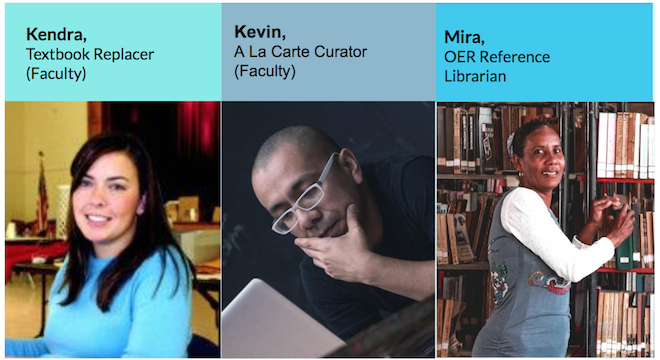
Though use of OER course materials in college classes is associated positively with student success, a principal barrier to OER adoption by faculty is difficulty in finding needed resources. This paper explores how user-experience (UX) research can be used to better understand discovery challenges for both faculty and librarians, and how user personas based on this research can support the design of OER discovery solutions. Aiming to improve the OER discovery experience, the Institute for the Study of Knowledge Management in Education, in collaboration with six higher-education library consortia based in the US, conducted a study to better understand OER search goals, needs, and pain points. Based on in-depth interviews with 35 faculty and library staff, the following five OER curation personas were created to support discovery design: Faculty Textbook Replacer, Faculty A La Carte Curator, OER Reference Librarian, Collections Maintenance Librarian, and Course Redesign Support Librarian. These personas describe archetypical users representing the curation needs of postsecondary faculty and library staff. Interview data were also used to develop a model of the decision-making processes faculty and library staff use when selecting and evaluating OER, and the metadata most useful at each step in that process. As an example of how user research can enhance OER discovery design initiatives, we discuss how using these personas enabled improvements in OER Commons, a public digital library of OER.
Keywords: open educational resources (OER); personas; metadata; OER discovery; OER curation; user experience.
Introduction
Open Educational Resources (OER) are defined by UNESCO as “teaching, learning or research materials that are in the public domain or released with intellectual property licenses that facilitate the free use, adaptation and distribution of resources” (UNESCO 2021). The use of OER textbooks and course materials in higher education is associated with improved grades and retention, particularly for low-income students, part-time students, and students who are historically underserved in higher education (Colvard, Watson, and Park 2018; Fischer et al. 2015). Additionally, OER have been shown to positively impact teaching and learning, supporting more inclusive, collaborative, and student-centered pedagogy (Griffiths et al. 2022; Petrides et al. 2011). As such, increasing the use of OER in college courses has the potential to broadly and positively support equity in higher education. However, an ongoing challenge and often primary reason for higher-education faculty reluctance to adopt OER in their courses is the difficulty in discovering and identifying high-quality OER textbooks and materials (Abeywardena and Chan 2013; Belikov et al. 2016; Judith and Bull 2016; Lou et al. 2020; Perifanou and Economides 2022).
Academic librarians worldwide have long had a role in sourcing high-quality open course materials for both students and faculty members (Martin 2010; Bell 2015; Smith and Lee 2016, mwinyimbegu 2018). Librarians also play a critical role in OER adoption and sustainability, through engaging in advocacy and education; providing strategies to faculty to find and evaluate OER; maintaining OER via institutional repositories and collections; using metadata, indexing, and classification skills to improve OER access; and leveraging copyright and media expertise to facilitate the curation and creation of OER (Okamoto 2013; Smith and Lee 2016; Reed 2019; VanScoy 2019). However, librarians also struggle with the OER discovery process, which often involves searching multiple repositories and is hindered by insufficient or inconsistent metadata (Sobotka, Wheeler, and White 2019). The documented struggle by both faculty and librarians in their OER searches suggests the need for significant back-end and front-end design improvement in OER repositories and online libraries to improve the discovery and curation process. One way to support this design process is through the development of data-driven faculty and librarian user personas, projections of different kinds of potential users that highlight specific goals, needs, and challenges of faculty and librarian OER seekers.
The Institute for the Study of Knowledge Management in Education (ISKME) is a non-profit organization that hosts the free, public digital OER library, OER Commons. ISKME also creates and hosts digital library microsites (unique, indexed libraries of OER that are locally administered) for partnering institutions, frequently academic library consortia. As part of a larger Institute of Museum and Library Sciences (IMLS) grant–funded effort to design sustainable OER discovery solutions that build toward a national digital infrastructure for OER, ISKME implemented a user research study to identify the specific OER search and metadata needs of postsecondary faculty and librarians in collaboration with six partner library consortia: the Louisiana Library Network (LOUIS), the Ohio Library and Information Network (OhioLink), Virginia’s Academic Library Consortium (VIVA), the Private Academic Library Network of Indiana (PALNI), the Pennsylvania Academic Library Collaboration, Inc. (PALCI), and the Digital Higher Education Consortium of Texas (DigiTex). More specifically, this study aimed to answer the following research questions in order to inform OER discovery design:
What are the tasks and decision-making processes faculty and library staff use when selecting, evaluating, and assembling both individual OER and collections of OER?
What augmentations to existing metadata are needed to accommodate their decision making?
What pain points do they encounter in the OER curation process?
Findings from in-depth interviews with faculty and librarians with moderate to high OER experience were then used to develop curation personas to guide the formulation of design solutions for OER metadata and discovery for higher-education faculty and librarians.
OER discovery
While researchers have noted that current industry standards for content search and discovery do not provide satisfactory mechanisms for identifying high-quality learning objects suitable for specific teaching contexts (Limongelli et al. 2022), and acknowledge the importance of incorporating task-based user-experience research in to the development of future solutions (Cortinovis et al. 2019), there has been little published research that delves into the specific information needs of faculty and librarians in their OER search and curation processes. Speaking to their own experiences, Oregon-based academic librarians Sobotka, Wheeler, and White note, “While there is ongoing improvement in some of the larger open educational resources (OER) search engines, librarians sending emails to listservs asking ‘anyone know of OER on this topic?’ and keeping old-fashioned reading lists of valuable OER are common occurrences.” They attribute this reliance on search methods outside of OER repositories and libraries to “subpar and variable” metadata. In their case study of searching for language learning OER, Perifanou and Economides (2022) point to lack of uniformity in repositories and in metadata, inaccurate and obsolete metadata, poorly or inaccurately labeled copyright information, and outdated OER with broken links as contributing to OER discovery barriers.
OER perception studies give hints as to what elements of discovery and evaluation are challenging to faculty, and what metadata they might find useful in their search and curation process. More than one study suggested that an underlying challenge may be that many faculty are not aware of existing OER repositories (Abeywardena, Gajaraj, and Chan 2012; Belikov and Bodily 2016). Lack of repository awareness however, is presumably less likely to be true of librarians. OER perception studies also suggest that even when faculty and librarians do know where to search for OER, they may not find the information needed to adequately assess whether the OER they have found is suited to their purpose. Abeywardena, Gajaraj, and Chan’s 2012 survey of academics in five countries in Asia indicated that discovery concerns included the need to find OER that is “specific, relevant, and quality” (6). In a more recent US-based multi-campus survey of faculty perceptions of OER and impediments to use, Elder et al. (2020, 141) found that 86% of faculty listed one or more of the following challenges: “finding comprehensive materials, finding suitable materials, finding high-quality materials, finding up-to-date materials, and finding locally relevant materials.”
Existing information on discovery barriers that have been encountered during specific search attempts is frequently in the form of internal feedback mechanisms rather than published literature. For example, ISKME and its microsite partners conducted internal surveys on faculty and library discovery needs. These surveys indicated that:
the curated collections often do not enable faculty users to efficiently identify how well OER aligns to specific course requirements or to understand what adaptations are needed to meet those requirements;
faculty end users lack social endorsement of material quality by way of peer feedback and reviews of the resources;
while full, textbook-level OER resources are now more discoverable for faculty due to curation and alignment efforts, identifying and sharing OER resources in smaller content chunks (such as lectures, slides, videos, and assessments) remains challenging due to lack of standards and coordination in metadata tagging strategies;
the process of finding, aligning, and maintaining OER for their centralized OER repositories is time consuming, difficult, and unsustainable by current library staff; and
overall, the consortia are not able to grow their own collections by leveraging the work of their peers because their process lacks an efficient way to ingest OER being curated by each other and by external OER repositories.
Past and present attempts to remediate discovery challenges have often focused on the creation of cross-repository search engines like the Learning Registry (Cavanaugh 2018), Mason Metafinder, or MERLOT’s Smart Search; methods to improve automated processes for harvesting and sharing metadata and assessing OER quality (Koutsomitropoulos 2010; Piedra et al. 2014); or ways to improve and standardize OER metadata within and across repositories (Bothmann 2020; Gallant et al. 2022). One well-known example of an approach to standardizing metadata is the work of the OER Discovery Working Group, sponsored by the Scholarly Publishing and Academic Resources Coalition (SPARC), who created the OER metadata Rosetta Stone to help translate between different metadata schemes and to suggest which metadata should be required in all repositories (SPARC 2021). However, it is unclear the extent to which user research informed these efforts, and future work to improve OER discovery and curation would benefit from concrete information about user needs and priorities, presented in a way that is accessible to and useful for designers.
Personas
Originally developed by Alan Cooper, personas are descriptive models that aim to precisely convey the goals and needs of a group of users (Cooper et al. 2014, 61). While personas are fictional depictions of individual users, they are grounded in research and serve as archetypal, aggregate composites based on groups of users with similar behavior patterns that preserve individuals’ anonymity. According to Cooper and colleagues, personas aid design by having a narrative structure and resemblance to a real person who is more easy for designers to relate to. Their use is based on the premise that design is more effective when it aims to meet the needs of specific individuals whose goals are representative of a larger group of users, rather than when it tries to accommodate long lists of disconnected needs from disparate users (Cooper et al., 2014, 62–64). Aldin and Pruitt describe the benefits of personas as “making assumptions and knowledge about users specific, creating a common language with which to talk about users meaningfully” as well as allowing designers to focus on smaller subsets of specific users and creating empathy for those users (Aldin and Pruitt 2010, 1). A Delphi study by Miaskiewicz and Kozar (2011, 423) found that, with moderate consensus on ranking, experts identified the top ten benefits of persona use as:
focusing product development on users and their goals;
prioritizing product requirements and determining if the right problems are being solved;
prioritizing the audience;
challenging organizational assumptions about users;
avoiding design that references the designer rather than the user;
providing a clear picture of customer needs and context to guide design decisions;
aiding in achieving design agreements and clarifying user goals to interested parties;
engaging, unifying, and educating those who are more distant from users and user research;
creating empathy for the user; and
stimulating innovative thinking for solutions to user goals and challenges.
Personas are increasingly being used in library contexts to guide user-centered design of services (Brigham 2013; Koltay and Tancheva 2010; Tempelman-Kluit and Pearce 2014; Zaugg, et al., 2016; Sundt and Davis 2017). Sundt and Davis relate how at Utah State Universities, prior to use of personas, website design was largely driven by “internal preferences and needs” with any consideration of users limited to “anecdotes or assumptions … with little agreement on how to evaluate or prioritize their assumed characteristics” (2017). Their use of research-grounded personas supported taking a more user-centered approach to design, and gave those collaborating on the design process a common frame or reference to discuss user needs. Lewis and Contrino (2016) describe how personas of distance-education library users were used to better bridge gaps between designers’ and users’ mental models of digital libraries, resulting in improved, data-driven design decisions about digital-learning objects and website design. Some personas are even used by libraries to improve targeted marketing to potential patrons (Thompson, Eva, and Shea 2017). Libraries have also found persona research to be useful outside of the specific institution in which it had been conducted. Zaugg and Ziegenfuss (2018) found that personas of library patrons developed for one academic library were applicable to a second library, demonstrating the potential universality of some library personas in similar contexts.
While personas have the ability to aid the design process, one significant drawback is that, as archetypes, they are particularly vulnerable to stereotyping (Turner and Turner 2011; Hill et al. 2017). Sundt and Davis (2017) recommend ensuring persona descriptions are solely based on rigorous research using real user data in order to mitigate the risk of researcher or designer bias informing persona development. Brummer (2021) recommends building personas by focusing on behaviors rather than demographic characteristics that lend themselves to stereotyping. While such strategies can be helpful, it should be noted that even when demographics are left out of narrative descriptions, designers can take cues from photographs and names and be influenced, consciously or unconsciously, by assumptions about gender, age, ethnicity, or other perceived demographic characteristics. There is also the risk, when personas with demographic cues are attached to professions, of reinforcing representational inequities.
Balancing the importance of names and faces in personas to making users concrete and eliciting empathy in designers, on the one hand, with risks of stereotyping based on visual or name cues, on the other, is a complex issue. Visser and Stappers (2007) note that research and theory in the fields of visual communication and media studies suggest that images of users can stimulate empathy, support creativity, build trust, support storytelling, and support recall through anchoring. Their research on the use of images in personas confirmed that photos in combination with names received the most attention, and that fictively attributed photos worked better than sketches. Turner and Turner (2011) reference using multiple photos for each persona as one potential method of mitigating the problem of stereotyping through images; however, Salminen et al. (2018) found that using photos of multiple people for personas can create confusion and lower persona informativeness. Other methods of stereotype mitigation include having multiple and diverse participants in persona development, educating designers about the social science of stereotyping, and incorporating activities into the design process that surface developers’ implicit biases and assumptions in order to consciously mitigate them (Turner and Turner 2011). Some researchers may choose to leave photographs and names out of persona descriptions altogether due to stereotyping concerns. For this project, persona narratives were based on interview findings and did not include demographic details. We elected to use photographs and names for each persona to make persona memorable and inspire more empathy in designers and to support design storytelling However, in selection of openly licensed[1] photographs for the personas, we also made a deliberate attempt to not reinforce specific stereotypes as to the gender, age, or ethnicity of university faculty and librarians, though we acknowledge the role that unconscious bias can play in the selection process.
Methods
Between December 2020 and January 2021, in-depth interviews were conducted in two phases with 35 librarians, staff, and faculty. The first phase consisted of interviews with 30 librarians, digital- or distance-education staff, and faculty from institutions affiliated with LOUIS, OhioLink, VIVA, PALNI, PALCI, and DigiTex. The second phase featured interviews with five collection specialist librarians, four of whom worked at the consortium level.
In phase one, an initial pool of potential participants were identified from a list of recommendations supplied by representatives of LOUIS, OhioLink, VIVA, PALNI, PALCI, and DigiTex. Consortia partners were asked to provide a list of faculty and library staff from both large and small two-year and four-year institutions, that represented a range of subject-area expertise, and that represented diversity in race/ethnicity and gender. A survey was then administered to recommended participants that included questions on discovery and metadata practices and needs. Sixty faculty, librarians, and staff responded, and a subset of 23 participants reporting a moderate to high level of experience curating OER were selected to participate in interviews. To increase the diversity of the institutions represented in the interview pool, an additional nine participants who did not take the survey were invited from Historically Black Colleges and Universities (HBCUs), Hispanic Serving Institutions (HSI), or schools where more than 50% of the students were Pell grant recipients. The final pool of interviewees contained 18 faculty members representing a diversity of disciplines (Table 1), 10 librarians, and two staff members who worked with OER in a distance or digital education role. Fourteen of the 30 participants represented schools where more than 50% of the students received Pell grants, five worked at an HBCU, and four at an HSI. Twenty-one participants (70%) came from public institutions (Table 2).[2]
State
Education
Humanities
Social Sciences
STEM
Grand Total
Indiana
2
2
Louisiana
2
1
2
2
7
Indiana
2
2
Ohio
1
1
2
Texas
2
1
1
4
Virginia
1
1
1
3
Grand Total
3
4
6
5
18
Table 1. Faculty participant disciplines by state.
Institution Type
Fewer than 5,000 students
5,000 to 15,000 students
More than 15,000 students
Grand Total
Four-year private
9
9
Four-year public
2
3
4
9
Two-year public
4
3
5
12
Grand Total
15
6
9
30
Table 2. Interview participants by type of institution.
Each of the thirty faculty, librarians, and staff members participated in ninety-minute Zoom interviews consisting of four components:
open-ended questions about their perceptions, attitudes, processes, and experiences around OER curation;
a think-aloud activity where participants were asked to screen-share and demonstrate their OER search processes;
a card sorting activity in which participants sorted nineteen metadata items corresponding to metadata concepts already available in the OER Commons platform into the categories of primary consideration, secondary consideration, rarely useful, or it depends; and
a stimulus response to mockups of new approaches to presenting metadata.
A qualitative, inductive, thematic analysis of interview data was conducted in order to identify shared discovery and curation goals amongst participants, and shared needs and pain points associated with these goals. Similar goals and associated needs and pain points were clustered to create two faculty user personas and one reference librarian persona. Results of the card sorting activity and the think-aloud were used to determine which metadata were used to support the discovery and curation goals associated with the different persona, when they were used, and how useful they were. Written user persona descriptions were then developed that included a fictional name; a photograph; a role; a quote summarizing the essential motivation of the user (created from composite interview data); a narrative that gives insight to each user’s goals, needs, and pain points; and a set of metadata items important to that user. As noted above, persona photographs were sourced from the public domain, and beyond the attempt to have demographic diversity represented in the five persona pictures, there was no deliberate assignment of a particular photo to a particular persona.
In addition to the personas, interviews were used to construct a sequential model representing users’ OER discovery– and curation–decision-making processes. This model includes essential questions asked and metadata used at each stage of a user’s OER search.
As the initial sample of ten librarians were found to contain too few who dealt with curating and maintaining library OER collections, as a second phase, five collection librarians were recruited through grant partners and ISKME’s existing OER librarian network. These collections librarians represented four of the six consortiums collaborating in the research grant, and one consortium in the northeastern US that was not part of the grant but that does have an OER commons microsite. Collections librarians participated in ninety-minute semi-structured interviews which consisted of open-ended questions relating to their role and responsibilities, OER curation approaches, challenges, wants and needs, and metadata preferences. Two additional collections librarian user personas, one whose goals focused on building and maintaining OER collections and one whose goals focused on aligning OER to specific courses, were developed based on these interview data.
Findings
A total of five curation personas were developed from the interview data, detailing OER discovery goals, needs, and pain points, and metadata utility: Faculty Textbook Replacer, Faculty A La Carte Curator, OER Reference Librarian, Collections Maintenance Librarian, and Course Redesign Support Librarian. Below, we present a description of these five personas, each of which represents an amalgamation of similar users. We also include the five persona slides, shared in the form they were presented to the ISKME design team (Figures 1 through 5).
Faculty Textbook Replacer
The Faculty Textbook Replacer persona (Figure 1) embodies a faculty user who simply wishes to replace a commercial textbook with an OER textbook. They typically teach introductory, lower-level classes in a subject area where a textbook is traditionally used, such as introductory STEM courses or an introductory psychology course. They are often motivated in their OER search by mandates or incentives for OER conversion and the desire to make textbooks more affordable for their students.
If the Faculty Textbook Replacer was accustomed to ancillary materials such as presentation slides, problem sets, and test banks being packaged with their commercial textbook, then they similarly want to be able to find these resources packaged together in OER. Faculty Textbook Replacers often must be ready to prepare to teach a class with little notice and are often searching without the support of a librarian. Consequently, the Faculty Textbook Replacer needs a quick and easy way to search for OER. A Faculty Textbook Replacer typically searches by keyword or by subject and prefers to look in repositories that are focused on textbooks, like Lumen Learning or the Open Textbook Library. They struggle when there are broken or outdated links, or when a search returns duplicates of the same material and insufficient resources. They would benefit from metadata that shows them if a resource is aligned with their class content, like a table of contents, and metadata that tells them if a resource comes with ancillary materials. They would also like to have information that allows for rapid evaluation of the trustworthiness or pedigree of a resource, such as faculty reviews and provider metadata, as well as information that shows how easy the resource is for their students to use, like material type, format, and accessibility metadata.
If you’re going to take away my commercial text, I need a replacement with the same features
I get that education access is important, and I support my community college’s mandate that we shift toward using OER. But finding quality open materials isn’t always easy.
What’s ‘quality’? For me, it’s the resemblance to a commercial textbook. The presentation has to be professional. There has to be a natural progression of the content—an internal consistency. It has to have test banks and ancillaries like a commercial textbook. And it has to come packaged as one thing.
I don’t have time to cobble together bits and pieces and adjust them so that they integrate. That’s not workable—especially when we’re parachuting-in an adjunct at the last minute. I need a single resource I can use to replace a commercial text, and sometimes it’s not easy to find.
Once I select my OER, I want to import everything into a course manual/ companion so that I can post it into my LMS to prevent students from getting derailed by external links and clicks.”
Figure 1. Faculty Textbook Replacer persona.
Faculty A La Carte Curator
In contrast to the textbook replacers, the Faculty A La Carte Curator (Figure 2) takes a more exploratory approach, piecing together different OER resources of interest. They are more likely to be teaching upper-level classes in subject areas that don’t lend themselves to textbooks, such as literature or film, so will search more diverse repositories like OER Commons, or even non-OER sites they know have strong resources like the Smithsonian. Because of this, they would benefit from a way to “save” items of interest to go back to later or easily compare saved items found across repositories. They are more deeply invested in OER and may want to remix a resource, and so knowing the license type and the limitations of use are very important. They have a higher tolerance for research frustration than the textbook replacer, but do complain about needing to search multiple repositories, metadata that is inconsistent across repositories or insufficient to their needs for assessing resources, lack of available resources, and the complexity of managing the many potential items in a search process. Similar to the Faculty Textbook Replacer, they are aided by a table of contents to determine alignment to their course needs, user evaluations to determine quality, and accessibility metadata to ensure resources can be used by students with learning accommodation needs.
I take pride in customizing my courses each year with new and topical resources that bring out the best in me as a teacher, and in my students as learners.
I’ve never liked commercial textbooks much. Teaching from the same dense book year after year is not a recipe for student engagement—or my own. I’m always looking for new OER; not just when I’m planning my courses, but all year long.
It’s fun for me to go down the rabbit hole—finding things I haven’t seen before and getting ideas. Librarians have helped me become a better searcher, but probably there’s more for me to learn. I want the OER movement to transform teaching—not just by making more stuff available, but by creating a kind of interactivity that didn’t exist before.
Once I select my OER, I want to save and organize items so that I can integrate them later. I then want to sequence items from a breadth of sources and resource types so that I can create a custom course in my LMS for my specific needs.”
Figure 2. Faculty A La Carte Curator persona.
Our faculty interview participants were divided nearly evenly into Faculty Textbook Replacers and A La Carte Curators, though it should be noted that our sample of participants may have a self-selection bias towards A La Carte Curators because of their pre-existing tendency toward deep engagement with OER.
OER Reference Librarian
The OER Reference Librarian (Figure 3) typically needs to be able to support faculty in their OER curation process by finding resources on request. They also need to be able to teach faculty the skills to conduct searches themselves. OER reference librarians are skilled at more sophisticated discovery techniques such as using known aggregators of a desired material type, using limiters, and entering the ISBN of a commercial textbook into a search engine that will suggest suitable open resources that are related. They will first use their library’s licensed collection, and then may search in OER mailing lists for threads about the subject area in question. As their job is to search multiple repositories, version or date-last-updated metadata is needed to help the reference librarian keep track of duplicates and know when changes have been made to a resource. Moreover, as they may not necessarily have the same level of subject-matter expertise as faculty, the subject and table of contents are critical to supporting them in finding material that match course needs.
A librarian also is a copyright expert, so license type is needed to confirm that a resource is OER and to understand the limitations on use as there are various types of open licenses that afford different permissions. Like faculty, librarians also need accessibility metadata to ensure inclusive access. Also like faculty members, reference librarians want quality indicators. This includes user evaluations, but for the reference librarian it also includes the provider and what institution may have vetted the resource. Reference librarians are typically aware of which OER providers and curated repositories have a reputation for quality assurance. A pain point for reference librarians are search terms that don’t turn up sufficient relevant content: the reference librarian needs a simple search system because it needs to not just work for them, but also for the faculty they train.
I enjoy searching for OER to meet individual faculty needs, but it could be less complicated.
I’m managing and troubleshooting electronic resources like databases and eBooks on our myriad platforms. A good part of my work relates to OER, and faculty reach out to me for support with searches, which sometimes means guiding them through a search and other times means doing the search for them.
I am an evangelist for OER, and a competent curator, but even for me the process can be complicated. As the OER movement evolves, I’d like to see a process that is more efficient and simple—both for me and for the faculty—whose buy-in we need for the movement to really grow.
Mira’s metadata needs:
Material Type and Format
Vetted by and Provider
Data Updated/Version
User Evaluations
License Type
Accessibility
Subject and Table of Contents
Figure 3. OER Reference Librarian persona.
Collections Maintenance Librarian
The Collections Maintenance Librarian (Figure 4) is focused on building out their libraries’ curated OER collections. They have trusted repositories they go to that they know to have rigorous curation, where they can cherry-pick content that aligns with their faculty needs. Therefore, like the resource librarian, metadata on providers and who the OER was vetted by are important to their quality evaluation, and license type, accessibility, and table of contents are important metadata points for both finding what faculty need and making resources added to the collection findable for faculty. The Collections Maintenance librarian would also benefit from media format metadata that indicates, for example, if a resource is available as downloadable file, not just as web-based/HTML material.
A Collections Maintenance Librarian needs to be able to build out collections to address gaps and create breadth in their collections, and to know when a resource has been updated so that they can keep their existing collections up to date. Therefore, date and version are important metadata, and lack of ability to search across systems, inconsistencies in metadata such as differences in institutional field naming, and duplication of resources in a single repository or site are pain points. For the Collections Maintenance Librarian, being able to both share their own curated resources and access those of other libraries would be a huge boon.
I focus on curating for breadth and on supporting faculty discovery of OER in my OER collections.
I work to build out our existing collections of OER so that I cover the greatest breadth of subject matter possible, and organize materials so it’s easy for faculty to identify what they need. I typically curate from collections that I know and that have indicators of quality, like faculty reviews.
I often find that there is a lack of adequate controlled language for subjects in the higher education space, and that there’s an overall inconsistency in metadata across repositories, which slows me down. Because I think about discoverability, I’m concerned about the lack of metadata to handle the varied types of resources that faculty search for, and that OER aren’t embedded into the discovery systems they use.
Big picture, I’d like to be able to efficiently leverage the curation work of others (e.g., through collections-level metadata), and to also to share the curation work I’ve done to benefit the wider OER community.
The Course Redesign Support Librarian (Figure 5) typically has a role that involves mapping OER to specific courses for the purposes of textbook replacement or for larger state initiatives. This work aids faculty in transforming courses with commercial course materials into OER courses.
Similar to other librarians, the provider and who the resource was vetted by are important metadata, as high-quality textbooks and ancillaries are often found in trusted repositories. Material type and format are also important metadata to have early in the search process.
Like the Collections Maintenance Librarian, the Course Redesign Support Librarian feels frustration at not being able to leverage work being done by other library consortia, effectively meaning that Collections Maintenance Librarians across the country are duplicating work and starting from scratch with mapping efforts. The Collections Maintenance librarian would like to be able to search and share resources and metadata across trusted curated repositories while also being able to easily distinguish duplicate records from updated or remixed versions of the same original resource. Faculty reviews would also be helpful for course mapping and quality assurance. They would additionally benefit from accessibility, subject, and table of contents metadata to ensure alignment with course and accessibility and accommodation requirements.
If other states and consortia are also aligning OER to their courses, why can’t I leverage that?
I support the curation of OER for textbook replacement and course redesign—either as part of individual faculty projects or as part of broader initiatives for mapping OER to state-level course requirements.
Sometimes I cherry pick materials in gap areas, and other times I curate with a lens toward mapping OER I find to as many courses as possible within a discipline. I really need a way to increase my success in finding hard-to curate-for upper level courses, including enhanced metadata to help in aligning materials outside of my area of expertise. I also want more detailed metadata that can help faculty discover the materials they need (e.g., accessibility metadata, more nuanced material type metadata, etc.).
I really wish I could more easily leverage and contribute to the curation work of other consortia, for example through a master record where participating libraries can access shared metadata, and add to it, as well as download and integrate it into their local records.
Figure 5. Course Redesign Support Librarian persona.
Similarities across personas
While the above descriptions indicate distinct differences in these five types of users, a cross-persona analysis revealed that OER faculty and librarians also share common motivations, goals, and pain points. Student success, decreasing student costs, and increasing student engagement are fundamental motivators for the users’ engagement with OER. Faculty and librarian users also share the goal of finding high-quality, up-to-date, accessible, comprehensive, and well-aligned content. Shared pain points include the difficulty of searching multiple repositories, getting duplicate results, and finding ancillaries that match with texts (Table 3).
Of particular note is the presence of OER accessibility as critical metadata for four out of the five personas. For many users interviewed, knowing that course materials were accessible (i.e., knowing that materials met basic WCAG requirements as is required under the ADA, or would be usable by students in their courses with specific accommodation needs) was important not just because materials that are already accessible reduce high time and monetary costs associated with accommodations, but also because it constitutes a fundamental equity issue. One participant, who categorized accessibility as “primary” metadata explained that you can’t have equity without access. Another participant said, on the importance of having metadata that identifies accessible OER, “I think it [material accessibility] is good and it’s the right thing. But that doesn’t mean it’s always the easy thing.” One participant, who said that they had worked in disability services, suggested that the potential for having resources that are already accessible is an argument in favor of using OER in the classroom rather than traditional textbooks. Research participants typically discussed accessibility metadata needs in terms of information about whether or not the resource met standards for learner differences access. “I’m looking for Universal Design,” shared one participant, referencing CAST’s Universal Design for Learning Guidelines (CAST 2018). Other participants discussed accessibility in conjunction with the importance of material format metadata. These users wanted to know if the format was easy to download for students who do not have consistent internet access and whether it was in a format that allows for revision by instructors and/or students.
Motivations
Goals
Pain Points
Decrease student costs
Increase student engagement and success
Increase engagement and visibility in professional communities of practice
Find comprehensive content that covers all the topics in a course
Find content that has been positively reviewed and used by people with credentials I trust
Find the most up-to-date content available
Find content that meets accessibility standards
Find content that is made in easily used media formats
Too many places to search and many of them contain the same materials
Difficult to tell the difference between versions (if duplicate is the same textbook or an update or remix)
Difficult to match ancillaries to core texts
Difficult to tell how accessible content is
Table 3. Commonalities across personas.
A model of curation-decision points
In addition to the curation persona development, in order to better understand user metadata needs, interview data was used to develop a model for sequential curation-decision points and metadata needs at those points. This model reflects the fact that users commonly seek to answer four essential questions in assessing resources in their OER search process (Figure 6):
What is this resource?
Is the content in this resource a fit for my needs?
Is this resource a quality resource?
How easy will it be to use this resource?
At each stage in their resource-assessment process, users found different metadata to be valuable in helping them eliminate unsuitable OER in their search process. The first stage involved eliminating resources that were not the correct type of resource. Most useful in this assessment are metadata on the material type. As one participant explained, “That’s primary. Is it a reading? Is it a textbook? Is it a video [lesson]? That is very helpful to me, because then I don’t have to dig in deeper and see what it is.” For those users for whom the lack of ancillaries is a dealbreaker (Faculty Textbook Replacers, for example), knowing up front whether a textbook has them also allows for quick elimination of unsuitable resources at this early stage. Resource format (i.e. whether a textbook has interactive assessments like those created with H5P or plain-text summary questions like you would find in a traditional textbook) was considered lower utility metadata at this early stage, but it did help those users who had strong preferences for or aversions to certain formats.
The second stage in the curation process was determining the fit of resources for specific needs. Title, subject area, learning level, and description were considered essential fundamental information to determine fit. The table of contents was also considered an efficient way to get a good sense of whether the resource was well aligned with course needs. Tags, however, were considered less useful metadata in assessing fit.
After assessing fit, users looked at the quality of resources. Here, faculty evaluations were considered to be of much higher utility than number of downloads or adoptions. As noted above, users often gauged quality by who vetted the material and what provider distributed the resources.
Finally, at the end of the search process, users considered ease of use. Faculty who did not eliminate certain formats at their first decision point took this opportunity to consider resource format. Also important at this stage were metadata on accessibility and license type, which determines whether a resource can be remixed and revised.
Metadata to answer “What is this resource?” include: material type; ancillaries included?; resource format.
Metadata to answer “Is the content a fit for my needs?” include: title; description; subject area; learning level; table of contents; date updated / version; alignment; tags.
Metadata to answer “Is it a quality resource?” include: user evaluations; provider; vetted by (and vetting institution); author; downloads / adoptions.
Metadata to answer “How easy will it be for me to use this resource?” include: license type; accessibility; resource format.
Figure 6. OER assessment process and metadata used at each stage.
While knowing the order in which different metadata are likely to be used in a discovery process is potentially helpful in optimizing the OER search experience for users, it is important to remember that the persona findings demonstrate that relative utility of metadata is variable depending on who is looking and what they are looking for.
OER Commons Design Application of Persona Research
To better illustrate how personas can be applied to design, we offer the example of how ISKME has planned a multi-phased approach to designing solutions for higher-education users of OER Commons and partner microsites in response to the needs and pain points identified in the faculty and librarian personas. The initial phases of this endeavor involve responding to the following findings represented in the cross-persona analysis:
Goal 1: find comprehensive content that covers all the topics in a course
Goal 2: find content that has been positively reviewed and used by people with trusted credentials
Goal 3: find the most up-to-date content available
Pain Point 1: too many places to search and many of them contain the same materials
Pain Point 2: difficult to tell the difference between versions (if duplicate is the same textbook or an update or remix)
To address these user needs, ISKME is in the process of developing an exchange that will help partner institutions share and search for OER materials across digital library platforms. The first milestone in the exchange development process is providing a strong, centralized, cross-platform search-and-discovery user experience, to address Pain Points 1 and 2 above. Librarians will be able to select specific collections from their local microsites and hubs to share with the entire community, as well as search for content shared by others. This will give librarians access to resources that have been authored and curated by trusted institutions, reduces duplication of effort in curating and applying metadata to the same OER content over and over again, and increases visibility and usage for novel content created and shared by faculty in local repositories. Furthermore, in addressing Pain Point 2 above, it was important to ensure search results are deduplicated and that metadata from multiple repositories are merged to provide clean search results with enriched metadata. Therefore, ISKME is developing automated ways to recognize when the same resource is cataloged on multiple sites by matching elements such as source URLs, titles, abstracts and descriptions, or the text itself. This not only allows users to more easily navigate search results when the same source is indexed across multiple microsites; it also facilitates the amalgamation of metadata and user reviews, and allows users to know how many institutions have chosen to include a resource in their catalog, ultimately giving users valuable information for course-alignment and quality-evaluation assessments. The OER exchange also will allow librarians from different consortia to leverage each other’s metadata, tagging, and alignment information, saving time and resources.
ISKME’s second milestone design goals will build on this work, making it easier for faculty and librarians to accomplish Goals 1, 2, and 3 by focusing on features that provide:
an easy process to allow librarians to index collections from exchange partners in their local repositories, including automated metadata mapping between different local taxonomies, so that faculty and librarians have access to the full breadth of content created by the community, tagged and indexed in a way that is locally relevant
the ability to subscribe to automated collection updates from exchange partners so that faculty and librarians consistently have access to new content, new versions, and new metadata as they are published
metadata enrichment across the OER exchange community to improve substance, utility, and clarity, such as:
improving the design of content-review features to enable and encourage users to leave helpful reviews, including star ratings and evaluations on dimensions such as comprehensiveness and quality of pedagogical design
improving course-alignment metadata by having examples of syllabi of courses that have used a textbook or an OER resource, and examples of key topics included in the resource
Additional future milestones will focus on developing more sophisticated features that are capable of addressing the following pain points:
Pain Point 3: difficult to match ancillaries to core texts
Pain Point 4: difficult to tell how accessible content is
These improvements, guided by curation personas, will allow higher-education faculty and librarian users to more easily find and evaluate the fit of resources and related ancillaries in the early stages of their OER search, as well as supporting Collections Maintenance Librarian and Course Redesign Librarian user types in the specific work they do in cataloging and collection building.
Discussion
User-experience research is by nature rooted in the ability of a specific service provider to respond to their users’ needs through design solutions for their particular service context. However, our research sought not just to understand how users interacted with ISKME’s OER digital library, but to more broadly understand higher-education faculty and librarians’ OER discovery and curation process, including goals, needs, and pain points. As such, the personas and curation decision model developed in this study have the potential for broader applications in the OER field.
The identification of three types of librarian users with both distinct and overlapping discovery and curation goals is particularly important given the critical role librarians play in OER adoption and sustainability. The librarian personas can help designers who are working on discovery solutions understand and contextualize different librarian needs. ISKME designers applied this by noting first where librarians’ goals, needs, and pain points overlapped with faculty goals, needs, and pain points in order to prioritize design choices that would have an impact on a wide variety of users, while also using specific librarian personas to inspire creative design choices to meet the needs of librarians doing collections and course-alignment work that affects a large number of OER users. Other OER libraries and repositories could similarly use OER curation personas to help set design priorities and to increase awareness of the specialized needs of librarian users whose work has a high impact on OER discovery at institutional, consortial, and state levels.
Faculty personas are also useful in defining two distinct types of users with very different OER goals. The Babson Research Group’s 2017 OER survey indicated that the most frequently cited reasons for faculty not adopting OER in the US were “difficult to find what I need” and “lack of resources for my subject” (Seaman and Seaman 2017, 30). However, personas revealed that “what I need” and “resources for my subject” are very different for Faculty Textbook Replacers versus A La Carte Curators, meaning that those seeking to alleviate this barrier must consider what search processes, metadata inclusion, and search-result displays work for two very different curation approaches based on different needs. At the same time, the two faculty OER curation personas tell us what these users have in common, such as a shared desire to find resources in one place and to have information about resources’ tables of contents, material type, accessibility information, and quality in the form of user reviews. Given that only two types of faculty OER curators emerged from our research, optimizing searches for these two users could meet the needs of the majority of faculty users, not just in OER Commons and partner microsites, but in other OER repositories catering to higher education faculty.
These five personas and the curation-decision model also have the potential to help the larger OER community in informing broader initiatives not attached to particular library or repository design projects, such as the ongoing efforts to improve and standardize OER metadata. For example, looking at what metadata is important to a variety of users, or essential for a particular user, can help guide decisions about what metadata should be universally requested or required when an OER is submitted to a digital library platform or discovery service. Information about how and when metadata is used by different users can also guide choices about what automated metadata searches we should develop and how we can best rank search results. The curation-decision model also generally suggests areas that can be strengthened in the visual display of OER metadata by highlighting what metadata is used at what point in the OER discovery process.
This research also helps illuminate where best practices for OER discovery might already be in place and where there is the need for future efforts in OER discovery research to support best practices. For example, the importance of ancillaries to various user personas and the pain point of not being able to tell the difference between versions of the same OER confirms the importance of the OER Metadata Rosetta Stone’s inclusion of “is ancillary” and “has ancillaries” as well as “edition statement” as core metadata elements. However, these fields are currently relegated to an “optional” classification, because processes for collecting ancillaries and versioning data are nascent in the field as a whole. Our user research demonstrates the importance of allocating more research and implementation resources toward making the collection of this information part of standard OER development processes.
The primacy of accessibility metadata as it pertains to student learning accommodations to nearly all users suggests that filtering by the presence of accessibility information, as, for example, can be presently done in both the OER Commons and the MERLOT platforms, should be standard across all repositories, alongside information about alignment to accessibility standards such as the Universal Design for Learning Framework. However, ISKME’s own internal UX research (in partnership with CAST, the nonprofit organization that developed the Universal Design for Learning Framework) has demonstrated that current accessibility metadata schemas are not understandable or usable by the average instructor or librarian. Future work in this area should focus on the implementation and testing of tools and processes that more effectively tag and describe content to enable OER creators and users to understand how technical features of a digital learning object impact accessibility for students with different accommodation needs.
Finally, the importance of quality assurance in faculty and librarians’ curation processes suggests that OpenStax’s sharing of star reviews, user reviews, number of adoptions, and clear articulation of peer review status, or MERLOT’s use of a “Quality” box that collects all available quality indicators for each resource, might be models for the type of quality information that could be helpful to users. However, given our findings showing that download and adoption data is less useful to users than faculty evaluations, further user research is likely needed to ascertain if available indicators are meaningful to users and sufficient for their quality assessment needs, even when they are more prominently displayed.
The strength of UX personas is that they put users first in the design process. For those OER sites that do not have the resources to engage in their own user research, personas provide a design starting point that is grounded in user experience rather than designer assumptions. They also provide more robustness of understanding and clarity about the different types of faculty and librarians who do or potentially could leverage OER. Librarians and faculty are not monolithic user groups, and understanding nuanced differences between the goals, motivations, and pain points of different types of users is important in ensuring the success of OER initiatives more broadly. For example, as noted above, the importance of encouraging faculty to submit and openly license ancillaries along with their OER Textbooks is clearly illuminated in our research, but this had not been previously prioritized as part of programmatic efforts that support OER authoring.
However, one aspect of the use of personas that remains unclear is whether or not the use of names and photographs in personas is necessary in order to achieve the design output, and therefore worth any risk of a potential stereotyping effect. While ISKME OER Commons designers anecdotally confirm that personas are useful in creating user stories to support the design process, it was beyond the scope of this research study to confirm whether the photographs and names used in the faculty and library personas supported empathy and memorability, or if they triggered unconscious biases. Demographic characteristics such as gender and race/ethnicity did not overtly play a role in ISKME’s metadata design decisions, and the collaborative nature of the design process—which included feedback from external partners, as well as ongoing, internal organizational conversations around diversity, equity, inclusion, accessibility, and anti-bias—ideally helped minimize the risk of stereotypes unduly influencing design for this particular project. However, these personas are publically available as OER, and there is arguably a risk that, if they are adopted for use in other environments, that stereotyping could be even more likely to occur. For example, photographs and names may read as reinforcing race/ethnicity and/or gender stereotypes about the demographics of different types of librarian jobs. For this reason, those using these personas may want to consider conducting their own stereotype risk assessment and removing or replacing photographs and names as appropriate for their own design environment.
Overall, we found personas to be a valuable way of organizing and summarizing research-based findings on user discovery needs and challenges in a way that generated a suite of actionable design decisions. This research focused on higher-education librarians and faculty in the US, but UX research to develop personas for students and for users in the K–12 space would be an important next step in removing the discoverability barrier for OER use. Furthermore, the global OER community would be enriched by persona studies in different countries in support of a worldwide approach to improving OER discovery, and ultimately in service to the community’s greater goals of global information access and educational equity.
Abeywardena, Ishan Sudeera, Gajaraj Dhanarajan, and Chee Seng Chan. 2012. “Searching and Locating OER: Barriers to the Wider Adoption of OER for teaching in Asia.” In Proceedings from the Regional Symposium on Open Educational Resources: An Asian Perspective on Policy and Practices (2012): 19–21.
Abeywardena, Ishan Sudeera, and Chee Seng Chan. 2013. “Review of the Current OER Search Dilemma.” Proceedings of the 57th World Assembly of International Council on Education for Teaching (2013): 25–28.
Belikov, Olga Maria, and Robert Bodily. 2016. “Incentives and Barriers to OER Adoption: A Qualitative Analysis of Faculty Perceptions.” Open Praxis 8, no. 3 (2016): 235–46.
Bell, Steven. 2015. “Start a Textbook Revolution, Part Two: Librarians Lead the Way With Open Educational Resources.” Temple University Libraries.
Colvard, Nicholas B., C. Edward Watson, and Hyojin Park. 2018. “The Impact of Open Educational Resources on Various Student Success Metrics.” International Journal of Teaching and Learning in Higher Education 30, no. 2 (2018): 262–76.
Cooper, Alan, Robert Reimann, David Cronin, and Christopher Noessel. 2014. About Face: the Essentials of Interaction Design. New York: Wiley.
Cortinovis, Renato, Alexander Mikroyannidis, John Domingue, Paul Mulholland, and Robert Farrow. 2019. “Supporting the Discoverability of Open Educational Resources.” Education and Information Technologies 24, no. 5 (2019): 3129–61.
Elder, Abbey, Amanda Larson, Elaine Thornton, and Will Cross. 2020. “Exploring Faculty Perceptions of OER and Impediments to their Use: A Multi-Institutional Study.” The International Journal of Open Educational Resources 3, no. 2 (2020): 129–55.
Fischer, Lane, John Hilton, T. Jared Robinson, and David A. Wiley. 2015. “A Multi-Institutional Study of the Impact of Open Textbook Adoption on the Learning Outcomes of Post-Secondary Students.” Journal of Computing in Higher Education 27, no. 3 (2015): 159–72.
Gallant, Jeff, Dawn N. Cannon-Rech, Rebecca J. Hunnicutt, Beth Burnett, Jeffrey Mortimore. 2022. “OER Discovery: Where Have We Come From, and Where Are We Going?” Library Faculty Presentations. Presentation 232. Georgia Southern University. https://digitalcommons.georgiasouthern.edu/lib-facpresent/232.
Hill, Charles G., Maren Haag, Alannah Oleson, Chris Mendez, Nicola Marsden, Anita Sarma, and Margaret Burnett. 2017. “Gender-Inclusiveness Personas vs. Stereotyping: Can We Have it Both Ways?” In Proceedings of the 2017 CHI Conference on Human Factors in Computing Systems, 6658–71.
Judith, Kate, and David Bull. 2016. “Assessing the Potential for Openness: A Framework for Examining Course-Level OER Implementation in Higher Education.” Education Policy Analysis Archives/Archivos Analíticos de Políticas Educativas 24 (2016): 1–19.
Koltay, Zsuzsa, and Kornelia Tancheva. 2010. “Personas and a User-Centered Visioning Process.” Performance Measurement and Metrics 11, no. 2: 177–83.
Koutsomitropoulos, Dimitrios A., Andreas D. Alexopoulos, Georgia D. Solomou, and Theodore S. Papatheodorou. 2010. “The Use of Metadata for Educational Resources in Digital Repositories: Practices and Perspectives.” D-Lib Magazine 16, no. 1/2 (2010).
Lewis, Cynthia, and Jacline Contrino. 2016. “Making the Invisible Visible: Personas and Mental Models of Distance Education Library Users.” Journal of Library & Information Services in Distance Learning 10, no. 1–2 (2016): 15–29.
Limongelli, Carla, Matteo Lombardi, Alessandro Marani, and Davide Taibi. 2022. “A Semantic Approach to Ranking Techniques: Improving Web Page Searches for Educational Purposes.” IEEE Access 10 (2022): 68885–96.
Luo, Tian, Kirsten Hostetler, Candice Freeman, and Jill Stefaniak. 2020. “The Power of Open: Benefits, Barriers, and Strategies for Integration of Open Educational Resources.” Open Learning: The Journal of Open, Distance and e-Learning 35, no. 2 (2020): 140–58.
Martin, Rebecca A. 2010. “Finding Free and Open Access Resources: A Value-Added Service for Patrons.” Journal of Interlibrary Loan, Document Delivery, & Electronic Reserve 20, no. 3 (2010): 189–200.
mwinyimbegu, chausiku mtumwa. 2018. “The Role of Libraries and Librarians in Open Educational Resources in Tanzania: the Case of Selected Public University Libraries.” Library Philosophy and Practice (2018): 2097. http://digitalcommons.unl.edu/libphilprac/2097.
Okamoto, Karen. 2013. “Making Higher Education More Affordable, One Course Reading at a Time: Academic Libraries as Key Advocates for Open Access Textbooks and Educational Resources.” Public Services Quarterly 9, no. 4 (2013): 267–83.
Perifanou, Maria, and Anastasios A. Economides. 2022. “Discoverability of OER: The Case of Language OER.” In Ludic: Co-Design and Tools Supporting Smart Learning Ecosystems and Smart Education, edited by Óscar Mealha, Matthias Rehm, and Traian Rebedea, 55–66.Singapore: Springer.
Piedra, Nelson, Edmundo Tovar, Ricardo Colomo-Palacios, Jorge Lopez-Vargas, and Janneth Alexandra Chicaiza. 2014. “Consuming and Producing Linked Open Data: The Case of Opencourseware.” Program: Electronic Library and Information Systems 48, no. 1.
Reed, Jason B., and Benjamin Jahre. 2019. “Reviewing the Current State of Library Support for Open Educational Resources.” Collection Management 44, nos. 2–4 (2019): 232–43.
Salminen, Joni, Lene Nielsen, Soon-gyo Jung, Jisun An, Haewoon Kwak, and Bernard J. Jansen. 2018. “‘Is More Better?’ Impact of Multiple Photos on Perception of Persona Profiles.” In Proceedings of the 2018 CHI Conference on Human Factors in Computing Systems, 1–13.
Seaman, Julia E., and Jeff Seaman. 2017. “Opening the Textbook: Educational Resources in US Higher Education, 2017.” Babson Survey Research Group.
Smith, Brenda, and Leva Lee. 2017. “Librarians and OER: Cultivating a Community of Practice to Be More Effective Advocates.” Journal of Library & Information Services in Distance Learning 11, nos. 1–2: 106–22.
Sobotka, Clare, Holly Wheeler, and Heather White. 2019. “Leveraging Cataloging and Collection Development Expertise to Improve OER Discovery.” OLA Quarterly 25, no. 11: 17–24. https://doi.org/10.7710/1093-7374.1971.
Sundt, Alex, and Erin Davis. 2017. “User Personas as a Shared Lens for Library UX.” Weave: Journal of Library User Experience 1, no. 6.
Tempelman-Kluit, Nadaleen, and Alexa Pearce. 2014. “Invoking the User From Data to Design.” College & Research Libraries 75, no. 5 (2014): 616–40.
Thompson, Spenser, Nicole Eva, and Erin Shea. 2017. “Watching the Movie: Using Personas as a Library Marketing Tool.” Reference and User Services Quarterly 57, no. 1 (2017): 17–19.
Turner, Phil, and Susan Turner. 2011. “Is Stereotyping Inevitable When Designing With Personas?” Design Studies 32, no. 1 (2011): 30–44.
VanScoy, Amy. 2019. “Bridging the Chasm: Faculty Support Roles for Academic Librarians in the Adoption of Open Educational Resources.” College & Research Libraries 80, no. 4 (2019): 426.
Visser, Froukje Sleeswijk, and Pieter Jan Stappers. 2007. “Mind the Face.” In Proceedings of the 2007 Conference on Designing Pleasurable Products and Interfaces, 119–34.
Acknowledgments
This article is based on a study made possible in part by the Institute of Museum and Library Services (www.imls.gov), under grant number [LG-246327-OLS-20]. The findings and recommendations expressed in this article do not necessarily represent those of the Institute of Museum and Library Services. We would like to acknowledge Lisa Petrides; Nick Lobaito; Sophie Rondeau; Teri Gallaway; Emily Frank; Anne Osterman; Sophie Rondeau; Anna Bendo; Amanda Hurford; Gretchen Gueguen; Judith Sebesta; and Ursula Pike for their contributions to this research.
About the Authors
Michelle Brennan leads product development for Open Access Digital Library Platforms at the Institute for the Study of Knowledge Management in Education (ISKME), where she collaborates across research, UX, engineering, and partner services. Michelle received her Masters in Information Science from the University of Michigan School of Information where she worked as an Instructional Technology Support Librarian. Her research interests include OER discovery and metadata, and the role of open knowledge tools in education in improving opportunities for participation in collaborative spaces.
Selena Burns is a senior researcher at the Institute for the Study of Knowledge Management in Education (ISKME), with expertise in qualitative and mixed-methodology education research. Her interdisciplinary background includes a BA from Wellesley college in Anthropology with a minor in Psychology, an MA in Communication from Stanford, a PhD in Educational Theatre from NYU, and six years working on federally funded STEM education research projects for Heller Research Associates. At ISKME her research has focused on Open Educational Resources in K–12 and higher education.
Cynthia Jimes served as director of research and learning for the Institute for the Study of Knowledge Management in Education (ISKME) from 2006 to 2022. During that time she led large-scale studies of the use of OER and other adaptable learning materials at the K–12 and post-secondary levels to support enhanced teaching and learning. Jimes has a PhD in Information Science from Sweden’s Uppsala University.
Jeff Hecker is a founding Principal at Athena Brand Wisdom. He has over twenty years experience in market and user research, including prototype research, usability testing, persona development, and research to support information architecture development. Jeff has an MBA in Marketing from the Schulich School of Business at York University and a degree in English Literature and Semiotics from the University of Toronto.
Anastasia Karaglani is a research associate at the Institute for the Study of Knowledge Management in Education (ISKME), focusing on quantitative and qualitative data collection, data management, and analyses. She has worked as a research assistant at USC, CRESST/UCLA, and Stanford University conducting quantitative and qualitative research. Anastasia holds a PhD in Educational Psychology from the University of Southern California.
Amee Evans Godwin is a senior advisor at ISKME, consulting on research projects and leading the national GoOpen initiative. She brings more than three decades of experience in applied research and interactive applications focused on learning and collaboration. Prior to joining ISKME, Amee worked as a consultant at Interval Research and in strategic market research at high-tech firms and nonprofits in San Francisco and Silicon Valley. She has a Masters Degree from New York University Tisch School of the Arts in Interactive Telecommunications, and BA from University of Buffalo’s Center for Media Study.
Email us at [email protected] so we can respond to your questions and requests. Please email from your CUNY email address if possible. Or visit our help site for more information: