Assignments

Introducing GIS in the History Classroom: Mapping the Legacies of the Industrial Era in Postindustrial America

Dr. Burd planned this lesson for a 100 level course titled History of American Capitalism. Students built digital maps using ArcGIS Online and later reflected on the benefits of the technology as an educational tool.

Introduction

During the fall 2018 semester, I taught a coursed titled History of American Capitalism. In addition to a history of economic trends, the course examined the ways in which American capitalism has influenced a set of ideas and cultural attitudes about wealth, citizenship, identity, gender, and the use of natural resources. The course structure was mostly traditional, as a vast majority of instruction blended lecture and seminar-style discussion around several readings. Though I followed this structure for much of the semester, I intentionally designed one module to introduce students to GIS mapping believing that the spatial tool could be an asset in instruction. My decision to choose GIS mapping grew from a wealth of scholarship that demonstrates that spatial tools can improve understanding, critical thinking, and cultural empathy (Hawthorne 2011; Johanson et al. 2012; Kelley 2017; Sinha et al. 2017). By incorporating GIS technology into the course, I introduced students to new digital tools while enabling participants to engage with the course material in a unique way in order to improve historical understanding, critical thinking, and digital literacy.

Overview

During the 75-minute session, I designated 15 minutes to reviewing themes from the previous course sessions. Leading up to the course module, I used lecture and assigned readings based on the work of historians that examined ecological and economic realities of postindustrial America (Hurley 1995; Neumann 2019). In class, we reviewed how the closures of industrial sites left many Americans unemployed, often forcing laid-off employees to find employment elsewhere—often at a fraction of their previous salary. The lesson was designed to teach students that although certain businesses may go bankrupt, move, or dissolve, the firms’ legacies long outlive their corporate existence. We can track America’s postindustrial era both through the ecological footprint of industrialization as well as its long-lasting economic void in countless manufacturing communities across the landscape. Tasking students to construct a GIS map of that historical legacy offered students the opportunity to become active learners in the course content.

After reviewing the course materials, I asked students to open ArcGIS Online and provided a brief overview of the tool. Students came to learn that ArcGIS Online is a free, open-access mapping tool that allows users to upload, visualize, analyze, and share geographic-based information. I chose to use ArcGIS Online in place of similar programs such as QGIS and Carto because the platform is free and also provides users quick access to the tool upon registration. I demonstrated the basic functions of the online version of the program including how to add features to a map and change the base layer. I then directed students to the feature that allows users to add new datasets or additional layers to maps based on information published to the web. Informed by the preceding lectures and knowledgeable about the basic functions of ArcGIS Online, students had to search, find, and add a dataset published by the Environmental Protection Agency outlining the National Priorities List of Superfund sites. The dataset provides information on several hundred hazardous sites, each with brief descriptions including the environmental issues and historic company responsible for the waste. The data includes Superfund sites whose addition to the list can date back to the early 1980s (Congress passed the Comprehensive Environmental Response, Compensation, and Liability Act in 1980) as well as data compiled within months of the class meeting. I asked students to pick a site, examine the scope of the waste, and do some basic searching on the web about the history of the company. Students often chose Superfund sites close their homes—often surprised to find that such toxic waste ever existed so close to their childhood home. At this point, we had a brief conversation where students shared a specific site and its industrial history. As expected, many of the Superfund sites derived from companies that either closed down, moved, or went bankrupt during the peak deindustrialization years. The visualization created a space for discussion among students as they quickly realized that the toxic legacy of many industrial companies outlived the firms’ years of operation.

The lesson not only tracked the historical roots of modern Superfund sites, it also pressed students to think about how modern populations are still affected by a company’s actions several decades ago. After a vibrant discussion about the Superfund dataset, I asked students to add another dataset that maps poverty ratios based on recent Census statistics (the published data was based on the US Census Bureau’s American Community Survey for 2013). As the students built confidence in their ability to navigate the ArcGIS Online tool, they began to realize the potential of map building as an instrument for sharing information and demonstrating visual evidence. Upon adding the new dataset, students explored the geographic relationship between modern poverty rates and the location of toxic waste sites. We began to discuss how adding datasets as separate layers influenced the first set of data and how the correlation between the two might contribute to a larger story of deindustrialization. Students began to imagine how visualizing both sets of data in geographic terms creates visual correlations as both an argument about the information as well as a vehicle to share this information with external audiences. After self-guided exploration, the students came back together for discussion. I asked several questions using the visualization as a source of conversation and critical engagement with the history of the postindustrial era. “Did you know that the American landscape contains this many toxic landscapes? Are there any sites close to your hometown? As you explore the map, do you get a sense of any correlation between poverty rates and current Superfund sites?” The corresponding discussion was strengthened as students navigated the spatial visualization they recently created.

Figure 1. Map with Superfund site and poverty rate information displayed.

Student Reactions

Using an anonymous and voluntary questionnaire, I asked students to reflect on the use of ArcGIS Online and its effectiveness during the course session. In addition to gauging students’ reactions to the specific lesson, I also encouraged students to think more broadly about GIS technology and imagine its possibilities outside of this particular course. Below are sample items from the questionnaire:

  • What past experiences have you had with ArcGIS or other data-visualization technology?
  • When you partook in the historical data-visualization learning module, what did you think you were learning?
  • How could you imagine using ArcGIS and other data-visualization software in the future?

Of the twenty-one students in the course, six volunteered to participate in the survey, and only one student noted previous experience with the tool. The responses could be organized into two basic themes. First, students reflected on how ArcGIS aided in learning the specific content affiliated with the History of American Capitalism course. Second, students demonstrated an understanding how the tool could be applied to other research and writing.

Based on student responses, it became apparent that ArcGIS Online improved student learning and comprehension of the specific lesson. One student noted the connection between the GIS learning module and the larger course themes: “We used two layers on the US map—households below the poverty line and superfund sites—to determine whether there was a particular correlation between the two.” Another student noted that the module provided the “same historical research and content as one would [get] through reading a book or paper.” The students’ comments also revealed how students welcomed the course module. The use of ArcGIS Online broke with more traditional forms of engagement such as journal articles, books, and other text-based course material providing students with different learning styles new opportunities to participate in the class.

One respondent especially appreciated the spatial focus of the exercise noting that the lesson made them aware of “how History and Geography are linked,” and that the “data visualization allow[ed] for patterns to be observed.” The comments reveal ways in which ArcGIS Online might be harnessed as a powerful tool for student learning in the history and humanities classroom. For those lessons that involve geographic information, the careful use of mapping technology offers students with an opportunity to become active learners. The process of building the map allowed students to critically engage with course material by using visualizations and geographic information as a form of historical argumentation.

The exercise also exposed students to a technology not commonly used in a history classroom. Participants expressed an enthusiasm to use ArcGIS in future assignments or courses, including one student who wrote, “With regards to writing historical research papers that [focus] a lot on specific data, ArcGIS would be an amazing source to back up particular claims within a study.” Another student echoed that message noting, “I would imagine using ArcGIS or another data visualization software as a tool for presenting research to an audience, i.e. giving them something more interesting to look at rather [than] just writing on a page and describing findings using only words.” Though their exposure to ArcGIS Online was brief, students who participated in the ArcGIS Online module and responded to the questionnaire noted an interest in the technology and noted its value in teaching the course content.

Conclusion

After reviewing the participants’ comments, I was struck with the eagerness to use ArcGIS Online more often in the classroom. It became clear throughout the classroom activity, as well as subsequent reviews, that students found the mapping software a helpful tool to learning. As the instructor, I was both affirmed by the comments and curious about the ways that I might be able use student feedback for future course design. For example, I could plan courses with more mapmaking and data visualization as a form of active learning. In this scenario, students would design and build maps with course material with geographic information. By designing individual course modules in this way, I could help students become more familiar with ArcGIS Online and feel emboldened to use the technology in other classes and outside coursework. Additionally, I could imagine providing students with more sustained interaction by using ArcGIS StoryMaps—a related program that integrates images, video, long-form writing, and traditional mapmaking—to design and publish longer histories as a final assignment. Both scenarios allow students to further engage with the mapping software and increase active learning time in the course.

Overall, the responses strengthen the claims of digital humanists who advocate for the use of technology in the classroom (Bonds 2014; Clement 2012; Iantorno 2014; Jakacki 2016; Locke 2017). As many digital humanists argue, the use of new technologies offers an opportunity to diversify curriculum, expand the ways in which students engage with course content, and introduce thoughtful engagement with new digital tools of the twenty-first century. It is my hope that this course module and related student feedback provide a roadmap for educators who wish to incorporate more hands-on and active-learning activities into humanities education. Given the students’ eagerness to engage more with ArcGIS Online, as well as their abilities to envision future applications for the tool, I believe the use of digital mapping tools will enhance student engagement and learning in the humanities classroom.
Bibliography

Bonds, E. Leigh. 2014. “Listening in on the Conversations: An Overview of Digital Humanities Pedagogy.” The CEA Critic 76, no. 2 (July): 147–157.

Clement, Tanya. 2012. “Multiliteracies in the Digital Humanities Curriculum: Skills, Principles, and Habits of Mind.” In Digital Humanities Pedagogy: Practices, Principles, and Politics, edited by Brett. D. Hirsch, 365–388. Cambridge, UK: Open Book Publishers.

Hawthorne, Timothy L. 2011. “Communities, Cartography and GIS: Enhancing Undergraduate Geographic Education with Service Learning.” International Journal of Applied Geospatial Data 2, no. 2: 1–16.

Hurley, Andrew. 1995. Environmental Inequalities: Class, Race, and Industrial Pollution in Gary, Indiana, 1945–1980. Chapel Hill, North Carolina: The University of North Carolina Press.

Iantorno, Luke A. 2014. “Introducing Digital Humanities Pedagogy.” The CEA Critic 76, no 2 (July): 140–146.

Jakacki, Diane. 2016. “Doing DH in the Classroom: Transforming the Humanities Curriculum through Digital Engagement.” In Doing Digital Humanities: Practice, Training, Research edited by Constance Crompton, Richard J. Lane, and Ray Siemens, 358–372. New York: Routledge.

Johanson, Chris, Elaine Sullivan, Janice Reiff, Diane Favro, Todd Presner, and Willeke Wendrich. 2012. “Teaching Digital Humanities through Digital Cultural Mapping.” In Digital Humanities Pedagogy: Practices, Principles, and Politics, edited by Brett D. Hirsch, 121–150. Cambridge, UK: Open Book Publishers.

Kelley, Shannon. 2017. “Getting on the Map: A Case Study in Digital Pedagogy and Undergraduate Crowdsourcing.” DHQ: Digital Humanities Quarterly 11, no. 3: http://www.digitalhumanities.org/dhq/vol/11/3/000330/000330.html.

Locke, Brandon. 2017. “Digital Humanities Pedagogy as Essential Liberal Education: A Framework for Curriculum Development.” DHQ: Digital Humanities Quarterly 11, no. 3: http://www.digitalhumanities.org/dhq/vol/11/3/000303/000303.html.

Neumann, Tracy. 2019. Remaking the Rust Belt: The Postindustrial Transformation of North America. Philadelphia, Pennsylvania: University of Pennsylvania Press.

Sinha, Gaurev, Thomas A. Smucker, Eric J. Lovell, Kgosietsile Velempini, Samuel A. Miller, Daniel Weiner, and Elizabeth Edna Wangui. 2017. “The Pedagogical Benefits of Participatory GIS for Geographic Education.” Journal of Geography 116, no. 4 (August): 165–179.

About the Author

Camden Burd holds a PhD in History from the University of Rochester. From 2016–2018 he was an Andrew W. Mellon Fellow in the Digital Humanities. In 2018, the Center for the Integration of Research, Teaching, and Learning at the University of Rochester awarded him a Teaching-as-Research Fellowship to study student reactions to digital technologies in the humanities classroom. He also was named a Humanities, Arts, Science, and Technology Alliance and Collaboratory Scholars Fellow from 2017–2019. Beginning in fall 2020 Burd will begin as an Assistant Professor of History at Eastern Illinois University.

The author shows a sample of student work using the highlight procedure.
0

Visualizing Essay Elements: A Color-coding Approach to Teaching First-year Writing

In this piece, I share a strategy for teaching first-year writing in which students color-code and annotate sample rhetorical analysis and research-based essays for elements including citations, quotations, transition words, vocabulary, and structure.

Introduction

Digital platforms such as Google Docs offer spaces for students to visualize, conceptualize, and collaborate on learning. While teaching writing, I have observed that first-year students often struggle with academic writing skills including developing ideas, incorporating and citing sources, and organizing essays. In this article, I share a Google Docs activity I designed and implemented in a first-year writing class that asks students to color-code and annotate sample rhetorical analysis and research-based essays for elements such as citations, quotations, transition words, vocabulary, and structure. The assignment enhances students’ metacognitive awareness of the characteristics of essay writing in various genres and supports the social construction of learning. In addition, this activity fosters first-year writing learning goals including teaching students to develop strategies for composing and to “create complex, analytic, well-supported arguments that matter in academic contexts and beyond” (UM English 124/125 Learning Goals).

Color-coding Rhetorical Analysis Essays

While teaching the rhetorical analysis genre, I encourage students to interpret rhetorical appeals such as logos, ethos, and pathos. I ask students to select an article of their choice that is targeted toward an audience within a particular discourse community that they are familiar with or interested in examining. As I state in the essay prompt (included below), I instruct students to “analyze and evaluate the effectiveness of the rhetorical strategies that the author employs in order to communicate his/her purpose. In addition, interpret the text in relation to the larger context.”

To scaffold the essay writing process, I share sample essays with the class and have students work in small groups to evaluate each essay based on the rubric criteria, which includes development/argument, structure/organization, and language/craft. In addition, as a way to facilitate students’ awareness of the language-level elements of essay writing, such as citations and transition words, I developed color-coding guidelines that ask students to color-code the following elements in each body paragraph of a sample essay and, optionally, in their own essay drafts. As a way to enhance accessibility for students with varying visual needs, I included options for identifying the elements using bold, italic, underline, and highlight:

  • Citations to sources in red/bold
  • Quotations from sources in green/italic
  • Transition words/phrases in blue/underline
  • Precise vocabulary/word choice in purple/highlight

In one class activity, students worked in small groups to color-code the sample essay “A Lopsided Pyramid: An Analysis on Michael Greger’s Call to Ditch the Dairy.” I shared the essay with the class as a Google Doc, and each student accessed the doc on their individual laptops, so that each member of the class could edit the doc simultaneously. I assigned each group to highlight a different body paragraph.

This image shows a screenshot of a color-coded paragraph from a rhetorical analysis essay, with the citations in red, quotations in green, transition words in underline, and vocabulary in purple
Figure 1. Screenshot of a color-coded rhetorical analysis essay paragraph.

As illustrated in the screenshot, one group highlighted the name of the article’s author (Greger) in red, a quotation in green/italics (“accelerated aging, being overweight, canker sores, kidney stones, childhood asthma, constipation, prediabetes and diabetes, prostate and other cancers, heart disease, imbalanced hormones, mucus, Parkinson’s disease, rheumatoid arthritis, rising blood pressure, skin wrinkling, sudden infant death syndrome, ulcerative colitis, bacterial vaginosis, and Multiple Sclerosis”), transition words and phrases in blue/underline (“in addition,” “though the article is short,” and “also”), and precise vocabulary in purple (“methodically,” “shear,” “extremely,” “sophisticated,” “compromised,” and “bombarded”). Following the activity, I asked each group to share their observations about the paragraphs they highlighted.

Color-coding Research-based Essays

This image shows a screenshot of instructions for annotating the research essay; each group is assigned a different section to identity and annotate.
Figure 2. Screenshot of color-coding instructions for the sample research-based essay.

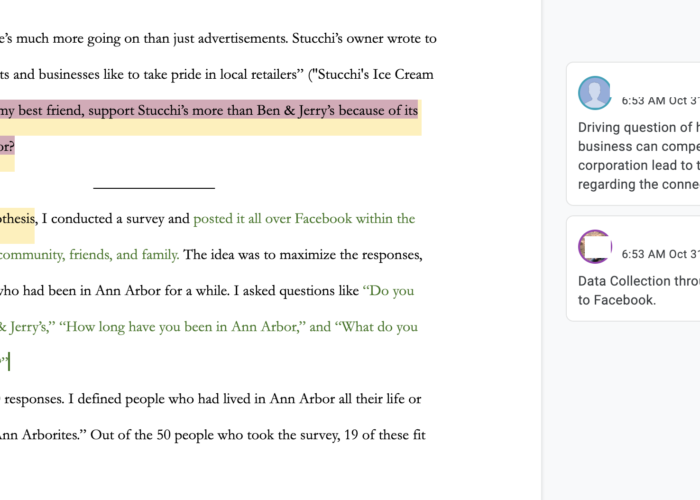
In addition to engaging students in this rhetorical analysis activity, I have adapted this color-coding exercise for research-based essays. In the research-based essay assignment, I ask students to examine a topic of their choice by conducting secondary well as primary research, including observations, surveys, or interviews. The assignment encourages students to contribute to a conversation that holds interest or significance to them. As students often investigate issues that arise from their personal interests, this genre can include traditionally narrative elements such as scene-setting and description as well as typical elements of research articles, including secondary sources, primary data collection, findings, analysis, and discussion. In this sense, this genre is hybrid in form, interweaving aspects of narrative, analytical, and research-based writing. Observing that students sometimes struggle with conceptualizing ways to structure their essays, especially when approaching unfamiliar genres such as this one, I developed an activity in which students highlight the sections of a sample essay entitled “A Tale of Two Ice Cream Stores.”

As shown in the instructions, each group is assigned to identify, highlight, and annotate a different section of the essay (exposition and context, driving questions/hypothesis, secondary source evidence, data collection and results, analysis and discussion, and conclusion).

This image shows a screenshot of a highlighted section of the research essay; students’ annotations comment on the driving question and data collection.
Figure 3. Screenshot of students’ highlights and annotations of the sample research-based essay.

As shown in the screenshot above, for example, a student highlighted the driving question in purple (“Did locals, like my best friend, support Stucchi’s more than Ben & Jerry’s because of its connection to Ann Arbor?”) and commented, “Driving question of how a local business can compete with a large corporation lead to the hypothesis regarding the connection with Ann Arbor.” Another group highlighted the description of the primary data collection in green, while a student commented, “Data Collection through a survey posted to Facebook.”

This image shows a screenshot of the concluding section of the research essay; students’ annotations comment on the conclusion.
Figure 4. Screenshot of students’ highlights and annotations of the sample research-based essay.

As shown in the second screenshot above, four students annotated the final paragraphs of the essay with their comments. As seen in the highlighted sections, the analysis (“what they stand for, and the quality of their products”) leads naturally into a conclusion (“But convenience comes with a price…”), while a further rhetorical question is posed within the conclusion (“Do we truly want everywhere to look the same? Have the same familiar stores, the same familiar logos?”). This screenshot illustrates the multilayered, intersecting nature of writing purposes and structures, showing that the sections are not necessarily linear, sequential, or mutually exclusive. Although this sample essay serves as one possible model or guide for approaching the assignment, I encourage students to structure their essays in flexible ways, according to their intended purposes for writing. For instance, I note the way the writer of the sample essay recursively generates new driving questions throughout the essay as opposed to only presenting initial questions in the opening.

Discussion

As illustrated, these color-coding activities render visible and legible the discrete elements of writing and enhance students’ metacognitive awareness of academic argumentation in various rhetorical situations. While collaborating on a Google Doc, students co-construct meaning by identifying key characteristics of written genres and by annotating the essays with their own commentary. Even so, one possible limitation of this approach might be that conceptions of writing are reduced to the surface-level features of a writing sample. In the future, I seek to encourage critical discussion of the shifting, evolving nature of academic writing as constructed by continual interactions across generic and discursive contexts, as writers shape and become shaped by the discourses they create. In this sense, students can become inspired not only to form their written compositions, but to transform their conceptions of writing as well.

Appendixes

Appendix A – Color-Coding Guidelines
Appendix B – Rhetorical Analysis Essay Prompt
Appendix C – Research-Based Argument Essay Prompt

About the Author

Ruth Li is a PhD student in the Joint Program in English and Education at the University of Michigan, Ann Arbor. Her research examines first-year students’ writing about literature, with attention to the reading-writing connection. More broadly, she is interested in literacy studies, writing development, applied linguistics, and digital tools and technologies for supporting writing research, pedagogy, and assessment. She serves as an instructor in the English Department Writing Program, where she has taught first-year and upper-level writing classes.

Ushering “Women in Antiquity” into the Modern Classroom

This assignment was created for a 200-level course cross-listed between Classics and Women & Gender Studies, entitled “Women in Mediterranean Antiquity.” The website (http://www.womeninantiquity.wordpress.com) is a work-in-progress, and any questions or collaboration inquiries can be sent to [email protected].

Introduction

This article introduces a project that I developed for an undergraduate course on the subject of Women in Mediterranean Antiquity at Mount Allison University in the winter 2017 semester. The aim of this project was to provide undergraduate students with an introduction to digital platforms in a historically archaic field and provide said students with skills that would impart digital literacy and valuable knowledge to benefit them regardless of their future career endeavors (see Macauley-Lewis 2015). The concept of the 21st-century university student as a “digital native” is problematic, and I echo Brandon Locke’s argument that although “many in higher education generalize their undergraduate students as being well acquainted with technology and approach their studies through a digital lens, students often struggle when it comes to critical content creation and mediation” (Locke 2017). I present here the methodology used in creating the assignment, its successes and failures, and future directions. The syllabus used for the course and instructions for implementation and evaluation are included as downloadable supplementary materials.

Description of the Assignment & Methodology

In lieu of a traditional research essay, students were asked to participate in what I termed a digital research assignment that required each student to submit 8–10 pages of research on a topic of their choosing (related to Women in Mediterranean Antiquity) with a comprehensive bibliography, and then to populate their own webpage within a larger website that I built using WordPress. This project was particularly well suited to Women in Antiquity because this was a course that seemed to have obvious topic selections for the student research that would then be placed into general headings on the website.

Once the traditional research was submitted, graded, and returned, students embarked upon the “digital” portion of this assignment. As mentioned above, I designed and set up a website through the WordPress.com platform (using the Gateway Theme). I chose WordPress for three primary reasons: 1) it is free to operate; 2) I had prior experience with the platform; and (most importantly) 3) WordPress is a useful platform with a lot of user support: as of May 2018, WordPress “runs 28.9% of the entire internet” (Karol, 2018; 31.6% on W3 Techs, n.d.). WordPress is user-friendly but also allows students to explore html options and coding language. Any party interested in adopting a version of this project for their own classroom would not be limited to WordPress but could instead explore the many options available online and select an alternative platform for a collaborative website (Kick, 2013) – although, as I repeated to my students throughout the semester, chances are that if they are facing a technical problem, someone else has already found the answer to it, and the resources available to WordPress users are extensive.

On the WordPress.com platform, the students each created a “blog post” that I later nested under parent headings so that it appeared instead as a static “page” to the website visitor. Within their posts, students had full creative license for design & media (including coding and CSS). I provided step-by-step instructions as to how to initially set up their pages, which are included here as Appendix B and are also freely available on the website under the Resources tab for any instructor interested in embarking upon a similar project. The students were strongly encouraged to set up their websites for a general audience and to make their pages as visually appealing as possible, but they were required to use only open-access images and media.

Final Product & Results

There were 47 original student contributions to the website, which I arranged into thematic groupings that appeared as drop-down menus on the main page (Greek Women, the Female Body, Roman Myth, etc.). I encouraged the use of real names and emphasized the merit of their contribution to this publicly available online resource; however, participants could remain anonymous in their authorship of the page through a chosen pseudonym, and any students who did not want their page to remain public could let me know and I’d remove it immediately following the end of the semester. My initial goal for this assignment was to include it every time I taught “Women in Antiquity” or a similar course, thus creating an ever-expanding resource on the subject of women in the ancient world. Anticipating a range in the quality of submissions, I informed students at the beginning of the course that their contributions would not necessarily be permanent, but that pages might be taken down and/or altered in future versions of the class. Due to the outstanding nature of several of the contributions, I decided that with the permission of the student authors, the best contributions would remain on the site long-term, with the ultimate goal that with each iteration of the course, further outstanding contributions would be added to the permanent version of the site, thus creating a growing open-access resource for the study of women in the ancient world.

Student Reactions & Feedback

The student feedback for this project was primarily—but not universally—positive. Anonymous feedback from course evaluations included comments such as, “The digital research project is fun and helped me hone applicable skills in website construction”; “Loved the digital component of the course and that we were able to choose from several topics, or our own”; “The website idea was great as it was a less stressful assignment”; and “Website making was so cool!” I asked a few students to provide more extensive feedback for this publication:

The Women in Antiquity website project is enjoyable as it allows students to write about a topic that they are interested in and be free from the usual boundaries of the traditional essay. I enjoyed being able to write in a less formal way and I felt like being able to share my research in this way helped me to gain a deeper understanding of my topics… this project not only benefits students within the class but also allows for others to access this wealth of information. —Caitlin McGowan

I really enjoyed the process of editing my research paper to see it evolve from one with a distinctive academic tone to a piece that was user friendly, engaging, and tailored to a blog platform, yet still maintained the credibility of academic writing. —Caroline Chamandy

I found the Women in Antiquity Digital Project component of Dr. Gardner’s course one of the most engaging projects of my undergraduate career. It taught me how to reconceptualize the way in which I thought about and approached my research. Being able to share my work with family, friends, and peers as a highly accessible and informative tool was very rewarding. —Janan Assaly

Negative feedback from students is also worth sharing since these provide important perspectives to consider for future improvement: one student enrolled in my course told me at the end of the semester that her friend had dropped this course as soon as he’d seen the digital project on the syllabus. In her words, he “just wanted to write a traditional essay and be done with it.” This student was an exception, but this reaction and the pushback against digital media does, in some cases, exist. Another student, who remained in the class and produced an excellent webpage, was the only individual (out of 47 students in my initial iteration of this course) who wanted their page taken down. This student generously provided feedback about their decision to remove their content, and I received their permission to share it here:

Personally, I am a private person, who tries to have as minimum a presence online as possible, therefore, I prefer not to have my name associated with something published on the internet. Overall, I felt that I was not in the right position to be educating the masses on my chosen topic because I was unsure if I truly believed what I had written. —Anonymous

This student’s insightful concerns are valid, because they bring up the question of whether there is any benefit to providing even more online content when students already have difficulties in evaluating the legitimacy of existing online sources (Basulto, 2017; Fleming 2018). Ultimately, I believe that researched, appealing academic content—even at the undergraduate level—is beneficial and valuable, especially in light of the inevitability that a large percentage of the population is accessing information online. By encouraging my students to provide reliable content with active hyperlinks to additional reliable, academic content (such as JSTOR, Diotima, and Lacus Curtius), we can strengthen the network of reputable online information.

Outreach & Impact

A recurring theme in this student feedback—both positive and negative—is the exposure of the site, which has far surpassed initial expectations. Students were encouraged to share their pages on social media platforms and to include many tags for their pages in order to generate search engine hits. In 2017 the site had 12,597 views; by 2018 the site had 63,290 views and as of November 2019 there have been 75,347 visitors. There is currently an average of 238 visitors per day. One of our most successful student contributions is the page Spinning and Weaving in Ancient Greece by Marion Blight, which was featured in the Seattle Weaver’s Guild May 2018 monthly bulletin and currently has 11,204 views. Links to our site are included in TedEd lessons (The myth of Arachne which links to Blight’s page and the legend of Medusa which links to Cheryl MacKinnon’s Medusa and her Sisters: The Gorgons); a post on Grunge (that links to Pregnancy and Childbirth by Keelin Howe); and an article on the Conversation (Barker, 2018; on Hetairai: The Ancient Athenian Courtesan by Samuelle Saindon). Adrienne Mayor, author of The Amazons: Lives and Legends of Warrior Women across the Ancient World (2014), found the site and offered permission to use some of her images for the page The Amazons by Dexter Fennell. Our top referrers for website traffic are search engines (105,214 views) while Facebook is a distant second (1,756 views); the site is also included among the online resources of courses at universities including Colorado State University, Kansas University, The Open University, Sewanee: The University of the South, Fashion Institute of Technology in New York (SUNY), Vassar College, Charleston College, and Memorial University. I was not aware that these institutions were using the site for their courses until I consulted the online statistics, which means that we are gradually achieving our desire to be an open-access resource for general public and scholarly audiences alike.

Future Directions & Collaborations

I decided to transform this assignment into an international, collaborative project, inviting instructors from any institution to incorporate this assignment into their undergraduate or graduate courses. The motivation to do so was twofold: first, this would provide a way for the website to expand continuously with new contributions from institutions all over North America, thereby bolstering the content and availability of resources for the study of Women in Antiquity; and second, this project offers an opportunity for instructors and for students, a viable means to begin to engage with Digital Humanities and alternative scholarship. For those without the vast quantities of time required to master even basic DH skills such as website-building, digitization, and database creation, there is a continued need for introductory-style pedagogical projects that can provide a viable solution for all scholars who want or need to embrace digital applications in the university classroom (Boss and Kraus 2007; The Pedagogy Project).

A different instructor at a different institution can teach this course and assign this project each semester, in order to continually add to and improve upon the existing content and to strengthen the collaborative networks that are fundamental to the Digital Humanities (Griffin & Hayler 2018). It is my personal hope that this website continues to grow and improve with the contributions of the next generation of scholars, encouraging the study of Women in Antiquity and the production of open-access information for a global audience, ultimately creating a comprehensive and collaborative resource for the foreseeable future.

Appendices

Appendix A – Original Course Syllabus
Appendix B – Instruction Slides
Appendix C – Digital Research Project Instructions

Bibliography

Basulton, Dominic. 2017. “Information Overload? There Has Always Been Too Much to Know.” BigThink. Accessed September, 2018.
https://bigthink.com/endless-innovation/information-overload-there-has-always-been-too-much-to-know.

Boss, Suzie, and Jane Kraus. 2007. Reinventing Project-Based Learning: Your Field Guide to Real-World Projects in the Digital Age. Eugene: ISTE.

Fleming, Grace. 2018. “Bad Sources for your Research Project.” ThoughtCo. Accessed September, 2018.
https://www.thoughtco.com/bad-research-sources-1857257.

Griffin, Gabriele, and Matt Steven Hayler. 2018. “Collaboration in Digital Humanities Research – Persisting Silences.” Digital Humanities Quarterly 12, no. 1. www.digitalhumanities.org/dhq/vol/12/1/000351/000351.html.

Karol, K. 2018. “WordPress Stats: Your Ultimate List of WordPress Statistics (Data, Studies, Facts – Even the Little-Known).” CodeinWP blog. Accessed September, 2018. https://www.codeinwp.com/blog/wordpress-statistics/.

Kick, Verena. 2013. “02. Collaboratively blogging / authoring a website in the foreign-language classroom.” HASTAC Online. Accessed September, 2018.
https://www.hastac.org/blogs/vkick/2013/11/01/02-collaboratively-blogging-authoring-website-foreign-language-classroom.

Locke, Brandon T. 2017. “Digital Humanities Pedagogy as Essential Liberal Education: A Framework for Curriculum Development” Digital Humanities Quarterly 11, no. 3.
http://www.digitalhumanities.org/dhq/vol/11/3/000303/000303.html#brake2014.

Macauley-Lewis, Elizabeth. 2015. “Transforming the Site and Object Reports for a Digital Age: Mentoring Students to Use Digital Technologies in Archaeology and Art History.” The Journal of Interactive Technology and Pedagogy 7.
https://jitp.commons.gc.cuny.edu/transforming-the-site-and-object-reports-for-a-digital-age-mentoring-students-to-use-digital-technologies-in-archaeology-and-art-history/.

W3Techs Web Technology Surveys. n.d. “Usage of content management systems for websites.” Accessed September, 2018.
https://w3techs.com/technologies/overview/content_management/all.

Computational Thinking-Centered Pedagogy: A Collecting Data with Web Scraping Workshop

Introduction: The Challenges of Library Instruction

Library-based instruction can be a tricky thing. We usually only have one chance to give a workshop or to visit a class, so there is a pressure to get it right the first time. This is hard enough when teaching first-year students the basics of information literacy, and it presents an additional set of challenges for technology-based instruction. New technical skills are rarely acquired in 60- or 90-minute sessions. They more often require longer periods of study and build on a foundation of other technical skills that one cannot assume all participants will have (Shorish 2015; Locke 2017).

NYU Libraries offers a range of technical workshops designed to provide this technical foundation, and sessions cover topics such as quantitative and qualitative software, GIS and data visualization, research data management, and digital humanities approaches. While these workshops can be taken as one-off sessions, they are designed as part of an interwoven curriculum that introduces technical skills and concepts in an incremental way. The Collection Data with Web Scraping workshop discussed here is offered as a digital humanities course and, while there are no prerequisites and it is open to all, participants are encouraged to take the Introduction to Python and Text as Data in the Humanities workshops in advance (NYU Libraries 2019).

The workshop introduces web scraping techniques and methods using Python’s Beautiful Soup library, with a focus on developing participants’ computational thinking skills. I always emphasize that no one becomes an expert on web scraping in this 90-minute workshop, especially given that some have no previous programming experience. However, participants still learn valuable skills and concepts and through this process develop a more foundational understanding of computational logic and its affordances when applied to digital research. I call this computational thinking and it is the primary learning outcome of the workshop.

Agenda and Learning Outcomes

The workshop is divided into four sections, with the agenda as follows:

  1. Why use web scraping?
  2. What are the legal and ethical implications?
  3. Technical introduction and setup
  4. Hand-on web scraping exercises

The sections are designed to fulfill the workshop’s learning outcomes:

  1. Strengthen computational thinking skills
  2. Learn the concepts and basic approaches to web scraping
  3. Understand how web scraping relates to academic research
  4. Understand the broader legal and ethical context of web scraping

A Computational Thinking Centered Pedagogy

The primary learning objective of this workshop is to help participants strengthen their computational thinking skills. A basic working definition of computational thinking is understanding the logic of computers. It seems obvious, yet worth stating, that computers prioritize different patterns of logic than humans. There are multiple layers of complexity to understanding computational logic and then applying it in real-world research and teaching environment, and my approach is to reveal and make explicit some of these layers. For example, one of the core activities of the workshop is an in-depth look at how websites are packaged and how data, broadly defined, is structured within them using HTML and CSS. This close look at one of the building blocks of the web then allows us to identify patterns in this structured data in order to extract the useful pieces of information and build the collection. More importantly, these lessons are applicable to contexts beyond web scraping and are transferrable to our other workshops or to any activity involving data work. This gives the workshop an added value and empowers participants more confident and comfortable using technology in their research (Taylor et al. 2018).

In addition to identifying patterns in structured data, there are countless other opportunities to provide insights that give participants a deeper understanding of how technology works. For instance, when introducing the Beautiful Soup library, I describe how programming libraries are just blocks of code that allow us to write our program with 10 lines of code instead of 100. There are several web scraping programs written in other languages, but I chose Python because it has a robust developer community. That is, there are people contributing to a whole network of libraries, like Beautiful Soup, that serve to expand the functionality so that once you have extracted data from a website and are ready to analyze it, you can simply import another library, such as spaCy or the Natural Language Toolkit (NLTK) to do your next phase of work (Explosion AI 2019; NLTK Project 2019). When built into the curriculum in a thoughtful way, these parenthetical notes make it easier to learn the material at hand and also to establish a wider technical context for the work.

Why Use Web Scraping?

In addition to inserting computational thinking vignettes throughout the workshop, I find it helpful to begin with a discussion of why one might use web scraping. Since the workshop’s primary audience is humanists, this discussion of when web scraping is (and is not) appropriate and how it can be used in research is particularly useful. For example, as more and more primary and secondary source materials are appearing on/as websites, it is increasingly common for scholars to need to gather this material. Within libraries, archives and museums, initiatives such as Collections as Data underscore a shifting approach whereby library collections are conceptualized and provided as data (Always Already Computational 2019). Projects such as OPenn demonstrate how a library’s digitized special collections can be made accessible as machine readable and ready for large scale analysis (University of Pennsylvania Libraries 2019). An additional example, the New York Society Library’s City Readers project, presents the Library’s early circulation records as data, allowing users to, for example, compare whether John Jay or John Jacob Astor read more books in a given year (The New York Society Library 2019). Such examples help participants envision how they could use web scraping in their work.


Figure 1. A data visualization from the New York Society Library comparing circulation statistics among patrons.

Figure 1. A data visualization from the New York Society Library comparing circulation statistics among patrons.

Another core concept of the workshop is that web scraping will become one of many skills in participant’s “digital toolbox,” and can connect with other technical skills used in the research lifecycle. For example, data gathered from web scraping is often messy and often needs additional scrubbing in a program like OpenRefine (MetaWeb Technologies, Inc. 2019). Or, web scraping might be just one step in text analysis project, and you might want to use a named entity recognition (NER) package to next extract names of people or places from the scraped dataset.

What are the Legal and Ethical Implications?

Next is a conversation about the legal and ethical implications of web scraping. The key lesson here is that just because you can scrape a website, it doesn’t mean you should. It is important to first check a site’s terms of use policy to understand whether there are rate limitations or if scraping is outright prohibited. Collecting certain types of online data on human subjects (e.g. some types of social media data) will require IRB approval. After collecting data, scholars will also need to consider how will the data be stored or archived and whether this has the potential to put others at risk. This is a particularly pertinent concern for materials dealing with controversial subject matters or underrepresented groups. The Documenting the Now project has many great resources to help navigate these often complex issues (Documenting the Now Project 2019).

In terms of research best practices, it also takes some data literacy basics to evaluate your target source. There is a lot of garbage online, and how so do you know the data is what it claims to be? Is it representative and what biases does it contain? And research projects using digital sources or methods are no different from more traditional approaches in that getting the data or producing a visualization of it is often not the end of a project. In most cases, the data must then be analyzed in a theoretical framework of the scholar’s discipline in order to form a scholarly argument. The earlier cited example of the New York Society Library illustrates this well – the circulation record visualization shown above is an interesting anecdote but the image is a relatively simple data visualization and does not actually tell us anything meaningful about, say, the American Revolution or eighteenth-century reading patterns.

Using Beautiful Soup

While asking participants to bring their own laptop and set them up with their own Python environment provides rich opportunities for moments of computational thinking, it is time intensive, demanding on the instructor, and requires a longer workshop. A simpler approach is to use an already exiting environment such as JupyterHub, PythonAnywhere, or a computer lab with Jupyter Notebook installed (Project Jupyter team 2019; PythonAnywhere LLP 2019; Project Jupyter 2019).

Beautiful Soup is a Python library for extracting textual data from web pages (Richardson 2019). This data could be dates, addresses, news stories, or other such information. Beautiful Soup allows you target specific data within a page, extract the data, and remove the HTML markup surrounding it. This is where computational thinking skills are needed. Webpages are intended to be machine readable via HTML. The goal is to write a program, in machine readable form, that extracts this data in a more human readable form. This requires that we “see” as our computers “see” in order to understand that if, for example, we want the text of an article, that we need to write a program that extracts the data between the paragraph tags.

<p></p>

Once we understand the underlying rules for how pages are displayed – i.e. using HTML and CSS – we can start to see the patterns in how content creators decide to present different types of information on pages. And that is the computational thinking logic behind web scraping: identifying these patterns so that you can efficiently extract the data you need.

Computational Thinking in Action

The examples used in the workshop are available online (Coble 2019), and working through the first example – collecting the titles from the Craigslist page for writing, editing, and translation – will illustrate some of these concepts. While the research value of this data is rather limited, it is a straightforward example to introduce basic techniques that are built upon in subsequent examples.


ALTTEXT
CAPTION
Figure 2. Screenshot of Craigslist page for writing / editing / translation.

Figure 2. Screenshot of Craigslist page for writing / editing / translation.

The first step is to use the browser’s View Source feature to look at the page’s HTML code. Not only do we get a quick glimpse into how the data is structured, we can also begin to identify the parts of the code that uniquely mark the title of these posts.


Figure 3. Screenshot of Craigslist page source code for writing / editing / translation.

Figure 3. Screenshot of Craigslist page source code for writing / editing / translation.

For example, here is the source code for the first post on our page:

<a href="https://newyork.craigslist.org/mnh/wet/d/brightwaters-college-tasks-essay-exams/6998844623.html" data-id="6998844623" class="result-title hdrlnk">🎼 🎼 College Tasks | Essay | Exams | Course Help 🎼 🎼</a>

Let’s start by breaking this into parts:

a href="https://newyork.craigslist.org/mnh/wet/d/brightwaters-college-tasks-essay-exams/6998844623.html"

The above part is the link to the full post. We don’t want this because it’s not the title.

data-id="6998844623"

This looks better, but data-id appears to be a unique identifier for a specific post. If we write a program to search for this, it will only return one title. This won’t work because we want all titles of posts on our page.

class="result-title hdrlnk"

This looks much better. But there are actually two class tags here, class=”result-title” and class=”hdrlnk” (condensed and separated by a space), so which one is best? We can do a quick check by searching on the View Source page – using Cmd+F or Ctrl+F – for “result-title.” There are 120 posts displaying on my page, and the search for “result-title” returns 120 results. Bingo!


Figure 4. Screenshot of source code for Craigslist and the browser’s search feature.

Figure 4. Screenshot of source code for Craigslist and the browser’s search feature.

We can repeat this process for “hdrlnk,” which, in this case, also returns 120 results. So we can comfortably use either “result-title” or “hdrlnk” for our program. To be safe, I would also do a quick manual check of other links on the page – both links for posts and for other links (My Account, Save Search, etc) to confirm that “result-title” and “hdrlnk” is the unique string that will return the post’s title and only the post’s title.

And this is the computational thinking the workshop helps to build. By understanding how web pages use HTML and CSS to structure their contents, we are able to isolate patterns unique to our target data and to use these patterns to extract the target data. Once we have these pieces in place, we can write a program that looks like this:

# import the urllib library to get the HTML
import urllib.request
# import the Beautiful Soup library to parse the HTML
from bs4 import BeautifulSoup

# define a variable with our web page
start_url = 'https://newyork.craigslist.org/search/bar'
# ask urllib to get the HTML from our web page
html = urllib.request.urlopen(start_url).read()
# ask Beautiful Soup to parse the web page as HTML
soup = BeautifulSoup(html, 'html.parser')
# ask Beautiful Soup to extract the titles
titles = soup.select('.hdrlnk')

# for loop to print each title
for title in titles:
    print (title.text)

And get something back that looks like this:

🎼 🎼 College Tasks | Essay | Exams | Course Help 🎼 🎼
Writing and English tutor. NYU and Columbia graduate.
Writing/Essay Assistance, $80. NYU and Columbia graduate.
Versatile Content Writer Provides Top Notch Business-Related Material
Experienced Proofreader At Your Service
Screenplay Solutions! Writing, Edits, Formatting, Etc.
Thesis, Research, Dissertations, Publications, Presentations.  Ivy
--> A Special Speech for a Special Event? |  Hire a Professional
Need a Bio? For profiles, websites, expert collateral, exec resumes
School and college coursework & essays w r i t i n g Service
$25 resume editing & consulting for students and young professionals
Don't Just Talk! Communicate - Medical School Intervew
Grad/law/MBA/med school personal statements due?
FOR HIRE: AWARD-WINNING, IVY-EDUCATED EDITOR/SCRIPT CONSULTANT
Pay me write your essay, edit your work, take an classes fully online
FAST Affordable Dissertation and Academic EDITING-NonNative English OK
Versatile Content Writer Provides Top Notch Business-Related Material
Winning Resume, Cover Letter and LinkedIn Package For $30
French writer and translator
Writers for FrontPage.nyc
Academic Intervention & Paper Writing

Conclusion

Bringing computational thinking concepts to the forefront of the workshops has been successful and resulted in more engaging sessions. Participant feedback has indicated that having a greater contextual understanding of web scraping and learning about its underlying principles has helped them better understand its potential applications and to feel more confident in doing their work. Given the nature of library-offered technical workshops, focusing on a computational thinking-centered pedagogy has been successful in helping participants to meet their specific need to pick up a new skill as well as to meet a less often stated need to understand how and why a particular tool or approach is situated within larger research and technology ecosystems.

Bibliography

Always Already Computational – Collections as Data. 2019. “Always Already Computational – Collections as Data.” https://collectionsasdata.github.io/.

Coble, Zach. 2019. Code examples from Collecting Textual Data with Web Scraping workshop. https://github.com/coblezc/webscraping-workshop.

Documenting the Now Project. 2019. “Documenting the Now.” https://www.docnow.io/.

Explosion AI. 2019. “SpaCy – Industrial-Strength Natural Language Processing in Python.” https://spacy.io/.

Locke, Brandon T. 2017. “Digital Humanities Pedagogy as Essential Liberal Education: A Framework for Curriculum Development.” Digital Humanities Quarterly Volume 113). http://www.digitalhumanities.org/dhq/vol/11/3/000303/000303.html.

Metaweb Technologies, Inc. 2019. “OpenRefine.” http://openrefine.org/.

NLTK Project. 2019. “NLTK 3.4.5 documentation.” https://www.nltk.org/.

NYU Libraries. 2019. “NYU Libraries Classes.” New York, NY: New York University. https://nyu.libcal.com/.

Project Jupyter. 2019. “Project Jupyter.” https://jupyter.org/.

Project Jupyter team. 2019. “JupyterHub.” https://jupyterhub.readthedocs.io/.

PythonAnywhere LLP. 2019. “Host, run, and code Python in the cloud: PythonAnywhere.” https://www.pythonanywhere.com/.

Richardson, Leonard. 2019. “Beautiful Soup.” https://www.crummy.com/software/BeautifulSoup/.

Shorish, Yasmeen. 2015. “Data Information Literacy and Undergraduates: A Critical Competency.” College & Undergraduate Libraries Volume 22, no. 1: 97–106. https://doi.org/10.1080/10691316.2015.1001246.

Taylor, Natalie G., J. Moore, M Visser, C. Drouillard. 2018. “Incorporating Computational Thinking into Library Graduate Course Goals and Objectives.” School Library Research Volume 21. http://www.ala.org/aasl/sites/ala.org.aasl/files/content/aaslpubsandjournals/slr/vol21/SLR_IncorporatingComputationalThinking_V21.pdf.

The New York Society Library. 2019. “City Readers.” https://cityreaders.nysoclib.org/.

University of Pennsylvania Libraries. 2019. “OPenn.” http://openn.library.upenn.edu/.


The Digital Story: Integrating the Personal and Academic through a Multimodal Approach


This assignment was created for a First Year Writing Inquiry Seminar (FIQWS) at City College of New York. FIQWS is based on the principles and pedagogy of the learning community. Students are enrolled simultaneously in a topic course in which they learn about a specific subject, in this case “Truth, Fiction and Photography,” and a composition course in which they learn and practice composition skills. This assignment for the composition section asks students to apply what they are learning in the topic section to their personal experiences through a personal photograph and compose a digital story.

Assignment Sheet

Literature review

Based on Amy Robillard’s (2003) argument that composition instructors should teach the ways narrative and argument are interdependent, and Deborah Mutnick’s (1998) claim that drawing boundaries between academic and personal writing limits development, this assignment asks students share a personal narrative and analysis through a specific lens. In academia, “We ask our students to accept meaning that has already been created” (Robillard 2003, 76). The meaning I ask students to accept in this assignment is that photographs do not always document “truth.” Photography is subjective despite often being passed off as documentary evidence of a truth. The personal narrative in this assignment gives students agency by asking them to “create their own meanings from their own histories” (Robillard 2003, 76).

Breaking boundaries even further, this assignment links the creative and the intellectual (Benmayor 2008). The multimodality of the project gives even more agency to the students (Kitalong and Miner 2017). Not only are they empowered to tell their own stories, but also to choose music and images that help them tell that story, rather than being limited to a formal academic essay. This assignment gives students who are non-native English speakers, or whose learning style does not align with the traditional essay, a chance to shine and “to inscribe emerging social and cultural identities and challenge unified cultural discourses in a new and exciting way” (Benmayor 2008, 200).

Implementation

The multimodality of this assignment requires more scaffolding than a traditional essay with each step encouraging students to think critically about the rhetorical choices they make. The project was broken down into four progressive parts over four weeks: a written narrative draft for peer review, the final narrative recorded, a storyboard, lastly a video incorporating all audio and visual components.

This class was held in an active learning classroom, and laptops were provided for all students. On the day the narrative recording and storyboard were due, I devoted the full class period to creating the videos so I could help if students had questions regarding the video editing software.

Since one of the main concerns with this project was technology access, I instructed students to use the free version of WeVideo, a cloud-based editor, ensuring students could work on their projects from any computer outside of class.

Successes

Community building

By scheduling this as the first assignment of the semester, it both utilized their writing skills and knowledge gained from the topic section, while also building community. As students were asked to analyze a personal photograph, they chose what aspect about themselves they wished to share with the instructor and the class. Students connected with each other based on common experiences. I, in turn, learned more about my students’ interests and challenges they face.

One student, often quiet in class, shared a picture of themself on a trip with a large group of people, narrating:

Many people may think I am such an outgoing person to go on the trip with a group of strangers. In reality, that is not true. I am a reserved and introverted person… Ever since I can remember I had a problem with making real friends.

I suddenly had context for this student’s reserved nature and was able to work with them from a new and pedagogically advantageous perspective.

Addressing the “fiction” of photography

The final products did an excellent job showcasing the “fiction” a photograph might portray in contrast to the truth behind the image. One student chose a photograph of themself at a dance studio, mid-dance move, highlighting:

Some might say that dance was easy due to the position I am holding…One of the things this photograph does not showcase is the amount of blood, sweat and tears I had to go through in order to be valued as a professional dancer.

Throughout the narration, the student used other verbal reminders like “in reality” or “one might assume” to demonstrate the idea of subjectivity in photographs. These were common phrases in many students’ narratives.

Rhetorical awareness

One student chose to write about their experiences with competitive fitness noting in the picture they looked happy and fit. They explained how open they were about sharing the positive aspects of their lifestyle when asked about how they achieved such incredible fitness goals. The tone of the narrative changed when the student wrote:

I was becoming a new person, but change is not always welcome if it affects how others interact with you. So eventually, many friends stopped calling me to go out and to eat or have drinks, since I would always say no; I missed out on a few family celebrations because I didn’t want to be around any food that I wasn’t allowed to have so I became very isolated.

With this shift in narrative tone, the music also shifted from an energetic song one might hear at the gym, to a more dramatic and serious song; the pictures also became more serious in nature, demonstrating rhetorical awareness in “[synthesizing] modes, genres, ideas, and skills” and practicing “more fluid and flexible” composition (Kitalong and Miner 2017, 40).

Challenges

Many of the rough drafts of the narrations focused solely on telling the story behind the photograph rather than incorporating the analysis of truth versus fiction. I theorize the students leaned in this direction because personal narrative is familiar to them while the concepts of analyzing truth and fiction in photography were new. Much of my feedback consisted of asking questions to encourage students to apply this lens to their personal story and engage with their personal stories as though they were strangers to it. Most students skillfully incorporated this into the final project, though the concept proved challenging to some.

As these stories were being shared to the student’s digital writing portfolios on the CUNY Academic Commons, they were limited to using sound effects, music and supplemental images with creative commons licensing. Several envisioned their videos with a soundtrack of their favorite music, but instead spent a significant amount of time sifting through creative commons music to find what closely approximated the mood they were trying to create. Additionally, the stock photographs they used to supplement their personal photography did not always fit with what they were trying to convey.

Adaptions

This assignment can be adjusted to fit nearly any theme or topic, though it lent itself especially well to the visual medium of photography. Merging the personal and academic can bring to life any number of subjects for our students allowing them to engage with material in a way traditional composition simply cannot match on its own.

Bibliography

Benmayor, Rina. 2008. “Digital Storytelling as a Signature Pedagogy for the New Humanities.” Arts & Humanities in Higher Education 7 (2): 188–204. https://doi.org/10.1177/1474022208088648.

Kitalong, Karla Saari, and Rebecca L. Miner. 2017. “Multimodal Composition Pedagogy Designed to Enhance Author’s Personal Agency: Lessons from Non-academic and Academic Composing Environments.” Computers and Composition 46 (December): 39–55. https://doi.org/10.1016.j.compcom.2017.09.007

Mutnick, Deborah. 1998. “Rethinking the Personal Narrative: Life-Writing and Composition Pedagogy.” In Under Construction, edited by Christine Farris and Chris M. Anson, 79–92. Louisville: University Press of Colorado.

Robillard, Amy. 2003. “It’s Time for Class: Toward a More Complex Pedagogy of Narrative.” College English 66 (1): 74–92. https://www.jstor.org/stable/3594235.

Images are for demo purposes only and are properties of their respective owners. ROMA by ThunderThemes.net

Skip to toolbar
