Short Form Pieces

0

Developing a Coronavirus (COVID19) Case Study Using Google Docs in a Master of Public Health Student Cohort

Dr. González offers a strategy for teaching Master of Public Health students to engage with data to identify and analyze the impacts COVID-19 on vulnerable populations living in NYC by developing a case study on the novel coronavirus. Using Google Docs, students wrote a case study that can be used in future classrooms to guide conversations about COVID-19. They additionally reflected on the benefits and challenges of the technology as an educational tool.

Introduction

I taught a master’s level public health course titled Translating Research to Practice that examined approaches for selecting, adapting, and implementing evidence-based public health programs. The course structure included lectures, seminar-style discussion around peer reviewed literature and case study methodology. I adhered to this structure until the novel coronavirus (COVID19) pandemic reached New York City when classes were converted to hybrid models (O’Byrne and Pytash 2015) that would function online for the rest of the semester. I believed developing a case study around the COVID19 using Google Docs could be an instructional asset for students to analyze critically the growing public health need while also offering a pedagogical tool to encourage discussion and learning among future cohorts (Bonney 2015; Penn et al. 2016; Escartín et al., n.d.).

Overview

During the first online 75-minute session after lockdown, I proposed the class collaboratively write a case study on the novel coronavirus to observe and analyze critically the rapidly changing public health context unfolding before us during Spring 2020. Students had the option to contribute to the collaborative writing project or continue with the planned final assignment; all students chose the case study. To start, I shared a Google Docs link with students. We selected NYU Google Docs as all students had accounts and were familiar with the tool. Four pages of text were generated during the initial 10-minute collaborative writing session wherein students added additional subheaders under which the class would write collaboratively and asychronously in the following weeks. As a process note, students agreed to using the format of their “name”: prior to text they wrote to track contributions (see Figure 1).

Figure 1. Initial student collaborative writing session. Outline being fleshed out by students in real time using Google Docs including Background, NYC Cases, Case Study Ethical Questions
Figure 1. Initial student collaborative writing session.

After the first week, contributions slowed, prompting me to ask students to share ongoing progress during a synchronous meeting via Zoom. One student shared how she incorporated feedback to improve readability and explore new research. Two students reported how they initiated communication on WhatsApp: one student called the other to expedite speedier and more effective communication, and this engendered trust and enabled them to comment on one another’s sections with more confidence that their commenting and feedback would “be taken the right way.” Reporting back weekly also allowed the class to explore sensitive issues. For example, we agreed to refer to the initial Westchester patient as “Patient one” rather than use their given name which led to a public health ethics discussion on this decision. We additionally agreed upon a timeline to ensure steady progress (Table 1), and roles (Huett and Koch, Jr. 2011), including:
Drafter – This person does the primary writing.
Reviewer – This person reads what others have written to identify and examine paragraph focus, idea arrangement, and development.
Editor – This person does a grammar check, formatting, and review source integration.
Zoom breakout rooms facilitated small group discussions by writing groups (Background, New York State, and New York City) to encourage student-led decision-making. For example, one group decided between two outlines, another group decided to restructure their section in chronological order.

Key benchmarks and defined due dates
Table 1.

One particular subgroup of students struggled due to a lack of communication outside of the classroom, and in light of the possible emotional toll of the content in the context of individual students’ lives. I communicated that success was “contributing what individual students were capable of” and encouraged those who had access to the bandwidth to contribute additionally as reviewers. Some students focused on a single section while others contributed throughout the document. Allowing students to contribute whatever their capabilities led to a robust product. One student described their experience:
It was a complicated exercise to be doing…on a situation that hits so close home – in your own city, to your own community members. In our previous case study explorations in class, there was a degree of distance we had from the material – of course, we have compassion and insight as students invested in public health, but were not, for the most part, examining situations that had an impact on our own lives.

Student Reactions

Twelve students submitted a one-page reflection on the collaborative writing process and the overall experience of writing a case study even as the event unfolds.
Two students noted discomfort due to unfamiliarity with collaborative writing and to writing about a quickly changing epidemic. Another student commented that the intimacy of writing about, “our communities … infused our collaborative project with a certain kind of intimacy and urgency – laying bare the massive and long standing interlocking aspects of this crisis that will touch our lives as individuals and as professionals moving ahead in our public health careers.” Another student commented, “I learned that writing a case study on a situation that is developing so rapidly is complex and difficult. Especially in the earliest days of the pandemic in New York, information, regulations, and safety protocol was seemingly changing by the hour.” See Appendix B for additional student reflection quotes.
Based on students’ responses, it became apparent that a collaborative writing assignment using Google Docs improved public health students’ learning. When asked about the lessons learned from the assignment, a student was struck by how the collaborative writing assignment enhanced the classroom’s original learning objectives. Another student similarly commented,the process of collaboratively writing this case study allowed us…to assess in real time some of the most pertinent questions asked in this course: What are the greatest challenges in solving complex public health problems? Which communities get left behind, and why? What does compassionate public health leadership look like in practice? What defines “community readiness” for public health solutions? How do we reach people effectively and with cultural competence?

Students commented on the therapeutic aspects of the assignment as students with a shared goal. One commented, “In a time when the feeling of togetherness was minimal, this collaborative writing experience gave the feeling of community, friendship and a strong support system.” Several students commented on the practical skills learned through the assignment including mitigating COVID19 in global settings, improving writing skills, and working collaboratively in a remote setting. Four students commented on feeling more prepared for their public health careers, and another student reflected, “I personally felt that I was actually a public health professional and the skills I had gained within these past two years had prepared me to work [on] the case study.”

The assignment also applied technology not commonly used in a public health classroom. Consistent with other web 2.0 mobile learning successes (Cochrane 2014), students reacted positively to the technical tools’ flexibility and observed that these tools accommodated students’ schedules and fostered learning: “I think the process in which one could comment and ask questions [in Google Docs] fostered…learning,” referring to the work of synthesizing data and generating probing questions for discussion among public health students and professionals.

Conclusion

This assignment allowed students to develop six of the eight core competency domains for public health professionals outlined by the Public Health Foundation, including: analytical/assessment, communication, cultural competency, community dimensions of practice, public health sciences, and leadership and systems thinking skills. Research suggests that real tasks supported by technologies, together with resources on the web, have the potential to improve the quality of online learning (Parker, Maor, and Herrington 2013), and also support meaningful learning (Woo and Reeves 2008). After reviewing the students’ comments, I was struck by the value of the assignment beyond these skill sets, and the importance of developing a sense of community and camaraderie. As classrooms abruptly shifted online, isolation was a struggle for students and professors alike. Collaborative writing can foster community and engagement to combat isolation: this is especially relevant as classrooms will likely continue online due to COVID19 (Ivankova and Stick 2005).

I was most excited by the collaborative work that was happening asynchronously as this encouraged meaningful learning. Students were able to step into different roles to both offer and receive feedback. The collaborative nature of the assignment also allowed students to relate to one another as colleagues, something that simulated how public health work is executed in practice. I intend to use collaborative writing assignments with future students. I hope that instructors at different institutions apply what is outlined here to other pressing social sciences topics: both as a collaborative writing assignment, and as a pedagogical tool using Google Docs to help guide conversations about COVID19.
Bibliography

Venue of Publication
Bonney, Kevin M. 2015. “Case Study Teaching Method Improves Student Performance and Perceptions of Learning Gains.” Journal of Microbiology & Biology Education 16, no. 1: 21–28. https://doi.org/10.1128/jmbe.v16i1.846.

Cochrane, Thomas Donald. 2014. “Critical Success Factors for Transforming Pedagogy with Mobile Web 2.0.” British Journal of Educational Technology 45, no. 1: 65–82. https://doi.org/10.1111/j.1467-8535.2012.01384.x.

Escartín, Jordi, Omar Saldaña, Javier Martín-Peña, Ana Varela-Rey, Yirsa Jiménez, Tomeu Vidal, and Álvaro Rodríguez-Carballeira. n.d. “The Impact of Writing Case Studies: Benefits for Students’ Success and Well-Being.” In International Conference on University Teaching and Innovation, CIDUI 2014,. Tarragona, Spain. https://doi.org/10.1016/j.sbspro.2015.07.009.

Huett, Amber, and Robert T. Koch, Jr. 2011. “Collaborative Writing Strategies.” UNA Center for Writing Excellence.

Ivankova, Nataliya V, and Sheldon L Stick. 2005. “Collegiality and Community: Building as a Means for Sustaining Student Persistence in the Computer-Mediated Asynchronous Learning Environment.” Online Journal of Distance Learning Administration 8, no. 3. https://www.westga.edu/~distance/ojdla/fall83/ivankova83.htm.

O’Byrne, W. Ian, and Kristine E. Pytash. 2015. “Hybrid and Blended Learning.” Journal of Adolescent & Adult Literacy 59, no. 2: 137–40. https://doi.org/10.1002/jaal.463.

Parker, Jenni, Dorit Maor, and Jan Herrington. 2013. “Authentic Online Learning: Aligning Learner Needs, Pedagogy and Technology.” Issues in Educational Research 23 (2): 227.

Penn, Marion L., Christine S. M. Currie, Kathryn A. Hoad, and Frances A. O’Brien. 2016. “The Use of Case Studies in OR Teaching.” Higher Education Pedagogies 1, no. 1: 16–25. https://doi.org/10.1080/23752696.2015.1134201.
Woo, Younghee, and Thomas C. Reeves. 2008. “Interaction in Asynchronous Web-Based Learning Environments.” Journal of Asynchronous Learning Networks 12, nos. 3–4: 179–94. https://eric.ed.gov/?id=EJ837522.

Appendix: Coronavirus Case Study. From global to local: Framing the impact of
COVID-19 on vulnerable populations living in NYC

Sonia K. González has had a public health and education career spanning 20 years. She has primarily served young people up to 25 years old in NYC, and served as an adjunct professor throughout NYC, and at NYU since spring 2018. Her research has received support from a National Research Service Award, National Institutes of Mental Health, National Institutes of Health (F31MH099924). Sonia has published her research in peer-reviewed journals, presented findings at conferences, and has been a TEDx speaker. In 2021, Dr. González joined The University of Texas at Austin as a Clinical Assistant Professor of Public Health.

About the Authors

Sonia K. González has had a public health and education career spanning 20 years. She has primarily served young people up to 25 years old in NYC, and served as an adjunct professor throughout NYC, and at NYU since spring 2018. Her research has received support from a National Research Service Award, National Institutes of Mental Health, National Institutes of Health (F31MH099924). Sonia has published her research in peer-reviewed journals, presented findings at conferences, and has been a TEDx speaker. In 2021, Dr. González joined The University of Texas at Austin as a Clinical Assistant Professor of Public Health.

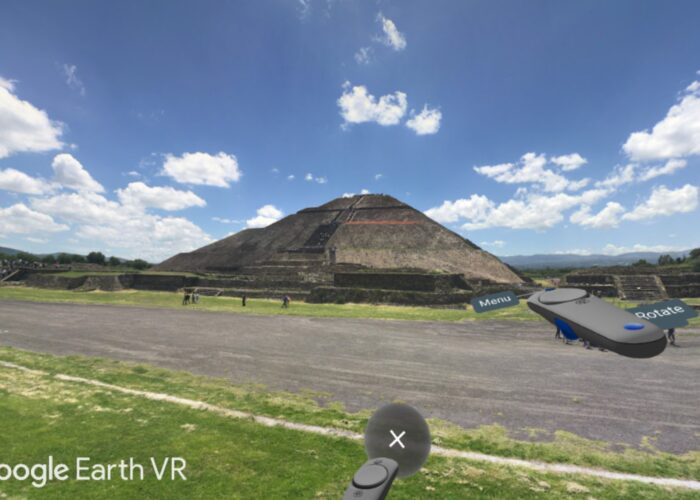
Google Earth VR view of a pyramid
0

Immersive Education: Virtual Reality and Project-Based Learning in the History Classroom

This article details a student-centered assignment that integrates primary source analysis and the immersive medium of virtual reality. The goal of the activity was to increase student spatial familiarity and geographic knowledge of historic spaces, as well as expand their interest in primary sources.

Assignment

In the fall of 2018, I began testing a virtual reality system in my 9th-grade world history classroom at the University of Illinois at Urbana-Champaign’s University Laboratory High School. The objective was to develop projects that were both student centered and digitally inflected. It was essential that students have a large degree of autonomy and agency in the development and execution of the digital project (Rogers and Freiberg 1994). Ultimately, I created two assignments that encouraged student creation while bringing together primary source analysis and the immersive medium of virtual reality. For the purposes of this article, I will focus on an assignment where the students used primary sources as the essential texts in the development of a tour of a historic space in Google Earth VR with an HTC VIVE virtual reality system. Using this application and system created a unique set of opportunities and challenges in how we understand and process historical texts. I found that virtual reality facilitated student engagement with the primary sources and allowed for the examination of historical spaces from new perspectives. Placing locations from a historical text on a modern map helped students think about change over time while granting them the ability to explore a map or space in a novel way. In addition, the assignment allowed the students to move beyond the two dimensions of a map or the limited interactivity of a video to create and present information in a uniquely immersive environment. Despite the assignment suffering from some challenging accessibility and collaboration limitations, the students ultimately enjoyed the project and appreciated the opportunity to learn about history while using a new classroom technology.

Many students in a classroom. Some are using virtual reality equipment. Others are looking at a projection of a simulation.
Figure 1. Students demonstrating virtual projects during a “Museum Day” activity.

As a classroom tool, the potential for virtual reality is substantial (Thompson 2018). Both low-end (Google Earth VR) and high-end (HTC VIVE or Oculus Rift) systems allow students to experience media with an unprecedented level of immersion. In comparison to traditional fixed-media, students can explore space in 360 degrees and engage content with a greater level of agency since they are less limited by the viewpoint of the camera. They can take in peripheral details and examine things that might otherwise fall outside the observer’s perspective. They can also visit places that would be too difficult or expensive to travel to. This is particularly useful when teaching world history and addressing topics connected to how humans have historically used space.

With the potential of the VR system and the application in mind, I went about creating a student-centered assignment that would facilitate student agency and autonomy. Although the medium of virtual reality already granted the students a comparatively significant amount of freedom in exploring a space, Google Earth VR does not necessarily encourage student creation. This led me to the idea of using virtual reality as a tool in the development and presentation of a historical tour. Because Google Earth VR has a number of spiritually significant locations fully rendered in 3D, I decided to make this assignment the capstone project of our unit on religion and philosophy.

Figure 2. A demonstration of a student project in Google Earth VR highlighting significant landmarks.A virtual simulation of Teotihuacán. A user navigates to the Pyramid of the Moon and followed by the Pyramind of the Sun. The user enters a 360 degree photo of the base of the Pyramid of the Sun followed by another photo from the pyramid’s top. The user leaves the photos and conducts a brief birdseye view tour of the site.

Over the course of six weeks, the students and I explored a series of texts (primary and secondary sources) through class discussion that highlighted the central beliefs of various world religions and philosophies. With these texts in mind, I envisioned my students creating a virtual tour in which they guided their peers through the narrow streets of Jerusalem or along the treacherous path to the top of China’s sacred Mount Emei. After engaging with these foundational texts, the students then began a three-week period of research and development. For the unit’s capstone project, I curated a list of primary and secondary sources specifically for the project and asked the students to choose a topic based on the available texts. However, I also encouraged the students to think of additional locations and develop their own source lists if they were interested in a topic not represented. Ultimately, the students chose to research a wide variety of sites, including a pilgrim’s guide of the Chār Dhām, Ibn Battuta’s account of the Hajj, a travel guide to Renaissance Rome, and an archeological map of Teotihuacán (Venkatraman 1988; Gibb 2010; Gardiner and Nichols 1986; Millon 1973).

Rows of images of a simulation of Teotihuacán.
Figure 3. A screenshot of a student itinerary in Google Earth VR.

I then encouraged the students to create an itinerary of important locations that provided the relevant historical context. Students consulted secondary sources while keeping in mind a series of questions: What characteristics make/made these locations so meaningful to adherents? What insights do the texts provide that could not be gained from observing the space in VR? What characteristics of the structures, buildings, or natural features provide insights into the worldview being studied? The itinerary would operate as the script for the tour and be where the students cited their sources. I did not place a page limit on the itinerary; however, I suggested that the tour should be no longer than 35 minutes since we have 45-minute periods. Once they completed their itineraries, the students began practicing with the virtual reality system, learning how to manipulate the controllers and mapping their locations. Finally, the students then spent a few weeks giving their tours as groups. Each group consisted of four members, and the students alternated between the role of guide and operator. The guide would present the information from the itinerary while the operator helped their classmates view locations in VR. This ensured that each student had the opportunity to present and, more importantly for the students, spend time in virtual reality.

Three students stand at the front of a classroom. They are pointing at a computer and consult a map. A student stands behind them wearing virtual reality equipment.
Figure 4. Students mapping their locations in Google Earth VR using an archeological map of Teotihuacán.

The students wrapped up the project with a critical reflection of their own work, their group’s dynamics, and the project as a whole. Overall, the students reported generally positive impressions of the project. When surveyed about their experience, the students commented that using VR helped them better conceptualize, in terms of scale and proximity, the locations that they toured as both a guide and an observer. Multiple students reported being better able to “visualize” the location that they guided their classmates or were guided through. In their survey responses, they expressed an improved ability to “visualize the important architectural aspects of various historical buildings,” develop “a better geographical understanding of what places looked like and how they look now,” and experience “certain ancient locations which otherwise could only be described by models or drawings.” The student feedback demonstrates a clear form of “lived learning” comparable to field trips and other types of experiential learning (Coughlin 2010). Although it cannot replace the experience of a field trip, using virtual reality may provide opportunities to experience locations that would otherwise be inaccessible to most students.

Figure 5. Students presenting their itineraries to their classmates.Students standing in front of a classroom of their peers. One student wears virtual reality equipment. Another students describes what the student in VR sees.

Despite the expressed student excitement about using a state-of-the-art VR system, there are some significant limitations to the use of virtual reality in the classroom. Some students voiced frustrations in their end-of-project reflections about learning to operate the controls while others experienced some minor motion sickness, which is not uncommon with VR. Perhaps, the largest limitation for using virtual reality is accessibility. The expense of purchasing a virtual reality-capable PC and a VR system would likely be cost prohibitive for many teachers. However, the project could be modified to be significantly less costly by integrating Google Cardboard headsets and the Google Tour Creator application. This would limit some of the immersive experience but still capture a significant portion of the experiential qualities that students found so appealing.

Overall, the project highlighted the pedagogical potential for virtual reality and other immersive technologies in the history classroom. Moving towards a more interactive mode of engagement allowed my students to analyze and synthesize sources in new and exciting ways. Despite its accessibility limitations, virtual reality allows students to engage in forms of “lived learning” that they might otherwise not be able to access. However, it is important to maintain an emphasis on the hard work of the historian and not become overly reliant on any new technology. When paired with traditional pedagogical practices, like primary source analysis, immersive technologies can be a useful educational tool. As virtual reality systems and the hardware required to run them become more affordable, virtual reality will likely become more ubiquitous in the classrooms.

Bibliography

Coughlin, Patricia K. 2010. “Making Field Trips Count: Collaborating for Meaningful Experiences.” Social Studies 101, no. 5 (August): 200–210.

Gardiner, Eileen, and Francis Morgan Nichols. 1986. The Marvels of Rome: Mirabilia Urbis Romae. New York: Italica Press.

Gibb, H.A.R. 2010. The Travels of Ibn Battuta, A.D. 1325–1354. Farnham, England: Ashgate.

Millon, René. 1973. The Teotihuacán Map. Austin: University of Texas Press.

Rogers, C.R., and H.J. Freiberg. 1994. Freedom to Learn. Columbus: Merrill/Macmillan.

Thompson, Meredith. 2018. “Making Virtual Reality a Reality in Today’s Classrooms.” THE Journal: Technology Horizons in Education, January 11. https://thejournal.com/Articles/2018/01/11/Making-Virtual-Reality-a-Reality-in-Todays-Classrooms.aspx?Page=1.

Venkatraman, G. R. 1988. Chār Dhām Yātra: Ecstatic Flight into Himalayas. Bombay: Bharatiya Vidya Bhavan.

About the Author

Andrew Wilson holds a PhD in history from the University of Nebraska-Lincoln. He is currently a teaching associate at the University of Illinois at Urbana-Champaign’s University Laboratory High School and was named a Levenick iSEE Teaching Sustainability Fellow for 2020 by the Institute for Sustainability, Energy, and Environment (iSEE) at the University of Illinois Urbana-Champaign.

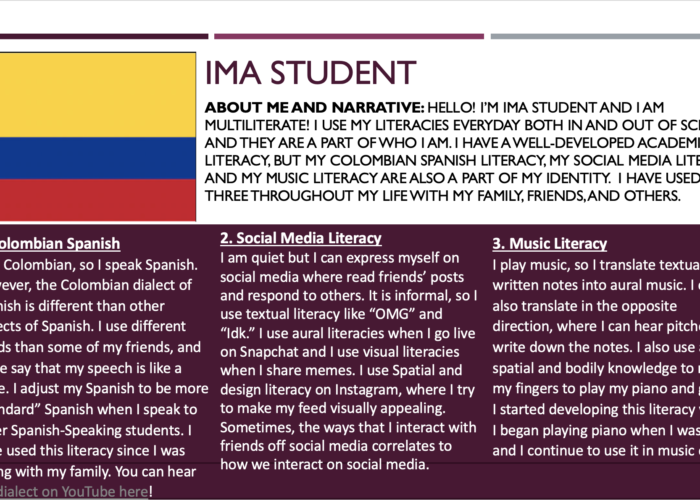
Composite profile for “Ima Student.” The profile starts with an introduction and an image of the Colombian flag in the top third of the profile. In the bottom section, the profile has numbered three literacies with three headings. The first heading is Colombian Spanish and, it includes a link to a YouTube video demonstrating the literacy. The profile also includes descriptions about Ima Student’s social media literacy and their music literacy.
0

Diluting the Dominance of SAE: A Multiliteracies Profile Sequence and Assignment

This Multimodal Profile, supplemental paper, and assignment sequence was designed to help students build a bridge between their social media compositions and their academic compositions to promote high-road transfer and value students’ multiliteracies.

Introduction: Multiliteracies, Multimodality, and Social Media

Though there are world “Englishes” (Ding and Savage 2013), Standard Academic English (SAE) is used in higher-education classrooms in the United States. However, English-only policies (Flowers 2019) and grading policies where white teachers judge students’ language (National Council of Teachers of English 2019) perpetuate racism by privileging certain identities (Andalzúa 2001; Lippi Green 2012). As such, teachers need to actively promote other literacies to challenge the hegemony of SAE (Paris 2012). However, reacting to SAE also reinforces boundaries and fails to recognize the labor of rhetors (Horner and Alvarez 2019). As such, pedagogues have wrestled with how to value students’ Englishes with multiliteracies (The New London Group 1996) and translingual pedagogies (Horner and Alvarez 2019; Flowers 2019).

Scholars have sought to value multiliteracies by incorporating multimodality (i.e. linguistic, visual, gestural, auditory, and spatial design) into their assignments (Kress 2010; Hung, Chiu, and Yeh 2012) and many have turned to social media. In writing classrooms, social media can be a useful tool for instructors because students can transfer their existing social media writing skills into academic settings (Vie 2008).

However, social media poses several challenges; online compositions put vulnerable students at risk of harassment (Gruwell 2017) and they expose students to surveillance technologies (Beck 2018). Furthermore, students may not see social media writing as connected to academic writing (Shepherd 2015). However, teachers can prompt students to form connections between social media and academic writing through metacognitive reflections about their rhetorical choices (Shepherd 2018). These metacognitive choices are important because they promote “high-road” transfer (Perkins and Salomon 1988), which is the process by which learners derive abstract and general principles to “transfer” their knowledge to other situations (3). Ultimately, when teachers help students to derive general principles from their social media writing, students can then apply those concepts in the classroom.

The Multiliteracies Profile Assignment

Taking up Shepherd’s (2018) call for instructors to facilitate high-road transfer, I developed a Multiliteracies Multimodal profile assignment (see Appendix A) and sequence. I built from Lee, Ardeshiri, and Cumins’ (2016) work with world Englishes, which included a multimodal profile (604). In my assignment, students can make the multimodal profile offline and they compose a paper explaining their rhetorical choices.

Readings and scaffolding

My readings and discussion board posts reflect my institutional context, so students have readings from Language Diversity and Academic Writing and Naming What We Know. Additionally, students read an article about the rhetorical situation, which generally refers to the writer, audience, constraints, and exigency of the composition (Grant-Davie 2017). However, teachers should alter these readings for their contexts.

My discussion board posts (see Appendix B) scaffold the assignment over four weeks. The posts help students to create knowledge and consider their audiences (Warnock 2009, 71–72), but they are low stakes to give students space to think (83–84). Prompts encourage students to connect to their personal lives, but the questions connect back to the readings (MacMillan, Forte, and Grant 2014).

The multimodal portion of the assignment

The multimodal portion of the assignment has clear and specific guidelines, though I tried to anticipate student questions by including links to resources (Jackson 2019). These links are important, as they can motivate students, invite them to interact, and engage them in a kind of conversation (Ho and Yao 2019). Furthermore, I tailored this assignment to my institution and local community. In particular, following Madruga (2020), I included a hyperlink to a Spanish version of the assignment for my Hispanic-Serving Institution (HSI) (see Appendix C).

Ideally, the assignment would require all of the different modes. However, in practice, pedagogy should guide the use of technology (Gibson and Martinez 2017). To include aural and gesticular components, students would need both technical skills and recording software, which I could not guarantee that they had. As such, I prioritized access and made those components optional.

The supplemental paper portion of the assignment

The assignment includes a supplemental paper to promote metacognition. Teachers will need to decide whether they will require students to code-switch (consciously switch to SAE) or code-mesh (consciously blend multiple languages) (Young and Martinez 2011) in grading. There is a paradox in grading these papers based on SAE, as this would reinforce the hegemony of SAE. However, as with all assignments, this assignment reflects the language policies of my circumstances as a graduate student. Ideally, teachers would design multiliteracies assessments (Jacobs 2013) and use grading contracts (Inoue 2019).

The paper is important for several reasons. First, as a white woman whose knowledge is situated in my experiences, the paper gives students another way to express themselves beyond the profile. Second, the paper prompts students to make connections between their social media compositions and their classroom compositions; they must connect back to readings, use metalanguage, explain their rhetorical choices, and consider their audiences’ prior knowledge.

Teaching Reflections on Implementation

Overall, students responded positively to the assignment when I implemented it into two of my face-to-face class first-year composition classes in Fall 2019 in a large, research-oriented, HSI in the Southeastern United States. The assignment had to be modified to fit my position though; I had to alter the readings, so students did not complete the discussions, though they did complete similar reflective quick-writes. I did not seek IRB approval and, for the privacy of my students, I only report holistically on the assignments and my experiences.

Since I created an example of the assignment in PowerPoint, many students also used PowerPoint. Though I told students about the risks of harassment, some created online profiles, with some creating their own websites. Allowing students to create their own websites as a compositional tactic opened doors to computer science and information technology students. This is important because students in these majors often see composition classes as pointless.

Many students created profiles reminiscent of a social media profile, though some created their own formats entirely. Both designs demonstrated spatial and rhetorical choices. Furthermore, students were aware of the fonts, sizes, and colors in their compositions. Finally, students demonstrated rhetorical awareness and directed their readers through their non-linear text with symbols.

Students also represented their multiple intersectional identities (Crenshaw 1989). They highlighted the different literacies that they used in the different roles that they played in their lives, including their (inter)national, athletic, and musical roles. Importantly, about one-third referred to their “social media literacies” directly, while many others referred to their “computer” or “Internet” literacies. When they did talk about social media, they often referred to how they rhetorically used different platforms differently. This highlights the possibility that those students began to build a bridge between their extracurricular and academic composing practices. Though one-third is less than ideal, this is a crucial step for students to develop high-road transfer (Shepherd 2018).

There were some challenges. Some students resisted seeing their social media writing as a form of writing, and others were (understandably) skeptical of social media. Though we talked about literacy explicitly in the course, the assignment would have been more successful if I had dedicated more time to talking about literacy, as some students struggled to grasp the concept and it became too abstract. In their papers, some of the students were still wrestling with the vocabulary. However, by the end of the semester, students acquired the metalanguage critical for high-road transfer (Jacobs 2013; Shepherd 2018).  

Bibliography

Adler-Kassner, Linda and Elizabeth Wardle, eds. 2016. Naming What We Know. Boulder: University Press of Colorado.

Andalzúa, Gloria. 2001. “From Borderlands/La Frontera.” In The Rhetorical Tradition: Readings from Classical Times to the Present. 2nd ed. edited by Patricia Bizzell and Bruce Herzberg, 1582–1604. Boston: Bedford/St. Martin’s.

Beck, Estee. N. 2018. “Sustaining Critical literacies in the Digital Information Age: The Rhetoric of Sharing, Prosumerism, and Digital Algorithmic Surveillance.” In Social Writing/Social Media: Publics, Presentations, and Pedagogies, edited by Douglas M. Walls and Stephanie Vie, 37–52. Boulder: University Press of Colorado. https://wac.colostate.edu/docs/books/social/chapter2.pdf.

Crenshaw, Kimberlé. 1989. Demarginalizing the Intersection of Race and Sex: A Black Feminist Critique of Antidiscrimination Doctrine, Feminist Theory and Antiracist Politics. Chicago: University of Chicago Legal Forum.

Ding, Huiling and Gerald Savage. 2012. “Guest Editors’ Introduction: New Directions in Intercultural Professional Communication.” Technical Communication Quarterly 22, no. 1 (December): 1–9. https://doi.org/10.1080/10572252.2013.735634.

Eaton, Angela. 2013. “Students in the Online Technical Communication Classroom: The Next Decade.” In Online Education 2.0: Evolving, Adapting, and Reinventing Online Technical Communication, edited by Kelli Cargile cook and Keith Grant-Davie, 133–158. New York: Routledge.

Flowers, Katherine S. 2019. “Resisting and Rewriting English-Only Policies: Navigating Multilingual, Raciolinguistic, and Translingual Approaches to Language Advocacy.” Literacy in Composition Studies 7, no. 1 (March). http://dx.doi.org/10.21623%2F1.7.1.5.

Gibson, Keith and Diane Martinez. 2017. “From Divide to Continuum: Rethinking Access in Online Education.” In Online Education 2.0: Evolving, Adapting, and Reinventing Online Technical Communication, edited by Kelli Cargile cook and Keith Grant-Davie, 197–211. New York: Routledge.

Grant-Davie, Keith. 2017. “Rhetorical Situations and Their Constituents.” In Writing About Writing: A College Reader, edited by Elizabeth Wardle and Douglas Downs, 487–509. Boston: Bedford/St. Martin’s.

Gruwell, Leigh. 2017. “Writing Against Harassment: Public Writing Pedagogy and Online Hate.” Composition Forum 36, (Summer). https://files.eric.ed.gov/fulltext/EJ1151291.pdf.

Ho, Jeffrey. C. J. and Mike Z. Yao. 2018. “Encouraging Learners to Explore Websites: Hyperlinks as Invitations.” The Journal of Educators Online 15, no. 2 (July). https://doi.org/10.9743/jeo.2018.15.2.4.

Horner, Bruce and Sara P. Alvarez. 2019. “Defining Translinguality.” Literacy in Composition Studies 7, no. 2 (November). http://dx.doi.org/10.21623%2F1.7.2.2.

Hung, Hsui-Ting, Yi-Cheng Jean Chiu, and Hui-Chin Yeh. 2012. “Multimodal assessment of and for learning: A theory-driven design rubric.” British Journal of Educational Technology 44, no. 3 (July), 400–409. https://doi.org/10.1111/j.1467–8535.2012.01337.x.

Inoue, Asao B. 2019. Labor-Based Grading Contracts: Building Equity and Inclusion in the Compassionate Writing Classroom. Fort Collins: The WAC Clearinghouse. https://wac.colostate.edu/docs/books/labor/contracts.pdf.

Jackson, Sherion. H. 2019. “Student Questions: A Path to Engagement and Presence in the Online Classroom. Journal of Educators Online 16, no. 1 (January). https://www.thejeo.com/archive/2019_16_1/jackson.

Jacobs, Gloria E. 2013. “Designing Assessments: A Multiliteracies Approach.” Journal of Adolescent & Adult Literacy 56, no. 8 (May): 623–626. https://doi.org/10.1002/JAAL.189.

Kress, Gunther. 2010. Multimodality: A social semiotic approach to contemporary communication. New York: Routledge.

Lee, Kyungmee, Minoo Ardeshiri, and Jim Cummins. 2016. “A computer-assisted multiliteracies programme as an alternative approach to EFL instruction.” Technology, Pedagogy and Education 25, no. 5 (February): 595–612. https://doi.org/10.1080/1475939X.2015.1118403.

Lehman, Rosemary M. and Simone C.O. Conceiçâo. 2014. Motivating and Retaining Online Students: Research-Based Strategies that Work. San Francisco: John Wiley & Sons.

Lippi-Green, Rosina. 2012. English With An Accent: Language Ideology and Discrimination in the United States . 2nd ed. New York: Routledge.

Looker-Koenigs, Samantha, ed. 2018. Language Diversity and Academic Writing: A Bedford Spotlight Reader. Boston: Bedford/St. Martin’s.

MacMillan, Thalia, Michele Forte, and Cynthia Grant. 2014. “Thematic Analysis of the “Games” Students Play in Asynchronous Learning Environments.” Journal of Asynchronous Learning Networks 18, no. 1 (April). https://doi.org/10.24059/olj.v18i1.332.

Madruga, Natalia. 2020. “Teaching Writing about Writing in the Commonplace of a Title 3 Hispanic Serving Institution.” Paper to be presented at Conference on College Composition and Communication, Milwaukee, WI, United States, March 25–28, 2020. (Conference canceled).

Markham, Annette. 2012. “Fabrication as ethical practice.” Information, Communication & Society 15, no. 3: 334–353. https://doi.org/10.1080/1369118X.2011.641993.

National Council of Teachers of English. 2019. Apr. 4. “Asao B. Inoue #4C19 Chair Address” Filmed March 20, 2019 at David L. Lawrence Convention Center, Pittsburgh, PA. Vide, 46:23. https://www.youtube.com/watch?v=brPGTewcDYY&feature=youtu.be.

The New London Group. 1996. “A Pedagogy of Multiliteracies: Designing Social Futures.” Harvard Educational Review 66, no. 1 (Spring). https://doi.org/10.17763/haer.66.1.17370n67v22j160u.

Paris, Django. 2012. “Culturally Sustaining Pedagogy: A Needed Change in Stance, Terminology, and Practice.” Educational Researcher 41, no. 3 (April): 93–97. https://doi.org/10.3102/0013189X12441244.

Perkins, David N. and Gavriel Salomon. 1988. “Teaching for transfer.” Educational Leadership 46, no. 1. (September). 22–32. https://eric.ed.gov/?id=EJ376242.

Shepherd, Ryan. 2015. “FB in FYC: Facebook Use Among First-Year Composition Students,” Computers and Composition 35 (March): 86–107. https://doi.org/10.1016/j.compcom.2014.12.001.

Shepherd, Ryan P. 2018. “Digital Writing, Multimodality, and Learning Transfer: Crafting Connections Between Composition and Online Composing.” Computers and Composition 48 (June): 103–114. https://doi.org/10.1016/j.compcom.2018.03.001.

Vie, Stephanie. 2008. “Digital Divide 2.0: ‘Generation M’ and Online Social Networking Sites in the Composition Classroom.” Computers and Composition 25, no. 1 (December): 9–23. https://doi.org/10.1016/j.compcom.2007.09.004.

Warnock, Scott. 2009. Teaching Writing Online: How and Why. Urbana: National Council for the Teachers of English.

Young, Vershawn Ashanti and Aja Y. Martinez. 2011. Code-Meshing as World English: Pedagogy, Policy, and Performance. Urbana: National Council for Teachers of English.

Appendix A: Multiliteracies Profile Assignment

Please note: I have removed the hyperlinks from this document to protect the privacy of myself as the links would link back to my personal accounts, but I indicate where they would be with red underlined text. I have maintained the hyperlinks to other Web resources with the standard blue underlined text.

Appendix B: Scaffolded Readings and Discussion Board Posts

Please note: Following Madruga (2020), I linked to a Spanish version of the assignment, which I created with Google Translate. As such, the translation is imperfect. I have removed the hyperlinks from this document to protect the privacy of myself as the links would link back to my personal accounts, but I indicate where they would be with red underlined text. I have maintained the hyperlinks to other Web resources with the standard blue underlined text.

Appendix C: Asignación de perfiles de multialfabetización

Appendix D: Composite Student Profile

Please note: I did not seek IRB approval to use student work and I want to protect my students’ privacy. As such, I have created a composite example (Markham 2012) of some of the Multiliteracies Profiles that students turned in for the class. To create the composite, I went back through their assignments and picked out some of the key components that stood out to me. I tried to keep their phrasing and sentiments as true to their original assignments as possible to avoid colonizing their voices for this example.

Composite profile for 'Ima Student.' The profile starts with an introduction and an image of the Colombian flag in the top third of the profile. In the bottom section, the profile has numbered three literacies with three headings. The first heading is Colombian Spanish and, it includes a link to a YouTube video demonstrating the literacy. The profile also includes descriptions about Ima Student’s social media literacy and their music literacy.
Figure 1. Composite profile for “Ima Student.”

About the Author

L. Corinne Jones is a PhD candidate in the Texts and Technology program at the University of Central Florida where she is specializing in Rhetoric and Composition. Her research focuses on social media and circulation studies and her other work has appeared in Computers and Composition Online and First Monday. She also teaches first-year composition, business and technical communication, and legal grammar.

Chance Encounters: Pedagogical Methodologies for Teaching Creative Coding

This paper presents a model for teaching drawing with computer programming, using conceptual and visual characteristics of twentieth century avant-garde painting practices. It examines how this pedagogic methodology is then developed to combine, synthesize, and apply these insights algorithmically, using the Python programming language, to produce generative artistic forms that can be evaluated and iteratively refined. The learning unit’s goal is to provide media production students with a tangible formula to continually build their critical, creative, and technical skills as they engage with visual culture.

We often overlook how much of our lives hinge on chance events. From the economic, geographic, and educational environments that we are raised in, to our genetic makeup, these chance occurrences can have a far greater impact on shaping our lives than whatever individual efforts we put forth. How might students develop a creative process that embraces these contingencies in their work? How can an educator inspire undergraduate students who may not have an art history or programming background to imaginatively foster unpredictable artistic outcomes through rigorous procedural thinking? What models can be used for students to embrace problem solving and play in assignments?

I consider these questions in Creative Code, an undergraduate course intended to explore the concept of computer programming as a creative endeavor to produce algorithmically generated artwork. This class provides a foundation in computational skills and aesthetic systems in preparation for advanced classes in programming for gaming, physical computing, and web development in emerging media. In Creative Code we focus on crafting algorithmic poetry, drawing, and sound production using different coding environments and aesthetic tactics to learn essential programming skills. For this unit I model an aesthetic and technical methodology that demonstrates how to identify concepts like chance, constraint, and repetition from the analysis of artistic and programming examples. We then combine, synthesize, and apply these insights to produce new hybrid artistic forms that can be evaluated and refined so students have a formula to continually build their critical, creative, and technical skills.

Presentation and Discussion Methodology

The teaching sequence begins with an analysis and discussion of representative artworks then shifts to in-class programming exercises and is followed by a homework assignment that explores and refines algorithmic drawing. To ground our programming work within a theoretical and aesthetic context, we analyzed and discussed Marcel Duchamp’s Three Standard Stoppages (1913). Duchamp’s piece was created by dropping a meter-long string three times onto separate canvases at a height of a meter and then adhering the string’s unplanned placement to the canvas. This approach, known as using a ‘chance operation’ within the field of the arts, is a process that leaves some element of randomness in the outcome of the artwork. During our discussion of the piece, I asked the students why artists would be interested in incorporating random elements into their authorial vision. I was surprised by the variety of the answers they provided: students gave examples of unpredictable moments that connected to their daily lives, from unexpected delays on the subway to disruptions in internet service. Students suggested that artists who work with chance may be interested in bringing the arbitrariness of existence into their artistic practice.

We then turned our attention to the use of constraint systems, a set of rules or restrictions that limit the range of possible materials, treatments, or outcomes for the creation of art. In the case of Three Standard Stoppages, we saw how there were limitations put to aspects of the piece to give it unity and cohesion, like the fact that each string was the same length and dropped from the same height. These constraints allow for the chance act of the dropping of the string and its physical movement through air, and memorializing the incidental physics at play to have more of an impact in the comparisons when viewing the three pieces together. In addition to Duchamp’s piece, we also looked at the drawing process of contemporary artist Sougwen Chung and how she incorporates chance behavior of traffic patterns in New York City as part of the mark making process in her collaborative artworks with robots. In her duet painting performance Omnia per Omnia (2018), a video camera’s live feed of a traffic intersection in Manhattan is analyzed by a motion engine software analytics program developed at Nokia Bell Labs. Information about the walking patterns of pedestrians and cars is then sent to a swarm of robots that are painting on the same canvas as Chung as she responds to their lines and shapes. The piece mixes chance and constraint because the behavior of the individuals at the intersection is unpredictable but limited by the use of just one particular intersection. The traffic signals function as a set of rules that guide behavior and there is a filtering of the data from the computer vision so only higher-order statistics are sent to the robots for their drawing patterns, not all the data collected (Chung 2018). In discussion of both artworks, the function of repetition was also considered, noting the importance of repeating a process over time for Duchamp and the use of multiple robots creating a small swarm of drawing collaborators with Chung.

This introduction to chance occurrences, constraints, and repetition was then followed by an additional presentation of artwork created in the Russian Suprematism movement, an approach championed by Kazimir Malevich, El Lissitzky, and Lakov Chernikhov. These artists wanted to move away from figurative painting, its history and connotations; they wanted to exclude all imagery except primitive geometric shapes. By critically looking at artworks created in this movement we noticed the parameters that the artists used to produce an infinite variety of imagery through the manipulation of the elements of art and design. The artists used variation in the length of lines in their artwork, the thickness of the lines, the hue, saturation and brightness of the colors of the geometric shapes, and location of the placement of objects on the two-dimensional plane.

In-Class Exercise

After our discussion and analysis of Duchamp, Chung and the Suprematists, the first computer programming exercise was introduced: create an algorithmic drawing that incorporates chance occurrences that is inspired by the Suprematist manipulation of basic geometric shapes. As a conceptual starting point for tackling the exercise we looked at taking the elements of design we identified in our analysis of the images (line, shape, color) and identified how the parameters that give them a specific character (width, length, hue, etc.) can become variables that can manipulated in a computer program. By creating a variable for the length of a line, the thickness of a line, the hue, saturation and brightness of the color, the size, height, and width of the geometric shapes, for instance, we would then be able to assign values from a random number generator in Python to these parameters. Each time the computer program is run it would draw a geometric shape where random variables determine the width, height, location on the screen, and color and then determine different variables the next time it is run.

Student Created Computationally Generated Geometric Design,
Figure 1. Student artwork created with Python programming inspired by the Suprematist movement.

To help students get started on their first algorithmic drawing, a starter file was provided that offered an example of how a line can be drawn as well as a simple shape with the Python library TkInter. In the sample code, one variation for manipulating the hue parameter was shown and it was left to the students to continue to build on many of the additional parameters available for lines and shapes.

Once students had completed the first exercise, a second exercise scaffolded skills learned in a prior class by applying a programming technique called a “for loop.” This is a technique common in many programming languages that enables the programmer to repeat a process a designated amount of times. Students were asked to use a “for loop” to draw one hundred lines or shapes that feature randomness in their drawing. So instead of drawing just one element at a time with a block of code, the goal was to create an algorithm that could generate multiple iterations of a line or shape with varying parameters for each iteration of the “for loop.” Essentially, students could wrap the code from the prior exercise and automate the running of it multiple times. Once students were able to get this second exercise working, we took a moment to evaluate the output. This is an important step in computational art: students learn that although we are handing over some of the control of the artwork to chance operations, the artistic process is still iterative and evaluative. Just as the process of painting or drawing incorporates decisions on whether to erase or refine certain areas, in the digital realm we also look to see if we are getting the behaviors we find aesthetically compelling from the program and hone the code based on our impressions. For instance, if we feel the colors are too saturated or the lines are going too far over to one of the edges of the image, we can modify the parameter ranges to create the impression we would like to communicate.

A screenshot of small amount of code illustrating the For Loop in Python
Figure 2. “For loop” in the Python programming language.

Picking up on our conversation about constraint systems from Duchamp and Chung, we considered how algorithmic constraint systems could be introduced into our programs. How could limiting the ranges of possibility create a striking visual impact for the work? How could limiting the placement of object on the screen or patterns of overlapping shapes add to the composition’s complexity? The students were encouraged to think aesthetically about the possible ranges for their chance parameters and the use of repeated procedures in artistic expression. Some students created a set of monochromatic colors choices that vary in their amounts of brightness and saturation while others only used circles for their design. During this exercise we discussed how constraints and chance can co-exist within an artwork and it can generate a productive tension within the work.

Homework Assignment

This sequence of in-class presentations and exercises was intended to lay a technical and aesthetic foundation for algorithmic drawing and foster a creative interest in the subject that could be expanded upon with new techniques in their homework. For their take-home assignment, students were given a chapter to read on Object Oriented Programming from their textbook and asked to creatively apply these concepts to their algorithmic drawings from our in-class exercises, converting the code they had written to be used with objects and classes in Python. Their final submission was to include two algorithmic drawings, one based on Suprematists geometric abstraction and the other using a “for loop” to create more than one hundred instances of an object. This homework assignment also required scaffolding knowledge of color theory from a prerequisite class. For each drawing they were to use a color scheme, such as monochromatic, complimentary, split complimentary, or analogous, which drew on their design knowledge to create a unified visual look for their piece. In that previous course, they learned how to create a color scheme with a graphic interface in Adobe Photoshop; however, in Creative Code the color scheme was to be created using programming in a text editor.

Outcomes and Reflections

One of the outcomes of this sequence in the class is to enable students to look at their daily visual surroundings and to consider how aspects of art and design might be created computationally. How can I make something I see? How can the elements that constitute an image be turned into variables that can be programmed and automated? This process can help students improve their problem-solving skills and improve their ability to think programmatically and break down ideas into smaller achievable steps. This attention to their visual surroundings can also foster a greater sense of play between analysis and creativity that supports and refines both of these areas.

Not only was this exercise/sequence intended to model procedural thinking, it was also intended to model a methodology for developing a creative computational practice. By fusing two different artistic approaches in this exercise (chance operations and Suprematist geometric abstraction) with two programming approaches (generating random values and looping repetitions) I modeled a framework for making computational artwork. This mode of production emphasizes remixing both the artistic influences and technical skills the student has learned to synthesize these sources and yield inventive new creations.

One issue that this exercise clarified for me was to reconsider the choice of software that is appropriate for both computational poetry and algorithmic drawing. The TkInter library is a little opaque in aspects of its organization and can be confusing for a student’s initial exposure to working with code. The Processing programming language seems far better suited for first time users to begin creative explorations with their drawings. I was worried about shifting between three programming languages in one semester, from Python to Processing and then to Max for the audio and video processing, denying the feeling of proficiency in any development environment. For future iterations, I will remove Python from the course even though it allows for a much wider variety of textual analysis and manipulations for our computational poetry work. I plan on using this assignment again, this time with the Processing programming language, and comparing the results.

After looking at the student submissions of their homework, I was surprised by the variety and overall quality of the graphics from these emerging coders. I have found that the undergraduate students tend to produce some of their best work when the exercise is not too open-ended, where there is room for creativity and variation but within a focused field of play. The students seem to enjoy the ability to generate work that was visually compelling without hundreds of lines of code. Based on their in-class reactions, another pleasurable aspect of this exercise for the students was their excitement to produce one hundred or even one thousand shapes based on just a few minor modifications of their program. For the students’ final project, they were able to choose from any of the computationally generated artistic approaches we covered (sound composition, generative poetry, video processing or algorithmic drawing) and over a third of the class used algorithmic drawing as a significant part of the final project, suggesting this combination of exercises, discussions, and homework instilled an interest in diving deeper into this area. Through this sequence, students were able to see the aesthetic potential of programming as a rewarding area for deep creative explorations.

Bibliography

Chung, Sougwen. 2018. Omnia per Omnia. Accessed August 15, 2020. https://sougwen.com/project/omniaperomnia.

About the Author

Andrew Demirjian is an interdisciplinary artist who works with remix, rhythm and ritual. His work has been exhibited at The Museum of the Moving Image, Eyebeam, Fridman Gallery, Transformer Gallery, Rush Arts, the White Box gallery, the Center for Book Arts, The Newark Museum and many other galleries, festivals and museums. The MacDowell Colony, Nokia Bell Labs, Puffin Foundation, Artslink, and Harvestworks are among some of the organizations that have supported his work. He is a Fellow at the MIT Open Documentary Lab and teaches emerging media courses in the Film and Media Department at Hunter College.

When Wikipedia Fought Back

In this short essay, the author explains what went wrong when he asked his students to tackle an ill-conceived project—an in-class Wikipedia edit—and what he’d do differently next time.

In the fall of 2018, at my last institution, a smaller, teaching-focused university in the Pacific Northwest, I tried—and failed—to use Wikipedia in my survey of digital media course.


The assignment? I urged my students to attempt to edit our institution’s entry on Wikipedia. I had them first read Wikipedia’s own “simple” rules for editing entries (though these by no means are necessarily user-friendly or transparent to beginners, in retrospect). With these rules in mind, I tried to offer some guidance, and we spent the first twenty or so minutes of class creating profiles and discussing how, exactly, to add text, images, and links to Wikipedia entries. It was part of a larger unit on wikis and collaborative digital tools. I was excited. I figured that even if we just succeeded in adding some small bits of information to the page, that would be a success. Students, however, were technically going to be graded on a self-reflection forum post afterward, so it was not necessary that they “succeed” at the process. That helped lower the stakes, but provided enough motivation for students to at least attempt the assignment. 


Like many of my colleagues, I had the best of intentions. I was going to lean in, darn it, to my students’ own learning habits (Wineburg 2018). Inspired by scholar-teachers smarter and savvier than I, I was going to have one of those collective “a-ha!” moments we all yearn for, when, in the silence of an air-conditioned, sun-lit space, the scent of marker lingering in the air, you turn, excitedly, from the whiteboard to gaze upon the newly enlightened faces of your students, who burst into applause.
That did not happen.


As I planned the in-class exercise the night before class, I realized too late that we might get pushback from Wikipedia’s infamously irascible and mysterious volunteer editors (Dougherty and O’Donnell 2015).
“But we’re just adding some innocuous info,” I thought—details like the names of buildings and programs. “What’s the worst that could happen?”

First Mistake

I soon learned, about 25 minutes into the whole affair, that, in fact, a great deal can go horribly wrong when you forget that the thing you’re toying with in real time—in our case, again, our university’s Wikipedia page—can fight back. Wikipedia, my friends, is very much alive.
It started innocently enough. One of my more engaged students raised her hand.
“Umm, Dr. Mari, I think Wikipedia doesn’t like how we’re all in this page editing it together right now.”
I strode over—surely, of all the pages in the wide world of Wikipedia, ours wouldn’t have some kind of odd editing cap on it, right? 

And yet, lo, it did! “Hmmm,” I said. And then I improvised.
“Pair up with Joon,” I said.[1]
And sure enough, things continued well enough for a bit. My students added some benign, or so I thought, facts about our volleyball team, the names of our new degree programs, some of our campus ground’s highlights, and so on. 

But then, one mischievous student decided to get a little… silly.

Second Mistake

“What if I just make up something dumb and put it in here?” he asked me.
“Like what?” 

“Well, what if I add myself to the list of famous alumni?” 

I thought about this for a second. On the one hand, I didn’t want to encourage the accumulation of garbage information in the world and turn my class into a fake news farm. I’d rather not become the subject of a cautionary tale in a journal somewhere.
But … we had just talked about how Wikipedia has a strong internal editing culture—as controversial and problematic as it can be—and I did want to show the students, instead of just prattling on about it.[2] I pushed aside the voice in my head that was saying, “wait a second here, sir.”
“Sure,” I said instead. “Try it and see what happens.”
And so he added his name, and the names of a few friends, for good measure. Within moments, it was deleted. I pulled up the editing log—a veteran Wikipedia volunteer editor, working under a pseudonym, had already corrected the record.
“There, everyone,” I pointed to the projected screen behind me, “just like I told you. This isn’t the Wikipedia of my time as an undergrad, a decade ago. Things have changed for the better and this engagement is part of why Wikipedia…” (see Ayers et al. 2008).
Various hands began shooting up, like baby asparagus shoots.
“Maybe this thing is working after all,” I thought, perhaps a touch too proudly. “Maybe I’m pretty good at this.”
It wasn’t, and I’m not.
My students’ careful and fact-based links, edits, and other changes were being erased and wiped clean, in rapid succession, by the original editor, but also now by several others. The word must have gotten out: we didn’t stand a chance!
We still had more than half of class left to go. But within minutes, all my poor students’ work was gone, vanished. They looked up, over the edges of their phones, laptops, and tablets.
They were not pleased.
I took great pains to try to connect what had just happened with our reading from the week, which had included articles both critical and supportive of Wikipedia and its potential as a kind of refuge, a stronghold of fact-checked information, and some of the irony of that.
I am not always fast on my feet with this kind of extemporaneous pedagogy. I have a stutter, and often need my slides and notes to guide me, as I talk fast and mumble more the more nervous I get, especially in front of twenty skeptical students. There’s almost always something else I wish I had said or added after these kinds of moments when teaching, especially with digital tools. I often write long notes afterward via email or post to our class page, debriefing disastrous assignments.
But in the moment, I just… sort of embraced the “successful failure,” to borrow from our friends at NASA (Leinfelder 2020).
I stopped talking. 

My students had questions: would they still get credit? Even though all their edits had been erased? What were we going to do now?
“Yes, I told them, you’ll get credit. We can talk more about this next time.”
Then I ended class early, thinking hard about power dynamics and hidden infrastructures and black boxes (Jemielniak 2015). In this case, “black boxes” are unexamined, taken-for-granted technologies that are not well understood outside of small circles of experts (Anderson and Kreiss 2013). Wikipedia has come a long way, and I need to be more thoughtful about how I unpack it, contextualize it in time and culture (Cummings 2009; Jemielniak 2015), and contrast it with other “legacy” sites such as Craigslist and Reddit (Lingel 2020, Lagorio-Chafkin, 2018). Wikipedia is not so easy to use as a teaching tool. I need to be less so-sure of myself. 

But I think it worked out OK, for a first attempt working through an exercise like this with students. Later, on their course evals, at least one of my students mentioned that day as one of their favorites, because it made them think about the people behind the software curtain. That helped, but now I know—Wikipedia can fight back. Watch out!
I’ll be ready next time. And for next time, I’ll be more mindful of the power of “black boxes” that are a heady mixture of software and hardware, people and intention, momentum and gatekeeping. I will equip my students to better face these hurdles—and overcome them—by reading more critical accounts of the site and how it works.
Maybe we’ll write an entry about it, while we’re at it. 


Notes

[1] Students’ names have been changed for the purposes of this essay.
[2] And as an avid fan of Stephen Colbert, I had enjoyed watching what happened when his team edited entries in the late aughts for fun—and to make a point: https://en.wikipedia.org/wiki/Wikipedia:Wikiality_and_Other_Tripling_Elephants.

Bibliography

Anderson, C.W. and Daniel Kreiss. 2013. “Black Boxes as Capacities for and Constraints on Action: Electoral Politics, Journalism, and Devices of Representation,” Qualitative Sociology 36, no. 4: 365–382. https://doi.org/10.1007/s11133-013-9258-4.
Ayers, Phoebe, Charles Matthews, and Ben Yates. 2008. How Wikipedia Works: And How You Can Be a Part of It. San Francisco: No Starch Press.
Dougherty, Jack, and Tennyson Lawrence O’Donnell. 2015. Web Writing: Why and How for Liberal Arts Teaching and Learning. Ann Arbor: University of Michigan Press. http://www.jstor.org/stable/10.2307/j.ctv65sxgk.
Cummings, Robert E. 2009. Lazy Virtues: Teaching Writing in the Age of Wikipedia. Nashville: Vanderbilt University Press. http://site.ebrary.com/id/10314047.
Dougherty, Jack, and Kristen Nawrotzki. 2013. Writing History in the Digital Age. Ann Arbor: University of Michigan Press.
Jemielniak, Dariusz. 2015. Common Knowledge?: An Ethnography of Wikipedia. Palo Alto: Stanford University Press.
Lagorio-Chafkin, Christine. 2018. We Are the Nerds: The Birth and Tumultuous Life of Reddit, the Internet’s Culture Laboratory. New York: Hachette Books.
Leinfelder, Andrea. 2020. “Lessons from a ‘successful failure:’ Apollo 13 astronaut, flight director recall famous mission.” Houston Chronicle, April 10, 2020. https://www.houstonchronicle.com/news/houston-texas/houston/article/APOLLO13-ANNIVERSARY-15192303.php
Lingel, Jessa. 2020. An Internet for the People: The Politics and Promise of Craigslist. Princeton: Princeton University Press.
Wineburg, Samuel S. 2018. Why Learn History (When It’s Already on Your Phone). Chicago: University of Chicago Press.

About the Author

Will Mari is now an assistant professor at the Manship School of Mass Communication at Louisiana State University, where he teaches media law and media history and continues to research the history of technology and news work.

Images are for demo purposes only and are properties of their respective owners. ROMA by ThunderThemes.net

Skip to toolbar