Issue Thirteen

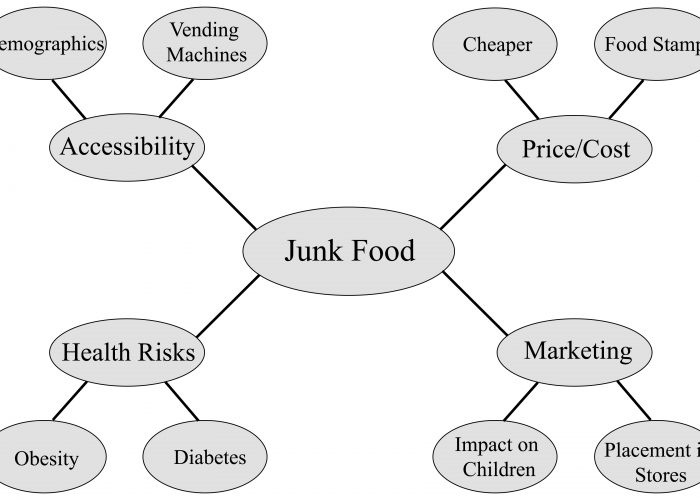
Sample concept map of ‘junk food’ and its related issues, complete with details and examples of each.
0

Advancing Information Literacy in a Semester-Long Library Instruction Course: A Case Study

Abstract

The following case study investigated the efficacy of Information Literacy (IL) pedagogy on undergraduate research in a credit-bearing library instruction class. More specifically, the study analyzed student success and sought to determine whether written reflection and practice strengthen IL skills, including the fundamental ability to develop a research question and thesis statement. Developing research questions and formulating thesis statements are among the most challenging duties of a young researcher. From high school through undergraduate, students often have minimal experience conducting research. They may not know where to begin the research process and what steps are necessary. Student frustration is exacerbated by the fact that typically IL instruction is one-shot guidance, given only once in a semester, making it difficult for a librarian to cover all that is needed. Can a semester long, credit-bearing course aid student success in research and improve IL skills? The instructors introduced several techniques to improve IL skills, and instructors evaluated three class assignments based on their college’s core competencies. Additionally, instructors collected and analyzed students’ written reflections of their progress and an end of semester survey as both qualitative and quantitative data.

Introduction

Information Literacy (IL) is one of the defining concepts of academic librarianship. It influences core functions including reference, collection development and especially library instruction. However, the definition of IL is malleable and influenced by the proliferation of online resources, developments in information technology, and trends in academic publishing, all of which have dramatically altered research methods. In January 2016, the Association of College and Research Libraries (ACRL), a division of the American Library Association (ALA), adopted the Framework for Information Literacy (Framework) for Higher Education. Its six core concepts afford librarians maximum flexibility when teaching IL (American Library Association 2015). This adoption was shortly followed by ACRL rescinding the Information Literacy Competency Standards for Higher Education (American Library Association 2000), which had served as the defining IL document for professional librarianship since 2000. The ACRL Framework defines IL as, “the set of integrated abilities encompassing the reflective discovery of information, the understanding of how information is produced and valued, and the use of information in creating new knowledge and participating ethically in communities of learning.” Moreover, the framework is based on interconnected core concepts with flexible options for implementation, rather than a set of prescriptive standards or learning outcomes.

The Library Media Resources Center (hereafter Library) at LaGuardia Community College, part of the City University of New York (CUNY) founded in 1971, maintains an active and evolving IL program that impacts reference services, library instruction, and credit-bearing courses. The latter is exemplified by LRC103: Internet Research Strategies, a one-credit, liberal arts elective offered by the Library; it has been offered since 2004, and IL is central to the course’s syllabus (Keyes and Namei 2010, 29). The course teaches students “analytical thinking, problem-solving, and information literacy skills necessary for academic research and digital citizenship” (LaGuardia Community College Catalog 2017-2018). Students receive one hour of face-to-face instruction each week, covering concepts (concept mapping, research question development, citation) and resources (subscription databases, digital images, digitized primary sources) central to developing IL. While LaGuardia is not unique in offering a credit-bearing IL course, a 2016 study concluded that only 19% of higher education institutions surveyed offer such courses (Cohen et al. 2016, 566). Due to this small percentage, credit-bearing IL courses present a relatively unique opportunity to teach IL to students. This is particularly true when compared to traditional library instruction sessions, which are typically one hour long and offered once each semester for select courses (e.g. English 101).

The following case study investigated the efficacy of IL pedagogy on undergraduate research in a section of LRC103 offered during the Spring 2017 semester at LaGuardia. More specifically, the study analyzed student success and sought to determine whether written reflection and practice strengthen IL skills, including the fundamental ability to develop a research question and thesis statement. In fact, the ACRL Framework recognizes the importance of research question advancement. As outlined in Research as Inquiry, research “depends upon asking increasingly complex or new questions whose answers in turn develop additional questions” (The Association of College and Research Libraries 2015). Developing research questions and formulating thesis statements are among the most challenging duties of a young researcher. From high school through undergraduate, students often have minimal experience conducting research. They may not know where to begin the research process and what steps are necessary (Fernando and Hulse-Killacky 2006, 103-104). Student frustration is exacerbated by the fact that typically IL instruction is one-shot guidance, given only once in a semester, making it difficult for a librarian to cover all that is needed. Can a semester long, credit-bearing course aid student success in research and improve IL skills? The instructors introduced several techniques to improve IL skills, and instructors evaluated three class assignments based on the college’s core competencies. Additionally, instructors collected and analyzed students’ written reflections of their progress and an end of semester survey as both qualitative and quantitative data. As a platform to post reflection, the authors implemented electronic portfolio (ePortfolio) practice for the course. Deeply embedded in LaGuardia’s academic culture, its current ePortfolio program utilizes Digication software in both pedagogy and assessment (LaGuardia Community College, “About ePortfolio”, 2017). All twelve enrolled students were eligible to participate, and eleven elected to take part in the study.

Literature Review

The following literature review reflects the goals of this study and is not intended to be comprehensive. Unlike conventional library instruction, the uniqueness of this study was that it examined students’ IL skills over the course of an entire semester. The research was empirical, using outcomes-based and affective analysis to study IL pedagogy. This case study expanded on the term project for LaGuardia’s LRC102, Information Strategies: Managing the Revolution, a credit-bearing course previously taught at LaGuardia, which called for an annotated bibliography, accompanied by a narrative of research where students describe the process used to find each item in the bibliography and explain its inclusion. In a study of LRC102, Fluk concluded that further research should be done into how research logs and journal writing affect student learning and how logs and journals should best be assigned (Fluk 2009, 50).

Colleges and universities have targeted the following learning objectives when creating or redesigning credit-bearing IL courses: developing research topics research questions, and thesis statements (Mulherrin, Kelley, Fishman, Orr 2004, 24; Frank and MacDonald 2016, 17). Broadly considered, the literature on measuring and assessing the impact of IL instruction on educational outcomes is varied, especially in the wake of the 2015 adoption of the ACRL Framework, which omitted specific standards, competencies, and learning outcomes. Examples from community colleges and/or credit bearing IL courses were sought for this literature review. Longitudinal studies of students at Hostos Community College, a CUNY school with comparable demographics to LaGuardia’s, and Western Georgia University demonstrated that students taking IL workshops and a credit-bearing IL course, respectively, resulted in higher graduation rates, higher pass rates on reading and writing tests, and higher cumulative grade point averages. The Hostos Community College study results determined that students taking IL workshops experienced a 35.3% graduation rate, compared with 9.8% for students who did not take the workshops. Additionally, students who completed the IL workshop passed the CUNY Proficiency Exams for Reading at a rate of 78.5% and for Writing at a rate of 73.5%; the students who did not take the workshops passed the exams at a rate of 57.6% and 47.2% (Laskin and Zoe 2017, 13-16; Cook 2014, 276-279). Similarly, University of Western Georgia concluded that overall graduation rates for students in the study who completed their credit-bearing IL course graduated within six years at significantly higher rates than those who did not, 56% versus 30% (Cook 2014, 277-278).

In their discussion of CUNY’s Critical Thinking Skills Initiative, Gashurov and Matsuuchi stressed the importance of IL for LaGuardia’s LRC103 course to ensure CUNY students are prepared for today’s competitive job market (Gashurov and Matsuuchi 2013, 70-71). The Critical Thinking Skills Initiative was in part a reaction to the financial crisis of 2007-2008, but LaGuardia’s commitment to IL can be traced back to 1991 when it began offering LRC102. As mentioned above, LRC103 was first offered in 2004 and is central to the Library’s IL program (Keyes and Namei 2013, 29). More recently, the Citation Project, a multi-institutional study on source usage in college writing, has concluded that students struggle with all aspects of citation and comprehending sources: summarizing, paraphrasing, and quotation, to name a few (Jamieson and Howard 2013, 125-126). Jamieson’s further research claims that IL pedagogy based on the ACRL Framework, more so than the older ACRL IL competencies, may help students better understand their sources (Jamieson 2017, 128-129), which matches the goals of the present study.

At the postsecondary level, ePortfolio use has matured from a tool to document professional development to a web portal for accessing work, tracking academic growth, and planning a career, acting as a record of skills, achievements, and learning (LaGuardia Community College, “Introduction: What is an ePortfolio?”, 2017). Nevertheless, academic libraries have been slow implementing ePortfolios as compared to other campus departments, due in part because IL instruction is typically offered once per semester, in one class, and tailored to a specific assignment. However, a few have administered ePortfolios as a method of improving research and critical thinking. In 2008, Three Rivers Community College designed a plan whereby students searched for scholarly articles and then discussed the techniques used to retrieve them in a written reflection of their online learning experience posted into their ePortfolio (Florea 2008, 424-425). More recently, in collaboration with another campus department, the Otis College Library in 2014 created a research assignment that students uploaded to their ePortfolio and that instructors graded using the college’s core competencies (Giuntini and Venturini 2014, 11-15).

Methods and Analysis

Instructed by the authors, the LRC103 class in this study met weekly in one-hour face-to-face sessions for twelve weeks in the spring 2017 semester. Class lessons and assignments aimed to advance student research ability by fostering IL skills. The first class lesson introduced fundamental database tools, such as subject headings and subject term delimiters, to narrow a broad topic down to specific issues and subjects. The technique helps students comprehend article indexing and focuses student research to an elemental concept. For example, a search for “global warming” in a standard database yields thousands of results. However, the recommended subject headings “global warming & politics” and “global warming & the environment” generates a more manageable list. Subject term delimiters, custom to databases, refine this list to specifics.  The assignment accompanying the lesson sought to discover if database tools support critical thinking development. First, it prompted students to write a 200-word description of an article found in a research database, summarizing the author’s viewpoint and any evidence provided in their argument. Next, it asked students to frame and develop a research question for further inquiry related to the article’s topic. Lastly, in a reflection, students explained if writing the summary helped them review and disseminate the material to forge a unique and specific area to research (See Appendix A).

The second lesson demonstrated use of an online encyclopedia, illustrating the expansive subject list available. Then, students read an article on a select topic and gathered keywords. Students made note of words that they felt were key to understanding the topic. The final part of the lesson introduced concept maps, a graphical tool for organizing and representing knowledge. Concept maps break down a topic into related issues, with details or examples for each issue (Appalachian State University: Belk Library and Information Commons 2017). Words are usually “enclosed in circles or boxes of some type, and relationships between concepts [are] indicated by a connecting line linking two concepts” (Novak and Cañas 2008). Using the words marked in the encyclopedia article, students created concept maps. Following this lesson, students completed the second assignment, the class midterm, which asked them to develop a topic and their own argument using methods learned in class. Students had the option to use the first assignment topic or to select a new one. Suggestions provided were affordable housing, human trafficking, and junk food. The instructors recommended that students first break down the topic using a concept map and then develop a related viewpoint or argument from one issue or concept in the map.  For the first part of the midterm, each student needed to find one scholarly article in support of their thesis argument and give a thirty-second, persuasive pitch in class to argue their viewpoint. In their ePortfolio, they provided an MLA citation of the article and wrote a one-paragraph description, which included their thesis statement, an explanation of the topic, and the reason they selected it. In the second part of the midterm, students supported their arguments with two additional scholarly articles, one in support of their thesis and one counterpoint. To showcase their evidence, students created an annotated bibliography. For this class, an annotated bibliography referred to a list of resources, each with a reference citation in Modern Language Association (MLA) style and a summary or evaluation (Stacks, et al. 2017). Finally, in a one-paragraph reflection, students considered whether or not the lesson and midterm helped them narrow down their research and develop their arguments (See Appendix B).

Sample concept map of ‘junk food’ and its related issues, complete with details and examples of each.

Figure 1: Sample concept map of ‘junk food’ and its related issues, complete with details and examples of each.  Concept maps break down a topic or main idea into related issues or concepts, and onto details or examples.

The class final required students to explain the most successful ways to develop a research question based on skills learned in class, in either a five-minute video, five-minute audio recording, or Microsoft PowerPoint presentation of at least five slides. As part of their work, they needed to describe if they will use the skills learned in other classes and assignments (See Appendix C). Lastly, an eight-question survey given to students on the last day of class provided a means to quantitatively measure success of class pedagogy. It was optional and anonymous (See Appendix D).

To evaluate student work, the instructors created an assessment rubric based on one of LaGuardia’s four core competencies, inquiry and problem solving. Inquiry and problem solving is comprised of the ability to design, evaluate, and implement a strategy or strategies to answer an open-ended question or achieve a desired goal. Students advance this competency by framing an issue, gathering evidence, analyzing material, and formulating conclusions (LaGuardia Community College, “Outcomes Assessment”, 2017). Based on this framework, the instructors assessed student work on ability to: 1) analyze and synthesize research material, 2) formulate conclusions to develop research questions and thesis arguments, and 3) understand and integrate IL skills.

Therefore, students who received a letter grade of A on an assignment demonstrated proficient IL skills. A letter grade of B signified competent skills, a C denoted developing skills, and a grade under C deemed the student a novice. In addition to a grade, the instructors also provided constructive feedback to advise students how they could improve their work.
Since each of the three assignments weighed differently towards the student’s final grade, all grades in this article were proportioned based on one-hundred points. For example, if a student assignment received fifteen out of twenty points, the grade was seventy-five, or a C, and the student demonstrated developing IL skills. In addition to grades, the authors analyzed student reflections to draw conclusions on student progress in class and uncover what pedagogies best helped.

Results

In the first assignment, seven students demonstrated proficient skills, two had competent skills, one showed developing skills, and one was a novice, for a class average of 89.5. In a combined midterm grade, six students were proficient, three were competent, one was developing, and one was a novice, for a class average of 89.1. While student work remained at the competent stage in the first two assignments overall, performance improved to proficient on the final, for a class average of 96.7, as students displayed a deeper understanding of research concepts and were able to express them in presentation and reflection.

A line graph shows student progress, from 89.5 in the first assignment, to 89.1 in the midterm, and to 96.7 in the final exam.

Figure 2: The line graph shows student progress in each of the four class assignments based on 100 points.  The class average changed from 89.5 in the first assignment, to 89.1 in the midterm, and to 96.7 in the final exam.


Student obstacles in the first two assignments were inability to narrow down a topic in a focused research question and lack of solid arguments in thesis statements. For example, the research questions “are artists overly-hypocritical of other artists’ work for biased reasons?” and “is society to blame for engraving the idea that men were/are much more superior than women?” were not open-ended but rather took a position. Similarly, the question “what are the causes of animal extinction?” could be improved by selecting a specific animal or animal habitat.

Conversely, the question “how did Edgar Allan Poe’s life affect his writing?” was open-ended and focused but could be revised by concentrating on one event in Poe’s life. In the midterm, the statement “[weight gain and disease due to junk food intake] has been a problem that has been occurring for many years and there is a solution to the problem” was not a solid thesis but rather only stated there was a solution. On the other hand, the thesis “college students should get free tuition” suggested a solution but didn’t offer any justification. Lastly, the complete statement “due to the highly addictive nature of junk food and food manufacturers reluctance to alter their products or marketing, only some type of severe intervention will improve the quality of the food made in America and lessen the rates of obesity and diabetes” demonstrated a strong thesis and highlighted student learning progress, acknowledging the complexity of the issue while taking a side.

Another student challenge was inability to follow directions. Some failed to provide an opposing viewpoint in the annotated bibliography while others placed too much opinion in a summary. For example, one student wrote: “[with this article] I came up with many more questions than answers.” Still, another student didn’t provide summaries at all, but rather simply listed citations. While most students explained class pedagogy well in the final exam, some didn’t explain it thoroughly enough or didn’t provide examples in relation to assignments. For example, one student simply added a bullet list on the final to support the best ways to successfully develop a research question rather than explaining them. Several students neglected to distinguish between their assignments, making it uncertain where one assignment ended and another began.

Student reflection on progress was generally positive. In fact, a student suggested that one skill learned in the course was the “ability to think critically about information found” in research. In a first assignment reflection, a student commented, “after laying out all the information and my personal thoughts, I felt that I had a better understanding of the article, making it easier to develop my own research question.” Another submitted that in summarizing the article they “started to really absorb the information.” In midterm reflections, concept maps most successfully aided student success. One wrote: “[concept maps] helped narrow down the possibilities of creating research questions and starting my search with general keywords where I could find articles.” Another added: “it allows me to develop a cohesive structure for the ideas that I want to present and analyze the relationship between the ideas and the main concepts as well as how the ideas complement the concept.” Reflections on the annotated bibliography were also positive and suggested that students not only developed IL skills but planned to integrate concepts in other classes. “It breaks down the articles and picks apart key details,” one student suggested. Another delved deeper, adding that they will retain class work for reference in case they need citation assistance: “It will come in handy in classes where the professor prefers MLA8 style.”

Results of the final survey indicated that students were generally pleased with pedagogy and instruction provided, and they generally agreed that reflection aided research. All participants identified both making a concept map and using fundamental database tools as the most useful approaches to develop research questions. Written feedback was also primarily positive, indicating satisfaction in semester-long IL course. One student said: “I thought this class was really helpful and should have been one of the first classes that I took here at LaGuardia because it helped a lot with writing research papers and finding information.” Another said: “the topics helped with my knowledge and expanded my experience with different databases.”

Discussion

This semester-long case study provides an argument that the course helped students develop IL skills and that further research is warranted. Its limitations were that it was conducted on one class with a low enrollment. The ideal case is either a class with a larger enrollment in a longitudinal study or a comparative study of two class sections, one section using reflection as a learning practice and one without. The authors hope their work can serve as a framework for subsequent studies at LaGuardia and elsewhere to foster IL skills.

While grade success may suggest that students gained academic proficiency in the class, student reflection provides the best argument for credit-bearing IL courses. In their own words, students reflected how they integrated key concepts into their academic work that will be used in both future classes and in life. Students suggested the concept map as the key method to success in the course, making this graphical tool a vital part of library instruction. It allows students to break down a topic and make conclusions about what area to research. Reflections also provided an opportunity to connect class pedagogy to lifelong learning. In a final study feedback response, a student summarized the need for semester-long instruction, and that the course should have been one of the first classes that they took at LaGuardia to guide their research and IL skills.

Conclusion

Student achievement in the course demonstrates that when applied in a credit-bearing IL course, strong IL pedagogy and effective use of instructional technology aids and enhances student success. Students generally felt that the IL skills they developed in LRC103 can be utilized in other courses. However, for IL instruction to be successful, strong pedagogy is tantamount in concert with thoughtful implementation of instructional technology, in this case ePortfolio. Ideally, credit-bearing IL instruction would be offered when a student begins college. The following is a list of considerations when making IL pedagogy decisions generally and possible next steps for LRC103.

Prepare useful lessons and select appropriate assignments

Nothing replaces solid pedagogy. Constructive assignments foster student learning. The lesson on concept maps as a method to develop focused research topics spurred the greatest jump in level of the inquiry and problem-solving competency. Assignments that encouraged metacognition — Student midterm reflections and answers in the final survey — also suggest concept maps as a useful method to help narrow a research topic.

Instructional technology best practices

There is no ideal course management platform.  An easy-to-use format where material and information can be added and retrieved is ideal. Naturally, the library may not be the final voice in what platform software a campus uses. However, it can suggest recommendations based on feedback from students. It is recommended that class time should be allotted at the beginning of the semester for course software instruction. Subsequent instruction should also be considered at the time assignments are introduced or prior to due dates, in order to model best practices.

Finally, organization and maintenance of a platform is key to success, and, as with any electronic tool, ePortfolio is only as good as the effort put to its use. Things to avoid are unlabeled assignments, irrelevant material, uploads that require additional software, broken links, and incomplete evidence.

Gather Qualitative Data

Since LRC103 is a one-credit course with modest enrollment, the sample size will remain small thereby limiting the impact of quantitative data. Gathering more qualitative data in the form of written reflections and student interviews could benefit the ongoing development of IL pedagogy for librarians teaching this course. Regardless of the instructional technology utilized, student reflection and metacognition are essential for credit-bearing IL instruction courses.

Collaborate with other academic departments

To promote library resources and services, collaborate with other departments. The English department is one option. Developing a research question, finding information, formulating a thesis, and then writing an argumentative paper are the basis for a common English class paper. Beyond English, there are ample opportunities incorporate IL pedagogy in various disciplines: history, social sciences, and STEM programs. An essential feature of the ACRL Framework is its flexibility. “Research as Inquiry,” “Information has Value,” and “Searching as Strategic Exploration,” three of the six frames, are central to academic research regardless of discipline. For example, LaGuardia’s Library has collaboratively developed a curriculum of one-hour, one-shot library instruction sessions for the college’s First Year Seminars, introductory, discipline-specific courses that provide remediation (LaGuardia Media Resource Center, FYS Library Instruction, 2017). The curriculum maps from LaGuardia’s core competencies (e.g. global learning, integrative learning) to related concepts in the ACRL Framework and library instruction lesson plans for each seminar; the entire curriculum is hosted on the LibGuides platform. This type of collaboration could be expanded to the Library’s credit-bearing courses to incorporate discipline-specific IL pedagogy. One way to incorporate is participation in LaGuardia’s Learning Communities, which pair two or more courses around a common theme (LaGuardia Community College, “Liberal Arts Learning Communities,” 2018). These learning communities could give LaGuardia librarians an opportunity to teach discipline-specific versions of LRC103 that would implement the conclusions from this case study and supporting research.

Bibliography

American Association of Colleges and Universities. 2017. “High-Impact Educational Practices.” http://www.aacu.org/leap/hips.

Appalachian State University: Belk Library and Information Commons. 2017. “Concept Mapping.” Accessed on October 9, 2017. https://library.appstate.edu/research-help-guides/video-tutorials/concept-mapping.

The Association of College and Research Libraries. 2010. “Information Literacy Competency Standards for Higher Education.” Accessed on October 9, 2017. https://alair.ala.org/handle/11213/7668?show=full.

The Association of College and Research Libraries. 2015. “Framework for Information Literacy for Higher Education.” Accessed on October 9, 2017. http://www.ala.org/acrl/standards/ilframework#introduction.

Beagle, Donald. 2010. “The Emergent Information Commons: Philosophy, Models, and 21St Century Learning Paradigms.” Journal of Library Administration 50, no. 1: 7-26.

Bryant, Lauren H. and Jessica R. Chittum. 2013. “ePortfolio Effectiveness: A(n Ill-Fated) Search for Empirical Support.” International Journal of ePortfolio 3, no. 2: 189-198.

Clark, J. Elizabeth, and Bret Eynon. “E-portfolios at 2.0–Surveying the Field.” Peer Review 11, no. 1 (2009): 18-23.

Cohen, Nadine, Liz Holdsworth, John M.Prechtel, Jill Newby, Yvonne Mery, Jeanne Pfander, and Laurie Eagleson. 2016. “A Survey of Information Literacy Credit Courses in US Academic Libraries.” Reference Services Review 44, no. 4: 564-582.

Cook, Jean Marie. 2014. “A Library Credit Course and Student Success Rates: A Longitudinal Study.” College & Research Libraries, 75, no. 3: 272-283.

Duvall, Sara, and Peter Pasque. 2013. “The 21st Century Literacies Gap: A Case for Adoption of the Student Learning Networks Model Grades 9-16.” Public Services Quarterly 9, no. 1: 70-80.

Fernando, Delini M., and Diana Hulse-Killacky. 2006. “Getting to the Point: Using Research Meetings and the Inverted Triangle Visual to Develop a Dissertation Research Question.” Counselor Education & Supervision 46, no. 2 (December): 103-115.

Florea, Mona. 2008. “Using WebCT, Wiki Spaces, and ePortfolios for Teaching and Building Information Literacy Skills.” Journal of Library Administration 48, no. 3-4: 411-430.

Fluk, Louise. 2009. “The Narrative of Research as a Tool of Pedagogy and Assessment: A Literature Review.” In-Transit: The LaGuardia Journal on Teaching and Learning 4: 40-56.

Frank, Emily and Amanda MacDonald. 2016. “Eyes Toward the Future: Framing For-credit Information Literacy Instruction.” Codex (2150-086X) 4, no. 4: 9-22.

Giuntini, Parme and Jean-Marie Venturini. 2014. “Learning by Doing: Using Eportfolios for Assessment at Otis College of Art and Design.” Library Hi Tech News 31, no. 7 (August): 11-15.

Guder, Christopher. 2013. “The Eportfolio: A Tool for Professional Development, Engagement, and Lifelong Learning.” Public Services Quarterly 9, no. 3 (July-September): 238-245.

Hampe, Narelle, and Suzanne Lewis. 2013. “E-portfolios Support Continuing Professional Development for Librarians.” Australian Library Journal 62, no. 1: 3-14.

Hsieh, Ting-Chu1, et al. 2015. “Longitudinal Test of Eportfolio Continuous Use: An Empirical Study on the Change of Students’ Beliefs.” Behaviour & Information Technology 34, no. 8 (August): 838-853.

Jamieson, Sandra. 2017. “What the Citation Project Tells Us About Information Literacy in College Composition.” In Information Literacy: Research and Collaboration across Disciplines. Perspectives in Writing Series. Edited by Barbara D’Angelo, Sandra Jamieson, Barry Maid, & Janice R. Walker, 119-143. Fort Collins, Colorado: WAC Clearing House & University Press of Colorado, 2017.

Jamieson, Sandra, and Rebecca Moore Howard. 2013. “Sentence-Mining: Uncovering the Amount of Reading and Reading Comprehension In College Writers’ Researched Writing” in The New Digital Scholar: Exploring and Enriching the Research and Writing Practices of NextGen Students. Edited by Randall McClure and James P. Purdy, 111-133. Medford, NJ: American Society for Information Science and Technology.

Kehoe, Ashley and Michael Goudzwaard. 2015. “ePortfolios, Badges, and the Whole Digital Self: How Evidence-Based Learning Pedagogies and Technologies Can Support Integrative Learning and Identity Development.” Theory into Practice 54, no. 4: 343-351.

Kuh, George and Carol Geary Schneider. 2008. High-Impact Educational Practices: What They Are, Who Has Access to Them, and Why They Matter. Washington, DC: American Association of Colleges and Universities.

LaGuardia Community College. 2017. “About ePortfolio.” Accessed on October 9, 2017. http://www.eportfolio.lagcc.cuny.edu/about/.

LaGuardia Community College. 2016. “Fast Facts.” http://www.laguardia.edu/About/Fast-Facts/.

LaGuardia Community College. 2017. “Frequently Asked Question.” Accessed on October 9, 2017. http://www.laguardia.edu/ssm/faq.

LaGuardia Community College. 2017. “Introduction: What is an ePortfolio?” Accessed on October 9, 2017. http://www.eportfolio.lagcc.cuny.edu/students/default.htm.

LaGuardia Community College. 2018. “Liberal Arts Learning Communities.” Accessed on March 6, 2018. http://www.laguardia.edu/clusters/.

LaGuardia Community College. 2017. “Outcomes Assessment.” Accessed on October 9, 2017. http://www.laguardia.edu/Assessment/Resources.

LaGuardia Community College, Library Media Resources Center. 2017. “First Year Seminar Curriculum Map.” Accessed on March 6, 2018. http://guides.laguardia.edu/fys.

Laskin, Miriam and Lucinda Zoe. 2017. “Information Literacy and Institutional Effectiveness: A Longitudinal Analysis of Performance Indicators of Student Success.” CUNY Academic Works. https://academicworks.cuny.edu/ho_pubs/60.

Mulherrin, Elizabeth, Kimberly B. Kelley , Diane Fishman & Gloria J. Orr. 2004. “Information Literacy and the Distant Student.” Internet Reference Services Quarterly 9, no. 1-2: 21-36.

Novak, Joseph D. and Alberto J. Cañas. 2008. “The Theory Underlying Concept Maps and How to Construct and Use Them.” Florida Institute for Human & Machine Cognition. Accessed on October 9, 2017. https://cmap.ihmc.us/docs/theory-of-concept-maps.

Osborn, Jennifer. 2009. “E-Portfolios: Personal Learning, Professional Development.” Incite 30, no. 6: 18.

Stacks, Geoff, et al. 2017. “Annotated Bibliographies.” Purdue Online Writing Lab. Accessed on October 9, 2017. https://owl.english.purdue.edu/owl/resource/614/01.

Appendix A: Prompt for Assignment 1

Prompt for Assignment #1.  First, students were asked to write a 200-word description of an article found in class.  Next, they were asked to develop their own research question based on the article. Lastly, they needed to explain in 100 words if writing the summary helped them develop the research question.

Appendix B: Prompt for Midterm

Prompt for the midterm, which was divided into two parts.  In the first part, based on the thesis from Assignment #1 or another thesis on a topic of their own choosing, students needed to first, find one article in support of their thesis and then upload a citation of the article to their ePortfolio.  Secondly, they worked on 30-second, persuasive pitch of their viewpoint, which they later delivered in class. Lastly, they wrote a 50-100 word paragraph in their ePortfolio, explaining why they selected the topic. In second part, students found two additional articles, one in support of their argument and one opposed to it.  Then, the created an annotated bibliography of all three articles and posted it their ePortfolio. Lastly, in a short paragraph in their ePortfolio, they reflected on the assignment and explained if it helped them narrow down and develop a research question.

Appendix C: Prompt for Final

Prompt for the final.  Using a five-minute video, five minute audio recording, or PowerPoint presentation, students were asked to explain the best ways to successfully develop a research question based on the skills learned in class.  In their answer they need to first, describe whether using ePortfolio as a reflective tool helped them develop a research question, then determine if the class assignments help you make connections to other classes, and lastly if they will use the skills you learned in class in future assignments.

Appendix D: Final Survey

Eight-question, student questionnaire to determine success of class pedagogy.  Questions sought to determine both which class lesson for developing research questions worked best to developing a research question and which ePortfolio reflection was most helpful.

About the Authors

Derek Stadler is the Web Services Librarian at CUNY LaGuardia Community College. Derek holds a B.S. in Computer Science, as well as an M.S. in Library Science and a M.A. in History. In addition to library research, Derek is also an avid history researcher, with a focus on New York City and urban studies.

Ian McDermott is an Assistant Professor and Instruction Librarian at LaGuardia Community College, City University of New York. His teaching and research focuses on information literacy and open educational resources. He is particularly interested in exploring the intersection of information literacy and critical pedagogy. He received an MLIS from the University of Pittsburgh, an MA in Art History from Purchase College, SUNY, and a BFA in Photography from the University of Illinois, Urbana-Champaign.

detail of assignment sheet with reflective markup
0

Using Digital Rhetoric in a Multimodal Assignment to Disrupt Traditional Academic Writing: Conventions in a First-Year Writing Classroom

Abstract

This paper argues that vestiges of Berlin and Inkster’s (1980) current-traditional rhetoric (CTR) paradigm still exists in some First-Year Writing (FYW) assignments that require students to write to an academic audience. I suggest that instructors use digital rhetoric as an analytic tool to critique these traditional writing assignments and to create and critically integrate multimodal assignments that disrupt the CTR paradigm. After briefly problematizing writing assignments that reflect CTR and the requirement that students write to an academic audience, I discuss my analysis and revision of a traditional argument-based FYW assignment. This analysis is supported by the inclusion of both the original and revised versions. Each version includes color-coded annotations to demonstrate areas in the traditional assignment that rely on CTR and to highlight modifications that embrace digital rhetoric in the revised multimodal assignment. I conclude by claiming the use of digital rhetoric as an analytical tool and pedagogical framework can help instructors create multimodal assignments that promote student agency, disrupt traditional academic writing conventions, and teach students how to effectively integrate rhetorical strategies to reach a real audience via online dissemination of the final text.

Introduction

Although multimodal composition assignments and the use of digital tools have become common in First-Year Writing (FYW) courses, many curriculums and assignments still require students to produce at least one traditional essay targeted to an academic audience using academic language. As a FYW instructor, I have witnessed students’ anxiety related to writing academically for college audiences; however, more recently, I believe this apprehension has grown. Possibly the proliferation of standardized high school writing curriculums and the continuous push for high school teachers to “teach to the test” have made writing academically even less relatable for incoming students than it has been in the past. High school writing assignments that require students to respond to prompts or follow a strict set of guidelines may not prepare students adequately to respond to collegiate writing situations that call for students to address an academic audience.

College writing assignments that ask students to write to an “academic audience,” which reflects Ede and Lunsford (1984)’s “invoked” audience, may further compound students’ apprehension related to writing at the college level. Invoking an audience requires students to imagine and construct their audience, and can be difficult for emerging or even practiced writers. Even when writing instructors do provide students with a specific audience within a writing assignment, it is probable that this “audience” will likely be conceptualized by the student as his or her teacher. This “writing to the teacher” frame of mind often results in students guessing how to address their audience, which hinders their ability to write academically.

Assignments that direct students to write to an imagined academic audience will most likely reflect current-traditional rhetoric (CTR) practices, which emphasize product, usage, style, and form (Berlin and Inkster 1980). When this emphasis becomes the basis for a writing assignment, it inhibits students’ creativity, promotes the binary of “good” or “bad” writing, and requires instructors to evaluate students on how well they can imitate traditional academic writing conventions. Though researchers and teachers have recognized that relying solely on CTR in writing assignments does not ensure, and may seriously hinder, students’ ability to recognize and converse with academic discourse communities (Werner 2017), remnants of or in some cases outright adherence to CTR still exist in many common FYW assignments. CTR is evident in assignments that require students to use proper MLA or APA documentation, correct grammar and mechanics, a regulated number of researched-based sources, and academic language. These types of assignments also generally rely on what Horner and Selfe (2013) call “single, uniform (‘standard’) language and modality” or SLMN, which results in a final product that has homogenized students’ language due to the required use of academic English and has been written using a word processor, printed, and handed to the teacher for evaluation.

I suggest incorporating digital rhetoric as a conceptual composing framework (Eyman 2015; Zappen 2005) to problematize CTR practices, SLMN requirements, and a continued tradition of teaching students to write for an academic audience. Using digital rhetoric as a framework creates an environment for multimodal composition practices, which provide opportunities for students to engage with “real” audiences. Even though many writing instructors and programs have answered calls from the field (Yancey 2009) and integrated multimodal assignments into writing curriculums, they are sometimes treated as a less-than-important assignment compared to traditional writing assignments. While these assignments may be integrated to meet programmatic digital literacy requirements, multimodal assignments are often placed last in a sequence of assignments in writing curriculums and are often associated with a “fun” or motivating end of semester composition anomaly. While I am not suggesting that all multimodal assignments receive such curricular placement or act only to engage or motivate students (Takayoshi and Selfe 2007), I am urging more instructors to recognize that multimodal composing in digital environments is also a rigorous academic endeavor.

This paper argues that using digital rhetoric to integrate multimodal composition assignments disrupts academic conventions perpetuated by the still prevalent CTR paradigm while also helping students write to real audiences, rather than the loosely imagined “academic audience.” I also discuss my use of digital rhetoric as an analytic method (Eyman 2015) to analyze a traditional assignment I have used in past FYW classrooms. Based on that analysis, I revised the assignment to embrace digital and multimodal affordances and disrupt academic writing conventions.

Analyzing a Traditional FYW Assignment: An Argument Without Sources Essay

Background

As a FYW instructor at a four-year university located in an urban setting, I have encountered traditional writing assignments that rely on CTR and SLMN. These assignments are part of the writing program’s curricular focus on classical rhetorical concepts and traditional argumentative structures. This curriculum promotes academic rigor and opportunities for students to practice academic writing but it also reinforces teacher-centered pedagogy and rewards students who can follow the rules of academic writing. One assignment I found particularly problematic was the “Argument Without Sources Assignment,” even though I co-wrote the assignment sheet in 2013. The assignment is the first of four in a shared assignment sequence in the program’s College Writing II course, which focuses on information literacy and argumentative writing and likely parallels other writing assignments found in various FYW curriculums across the country.

Knowing that I wanted to revise the traditional assignment, I first analyzed it using digital rhetoric and student-centered pedagogical philosophy. The result of my analysis is a color-coded visual analysis of the assignment (see Appendix A for the full assignment sheet) pointing out areas that adhere to CTR through language (blue) and content (yellow), requirements that perpetuate the production of SLMN texts (green), and sections that provide only vague references to audience (pink). In the following discussion, I have included screenshots of annotations made to the original visually annotated assignment sheet to support my argument that the assignment (and ones like it) still reinforce the CTR paradigm and the production of monomodal texts.

Instructor Language Usage and Textual Design in a Traditional FYW Assignment

The original “Argument Without Sources” assignment uses imperative language that promotes teacher-centeredness and decenters the agency of the student. Figure 1 shows that “must” is used five times and “will” is used twice in the span of five sentences. An overall authoritative tone maintains the feeling that a student cannot negotiate with academic conventions but should conform to the expectations of the teacher, program, or university. The relationship that this type of language use creates is also one based on authority rather than dialogue. The use of “must” solidifies the teacher as the giver of knowledge and the student remains the receiver. This problematic dichotomy may look shockingly familiar to many instructors.

Even the assignment sheet’s formatting maintains that dichotomy. The font, font size, and spacing are severe and intimidating. Students literally “see” the authority of the instructor in the use of small margins and a lack of white space. The design does not take into account how a student might read it; rather its purpose is to identify requirements and rules. The design is unfriendly to transitioning writers and perpetuates the myth that “good” writing must look a certain way.


In five sentences of the assignment section, the imperative “must” appeared 5 times and “will” 3 times.
Figure 1. “Argument Without Sources” excerpt
Please see Appendix A for the full assignment, and an accessible PDF file of the assignment.

Production of a Standard, Normal, and Monomodal Text

The green highlighted phrases in Figure 2 indicate that print-based design and dissemination is privileged. The “Evaluation” section declares that a successful text must have “correct formatting and MLA [and] a page length that is 2-3 pages.” Here, students are being explicitly asked to produce a print-based essay following the conventions of MLA style. Though I am not arguing for the removal of documentation requirements or the print-based essay, I do believe these stringent and non-contextualized requirements reduce students’ agency and increase focus on product rather than process. Perhaps if there was more emphasis on avoiding plagiarism rather than emphasizing the need to “correct” formatting and documentation, then students might begin to understand that a writer’s choice of documentation style signifies a connection with a discipline-specific audience.

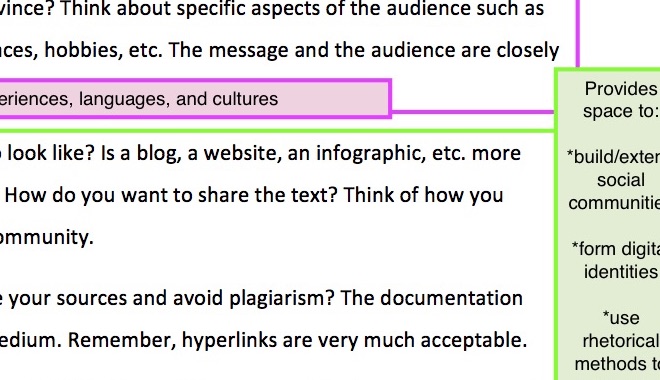
Three of the required criteria were 'Correct formatting and MLA', 'A page length that is 2-3 pages', and 'Follows the basic structure of an argument without sources.'
Figure 2. Evaluation standards reinforcing monomodal textual productions

Whom Am I Addressing?

In the traditional assignment, the word “audience” is mentioned once and is only implicitly referred to later in the “Evaluation” section (see pink annotations in Appendix A). The assignment declares that students must “address an audience” using “ethos, pathos, and logos.” This statement does not allow students to clearly envision a real or easily construct an imagined audience and implies that they should simply write for the instructor. The lack of audience specificity adheres to the prevalent “teacher as audience” conceptualization of audience and does not disrupt the problematic nature associated with asking students to write academically.

The “Evaluation” section also lists the use of “formal, academic language” as a requirement to produce a successful argument. Not only is this assessment criteria reinforcing CTR, but also some students may not have experience with this type of language or know when to use it. Further, if students do not have a concrete audience to address or if they cannot clearly imagine an audience based on their experiences, then asking them to use formal, academic language may prove especially frustrating for them.

Perpetuating the Current-Traditional Rhetoric Paradigm

The last aspect of the assignment sheet, annotated in yellow, is a broader categorization of foregrounding teacher, program, or university expectations rather than the students’ own experiences and languages. Again, the “Evaluation” section states, “a successful argument will include all of the following requirements.” The focus here is on what students “must” include to complete the assignment and achieve a high score. There is little room for negotiation between the instructor and the student and clearly values the product rather than the process. Though there are references to process writing, specific points and due dates are also included taking away from the recursive nature of the writing process and revision.

Figure 3 shows a list of specific features of argumentative writing (e.g. an introduction, body paragraphs, etc.), which might be useful to new writers. However, the highly specific bullet points within each section seemingly imply that students should check provided argumentative features off the list as they write–possibly impeding their writing processes and promoting commonality among a diverse group of students. This promotion of commonality in writing also reinforces the problematic binary that there is a “right” way to write and only if a student performs as they are told, can he or she achieve success.

The “Argument Without Sources” assignment emphasized a definitive structure through twelve bullets, rewarding rules-following and deprioritizing creativity
Figure 3. Restrictive structural requirements


While using this assignment in my courses, I quickly became frustrated because it forced students to produce essays that looked and sounded the same. The argumentative structures were repeated, student voices became homogenized, and, because students were forced to use their textbook as the basis for their arguments, the content was also very similar. After reading nearly 200 of these papers over the course of two academic years, I decided to begin embracing digital rhetoric and multimodal composing practices. Although there were challenges associated with integrating an assignment reflecting these practices and digital rhetoric, I argue that the revised assignment discussed below achieved the same course goals, encouraged creativity and agency, and taught students how to recognize and converse with various discourse communities.

A Discussion of the Revised Assignment: Convincing your Discourse Community

Using the same color coding method, I created a visual analysis of the revised assignment (see Appendix B). In this version, areas of negotiation and less imperative language are highlighted in blue, revisions to prescriptive requirements and teacher-centered pedagogy are annotated in yellow, integration of digital rhetoric is annotated in green, and specific references to audience are annotated in pink. The revision was implemented into my four sections of College Writing II in the spring of 2017. Like the original, students produce a persuasive text as the first assignment in the course sequence, but the revision asks students to choose one of their discourse communities (e.g. a video gamer community), determine an argument intended for that community, compose their text multimodally, and share it digitally with the community.

Assignment Sheet Design and Language

Design

When designing the assignment sheet, I attempted to make the format less intimidating and easier to read. I enlarged both the font size and spacing, which makes the text look less intimidating. I also used Calibri as a font, rather than Times New Roman, because it is not as commonly associated with traditional academic writing. However, I feel that the assignment sheet itself could (and should) be revised to include multiple modes rather than relying completely on changes to font, spacing, and white space.

An additional “poster” from NCTE (2012) was included to provide an entry point for students beginning to learn about discourse communities and shows that disrupting traditional, scholarly formats is appropriate in context. Many students may feel that to “write academically” one must produce a text that looks academic. The NCTE text problematizes this notion and gives students a multimodal example of work created by a highly respected academic organization.

The text can also serve as the basis for discussions about the relationship between context and design. For example, an instructor might facilitate a discussion about how to determine when a text should reflect academic design conventions and when a less traditional design might also be appropriate.

Language

In Figure 4, words highlighted in blue show the revision of declarative statements such as “students must” to more negotiated language such as “you should” or “this assignment asks you to…” I believe shifting from restrictive language provides students with the opportunity to reflect on, question, or negotiate with the assignment or the instructor rather than simply follow the directions.

The revised assignment includes negotiated language choices like 'asks' and 'should.'
Figure 4. Revised assignment sheet language
Please see Appendix B for the full assignment, and an accessible PDF file of the assignment.

Embracing Digital Rhetoric and Producing a Multimodal Text

In Figure 5, the green highlighting points out instances where the assignment asks students to shift from traditional composing practices to multimodal and embrace the affordances of digital environments. The revised assignment requires students to compose multimodally and share their work online with the appropriate discourse community.

The revised assignment embraces digital rhetoric with prominent prompts about the audience, medium, documentation style, and language
Figure 5. Embracing digital rhetoric


Recognizing that not all students are comfortable with multimodal design, students have the choice to create more print-based texts such as posters or newsletters, but they are still asked to compose multimodally and share those texts with their discourse community online. This aspect of the assignment combines digital environments with traditional rhetoric, which allows students to account for their audience and medium when choosing appropriate rhetorical moves (Eyman 2015; Zappen 2005). This helps students think more about the power of visual, aural, gestural, and spatial modes of communication when constructing an argument as opposed to considering only the linguistic mode and print-based production options.

Addressing a Real and Interactive Audience

When contrasting traditional print affordances and multimodal affordances, the latter provide students with more opportunities to communicate with varied and interactive audiences. Research has shown that students perceive audience awareness as an affordance of multimodal composing (Alexander, Powell, and Green 2012; Kirchoff and Cook 2016; Takayoshi and Selfe 2007). The revised assignment places audience awareness at the center of its pedagogical goal, rather than relying on a vague description of an imagined audience. Pink annotations showcase areas where audience is prioritized (see Appendix B for full annotations), beginning with the poster from NCTE that defines discourse communities and scaffolds understanding of discourse communities into the assignment. Figure 6 shows a disruption of the traditional notion of a teacher as audience by asking students to first visualize an imagined audience, based on their actual experience(s), then to write to those audiences by digitally sharing the texts with their communities. Shifting from vague audience conceptualizations to real and interactive ones aligns with two of the primary activities within a digital rhetoric framework: helping students form digital identities and building social communities (Zappen 2005).

The revised assignment includes questions and examples to help students envision an interactive audience, e.g. 'Who are you addressing' and 'What are you trying to persuade them to do, feel, think, etc?'
Figure 6. Envisioning an interactive audience


Asking students to share their work online embraces the affordances offered by writing in digital environments using digital tools (Nobles and Paganucci 2015). However, this choice was not without its challenges. Generally, students appreciated the opportunity to directly interact with an audience of their choice, but some students were not as comfortable with this component. Prior to the actual dissemination of their texts, some students requested that they be allowed to use fake names or to remove their work as soon as I had evaluated it. Students were quickly granted permission for their requests, but I recognize the gap in execution of the assignment. To account for this gap, I plan to scaffold lessons into the project that help students choose how they want to be (de)identified. I will also create an option for students to post their work to a shared and closed classroom website designed and curated by me.

Shifting the Focus from CTR

The revised assignment upholds the programmatic goal of requiring students to produce a persuasive text, but yellow annotations illustrate areas that allow for student creativity and playfulness. The “Evaluation” section, while still in a list form, has been shortened considerably and the criterion for success has been expanded. The revised assignment does not require “formal, academic voice”, which gives students more room to express themselves and use varied and rhetorically appropriate languages, dialects, and slang based on the discourse community they are addressing. However, the streamlined evaluation section creates a challenge related to creating an effective assessment tool. When assessing a student’s work, I need to act as both the evaluator and as hypothetical audience-member, which is challenging. Since the assignment was created to reinforce the components of digital rhetoric and allow for student creativity, I believe that my primary job is to act as a hypothetical audience-member and respond accordingly.

Although this may put more pressure on the instructor, it helps shift the assessment of student work from evaluating how well a student demonstrates his or her ability to write academically (privileging commonality) to one that evaluates how well a student uses languages and various modes to effectively address his or her community (promoting difference).

One potential benefit of the assignment is its ability to prepare students for responding to writing situations in other courses by not giving them a specific rhetorical situation. Instead, it urges them to really think about who they are as an author and as a member of that community, the message that they want to share within the context of that community, and to address a “real” community that they know from experience. This does not mean that some students do not choose to address a more formal community (e.g. a workplace manager) but it gives them the choice to do so. The point of this assignment is not to reinforce the importance of grammar, MLA, or academic voice (though those are important components of their final semester project) but to introduce them to the idea of discourse communities as audience and to think about composing in a digitalized world.

Student Reception of the Revised Assignment

When I incorporated the revised assignment into my course in spring 2017, I was nervous that students would push back against the lack of formalized instruction and that they might not see the connection between their discourse communities and writing persuasively. For the most part, I was happily surprised. I witnessed students who initially identified themselves as “terrible” writers spending hours on revising their website layout to “make it easier for my discourse community to understand.” One specific example stands out. A self-proclaimed “bad writer” from day one, Sue was hesitant about the class. When told that she would not be writing a formal essay as the first assignment, she became a little less hesitant. When told she could choose her audience, use language of that community, and share her message with them, she was absolutely thrilled. Two and half weeks later, she produced a website convincing a specific audience, the discourse community of avid golfers, to play at her favorite golf course. She included tabs echoing the traditional argumentative essay structure as well as an “author bio” tab, which she explained helped “get her credibility with her audience.” For the remainder of the semester, she was confident in her writing skills. She spent more time revising her traditional text than she had in other writing classes (according to her) and she became an active member in our small classroom community.

The example I have shared is just one of many positive experiences I had with this assignment last semester, but that is not to say that there weren’t less-than-positive experiences. As stated previously, some students were uncomfortable with sharing their work online, while others struggled with the skills associated with creating a text using digital tools. Some students struggled to create functional websites and some had difficulties converting a text-based document into a format that could easily be shared online. While I attempted to account for these struggles via mini-technology lessons, more time should have been spent discussing problem-solving strategies to aid students in the creation and dissemination of their texts. These strategies might include prompting students to create a list of places to find help on campus and useful web-based tools (e.g. tutorials, freeware, examples, etc.), which would be shared on our online course management system.

Some students also felt that a multimodal composition assignment was not preparing them academically and disliked the non-traditional nature of the assignment. Yet, generally and anecdotally speaking, many students began to see that writing does not always have to look and sound the same and that there is room for creativity in academic writing. They also began to understand that “audience” does not simply mean writing to one’s teachers. This assignment also made it easier for me to introduce academic discourse communities to my students, which helped them think about a discipline-specific academic audience when they chose topics, journal articles, documentation styles, and language prior to and during the writing of their final research papers (a traditional, print-based assignment). My assertion is that framing a multimodal assignment using digital rhetoric helps teach students how to recognize the connection between audience, message, and digital environments. This kind of digital rhetorical work might also help shift the multimodal and digital assignment from “lesser than” to “equal to” or “as good as” traditional, print-based composing.

Final Remarks

My discussion here offers a revision of what I saw as a restrictive assignment that closely adhered to CTR. While I am not claiming that digital rhetoric and/or digital practices should replace traditional print-based composing practices, I am urging instructors to consider incorporating digital rhetoric into their curriculums to continue to provide opportunities for student choice and creativity. This paper showcased my willingness to use digital rhetoric as an analytic tool to analyze and then revise a common writing assignment in my FYW classroom. I also urge any instructor who wishes to push against the CTR paradigm of academic writing, which often leaves out varied and textured voices, to conduct a similar analysis of a traditional assignment and then revise it so it reflects a digital rhetoric framework. I hope that fellow instructors who have become frustrated with the vague instructional goal to teach students “audience awareness” will consider the affordances provided by digital spaces and help students learn (re)address real and interactive online communities.

Bibliography

Alexander, Kara Poe, Beth Powell, and Sonya C. Green. 2012. “Understanding Modal Affordances: Student Perceptions of Potentials and Limitations in Multimodal Composition.” Basic Writing e-Journal 10:11.1. Accessed November 5, 2017. https://bwe.ccny.cuny.edu/alexandermodalaffordances.html

Berlin, A James and Robert P. Inkster. 1980. “Current Traditional Rhetoric: Paradigm and Practice.” Freshman English News 8:3, 1-4. Accessed November 4, 2017. http://www.jstor.org/stable/43519330

Eyman, Douglas. 2015. Digital Rhetoric: Theory, Method, Practice. Ann Harbor, MI: University of Michigan Press.

Ede, Lisa and Angela Lunsford. 1984. “Audience Addressed/Audience Invoked: The Role of Audience in Composition Theory and Pedagogy.” College Composition and Communication 35:2, 155-171. Accessed November 7, 2017. http://comphacker.org/pdfs/335/358093.pdf

Horner, Bruce and Cynthia L. Selfe. 2013. “Translinguality/Transmodality Relations: Snapshots from a Dialogue.” (Working Paper No. 7). Accessed November 10, 2017. http://louisville.edu/workingpapers/copy_of_working-papers.

Kirchoff, Jeffrey S.J. and Mike P. Cook. 2016. “The Impact of Multimodal Composition on First Year Students’ Writing.” Journal of College Literacy and Learning, 42, 20-39. Retrieved from storage.googleapis.com/wzukusers/user-20714678/…/Kirchoff%20Cook.pdf

NCTE. (2012). Discourse community. Retrieved from http://www.ncte.org/library/NCTEFiles/Resources/Journals/CCC/0641-sep2012/CCC0641PosterDiscourse.pdf.

Nobles, Susan. and Laura Paganucci. 2015. “Do Digital Writing Tools Deliver? Student Perceptions of Writing Quality Using Digital Tools and Online Writing Environments. Computers and Composition 38, 16-31. Accessed November 7, 2017. doi:10.1016/j.compcom.2015.09.001

Takayoshi, Pamela and Cynthia L. Selfe. 2007. “Thinking About Multimodality.” In Multimodal composition: Resources for teachers, edited by Cynthia L. Selfe, New York: Hampton Press, Inc.

Yancey, Kathleen Blake. 2009. Writing in the 21st century: A report from the National Council of Teachers of English. Accessed on November 10, 2017. http://www.ncte.org/library/NCTEFiles/Press/Yancey_final.pdf.

Werner, L Courtney. 2017. “How Rhetoric and Composition Described and Defined New Media at the Start of the Twenty-First Century.” College Composition and Communication 68:4, 713-739.

Zappen, P James. 2005. “Digital Rhetoric: Toward an Integrated Theory.” Technical Communication Quarterly 14:3, 319-325.

Appendix A: Marked-up Original Assignment Sheet

This appendix is also available as a pdf.

First page: intro and options. Small print, small margins, and forceful language provide little room for student agency (but reinforces teacher's knowledge).
Second page: structure, evaluation, points. Emphasis on correctness, completeness, and uniformity promote the teacher as audience and reinforce traditional structure.

Appendix B: Marked-up Revised Assignment Sheet

This appendix is also available as a pdf.

First page: NCTE's multimodal definition of 'discourse community.' Markup highlights the significance section.
Second page: genre, guidelines. Markup highlights room for flexibility, negotiation.
Third page: rhetorical considerations. Markup highlights the student-centered framing.
Fourth page: process and evaluation. Markup highlights the centrality of students' reflection on their choices.

About the Author

Melanie Gagich is an Associate College Lecturer in the First-Year Writing Program at Cleveland State University, where she has taught composition courses for six years. She is also currently pursuing her PhD in Composition and TESOL. Her research interests include multimodal composition, digital rhetoric, and open access resources (OERs).

0

Video Essays and Virtual Animals: An Approach to Teaching Multimodal Composition and Digital Literacy

Abstract

This article explores the pedagogical goals and student artifacts from a first-year composition course that provides students the opportunity to analyze interactive technologies—including video games—as rhetorical texts. As an approach to teaching digital literacy and multimodal composition, this course addresses the question of how to teach students to analyze not only the content of new media, but also how the design of social media platforms and video game mechanics persuade users to act and understand in circumscribed ways. More specifically, this article describes the process of assigning students a video essay project that requires them to articulate and defend a sustained argument about how a video game represents nonhuman animals. As a multimodal medium, video essays can provide a record of interaction between students and human-to-software interfaces, including video games. By analyzing how and why video games afford possibilities for interaction with virtual animals, the student artifacts examined here demonstrate students’ recognition that interfaces are constructed to achieve rhetorical ends. It is my intent that such recognition serves as a gateway for students to begin approaching everyday texts as rhetorical, that is, as working to incline them to persuasion and, by extension, certain patterns of thinking and behaving.

Introduction: Course Overview and Objectives

I teach a first-year, multimodal composition course at the Georgia Institute of Technology themed around interactions between animals and technology. I titled the course “Technocritters, or Animals and/as Technology.” Broadly, the course aims to develop students’ skills in multimodal communication (including written, visual, oral, nonverbal, and electronic communication) through an emphasis on process and rhetoric. As the second course in Georgia Tech’s two-semester first-year composition sequence, students should arrive in my course having been introduced to basic rhetorical concepts and strategies for effective communication. One of the “animals and/as technology” theme-related areas we study is the impact of new media on representations of animals. We ask questions such as: When and why does new media represent animals? How do the social media interfaces we use to access and share images of animals shape our understanding of them as food, pets, or pests?

For a STEM-focused institution like Georgia Tech, many of the first-year students I encounter plan to study in fields that will require that they utilize existing technologies and engineer new interactive computer systems for both specialized and public audiences. Consequentially, a course themed partially around a rhetorical analysis of computer-mediated communication helps increase engagement in a course students widely regard as “required” but not desired. Further, digital literacy skills are increasingly essential for all first-year college students, particularly given the near-ubiquity of interactive technologies in students’ academic, workplace, and recreational lives. Even writing programs and composition courses that prioritize traditional genres of academic writing must take notice of the rapidly growing rhetorical influence of new media on students learning to write, read, and think in the twenty-first century.

Digital Literacy… with Animals

At the beginning of each section of this course, I take an informal survey to learn a little about students’ personal histories, including their personal experiences with animals. As a group, we establish students’ prior knowledge about animals as a baseline for their exploration of animals in new media. Such a baseline enables us to raise questions such as: To what extent do animals in new media challenge or reinforce my previous assumptions about how animals look, move, think, and feel? How can and should humans interact with them? What are animals “for”? Almost all students enter my courses having had experiences with animals typical for young adults from non-rural areas of America. That is, few have first-hand experience with animals beyond their family dog or cat. Between two and three students may have experience riding horses, hunting deer or small game animals, or tending to farmed animals. Nearly all students have visited at least one zoo or amusement park that displays captive animals. Several students (between 4-5 each semester out of 75) have worked with or are currently working with animals in a laboratory setting: always mice. Finally, very few students—roughly three out of 75 every semester—identify as vegetarian or vegan. Therefore, most students are familiar with animals as products for consumption, even though, by students’ own admission, they do not readily make the association between the sliced meat on their lunch plates and animals.[1]

After students identify their personal history with animals, I prompt them to consider how varied media forms affect their understanding of animals, particularly nonhuman behavior and appearance. Students are quick to admit to consuming new media texts—including memes, Instagram profiles, and videos—as a source of “information” about animals. At the time of this writing, dogs and puppies (or, per the language of doggolingo, “doggos” and “puppers”) enjoy wide popularity across social media platforms. Cats and kittens (including Grumpy Cat, Maru, and the many Lolcat variants)—a variety of companion animal once nearly synonymous with digital image virality—persist in students’ vocabulary. That said, some students go so far as to claim that internet cats are “outdated.” Such recognition on their part—internet trends come and go rapidly—is an important insight: it helps students recognize that patterns of representation—such as the once-ubiquitous new media portrayal of house cats as playful, erratic, and cute—are neither fixed nor inevitable. As Sarah Warren-Riley and Elise Verzosa Hurley suggest, even when it comes to cat memes, “Liking, sharing, or reposting a cute cat meme does result in advocating specific values and ideologies (regardless of whether the individual agrees with those values) and results in something (in this case, the reinforcement of Western values that cats are cute house pets)” (Warren-Riley and Hurley 2017). By asking students to consider the frequency with which certain animal behaviors are visually depicted and shared through new media, I want to encourage them to consider how pervasive but undertheorized texts like cat memes advance ideologically-laden understandings about the subjects those texts represent, such as which nonhuman species should be treated variously as “pets,” “pests,” or “food.”

Developing students’ digital literacy additionally requires that students consider how computer interfaces facilitate and constrain the actions they perform in digital environments. My use of the term “interface” refers to the programs (such as applications and software) and hardware (including a mouse, keyboard, and display screen) that enable interaction between computers and people (rendered through said interaction as “users” or, for video games, as “players”). When it comes to a rhetorical study of new media, students must consider not only the content of new media (the memes themselves), but also the means through which such content is disseminated (interfaces that include but are not limited to those of social media). Because the interfaces of social media make sharing content easy, for example, students are likely to consider the act of “liking,” “retweeting,” or “upvoting” a piece of internet content “mundane and routine” and, by extension, inconsequential (Warren-Riley and Hurley 2017). To challenge the notion that the act of sharing content online is meaningless, we might ask students: what is the relationship between the popularity of animal images on the internet and the ease with which we share those images?

The pervasive tendency for humans to project meaning onto animals’ often inscrutable behaviors and expressions works in tandem with the seeming effortlessness involved in sharing content on social media platforms. Joseph Anderton (2016) advocates for such a contextual assessment of internet memes, writing that the meme’s “ability to pervade privy groups cements non/human animals in facetious material and renders them vacuous figureheads subsidiary to human meanings” (142). That is, the represented animal, rather than the meme itself, is rendered vacuous by the form’s popularity across web platforms. Memed animals become flexible signifiers for a range of human expressions and desires, a flexibility that advances an understanding of animals as a kind of bare material upon which human meanings can be inscribed. Here, the ease of sharing content online encourages the proliferation of texts and genres with highly malleable semiotic potential.

This image of “Chemistry Cat,” a popular meme, depicts an all-white cat, wearing black-rimmed glasses and a red bow tie, seated in a chemistry laboratory. The cat is surrounded by beakers and flasks filled with blue, green, yellow, and red fluids. The chalkboard in the background displays silly equations involving mice, milk, and cheese as the variables. The text on the image reads, in all caps, “I’d tell you a chemistry joke… But all the good ones Argon.”

This example of the “Chemistry Cat” meme demonstrates how cultural values and assumptions inform animal memes. For example, the cat’s white fur resembles a white lab coat, her glasses serve as a cultural signifier of intelligence, and her bow tie implies the traditional representation of men as scientists.

Teachers of digital literacy and rhetoric are therefore faced with a two-part challenge. First, students must learn to recognize how new media representations, such as the cat in the cat meme, reinforce variable—that is, both prevailing and niche—cultural values. Second, students must learn to recognize and consider how the interfaces that enable the circulation and popularization of certain representations are themselves built to encourage and facilitate a particular set of user actions. Asking students to consider how interfaces encourage, facilitate, or reward certain user actions and behaviors enables them to perceive interfaces as rhetorical. The range of social media platforms that students interact with every day can serve as a reliable starting place for students to begin this process of recognition. I have found, for example, that students are quick to recognize how social media platforms encourage users’ public affirmation of posted content (via the “like” function on Instagram) as well as the broader sharing of that content (such as “retweets” on Twitter).

Students’ examination of how they interact with computer interfaces should not and cannot end with a consideration of social media, however. Computer interfaces endeavor to conceal their function as rhetorical texts, that is, their own status as persuasive tools that influence user behavior. As Lori Emerson (2014) underscores, “interfaces themselves and therefore their constraints are becoming ever more difficult to perceive” as contemporary technology seduces us with feats that seem at once “wondrous” and magical (x). To be sure, the range of interfaces with which students interact on a daily basis are varied and quickly changing. Many college students own at least one if not multiple personal computers (including laptops, tablets, and smartphones) for both academic and recreational use, and their experience of those interfaces—except, perhaps, when they fail to work seamlessly—are likely to go largely without much or any critical inspection. Teena Carnegie (2009) argues that teachers and students of writing must learn to talk about the often invisible or “natural”-seeming work of interfaces (166). For Carnegie, as interfaces work continually to engage the audience through interaction, they create “higher levels of acceptance in the user,” acceptance that leads to the increased invisibility of the interface itself (171). In consequence, increasingly taken-for-granted interfaces make users more susceptible to persuasion and more likely to “accept the messages contained within the content, to continue to use a particular site, or to perform certain actions” (171-2). To my mind, that interfaces both render themselves invisible and dispose users to accept messages make the study of the rhetorical work of interfaces essential to developing students’ digital literacy.

Why Video Essays?

A video essay project like the one I assign in my multimodal composition courses presents not only an opportunity for students to practice strategies of analysis and argumentation, but also the opportunity to reflect on how software interfaces ask them to behave. Like written essays, video essays should make a clear argument. Additionally, video essay creators must consider how audible and visual registers reinforce, elaborate on, conflict with, or distract viewers from the essay’s argument. Therefore, successful video essays take seriously how the combination of moving images, still images, oral narration, and a revised, written script can work together to facilitate audience comprehension. Moreover, assigning students a video essay project provides one way for them to practice composing in all of the modes of communication.

As a form, video essays are particularly popular as an emergent form of film criticism. Rather than rely on written descriptions or even screenshots of filmic features, film critics increasingly turn to video essays for their ability to present for analysis the complex visual and nonverbal features in films, features that include lighting, shot design, sound, and costume. To show students the wide range of approaches to video essay design that critics take, I offer them writer Conor Bateman’s “The Video Essay as Art: 11 Ways to Make a Video Essay,” a brief, introductory text useful for its discussion of varied video essay forms as the vlog, scene breakdown, and desktop video. Then, to demonstrate how digital media critics have turned to the video essay for the purposes of making arguments supported by visual evidence and gameplay analysis, I refer to Anita Sarkeesian’s series “Tropes vs Women in Video Games” on the website Feminist Frequency.

Thanks to screen-capture software (including free tools such as Open Broadcaster Software), students can record particular moments of interaction between themselves and software interfaces for later use in video essay arguments. After recording, students can review their documented interactions and analyze them. To be clear, the aspect of the video essay project that requires students to record their interactions is, to my mind, essential. The process of recording footage for the video essay and then constructing an argument using that footage asks students to critically assess how software interfaces incline them to behave in particular (and variously circumscribed) ways. The process of recording, reviewing, and analyzing also has the effect of making students more interface-savvy. That is, after recording their actions in one interface, they may become more likely to reflect on how their actions in other systems could undergo similar analysis.

Why Video Games?

Video games as persuasive texts lend themselves well to student analysis of the often hidden rhetorical implications of software interfaces. More explicitly than the social media interfaces mentioned above, video games as software ask players to behave according to a set of rules or constraints in order to advance or “win.” Relevant to the “animals and/as technology” theme of my course, video games present strong arguments for how players should interact with and, by extension, regard the animals they encounter within game worlds. In response, I ask students to explore how players can interact with animals in games as a means to uncover the implicit or explicit arguments video games make about human-animal relationships. For example, students raise questions such as: what forms of interaction between humans and animals does the game afford me, the player? How easy does the game make it for the player to facilitate that interaction? Is the interaction sustained, or brief? What is that animal’s function in relationship to the player and/or to the game’s narrative? Is the player required to kill or otherwise manipulate the animal to proceed with the game? Can the player mount the animal and use it as a form of transportation or to enhance the player-character’s mobility? Can the player take the role of an animal by guiding it in the first person (as in simulator games)? When the player assumes the role of an animal, what abilities does the animal have? Do the rules of the game change when a player inhabits the role of an animal?

These questions encourage students to consider how the interactive possibilities between player and virtual animals reproduce or challenge pre-existing assumptions about animals in industrialized societies. As Adam Brown and Deb Waterhouse-Watson (2016) remind us, “To varying degrees (but always to some extent), human beings learn about other animals through the symbolic status attributed to them through cultural products, and this frequently involves the naturalization of anthropocentrism.” Anthropocentrism, or the human tendency to privilege the wants and needs of Homo sapiens above the wants and needs of all other forms of life, certainly informs the design of many video games. However, playing video games does not always necessitate that players passively accept anthropocentric interactions with animals as an inevitable requirement for play. With his concept of “procedural rhetoric,” Ian Bogost provides a precise term for how video games encourage (while often allowing for degrees of freedom to resist) a particular manner of interaction between player and game world. For Bogost, “video games can make claims about the world. But when they do so, they do it not with oral speech, nor in writing, nor even with images. Rather, video games make argument with processes. Procedural rhetoric is the practice of effective persuasion and expression using processes” (Bogost 2008, 125). Processes comprise the rule-based systems by which games as computer software unfold as well as the rules that constrain the actions of players. Asking about the “rules of the game” or how and why a game constrains and incentivizes player interactions with particular game features attunes students to the ways games-as-interfaces construct rhetorical arguments.

Scaffolding Game Analysis

Before we begin playing games and analyzing the arguments they make, I provide students with an illustrative model of academic video game criticism: Gary Walsh’s (2014) article “Taming the Monster: Violence, Spectacle, and the Virtual Animal.” By seeing video game criticism in action, students recognize that their video essay projects can contribute to a visible, existing conversation in humanities disciplines. Walsh argues that “videogames create a space in which virtually anyone can commit acts of violence without being registered as such,” that video games be read as opportunities for players to subject animals to violence and to read their own actions as strictly entertainment (22). Many students initially resist Walsh’s argument. Their inclination is to dismiss the implications of game processes that reward violent interactions with nonhuman animals, suggesting instead that games are unworthy of the careful scrutiny provided more transparently rhetorical texts. Indeed, the phrase “But it’s just a game” circulates during the session we consider Walsh’s work. Working through Walsh’s essay, I urge students to examine their reluctance to 1) read video games as argumentative, and 2) consider their actions as players as participating in an argument constructed by interface with a set of game rules. With students, I ask: why does the pleasure we take in video games’ fantasy spaces preclude a critical examination of the way games rely on existing ideologies and ways of interacting between humans and animals?

To give students practice formulating critical questions about games’ rhetorical choices while also thinking about how games ask them to behave as players, I require students to play a series of free-to-play games that involve animals. Asking students to play a set of preselected games prior to their in-depth interrogation of a single game for their video essays serves two important instructional purposes. First, these games help familiarize students with common video game genre conventions. One represents a “casual game”; another lets us explore the conventions of the “first-person shooter.” By introducing students to some of the basic video game genres, even students relatively unfamiliar with game genre conventions can draw on their experiences playing these free games as a foundation for the more sustained rhetorical analysis of game conventions and rules that they undertake soon afterward. Second, I select the initial games students play because of the illustrative way each game represents animals. Rather than offer complex representations, these games are simple both in terms of controls and argument, making them excellent starting points for a more in-depth interrogation of how games make claims about animals.

For example, one of the free games I ask students to play, Linksolutions’ Pets Fun House, represents a “casual” game in which players assume the role of a new pet shop manager. Pets Fun House asks players to feed, water, and clean up after an expanding collection of dogs and cats with the objective of selling those pets to impatient shop customers. As the game proceeds, players’ in-game profits can purchase increasingly larger shop facilities and a wider range of dog and cat breeds to exchange for additional profits. After playing Pets Fun House, I can reliably anticipate that students will respond eagerly to the question: “What argument does this game make about animals?” That is, after playing the game, students identify, at minimum, that 1) Pets Fun House reduces animals to commodities, and 2) Pets Fun House simplifies the needs of companion species, the player needing only to click once per creature to alleviate hunger, thirst, and waste (the three needs that must be satisfied to successfully prepare the animals for sale).

In another of the free games I require students play, DroidCool.com’s Deer Hunter 3D (2015), students become acquainted with the genre of the first-person hunting simulator. In this game, players must shoot an increasing number of deer before time runs out in order to proceed to the next level. Each deer in the game looks and behaves identically to every other deer: they pace across the screen and remain blissfully unaware of the player’s approach. The game’s simplified representation of deer appearance and behavior prompts students to identify that this game promotes the idea that animals are repetitive, instinctual machines. Further, since the player must slay as many deer as possible within a narrowing time frame in order to proceed to the next level, students quickly see how the game’s deer have a single purpose: to “die.” The game portrays its animals not only as machinic obstacles to overcome, but also as morally and physically simple to eradicate. Here, the simplicity of the game’s interface—point and click to shoot without the need to reload or take cover in features of the landscape—implies that the act of killing deer is both easy and straightforward and, consequently, does not require player reflection. As we saw with animal memes, the ease with which video games as interfaces can make an action possible—here, the ease with which Deer Hunter 3D makes it possible for a player to kill deer—is instructive for students as they consider the rhetorical work of interfaces in general.

Work and Play: The Video Essay Project

For the image-based version of the video essay project assignment sheet, please click here.

For a text-only version of the assignment sheet, please click here.

The student artifacts included below comprise a representative sample of the video essay projects students submitted during the past two semesters of this course. Briefly, this project requires students collaborate in groups of 4-5 members each and choose a Steam-based video game to analyze from a list of games I briefly pre-screen for cost and content. Assigning a game available through Steam, a game distribution platform for personal computers, streamlines the requirement that students record their gameplay. Additionally, I tell students that their video essays should not “review” their chosen game. Rather, their video essays should analyze the game’s rhetoric and make an argument about how the game represents animals.

Importantly, I require that students compose their video essay projects for a public audience: students must upload their completed video essays to YouTube and list them as “public.” This requirement has two important pedagogical benefits. First, composing for a public audience allows students to become active knowledge producers, not simply passive consumers. That is, public video essays enable students to contribute their voices, interests, and, by the end of the process of analysis, expertise to an existing network of positions and ideas. Second, I find that students not only produce better work when composing for outside-the-class audiences, but also make more connections between the work we do in the classroom and communication practices in the “real world” when required to produce public-facing work. They see how the work of rhetorical analysis, for example, can influence and inform others. Centrally, a public-facing project teaches students a fundamental concept like the rhetorical situation by providing them a “real” audience to persuade.[2]

Finally, this project requires students to draft and revise a rough script and storyboard for their essays. Their script organizes the scope and structure of students’ voice-over narrations; it also emphasizes the importance of clear, succinct writing in projects that seem at first glance to prioritize visual and electronic modes of communication. Indeed, assigning a multimodal project like a video essay does not alleviate or dismiss the need for students to consider how and why certain “moves” in their persuasive texts become rhetorically effective. For example, student-produced video essays like Essay I on Giant Squid Studios’ 2016 game Abzû present widely-recognized indicators of an effective argument, such as discussion of counterexamples. In addition to the students’ discussion of counterexamples, Essay I demonstrates students’ attention to how the game’s mechanics (or rule-based systems) affect how players think about the role of animals in the game. Against their primary argument that the game promotes a “genuine connection” between player and virtual animals, students analyzed how the inclusion of the mechanic of “riding” animals (see between 4:23 and 5:00 in Essay I) violates said connection. They explain:

By latching on to these creatures, you can take control of their actions and use their bodies to your own benefit…The animal gives up its autonomy…establishing a hierarchical relationship…By riding these creatures, you create temporary and superficial bonds that disappear once you let go.

This piece of analysis demonstrates the thoughtful associations that students developing digital literacy skills can establish between game interfaces and game arguments. Specifically, students here articulate their perception of a link between the interface-afforded opportunity to “ride” animals in the game and the “hierarchical relationship” between human character and nonhuman animal such a rule implies.

Essay I:

Abzú Video Essay
Mairead Gawryszewski, Carlos Gabriel Velazquez Sierra, and three anonymous students created Essay I.


In Clip I, students explain how Might and Delight’s 2013 game Shelter restricts player movement to incline players to think about the badger cubs placed in their care. This clip shows not only students’ rhetorical awareness (insofar as they address audience members directly by telling them which visual features of their gameplay footage to pay attention to), but also their astute attention to the relationship between the rules of the game and how those rules persuade players to feel a certain way: in this case, to invest emotionally in the badger cubs.

Clip I:

Shelter Video Essay Clip
Dylan Pirro, James Forsmo, and three anonymous students created Clip I.


Many of the most effective multimodal arguments take seriously what a given medium affords in terms of opportunities for persuasion. Throughout Essay II, students use a combination of gameplay footage, video, and overlaid graphics to enhance their argument about how the visual and mechanical simplicity of Chris Chung’s 2013 game Catlateral Damage creates a fantasy of carefree nonhuman embodiment for the player. A particularly rich example takes place during 3:39 and 4:25 of Essay II. Here, students demonstrate their understanding that showing an image of a “cockroach” and “spider” followed by a series of clips of house cats provides a visceral visual reminder that we very often value the lives of (cute) animals over others. Such a difference in species’ implicit value, students claim, is central to the lack of a death mechanic in Catlateral Damage, a game they claim is largely about causing destruction with no fear of consequences.

Essay II:

Catlateral Damage Video Essay
Joo Won (Michael) Lee, Ryan Pickart, Matthew G. Weissel, and two anonymous students created Essay II.


As a final example, Essay III demonstrates students’ recognition that games can make culturally-specific arguments. Throughout Essay III, students analyzed how developer Upper One Games translated interactions between indigenous Iñupiaq culture and nonhuman animals into the game interface of Never Alone (2014). Students saw such translation occur through what they termed the “equal but different” representation of the game’s human and fox protagonists. From 5:35 to 6:59, Essay III provides a particularly astute analysis of how game mechanics can construct one argument while a game’s narrative can construct another, contradictory argument.

Essay III:

Never Alone Video Essay
Maya Flores, So-Ying Ester Chang, Kia Clennon, and Elizabeth Stephens created Essay III.


Despite the success of many of the video essays I received, issues that teachers of persuasive writing will be familiar with still persisted in some cases. For example, some essays did not provide sufficient evidence to support students’ claims. In other essays, students failed to articulate a clear and straightforward argument. Moreover, it is worth pointing out the ample hardware and software resources available to students at Georgia Tech as they play their games, record their footage and narration, and edit their essays. I recognize that such resources are far from universally available. Even with these challenges in mind, I am encouraged by the work students have accomplished in these video essays, and I will continue to adapt this project to help students analyze other forms of interactive technology in the future.

Reflection and Conclusion

Looking back at the results of the informal survey I administer to assess students’ familiarity with animals, I am impressed by the wide range of interpretations students developed in their video essays, interpretations unlikely to have emerged from attempts to simply apply their prior knowledge of human-animal relationships. Richard Colby, Matthew S. S. Johnson, and Rebekah Shultz Colby (2013) suggest that video games constitute “exemplar multimodal texts, aligning word, image, and sound with rules and operations constrained by computer technologies but composed by teams of writers, designers, and artists to persuade and entertain” (4). Even so, after analyzing survey data of texts selected by writing teachers for use in writing courses, Johnson and Richard Colby (2013) found that “video games are…neglected as texts to be analyzed” despite statistics that show “the sheer number of gamers and the magnitude of the game industry” (87). By bringing video games into the first-year composition classroom, I witnessed students moving away from their initial impulse to regard everyday texts as innocent and undeserving of critical inspection. An overwhelming majority of essays showed students performing thoughtful, in-depth analyses of texts with rhetorical content that once seemed invisible. As regards nonhuman animals, too, an examination of video games may train students to consider their acts of “interfacing” with animals both virtual and actual as worthy of curiosity and reflection, especially if a particular form of interaction seems only natural.

Bibliography

Anderton, Joseph. 2016. “Cyberbeasts: Substitution and Trivialization of the Animal in Social Media, Memes and Video Games.” In Screening the Non/Human: Representations of Animal Others in the Media, edited by Joe Leeson-Schatz and Amber George. New York: Lexington.

Bogost, Ian. 2008. “The Rhetoric of Video Games.” In The Ecology of Games: Connecting Youth, Games, and Learning, 117–40. Cambridge, MA: The MIT Press.

Brown, Adam, and Deb Waterhouse-Watson. 2016. “Playing with Other(ed) Species: Games, Representation, and Nonhuman Animals.” Ctrl-Z: New Media Philosophy, no. 6.

Colby, Richard, Matthew S. S. Johnson, and Rebekah Shultz Colby. 2013. “Introduction: Rhetoric/Composition/Play through Video Games.” In Rhetoric/Composition/Play through Video Games: Reshaping Theory and Practice of Writing, 1–8. New York, NY: Palgrave Macmillan.

DroidCool.com. (2015). Deer Hunter 3D.

Emerson, Lori. 2014. Reading Writing Interfaces: From the Digital to the Bookbound. Minneapolis: U of Minnesota P.

Johnson, Matthew S. S., and Richard Colby. 2013. “Ludic Snags.” In Rhetoric/Composition/Play through Video Games: Reshaping Theory and Practice of Writing, edited by Richard Colby, Matthew S. S. Johnson, and Rebekah Shultz Colby, 83–98. New York, NY: Palgrave Macmillan.

Pets Fun House. Linksolutions.

Teena A. M., Carnegie. 2009. “Interface as Exordium: The Rhetoric of Interactivity.” Computers and Composition 28 (2):164–73.

Walsh, Gary. 2014. “Taming the Monster: Violence, Spectacle, and the Virtual Animal.” Antennae: The Journal of Nature in Visual Culture, no. 30 (Winter): 21–34.

Warren-Riley, Sarah, and Elise Verzosa Hurley. 2017. “Multimodal Pedagogical Approaches to Public Writing: Digital Media Advocacy and Mundane Texts.” Composition Forum 36.

Notes

[1] The data referenced here represents survey results that I collected informally.

[2] I anticipate and address students’ potential privacy concerns and hesitation to share their work in three ways. First, within the first week of the course, I ask that students sign a “Statement of Understanding,” a brief form in which they disclose if they feel comfortable with me referencing their work in print or electronic publications and how they want to be credited (either by name or anonymously) if they do permit me to reference their work. A sample Statement of Understanding can be viewed by following this link to the course syllabus and scrolling to the bottom of the document. Second, the course syllabus includes a “Public Nature of the Course” clause that informs students that most of their work for the course—including drafts prepared for peer review, in-class presentations of their work, and digital sharing—should be composed with a larger audience (that is, an audience not exclusive to their professor and themselves) in mind. As part of this clause, I emphasize that students’ grades will never be made public. The syllabus linked above contains the “Public Nature of the Course” clause. Finally, I provide students a range of options for posting their work to YouTube. Even though their work remains visible and shareable on this platform, they can choose some combination of the following, privacy-assuring precautions: they can 1) remove all references to their names, 2) “unlist” their video, or make their video undiscoverable by in-site searches, and/or 3) disable comments in YouTube. Perhaps surprisingly, many students want to be credited by name for their work and are excited to share their work with others. Others take comfort in anonymity while still fulfilling the course objectives and seeing how others respond to their efforts via peer review and questions from their classmates.

About the Author

Christina M. Colvin is currently a Brittain Postdoctoral Fellow at the Georgia Institute of Technology. There, she teaches courses in multimodal composition that emphasize digital rhetoric. Her research focuses on American literature, new media, animal studies, and ecocriticism.

0

From Addiction to Connection: Questioning the Rhetoric of Drugs in Relation to Student Technology-Use

Abstract

When describing students’ relation to digital technology, for the most part, educators employ the rhetorics of drugs and addiction without much hesitation. Students are considered hopelessly “hooked,” and in response to this state of affairs, many teachers adopt harsh in-class device use policies, along with attitudes of derision, anger, and fear, concomitant with the belief that technology is ruining young minds or even “deep” thinking as such. In response to such concerns, the following essay explores how one group of students—those in my upper-division Digital Writing course—described themselves and their relation to various media platforms. Students began by collecting a series of brief autoethnographic observations, which they then synthesized into blog posts which addressed the question “Am I Addicted to Technology?” Students were primed prior to writing by discussing an academic essay and watching a TED Talk that challenge employing the rhetoric of addiction/drugs, and when provided this alternative framework, many began to adopt it. In-line with Hari’s supposition that “[t]he opposite of addiction is not sobriety[;] the opposite of addiction is connection,” students continually highlighted the importance of connection in their lives, without automatically stigmatizing this need by couching it in pathological terms. Some continued to describe themselves as addicts, but those who began to explore alternative vocabularies suggest analyzing student/teacher behavior in relation to technology in a variety of new ways.

“For 100 years now, we’ve been singing war songs about addicts. I think all along we should have been singing love songs to them. Because the opposite of addiction is not sobriety. The opposite of addiction is connection.”

– Johann Hari, “Everything You Think You Know About Addiction is Wrong”

“Instead of thinking about addiction, it makes more sense to explore how we are vulnerable to certain things that technology offers. The path forward is to learn more about our vulnerabilities and design around them. To do that, we have to clarify our purpose.”

– Sherry Turkle, “How to Teach in an Age of Distraction”

Introduction

The more digital studies/digital humanities has increasingly become the focus of my teaching and research over the past few years, the more I am convinced there is something deeply problematic about deploying the figures of addiction and drugs in relation to technology. In a recent article published in the journal Enculturation, “This Fragile Machine: Technology, Vulnerability, and the Rhetoric(s) of Addiction,” I outlined my concerns in some detail, but this analysis was based primarily in rhetorical theory with little discussion of the pedagogical ramifications of the argument. What follows here, then, is an attempt to articulate how my previous contentions might affect classroom attitudes and practices, so as to prevent teachers and students from unwittingly importing the draconian logic of the War on Drugs into the classroom, in particular, with regard to digital device usage.

A young woman with dark hair snorting a powdered drug that spells out ‘Facebook.’

Figure 1: Woman Snorting a “Line” of Facebook

My outline for investigating the above questions and concerns is as follows: I begin by briefly considering the prevailing attitude toward classroom technologies, wherein they are viewed as addictive substances, brain-damaging “drugs” upon which students (and certain teachers) are irrepressibly “hooked.” I then articulate my reservations with rhetorically framing technology in this way, while looking at how students in my upper-division Digital Writing course responded in academic blog-form to the question “Am I addicted to technology?” They were primed for this assignment by reading and discussing my Enculturation essay, along with watching a TED Talk by Johann Hari titled “Everything You Think You Know About Addiction is Wrong.” As I share these materials along with my own arguments, from the outset I will strive to articulate what pedagogical implications may be at stake if one were persuaded by them.

At the same time students were considering the question of technology addiction, they were tasked with collecting autoethnographic observations on their social/digital media behaviors (something Margaret “Peg” Syverson inspired me to do after introducing me to the qualitative assessment tool Learning Record Online). Throughout, I share some of the students’ most interesting field-notes in the form of textual interjections, and suggest how one might evaluate them according to different rhetorical frameworks. Sharing this quasi-anthropological data, information which attempts to be as “neutral” as possible, is especially valuable because it evinces how students can be legitimate co-producers of knowledge, and are not bound by the reductive characterizations of their media practices many foist upon them. Indeed, through this assignment many students came to see how “drugs” and “addiction,” when applied to technology, are bound to specific rhetoric and not obvious clinical or psychological facts.

Finally, I share some insightful remarks from students’ blog-posts on technology addiction, and speculate on how they might lead educators to transform their attitudes/positions and pedagogical practices. I hope that sharing these findings serves as a launching pad for further discussion and debate.

What’s Wrong with the Rhetoric of Addiction?

At the risk of over-generalizing, it strikes me that most people, professors and students included, apply the rhetoric(s) of drugs and addiction to technology with little hesitation, assuming the parallel is obvious, unaware of the problematic consequences of doing so. Oftentimes, such analogies are perhaps simply “slips,” like when Sherry Turkle describes student-users as “drinking the [presumably cyanide-laced cult] Kool-Aide” (Digital Nation). But others are far less subtle. For instance, Gary Small states:

“When we think of addiction, most of us think of alcoholism or drug abuse. But the easy access, anonymity, and constant availability of the Internet … has led to a new form of compulsive and dependent behavior – techno-addicts. The same neural pathways in the brain that reinforce dependence on substances can reinforce compulsive technology behaviors that are just as addictive and potentially destructive.”

Following Small’s line of thought, scores of materials have been produced in recent years decrying a new cultural epidemic, where digitization is framed as outright dangerous, even capable of, in Nicholas Carr’s words, “threathen[ing] the depth and distinctiveness of the self … [along with] the depth and distinctiveness of the culture we all share” (196). Works like Carr’s The Shallows, and others in its genre like Mark Bauerlein’s The Dumbest Generation, Nicholas Kardaras’ Glow Kids, and Damon Zaharides’ Digital Detox (the latter two of which have the term “addiction” in their subtitles), however alarmist they may be, have struck a chord and met with incredible commercial success. A quick Google search for “technology addiction” and “cell phone addiction” collectively result in nearly one hundred forty million hits, with hundreds of articles from sources ranging across the entire political news spectrum.

The medical community has gotten increasingly involved in the discussion as well, for instance, via debates over whether “Internet Addiction” is a medical disorder worthy of inclusion in the Diagnostic and Statistical Manual of Mental Disorders, Fifth Edition (Pies). And countries like South Korea have already declared “a public health crisis,” instituting programs to develop healthier tech-use habits for students of all ages (Digital Nation). By no means am I outright naively rejecting the claims of those concerned with digitization’s problematic affects/effects, but I do want to rigorously interrogate how such worries are troped or figured.

“The hospital lost my phone when I was admitted to the ER. During my hospital stay I kept reaching for it to check things. But I couldn’t look at it because it was lost. I felt very uncomfortable and disconnected.”

– Student Autoethnographic Observation (emphasis mine)

I imagine most people, scholars included, because they have no alternative rhetoric for framing this example, would think it obvious that a student worried about checking their phone while in the Emergency Room is an “addict,” with all the troubling conceptual baggage attached to the term. As will become increasingly clear, however, what if one were to focus here instead on the irrepressible need for connection or bonding, especially in a frightening or painful situation?

Given the possibility for alternative interpretations, it’s surprising one still finds even someone like champion of technology Clay Shirky making the following observation in a recent post: “Multi-taskers often think they are like gym rats, bulking up their ability to juggle tasks, when in fact they are like alcoholics, degrading their abilities through over-consumption” (emphasis mine). So why should statements like this give one pause? In response, permit me to briefly summarize the claims contained in my essay “This Fragile Machine,” while extending them into pedagogical territory:

(1) “The Addict” has solidified into an identity that contains numerous problematic assumptions: identities are largely fixed and unchanging; the addict uses drugs to escape reality; the addict suffers from a deficiency of “will”; the addict’s life is in inescapable decline; the addict’s habits can be overcome only through resolute abstinence; hence, addiction/drugs, including digital technologies, must be harshly regulated and punishment can serve as an effective deterrent. [1]

When one refers to students or anyone else as addicts, without realizing it, one not only ascribes them an essentializing identity, but one with a serious stigma attached to it. And since identities are viewed as largely intractable, I heartily agree with Turkle that “discussing the power of technology in those terms makes people feel powerless. It is as though they are facing something that is by definition more powerful than they could ever be.” Ascribing someone an identity can make it seem as though there is no way to change or modify it, say, through an ethics of “hygienic” self-care, and so the only way to discipline/control the techno-addicted, supposedly weak-willed student is to force them to abstain from “using.”

“During my Physics [class], the teacher began talking about things that did not seem relevant. … About 2/3 of the class seemed to be using cell phones or laptops to do other things. Some were on both laptops and cell phones. I myself was scrolling through Twitter, Instagram, and imessage simultaneously.”

– Student Autoethnographic Observation (emphasis mine)

Provided observations like the above, it would be folly to ignore that sometimes classroom technology produces undesirable effects like distraction and detrimental cognitive modification, but ascribing identities can rob students of the opportunity to learn classroom-appropriate practices and to take responsibility for employing them. This is likely what Shelley Rodrigo has in mind when she contends: “[s]tarting with what the students already do works not only because we are going with the flow; … it is because it is going with their flow.” And it is not only a matter of going “with” the flow, but guiding that flow in an effective, insightful manner, versus, say, the above physics classroom, where it seems the problem is not addiction, but boredom, disengagement, disconnection, and ineffective pedagogy.

(2) Even if one views addiction as the cyclical or algorithmic repetition at the heart of all behavior, the rhetoric of drugs is saturated with innumerable “moral” norms and prohibitions; hence one will likely feel ashamed or guilty if one cannot abstain.

Scholars influenced by deconstruction such as Avital Ronell have suggested the stigma surrounding addiction might be lifted by seeing it as tied not to specific habits but rather all behavior. (More precisely, addiction is viewed here as an existential structure.) However, since the rhetoric of drugs/addiction is so tropologically loaded, I have difficulty accepting this approach will alleviate the “bad conscience” of students, absolving them of the guilt or shame they feel for “using.” After all, this approach still suggests tech-users are addicts, even if it moves away from viewing addiction as something attributable to the weak-willed. In fact, the universalization of addiction might even exacerbate the problem at issue.

(3) In contrast to specific technologically-oriented behaviors, vulnerability/“openness” to affection by technology is inescapable. A posthuman approach highlights this exposedness, and thus challenges assumptions regarding identity, will, abstinence, guilt, and more.

A liberal humanist view of subjectivity suggests rationality grants human beings untrammeled freedom to act (“will”) without regard for contextual material conditions—including everything from race, class, and gender, to technologies available within one’s environment. This approach not only doggedly continues to influence the whole of contemporary society, from politics to law to economics, but provides the assumptions necessary to brand students as addicts who can be seduced by the allure of technology and “morally” fail to resist. By contrast, in the words of Shirky, “I’ve stopped thinking of students as people who simply make choices about whether to pay attention [or compulsively use technology,] and started thinking of them as people trying to pay attention but having to compete with various influences.” In short, if students are non-declinably open to affection by technology, not only is it unfair to stigmatize their compulsive digital inclinations, but as Shirky notes, the greater responsibility lies with capitalist technologies purposely “designed to distract” as opposed to some flaw in students themselves. Such an approach urges one to not make students feel ashamed for technology-use, and that punishing them for partaking will ultimately fail as a deterrent (just as it has abjectly failed to end the War on Drugs), as well as precluding critical discussions of how certain media platforms or specific facets of them are built to be “addictive.”

Three colorful syringes labeled Facebook, Youtube, and tumblr. respectively.

Figure 2: Syringes Labeled as Social Media Platforms

Although students seemed intrigued by my own claims regarding the rhetoric of technology addiction, it was clear from their blog-posts they were persuaded most deeply by Johann Hari’s TED Talk on addiction writ large. For one, Hari challenges whether the rhetoric of addiction is viable at all, suggesting “maybe we shouldn’t even call it addiction. Maybe we should call it bonding. Human beings have a natural and innate need to bond, and when we’re happy and healthy, we’ll bond and connect with each other, but if you can’t do that … you will bond with something that will give you some sense of relief.” The language of “bonding” that evokes the psychoanalytic concept of libidinal ties, not only helps diminish the stigma attached to addiction, it suggests students are driven to use technology—social media platforms in particular—not because they’re trying to evade reality or are looking for a dopamine fix, but because they’re simply doing what human beings are built to do: Connect.

In contrast to his progressive insights, however, one move Hari makes that gives me pause is he avers digital connections are “like a kind of parody of human connection. [Since if] you have a crisis in your life, you’ll notice … it won’t be your Twitter followers who come to sit with you. It won’t be your Facebook friends who help you turn it around.” Rather than considering digital connections unfulfilling “parodies,” I think it far less problematic to highlight the various affordances in connection across different mediums. For example, face-to-face connection provides the affordances of physical touch, eye-contact, smell, “chemistry,” and so on, whereas online connection provides the affordances of multimodal interaction that surpasses speech/graphical writing along with extending connection beyond one’s geographic and temporal proximity. In other words, one can posit the importance of face-to-face connections without suggesting said connections are somehow more “authentic” than digital ones. As twenty-first century educators, helping students to navigate and balance relationship-types and their specific affordances is key, and it’s far more troublesome than helpful to suggest certain forms of desire for connection are addiction-oriented whereas others are not.

Perhaps the most pedagogically-potent observations Hari makes, though, regard Bruce Alexander’s psychological experiments with “Rat Park.” The basic outline is as follows: in earlier twentieth-century tests, researchers placed rats alone in a cage with two bottles of water, one of which laced with either heroin or cocaine. In these experiments where rats were imprisoned and in isolation, they would nearly always become “bonded” to the drugged water and eventually die. Later, researchers like Alexander questioned this initial approach, and reproduced the experiments with a critical modification: the rats still had access to heroin/cocaine but they were no longer alone. Instead, Rat Park was a community wherein they could form social bonds, mate, play, and more. In these tests, the rats almost never drank the drugged water, nor became addicted and died in miserable fashion. Hari therefore asks: “What if addiction is about your cage? What if addiction is an adaptation to your environment?”

The chilling insight, then, that I had with regard to Rat Park was: What if technology “addiction” is about adapting to the “cage” of your classroom? What if it is about feeling trapped and alone, “not being able to bear to be present in your [educational] life?” For example, if students are expected to sit silently during lecture, work on assignments in isolation, or being “talked at” by the educator, that is, when they’re dis-connected, when forming social ties is not encouraged, is it surprising they would opt for the “bonds” of the Internet? Indeed, what if certain classroom spaces are even more tortuous than those of rats in isolation because students are in proximity to one other yet often explicitly forbidden to interact? Hence, I take responsibility upon myself if I notice a student checking Facebook during lecture/discussion, etc., because it signals to me said student feels disconnected from what’s happening around them. Furthermore, such occurrences highlight the need for new types of learning spaces that facilitate both analog and digital connection, dynamic environments like those Katherine Hayles has in-mind when she contends “[t]he classroom is no longer sufficient for the needs of web pedagogy; needed are flexible laboratory spaces in which teams can work collaboratively” (5). [2]

“The teacher split my Accounting class into groups to collaborate on a case study. Instead of collaborating, everyone looked for answers on the internet.”

– Student Autoethnographic Observation (emphasis mine)

Provided this example, again the rhetoric of drugs/addiction threatens to return. But what if one asked instead: Why does the student not view doing online research as itself collaborative? Is it because they’ve internalized the view that only face-to-face interaction counts as authentic engagement with others? And if the choice is between working with “strangers” in the classroom as opposed to “strangers” online–since most college classrooms don’t emphasize forming neighborly communities among peers–isn’t it less scary to engage with an “other” whose gaze one can escape?

Put another way, it seems that because collaborative practices break with individualist, humanist models of education, one cannot assume students know how to work together collectively; hence one task of contemporary education is to help develop this indispensable skill. As I often joke with students: “It’s okay—we’re all still learning how to Internet.” And I mean that in relation to face-to-face networking as well as writing online, especially since robust team-oriented projects/evaluation are still an outlier in the humanities and learning to excel at and balance various types of connections with different affordances is something that is rarely, if ever, taught.

Provided the above observations, then, there is great pedagogical significance in Hari’s concluding observation: “[I say] to the addicts in my life that I want to deepen the connection with them, to say to them, I love you whether you’re using or not. I love you, whatever state you’re in, and if you need me, I’ll come sit with you because I love you and I don’t want you to be alone or to feel alone.” As educators concerned with effective/affective bonding, isn’t this a vastly healthier message to provide students than to chastise or punish them for their so-called “addictive,” “weak-willed” behaviors? To sympathize with them for feeling caged?

“I heard my phone vibrate in my backpack while in class and resisted the urge to check the notification to avoid losing points in the class where phones are not allowed.”

– Student Autoethnographic Observation (emphasis mine)[3]

To make the analogy more explicit, if you’re a student “using” technology problematically in the classroom, I still love you; it’s apparent you’re not feeling loved or connected, so I’ll go out of my way to form a bond with you or encourage activities that lead you to bond with others, especially in contrast to the above punishment-oriented approach. In this regard, I think it’s obvious many classrooms are not emotionally sensitive spaces. To the contrary, they’re ultra-logocentric, implicitly presupposing education has nothing to do with pathos. As burgeoning pedagogues, we are rarely taught how to form healthy, meaningful connections with students, but in a society where people are lonelier and more isolated/alienated than ever, developing such connections seems increasingly exigent. Perhaps this is to suggest that concomitant with helping students/teachers became increasingly digitally literate, is a call to help them become more emotively reflexive and considerate of which types of connections are most fulfilling in which contexts and for what reasons.

“Am I Addicted to Technology?”

After being primed to question the rhetoric of drugs in relation to technology-use, what did students themselves have to say about digital “addiction,” and what might educators gain from these observations? For one, I hope it’s apparent that by valuing what students have to say about themselves, this highlights the importance of student/teacher co-invention of knowledge (and feeling!). Or as Kimberly Mair puts it, I see encouraging students to define their own relations to technology as “acknowledg[ing] the emergent shift from the expert paradigm of one-directional knowledge transfer to a collaborative model of knowledge production known as distributed expertise.” To cite and discuss the findings of students is not some mere research curiosity, but indicates a genuine desire to cultivate new frameworks for “seeing” technology in tandem with students themselves, especially since they often aren’t bogged down by traditional assumptions or vocabularies. When one is a non-millennial educated in a print-centric, humanist environment, it’s disrespectful and intellectually myopic to simply dismiss contemporary student attitudes and media practices with disdainful finger-wagging as though one Knows Better.

In fact, I contend valuing students’ experiences is one way of beginning to form the sort of emotive bonds and connections mentioned previously—especially since students were not given incentive for reaching any particular conclusion(s) and/or parroting back to me what they thought I wanted to hear. Some even explicitly disagreed with me, and I encouraged them to do so, such as Nick Konstantinidis, who remarked:

“[‘Addict’] is a vulgar word nobody likes admitting themselves to being. However, my social media usage along with the studies we’ve done in class makes me believe I am quite addicted to social media sites. When I say I’m addicted I’m not comparing myself to some of the people we’ve seen in videos such as those in [South Korea] who accumulate days’ worth of consumption at a time, wearing diapers to prevent time away from [a video] game while using the restroom. But I do find myself reaching for my phone extremely frequently checking my social media accounts, text messages, or surfing the web.”

Although the student is mostly reinforcing the view of those like Carr and Bauerline, what interests me more is the sentiment attached to this position, namely, that “addiction is vulgar,” and/or no one wants to “admit” they’re addicted to something. Hence one is provided a taste of the guilt, shame, and embarrassment unwittingly produced when one defines students as addicts: they feel dirty, unsophisticated, and so very “common.”

A young woman with blue-tinted skin smoking a smartphone as though it were a crack-pipe.

Figure 3: Woman Smoking Smartphone Crack-Pipe

Contrasting a more traditional, “bad conscience”-wracked response were students who tried to carve out a middle path, wherein they retained the rhetoric of addiction while questioning its accuracy, effects, and so on. One student, Cole Sanderson, posited “I think we are addicted to using social media and cell phones for communication but it’s not in a bad way. It just makes things get done more efficiently when communicating. … I don’t think addiction in this sense should be looked down upon because it [is] truly helping people communicate in a faster way” (emphases mine). This observation not only evinces having rejected the guilt/shame associated with technology-use, but suggests this sentiment is justified since such an “addiction” doesn’t involve breaking social norms. The question remains, however—in-line with concerns regarding addiction as a universal existential structure—can one truly deploy the rhetoric of addiction without it remaining contaminated, saturated by normativity? For as Jacques Derrida avers, “[a]s soon as one utters the word ‘drugs,’ even before any ‘addiction’[,] a prescriptive or normative ‘diction’ is already at work, performatively, whether one likes it or not” (229).

In other words, perhaps the *only* way out here, ironically, is to abstain from the rhetoric of technology-as-drug(s) altogether, a move one student, Rachel McCown, seemed to be shifting toward. As she explains, “[s]ome people claim that you can be addicted to technology … I think I fall somewhere in the middle of these two arguments. I don’t know that I would call it an addiction because most everyday tasks require the internet or technology to some degree, but I do know that people experience an impulsive need to check their social media, blogging sites, and emails” (emphasis mine). I appreciate the distinction made here, as no one would deny people feel “vulnerable to” and compulsively drawn toward certain technologies; it’s simply a question of how one figures that impulse. Moreover, McCown’s[4] observation about “everydayness” suggests asking one to imagine a historical classroom where print books had recently become available, and the instructor has become incensed at the student who loves text and can’t keep “his” nose out from between the pages, looking for information (rather than drawing on so-called “personal” memory). A behavior once chastised and stigmatized as breaking pedagogical norms, as proto-“addictive” (especially when someone like Madame Bovary, i.e., a woman), dared do it, is now looked upon by many with nostalgic longing.

Let’s wrap up, then, by looking at some contentions by students who explicitly challenged the rhetoric of tech-addiction. To this end, Camille Mountjoy writes: “Now, is my social media an addiction? I truly believe it is not. I can stop using social media in situations where an addict may not be able to stop using” (emphasis mine); hence, she draws a critical qualitative distinction with regard to dependency I agree is legitimate. She doesn’t stop here, though, but goes on to share an anecdote I think reveals her position as more informed than many in academia and the greater population. In her own words, “I find it a little insulting that social media usage can be viewed as addicted behavior because I knew people close to me with different addiction problems and it is vastly different. The only thing I could see that has similarities is the idea [that “addicts”] do not have that many strong connections so they escape by numbing themselves” (emphasis mine). Perhaps I am assuming too much here, but anyone who has struggled with “addiction” themselves, or loved and cared for someone who has, is likely going to be (or should be) more hesitant to employ the rhetoric of addiction/drugs in relation to technology.[5] The student has experienced first-hand the significant differences at issue, yet one of the only scholarly examples I have found along these lines is when Turkle states “[t]he analogy between screens and drugs breaks down … There is only one thing you should do if you are on heroin: Get off it. Your life is at stake. But laptops and smartphones don’t need to be removed. They are part of our creative lives. The goal is to use them with greater intention, to live with them in greater harmony.”

As opposed to “harmony,” however, many academics have developed and propagated an adversarial attitude toward technology, along with putative disciplinary measures, and have thereby unwittingly imported the logic of the War on Drugs into the classroom. Another student, Brianna Coggins, seems to sense as much when she writes “labeling urges to use a phone or computer as an addiction takes the situation out of context and blows it out of proportion to push an ‘anti-digital age’ propaganda caused by personal hesitation – fear of the effects the digital world has on humanity” (emphasis mine). Here, not only does the student’s observation resonate alongside previous ones with regard to eliding key differences between types of compulsive dependency, she spotlights how many over-generalize and transmute personal fears into apocalyptic universalizations about the degeneracy of contemporary culture.[6] Yet, despite this mass panic regarding technology-use among certain populations, one bright student dared arrive at an almost diametrically-opposed position, namely, that “[p]eople think that social media is taking away human interaction and physical contact[, but] in fact, social media is just giving us a new way to define what it means to be a human. It isn’t the end of humanity, it’s a new beginning” (emphasis mine). Here Mountjoy recognizes—even if she doesn’t employ the exact vocabulary—what is at issue is the question of affordance. Digital media technologies produce opportunities for new forms of human interaction and bonding, such that what it means to be human is expanding rather than disintegrating.

Such is the vision promoted by a posthumanist pedagogy and its accompanying classroom or lab: a space wherein the desire for connection and exploring/“balancing” affordances in bonding, whether via analog and/or digital modes, is not only encouraged and guided in emotionally-attuned fashion, it is viewed as an inescapable part of existing in relation to and through others—where it is recognized no “desiring-machine” functions on its own, independently of a network. Or to pose it as a question: what transformation takes place when one affirms that being irrepressibly drawn toward technology (or any “other”) is not indicative of failure to resist through resolute will, that is, to destructive “addiction,” but to the vulnerability of bodies affected by that which non-declinably grasps them?

Although technology-use may derail one’s initial educational aims, as teachers and students, it is within our capacity to redefine and reframe the rhetoric involved, not only putting into question our aims themselves, but cleansing our teaching and learning more generally from derisive moral judgment and retributive discipline, thereby vitally, “mercifully,” modifying our pedagogical attitudes and practices. For questioning is the blasphemy which drives the motor of invention.

Notes

[1] In reference to my initial reservations regarding the rhetoric of addiction, I cannot encourage strongly enough that readers check out Eve K. Sedgwick’s challenging and incisive essay “Epidemics of the Will” in Tendencies.

[2] I really appreciate Turkle’s insight that “[c]ollaboration is a kind of intimacy. You don’t just get more information. You get different information. … The most powerful learning takes place in relationship.”

[3] Question: What if one were to “legalize” all digital devices in classrooms, then take the substantial energy and resources spent on policing device (mis-)use and channel it into helping students form substantive connections? What might this look like, to respond to students not with punishment but by further facilitating connection?

[4] Near the end of her post, McCown adds “maybe calling it an addiction is wrong because it’s really people trying to stay active when life around them has become dull. There are always new things to read and do on the internet when you’re sitting in a boring lecture that you can’t listen to even if you try. In lectures and classrooms your attention is being forced to focus on things you’re not necessarily interested in” (emphasis mine).

[5] In Occupying Memory, I make a similar claim in relation to the rhetoric of trauma and “the traumatic,” namely, that even (and especially) scholars have a bad habit of throwing around the term, especially when it’s fairly clear they have never undergone being traumatized themselves.

[6] As an exemplar of this type of argument, I point the reader toward Nicholas Carr’s best-selling work The Shallows: What the Internet is Doing to Our Brains.

Bibliography

Carr, Nicholas. 2011. The Shallows: What the Internet is Doing to Our Brains. New York: W.W. Norton & Company.

Derrida, Jacques. 1995. “The Rhetoric of Drugs.” Points… Interviews, 1974-1994. Translated by Peggy Kamuf and others. Stanford: Stanford University Press.

Dretzin, Rachel. 2010. “Digital Nation.” PBS Frontline. https://www.pbs.org/wgbh/frontline/film/digitalnation/

Hari, Johann. “Everything You Think You Know About Addiction is Wrong.” TED Talk, 14:43. June 2015. https://www.ted.com/talks/johann_hari_everything_you_think_you_know_about_addiction_is_wrong

Hayles, N. Katherine. 2012. How We Think: Digital Media and Contemporary Technogenesis. Chicago: Chicago University Press.

Hoag, Trevor. 2017. “This Fragile Machine: Technology, Vulnerability, and the Rhetoric(s) of Addiction.” Enculturation: A Journal of Rhetoric, Writing, and Culture (24). http://enculturation.net/this_fragile_machine

Mair, Kimberly. 2016. “Participatory Culture and Distributed Expertise: Breaking Down Pedagogical Norms or Regulating Neoliberal Subjectivities?” The Journal of Interactive Technology and Pedagogy (9). https://jitp.commons.gc.cuny.edu/participatory-culture-and-distributed-expertise-breaking-down-pedagogical-norms-or-regulating-neoliberal-subjectivities/

Pies, Ronald. 2009. “Should DSM-V Designate ‘Internet Addiction’ a Mental Disorder?” Psychiatry. Vol 6 (2): 31-37. https://www.ncbi.nlm.nih.gov/pmc/articles/PMC2719452/

Rodrigo, Shelley. 2013. “Can You Digg it? Using Web Applications in Teaching the Research Process.” The Journal of Interactive Technology and Pedagogy (4). https://jitp.commons.gc.cuny.edu/can-you-digg-it-using-web-applications-in-teaching-the-research-process/

Ronell, Avital. 2004. Crack Wars: Literature, Addiction, Mania. Chicago: University of Illinois Press.

Sedgwick, Eve K. 1993. “Epidemics of the Will.” Tendencies. Durham, Duke University Press.

Shirky, Clay. 2014. “Why I Just Asked My Students To Put Their Laptops Away.” Medium (Blog). https://medium.com/@cshirky/why-i-just-asked-my-students-to-put-their-laptops-away-7f5f7c50f368

Small, Gary. 2009. “Techno-Addicts: Dopamine is responsible for the euphoria that addicts chase.” Psychology Today. https://www.psychologytoday.com/blog/brain-bootcamp/200907/techno-addicts

Turkle, Sherry. 2015. “How to Teach in an Age of Distraction.” The Chronicle of Higher Education. http://www.chronicle.com/article/How-to-Teach-in-an-Age-of/233515

Student Bloggers

Coggins, Brianna. October 2017. “This is Not a Hit for Pleasure but for Connection.” Maelstrom: Writing Digital Humanities (Blog). https://maelstromdigitalactivismblog.wordpress.com/2017/10/18/this-is-not-a-hit-for-pleasure-but-for-connection/

Konstantinidis, Nicolas. October 2017. “Am I Addicted?” Maelstrom: Writing Digital Humanities (Blog). https://maelstromdigitalactivismblog.wordpress.com/2017/10/18/am-i-addicted-2/

McCown, Rachel. October 2017. “Auto-Ethnography: Are We Addicted?” Maelstrom: Writing Digital Humanities (Blog). https://maelstromdigitalactivismblog.wordpress.com/2017/10/18/auto-ethnography-are-we-addicted/

Mountjoy, Camille. October 2017. “Should We Be Throwing the Word ‘Addiction’ Around?” Maelstrom: Writing Digital Humanities (Blog). https://maelstromdigitalactivismblog.wordpress.com/2017/10/18/should-we-be-throwing-the-word-addiction-around/

Sanderson, Cole. October 2017. “Is Being Addicted to Your Phone a Bad Thing?” Maelstrom: Writing Digital Humanities (Blog). https://maelstromdigitalactivismblog.wordpress.com/2017/10/24/is-being-addicted-to-your-phone-a-bad-thing/

About the Author

Trevor Hoag, Ph.D. (@DrHoagCNU), is Assistant Professor of English and Director of the minor in Digital Humanities at Christopher Newport University in Newport News, Virginia. His forthcoming book, Occupying Memory: Rhetoric, Trauma, Mourning, explores how memorialization, testimony, grief, and more serve as grounds for political/clinical struggle. His work appears in the journals Hybrid Pedagogy, Enculturation, and Liminalities. You can visit his website here: http://trevorhoagphd.org/

0

Teaching the Digital Caribbean: The Ethics of a Public Pedagogical Experiment

Abstract

In this essay, I discuss my methodology in choosing course content for a “Digital Caribbean” course at the CUNY Graduate Center and some of the challenges, expected and unexpected, that I encountered with my approach. In particular, I focus on some of the ethical and methodological questions I grappled with in melding the study of digital technologies with interdisciplinary study of the Caribbean. Formally a narrative assessment of the ways “not to” build a graduate humanities course that engages digital content, this essay primarily explores what it means to work publicly, in a digital format, with graduate-level research on the Caribbean in academia.

You have to be sure about a position in order to teach a class, but you have to be open-ended enough to know that you are going to change your mind by the time you teach it next week.
— Stuart Hall

In the spring of 2014, I taught a course entitled “The Digital Caribbean” at the CUNY Graduate Center. The course was run by the M.A. in Liberal Studies program (MALS) and cross-listed for the PhD certificates in American Studies and Africana Studies. As far as I could tell in doing my research for the course, it was the first of its kind to be taught at either the graduate or undergraduate level. As such, I found myself cobbling together materials for the course with no precedents or guidelines. This was somewhat easier when I taught the course a year later in the doctoral program in English (again at the CUNY Graduate Center) and then again in Spring 2017 as an undergraduate course at Williams College. In the patchwork essay that follows, I focus on that initial creation for the MALS course, discussing my methodology in choosing content and some of the challenges, expected and unexpected, that I encountered with my approach. In particular, I focus on some of the ethical and methodological questions I grappled with in melding the study of digital technologies with interdisciplinary study of the Caribbean. In part, this is a narrative assessment of the ways “not to” build a graduate humanities course that engages digital content. Mostly, however, it is an exploration of what it means to work publicly with graduate-level research on the Caribbean in academia, particularly with students who have set ideas about their own personal and intellectual relationships to digital technology and to the region.

There were several considerations in both setting up and running the course. Some were foreseeable at the outset, but others part of the learning process of working with living, variable (and often ephemeral) material. In building the initial version of the course, I worked from what at the time was the fifth chapter of a book in progress on Caribbean cosmology. That project has since changed, primarily I believe because of my experience creating and teaching the course. There was a symbiotic relationship such that what was once merely a chapter became pretty much the book. Nevertheless, the former project did shape my approach to the course in that the idea of cosmology (in the most general, universal, sense of the word) helped me to draw together material I was already comfortable teaching – on Caribbean literature and culture – with the Digital Humanities material that was either entirely new to me or new to me in a classroom setting.

Pedagogy: Teaching and Learning the Digital Caribbean

During the course proposal stage, I was not entirely sure what direction the syllabus would take, so, as many of us do at this stage, I left the course description relatively open. The following course description was part of that proposal and appears in slightly abbreviated form on the course website:

Text of course description for Digital Caribbean course

Figure One: Course Description for Digital Caribbean

Much like a presentation abstract months before a conference, the course description above sounded great ahead of time, but in reality I had no template ready for the course. I had not previously appreciated how much I rely on a literary tradition in my pedagogy. In teaching courses like “Caribbean Literature,” “Literary Theory,” and “Women Writers,” I had always had sample syllabi available to me either via the internet or departmental archives. I had also taken similar courses myself as a graduate student. With the digital component, I was charting new ground in Caribbean Studies; and I was teaching in an interdisciplinary program. Thankfully, there was a relatively established body of work on the intersection of race and digital culture by scholars such as Anna Everett and Lisa Nakamura, as well as a newer but also visible and growing body of work on global digital cultures by scholars such as Jennifer Brinkerhoff and Karim H. Karim. However, work that directly addressed digital technology and the Caribbean was much more difficult to find in 2013. Prior to teaching the class, I knew only of very few sources, most notably, Curwen Best’s 2008 monograph, The Politics of Caribbean Cyberculture, articles in the 2011 sx salon discussion “Caribbean Culture Online,” and Annie Paul’s essay in the 2011 Routledge Companion to Anglophone Caribbean Literature, “Log On: Toward Social and Digital Islands.”

Though few and limited to the Anglophone Caribbean, these texts spanned the disciplinary spectrum and so formed a good base from which to begin. My approach to interdisciplinarity has always been to begin with my strength – literature and close reading – and branch out from there. I was also guided by the description of the “second wave” of digital humanities posited in the “Digital Humanities Manifesto 2.0”:

The first wave of digital humanities work was quantitative, mobilizing the search and retrieval powers of the database, automating corpus linguistics, stacking hypercards into critical arrays. The second wave is qualitative, interpretive, experiential, emotive, generative in character. It harnesses digital toolkits in the service of the Humanities’ core methodological strengths: attention to complexity, medium specificity, historical context, analytical depth, critique and interpretation.[1]

Though I am sure there are scholars who would argue with the portrayal of the “first wave,” the rest of the description resonated with me because it spoke so directly to what I wished to achieve in the classroom and in whatever scholarship I produced on the topic. This class, this project, was to be generative in nature, for my students, my colleagues, my field, and myself.

But how to pull these varied texts together in a coherent way for these varied audiences? I began with a provisional syllabus that covered only the first three weeks. This decision was motivated by two realities: 1) I simply was not sure what to put in the following weeks as I was still hoping to seamlessly meld Caribbean studies and digital humanities, 2) I wanted to be transparent with my students about the experimental nature of the course and the need for their active participation in generating course content. For various reasons – professional and personal – I was hesitant about this as a pedagogical strategy, but later in the semester some of the students expressed appreciation for this contingent beginning. My openness about the course as an experiment allowed them to feel part of the creation of the course. Throughout the semester the students were comfortable enough to suggest sites, though not readings, for us to analyze. It also helped that I left space in the syllabus for them to do so and designed some of the assignments to require that they find their own examples to illustrate connections between the readings.

At the time, I was unaware of the wealth of research, case studies, and practical advice regarding co-creating course syllabi with students already amassed by scholars steeped in learner-centered pedagogy. The experimental nature of the Digital Caribbean course was not entirely student-centered, but the openness of the syllabus did allow for a foregrounding of some of the students’ interests throughout the semester. In particular, in response to our first class discussion about topics, I scheduled weeks for us to focus on Caribbean tourism online and queer sexualities in Caribbean digital representation(s), topics I had not previously planned to cover. For these especially, but generally throughout the semester, I became a “co-learner” with my students as the course progressed. Much of what I learned from students in this first iteration of the course shaped the next two versions, which were not quite so experimental in syllabus creation.[2]

Our first day was organized around the traditional discussion of the syllabus, texts, and what students hoped to get out of the class; however, I left the second half of class for setting up the course website. We used the CUNY Academic Commons, which is a robust network that offers members not only WordPress-based websites, but also backend privacy for file-sharing and discussion; this helped to avoid the question of copyright with the readings for the course and gave students a space to communicate as a group.[3] We had a lively discussion about what the URL should be for the site as we tried to take into account our current needs, the potential needs of future scholars, and the ways the site might be accessed and for what reasons. The discussion extended to a consideration of what dependencies we had on such tools as search engines, link condensers, and social media. In the end, we decided that though it may be long (so much so that the Commons site creation tool warned us that we would be better off with something shorter), we would choose digitalcaribbean.commons.gc.cuny.edu. It was easy to remember and had a distinct clarity of purpose – two qualities important for both current and potential future users.[4]

Platforms and Privacy: The CUNY Academic Commons

The decision that seemed in those early days to be the easiest – that of which platform to use – became in time one of the most troubling. The CUNY Commons has been a model for several organizations’ digital platforms in the near-decade since launching in 2009. Though there are always improvements to be made, the platform is well-developed and the community is welcoming and supportive. I had no doubts about it being the proper home for our course site. However, as the semester wore on, many of the assumptions that led to my choice of this platform – some of them about the very topic we were studying – proved to be short-sighted.

First, there was my assumption about students’ (and by extension other professors’) usage of the CUNY Academic Commons. During that first class I realized that several of the students had not yet set up their Commons accounts, even though this was the Spring semester and so all but one of them had been enrolled at the Graduate Center for at least one semester of classes. This highlighted the assumption I had made about my students’ technological savvy. It would become more clear throughout the rest of the semester that I would need to set aside time for a “practicum” at the end of some classes to cover some of the technical details of using the WordPress-based Commons to complete assignments. Of the eight students, about half had never blogged, even more had never blogged using WordPress, and the CUNY Academic Commons was new to the majority.[5]

As scholars we are inundated with information (and in some cases exhortations) about digital pedagogy and digital scholarship. Regardless of our field and topic, our research is increasingly done via screens rather than via printed material. According to David M. Berry in Understanding Digital Humanities,

Across the university the way in which we pursue research is changing, and digital technology is playing a significant part in that change. Indeed, it is becoming more and more evident that research is increasingly being mediated through digital technology. Many argue that this mediation is slowly beginning to change what it means to undertake research, affecting both the epistemologies and ontologies that underlie a research programme […] it is rare to find an academic today who has had no access to digital technology as part of their research activity.[6]

As such, we can easily make assumptions about not only about our colleagues’ usage of digital technology, but also the digital readiness of our students; we know they use computers to write for us and we observe them (sometimes during class) utilizing their ever-smarter phones. Additionally, advertising and mass media in general would have us believe that everyone is accessing the internet to conduct business and pleasure. But in truth, access does not mean use, and use does not mean full engagement.

This question of engagement, my first hurdle beyond creating a syllabus, was a peculiar reflection of what we were to study in the class. Six of my eight students were of Caribbean descent and the ways in which they used the internet to enhance their understandings of Caribbean culture was repeatedly a topic of discussion across the semester. More relevant for my purposes here, however, is the way in which they did not use the internet. The students’ lack of engagement with the CUNY Academic Commons spoke to their concerns about privacy and the distinction they imagined (or ignored) between their professional and personal digital lives.

Because the field of Caribbean digital studies could, at best, be termed small, one of my objectives was to build a resource for future teachers, students and scholars of similar material, a group that was at that time, and still is, noticeably increasing in number and visibility. This envisioned resource included, in large part, my students’ blogging activity, depending on these posts to convey some of the content of our discussion and the nature of possible connections between the materials. I had once before, as an extra credit exercise, assigned public blogging as part of a course, but that was with undergraduates, and optional. For this course I had, without proper forethought, made public blogging a requirement for students who were more invested in academia than my undergraduates and still had further to go on the track (I had one PhD student and the others were Master’s students, most of whom were planning to apply to doctoral programs). One student was vocally hesitant about blogging publicly, especially since our use of the CUNY Academic Commons meant he could not write pseudonymously.[7] I encouraged him to continue to participate, but I offered the option to delete the blogs after the course, which made him much more comfortable. In later discussions with colleagues I found that many offered the opportunity to blog privately. I could have offered this option, but I wanted the “pressure” of public writing to shape the students’ responses. I also, selfishly, wanted to build the site with curated content.

Despite this choice to stick with my original plan, I was torn about the decision as the unevenness of my students’ writing and abilities became more apparent. Public writing is its own genre and the students approached it in different ways; some with previous blogging experience took to the writing requirement easily, as did others comfortable with writing and/or public performance. The distance between these students and those more hesitant about blogging grew as the course went on. Included in my original course description was the objective to “consider the pedagogical and professional aspects of working with not only digital texts, but specifically those produced to represent a minority culture, particularly given the increasing digitization of academic work.” Somehow, I had not envisioned the work produced in the class itself to be part of this objective, but learned quickly that I needed to treat my students’ work as part of these “digital texts” as well. As Trevor Owens writes of his course site in “The Public Course Blog: The Required Reading We Write Ourselves for the Course That Never Ends,” my students’ blogging “was not simply a supplement to the course; rather, it played a cognitive role in the distributed structure of the class, moving it from knowledge consumption to knowledge production.”[8] Their blog posts were producing knowledge not just for our little community in the course, but for a larger (albeit still largely imagined) community beyond the classroom.

On the first day of class we had been optimistic enough to choose a hashtag for sharing our course materials on social media but my concerns about my students’ right to relative privacy kept me from directly linking to their work until the final projects at the end of the semester. The question that repeatedly haunted me was: to what extent are we responsible for shielding our students in this manner? It seems a bit silly to think of myself as “shielding” my students when their work was available on the World Wide Web, but given the relative obscurity of some (even most) web content, it is easy to forget about the public nature of material created for a small group. Could I strike some balance between public encouragement of their work and the traditional private safe space of the classroom? A related concern was that all my students were students of color and I did not know which approach to public writing would most benefit them in an academic system and space ill-designed for their success.  As a compromise, I began to suggest revisions in my reading of their blogs. Though I occasionally commented on their blogs publicly, I also periodically “graded” the blogs privately with comments about each. This resulted in more work but sat well with me ethically as it gave my students the option of going back to revise the blog posts both before and after the “grading.”[9] In retrospect, this was the best approach possible given the varied rationales for the course site: a conversation between the course participants, a contemporary resource for interested readers, and an archive for potential future scholars.

Sooner than expected, I had cause to question the ways in which the course was framed on the site for this latter audience. That summer, after the course had closed, I was contacted by Elena Machado Sáez, who was doing research on Robert Antoni’s As Flies to Whatless Boys. Her project was on reader responses to the text and its accompanying website and in doing research she encountered my students’ posts on the Digital Caribbean site. Antoni was one of our class visitors and so there had been significant activity on the blog surrounding his novel and its experimental website. Because many reviewers were ignoring the website (possibly due to how unusual and “out there” it is), my students’ online conversation represented the largest resource of rigorous engagement with both the novel and its website that a scholar could access at the time. Machado Sáez contacted me about the posts and the site in general. Her email and her subsequent usage of material from the site brought me up short and made me realize the ways in which I had not been careful enough in my creation of the site and contextualization of the course.

The irony here is that our last class was on how search engine optimization (SEO) – via Google in particular – affects one’s exposure to information. Therefore, I should have been more cognizant of how the site appeared to an outsider. But I was, again, operating under myopic assumptions about internet usage. Unfortunately, I did not fully realize this until my students’ work had already made it into Machado Sáez’s book. Her reference to the students’ writings begin: “The digital marginalia accessible via CUNY Academic Commons and produced within a classroom setting indicates the discomfort of readerships with the (im)possible intimacy of Antoni’s online archive, as well as its appeal.”[10] This was footnoted with reference to our email exchange:

Kelly Josephs taught a Spring 2014 graduate course at the CUNY Graduate Center on the “Digital Caribbean,” which produced the blog postings on CUNY Academic Commons (“Introduction”). Since I accessed the blog commentary via Google and the classroom context was not directly acknowledged by the posts, I contacted Josephs via e-mail on June 2, 2014, to see if she knew who had generated the posts. Josephs was kind enough to provide me with her course syllabus and a description of the blog post assignment, but she was unaware that the posts could be disconnected from the course content, or rather, read without accessing the relevant online course description and materials. As she noted, “The CUNY Academic Commons is a large conglomerate and this is just one site within it” (“Re: CUNY Academic Commons,” 2 June 2014). Our academic exchange speaks to how classwork may circulate digitally in ways that we as teachers might not imagine, namely, decontextualized from the pedagogical frame that produced that work.[11]

I quote the note in full here because it speaks to the various ethical, archival, and pedagogical dilemmas I highlight above. Machado Sáez raises a salient point about the circulation of digital material. My disconcertion here is not that the student posts were accessed without context, but that the content of the course could then be “decontextualized from the pedagogical frame that produced that work.” This was in part due to my neglecting to properly “brand” the course and its proliferating content, relying too much on the assumption that readers would navigate their way to the syllabus and the course description. Indeed, we had the public in mind when creating the site – that was in large part the point of our first class discussion about what to name the site and how to frame it – however, the prominence of the “CUNY” branding vis-à-vis the name of the site itself had not been part of that initial discussion (nor had it occurred to me during the course). The potential divorcing of student work from the entirety of the course experience raises for me the following questions:

  • What assumptions do we make about the holistic nature of a course when building a public site to house student work? Do these assumptions really matter to future “use” of the work?
  • What does it do to add the public as an audience for coursework? How does that reflect on content choices? How does this additional component shape assignments and “performance” in the course?
  • How does the choice of platform affect reception of the work? If we rely on platforms provided by our academic institutions, how does the institution continue to own our intellectual labor in ways we did not envision – or ways we do not mean to occur?

Three iterations of the course later, I am still grappling with these questions.[12] Before teaching the course again in 2015, I made small revisions to the course site in an effort to more clearly signal the course context for public readers, but kept the general structure and all the previous student work as part of the archive. For the 2017 undergraduate course I decided to build a new site with a different theme and organization, partly to speak to the distinct needs of my undergraduate students but also in an effort at embracing the ephemerality of a site hosted by an institution within which I was contingent faculty.[13] Rather than answering the questions above, teaching the course again has simply nuanced them, foregrounding for me the ethics of scholarship vs pedagogy, particularly when the Caribbean as subject matter and identity politics in the classroom – engaging underrepresented peoples and places – underlie these questions of ethics and public distribution.

We learn as we teach. As I teach this course, I am learning to err on the side of impermanence whenever my drive to build a site as part of the “product” of the course seems to be in tension with the needs of my students to learn in a private, safe space. I am learning to incorporate space and time for opacity in such ventures; space and time for students to create, and revise, and perhaps even refuse work in ways ultimately invisible behind the screens of outsiders. Impermanence and opacity – these are not easy choices for a Caribbeanist in the age of livestreamed conferences, recorded lectures, and hashtagged events. In the digital age, we want access to everything, archives of everything. As a Caribbean scholar, I also desire to build evidence of the complexities, the very existence, of our cultures; evidence against, as Derek Walcott phrases it: “the way that the Caribbean is still looked at, illegitimate, rootless, mongrelized. ‘No people there,’ to quote Froude, ‘in the true sense of the word.’ No people. Fragments and echoes of real people, unoriginal and broken.”[14] The lure of digital archives is their potential to make such evidence of history, of humanity, accessible in all senses of the word. I am learning to weigh this drive toward visibility against my students’ needs for invisibility, reminding myself each time that impermanence and opacity, difficult as they may be for a digital humanist, are longstanding strategies of resistance in Caribbean cultures.

Notes

[1] Jeffrey Schnapp, Todd Presner, and Peter Lunenfeld, “Digital Humanities Manifesto 2.0,” http://www.humanitiesblast.com/manifesto/Manifesto_V2.pdf. Emphasis in original. This citation is limited as according to Presner, “Parts of the manifesto were written by Jeffrey Schnapp, Peter Lunenfeld, and myself, while other parts were written (and critiqued) by commenters on the Commentpress blog and still other parts of the manifesto were written by authors who participated in the seminars. This document has the hand and words of about 100 people in it.” (Todd Presner, “Digital Humanities Manifesto 2.0 Launched” 22 June 2009, http://www.toddpresner.com/?p=7, accessed 15 November 2017). Thus, while I note all three authors in the bibliographic record, I wish to also acknowledge that, in keeping with the gestalt of DH work, it is a collaborative document.

[2] For an illustrative discussion of the hows and whys of co-creating syllabi and course assignments with students, see Cathy Davidson’s 2015 HASTAC series “How Do I Get Started? A Step-by-Step Guide to Designing a Student-Centered Classroom,” https://www.hastac.org/blogs/cathy-davidson/2015/08/04/how-do-i-get-started-step-step-guide-designing-student-centered

[3] The Journal of Interactive Technology and Pedagogy is also part of the CUNY Academic Commons, though the site does not have a Commons URL or the Commons header.

[4] I was already using the simpler URL caribbean.commons.gc.cuny.edu for another site. It pays to be an early adopter in this field.

[5] The Commons team has since focused some of their resources on orienting new CUNY Graduate Center students to the platform and so both knowledge and usage of the Commons has increased in the past four years.

[6] David M. Berry, ed. Understanding Digital Humanities (New York: Palgrave Macmillan, 2012), 1.

[7] I learned afterward that this is a possibility with the CUNY Academic Commons and have since offered the option to students, though none have yet chosen to blog under a pseudonym. In an unexpected turn of events, the student most hesitant about public blogging in this first version of the course later included his posts as part of his online resume of writings.

[8] Trevor Owens, “The Public Course Blog: The Required Reading We Write Ourselves for the Course That Never Ends.” In Debates in the Digital Humanities, ed. Matthew K. Gold (Minneapolis: University of Minnesota Press, 2012). http://dhdebates.gc.cuny.edu/debates/text/6

[9] The course site remains public and as of this writing – as far as I could tell from the dashboard – none of the students have erased their blogs. This may, of course, speak more to their forgetting to remove them than any considered decision about their academic portfolio.

[10] Elena Machado Sáez, Market Aesthetics: The Purchase of the Past in Caribbean Diasporic Fiction (Charlottesville: University of Virginia Press, 2015), 207.

[11] Ibid, 228.

[12] The initial course ended with student digital projects (though I gave the option of a traditional paper, six of the eight students chose to build digital projects). The projects were extremely gratifying for me and I felt much more comfortable sharing these projects via social media because the students had “owned” them in a way they had not “owned” the blog posts for the course. What I found most interesting was that each of these projects was built “elsewhere.” That is, none of the students chose the CUNY Academic Commons to house their work. Perhaps they were much more aware of these questions of ownership and reception than I was at the time.

[13] This course was part of my teaching responsibilities as a visiting professor at Williams College. As of this writing, the site is still accessible, but my access to the administration of it will expire when my Williams College email account expires.

[14] Derek Walcott, “The Antilles: Fragments of Epic Memory” Nobel Lecture, December 7, 1992. https://www.nobelprize.org/nobel_prizes/literature/laureates/1992/walcott-lecture.html

About the Author

Kelly Baker Josephs is Associate Professor of English at York College, CUNY. She is the author of Disturbers of the Peace: Representations of Insanity in Anglophone Caribbean Lit­erature (2013), editor of sx salon: a small axe literary platform, and manager of The Caribbean Commons website. Her current project, “Caribbean Articulations: Storytelling in a Digital Age,” explores the intersections between new technologies and Caribbean cultural production.

Images are for demo purposes only and are properties of their respective owners. ROMA by ThunderThemes.net

Skip to toolbar