Issue Eighteen

Issue Eighteen

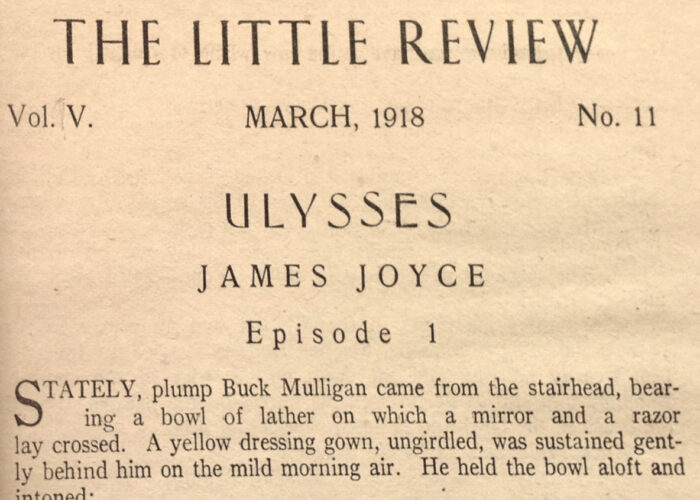
Alt text: The opening header of the first episode of Ulysses in The Little Review, volume 5, number 11, March 1918 (photograph by the author from the copy in the Special Collections and Archives of Grinnell College)
0

Numbering Ulysses: Digital Humanities, Reductivism, and Undergraduate Research

Abstract

Ashplant: Reading, Smashing, and Playing Ulysses, is a digital resource created by Grinnell College students working with Erik Simpson and staff and faculty collaborators.[1] In the process of creating Ashplant, the students encountered problems of data entry, some of which reflect the general difficulties of placing humanistic materials in tabular form, and some of which revealed problems arising specifically from James Joyce’s experimental techniques in Ulysses. By presenting concrete problems of classification, the process of creating Ashplant led the students to confront questions about the tendency of Digital Humanities methods to treat humanistic materials with regrettably “mechanistic, reductive and literal” techniques, as Johanna Drucker puts it. It also placed the students’ work in a century-long history of readers’ efforts to tame the difficulty of Ulysses by imposing numbering systems and quasi-tabular tools—analog anticipations of the tools of digital humanities. By grappling with the challenges of creating the digital project, the students grappled with the complexity of the literary material but found it difficult to convey that complexity to the readers of the site. The article closes with some concrete suggestions for a self-conscious and reflexive digital pedagogy that maintains humanistic complexity and subtlety for student creators and readers alike.

In calculating the addenda of bills she frequently had recourse to digital aid.
—James Joyce, Ulysses (17.681–82), describing Molly Bloom[2]

The growth of the Digital Humanities has been fertilized by widespread training institutes, workshops, and certifications of technical skills. As we have developed those skills and methods, we DHers have also cultivated a corresponding skepticism about their value. Katie Rawson and Trevor Muñoz, for example, write that humanists’ suspicions of data cleaning “are suspicions that researchers are not recognizing or reckoning with the framing orders to which they are subscribing as they make and manipulate their data” (Rawson and Muñoz 2019, 280–81). Similarly and more broadly, Catherine D’Ignazio and Lauren Klein describe in Data Feminism the need for high-level critique when our data does not fit predetermined categories—to move beyond questioning the categories to question “the system of classification itself” (D’Ignazio and Klein 2020, 105). When we have “recourse to digital aid,” to reappropriate Joyce’s phrase from the epigraph above, we break fluid, continuous (analog) information into discrete units. In the process, we gain computational tractability. What do we lose? What do we lose, especially, when we use digital tools in humanistic teaching, where we value the cultivation of fluidity and complexity? These recent critiques build on foundational work such as Johanna Drucker’s earlier indictment of the methods of quantitative DH:

Positivistic, strictly quantitative, mechanistic, reductive and literal, these visualization and processing techniques preclude humanistic methods from their operations because of the very assumptions on which they are designed: that objects of knowledge can be understood as self-identical, self-evident, ahistorical, and autonomous. (Drucker 2012, 86)

The problems that Drucker identifies echo the distinction that constitutes the category of the digital itself: whereas analog information exists on a continuous spectrum, digital data becomes computationally tractable by creating discrete units that are ultimately binary. Tractability can require a loss of complexity. One of Drucker’s examples involves James Joyce’s Ulysses: she evokes the history of mapping the novel’s Dublin as a signature instance of the “grotesque distortion” that can occur when we use non-humanistic methods to transform the materials of imaginative works (Drucker 2012, 94). At their worst, such methods can operate like the budget of Bloom’s day in Ulysses, which is an accounting of a complex set of interactions that obscures at least as much as it reveals, mainly by sweeping messy expenditures into a catch-all category called “balance” (17.1476). Making the numbers add up can render complexity invisible.[3]

I agree with Drucker’s point, albeit with some discomfort, as I am also the faculty lead of a digital project that involves mapping Ulysses, albeit in a different way. In this essay, I take up the pre-digital and digital history of transforming information about Joyce’s novel into structured data. Then I consider the concrete application of those methods in Ashplant: Reading, Smashing, and Playing Ulysses, a website that shares the scholarship of my Grinnell College students. Working on the site has brought us into the history of numbering Ulysses, for better and for worse, and shown us how Ulysses specifically—more than most texts—resists and undermines the very processes that give digital projects their analytical power. In creating Ashplant, we have found that undergraduate research provides an especially generative environment for breaking down the “unproductive binary relation,” in Tara McPherson’s words, between theory and practice in the digital humanities (Macpherson 2018, 22).

Numbering Ulysses from The Little Review to the Database

Although created with twenty-first–century digital technologies, Ashplant takes part in a tradition that has built over the full century since the publication of Ulysses. Readers of Joyce’s text have long sought to discipline its complexity by creating reading aids structured like tabular data. That process begins with numbering: facing a novel that sometimes runs for many pages without a paragraph break, we readers have given ourselves a unique, identifying value for each line of the text. In database architecture, such a value is called—with unintentionally Joycean overtones—a primary key.[4] The primary key for Ulysses assigns the lines a value based on episode and line numbers. In its most conventional form, the line numbering is based on the Gabler edition of the novel. The episode-line key lets us point, for instance, to “Ineluctable modality of the visible”—the first line of the third episode—as 3.1.

Ulysses is unusual in having such a reliably fixed convention for a work of prose. Prose normally resists stable line numbering because its line breaks change in response to variations of typesetting that we do not normally read as meaningful; thus arises the variation among editions of Shakespeare’s plays in the line numbering of prose passages. The difficulty of reading Ulysses, however, creates a desire for reliably numbered reference points, for stable ground upon which communities of readers can gather. Such numbering imposes orderly hierarchy upon a text that implicitly and explicitly resists the concept and practices of orderly hierarchy. The early history of numbering the chapters and pages of Ulysses reveals our modern standardization—and by extension the structured data in Ashplant—as the product of a century-old conflict between printed versions of Ulysses and efforts of readers to retrofit the text into tractable data.

The serialization of Ulysses in The Little Review gave readers their first opportunity to grasp Joyce’s text with names and numbers. In the first issue containing part of Ulysses, the numbers begin: issue V.11, for March 1918. The Table of Contents reads, “Ulysses, 1.” The heading of the piece itself, on three lines, is “ULYSSES / JAMES JOYCE / Episode 1.”

The opening header of the first episode of Ulysses in The Little Review, volume 5, number 11, March 1918.
Figure 1. The opening header of the first episode of Ulysses in The Little Review (photograph by the author from the copy in the Special Collections and Archives of Grinnell College).

The 1922 Shakespeare and Company edition removes the episode numbers of the Little Review installments and, indeed, removes most signposting numbers altogether. The volume has no table of contents. In the front matter, the sole indication of a section or chapter number is a page containing only the roman numeral I, placed a bit above and to the left of the center of the page.

Figure 2. The Shakespeare and Company page with only the roman numeral “I” (Joyce, 1922).

This page is preceded by one blank page and followed by another, after which the main text of the novel begins, with no chapter title or episode number.

The beginning of the first episode in the Shakespeare and Company edition, showing no numbering or other header above the text.
Figure 3. The beginning of the first episode in the Shakespeare and Company edition (Joyce, 1922).

The page has no number, either. The following page is numbered 4, so the reader can infer that this is page three, and that the page with the roman numeral I has also been page one of the book. Episodes two and three are also unnumbered, so the reader can infer retrospectively that the roman numeral one indicated a section rather than a chapter or episode number. At this point, that is to say, the only stable numbering from The Little Review—the episode numbers—has disappeared entirely and been replaced by section numbers (just three for the whole book) that reveal their signification only gradually.

To fill the void of stable numbering, early readers of Ulysses relied on supplemental texts that have structured the naming and numbering conventions of the text ever since: the two schemata that Joyce hand-wrote for Carlo Linati and Stuart Gilbert in 1920 and 1921, respectively. The schemata have retained their power in part because of the tantalizing (apparent) simplicity of their form: they organize information about the novel in a structure closely resembling that of a spreadsheet or relational database table. Both schemata use the novel’s eighteen episodes as their records, or tuples—the rows that act essentially as entries in the database—and both populate each record with data corresponding to a series of columns largely but not entirely shared between the two schemata. The relational structure of the Linati schema, for example, has a record for the first episode that identifies it with the number “1,” the title “Telemachus,” and the hour of “8–9” (Ellmann 1972).

Today, any number of websites re-create the schemata by making the quasi-tabular structure fully tabular, as does the Wikipedia page for the Linati schema (“Linati Schema for Ulysses”).

A screenshot of the Linati schema in Wikipedia, showing the tabular structure of the data in the web page.
Figure 4. A screenshot of the Linati schema in Wikipedia. (https://en.wikipedia.org/wiki/Linati_schema_for_Ulysses).


Joyce’s sketches mimic tabular data so neatly that many later versions of the schemata put them in tabular structure without comment. The episode names and numbers again prove their utility: though the two schemata contain different columns, a digital version can join them by creating a single, larger table organized by episode.[5]

Organizing information by episode number has become standard practice in analog and digital supplements to Ulysses. In the analog tradition, readers have long used supplemental materials, organized episode by episode, to assist in the reading of the novel. An offline reader might prepare to read episode three, for instance, by reading a brief summary of the episode on Wikipedia, then consulting the schemata entries for the episode in Richard Ellmann’s Ulysses on the Liffey, then reading the longer summary in Harry Blamires’s New Bloomsday Book. In each case, that reader would look for materials associated with episode number three or the associated name “Proteus.” As much as any other work of literature, Ulysses invites that kind of hand-crafted algorithm for the reading process, all organized by the supplements’ adoption of conventional episode numbers and, often, the Gabler edition’s line numbers as well.

Digital projects, including Ashplant, rely on these episode and line numbers even more fundamentally. One section of Ashplant—the most conventional section—is called “Ulysses by episode.” It organizes and links to resources created by other writers and scholars, from classic nodes of reading Ulysses such as the Linati and Gilbert schemata to contemporary digital projects such as Boston College’s “Walking Ulysses” maps and the textual reproductions of the Modernist Versions Project.[6] This part of Ashplant, like those digital supplements to Ulysses and a long list of others, relies on the standard numerical organization: it has eighteen sections, corresponding to the eighteen episodes of the novel.

The underlying structure of these pages illustrates the importance of the episode number as a primary key: at the level of HTML markup, all eighteen pages point to the same file (“episode.php”) and therefore contain the same code.[7] The only change that happens when the user moves from the page about episode one to that for episode two, for example, is that the value of a single variable, “episode_number,” changes from “01” to “02.” Based on that variable, the page changes the information it displays, mainly by altering database calls that say, essentially, “Look at this database table and give me the information in the row where episode_number equals” the value of that variable. The database call looks like this, with emphasis added:

/* Performing SQL query */
$query = “SELECT a.episode_number, a.episode_name, b.episode_number, b.ls_time, b.ls_color, b.ls_people, b.ls_scienceart, b.ls_meaning, b.ls_technic, b.ls_organ, b.ls_symbols, b.gs_scene, b.gs_hour, b.gs_organ, b.gs_color, b.gs_symbol, b.gs_art, b.gs_technic
FROM episode_names a, schemata b
WHERE (a.episode_number=’$episode_number’) and (a.episode_number=b.episode_number)”;
$result = mysql_query($query) or die(“Query failed : ” . mysql_error());
$num=mysql_numrows($result);

The user’s input provides the value of episode_number (from 01 to 18) when the page loads.[8] Then, the page with this code queries the database to gather the information—the episode’s name, the schemata entries, and much more—from two database tables joined by the column containing that two-digit number in each table. The process gains its effectiveness from the conventionality of the episode numbers. The price of that efficacy is the loss of a good deal of information—from quirks of typesetting and handwriting, to alternative approaches to numbering the episodes, to the Italianate episode names from the schemata—that have at least as much textual authority as do our later simplifications.

Hierarchy and Classification

If there could be that which is contained in that which is felt there would be a chair where there are chairs and there would be no more denial about a clatter. A clatter is not a smell. All this is good.
—Gertrude Stein, Tender Buttons (Stein 2018, 53)

Line numbers, mainly those of the Gabler edition, impose further numerical discipline on Ulysses. The line numbers produce a hierarchy that allows humans and machines alike to arrive at a shared understanding of textual location:

Line (beginning at 1 and incrementing by 1 within each episode)

Episodes (1–18, or “Telemachus” to “Penelope”)

Ulysses (the whole)

This rationalization functions so powerfully, not only in digital projects but also in conventional academic citation, because it assigns to each location in the text—with some exceptions, such as images—a line, and every line belongs to an episode, and every episode belongs to Ulysses. The hierarchy of information allows shared understanding of reference points.

Though created before the age of contemporary digital humanities, the line/episode/book hierarchy produces a kind of standardization—simple, technical, and reductive—that is enormously useful for digital methods. For example, I embedded into Ashplant a script that combs parts of the site for references to Ulysses, based on a standard citation format of “(U [episode].[line(s)]),” then generates automatically a list of references to an episode, with a link to each source page.

A screenshot of an index of line references from Ashplant, showing a machine-generated list of references from Episode Five of Ulysses.
Figure 5. A screenshot of an index of line references from Ashplant.

These references point to entries in our collective lexicon of key terms in Ulysses. The students’ lexicon entries together constitute a playful, inventive exploration of the book’s language. The automated construction of the list itself, however, relies on an episode-line hierarchy that has none of that playfulness or invention.

For playful inventiveness in a hierarchy of location, we can turn instead to Stephen Dedalus in Joyce’s Portrait of the Artist as a Young Man, who reads the hierarchical self-location he has written on the flyleaf of his geography book:

Stephen Dedalus
Class of Elements
Clongowes Wood College
Sallins
County Kildare
Ireland
Europe
The World
The Universe (Joyce 2003, 12)

Stephen’s hierarchy is personal and resistant, not only containing the humorously self-centered details of his hyper-local situation but also excluding, for instance, any layer between “Ireland” and “Europe” that would acknowledge Ireland’s containment within the United Kingdom. It also confuses categories: although the list seems geographical—appropriately, given its location on a geography book—it contains some elements that would require additional information to become geographical (“Stephen Dedalus,” “Class of Elements”), and others whose mapping would be contentious (“Ireland,” “Europe”). It even contains an element, “Class of Elements,” that constitutes a self-reflexive joke about the impulse to classification that the list satirizes.

Such knowing irony does not infuse the hierarchies that drive much of our work in the digital humanities. That work requires schemes of classification that rely on one element’s containment within another. Consider what “Words API” claims to be “knowing” about words:

A screenshot from the 'About' section of Words API describing the hierarchical relations of certain terms, such as 'a hatchback is a type of car'.
Figure 6. A screenshot from the “About” section of Words API describing the hierarchical relations of certain terms (https://www.wordsapi.com).

An API, or Application Programming Interface, provides methods for different pieces of software to communicate with one another in a predictable way. Words API, “An API for the English Language,” performs this function by adding hierarchical metadata to every word. That metadata, in turn, allows other software to draw on that information by searching for all the words that refer to parts of the human body, for instance, or for singular nouns. In other kinds of DH applications, such as textual editions that are part of the XML-based Text Encoding Initiative, the hierarchical relationships are often hand-encoded: feminine rhyme is a type of rhyme, and rhyming words are sections of lines, which are elements of stanzas, and so forth.

The utility of these techniques is not surprising. Stanzas do generally consist of lines, transitive is a type of verb. The reliance on these encoded hierarchies echoes the methods of New Criticism, such as Wellek and Warren’s hierarchical sequence of image, metaphor, symbol, and myth—for them, the “central poetic structure” of a work (Wellek and Warren 1946, 190). For contemporary scholars more invested in decentering and poststructuralism, however, the echo of New Critical hierarchies in DH is unwelcome. Centrality implies exclusion; structure implies oversimplification; formal hierarchy implies social hierarchy. Or, as John Bradley writes, “XML containment often represents a certain kind of relationship between elements that, for want of a better term, can be thought of as ‘ownership’” (Bradley 2005, 145). Even for scholars working specifically to counteract the hierarchical containments of XML, the attempt can lead—as in Bradley’s work—to the linking of multiple hierarchical structures rather than the disruption of hierarchical organization itself.

Problems of “Subtle Things”

Addressing the challenges of encoding historical materials in XML, Bradley describes the limitations of hierarchical classification. “Humanities material,” he writes, “sometimes does not suit the relational model,” and he cites the Orlando Project’s opposition to placing its data in a relational database because it wanted to say more “subtle things” than the relational model could express (Bradley 2005, 141).[9] Bradley responds to that challenge with an ingenious method of integrating the capabilities of SQL databases into XML, solving the problem of expressing how a name in a historical document might refer to one of three people with discrete identifiers in the database. Even this problem, however, involves a relatively simple kind of uncertainty, representable on a line between “certain” and “unlikely.” The data being encoded is used for humanistic purposes, but the problem itself is not especially humanistic: it assumes an objective historical reality that can be mapped, with varying levels of confidence, onto stable personal identifiers.

The data of Ulysses presents additional difficulties, many of which are specifically literary, as the students working on Ashplant have repeatedly found. In one case, a group of them sought to document every appearance of every character in Ulysses. That data has clear utility for readers: when made searchable, it could assist a reader by identifying, for a given episode and line number, the active characters, perhaps adding a brief annotation to each name. Many earlier aids to reading the novel offer descriptions of the main characters, but the students set out to develop a resource that was more comprehensive and more responsive to a reader’s needs at a given place in the text. The students quickly discovered that identifying and describing a handful of major characters is easy; identifying all of them and their textual locations is not just a bigger problem but a fundamentally different one.

Take, for example, the novel’s dogs. We had established early on that non-human entities could be characters in our classification, given Joyce’s attribution of speech and intention to, say, hats and bars of soap. At least one dog seemed clearly to reach the level of “character”: Garryowen, the dog accompanying the Citizen in the “Cyclops” episode. According to one of the satirical interpolations of the episode, Garryowen has attained, “among other achievements, the recitation of verse” (12.718–19), a sample of which is included in the text. For the purposes of our data and accompanying visualization, we therefore needed basic information about the character, such as its name and when it appears in Ulysses.

The name creates the first problem. The description of the dog in “Cyclops” identifies it as “the famous old Irish red setter wolfdog formerly known by the sobriquet of Garryowen and recently rechristened by his large circle of friends and acquaintances Owen Garry” (12.715–17). In itself, the attribution of two names to one being is not a problem. For instance, Leopold Bloom can be “Bloom” or “Poldy,” but switching between them does not rename him. In Ulysses, such an entity could take the names “Garryowen” and “Owen Garry.” As long as the underlying identity is stable, this kind of multiplicity (two names at two different times) can fit easily into a relational database.

But Ulysses does not work so simply. Within the fiction, the renaming of the dog has questionable reality-status.[10] The “rechristening” has no durability within the narrative; it exists only in the context of one satirical interpolation, and subsequent references to the dog revert to “Garryowen.” Arguably, if our task is to describe the characters that are real within the world of the novel, the name “Owen Garry” has no status at all, as it attaches more to the voice of the temporary narrator than to what we could imagine as the real (fictional) dog.

However, we could just as plausibly say that, in the fiction, “Owen Garry” must not only exist but also be recorded as a separate character representing the temporary re-creation of Garryowen by this narrative voice. All of this messiness anticipates the further complications of the hallucinatory “Circe” episode, in which Bloom is followed by a dog that metamorphoses among species—spaniel, retriever, terrier, bulldog—until Bloom addresses it as “Garryowen,” and it transforms into a wolfdog. The dog might say, as Stephen does, “I am other I now” (9.205). Joyce’s method relies on the unresolvability of these ambiguities.

Emily Mester, the student who took the lead on the Ashplant character project, brought the transforming dog to our working group as a problem of data entry. We discussed how the problem stemmed from a breakdown of classification: rather than allowing the reader to rely on conventional relationships between sets and their elements (living things include humans and other animals, which include dogs, which include species, which include individual dogs), Joyce’s transforming dog implies a relation in which the individual dog contains multiple species. Our conversation led us to consider the dog as a device through which Joyce upends hierarchies of containment by attaching the name “Garryowen” to a dog, or an assortment of dogs, whose characteristics arise from the surrounding narration.

We realized together that the exercise of entering data into our spreadsheet led us to new questions about earlier scholarship on Ulysses. We found, for example, that Vivien Igoe assumed that Joyce’s Garryowen represented a historical dog of the same name, as in her statement that “Garryowen, who appears in three of the episodes in Ulysses (‘Cyclops’, ‘Nausicaa’, and ‘Circe’), was born in 1876” (Igoe 2009, 89). Although Igoe subsequently notes that Joyce distorts Garryowen for the purposes of fiction, this sentence still relies on several related presumptions for the purposes of historicist explanation: that the historical and fictional Garryowens are the same, that the Garryowen of Ulysses has the species identification of the historical dog (“famous red setter” [Igoe 2009, 89] rather than the “Irish red setter wolfdog” of “Cyclops”), and that within Ulysses, the fictional dog maintains a constant identity across episodes.[11] Reading phrasing such as Igoe’s in light of our questions about Garryowen led the Ashplant group to consider the confrontation between certain kinds of historicist methods with poststructural skepticism.

As the students continued to develop Ashplant, they discovered more and more examples of data entry problems that gave rise to probing discussions of Ulysses and, often, of how fictions work and how readers receive them. We sought, for instance, to map the global imagination of Ulysses, resisting the tendency Drucker had criticized of producing simplistic, naïve Dublin-centric visualizations of the “action” of the book. Instead, our map included only places outside of Dublin. For that subproject, guided by the student Christopher Gallo, we asked, How do we map an imaginary place? One that a character remembers by the wrong name? One that seems to refer to a historical event but puts it in the wrong place? For another part of the project, led by Magdalena Parkhurst, we created a visualization of the Blooms’ bookshelf that has been disrupted in “Ithaca,” and we needed to represent books with missing, incorrect, and imaginary information according to our research into historical sources.

Again and again, we found that the parts of Ashplant that appeared to involve the simplest kinds of data entry prompted us to have some of our deepest conversations about Ulysses, often leading us to further reading in contemporary criticism and theory. We found that, as Rachel Buurma and Anna Tione Levine and have argued,


Building an archive for the use of other researchers with different goals, assumptions, and expectations requires sustained attention to constant tiny yet consequential choices: “Should I choose to ignore this unusual marking in my transcription, or should I include it?” “Does this item require a new tag, or should it be categorized using an existing one?” “Is the name of the creator of this document data or metadata?” (Buurma and Levine 2016, 275–76)


Though our project is not archival, our experience has aligned with Buurma and Levine’s argument. Undergraduate research, which “has long emphasized process over product, methodology over skills, and multiple interpretations over single readings,” is well situated to foster the “sympathetic research imagination” necessary for creating useful digital projects. As our process became product, we felt more powerfully the constraints of using the “reductive and literal” tools that concern Drucker. No matter how nuanced and far-reaching our conversation about Garryowen had been, for instance, the needs of our spreadsheet compelled us to choose: is/are the transforming dog(s) of “Circe” appearances Garryowen or not?[12]

We found that the machinery of data entry and visualization produced what Donna Haraway calls the “god trick” of producing the illusion of objectivity, even when our conversations and methods aspired to privilege, in Haraway’s words, “contestation, deconstruction, passionate construction, webbed connections, and hope for transformation of systems of knowledge and ways of seeing” (Haraway 1988, 585).[13] Our timeline-based visualization of character appearances, for example, could not resist the binary choice of yes or no; even a tool that could represent probability would not be capable of representing non-probabilistic indeterminacy in the way that our conversation had. We needed to find other ways to make Ashplant into a site that produces a humanistic experience for its readers as well as its creators.

Ways Forward for Humanism in Undergraduate Digital Studies

This essay will not fully solve the problem it addresses: that digital methods gain some of their power by selecting from and simplifying complex information, sometimes in ways that run contrary to humanistic practices. Like Buurma and Levine, however, I find that the scale and established practices of undergraduate research create opportunities to do digital work that minimizes the problem and may, in fact, point to approaches that can inform humanistic digital work in general. With that goal in mind, I offer a few propositions based on our Ashplant team’s experience to date.

  1. Narrate the problems. Undergraduate research often operates at a scale that allows for hand-crafted digital humanities, in which the consequences of data manipulation can become the explicit subject of a project. The structure of Ashplant allows us to explain the problems of documenting character and location in Ulysses, and it also provides space for a wider range of student research: an analysis of Bloom’s scientific thinking and mis-thinking in “Ithaca,” a piece about Ulysses and the film Inside Llewyn Davis that uses hyperlinks to take a circular rather than linear form, and students’ artistic responses to the novel. The scale of undergraduate research allows it to become an arena for confrontation with and immersion in the problems created by the intersection of data science and the humanities.
  2. Connect conventional research to digital outcomes. Ashplant has at its heart an annotated bibliography, for which students read, cite, and summarize existing scholarship. Creating such a bibliography in digital form—specifically, with the bibliographical information in a database accessed through our web interface—enables searchability and linking. The bibliography thus becomes the scholarly backbone of the site, linked from and linking to every other section. Contributing to this part of the project grounds the students in the kind of reading and writing they have done for their other humanistic work, while also illustrating the affordances of the digital environment.
  3. Use the genre of the hypertext essay. Writing essays that combine traditional scholarly citation with other means of linking—bringing a project’s data to bear on a problem, connecting the project to other digital collections and resources—allows students to experience and demonstrate the impact of their digital projects on scholarly argumentation. Ashplant therefore includes a section of topical essays and theoretical explorations, addressing subjects from dismemberment to music. These essayistic materials link to and, importantly, are linked from the parts of the site that are based more explicitly on structured data. Our visualization of the global locations of Ulysses can lay the foundations for discussions of the Belgian King Leopold and the postcolonial Ulysses, for example, and a tool we developed for finding phonemic patterns in the text became the prompt for Emily Sue Tomac, a student specializing in linguistics as well as English, to undertake a project on Joyce’s use of vowel alternation in word sets such as tap/tip/top/tup. Hypertext essays can reanimate the complexities and contestations hidden by the god trick.
  4. Make creative expression a pathway to DH. My initial design Ashplant involved an unconventional division of labor. For the most part, students wrote the content of the site, while I took the roles of faculty mentor, general editor, and web developer. As the site evolved, so did those roles, and I perceived an important limitation of our model: students were rarely responsible for the visual elements of our user interface, and their interest in that part of the project was growing. The students saw the creative arts as a means of resisting the constraints of digital methods, and some of them created art projects that now counterbalance the lexical content of the site. When I designed a new course on digital methods for literary studies, therefore, I put artistic creativity first.[14] In that class, the students learned frameworks for discussing the affordances and effects of electronic literature, and we applied those frameworks to texts such as “AH,” by Young-hae Chang Heavy Industries; Illya Szilak and Cyril Tsiboulski’s Queerskins: A Novel; and Ana María Uribe’s Tipoemas y Anipoemas.[15] These works model a range of approaches to interactivity and digital interfaces. Therefore, all of our subsequent work in the semester—from the creation of the students’ own works of electronic literature, to the collection and presentation of geographical data, to writing Python scripts for textual analysis—takes place after this initial framing of digital work as a set of creative practices.

The complexity of humanistic inquiry does not involve solving well-defined problems with clear endpoints and signs of success. Our wholes have holes. As I have worked with my students on Ulysses, we have come to embrace a practice of digital humanities that puts creativity, resistance, and questioning at its heart, even (or especially) when we use the tabular and relational structures that appear at first to build walls within the imaginative works we study. Asking questions as simple as “What do we call this chapter of Ulysses?” and “When does this character appear?” has led my students to think and play and draw, representing contours of absurdity and art that help draw new maps of undergraduate study in the humanities.

In some ways, that new mapping takes part in the tradition I have described here: the translation and even reduction of textual complexity into reference materials that help students grasp Ulysses and begin the process of making meaning of and around it. In other ways, however, Ashplant has led us to a practice of digital humanities more aligned with Tara McPherson’s emphasis on “the relations between the digital, the arts, and more theoretically inflected humanities traditions” (McPherson 2018, 13). The scale of undergraduate pedagogy allows spreadsheets, essays, maps, and paintings to grow from the same intellectual soil, maintaining the value that structured data has long provided while preserving the complex energies of humanistic inquiry.

Notes

[1] “Ashplant” is the word Joyce uses to describe the walking stick of Stephen Dedalus. As the site explains, Stephen’s ashplant “is not a simple support but his ‘casque and sword’ (9.296) that he uses for everything from dancing and drumming to smashing a chandelier.” We likewise sought to take the conventional idea of a digital site supporting the reading of Ulysses and create varied and surprising possibilities for its use.

[2] I cite Ulysses (Joyce 1986) by episode and line number throughout, following the numbering convention that is about to become the subject of this essay.

[3] On the other hand, when Bloom later relates the events of his day to his wife in words, his account includes similar evasions and omissions. Joyce’s larger point seems less about the deceptions of quantification than about the many modes of deception humans can use when sufficiently motivated to hide something.

[4] More technically, in a database, a primary key is a column or combination of columns that have a unique value for every row. For example, in Ulysses, line number alone cannot be a primary key because every episode has, for instance, a line numbered 33. Therefore, the primary key requires the combination of episode and number: 1.33, 4.33, and 17.33 are all unique values. The other main characteristic of a primary key is that it cannot contain a null value in any row.

[5] As we have seen, the numbering convention of labeling the episodes from one to eighteen follows the lead of the Little Review episodes but not of the Shakespeare & Company edition, which uses only section numbers. The schemata employ yet another system, primarily restarting the episode numbering at the beginning of each section (so the fourth episode, which begins the second section, becomes a second episode “1”).

[6] These projects’ addresses are http://ulysses.bc.edu/ and http://web.uvic.ca/~mvp1922/, respectively.

[7] HTML (Hypertext Markup Language) is the standard markup language for web pages. HTML describes the structure of the data in a page, along with some information about formatting, so that it can be rendered by a browser. HTML does not contain executable scripts (or “code”). To create executable scripts and access information in databases, Ashplant embeds the scripting language PHP within its HTML code and connects to databases created with MySQL. Using this combination of PHP and MySQL is a common approach to creating dynamic web pages.

[8] This numbering involves another small translation: using two digits—01 and 02 rather than 1 and 2—allows the numbers to sort properly when interpreted computationally.

[9] The ability of XML-based schemes to contain non-hierarchical information remains a point of lively contention. The subject prompted a lengthy conversation on the HUMANIST listserv in early 2019 under the heading “the McGann-Renear debate.” That conversation is archived at https://dhhumanist.org/volume/32/.

[10] “Cyclops” implies yet another variant of the name: the Citizen familiarly calls the dog “Garry,” and the mock-formal narrator calls the poet-dog “Owen,” reversing the usual functions of first and last names and implying another identity called “Garry Owen.”

[11] Igoe’s phrasing also conflates the birth years of the historical and fictional Garryowens, although the historical dog would have had an implausible age of around twenty-eight years at the time Ulysses takes place.

[12] For whatever it’s worth, the unsatisfying decision we made was to classify the “Garryowen” (and “Owen Garry”) of “Cyclops” and “Nausicaa” as the character “Garryowen,” then create a separate character called “Circe Dog” to capture the transforming species of the dog(s) of that episode.

[13] Haraway’s skepticism echoes the sentiments of the “foundational crisis” of mathematics about a century ago, when Joyce was conceiving Ulysses and when, in 1911, Oskar Perron wrote, “This complete reliability of mathematics is an illusion, it does not exist, at least not unconditionally” (Engelhardt 2018, 14).

[14] That course, “Lighting the Page: Digital Methods for Literary Study,” was designed in partnership with my student collaborator Christina Brewer, who made especially valuable contributions to the unit on electronic literature.

[15] “AH” is online at http://www.yhchang.com/AH.html, Queerskins at http://online.queerskins.com/, and Uribe’s poetry at http://collection.eliterature.org/3/works/tipoemas-y-anipoemas/typoems.html.

Bibliography

Blamires, Harry. 1996. The New Bloomsday Book. London: Routledge.

Bradley, John. 2005. “Documents and Data: Modelling Materials for Humanities Research in XML and Relational Databases. Literary and Linguistic Computing 20, no. 1: 133–51.

Buurma, Rachel Sagner and Anna Tione Levine. 2016. “The Sympathetic Research Imagination: Digital Humanities and the Liberal Arts.” In Debates in the Digital Humanities, edited by Matthew K. Gold and Lauren F. Klein, 274–279 Minneapolis: University of Minnesota Press.

D’Ignazio, Catherine and Lauren F. Klein. 2020. Data Feminism. Cambridge: MIT Press.

Drucker, Johanna. 2012. “Humanistic Theory and Digital Scholarship.” In Debates in the Digital Humanities, edited by Matthew K. Gold, 85–95. Minneapolis: University of Minnesota Press.

Ellmann, Richard. 1972. Ulysses on the Liffey. Oxford: Oxford University Press.

Engelhardt, Nina. 2018. Modernism, Fiction, and Mathematics. Edinburgh: Edinburgh University Press.

Haraway, Donna. 1988. “Situated Knowledges: The Science Question in Feminism and the Privilege of Partial Perspective.” Feminist Studies 13, no. 3: 575–599.

Igoe, Vivien. 2009. “Garryowen and the Giltraps.” Dublin James Joyce Journal 2, no. 2: 89–94.

Joyce, James. 1922. Ulysses. Paris: Shakespeare and Company. http://web.uvic.ca/~mvp1922/ulysses1922/

Joyce, James. 1986. Ulysses, edited by Hans Walter Gabler with Wolfhard Steppe and Claus Melchior. New York: Vintage.

Joyce, James. 2003. A Portrait of the Artist as a Young Man, edited by Seamus Deane. New York: Penguin.

Macpherson, Tara. 2018. Feminist in a Software Lab: Difference + Design. Cambridge: Harvard University Press.

Rawson, Katie and Trevor Muñoz. 2019. “Against Cleaning.” In Debates in the Digital Humanities, edited by Matthew K. Gold and Lauren F. Klein, 279–92. Minneapolis: University of Minnesota Press.

Stein, Gertrude. 2018. Tender Buttons: Objects, Food, Rooms, edited by Leonard Diepeveen. Peterborough: Broadview.

Wellek, René and Austin Warren. 1946. Theory of Literature. New York: Harcourt.

Acknowledgments

This essay names some of the contributors to Ashplant, but dozens of student, faculty, and staff collaborators have made important contributions to the project, and the full accounting of gratitude for their work is on the site’s “About” page at http://www.math.grinnell.edu/~simpsone/Ulysses/About/index.php. I also thank Amanda Golden, Elyse Graham, and Brandon Walsh for their insightful comments on earlier versions of this piece.

About the Author

Erik Simpson is Professor of English and Samuel R. and Marie-Louise Rosenthal Professor of Humanities at Grinnell College. He is the author of two books: Literary Minstrelsy, 1770–1830 and Mercenaries in British and American Literature, 1790–1830: Writing, Fighting, and Marrying for Money. His current research concerns digital pedagogy and, in collaboration with Carolyn Jacobson, the representation of spoken dialects in nineteenth-century literature.

Two adults sitting side-by-side looking at their laptop screens.
0

Data Literacy in Media Studies: Strategies for Collaborative Teaching of Critical Data Analysis and Visualization

Abstract

This essay addresses challenges of teaching critical data literacy and describes a shared instruction model that encourages undergraduates at a large research university to develop critical data literacy and visualization skills. The model we propose originated as a collaboration between the library and an undergraduate media and cultural program, and our specific intervention is the development of a templated data-visualization instruction session that can be taught by many people each semester. The model we describe has the dual purpose of supporting the major and serving as an organizational template, a structure for building resources and approaches to instruction that supports librarians as they develop replicable pedagogical strategies, including those informed by a cultural critical lens. We intend our discussion for librarians who are teaching in an academic setting, and particularly in contexts involving large-scale or programmatic approaches to teaching. The discussion is also useful to faculty in the disciplines who are considering partnering with the library to interject aspects of data or information literacy into their program.

Learning that emphasizes data literacy and encourages analysis within multimedia visualization platforms is a growing trend in higher education pedagogy. Because data as a form of evidence holds a privileged position in our cultural discourse, interdisciplinary undergraduate degree programs in the social sciences, humanities, and related disciplines increasingly incorporate data visualization, thus elevating data literacy alongside other established curricular outcomes. When well-conceived, critical data literacy instruction engenders a productive blend of theory and practice and positions students to examine how race-based bigotry, gender bias, colonial dominance, and related forms of oppression are implicated in the rhetoric of data analysis and visualization. Students can then create visualizations of their own that establish counternarratives or otherwise confront the locus of power in society to present alternative perspectives.

As scholarship in media, communications, and cultural studies pedagogy has established, data visualizations “reflect and articulate their own particular modes of rationality, epistemology, politics, culture, and experience,” so as to embody and perpetuate “ways of knowing and ways of organizing collective life in our digital age” (Gray et al. 2016, 229). Catherine D’Ignazio and Lauren F. Klein (2020, 10) explain this dialectic more pointedly in Data Feminism, arguing, “we must acknowledge that a key way power and privilege operate in the world today has to do with the word data itself,” especially the assumptions and uses of it in daily life. Critical instruction positions undergraduates to question how data, in its composition, analysis, and visualization, can often perpetuate an unjust socio-cultural status quo. Undergraduates who are introduced to frames for interpreting culture also need to be exposed to tools—literal and conceptual—that help them critique data visualizations. The goal is to enable a holistic critical literacy, through which students can find data, structure it with a research question in mind, and produce accurate, inclusive visualizations.

However, data instruction is challenging, and planning data learning within the context of an existing course requires an array of skills. Effective data visualization pedagogy demands that instructors locate example datasets, clean data to minimize roadblocks, and create sample visualizations to initiate student engagement with first-order cultural-critical concepts. These steps, a substantial time investment, are necessary for teaching that enables data novices to contend with the mechanics of data manipulation while remaining focused on social and political questions that surround data. When charged with developing data visualization assignments and instructional assistance, faculty often seek the support and expertise of librarians and educational technologists, who are located at the nexus of data learning within the university (Oliver et al. 2019, 243).

Even in cases where librarians and instructional support staff are well-positioned to assist, the demand for teaching data visualization can be overwhelming. It can become burdensome to deliver in-person instruction to cohort courses with a large student enrollment, across many sections and in successive semesters. In order to initiate and maintain an effective, multidisciplinary data literacy program, teaching faculty, librarians, and educational technologists must establish strong teaching partnerships that can be replicated and reimagined in multiple contexts.

This essay addresses some challenges of teaching critical data literacy and describes a shared instruction model that encourages undergraduates at a large research university to develop critical data literacy and visualization skills. Although anyone engaged in teaching critical data literacy can draw from this essay, we intend our discussion for librarians who are teaching in an academic setting, and particularly in contexts involving large-scale or programmatic approaches to teaching. In addition, we believe our essay is particularly pertinent to those designing program curricula within discipline-specific settings, as our ideas engage questions of determining scale, scope, and learning outcomes for effective undergraduate instruction.

The teaching model we propose originated as a collaboration between the New York University Libraries and NYU’s Media, Culture, and Communications (MCC) department, and our specific intervention is the development of an assignment involving data visualization for a Methods in Media Studies (MIMS) course. The distributed teaching model we describe has the dual purpose of supporting the major and serving as an organizational template, a structure for building resources and approaches to instruction that supports librarians as they develop replicable pedagogical strategies, including those informed by a cultural critical lens. In this regard, we believe that collaborative instruction empowers librarians and faculty from many disciplines to develop their own data literacy competency while growing as teachers. And, it enables the library to affect undergraduate learning throughout the university.

There is already an extensive body of research about the role of critical data literacy instruction, including critical approaches to the technical elements of data visualization (Drucker 2014; Sosulski 2019; Engebresten and Kennedy 2020). While we draw from that scholarly discussion, we focus instead on the upshot of programmatic, extensible teaching partnerships between libraries and discipline-specific undergraduate programs. Along the way, we engage two crucial questions: What is the value of creating replicable lesson plans and materials, to be taught by an array of library staff repeatedly? How can the librarians who design these materials strike a balance between creating a step-by-step lesson plan that library instructors follow and structuring a guided lesson that is flexible and capacious enough for instructors to experience meaningful teaching encounters of their own?

Data Literacy in Undergraduate Education

Several curricular initiatives and assessment rubrics in higher education pedagogy recognize the need for students to develop fluidity with digital media and quantitative reasoning, a precursor to effective data visualization. In 2005, Association of American Colleges and Universities (AAC&U) began a decade-long initiative called Liberal Education and America’s Promise (LEAP), which resulted in an inventory of 21st century learning outcomes for undergraduate education. Quantitative literacy is on the list of outcomes (Association of American Colleges and Universities 2020). A corresponding AAC&U rubric statement asserts that “[v]irtually all of today’s students … will need basic quantitative literacy skills such as the ability to draw information from charts, graphs, and geometric figures, and the ability to accurately complete straightforward estimations and calculations.” The rubric urges faculty to develop assignments that give students “contextualized experience” analyzing, evaluating, representing, and communicating quantitative information (Association of American Colleges and Universities 2020). The substance of the LEAP initiative informed the development of our collaborative teaching model, for it allowed us to ground our curricular interventions within larger university curricular trends that had already emerged.

Although quantitative literacy is important, there are other structures for teaching that see data fluidity and visualization as being tied to larger information seeking practices. For this reason, we also turned to the Framework for Information Literacy for Higher Education, developed by the Association of College and Research Libraries (ACRL). The Framework embraces the concept of metaliteracy, which promotes metacognition and a critical examination of information in all its forms and iterations, including data visualization. One of the six frames posed by the document, “Information Creation as a Process,” closely aligns with data competency, including data visualization. This frame emphasizes that the information creation process can “result in a range of information formats and modes of delivery” and that the “unique capabilities and constraints of each creation process as well as the specific information need determine how the product is used.” Within the Framework, learning is measured according to a series of “dispositions,” or knowledge practices that are descriptive behaviors of those who have learned a concept. Here, the Framework is apropos, as students who see information creation as a process “value the process of matching an information need with an appropriate product” and “accept ambiguity surrounding the potential value of information creation expressed in emerging formats or modes” (ACRL 2016). The Framework recognizes that evolved undergraduate curricula must incorporate active, multimodal forms of analysis and production that synthesize information seeking, evaluation, and knowledge creation.

Other organizations and disciplines also advocate for quantitative literacy in the undergraduate curriculum. For instance, Locke (2017) discusses the relevance of data in the humanities classroom and points to ways undergraduate digital humanities projects can incorporate data analysis and visualization to extend inquiry and interpretation. And Beret and Phillips (2016, 13) recommend that every journalism degree program provide a foundational data journalism course, because interdisciplinary data instruction cultivates professionals “who understand and use data as a matter of course—and as a result, produce journalism that may have more authority [or] yield stories that may not have been told before.” In sum, LEAP, the ACRL Framework, and movements for data literacy in the disciplines influenced the Libraries’ collaboration with the Media and Cultural Communications department, and this informed the effort to create and support a meaningful learning experience for students in this major.

Learning-by-Teaching: Structured, Programmatic Instruction and Libraries

Our collaborative model evolved with the conviction that structured, programmatic teaching can foster professional growth for librarians and library technologists. In addition to creating impactful learning for students, programmatic teaching provides a structure that allows for educators to expand the contexts in which they can teach. In many cases, librarians who specialize in information literacy are less adroit regarding the concepts and mechanics of working with data. Teaching data as a form of information, then, necessarily requires a baseline technical expertise.

Several studies published within the past decade indicate that learning with the intent to teach can lead to better understanding, regardless of the content in question. One such study finds that learners who were expecting to teach the material to which they were being introduced show better acquisition than learners who were expecting only to take a test, theorizing that learning-by-teaching pushes the learner beyond essential processing to generative processing, which involves organizing content into a personally meaningful representation and integrating it with prior knowledge (Fiorella and Mayer 2013, 287). Another study finds that learners who were expecting to teach show better organizational output and recall of main points than those who were not expecting to teach, which suggests that learners who anticipate teaching tend to put themselves “into the mindset of a teacher,” leading them to use preparation techniques—such as concept organizing, prioritizing, and structuring—that double as enhancements to a learner’s own encoding processes (Nestojko, et al. 2014, 1046). This evidence boosts our belief that learning-by-teaching is a good strategy for librarians to build foundational data literacy skills, and it informed the development of our program.

Development and Implementation of the Collaborative Teaching Model

Situated in NYU’s Steinhardt School of Culture, Education, and Human Development, the MCC program covers global and transcultural communication, media institutions and politics, and technology and society, among other related fields. MCC program administrators, who were looking to incorporate practical skills into what had previously been a theory-heavy degree, approached the library to co-develop instructional content that would expose students to applied data literacy and multimedia visualization platforms. The impetus for the program administrators to reach out to the library was their participation in a course enhancement grant program, which testifies to the lasting effects that school or university-based curriculum initiatives can have on undergraduate learning. In this case, what emerged was a sustained teaching partnership. Though the support was refined over time, its core remained constant: individual sections of a media studies methods class would attend a librarian-led class session that prepares students to evaluate data and construct a visualization exploring some element of media and political economy, grounded in an assigned reading that asserts ownership of or access to media and communications infrastructure is intrinsically related to the well-being and development of countries around the world.

The class is a first-year requirement in Media, Culture, and Communication, one of NYU’s largest majors. The course tends to be taught by beginning doctoral students, and is by design a highly fluid teaching environment. In early iterations of library support, we designed a module that attempted to have students perform a range of analysis and visualization tasks. Students were introduced to basic socio-demographic datasets and were invited to create a visualization that investigates a research question of their choosing, provided that the question adhered generally to the themes of media and political economy. The assignment as initially constituted expected the student to frame a question, find a dataset and clean it, choose a visualization platform, and generate one or more visualizations that imply a causal relationship between variables that they had identified.

The learning outcomes and assignment developed in this initial sequence turned out to be too ambitious. The assignment had fairly loose parameters, which proved problematic, and the 75-minute class session could not provide sufficient preparation. Students struggled with developing viable research questions, finding data sets, and cleaning the data (the multivalent process of normalizing, reshaping, redacting, or otherwise configuring data to be ingested and visualized in online platforms without errors). Also, we had pointed them to an overwhelming array of data analysis software tools, including ESRI’s ArcMap, Carto, Plot.ly, Raw, and Tableau. We found they had great difficulty with both selecting a tool and learning how to use it, in addition to the connected process of finding a dataset to visualize within it. The Libraries tried to accommodate, but ultimately realized that the module needed significant adjustment going forward, especially since the MCC department decided to expand the project to include up to 10 sections of the course each semester.

Besides struggling with research questions, datasets, and tools, it was also apparent that students had trouble connecting this work to the broader ideas of media and political economy intrinsic to the assignment. Informed by these first-round outcomes, we came together again to revise the instructional content and assignment. Taking our advice into account, the MCC teaching faculty and program administrators refined the learning outcomes as such:

  • Become familiar with the principles, concepts, and language related to data visualization
  • Investigate the context and creation of a given dataset, and think critically about the process of creating data
  • Emphasize how online visualization platforms allow users to make aesthetic choices, which are part and parcel of the rhetoric of visualization

The librarians also created a student-facing online guide as a home base for the module and decided to distribute the teaching load by inviting Data Services specialists from the Libraries’ Data Services department to help teach the library sessions (MCC-UE 2019). And to provide a better lead-in to the library session, a preparatory lesson plan was developed for the MCC instructors to present in the class prior to the library visit.

After further feedback from program administrators and consideration, we inserted a scaffolding component into the library session lesson plan to better prepare students for their assignment. The component involved comparing four sample visualizations created from the very same data, and it included questions for eliciting a discussion about the origins and constructions of data. Scenario-based exercises for creating visualizations in Google sheets and Carto were also incorporated into the lesson, giving students practice before tackling the actual assignment. The assignment was also redesigned with built-in support. Students would no longer be expected to find their own dataset and attempt to clean extracted data, tasks that had caused them frustration and anxiety. Instead, they would choose from a handful of prescribed and pre-cleaned datasets. Data Services staff worked to remediate a set of interesting datasets to anticipate the kind of visualization students would attempt. Also, rather than having to choose from a confusing array of data visualization tools, they would be directed to use Google sheets or Carto only. Assuming the task of identifying, cleaning, and preparing datasets meant extra front-loaded work on the Libraries’ part, but it also freed students to focus on the higher order activity of investigating the relationship between visualizing information and examining social or political culture.

Instructional Support from a Wide Community of Teachers: Growing a Base

Another issue at hand was the strain the project was having on the members of the Data Services team and Communications Librarian, who taught all ten library sessions that were offered each semester. To achieve sustainability going forward, a broader group of librarians would be needed to help teach the library sessions. Moving forward, the Data and Communications librarians decided to recruit other NYU librarians to participate as instructors. Most of the recruits were data novices, but they viewed the invitation as an opportunity to learn data basics, expand their instruction repertoire, and strengthen their teaching practice. Calling on colleagues to teach outside their comfort zone is a big ask, one that requires strong support and administrative buy-in. So recruits were provided with a thorough lesson plan, a comprehensive hands-on training session, and the opportunity to shadow more experienced instructors before teaching the module solo (MCC-UE 2019).

By including a more robust roster of instructors, the structure also gave us the ability to further tie our lesson to what was planned in the MIMS curriculum. A new reading was chosen by the media studies faculty, “Erasing Blackness: the media construction of ‘race’ in Mi Familia, the first Puerto Rican situation comedy with a black family,” by Yeidy Rivero. The article grounds the students’ exploration of the relationship between media and political economy within the MIMS class, and it also provides a good entry point to explore critical data literacy concepts. According to Rivero, the show Mi Familia, deliberately represents a “flattened,” racially homogeneous “imagined community” of lower-middle class black family life that erases Puerto Rico’s hybrid racial identity. This flattening, Rivero argues, is part and parcel of multidimensional efforts to “Americanize” Puerto Rico and align its culture with the interests of the U.S. Furthermore, since the Puerto Rican media is regulated by the U.S. Federal Communication Commission (FCC) and owned by U.S. corporations, Puerto Ricans themselves had little recourse to question the portrayal of constructed racial identities in the mainstream culture (Rivero 2002).

Students were instructed to complete the reading prior to the library session. During the session, the library instructor referred to the reading and introduced a dataset with particular relevance to it. The instructor engaged students in a discussion about the importance of reviewing the dataset description and variables in order to form a question that can be reasonably asked of the data. With students following along, the instructor then modeled how to use Google sheets to manipulate the data and create a visualization that speaks to the question.

The selected dataset resulted from a study of the experiences and expressions of racial identity by young adults who lived in first and second-generation immigrant households in the New York City area during the late 1990s (Mollenkopf, Kasinitz, and Waters 2011). The timeframe of this article and the dataset line up well. The sitcom mentioned in the article first aired in 1994, but had been picked up in Telemundo’s NYC area affiliates by the late 1990s, so it is highly possible that this sitcom would have been on the air in the homes of study participants. The dataset, which is aggregated at the person level, includes variables about participants’ family and home context, patterns of socialization, exposure to media, and sense of self. In order to foreground the analytic process of looking at data, ascertaining its possibilities, and gesturing at potential visualizations, we created a simplified version of the raw data, which omits some columns and imputes other variables for easier use. To accompany this dataset, we also created some simple data visualizations in Google Sheets, ArcGIS Online, and Tableau, which are intentionally “impoverished,” thus designed to elicit discussion from students about the claims made by the visualizations.

Undoubtedly, these adjustments to the module led to students performing better on the assignment. Improvements to the lead-in session provided by the MCC instructors ensured that the students were prepared with context for the library workshop and an understanding of why the library was supporting the assignment. Basing the assignment on a specific article made it possible for librarians to model a way of bridging the theoretical concepts of the class to a question that could be asked of data. There was also more time for two pair-and-share discussions and group work in Google Sheets and Carto, which addressed a fundamental and recurring frustration in the students’ understanding of the assignment: the ability to ask an original question of a dataset, and to ask a question that would address a larger theme of media and political economy.

From the standpoint of instructors in NYU Libraries, we also found that the model provided a strengthened group of teachers. Several people who worked with sections of MIMS contributed ideas to the instructor manual and created ancillary slides and examples that are tailored to their own interest in the claims about racial and national identity that the Rivero article makes. For us, this flexibility is an important element of the collaborative teaching model; it offers both the structure for those who are new to data analysis and visualization to teach effectively, yet it also contains enough pathways for discussion to be meaningful and personal, should individual instructors want to branch out in their own teaching.

Conclusion

Despite being familiar with technology, many students arrive at college without a holistic ability to interpret, analyze, and visualize data. Educators now recognize the need to provide foundational data literacy to undergraduates, and many teaching faculty look to the library for support in instructional design and implementation. In this article, we recognize that creating integrated, meaningful data learning lessons is a complex task, yet we believe that the collaborative teaching model can be applied in various disciplinary contexts. Sustainability of this model depends on equipping a wide range of librarians with necessary data literacy skills, which can be achieved with a learning-by-teaching approach. After developing a teaching model that calls upon the expertise of teachers across the library, we gained some important insights on maintaining the communication and support to make it sustainable, building the workshop itself, and balancing the labor that all of this requires.

Good communication and organization between the MCC department and librarians was also key in maintaining the scalability of this instruction program. Given the heavy rotation of new teachers on both the library and MCC side, we needed to provide module content that was streamlined and assignment requirements that were clear cut in order to quickly on-board teachers to the goals, process, and output of the module. When recruiting library instructors, we emphasized that volunteers will not only build their data literacy skill set, but will also expand their pedagogical knowledge and teaching range. Finally, to ensure that volunteer instructors have a successful experience, we also provide support mechanisms such as a step-by-step lesson plan, thorough train-the-trainer sessions, opportunities to observe and team-teach before going solo, and a point person to contact with questions and concerns.

There is much hidden labor in all of this work. Robust student support for the course was also crucial, and really took off when the MCC department created a dedicated student support team from graduate assistants in the program. On the library side, communicating regularly with the MCC department, assessing and revising the learning objects, organizing and hosting train the trainer sessions, and scheduling all of the library visits takes many hours of time and planning. This work should not be overlooked when considering a program of this scale.

A collaboration at this level can provide rich data literacy at scale to undergraduates, while also offering the chance for instructors in the library and in disciplinary programs to develop their own skills in numeracy and data visualization as they learn by teaching. Through time, effort, and dedicated maintenance, a program like this becomes a successful partnership that has a broad and demonstrated impact on student learning, strengthens ties between the library and the departments we serve, and allows librarians and data services specialists the opportunity to learn and grow from each other.

Related to the learning objects themselves, we had the most success when we matched the scope of the assignment closely with the time and support the students would have to complete it, and preparing a small selection of data sets for the students in advance was very helpful in this regard. We also built in a full class session of preparation before the library visit, in which MCC teachers introduced the assignment, some principles of data visualization (via a slide deck prepared by the library’s Data Services department), and how this method can connect to broader concepts of media analysis. This led to more effective learning for students. These changes to the student assignment, learning outcomes, and library lesson plan were developed through regular and structured assessments of the workshop: a survey to the instructors teaching the course, classroom visits to see the students’ final projects, and in-depth conversations with instructors on which aspects of the lesson plan were successful and which fell flat. Following each assessment the MCC administrators and the librarians would get together to discuss and iterate on the learning objects. This process of gathering feedback on the workshop, reflecting on that information and then revising the assignment enabled us to improve the teaching and learning experience over the years.

Bibliography

Association of American Colleges and Universities. n.d. “Essential Learning Outcomes.” Accessed June 2, 2020. https://www.aacu.org/essential-learning-outcomes.

Association of American Colleges and Universities (AAC&U). n.d. “VALUE Rubrics.” Accessed June 2, 2020. https://www.aacu.org/value/rubrics/quantitative-literacy.

Association of College & Research Libraries. 2016. “Framework for Information Literacy for Higher Education. “ Accessed June 2, 2020. http://www.ala.org/acrl/standards/ilframework.

Berret, Charles and Cheryl Phillips. 2016. Teaching Data and Computational Journalism. New York: Columbia Journalism School. https://journalism.columbia.edu/system/files/content/teaching_data_and_computational_journalism.pdf.

D’Ignazio, Catherine and Lauren F. Klein. 2020. Data Feminism. Boston: MIT Press. ProQuest Ebook Central.

Drucker, Johanna. 2014. Graphesis: Visual Forms of Knowledge Production. Cambridge, Massachusetts: Harvard University Press.

Engebretsen, Martin and Helen Kennedy, eds. 2020. Data Visualization in Society. Amsterdam: Amsterdam University Press. Project MUSE.

Fiorella, Logan, and Richard E. Mayer. 2013. “The Relative Benefits of Learning by Teaching and Teaching Expectancy.” Contemporary Educational Psychology 38, no. 4: 281–288. https://doi.org/10.1016/j.cedpsych.2013.06.001.

Gray, Jonathan, Lillian L. Bounegru, Stefania Milan, and Paolo Ciuccarelli. 2016. “Ways of Seeing Data: Toward a Critical Literacy for Data Visualizations as Research Objects and Research Devices.” In Innovative Methods in Media and Communication Research edited by Sebastian Kubitschko and Anne Kaun, 227–252. Cham, Switzerland: Palgrave Macmillan. ProQuest Ebook Central.

Locke, Brandon T. 2017. “Digital Humanities Pedagogy as Essential Liberal Education: A Framework for Curriculum Development.” Digital Humanities Quarterly 11, no. 3. http://www.digitalhumanities.org/dhq/vol/11/3/000303/000303.html.

Nestojko, John F., Dung C. Bui, Nate Kornell, and Elizabeth Ligon Bjork. 2014. “Expecting to Teach Enhances Learning and Organization of Knowledge in Free Recall of Text Passages.” Memory & Cognition 42, no. 7: 1038–1048. https://doi.org/10.3758/s13421-014-0416-z.

Mollenkopf, John, Phillip Kasinitz, and Mary Waters M. 2011. Immigrant Second Generation in Metropolitan New York. Ann Arbor: Inter-university Consortium for Political and Social Research [distributor]. https://doi.org/10.3886/ICPSR30302.v1/.

“MCC-UE 14 Media & Cultural Analysis.” 2019. New York University. https://guides.nyu.edu/mims/.

Oliver, Jeffry, Christine Kollen, Benjamin Hickson, and Fernando Rios. 2019. “Data Science Support at the Academic Library.” Journal of Library Administration 59, no. 3: 241–257. https://doi.org/10.1080/01930826.2019.1583015.

Rivero, Yeidy. M. 2002. “Erasing Blackness: The Media Construction of ‘Race’ in Mi Familia, the First Puerto Rican Situation Comedy with a Black Family.” Media, Culture & Society 24, no. 4: 481–497. https://doi.org/10.1177/016344370202400402.

Sosulski, Kristen. 2018. Data Visualization Made Simple: Insights into Becoming Visual. London: Routledge. ProQuest Ebook Central.

Acknowledgments

This teaching partnership, data, and associated resources would not have been possible without the work of many people in NYU Libraries and Data Services, as well as the NYU Steinhardt Methods in Media Studies program including: Bonnie Lawrence, Denis Rubin, Dane Gambrill, Yichun Liu, and Jamie Skye Bianco.

About the Authors

Andrew Battista is a Librarian for Geospatial Information Systems at New York University and teaches regularly on data visualization, geospatial software, and the politics of information.

Katherine Boss is the Librarian for Journalism and Media, Culture, and Communication at New York University, and specializes in information literacy instruction in media studies.

Marybeth McCartin is an Instructional Services Librarian at New York University, specializing in teaching information literacy fundamentals to early undergraduates.

Network showing trilingual alignment on Ugarit (Armenian, Greek, and Latin).
0

Reading Texts in Digital Environments: Applications of Translation Alignment for Classical Language Learning

Abstract

This paper illustrates the application of translation alignment technologies to empower a new approach to reading in digital environments. Digital platforms for manual translation alignment are designed to facilitate a particularly intensive and philological experience of the text, which is traditionally peculiar to the teaching and study of Classical languages. This paper presents the results of the experimental use of translation alignment in the context of Classical language teaching, and shows how the use of technology can empower a meaningful and systematic approach to information. We argue that translation alignment and similar technologies can open entirely new perspectives on reading practices, going beyond the opposed categories of “skimming” and traditional linear reading, and potentially overcoming the cognitive limitations connected with the fruition of digital content.

Reading and Digital Technologies: A New Challenge

It seems impossible to imagine a world where digital technologies are not a substantial part of our intellectual activities. The use of technology in teaching and learning is becoming increasingly prominent, even more now, as the massive public health crisis of COVID-19 created the need to access information without physical proximity. Yet, the way information is processed on digital platforms is substantially different from the cognitive standpoint, and not exempt from concerning consequences: recently, it has been emphasized that accessing content digitally stimulates superficial approaches and “skimming”, rather than reading, which may have a longstanding impact on the ways in which human brains understand, approach, and articulate complex information (Wolf 2018).

Therefore, we must ask ourselves if we are using digital technologies in the right way, and what can be done to address this problem. Instead of eliminating digital methods entirely (which in current times seems especially unrealistic), maybe the solution resides in using them to empower a different way of approaching information. In this paper, I will advocate that the practices embedded in the study of Classical texts can offer a new perspective on reading as a cognitive operation, and that, if appropriately empowered through the use of technology, they can create a new and meaningful approach to reading on digital platforms.

The study of Classical languages implies a very peculiar approach to processing information (Crane 2019). The most relevant aspect of studying Classical texts is that we cannot consult a native speaker to verify our knowledge: instead, “communication” is achieved through written sources and their interaction with other carriers of information, such as material culture and visual representations. On the other hand, we must never forget that we are engaging with an alien culture to which we do not have direct access. This necessity of navigating uncertainty requires a much more flexible approach to information, and a very different way of engaging with written sources, where the focus is on mediated cultural understanding through reading, rather than immediate communication.

Engaging with an ancient text is a deeply philological operation: a scholar of an ancient language never simply goes from one word to another with a secure understanding of their meaning. Their reading mode is much more immersive. It is an operation of reconstruction through reflection, pause, and exploration, which requires several skills: from the ability of active abstraction of the language and its mechanics, to the recognition of linguistic patterns that coincide with given models, to the reflection on what a word or expression “really means” in etymological, stylistic, and cultural terms, to the philological reconstruction of “why” that word is there, as a result of a long process of transmission, translation, and error.[1] Yet, the implications of this intensive reading mode, in the broader context of the cognitive transformations to reading and learning, are often overlooked.

The operations embedded in the reading of Classical languages respond to a different cognitive process, that is beyond the opposed categories of “skimming” and traditional linear reading. Because of this peculiarity, some of the technologies designed in the domain of Classical languages are created specifically to empower this approach, bringing it at the center of the reader’s experience.

Translation Alignment: Principles and Technologies

Digital technologies are widely used in Classics for scholarship and teaching, thanks to the widespread use of digital libraries like Perseus (Crane et al. 2018) and the Thesaurus Linguae Graecae (2020), and to the consolidation of various methods for digital text analysis (Berti 2019) and pedagogy (Natoli and Hunt 2019). One of the most interesting recent developments in the field is the proliferation of platforms for manual and semi-automated translation alignment.

Translation alignment is a task derived from one of the most popular applications in Natural Language Processing. It is defined as the comparison of two or more texts in different languages, also called parallel texts or parallel corpora, by means of automated or semi-automated methods. The main purpose is to define which parts of a source text correspond to which parts of a second text. The result is often a list of pairs of items – words, sentences, or larger texts chunks like paragraphs or documents. In Natural Language Processing, aligned corpora are used as training data for the implementation of machine translation systems, but also for many other purposes, such as information extraction, automated creation of bilingual lexica, or even text re-use (Dagan, Church, and Gale 1999).

The alignment of texts in different languages, however, is an exceptionally complex task, because it is often difficult to find perfect overlap across languages, and machine-actionable systems are often inefficient in providing equivalences for more sophisticated rhetorical or literary devices. The creation of manually aligned datasets is especially useful for historical languages, where available indexes and digitized dictionaries often do not provide a sufficient corpus to develop reliable NLP pipelines, and are remarkably inefficient for automated translation. Therefore, creating aligned translations is also a way to engage with a larger scholarly community and to support important tasks in Computer Science.

In the past few years, three generations of digital tools for the creation and use of aligned corpora have been developed specifically with Classical languages in mind. First, Alpheios provides a system for creating aligned bilingual texts, which are then combined with other resources, such as dictionary entries and morphosyntactic information (Almas and Beaulieu 2016; “The Alpheios Project” 2020). Second, the Ugarit Translation Alignment Editor was inspired by Alpheios in providing a public online platform, where users could perform bilingual and trilingual alignments. Ugarit is currently the most used web-based tool for translation alignment in historical languages: since it went online in March 2017, it has registered an ever-increasing number of visits and new users. It currently hosts more than 370 users, 23,900 texts, 47,600 aligned pairs, and 39 languages, many of which ancient, including Ancient Greek, Latin, Classical Arabic, Classical Chinese, Persian, Coptic, Egyptian, Syriac, Parthian, Akkadian, and Sanskrit. Aligned pairs are collected in a large dynamic lexicon that can be used to extract translations of different words, but also as a training dataset for implementing automated translation (Yousef 2019).

The alignment interface offered by Ugarit is simple and intuitive. Users can upload their own texts and manually align them by matching words or groups of words. Alignments are automatically displayed on the home page (although users can deactivate the option for public visibility). Corresponding aligned tokens are highlighted when the pointer hovers on them. The percentage of aligned tokens is displayed in the color bar below the text: the green indicates the rate of matching tokens, the red the rate of non-matching tokens. Resulting pairs are automatically stored in the database, and can be exported as XML or tabular data. For languages with non-Latin alphabets, Ugarit offers automatic transliteration, visible when the pointer hovers on the desired word.[2]

Overview of a trilingual alignment on Ugarit (Armenian, Greek, and Latin). The mouse pointer triggers the highlighting of aligned pairs, and activates the transliteration for the Armenian text. A color bar below the text shows the percentage of aligned pairs in green, and of non-aligned tokens in red.
Figure 1. Overview of a trilingual alignment on Ugarit (Armenian, Greek, Latin), with active transliteration for Armenian.

The structure of Ugarit was also used to display a manually aligned version of the Persian Hafez, in a study that tested how German and Persian speakers used translation alignment to study portions of Hafez using English as a bridge language. The results indicated that, with the appropriate scaffolding, users with no knowledge of the source language could generate word alignments with the same output accuracy generated by experts in both languages. The study showed that alignment could serve as a pedagogical tool with a certain effect on long-term retention (Palladino, Foradi, and Yousef forthcoming; Foradi 2019).

The third generation of digital tools is represented by DUCAT – Daughter of Ugarit Citation Alignment Tool, developed by Christopher Blackwell and Neel Smith (Blackwell and Smith 2019), which can be used for local text alignment and can be integrated with the interactive analysis of morphology, syntax, and vocabulary. The project “Furman University Editions” shows the potential of these interactive views, which are currently part of the curriculum of undergraduate Classics teaching at Furman and elsewhere.

This proliferation of tools shows that there is potential in the pedagogical application of this method: translation alignment can provide a new and imaginative way of using translations for the study of Classical texts, overcoming the hindrances normally associated with reading an ancient work through a modern-day version.

Text Alignment in the Classroom

The use of authorial translations to approach Classical texts is normally discouraged in the classroom, being perceived as “cheating” or as unproductive for a true, active engagement with the language. Part of this phenomenon is explained by the fact that, as “passive” readers, we don’t have any agency in assessing the relationship between a translation and the original, and reading them side by side on paper is rarely a systematic or intentional operation (Crane 2019). However, translations are an integral part of ancient cultures.[3] They are a crucial component of textual transmission, as they represent witnesses of the survival and fortune of Classical texts. Translations are also important testimonies of the scholarly problem of transferring an alien culture and its values onto a different one, to ensure effective communication, or to pursue a cultural and political agenda through the reshaping and recrafting of an important text (Lefevere 1992).

Translations are a medium between cultures, not just between languages. Engaging in an analytical comparison between a translation and the original means to have a deeper experience of how a text was interpreted in a given time, what meanings were associated to certain words, and, at the same time, how certain expressions can display multifaceted semantics that are often not entirely captured by another language. This is also an exercise in cultural dialogue and reflection, not only upon the language(s), but upon the civilization that used it to reflect its values. In other words, it is a philological exploration that resembles much of the reading mode of a Classicist.

Digital platforms for translation alignment offer an immersive and visually powerful environment to perform this task, where the reader can analytically compare texts token by token, and at the same time observe the results through an interactive visualization. It is the reader who decides what is compared, how, and to what extent: the comparison of parallel texts becomes an analytical, systematic operation, which at the same time encourages reflection and debate regarding the (im)perfect matching of words and expressions. In this way, translation alignment provides a way to navigate between traditional linguistic mastery and the complete dependence upon a translation. Not only this stimulates an active fruition of modern translations of ancient texts, but the public visibility of the result on a digital platform also provides a way to be part of a broader conversation on the reception and significance of an ancient text over time.

However, it is also important to apply this tool in the right way. For example, translation alignment needs to be coupled with some grammatical input, to encourage reflection on structural linguistic differences. Mechanical approaches, all too easy with the uncontrolled use of a clickable “matching tool”, should be discouraged by emphasizing the importance of focused word-by-word alignment. In practice, translation alignment needs to be used with caution and in meaningful ways, as a function of the goal and level of a course.

The following sections illustrate examples of application of translation alignment in the context of beginner, intermediate, and upper level classes in Ancient Greek and Latin. Translation alignment was structurally used during the courses to emphasize semantic and syntactic complexities through analytical comparison with English or other languages. Later, students were assigned various alignment tasks and exercises, designed to empower an analytical approach to the text.

Beginner Ancient Greek, first and second semester

The students were given two assignments, performed iteratively in two consecutive semesters, with variations in quantity (more words and sentences were assigned in the second semester):[4]

  1. Individuate specific given words in a chosen passage, and align them with the corresponding words in one translation. The goal of this exercise was to set the groundwork to develop a rough understanding of the depth of word meanings, by assessing how the same word in the source text could appear in different ways across the same translation.
  2. Use alignment to evaluate two translations of a shorter text chunk (1–3 sentences, or 10 verse lines). Identify precisely the corresponding sections of text in the source and in the translations. Assess which translation is most effective by using two criteria: 1, combination of number and quality of matched tokens; 2, pick particularly problematic words and look them up in a dictionary, to assess their meanings; compare the dictionary explanation with the general context of the passage, and assess how translations relate to the dictionary entries and how closely they render the “original sense” of the word.

The results were two short essays where the students articulated their considerations. Grading was based on the ability to give insightful analysis of how word choices impacted the tone and meaning of the translations, and discuss the semantic depth of the words in the original language. Bonus points were provided if the student was able to identify tangential aspects, such as word order, changes in cases, and syntax. Minor weight was given to the overall accuracy of the alignment, in consideration of the level: the design of the exercises was deliberate in discouraging the creation of longer alignments, which often result in the student doing the work without thinking about their alignment choices. Essay questions focused instead on close-reading, analytical, in-depth investigation into the semantics of the source language.

The Ancient Greek text is located at the center, and the two translations at the sides. The translation on the left displays a 75% of aligned pairs, the translation on the right a 73%.
Figure 2. Two aligned English translations of Odyssey 9.105–9.115.

Intermediate level of Ancient Greek and Latin, third semester

Students used translation alignment in the context of project-based learning. They were responsible for the alignment of a chosen text chunk against translations that they had selected, ranging from early modern to contemporary translations. The assignment was divided in phases:

  1. Alignment of the source text against two chosen translations in English, and systematic evaluation of both translations. The students were asked to focus on chosen phenomena of syntax, morphology, grammar and semantics, that were particularly relevant in the text: e.g. word order, participial constructs, adjectival constructs, passive/active constructions, changes in case, transposition of allusion and semantic ambiguity. The students used their knowledge of syntax and grammar to critically assess the performance of different translators, focusing on the different ways in which complex linguistic phenomena can be rendered in another language. This assignment was combined with side analysis of morphology and syntax: for example, the students of Ancient Greek designed a morphological dataset containing 200 parsed words from the same passage.
  2. Creation of a new, independent translation, with a discussion of where it distanced itself from the original, which aspects of it were retained, and how the problems individuated in the authorial translations were approached by the student.

The result was a written report submitted at the midterm or end of the semester, indicating: the salient aspects of the texts and its most relevant linguistic features; an analytical comparison of how those linguistic features appeared in the competing aligned translations, and an evaluation of the translator’s strategy; the student’s translation, with a critical assessment of the chosen strategy to approach the same problems. These aspects constituted the backbone of the grading strategy, with additional attention to the alignment accuracy.

Section of two aligned translations of Hesiod, Works and Days vv. 42–105, with the original ancient Greek at the center, and the English translations on the sides.
Figure 3. Section of two aligned translations of Hesiod, Works and Days vv. 42–105. The student used a comparison between two translations from the same period (Hugh G. Evelyn-White, 1914, and David W. Tandy and Walter C. Neale 1996) but with very different styles, and used adjective-noun combinations and participle constructions to systematically evaluate them. The 1996 translation was judged more literal than the other, and more useful for a student.

Upper level Ancient Greek and Latin, fourth to seventh semester (graduate and undergraduate)

The exercises assigned for the upper level were a more articulated version of the project-based ones given to the intermediate level. The students were assigned a research-based project where alignment would be one component of an in-depth analysis of a chosen source. At an intermediate stage of the semester, the students would submit a research proposal indicating: an extensive passage they chose to investigate, and why they chose it; the topic they decided to investigate, and a short account of previous literature on it; methodologies applied to develop the project; desired outcomes. The final result would be a project report submitted at the end of the semester, indicating: if the desired outcomes had been reached, what kinds of challenges were not anticipated, and what new results were achieved; strategies implemented to apply the chosen methodology, e.g. which alignment strategy was applied to ensure that the research questions were answered; what the student learned about the source, its cultural context and/or language. The results were graded as proper projects: the students were evaluated according to their ability to clearly delineate motivation and methodology, use of existing resources, and critical discussion of the outcomes.

Many students creatively integrated alignment in their projects. For example:

  • Creation of an aligned translation for non-expert readers, alongside a commentary and morphosyntactic annotations. To facilitate reading, the student developed a consistent alignment strategy that only matched words corresponding in meaning and grammatical function. This project was published on GitHub.
  • Trilingual alignment of English-Latin-German to investigate the matching rate between two similarly inflected languages. The student noted that, even if their knowledge of German was inferior to English and Latin, matching Latin against German proved easier and more streamlined, while the English translation was approached with more criticism for its verbosity (Figure 4).[5]
  • Trilingual alignment to compare different texts. The student conceived a project aimed at gathering systematic evidence of the verbatim correspondences between the so-called Fables of Loqman and the Aesopic fables: according to existing scholarship, the former would be an Arabic translation of the latter. The student used a French translation of the Loqman fables to leverage on the challenges of the Arabic, and examined the overall matching rate across the texts (see this sample passage).
Sample passage of Tacitus, Germania 1.1, with two aligned translations in English and German, located on the left and at the center respectively. The German translation at the center displays identical matching rate as the Latin text on the right (93%), while the English translation on the left only has 89% matching rate.
Figure 4. Sample passage of Tacitus, Germania 1.1, with two aligned translations in English and German.

Results

The students reported how alignment affected their understanding of the source and its linguistic features, and how approaching the original by comparing it against a modern translation gave them a deeper understanding and respect for the content. While the alignment process often resulted in some criticism of available translations, the students who had to discuss the challenges faced by translators (or who had to translate themselves) gained a stronger understanding of the issues involved in “transferring” not only words and constructs but also underlying cultural implications and multiple meanings. The students who used alignment in the context of research projects also benefited from the publication of their aligned translations, and some presented them as research papers at undergraduate conferences. Many students even reported to have used alignment independently afterwards in other courses, often to facilitate the study of new languages, both ancient and modern.

Some overarching tendencies in the evaluation of concurrent translations emerged, particularly at the Intermediate and Upper Level. This feedback was extremely interesting to observe, because most of it can only be explained as the result of a systematic comparison between target and source language, in a situation where the reader is an active operator and not a passive content consumer.

The students observed analytically the various ways in which translations cannot structurally convey peculiar aspects of the original: for example, dialectal variants, metrical arrangement, wordplays, or syntactic constructs. Most of them were still able to appreciate skillful modern translations, and even to diagnose why translators would distance themselves from the original. They definitely understood the challenge by engaging in translation tasks themselves. For many, however, the discovery that they could not fully rely on translations to understand what is happening in a text was astonishing. Students tend to be educated to the idea that authorial translations are necessarily “right” (and therefore “faithful”[6]) renderings of Classical texts, to the point where they often trust them over their own understanding of the language. With this exercise, they learned that “right” and “faithful” may not be the same thing, and that the literature of an ancient civilization preserves a depth and complexity of meaning that cannot be fully encompassed in a translation.

Interestingly, students often had a more positive judgement of translations that rendered difficult syntactic constructs more closely to the original without fundamentally altering the structure, or shifting the emphasis (e.g. by changing subject-object relations or by altering verb voices). Students at the Intermediate level, in particular, judged such translations more “literal”, as they found them more helpful in understanding important linguistic structures: Figure 3 shows an alignment of Hesiod’s Works and Days, where the student extrapolated adjective-noun combinations and participle constructs to draw a systematic comparison between two concurring translations. The translation that was judged “more literal”, and therefore more useful for a student, was the one that kept these structures closer to the way they appeared in the original. This phenomenon intensified with texts that had a strong amount of allusions and wordplay, which are often conveyed by means of very specific syntactic constructs: students who dealt with this kind of texts were merciless judges of translations that completely altered the original syntax and recrafted the phrasing to adapt it to a modern audience. The students indicated how such alterations regularly failed to convey the depths of sophisticated wordplay, where the syntax itself is not an accessory, but a structural part of the meaning.

The omission of words in the source language was considered particularly unforgiving: even though some words like adverbs and conjunctions are omitted in translations to avoid redundancies, some translations were found to leave out entire concepts or expressions for no apparent reason. The visualization of aligned texts on Ugarit certainly accentuated this aspect, as it tends to emphasize the relation between matched and non-matched tokens through the use of color, and it also provides matching rates to assess the discrepancy between texts. Almost all the students seem to have intensively taken advantage of this aspect, by emphasizing how translations missed entire expressions that appeared in the original and shaped its message: in other words, even if the omission only regarded one adjective or a particularly intensive adverb, they felt that translations did not convey the full meaning of the text they were reading.

The implications of such observations are interesting: the translations in question were “bad” translations not because they were not understandable or efficient in conveying the sense of a passage in English, but because they hindered the student’s understanding of the original. Readers, even classically-trained ones, normally enjoy translations that, while taking some liberties, are more efficient in conveying the content and artistic aspects of a text in a way that is more familiar to a modern audience. Students who read a text in translation often struggle with versions that try to be close to the original language (sometimes with rather clumsy results), and they also make limited use of printed aligned translations that used to be very popular in school commentaries of the past. However, when students became active operators of translation alignment, the focus shifted to the understanding of the original through the scaffolding provided by the translation. In other words, the focus was on how the translation served the reader of the source text: this suggests an extremely active engagement with the original, through the critical lenses of systematic linguistic comparison.

With the guidance provided by the exercises, the students used translation alignment to engage with linguistic and stylistic phenomena, and the assessment of the ineffectiveness of translations in conveying such complex nuances often made them more confident in approaching the original language. In their own translations, they became extremely self-aware of their position with respect to the text, and tried to justify every perceived variation from the structure and the style of the original. Some of them opted for very literal, yet clumsy, translations, which they reflected upon and elaborated more thoroughly in a commentary to the text; others, particularly at the Upper level, built upon aspects that they liked or disliked in the translations to create better versions of them, depending on their intended audience.

We can conclude that, if appropriately embedded in reflective exercises, translation alignment did not result in a mechanical operation of word matching, but nurtured an active philological approach to the text, and an exploration of it in all its different aspects, from linguistic constructs to word meanings, to the role of wordplays in a literary context. Despite growing skepticism in the ability of translations to convey the “full” meaning of a text, the students still believed in the necessity of using them in a thoughtful manner.

In fact, the students advocated for more and more varied use of digital tools, to compensate for the deficiencies of aligned corpora. At the Upper level in particular, many students complemented their translation alignments with additional data gathered through other digital resources: for example, while creating translation alignments directed at non-expert readers, they integrated the resource with a complete morphosyntactic analysis performed with treebanking (Celano 2019), with the intention of making up for the limitations of incomplete matching of word functions in specific linguistic constructs.

In this regard, it is important to emphasize that translation alignment is just one of the tools at our disposal. In a future where learning and reading are going to be prevalently performed through digital technologies, we need to create environments where readers can meaningfully engage in a philological exploration of texts at multiple levels: translation alignment, but also detection of textual variants, geospatial mapping, social network analysis, morphosyntactic reconstruction, up to the incorporation of sound and recording that can compensate for reading and visual disabilities (Crane 2019).

Conclusions

Overall, the experiment showed that a meaningful use of translation alignment can empower a reflective and active approach to Classical sources, by means of the continuous, systematic comparison of the cultural and semantic depths embedded in the language. Of course, translation alignment should not be the only option: digital technologies offer many opportunities of enhancing the reading experience as a philological exploration, through the interaction of many different data types, allowing a sophisticated approach to information from multiple perspectives. Even though these tools have been created to empower the reading processes specific of Classical scholars, their application promises new ways of approaching digital content in a much wider context, going beyond the categories of “close reading” and “skimming.”

Translation alignment is a tool that can empower a thoughtful and meaningful approach to reading on digital platforms. But more than that, it can also stimulate a deeper respect for cultural differences. In an increasingly globalized world, translations as means of communicating through cultural contexts and languages are increasingly important: automated translations, as well as interpreters and professional translators, represent a response to a generalized need of fast and broad access to information produced in different cultural contexts. However, being able to access translated content so easily can result in oversimplification, and in the overlooking of cultural complexities. Aligned translations offer an alternative. By discouraging the idea that every word has an exact equivalence, aligned translations add value to the original, rather than subtracting it, through a continuous dialogue between cultural and linguistic systems. Engaging with a translation meaningfully means so much more than merely establishing equivalences: by emphasizing the depth of semantic differences, it can promote better attitudes to cultural diversity and acceptance.

Notes

[1] In this sense, reading an ancient text is much closer to literary criticism than to the study of a foreign language. This is the reason why Classical languages are never fully embedded in current practices of foreign language teaching and assessment. This topic was recently treated, among others, by Nicoulin (2019).
[2] This feature is currently available for Greek, Arabic, Persian, Armenian, and Georgian.
[3] Translations were continuously used to ensure communication between different cultures and communities in the ancient world (Bettini 2012; Nergaard 1993). The practice of multi-lingual aligned texts as means of cultural communication was normal, if not frequent, in antiquity, with famous examples like the inscriptions of Behistun, the edicts of Ashoka the Great, and the Rosetta Stone.
[4] A variant of this assignment was also tested on a group of students with no knowledge of Greek, enrolled in courses of literature in translation (Palladino, Foradi, and Yousef forthcoming).
[5] Interestingly, trilingual alignment was used by some students to improve their mastery of a third language, often a modern one, by leveraging on their knowledge of their native tongue and the ancient language (Palladino, Foradi, and Yousef forthcoming).
[6] Incidentally, the “faithfulness” of a translation as a value judgement was introduced by the Christians: since God imprints his image on the text, every version of that text needs to be a faithful reproduction of it. Here resides the miraculous character of the translation of the Septuagint, which, according to tradition, came to be when seventy savants independently wrote an identical translation of the Bible (Nergaard 1993).

Bibliography

Almas, Bridget, and Marie-Claire Beaulieu. 2016. “The Perseids Platform: Scholarship for All!” In Digital Classics Outside the Echo-Chamber, edited by Gabriel Bodard and Matteo Romanello, 171–86. Ubiquity Press. https://doi.org/10.26530/OAPEN_608306.

Berti, Monica, ed. 2019. Classical Philology. Ancient Greek and Latin in the Digital Revolution. Berlin: De Gruyter Saur.

Bettini, Maurizio. 2012. Vertere. Un’antropologia della traduzione nella cultura antica. Torino: Einaudi.

Blackwell, Christopher, and N. Smith. 2019. “DUCAT – Daughter of Ugarit Citation Alignment Tool.” Accessed October 4, 2020. https://github.com/eumaeus/ducat.

Celano, Giuseppe. 2019. “The Dependency Treebanks for Ancient Greek and Latin”. In Digital Classical Philology. Ancient Greek and Latin in the Digital Revolution, edited by Monica Berti, 279–298. Berlin: De Gruyter Saur.

Cook, Guy. 2009. “Foreign Language Teaching.” In Routledge Encyclopedia of Translation Studies, edited by Monica Baker and Gabriela Saldanha, Second Edition, 112–15. London; New York: Routledge, Taylor & Francis Group.

Crane, Gregory. 2019. “Beyond Translation: Language Hacking and Philology.” Harvard Data Science Review 1, no. 2. https://doi.org/10.1162/99608f92.282ad764.

Crane, Gregory, Alison Babeu, Lisa Cerrato, Bridget Almas, Marie-Claire Beaulieu, and Anna Krohn. 2018. “Perseus Digital Library.” Accessed March 5, 2020. http://www.perseus.tufts.edu/hopper/.

Dagan, I., K. Church, and W. Gale. 1999. “Robust Bilingual Word Alignment for Machine Aided Translation.” In Natural Language Processing Using Very Large Corpora, edited by Susan Armstrong, Kenneth Church, Pierre Isabelle, Sandra Manzi, Evelyne Tzoukermann, and David Yarowsky, 209–24. Text, Speech and Language Technology. Dordrecht: Springer Netherlands. https://doi.org/10.1007/978-94-017-2390-9_13.

Foradi, Maryam. 2019. “Confronting Complexity of Babel in a Global and Digital Age. What Can You Produce and What Can You Learn When Aligning a Translation to a Language That You Have Not Studied?” In DH2019: Digital Humanities Conference, Utrecht University, July 9–12. Book of Abstracts. Utrecht.

Lefevere, André. 1992. Translation, Rewriting, and the Manipulation of Literary Fame. London; New York: Routledge.

Natoli, Bartolo, and Steven Hunt, eds. 2019. Teaching Classics with Technology. London; New York: Bloomsbury Academic.

Nergaard, Siri, ed. 1993. La teoria della traduzione nella storia. Milano: Bompiani.

Nicoulin, Morgan. 2019. “Methods of Teaching Latin: Theory, Practice, Application.” Arts & Sciences Electronic Theses and Dissertations, May. https://doi.org/10.7936/znvz-zd20.

Palladino, Chiara, Maryam Foradi, and Tariq Yousef. forthcoming. “Translation Alignment for Historical Language Learning: A Case Study.”

———.“The Alpheios Project.” 2020. Accessed June 23, 2020. https://alpheios.net/.

———.“TLG – Thesaurus Linguae Graecae.” 2020. Accessed June 18, 2020. http://stephanus.tlg.uci.edu/.

Wolf, Maryanne. 2018. Reader, Come Home: The Reading Brain in a Digital World. New York: Harper.

Yousef, Tariq. 2019. “Ugarit: Translation Alignment Visualization.” In LEVIA’19: Leipzig Symposium on Visualization in Applications 2019. Leipzig.

About the Author

Chiara Palladino is Assistant Professor of Classics at Furman University. She works on the application of digital technologies to the study of ancient texts. Her current main interests are in the use of semantic annotation and modelling for the analysis of ancient spatial narratives, and in the implementation of translation alignment platforms for reading and investigating historical languages.

Images are for demo purposes only and are properties of their respective owners. ROMA by ThunderThemes.net

Skip to toolbar
