Issue 21

A table describing the project timeline during full scale implementation from summer of 2018 to summer of 2019.
0

Implementing OER at LaGuardia Community College: Three Case Studies

Abstract

LaGuardia Community College, City University of New York (CUNY) began receiving funds from a New York State Open Educational Resources (OER) grant in 2017. Since then, several departments have made significant strides in the implementation of OER. We offer three case studies of putting OER into practice, in math, astronomy, and chemistry. Each case study presents the context for OER conversion, the steps taken, early results from OER implementation, and the main takeaways. A common feature across courses and departments is a process-oriented implementation of OER, namely, one that is constantly improving and moving towards the goal of openness and accessibility. The conclusion and future directions provide a critical reflection on the NY State grant, which is understandably focused on outcomes and not processes. The grant largely awards money based on converting courses to Zero Textbook Cost (ZTC), with total savings a primary metric. This approach leaves out features of open educational practice (OEP) that are critical to a process-oriented implementation. One feature highlighted in future directions is accessibility via Universal Design for Learning, which can help students with disabilities better utilize learning materials. Faculty and staff at CUNY have achieved a great deal from the New York State OER grant, despite a perpetual state of austerity. The authors recommend increased support for ongoing, less quantifiable, process-oriented improvements for OEP at LaGuardia and across CUNY.

Keywords: open educational resources (OER); open educational practice; STEM; library; IMathAS/MyOpenMath; LaGuardia Community College; CUNY; accessibility.

Introduction

Community colleges in the United States are among the most critical places to implement open educational resources (OER), here defined by the United Nations Educational, Scientific, and Cultural Organization (UNESCO) as educational and research materials that permit “no-cost access, use, adaptation and redistribution by others with no or limited restrictions” (UNESCO 2002; UNESCO 2012). At LaGuardia Community College, part of the City University of New York (CUNY), faculty and staff working on OER initiatives are part of a larger project that aims to achieve three goals: lowering economic barriers, lowering academic barriers, and improving open educational practices (OEP). The Cape Town Open Education Declaration (2007) frames OEP as follows:

Open education is not limited to just open educational resources. It also draws upon open technologies that facilitate collaborative, flexible learning and the open sharing of teaching practices that empower educators to benefit from the best ideas of their colleagues. It may also grow to include new approaches to assessment, accreditation and collaborative learning.

The three case studies included below present a process-oriented approach to OER implementation and OEP that encompass the above goals. These goals correspond to Lambert’s social justice aligned definition of OER, which is centered on redistributive, recognitive, and representational justice (Lambert 2018, 227–228). As Lambert argues, lowering economic barriers (redistributive justice), while important, does not necessarily lead to recognitive justice, which centers around representing diverse populations in learning materials, or representational justice, which provides “self-determination of marginalised people and groups to speak for themselves, and not have their stories told by others” (Lambert 2018, 227–28). Lowering academic barriers and attaining justice for students is more likely to occur when educators develop and implement learning materials that reflect students’ material and cultural lives (Benjamin and Vaught 2018).

The above factors are critical, since LaGuardia students often come from financially burdened homes and cannot afford costly textbooks; 62% of LaGuardia students living independently have incomes below $25,000 per year, and nearly 50% of students live with families earning less than $25,000 (LaGuardia Community College, Office of Institutional Research & Assessment 2021, 6). In addition to tuition and fees, LaGuardia estimates in its catalog that books and supplies cost each student over $1,500 per academic year. While cost and pedagogical consistency are common motivators for implementing OER, what has emerged after five years of development has been a commitment to the OER process.

A process-oriented approach is central to OER initiatives at LaGuardia and developed organically. Since 2017, the City University of New York and State University of New York have each received an annual $4 million grant from New York State to support OER; many departments at LaGuardia have successfully applied for portions of this grant to fund OER projects. Early efforts included Library Department-hosted one-off workshops, using the Open Education Network model (Cronin and MacLaren 2018), that introduced classroom faculty to OER textbooks. Simultaneously, the Math, Engineering, and Computer Science (MEC) Department piloted OER platforms for several gateway courses. A new professor in the Natural Science Department sought an automated grading system for his classes and began using an open-access online homework and learning management system (LMS) called MyOpenMath, powered by IMathAS software and published by Prof. David Lippman of Pierce College, Washington. The following year, the Natural Science Department initiated work on an OER portal for biology, chemistry, physics, and astronomy courses. Even as the COVID-19 pandemic upended higher education, with LaGuardia being no exception, OER and OEP work continued as the pandemic foregrounded crucial topics like accessibility—both for students with disabilities and for those with limited access to the necessary technologies. These topics are becoming an increasing part of LaGuardia’s OER process, but much work remains to be done. The initiatives described in the case studies are part of a larger community of practice (Kirschner and Lai 2007) at LaGuardia. Each year, LaGuardia’s growing OER community inches closer to Lambert’s three types of educational justice.

The three case studies provide a practical, step-by-step overview of how OER was implemented in courses in the MEC and Natural Science Departments. The studies are organized around four topics: context and problem, steps taken, results, and main takeaways. Each situation is unique, albeit with overlapping problems that needed to be solved through OER implementation. When available, the authors discuss the results of OER implementation, as well as the primary takeaways and future directions. What emerges is a detailed picture of how LaGuardia reached its current level of OER implementation and OEP.

Case Studies

Implementing OER in math: Written by Alioune Khoule

Problem and context

Most LaGuardia students, like those at many community colleges in the United States, are placed in remedial mathematics courses due to the lack of readiness for college mathematics, and they are highly likely to drop out of college due to the financial and academic challenges (Bailey, Jaggars, and Jenkins 2015). To combat the latter fact, MEC’s central focus has been removing barriers and ensuring access to educational resources, especially in its remedial courses.In Spring 2017, MEC at LaGuardia launched its OER initiative with the express intention of eliminating the costs of textbooks and platforms while at the same time expanding access to learning, improving class materials and enhancing our conventional mathematics course content (Khoule, Idrissi, and Sze 2021). The CUNY OER initiative funded by the State of New York contributed to the success of our local initiative by awarding MEC $1,016,250 in 2017–2022, which was used to redevelop courses, align homework and assignments, design videos, create more suitable course materials, and conduct faculty professional development.

Steps taken

Our first pilot phase of ten sections began in Fall 2017, detailed in Figure 1, using three different platforms: MyOpenMath, Webwork, and Khan Academy. One of the three platforms used in phase I, MyOpenMath, was selected to pilot thirty-four sections in Spring 2018 using Intro to Algebra, Fundamental Algebra, College Algebra, Corequisite STEM, and Elementary Statistics courses.

This table describes the OER project timeline for Spring 2017, Fall 2017, Spring 2018, and beyond.

  • Spring 2017: Course Design; Platform Selection.
  • Fall 2017: Pilot #1; Platform Final Selection; Course (Re)Design; Faculty Support Program = Preparation for Pilot #2.
  • Spring 2018: Pilot #2; Collaborative Adaptation of Courses; Assessment of Course Outcomes and Student Experience; Full Scale Faculty Support Program = Preparation for Full Scale Implementation.
  • Fall 2018: Full Scale implementation OER for: Fund of Algebra; Intro to Algebra; Elem Algebra; Co-req STEM; College Algebra; Elem Statistics.
  • Beyond: Pilot #3 for gateway courses; Explore low-cost courses.
Figure 1. MEC Department project timeline from pilot phase to full scale implementation.

Our OER courses were designed to make sure our students are learning with valuable resources needed to succeed in mathematics at zero or low cost.

We designed the course master sections using MyOpenMath by taking the following steps:

  • Examine the copyright license and terms of use to check provisions with respect to retaining, reusing, revising, remixing, or redistributing resources.
  • Ensure that there were sufficient resources available that aligned with established curricula.
  • Structure course items according to the order of the course curricula in consultation with course coordinators.
  • Set up a gradebook using the same weights as in the syllabi.
  • Ensure that each topic contains a detailed lecture from the chosen book as well as homework assignments and video lectures from YouTube.

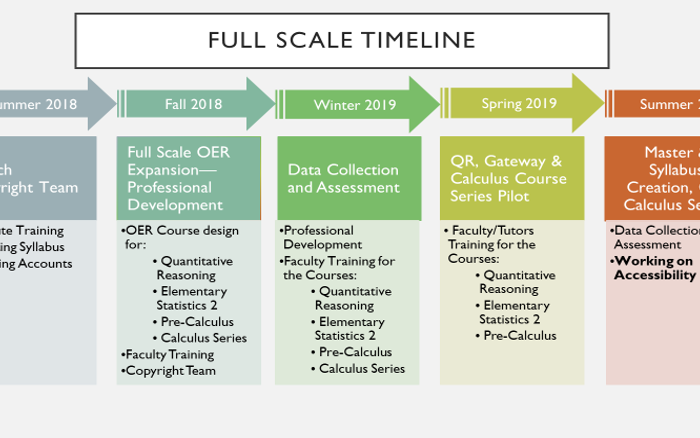
After three semesters of exploring and piloting OER courses, MEC decided to go full-scale on six major courses: Intro to Algebra, Fundamental Algebra, College Algebra, Corequisite STEM, and Elementary Statistics courses. Figure 2 illustrates how we refined and improved all master sections by adding more supplemental readings as well as exam practices and video assignments.

A table describing the project timeline during full scale implementation from summer of 2018 to summer of 2019.

  • Summer 2018: Launch Copyright Team. Institute Training; Adapting Syllabus; Creating Accounts.
  • Fall 2018: Full Scale OER Expansion—Professional Development. OER Course design for Quantitative Reasoning; Elementary Statistics 2; Pre-Calculus; Calculus Series. Faculty Training. Copyright Team.
  • Winter 2019: Data Collection and Assessment. Professional Development. Faculty Training for the Courses: Quantitative Reasoning; Elementary Statistics 2; Pre-Calculus; Calculus Series.
  • Spring 2019: QR, Gateway & Calculus Course Series Pilot. Faculty/Tutors Training for the Courses: Quantitative Reasoning; Elementary Statistics 2; Pre-Calculus.
  • Summer 2019: Master & Syllabus Creation, QR, Calculus Series. Data Collection & Assessment. Working on Accessibility.
Figure 2. Full scale timeline from Summer 2018 to Summer 2019.

In Spring 2020, the COVID-19 pandemic shifted all courses to distance learning, requiring us to create and host accessible e-learning materials. We used a manual accessibility checklist from Duke University (2017) to be certain our course contents were accessible to all students. This checklist produces a more thorough accessibility review, as popular software like Utah State University’s Institute for Disability Research, Policy, and Practice’s WAVE tool may only find 30%–50% of accessibility issues (Duke University 2017).

At first, we made sure all virtual course materials were clearly labeled; quizzes, homework, exams, and exam practices were organized and easy to access. Chapters were divided into separated content areas, each containing a Portable Document Format (PDF) lecture from the book, a video lecture, and supplemental resources or links that were valuable to students learning. We converted all Word documents to PDF for better compatibility with screen readers—we also acknowledge there is considerable debate whether PDFs or Word documents are better from an accessibility perspective. For example, PDF text can be magnified much more than a Word document and background colors can be changed to improve accessibility. However, math problems often appear as images in PDFs that cannot be read by screen reading software, whereas they appear as screen-readable text in a Word document (Jisc Accessibility and Inclusion 2016). We ensured all our PDF images had descriptions saved into the alt text descriptions. We edited all video lectures and video assignments to make sure that they all contain captions. We created recordings of the two statistics projects and are planning on creating recordings for all our PDF content materials.

Because students were taking exams online from home, course coordinators changed the design and structure of the departmental exams for all our courses to a format in which students had to upload their work for some of the questions. Coordinators rewrote the exam questions which were later uploaded into a Lumen Learning platform (a front-end, low-cost software architecture that uses the same IMathAS backend as MyOpenMath) and MyOpenMath. Faculty members were paid to complete a professional development workshop on how to manually grade answers uploaded by students in MyOpenMath and Lumen.

Results

The total savings for students taking OER courses reached $1,184,329.25 by Fall 2019 and nearly $2,000,000 by Fall 2021. In addition, in Fall 2017 the passing rates for courses using MyOpenMath were slightly lower for fundamental algebra and college algebra and slightly higher for the co-req STEM courses when compared to non-OER. With a full-scale implementation of OER courses in Introduction to Algebra, Fundamental Algebra, College Algebra, Co-req STEM and Elementary Algebra courses (no pilot courses were offered in Fall 2018), we compared the pass rate of OER sections in Fall 2018 to Spring 2018 OER sections and non-OER sections. The pass rates for OER sections in Fall 2018 were the same or better than the pass rates of non-OER and OER courses in Spring 2018. The OER course template refinements and improvements achieved in Fall 2018 might have had an impact on student success: we added more course materials (video lectures and supplemental reading) and assessments (video homework and critical thinking homework and critical thinking exercises).

Takeaways

In addition to the costs of textbooks saving, the MEC OER initiative brought more freedom and flexibility in designing courses to ensure our students have all the learning materials they need to succeed. As of Spring 2022, all mathematics courses (about 200 sections per semester) are fully converted to OER. Our successful collaboration within MEC has made our OER initiative reach this far. We are working, in collaboration with the Natural Sciences Department, on implementing a college-wide, locally-hosted implementation of IMathAS, which would create an Open Learning LMS at LaGuardia. Our OER project still presents some challenges, such as creating more accessible visualizations of math problems for students with disabilities, for which we are still finding the most effective and suitable solutions.

Implementing OER in astronomy: Written by Joshua Tan

Context and problem

Upon arrival at LaGuardia Community College in Fall 2017 as a new faculty member, two major concerns occupied my mind. One was the lack of support for assessment. Full-time instructors at LaGuardia were required to teach twenty-seven credit hours a year, which typically corresponded to nine courses spread over two semesters. Each course was capped at twenty-four students, which potentially meant that 216 students a year would need assessment. Many instructors had adopted plans where homework assignments were assigned but never evaluated, which had the auxiliary effect that examinations would become the main means of assessment. Knowing that formative rather than summative assessments are often the most valuable means to provide student feedback and acknowledging that, at institutions with more resources, there were often teaching assistants and graders who would assist in reviewing students’ work on homework, it seemed reasonable that automated assessment strategies be considered. Additionally, the population at LaGuardia was uniquely vulnerable to the costs of textbooks and course materials that have lately been an increasing burden on student higher education. With these motivations in mind, I immediately began searching for options to address all these needs. OER options were an obvious choice, as they would allow for both open-source development of assessment modules from across all participating institutions, as well as providing access to students in affordable and accessible means.

Steps taken

The first completely free, modular system that I found was MyOpenMath, and even though no other astronomers were yet using the platform, I adopted it immediately to provide a randomized and automatically graded system for my classes, hoping that my example in the future might encourage others to follow suit.

Within a few months, a call for proposals was issued from City University of New York for implementation of Open Educational Resources (OER). I wrote and received a $10,000 grant to create homework questions using the platform along with two other professors in the department in the hopes of gaining a Zero Textbook Cost (ZTC) certification; see Figure 3 for an example of a question created with MyOpenMath. Upon the successful completion of that grant in 2018, the next round expanded implementation of OER to classes across the Natural Science department, with MyOpenMath forming a critical assessment structure for many of the courses with quantitative components (especially astronomy, physics, and chemistry).

An example question from Joshua Tan's library of IMathAS assessments in astronomy.

The question reads as follows: "Some exoplanets are discovered using the radial velocity (RV) method which measures the wobble of a star towards and away from an observer. Shown below is data from the RV curve for HD 149026 b, an exoplanet that was discovered using this method. This is a mock-up of the real data for this object, and you can verify this using the NASA exoplanet archive." A plot is then shown with alt text that indicates a sinusoidal variation of a particular velocity amplitude in meters per second and period in years. The questions are then presented as follows: "On the basis of this observation, what is the maximum radial velocity observed (in meters per second)?", "What is the period of the exoplanet orbit (in days)?", and "Since we know the period of the orbit, we can calculate the semi-major axis of the orbit given that the star that HD 149026 b orbits around has a mass of 1.3 M⊙ (the symbol for the mass of the Sun). What is the semi-major axis of HD 149026 b's orbit in astronomical units (AU)?" A scaled version of Kepler's 3rd Law is given as "Potentially Useful Information".

Figure 3. This question is used in assessments for Joshua Tan’s astronomy and astrobiology classes which uses randomly selected real data from the NASA exoplanet archive to generate unique “mock observations” for every student that illustrate how the exoplanet (that is, a planet that orbits another star) was discovered.

The advantage of the IMathAS system is its modularity, openness, and flexibility in design. As a community-based project, the thousands of questions in its libraries, the customization possible in assignment and assessment design, and the full capabilities of the platform as an LMS make it uniquely suited to provide for innovative, open pedagogy at the level of assessments. Questions can be designed to randomize quantities, pull a random element from a list, or even display a random image for analysis. I use the capabilities of the system to test specialized vocabulary, scaffold assessments (Crippen and Archambault 2012), and guide students through complicated calculations in a piecewise fashion. Such modularity aligns with pedagogical design principles that foreground student understanding in instruction and assessment (Wiggins and McTighe 2005; Lowyck 2002).

At the point where the COVID-19 pandemic hit, assessment materials had been developed and implemented so that distance learning was much more easily accommodated. One of the primary concerns of many instructors in LaGuardia’s Natural Sciences Department was whether and how assessments could be proctored to avoid instances of cheating or sharing answers. The skills used to develop effective OER assessments that addressed this concern were no longer simply best practices. They suddenly were instruments that could allow class to carry on with minimal disruption. Assignments that provided each student with a different question or a randomized element were in high demand as controversies swirled around instructors instituting proctoring software with troubling implications for surveillance and privacy (Logan 2021).

In the Natural Sciences, the biggest hurdle to enforced quarantine was the question of laboratory investigations. While physics, chemistry, and biology laboratory skills are difficult to gain without access to the equipment, physical venues, and hands-on engagement that in-person lab experience provides, a significant number of pedagogical goals including hypothesis testing, data production and analysis, and empirical engagement can be achieved with simulation. The structure provided by the IMathAS system used in tandem with online simulations and applications released under OER licenses (perhaps, most famously, the PhET simulations of the University of Colorado) encouraged me to develop entire virtual laboratory environments that worked through the open licenses, randomized the experimental set-ups, and allowed for experiments that would be impossible to achieve in any other fashion. For example, a thirty-minute investigation into the force of gravity using the application developed by PhET simulates an experiment that uses masses on the order of billions of kilograms separated by kilometers of distance to achieve human-scaled forces. Thus, OER technological innovation allowed pedagogy to extend beyond the traditional limitations of introductory science classes and provided a context for authentic learning experiences in place of what is otherwise conceptual inquiry at the theoretical level.

At the same time as I was developing OER material for introductory science classes, a cross-disciplinary team of educators from LaGuardia Community College’s Library Department, Mathematics, Engineering, and Computer Science (MEC) Department, and Natural Science Department came together to lead a professional development seminar with the hopes of supporting the implementation and development of OER materials across the campus. Running every spring since 2020, this seminar has encouraged a critical examination of extant platforms and opportunities for development and highlighted best practices for use, modification, and production of OER materials involving more than fifty faculty participants from around the college.

Results

Having now created a library of 1,200 questions, the MyOpenMath astronomy community which I initiated, includes instructors at LaGuardia and increasingly at other institutions as well. The two astronomers from LaGuardia (myself and Prof. Allyson Sheffield) along with Dr. Jana Grcevich, an adjunct instructor at City College of New York and Outreach Director at Columbia University, led two Astronomical Society of the Pacific conference workshop sessions in 2020 and 2021 to encourage astronomy educators to use the platform by highlighting the versatility and the compendium of questions already created (Tan, Sheffield, and Grcevich 2021).

The outcomes of the OER seminar have included faculty adopting and adapting OER materials for their own use, documented on our seminar website. The progression from considering OER to lower the financial impact for students toward a model of open pedagogy (Teixeira 2013) encouraged us to incorporate accessibility for students with disabilities as a major consideration in development. This emphasis has become more pronounced as we have continued in this work.

Takeaways

Indeed, emergency distance learning highlighted the way that OER development can promote greater accessibility for course materials (Baran and AlZoubi 2020). While the financial considerations are most often emphasized in evaluating the impact of such work, the modularity afforded by material that is licensed for modification and sharing provides an efficient means to accommodate the accessibility needs of students with a variety of needs from having low bandwidth to those with disabilities (Almeida 2017). To address the goal of open learning and educational equity, the OER framework has encouraged greater consideration of accessibility requirements and the active participation of instructors in ensuring that such ideals are met and maintained.

What does the future hold for OER at my institution? My current interest is to use the modularity and flexibility of the IMathAS platform to expand beyond the STEM fields which have traditionally utilized it. To that end, the LaGuardia Center for Teaching and Learning (CTL) sponsored a pilot professional development seminar to encourage adoption of the system for fifteen faculty members from across the college to examine use cases within their own disciplines. Led by myself and Prof. Alioune Khoule of the MEC Department (author of the first case study in this paper) and technologist Pablo Avila from the CTL, this pilot program engaged STEM faculty as well as professors of accounting, English, and critical thinking. A group of faculty including myself and Prof. Khoule are now interested in implementing our own local fork of the IMathAS project to start an Open Learning LMS that would allow for innovative modification by all at the college with the potential to provide a disruptive technology and pedagogical openness that will change the dynamic of students and faculty from consumers of such technology to developers and users of accessible, open-source learning (cf. Calma and Dickson-Deane 2020).

MyOpenMath in general chemistry classes: Written by Marta Kowalczyk

Context and problem

In Fall 2019, the Natural Sciences Department received a grant funded by New York State as part of the CUNY OER Initiative. In each subsequent year, several courses are in transition to open educational resources using grant funds. The transition involves:

  • Searching for and adapting a textbook
  • Creating and writing a lab manual
  • Adapting or creating online homework assignments as OER

At the start of each semester, we schedule meetings with each course coordinator and their teams to help with the OER search, adjustment, and implementation process.

The goal was to switch from commercial products and allow students to reduce the cost of the chemistry course while maintaining a high level of student learning outcomes.

Here we present guidelines on implementing MyOpenMath as an online homework assignment platform in general chemistry (Gen Chem I and II) classes. In these classes, students use online homework to practice and grasp the learning objectives at their pace. Many commercial platforms are available to ease the burden on the teaching faculty. However, even though highly advanced and very resourceful, a substantial amount of time is required to set up an accurate online homework assessment for students every semester, which comes with its price. The primary questions we asked heading into the process were: how do you use MyOpenMath when you are unfamiliar with HTML code, and can you use the platform for chemistry questions?

Steps taken

We have started using a question bank, already available on the platform. We have created a few fundamental assignments, distributed them to selected sections, and collected students’ feedback. Based on it, we modified the assignments and piloted them in additional sections. In the following semester, we included our questions and learned basic HTML. We asked for help from physics and math professors to help with troubleshooting HTML code. Following students’ feedback, we include links to the OER textbook with the learning objective and hints. Also, in addition to text, we have added links to various OER videos, so students could watch additional explanations in video demonstrations.

Results

MyOpenMath was run as required homework in Gen Chem I classes in the next academic year. As many faculty are teaching this course, we have prepared and distributed all assignments in all sections and provided maximum guidance and support to teaching instructors.

There is a lot of support in the instructor’s forum, and that’s helpful. However, MyOpenMath does not provide any student support. The instructor is responsible for helping their students and resolving their issues. While instructors are learning the setting of MyOpenMath, an assigned faculty provides support to instructors (especially part-time instructors) and their students. After successful implementation in Gen Chem I, we used a similar implementation approach in Gen Chem II.

Takeaways

The learning curve can be steep for an instructor implementing this platform in their class; Figure 4 compares the student view with the professor’s view in MyOpenMath. Anyone planning to use MyOpenMath in general chemistry (especially those with limited HTML experience) would be best served by starting small; learn the differences between assessment, block, and forum. Be sure to check for available questions in the data bank. As with other OER, a lot of material you need may already be covered—look for existing templates and promoted courses. When it comes to existing questions, test them first because they may require modifications. If you plan to write your own questions, modify existing multiple-choice questions, which can help familiarize you with HTML. Modifying code is much easier than starting from scratch, especially for complicated questions and randomizations. Ask your colleagues for help and use the faculty support group on the platform. Finally, first use your questions in a low-stakes assignment and get feedback from students. Their feedback is critical to improving your questions and overall assessments.

An example of an online chemistry question created with the program MyOpenMath. The image shows the question as students see it and as it appears with HTML code as a professor creates it.
Figure 4. Example of chemistry question. Students can utilize PheT simulations to answer questions (insert A). Example of HTML code for this question (insert B). Questions written in pair with the code (insert C).

During the pandemic, faculty started to record more videos, tutorials, and how-to resources. The video demonstrations were initially planned to be used during the pandemic; however, after positive feedback from students, they became a part of their learning process beyond the textbook and lecture slides while doing online homework. The aspect of accessibility of multimedia and visual aids requires more attention. While faculty focus primarily on the content, learning objective, and accurate demonstration, we are heavily relying on the accessibility office to help students with educational needs.

Online homework assignments for Gen Chem classes are continually improving every semester (see Figure 5), including introducing new resources, creating further questions, and increasing students’ learning outcomes while keeping it at zero cost and advancing student learning and success.

Factors that move implementation of MyOpenMath
Three gears are shown from top to bottom, each one interlocking with the next and arrows added to indicate gear movement. The top gear is labeled Students' feedback. The middle gear is labeled Faculty feedback. The lowest gear is labeled Improving questions.
Figure 5. Factors taken into consideration before full implementation of MyOpenMath in general chemistry classes.

Conclusion

These case studies demonstrate the cultivation of OEP at LaGuardia. Each study acknowledges the importance of lowering or eliminating the cost of textbooks, which is often the initial motivation for using OER. Cost is critical, but other factors are just as important for LaGuardia students and instructors: increased access, quality of teaching materials, pedagogical consistency, curricular alignment, and automated grading, among many others. These factors necessitate the process-oriented approach detailed in the above studies. This iterative process requires flexibility, consistent self-examination, and a willingness to develop new skills.

Alioune Khoule describes how once the MEC Department selected MyOpenMath, math instructors meticulously implemented the new platform, with particular attention to copyright, accessibility regarding technological access and for students with disabilities, and organization of teaching materials. To implement OER at scale, MEC needed course materials to be clearly organized for the dozens of professors teaching the courses using the new platform (Lumen Learning). Joshua Tan’s motivation for using MyOpenMath has as much to do with effective and efficient student assessment methods as it does with eliminating the cost of expensive textbooks and learning platforms. His novel approach has pushed MyOpenMath’s boundaries into astronomy, and potentially beyond, as he and Professor Khoule teach others how to use the platform. Marta Kowalczyk describes how the relatively inexperienced instructor can successfully adopt MyOpenMath in general chemistry courses. Moreover, chemistry instructors at LaGuardia are continually improving their open question banks based on student and faculty feedback, as well as increasing their facility with HTML coding. These issues all point to the fact that implementing OER consists of a continual movement toward effective openness and cannot be constrained by a single endpoint or goal.

For the first several years, the CUNY OER Initiative, funded by New York State, focused on outcomes like the number of courses converted to OER and students’ textbook savings as the primary metrics included in annual reporting. To this day, each college’s grant allocation is largely determined by how many courses and sections will be converted. At LaGuardia, funds typically go toward paying the faculty member responsible for a course conversion. Professional development stipends are available to train instructors who will teach sections using OER. For better and for worse, this work, from selecting OER to professional development, is left to the individual colleges. This approach helps foster local communities of practice, but it does not provide system-wide support and coordination for critical issues like accessibility via Universal Design for Learning (UDL). To its credit, the CUNY Office of Library Services is supporting work across the system that does not fit neatly into OER conversion (Fiddler and McKinney 2021, 8–10). But there is little incentive to support the work required to revisit courses after they have been converted to OER. Instead, the current model prioritizes OER implementation, like switching to an OER textbook. In other words, the grant should do more to support ongoing open educational practices (OEP).

Future Directions

Accessibility and UDL demand greater attention. Making learning materials accessible for students with disabilities is not a measurable outcome of the New York State grant. A course may have zero textbook costs (ZTC) and have no accessibility features in its materials, but it will still meet the requirements of the grant. Alternately, a course may be ZTC and have stellar accessibility features and equally meet the requirements of the grant. If openness is about being open to all regardless of ability, accessibility should be central to grant-funded projects. Further equity in open education lies at the intersection of OER and accessibility/UDL. We must center these principles from the beginning of our workflows. Content that is born digital should also be born accessible (Parks 2015). Evaluating accessibility while a resource is being created contributes to a better adoption once the resource is published in a virtual learning environment or in a repository (Avila et al. 2020). The OER program at Bucks County Community College offers a model for consideration (Bornak et al. 2017). Their OER course template process is supported by a team that includes an accessibility advocate. The advocate meets with instructors throughout the OER conversion process to address accessibility questions and issues as they arise. Our pedagogical practices require a fundamental and sustained shift in design to make learning materials fully accessible. For example, students in biology classes are often required to label diagrams, and, as an accessible stopgap, we can tag images with alt-text. But what would it mean to make such an assignment less reliant on visual faculties? In this way, accessibility fits into a process-oriented view of OER, a continuous movement toward openness and accessibility.

Future and ongoing CUNY OER initiatives should explicitly prioritize accessibility in their metrics of success and include budget line items for the additional costs associated with doing so (Parks 2015). A one-size-fits-all approach to compensation may not be suitable with this change. Dimensions to consider are academic disciplines (size of work for disciplines relying on tables and diagrams to communicate critical information), our proficiency with best and effective practices, training and ongoing support, and whether we are creating our own content or adapting open content. There is an even greater level of effort required to convert non-accessible course materials to accessible OER (Affordable Learning Georgia, n.d.; CAST, 2019). This effort includes accessibility reviews and remediation, or technical assistance to meet certain standards. Finally, budgets should include funds to include and compensate students with disabilities in usability testing throughout the design process.

To this end, LaGuardia is implementing OER and foregrounding accessibility in projects beyond the above case studies. One project is creating the first textbook for LaGuardia’s First Year Seminar (FYS) courses. Instead of replacing a high-priced textbook, this project builds upon other, similar OER textbooks to center accessibility and open pedagogy in the FYS (Baldwin 2020; Campagna et al., n.d.). Student voices have been centered as content reviewers for this project. Future plans include employing students with disabilities to review the content and accessibility of the textbook. The OER professional development seminar described in Joshua Tan’s case study dedicated a sizable portion of time to accessibility to help ensure it is included from the outset of OER projects. Librarians and instructional technologists serve as OER liaisons for LaGuardia’s academic departments to highlight accessibility in their OER projects. To date, the liaisons have worked with classroom faculty in Education and Language Acquisition, English, Health Sciences, and Natural Sciences.

Not only does this foreground the process-oriented nature of accessibility, but it also points to the process-oriented nature of open educational practice. Seminars and presentations get participants thinking about OER and accessibility from an early stage, and, while it may not yield a clear deliverable like an OER course conversion right away, it raises awareness. It builds the culture of OEP. The holistic approach underway at LaGuardia can deliver measurable outcomes for the New York State grant, but it can do much more by moving the college community toward a more just and equitable pedagogy.
References

Almeida, Nora. 2017. “Open Educational Resources and Rhetorical Paradox in the Neoliberal Univers(ity).” Journal of Critical Library and Information Studies 1, no. 1. https://doi.org/10.24242/jclis.v1i1.16.

Avila, Cecilia, Silvia Baldiris, Ramon Fabregat, and Sabine Graf. 2020. “Evaluation of a Learning Analytics Tool for Supporting Teachers in the Creation and Evaluation of Accessible and Quality Open Educational Resources.” British Journal of Educational Technology 51, no. 4: 1019–1038. https://doi.org/10.1111/bjet.12940.

Bailey, Thomas R. (Thomas Raymond), Shanna Smith Jaggars, and Davis Jenkins. 2015. Redesigning America’s Community Colleges: a Clearer Path to Student Success. Cambridge, Massachusetts: Harvard University Press.

Baldwin, Amy. 2020. College Success. Houston: OpenStax. https://openstax.org/books/college-success/pages/1-introduction.

Baran, Evrim, and Dana AlZoubi. 2020. “Human-Centered Design as a Frame for Transition to Remote Teaching During the COVID-19 Pandemic.” Journal of Technology and Teacher Education 28, no. 2: 365–372. https://www.learntechlib.org/primary/p/216077/.

Benjamin, Jesse, and Seneca Vaught. 2018. “Pedagogic Paths to Liberation: Personal Struggles, Institution Building and the Rise of the Walter Rodney School of Groundings Praxis in Atlanta.” The Journal of Intersectionality 2, no. 1: 6–30. https://doi.org/10.13169/jinte.2.1.0006.

Bornak, Mary Ellen, Jacqueline Burger, Linda McCann, and Bill Hemmig. 2017. “Open Educational Resources: An Initiative at Bucks County Community College.” TCLC Program Proceedings 10. https://rdw.rowan.edu/tclc_proceedings/2017/All/10.

Calma, Angelito, and Camille Dickson-Deane. 2020. “The Student as Customer and Quality in Higher Education.” International Journal of Educational Management 34, no. 8: 1221–1235. https://doi.org/10.1108/IJEM-03-2019-0093.

Campagna, Michele, Adam Frank, Hector Graciano, Robin Graff, Rachele Hall, Leonore Rodrigues, and Christine Thomas. n.d. Westchester Community College: First-Year Seminar. Accessed November 22, 2022. https://courses.lumenlearning.com/suny-wcc-collegesuccess2/.

“Cape Town Open Education Declaration.” September 2007. https://www.capetowndeclaration.org/read/.

CAST. 2019. “CAST & ISKME Partner to Make OERs More Inclusive, Effective.” https://www.cast.org/news/2019/cast-iskme-partnership-oer-commons-open-authoring-system.

Crippen, Kent J., and Leanna Archambault. 2012. “Scaffolded Inquiry-Based Instruction with Technology: A Signature Pedagogy for STEM Education.” Computers in the Schools 29, nos. 1–2: 7–173. https://doi.org/10.1080/07380569.2012.658733.

Cronin, Catherine, and Iain MacLaren. 2018. “Conceptualising OEP: A Review of Theoretical and Empirical Literature in Open Educational Practices.” Open Praxis 10, no. 2: 127–143. http://doi.org/10.5944/openpraxis.10.2.825.

DeRosa, Robin, and Scott Robison. 2017. “From OER to Open Pedagogy: Harnessing the Power of Open.” In Open: The Philosophy and Practices That Are Revolutionizing Education and Science, edited by Rajiv S. Jhangiani and Robert Biswas-Diener, 115–124. https://doi.org/10.5334/bbc.i.

Duke University. “Manual Accessibility Testing Checklist.” March 7, 2017. https://spotlight.duke.edu/communications/wp-content/uploads/sites/25/2017/11/Accessibility-Testing-Checklist3.pdf.

Fiddler, Ann, and Andrew McKinney. 2021. “Making Open and Affordable Courses: Best Practice Case Study.” In New York State Open Educational Resources Funds: CUNY Year Three Report, 5–10. https://www.cuny.edu/wp-content/uploads/sites/4/page-assets/libraries/open-educational-resources/CUNY_OER_Report3_Web_V32.pdf.

Jisc Accessibility and Inclusion. 2016. “Word or PDF? What’s the Learner Experience Likely to Be?” Accessibility, Assistive Technology and Inclusive Practice, September 13, 2016. https://accessibility.jiscinvolve.org/wp/2016/09/13/word-pdf/.

Khoule, Alioune, Abderrazak Belkharraz Idrissi, and Sandra Sze. 2021. “Large Scale Open Educational Resources (OER) Initiative in Mathematics.” Journal for the Mathematics Education and Teaching Practices 2, no. 2: 55–69. https://dergipark.org.tr/en/pub/jmetp/issue/66397/1012331.

Kirschner, Paul A., and Kwok‐Wing Lai. 2007. “Online Communities of Practice in Education.” Technology, Pedagogy and Education 16, no. 2: 127–131. https://doi.org/10.1080/14759390701406737.

LaGuardia Community College, Office of Institutional Research & Assessment. 2021. LaGuardia Community College: Institutional Profile 2021. https://www.laguardia.edu/uploadedfiles/main_site/content/ir/docs/institutional-profile-2021.pdf.

Lambert, Sarah R. 2018. “Changing our (Dis)ourse: A Distinctive Social Justice Aligned Definition of Open Education.” Journal of Learning for Development 5, no. 3: 225–244. DOI: https://doi.org/10.56059/jl4d.v5i3.290.

Logan, Charles. 2021. “Toward Abolishing Online Proctoring: Counter-Narratives, Deep Change, and Pedagogies of Educational Dignity.” Journal of Interactive Technology and Pedagogy 20. https://jitp.commons.gc.cuny.edu/toward-abolishing-online-proctoring-counter-narratives-deep-change-and-pedagogies-of-educational-dignity/.

Lowyck, Joost. 2002. “Pedagogical Design.” In Handbook on Information Technologies for Education and Training, edited by Heimo H. Adelsberger, Betty Collis, and Jan M. Pawlowski, 199–217. Berlin, Heidelberg: Springer. https://doi.org/10.1007/978-3-662-07682-8_13.

Parks, Kaela. 2018. “Open and Inclusive Education – Connections to Universal Design.” In The Evolution of Affordable Content Efforts in the Higher Education Environment: Programs, Case Studies, and Examples, edited by Kristi Jensen and Shane Nackerud. Minneapolis: University of Minneapolis. https://doi.org/10.24926/86666.0101.

Tan, Joshua, Allyson Sheffield, and Jana Grcevich. 2021. “An Autograded, Open Educational Resource Assessment Tool for Astronomy Using MyOpenMath.” arXiv preprint. https://doi.org/10.48550/arXiv.2111.15604.

Teixeira, António, Carlos João Correia, Filipa Afonso, Antonio García Cabot, Eva García López, Salvador Otón Tortosa, Nelson Piedra, Luciana Canuti, Jacqueline Guzmán, and Miguel Ángel Córdova Sol. 2013. “Inclusive Open Educational Practices: How the Use and Reuse of OER Can Support Virtual Higher Education for All.” European Journal of Open, Distance and E-Learning 16, no. 2. https://old.eurodl.org/index.php?p=special&sp=articles&inum=5&article=632.

Tijerina, Tiffani. 2021. “OER Accessibility Series and Rubric: Document Design.” Affordable Learning Georgia. https://alg.manifoldapp.org/projects/oer-accessibility-series-and-rubric.

UNESCO. 2002. “Forum on the Impact of Open Courseware for Higher Education in Developing Countries: Final Report.” Last modified July 2002. https://unesdoc.unesco.org/ark:/48223/pf0000128515.

UNESCO. 2012. “2012 Paris OER Declaration.” World Open Educational Resources (OER) Conference. June 22, 2012. https://unesdoc.unesco.org/ark:/48223/pf0000246687.locale=en.

Wiggins, Grant P., and Jay McTighe. 2005. Understanding by Design. Alexandria, VA: Association for Supervision and Curriculum Development.

About the Authors

Ian McDermott is an associate professor and Coordinator of Library Instruction in the Library Department at LaGuardia Community College, City University of New York. He serves as LaGuardia’s OER Liaison, and his research examines the intersection of open educational practice and critical pedagogy.

Alioune Khoule is a Professor of Mathematics in the Department of Mathematics and Computer Science at LaGuardia Community College, City University of New York. His research interests are in mathematics modeling and mathematics education. His current research focuses on the impact of teaching-based concepts in developmental courses and statistics.

Joshua Tan is an assistant professor of astronomy and physics in the Natural Science Department at LaGuardia Community College, part of the City University of New York. He is also a research associate at the Astrophysics Department of the American Museum of Natural History, New York. In addition to pedagogical innovation, Prof. Tan’s research interests include high-energy astrophysics, remote astronomical observations using small telescopes, and the theory and observations of binary millisecond pulsars.

Marta Kowalczyk is an associate professor of chemistry in the Natural Science Department at LaGuardia Community College, City University of New York. Her research focuses on the experimental and computational photochemistry of inorganic and organic compounds. Her expertise is in charge transfer mechanisms and conjugated polymers. She is currently helping the chemistry and biology faculty in the OER conversion of their classes.

Rena Grossman is an adjunct OER Librarian at LaGuardia Community College and Hostos Community College, City University of New York. She is currently helping faculty in the OER conversion of their classes, and is particularly interested in helping them find media sources for multi-sensory types of learning. Her expertise is at the intersection of accessibility and critical disability studies, all well as urban agriculture.

Emma Handte is an OER Instructional Technologist at LaGuardia Community College, City University of New York. She is also the Project Coordinator for Global Scholars Achieving Career Success, a program that connects CUNY students to students in the Middle East and North Africa through virtual exchanges. She holds a master’s degree in Middle Eastern Studies, and her interests lie at the intersection of open education and global learning.

Building a Community of Voices in Professional Writing

Abstract

This essay provides an example of how educators can employ Open Educational Resources (OER) to foster diversity, equity, and inclusion in professional writing courses. Instructors should carefully consider the voices that open access resources amplify. We can use a pedagogical approach that combines multiple readings, videos, images, activities, and audio recordings to build a community of voices that reflect and represent students’ experiences. When we select OER for professional writing lessons and assignments, we should incorporate many perspectives that discuss power, language, discourse community, and rhetorical situation. The essay describes my process of selecting OER texts for my upper-level online professional wrtiting course. I collected a variety of open access texts for students to explore. My professional writing course asked students to analyze their rhetorical situations and discourse communities. The writing assignments encouraged learners to choose language in accordance with their writing context. Students used their knowledge to compose health promotion documents for their communities. This essay provides a sample prewriting assignment and a discussion of collaborative assessment. By building a repository of resources for students to use in the course, assigning community-based projects, and encouraging students to assess their own work, we can foster a more equitable and inclusive learning environment.

Keywords: open educational resources (OER); equity; diversity; composition; online learning.

Introduction

In the Professional Writing Program at the University of Louisiana at Lafayette, I teach online courses in technical and professional writing. My classes are required for English students with concentrations in Professional Writing and students in STEM fields like kinesiology, industrial technology, and informatics. I first adopted an Open Educational Resource (OER) textbook in my technical writing classes in the Fall of 2020, when South Louisiana was grappling with compound disasters of Covid-19, protests surrounding the police shooting of Trayford Pellerin on August 21, Hurricane Laura on August 27, and Hurricane Delta on October 9. My students stumbled through the semester, trauma- and grief-stricken, some weeks quarantining in their homes, and other weeks traveling miles to find electricity or internet access.[1]

In the summer of 2020, during a pandemic that disproportionately affected Black, Indigenous, People of Color (BIPOC) students, and after the deaths of Breonna Taylor, George Floyd, and Ahmaud Arbery, the Conference on College Composition & Communication (CCCC) published a demand for Black Linguistic Justice. These scholars called for teachers of English composition and writing to educate themselves and teach students about Black Linguistic Justice (Baker-Bell et. al. 2020). The writers asked composition instructors to “stop using standard English as a communicative norm,” and instead, the committee demanded that instructors teach about white linguistic supremacy and anti-Black linguistic racism. In 2021, the CCCC published a new statement on White Language Supremacy (WLS), which is “an implement to white supremacy, particularly within educational institutions” (Richardson et al. 2021). The community affirmed their commitment to anti-racist teaching and dismantling oppressive systems through writing and communication.

In 2020, scholars like April Baker-Bell, Bonnie J. Williams-Farrier, Davena Jackson, Lamar Johnson, Carmen Kynard, and Teaira McMurtry demanded that we think about our own pedagogy as a place where we can have discussions about social justice and language. As a white European-Acadian person who has had, as Hansen (2018) says, “the privilege of being born into [standard] English,” I felt compelled to look critically at my own pedagogies to make my composition classroom a more equitable place for multiple identities and expressions. Therefore, I sought to enact a holistic model of teaching that bell hooks theorized in Teaching to Transgress. This pedagogical model would not only empower my students but would also establish “a place where teachers grow … and are empowered by the process” (hooks 1994, 21). Through my assignments and lectures in class, I sought to use OER not only to reduce textbook costs for students, but also to foster cross-cultural equity in the classroom. OER are tools we can use to make our classrooms more equitable and inclusive, especially in terms of the financial burdens of education.[2] However, without careful selection and planning on the instructor’s part, some OER can reinforce structural inequities and bias, as some textbooks promote equity and diversity more than others. George Veletsianos writes that we must carefully choose course materials to “dismantle some of the structural inequities that OER may reproduce” (2021, 409). Veletsianos asks us to consider the people and “forms of knowledge” that authors represent in open access resources. One resource alone typically cannot represent or reflect the diverse viewpoints of all our students. We must think critically about how existing OER intersect with our own positions and contexts and we must develop a community of voices or a repository of various perspectives in our classrooms (Veletsianos 2021, 409). When we work with our students to analyze, study, or create OER for class assignments, we should seek to amplify an abundance of ideas and engage in equitable and inclusive compilation and research practices.

Reliance on a single composition book, when not supplemented with additional resources, might further exclude students’ viewpoints from the conversation. This essay discusses my journey to select OER texts for my upper-level online professional writing course and how I learned to curate readings and media that foster a growth mindset (Dweck 2006; Cote 2022), include diverse voices and cultures, and ask students to participate in their ownership of knowledge and writing. First, I will explain the challenges I encountered by initially putting too much emphasis on a single commercial textbook—particularly when the source seemed to downplay “real-world” language encounters I had experienced myself as a professional writer in my community. Second, I argue that choosing multiple OERs, rather than using one, can help achieve the goals of equity and equality in the classroom. Finally, I posit that if we are interested in inclusive, equitable education, then we should bring our students into the discussion about the topics of OER and inclusion. Their experiences—whether as speakers who were “born into English” (Hansen 2018) or speakers from other countries—heavily influence their expectations and goals in a composition class.

Choosing a Textbook

In Fall of 2020, I struggled to find an appropriate OER textbook for my upper-level professional writing class, so I assigned a new commercial textbook, Paul MacRae’s Business and Professional Writing: A Basic Guide (2019). The text had useful chapters on plain language, genres of professional writing, and clear communication, but the book attempted to persuade my students that their success in the workplace depended on their use of Standard American English. The text did not fully explore the complexities of the English language and lacked nuance about audience analysis, dialects, and language that would empower students in their own communities. MacRae’s introduction advocates for students to learn and use American Standard English for all business contexts. He begins with “The Importance of Good Communication,” lamenting that with the shift in media technologies from television to internet, progressive educators stopped forcing students to learn the rules of spelling, writing, and grammar. This, MacRae argues, has led to students who “cannot express themselves in print, much less create great written work” (2019, 15–16). MacRae and other scholars like Rob Jenkins (2018) assert that Standard English pays off in the corporate world. They argue that without standard English literacy, students are unlikely to succeed or get jobs in the workplace.

The introduction in McRae’s Business and Professional Writing did not encourage my students to embrace their own language skills and proficiencies. Instead, the book aimed to standardize my students’ linguistic identities to prepare them for a seemingly homogenous workforce. In “Contesting Standardized English,” Missy Watson (2018) writes, “we don’t actually need a single homogeneous variety of language in order to communicate effectively.” Moreover, my own personal experiences led me to agree with Watson.

In the years before I began teaching at the University of Louisiana at Lafayette, I worked as a Guardian ad Litem alongside social workers in the Louisiana Department of Children and Family Services. Black professionals in this field often used Black English in correspondence, reports, and other documents. I learned that workplace discourse communities were highly context-specific and used different registers, tones, dialects, and specialized vocabularies to meet their needs (Swales 1990; Bremner 2018). Contrary to MacRae’s emphasis, workplace writing, in my experience, was not monolithic. The textbook, for which my students had paid around forty dollars, did not present a multi-faceted view. As a result, I decided to address ideas about Standard English and workplace writing with the students.

After Fall 2020, I sought to find an OER textbook for the professional writing course, and I redesigned the class to also include lessons that borrow from and cite multiple sources. I aimed to add to my repository of voices and perspectives in the online composition classroom. One of the sources I chose is an OER by Melissa Ashman, Introduction to Professional Communications (2018), because it includes citations of diverse sources and examples with names that reflect different kinds of identities. Ashman’s text emphasizes a growth mindset and affirms student’s languages, cultures, and dialects. Ashman writes that students who have proficiencies in multiple languages or dialects have an advantage in workplace environments, adding, “Our goal is not to erase what’s unique about your writing voice to make it “appropriate” for the workplace, but to build on your existing skills so that you can be successful in whatever workplace you enter” (13). Instead of attempting to replace or supplant students’ “inadequate” writing with newer, standardized ways of writing, Ashman’s approach is an additive model, adding new information to the kinds of skills and experiences students bring with them to class.

Ashman’s text aligns with Guide to Inclusive Teaching at Columbia (Kachani et al. 2018). The teaching strategies instruct teachers to “use examples that speak across gender, work across cultures, and are relatable to people from various socioeconomic statuses, ages, and religions” (Kachani et al. 2018, 20). Ashman’s book uses examples of students who have complex, intersectional identities. One example is Jian Yi who began his education in China and learned English as a second language when he moved to Canada at age twelve. Although Jian Yi can write in multiple languages, he lacks confidence in his writing skills. In addition to this, he is taking a full course load and feels burdened by the communication class. Ashman encourages students like Jian Yi to consider their language proficiencies as an advantage in business and professional writing. Ashman asserts that Jian Yi is a good writer because he can shift between two languages, and he can build on this skill as he adapts to the conventions of business writing in the workplace. Introduction to Professional Communication takes a broad view of the social skills that students need to succeed in business writing. This approach fosters positive views about writing skills and encourages students to find their own socio-cultural strengths and motivations.

Ashman also gives examples of various gender identities. In one example, the textbook uses they/them pronouns for a student named Kai: “Kai prided themself on being able to write their essays the night before. They would drink some energy drinks and buy their favourite snacks and write for hours” (2018, 56). Kai’s story of procrastination may resonate with my students who struggle with time management, drafting, and revision. The example provides a model for adapting the writing process. In the example, Kai tries writing a draft for peer review and learns to write and revise their essay in multiple stages. This example is not only useful to students who want to learn more about drafting and revision, but also provides representation for nonbinary students and introduces they/them pronouns to students who know little about nonbinary or trans* identities. This kind of representation fosters social-emotional learning principles like self-awareness and social awareness.

Ashman’s Introduction to Professional Communications acknowledges the diverse experiences of our students, recognizing that some students might have job responsibilities or family caretaking obligations in addition to their research and schoolwork. The textbook also includes reflections for students to consider, such as,“What do people in your culture and/or your family believe about reading, writing, and telling stories?” (Ashman 2018, 17). This asks students to reflect on their own identities and the value of communication in their own families or cultures. Ashman not only respects the cultural identities of her readers, but also encourages developing writers to respect their audiences when composing documents. She instructs students not to make assumptions about their audiences in their own writing, and to avoid reinforcing stereotypes about groups of people.[3]

Ashman’s text is a good start to finding representation of various identities in textbook, but the Canadian cultural context of this OER meant that I needed to include other voices and positionalities that would reflect the situations and perspectives that my students might encounter in the workplaces of the United States or in the Gulf South. To help with this, I used the Sutori platform to create a learning library, including resources from CCCC Black Technical and Professional Communication Resource Guide, and added other resources, ranging from an episode of The Bitter Southerner’s podcast, “What We Talk About When We Talk About How We Talk,” to the Yale Grammatical Diversity Project. I ask students to explore the library and choose topics and media that interest them, speak to their own experience, or give them new insights about power, communication, and language.

I began collecting free resources, articles, podcasts, and videos for students to explore. Starting with the CCCC’s “Students’ Right to Their Own Language” in 1974 that “affirms the students’ right to their own patterns and varieties of language,” our class explored language and power as they read and listened to a debate about workplace communication. Students read excerpts of Stanley Fish’s “What Colleges Should Teach, Part III” (2009) and Vershawn Young’s response in “Should Writers Use They Own English?” (2010). I wanted to align my teaching practices with Brittany Hull who writes that in her classroom, students “write usin the language or variety they were comfortable with, depending on their intended audience and the rhetorical situation” (Hull, Sheldon, and McKoy 2019).

We listened to NPR’s Rough Translation episode “How to Speak Bad English,” and Hansen’s TED Talk “2 Billion Voices,” which de-centers speakers who were “born into English” and focuses on the English language skills of the two billion people who learn English as a second language. Hansen encouraged my professional writers to use plain language and avoid idioms when writing for international audiences. We learned more about cross-cultural communication, emphasizing that English speakers should train themselves to listen to different accents and different ways of communicating in global business environments. These conversations pushed students to challenge their own assumptions and consider audience expectations in a world where colonialism, classism, racism, and white supremacy have devalued many cultures, accents, and dialects.

Students had thought-provoking and lively discussions about these readings in an online forum. Some were energized to see representations of their own Black English in Young’s work, others discussed suppressing their own Southern or Cajun accents and dialects as they grew up in public schools. Meanwhile, others wrote about their experiences as international students and expressed the difficulties they found while reading Young’s article. The discussion forum became a way for my students to share the ways that they felt about their own languages, how they learned English, and how they learned to code-switch or code-mesh at a very young age or later in life.[4] Students generated their own discussion topics and by far, the most popular discussion thread was “would you date someone on a dating app who used a different grammar than you?” The students took their knowledge of language and power and turned the discussion to ways that they encountered interpersonal relationships and possible romantic interests online. Some students responded that they would refuse to go out with a person who wrote in a different style or dialect, while others challenged these notions and said they would likely be willing to get to know a person before deciding.

Finally, to add more voices to the array, I have been working to include writers or speakers with disabilities and LGBTQIA+ authors who can teach us about different embodied and lived experiences. When I teach students about user experience design and accessibility, I often include YouTube videos from screen-reader users who teach us how to design texts for accessibility and keyboard navigation. If students who are unfamiliar with screen-reader technologies understand how screen readers operate, they begin to reconsider their document design and the importance of accessibility in professional and technical writing. In the class, my students read Emily Ladau’s Demystifying Disability (2021). Although Ladau’s book is not an OER, she offers a free, accessible, plain language translation—translated by Becca Monteleone and herself—on her website for readers to use. We also listened to Emily Ladau discuss language on NPR and watched a video of her interview with Judy Heumann. Sasha Costanza-Chock’s open access book called Design Justice (2020), which explores how marginalized communities might take part in designing structures and information for a better world. I am currently working to add new voices to my accessibility collection, including intersectional identities.

Writing for the Community: A Sample Assignment

To help students explore professional writing in their communities, I ask students to compose a health promotion document for their community. Many of my students are Health Promotion and Wellness majors and enjoy this assignment. I teach writing as a process, and pre-writing activities are crucial to the development of this community-based project. Before students begin writing, they learn about language and culture choices from professionals in the field. We discuss Miriam Williams’s research on race in professional communication and the value of using plain language when writing for the public (Weber 2015; Williams 2017). We also listen to an interview with Emily Haozous, in which she talks about the need for technical writers to immerse themselves in the culture of the community to determine what the audience needs from the document (Weber 2022). Haozous demonstrates the need for Indigenous writers to work within the community to create culturally appropriate healthcare documents.

We also examine communications and public service announcements in community health organizations during the height of the Covid-19 pandemic. Professional writers in New Orleans LCMC Health published a public health article titled “5 Ways to Stay Safe while Makin’ Groceries during Coronavirus.” The phrase “makin’ groceries” is an expression that means to go shopping. It comes from a literal English translation of the French verb “faire,” meaning either “to do” or “to make.” This public health campaign used the community’s familiar phrasing to target an audience to encourage mask wearing in public places like grocery stores. We examined the value of such community-minded discourse to connect with audiences who could understand the cultural context and nuance of the message. We also considered the drawbacks of such context-specific language for national or international audiences, demonstrating the inherent tensions in language and the value of carefully considering audience and rhetorical situation when writing for the community.

Students complete a few pre-writing exercises in which they reflect on their ideas about language choices, their communities, and their audiences:

  • How might you describe your own culture in terms of your heritage, religion, identity, nationality, race, ethnicity, etc.? How have your experiences informed your worldview? How do you think that your culture informs your communication style?
  • Our textbook talks about how our culture helps to shape our predominant modes of communication. Narrative storytelling, group discussion, and listening to elders are ways that people communicate or make decisions. Which one of these options do you rely on most? What does this say about your culture?

They conduct research about their own communities, and they use John Swales’s discourse community theory to analyze the modes of communication and the languages that people use in their neighborhoods, peer groups, workplaces, or their families. Students select a community that is important to their personal or professional life, and they introduce their discourse community to the class. They also conduct primary research: observing conversations, conducting interviews, and collecting documents or artifacts from their community. In their written reflections, students discuss their findings and analysis:

  • What did you learn about how your discourse community communicates?
  • What did you learn about the genres your discourse community uses for communication?
  • How does this knowledge help you better understand what it’s like to be a member of this discourse community?

Students also create empathy maps for their audiences to think about audience expectations for health promotion documents. Empathy maps, developed by the Nielsen Norman group, help each person to consider what a target audience thinks, feels, says, and does (Gibbons 2018). After completing their analysis of the community and target audience, students compose a document for their chosen community. Students have written exercise plans for improving mental health outcomes for students on campus, low-cost recipes for the free food pantry in their neighborhood, and informational guides for the Louisiana Lupus Foundation. Students choose their writing style, tone, and language based on the research they conducted in the community and the empathy map of their audience.

Assessing Student Writing

I assess students’ writing in their own language by including students in the grading process. In their 1982 article, “On Students’ Rights to Their Own Texts: A Model of Teacher Response,” Lil Brannon and C. H. Knoblauch argue that composition teachers should not assess student writing based on a vision of an “Ideal Text,” but instead in conversation with the student. This method of assessment de-centers the teacher’s power in the classroom and treats students as authorities over their own texts. I use a process that Christian Aguiar, Andrew M. Howard, and Ahmad Wright (2020) call collaborative grading. Collaborative grading creates resilient learners as it asks students to metacognitively reflect about their learning process. Many scholars have written about how we can move away from the traditional models of grading and have students take more power into their learning (Blum 2020, Stommel 2021).

Students grade their own health promotion documents by developing their own rubrics and scoring themselves. They also write a 300-word reflection for the assignment to report their purpose, audience, strengths, and weaknesses. Students submit multiple drafts of their work, using their own assessment and my feedback to revise the work before they submit a final portfolio at the end of the semester. I determine grades either through a labor-based model or by averaging the student’s self-assigned grade with the grade that I assign using the rubric. This approach to grading emphasizes the writer’s ideas and communicative goals. Although students are still developing their writing skills, they have an extensive knowledge about their own culture and community. I have found that students take this assessment seriously and reflect upon their communication choices, goals, and audience considerations. Often, they accurately identify areas that they can revise in future drafts. We can begin to see the potential and power of Open Pedagogy when we combine OER with class activities that foster connection, inclusion, and the amplification of all voices in the classroom space (Jhangiani and DeRosa 2017). Collaborative grading invites students to participate in that knowledge-making through discussion and reflection.

Conclusion

I have more work to do to craft a diverse, equitable, and inclusive classroom. I will continue to learn and build my community of voices in technical and professional writing classes. This essay represents a discussion of texts that have been useful to give students a framework to consider their own positions in their discourse communities. In the professional writing classroom, OER can remove financial barriers to learning, allowing us to share multiple texts with students at no cost. Due to the increase in open access composition textbooks, I no longer rely solely on the perspective of a single book or author. I have found it useful to ask students to choose their interests, discuss their differences, and contribute to their own learning. My professional writing students research their own discourse communities and the language and rhetorical approaches that they will use in their future workplaces.

Instead of prescribing Standard American English as the model for all workplace writing, I ask students to think critically about the potential audiences that they will encounter after graduation. Together, we’ve learned that their understanding of the rhetorical situation and audience expectations can guide their linguistic choices. Moreover, students have become empowered to choose tones, registers, designs, and dialects that will reach their audiences and result in effective communication.

OER can make learning more accessible for our students, but sources can sometimes perpetuate biases and world views that exclude or marginalize students in the classroom. As educators, we must carefully select supplementary materials to build a community of voices that will support our students’ learning. Voices from diverse perspectives can encourage students to grow and better understand their own identities as well as the consideration of others when writing in discourse communities.

Notes

[1] Despite their potential to create accessible learning environments, OER have some limitations. Inequities in internet access and rural broadband are one obstacle to OER (Cleary, Pierce, and Trauth 2006), and it takes time for instructors to remix, locate, and adopt new textbooks (Luo et. al. 2020).

[2] Many studies have examined the efficacy of OER improving retention and student success (Feldstein, A. et al. 2012; Hilton et al., 2016; Luo et al 2020; Hilton 2020; Delimont 2016). Almost 40 percent of college students are food insecure (Thoelke 2021) and 60 percent cannot afford their textbooks (Jhangiani and Jhangiani 2017; Broton and Goldrick-Rab 2018). Open pedagogies can alleviate the financial burden of textbook costs for our students. The American Council on Education has found that students most likely to experience inequity in their college education are Black, Hispanic/Latinx, first-generation students, and international students. According to the study, Black students were more likely to borrow student loans and had greater difficulty repaying those loans (Baum 2020).

[3] Ashman’s chapter on inclusive language cites Elements of Indigenous Style (2018) by Gregory Younging, a member of the Opsakwayak Cree Nation in Northern Manitoba.

[4] We could also consider students’ perceptions of their own unique linguistic identities through the lens of translanguaging, or ways that “bilingual people fluidly use their linguistic resources—without regard to named language categories—to make meaning and communicate” (Vogel and García 2017). Thanks to Inés Vañó García for this useful suggestion and resource.

References

Ashman, Melissa. 2018. Introduction to Professional Communications. Pressbooks. https://pressbooks.bccampus.ca/professionalcomms/

Aguiar, Christian, Andrew M. Howard, and Ahmad Wright. 2020. “Now More Than Ever: Why Collaborative Grading Works, Even Online.” Faculty Focus: Higher Ed Teaching Strategies from Magna Publications. https://www.facultyfocus.com/articles/educational-assessment/now-more-than-ever-why-collaborative-grading-works-even-online/.

Baker-Bell, A. 2020. Linguistic Justice: Black Language, Literacy, Identity, and Pedagogy. New York: Routledge & National Council of Teachers of English.

Baker-Bell, April, Bonnie J. Williams-Farrier, Davena Jackson, Lamar Johnson, Carmen Kynard, and Teaira McMurtry. 2020. “This Ain’t Another Statement! This is a DEMAND for Black Linguistic Justice!” Conference on College Composition and Communication. https://cccc.ncte.org/cccc/demand-for-black-linguistic-justice.

Baum, Sandy. 2020. “Student Debt: The Unique Circumstances of African American Students.” The American Council on Education. https://1xfsu31b52d33idlp13twtos-wpengine.netdna-ssl.com/wp-content/uploads/2019/02/REHE-Essay-Chapter-8-SA.pdf.

Blum, Susan. 2020. Ungrading: Why Rating Students Undermines Learning (and What to Do Instead). Morgantown: West Virginia University Press.

Brannon, Lil, and C. H. Knoblauch. 1982. “On Students’ Rights to Their Own Texts: A Model of Teacher Response.” College Composition and Communication 33, no. 2: 157–66. https://doi.org/10.2307/357623.

Bremner, Stephen. 2018. Workplace Writing: Beyond the Text. New York: Routledge.

Broton, K. M., and S. Goldrick-Rab. 2018. “Going Without: An Exploration of Food and Housing Insecurity Among Undergraduates.” Educational Researcher 47, no. 2: 121–133.

CCCC. 1974. “Students’ Right to Their Own Language” Special Issue of CCC 25 (Fall). https://cdn.ncte.org/nctefiles/groups/cccc/newsrtol.pdf.

Cleary, Paul F., Glenn Pierce, and Eileen M. Trauth. 2006. “Closing the Digital Divide: Understanding Racial, Ethnic, Social Class, Gender and Geographic Disparities in Internet Use Among School Age Children in the United States.” Universal Access in the Information Society 4: 345–373.

Costanza-Chock, Sasha. 2020. Design Justice: Community-Led Practices to Build the Worlds We Need. Cambridge: MIT Press.

Cote, Catherine. 2022. “Growth Mindset vs. Fixed Mindset: What’s the Difference?” Harvard Business Review, March 10, 2022. https://online.hbs.edu/blog/post/growth-mindset-vs-fixed-mindset.

Davis, Barbara Gross. 2009. Tools for Teaching, Second Edition. San Francisco: John Wiley & Sons.

DeRosa, Robin, and Rajiv Jhangiani. 2017. “Open Pedagogy.” In A Guide to Making Open Texbooks with Students, Edited by Elizabeth Mays. The Rebus Community for Open Textbook Creation. https://press.rebus.community/makingopentextbookswithstudents/.

Delimont, Nicole, Elizabeth C. Turtle, Andrew Bennett, Koushik Adhikari, and Brian L. Lindshield. 2016. “University Sudents and Faculty Have Positive Perceptions of Open/Alternative Resources and Their Utilization in a Textbook Replacement Initiative.” Research in Learning Technology 24. https://doi.org/10.3402/rlt.v24.29920.

Dweck, Carol. 2006. Mindset: The New Psychology of Success. New York: Random House.

Feldstein, Andrew, Mirta Martin, Amy Hudson, Kiara Warren, John Hilton, III, and David Wiley. 2012. “Open Textbooks and Increased Student Access and Outcomes.” European Journal of Open, Distance and E-Learning 15, no. 2: 1–9.

Fish, Stanley. 2009. “What Colleges Should Teach, Part III.” New York Times, September 7, 2009. https://opinionator.blogs.nytimes.com/2009/09/07/what-should-colleges-teach-part-3/.

Gibbons, Sarah. 2018. “Empathy Mapping: The First Step in Design Thinking.” Nielsen Norman Group. https://www.nngroup.com/articles/empathy-mapping/.

Goldrick-Rab, Sara. 2016. Paying the Price: College Costs, Financial Aid and the Betrayal of the American Dream. Chicago: The University of Chicago Press.

Hansen, Heather. 2018. “2 Billion Voices: How to Speak Bad English Perfectly.” Filmed April 2018 at TEDxOdense, Denmark. Video, 19:16. https://www.youtube.com/watch?v=9dum2Z4B3js.

Hilton, John, III, Lane Fischer, David Wiley, and Linda Williams. 2016. “Maintaining Momentum Toward Graduation: OER and the Course Throughput Rate.” International Review of Research in Open and Distributed Learning 17, no. 6. http://www.irrodl.org/index.php/irrodl/article/view/2686/3967.

Hilton, John, III. 2020. “Open Educational Resources, Student Efficacy, and User Perceptions: A Synthesis of Research Published Between 2015 and 2018.” Education Tech Research Dev 68: 853–876 https://doi.org/10.1007/s11423-019-09700-4.

Hockings, Christine. 2010. Inclusive Learning and Teaching in Higher Education: A Synthesis of Research. York: Higher Education Academy.

hooks, bell. 1994. Teaching to Transgress: Education as the Practice of Freedom. New York: Routledge.

Hull, Brittany, Cecilia Sheldon, and Temptaous McKoy. 2019. “Dressed but not Tryin’ to Impress: Black Women Deconstructing ‘Professional’ Dress.” The Journal of Multimodal Rhetorics 3, no. 1. http://journalofmultimodalrhetorics.com/3-2-hull-shelton-mckoy.

Jenkins, Rob. 2018. “We Must Help Students Master Standard English.” The Chronicle of Higher Education, April 10, 2018. https://www.chronicle.com/article/we-must-help-students-master-standard-english/.

Jhangiani, Rajiv, and Robin DeRosa. 2017. “Open Pedagogy and Social Justice,” Digital Pedagogy Lab, June 2, http://www.digitalpedagogylab.com/open-pedagogy-social-justice/.

Jhangiani, Rajiv Sunil, and Surita Jhangiani. 2017. “Investigating the Perceptions, Use, and Impact of Open Textbooks: A Survey of Post-Secondary Students in British Columbia.” The International Review of Research in Open and Distributed Learning 18, no 4. https://doi.org/10.19173/irrodl.v18i4.3012.

Kachani, Soulaymane, Catherine Ross, Dennis A. Mitchell, and Anne L. Taylor. 2018. Guide to Inclusive Teaching at Columbia. Columbia Center for Teaching and Learning. Office of the Provost. https://cpb-us-w2.wpmucdn.com/edblogs.columbia.edu/dist/8/1109/files/2020/02/Guide-for-Inclusive-Teaching-at-Columbia_Accessibility-Revisions_15-January-2020_FINAL.pdf.

Ladau, Emily. 2021. Demystifying Disability: What to Know, What to Say, and How to Be an Ally. Berkeley: Ten Speed Press.

Luo, Tian, Kirsten Hostetler, Candice Freeman, and Jill Stefaniak. 2020. “The Power of Open: Benefits, Barriers, and Strategies for Integration of Open Educational Resources.” Open Learning: The Journal of Open, Distance and E-Learning 35, no. 2: 140–158. https://doi.org/10.1080/02680513.2019.1677222.

LCMC Health. 2020. “5 Ways to Stay Safe while Makin’ Groceries during Coronavirus.” April 29, 2020. LCMC Health Blog. https://www.lcmchealth.org/blog/2020/april/5-ways-to-stay-safe-while-makin-groceries-during/.

MacRae, Paul. 2019. Business and Professional Writing: A Basic Guide, Second Edition. Ontario: Broadview Press.

Richardson, Elaine, Asao Inoue, Denise Troutman, Qwo-Li Driskill, Bonnie Williams, Austin Jackson, Isabel Baca, Ana Celia Zentella, Victor Villanueva, Rashidah Muhammad, Kim B. Lovejoy, David F. Green, and Geneva Smitherman. 2021. “CCCC Statement on White Language Supremacy.” Conference on College Composition and Communication. https://cccc.ncte.org/cccc/white-language-supremacy.

Sellers, Sherrill L., Jean Roberts, Levi Giovanetto, Katherine Friedrich, and Caroline Hammargren. 2007. Reaching All Students: A Resource for Teaching in STEM. Center for the Integration of Research, Teaching, and Learning (CIRTL), last modified 2007. https://career.ucsf.edu/sites/career.ucsf.edu/files/PDF/Researchersreachingallstudents.pdf.

Stommel, Jesse. 2021. “Ungrading: An Introduction.” Jesse Stommel. https://www.jessestommel.com/ungrading-an-introduction/

Swales, John. 1990. Genre Analysis: English in Academic and Research Settings. New York: Cambridge University Press.

Thoelke, Olivia. 2021. “Why College Students Face Hunger.” Feeding America Hunger Blog https://www.feedingamerica.org/hunger-blog/why-college-students-face-hunger.

Veletsianos, George. 2021. “Open Educational Resources: Expanding Equity or Reflecting and Furthering Inequities?” Education Tech Research Dev 69: 407–410. https://doi.org/10.1007/s11423-020-09840-y.

Vogel, Sara, and Ofelia García. 2017. “Translanguaging.” Oxford Research Encyclopedia of Education. https://oxfordre.com/education/view/10.1093/acrefore/9780190264093.001.0001/acrefore-9780190264093-e-181.

Watson, Missy. 2018. “Contesting Standardized English.” American Association of University Professors. May–June 2018. https://www.aaup.org/article/contesting-standardized-english#.YoFMY27MK88.

Weber, Ryan. 2015. “Dr. Miriam F. Williams on Race and Ethnicity in Tech Comm.” Ten-Minute Tech Comm Podcast. Aired Nov 23, 2015. 9 mins.

Weber, Ryan. 2022. “Dr. Emily Haozous on Health Communication with Native American Communities.” Ten-Minute Tech Comm Podcast. Aired August 24, 2022. 24:50 mins

Williams, Miriam F. 2017. From Black Codes to Recodification: Removing the Veil from Regulatory Writing. New York: Routledge.

Young, Vershawn. 2010. “Should Writers Use They Own English?” Iowa Journal of Cultural Studies 12, no. 1: 110–118.

About the Author

Taylor Clement is an assistant professor of professional writing at the University of Louisiana at Lafayette. Her research interests include plain language, user experience design, accessibility, and writing for community non-profits. She teaches classes in technical writing, workplace writing, and grant writing. Her recent work has been published in Teaching with Primary Sources (TPS) Collective and Word & Image.

How the Pandemic Transformed Us: The Process and Practices of a Diversity, Equity, Inclusion, and Accessibility-Focused OER Project for Teaching and Learning Spanish

Abstract

Pandemic teaching opened opportunities for faculty to try out new teaching practices and tools to support successful remote instruction. Like many faculty, we turned to digital resources, like Open Educational Resources (OER), for content delivery and student engagement. The pandemic also made more salient the numerous barriers to educational equity that our students face and the potential for OER to address those inequities. This period of innovation and exploration led us to discover a greater community with a shared commitment to OER, equity, and social justice in higher education at our institution and more widely. This article describes the first year of a multi-year OER project of an institutional team working together to address diversity, equity, inclusion, and accessibility (DEIA) in the context of learning and teaching Spanish at the University of Virginia and, applying the framework of transformative learning theory (Mezirow 1997; Mezirow 2000), the transformative impact of this project on our faculty, program, and institution.

Keywords: open educational resources (OER); COVID-19; faculty development; equity; transformative learning theory.

Introduction

The COVID-19 pandemic brought to light the growing inequities that prevent students from participating fully in the learning mission of our colleges and universities. The rapid transition to remote instruction in March 2020 prompted many faculty to adopt new tools and pedagogies to facilitate learning and teaching online. Results of a survey of faculty in higher education found that “Moving online forced faculty to modify their courses: one-quarter of faculty said the Fall 2020 version of their course was considerably different than the version taught before” (Seaman and Seaman 2021, 3). Concerned about barriers to equitable access to learning for our students, some faculty in our language department explored low-cost online materials and Open Educational Resources (OER) during the pandemic year of online instruction. Over the years our interest in low- and no-cost educational materials had initially come from concerns about rising textbook costs as well as a growing dissatisfaction with the content of commercial textbooks. During the pandemic these issues became even more critical and sparked the desire for a more concerted and coordinated effort among faculty. Faculty in our language department quickly realized the potential of OER—educational materials offered freely and openly and under an open license—as a tool for social justice in higher education.[1] Using transformative learning theory (Katz 2019; Mezirow 1997; Mezirow 2000) as a framework to understand faculty OER adoption, this article describes the goals, stages, and outcomes of the first year of a multi-year OER project centered on addressing diversity, equity, inclusion, and accessibility (DEIA) in eight high-enrollment Spanish courses at the beginning, intermediate, and advanced levels at the University of Virginia (UVA): five courses in the required world language sequence (SPAN 1010, 1020, 1060, 2010, and 2020), two advanced-level bridge courses for the Spanish major/minor (SPAN 3010 and 3020), and a new Spanish for heritage speakers course (SPAN 3015). In the sections below, we describe the transformative impact of this project at the individual, program, and university levels.

Transformative Learning Theory

Transformative learning theory (Mezirow 1997; Mezirow 2000) is a constructivist theory of learning that posits that deep learning occurs when learners encounter a catalyst that forces them, through critical reflection, to examine and reconstruct their beliefs and knowledge. The stages of transformative learning are the following (Mezirow 2000, 22):

  1. A disorienting dilemma.
  2. Self-examination with feelings of fear, anger, guilt, or shame.
  3. A critical assessment of assumptions.
  4. Recognition that one’s discontent and the process of transformation are shared.
  5. Exploration of options for new roles, relationships, and actions.
  6. Planning a course of action.
  7. Acquiring knowledge and skills for implementing one’s plans.
  8. Provisional trying of new roles.
  9. Building competence and self-confidence in new roles and relationships.
  10. A reintegration into one’s life on the basis of conditions dictated by one’s new perspective.

Stacy Katz (2019) applies transformative learning theory as a framework to examine faculty decisions to adopt, adapt, and create OER for their teaching contexts. OER adoption is not simply about the decision to adopt a tool; it requires a shift in faculty beliefs and values. For Katz, “OER differs from most educational technology innovations, as it has a commitment to social justice principles and equity” (2019, 1).

Stage 1: A Disorienting Dilemma

The pandemic exposed numerous barriers, both new and existing, that prevent students from participating fully in our courses—financial barriers, technology barriers, and health and wellness barriers. In an effort to support students during this difficult time and to alleviate the burden of these barriers, our faculty team turned to low-cost and no-cost online resources as we revised our courses for online instruction.

As historian J. Mark Souther reflected, pandemic remote learning has the potential to be “A Bridge to Better Teaching.” Curriculum ideas and innovation that instructors have put off due to lack of development time or technology resources in past semesters now seem possible in part due to the need for alternative delivery methods and institutional investments in licenses for key applications. (Buckley-Marudas and Rose 2021)

The motivation to adopt OER materials in our courses was prompted initially by the instructional needs of the pandemic and concerns about financial barriers for students. For many years we had felt growing dissatisfaction with the content of commercial textbooks—especially for advanced grammar and writing courses and Spanish for the Profession courses—and a desire on the part of faculty for greater agency over course materials. We found content in traditional textbooks to be outdated, inaccurate, and constraining, and some faculty resorted to creating their own learning content to fill in the gaps. Moving to OER seemed to be a natural outcome of this process and allowed us to work toward DEIA efforts in our program. In the framework of transformative learning (Mezirow 2000), these were the “disorienting dilemmas” that triggered a shift to OER, and the pandemic made these issues even more pressing.

Stages 2 and 3: Self-Examination with Feelings of Fear, Anger, Guilt, or Shame; And Critical Assessment of Assumptions

These disorienting dilemmas also revealed feelings of guilt about requiring students to purchase costly textbooks and frustration about the many factors, such as access to technology and accessibility of course materials, that include or exclude students from engaging fully in the learning process and achieving academic success. The pandemic forced us to reexamine our assumptions about equity in higher education. In exploring OER, each of us confronted our own misconceptions about the quality and educational value of OER as compared to commercially published textbooks as well as misconceptions that our work in OER development does not carry weight in our professional careers in terms of contributions to our field. During the pandemic, our exploration of OER led us to reexamine our beliefs about knowledge creation as we discovered the benefits of Open Pedagogy—student authorship and curation of open resources. Open Pedagogy fosters student agency, motivation, collaboration, technical skills, and open access awareness (Griffiths et al. 2022; Maultsaid 2022; Trust, Maloy, and Edwards 2022), allowing students to be creators of knowledge and not just consumers of it. The pandemic pushed some faculty in our department to reconsider our teaching practices and curricula not just to improve remote learning but to work toward greater educational equity. This self-examination and critical assessment of assumptions, the second and third steps of transformative learning theory, happened individually as faculty revised curricula to support remote instruction during the pandemic and collectively as we worked together on OER projects.

Stage 4: Recognition that One’s Discontent and the Process of Transformation Are Shared

While our interest in OER was prompted by the realities of the pandemic, our project seeks to harness the unique affordances of OER to address our concerns about DEIA in higher education. We each came to explore OER to improve learning in our individual courses, but we came together as a team once we realized that our “discontent and the process of transformation are shared” with others – the fourth step of transformative learning. We formed an OER project team consisting of four faculty in the Department of Spanish, Italian & Portuguese, the Assistant Director of Learning Design & Technology, and an OER Librarian from the University Library. All faculty on the project team are non–tenure track and include the Spanish Language Program Director, the Course Coordinator of SPAN 3010/3020, and faculty teaching intermediate and advanced-level Spanish courses; all had some exposure to or background in open education prior to the project. In addition to working on our course OER materials, this collaboration allowed us to work across course levels and to tackle curriculum redesign at the course and program levels. We also came to appreciate the support and work done by the larger OER communities in world language teaching and worldwide. With a shared commitment to DEIA, we came together to learn more about open education, collaborate on our work, and support each other.

Working together toward diversity, equity, inclusion, and accessibility

Our team came together with shared concerns about the barriers to educational equity that traditional commercial course textbooks present: textbook affordability, Americans with Disabilities Act (ADA) compliance with assistive technologies and accommodations, lack of representational diversity, and lack of faculty autonomy over content. Research on the impact of OER (for example, Bali, Cronin, and Jhangiani 2020; Clinton-Lisell et al. 2021; Colvard, Watson, and Park 2018; Lambert 2018; Lambert and Fadel 2022; Nusbaum 2020) suggests that it is uniquely suited to address these issues in higher education, and it was this potential that led our team to embark on this project.

Traditional commercial textbooks for world language courses (which include online homework access codes) generally cost students $250–$300, presenting a significant financial barrier to academic success for many students. In a 2020 survey of college students and textbook affordability, 65% of students reported not buying a textbook due to barriers of cost while 21% reported not buying an access code to course materials (Nagle and Vitez 2021). In a 2021 survey of students from forty-one Virginia colleges and universities (Virginia’s Academic Library Consortium, n.d.), 42% reported feeling extremely or moderately worried about meeting their course material costs, and 66% report not buying required textbooks. High textbook cost affects academic progress, opportunity, and success; for example, 38% of Virginia students reported having taken fewer courses, 40% did not register for a specific course, 34% earned a poor grade, and 16% failed due to costs of required materials (Virginia’s Academic Library Consortium, n.d.). Students also reported being unable to meet basic human needs (food, housing, healthcare, transportation, etc.). These factors affect access to educational equity and present significant barriers for academic success and student well-being. Because OER eliminate many financial barriers of access to course materials, the opportunity for academic success increases for all students. Research coming from a large-scale study on the impact of OER reports that “OER improve end-of-course grades and decrease DFW (D, F, and Withdrawal letter grades) rates for all students. They also improve course grades at greater rates and decrease DFW rates at greater rates for Pell recipient students, part-time students, and populations historically underserved by higher education” (Colvard, Watson, and Park 2018, 262).

In addition to cost concerns, many faculty find traditional course materials limiting, out-of-date, or simply inaccurate. Our earliest creation of no-cost learning materials came out of a need to maintain the currency of learning content in our courses, which in commercial textbooks quickly becomes outdated. For example, in our Business Spanish course, the cultural and economic information in our commercial textbook was out-of-date and inaccurate, which led us to create our own course modules using newspaper articles, statistical information from databases, interviews with professionals, short films, and the like and to rely on the textbook for vocabulary only. OER creation allows faculty agency over content tailored for their own student community and the ability to update and revise materials when needed.

Another issue is that course materials may fail to present the rich diversity of the discipline—in content, scholarship, key figures, textbook contributors, and pedagogical methods. Many commercial textbooks for Spanish language learning reinforce stereotypes of Spanish-speaking people and cultures by presenting their cultures as either exotic or oppressed. Many focus more on Spain than Latin America or U.S. Spanish-speaking communities, and include little representation of indigenous people, Asian groups, mixed-race groups, Afro-Latino people, LGBTQ+, people with disabilities, or people older than student-age (see, for example, Canale 2016; Gurney and Díaz 2020; Padilla and Vana 2022; Uzum et al. 2021; Weninger and Kiss 2015). The lack of representation of diversity in course materials and textbooks has a negative impact on the sense of belonging and potential academic achievement for students in those or other underrepresented communities (Anya 2011; Anya 2020; Anya and Randolph 2019). For our OER team, an advantage of OER authorship is the ability to design content that accurately represents the diversity and vibrancy of the Spanish-speaking world and also the lived experiences and perspectives of our diverse student community. A diverse curriculum affects the learning of all students by presenting an accurate, complete, and authentic picture of the Spanish-speaking world. Centering experiences of diverse groups can enhance student sense of belonging in college, particularly for students from historically marginalized groups. Sense of belonging affects academic achievement, persistence, and well-being. Research shows that underrepresented racial-ethnic minority and first-generation students report a lower sense of belonging than other groups at 4-year schools (Gopalan and Brady 2019). For faculty interested in inclusive pedagogy and social justice, OER offers an appealing option for content delivery and student engagement.

Another potential barrier that traditional course materials may present is accessibility—course materials may fail to meet ADA compliance, excluding students who need assistive technologies or other accommodations from fully participating in the course. Students learning world languages regularly engage with multimedia materials that include video and audio to develop listening comprehension skills as well as text, images, and other media to develop skills in reading, writing, speaking, cultural competence, and critical thinking. To be accessible to all learners, materials such as these must include captioning, transcription, alt-text, and formats accessible for screen readers. In applying principles of Universal Design for Learning (UDL) to OER creation, faculty can ensure that students with diverse needs are able to access and engage with all course materials in all formats, whether written, video, audio, or image (Scott and Edwards 2019).

The goal of our multi-year project is OER implementation in eight high-enrollment undergraduate Spanish courses to center DEIA: the five courses in the required world language sequence (SPAN 1010, 1020, 1060, 2010, and 2020), two advanced-level bridge courses for the Spanish major/minor (SPAN 3010 and 3020), and a new Spanish course for heritage speakers (SPAN 3015). The projected annual cost savings of this project is $574,468. The projected timeline for our project is as follows:

Year 1: Faculty Training and Exploration

Year 2: OER Design and Creation

Year 3: Pilot and Revision

Stages 5–8: Exploration of Options for New Roles, Relationships, and Actions; Planning a New Course of Action; Acquiring Knowledge and Skills for Implementing One’s Plans; Provisional Trying of New Roles

The first year of our project focused on laying the initial groundwork necessary for this large-scale OER project. Instead of simply diving into OER creation right away, our first year was dedicated to developing expertise in the skills and knowledge essential for the OER work in Year Two and beyond. To be prepared for the work of OER creation, our team worked together during the first year on training, development, and exploration of OER. To attain our Year One goals of OER exploration and professional development, we engaged in three primary activities: (1) learning from experts and establishing collaborations, (2) data collection, and (3) OER curation. Funding from a 2021–2022 Learning Technologies Incubator Grant through the College of Arts & Sciences at UVA supported this work.

Learning from experts and establishing collaborations

Our professional development goal was to develop greater expertise in OER design, creation, and implementation, accessibility, fair use, copyright, licensing, and UDL. In addition to attending conferences and workshops on these topics, our team participated in the AAC&U 2021–2022 Institute on Open Educational Resources, a year-long online engagement program designed to support teams seeking to launch or expand OER on their campus. The Institute consisted of retreats, webinars, and regular team meetings with a faculty mentor from another institution. To better understand the process behind OER project planning and creation, our team also met with OER experts in world language instruction, and we invited guest speakers to give virtual talks on OER and Open Pedagogy to UVA faculty in world languages.

Data collection

Before designing OER textbooks for our Spanish courses, it was important to better understand what features and components our students need and want to support successful language learning. We administered an anonymous online survey to students enrolled in beginning and intermediate level Spanish courses (SPAN 1060, SPAN 2010, SPAN 2020) in Spring 2022 to gather data on students’ experiences and perspectives using traditional commercial textbooks and what content would interest them in a future OER textbook. We included questions on DEIA to better understand the student perspective on how our team could center DEIA in our textbook design. Total survey responses were 452 students, a response rate of approximately 45%: of the total number of respondents, 32% were from SPAN 1060, 44% from SPAN 2010, and 24% from SPAN 2020. Our survey asked students to indicate their interest in meeting in a focus group to engage in further discussion on these topics, and 156 out of 452 students volunteered. We randomly selected a subset of that group and set up in-person focus groups that met in Spring 2022. Twelve students participated in the two focus groups.

In the online survey, students were asked what topics they would most like to learn about in a Spanish textbook, checking “all that apply” from a list of 25 options. Results indicate that students are most interested in the following: pop culture, Spanish in the United States, travel, professions, social justice, the arts, and diversity in the Spanish-speaking world (see Table 1). Another question asked students to select those features of diversity, equity, inclusion, and accessibility important to them in a Spanish textbook, checking “all that apply.” Results indicate that students value representational diversity, diversity in cultural and linguistic content, representational diversity of lived experiences of our students, ADA compliance, focus on learning strategies, and multiple modes of access in an online textbook (see Table 2). In the focus groups, students reported preferring an online resource that is easy to navigate and that has concise grammar explanations, varied practice activities, and additional learning resources.

Survey Question: Which of the following topics would you most like to learn about in a Spanish textbook? Check all that apply.
Choice % of respondents
Pop culture of Spanish-speaking cultures 63%
Spanish in the U.S. 62%
Travel 58%
Jobs and professions 52%
Social justice, and topics of social (in)equality 50%
Arts and artistic expressions 49%
Diversity in the Spanish-speaking world 46%
Language (bilingualism; heritage speakers; language change; dialects; indigenous languages; expressing gender identity; non-sexist language) 44%
Environment and human impact on it 43%
Technology and innovation 41%
Education 40%
Cities and their expansion 38%
Food (in)security 37%
Business 37%
Politics and international organizations 35%
The past and its habitants, the process of development of today’s world 34%
Religion and spirituality 32%
Global health 32%
Geography 31%
Flourishing and well-being 29%
Activism 29%
Law and public policy 27%
Cultural impacts of Afro-descendant populations 24%
Identity through migrations 23%
Peace studies 18%
Table 1. Topics of interest in Spanish textbooks.


Survey Question: One of the primary goals of this project is to ensure that our new online textbooks align with goals of diversity, equity, inclusion, and accessibility (DEIA). Which of the following is important to you in a Spanish textbook? Check all that apply.
Choice % of respondents
The textbook is accessible for all students: captions, subtitles, transcriptions, adjustable video speed, and alt tags are used. 71%
The textbook is accessible in multiple modes (e.g., for download, printing, reading online, and mobile technology). 71%
The content, illustrations, photographs, and other media reflect diverse peoples, and the context of the depiction does not perpetuate stereotypes. 66%
Learning strategies and skill-building strategies are included. 64%
Representation in the textbook reflects the rich cultural diversity and lived experiences of all students at UVA. 59%
There is a variety of additional resources for learning and practice. 56%
The cultural products, practices, and perspectives of historically marginalized groups of the Spanish-speaking world are centered. 46%
Authentic texts included in the book come from a diversity of authors. 44%
Contributors referenced in the textbook come from diverse backgrounds. 28%
Table 2. Student perspective of DEIA in Spanish textbooks.


OER curation and rubric

Through research, conferences, webinars, and meetings with experts, we compiled a lengthy list of existing OER for Spanish courses at the beginning, intermediate, and advanced levels (see List of OER for Spanish). To evaluate these OER, we designed a rubric based on existing models used to assess DEIA in educational materials (see DEIA in OER Rubric). We further refined the rubric based on the data collected from the student survey and focus groups. We then curated a list of potential materials to consider for adoption/adapting as we move forward into the next stage of OER creation.

Results, year one

We successfully achieved our primary goals of exploring the world of OER and developing greater expertise on OER design, OER implementation, UDL, accessibility, copyright, fair use, and licensing. This first year of our project fostered collaboration and synergies of a cross-institutional team from the College, Learning Design & Technology, and the University Library.

The work we did helped us to better understand the importance of centering DEIA in OER design and of including active student participation throughout all stages of the project. Our work in Year One reflects steps 5–8 of Mezirow’s transformational learning theory.

  1. Exploration of options for new roles, relationships, and actions.
  2. Planning a course of action.
  3. Acquiring knowledge and skills for implementing one’s plans.
  4. Provisional trying of new roles.

Our collaboration and project teamwork opened up new roles, relationships, and actions while we planned a course of action for our multi-year project and developed the expertise necessary to embark on our project. As we transition into Year Two, we move into trying new roles as OER designers and authors, mentors, and advocates, exploring new collaborative relationships with world language colleagues at UVA and at other institutions, and inviting our students to author their own open materials.

The activities of the first year of our project helped to spark interest in OER among other UVA world language faculty through the OER guest talks we organized and through collaboration with the Institute of World Languages (IWL). We also planned an IWL Faculty Retreat focused on OER and Open Pedagogy in May 2022 for world language faculty at UVA. We hope that this stage of laying the groundwork for our OER work will serve as a model for other colleagues interested in OER creation. In addition to the intra-institutional collaborations established, collaborative work has also developed with colleagues outside of our institution.

Stages 9 and 10: Building Competence and Self-Confidence in New Roles and Relationships; A Reinterpretation into One’s Life on the Basis of Conditions Dictated by One’s New Perspective

Year Two (2022–2023) of our multi-year project will focus on adapting and creating new OER (textbooks) for the Spanish courses targeted and will include small-scale piloting, data collection and analysis, and revision and editing. Applying the framework of transformative learning, Year Two encompasses steps 9 and 10—faculty will build “competence and self-confidence in new roles and relationships,” as OER designers and collaborators and reintegrate a new perspective on teaching and learning focused on social justice and inclusive pedagogy. What we learned in Year One will shape how we approach the task of OER creation in Year Two. The work of this stage of the project kicked off in May 2022 with a four-day collaborative faculty work sprint on curriculum design and project planning applying principles of Backward Design (Wiggins, Wiggins, and McTighe 2005) and included other world language faculty at UVA. Work sprints scheduled for summer and winter break will further promote collaborative relationships and support for our projects. A world language OER writing group, meeting weekly throughout the academic year, will provide momentum and motivation for our work. The world language faculty participating in Year Two OER creation, work sprints, and the weekly writing group come from French, Italian, Portuguese, Russian, and Spanish and are recipients of internal grants to support their OER projects at UVA; all are faculty or graduate student instructors.

In our projects, material design and content decisions will be made through the lens of DEIA.

To ensure that our OER (textbooks) reflect the diversity of our student community and meet the needs of UVA students, students will be actively involved in consultation and design. The project will center student experience and perspectives by working with a Student Advisory Board throughout all steps of this project. The Student Advisory Board will consist of 3–5 undergraduate students who have taken the targeted Spanish language courses, hired through an application process. Our team will meet regularly with the Board for input, and students will be compensated for their work. This model will allow student users to participate from the outset on the product design so that our textbooks meet the needs and interests of our diverse UVA student community. In addition, these students will gain valuable experience in curricular material design, open education, and DEIA in higher education. Through our use of Open Pedagogy, students in our courses will be involved in the creation of new open materials as part of their coursework. Students will be involved in the evaluation of the new OER textbooks through prototyping, small-scale piloting, focus groups, and surveys.

Challenges

Of course, this work is not without its challenges. While OER has the potential to improve educational equity, it is not a quick and easy solution. Many OER authors point to the time and labor involved in creating high-quality open materials and the lack of adequate compensation and recognition. Faculty work in authoring OER is rarely recognized for promotion and tenure reviews. Once published, there is also the issue of sustainability, updating, ongoing revision, and technical support for OER. Our interest in implementing OER grew from the inequities we witnessed during the pandemic; a concern of ours is the addition of work for faculty who are already stressed, exhausted, and burned out from the pandemic. A question that our community needs to address is how to adequately support faculty engaged in open education. In other words, how can we balance the desire to make education accessible for all students while respecting the needs and limitations of our faculty and recognizing their work? The DOERS3 Collaborative (New England Board of Higher Education 2021) offers a matrix for faculty as they consider how OER work might fit into research, teaching, and service for promotion and tenure. At our own institution, many early OER adopters are non-tenure track faculty, including those faculty on our team. If issues of institutional support, compensation, and recognition are not resolved, there will be little motivation on the part of faculty to engage in OER work.

To address some of these challenges, we have established a strong community of support among the UVA world language faculty currently engaged in OER projects; this support comes in the form of weekly writing groups, team meetings, and work sprints. The UVA Library has also offered significant ongoing support with consultations, regular webinars, resources, grant opportunities, Pressbooks accounts, and the formation of an Open Education Community of Practice. The Learning Design & Technology group in the College of Arts & Sciences provides assistance with technology, project design, consultations, and grants. Funding for OER projects is available through a number of grant opportunities at UVA through the College of Arts & Sciences and UVA Library as well as Virginia’s Academic Library Consortium (VIVA). While an OER project can seem daunting, our team’s work sprints and weekly writing group meetings have helped us to break up the work into smaller, more manageable steps while also maintaining momentum. Unlike commercial print textbooks that are finished products, an OER project will always be a work in progress (Zourou 2016); this acknowledgment helps us establish more realistic goals, project planning, and timelines. We also recognize that faculty need not be the only ones involved in curating and authoring OER. Graduate student instructors and lecturers can be valuable contributors to OER initiatives, broadening their own professional development (Rossomondo 2011; Thoms and Thoms 2014). In addition, the curation and development of open materials can simply be integrated into the normal curricular design work of faculty course teams, programs, or departments (Comas-Quinn and Fitzgerald 2013). In adopting open pedagogy practices, many faculty on our team invite students to curate and create their own open learning materials for inclusion in OER projects (see Mathieu et al. 2019).

Conclusion

The pandemic opened the door for innovation and change in teaching and learning in higher education. “This period marked a massive change in how faculty prepared for and taught their courses, and their level of experience using teaching tools and techniques that were new to them. This exposure resulted in substantial changes in awareness, and often, in their attitudes towards different teaching approaches” (Seaman and Seaman 2021, 9). The realities of the pandemic pushed us to consider how the adoption and creation of OER might improve learning for the immediate needs of remote teaching and reduce students’ learning barriers during the pandemic. But it went further than that—our exploration of OER during the pandemic sparked a significant transformation for our team on multiple levels. First, our teaching practices and beliefs shifted informed by Open Pedagogy, inclusive pedagogy, and social justice in education. Coming together as a team committed to open education and DEIA, our community was transformed by working in new partnerships and collaborations institution-wide. Our Spanish OER (textbook) projects pushed us to reconsider our course-level objectives and program-wide goals and to articulate greater coherence across courses and levels, and our May 2022 work sprint centered on curriculum and program redesign. This project helped us reconsider the roles of faculty and students in knowledge creation and ownership as well as the contributions to and value of our OER work in the profession. As early adopters, our team members are models and advocates for OER expansion on our campus—the beginning perhaps of an institutional transformation.

Notes

[1] OER are materials that can be retained, remixed, revised, reused, and redistributed in compliance with minimally restrictive or Creative Commons licensing. (See Open Education Defined). The Creative Commons licenses offer degrees of permission for use.

References

Anya, Uju. 2011. “Connecting with Communities of Learners and Speakers: Integrative Ideals, Experiences, and Motivations of Successful Black Second Language Learners.” Foreign Language Annals 44 (3): 441–466.

Anya, Uju. 2020. “African Americans in World Language Study: The Forged Path and Future Directions.” Annual Review of Applied Linguistics 40: 97–112.

Anya, Uju, and L. J. Randolph. 2019. “Diversifying Language Educators and Learners.” The Language Educator (Oct/Nov): 23–27.

Bali, Maha, Catherine Cronin, and Rajiv S. Jhangiani. 2020. “Framing Open Educational Practices from a Social Justice Perspective.” Journal of Interactive Media in Education, 1. DOI: http://doi.org/10.5334/jime.565.

Buckley-Marudas, Mary Frances, and Shelley E. Rose. 2021. “Collaboration, Risk, and Pedagogies of Care: Looking to a Postpandemic Future.” The Journal of Interactive Technology & Pedagogy 19. https://jitp.commons.gc.cuny.edu/collaboration-risk-and-pedagogies-of-care-looking-to-a-postpandemic-future/.

Canale, Germán. 2016. “(Re)Searching Culture in Foreign Language Textbooks, or The Politics of Hide and Seek.” Language, Culture and Curriculum 2 (2): 225–243.

Clinton-Lisell, Virginia, Elizabeth M. Legerski, Bri Rhodes, and Staci Gilpin. 2021. “Open Educational Resources as Tools to Foster Equity.” In Teaching and Learning for Social Justice and Equity in Higher Education, edited by C. Casey Ozaki and Laura Parson, 317–337. Palgrave Macmillan, Cham.

Colvard, Nicholas B., C. Edward Watson, and Hyojin Park. 2018. “The Impact of Open Educational Resources on Various Student Success Metrics.” International Journal of Teaching and Learning in Higher Education 30 (2): 262–276.

Comas-Quinn, Anna, and Alannah Fitzgerald. 2013. Open Educational Resources in Language Teaching and Learning. Higher Education Academy (HEA), York. https://oro.open.ac.uk/37550/.

Gopalan, Maithrey, and Shannon T. Brady. 2020. “College Students’ Sense of Belonging: A National Perspective.” Educational Researcher 49 (2): 134–137.

Griffiths, Rebecca, Ela Joshi, Emma Pellerin, and Audra Wingard. 2022. Teaching and Learning with Open Educational Resources (OER). Menlo Park, CA: SRI International.

Gurney, Laura, and Adriana Díaz. 2020. “Coloniality, Neoliberalism and the Language Textbook: Unravelling the Symbiosis in Spanish as a Foreign Language.” Language, Culture and Society 2 (2): 149–173.

Katz, Stacy. 2019. “Applying Transformative Learning Theory to Open Education.” Journal of Transformative Learning 6 (2): 1–6.

Lambert, Sarah R. 2018. “Changing our (Dis)Course: A Distinctive Social Justice Aligned Definition of Open Education.” Journal of Learning for Development 5 (3): 225–244.

Lambert, Sarah, and Habiba Fadel. 2022. “Open Textbooks and Social Justice: A National Scoping Study.” https://www.ncsehe.edu.au/publications/open-textbooks-social-justice/.

Mathieu, Lionel, Kathryn Murphy-Judy, Robert Godwin-Jones, Laura Middlebrooks, and Natalia Boykova. 2019. “Learning in the Open: Integrating Language and Culture through Student Curation, Virtual Exchange, and OER.” In New Case Studies of Openness In and Beyond the Language Classroom, edited by Anna Comas-Quinn, Ana Beaven, and Barbara Sawhill, 65–82. DOI: https://doi.org/10.14705/rpnet.2019.37.967.

Maultsaid, Deirdre. 2022. “Open Pedagogy and the Inclusion of Marginalized Students.” https://wordpress.kpu.ca/tlcommons/open-pedagogy-and-the-inclusion-of-marginalized-students/.

Mezirow, Jack. 1997. “Transformative Learning: Theory to Practice.” New Directions for Adult and Continuing Education 74: 5–12.

Mezirow, Jack. 2000. “Learning to think like an adult.” In Learning as Transformation: Critical Perspectives on a Theory in Progress, 3–33. San Francisco: Jossey-Bass.

Nagle, Cailyn, and Kaitlyn Vitez. 2021. Fixing the Broken Textbook Market, 3rd ed. U.S. PIRG Education Fund. https://pirg.org/edfund/resources/fixing-the-broken-textbook-market-third-edition/.

New England Board of Higher Education. 2021. “Practitioner Perspectives: The DOERS3 Collaborative on OER in Tenure and Promotion.” https://nebhe.org/journal/practitioner-perspectives-the-doers3-collaborative-on-oer-in-tenure-and-promotion/.

Nusbaum, Amy T. 2020. “Who Gets to Wield Academic Mjolnir?: On Worthiness, Knowledge Curation, and Using the Power of the People to Diversify OER.” Journal of Interactive Media in Education 1 (4): 1–9. DOI: https://doi.org/10.5334/jime.559.

Padilla, Lillie, and Rosti Vana. 2022. “The ‘Other’ Latinx: The (Non)existent Representation of Afro-Latinx in Spanish Language Textbooks.” Journal of Language, Identity & Education (Jan.): 1–15. DOI: https://doi.org/10.1080/15348458.2021.2014845.

Rossomondo, Amy. 2011. “The Acceso Project and Foreign Language Graduate Student Professional Development.” In AAUSC Issues in Language Program Direction 2011: Educating the Future Foreign Language Professoriate for the 21st Century, edited by Heather Willis Allen and Hiram H. Maxim, 128–148. Boston: Heinle Cengage Learning. http://hdl.handle.net/10125/69700

Scott, Sally, and Wade Edwards. 2019. Disability and World Language Learning: Inclusive Teaching for Diverse Learners. Lanham, MD: Rowman & Littlefield.

Seaman, Julia E., and Jeff Seaman. 2021. “Digital Texts in the Time of COVID: Educational Resources in US Higher Education, 2020.” Bay View Analytics.

Thoms, Joshua J., and Becky L. Thoms. 2014. “Open Educational Resources in the United States: Insights from University Foreign Language Directors.” System 45: 138–146.

Trust, Torrey, Robert W. Maloy, and Sharon Edwards. 2022. “College Student Engagement in OER Design Projects: Impacts on Attitudes, Motivation, and Learning.” Active Learning in Higher Education (March 2022). DOI: https://doi.org/10.1177/14697874221081454.

Uzum, Baburhan, Bedrettin Yazan, Samar Zahrawi, Siham Bouamer, and Ervin Malakaj. 2021. “A Comparative Analysis of Cultural Representations in Collegiate World Language Textbooks (Arabic, French, and German).” Linguistics and Education 61: 100901.

Virginia’s Academic Library Consortium. n.d. “Virginia Course Materials Survey: Initial Findings.” https://vivalib.org/va/open/survey.

Weninger, Csilla, and Tamás Kiss. 2015. “Analyzing Culture in Foreign Language Textbooks: Methodological and Conceptual Issues.” In Language, Ideology and Education: The Politics of Textbooks in Language Education, edited by Xiao Lan Curdt-Christiansen and Csilla Weninger, 50–66. Abingdon: Routledge.

Wiggins, Grant, Grant P. Wiggins, and Jay McTighe. 2005. Understanding by Design. Alexandria, VA: ASCD.

Zourou, Katerina. 2016. “Social Networking Affordances for Open Educational Language Practice.” Alsic 19 (1). DOI: https://doi.org/10.4000/alsic.2903.

Acknowledgments

This work was supported by a 2021–2022 Learning Technologies Incubator Grant through the College of Arts & Sciences at UVA. I would like to acknowledge the valuable contributions and collaborative energy of our OER team: Marina Escámez Ballesta, Hope Fitzgerald, Bethany Mickel, Esther Poveda Moreno, and Paula Sprague. I would also like to thank the reviewers for their suggestions and insightful comments.

About the Author

Emily Scida is Professor, General Faculty, in the Department of Spanish, Italian, and Portuguese at the University of Virginia, USA, where she teaches courses in Spanish linguistics and world language pedagogy. From 1999–2022, she was Director of the Spanish Language Program. Her research interests include Open Education, teacher education, ePortfolio pedagogy, online and hybrid instruction, and contemplative pedagogies. She was a participant in the 2021–2022 AAC&U Institute on Open Educational Resources and is project manager of two Spanish OER projects in her department.

Teaching DH on a Shoestring: Minimalist Digital Humanities Pedagogy

Abstract

This article explores minimalist digital humanities pedagogy: strategies for teaching DH at institutions that don’t have many resources for doing so. Minimalist digital humanities pedagogy aims to maximize learning while minimizing stress, barriers of access, and time (for both instructors and students). This article considers how we can take a minimalist approach to course design, course websites, and DH project assignments. Throughout, it highlights how free, low-cost, and open-source tools can be used to help students increase their digital literacy, including their awareness of the ways technologies reproduce and challenge conditions of inequality. Such methods, I contend, can help students at a range of institutions develop digital skills both to navigate the world and to change it.

Keywords: pedagogy; digital literacy; student-centered learning; teaching; digital humanities; project-based learning.

The educational benefits of digital humanities are multifaceted. Studying DH helps students increase their digital literacy. It teaches them to think critically about how technology shapes social, cultural, and political life. They learn to see beyond “productivity” and “innovation” and question the material conditions—related to labor exploitation and environmental impact—that underlie shiny new technologies. Many use what they learn to create digital projects that aim to improve society. In the process, they gain valuable transferable skills like project management, collaboration, and digital publishing. These skills, we know, are valuable not only to future employers, but to students, in their lives as activists, artists, and engaged citizens. At the heart of this article is one simple but strongly held belief: that these experiences should be available not only to students at elite research universities, but to all students, regardless of the kind of institution they attend.Though access to college has increased dramatically in the past fifty years, disparities in the kind of institutions students attend and what they study have actually intensified along the lines of race and class (Mullen 2010; Fabricant and Brier 2016; Hamilton and Nielsen 2021). Today, affluent white students are channeled into elite, exclusive, and well-funded institutions—private colleges and flagship campuses of state universities—where they have access to small class sizes, receive personalized instruction, and are encouraged to study a broad liberal arts curriculum. By contrast, working-class students and students of color are tracked into drastically underfunded institutions, which have fewer full-time instructors, larger class sizes, and higher instructor teaching loads, and where they are steered towards pre-professional vocational education.

In “Whose Revolution? Towards a More Equitable Digital Humanities,” Matthew Gold (2012) sounded the alarm about the ways that DH funding was contributing to these disparities through its concentration at elite, research-intensive universities. Gold writes, “At stake in this inequitable distribution of digital humanities funding is the real possibility that the current wave of enthusiastic DH work will touch only the highest and most prominent towers of the academy, leaving the kinds of less prestigious academic institutions that in fact make up the greatest part of the academic landscape relatively untouched.” For all that digital humanities promises in regards to disruption, transformation, and social change, such promises will ring hollow if the field is confined solely to elite institutions and the affluent students they serve.

Though it’s difficult to find precise information about where exactly DH courses are taught, data from Gold’s “Degrees in Digital Humanities” Github repository suggests that the vast majority (roughly 87%) of the schools that offer DH programs are research-focused and/or private universities.[1]

pie chart showing that 58.5% are R1 & R2 universities, 20.8% are SLACs, 13.2% are other public institutions and 7.5% re other private institutions
Figure 1. US Universities with an undergraduate major, minor, specialization, or certificate in digital humanities.

At these schools, teaching loads are lower, class sizes are smaller, and there is often greater funding for technology, equipment, physical space, librarians, and support staff. The problem, then, is that the siloing of digital humanities teaching only in elite institutions can actually reproduce, or even exacerbate, existing power hierarchies by equipping more affluent and predominantly white students with extensive digital skills, while students at under-resourced institutions fall farther behind. Thus, this article focuses on what I call minimalist digital humanities pedagogy: strategies for teaching DH at institutions that don’t have many resources for doing so.

Teaching DH at Under-Resourced Institutions

While elite schools more often make news headlines, the vast majority of our nation’s students are educated at what I’ll refer to as under-resourced institutions. Though definitions of “under-resourced” vary, I use this as an umbrella term for institutions where funding falls short of what is available at elite, private, and/or research-intensive institutions.[2] This encompasses open-access institutions like community colleges, Historically Black Colleges and Universities (HBCUs), Minority-Serving Institutions (MSIs), and regional, comprehensive universities—what Gold calls “the institutionally subaltern” (2012). My aim is not to erase the specificity of these various institutional contexts, but to strategize across these sites to develop pedagogical practices tailored for the material conditions of students and faculty at these kinds of institutions. At such schools, resources are often scarce and endowments nonexistent, but creativity and desires to learn exist in abundance.

Though we often imagine the average college student as someone between the ages of eighteen and twenty-two who lives on campus and is not working, but focusing solely on school, this profile describes an ever-smaller fraction of actual students. Today, 77 percent of undergraduates attend public universities and nearly 35 percent are enrolled in community colleges (NCES “Student Enrollment” n.d.). Thirty-three percent are above the age of 24 (Hanson 2022) and their average age is 26.4 years old (McCann 2017). Forty percent are first generation students (Startz 2022) and 33.6 percent receive Pell grants (NCES “Financial Aid,” n.d.). More than 70 percent of college students work while enrolled in college (and 40 percent work at least 30 hours per week) (Carnevale, Smith, Melton, and Price 2015). Only about 50 percent attend college full-time (McCann 2017). In contrast to their elite university counterparts, students at less exclusive and expensive institutions are more likely to be low-income, the first in their families to attend college, returning adults, veterans, and students of color. Many commute, rather than living on campus, and work full or part time outside of class. They can’t always afford functioning laptops, high-speed internet connections, or unlimited data plans. Often, their levels of preparation for college-level work vary widely. These are the material conditions we must keep in mind as we think about DH pedagogy.

This article draws on my experiences teaching DH courses (and incorporating such methods in other courses), alongside examples from other scholars, to articulate a vision of minimalist digital humanities pedagogy.[3] Digital pedagogy, here, refers not only to the use of digital tools and platforms, but to the process of helping students think critically about them, especially in relation to broader social conditions and questions of power. Minimalist digital humanities pedagogy Minimalist digital humanities pedagogy aims to maximize learning while minimizing stress, barriers of access, and time (for both instructors and students). In the sections that follow, I explore how we can take a minimalist approach to course design, course websites, and DH project assignments. More specifically, I highlight how free, low-cost, and open-source tools can be used to help students increase their digital literacy, including their awareness of the ways technologies reproduce and challenge conditions of inequality.

This article is inspired by recent scholarship on “minimal computing”: what Alex Gil defines as “computing done under some set of significant constraints of hardware, software, education, network capacity, power, or other factors” (Gil n.d.). This involves designing digital projects, not with the most flashy and expensive tools, but with those that will make the project accessible to users in a wide range of subject positions and geographic locations, who may have disparate access to resources. As someone who has only ever taught at under-resourced institutions, it’s always struck me that this is the work that we do every day as we’re figuring out how to teach digital humanities in such schools. By necessity, these institutions are sites of what Jade E. Davis (2017) calls “frugal innovation.” Davis’s four principles for “meaningful and accessible digital innovation” include: “1) simplify 2) make it fun (for faculty to learn and students to engage as part of the learning) 3) show relevance in learning and beyond 4) goal is always small cost to students including time, equipment, stigma, etc.”

This article also builds on a small but growing body of research on teaching digital humanities (Hirsch 2012; Risam 2019; Davis, Gold, Harris, and Sayers 2020; Guiliano 2022). In recent years, scholarly projects like Digital Pedagogy in the Humanities have made a concerted effort to focus on innovative teaching practices at a wide range of institutions (the introduction to that text is a useful primer for those who are just getting started). In examples drawn from her courses at a regional, comprehensive, teaching-focused institution, Roopika Risam (2019) shows how assignments such as digital textual analysis, digital writing, social media content creation, mapping and timeline projects, and Wikipedia editing assignments can help students better understand postcolonial literature, intervene in the digital cultural record, and increase their digital literacy.

Minimalist DH pedagogy also builds on Anne McGrail’s (2016) and David “Jack” Norton’s (2019) work on teaching DH in community colleges. In “The Whole Game: Digital Humanities at Community Colleges,” McGrail demonstrates how experiments with distant reading; long-term multimodal composition projects; and scaffolded, interactive assignments provide opportunities for community-college students produce knowledge and facilitate the kind of “social and cultural integration” that students at elite colleges gain through extracurriculars. Because such students often maintain “a fragile sense of belonging in the academy,” McGrail advises educators not to overwhelm them with unnecessarily complex assignments that might catalyze self-doubt. In addition, McGrail suggests that because community-college students’ average age is twenty-nine, it is important to affirm the different kinds of learning that they bring to the classroom as potential bridges to digital work. For Norton, the key to teaching DH at community colleges is designing sustainable, efficient, and reproducible teaching “workflows,” his term for the entire process of creating, teaching, and assessing assignments. Though some may hear in “efficiency” the squawks of the neoliberal university, Norton reminds us that this is a necessary strategy for navigating the large class sizes and high teaching loads one finds at community colleges. There, Norton reminds us, just five additional minutes spent per student on assessing an assignment can yield an additional thirteen hours of grading per week.

Seven Strategies for Minimalist DH Course Design

This section discusses seven strategies for minimalist DH course design, using my course on Digital Divides: Race, Class, and Gender in the Age of the Internet as the primary example. The syllabus is publicly available, as is the course website (a pedagogical decision I’ll discuss in greater detail). Digital Divides explores how digital tools and platforms both reproduce and can challenge conditions of inequality, especially in relation to race, class, gender, and sexuality. It aims to help students increase their digital literacy and to become advocates for digital justice. Though technically a 400-level seminar, minimal prerequisite requirements mean that it attracts a wide range of students. I also want to note that because my regional, comprehensive university affords the benefit of relatively small class sizes, with just fifteen to twenty students, I’ve also included ways to adapt these strategies for larger classes.

To give you a feel for the course, I’ve simplified the syllabus into six main units, which I’ll refer to in the points below. Such a structure, I believe, could easily be adapted for courses on topics like Black digital humanities, digital Black feminism, or digital ethnic studies.

Unit Major Readings Major Assignments
1) The Politics of Platforms (Excerpts from)
Nakamura, Digitizing Race
Eubanks, Automating Inequality
Noble, Algorithms of Oppression
Davidson, “Against Technophobia” and “Against Technophilia” in The New Education
Blog posts, comments, student-led facilitations
2) Situated Knowledges Haraway, “Situated Knowledges”
Readings on bias on Wikipedia
Wikipedia project
3) Labor Levidow, “The Women Who Make the Chips”
Nakamura, “Ecologies of Digital Production in East Asia”
News articles on working conditions in Foxconn
4) Introduction to Digital Humanities Risam, New Digital Worlds Analysis of an existing DH project
5) Student-led Lessons Students decide Each group of students leads a 50-minute class session
6) Final Projects “Critical and Creative Precepts for DH Projects”
Readings on accessibility
Students create public final projects
Table 1. Outline of Digital Divides: Race, Class, and Gender in the Age of the Internet.

Organize courses around topics that matter to students

At teaching-focused institutions, students often have not heard of digital humanities. It’s likely not listed on institution websites as a major, minor, concentration, or certificate. The halls may not be plastered with posters announcing upcoming DH events, speakers, or skills workshops (as was the case at my DH-focused PhD institution). Thus, instead of organizing the course around a subject many students were unfamiliar with, I instead organized Digital Divides around topics they do care about: namely, questions about justice and equity. The description states: “Is Google racist? Is Wikipedia sexist? In this course, we will critically reflect on the digital tools and platforms that mediate so much of our daily lives. More specifically, we will explore how digital technologies can reproduce and challenge conditions of racial, class, and gender inequality.” Framing the course in this way signals to students who care about social justice that this will be a course to explore their interests.

Assuage anxieties surrounding technological expertise

Another common experience among students at under-resourced institutions is a perception of their own technological inability. As Gold, Davis, and Harris write, recent research shows that “the last two generations of students are high-functioning consumers and users of digital technology rather than fluent, critical users of digital tools” (2020, 21). Though my students are aware of the large role technologies play in their lives, they’re also quick to admit how little they know about them. One way we can alleviate these anxieties is by explicitly addressing them. The description of Digital Divides lets students know that this course is “perfect for beginners; no advanced knowledge of digital technologies is necessary.” Another helpful strategy is making “increasing our digital literacy” one of the course objectives. I always tell students upfront that the only guarantee in this course is that things are going to go wrong. Whether they’re learning how to use WordPress or figuring out how to edit Wikipedia pages, things are inevitably going to be confusing. Tools and platforms are not going to work as they ought. Students will hit dead ends. But by making “increasing our digital literacy” a course goal, we can help students recognize these obstacles—and the strategies they develop for navigating them—as part of the learning process.

Begin with relevant texts that give students new perspectives on their everyday lives

Digital Divides begins with books like Safiya Noble’s Algorithms of Oppression (2018) and Virginia Eubanks’s Automating Inequality (2019), which highlight the often invisible ways that platforms mediate our everyday lives, in ways that can reproduce dominant power hierarchies. These readings establish a sense of urgency for the course, a sense that what students will learn this semester matters. Students’ reactions to these readings are intense. Many are, to use their term, “shook,” by these revelations about automated decision making. After reading, the devices glowing in their palms begin to look different. As early as the third week of class, students begin to ask questions like: “Why do people with authority in Google (as a company) not address the situation of racism and conduct more exams on their search engines?” “Do they change anything on their search engine to help fix this issue?” “How are algorithms created in the first place?” Many express frustration at not having been taught this earlier on and a belief that these readings should be required of all students. Beginning with compelling readings (or viewings or listenings) increases student interest and investment, which they then carry with them throughout the semester.

Help students identify their intellectual investments in the course material

Having students write blog posts and comments and lead in-class lessons on the assigned reading is one of the most effective tools in a minimalist DH pedagogy toolbox. As we read research about social media, algorithms, and surveillance technologies, these assignments create opportunities for students to connect the readings to their own particular experiences, situations, and contexts. In their blogs, comments, and facilitations, students identify potential applications and extensions of the research we read and begin asking deeper questions about digital platforms, some with the potential to turn into highly original research projects. For example, my students have shared stories about the unreliable internet connections in their rural home communities and how the college’s surveillance software identified a fake ID scam on campus. Through these assignments, students generate the observations and ideas they might later build on in their projects.

Some quick logistics. These blogs, comments, and facilitations are a major focus of our course. Depending on the course level and the number of students, they are worth anywhere from 30–75% of students’ final grades. For most classes, two students write blogs about the assigned reading and then serve as in-class discussion leaders. Their blogs can focus on whatever interests them, and we discuss how good blog posts help us see an aspect of the reading in a more complex and nuanced way. Every other student leaves a comment on at least one of the blogs prior to class (we discuss how effective comments advance the conversation, often by bringing in an additional example that further supports or complicates the blog author’s main point). In class, the two bloggers stand in front of the classroom and each teach a ten-minute lesson related to their post. We call these “facilitations” rather than “presentations” to emphasize their interactive nature. Though this assignment can take place on an institutional learning management system, the next section discusses the additional benefits of utilizing WordPress for the course’s digital learning environment, provided one is able to do so.

Yet we also need to consider how to evaluate these assignments, since they can leave us, depending on our teaching loads, with upwards of ten blog posts and seventy comments to read prior to each class. I have navigated this by providing written feedback on only two comments throughout the semester and using a rubric for all others. You can choose to spread out the evaluation workload by selecting different days to provide feedback to different classes or concentrate this feedback on a few particular days, blocked off for grading, as one would for a midterm or final essay. In addition, though I don’t always have time to closely read each comment prior to class, I try to highlight at least two excellent comments each class to incentivize thoughtful comments.

Organize course units around praxis

Another strategy is to organize course units around praxis: testing out and generating ideas through practice. As J.K. Purdom Lindblad, Bethany Nowviskie, and Jeremy Boggs (2020) write, “praxis-oriented pedagogy helps students engage with theory through concrete action.” Often, this involves pairing readings (or viewings or listenings) with small activities and assignments that challenge students to test out these ideas by experimenting with different digital tools. McGrail (2016) highlights two examples of praxis-based assignments that have been effective with community-college students: one on crowdsourcing and digital labor that results in a public policy paper, another on search engines that helps students explore “filter bubble” and “choice architecture.” Jewon Woo’s online course on “Intro to Black Digital Humanities” at Lorain County Community College includes additional examples of praxis-based assignments on topics such as “#BlackLivesMatter and social media” and “Distant reading of runaway slave advertisements.” The course opens with readings on race in digital space—including articles on digital blackface—and then asks students to write a digital auto-ethnography in which they critically reflect on their practices of self-representation online. In her unit on “#BlackLivesMatter and social media,” students read research on social media and social movements and then analyze a particular trend related to the #BlackLivesMatter hashtag on a platform of their choice.

Digital Divides encourages praxis through a unit on “Situated Knowledges and Wikipedia.” Students read Donna Haraway’s foundational 1988 essay on feminist epistemology alongside articles on bias on Wikipedia and then explore these ideas by attempting to edit or create Wikipedia pages. While Wikipedia might seem like it contains neutral or objective facts, these readings introduce the idea that the platform’s content actually reflects the standpoints of its authors. They discuss how structural barriers such as difficulty of the editing software, harassment of editors, and subjective standards impact who ends up editing Wikipedia. As a result, the platform’s content reflects the particular subject-positions of its predominantly affluent, white, male authors. After discussing these texts, students further explore these structural barriers by attempting to edit or create Wikipedia pages. By attempting to add information that meets Wikipedia’s criteria for “notability” and “neutral point of view,” students learned to think critically about the accuracy and reliability of online information, as well as the ways that the editing platform’s difficulty can become an obstacle to greater participation. As Risam writes, “editing Wikipedia gives students both experience with the politics that shape how knowledge is produced online and the tools to intervene in it” (2020, 107). Such assignments also help students understand the platform’s affordances and limitations. Summarizing the view of many in my class, one student described learning that the information on Wikipedia is often “useful and accurate however it does not paint a full picture” and that “Wikipedia should be used as a stepping stone for information … [and] a path to deeper research.”

Though creating a Wikipedia assignment can initially be time consuming, it is then relatively easy to reproduce in other courses. For those who may be interested in doing so, the Wiki Education nonprofit organization provides extensive support and a designated liaison to assist with setting up the project. There are also many online resources on designing effective Wikipedia assignments.[4]

Create opportunities for students to design a portion of the course

As educators well know, students learn best when they make decisions about the content and methods of their learning. One way we can encourage this is by dividing students into groups and having them design and teach course sessions on a topic of their choosing. Unit five of Digital Divides includes a student-led lesson assignment, in which students work in small groups to identify a topic they want to learn more about and then design, prepare, and teach a fifty-minute course session on the subject. Sample topics have included “fake news and media bias” and “LGBTQ+ discrimination on dating apps.” In Digital Divides, we dedicate a week of in-class time to research and preparation, and another two weeks for students’ lessons (though more would be warranted if you can spare it). Each group is responsible for every component of the lesson. First, they read a wide range of sources (scholarly research, news articles, videos of academic or TED talks, podcasts, etc.) to select the most informative, reliable, and relevant material to assign to their peers for homework. Often, by this point in the semester, students have internalized the praxis-based methods of the course, and the homework they assign to their classmates includes not only texts but also small experiments. For example, the group focused on “accessibility and universal design” asked us to apply key concepts from disability studies to everyday digital practice, by running accessibility checks on websites. Next, each group develops a plan for teaching this material to students, and we discuss various methods for doing so. They then teach an entire fifty-minute course (for larger classes, you could divide course sessions in half, so each group leads a twenty-five minute lesson). Through this process, students develop strategies for tracking down reliable information on new subjects, conveying ideas to others, collaboration, public speaking, and project management.

two photographs of chart paper, both handwritten with a date in a box at the top. Below each date is written “topic,” “homework,” and “plans.” Students have filled these in. The left photo reads “Wed. 10/23” “topic: accessibility in digital spaces” “homework: guidelines reading and access report” “plans: free writing and discussion.” The right photo reads “Wed. 10/30” “topic: racism in dating apps.” “Homework” is blank. “Plans” are listed but the handwriting is small, “speed dating” is legible at the top of a list of five bullet points. “Exit ticket” is the last bullet point.
Figure 2. Planning documents for student-led lessons.

Utilize group work to teach collaboration

Group work is key to minimalist pedagogy for several reasons. For one, it helps students develop skills they can draw on beyond the classroom. Unlike individual assignments, group work more closely parallels the ways projects are completed outside of classrooms. The ability to work with others toward a goal is essential for success in any endeavor, whether that’s organizing a protest, solving a problem in the workplace, or arriving at an accurate medical diagnosis. In addition, group work decreases the volume of work instructors must evaluate, thus allowing us to increase the depth of feedback and attention we give. It also frequently results in stronger projects.

Ensuring these outcomes requires carefully structuring the collaboration process. I try to start from the premise that we don’t inherently know how to equitably distribute work and work effectively with others. Why would we, when so much of education teaches us to compete, rather than collaborate, with the students sitting next to us? We also address upfront the common yet dreaded phenomenon in which one student does all the work, while everyone else receives credit. Instead, we treat collaboration as a skill—like writing a thesis statement—something that we can get better at with practice. In class, we use an adapted version of Arola, Ball, and Shepherd’s “Guidelines for Successful Collaborations” in Writer/Designer (2022) to discuss strategies for dividing up large projects into small components, equitably distributing work, and setting deadlines for various components. (Students often have additional suggestions to add.) In class, students decide what each group member will do for homework, and I check in to ensure they remain on track. For any group assignment, students write a “collaboration evaluation” where they reflect on both their own and their peers’ contributions (this can be a simple, ten-minute warm-up writing exercise). Below is an example of what such an evaluation can look like:

Collaboration evaluation

  • Write your project name, your name, and group members’ names on a piece of paper.
  • How would you evaluate your own contribution to the final project?
    • Were you prepared for each group meeting and working session? Did you listen and contribute to conversations? Did you try to make sure everyone was included?
    • What else would you like to share about your participation? Were there any circumstances that prevented you from being an ideal contributor? Keep in mind that no one is perfect!
  • How would you evaluate your peers’ contributions to the final project?
    • Were your peers prepared for each group meeting and working session? Did they listen and contribute to conversations? Did they try to make sure everyone was included? Did you all contribute equally to the project? Keep in mind that no one is perfect!
  • Remember that contributions to a collaboration can take many forms: setting up a Google Doc, sending reminder emails, printing drafts of the project, writing, editing, finding images, formatting citations, transfering the project from Google Docs to your platform, etc.

Course Website

For educators with high teaching loads (and those prohibited from teaching on alternative platforms), the institutional learning management system (LMS) may be the best platform to use for the course website. Yet for those who may have pre-existing knowledge of website-building platforms like WordPress (or a desire for a hands-on opportunity to learn more about them), using alternatives to the LMS as a course website presents exciting and effective opportunities for helping students increase their digital literacy and awareness of the ideologies embedded in different platforms.

Rather than using our LMS (in our case, Blackboard), I create customized course websites using the open-source software WordPress.org. While some schools provide WordPress to students and faculty through platforms like Commons in a Box and Domain of One’s Own, Reclaim Hosting offers affordable server space for educators at schools that don’t. Creating these sites can be labor intensive (readers who are already spread thin, feel free to skip ahead to the next section!). But the pedagogical benefits are impressive. One reason I teach with WordPress is because it’s the platform on which 34 percent of the world’s websites are built. Unlike with Blackboard, when students learn to use WordPress they are developing a transferable digital skill that they can utilize beyond the classroom. Even a basic understanding of WordPress is valued in many workplaces: former students have gone on to use it in their internships and jobs. Using WordPress for a course website also catalyzes what Paul Fyfe (2011) calls “defamiliarization”: a productive estrangement from the LMS students are accustomed to. From this alternate vantage point, we can better apprehend how learning management systems like Blackboard are not neutral. Rather, like the other digital platforms we analyze in the course, they shape our relationship to learning. Often, and with minimal prompting, students begin to reflect on the ways learning looks and feels different in our digital environment: the online counterpart to the creative, student-centered community we work to cultivate in the classroom. On our WordPress class website, in a very literal sense, students’ words take center stage: their blogs are the home page. This contrasts sharply with Blackboard, which foregrounds the instructor’s content and reinforces hierarchical models of teaching. This opens up broader conversations about how educational technologies reproduce what Paulo Freire (1970) refers to as a “banking” model of education, in which expert professors deposit knowledge into students, who are then evaluated on their ability to memorize it.

I scaffold students’ interaction with WordPress to gradually familiarize them with the platform. First, students learn to write blog posts and comment on each other’s work. In lower-level courses, the next scaffolded interaction involves using WordPress for a collaborative class project in which we co-author a digital glossary of keywords for literary studies. In the context of an upper-level course like Digital Divides, once students are familiar with the WordPress Dashboard, they then work in small groups to create their own sites. While students are accustomed to using platforms like Instagram, Twitter, Snapchat, and TikTok, for many, this is their first time creating their own website.

screenshot of home page for Digital Divides: Race, Class, and Gender in the Age of the Internet from 2019 with student blogs as home page
Figure 3. Customized WordPress website for Digital Divides.

As professors, we often try to strike a delicate balance between introducing students to new tools and platforms that will help them increase their digital literacy and relying on traditional ones so as not to overwhelm them (or ourselves!). Sometimes the benefits of using a familiar platform will outweigh those of introducing a new one. For instructors who choose not to go rogue, there are other ways to help students think critically about the required LMS. Students can research where these platforms came from, who holds decision-making power over them, how much they cost, and how they treat student data. We can assign work by Jesse Stommel and Sean Michael Morris, which questions whether learning management systems facilitate—or actively impede—our pedagogical goals of creative, consciousness-raising education. We can also discuss what assumptions about learning and the student-teacher relationship are embedded in the platform and invite them to imagine better alternatives, for example, by drawing what their ideal digital learning environment would look like.

Digital Humanities Project Assignments

Today, collaborative projects are one of the most common features of DH pedagogy—and for good reason. Extensive research by scholars like Kathleen Blake Yancey (2009), Tanya Clement (2012), Mark Sample (2012), Cathy Davidson (2017), Roopika Risam (2019), and Jeffrey W. McClurken (2020) has demonstrated that teaching through digital projects increases student motivation, learning, and the quality of their work. As McClurken writes, students “invest more effort, time, and attention on public class projects because they know that their creations are viewed by an audience that goes well beyond their instructors” (2020). Among their many benefits, project assignments give students the opportunity to reflect on what they’ve learned and share it with an audience beyond the classroom. In doing so, they teach students to use what they are learning, not just for personal gain, but to contribute to the public good. In Clement’s words, digital projects increase students’ “sense of creative control and … desire to participate in society” (2012). Cathy N. Davidson calls this making “a public contribution to knowledge” (2017, 267). Building on this research, this section explores how we can guide students in creating public projects worth sharing with audiences beyond the classroom. I focus, in particular, on how we can design such assignments both for teaching-focused institutions and in ways that prompt deeper critical engagement with broader issues related to the politics and ethics of technologies.

When designing project assignments it’s important to consider students’ distinct learning styles, skill levels with different technologies, and the materials (hardware, software, bandwidth, and equipment) they have access to, both on campus and at home. If, for example, we’re asking students to create a podcast, what kind of recording hardware (such as microphones) and editing software are necessary? Will students be expected to learn these on their own time or will tutorials be given in class? Jennifer Guiliano recommends “setting up loan programs for devices, creating low-bandwidth versions of course content, and providing alternative assignments that scale up to the resources available to your students” (2022, 8). Another key factor is the time that students have to complete the assignment, including how much of it will be completed inside and outside of class. In 2020, 40 percent of full time students and 74 percent of part time students held jobs while attending college (NCES 2022). They might also be commuting to campus or have family obligations, both of which make collaborative work outside of class difficult. For students who might be juggling multiple jobs as well as family obligations, scheduling in-class working sessions is paramount. So too is giving credit for this lab time. If possible, it’s helpful to reserve the computer lab to ensure that students have access to the technologies they need and have time to work together in groups. In situations where there aren’t enough computers to go around, students can be asked to bring in their own devices or double up in pairs or groups. As we design project assignments, we want to make sure that every student is equipped to succeed, regardless of prior experience, material constraints, and the amount of time they have to work on projects outside of class.

Digital project assignments can take many different forms, such as:

  • creating something for the college community
  • (co-)authoring a piece of public writing (like a blog post)
  • creating a digital resource for a particular audience or community
  • contributing to an existing digital humanities project
  • improving an existing digital resource (such as editing Wikipedia articles)
  • creating a particular product which might relate to the broader course goals (producing a map in a geography course or a digital exhibit in art history)
  • open-ended projects in which students select a digital platform and create a project based on something they have learned in the course

For now I’m going to focus on the last one—open ended projects—as a key component of minimalist DH pedagogy. Rather than dictating the form their projects will take, students select their own form (such as website, podcast, timeline, or lesson plan) and choose an appropriate platform for their project. One key requirement is that the project should be useful to an audience beyond our classroom.

Open-ended projects have many benefits, especially for students at under-resourced institutions. They create space for student creativity. This is especially important, given the inequities of our tiered US education system, which readily provides affluent students with learning that nurtures their creativity, and leaves standardization and teaching to the test for everyone else. Open-ended projects also honor the experiential knowledge that students bring to the classroom. In addition, they require students to think critically about which platform they will select to fit the goals of their project—a key component of digital literacy. Open-ended projects are also well suited for heterogeneous students with a range of different skill levels, abilities, and levels of comfort with technologies. They allow students to determine whether they will use the project as an opportunity to learn a new platform or create something using a tool they’re more comfortable with. Such assignments are also easy to reuse and adapt for other courses—especially important for instructors with heavy course loads.

In Digital Divides, students work in small groups to create a public digital project related to our course content or their own interests (here is the full assignment sheet). This project is the product of a scaffolded assignment sequence that first introduces students to the field of digital humanities, then asks them to review an existing DH project, and then challenges them to create their own project. The set-up for the assignment begins on the first day of class, when students are informed that the course will conclude with a project. Throughout the semester, we look at examples of projects created by former students so that they can start thinking about what kind of project they’d like to create. About halfway through the semester, students are introduced to the term “digital humanities.” I wait until the middle of the course so that it can become not an intimidating new field but a term to describe the work they have already been doing. The definition we use is adapted from Kathleen Fitzpatrick’s statement that digital humanities involves 1) using digital tools and methods to perform humanities research (on culture, language, history, society, art, education etc.) and 2) analyzing technologies by asking humanistic questions (about power, representation, ethics, politics, labor, etc.) (Fitzpatrick, Lopez, and Rowland 2015). We also use the paradigm in Risam’s New Digital Worlds (2019) to think about how “the digital cultural record” both reproduces and can challenge existing power hierarchies. Next, students use these ideas to review an existing DH project related to social justice (assignment sheet). I provide options based on the students’ interests, and they’re welcome to find their own. They write a review of the project and present it to the class. In the future, I plan to assign sample reviews in Reviews in DH as models for student work.

This review sets up the project assignment, which has three stages:

  1. a tool parade to evaluate the affordances and limitations of different platforms and
    select the best one for their project
  2. drafting project proposals, voting on top choices, organizing into groups
  3. planning and executing the project

While the amount of time devoted to such projects will vary depending on the scope of the assignment, I have found that a minimum of four weeks is necessary for a project that includes a proposal, rough draft, peer review, and then the submission and presentation of final projects (more would be warranted, again, if you can spare it).

1) Tool parade

The first stage of the assignment involves what Jesse Stommel calls a “tool parade,” which introduces students to a range of potential platforms that they might use for their project. Over the course of one fifty-minute course period, students are introduced to about eight platforms, with time at the end for students to do more research on ones that interest them. We meet in a computer lab if one is available, or students bring laptops to class (doubling up if devices are in short supply). Figure 4 illustrates the note-taking format I suggest students use as they evaluate the affordances and limitations of different platforms in order to select the most appropriate one for their project. Through this activity, we distinguish between form—as in, type of project, such as podcast, website, timeline, or blog post—and platform, or software, that they’ll use to create their project. Key here is the notion that different platforms can be used to produce a particular kind of project (a timeline could be built on an open-source platform like Timeline.js or a proprietary platform like Tiki-Toki) and that some platforms, like WordPress, can be used to create different kinds of projects, such as a blog post or website. Hesitant students may choose to stick with a platform that they know, perhaps using the project as an opportunity to increase their basic knowledge of WordPress, while technologically-savvy students may select a platform beyond those covered in class. As instructors, we are not responsible for teaching students how to use each platform; rather, we can guide them in their efforts to learn these new tools for themselves.

An empty chart with the headers Platform; Type of project (podcast, website, timeline, map, blog, etc.) you could use it for; Affordances; Limitations; and Additional notes/questions
Figure 4. Suggested note-taking format for tool parade.

Next, students perform further research on potential platforms they might use for the project. Depending on how much time you have, this platform analysis could range from an in-class activity to a more formal written analysis that students present to the class. We use two sets of questions to guide this activity. The first set guides students in rhetorically analyzing platforms to consider the choices that will be available to them in creating their projects.

Questions for rhetorical analysis

  • What are the conventions of the platform?
  • How is information organized?
  • How is content structured?
  • What works well?
  • How are media incorporated?
  • How are citations attributed?

The second set of questions guides students in analyzing these platforms in relation to broader questions about data, privacy, and power. My goal is to help students understand that platforms are not ideologically neutral, and to consider the material conditions that underlie them.

Critical platform questions

  • Who created this platform? When? Why?
  • Who funds the platform? Who profits from the platform?
  • What software was used to create this platform?
  • What is the platform’s privacy policy? How does it treat users’ data?
  • What terms are you agreeing to if you sign up for this platform?
  • What do we know about the users or community?

These questions encourage broader awareness of the ways that profit shapes our online experiences, as in the old adage that “if you’re not the customer, then you’re the product.” To take just one example, my students are often eager to publish their work on HASTAC.org, a free, nonprofit, academic social network and blogging platform that allows students to share their work with its 16,000 network members, “humanists, artists, social scientists, scientists, and technologists” committed to “changing the way we teach and learn.” In addition to reading HASTAC’s Privacy Policy and Legal Agreement, we discuss how, unlike many other free digital platforms, HASTAC has promised to never share users’ data with third parties, which earned it the moniker of “the ethical social network.” Through these questions, we can do more than simply teach students to use particular digital tools—we can help them increase their digital literacy. These are questions that I hope students will ask in the future when they encounter new tools and platforms.

2) Proposal

The tool parade prepares students to write a project proposal (instructions in assignment sheet) in which they identify the aims, audience, impact, type of project, platform, and a work plan. They also identify whether their project can best be achieved by an individual or by a group and explain their reasoning. Then they vote on their top choices and organize into groups.

3) Planning and execution of projects

This involves co-working sessions in the computer lab, the submission of rough drafts, peer review, and the presentation of final projects. Figure 5 contains the chart I use to help us keep track of all materials related to the project.

chart with five columns “name” “proposal” “rough draft” “peer review doc” and “final draft” and four rows “name” “Brooke G.” “Greg” “Megan.” In the interior chart boxes are hyperlinks to each student’s work.
Figure 5. Chart to Keep Track of Students’ Final Project Materials.

One key advantage that public projects offer over final papers is the fact that they can be viewed by audiences beyond the classroom. This seemingly small shift opens up a world of possibilities for teaching digital literacy.

First, the public nature of such projects presents key opportunities to help students think critically about privacy. While students are often eager to undertake public projects, we have to help them understand the potential risks of doing so (McClurken 2020; Stommel and Morris 2020). Kevin Smith, Director of Copyright and Scholarly Communication at Duke University, offers four steps for mitigating the risks of public assignments. These include 1) informing students about the public nature of assignments early on and providing opportunities for them to speak with you about issues of privacy; 2) allowing them to use an alias or pseudonym; 3) reminding students not to post private information (such as their dorm location or social security number); and 4) providing alternative ways for students to fulfill class requirements.[5] My goal is always to help students make informed decisions about how much of their identity they want to disclose.[6] We discuss how their work can become genuinely useful to others, but also how their writing will be attached to their names and appear in search results for years to come, including those of potential employers, internet trolls, and immigration officials. As Table 2 illustrates, I try to help students think expansively about the implications of publishing work with their real names vs. using a pseudonym, omitting their names altogether, or choosing an alternative option that won’t be made public.

Should I use my real name?
Pros Cons
Other people interested in this topic might reach out, leading to opportunities for future collaboration. I’m only a first-year student. I anticipate learning and improving my writing during my college education. Maybe I’ll start using my name when I’m further along in my education.
If future employers search for me, they might see this instead of my Instagram. I completed this project while studying for four exams. I didn’t have time to give it the proofreading I would have liked. This may not be reflective of my best writing.
I can send this to future employers as evidence of my collaboration and digital-publishing skills. My ex-boyfriend might use this to determine my location.
Table 2. Help students make informed decisions about how much of their identity to disclose.

Second, the public nature of digital projects creates space for conversations about accessibility: the ways students’ design choices might impact the audiences they’re hoping to reach, including those differently positioned amid intersecting axes of power. Often, we’ll discuss “Creative and Critical Precepts for Digital Humanities Projects,” which helps students think about how to design a project that will be accessible to a wide range of users. For instance, the list of questions on “Access” includes “How accessible is the project in low bandwidth environments?” and “How accessible is the project for people with disabilities?” If students are making podcasts, we can discuss how providing an accompanying transcript will make it accessible to audiences with a range of abilities. Through this process, students gain valuable experience creating accessible digital work.

On the final day of class, I always present students with a public, digital gallery of their projects to visualize all that we have done together. This landing page allows students to interact with each other’s projects. It also helps them to easily locate their projects, which they can then share with their friends, with their family, as part of graduate school applications, or with potential future employers as evidence of their skills in writing, editing, collaborating, project and time management, and digital publishing.

image gallery of six final projects from Digital Divides: Digital Grief, The True Path of the iPhone, Women’s Rights are Human Rights, Technology and the Sexualization of Young Women, LGBTQIA Discrimination, Dating App Discrimination
Figure 6. Digital gallery of final projects from Digital Divides.

Open-ended projects also allow students to pursue their own intellectual interests and create projects that are meaningful to them. Students reflect on what they have learned, identify gaps in dominant discourse, and figure out how to use their knowledge and skills to create something that will be useful to an audience beyond the classroom. Among the projects that emerged from my Fall 2019 version of this course was an activist art project in which students used what they had learned about the exploitative labor conditions in Apple’s Foxconn factories to redesign the packaging of an iPhone box to tell the story of “The True Path of the iPhone.” Another group created a lesson plan for middle-school teachers on the sexualization of young girls online, including assigned readings and viewings, discussion prompts, slides, and class activities, which they encouraged other educators to utilize via HASTAC. Yet another student created an interactive Twine storytelling game that explores the emotional experiences of grief in an era where the digital leaves traces of everything. Such projects reinforce the idea that students are active knowledge producers with important things to say and who can use what they learn to make a positive impact in the world.

One of the most effective (and essentially free) things we can do as instructors is to help students reflect on and articulate what they have learned. This involves discussing the “why” behind any assignment: what skills or knowledge we hope they will gain by doing it. At the end of every semester, I provide students with a course rationale that explains why we did each assignment and what I hoped they would get out of it. For their final assignment, they write a reflection on the various components of the course: what they learned, what they’ll take away, what they’ll continue working on, and how assignments might be improved. For the final project, the rationale states: “This semester, you used what you learned in class to create a digital project that would be useful to an audience beyond our classroom. This assignment was designed to help you think critically about the affordances and limitations of different platforms, to give you hands-on experience with digital publishing, and to practice applying what you learn to make a positive impact on the world. Through this assignment, you developed time and project management skills by creating a work plan, adjusting your project to meet set deadlines and time constraints (often in the tech world called “scoping” a project), and equitably distributing work. Your digital projects will live forever on the internet and can be shared with friends, family members, and future employers, especially as evidence of your writing, digital publishing, project management, and collaboration skills.”

Conclusion

In this article, I have highlighted some ways we can teach digital humanities without expensive software, grant funding, or labs, and sometimes even without functioning faucets. Yet this minimalist approach won’t solve the problems of unequal resource allocation in our tiered system of higher education. At the same time that we do the best we can with what we have, we must also refuse to settle for the unjust and inequitable policies of racialized austerity (Fabricant and Brier 2016; Hamilton and Nielsen 2021). Instead, we must insist that all students, regardless of race or class, deserve small class sizes, cutting-edge technology, and adequately compensated instructors. This means advocating for greater state funding for education and the redistribution of educational resources to those who need them most. All students deserve creative, transformative, empowering education—learning that prepares them not only to navigate the world, but to change it.

Notes

[1] Among the 53 US colleges with DH majors, minors, specializations, or certificates, roughly 60 percent are R1 and R2 institutions (some public, some private), 20 percent are Small Liberal Arts College, 13 percent are other public institutions (primarily regional, comprehensive teaching colleges), and 7 percent are private universities (primarily religious institutions).
[2] For example, the US Department of Education defines such institutions as Historically Black Colleges and Universities, Tribally Controlled Colleges and Universities, and Minority-Serving Institutions, many of which are community colleges.
[3] The schools I have taught at are Queens College, a public, urban university in the CUNY system and SUNY Cortland, a comprehensive, regional, teaching-focused institution.
[4] See FemTechNet on feminist wiki-storming and “Engaging Women’s History through Collaborative Archival Wikipedia Projects.”
[5] See also the Student Collaborators Bill of Rights, which states that “8. When digital humanities projects are required for course credit, instructors should recognize that students may have good reasons not to engage in public-facing scholarship, or may not want their names made public, and should offer students the option of alternative assignments.”
[6] In “Hybrid,” Sean Michael Morris and Jesse Stommel (2020) emphasize the importance of student agency in making determinations about privacy.

References

Arola, Kristin L., Cheryl E. Ball, and Jennifer Shepherd. 2022. Writer/Designer: A Guide to Making Multimodal Projects. New York: Macmillan Learning.

Carnevale, Anthony P., Nicole Smith, Michelle Melton, and Eric W. Price. 2015. “Learning While Earning: The New Normal.” Report from CEW Georgetown. Accessed October 1, 2022. https://cew.georgetown.edu/cew-reports/workinglearners/.

Clement, Tanya. 2012. “Multiliteracies in the Undergraduate Digital Humanities Curriculum: Skills, Principles, and Habits of Mind.” In Digital Humanities Pedagogy: Practices, Principles and Politics, edited by Brett D. Hirsch. Cambridge: Open Book Publishers.

Davidson, Cathy. 2017. The New Education. New York: Basic Books.

Davis, Jade E. 2017. “Frugal Innovation in Digital Learning.” Connected Learning Alliance. Accessed March 23, 2022. https://clalliance.org/blog/frugal-innovation-digital-learning/.

Davis, Rebecca Frost, Matthew K. Gold, Katherine D. Harris, and Jentery Sayers, eds. 2020. Digital Pedagogy in the Humanities: Concepts, Models, and Experiments. Modern Language Association. https://digitalpedagogy.hcommons.org/.

Di Pressi, Haley, Stephanie Gorman, Miriam Posner, Raphael Sasayama, and Tori Schmitt, with contributions from Roderic Crooks, Megan Driscoll, Amy Earhart, Spencer Keralis, Tiffany Naiman, and Todd Presner. 2015. “A Student Collaborators’ Bill of Rights.” UCLA Digital Humanities. https://humtech.ucla.edu/news/a-student-collaborators-bill-of-rights/.

Eubanks, Virginia. 2019. Automating Inequality: How High-Tech Tools Profile, Police, and Punish the Poor. New York: St. Martin’s.

Fabricant, Michael, and Stephen Brier. 2016. Austerity Blues: Fighting for the Soul of Public Higher Education. Baltimore: Johns Hopkins University Press.

Fitzpatrick, Kathleen, Andrew Lopez and Fred Rowland. 2015. “On Scholarly Communication and the Digital Humanities: An Interview with Kathleen Fitzpatrick.” In the Library with the Lead Pipe. Accessed March 23, 2022. https://www.inthelibrarywiththeleadpipe.org/2015/on-scholarly-communication-and-the-digital-humanities-an-interview-with-kathleen-fitzpatrick/.

Freire, Paulo. 1970. Pedagogy of the Oppressed. New York: Continuum.

Fyfe, Paul. 2011. “Digital Pedagogy Unplugged.” Digital Humanities Quarterly 5, no. 3. http://www.digitalhumanities.org/dhq/vol/5/3/000106/000106.html.

Gil, Alex. n.d. “About Minimal Computing.” Accessed March 23, 2022. https://go-dh.github.io/mincomp/about/.

Gold, Matthew K. 2012. “Whose Revolution? Towards a More Equitable Digital Humanities.” Matt Gold (Blog). Accessed March 23, 2022. https://blog.mkgold.net/2012/01/10/whose-revolution-toward-a-more-equitable-digital-humanities/.

Gold, Matthew K. 2022. “Degrees in Digital Humanities.” Github. Accessed March 23, 2022. https://github.com/dh-notes/dhnotes/blob/master/pages/dh-programs.md.

Guiliano, Jennifer. 2022. A Primer for Teaching Digital History: Ten Design Principles. Durham: Duke University Press.

Hamilton, Laura T., and Kelly Nielsen. 2021. Broke: The Racial Consequences of Underfunding Public Universities. Chicago: The University of Chicago Press.

Hanson, Melanie. 2022. “College Enrollment Statistics [2022]: Total + by Demographic.” n.d. Education Data Initiative, July 26. Accessed October 1, 2022. https://educationdata.org/college-enrollment-statistics.

Haraway, Donna. 1988. “Situated Knowledges: The Science Question in Feminism and the Privilege of Partial Perspective.” Feminist Studies 14, no. 3: 575–99. https://doi.org/10.2307/3178066.

Hirsch, Brett D., ed. 2012. Digital Humanities Pedagogy: Practices, Principles, and Politics. Cambridge: Open Book Publishers.

Lindblad, Purdom J.K., Bethany Nowviskie, and Jeremy Boggs. 2020. “Praxis.” In Digital Pedagogy in the Humanities: Concepts, Models, and Experiments, edited by Rebecca Frost Davis, Matthew K. Gold, Katherine D. Harris, and Jentery Sayers. Modern Language Association. https://digitalpedagogy.hcommons.org/keyword/Praxis.

Marvashti, Lisa Chinn. 2017. “UMW Shares Virtual Tool Parade.” University of Mary Washington. Accessed March 23, 2022. https://www.umw.edu/news/2017/09/20/umw-shares-virtual-tool-parade/.

McCann, Clare. 2017. “Perception vs. Reality: The Typical College Student.” New America. Accessed October 1, 2022. http://newamerica.org/in-depth/varying-degrees/perception-vs-reality-typical-college-student/.

McClurken, Jeffrey. 2020. “Public.” In Digital Pedagogy in the Humanities: Concepts, Models, and Experiments, edited by Rebecca Frost Davis, Matthew K. Gold, Katherine D. Harris, and Jentery Sayers. Modern Language Association. https://digitalpedagogy.hcommons.org/keyword/Public.

McGrail, Anne. 2016. “The ‘Whole Game’: Digital Humanities at Community Colleges.” In Debates in the Digital Humanities 2016. Minneapolis: University of Minnesota Press. https://dhdebates.gc.cuny.edu/read/untitled/section/39a2e421-1588-455a-8828-3709a728126f#ch02.

Morris, Sean Michael. 2017. “Reading the LMS Against the Backdrop of Critical Pedagogy.” Sean Michael Morris (Blog).Accessed March 23, 2022. https://www.seanmichaelmorris.com/reading-the-lms-against-the-backdrop-of-critical-pedagogy/.

Morris, Sean Michael, and Jesse Stommel. 2020. “Hybrid.” In Digital Pedagogy in the Humanities: Concepts, Models, and Experiments, edited by Rebecca Frost Davis, Matthew K. Gold, Katherine D. Harris, and Jentery Sayers. Modern Language Association. https://digitalpedagogy.hcommons.org/keyword/Hybrid.

Mullen, Ann L. 2010. Degrees of Inequality: Culture, Class, and Gender in American Higher Education. Baltimore: Johns Hopkins University Press.

National Council for Education Statistics. 2022. “Student Employment.” NCES. Accessed October 1, 2022. https://nces.ed.gov/programs/coe/indicator/ssa/college-student-employment.

National Council for Education Statistics. n.d. “Student Enrollment – How Many Students Enroll in Postsecondary Institutions Annually?” NCES. Accessed October 1, 2022. https://nces.ed.gov/ipeds/TrendGenerator/app/build-table/2/2?rid=1&cid=9.

National Council for Education Statistics. n.d. “Financial Aid – What Is the Percent of Undergraduate Students Awarded Pell Grants?” NCES. n.d. Accessed October 1, 2022. https://nces.ed.gov/ipeds/trendgenerator/app/answer/8/35.

Noble, Safiya Umoja. 2018. Algorithms of Oppression: How Search Engines Reinforce Racism. New York: NYU Press.

Norton, David “Jack.” 2019. “Making Time: Workflow and Learning Outcomes in DH Assignments.” Debates in Digital Humanities 2019. Minneapolis: University of Minnesota Press. https://dhdebates.gc.cuny.edu/read/untitled-f2acf72c-a469-49d8-be35-67f9ac1e3a60/section/f1b1d9a6-974b-46c4-afde-7606bf238fc3.

Risam, Roopika. 2019. New Digital Worlds: Postcolonial Digital Humanities in Theory, Praxis,
and Pedagogy
. Evanston: Northwestern University Press.

Risam, Roopika, micha cárdenas, Jeremy Boggs, Ashley Byock, Vinamarata Kaur, Joan Lubin, Emily Sessions, Danica Savonick, and Sveta Stoytcheva. 2015. “Creative and Critical Precepts for Digital Humanities Projects.” Accessed March 23, 2022. https://web.archive.org/web/20220522111041/http://criticaldh.roopikarisam.com/

Sample, Mark L. 2012. “What’s Wrong with Writing Essays?” Debates in Digital Humanities 2012. Minneapolis: University of Minnesota Press. http://dhdebates.gc.cuny.edu/debates/text/42.

Smith, Kevin. 2012. “Guidelines for Public, Student Class Blogs: Ethics, Legalities, FERBA and More.” HASTAC. Accessed March 23, 2022. https://www.hastac.org/blogs/superadmin/2012/11/30/guidelines-public-student-class-blogs-ethics-legalities-ferpa-and-more.

Startz, Dick. 2022. “First-Generation College Students Face Unique Challenges.” Brown Center on Education Policy, Brookings Institution, April 25, 2022. https://www.brookings.edu/blog/brown-center-chalkboard/2022/04/25/first-generation-college-students-face-unique-challenges/.

Stommel, Jesse. 2017. “If bell hooks Made an LMS.” Accessed March 23, 2022. https://www.jessestommel.com/if-bell-hooks-made-an-lms-grades-radical-openness-and-domain-of-ones-own/.

Yancey, Kathleen Blake. 2009. “Writing in the 21st Century.” Report from the National Council of Teachers of English. Accessed March 23, 2022. https://archive.nwp.org/cs/public/download/nwp_file/12440/Kathleen_Blake_Yancey_Writing_21st_Century.pdf?x-r=pcfile_d.

About the Author

Danica Savonick is an Assistant Professor of English at SUNY Cortland. Her research and teaching focus on twentieth-century and contemporary US literature, African American literature, feminist pedagogy, and digital humanities. She is currently completing a book manuscript, Insurgent Knowledge: the Poetics and Pedagogy of Toni Cade Bambara, June Jordan, Audre Lorde, and Adrienne Rich in the Era of Open Admissions (under contract with Duke University Press).

Images are for demo purposes only and are properties of their respective owners. ROMA by ThunderThemes.net

Skip to toolbar
