Daily Archives: December 3, 2018

Watercolor showing bookstack with notes scattered nearby. A sign reads "pencils only."
0

Table of Contents: Issue Fourteen

Introduction
Danica Savonick, Jojo Karlin, and Stephen Klein

Possibly Impossible; Or, Teaching Undergraduates to Confront Digital and Archival Research Methodologies, Social Media Networking, and Potential Failure 
Rebekah Fitzsimmons and Suzan Alteri

From Page to Screen and Back Again: Archives-Centered Pedagogy in the 21st Century Writing Classroom
Elizabeth Davis, Nancee Reeves, and Teresa Saxton

Crowdsourcing Traumatic History: Understanding the Historial Archive
Kristi Girdharry

Digital Paxton: Collaborative Construction with Eighteenth-Century Manuscript Collections
Will Fenton, Kate Johnson, and Kelly Schmidt

The Space Between Researcher, Object, Institution: Building Collaborative Knowledge with Primary Sources
Mary Catherine Kinniburgh

Narrating Memory through Rhetorical Reflections: CUNY Students and Their Archives
Wendy Hayden, Maria Hernandez-Ojeda, and Iris Finkel

Engaging Women’s History through Collaborative Archival Wikipedia Projects  

Ariella Rotramel, Rebecca Parmer, and Rose Oliveira

Collaboration Adventures with Primary Sources: Exploring Creative and Digital Outputs
Jennifer Needham and Jeanann Croft Haas

Realizing the Past: Charting a Course for Sustainable Instruction and Engagement with Archival Materials Using Augmented and Virtual Reality Technologies
Amanda G. Pellerin, Ximin Mi, and Alison Valk

Branching Out: Using Historical Records to Connect with the Environment
Wendy Wasman, Thomas Beatman, Shanon Donnelly, Kathryn Flinn, Jeremy Spencer, and Ryan Trimbath

Views from the Field

Teaching Colonial Translations Through Archives: From Ink and Quill to XML (Or Not)
Allison Margaret Bigelow

Diving into the Wreck: (Re)Creating the Archive in the First Year Writing Classroom 
Maxine Krenzel and Daisy Atterbury

Born-Digital Archives in the Undergraduate Classroom
Mackenzie Brooks

How a Digital Collaboration at Oberlin College Between Archivists, Faculty, Students and Librarians Found Its Muse in Mary Church Terrell, Nineteenth-Century Feminist and Civil Rights Icon
Ken Grossi, Alexia Hudson-Ward, Carol Lasser, Sarah Minion, and Natalia Shevin

Issue Fourteen Masthead

Issue Editors
Danica Savonick
Jojo Karlin
Stephen Klein

Managing Editor
Patrick DeDauw

Copyeditors
Anne Donlon
Patrick DeDauw
Jojo Karlin
Benjamin Miller
Nicole Zeftel

Style and Structure Editor
Dominique Zino

Staging Editors
Teresa Ober
Lisa Brundage
Anne Donlon
Krystyna Michael
Benjamin Miller
Danica Savonick
sava saheli singh
Inés Vañó García
Luke Waltzer

""
0

Teaching Colonial Translations Through Archives: From Ink and Quill to XML (Or Not)

Abstract

There is a rich body of work on colonial archives, but little consensus about how to use them in the classroom. What is the right level of complexity to introduce? What is a manageable assignment structure in an undergraduate course? In this essay, I present four experiments in teaching an upper-division seminar in which students translate colonial-era materials from Special Collections for publication on the Early Americas Digital Archive (EADA). I have taught the class in different institutional contexts, twice at small liberal arts college (listed in three departments) and twice at large research university (listed in one department). In one semester, we translated a text together. In other semesters, students selected portions of rare books or manuscripts that they thought would enhance the scholarly mission of EADA. This essay explains the course structure and assignment structure of the seminar as I have changed it over time. I conclude by assessing where the class has succeeded, where it has failed, and what I can do differently as I teach students to think critically about the nature of information, present and past.

Background

Many of the new insights and much of the energy animating colonial studies comes from our archival research. Students are often eager to work with rare materials and to share unique aspects of their university’s collections with wider audiences, although even advanced undergraduates may not have the skills in early modern language, paleography, and archival protocols required for original research. In this essay, I explain the design and implementation of a seminar in which third- and fourth-year students in Spanish worked in teams to translate a handful of texts from Special Collections for the Early Americas Digital Archive (EADA), a free, open-access repository of texts published in or about the Americas from 1492 to 1898. In this way, students learn about colonial archives by approaching them as public-facing, meaning-making sites of translation, interpretation, and textual editing, and by remediating print materials from the archives into annotated translations.

Assignment Sequence

Beginning

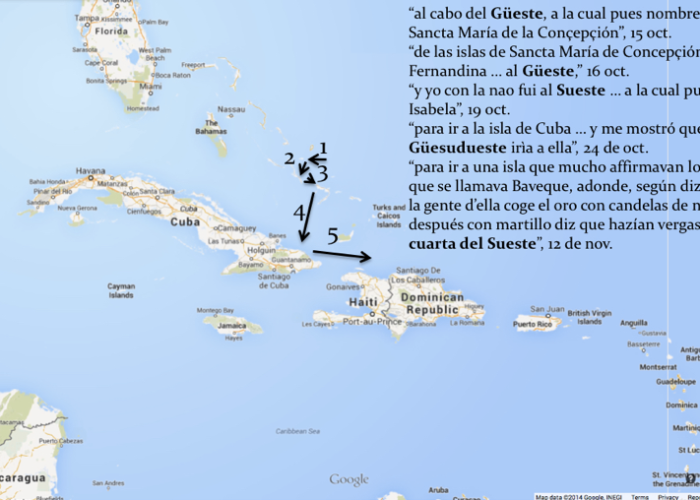
We begin the semester by asking students to analyze passages related to translators, interpreters, and message-shaping go-betweens in texts from the early Americas. By plotting the movements of Admiral Cristóbal Colón ([1492–1503] 2011, 63-93) on Google Maps, students visualized the ways indigenous informants shaped the movements of Spanish imperial agents (Figure 1). In this way, I take a familiar practice (close reading of literary passages) and use it to destabilize concepts that students thought they knew: empire, power, language.

""

Figure 1. Map of Colón’s movements from 15 October–12 November 1492.

In weeks two to six, we practice translation with hands-on exercises from the primary texts. In a Tuesday/Thursday class, I ask students to translate a passage from Tuesday’s reading, such as Colón’s finding “beautifully deformed trees” ([1492–1503] 2011, 69) or Cabeza de Vaca’s report of same-sex marriage ([1542–1555] 2011, 173). We review their translations in class on Thursday, debating the advantages and disadvantages of “deformed,” “different,” and “diverse” as translations of “están tan disformes de los nuestros” and analyzing the connotations of “idolatry,” “devilishness,” and “sin” for “vi una diablura.” To trace lexical emergences and common usages, we consult databases like the Real Academia Española’s Corpus diacrónico del Español (CORDE, http://corpus.rae.es/cordenet.html) and Nuevo Tesoro Lexicográfico de la Lengua Español (NTLLE, http://ntlle.rae.es/ntlle/SrvltGUILoginNtlle). As students compare translations in their groups, they appreciate how team members approach the task of translation in different ways and how small lexical variations impact the tone and meaning. This is one of the most challenging aspects of collaborative translation: each translator writes in her or his own voice, yet the group must find a shared tone that respects the historical tenor of the source text. To complement these in-class workshops, I sometimes assign theories and methods of translation (Benjamin [1923] 1968, Spivak 1992).[1]

Along the way, in week three, we transition to a “metadata analysis” of those sources, meaning that students begin to analyze them within the context of digital publics and archives. First, students review a curated list of archival texts that they might consider translating, sorted by theme (language contact, science, religion), region (Central America, the Caribbean, South America), and author (Gonzalo Pizarro, Hernando de Soto, El Inca Garcilaso de la Vega). Then, they meet with archivists in Special Collections to learn about rare materials: how the library acquires its collection, determines which materials to purchase, and classifies colonial works that defy genres, such as multilingual broadsides and maps with artwork. Students also learn protocols required to handle rare materials. After seeing how tightly the university controls access to colonial records, most students are excited to make these materials accessible to readers. We define “access” in two ways. These documents must be freely available and contextualized for general audiences so that non-specialists can understand them.

Independently, students work through a handout to evaluate the text’s content, interest to EADA users, and availability of other editions (Figure 2, distributed before visiting Special Collections). For example, Abby Kamensky, Mae Flato, Molly Hepner, Kayla Pomeranz, and Karla Núñez found a recent, scholarly translation of an important treatise on indigenous people of Mexico on Google Books (Palafox y Mendoza [1650] 2009). Because most of the text is not available in preview mode, they used an edition from Special Collections to transcribe and translate passages on law, foodways, and artisan practices (Palafox y Mendoza [1650] 1893). These themes complement other digital works, such as Sigüenza y Góngora ([1693] 1932) and Las Casas (1552), prepared by guest editor Rafael E. Tarrago from an edition held at the James Bell Ford Library of the University of Minnesota. The students thus understood their work as part of a larger process of archival formation with EADA collaborators at other libraries and universities, and electronic resources like Google Books.

The second part of the handout asks students to identify what they want to learn from the project. Some students seek practical experience in translation, while others want to make the work intelligible to non-specialists with well-researched footnotes. Students also specify which passages or chapters they will translate, explaining how they will balance this project and its challenges with their other coursework and commitments.

""

Figure 2. Handout to evaluate texts to translate for EADA.

Middle

Students use the handout, which we work on in class, to write a formal proposal of one or two pages, which takes the place of a midterm exam (weeks six and seven). Each proposal explains how the selected text will enhance EADA readers’ understandings of early American history, literature, or culture, and how the student will design a manageable project within the constraints of the semester. For context, we review sample proposals of translation fellowships from the National Endowment for the Arts. I removed all of the names and identifying information from the proposals and secured NEA approval before sharing materials in class. By evaluating recent, real-world proposals, students see how professional translators conceive of a project, justify its merit, and plan to bring projects to completion.

These proposals reveal how students understand archives and public-facing digital research. Some see digital archives as mode of preservation, as when Claire Gillespie chose to work with a manuscript that bears signs of water stains, deteriorating paper, and ink runs (Vendrell y Puig 1794). Others considered that the archive should fill gaps in public knowledge. When Hannah Berk discovered that no full-text digital edition existed of the order of King Carlos III (1767) to expel the Jesuits from Mexico, she resolved to make a bilingual edition that was freely available to readers. Emma Merrill identified a gap in the historiography, noting that a Dominican treatise about the excesses of women, fashion, and tobacco (Ramón 1635) was cited in important scholarly works from Latin America (Ortiz 1940), but not available in English.[2]

After commenting on and grading the proposals, in week seven, students are grouped based on overlapping interests like European empires in the Caribbean or Orientalisms in the Global South. These were the points around which two groups formed. Sutton White, Matt Trope, Anthony Correia, and Brent Nagel translated a Spanish diary of a British attack on Florida (Gálvez 1781(?)), and Taneen Maghsoudi, Kimia Nikseresht, and Tara Shafiei translated a Francophone account of Persia that connects orientalisms in the Middle East and Latin America. The latter group of students used their knowledge of Farsi to reveal these points of connection, recently studied by Camayd-Freixas (2013), and to correct Tavernier’s interpretations of medical practices, policies, and customs. So far, I have only grouped students by shared interests, although I can imagine pairing them based on complementary goals. For example, if one student wanted to build experience in translation, one wanted to research and edit, and a third wanted to manage the project, they could make an effective team.

Once students are in their teams, they transcribe the text to create a searchable record. This assignment serves two purposes: I have something tangible to grade before the final project, and students begin to develop collaborative methods. The interactive format of Google Docs makes it easier for teams to search and replace terms that they decide to re-translate, such as rendering “natural del pueblo” as “from the town of” rather than “native of” in Danielle Tassara’s translation of a Chinese labor contract in Cuba, or Ashleigh K. Ramos, Andreea Cleopatra Washburn, and Vanessa Macias’s decision to encode John Smith’s addresses to Queen Anne and Pocahontas in different registers to mark the gendered nature of both relationships in Álvarez(?) (1788).

End

In the final month of the semester, we edit drafts during in-class workshops. I also meet with students in office hours and in Google Hangouts, often joining their drafts to edit and ask questions (Figure 3). One week before the due date, students submit complete drafts. I review them and add comments, either with pen and paper or on a Google Doc, depending on the group’s preference. By using low-tech collaborative platforms like Google Docs, students see that a task that sounds obscure—translating rare materials for a digital archive as a group—is actually within their reach.

""

Figure 3. Trading comments with students by Google Doc.

On the day of the final exam, student groups sign up for a thirty minute appointment to review their work and submit it. One semester, I made the mistake of asking students to mark up their translations using XML, after learning it in a library workshop. None of the students were able to complete the markups. They ultimately submitted their work to the EADA site as plain text files, which editors at the archive finalized for publication. I realized that students were working hard to select, transcribe, translate, and annotate colonial-era texts, so I never repeated the XML assignment. Now, we send our work as plain text files to the managing editor, who reviews submissions for quality and consistency. This external review makes it easy to grade final projects: an undergraduate who writes for publication is doing excellent work. I grade the projects based on four parts: transcription, translation, footnotes, and letters of reflection in which students evaluate the contributions of all group members—including their own.

Student Response

Students generally enjoy the course, reporting favorably on meeting with professors, archivists, and librarians, and learning a variety of skills, including collaboration, textual analysis, and how “to help others in translating and teaching translative methods.” They also highlight the value of “meaningful work” in a “very fulfilling course,” writing, “I am amazed how much we accomplished in this course,” “The work was extremely practical…. Coming out of it with something substantial to put on my resume is great,” “the course gave me a sense of accomplishment that no other course had,” and “I could see myself translating texts in the future because of it.”

Teacher Evaluation

I have taught the class four times with twelve student projects, eleven of which are published on the EADA site. Because I work closely with students in each step of the process—selection, transcription (especially with manuscripts), translation, and research—teaching this course requires more time and energy than a course with a traditional research paper. It is also far more rewarding.

After teaching “Colonial Translations,” I began to incorporate projects with interactive technological components into my other courses, such as “Literatura indígena,” in which students wrote Spanish-language Wikipedia pages based on understudied aspects of indigenous history, literature, and culture (https://es.wikipedia.org/wiki/Usuario:Alisoneditorial). I also offer translation projects as options for students who want to combine academic and creative work, such as an edition of Sor Juana’s “Hombres necios” (Foolish men) in which Kate Eagen and Lisa Trinh, enrolled in a seminar on the Mexican nun, conserve the rhyme scheme and meter (http://eada.lib.umd.edu/text-entries/509/) in ways that the EADA edition of Sor Juana ([1689] 1920) had not.

By adapting a project-centered understanding of the archive, one grounded in projects that students develop, students understood in practical terms some of the theoretical questions—what is an archive, whose voices shape it, and how do we hear them?—that can be hard to teach. In the future, I will incorporate more theoretical and methodological readings on translation and digital publics to complement the practical orientation of the course.

Student Projects

Project: …. Francisco Álvarez (?). 2012. Noticias del establecimiento y población de las colonias inglesas en la América Septentrional: religión, orden de gobierno, leyes y costumbres de sus naturales y habitantes; calidades de su clima, terreno, frutos, plantas y animales; y estado de su industria, artes, comercio y navegación. Translated by Ashleigh K. Ramos, Andreea Cleopatra Washburn, and Vanessa Macias. Early Americas Digital Archive (EADA). http://eada.lib.umd.edu/text-entries/noticia-del-establecimiento-y-poblacion-de-las-colonias-inglesas-en-la-america-septentrional-religion-orden-de-gobierno-leyes-y-costumbres-de-sus-naturales-y-habitantes-calidades-de-su-clima-terr/.

Source document: Álvarez, Francisco (?). 1778. Noticias del establecimiento y población de las colonias inglesas en la América Septentrional. College of William & Mary (W&M) Swem Special Collections Research Center (SCRC) Rare Books #E188 .A47.

Project: “The Audiencia of Sta. Fee to the king, on the taking of Sto. Thome by the English in 1618.” 2014. Translated by Allison Bigelow, Mawusi Bridges, Shaun Casey, Julia Colopy, Eleanor Daugherty, Taylor Dorr, Mary Catherine Gibbs, Carly Gordon, Rebecca Graham, Alison Haulsee, Brynna Heflin, Kimberly Hursh, Lindsey Jones, Katherine Lara, Nathaniel Menninger, Sierra Prochna, Kyle Reitz, Blake Selph, Alexandra Soroka, Julia Sroba, Nora Zahn, Mary-Rolfe Zeller, and Emily Zhang. EADA. http://eada.lib.umd.edu/text-entries/the-audiencia-of-sta-fee-to-the-king-on-the-taking-of-sto-thome-by-the-english-in-1618/.

Source document: “The Audiencia of Sta. Fee to the king, on the taking of Sto. Thome by the English in 1618,” In Venezuela Papers, Vol. VIII, British Library Western Manuscripts Collection, Add MS 36321, 67-91.

Project: Benites y Gálvez, Bartolomé. 2014. Diario que hicieron los comisionados Alonso Hill Interprete de Indios, y Don Bartolome de Castro y Ferrer…. Translated by Patrick Johnson. EADA. http://eada.lib.umd.edu/author-entries/benites-y-galvez-bartolome/.

Source document: Benites y Gálvez, Bartolomé. 1790. Diario que hicieron los comisionados Alonso Hill Interprete de Indios, y Don Bartolome de Castro y Ferrer…. East Florida Papers Bundle 353. N. 17 170, April 6 (San Agustín).

Project: Gálvez, Don Bernardo de. 2015. Diario de las operaciones de la expedicion contra la plaza de Panzacola…. Havana (?). Translated by Sutton White, Matt Troppe, Anthony Correia, and Brent Nagel. EADA. http://eada.lib.umd.edu/text-entries/diario-de-las-operaciones-de-la-expedicion-contra-la-plaza-de-panzacola-concluida-por-las-armas-de-s-m-catolica-baxo-las-ordenes-del-mariscal-de-campo-don-bernardo-de-galvez_-havana-1781/.

Source document: Gálvez, Don Bernardo de. 1781 (?). Diario de las operaciones de la expedicion contra la plaza de Panzacola…. Havana (?) University of Virginia (UVA) Albert and Shirley Small Special Collections Library (SC) #A1781.G358.

Project: King of Spain (Carlos III). 2014. “Se extranen de todos sus Dominios de España….” Translated by Hannah Berk. EADA. http://eada.lib.umd.edu/text-entries/se-extranen-de-todos-sus-dominios-de-espana-e-indias-islas-philipinas-y-demas-adyacentes-a-los-religiosos-de-la-compania-assi-sacerdotes-como-coadjutores-o-legos-que-hayan-hecho-la-primero-pr/.

Source document: King of Spain (Carlos III). 1767. “Se extranen de todos sus Dominios de España….” México: s.n. W&M SCRC Rare Books Double Folio #F1231.M4.

Project: Lafitau, Joseph François. 2012. Histoire des découvertes et conquestes des Portugais dans le Nouveau Monde. Translated by Sarah Schuster. EADA. http://eada.lib.umd.edu/text-entries/histoire-des-decouvertes-et-conquestes-des-portugais-dans-le-nouveau-monde/.

Source document: Lafitau, Joseph François. 1733. Histoire des découvertes et conquestes des Portugais dans le Nouveau Monde. Vol. I, Book ii, pp. 123-125 and Vol. II, p. 485. Paris: Saugrain. W&M SCRC Rare Books #DP583.L16.

Project: Palafox y Mendoza, Juan. (1650) 2015. Virtudes del Indio, chapters V, VII, IX, XII, XIV, and XVI. Translated by Abby Kamensky, Mae Flato, Molly Hepner, Kayla Pomeranz, and Karla Núñez. EADA. http://eada.lib.umd.edu/author-entries/palafox-y-mendoza-juan/.

Source document: Palafox y Mendoza, Juan. (1650) 1893. Virtudes del Indio. Madrid: Tomás Minuesa de los Ríos, chapters V, VII, IX, XII, XIV, and XVI. UVA SC #A1891.C65 v.10.

Project: Queen of Spain (Isabela II). 2014. “Chinese Coolie Contract Regarding Work in Cuba.” Translated by Danielle Tassara. EADA. http://eada.lib.umd.edu/text-entries/chinese-coolie-contract-regarding-work-in-cuba-1858/.

Source document: Queen of Spain (Isabela II). 1858. “Chinese Coolie Contract Regarding Work in Cuba.” Collection of Spanish Language Manuscripts. W&M SCRC, Mss 1.16, Box 1, item 2012.146.

Project: Ramón, Tomás. 2012. Nueva prematica de reformacion contra los abusos de los afeytes, calçado, guedejas, guarda-infantes, lenguaje critico, moños. trajes: y excesso en el uso del tabaco… Translated by Emma Merrill. EADA. http://eada.lib.umd.edu/text-entries/nueva-prematica-de-reformacionnew-pragmatic-language-of-reformation/.

Source document: Ramón, Tomás. 1635. Nueva prematica de reformacion contra los abusos de los afeytes, calçado, guedejas, guarda-infantes, lenguaje critico, moños. trajes: y excesso en el uso del tabaco… Zaragoza: W&M SCRC Rare Books #GT509.R3 1635.

Project: Tavernier, Jean-Baptiste. 2015. “The Travels of Mr. Johannes Baptista Tavernier,” 335, 340-341, 343. Translated by Taneen Maghsoudi, Kimia Nikseresht, and Tara Shafiei. EADA. http://eada.lib.umd.edu/text-entries/voyages-through-persia-and-india-spanish-trans/.

Source document: Tavernier, Jean-Baptiste. (1686) 1705. “The Travels of Mr. Johannes Baptista Tavernier.” In Navigantium Atque Itinerantium Bibliotheca, edited by John Harris. London: Thomas Bennet, John Nicholson, and Daniel Midwinter, 301-348. UVA SC #G160.H27 1705, v. 2.

Project: Vendrell y Puig, don Miguel. 2014. “Mathematical Dissertation.” Translated by Claire Gillepsie. EADA. http://eada.lib.umd.edu/text-entries/mathematical-institutions/#colophon.

Source document: Vendrell y Puig, don Miguel. 1794. “Mathematical Dissertation.” Collection of Spanish Language Manuscripts. W&M SCRC, Mss. 1.16.

Notes

[1] When I taught the class in an English department, largely to heritage speakers of Spanish, I included these texts. When I taught the class in a Spanish department, I did not, because most of the students had taken a translation course for their major or minor.
[2] When I taught the class in a seminar with five to six students, I allowed students to work independently. In a class with eighteen to twenty-two students, they work in groups.

Bibliography

Benjamin, Walter. (1923)1968. “The Task of the Translator.” Translated by Harry Zohn. In Illuminations, edited by Hannah Arendt, 69–82. New York: Random House.

Cabeza de Vaca, Álvar Núñez. (1542-1555) 2011. Naufragios. Edited by Juan Francisco Maura. Madrid: Cátedra.

Camayd-Freixas, Erik. 2013. Orientalism and Identity in Latin America: Fashioning Self and Other from the (Post)Colonial Margin. Tuscon: University of Arizona Press.

Colón, Cristóbal. (1492-1503) 2011. Los cuatro viajes: Testamento. Edited by Consuelo Varela. 3rd ed. Madrid: Alianza.

de la Cruz, sor Juana Inés. (1689) 1920. “Arraignment of Men.” Translated by Peter H. Goldsmith. In Hispanic Anthology: Poems Translated from the Spanish by English and North American Poets, edited by Thomas Walsh. New York: Putnam. From Early Americas Digital Archive (EADA). http://eada.lib.umd.edu/text-entries/arraignment-of-men/.

—. (1689) 2017. “Philosophical satire, or Sátira filosófica.” Translated by Kate Eagen and Lisa Trinh. From EADA. http://eada.lib.umd.edu/text-entries/509/

Ortiz, Fernando. 1940. Contrapunteo cubano del tabaco y el azúcar (advertencia de sus contrastes agrarios, económicos, históricos y sociales, su etnografía y su transculturación). Havana: Jesús Montero.

Palafox y Mendoza, Juan. (1650) 2009. Virtues of the Indian. Translated by Nancy Fee. Lanham: Rowman & Littlefield.

Sigüenza y Góngora, Carlos. (1693) 1932. The Mercurio Volante of Don Carlos de Sigüenza y Góngora. Translated by Irving Leonard. Los Angeles: Quivara Society. From EADA. http://eada.lib.umd.edu/text-entries/mercurio-volante/

Spivak, Gayatri Chakravorty. 1992. “The Politics of Translation.” In Destabilizing Theory: Contemporary Feminist Debates, edited by Michèle Barret and Anne Phillips, 177–200. Stanford: Stanford University Press.

About the Author

Allison Margaret Bigelow is an assistant professor of colonial Latin America in the Department of Spanish, Italian, and Portuguese at the University of Virginia, where she teaches courses on colonial science, Indigenous literatures, and Latin American digital humanities. Her work has been published in or is forthcoming from Anuario de estudios bolivianos, Early American Literature,Early American Studies, Ethnohistory, Journal of Extractive Industries and Societies, and PMLA. Her book, Cultural Touchstones: Mining, Refining, and the Languages of Empire in the Early Americas, is forthcoming from the Omohundro Institute of Early American History and Culture/UNC Press (Spring 2020).

""
0

Engaging Women’s History through Collaborative Archival Wikipedia Projects

Abstract

This paper considers the potential of archivist–faculty collaboration to open and build engagement with women’s history–related collections. Collaborative digital scholarship projects built around institutional primary-source collections advance course- and discipline-specific goals and impart critical lessons about research and knowledge production to students. We share and reflect upon a dynamic Wikipedia project carried out in a feminist theory course, highlighting an accessible approach to archival research and digital methods. The project produced work that emphasized academic challenges and debates around sources of knowledge. Over two iterations of the project, students interacted with the library’s archival materials, analyzing and synthesizing this information into Wikipedia articles, and engaging in discussions of archival practice and feminist knowledge production.

We propose that Wikipedia offers a unique set of openings into women’s history for undergraduate students, providing an accessible platform with a low barrier of entry for students coming to a digital project for the first time. Wikipedia provides a compelling base for students to engage with global audiences while struggling with editorial criteria that value objectivity and notoriety. Through the collaboration between students, archivists, faculty, and Wiki Education Foundation staff, this project demonstrates the importance of a team approach to supporting students as they work through a challenging research project for a public audience.

Introduction

Wikipedia is an open access, online resource built on the creative and administrative contributions of thousands of individuals around the world. With more than 35 million articles in 280 languages, Wikipedia is a ubiquitous presence in popular culture and the classroom alike. An immediately familiar resource for students (and often the place where they begin their research), Wikipedia is increasingly recognized as an essential component of the research process, “an essential tool for getting our digital collections out to our users at the point of their information need” (Lally and Dunford 2007; cf. Head and Eisenberg 2010). The openness of the platform to anyone interested in contributing, however, has exposed some biases and deficiencies in the encyclopedia’s coverage and editing community. Wikipedia has a major gender imbalance in contributing editors—women are estimated to make up 9 to 13 percent of them (Wadewitz 2013; Bayer 2015)—and the editing community has largely minimized women’s history, with an estimated 15.5 to 17 percent of the biographical articles focusing on women (Proffitt 2018; Moravec 2018).

Feminist activists and scholars have developed a set of approaches to address the Wikipedia gender gap. In 2012, undergraduate student Emily Temple-Wood founded the WikiProject Women Scientists, which sought to ensure “the quality and coverage of biographies of women scientists.” Alongside Rosie Stephenson-Goodknight, she co-founded WikiProject Women in Red. On Wikipedia, red links mean that “the linked-to page does not exist‍.” The Women in Red project continues to create lists of links that are either about “a woman, or a work created by a woman.” These efforts garnered Temple-Wood and Stephenson-Goodknight the first co-awarded Wikipedian of the Year award. Aaron Halfaker (2017) notes how Temple-Wood’s efforts not only improved the quantity of content related to women on Wikipedia, but also the quality of entries.

Collective gatherings have shown promise for supporting new editors, as groups like Art+Feminism, AfroCROWD, Fembot, and FemTechNet have taken a “do-it-yourself and do-it-with-others” approach. Wiki edit-a-thons hosted by such groups take place in public spaces like coffee shops and museums, and at libraries ranging from New York Public Library’s Schomburg Center for Research in Black Culture to Connecticut College’s Shain Library, the site of this study (Boboltz 2017). Librarians have taken on a key role in facilitating the work of groups seeking to add content about marginalized people and issues to Wikipedia. They have sought out ways to not only support activists doing this work, but also to institutionalize engagement with Wikipedia. For example, at West Virginia University, academic librarians worked to enable students to receive required service credit hours for editing Wikipedia, drawing sorority groups and graduate students into this work (Doyle 2018, 63). Finally, as evidenced by the work of Wiki Education, classes are increasingly bringing together student learning with editing Wikipedia: in the Fall 2018 session, 321 classes participated across a wide range of academic fields.

Over three iterations, a feminist theory class and the Linda Lear Center for Special Collections & Archives at Connecticut College collaborated on an in-depth Wikipedia archival research assignment (Appendix 1) with a twofold goal: first, to address some of these Wikipedia deficiencies by creating and editing articles through a feminist scholarship lens, and second, to engage students in the process of knowledge creation for a public audience (Appendix 2). This project built upon an ongoing collaboration between faculty and archivists to develop project-based learning opportunities in institutional collections, and reflects a growing recognition of Wikipedia’s potential for generating “meaningful service learning experience[s]” for students (Davis 2018, 87). The first iteration of the course allowed students to develop topics that were far ranging, but this initial approach resulted in some issues with their engagement with Wikipedia (e.g. overly specific topics or concepts that were difficult to document). The second and third iterations of this course focused on identifying gaps in Wikipedia that could be directly tied to the Lear Center’s collections. The team reviewed course learning goals and developed a list of relevant material in the Lear Center (Appendix 3) which connected to themes in feminist theory such as women’s leadership, ecofeminism, poverty, and racial and disability justice. Students conducted research using these collections and worked to either generate or modify existing Wikipedia content. Students then summarized their experience in public presentations at the end of the semester. The resulting project represents a collaborative approach between students, faculty, and archivists, and showcases the community of shared interests and values that are fundamental to the digital humanities (Scheinfeldt 2010). This paper argues for the power and potential of this type of collaboration in developing projects that challenge students to engage in practical feminist praxis and to make connections between theory, archives, and public digital engagement.

Digital engagement with Wikipedia offers a unique set of openings into feminist theory and history for undergraduate students. Wikipedia serves as an accessible platform for students to consider questions of evidence, representation, and knowledge creation. While many use Wikipedia as the first stop for information, few understand how this information is created. The project team recognized that the platform’s ubiquity and familiarity could serve a dual purpose: first, to emphasize the importance of contributing reliable, accurate information to a site used by so many, and second, to help mitigate potential nervousness about working with digital technology in the public realm. This pedagogical approach ensures that students understand the historical and political context of Wikipedia and its community. They can draw upon their experience with this platform to ask questions and actively engage with media.

The team partnered with the Wiki Education Foundation (Wiki Ed), a non-profit entity separate from Wikipedia that supports faculty who incorporate Wikipedia into their curriculum. The program emphasizes that students “gain key 21st century skills like media literacy, writing and research development, and critical thinking, while content gaps on Wikipedia get filled thanks to [their] efforts” (Wiki Education, n.d.). Wiki Ed provides tools and resources, including interactive tutorials about the tenets of Wikipedia and basics of editing and adding content. The Wiki Ed Dashboard serves as the digital home for the class, enabling faculty to create and manage their Wikipedia assignment and to monitor student progress. For students, it contains the tutorials and relevant information for the Wikipedia assignment and allows them to track the progress on their article as well as that of their classmates. Faculty and archives staff use the dashboard to design and monitor students’ work in real time.

A key aim of the project was that students experience the process of conducting and presenting research. Much of feminist theory is based in intensive critique of research and representational practices. Students risk becoming either highly critical of all scholarship without engaging the merits of the work or fearful of creating their own work, believing that it will also be easily criticized. In this assignment, students learned to balance rigorous critique with a strong understanding of knowledge production. Editing content for a general audience on Wikipedia raised the stakes for students: the challenge of writing for the public proved more rewarding than the perceived standard of writing for only the instructor (Davis 2018, 88). The team presented Wikipedia’s overlapping gender and racial imbalance as a problem that students had the power to address as part of a broader scholar-activist community. Student feedback about the challenge and meaning of the assignment supports scholars’ arguments that structured opportunities for student interaction with institutional special collections and archives generate deeper engagement with and investment in research and its meaning (Tally and Goldenberg 2005).

Institutional Context

Connecticut College is a private, undergraduate liberal arts institution in New London, Connecticut. It offers 56 majors, minors, and certificates to approximately 1850 undergraduates. As with many liberal arts colleges, Conn’s culture is deeply rooted in teaching and learning. These efforts are supported by several campus resources and partnerships, including the Center for Teaching and Learning and the Technology Fellows Program, as well as by collaborations between faculty and staff in the six academic centers across campus, the campus’ Charles E. Shain Library, and the Linda Lear Center for Special Collections and Archives. The Lear Center is home to Connecticut College’s collections of rare books, manuscripts, and archives. The Center works extensively with faculty to develop projects which engage students in active primary source research, both in the classroom and increasingly as a part of the College’s emerging Digital Scholarship program. The Digital Scholarship program provides technological, project, and platform support for student, staff, and faculty digital projects with a focus on the pedagogical, classroom-based side of digital scholarship. The Lear Center has been involved with the College’s Digital Scholarship efforts from the start, as it sees digital scholarship as a natural extension of outreach and use activities. By combining primary source research with digital methodologies, the Lear Center offers students a unique opportunity to become active producers of knowledge, rather than passive consumers, and to convey this knowledge to a real-world audience.

Wikipedia as a Space for Feminist Praxis and Skill-Building

Gender, Sexuality, and Intersectionality Studies (GSIS) emphasizes feminist praxis, the “philosophy and practice of participatory democracy and situated knowledges” (Naples and Dobson 2001, 117). At its heart, feminist praxis is a call for hands-on engagement with core questions within the field, particularly in how each person can participate in the creation, circulation, and usage of knowledge. While feminist theory can be taught in a manner that solely focuses on theories of gender, sexuality, and other categories of analysis, the course provides an opportunity to enact a praxis-based pedagogical strategy. This approach can deepen students’ understanding of theory, asking them to apply theory to their work and consider its accuracy or limitations when put into practice.

Feminist theory presents a challenge to undergraduate students who are drawn into GSIS through varying avenues. As feminist theory is interdisciplinary, students encounter authors that may be writing from fields or on topics they have yet to study. They also may not have developed necessary reading skills or frustration tolerance (that is, the ability to navigate work that is dense, references unfamiliar ideas and academic jargon, or challenges their perspective). Scholar Gloria Anzaldúa (1991, 252) argues that “[t]heory serves those that create it” and that as a queer woman of color, she had to challenge existing theories to adequately account for her knowledge and experiences. Indeed, students may struggle to see themselves or their concerns in texts that are written in a language and for an audience far removed from themselves, or in the disproportionate amount of scholarship written by white Western cisgender women. However, Anzaldúa also reminds us that works have “doors and windows,” or entradas (1991, 257). As readers come with a need to find themselves in texts, having multiple entradas through diverse course readings and assignments creates a range of opportunities to engage with and find connections to feminist theory. It is imperative for instructors to find ways to address these concerns while ensuring that students directly work with the scholarship that undergirds the field and its contributions more broadly.

The Advanced Readings in Feminist Theory course is a required annual offering for both GSIS majors and minors (see Appendix 4 for the 2017 syllabus). This 300-level class is for some students their first undergraduate course that heavily centers theoretical work. This course draws students from a range of disciplines including English, Music, East Asian Studies, and Psychology. In the 2017 version, McCann’s and Kim’s edited collection, Feminist Theory Reader (2016), and Moraga’s and Anzaldúa’s edited collection, This Bridge Called My Back (2015), served as the core texts, along with additional readings. Key themes included theorizations of inequality, violence, and intersectional feminism along with epistemological frameworks such as standpoint theory and feminist phenomenology. The learning goals for the semester sought to ensure that students would be able to:

  • Knowledgeably discuss key forms of feminist theory in terms of their content and implications
  • Articulate the significance of feminist theories to their own research and education
  • Effectively present their research to a public audience online and in person

It was important to devise course assignments that asked students to put into practice the frameworks they were using so that they could more critically understand the stakes of feminist theory, articulate key ideas in their own words, and apply these concepts to unique projects.

The platform of Wikipedia offered a novel means to take feminist theory out of the ivory tower and illuminate the value of the course content for students. Positioned as editors, students were challenged to make meaning out of theory and archival materials for a broad audience. Working with Wikipedia made coursework relevant by making it accessible to a public at large, thus enabling to students to find a compelling reason to stay engaged throughout.

Collaboration in the Archives, Navigating Wikipedia’s Norms

Coupling the Wikipedia platform with archival research provided a set of connections and resources to facilitate the achievement of these pedagogical aims (see the Fall 2017 course dashboard). Faculty and archives staff reviewed course learning goals and core themes and identified relevant, robust topics in the collection that either had underdeveloped pages or were absent from Wikipedia. Collections were assessed to ensure each had sufficient primary and secondary material to build an entry that would meet Wikipedia’s standards. Students used primary source material such as photographs, correspondence, and reports, while drawing upon secondary sources to verify their claims and authenticate their subject’s notability, a critical standard of Wikipedia.

The practice element of feminist praxis requires skill building and serves to reinforce the content of feminist scholarship. As students worked with Wikipedia, they practiced what feminist theorist Donna Haraway describes as learning the ins and outs of knowledge production and representation. She argues that “understanding how these visual systems work, technically, socially, and physically, ought to be a way of embodying feminist objectivity” (Haraway 1988, 583). Through the process of conducting research in the archives and in secondary sources, drafting and revising content for Wikipedia, and then presenting and reflecting on this work, students were challenged to consider multiple facets of knowledge production. Moreover, they encountered those questions and challenges at the heart of feminist debates about epistemology, as they considered the perspectives included in the archival source material, their own positionality in relation to their research, and the dynamics that exist within Wikipedia vis-à-vis its standards and editing community.

Wikipedia’s policies and practices hold both potential and barriers for its usage in a feminist classroom. The formal policies are expressed most directly through the Five Pillars that address the basics of Wikipedia. While the first and third pillars state basic elements of Wikipedia (it is an encyclopedia; free content that is edited), the second, fourth, and fifth pillars present elements of Wikipedian culture. Pillar two, “Wikipedia is written from a neutral point of view,” contains the key conflicts that are perennially navigated in our feminist theory assignment and have been challenged by feminist scholars (Gauthier and Sawchuk 2017). It states:

We strive for articles in an impartial tone that document and explain major points of view, giving due weight with respect to their prominence. We avoid advocacy, and we characterize information and issues rather than debate them. In some areas there may be just one well-recognized point of view; in others, we describe multiple points of view, presenting each accurately and in context rather than as “the truth” or “the best view.” All articles must strive for verifiable accuracy, citing reliable, authoritative sources, especially when the topic is controversial or is on living persons. Editors’ personal experiences, interpretations, or opinions do not belong. (Wikipedia 2018)

In response to standpoint and situated knowledge theories, it is de rigueur in feminist theory to recognize and acknowledge one’s relationship to a topic (Collins 1986; Haraway 1988; Harding 1992). While feminist scholars range in their approach to academic tone, there is generally an acceptance of taking stances that explicitly embrace values such as antiracism and antisexism, rather than avoiding any direct acknowledgment of their interest in a subject and the stakes of inquiry (hooks 1998; Mohanty 2003). The encyclopedia form of Wikipedia thus at once provides an opportunity to build a broader audience for feminist-themed topics while disavowing the motivation that drives feminist engagement with the platform.

A critical analysis of power and the circulation of knowledge also conflicts with the assertion in the second pillar that as members of Wikipedia, “We strive for articles that document and explain major points of view, giving due weight with respect to their prominence in an impartial tone.” Michelle Moravec’s essay “The Endless Night of Wikipedia’s Notable Woman Problem” provides insight from the field of women’s history about why assumptions about prominence continue to stymie the work of feminist Wikipedians. She argues that it is important to:

consider the difference between notability and notoriety from a historical perspective. One might be well known while remaining relatively unimportant from a historical perspective. Such distinctions are collapsed in Wikipedia, assuming that a body of writing about a historical subject stands as prima facie evidence of notability. (Moravec 2018)

The presumption of prominence fails to address the ebb and flow of cultural memory, and in practice requires that women rise to a level of exceptionality to register as worthy of inclusion in Wikipedia. Moravec cites the reality that the “‘List of Pornographic Actresses’ on Wikipedia is lengthier and more actively edited than the ‘List of Female Poets.’” While arguably both lists could serve as useful sources of information, this gap highlights an editorial priority based on editors’ personal consumption practices rather than the quantity or quality of an artist’s contributions. Wikipedia itself has articles addressing the challenges of notability, and includes discussions of the two camps, deletionists and inclusionists, who struggle over either stringent adherence to the requirement or the allowance of entries that are viewed as “harmless.” The ongoing struggle over how to best balance the intention of Wikipedia to serve as a reliable source of information with the demand for increasing inclusion of diverse content, and editors who echo broader debates within feminist scholarship and our society at large, is critical for students to take on in their learning.

Screenshot of a Wikipedia article featuring poet Eli Coppola.

Figure 1. A student created a new Wikipedia entry for Eli Coppola, a poet whose work addresses disability and sexuality.

Assessment and Outcome

The project’s aims—archives staff’s desire to develop extended, class-based community engagement with library resources and collections, and the faculty member’s desire for students to participate in the collaborative process of planning, conducting, and presenting their research to a public audience—were met. The project’s design allowed students to demonstrate their learning through multiple formats (archival research, work with Wikipedia, a poster presentation, and a reflection essay), as well as to provide feedback through the reflection essay, in-class discussions, and the anonymous, end-of-semester teaching evaluation. While students at times struggled with the assignment, the project team determined that they not only gained skills related to feminist theory, metaliteracy, and critical reading, but recognized the long-term value of their work for their future careers.

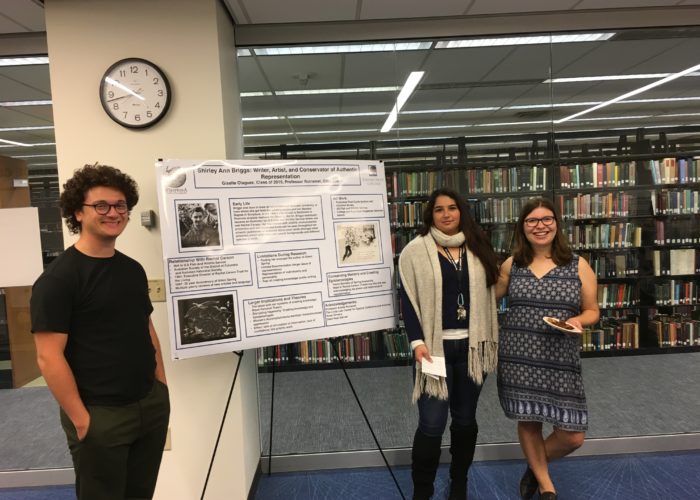
Students presented their work publicly in the college library through poster presentations. Along with a final reflection essay, these components served to assist students in recognizing the level of effort that they put into this project and its significance to their understanding of feminist theory. Students’ projects were assessed on their work in the archives, the Wiki dashboard, effort and collaboration with classmates, and their poster presentation and reflection essay (Appendix 5, Appendix 6). This assessment approach emphasized students’ engagement and centered the need to connect their work with archival material and Wikipedia with course readings. The assignment set a clear expectation that students engage in feminist praxis, considering how the work they were doing in researching and creating public-facing content was informed by feminist theory and vice versa.

Course outcomes

Students’ reflection essays[1] provide insight into how they understood the work they did throughout the project and what doors opened for them. They were asked to make a unique argument about the assignment in terms of feminist theory and a core facet of the project. Students highlighted their priorities, including gaining a deeper understanding of key questions in the course content, challenging the limitations of Wikipedia, and preparing for post-graduate life. One student made explicit how the assignment addressed theoretical questions within the field:

Similar to how feminist epistemology seeks to change, redefine, and rewrite mainstream theories which exclude women’s narratives … metaliteracy “challenges traditional skills-based approaches to information literacy” [Mackey and Jacobson 2011, 62].

By putting questions of epistemology into conversation with metaliteracy, the student emphasized the ways that the assignment helped students think and act critically in their project work.

Two students’ responses to engaging with Wikipedia demonstrate the struggles they encountered and their differing attitudes to the project’s outcomes. The first student’s response centered on the importance of working in the archives. They wrote, “Through the use of primary documents and news clippings found in the archives, I was able to navigate the problematic limitations that Wikipedia exhibits.” They found that the collections provided the necessary content to ensure that they were showing notability and to avoid challenges raised by Wiki editors.

Screenshot showing the revision history for a Wikipedia article on Audre Lorde’s “Sister Outsider.” A highlighted revision from 20 December 2016 shows an editor’s challenge to the inclusion of Lorde’s self-described sexuality in the article.

Figure 2. A Wiki editor claimed that naming Audre Lorde’s “sexual preference” was offensive. Lorde was a famously self-described “black, lesbian, mother, warrior, poet” who emphasized the importance of naming herself in her writing. This editing challenge suggests a bias against public identification of LGBTQ people.

In contrast, another student was frustrated by the constraints of Wikipedia. They argued that due to Wikipedia’s neutrality standards “feminist knowledge is neither present in its full unapologetic extent, nor is it accessible to the global web users.” The student recognized the potential of Wikipedia to reach many people and was thus frustrated that the process of composing work for Wikipedia required both a tone and selection of content that did not align with either the student’s understanding of feminist knowledge or course readings that were unapologetically explicit in their political aims. While this response may be viewed as a negative outcome, it showed students’ conscious engagement with a critical question about how feminist knowledge circulates and is constrained, as well as a deeper understanding of how Wikipedia operates.

A final example of student reflection essay suggests why collaboration is key to the assignment. They observed that:

collaborating with the Wiki Education Foundation and the Linda Lear Center gave me confidence… as well as built upon my skills… being able to see the results of our work on such a public and well-known domain, shows that our work as students is valued and relevant to scholarship; we don’t have to wait to enter the professional realm to have our work recognized.

In this case, the student recognized how they were supported by archives and Wiki Ed staff as they worked toward creating a public-facing article. The student identified this assignment as opening a door into a public realm that they had previously assumed would only become available after graduation. Teaching evaluations showed that students thought about the value of the assignment. One student emphasized the role that writing for Wikipedia had in their investment in the project, noting:

The work I did on Wikipedia will be looked at by hundreds of people even after the project is done, instead of just a paper that will only be read by my professor… I was surprised [by] how much it exposed me to new and constructive ways of research.

The student found that knowing that their work would be read by a wide audience rather than simply by a professor for evaluative purposes was motivating. Moreover, the assignment introduced archival research and pushed them to delve into how what they were exploring in the archives could be put into conversation with other sources. For another student, “The Wikipedia project was difficult but it was one of the most important projects I have ever done for a class.” This student echoed a sense among many students that the assignment was higher in difficulty because of the effort required to collect, analyze, and create multiple representations of their findings. By the end of the semester, students recognized the value of learning how to create and share information with an audience beyond the walls of their institution.

Sharing this project with a broader Digital Humanities community through blog posts and conferences produced further positive outcomes. For example, Alex Ketchum, feminist food scholar, tweeted that the description of this digital project at the Women’s History in the Digital World conference in part inspired her own digital project (Ketchum 2018). Each project adds to the network of possibilities, inviting conversations and collaborations that move ideas forward and create a rich community experience.

Archives outcomes

The use of Wikipedia to develop an online presence for underrepresented archival collections offered a meaningful opportunity to generate greater access and exposure to these collections, as well as to create a valuable public-facing resource. Working with faculty and students provided an opportunity to examine collections through a feminist lens, bringing to a global audience the lives and histories of women with little public representation. Through multiple sections of the class, twenty-six entries were created on the work of women whose contributions ranged from environmental and labor activism to civic and institutional leadership. Each entry cites the Lear Center’s collections, increasing exposure of its archives and encouraging engagement on a global scale (Appendix 2).

Staff contribution at each stage of the project emphasized the power and potential of collaboration. Archives staff worked with faculty to develop course outcomes and select appropriate collections, and provided an important support system for students throughout the project. Staff engaged students in the work of primary source research, helping them think through ways of structuring their entries, find additional sources, and cite material appropriately. The intensive one-on-one work opened important avenues for conversations about the complexities of archives and archival research, the ethical issues surrounding privacy, the gaps in our collections, and the resulting archival silences.

Conclusion

The collaboration between faculty, students, archives staff, and Wiki Ed produced a successful project from both pedagogical and archival perspectives. It opened doors for students to engage deeply with feminist scholarship as they created content for Wikipedia on topics related to gender and sexuality. The topics chosen from within the archives were carefully selected to address gaps in Wikipedia. This approach led to important conversations with students about how sexist, racist, and other forms of bias are expressed in Wikipedia. As students became more confident as editors, they were able to identify and address more complex issues of bias: for example, the shortage of articles that focus on women and other underrepresented groups, the types of information certain articles emphasized, and the ways in which all that information was linked within Wikipedia. In individual meetings and in-class sessions, students discussed how these gaps are created and how their role as editors was vital in helping to fill them. Students also benefited from sharing their experiences with the Connecticut College community: they came to see themselves as knowledge-producers, educating others about the biases and gaps in Wikipedia, as well as about the potential of the platform.

This project also provided a supportive environment for students to undertake archival work. By collaborating closely with archival staff, students experienced first-hand the complexities of archival research, engaging with archivists on issues of collection development, privacy, copyright, and gaps in archival records. In addition, the project generated opportunities for discussion about what materials from these collections could be used as citable evidence in Wikipedia articles. These exchanges made working in the archives a richer experience for students and staff.

The ongoing pedagogical value of this project is clear to Connecticut College’s GSIS department. Now in its fourth iteration, under the direction of a new GSIS faculty member, the project has become a core component of the department’s approach to teaching feminist theory. This project is a flexible, extensible way for students to directly engage in feminist praxis, providing students with the opportunity to address real-world inequalities in Wikipedia and to consider how their own research is informed by feminist theory. The project has the flexibility to expand by incorporating the use of digitized collections from other institutions to explore topics and content not held in the Lear Center. This extension has exciting possibilities for students as they explore different collections and learn about the differences and similarities in using analog and digital collections. For faculty and archival staff, this project deepened an already positive working relationship and inspired further exploration of digital humanities work in other classes.

Notes

[1] Quotations in this section come from students’ reflection essays completed at the end of the Wikipedia assignment in Professor Rotramel’s courses in the fall of 2016 and 2017. Names are withheld to maintain student privacy.

Bibliography

Anzaldúa, Gloria. 1991. “To(o) Queer the Writer—Loca, escritora y chicana.” In Inversions: Writing by Dykes, Queers, and Lesbians, edited by Betsy Warland, 249–61. Vancouver: Press Gang.

Bayer, Tilman. 2015. “How many women edit Wikipedia?” WikiMedia (blog), April 30, 2015. https://blog.wikimedia.org/2015/04/30/how-many-women-edit-wikipedia/.

Boboltz, Sara. 2017. “Editors Are Trying To Fix Wikipedia’s Gender And Racial Bias Problem.” Huffington Post, December 6, 2017. https://www.huffingtonpost.com/2015/04/15/wikipedia-gender-racial-bias_n_7054550.html.

Collins, Patricia Hill. 1986. “Learning from the Outsider Within: The Sociological Significance of Black Feminist Thought.” Social Problems 33 (6): S14–S32.

Davis, Lianna L. 2018. “Wikipedia and Education: A Natural Collaboration, Supported by Libraries.” In Leveraging Wikipedia: Connecting Communities of Knowledge, edited by Merrilee Proffitt, 87–104. Chicago: American Library Association.

Doyle, Kelly. 2018. “Minding the Gaps: Engaging Academic Libraries to Address Content and User Imbalances on Wikipedia.” In Leveraging Wikipedia: Connecting Communities of Knowledge, edited by Merrilee Proffitt, 55–68. Chicago: ALA Editions.

Gauthier, Maude, and Kim Sawchuk. 2017. “Not Notable Enough: Feminism and Expertise in Wikipedia.”Communication and Critical/Cultural Studies 14 (4): 85–402.

Halfaker, Aaron. 2017. “Interpolating quality dynamics in Wikipedia and demonstrating the Keilana Effect.” Wikimedia Meta-Wiki. https://meta.wikimedia.org/wiki/Research:Interpolating_quality_dynamics_in_Wikipedia_and_demonstrating_the_Keilana_Effect

Haraway, Donna. 1988. “Situated Knowledges: The Science Question in Feminism and the Privilege of Partial Perspective.”Feminist Studies 14 (3): 575–99.

Harding, Sandra. 1992.“Rethinking Standpoint Epistemology: What is ‘Strong Objectivity?’” The Centennial Review 36 (3): 437–470.

Head, Alison J., and Michael B. Eisenberg. 2010. “Truth Be Told: How College Students Evaluate and Use Information in the Digital Age.” Project Information Literacy Progress Report. Seattle: The Information School, University of Washington.

hooks, bell. 1989. Talking Back: Thinking Feminist, Thinking Black. Cambridge, MA: South End Press.

Ketchum, Alex (@aketchum22). 2018. “Last summer, I had the pleasure to be part of Women’s History in the Digital World #WHDW17. Panelists @rlprm & @AriellaRotramel, Elizabeth Novara + Leslie Fields.” Twitter, May 24, 2018, 4:51 p.m. https://twitter.com/aketchum22/status/999754907329662976.

Lally, Ann M., and Carolyn E. Dunford. 2007. “Using Wikipedia to Extend Digital Collections.” D-Lib Magazine 13, no. 5/6, (May/June): http://www.dlib.org/dlib/may07/lally/05lally.html.

Mackey, Thomas P., and Trudi E. Jacobsen. 2011. “Reframing Information Literacy as a Metaliteracy.” College & Research Libraries 72 (1): 62–78.

McCann, Carole, and Seung-kyung Kim, eds. 2016. Feminist Theory Reader: Local and Global Perspectives. New York: Routledge Press.

Mohanty, Chandra Talpade. 2003. Feminism without Borders: Decolonizing Theory, Practicing Solidarity. Durham, NC: Duke University Press.

Moraga, Cherríe, and Gloria Anzaldúa, eds. 2015. This Bridge Called My Back. Albany, NY: SUNY Press.

Moravec, Michelle. 2018. “The Endless Night of Wikipedia’s Notable Woman Problem.” b2o: an online journal.
http://www.boundary2.org/2018/08/moravec/.

Naples, Nancy A., and Marnie Dobson. 2001. “Feminists and the Welfare State: Aboriginal Health Care Workers and U.S. Community Workers of Color.” NWSA Journal 13 (3): 116–37.

Proffitt, Merrilee. 2018. Leveraging Wikipedia: Connecting Communities of Knowledge. Chicago: ALA Editions, the American Library Association.

Scheinfeldt, Tom. 2010. “Stuff Digital Humanists Like: Defining Digital Humanities by its Values.” Found History (blog), December 2, 2010.
https://foundhistory.org/2010/12/stuff-digital-humanists-like/

Tally, Bill, and Lauren Goldenberg. 2005. “Fostering Historical Thinking with Digitized Primary Sources.” Journal of Research on Technology in Education 38 (1): 1–21.

Wadewitz, Adrianne. 2013. “Wikipedia Is Pushing the Boundaries of Scholarly Practice but the Gender Gap Must Be Addressed.” LSE Impact Blog (blog), The London School of Economics and Political Science. April 9, 2013.
http://blogs.lse.ac.uk/impactofsocialsciences/2013/04/09/change-the-world-edit-wikipedia/

Wiki Education. n.d. “About Us.” Accessed October 17, 2018.
https://wikiedu.org/about-us/.

Wikipedia. 2018. “Wikipedia: Five Pillars.” Last modified September 15, 2018.
https://en.wikipedia.org/w/index.php?title=Wikipedia:Five_pillars&oldid=859616109.

About the Author

Ariella Rotramel is the Vandana Shiva Assistant Professor of Gender, Sexuality and Intersectionality Studies at Connecticut College. Rotramel’s research and teaching interests include social movements, gender and women’s history, women and work, ethnic studies, queer and sexuality studies, community-based learning, and digital humanities and metaliteracy education.

Rebecca Parmer is the Head of Archives and Special Collections at the University of Connecticut. She has previously held positions at Connecticut College, the USS Constitution Museum, and Northeastern University. Her research interests include exploring archival pedagogy in undergraduate and graduate education and examining the impact of inquiry- and project-based engagement in college and university archives.

Rose Oliveira is the Linda Lear Special Collections Librarian at Connecticut College, where she preserves, describes, and provides access to the manuscripts, rare book, and art collections held by the college. She has previously held positions at Tufts University Digital Collections and Archives and The Arthur and Elizabeth Schlesinger Library on the History of Women in America at Harvard University. She holds a master’s degree in Library Science with a concentration in Archives Management from Simmons College in Boston.

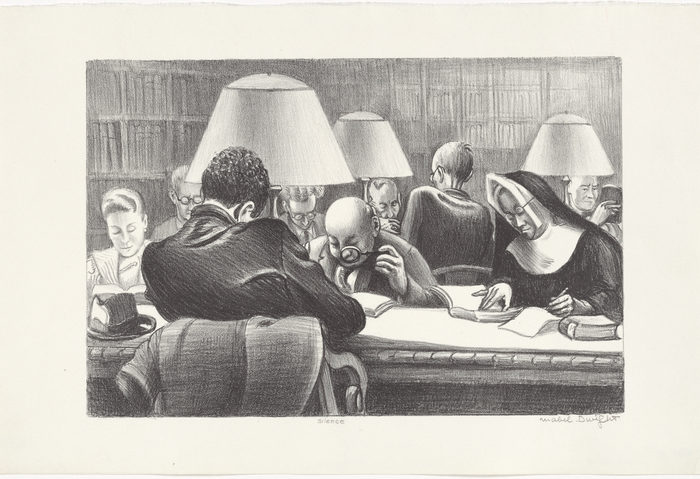
1939 cartoon of caricatures at the NYPL reading room
0

The Space Between Researcher, Object, Institution: Building Collaborative Knowledge with Primary Sources

Abstract

As archival and special collections resources become increasingly available in digital environments, our need to understand these documents in the context of their original material forms remains. As a result, techniques for teaching primary source literacy are a topic of rich discussion in special collections, archives, and library institutions, especially as information professionals consider ways to expand both research and readership. In light of the significant focus on undergraduate populations in many case studies on special collections pedagogy, this article discusses a year-long pilot program titled “The Collaborative Research Seminar on Archives and Special Collections” between the Graduate Center, CUNY, and the New York Public Library. To frame this interdisciplinary graduate seminar, which addressed both the theory and praxis of primary source research, I first discuss pedagogical frameworks, including Jacques Rancière’s critique of explication and Paulo Freire’s “banking model,” alongside Adrienne Rich’s teaching notes from her time at CUNY and Patrick Williams’ work on embodiment and archives. I then explore participant responses that address imagination, experimentation, and identification in the reading room—especially after the methods of Lost & Found: The CUNY Poetics Document Initiative, a key contributor to this program. By enumerating the practices that informed and constituted the Seminar, I suggest that we might consider conversation, experience, and experimentation as fundamental values in special collections pedagogy.

As we envision the digital futures of books, manuscripts, and archives, there is no substitute for historicization: books and manuscripts are technologies too, and foregrounding this perspective allows us to contextualize our work with digital facsimiles, metadata, and resources. This conversation far predates our current moment of digital profusion; in Orality and Literacy (1982), Walter J. Ong compares Plato’s critique of writing to contemporaneous critiques of computation, noting that “once the word is technologized, there is no effective way to criticize what technology has done with it without the aid of the highest technology available.” Ong continues, arguing that this technology is not “merely used to convey the critique” but rather brings “the critique into existence” (78). To corroborate this: when we explore the implications of our material history, our work increasingly, though not exclusively, occurs within or alongside digital context. We write about rare and archival materials in digital spaces, create digital repositories of items, and use digital methods to analyze documents, from transcription services to x-ray spectroscopy. Yet handling, working with, and conceptualizing primary source materials are skills that can be gained through a combination of experience and instruction. Forms of digital access to these items do not circumvent the need for these skills, but only expand their value.

While there are decades of research on the concept of information literacy, the idea of “primary source literacy” is relatively nascent both as a professional term and as a template for specific pedagogical strategies (Carini 2016, 191). Elizabeth Yakel and Deborah Torres’ “AI: Archival Intelligence and User Expertise” (2003) posits an influential three-part standard: domain or subject-focused knowledge, artifactual literacy, and the idea of “archival intelligence,” which consists of understanding archival theory and practices, negotiating strategies to handle the ambiguity of primary sources, and creating meaning from the artifactual or material qualities of a source. In addition, professional organizations for libraries such as the Society of American Archivists (SAA), the Association of College and Research Libraries (ACRL) and ACRL’s Rare Books and Manuscripts Section (RBMS) have formed a “Joint Task Force on Primary Source Literacy” (2015), whose guidelines have been approved as of 2018. These guidelines, which consolidate decades of work among information professionals in these organizations, attest to the growing importance of quantifying and understanding the ways in which we teach within special collections, archives, and libraries.

Today, teaching techniques that animate these guidelines are most visible in case studies or digital toolkits (such as Brooklyn Historical Society’s “Teach Archives” in 2013), designed to illuminate the pedagogy of specific institutions, as well as the Society of American Archivists’ recent publication series, “Case Studies on Teaching with Primary Sources (TWPS)” (2018), which animates the “Guidelines for Primary Source Literacy” by the same organization. These resources are often extensive, such as Using Primary Sources: Hands-On Instructional Exercises (Bahde, Smedberg, and Taormina 2014), a text designed to share both activities and types of learning goals across a range of collections and populations (vii). These techniques and examples often emphasize hands-on, lesson-based learning, as opposed to presentations or “show-and-tells” that exhibit materials but do not provide instruction on how to analyze them or access them in the context of a research visit. As embodied by Past or Portal?: Enhancing Undergraduate Learning through Special Collections and Archives (Mitchell, Seiden, and Taraba 2012), the increasing volume of specific case studies across materials and institutions contributes to the robust conversation on pedagogy in special collections, particularly at the undergraduate level. However, beyond resources such as the Council on Library and Information Resources (CLIR) report, Terra Cognita: Graduate Students in the Archives (2016), which surveys the findings of the CLIR Mellon Fellowships for Dissertation Research in Original Sources, few resources or literature exists for teaching primary source literacy to graduate populations, especially in a multidisciplinary context.[1]

At the graduate level, students often seek basic training that echoes aspects of Yakel and Torres’ (2003) idea of primary source literacy and includes negotiating materials in special collections and archives, navigating catalogs and finding aids that are primarily hosted in digital spaces, and managing information and notes once in the reading room. The types of questions that accompany graduate-level primary source literacy align with Yakel and Torres’ concept of “archival intelligence,” and are enumerated in the CLIR report Terra Cognita (2016): “Navigating Institutions,” “Negotiating Expectations,” “Documenting Processes,” and “Finding What You Need”—all essential aspects of archival research that involve technical knowledge, critical thinking, project management, and interpersonal skills. However, particularly in fields with a strong theoretical component, or in programs that require teaching, graduate students are also often primed for conversations not just on resources or skill development but also on special collections pedagogy itself. Special collections-based classes with graduate students are not just an opportunity to impart skills or information, but to critically examine “the archive” as a theoretical, conceptual, and literal space. As a result of the so-called “archival turn” in literary studies, for instance, sparked in part by Jacques Derrida’s Archive Fever: A Freudian Impression (1995), the idea of the archive, which graduate students often theorize in their work, may have little in common with an institution they visit to conduct research that is staffed by humans (not theories), with unique management and custodial procedures, reflecting a history all its own. In particular, scholars and archivists have different stakes in their definitions of what constitutes an archive or special collection, and how these sites signify critically, conceptually, and literally. By speaking across these disciplinary boundaries, we can more equitably offer credit and share responsibilities for making the material traces of history visible and accessible to those who need them. And given the critical possibilities of this interaction, special collections pedagogy stands to benefit from a model in which knowledge of primary source work is not just transmitted, but actively co-created with a highly proficient and critically engaged population.

To frame key features of critical pedagogy specifically for work in special collections,[2] we might consider the standard “show-and-tell” class visit, in which a librarian or curator imparts information about objects on display, as an example of Paulo Freire’s “banking model” of education from his canonical Pedagogy of the Oppressed (1970). In this model, knowledge is “bestowed” by those in possession of it unto those who do not, and students may only participate in “receiving, filing, and storing the deposits” of knowledge they are granted within the educational context (72). While these “show-and-tells” often have a highly affective component—since generally the most striking or historically important objects are featured, which can feel special or exclusive—they rhetorically foreground a teaching model in which the instructor is the gatekeeper or expert, and students the initiates. This model, based on explication, is the target of Jacques Rancière’s The Ignorant Schoolmaster (1987), in which he argues that a student who “is explained to” is susceptible to submit to a “hierarchical world of intelligence,” in which an explanation can always be obtained or offered as superior to the student’s own intuition and research (8). Rancière suggests that by explicating, instead of fostering the development of communal knowledge and conversation that he terms “universal learning,” we may well reinstate hierarchies of knowledge that certainly apply to the special collections reading room and should be challenged: the trope of the omniscient librarian, or the equally inaccurate librarian who solely pages items without interest or understanding.

If we consider the dynamic of the reading room—the physical space in which archival encounters occur—they are not dissimilar to the hierarchies of access that Rancière (1987) describes within learning: the uneven distribution of knowledge in the room, the presence of obstacles or facilitators that mediate the flow of materials that may yield knowledge, the differing institutional and disciplinary vocabularies on either side of the reference desk. Many of these discrepancies may have practical and professional purpose; for instance, security considerations require material to be distributed according to certain protocols, and standards for metadata and cataloging are often in place to facilitate physical access and storage of materials. In addition, many misperceptions about the figure of librarian or archivist as all-knowing or gatekeeping conceal the fact that staff often work with little resources, within hierarchies of supervision, and in light of their own interests or challenges regarding the material in their care.

However, the presence of these limitations offers us critical possibility, and likewise opportunity to re-examine their usefulness as policies. For instance, Patrick Williams’ (2016) work on critical library pedagogy cites Audre Lorde’s exhortation to examine not just books, but also our interactions with them, and asks what possibilities might unfold if we approach special collections work in this embodied way (111). Continuing in this critical pedagogical vein, we might also consider Rancière’s (1987) idea of intelligence as “the power to make oneself understood through another’s verification,” which includes dialogue, participation, and experimentation (73). Together, these theories suggest that rather than a pedagogical model that views student knowledge, particularly at the graduate level, as deficient and in need of augmentation, teaching models within special collections might collaboratively cover the technical basics expressed by Yakel and Torres (2003)—such as negotiating discovery systems, reading a finding aid, or mastering a research statement in the reference interview—while also allowing students and facilitators to build and develop collective knowledge that addresses both practical and conceptual considerations for primary source work in a digital era. In doing so, we can reframe teaching and outreach as acts of equity and access, expanding the historically narrow range of who feels empowered to conduct primary source work.

In what follows, I will suggest how this teaching model applies specifically to interdisciplinary graduate populations, and will discuss the technical and conceptual underpinnings of a year-long project titled the “Collaborative Research Seminar on Archives and Special Collections,” conducted with staff and support from the Graduate Center, CUNY and the New York Public Library. This project entailed numerous group meetings to discuss institutional partnerships, pedagogy, and student research, and culminated in two two-hour long seminars each semester, each hosting under twenty students, faculty, and staff that had been selected by application. While many aspects of this project used digital platforms—for promotion of the event, for applications, for communicating with participants, for locating relevant materials, and for follow-up communication with participants who elected to write blog posts about the experience—the core of this program was conversational, in-person, and interactive with materials. And after Ong’s (1982) discussion of using the highest technology available to understand those prior, this project uses digital methods—such as this article, as well as student blogs—to make its non-digital elements visible. Not as a preliminary to digital work, but as an essential interlocutor for it, the Seminar focused on cultivating the in-person conversations, relationships, and experiences that prepare participants for confident and critical engagement with primary source materials. Thus, I present this project as a case study, for the specificity the genre offers, but also invested in developing a pedagogical frame that considers two core principles—conversation and experience—that allow us to not only impart primary source literacy skills, but also reconsider the possibilities of what counts as “research” in our embodied encounters with primary sources.[3]

The Seminar

Background

The Collaborative Research Seminar on Archives and Special Collections began as a project in the spring of 2017 to engage graduate students, faculty, and staff in academic and cultural institutions with primary source research methods, and to increase dialogue between the Graduate Center, CUNY, and the New York Public Library.[4] In early 2017, I developed the idea for the Seminar with Alycia Sellie, Assistant Professor and Associate Librarian for Collections at the Graduate Center, CUNY, as well as subject specialist for the English program. Adam Rosenkranz, Gale Burrow, and Lisa Crane (2016) at Claremont University, who document their own “Primary Source Lab Series” begun in 2012, cite this type of collaboration—between subject specialist and librarians—as an effective model for graduate-level primary source teaching. However, like many projects, this one began not with a literature review but with an immediate concern: as a specialist, my daily work consisted of collaborating with a variety of researchers and materials, while my evenings were spent working as a graduate student in the Graduate Center, CUNY’s English Ph.D. program. I wanted to consider a structure to share my experiences as a library specialist with my academic colleagues and also to create a platform for my Library colleagues to share their expertise, ideas, and sentiments about their work. This commitment to representing voices across institutions was comprehensive, and involved a Seminar committee that included the Graduate Center Library’s Alycia Sellie, Roxanne Shirazi, and Polly Thistlethwaite, the New York Public Library’s Jessica Pigza and Thomas Lannon, faculty advisors Ammiel Alcalay (Lost & Found: The CUNY Poetics Document Initiative) and Duncan Faherty (The Early Research Initiative), the Center for the Humanities’ Kendra Sullivan and Sampson Starkweather, and Matthew K. Gold and Lisa Rhody from Graduate Center Digital Initiatives. Together, the committee negotiated pedagogical structure, the application process, and decisions that ultimately contributed to the collaborative nature of the program.[5] The Seminar was designed for the needs of an interdisciplinary and varied applicant pool, with the perspectives of numerous committee members, facilitators, and participants whose work addresses academia, radical archives, publishing, and special collections librarianship. As Marcus C. Robyns (2001) indicates, teaching primary sources beyond discipline-specific skills and knowledge allows us to envision “the archives [as] not only a repository of the past but also a challenging center of critical inquiry” with multiple interlocutors and facets, and the Collaborative Research Seminar sought to create an experience that spoke to this concept (365).

A key part of the Seminar’s pedagogy took up the primary source principles of Lost & Found: The CUNY Poetics Document Initiative, begun in 2010. This publishing initiative, under the editorship of Ammiel Alcalay and consulting editorship of Kate Tarlow Morgan, in conjunction with staff from the Center for the Humanities, connects doctoral students and guest editors with projects that explore the archives of under-published and underrepresented authors of the twentieth century, as well as lesser or unknown aspects of well-known authors. The results are published annually and draw on a variety of authors from Langston Hughes to William S. Burroughs, Kenneth Koch to Toni Cade Bambara, Diane di Prima to Ed Dorn. As editor Megan Paslawski (2013) notes, the principle of Lost & Found is to “follow the person,” an ethos that Alcalay and the editors take literally—as in, visiting poets or the unexpected institutional and personal places their works lead—and also archivally. Instead of privileging scholarly conversations and secondary knowledge that categorizes materials, Lost & Found editors are encouraged to listen closely to the documents, engaging what their primary materiality might mean (8). Given Rancière’s (1987) Jacotot, whose teaching method rests on distributing literature and then engaging with it closely, carefully, and extensively without explication, Lost & Found’s exhortation to “follow the person” models a mode of both pedagogy and academic research centered on fidelity, community, connection. As Paslawski (2013) notes, this method “allow[s] more than words to be found” in its requirement that we examine what is there, listen to it on its own terms, and forsake traditional narratives about materials for the paths they indicate (9). This method encourages a different practice of engaging with archival materials, by fostering personal relationships with heirs and literary estates, former colleagues, and other archivists, editors, and scholars to generate new insights and interest in the subject. In particular, this entails “rescuing” literary figures from the way they have been historicized (or forgotten), in order to understand the person who actually was, and restoring the live-wire network of authors and collaborators instead of siloing authors by style or literary movement. While Lost & Found focuses on twentieth-century poetry that might broadly be considered as part of the New American poetry milieu (even as it challenges the value of such a categorization), its methods are applicable to a variety of primary sources—many of which we examined in the Collaborative Research Seminar itself.

As an essential teaching resource, Lost & Found has published archival materials on pedagogy that were generated by poets who taught at City University of New York, including Adrienne Rich, June Jordan, and Toni Cade Bambara. These poets were hired as instructors by Mina Shaughnessy, the Director of the CUNY SEEK Program (Search for Education, Elevation, and Knowledge) in the late 1960s. This program, which came to City College in 1965 as a pre-baccalaureate program, sought to provide additional instruction and educational support to students from a more diverse range of communities, and to increase the percentage of African-American and Puerto Rican students at City College (Rich et al. 2013, 1). In a chapbook of her archival materials from this era, Lost & Found editors include quotations by Adrienne Rich of Paulo Freire, among numerous other critical pedagogy voices, as she writes her own powerful methods of teaching. In her “Notes, Statements & Memos on SEEK, Basic Writing & the Interdisciplinary Program (1962-1972),” Adrienne Rich writes of her class English 1.8:

The problem for the teacher is to make the term’s work supportive and relevant for each and every student: to help dislocate ‘blocks,’ to open possibilities of expression, to help each student as much as possible to become the kind of writer he is meant to be. It is not simply to turn out 15 people who can pass the English proficiency examination, although we hope that that will inevitably result. (Rich et al 2013, 18-19)

While Rich’s subject is writing, this type of pedagogy is widely applicable. Rancière (1987) expresses similar sentiments—“the problem is to reveal an intelligence to itself”—but Rich’s model is distinctly expressive and supportive, beyond a baseline of fostering student self-motivation and independence (28). As with the Seminar, we might think beyond activities designed to produce proficiencies (like Rich, while acknowledging that these are essential), but look ahead to the outcome of fostering the unique type of primary source researcher our students want to and need to be. As with Rich’s pedagogy, this type of mentorship is an act of equity in its potential to expand who believes themself to be a writer, or an archival researcher—and thus, a custodian and author of our material history.

Implementation

As with any conversation on pedagogy, theoretical robustness depends on good implementation: this starts with understanding both learning goals and student needs. To learn more about self-reported student needs and interests, as well as manage enrollment numbers, the Seminar began its pilot year with an application process. Both the Graduate Center, CUNY, and the New York Public Library are considering how to contribute the resources necessary to continue, given that 117 students, faculty, and staff from primarily the Graduate Center, CUNY applied over the course of the pilot year in two application cycles. The volume of applicants attests to the need for this type of programming, and while the demand for the Seminar far exceeded our instructional capacity at the time, I connected with all applicants to provide additional resources and support for their work.[6] Expressing interest across a wide swath of disciplines, skill levels, and even academic status, the application results of the Collaborative Research Seminar foregrounded the need for pedagogy with an interdisciplinary audience in mind. Given that most case studies for special collections pedagogy focus on class-specific visits that have a set subject or topic, the Collaborative Research Seminar explores a teaching model that challenges us to give voice to interdisciplinary archival experiences.

The first iteration of the Seminar in Spring 2017 was hosted jointly at the Graduate Center Library and the Brooke Russell Astor Reading Room of the New York Public Library, with a cohort of 12 participants selected from 58 applicants. The second iteration involved 19 participants from 59 applicants, as an experiment to determine scalability of the pedagogical model. Most of the participants were graduate students, with one or two faculty members at each Seminar; the committee decided to prioritize graduate student applications and work towards a different model to specifically address the different needs of faculty. All participants from both sessions were given the opportunity to publish a blog, funded by the Center for the Humanities, about their experience and the items they examined at the New York Public Library, and to join the working group Primary Source, also through the Center for the Humanities. Given also the inability of the program’s structure to accommodate all applicants due to staffing and resources—a conflict at odds with the very mission of the program to increase access to special collections work—much remains to be seen as to the possibilities of this model.[7]

Each Seminar consisted of two sessions—held for two hours in the evening, two weeks apart. The first session was hosted by the Graduate Center Library and oriented participants towards specific questions and concerns in archival work. The second session was hosted in the Brooke Russell Astor Reading Room at the New York Public Library, and consisted of hands-on experiences with collection holdings. I worked with staff from the New York Public Library to curate objects from the second session in response to conversations and feedback from the first session, either around an area of research interest or a theme in archival work. Each session concluded with a short exit survey that participants completed on paper, containing basic response questions, including hopes for future sessions or information that was helpful or still being digested. To accommodate the variety of skill levels in the Seminar, participants also received a sheet on how to handle special collections material, as well as a hand-out on other Graduate Center and New York Public Library collections and resources available to them as their research progresses.

In the Spring Seminar, with a cohort of 12 students, Alycia Sellie and I led the initial session of the first Seminar with an open-ended discussion on archival work. Topics discussed included challenges with finding relevant resources, negotiating expectations in reading rooms, and collaborating with archival staff. The session concluded with small group work browsing NYPL’s Archives Portal and digital catalog to find items of interest for the second session. Participants wrote suggestions for second session on notecards and submitted them before leaving. After a debriefing meeting that included feedback from the Seminar committee, I worked with Thomas Lannon and Jessica Pigza to lead the second session. Using New York Public Library collection materials from multiple curatorial units, we conceived of research tables as “stations” that addressed specific fields of knowledge or types of archival materials—including institutional records, books and annotation, serial publications, family papers, lightly processed archival boxes, and others. Items were arranged by their designated theme on a table, where participants were invited to rotate either solo or with colleagues to examine the materials. After rotating through stations, participants reconvened for a large group discussion about materials they encountered. The session ended with completion of feedback forms, and an invitation for participants to stay involved by writing a blog post or joining the working group for Primary Source at the Center for the Humanities.

The Fall Seminar operated on a similar principle, although with a slightly larger cohort of 19 participants. In advance of the first session, the Collaborative Research Seminar committee distributed a list of readings to participants to assist in framing their Seminar experience, including introductions to the field of archives as well as accounts of specific experiences with primary source work (Appendix A). To accommodate a larger cohort of students, the first session drew on the rotating station model of the second session of the first Seminar. Staffed by Meredith Mann (NYPL), Tal Nadan (NYPL), Alycia Sellie (GC CUNY), Roxanne Shirazi (GC CUNY), Thomas Lannon (NYPL), and myself, the rotating stations covered four main themes. These themes, collaboratively developed and inspired by Roxanne Shirazi’s sharing of the CLIR report Terra Cognita (2016), included “Navigating Institutions,” “Negotiating Expectations,” “Documenting Processes,” and “Finding What You Need.” Participants rotated through the first three stations for short amounts of time, and then remained as a whole group in the final station—an exploration of archival vocabulary, New York Public Library discovery tools, and a working session where the group populated a shared Google Doc with items of interest as a way to experiment with collections discovery. The relatively high ratio of facilitators to participants allowed for a variety of pedagogical approaches within each station—from small activities to open discussion—as well as offered participants an opportunity to meet and connect with librarians at the Graduate Center and the New York Public Library.

The second session of the Fall Seminar followed the model of the Seminar’s first iteration, featuring a series of curated stations designed around groups of documents from the New York Public Library’s curatorial units of the Stephen A. Schwarzman Building. After rotating through a few stations, either collaboratively or solo, participants convened for a larger follow-up discussion. The session ended with completion of feedback forms, and an invitation for participants to stay involved by writing a blog post or joining Primary Source at the Center for the Humanities.

For both of the second sessions of the Seminar, material selection was an especially important component. We sought to not only choose generative items that spoke to multiple research possibilities, but to create a pedagogical framework in which participants could encounter these items with as little predetermination as possible. Given the interdisciplinary nature and varied skill levels of the participants, the principle of “listening closely” to documents on their own terms was key to the success of the hands-on portion of the Seminar. This was accomplished in part by mitigating expectations: in the application phase of the program, we asked participants to submit research interests, but reinforced that the Seminar was not a reference consultation and they were likely to encounter materials that did not speak to their current research topics. This openness was also facilitated by the manner in which participants were invited to encounter the materials themselves in the second session—by roaming from table to table, alone or among colleagues, for suggested ten-minute intervals.

Curated stations in the reading room had minimal didactics, generally only including a small slip that indicated whether or not items could be photographed for online distribution (as on social media networks, such as Twitter). For some archival materials, we would supply the finding aid or the catalog record as an additional object on the table in its own right, to facilitate the iterative practice of negotiating the physical object alongside its metadata. Participants were encouraged to learn about the materials in this exploratory manner by speaking with the session’s facilitators and their colleagues, as well as being attentive to the nature of the encounter itself, beyond how the item might apply to their specific research. We ended the second session with a framing discussion, that allowed us as a group to consider the possibilities and limitations of such an interdisciplinary openness to materials, and what types of encounters encourage increased comfort and skill with primary source work.

Specific examples of collection items from the first Seminar included Isaac Newton’s assistant’s edits on the Principia (1687), Wallace Berman’s innovative literary mail-magazine Semina, Sylvia Plath’s annotations of The Four Quartets, a copy of William Makepeace Thackeray’s Vanity Fair as a book-in-parts, Patti Smith’s notebooks juxtaposed alongside nineteenth-century commonplace books, a single box from the Timothy Leary Papers, Noah Webster’s correspondence with his daughters, among many others. These items, which range from rare books to periodicals, archival material to unique manuscript items, offered participants a variety of archival encounters to experience and discuss. Likewise, in the second session, selections included Muriel Rukeyser’s reading notes on Willard Gibbs, a collection of archival research done by Rukeyser; the mimeographed biweekly magazine, The Floating Bear, edited by Diane di Prima and LeRoi Jones; the San Quentin execution register; photographs by Jessie Tarbox Beals of the Health School at P.S. 40 in New York City in 1918, from the People’s Institute records; affidavits and inspector’s reports from Brooklyn and East Harlem from the Committee of Fifteen records; as well as documents relating to early printing in Peru, 1584-1628. Each of these stations presented a range of materials that, whether or not they directly addressed participants’ research field, afforded increased experience with the first steps of meaning-making with primary sources—to look closely, and listen to the documents.

This type of close attention was modeled in multiple ways across a single collection. The New Yorker records station, curated by Tal Nadan and Meredith Mann, contained a typescript of Rachel Carson’s Silent Spring and letters to the editor in response, a print copy of The New Yorker from the Library’s general research division, and a computer opened to the New Yorker Digital Archive database. Here, we encouraged participants to think of the different digital and paper materialities of these items and how they might serve varying forms of research. For instance, sometimes a searchable database of digitized items is far more expedient than searching individual items, depending on the research question. Through printouts of the digital catalog records and discussion of digital resources, we sought to underscore how different materialities address different research needs.

With material selections for special collections teaching, it is difficult to avoid the act of curation, which is traditionally associated with the “show-and-tell” format. Expertise and knowledge of collections is a valuable pedagogical resource, to frame disciplinary and methodological approaches to materials widely, as well as suggest the sheer variety of encounters that can occur in special collections. While the very act of creating stations constituted curation in the Seminar’s pedagogical model, the approach to material selection in conversation—noting its arbitrariness, its relationship to a librarian’s personal interest, and its value as an example of a type of record group—opened the idea of selection for questioning. In this way, by understanding that one must start somewhere for hands-on primary source work but that this act nevertheless predetermines the experience, the pedagogy of the Seminar used discussion to reframe and question the authority of material selection.

The final aspect of each iteration of the Seminar was post-assessment, a practice that is encouraged by Anne Bahde and Heather Smedberg (2012), who advocate for “measuring the magic” as an essential component to facilitate primary source literacy and build on Esther Grassian and Joan Kaplowitz’s (2009) instructional literacy assessments of reaction, learning, and performance assessments. These translate to three rhythmic questions: “did they like it?” “did they get it?” and “can they do it?” (156). To address this, the Seminar used a questionnaire assessment, which entailed completion of a paper exit survey after each session. For the initial session, questions focused on clarifying learning objectives and understanding how participants felt about the experience, and for the second session, the questions focused on the entire Seminar structure more broadly.

In terms of “did they like it”: all participants said they would recommend the program to a colleague, and when the second Seminar cohort was asked if their likelihood of using New York Public Library materials increased as a result of the Seminar, all answered affirmatively. The question of whether participants “got it” creatively appears in the resulting blog posts published through the Center for the Humanities, which I will address shortly. As for “can they do it”: the nature of graduate research is long and winding, with results diffused across publications, papers, and dissertations. Thus, while assessment is a key consideration, given the complexity of the materials and subjects we teach, metrics for assessment in graduate populations may ultimately constitute very long-term and qualitative information. In the case of the Seminar, while we have provisional information as to its reception and success, it may be too early to understand the impact on its participants and facilitators. What does offer extensive insight, however, are participant-generated blog posts that reflect on the experience.

Conversation and Archival Encounter

While the success of these Seminars in terms of quality of conversation, depth of thought, and general demand and interest is due to a special alchemy of enthusiastic instructors, participants, and diverse expertise, I observed two fundamental pedagogical features within the structure of the Collaborative Research Seminar. These two features—conversation, and what I will term the “archival encounter”—challenge the general protocols of the reading room in ways that are productive for both participants and instructors. In doing so, they offer an opportunity to rethink what is in fact occurring when we teach with special collections or work with primary source materials.

“The archive” is often an archetype of rules, silence, and prowess—quiet rooms with careful pencils, researchers with well-formulated questions, librarians as gatekeepers to the treasures. Even with proper training on and permission to handle rare items, students may, as Patrick Williams (2018) notes, appear “almost scared to move” (118). We might consider this timidity as a result of the aura of the materials themselves, as Williams discusses, and also the imposing aura of the institution—including reading room, policies, and atmosphere. These archetypes (and indeed, stereotypes) obscure many of the realities of reading rooms, from the intellectual labor of staff to institutional hierarchies and pressures, and deserve to be thoroughly questioned (if not outright debunked). Thus, to encourage conversation around methods, to invite participants to encounter materials without research questions, context, or any hope of being an instant expert, is to de-center the authority of the reading room and reference model of special collections. This act not only demystifies, but also reimagines what parts of the archival encounter might be considered research: emotion alongside analysis, touch alongside historical knowing.

In their assessment of an undergraduate-based special collections program, Melissa Hubbard and Megan Lotts (2013) reiterate the importance of responsiveness and experience in their program’s success, encouraging students to relate materials to their “own thoughts and feelings” as a way to “view themselves not only as consumers of information, but also as interpreters and creators” (32). Hubbard and Lotts describe a relatively familiar process to those who have worked in special collections: the realization that authority and answers are not to be uncovered and “consum[ed],” but rather forged. Like the methods of Rancière’s Jacotot, the experience of encountering primary sources—especially during a class visit, in the context of a seminar, or in early stages of research—defies simple explication or understanding and instead asks for more of the researcher: thinking, feeling, creating context. As Patrick Williams (2016) notes, the general focus on explication, or the “supplying [of] answers” in response to materials, is often transformed when the reading room becomes a classroom space, “relieved by the overwhelming impulse to notice the odd or unexpected attributes of the materials with which we share space” (118). Williams’ word, “relieved,” is critical to the affective experience of this type of encounter—when we examine items that are not part of our fieldwork, that float without context for that initial moment of encounter, the experience of archival work is suddenly not about context or answers, but about immediacy. The moment of the encounter becomes a close orbit between the object and the ability to make sense of its form, our feeling.

This intensity of encounter often leads to imagination and identification as powerful forms of archival knowing, such as those described by Iris Cushing (2017), a participant in the first Seminar who returned to the Berg Collection to work on The Floating Bear, a rapidly and frequently published mimeograph newsletter edited by Diane di Prima and Amiri Baraka from 1961 to 1971. As part of her investigation, Cushing considers the question of context by examining the variety of authors represented in The Floating Bear, noting how the material document collapses the temporal distance between her and her subject, as well as creates a force-field of focus unto itself. Writing about these poets, she notes:

Those people are very close (their work is in my hands) and yet very far away (as it was made over half a century ago). In the Bear the names of the authors are placed after their work, so if I didn’t recognize the poem, I wouldn’t know who wrote it unless I turned a few pages. There’s no table of contents. The poem is the total focus of attention. I begin to read, my eyes wandering over the plain, uncluttered space of the page. (Cushing 2017)

While Cushing’s observations are specific to The Floating Bear’s decisions in layout and publishing, her statement that “the poem is the total focus of attention,” in the absence of paratextual information such as a table of contents, author biographies, or even secondary research in the moment of the encounter, might be a metaphor for the type of archival encounter that occurred in the Collaborative Research Seminar more generally. Cushing follows the imperative of the poem as “total focus of attention” as she states, “I begin to read,” offering a succinct methodology for archival work: find the focus in the material itself and encounter it on its own terms. Doing so, as she finds, leads to imaginative possibilities, generated by this specific materiality:

Sliding the very first issue of the Bear out of its white envelope, I found myself holding a stapled packet of 8 ½ x 11” pages, creased long ago from being folded in half for mailing. There was a purple 3-cent stamp in the top right corner, and a typed mailing label above the masthead, bearing the address of the poet John Wieners. Instantly I envisioned the young poet on a day 56 years ago, checking his mail, loosening the staple holding the newsletter closed (a staple now rusty with age) and sitting down to read it. (Cushing 2017)

Here, Cushing demonstrates not only the act of physically investigating the material for signs of its context—the fold in the paper, the stamp, the address—but also a key recipient, the poet John Wieners, wiggling the staple that holds the mimeographed pages closed. This act of imagination requires context—such as knowledge of Wieners’ status as a poet in the New American milieu, as well as the importance of The Floating Bear for creating poetic community when poets were far-flung, often broke, and hungry for each others’ work. However, as Cushing narrates, the act of sitting in a special collections reading room, imagining the addressee at a kitchen table, attests to the particular magic of primary source work—like crystals, these objects may hold energy of eras prior, memories, and experiences that we might tap into through imagination and experience. This collapse of boundaries is critical in the archival encounter, and the implementation of stations in the Collaborative Research Seminar intends to create space for these moments.

Writing on Valerie Solanas’s annotated SCUM Manifesto held in the Manuscripts Division, Collaborative Research Seminar participant Cory Tamler (2017) notes that

During the Collaborative Research Seminar we tried to think beyond the limitations of the practical and to imagine what might be possible within archives. I got fired up by instances of time leaving marks in an archive, on an object; an object’s temporal layers. What drew me to the annotated SCUM Manifesto is the way it contains two characters who are the same person. It’s a record of a conversation between the author and herself, but it’s a performative conversation, enacted for an audience (but what audience?) that was already historicizing her through public characterizations of her sexuality and mental health. It resists the freezing action of historicization, existing within time dynamically.

Together, conversation and “the encounter” in the Collaborative Research Seminar might echo Rancière’s (1987) idea of the material book as a site for “verification” based on its material qualities: “the materiality of each word, the curve of each sign” (15). When enmeshed as a pedagogical strategy, conversation and experience focus the instructors or facilitators not on verification of the student’s “knowledge, but the attention he gives to what he is doing and saying” (32). The second session is particularly instrumental for this process, since materials are presented as stations that participants can engage at will. Instructors may choose to circulate and linger around their favorite stations, sharing conversation with participants, or might abstain from revealing contextual details. The focus is not on transmitting knowledge, but on framing our experiences in terms of the material conditions that inspire them.

Conclusion

At its core, the move to create practical resources and theoretical constructs around the particulars of special collections pedagogy rests on a political and ethical imperative. The movement to reconsider radical, inclusive pedagogy and decenter the economic and cultural hierarchies that restrict access to education reminds us of important precedent for destabilizing the idea of who certain institutions are meant to serve. Libraries, from the nineteenth century onward, have served as symbols of democracy (even though they may be more accurately seen as testaments to benevolent capitalism)—the New York Public Library’s latest slogan is “Libraries are for Everyone,” and now, “Knowledge is Power.” At the same time, a public institution like the New York Public Library also contains reading rooms for rare books and archives, whose use is governed under significantly different conditions than the rest of the Library. While these practices are ultimately important for the safe preservation of materials, they nevertheless create mystique, and in some cases intimidation, for those who are not used to the rhythms of special collections—students who have not been told or taught that the materials of primary sources are theirs to examine, analyze, and place within history.

For instance, Cecilia Caballero’s (2017) “Mothering While Brown in White Spaces, Or, When I Took My Son to Octavia Butler’s Exhibit,” raised extensive conversation around institutional knowledge as a fundamental gatekeeping concern in primary source literacy, and in particular the political stakes of such uneven distribution of this knowledge. Caballero notes that while she applied to a fellowship to gain access to the Octavia Butler material at the Huntington Library, she took her unsuccessful application as an indication that she was not able to access the archive as a researcher and had to instead attend an exhibition of Butler’s work to examine it in person. While the Huntington Library, as well as many other major collections, permit researchers with a reference application alone, the fact that this only transparent to those already “in-the-know” poses a challenge to truly diversifying the researchers and research that occurs in special collections. Thus, to reconsider the role of special collections pedagogy as a fundamental act of access, and an act of making reading rooms more diverse and equitable, we must think critically about ways we might teach primary source research skills, including how to make meaning around objects, the institutions that hold them, and the community of people they engage.

As special collections continue to invest in digitization—whether that means making catalog records or finding aids available online, digitizing images of collection materials with accompanying metadata, or sharing born-digital materials in reading rooms and through online reference correspondence—we must consider how these materials are currently being used and also how they might possibly be used in the future. In determining the future of digitally-inflected archives and special collections, there is no substitute for conversations with the research populations we hope to serve and expand. To that end, the Seminar demonstrates through its teaching model, through student blogs, and through this very article, that the fundamental piece of context for primary materials is not necessarily secondary sources, nor is it an understanding of the differences between digital and analog archival objects. Rather, by understanding our embodied selves, we might collectively acknowledge the depth of knowledge that primary source practices afford.

It is my hope that the Collaborative Research Seminar might serve as an extensible and adaptable format for creating community and conversation between libraries and graduate institutions, as well as a model for an interactive approach to special collections pedagogy. While this collaborative model is an investment, for both institutions as participants, and requires extensive administrative support, as well as time spent teaching, coordinating student blogs, and following up with individual reference support, it nevertheless affords a starting point for thinking through specific practices of special collections pedagogy with graduate populations. In particular, it suggests that special collections pedagogy for graduate students is well-served by taking full advantage of methods that foreground conversation and experience, so that we might use interdisciplinary and multi-level classrooms as an occasion to listen closely to our primary sources and the ways they challenge institutional and disciplinary categories. In doing so, we will expand the possibilities of primary source work for our next generation of researchers, and welcome their fresh insights to conversations in higher education and cultural institutions alike.

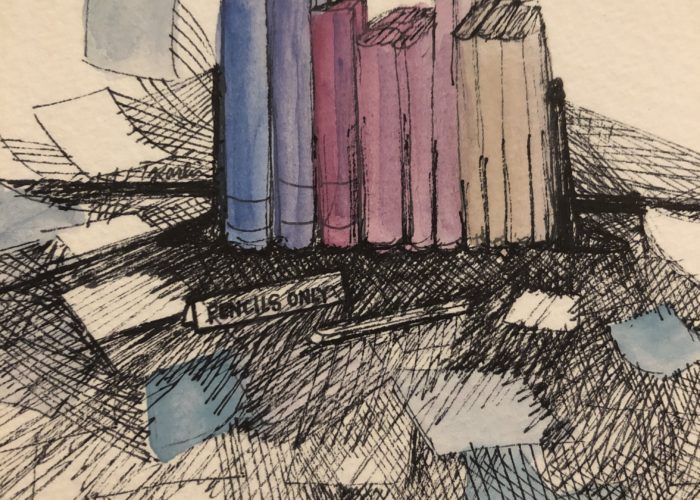
Notes

[1] While this may be in part a result of changing disciplinary training, or lack of institutional resources on both sides, it may also be in part because of the high expectations of professionalization in graduate programs today—that graduate students should already have these abilities, even though the literature on undergraduate primary source literacy strongly indicates that these skills are not taught at that level evenly or consistently.

[2] While special collections, archives, libraries, and even museums all constitute different repositories for artifacts and records that we might consider primary sources, I refer specifically to library contexts in this article, and use the term “special collections” as the most capacious and broadly-applicable term, since they often contain a mixture of rare books, literary manuscripts, and archives as part of research collections curated and designated for primary source work.

[3] During this article, at times I may foreground the first person “I” to indicate aspects of my professional and personal experience that shaped this program as well as my critical response to it, including my status as a doctoral candidate at the Graduate Center, City University of New York (CUNY), during planning; as a literary manuscripts specialist at the New York Public Library’s Henry W. and Albert A. Berg Collection of English and American Literature; and as an editor of Lost & Found: The CUNY Poetics Document Initiative, a publishing collective for primary source materials. It is my hope that this specificity will make clear the veritable alchemy that constitutes primary source pedagogy, as well as encourage others to reflect on their unique capacity to create similar projects with their own strengths and intentions.

[4] While the special collections of the New York Public Library have a longstanding relationship with CUNY students, and for decades have partnered with professors and staff to facilitate class visits, no formal structure exists to consistently and annually link the Graduate Center, CUNY, and the New York Public Library on the specific topic of primary source literacy and practices. Given the size and scope of both of these institutions, as well as the variety of student and instructor needs from special collections class visits, this is of course understandable. At the same time, the Seminar’s collaborative design, with two sessions that span the Graduate Center Library and the manuscript and print-based special collections of the Stephen A. Schwarzman Building, fills a gap in graduate and professional-level instruction on primary source research methods across these institutions, and considers how a sustainable model of engagement might look in future iterations.

[5] Additional teaching was provided by Tal Nadan, Meredith Mann, and Emilie Yardley-Hodges from the New York Public Library.

[6] This additional support took the form of a digital resource with a list of New York Public Library and Graduate Center resources, individual reference consultations via email or in person, and an invitation to join an open-ended working group titled “Primary Source,” with the Center for the Humanities.

[7] This Seminar is not a sole effort within the New York Public Library or the Graduate Center Library to consider special collections pedagogy; numerous staff are engaged with this question, across divisions and disciplines, at any given time. Rather, I intend to examine the practical and theoretical considerations of this particular event while making visible as much as possible the labor contributed by staff members from both institutions.

Bibliography

American Library Association (ALA). 2000. “Information Literacy Competency Standards for Higher Education.” American Library Association. Accessed June 8 2018. http://www.ala.org/Template.cfm?Section=Home&template=/ContentManagement/ContentDisplay.cfm&ContentID=26962

Badhe, Anne and Heather Smedberg. 2012. “Measuring the Magic: Assessment in the Special Collections and Archives Classroom.” RBM: A Journal of Rare Books, Manuscripts, and Cultural Heritage 13 (2): 152–174.

Bahde, Anne, Heather Smedberg, and Mattie Taormina. 2014. Using Primary Sources: Hands-On Instructional Exercises. Santa Barbara, California: Libraries Unlimited.

Brooklyn Historical Society. 2013. TeachArchives.org. Julie Golia and Robin M. Katz, Co-Directors. Accessed June 8 2018. http://www.teacharchives.org/

Caballero, Cecilia. 2017. “Mothering While Brown in White Spaces, Or, When I took My Son to Octavia Butler’s Exhibit,” Chicana M(other)work. Accessed June 9 2018. https://www.chicanamotherwork.com/single-post/2017/08/23/Mothering-While-Brown-in-White-Spaces-Or-When-I-Took-My-Son-to-Octavia-Butler%E2%80%99s-Exhibit

Carini, Peter. 2016. “Information Literacy for Archives and Special Collections: Defining Outcomes.” portal: Libraries and the Academy 16 (1): 191–206. https://doi.org/10.1353/pla.2016.0006

Council on Library and Information Resources (CLIR). 2016. “Terra Cognita: Graduate Students in the Archives, A Retrospective on the CLIR Mellon Fellowships for Dissertation Research in Original Sources.” CLIR Publication No. 170 (Washington, DC: Council on Library and Information Resources). https://www.clir.org/pubs/reports/pub170

Cushing, Iris. 2017. “A Labor of Freedom: Reading the Floating Bear at the Berg Collection.” The Graduate Center, CUNY: Center for the Humanities. https://www.centerforthehumanities.org/blog/a-labor-of-freedom-reading-the-floating-bear-at-the-berg-collection

Derrida, Jacques, and Eric Prenowitz. 1996. Archive fever: a Freudian impression. Chicago: University of Chicago Press.

Ferraiolo, Nicole et al. 2016. Terra Cognita: Graduate Students in the Archives, A Retrospective on the CLIR Mellon Fellowships for Dissertation Research in Original Sources. Council on Library and Information Resources. Accessed June 8 2018. https://www.clir.org/pubs/reports/pub170/

Freire, Paulo. 1970. Pedagogy of the Oppressed. Translated by Myra Bergman Ramos. New York, London: Continuum Press. Published 2005.

Grassian, Esther S. and Joan R. Kaplowitz. 2009. Information Literacy Instruction: Theory and Practice. New York, NY: Neal-Schuman Publishers.

Hubbard, Melissa and Megan Lotts. 2013. “Special Collections, Primary Resources, and Information Literacy Pedagogy.” Communications in Information Literacy 7 (1): 24–38.

Mitchell, Eleanor, Peggy Seiden, and Suzy Taraba. 2012. Past or Portal?: Enhancing Undergraduate Learning through Special Collections and Archives. Chicago: Association of College and Research Libraries, a division of the American Library Association.

Ong, Walter J. 1982. Orality and Literacy: Technologizing the Word. London and New York: Routledge, Taylor and Francis Group. Reprinted 2002.

Paslawski, Megan. 2013. “Publishing’s Restorative Properties.” American Book Review 34 (3): 8–9.

Rancière, Jacques. 1987. The Ignorant Schoolmaster: Five Lessons for Intellectual Emancipation. Translated by Kristin Ross. Stanford: Stanford University Press. Published 2001.

Rich, Adrienne, Iemanjá Brown, Stefania Heim, Erica Kaufman, Kristin Moriah, Conor Tomás Reed, et al. 2013. “What we are part of”: Teaching at CUNY: 1968-1974, Adrienne Rich. New York: Center for the Humanities, the Graduate Center, City University of New York. Lost & Found: The CUNY Poetics Document Initiative.

Robyns, Marcus C. 2001. “The Archivist as Educator: Integrating Critical Thinking Skills into Historical Research Methods Instruction.” In The American Archivist, 363–384.

Rosenkranz, Adam, Gale Burrow, and Lisa Crane. 2016. “Developing a Primary Source Lab Series: A Collaboration Between Special Collections and Subject Collections Librarians.” In Collaborating for Impact: Special Collections and Liaison Librarian Partnerships, edited by Kristen Totleben and Lori Birrell. 163–86. Chicago: ACRL/ALA.

Society of American Archivists (SAA). 2018. Case Studies on Teaching With Primary Sources. Bill Landis, Series Editor. https://www2.archivists.org/publications/epubs/Case-Studies-Teaching-With-Primary-Sources

“SAA-ACRL/RBMS Joint Task Force on Primary Source Literacy.” 2015. Society of American Archivists. Accessed June 8 2018. https://www2.archivists.org/groups/saa-acrlrbms-joint-task-force-on-primary-source-literacy

Tamler, Cory. 2017. “Annotating and Becoming: Valerie Solanas on Valerie Solanas.” The Graduate Center, CUNY: Center for the Humanities. https://www.centerforthehumanities.org/blog/annotating-and-becoming-valerie-solanas-on-valerie-solanas

Yakel, Elizabeth and Deborah Torres. 2003. “AI: Archival Intelligence and User Expertise.” The American Archivist 66 (1): 51–78. https://doi.org/10.17723/aarc.66.1.q022h85pn51n5800

Williams, Patrick. 2016. “What Is Possible Setting the Stage for Co-Exploration in Archives and Special Collections.” In Critical Library Pedagogy Handbook Volume 1, edited by Kelly McElroy and Nicole Pagowsky, 111–120. American Library Association.

———. 2018. “& lo yr letter hit me hard: Live(s) and Work(s) in Special Collections and Archives.” In Poet-Librarians in the Library of Babel: Innovative Meditations on Librarianship, edited by Sommer Browning and Shannon Tharp, 115–134. Library Juice Press. http://dx.doi.org/10.17613/M6PN8XD8B

APPENDIX A: Advance reading list for Fall 2017 first session of Collaborative Research Seminar.

Caballero, Cecilia. August 23, 2017. “Mothering While Brown in White Spaces, Or, When I took My Son to Octavia Butler’s Exhibit,” Chicana M(other)work (blog). https://www.chicanamotherwork.com/single-post/2017/08/23/Mothering-While-Brown-in-White-Spaces-Or-When-I-Took-My-Son-to-Octavia-Butler%E2%80%99s-ExhibitCouncil on Library and Information Resources. 2016. “Terra Cognita: Graduate Students in the Archives, A Retrospective on the CLIR Mellon Fellowships for Dissertation Research in Original Sources.” CLIR Publication No. 170 (Washington, DC: Council on Library and Information Resources). https://www.clir.org/pubs/reports/pub170

Hardesty, Michele. October 2016. “Digital Tools for Archival Research.” Archive Journal. http://www.archivejournal.net/notes/digital-tools-for-archival-research/

Manoff, Marlene. 2004. “Theories of the Archive from Across the Disciplines.” Portal: Libraries and the Academy 4: 9-25. http://hdl.handle.net/1721.1/35687

Rusert, Britt. 2015. “Disappointment in the Archives of Black Freedom.” Social Text 33:4: 19-33. https://doi.org/10.1215/01642472-3315874

About the Author

Mary Catherine Kinniburgh is a doctoral student in the English Program. Her research focuses on book history and the digital humanities, with particular interest in embodied readership, materiality, and critical posthumanism. She is currently working on a maker project titled “Digital Alchemy,” funded by a Provost’s Grant for Digital Innovation, as well as archival research on the contemporary poet Diane di Prima as part of Lost and Found: The CUNY Poetics Document Initiative. Prior to The Graduate Center, CUNY, Mary Catherine served as a Digital Fellow at Columbia University Libraries in the Digital Social Sciences Center during the completion of her M.A. in the Department of English and Comparative Literature. There, she completed a geospatial and networked map of place names in the medieval Icelandic outlaw sagas, and taught workshops on TEI for library applications. She is a former contributor to Archipedia at the University of Virginia, where she received her B.A. as a Jefferson Scholar.

""
0

Realizing the Past: Charting a Course for Sustainable Instruction and Engagement with Archival Materials Using Augmented and Virtual Reality Technologies

Abstract

The role of libraries in education is evolving and we must reframe how our users engage with collections. Library services are expanding beyond simple circulation and access to include specialized resources. Librarians and archivists fulfill roles in instructional programming and provide campus support for data visualization, multimedia production, and knowledge preservation. Because preservation and access fill equally important roles in archival settings, collections use in library instructional activities presents a unique set of challenges. Creating new environments for our users to interact with archival collections opens the possibility to reach new audiences. How might we best engage students and community members with archival collections?

The authors explore the potential for using Augmented Reality (AR) and Virtual Reality (VR) technologies with archival materials to enhance opportunities for instruction and outreach activities at a STEM-based institution. AR, VR, and archival resources support pedagogical models including constructivist learning, inquiry-based learning and game-based education. Through an analysis of the current landscape of technological requirements and educational institutions using AR/VR in conjunction with special collections, this article discusses how simulated environments can democratize archival instruction and outreach. Authors reflect on a pilot class led by librarians that invited students to design creative solutions for engaging the campus community with items from the Georgia Tech Library’s special collections through the use of AR and VR. This educational prototype demonstrates how librarians and archivists drive the research on campus by taking an active partnering and mentoring role in student research. This model of instruction informs recommendations for smart project design and future state anticipations.

Introduction

Augmented Reality (AR) and Virtual Reality (VR) technologies are becoming more prevalent in educational settings. AR and VR have been used to facilitate and enhance students’ learning in almost all disciplines, including but not limited to science, engineering, medicine, psychology, and the humanities. For example, augmented reality games have been used to create a sense of authenticity in medical training (Rosenbaum, Klopfer, and Perry 2007). The use of AR and VR in the classroom instruction has shown positive impact on increasing motivation and improving students learning outcomes for specific tasks (Di Serio, Ibáñez, and Kloos 2013, Sharma, Agada, and Ruffin 2013). One such example of a pedagogical benefit and affordance of mixed realities is the capacity to resize or manipulate objects that would be too small or too large to study in a traditional setting. Other examples include the ability to integrate and overlay contextual information alongside visual cues. AR, VR, and archival resources support pedagogical models including constructivist learning, inquiry-based learning and game-based education. Given these factors, there is potential to explore AR and VR technologies as ideal conduits for enhancing student engagement within instructional programs of library archives and special collections.

Professionals in museums and other cultural heritage institutions employ these technologies to enhance their user experience with collections. Relevant examples from these allied fields explore the basis of coupling AR and VR with archival resources to democratize instruction and outreach programs. Preservation and security concerns confine the physical manifestations of archival materials to onsite, proctored reading rooms. Archival programs, when able, offer access to digitized, born-analog records to increase discovery and use, as well as protect materials from exposure to elements that speed deterioration. When presented online, both born-digital and analog archival materials may appear static, rigid, and unable to entice contemporary learners. AR and VR not only improve access to archival materials by reducing physical proximity and capability barriers to access, but also aid in the preservation of fragile materials. AR and VR technologies enhance the archival instruction experience beyond current practices of digital presentation. Curating an interactive environment with these technologies provides contextual meaning and additional information that is important to engage students during instruction and outreach initiatives. With AR and VR technologies, instructional experience outside of the archival reading room more closely mirrors the serendipitous, real-life encounters with archival resources.

Despite being mentioned together, AR and VR are different technologies and bring distinct possibilities to instruction and outreach with archival resources. As defined by Ronald Azuma (1997), AR integrates virtual and physical information, interacts with the environment in real time, and the content is displayed in three dimensions. VR, on the other hand, typically creates a virtual scene or recreates reality in a virtual environment to offer an immersive experience. At the Georgia Institute of Technology, a STEM-focused public university, librarians and archivists are exploring the potential for using AR and VR technologies to enhance outreach experiences and facilitate educational engagement with Georgia Tech archival materials. This article discusses the potential of employing these technological tools to help improve instruction and students’ engagement with Georgia Tech’s special collections.

New Pedagogies and Methods of Student Engagement at the Georgia Tech Library

The Computational Media program at Georgia Tech is a collaborative effort by the College of Computing and the School of Literature, Media, and Communication (LMC). Students in this program specialize in areas including interactive game design, human-computer interaction, digital arts, media theory, media history, and software design. One component of this program is providing students with an opportunity to focus on their research interests in an internship-style setting mentored by Georgia Tech faculty. Through these research-for-credit course sections, students are presented with a real technology-based challenge from a campus department. The students are given a semester or two to first research the issue and then prototype potential solutions. Student findings are summarized in a report or presentation that is assessed and graded by mentoring faculty. In many cases the students’ findings or outputs are incorporated into the departmental workflow and lead to new use cases, models of service, or further research.

The Georgia Tech Special Collections and Archives have a robust teaching and outreach program. Each year more than two thousand faculty, staff, and students use the archival resources to develop lesson plans, fulfill mission critical duties, and complete course assignments. Most of the archival materials are stored in an offsite storage facility, which provides a high-capacity, state-of-the-art space with ideal climate conditions but stifles on-demand access to most of the collections. Recall from the offsite facility can take up to forty-eight hours. By implementing AR and VR technologies with archival resources, users receive immediate access to the information they need.

In recent years, Georgia Tech librarians and archivists have been serving as mentors for students participating in these research sections. In the fall of 2017 and spring of 2018, one of these special topic courses had students working with the Georgia Tech Library Instruction program and the Data Visualization Lab on how VR could be used for teaching and learning. This class was designed to be exploratory and self-directed, presenting students with fairly broad learning objectives. Outside of having the basic framework for a small educational game built, the main learning objective of the class was for the students to be able to identify the main components of the VR design and development lifecycle through hands-on experience. Additionally, the cohort was to produce a report that included a directory of campus resources and tools necessary for these types of projects. Finally, they were to explain how someone using VR for educational purposes might assess the effectiveness of these methods.

This small group of students began analyzing how VR technologies could be used to showcase, enhance, and engage other undergraduates with the library’s special collections. Students were challenged to use immersive technologies to address the issue of accessibility for these unique resources. Approaching these issues through the lens of storytelling and experiential learning, the student team first conceptualized the narrative for an educational game that would introduce other students to items within Georgia Tech’s archival collection.

The class project was initially designed to be a component of the first-year experience program on campus. First year students would be introduced to library resources in a virtual setting and quizzed on these concepts through interaction with an avatar. After storyboarding their initial ideas, the students began with an environmental scan of campus resources, partners, and technologies necessary for completion of the project.

The cohort explored the campus invention studio and tools used for 3D scanning. The Artec Spider 3D scanner was the primary tool used for capturing three-dimensional images of artifacts from Georgia Tech’s special collections. This scanning process creates a three-dimensional representation of an object that can then be imported into Unity, a cross-platform game engine the class used for developing 3D content and compiling all contents to a VR game. Therefore, the scanning process was one of the first phases in the students’ project development. The three-dimensional scanning process alone was a major challenge. The 3D scanning process presented enough hurdles and issues for an entire semester’s worth of analysis and research.

""

Figure 1. Student using Artec 3D scanner in engineering lab to scan football helmet from Georgia Tech Archives


""

Figure 2. 3D Scan of “RAT” Hat with Artec Scanner in Artec Editor


One problem facing the students was how to handle scanning complex textures and managing surface variations of the artifacts. Dark or shiny objects proved to be particularly time-consuming and problematic. For example, the students had hoped to use the archive’s prototype of the 1996 Olympic torch in their educational game but were not able to capture the texture information in a 3D scan. In some cases, objects can be greased with a developer spray which prepares the surface and creates an ideal environment for scanning, thus decreasing distortion. However, when it comes to working with rare or delicate artifacts such as the torch, these solutions are not an option. In hindsight, the librarians guiding the project determined that the 3D scanning process could and should have been a solo research project. Future iterations of this class will distill the research focus of the class into manageable components that can be built upon, combined, and eventually grown into a larger scope project over multiple semesters.

""

Figure 3. Unused 3D Scan of the 1996 Olympic Torch prototype from Georgia Tech Archives


""

Figure 4. 3D Scan of “RAT” Hat used in project Georgia Tech Space Station


Given the large scope of the topic presented, students later modified their project design to function more as an interactive campus tour that included scanned photos of campus landmarks and some historical imagery from the library archives. This late stage modification was largely a result of the issues they encountered during the 3D scanning process. The 3D scanning and subsequent attempts to import the scanned objects into the development engine Unity proved to be extremely difficult. In an attempt to narrow the focus of their project, the students collectively changed the narrative of the game allowing them to use assets, such as the photographs, that were technologically easier to work with. The substitution of photographs instead of 3D scanned objects allowed the students to focus more of the development process as a whole rather than getting hung up on isolated yet critical problems that would prevent completion of the project.

""

Figure 5. Hallway in Georgia Tech Space Station Game showing images from the Georgia Tech Archives hanging on the wall, detail below.


""

Figure 6. 2D scanned archival images hanging on the hallway wall inside of Georgia Tech Space Station Game


""

Figure 7. 3D Model “RAT” Hat on the Table within Georgia Tech Space Station Game

The Georgia Tech Library’s role in these for-credit research classes presents a new pedagogical model where librarians and archivists drive the research on campus by taking an active partnering and mentoring role in student research. A year of working with the students in this capacity has informed how we approach the role of an academic library and the services provided. Redesigning traditional service points in a cutting-edge way highlights the mission of the Library NEXT project (http://librarynext.gatech.edu), which is looking to reevaluate and chart the course of the library’s place in the twenty-first  century world. Library NEXT is not only a physical transformation and renovation of the Georgia Tech Library, but it is also a reimagining and reinvention of our library services.  A large part of Library NEXT is making services more visible. A new data visualization lab, classrooms, and exhibit spaces in the renovated library highlight data modeling, educational programs, and archival services providing more transparent access.  Virtual reality and multimedia labs in libraries are not uncommon on college campuses, but they are often self-directed or self-serve spaces without librarian and archivist led research or learning initiatives (Oliveira 2017, Moore et al. 2018). Georgia Tech Library faculty and staff are striving to break down these independent silos and passive spaces. This model also presents an opportunity for novel partnerships and collaboration between librarians, archivists, and technology specialists; each brings expertise to the endeavor and all work together to highlight and utilize special collections and resources while engaging our community.

Archivists work with a variety of campus partners to engage local community groups through outreach initiatives. Two times a year, the Georgia Tech Community Development Office hosts primary students from local school districts during a “Tech Discovery Day.” The archivists created sleuthing centers for visiting middle-school students to discover the history of Georgia Tech and have hands-on experience with primary source materials. The event was held in a building separate from the archives department. Had there been rain, the demonstration would have been canceled. The need to protect the rare and unique records from harm or deterioration supersedes any individual experience. Placing this demonstration in an AR or VR simulation will free the materials from the constraints of mother nature. For this particular audience, the digital simulations may also spark interest in “old stuff” presented in a novel fashion.

  1. GeorgiaTechSpaceStation


The Educational Landscape of VR and AR in Archival and Allied Fields

VR and AR as Access Tools

AR and VR technologies have their respective advantages and disadvantages. VR is not attached to the actual artifacts or environments, which allows VR projects to be taken off-site as the hardware permits. However, current high-end VR devices demand specific set up configurations. Major VR devices in this category like Oculus Rift, HTC VIVE, and upcoming HTC VIVE Pro require costly gaming PC to drive high-quality graphic rendering. They also come with tethered heavy headsets and powered sensors as part of the device package. There have been portable mobile VR devices, such as Google Daydream VR, Google cardboard, and Samsung Gear VR, that enable phone VR experience if the graphic quality and room scaling are not the focus of the design. The upcoming Oculus Go sits between these two categories. Different options of VR devices open up opportunities to a variety of archival instructional designs.

AR design, on the other hand, relies on and interacts with the local environments to function. Because of this criteria, some archives-related AR projects only function in close proximity to the archival materials or environments with embedded trigger information, like GIS information or QR codes. AR enhances user experience through interacting with the physical environments. The advantage of AR for archives projects is that the hardware is easy to access, most times requiring only a smartphone, and that layers of information, including text, image, audio, video, 3D scanning, as well as virtual prototype, could be projected on physical objects to enrich and expand the learning experience. When it comes to application in archival materials, it is important to keep in mind these pros and cons to help make design decisions.

The potential for teaching and outreach with archival materials using AR and VR technologies is vast but requires collaboration with partners outside of the field. Tonia Sutherland suggests that “collaborating with scholars in fields such as the digital humanities and embracing new media technologies…create new possibilities for archivists to capture and preserve performance and other traditions, practices, and events” (2016, 393). A variety of AR and VR-facilitated projects have been done in archives-like environments, primarily at museums and cultural heritage sites for educational purposes. The projects detailed below serve as inspiration for the use of these technologies and applications in an archival setting.

Instruction with archival resources lends itself to hands on teaching pedagogies like constructivism and inquiry-based learning. Silvia Vong notes “special collections and archives have great potential to nurture students’ curiosity. Therefore, the use of a learning framework in that environment could transform it from just a physical space that houses books, papers, and objects to a place filled with discussion and interaction between students and teachers” (2016, 150). VR and AR technologies explore further the applications of these frameworks in advancing pedagogies of archival instruction by making the documents and artifacts relate to one another in a way that mirrors contemporary searching styles and information presentation.

Developing VR environments and AR tools to help instruct with archival materials entices students to reconsider the relevance of past events to current issues. Barbara Rockenbach writes “…students should be exposed to a learning environment in which they ‘deal with topics that will stimulate and open intellectual horizons and allow for opportunities for learning by inquiry in a collaborative environment” (2011, 299). The multidisciplinary nature of VR and AR projects using archival materials necessitates an environment where people with different skill sets work towards an end goal. Instructional faculty are also key stakeholders in this scenario. Again, Rockenbach recommends that “[i]nstead of contacting professors with a plan that sounds overly programmatic (a mistake made by librarians trying to shoehorn faculty needs into the strictures of the Information Literacy Competency Standards), we’ve had some success…by listening to faculty and trying to understand their specific objectives and suggesting some creative collaborations based on learning theory” (2011, 302). VR and AR systems using archival materials have a variety of lesson plan and learning objective crosswalks that can increase the usability of the archives by a broad audience.

Technology Applications

In the archival context, the use of new media technologies is a dream hoped for by many but obtained by only a few. Depending on size, budget, and distinction, archival repositories provide inconsistent virtual access to materials. Online descriptions of archival collections displayed by electronic finding aids give minimal awareness of archival content. A more robust digital presence displays actual archival materials at the item level (ie a letter, a photograph, or a map). This access is achieved through digitization projects or links to born-digital records. The potential of AR and VR technologies to create interactive digital experiences lies partly in its ability to empower students and teachers to access and use archival records. Duff and Haskel note that “[a]rchives need to embrace archival 2.0 programs that extend archival access and facilitate open-ended conversations with their communities if archival records are to be exposed to new contexts and new uses” (2015, 42). Archival institutions have been employing mobile apps, social media crowdsourcing, GIS interactives, and gamification projects to reach out to users on their own terms and stimulate virtual learning.

VR and AR technologies are less pervasive in archival instruction and outreach applications thus far. The US National Archives and Records Administration (NARA) launched a do-it-yourself augmented reality initiative in 2010 known as “History Happens Here”. The project is a low-tech contest where users snap a picture of an historic photo from the NARA holdings using its geotagged location to create a mash-up of past and present (NARA 2010). Remix techniques such as these are creative and provide a different type of access to archival records, but they do not meet the rigor of archival authenticity standards which can limit their usefulness in instructional settings. However, librarians and archivists guiding students through VR or AR interactions with archival materials may use this opportunity to discuss elements of information and archival literacy.

Major AR techniques detect target items based on location or trigger objects, such as images, artifacts or simple QR codes, and then project digital content on these items to improve user interaction and enhance their experience with the environments. The trigger object technique has been utilized with both real objects and in virtual reproductions, such as an image or drawing of an artifact. AR allows users to interact with an overlay of related digital content on top of physical objects. The Playing with the Artwork project applied such a design approach. Users first color digital representations of artwork without knowing anything about them. Then they go out on a scavenger hunt to find these pieces in the museum and compare their coloring with the actual artworks. When users point their app at a matching artwork, it triggers the app to display contextual information about that piece (Pucihars, Klijun, and Coulton 2016). The idea of learning while playing with technology is the highlight of this approach. The Playing with the Artwork project study proves effective among children.

In addition to the rich information AR adds for learners to understand the objects or environments, some designs break spatial boundaries by adding virtual avatars and thus bringing the interaction opportunities to users. Chen’s study designed a museum guidance system offering visitors the ability to interact with 3D scanned items at access points. Additionally, the access point provides contextual information about the artifact. If browsing triggers visitors’ interests, they will be guided to the location of the item within the museum (Chen, Chang, and Huang 2014). This helps visitors curate their own experience at the museum, leading them to the most relevant information for their interests before going to see the item in the exhibit. This prototype could be deployed in schools and other spaces to display educational content. Similar to museums, archives could benefit from such a mechanism for distilling information in a way that is relevant and approachable.

Another category of AR design integrates multimedia content with the actual artifact or environment and enables visitor-object interaction with AR control. One merit of this approach lies in exploring extra information about an object that is not visible to human eyes. The Revealing Flashlight project overlays 3D scanning and visualization of an object’s surface geometry. Users can use AR control to interact with the object and explore its properties by projecting the information of 3D layers instead of directly touching the objects (Ridel et al 2014). This design is of particular value for interacting with fragile materials with which the archives prohibit direct human contact for preservation purposes.

Different from AR, VR typically does not rely on actual objects or environments. Instead, it creates a virtual environment that replicates the reality and offers an immersive experience. The Virtual Experience on an Aircraft Carrier project in China creates a virtual flight experience where visitors interact with other players in the scene (Lu and Zhou 2016). Most VR initiatives to improve and enhance user experience with historical environments and artifacts are designed as games. In Spain, the PLAYHIST experiment used VR recreation of historical events with 3D artifact models to test users’ learning effectiveness through playing historical characters and reliving the historical moments (Aguirrezabal 2014).

In 1994, the National Science Foundation (NSF) implemented a grant program called the Digital Libraries Initiative. Through this program and cooperation with the National Initiative for Networked Cultural Heritage (NINCH), the NSF sought ways technology could address needs in the humanities fields. The Virtual Vaudeville Prototype received funding through the Phase II cycle of the Digital Libraries Initiative to explore ways “to use digital technology to address a problem fundamental to performance scholarship and pedagogy: how to represent and communicate the phenomenon of live performance (Sutherland 2016, 393). Project manager, David Saltz a performance scholar at the University of Georgia headed a national team of computer scientists, 3D modelers and animators, professional actors, and subject matter historians. The group set out to create “an archives of experience” that could recreate a dynamic sense of place with on-stage, backstage and audience activity presented in an interactive virtual environment (Saltz 2001). The prototype as written was not fully attained due to time and funding limitations and the work silos created by different institutional teams. The Virtual Vaudeville Prototype launched in 2004 and was last updated in 2005. It has since gone dormant, but the animations are available through YouTube.

VR, AR, and Archives: Techniques, Applications and Hurdles

VR creates a labyrinth of possible connections and deep explorations when incorporating archival materials in teaching and outreach settings. Total immersion allows for documents, photographs, drawings, and other artifacts to be understood in context (Craig and Georgieva 2017). The objects that tell the story of a person’s life or a business’ creative output are seen in a more organic than hierarchical order. For instance, the scrapbooks of H. Wayne Patterson, class of 1912, provide a snapshot of what student life on the Georgia Tech campus was like in the early 20th century. Combining historic documents, photographs, audio, and visual materials into a VR project would allow students to walk through a virtual timeline, learn about major changes in Georgia Tech policy, solve equations with a slide rule, and get a sports lesson from legendary Coach John Heisman. Through such an experience different audiences see the evolution of the school and community.

VR immersive qualities are ideal for instruction of technical and detailed lessons. When combined with archival records, solutions to current challenges could be tried without fear of failure. The Guggenheim Building at Georgia Tech houses a wind tunnel used to test numerous products including fighter planes, radar antennae, and the soil scoop arm for NASA’s Curiosity Mars Rover. Since the wind tunnel’s initial construction in 1929, the station has undergone several modifications and upgrades to keep up with the technology. Using blueprints, drawings, and photographs of the iterations of the wind tunnel system, aerospace engineers are able to see the building blocks of their current tool. Incorporating these records into a virtual reality environment would allow current aerospace engineers to peel back the layers of information. This illustration also has the effect of transforming archival materials into an interactive game allowing for meaningful connections with a non-traditional audience.

With its advantage of interacting with the physical environment, AR technologies could be applied to archival materials to facilitate instruction and student engagement in various projects. The virtual-real interactive capacity of AR enables loading multiple attributes including surface geometry, inside structure, and extra metadata. With AR, users can explore attributes that are not visible to them in traditional archival display and instruction. One possible application is to scan archival records documenting the 1996 Summer Olympic Games hosted in Atlanta with a number of events held on Georgia Tech’s campus. Currently, archives users cannot interact with some items for preservation purposes, like Olympic hats and shirts. This barrier prevents them from gaining an experience beyond just seeing these items. In an AR design, the hats and shirts could be reproduced with 3D scanning. Users would be able to pick them up and put them on virtually during archival instruction without damaging the originals. AR-facilitated interactions could change archival instruction from traditional lecture to more active learning.

In addition to enhancing user experience in an instruction setting, AR also brings archival experience out of a restricted space into a larger community. One possible application would be to scan historical images around campus. These images could be embedded at their original location based on the geo-information in metadata. Students and visitors could use an AR phone app to find these images around campus, read the history and compare the change of campus over time. This design not only breaks the physical boundary of archival materials, but more importantly, it also reaches out to a community that typically would not come into the archives to explore the collection. The enriched information and interactive experience of AR engages users and students in the classroom to learn about archival materials and inspires deeper and wider discussions.

AR and VR present a wide array of potential educational uses. However, compared to these hypothetical scenarios, there have been few applications of these technologies in archival settings or even in the college classroom environment (Johnson, Adams, and Cummins  2012). This disparity between the hypotheticals and the implementation is typical of early adoption with new technologies but also speaks to the steep learning curve and technological support necessary to develop these kinds of projects. Such hurdles include having access to necessary computing power such as gaming computers with high-end video cards and the high cost of 3D scanners. For effective implementation of educational methods utilizing technology, instructors need assurance it can enhance the learning experience. Without more practical examples in place, educators will be unable to develop a conceptual framework for how best to integrate AR or VR and archival resources.

Other hurdles librarians and archivists will need to address are long-term support, infrastructure, and preservation. This may be one of the more daunting aspects of working with AR and VR presently. However, archivists working with librarians are poised to address this issue as they regularly work to assist users with access to outdated media, digital repositories, and historical documents, while preserving access over time. As mentioned earlier, even with sizable funding from the National Science Foundation (NSF) and multiple institutions involved in development, Virtual Vaudeville went dormant and is no longer supported (Sutherland 2016). Long term preservation, access, and support need to be addressed early in the development process. This includes adequate publication platforms for these types of projects. Without a robust plan for sustainability and thorough documentation outlining how a project will be maintained moving forward, any changes in personnel or organizational adjustments could derail these technology-rich projects.

Unique to archival collections are issues related to donor privacy and the validity of historical records or artifacts. With AR and VR as a channel for user interaction in the archives, there is the potential to radically change the context in which an artifact or document is presented. This aspect opens discussion around authenticity in information sources and the role technology plays in disrupting. The importance of exact replication hinges on the design intention of the AR or VR project. If the end goal of the project is engagement and enticement of new users with the archival materials, then dependency on the virtual item as the absolute authority is unnecessary. However, in a VR or AR project that intends to contribute to scholarly research, the virtual representation of the archival object must capture all of the information content conveyed in the physical resource.

Even then, in the material transformation, digital surrogates cannot completely convey the aura of the physical resource or replace the original artifact. Walter Benjamin’s theory regarding mass reproductions of original art works in his 1935 essay The Work of Art in the Age of Mechanical Reproduction is relevant when grappling with the concept of authenticity in reproductions of original materials in VR/AR environments. Benjamin writes, “The presence of the original is the prerequisite to the concept of authenticity…The situations into which the product of mechanical reproduction can be brought may not touch the actual work of art, yet the quality of its presence is always depreciated” (1968, 3-4). A replica of an original object is at best a mirrored representation, but it lacks the presence of the original that extends from its creative context and subsequent journey. Therefore, the reproduction is of lesser value than the original item. Interacting with a reproduction of an original object is not the complete experience for researchers, but where it lacks aura, duplications provide increased access to the object.

This article does not judge the socio-economic ramifications of reproducing archival resources but suggests that the reproduction should be specifically presented as such to promote transparency of the information object. Librarians and archivists in instructor roles may use the topic of reproductions in the archives to discuss scholarly interpretation and analysis of original sources. The authenticity of the rendered copy in virtual or augmented reality supports the development of information and archival literacy. For example, the Association of College Research Libraries’ Framework for Information Literacy for Higher Education instructs the information literate student to “use research tools and indicators of authority to determine the credibility of sources, understanding the elements that might temper this credibility” (American Library Association 2015). The additional VR or AR access point to the archival record encourages discoverability. The student may then do a comparison of the physical object to the digital surrogate if and when the project demands that verification.

Applications of VR and AR with archival materials come with need to evaluate donor consent to these types of uses, copyright restrictions, and other sensitivities before including the materials in outreach and instruction efforts. Duff and Haskel note how “Eliminating all control, or opening up the archives to all uses, may not be appropriate or acceptable when dealing with sensitive records that can distress, dismay or impinge on a person’s most private moments” (2015, 54). To this end the collective archival thought is barely brewing and there will be a need for revised policy or statement of principles to help guide archivists through the new realities of teaching, outreach, and instruction with VR and AR tools. Ultimately, using these types of technologies will “engage more participants and more collaborators, but archivists will need to consider how these changes will affect their archives” (Duff and Haskel 2015, 55).

Future State Applications

Archivists and Librarians at the Georgia Tech Library are sensitive to the known hurdles and challenges to instruction with AR and VR technologies. To achieve long-term success, our future implementation of AR and VR project design takes consideration of available resources and parses the process into manageable components. Campus partners fill gaps and create a wide base of support for and use of the instruction designs.

Digital preservation, rapidly changing media, and ongoing technological support is a universal problem in a number of industries and educational fields. This issue spills over into potential scenarios and uses for VR and AR with archival materials. Georgia Tech Library recognizes the need to address this overarching challenge by designing and prototyping smart solutions with multidisciplinary partners. Librarians with functional expertise provide specialized technical skills and instructional design. Tonia Sutherland proposes that virtual reality technologies play a role not only in capturing the essence of archival materials but also in redressing silences in the archival record. The promulgation of VR and AR arenas using primary source materials explores the past and itself becomes a record of enduring value. Archivists play a significant role in guiding sustainable design of such projects, not only from a short-term service perspective but also with an eye towards creating new archival collections. With the guidance of Library Next’s project goals, the stage is set for librarians and archivists to explore radical, cutting edge service changes for teaching and engaging users in innovative ways.

Bibliography

Aguirrezabal, Pablo, Rosa Peral, Ainhoa Pérez, and Sara Sillaurren. 2014. “Designing history learning games for museums: an alternative approach for visitors’ engagement.” In Proceedings of the 2014 Virtual Reality International Conference, 6. ACM.

American Library Association. 2015. “Framework for Information Literacy for Higher Education.” February 9, 2015. http://www.ala.org/acrl/standards/ilframework

Azuma, Ronald T. 1997. “A survey of augmented reality.” Presence: Teleoperators & Virtual  Environments 6, no. 4: 355-385.

Benjamin, Walter, and Hannah Arendt. 1968. Illuminations. New York: Schocken Books.

Chen, Chia-Yen, Bao Rong Chang, and Po-Sen Huang. 2014. “Multimedia augmented reality information system for museum guidance.” Personal and ubiquitous computing 18, no. 2:   315-322.

Čopič Pucihar, Klen, Matjaž Kljun, and Paul Coulton. 2016. “Playing with the artworks: engaging with art through an augmented reality game.” In Proceedings of the 2016 CHI Conference Extended Abstracts on Human Factors in Computing Systems, 1842-1848. ACM.

Craig, Emory, and Maya Georgieva. 2017. “VR and AR: Transforming Learning and Scholarship in the Humanities and Social Sciences” Educause Review . Accessed June 1, 2018.  https://er.educause.edu/blogs/2017/10/vr-and-ar-transforming-learning-and-scholarship-in-the-humanities-and-social-sciences.

Di Serio, Ángela, María Blanca Ibáñez, and Carlos Delgado Kloos. 2013. “Impact of an augmented reality system on students’ motivation for a visual art course.” Computers & Education 68: 586-596.

Duff, Wendy M., and Jessica Haskell. 2015. “New Uses for Old Records: A Rhizomatic Approach to Archival Access.” The American Archivist 78, no. 1: 38-58.

Johnson, Larry, Samantha Adams, and Malcolm Cummins. 2012. “NMC Horizon Report: 2012 K–12 Edition (Austin, TX: New Media Consortium).”

Lu, Li, and Ji Zhou. 2016. “Virtual Reality Technology Based Developmental Designs of Multiplayer-Interaction-Supporting Exhibits of Science Museums: Taking the Exhibit of “Virtual Experience on an Aircraft Carrier” in China Science and Technology Museum as an Example.” VRCAI ’16 Proceedings of the 15th ACM SIGGRAPH Conference on Virtual-Reality Continuum and Its Applications in Industry, no. 1: 409-412.

Moore, Michael T., Tania P. Bardyn, Adam Garrett, Deric Ruhl, and Gili Meerovitch. 2018. “Virtual Reality in Academic Health Sciences Libraries: A Primer.”

National Archives. 2010. “See History in Your Reality: A New Flickr Photo Project!,” NARAtions:  The Blog of the United States National Archives. Entry posted October 7, 2010.  https://narations.blogs.archives.gov/2010/10/07/see-history-in-your-reality-a-new-flickr-photo-project/.

National Science Foundation, UGA Research Foundation. 2018. “The Virtual Vaudeville Project.” About Virtual Vaudeville. Virtual Vaudeville. Last accessed June 5, 2018.  http://www.virtualvaudeville.com/info.htm.

Oliveira, Silas M. 2017. “Trends in Academic Library Space: From book boxes to learning commons.” Open Information Science2, (1): 59-74.

Ridel, Brett, Patrick Reuter, Jeremy Laviole, Nicolas Mellado, Nadine Couture, and Xavier

Granier. 2014. “The revealing flashlight: Interactive spatial augmented reality for detail exploration of cultural heritage artifacts.” Journal on Computing and Cultural Heritage (JOCCH) 7, no. 2: 6.

Rockenbach, Barbara. 2011. “Archives, undergraduates, and inquiry-based learning: Case studies from Yale University Library.” The American Archivist 74, no. 1: 297-311.

Rosenbaum, Eric, Eric Klopfer, and Judy Perry. 2007. “On location learning: Authentic applied science with networked augmented realities.” Journal of Science Education and Technology 16, no. 1: 31-45.

Saltz, David. 2001. “A live Performance Simulation System: Virtual Vaudeville: Project Summary.” National Science Foundation Grant Proposal.

Sharma, Sharad, Ruth Agada, and Jeff Ruffin. 2013. “Virtual reality classroom as a constructivist approach.” In Southeastcon, 2013 Proceedings of IEEE, pp. 1-5.

Sutherland, Tonia. 2016. “From (Archival) Page to (Virtual) Stage: The Virtual Vaudeville Prototype.” The American Archivist 79, no. 2: 392-416.

Vong, Silvia. 2017. “A Constructivist Approach for Introducing Undergraduate Students to Special Collections and Archival Research.” RBM: A Journal of Rare Books, Manuscripts, and Cultural Heritage 17, no. 2: 148-171.

About the Authors

Amanda G. Pellerin is the Access Archivist in the Georgia Tech Library’s Special Collections and Archives Department. In this role, she promotes the archival holdings at Georgia Tech through new acquisitions, collection processing, descriptive records, and class instruction. Amanda is particularly interested in supporting access to archival holdings through archival advocacy, teaching with primary resources, and oral histories.

Ximin Mi is the Data Visualization Librarian at the Georgia Tech Library. She operates the Data Visualization services in the library to offer research support and related workshops to students, faculty and staff. Ximin also initiates Georgia Tech library’s VR services by managing the hardware, organizing student Interest Group, and co-leading the Undergraduate VR Research Section with colleague Alison Valk.

Alison Valk is the Instructional Coordinator and Multimedia Librarian for the Georgia Tech Library. She is the program manager for the Georgia Tech Library’s instruction program and has been researching the benefits of embedded librarians in college-level courses. She leads numerous specialized educational programs including an IMLS grant funded program that integrates arts-based projects and library resources into the curriculum.

Images are for demo purposes only and are properties of their respective owners. ROMA by ThunderThemes.net

Skip to toolbar