
Since the early days of the field in the late nineteenth century, art and architectural historians have relied on image-based reproductions of primary source material to do our work, a practice that has given the discipline significant experience with using technologies to do the work of the humanities. Photography and digitization—the two main image-reproduction technologies of the twentieth and twenty-first centuries—do not duplicate their subjects uncritically, however. They do not simply convey an object from one mode to another; they are transformative technologies. The reference images they produce are, and have always been, significant remediations of our objects of study, composed of a variety of processes and materials that we allow to stand in for what is not present. They have actively shaped our disciplines in sometimes overt, sometimes covert, ways.
That said, photography and digitization are also different technologies from one another, and their use has been implemented fitfully and heterogeneously over time within the field. Art and architectural historians have thus not only become familiar with the process of embedding technologies into the humanities, we have also gathered hard-won, field-wide experience with the impact that their presence and obsolescence over time can have on our research processes. The story is not always one of success. Our discipline has occasionally permitted the technical and social affordances of these shifting technologies to become invisible to us. We have often chosen to elide, ignore, or take for granted the ways that the socio-technical environments of these remediations have transformed the daily operations and rituals of our discipline.
Because of this time-tested relationship, I wish to argue that art and architectural history offers the Digital Humanities approximately 115 years of experience with being attuned (or not attuned) to the impact of relying on technologically mediated representations of the phenomenal world to perform humanities research. This type of scholarship, that is, one not directly reliant on primary sources but instead on remediations of those sources, is the fundamental, originary condition of the Digital Humanities. Art and architectural history can serve in some ways as a model for the mindful adoption of technologies into the humanities, but it can also offer objective lessons on the risks of taking both the technical and social affordances of these tools for granted.
Herman Grimm and His Skioptikon
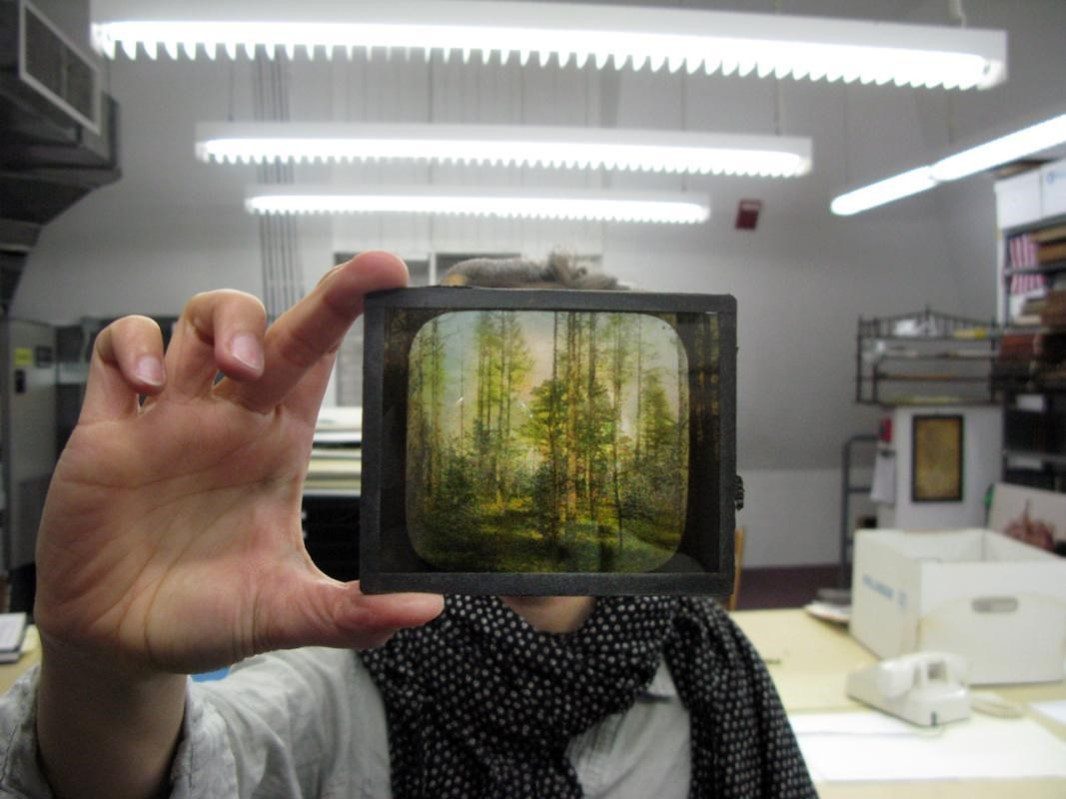
Throughout history, works of art and architecture have been reproduced and distributed via paper-based media, whether by drawings or printing technologies. However, the rise of modern art-historical study, which took place over the course of the late nineteenth century in Germany, was concomitant with the rise of a set of photographic technologies that would transform the discipline profoundly. Around 1890, the art historian Herman Grimm normalized the use of the lantern slide projector—the Skioptikon—in the classrooms of the University of Berlin (Figures 1 and 2).
-
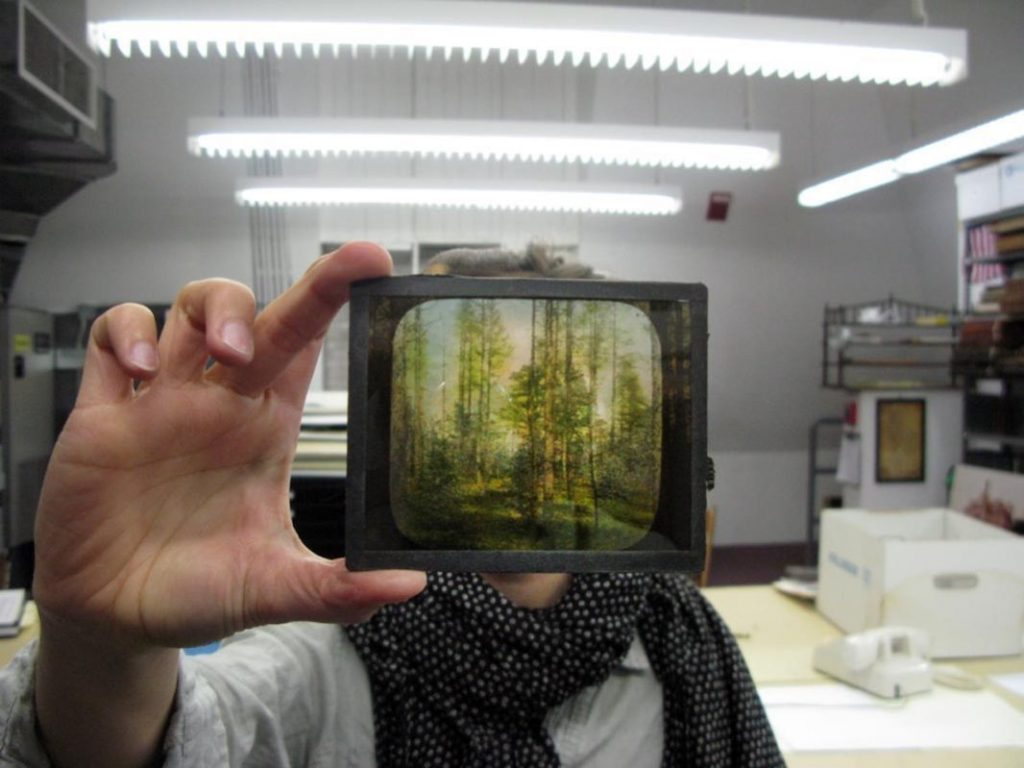
- Figure 1. What a Lantern Slide Looks Like. Image: Colleen Doyle, April 26, 2012. http://notrashproject.com/2012/04/26/to-my-great-pleasure-my-professional-projects/
-
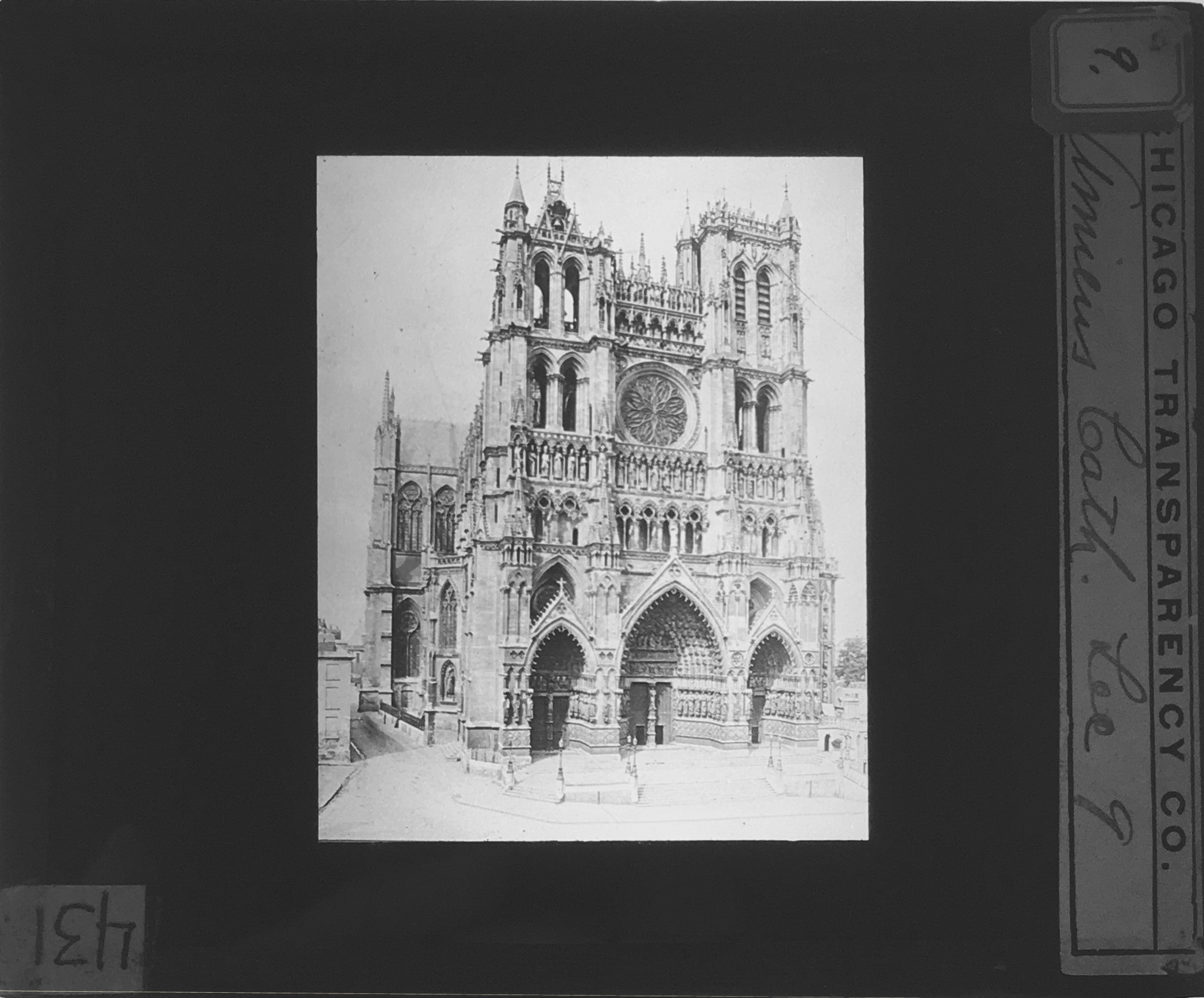
- Figure 2. Lantern Slide of Amiens Cathedral produced by the Chicago Transparency Company. Handwritten notes include “9. Amiens Cath. Lec[ture] 9” and the code “431.” Collection of the Department of History of Art and Architecture, University of Pittsburgh. Photo: Author.
In his 1892 work, “Transforming University Lectures on Modern Art History Through the Use of Skioptikons,” Grimm noted that what attracted him most to this technology was that the slides allowed him to move away from a focus on the contextual, literary, and historical texts about the art, and move towards a study of what was actually visible in the art.[1] Before this period, to bring the visual object into the classroom, lecturers might have passed around printed reproductions or they might have employed verbal descriptive techniques such as ekphrasis—a highly personalized narrative used to evoke the experience of looking at a work of art or architecture. Instructors may have also suggested that students remember their last encounter with the object, or recommend they go and see it on their own in their travels. These images allowed Grimm to lecture much more effectively in class about the visual forms of the work itself by means of large, black-and-white projections that the entire class could see communally.[2] Absent objects could be made shimmeringly present by patterns of shadow and light on the wall.
Wölfflin: Thisness-and-Thatness
Just a few years later, the research and presentation practices of the art historian Heinrich Wölfflin would not only transform the way the discipline operationalized these representations, they would also fundamentally change the way the field approaches its very subject material. Wölfflin is credited with standardizing the use of, not just one, but two, lantern slide projectors in the classroom, lecturing consistently in front of simultaneous pairs of images at the University of Berlin between 1901 and 1912 (Figures 3 and 4). This technological tweak was small, but its effect was mighty. Shifting the field from a focus on single objects to a comparative mode of analysis was truly transformative, as it asked historians to move away from a consideration of synchronicity to diachronicity. His approach was quite rapidly taken up field-wide. Objects, once dutifully considered in isolation, were now expected to be brought into conversation with one another across time and space.
-
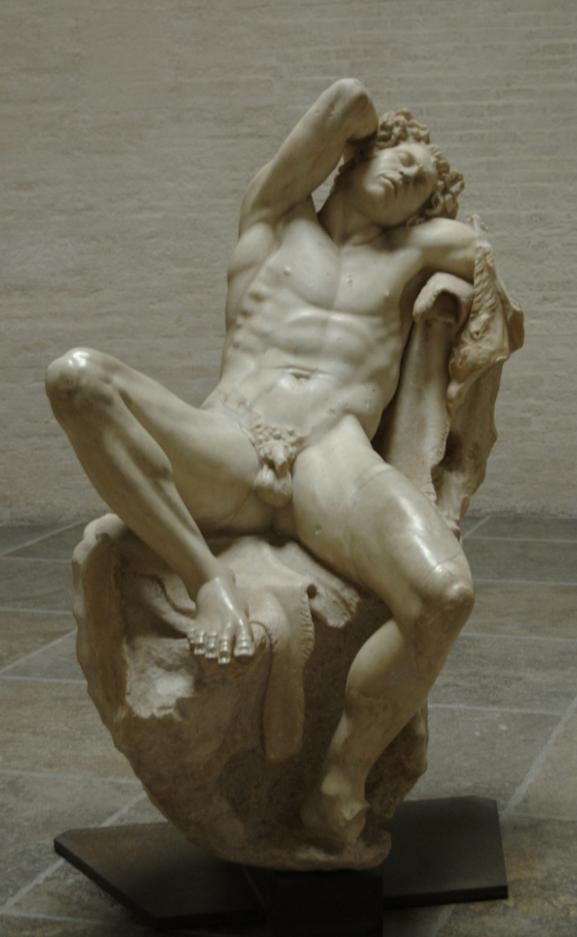
- Figure 3. The “Barberini Faun,” Greek, ca. 220 BCE. Marble. Collection of the Glyptothek, Munich. Image: Bibi Saint-Pol, 2007, https://commons.wikimedia.org/wiki/File%3A Barberini_Faun_front_Glyptothek_Munich_218_n2.jpg
-
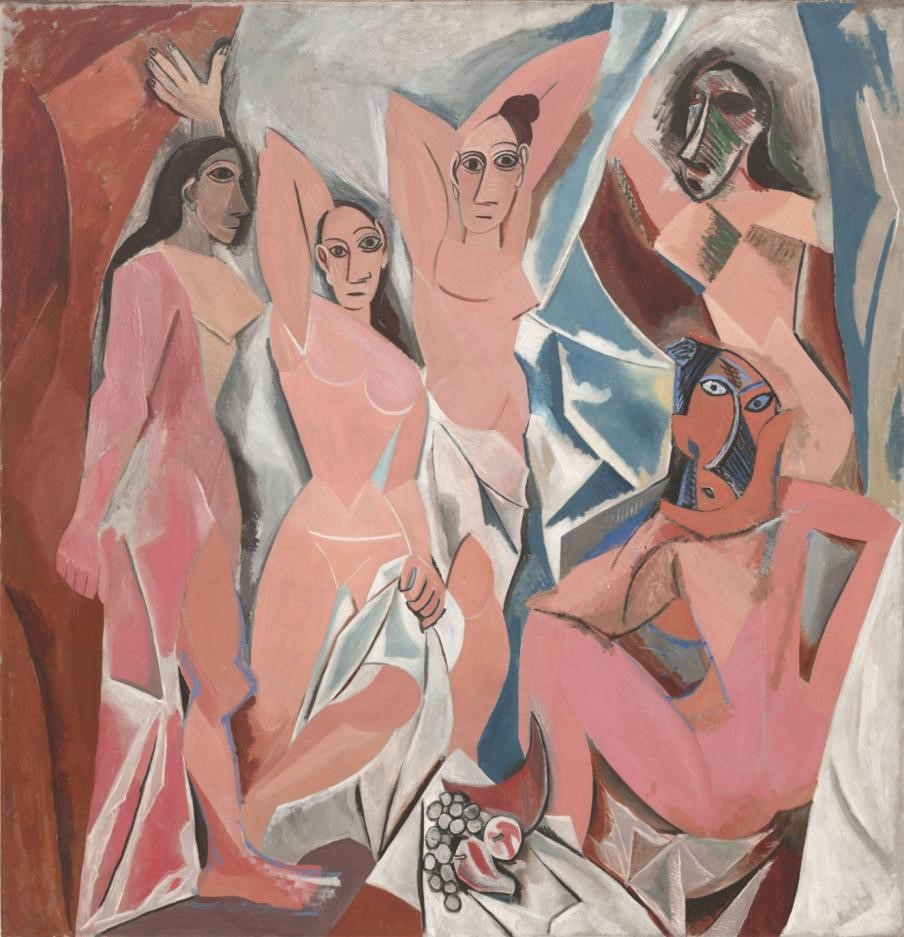
- Figure 4. Pablo Picasso (1881–1973), “Les Demoiselles d’Avignon,” Paris, June-July 1907. Oil on canvas, 8′ x 7′ 8″ (243.9 x 233.7 cm). Collection of the Museum of Modern Art, New York. Acquired through the Lillie P. Bliss Bequest. © Estate of Pablo Picasso / Artists Rights Society (ARS), New York.
Nevertheless, this transformation was not solely technical. According to accounts of his lecture style, Wölfflin’s classroom was also a type of full-body infotainment experience—a bit like the phantasmagoric Magic Lantern shows, popular since the eighteenth century, that used similar technologies. He would turn off the lights, fire up the projectors, and instead of lecturing from the front of the room, he would sit out in the crowd of his students, sharing with them the view on the pairs of images as they came up, set after set, image after image in succession. It is said that when each new pairing would come on the screen, he would pause dramatically, as if to give the objects a chance to shine on their own before submitting them to his piercing comparative analyses.[3]
This use of paired reproductions and vivid, spoken rhetoric was not simply an expression of early twentieth-century Germanic ed-tech melodrama. With this approach, Wölfflin profoundly influenced both the style of argumentation and scholarly expression in the field of art and architectural history to this day. His art history was one based not only on comparison, but also on the communal experience of looking and listening, and the socio-technical affordances of image reproduction that brought these practices together were at its heart.
Indeed, Robert Nelson and Dan Karlholm have argued that Wölfflin and Grimm were both radically experimenting with a style of academic argumentation that proceeded first from the image and the voice, rather than the more traditional written text.[4] This approach was designed to display rhetorical and oratorical skill, a tactic that takes full advantage of the medium of speech and the performativity of the slide lecture.[5] It allowed art historians to call on any number of rhetorical techniques that work primarily in the performative vein, such as deixis, or the ability to call on one’s physical human relationship to an object while explicating a point, as in, “over here we see Les Demoiselles d’Avignon…” Art and architectural historians, then as now, could also deploy the use of “anchor slides” in their lectures—images to which one might return frequently, each time making a more nuanced and fully formed argument. This technique easily allows for circular, spiraling, or recursive arguments. Even retractable arguments are more permissible as oral rhetoric. The slide lecture, a foundational methodology to the field of art and architectural history, was and is a multi-modal, embodied experience. Unlike the process of reading, the audience can both listen and see at the same time, rather than needing to shift its gaze from text to image and back again. They also experience the argument synchronously and communally. These techniques are difficult to reproduce in writing, yet they remain at the core of our training and profoundly influence the way we interpret our primary sources.
This Technology Changed Us
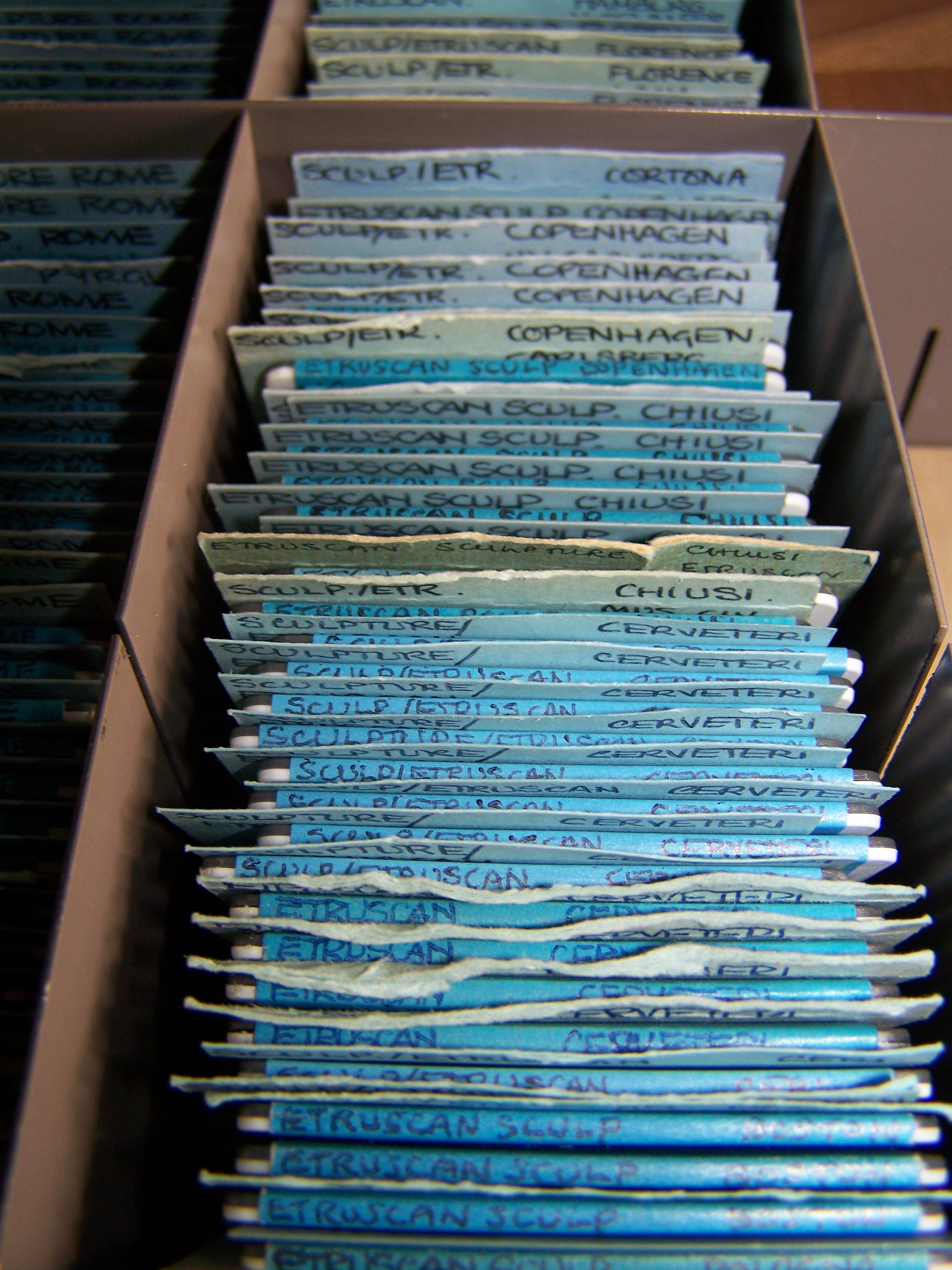
The technology of image reproduction at the heart of this disciplinary shift, the glass lantern slide, was soon made obsolete. 35mm Kodachrome slide production began in 1936, and this photographic technique fully solidified the ubiquity of the paired, projected image in the art-historical classroom. Kodachrome was, of course, a color process, offering obvious chromatic improvements over the older black-and-white lantern slides. 35mm slides were also smaller and far easier to make and store than the older technology (Figures 5 and 6).
-
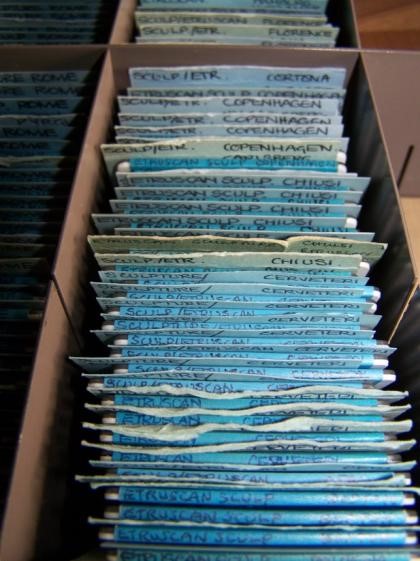
- Figure 5. Jenna Ashton, Slides from the Department of Art History and Visual Studies, The University of Manchester, September 2012. https://archiveinterventions.files.wordpress.com/2012/09/100_2434.jpg
-
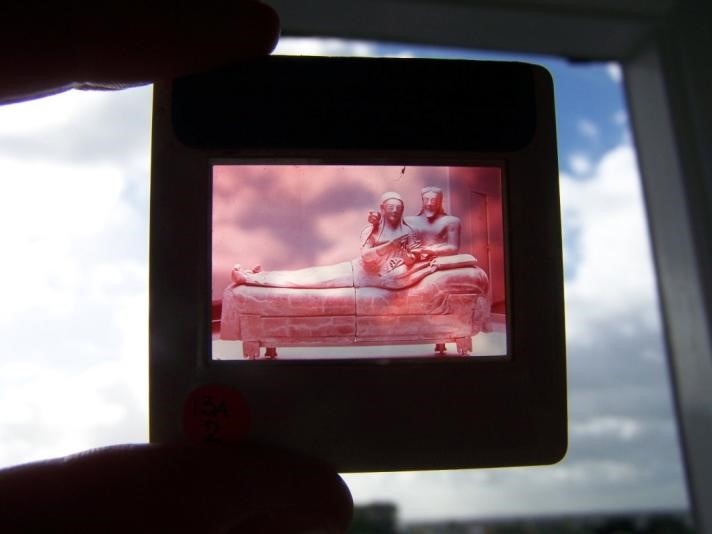
- Figure 6. The “Sarcophagus of the Spouses,” Etruscan, ca. 520 BCE. Terracotta. Jenna Ashton, Slides from the Department of Art History and Visual Studies, The University of Manchester, September 2012. https://archiveinterventions.files.wordpress.com/2012/09/100_2435.jpg. This is an Ektachrome slide, as revealed by the shift to magenta tones, the telltale signs of color degradation in this format.
While their technical affordances were considered improvements over the older technologies, their arrival did not cause a reconsideration of the role of the reproduced image in discipline. The field swallowed them into its practice and kept them pinned to the early twentieth-century use case offered by Wölfflin and Grimm. The technological armature of these slides remained hidden from the audience, and possibly from the field itself, as part of the performative rhetoric of the art-historical classroom.
However, this technology did transform the discipline in its own way. The most demonstrable impact made by 35mm slide technology was perhaps to be found outside the classroom. The millions and possibly billions of 35mm slides produced for the discipline of art and architectural history over the course of the twentieth century created, quite literally, a weighty mark on the field. Such vast quantities of these slides were produced globally for each department of art and/or architectural history that they created a physically massive, disciplinary-specific, information infrastructure not shared by many other fields of the humanities—that is, the slide room (Figure 7).[6]
-
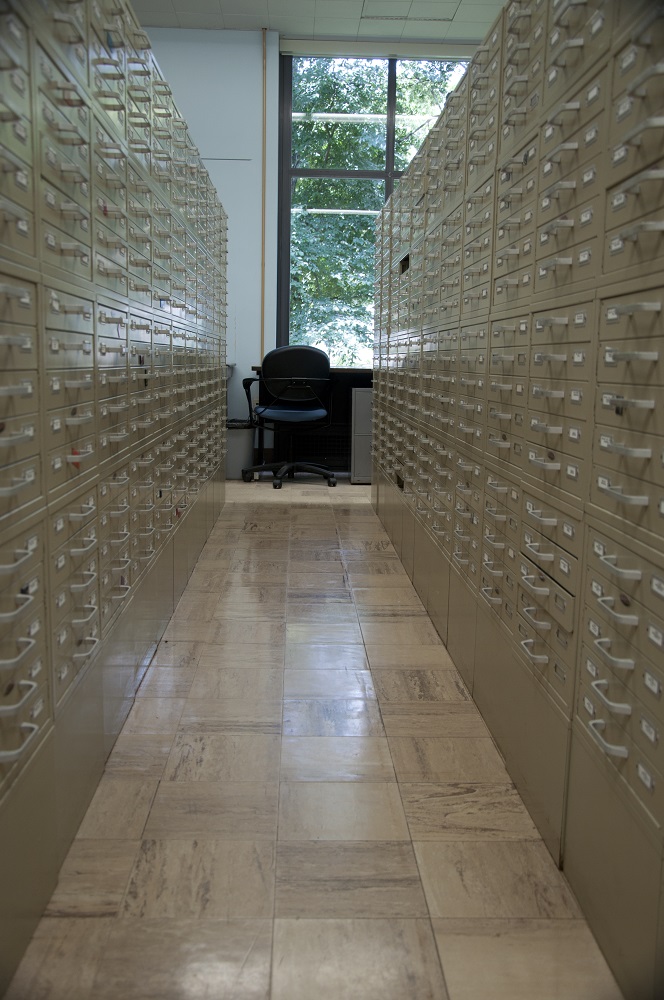
- Figure 7. The former slide library at the University of Pittsburgh, Frick Fine Arts Building, June 2011. Photo by the author.
-
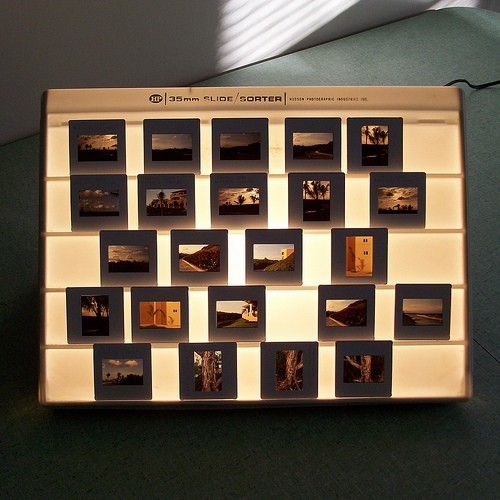
- Figure 8. Slide sorter as made available for sale by Lauren Busiere (@madebylaurenb) on Etsy in 2009. Image permission granted by the creator.
While easier to make than glass lantern slides, 35mm slides still remained a bit of a hassle to produce, and their creation, organization, and storage was a capital-intensive endeavor that encouraged the creation of common repositories. Whether called the slide library, the visual resources collection, or the slide room, this socio-cultural environment often became the “town square” for departments of art and architectural history.[7] It was an information commons, a resource shared by a community of inquirers, and a physical location that drew members of the department together in one place for a shared purpose. Scholars certainly had their own personal collections, but the slide room was a central location where people not only went to access image resources but also to meet and discuss their scholarship and the more mundane things of life. Some, if not most, departments also had communal slide sorters in these spaces, allowing patrons to walk by and see the growing image-focused networks of argumentation being made by their colleagues and teachers. A smattering of slides across one of these sorters could have a multitude of possible meanings (Figure 8).[8]
Yet, the changes wrought by the influx of 35mm slides were not all social, they impacted habits of scholarship as well. This information commons operated within a form of information scarcity. Because 35mm slides were not quite a dime-a-dozen, they could also become “quasi-unique” to scholars.[9] These types of views showed just what one needed to make a point, and were prized. It is worth reflecting back on the day when it was normal to walk into the slide room, hoping that one, single, small, colored piece of plastic was there to allow us to make a point in a lecture. Because, if not, the hassle of making a slide was significant, requiring finding a book or a vendor, getting to a copy stand, having a camera loaded with slide film (and possibly taking only a few slides off that roll), having it developed through a process that took time, money, and often great effort, etc. Even if not directly responsible for producing slides, there was always a significant time delay between needing and image and finding it in hand.
If the desired slide was not in the slide room, a scholar could also simply choose not to make that point, or to make a totally different point. In this way, the availability of the technical infrastructure could—and often still does—change the shape of art-historical scholarship.[10] But often, the slide was blissfully there, because these collections were carefully perfected for particular departments and faculties by a cadre of trained information professionals (“slide librarians” or “visual resources curators”) during the course of nearly a century. Nowadays, these collections, each containing tens of thousands of 35mm slides, often look more like piles of junk than the massively capital-intensive information commons they once were (Figures 9 and 10).
-
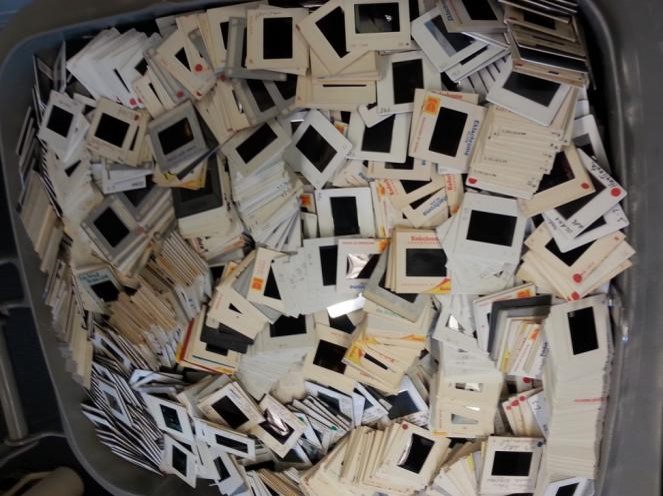
- Figure 9. Amy Lazet, University of Michigan, Visual Resources Collection, August 2014. https://seelio.com/w/k80/university-of-michigans-history-of-art-visual-resources-collection. Image courtesy of photographer.
-
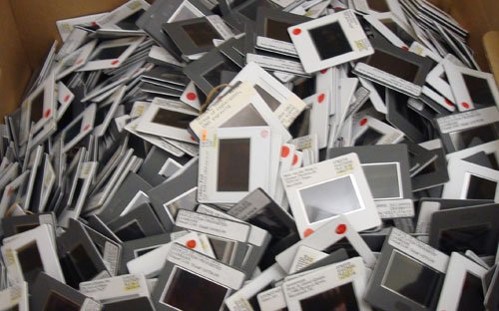
- Figure 10. School of Visual Arts, NYC, November 2011, https://svalibrary.wordpress.com/2011/11/23/free-slides-for-the-taking/. Image courtesy of the School of Visual Arts Library’s Visual Resources Center.
We Study What We Can See, But We Can Also Elide What We Wish
We do not usually think of our research and teaching images as these rampaging, obnoxious piles of disorder, although it is easily possible to imagine that this is exactly how they are currently organized on the Internet. Instead, when projected, these images were used as evidence for our arguments, as surrogates for an original, or, rhetorically, even as the object itself. It is rare to find a lecturer in art history who has not elided the gap between the image on the screen and the object under consideration. We say things like:
Here on the screen is the Demoiselles d’Avignon, painted by Pablo Picasso in 1907, although it was not displayed publically until 1916. It is a work in oil on canvas, and measures 243.9 x 233.7 centimeters. That is around 8-foot-square in old money. (Figure 5)
No such thing is actually on the screen. The projection is not that size; it was not made on that date. Such is the permitted use of the oral rhetoric that is so fundamental to our field. It is a seemingly innocent illusion/elision between the represented and its representation, but it is an elision none the less. Hiding the imaging technologies as we do, both verbally and physically, allows the discipline to fulfill the Wölfflinian ideal of presenting an argument that seamlessly combines a spoken explication alongside a display of relevant image evidence, audible and visible to all.[11]
Given that the particular technological affordances of glass lantern slides, and the 35mm slides that followed them, were at the very heart of the normalization of this method of art-historical inquiry, it seems somehow unsatisfying to consider this elision entirely innocent. This discipline, the one that studies representation theory itself, has had numerous opportunities to be more mindful of this approach. Artists have certainly done so. Mark Tansey’s enormous oil painting, the Innocent Eye Test from 1981, pokes a little fun at such behavior (Figure 11).[12]
-
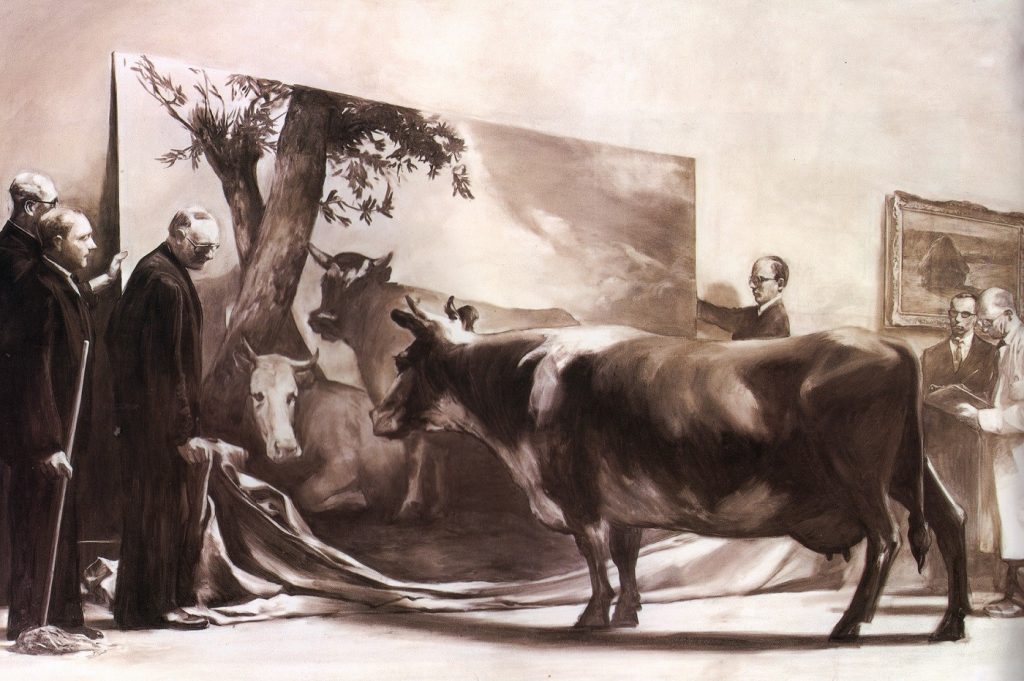
- Figure 11. Mark Tansey, Mark (b. 1949). “The Innocent Eye Test,” 1981. Oil on canvas. 78 x 120 in. (198.1 x 304.8 cm). Collection of the Metropolitan Museum of Art. Gift of Jan Cowles and Charles Cowles, in honor of William S. Lieberman, 1988 (1988.183). ©Mark Tansey
Here we see a cow being shown a painting of other cows by a group of men in suits. The men peer at the cow, seemingly wondering what her (necessarily non-verbal) response will be to what she sees, an act that begs the question of whether the scene depicts an “innocent” having a vision test or instead an experiment about a scientifically “innocent eye.” The man on the extreme right dressed in a white lab coat, takes notes on a clipboard, while the man with a mop on the extreme left stands as testimony to the embodied reality of having a cow in a gallery space. In a way, art and architectural history has been performing a variation of this silly experiment on our audiences for more than a century.
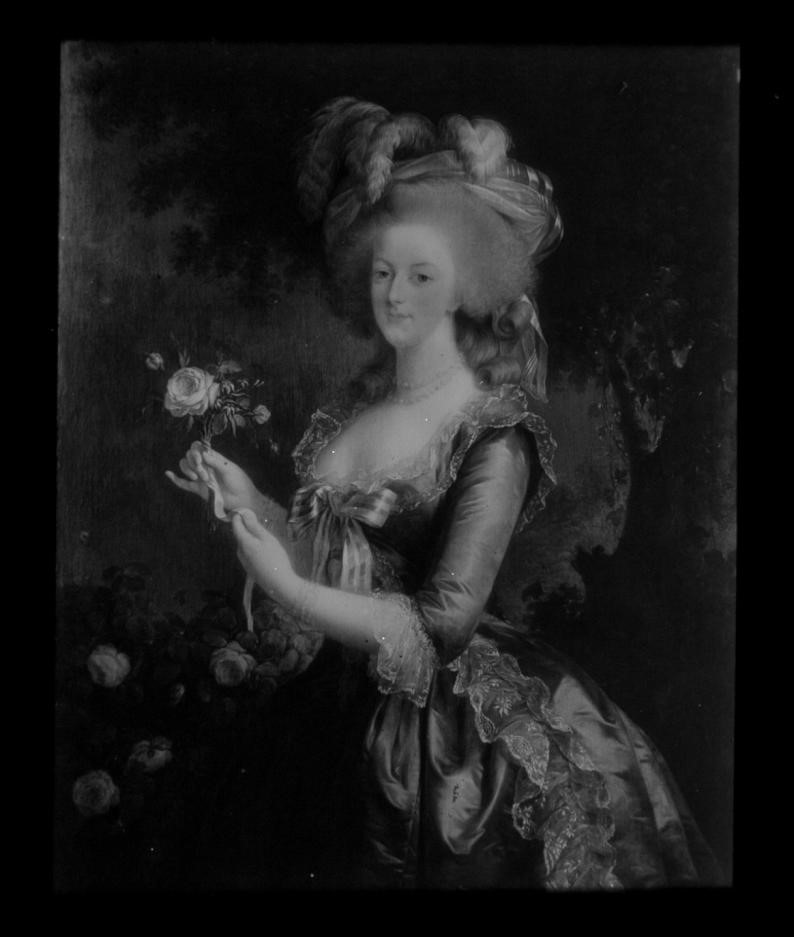
Yet even beyond the human tendency to use this rhetorical sleight-of-hand to elide the relationship between the represented and its representation, the technologies used to remediate the objects of our study have themselves had a fundamental impact on what we have chosen to study at all. It is not only the case that we choose to study those objects for which we can find a representation—whether in a slide room or on the Internet. It is also a well-known, field-wide trope that art and architectural history has traditionally focused on those aspects of visual culture best represented by the most advanced image reproduction technologies available at the time.[13] The early black-and-white lantern slides, for example, allowed scholars, including Wölfflin himself, to focus on line, shading, composition, planarity/surface, even content/iconography over materiality, all without the “distraction” of color information (Figure 12).
-
- Figure 12. Different representations present objects differently. Digital image of a lantern slide representing Élisabeth Louise Vigée Le Brun (1755–1842), “Portrait of Marie Antoinette,” 1783. Oil on canvas, 113 x 87 cm. Collection of the Palace of Versailles, Versailles. Digitization from the Morris Wachs Collection, W. T. Bandy Center for Baudelaire and Modern French Studies, Vanderbilt University.
-

- Figure 13. But is this the actual color of the original? Élisabeth Louise Vigée Le Brun (1755–1842), “Portrait of Marie Antoinette,” 1783. Oil on canvas, 113 x 87 cm. Collection of the Palace of Versailles, Versailles. https://commons.wikimedia.org/wiki/File:Vig%C3%A9e-Lebrun_Marie_Antoinette_1783.jpg
The addition of color to the slides did not magically erase the ways that the technological affordances of our reproductions shape our scholarship (Figure 13). It has never been the quality of the representation that asks us to compromise on our interactions with the object, it is the very act of reproduction itself. The introduction of color to these images may have allowed for the study of more image features, but the colors studied remain steadfastly those of the reproduction. Maintaining a color match between a representation and its referent was, as it continues to be, difficult at best. Representation is a form of interpretation and remediation, from the framing chosen, to the color balance used, to the precise technology selected. It is not a neutral act; it is materially transformative.[14]
Digital Images Are Numbers
Over 100 years after projected image technologies transformed the field of art and architectural history, the use of film-based slides came to an end. In 2004, Eastman Kodak stopped making 35mm slide projectors. In 2012, Eastman Kodak stopped making 35mm slide film, an act that ceded the playing field definitively to digital imaging. But just as at the moment of transition between lantern slides and 35mm slides, art and architectural historians, as a group, did not hasten to probe the affordances of this new technology for possible transformative impacts on our methods and approaches.[15] Instead, the decline of film-based image reproduction technologies was simply matched by a rise in the use of digital images within software presentation packages such as Microsoft PowerPoint.[16] That is, the discipline chose to adopt digital images as “digital slides,” surrogates of the surrogates we had already been using.
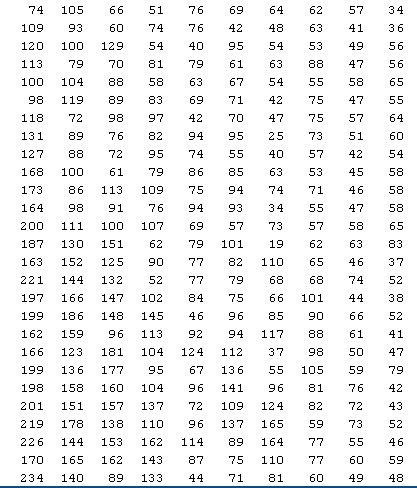
This strong focus on only those affordances of digital images that simulated the historical use of film-based images skimmed over fact that this newer form of reproduction was, and is, produced by an extremely different set of technologies. Digital images and film-based images are not made up of same materials, and they do not function internally in anything like the same manner. Digital images are not colored pieces of plastic or glass. They are, like every other thing that can be represented within a digital computer, made up solely of numbers (Figures 14 and 15).
-

- Figure 14. Johannes Vermeer (1632–1675), “Girl with a Pearl Earring,” 1665. Oil on canvas, 44.5 x 39 cm. Collection of the Mauritshuis, The Hague. https://commons.wikimedia.org/wiki/ File:1665_Girl_with_a_Pearl_Earring.jpg
-
- Figure 15. Detail of the red channel of the digital image in Figure 14 made in MATLAB. Image courtesy Thomas Lombardi. Used with permission of the creator.
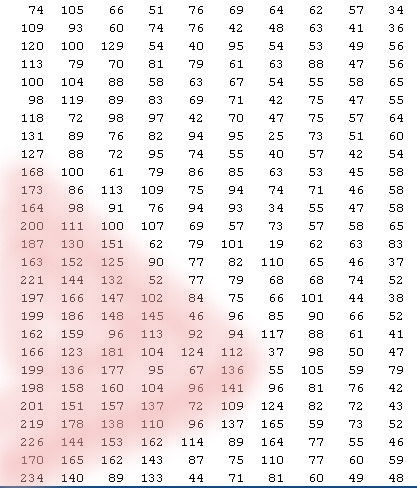
The matrices used by the computer to produce images on the screen can easily be made visible, but to do so does require an act of intention.[17] In Figure 15a, we see a detail, in the red channel only, of the right corner of the mouth as represented by the digital image that is Figure 15. Looking closely, one can see that very shape of this detail is just visible to the human eye by tracing the triangular pattern of the larger numbers, indicating a greater amount of red, against the ground of smaller numbers, indicating a lesser amount of red (Figure 15a).
-
- Figure 14. Johannes Vermeer (1632–1675), “Girl with a Pearl Earring,” 1665. Oil on canvas, 44.5 x 39 cm. Collection of the Mauritshuis, The Hague. https://commons.wikimedia.org/wiki/ File:1665_Girl_with_a_Pearl_Earring.jpg
-
- Figure 15a. Detail of the red channel of the digital image in Figure 14 made in MATLAB, colored to highlight the location of the detail (right side of the mouth). Image courtesy Thomas Lombardi. Used with permission of the creator.
But the mouth, whose pattern is thus barely visible in this set of numbers, is not truly there at all, not even as a smear of red chemicals on a piece of plastic. Computers must enact these numbers—perform them—in order to provide us with a rendering that looks like an image. While it is possible to use these matrices of numbers in a manner that is functionally equivalent to film-based slides, it remains true that digital images are built on an entirely different model of representation, one in which treating color as numbers is a fundamental, inescapable reality.[18]
The Social Effects of the Digital Turn
The demise of film-based imaging and the concomitant rise of digital imaging also caused a radical shift in the social environment surrounding the use of image reproductions in the field of art and architectural history. In the twenty-first century, the ways in which we collect, search for, retrieve, and disseminate our images are utterly different than they were throughout the twentieth. For one thing, the act of creating and distributing a reproduction of an image in a book now has a fundamentally different relationship to copyright law than it did in the days of the physical slide library.[19] However, one of the most prominent social ramifications of the digital imaging revolution within the field may in fact have been the demise of the slide library itself, along with the “town hall” space that it afforded. The integration of digital images into our disciplinary workflow dissolved the need for this communal room, and sent art and architectural historians back to their individual desks, pinning them in relative isolation to their screens and keyboards.
As scholars in this particular historical moment, we are essentially each responsible for finding and organizing our own image resources in our own personal digital world. Whether using Google, ArtSTOR, or some other digital service, art and architectural historians nowadays tend to create collections by hunting down images using textual search terms rather than by proceeding to a specific physical drawer carefully arranged within a much larger assemblage of cabinets, all professionally organized hierarchically by period, location, creator, and then object. Like direct searches, browsing for images is also now much more likely to happen on the basis of the results offered by a textual search algorithm than the tactile perusing of a carefully-curated, highly-intentional sequence of 35mm slides. This said, within art and architectural history itself, the impact of this move from a centrally catalogued set of canonical images has not always been a detrimental one. Our monolithic, Western-centric tradition of cataloging told a very particular story about what was and was not valued in our disciplines, and the massive physicality of these collections did not easily allow for the types of reconfigurations of interconnections that are now possible in the digital environment.
From every angle, this shift from a physical system of search and browse to an algorithmic one has profoundly changed the way our discipline interacts with, and attends to, the image reproductions we rely on. We look for pictures with words, wade through search results of varying responsiveness, and we tend to do so in isolation. Indeed, the transformative impact of this search-based shift in scholarly attention has also been noted by other fields in the humanities, such as the discipline of history, as they too begin to rely more heavily on digitizations of their primary source material.[20]
More Than Doubling Down on the Index
Art and architectural history has more than once shown itself to be relatively uninterested in re-thinking the use of changing technologies in our field, and even perhaps slightly resistant to considering the socio-technical armature of our profession as an active agent that shapes our teaching and research.[21] We have absorbed, taken for granted, and in many ways “un-seen,” the full disciplinary scaffold that we have built on top of the original introduction of film-based, photographic slides in the classroom—from the performative nature of its basic mode of argumentation to the socio-technical impacts of the massive, professional image information management systems that constituted the slide libraries.[22] The field has also chosen not to dwell, up to a point, on the ways that digital imaging has transformed technologically and socially the very act of image representation yet again.
Each time we have adopted a new type of image reproduction technology, we have tended to focus on retaining the results of the last transformation rather than initiating a deep understanding of the current impetus for change and its potential impact on our field. For example, the penchant for veering into showmanship that accompanied Wölfflin’s approach to lecturing has been more strongly retained by the discipline than the memory of why communally visible images in the classroom were so revolutionary in the first place. The discipline has, along these lines, shown quite a bit of fascination with the creation of digital virtual environments, some of which run on platforms like the Unity gaming engine. This love of producing engaging, absorbing images is certainly part of a long-standing tradition in the discipline, but cleaving to this habit has had a field-wide impact not only on the types of research we do but also on the ways we are perceived outside our discipline. Our field began by adopting the infotainment technology of the Magic Lantern show, and we can use digital gaming platforms in similar ways now if we like.[23] But we should do so mindfully, and with full understanding of what these approaches offer us in the twenty-first century.
Similarly, we have had a long-standing disciplinary habit, noted above, of rhetorically eliding the distance between representations and what they represent, and digital images can certainly be used to this end. But no matter how indexical, suitable, or numerous the representations of an object are, what is on the screen will always resolutely remain a representation that stands in for something else. Using the ease and flexibility of digital imaging to multiply the number of images present, or to make these representations seem more immersive, or any other approach that simply doubles down on the indexicality of these images, will never change this state of affairs.[24] Multiplying representations can even have the effect of drawing increased attention to the very absence the scholar is trying to cover up as the diminishing returns on adding yet one more image, one more angle, one more point-of-view become ever more conspicuous.[25]
Digital images have more to offer the field than their often jaw-dropping visual appearance. In the digital studies community, studying only the screen-facing aspects of a digital object risks a pitfall known as “screen essentialism.”[26] That is, it is not enough to assume that what is most important about a digital object is what it looks like when displayed, because digital objects always include an armature of numerically-encoded information and behaviors that enact what becomes visible. Other affordances of digital imaging and its socio-technical infrastructure can provide ways to interrogate the role of remediation in the study of material culture and the built environment. By extension, this work may have much to offer to the study of any digitized object, transformed into numbers as they all are by the encoding process.
The discipline of art and architectural history has only just begun to confront the possibilities inherent to this new model of representing an object as a matrix of numbers—that is, we are just now considering the possibility that computing over these representations could be part of our acceptable disciplinary methodologies. Scholars such as Lev Manovich are approaching digitized and born-digital images in this manner, producing provocative results.[27] The computing and information sciences have also shown great interest in using representations of our primary source material in their own investigations of computer vision and image analysis, implementing a mixture of their methodologies and what they have gleaned of ours through the literature.[28] Further direct collaborations between these fields may result in new knowledges that benefit us all.
It is critical to our field, however, that we not take up these encoding-focused approaches without first considering our contemporary reasons for doing so, as well as the ways that they are best situated within our long-standing technological historiography. We introduced the use of image reproductions in order to facilitate an understanding of our primary sources, not to supplant them or take their place. And yet, the digital approaches that focus on computing over these matrices of numbers can only delve ever more deeply into the innards of the surrogates themselves. To commit to this line of inquiry, the field of art and architectural history will need to accept fully that the results of this computational process, one that can only work on the representation, may be used to interpret the original object it represents successfully. This is not just an innocent elision between the object and its remediation, this is a potential collapse. Working directly with the matrices of our digital images strives, perhaps, to uncover information within these encodings that the human eye cannot otherwise perceive in the “real” world, whether because of a change of scale, from microscopic to immense, or technique, whether experimental or mathematical. This method seeks information about the experiential world in a place entirely divorced from it—a central characteristic of the digital turn itself.[29] Great things may come from this approach, but only if it is done mindfully and with full knowledge of the costs and benefits.
Taking Different Cues from a History of Working with Technology in the Humanities
While diving ever deeper into the foundationally representational nature of the digital image is one path forward for a digitally-engaged history of art and architecture, it is also conceivable that there could be explorations that do not partake of a narrative of technological rupture, but instead one of mindful, engaged continuity with both the technical and socially-based disciplinary traditions that still work for us. Perhaps in a manner akin to Wölfflin’s shift from projecting one sole image to a pair, thinking deeply about the affordances of our changing technologies can provide a sense of intellectual parallax, enabling art and architectural historians to separate the useful interpretive techniques that are important to retain from the framing of the technical affordances that originally facilitated them.
One such behavior, ripe with possibility in the digital era, is the traditional art-historical mode of argumentation rooted in oral, rather than written, rhetoric. More than just an act of showmanship, Wölfflin taught an experience. In his classrooms, he created an environment of shared potential. In his argumentation, his reasoning did not always unfold linearly, instead it moved back and forth, in zig-zags, towards his conclusions. Even if many of his interpretations are no longer considered convincing, his remarkable style of presentation made a fundamentally lasting mark on the field. Art-historical knowledge produced in this way has always been best taught, shared, and understood as an engaged performance rather than as the recitation of a linear, written text.
This type of performative knowledge can find an easy home in, and a deep connection to, the world of digital interactivity, especially in the era of the Internet. Numerous scholars, especially in the field of digital preservation, are exploring the importance of conceiving of the networked, digital environment not as a static object that can be directly preserved, but instead as a lived performance that is constantly unfolding and changing over time.[30] Users issue commands that are interpreted by the machines at a given time and in a given context, and while the computer will always perform the same operations when asked, the results it produces will always be both contingent and dependent on the data available at that time.[31] The interaction between the user and the computer can thus produce new performative knowledge together.
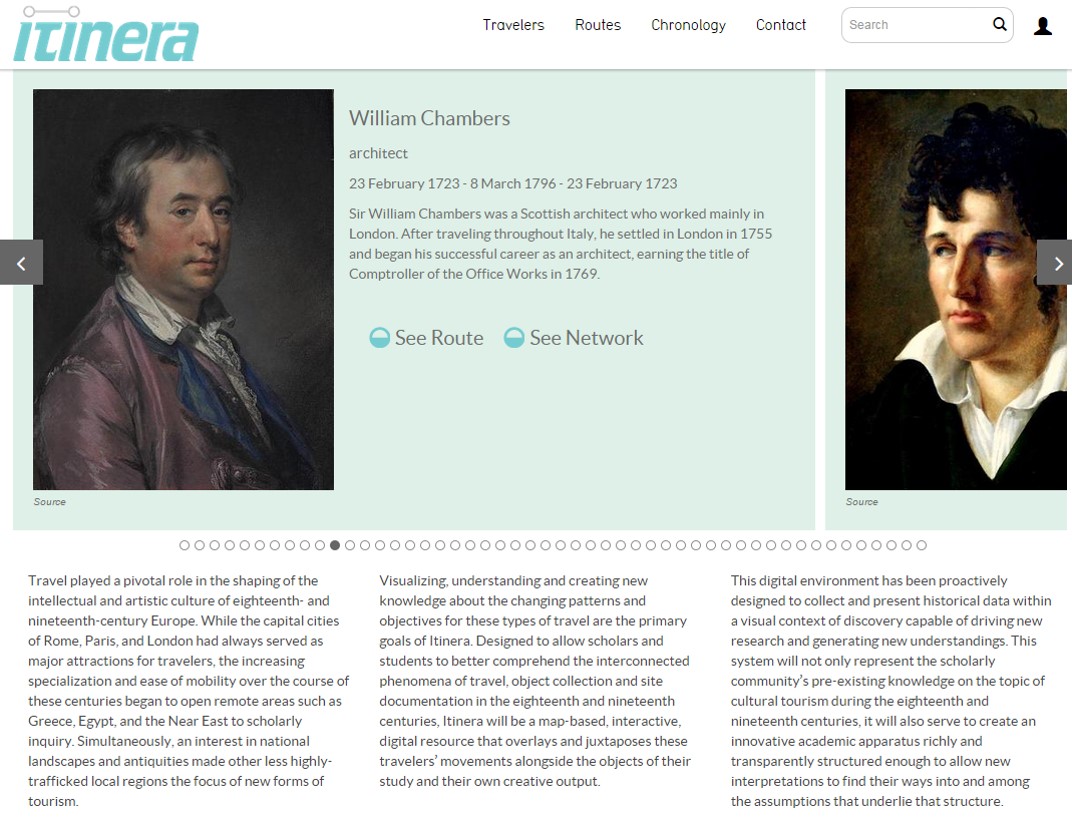
Art and architectural historians can take advantage of this happy congruence, not only by drawing our deep understanding of this type of embodied, interactive knowledge production but also by allowing the technological affordances of this new digital environment to push us to think more deeply about this interpretive act. The Visual Media Workshop at the University of Pittsburgh (VMW) has been investigating such a set of digitally focused, performative, art-historical methodologies using large-scale, lab-based projects like Itinera (http://itinera.pitt.edu and Figures 16a-b).
-
- Figure 16a. Screenshot from Itinera’s splash page. Screenshot: Author.
-
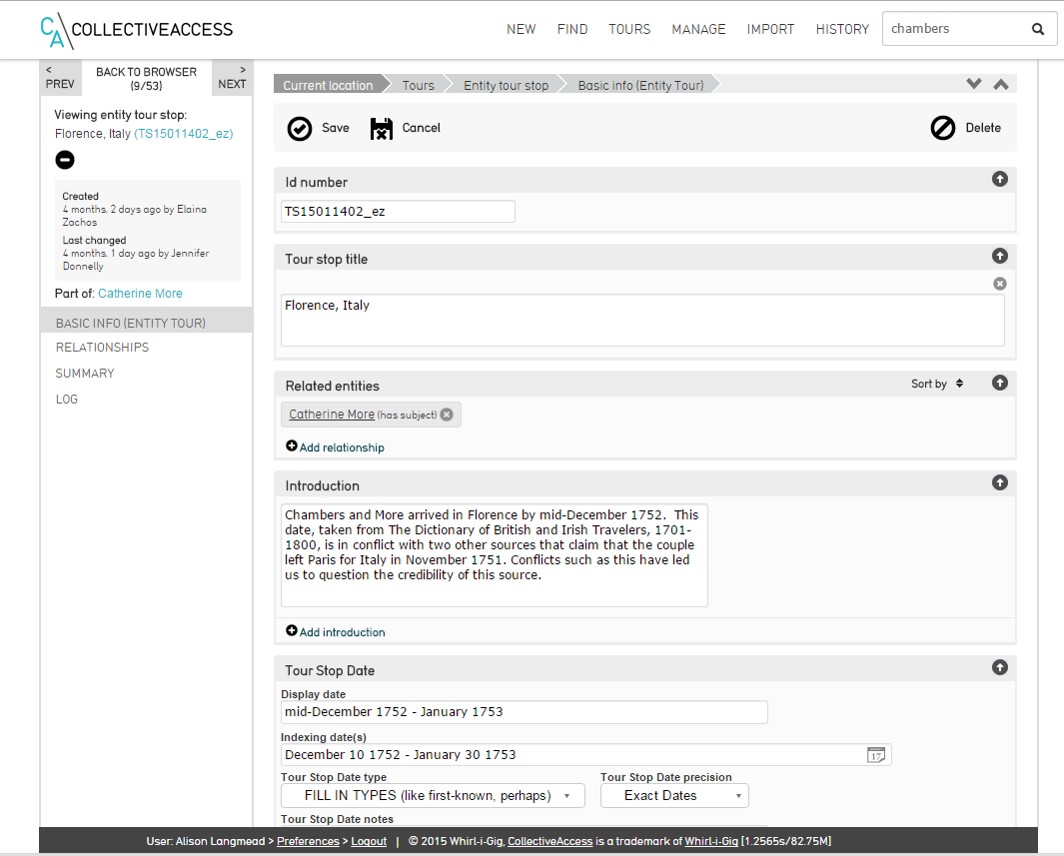
- Figure 16b. Screenshot from Itinera’s back-end data entry form. Screenshot: Author.
Itinera is a digital project that focuses on collecting, arranging, and visualizing data about culturally-motivated travel in the eighteenth and nineteenth centuries. At its heart, the project is a complex data model designed to represent what we know about past behaviors, actions, movements, and collections in a particular historical context. In practice, it is far more than this particular technology. Itinera serves as a continuous point of interaction between the data model, the visualizations that activate the data, and the students and faculty who work so carefully to input information gleaned from historical primary sources. It has been thrilling to participate in the ways that the site engenders new performative knowledge. Undergraduates come to learn the slipperiness of historical materials as they come to grips with the specific requirements of Itinera’s data model. Every year, the project gets a new graduate student for a project manager, and every year that project manager interacts with the system differently, asking new questions of the system, creating new data, and new ways of looking at that data.[32]
The project team has found that Itinera produces new knowledge, not because it is heading towards a conclusion, but because it will always be in a state of creation and enactment. To be sure, it can also be used for more directive purposes. Itinera can help train students on the specific techniques and approaches of the Digital Humanities, from the principles of information visualization to the hows and whys of normalizing historical data. Yet it is also a continual performance between computers, programmers, users, and inquirers. It asks the team to focus on the impact of our historical storytelling, and it points out the gaps in our knowledges as well as the presences. It is never finished, always lacking, but therefore open to the possibilities of the next interaction, the next performance.
But it is not only in the technical sphere that connections can be made and explored between the disciplinary traditions of art and architectural history and contemporary digital infrastructures. Such linkages can also occur in the social sphere.[33] Spaces such as the Visual Media Workshop can work to counter-balance the trend of isolated search-and-retrieval behaviors, drawing on the history of our discipline and re-instantiating some of the “town square” functions made possible by the former slide library. The Itinera team not only works together physically in the communal space that is the VMW—a space that, importantly, was the former location of the University of Pittsburgh’s slide library (Figures 7 and 17)—but it also works together virtually, in the space carved out by the project’s digital environment, complete with its interfaces, visualizations, and technological infrastructures.
-
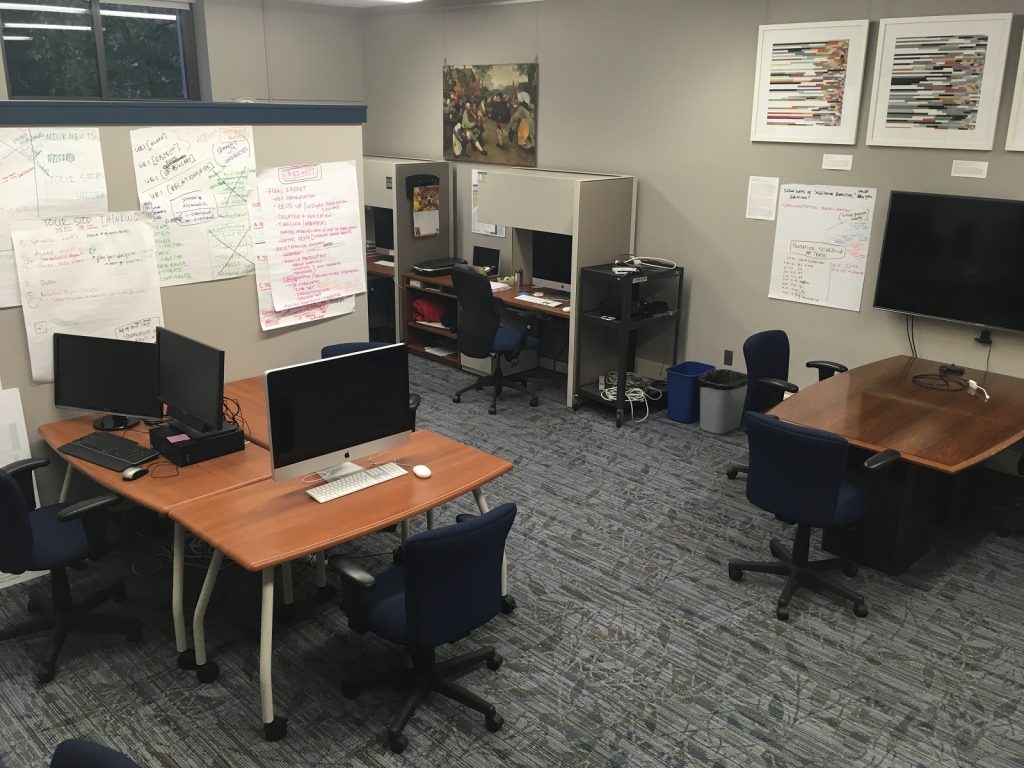
- Figure 17. The Visual Media Workshop in October 2017. Photo: Author.
Moreover, Itinera is also not the only project housed in the VMW. Students and technologists work together in this space collaborating across a number of projects, taking lessons from one arena and applying it to another. Because of our physical and intellectual collocation, there is space for chance conversations and for serendipitous findings produced within the interactions of a community.[34] The project teams of the Visual Media Workshop consistently note that the importance of embodied contact with other scholars cannot be underestimated when working on a shared technological infrastructure. Working with digital tools, and staying mindful of our full socio-technical environments, helps us produce knowledge that is as much a social and performative act as an intellectual one.
Using Technologies to Study the Humanities
Art and architectural history has long-standing experience with transforming an academic discipline through technologically engaged practices, and it can offer its findings fruitfully to the Digital Humanities writ large. Our field has always been multimodal, experiential, and performative—even to the point of theatricality. Its members have used technologies actively and mindfully both to expand scholarly opportunities and to change the way we study our primary sources. Yet we have also enacted the less-advantageous practice of coming to take the socio-technical affordances of these technologies for granted. We know what it is like to absorb these tools into a discipline so completely that the formative effects they once offered become seemingly invisible and replaced only by their results. When this happens, the technologies at the heart of fantastic innovation can also become the handmaidens of a field-wide, scholarly inertia.
The technologically engaged traditions of the field of art and architectural history demonstrate that the power of these tools does not, and should not, end with their initial novelty and impact. Engaging with technologies in the humanities is best done mindfully, with a commitment to bringing their full socio-technical environments into view—periodically and over time. These affordances need to be kept in sight not only so they do not ossify but also so that they can continue to prompt us to do our best work. Using technologies to help study the humanities need not always be about rupture and beginnings. Technologies can participate in, and even engender, a mindful continuity with thoughtful and effective past practices.





'Art and Architectural History and the Performative, Mindful Practice of the Digital Humanities' has no comments
Be the first to comment this post!