Issue Twelve

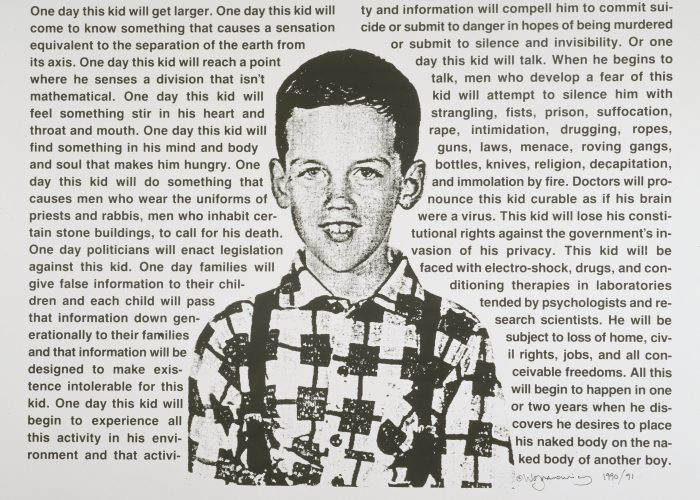
One Day This Kid… is an image of the artist as a young boy is surrounded by text. The prose is a moving and poignant description of the oblique feeling of difference he felt as an innocent child coming to terms with how the world perceives homosexuals and him. The feeling of otherness is quickly transformed into discrimination, fear, and violence.
0

Digital Developments in the 2010s for an Art History Student and David Wojnarowicz

Abstract

This article is both a personal response to and review of the digital resources created by Fales Library and Special Collection, New York University (NYU), for the David Wojnarowicz Papers, MSS.092 during the 2010s. It discusses the digitization of Wojnarowicz’s journals and the David Wojnarowicz Knowledge Base, which is the first digital resource to come out of the Artist Archives Initiative at New York University. The author details his experience learning to use new technologies to undertake art-historical research as an undergraduate and graduate student as well as his relationship to the artist’s work. He concludes that although the David Wojnarowicz Knowledge Base is an excellent resource for research and a model for digital art history, nothing can replace primary research in an artist’s archive.

Seven years ago, while reading the powerful and beautiful memoir Close to the Knives, I saw the author’s name pop up in the news. I was not sure how to pronounce it, but I definitely recognized it: Wojnarowicz. I was familiar only with his written work at the time, but I knew enough to understand the issues at play in the headlines accruing with each new Google News search: controversy, censorship, religion. Little did I know when I decided that this would be the topic of my senior seminar research in art history as an undergraduate that this was an echo of the Culture Wars twenty-some years earlier.

David Wojnarowicz (1954–1992) was a man of many talents. In addition to being a writer, Wojnarowicz was a visual artist, filmmaker, and musician who was active in New York City’s Lower East Side during the 1980s (McCormick 1984, 18–19). With the AIDS crisis escalating in the city, and many of his own friends, loved ones, and peers falling ill and dying, Wojnarowicz received his own diagnosis in spring of 1988, just six months after losing his friend and mentor Peter Hujar (Carr 2012, 391). After seeing his lover suffer from the disease—and ultimately die of AIDS-related complications—Wojnarowicz began exploring the pains and anxieties tied to loss and his own diagnosis through his art. He eventually stated, “Everything I made, I made for Peter” (Carr 2012, 179). The last few years of his life, Wojnarowicz was able to synthesize aspects of his private and public life to produce some of the most poignant work of his career amidst the Culture Wars. Before Wojnarowicz died of AIDS-related complications in 1992, he was challenged by a number of conservative groups that attempted to silence or distort his voice and art. I learned all of this as I followed the events unfolding in 2010 surrounding the removal of Wojnarowicz’s video A Fire in My Belly (1986–87) from the Smithsonian National Portrait Gallery exhibition HIDE/SEEK: Difference and Desire in American Portraiture and read more on the artist himself.[1]

The process of researching and writing for this undergraduate capstone project was unlike any other academic work I had done previously. Instead of going to the library and checking out books and searching JSTOR as I had learned to do, I was Googling different keyword combinations and reading online comment sections. In some ways it felt very rudimentary, yet that was where the story was unfolding. I have since returned to these resources and looked at Twitter posts starting on November 30, 2010 containing the name “Wojnarowicz.” I knew that these events would later be looked at by art historians, cultural theorists, and politicians since the controversies that developed around Wojnarowicz’s work in 1989 and 1990 were touchstones for his career and the Culture Wars during the AIDS crisis.[2]

Yet one can glean only so much from mass media outlets, the blogosphere, and social media during a time of social and cultural upheaval. Knowing that I wanted to learn more about Wojnarowicz’s work and life beyond the published materials available and the shouting match of publicized controversies, I decided to head to New York City. Leaving my quiet, rural, liberal arts bubble, I found myself in Manhattan for the first time trying to navigate Chelsea in order to find an exhibition called Spirituality: Works by David Wojnarowicz, 1979-1990 at P∙P∙O∙W Gallery, which manages the David Wojnarowicz Estate. For me, this exhibition was a revelation and an affirmation that I was on the correct path with my research and writing. I was able to speak with a few people at the opening who had known the artist, experienced the world he lived in, and survived. These scattered conversations were glimpses into the past as well as an insight into the worldview of artists from the period. Everything I had been reading online hinted at the depth of Wojnarowicz’s work but failed to explore it fully before moving on to important but tangential issues. Moreover, from talking to people at the opening, I sensed the chaos of the 1980s in New York City and realized how poignant and concise Wojnarowicz’s work was back then—and remains today.

I lingered in New York for a few days attempting to soak up the atmosphere of the city that had helped shape who Wojnarowicz was. Eventually, I stumbled into the Whitney Museum of American Art and encountered Untitled (One Day, This Kid…) (1990). This powerful self-portrait depicts Wojnarowicz as a child surrounded by text describing difference, discrimination, fear, and the violence directed toward the young homosexual boy. Leaving the city, I returned to school full of passion to finish my project. Unbeknownst to me at the time, Fales Library and Special Collections at NYU held The David Wojnarowicz Papers, an unbelievably rich and complex collection of the artist’s journals, photographs, and objects.

One Day This Kid… is an image of the artist as a young boy is surrounded by text. The prose is a moving and poignant description of the oblique feeling of difference he felt as an innocent child coming to terms with how the world perceives homosexuals and him. The feeling of otherness is quickly transformed into discrimination, fear, and violence.

Figure 1. David Wojnarowicz, Untitled (One Day This Kid…), 1990. Photostat, 30 ¾ x 41 inches. Courtesy of the Estate of David Wojnarowicz and P·P·O·W, New York. ©Estate of David Wojnarowicz

A year later, in 2012, I eagerly awaited the opportunity to read Fire in the Belly: The Life and Times of David Wojnarowicz by Cynthia Carr. Thinking that I had written a thorough and carefully researched paper on Wojnarowicz for my senior seminar project, I was skeptical that I would learn anything I did not already know. I had fancied myself a writer and expert on Wojnarowicz, but after about twenty pages, I realized I was wrong. Carr’s biography is stunningly beautiful. Not only is it supported by astoundingly thorough research, Carr shared the world in which Wojnarowicz lived and knew things I could never have dreamed of discovering through research alone. The richness of this book cannot be understated, and ultimately I knew I needed to visit Fales Library to explore the David Wojnarowicz Papers.

It would be another year before I returned to New York, but in 2013, Fales Library completed digitally scanning Wojnarowicz’s journals and made them available online. As I perused the documentation, I realized once again that I had no idea who Wojnarowicz really was as a person. I certainly knew things about him and could talk for extended lengths of time about his work, but I started considering new aspects of the artist’s life beyond where and when Wojnarowicz dated his journal entries. For example, where in Berlin and at what time of day on January 8, 1984 did he complete the entry “I leave down the road feeling slightly sad but good at last—removed from the handcuffs of taste and dictation of critics—free to make anything or nothing”?[3] Did he close the notebook emphatically and take a large sip of coffee thinking of his career as an artist? Alternatively, did he roll back over and go to sleep? With Wojnarowicz’s journals, I could piece together some of Carr’s insights more clearly than when I first read her account of Wojnarowicz’s life and career, but there was even more life present in these journals than even she could condense into a 600+ page biography.

A scanned journal page from David Wojnarowicz’s notebooks which are held at Fales Library and Special Collections in the David Wojnarowicz Papers.

Figure 2. Scan #7 from Box: 1 Folder: 17, “1984: Berlin, journal fragment” (1984), The David Wojnarowicz Papers; MSS 092; Box 1, Folder 17; Fales Library & Special Collections, New York University

Although I had been thinking about graduate school since completing my undergraduate studies, it was not until that summer that I began applying. I knew that I wanted to continue my education in art history, but I also felt that it would be beneficial to pair that knowledge with some technical skills. Library school was the most attractive option, and I received an acceptance letter from Pratt Institute in New York to enter their dual-master’s program in the History of Art and Design and Library and Information Science.

When I began the program in the fall of 2014, I did not intend to continue my academic research on Wojnarowicz, but I made plans to visit Fales Library to see the David Wojnarowicz Papers in person since I had been following their endeavors for the past three years. I eventually visited the collection and was able to study objects and documents I had only encountered in photographs or descriptions of Wojnarowicz’s work. The decision to come to Pratt was based on both a desire to study in a big city and the notion that art history and the rapidly developing digital world were bound to intersect in profound ways.

By the spring of 2016, I was taking a course titled “Installation Art: Design and Change” that would lead me to my thesis research on the installation and ephemeral art created by Wojnarowicz. The primary function of my thesis was to describe and collect documentation on this aspect of the artist’s creative output since many of these projects and works no longer exist. Believing that Wojnarowicz’s installations were emblematic of his biography, corpus, and culture, I began organizing my research. In an attempt to catalog and quantify Wojnarowicz’s intricate installations from photographs, exhibition checklists, and journal entries, I created an Omeka website that acted as a hierarchical collection management system (CMS) for the installations (Collection Level) and the objects therein (Item Level) assembled by Wojnarowicz throughout several periods in his career as an artist (Exhibit Level). Using an online platform was a way for me not only to organize my research but also to share it with others. This was by no means a “digital art history” project, but rather a digital tool that would help facilitate my analysis and interpretation of this aspect of Wojnarowicz’s work.

An installation shot of the Untitled (Burning Child) Installation from Gracie Mansion Gallery. This elaborate installation included a mannequin of a child covered in maps with paper flames coming off its arms as it runs on a sandy floor amid aquatic plants made of paper. Above the child is a taxidermied shark, also covered in maps. The windows are blacked out with heavy curtains and a large painting, Dad’s Ship, hangs on the wall behind the child. There was also an audio element in this multimedia installation.

Figure 3. Untitled (Burning Child) Installation (1984), The David Wojnarowicz Papers; MSS 092; Box 80, Slide Box 48; Fales Library & Special Collections, New York University

I soon became aware that a project related to my thesis work was developing at NYU. The NYU project, known as the Artist Archives Initiative (AAI), shared some similarities to my own work, but was being executed on a far grander scale. Using the fabulously rich collection in the David Wojnarowicz Papers, a team led by Deena Engel, Marvin Taylor, and Glenn Wharton was undertaking the task of creating an interdisciplinary digital resource for scholars, curators, and conservators of Wojnarowicz’s work (Wharton, Engel, and Taylor 2016, 241–47). Having a finding aid is essential for a large collection like The David Wojnarowicz Papers and creating an HTML and single-webpage version allows for easier searching. However, this project went far beyond simple digitization. By populating this Wiki-based platform with data, text, images, audio, and newly created content, Fales was not only creating a tool that facilitated scholarly research but also providing a space for dialogue and contributions from the community. This was an ambitious project in digital art history that provided new pathways and models for academic research. After reaching out to the organizers, I joined the project as a researcher/student worker and was granted access to the David Wojnarowicz Knowledge Base prior to its launch in April 2017.

While consulting the finding aid for the David Wojnarowicz Papers, I requested materials for my thesis research, carefully taking detailed notes to make recommendations to the AAI team. I knew as well as anyone in today’s increasingly digital world that the user experience (UX) was almost as important as the content. In addition to subject research and content organization, I provided the AAI team feedback on the functionality and intuitiveness of the Knowledge Base. Not only would this resource be scalable and grow the more scholars used it, it could also provide a model for other organizations seeking to develop similar projects.

Although the notion that digital art history might replace the old ways of researching and learning about art and artists through direct experience and time spent in libraries persists, I would argue that we can rule out that possibility. Digital art history will never be a solution to all of the problems inherent in researching and speculating about the artist’s intent, meaning, and purpose in creating their art. Nor will it replace the individual achievements of scholars producing original interpretations. Rather, digital art history is one tool among many that we must use with respect, always acknowledging its limitations. With the technology and resources available to us today, we enjoy ever more opportunities to access material instantly regardless of geographic borders or traditional academic hierarchies. The necessity to sit quietly with a work of art in addition to careful consultation of related documents and resources is still paramount. We as art historians, curators, and conservators do not want to fall into the illusion that because we saw something online, or gathered new evidence from a digital algorithm, we know the “truth.” That being said, there are new opportunities and methodologies we can develop alongside these digitized resources. The David Wojnarowicz Knowledge Base and the Artist Archives Initiative at NYU are more than datasets, yet they are not traditional art-historical interpretations of an artist or their work. This is an endeavor in digital art history that grants access to digitized information and images while providing pathways for research and outlines frameworks for education. Computational tools and analytic techniques can be leveraged to our advantage. Collaboration and information sharing on a public yet vetted platform reflects the strengths and appeal of the internet. These are the first steps into digital art history, but it is up to us where we take our research and resources in the field of digital art history and what innovations we produce therein.

When I put my hands on your body on your flesh I feel the history of that body. Not just the beginning of its forming in that distant lake but all the way beyond its ending. I feel the warmth and texture and simultaneously I see the flesh unwrap from the layers of fat and disappear. I see the fat disappear from the muscle. I see the muscle disappearing from around the organs and detaching itself from the bones. I see the organs gradually fade into transparency leaving a gleaming skeleton gleaming like ivory that slowly resolves until it becomes dust. I am consumed in the sense of your weight the way your flesh occupies momentary space the fullness of it beneath my palms. I am amazed at how perfectly your body fits to the curves of my hands. If I could attach our blood vessels so we could become each other I would. If I could attach our blood vessels in order to anchor you to the earth to this present time I would. If I could open up your body and slip inside your skin and look out your eyes and forever have my lips fused with yours I would. It makes me weep to feel the history of your flesh beneath my hands in a time of so much loss. It makes me weep to feel the movement of your flesh beneath my palms as you twist and turn over to one side to create a series of gestures to reach up around my neck to draw me nearer. All these memories will be lost in time like tears in the rain.

When I Put My Hands on Your Body is a photograph of exposed skeletons in a Native American burial ground with a silkscreen text layer on top of the image. The text reflects the artist’s struggle with finding an honest and true connection in the world and realizing how precious life is during the AIDS crisis.

Figure 4. David Wojnarowicz, When I Put My Hands On Your Body, 1990. Gelatin silver print and silk screened text on museum board, 26 x 38 inches. Courtesy of the Estate of David Wojnarowicz and P∙P∙O∙W, New York ©Estate of David Wojnarowicz
Notes

[1] The version presented in HIDE/SEEK was a four-minute excerpted version from the original “work in progress.”
[2] See the 1989 fiasco at Artists Space when the National Endowment for the Arts pulled its funding from the exhibition Witnesses: Against Our Vanishing and then reinstated the funds, and the 1990 court case with the American Family Association—that Wojnarowicz won—over the misuse of the artist’s images.
[3] David Wojnarowicz, “1984: Berlin, journal fragment” 1984; The David Wojnarowicz Papers; MSS 092; Box 1, Folder 17; Fales Library & Special Collections, New York University.

Bibliography

Carr, Cynthia. 2012. Fire in the Belly: The Life and Times of David Wojnarowicz. New York: Bloomsbury.

McCormick, Carlo. 1984. “David Wojnarowicz: A Man of Many Talents.” East Village Eye, July 1984.

Wharton, Glenn, Deena Engel, and Marvin J. Taylor. 2016. “The Artist Archives Project—David Wojnarowicz.” Studies in Conservation, London: International Institute for Conservation 61.

About the Author

John B. Henry is a writer, editor, and archivist working with art and literary texts. He is interested in museum archives, art-historical research, art librarianship, curatorial practice, collections and information management, and art education. John holds an MS in History of Art and Design and an MSLIS from Pratt Institute and a BA in Art History from Hiram College.

0

Wandering Volunteer Park

Abstract

This short 360-degree documentary traces the history of Seattle’s Olmsted-designed Volunteer Park through the eyes of one of its regular users.

For scholars of architectural and urban history, 360-degree video offers an innovative and immersive means of sharing research about physical spaces with global audiences. Created using a camera with two or more lenses that essentially record in every direction at once, this new format displays as a visual sphere that users can rotate spontaneously in order to take in different views while the video plays. The viewer’s vantage point is from the center of this sphere, so that rotating the view feels like turning one’s head or body to look in different directions. Because of this quality, physical space—and human beings’ relationship to it—is not simply a feature, but a generative principle of the visual experience of 360-degree video, making it especially promising for art and architectural historians who work on issues of space and place. Immersive representations of far-flung locales have long been a part of the practice of art history, especially as a means of presenting research to the public—even if such representations have often been more “popular” than “scholarly.” In the nineteenth and early twentieth centuries, for instance, painted panoramas allowed middle-class viewers to experience the archaeological and art-historical documentation of faraway places. The invention of film added the possibility of witnessing such distant places in motion, but the medium did not become truly “immersive” until the mid-twentieth century, when the Cinerama, IMAX, and OMNIMAX film technologies began to use enormous, curved screens and high resolution to give viewers the sense of being physically surrounded by the film. More recently, urban documentarians like Jonas Bendiksen (The Places We Live, 2008), Katerina Cizek (The Highrise Project, 2009-present), and Kolja Mensing and Florian Thalhofer (13ter Stock, 2005, and 13ter Shop, 2007) have adeptly combined audio, video, and 3D photography within proprietary, web-based interfaces to provide viewers with intimate experiences of particular spaces and their inhabitants. And over the last couple of years, the Google Cultural Institute and Google Street View have incorporated many 180- and 360-degree videos and images into their repositories.

360-degree video operates not only visually and aurally but also kinesthetically, offering the viewer an “embodied” experience in which the sensorium has the potential to become more keenly engaged than it might be with more traditional media (Millar 2016). While it is tempting to argue that this dimension makes the medium more impactful, we should also remain critical of such messianic claims (see, for instance, Hansen 2006 and Hillis 1999). 360-degree video is still essentially a linear, cinematic format that utilizes established storytelling methods, and after the initial novelty wears off for a given viewer, it may ultimately be consumed just as passively as other traditional media. Like earlier immersive experiences such as panoramas, it also risks becoming a spectacle whose appeal lies more in its technical achievements than its intellectual content.

More positively, the technical characteristics of 360-degree video force us, as producers and scholars, to reconsider our traditional relationships to authorship critically. Since the camera shoots everything within its spherical range of vision—including the cameraperson—it is much more difficult to remain aloof and hidden behind the camera, as we easily do when shooting traditional video or still photography. Academics typically shy away from the media spotlight: many of us prefer to remain comfortably masked as names attached to text. It is possible to shoot 360-degree videos without being seen by the camera, but it necessitates leaving the camera by itself for the duration of the shot—a risky undertaking in public spaces. The medium therefore seems to require us to be physically present within our work, which forces us to take on the role of public intellectual, and has the added benefit of lending the videos a sense of human presence and scale.

Today, thanks to the availability of affordable software and accessible platforms like YouTube and Vimeo, individual scholars have the opportunity to create and share high-quality videos without the financial and technical hurdles that used to accompany technologies like IMAX.[1] However, it is still a challenge to do so. Good video and audio take time and practice to produce, and technical problem-solving takes patience. Even if the technologies themselves are somewhat simple, conceptual approaches to storytelling with video involve a steep learning curve. As exemplified by this special issue of The Journal of Interactive Technology and Pedagogy on digital art history, the academy and art institutions are starting to recognize the value of these formats, and hopefully this shift will encourage scholars to invest the same amount of time in mastering these skills as they do in their other writing and research.

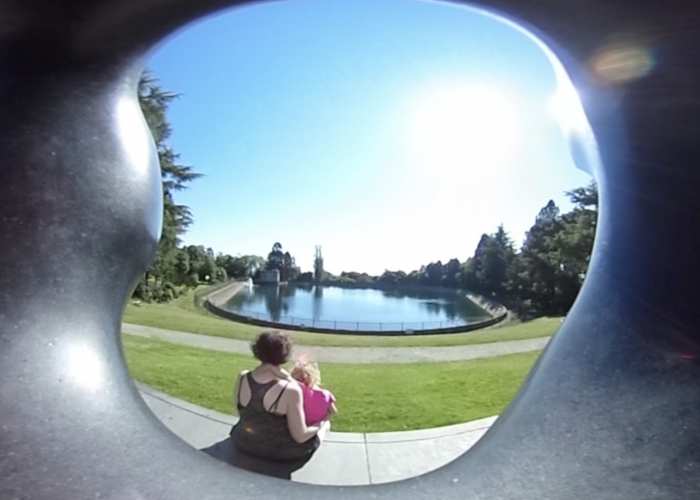
This video about Seattle’s Volunteer Park, designed by Frederick Law Olmstead (1822–1903), is an attempt to harness some of the possibilities of 360-degree video for public scholarship. Using an intimate, personal storytelling voice-over format adapted from radio, I use my own bodily experience of the park (which, as discussed above, is hard to exclude during filming) to frame a discussion of its design history. 360-degree video provides a sense of physical space that traditional video simply cannot capture and I hope more scholars of space and place will experiment, innovate, and share work in this format.

Instructions

In order to view the 360 video, you must be using the Chrome, Firefox, MS Edge, or Opera browser. To navigate around the 360-degree sphere, on a desktop computer, use your mouse to either drag the video itself, or use the controls on the upper left of the frame. On a tablet or phone, simply move your device around as if it were a camera.

Notes

[1] Beth Harris and Steven Zucker at Smarthistory, for instance, have developed a groundbreaking format for short, conversational YouTube videos about art and architecture that reach millions of learners around the world. The successful podcast series “99% Invisible” has also been a pioneer, using the intimate storytelling format developed by “This American Life” to make rigorous research on urban and architectural themes accessible and engaging. Although wildly popular, both of these projects are produced by tiny teams working on shoestring budgets.

Bibliography

Hansen, Mark B.N. 2006. Bodies in Code: Interfaces with Digital Media. New York: Routledge.

Hillis, Ken. 1999. Digital Sensations: Space, Identity, and Embodiment in Virtual Reality. Minneapolis: University of Minnesota Press.

Millar, Heather. 2016. “Can Virtual Reality Emerge as a Tool for Conservation?” JSTOR Daily (blog), August 11, 2016. https://daily.jstor.org/can-virtual-reality-emerge-as-a-tool-for-conservation/. Previously published in Yale Environment 360, June 27, 2016.

About the Author

Dr. Naraelle Hohensee holds a Ph.D. in Art History from the Graduate Center of the City University of New York and an M.A. in Media, Culture, and Communication from New York University. Her research, undertaken in tandem with digital media production, has to do with the many ways that our visual surroundings in the everyday urban landscape shape our perception of ourselves as individuals and as members of communities. Her dissertation research was on the rebuilding of central Berlin after 1990. She is currently the Andrew W. Mellon Postdoctoral Fellow at Smarthistory.org.

Table of Contents: Issue Twelve

Introduction
Kimon Keramidas and Ellen Prokop

Art and Architectural History and the Performative, Mindful Practice of the Digital Humanities
Alison Langmead

Hunting for Weave Matches: Computation in Art Scholarship
C. Richard Johnson, Jr. and William A. Sethares

Animated Shadows on Virtual Stone: Ancient Sundials in a Gallery Setting
Sebastian Heath, Rachel Herschman, and Christine Roughan

Teaching Renaissance Workshop Practice as Network Analysis
Elizabeth Alice Honig

3-D Modeling in the Urban Classroom: Using Photogrammetry for the Study of Historic Architecture in Coral Gables, Florida
Karen Rose Mathews, Amin Sarafraz, and Chris Mader

Of Software and Sepulchers: Modeling Ancient Tombs from Oaxaca, Mexico
Ellen Hoobler with Arturo Hernández Jr., Ve’Amber Miller, and Catherine Quinn

Doing Digital Art History in a Pre-Columbian Art Survey Class: Creating an Omeka Exhibition Around the Mixtec Codex Zouche-Nuttall
Lauren G. Kilroy-Ewbank

Views from the Field

Digital Developments in 2010s for an Art History Student and David Wojnarowicz
John B. Henry

Wandering Volunteer Park
Naraelle Hohensee

Issue Twelve Masthead

Issue Editors
Kimon Keramidas
Ellen Prokop

Managing Editor
Alessandro Zammataro

Copyeditors
TKTKTK

Staging Editors
Lisa Brundage
Anne Donlon
Laura Kane
Benjamin Miller
Teresa Ober
Danica Savonick
Luke Waltzer

Introduction: Re-viewing Digital Technologies and Art History

A widespread opinion within the academic community is that art historians have been left behind by the digital turn in the humanities (see Greenhalgh 2004, Zorich 2012, and the essay by Elizabeth Honig in this issue). According to many researchers and educators, the field of Digital Art History (DAH) — that is, the application of computational tools and analytical techniques to art-historical research questions — has not fulfilled its potential and remains a marginal branch of the discipline (Zorich 2012, 6). As Benjamin Zweig has argued, however, the assumption that art history has lagged behind other humanities disciplines in employing digital technologies is not entirely correct. In a 2015 article, he documents a selection of pioneering DAH projects, initiatives that emerged as early as the 1970s. Examples include the 1983 collaboration between the Getty Trust and the Architectural Drawings Advisory Group to produce a cataloging standard for digitized drawings that would allow scholars to search across all electronic repositories of works on paper as well as manipulate this information in ways that could stimulate new views of the material and thus, new research questions. The ambitious MORELLI project, launched in the mid 1980s by William Vaughan, a professor of art history at Birkbeck, University of London, is another example of an early DAH project. MORELLI, named for the nineteenth-century Italian connoisseur Giovanni Morelli who developed a system of identifying an artist’s “hand” by means of the close examination of a few key details that the artist executes consistently, was a pattern recognition tool that sought to classify and evaluate the formal qualities of images (Zweig 2015).

Unfortunately, these and similar initiatives did not fulfill their potential. Issues of funding, sustainability, archiving and access, copyright, and technological barriers ensured that what few gains were made were quickly undermined. In short, art historians faced challenges sourcing the software, maintaining and supporting collaborations and staff, and building and maintaining the datasets necessary for sustained intellectual engagement with DAH. As these early projects foundered, the field of literary studies advanced in the digital humanities — and with good reason. When the dataset is a text that can be scanned, when the “catalog” — in this case, the set of words included in that text — is readable across all platforms, it is easier to explore research questions using widely available digital tools, such as topic modeling and word embeddings. Unfortunately, these tools are not as useful for art historians, unless they want to analyze the oeuvre of an art historian, critic, or the writings of an important art-historical figure. Such an approach could be useful, but what about working with images? Isn’t that what art history is about?

This is one of the reasons why there remains anxiety among art historians that they have fallen behind their academic peers: art history is different. What defines art history is the study of the visual. Thus, the tools used and methodologies developed for DAH should support visual analysis and learning. Unfortunately, in the rush toward working digitally, many art historians and museum professionals have enthusiastically borrowed theoretical models and technical terms from disciplines and sub-disciplines such as literary theory, computer science, and cultural analytics without careful consideration as to how these methods and terms function within the specificities of the field of art history. Equally troubling is how many art historians have adopted a software developed for other disciplines and industries without due appreciation of how it structures data and thus might privilege certain information and promote certain trends (see Jaskot and Van der Graff 2017). In short, art historians require different tools — such as image-recognition software — tools that allow them to search, organize, catalog, and investigate images effectively, and few tools that fulfill these needs are available. Fortunately, with recent advances in the fields of computer vision and Artificial Intelligence, this will change. The future is looking bright.

But what about the present? Despite the challenges outlined above, we would argue that it is still possible for art historians to benefit from embracing existing current digital tools and computational techniques. As the essays in this special issue attest, there is a place in the discipline right now for the digital.

The issue begins with Alison Langmead’s discussion of art history’s longstanding engagement with image-based reproductions and how these “significant remediations” have affected the development of the discipline. Far from being marginalized by the digital turn, she argues for art history’s central role in the digital humanities as a model for the “mindful” adoption of technology. The discipline, she concludes, “can offer objective lessons on the risks of taking both the technical and social affordances of [digital] tools for granted” and thus, may promote awareness of how technologies impact the research process.

The remaining essays are divided into two groups that examine DAH at work in the art gallery and the university. C. Richard Johnson, Jr. and William A. Sethares’s “Hunting for Weave Matches: Computation in Art Scholarship” outlines the pioneering application of signal processing to a traditional technique of painting analysis—thread counting. Determining the weave density of the canvas support of a painting offers conservators crucial technical information as well as useful clues regarding the painting’s origin and approximate date of execution. Manual techniques for thread counting, however, are time-consuming and laborious. Johnson, a professor of engineering at Cornell University, realized that this process could be automated by means of algorithmic analysis of x-rays of paintings. Using this method, the canvas supports of different paintings may be matched. These matches suggest that the paintings may have originated from the same bolt of cloth, a discovery that in turn suggests the paintings were in the same place at one point in their history. In their article, the authors outline the procedure for comparing possible weave matches in full, stage by stage, providing increased understanding of this ground-breaking technique and offering a model for future collaborations between art historians and scientists.

Animated Shadows on Virtual Stone: Ancient Sundials in a Gallery Setting” by Sebastian Heath, Rachel Herschman, and Christine Roughan describes the use of animated displays at a 2016–2017 exhibition held at New York University’s Institute for the Study of the Ancient World (ISAW). The exhibition introduced audiences to more than one hundred time-tracking devices from Greco-Roman antiquity. To illustrate how ancient audiences experienced these devices, the organizers formed collaborations across multiple departments, including the work of graduate students, to develop a series of 3D animations using the open-source animated suite Blender. The resulting digital surrogates were cost-effective and highly informative, not only helping the public to understand how the objects on display functioned but also showing examples that could not be included in the exhibition due to size or location. Happily, these “exhibits” will enjoy an afterlife on the journal’s site.

Appropriately, many of the articles in this issue examine the use of digital tools and new methodologies in the classroom. Elizabeth Honig provides an honest and enlightening analysis of two courses she designed that disrupt the art history lecture, the cornerstone of art-historical instruction. As she notes, transitioning from the lecture format, reliant on the projection of images in a darkened room as well as the instructor’s expertise, to an interactive model that requires students to engage with data collection, digital technologies, and each other is not a simple process. Professors of art history will have to gain new skills in computer science and statistics; what will be more difficult is learning to embrace the serendipitous encounters, unplanned epiphanies, and failures of project-based learning. The professor “cannot control either process or outcomes” as in a lecture course, Honig observes. Reworking the traditional art history class, however, will ultimately enable students to develop new skills in critical analysis and knowledge production.

3D Modeling in the Urban Classroom: Using Photogrammetry for the Study of Historic Architecture in Coral Gables, Florida” presents an additional, highly innovative approach to rehabilitating the traditional art history course. Instead of focusing on the formal qualities and construction history of the architectural monuments in lectures and emphasizing art-historical research and writing in assignments, Karen Mathews, Assistant Professor of Art and Art History at the University of Miami, and her team seize the opportunity to teach students about data collection and curation, collaboration, online exhibitions, digital tools and storytelling, and public art history as well. The materials, textual and visual, that are produced during the semester are published on an interactive website, a project that not only increases the students’ but also the public’s engagement, creating “bridges between the university and the community around it [and] promoting awareness of cultural heritage sites and their preservation.” The authors’ thorough explanation of their process generously allows other educators to investigate this innovative pedagogical paradigm.

Two articles in this special issue focus on Pre-Columbian topics; this may not be coincidental but instead indicative of how specialists of non-Western cultures have often been critical of conventional research methods and pedagogical strategies and are more willing to explore novel approaches in their scholarship and instruction. Ellen Hoobler’s article, produced in collaboration with three of her students, presents an additional example of how 3D modeling can offer increased understanding of the material past. Hoobler’s original plan was to expand on her dissertation research examining the tombs of Monte Albán in Oaxaca, Mexico, built by the Zapotec peoples in ca. 500 BCE–850 CE, by producing an interactive model of one of these tombs, including all of its contents. During the course of two summers, her team created dozens of 3D models, visualizations, and videos as well as a website documenting their work. While the completion of her original vision proved a much more difficult process than anticipated, the experience of Hoobler and her students yields instructive insight into issues of collaboration, sustainability, funding, and community engagement. Hoobler notes that perhaps the most important lessons her students gained from this DAH project were the “byproducts” of their contributions: increased skills in visual analysis and archival research as well as a deeper comprehension of the process of contextualization.

Outlining the incorporation of DAH methods and tools into a Pre-Columbian art history survey course, Lauren G. Kilroy-Ewbank’s essay expands on several of the themes developed throughout this special issue, including the instructive byproducts of the student-centered DAH project. The centerpiece of her course is the creation of a collaborative online exhibition using Omeka, a popular open-source content management system for the production of online exhibitions, focused on the Mixtec Codex Zouche-Nuttall (ca. 1450). The assignment requires students to source and annotate images, create metadata, and assess online resources as well as undertake traditional art-historical research; it also encourages students to consider issues of digital visual culture, digital storytelling, and the possibilities of public art history. Like Honig and Hoobler, Kilroy-Ewbank finds that student engagement with DAH is not always a straightforward process. Yet, she argues, students receive valuable lessons regarding responsibility, both to their team and the discipline, from the experience. Helpfully, Kilroy-Ewbank includes her course syllabus as an appendix, making it easy for similar-minded pedagogues to integrate these types of assignment in their own classrooms successfully.

The issue concludes with two non-peer-reviewed pieces that record experiences of working within the field of DAH. John B. Henry documents his evolving research on David Wojnarowicz and how information resources created by the Artist Archives Project that guide researchers through the collections held by New York University’s Fales Library and Special Collections affected his understanding of the artist. Henry argues that this tool not only facilitates research but also offers the opportunity for additional knowledge creation through the incorporation of online comments and the institution of an online community. More than a digitized collection, it is in effect an “ambitious project in digital art history” that offers new models for academic study.

Finally, Naraelle Hohensee presents her 360-degree video of Seattle’s Olmsted Brothers-designed Volunteer Park (1904–1910), an educational resource that offers an immersive environmental experience as well as presentations of historical documentation. Her literal exploration of this public space fuses design history with urban studies and offers an embodied understanding of the site, thus — like many of the DAH projects introduced in this issue — providing increased comprehension of how people interact with the built environment. The result is both an informative and entertaining mediation on the designers’ accomplishment and a subtle analysis of the evolving role of the historian in the digital age that raises questions regarding the use of digital storytelling in the academy and across cultural institutions.

Technology that allows art historians to work with images rapidly and effectively will be available in the near future, and art historians must take an active role in determining how this technology is developed. After all, who better than art historians to direct these advancements? Or, as Kilroy-Ewbank observes: “Art historians (and our students) are […] positioned to think critically about digital visuality and analyze how digital visual environments encode ideas.” Art historians should remain alert to these new developments in computer vision, stay informed, and, when possible, collaborate with technologists, computer scientists, and other digital humanists to ensure that these professionals and their projects benefit from their expertise. In this way art historians will once again become significant contributors to the digital humanities.

Bibliography

Greenhalgh, Michael. 2004. “Art History.” In A Companion to Digital Humanities, edited by Susan Schreibman, Ray Siemens, and John Unsworth, 31–45. Oxford: Blackwell Publishing Ltd. DOI: 10.1002/9780470999875.ch3.

Jaskot, Paul B., and Ivo van der Graaff. 2017. “Historical Journals as Digital Sources: Mapping Architecture in Germany, 1914–24.” Journal of the Society of Architectural Historians 76, no. 4 (December): 483-505. DOI: 10.1525/jsah.2017.76.4.483.

Zorich, Diane. 2012. Transitioning to a Digital World: Art History, Its Research Centers, and Digital Scholarship. New York: Samuel H. Kress Foundation. http://www.kressfoundation.org/research/transitioning_to_a_digital_world/.

Zweig, Benjamin. 2015. “Forgotten Genealogies: Brief Reflections of the History of Digital Art History.” International Journal for Digital Art History 1. DOI: 10.11588/dah.2015.1.21633.

About the Authors

Kimon Keramidas is Associate Director and Clinical Assistant Professor in NYU’s Center for Experimental Humanities and Adjunct Assistant Professor for the CUNY Graduate Center Doctoral Certificate in Interactive Technology and Pedagogy. Kimon is one of the founding member’s of The Journal of Interactive Technology and Pedagogy, as well as being a founding member of NYCDH.org, co-director of OutHistory.org and co-investigator of History Moves. Kimon has worked extensively on digital exhibitions, and is currently co-curating an exhibition for the Freer|Sackler Asian Art Galleries of the Smithsonian Institute on the Sogdians, a middle ages mercantile culture from Central Asia. His most recent project is The Interface Experience, a multi-platform exhibition which included a physical exhibition, web application, and award-winning catalog for the Bard Graduate Center. Kimon’s web site @kimonizer

Ellen Prokop is the Associate Head of Research and a member of the Digital Art History Lab at the Frick Art Reference Library, New York, and Adjunct Professor of Art History at Hunter College, City University of New York. She was the lead author and editor of Art History in Digital Dimensions: A Report on the Proceedings of the Symposium (2017), and has published several articles and essays on Spanish art of the sixteenth and seventeenth centuries, including most recently a chapter in El Greco Comes to America: The Discovery of a Modern Old Master (2017). Please contact her at [email protected].

Illustration of the Image Investigation Tool, showing two paintings by Jan Brueghel with a detail cropped from one and made into a transparency.
0

Teaching Renaissance Workshop Practice as Network Analysis

Abstract

In this essay I recount my own experience in transitioning to a project-based, data-driven teaching of art history within a Digital Humanities context. I focus in particular on the art-historical module of my DH class “Digital Travels,” taught in the Spring of 2017. I suggest that having students work on material about which I knew a great deal was not optimal, because it lead me to expect a level of sophistication in creating, visualizing, and especially interpreting data that could not be achieved by most non-experts in five weeks. However, I also suggest that putting students into complicated and messy learning situations is valuable and, for the students willing to engage at this level, can teach them how to think in ways that more traditional, bounded learning experiences often fail to do.


Art history has had its particular pedagogical format for nearly a century: the paired slides in the darkened room, the voice of the lecturer trying to speak with enough energy and excitement to keep the students awake. As other disciplines experienced the new adventure of PowerPoints, we merely jettisoned glass-encased slides in favor of digital images and grumbled about the smaller projection area. After decades of posting glossy photographs on bulletin boards for our students to study, we moved to digitized study collections and websites in the 1990s and congratulated ourselves that we were far ahead of the rest of the humanities in embracing technology. Then they caught up. And as both research and pedagogy moved to encompass something called the “Digital Humanities,” art historians realized that our models were poorly suited to the demands of this new age. What was our “data” and did students ever study it? How many students had ever been asked to do group work? How many professors had practiced “project-based learning”? Only a few years ago, my campus proposed to convert all the art history lecture spaces into “smart classrooms,” with screens on every wall and seating that could be grouped at stations; my department, in horror, protested that in art history, we used one screen and the students sat in rows!

For the past year, I have taught in a smart classroom. My students have gathered data and done group work. Everything has been based on projects. This has not been an easy transition. With encouragement and a teaching grant from my campus’s Digital Humanities program, I taught two courses under that rubric: a freshman seminar called “Humanists on the Move” and an advanced course for juniors and seniors with the less catchy title “Digital Travels: Images and Texts ca. 1600.” The former class involved very little art history, and while a third of the latter was devoted to an art history project, I do not feel that unit went terribly well. This is not to say that it is impossible to teach digital art history effectively. It merely suggests that my own comfort zone in the digital world as allied to the history of art was difficult to transfer to pedagogy. It also might indicate that specialization, such a help in lecturing, can be an actual handicap in this kind of work: the material about which I knew relatively little was more effective in a project-based context than that in which I was an expert. The fact that I had developed a website dedicated to the study of Jan Brueghel (1568–1625) and had written a book on the topic at once made student projects on the Brueghel workshop possible, and problematic.

Project-based pedagogy was in many ways a shock. You cannot control either process or outcomes the way you can in a lecture course. It is very challenging to plan the sequence of work carefully enough: while in theory, every project is a new and exciting adventure in which professor and students engage jointly, in practice this works better if you have taught the same project previously. Thus although I had carefully crafted my “Digital Travels” syllabus, and spent a week studying “Digital Pedagogy” at the Digital Humanities Summer Institute in Victoria, Canada to refine my assignment sequence, the students rightly complained that the course was disorganized and the projects were hard to understand. The only project that worked really well in that class was one I had taught in the freshman seminar the semester before—and it was not about art history. In what follows here, I will explain the DH work in art history that I had my students undertake, consider some reasons why the outcomes were not fully satisfactory, and suggest how the pitfalls I encountered might be avoided by others wishing to engage in this kind of teaching.

In the field of renaissance art history, it is well known that within workshops, the master and his assistants often repeated basic elements of pictorial imagery. Artists replicated and re-purposed textile patterns, landscape elements, figures, even entire compositions using a wide variety of ingenious techniques (for an outstanding study of these techniques see Bambach 1999). Some were notorious for excessive repetition, and contemporaries criticized them for this. Vasari reports that when an altarpiece by Pietro Perugino (ca. 1446–1523) was unveiled, “it received no little censure from all the new craftsmen, particularly because Pietro had availed himself of those figures that he had been wont to use in other pictures” (Vasari [1550; 2nd ed., 1568] 1912–14, 4: 44). Yet overall, an early modern buying public seems to have had a less rigid notion of uniqueness and originality than later generations would develop. The repetition of forms is not something I spend a lot of time on in my normal lecturing on this period because it is rather dry and technical to an undergraduate audience. However, I thought that the mobility of patterns across renaissance workshops could be rather interesting to trace through a digital and collaborative project.

One artist of this period whose work is particularly marked by repetition is Jan Brueghel, son of the more famous Pieter Bruegel (ca. 1525–1569). Sometimes on his own and sometimes with the help of studio assistants he produced multiple copies and variants of many of his own compositions. He also borrowed from and revised works by his renowned father. The replication may be quite close, but more often the works are subtly different from one another. Bits of imagery are shuffled and recombined across images: the same windmill looks out over rolling hills in one composition but over a riverside town in another; a group of cattle wander down a village street and then reappear on a rural mountain path; the same man carries his sack through a woodland here and over a bridge there; a monkey climbs a tree in paradise and then shambles through a gigantic fruit garland. Drawings and oil sketches, most now lost, enabled this mix-and-match of fragmentary elements to be drawn together into hundreds of individual works of art.

But how were these various works actually created, how did they really relate to one another, and who was doing this work—Brueghel, his studio, later copyists, or imitators? In my book on Brueghel, I wrote that ideally one would have a map that located all the pictures at a greater or lesser distance from Jan himself and indicated their relationships to one another (see Honig 2016, 23–35). But mapping is not the right digital tool for this job: network analysis is the best tool to visualize data about these webs of artistic relation. Creating and refining that data and then visualizing it through network analysis tools was the task that I set the students in “Digital Travels.”

“Digital Travels” was cross-listed in the departments of English and Art History. Officially a lecture course, the class met four times each week over fourteen weeks. Since it was a project-based class, I only really lectured once or twice a week, providing the background information that the students needed to pursue each of three projects; for the remainder of our sessions, class time was devoted to discussion and group work. The student projects centered on renaissance mobility and allowed them to practice three types of digital work: mapping, network analysis, and text analysis (“distant reading”). For each project, it was important to me that the students generate original data as well as visualizing and analyzing it. Thus in the first unit they each researched the travels of a single historical figure, geocoded all the locations, combined their data with that of the other students working on related figures (rulers, artists, scientists, etc.), and then produced a map of historical travels. In the third unit, each group created a text corpus of a single continent covered in the Voyages by Richard Hakluyt (1553–1616), and used Voyant to analyze it.[1] The second unit focused on the Brueghel material and was the only art-historical assignment. About half of the students in the class had little or no art-historical background. They had five weeks, slightly over a third of the semester, to work on this project.

The raw data that I provided for the students consisted of hundreds of paintings and drawings from the Brueghel workshop, which I had further subdivided into what we called “series” or “clusters” of related images. The students were divided into groups of 3–6 students, and each group worked on a body of between 25 and 60 related works produced by Jan Brueghel, his father Pieter, and the studios of both masters. As an example, I illustrate here works from the cluster of paintings by Pieter and Jan showing the Adoration of the Magi (Figures 1 and 2).

Two very similar paintings by or after Pieter Bruegel, showing the Adoration of the Magi.

Figure 1. Two very similar paintings by or after Pieter Bruegel, showing the Adoration of the Magi.

Two very similar paintings by Jan Brueghel or his studio, showing the Adoration of the Magi.

Figure 2. Two very similar paintings by Jan Brueghel or his studio, showing the Adoration of the Magi.

In this cluster, the works are closely related to one another within the sub-groups of “Pieter works” and “Jan works” but are never truly identical, although the earlier Pieter group is more closely interrelated than the later Jan works. It is unclear how the two sub-groups are related to one another.

To prepare the students to think about this material, I lectured on the replication of imagery through prints and studio patterns; on painting techniques and methods of copying in the early modern period; on the development of the art market in this period and the value of originals vs. replications; and on the Brueghel family as artists within this world. We read and discussed texts about workshop practice as well as conceptual material on imitation, originality, and aura. Students spent one meeting looking at prints in the Berkeley Art Museum and Pacific Film Archive and thinking about reproductive images. They also visited the De Young Museum in San Francisco, looked at trompe l’oeil paintings there, and wrote a short paper comparing the visual experience of an illusionistic painting to the visual information that a digitized version (on Google Art) provided. Since they would be working with digital images when considering issues of artistic facture and manufacture, I wanted them be conscious of what information they received, and lost, through digital viewing. This, I thought, was a very successful assignment that both art history and English majors engaged with well.

For the core unit work, the students operated both on their own and in their groups to study the cluster they had been assigned, break it down into segments of imagery, and compare that imagery among all the paintings. Once each student in the group had assumed responsibility for a specific type of imagery—the lions in Paradise, for example, or the kneeling king in a representation of the Adoration of the Magi—they began using a digital tool that I had designed, the “Image Investigation Tool” (IIT), to compare pairs of pictures and their details (Figure 3).

Illustration of the Image Investigation Tool, showing two paintings by Jan Brueghel with a detail cropped from one and made into a transparency.

Figure 3. Illustration of the Image Investigation Tool.

Some students assessed the similarity of entire compositions—i.e. had they been duplicated exactly or were small changes introduced?—but most extracted particular details repeated in some or all of the works and created overlays to see whether imagery had been exactly transferred or approximately copied. In order to describe these relationships, the groups discussed the criteria by which they could assign numerical values to types of similarity.

The students then made individual spreadsheets of linked data with a first sheet listing attributes of each individual image (scale, support, attribution) and a second describing relationships between those images (Figures 4 and 5).

Spreadsheet of node (object) properties, Adoration of the Magi paintings by the Brueghels.

Figure 4. Spreadsheet of node (object) properties.

Spreadsheet of edge (relationship) properties of the same Adoration of the Magi paintings.

Figure 5. Spreadsheet of edge (relationship) properties of the same Adoration of the Magi paintings.

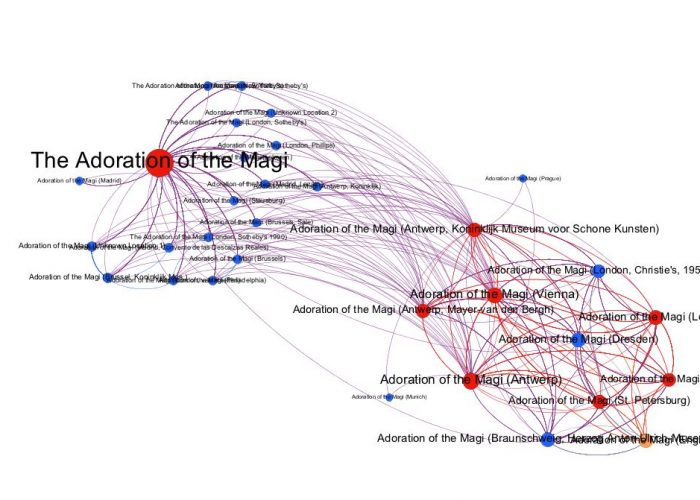
They then combined these into one spreadsheet for the whole group, cleaned up the data using OpenRefine, and used the resulting spreadsheet to visualize the interconnections between the artworks in their cluster.[2] First, they used Palladio, an open-source tool set available from the Humanities & Design Research Lab at Stanford University.[3] Palladio is extremely simple to use. Although its visualizations are not elaborate and colorful, it does have a surprising number of capabilities and students who were comfortable with exploring digital tools found ways to visualize different aspects of the network of imagery (Figure 6).

Visualization of the relationships between Adoration of the Magi paintings made using Palladio

Figure 6. Visualization of the relationships between Adoration of the Magi paintings made using Palladio.

Some students had been learning in another course to use Gephi, a more complex network visualization tool, and they led the groups in uploading data to display more attributes of both nodes (paintings) and edges (relationships).[4] Edge colors could now be used to visualize what type of imagery connected two works, node colors to indicate whether works were autograph or studio versions, and the closeness of relationship (edge weight) could be shown at the same time (Figure 7).

Visualization of the same data made using Gephi.

Figure 7. Visualization of the same data made using Gephi.

When the groups presented their results to the class, it was clear that the Brueghel studio had operated very differently depending on the kind of image they were producing. For instance, paintings depicting the scene of the Adoration of the Magi were divisible into tight clusters connected in terms of overall composition although varied in details, while images of Paradise were mish-mashes of bits of imagery that moved across all the paintings rather than falling into distinct sub-groups.

This was very interesting to me, but when I read the papers each student wrote about their group’s results, I realized that many of them did not have the art-historical background to make sense of the data they had generated. Even the art history students were not always able to see the implications of their own work, and the students from the English department were, I suspect, frustrated by the entire exercise. There were too many layers to the problem: studio practice, originality, and market value were meeting data creation and analysis and the use of new digital tools. There were certainly students for whom all these pieces came together and who wrote wonderful papers, but other papers showed a level of plain confusion that I am not used to seeing in an upper-level class. This project truly separated out the students willing to put in extra time, thought, and effort from those accustomed to doing rather well just by coasting. Those students were lost.

I would argue that it is good for students to be confused sometimes. Faculty frequently complain that students today need, and receive, excessive amounts of guidance on each assignment, often resulting in prompts and grading rubrics that are longer than the assignment itself. Such assignments for which successfully ticking off each box results in an “A” grade is one cause of the grade inflation that also infuriates faculty. It is healthy for students to have to feel their own way through material, to ponder what kinds of evidence can be mobilized, how data can be interpreted, how to create an argument that synthesizes disparate threads. Beyond simply learning to deal with “messy data,” they should learn how to deal with messy problems and not expect neat paths to historical knowledge. Yet to work this way effectively and without excessive guidance, they need to have enough knowledge—or the means of acquiring it—to make informed assessments of their material. Project-based learning allows us to plunge students into more open-ended ways of learning but it also challenges us to provide them with a different kind of scaffolding for their work.

This is doubly difficult in a Digital Humanities context because in addition to providing a context for interpretation we are also guiding the students through both theoretical and practical questions pertaining to a way of working digitally that is itself probably new to most of them. Before my class embarked on their art history project, they had already done a more straightforward mapping project in the course for which they had read some key theoretical texts about DH, and they read a few others during this second unit.[5] Yet to ask them to think critically about the practice of DH at the same time as they were engaging in a digital art history project was indeed asking a lot. A handful of my students were concurrently taking other DH classes, and they had a huge advantage over the rest of the group. They already knew tools and concepts the way that the art history majors already knew about theories of the copy. Some of these DH specialists also had a very advanced grasp of how to think about linked data and how it could be visualized using different tools to reveal new insights into the material. They understood the implications of what they were doing. Because the students were working in groups, and I had been careful to distribute these students among the groups, they were able to share their expertise with their peers and most of the group spreadsheets, visualizations, and presentations were excellent. In the individual papers, however, it was very clear who had understood the digital work they had engaged in—and who had just been going along for the ride.

One important takeaway from this experience, for me, was that if you are too much of an expert on a subject, it is hard to see how complex a “project” really is. A good lecturer can organize, simplify, interpret, and explain even very advanced and subtle material. But it is much more difficult to put together a coherent project about a tough, multi-leveled subject with both historical and theoretical implications involving data-gathering and digital-tool-using in such a way that students can comprehend it and feel that they have made a contribution to knowledge, which is the ultimate goal of any project-based learning experience. The class’s other projects, in non-art-historical areas about which I knew rather little, worked better for the very reason that I was not asking, nor expecting the students to ask, very sophisticated questions about their data. To teach on your own material through projects and digital tools, you need to slow down the pace at which the students proceed; make sure they have time to digest all the facets of the project (historical content, art-historical theory, digital tools); and guide them in synthesizing their work so that they fully understand its implications.

The class’s final assignment asked each student to write a paper designing a DH project for another class they were taking, and then positioning themselves within the field of the Digital Humanities. The students seemed to enjoy this assignment and did well on it: their projects for other classes were smart and imaginative and their self-positioning was very thoughtful. I might try extending that assignment in smaller pieces over the course of the semester, allowing students to connect it more directly with their art-historical work as they are completing that project. In addition, were I to teach this material again, I would want to give the students a bit more time to process the implications of what they were doing, either by preparing more of the visual data myself, or by having fewer projects in the semester so that the art-historical one would be emphasized.

So was this class, with its digital art-historical section, a success? Measured in terms of the dreaded course evaluations, no. From my normal lecture course average of about 6.5 out of 7, I went down to about 5.5—a precipitous drop that made me glad that I already had tenure. Many students shared my dislike of the out-of-control feeling of the class, the lack of smooth trajectory, and the unfamiliar types of outcome. In the end, however, those reactions were compensated for by people who wrote, “This class really allowed for me to think—some classes show you what to learn, but this class taught and encouraged me how to learn, how to think: I loved that,” and “I did more reading, analysis, and just plain thinking than I’ve ever done in any other Berkeley course, and through it I’ve grown as a writer and as a scholar.”[6] Two students have asked me for recommendations to go on to graduate school in digital art history, and one wrote an article for a student magazine about DH and her experiences in this class (Buyukakbas 2017). Teaching at the edge of a new field, a new methodology, is incredibly challenging but it also has great rewards.

Notes

[1] http://voyant-tools.org/

[2] http://openrefine.org/

[3] http://hdlab.stanford.edu/projects/palladio/. Palladio also has a mapping functionality that we had used in Unit 1, so the students were already familiar with how its data functions worked.

[4] https://gephi.org/

[5] Texts they had read up to and during this unit included Kramer 2012; “Day of DH: Defining the Digital Humanities” 2012; Drucker 2011 and 2012; and Moretti [2003] 2005 and 2013.

[6] Quoted from course evaluations written in April 2017.

I would like to thank the Mellon Foundation, Tony Cascardi, and Claudia von Vacano for their support of Digital Humanities at U.C. Berkeley; Jess Bailey, who was my invaluable teaching assistant for this course; and all the people who advised me and gave guest lectures, particularly Scott McGinnis, Rebecca Levitan, and Justin Underhill.

Bibliography

Bambach, Carmen. 1999. Drawing and Painting in the Renaissance Workshop: Theory and Practice, 1300–1600. Cambridge and New York: Cambridge University Press.

Buyukakbas, Elif. 2017. “Digital Humanities: A (Relatively) New Approach to Humanities.” Caliber Magazine, October 3, 2017. https://issuu.com/calibermag/docs/preview_issu/.

“Day of DH: Defining the Digital Humanities.” 2012. Debates in the Digital Humanities, ed. Matthew K. Gold. Accessed January 31, 2018. http://dhdebates.gc.cuny.edu/debates/text/40.

Drucker, Johanna. 2011. “Humanities Approaches to Graphical Display.” Digital Humanities Quarterly 5, no. 1. http://digitalhumanities.org/dhq/vol/5/1/000091/000091.html.

———. 2012. “Humanistic Theory and Digital Scholarship.” In Debates in the Digital Humanities, edited by Matthew K. Gold, 67–71, 85–95. Minneapolis: University of Minnesota Press.

Honig, Elizabeth A. 2016. Jan Brueghel and the Senses of Scale. State College: Pennsylvania State University Press.

Kramer, Michael. 2012. “What Does Digital Humanities Bring to the Table?” September 25, 2012. Accessed January 31, 2018. http://www.michaeljkramer.net/cr/what-does-digital-humanities-bring-to-the-table/.

Moretti, Franco. (2003) 2005. “Graphs.” Republished in Graphs, Maps, Trees, 3–33. London: Verso.

———. 2013. “The Slaughterhouse of Literature.” In Distant Reading, 63–89. London: Verso.

Vasari, Giorgio. (1550; 2nd ed., 1568) 1912–14. Lives of the Most Eminent Painters. Translated by Gaston du C. de Vere. 4 vols. London: Macmillan & The Medici Society. http://www.gutenberg.org/files/28420/28420-h/28420-h.htm#Page_31.

About the Author

Elizabeth Honig teaches the art of early modern Europe at U.C. Berkeley. She is the author most recently of Jan Brueghel and the Senses of Scale (2016) and manages the websites janbrueghel.net, pieterbruegel.net, and the forthcoming brueghelfamily.net.

Images are for demo purposes only and are properties of their respective owners. ROMA by ThunderThemes.net

Skip to toolbar
