Issue Fourteen

0

From Page to Screen and Back Again: Archives-Centered Pedagogy for the 21st Century Writing Classroom

Abstract

This paper describes the efforts of three instructors to incorporate archival research into first-year and advanced undergraduate writing courses. Inspired by recent scholarship on the value of archives-centered pedagogy in rhetoric and composition, we participated in the second cohort of the University of Georgia’s Special Collections Libraries Faculty Teaching Fellowship program, an effort to help faculty learn best practices and methods for using primary source material held in our Special Collections Libraries. In the program we developed courses that ran during Academic Year 2017–18: two First-Year Composition II courses and one upper level writing course, Writing for the World Wide Web. We found that working with archival material in writing courses allowed students to remix, appropriate, and curate the past as they identified new avenues for exploration in the unanswered questions and creative provocations presented by the historical record. In addition, the collaborative and active nature of the archives-based composition process helped build an awareness of the social nature of writing and the material properties of texts that are essential for critical 21st-century literacy.

Introduction

In 2017, we participated in the University of Georgia’s (UGA) Special Collections Libraries Faculty Teaching Fellowship (SCLFTF) with a common goal of using archival collections and research methods to improve student writing. The fellowship offered us access to the expertise of the archivists and the space of the library for our student population in courses that we developed over the course of the program. As Wendy Hayden (2015, 404) has noted, “One challenge to integrating archival research into undergraduate courses has been the lack of practical advice and training in archival research provided by the field.” UGA’s archival Teaching Fellowship  program provided us with crucial training in navigating the collections, working with finding aids, and understanding the “archival and library principles that support robust discovery and integration of relevant special collections materials” (Center for Teaching and Learning, n.d). During Spring 2017 semester, we each developed writing courses that would introduce students—both first-years and upper-level English majors—to archival research.

In this article, we describe the resulting archives-centered courses that we ran during Academic Year 2017–18 and discuss what we see as the most significant implications and opportunities for writing pedagogy that emerged from our experience. More specifically, we focus on the way this work foregrounded the technologies and materialities of texts and the collaborative and social nature of writing activities. In our courses, students, instructors, and librarians worked together to assemble and recontextualize archival materials through varied lenses and to produce new collaborative and multimodal texts that drew on that material in different ways, not necessarily simply as sources to be cited, but as inspirations for new ways of thinking about the past and future. Using archival research also gave our students the opportunity to think in new ways about how library-based material can produce new questions for exploration and how rare books and manuscripts can inform and inspire textual form and delivery systems in the digital age.

A key question for us was, “What does this kind of focus on textual materiality and physical interaction with primary texts bring to the table for writing pedagogy?” We observed that archival work is not, as typically depicted, solitary. As Matthew A. Vetter has noted, instructors who use the archives must collaborate with the librarians and often with outside organizations in charge of the archives as well; as such the authority in the classroom is dispersed throughout a community that is able to include and inspire the students (2014, 36–37). In each of our courses, we, the instructors, could provide some guidance but not prescribed rules for interaction with the archive, nor could we predict the outcomes of the class research.

The instructor generally curates the archive in an undergraduate setting, encouraging the students to work collaboratively with the texts to decode unfamiliar media. In addition, all work must be done at the archive, in reading rooms with strict rules, all of which takes reading out of the private space and into a social one. In her consideration of how to tap into the social affordances of digital media in scholarly publishing, Kathleen Fitzpatrick (2007) reminds us that “the technology of the book, and the literate public with which it interacted, produced a general trend toward individualizing the reader, shifting the predominant mode of reading from a communal reading-aloud to a more isolated, silent mode of consumption.” Classroom archival work shifts the focus back to reading as a communal act, serving as a model for cooperative writing. Fitzpatrick notes that “texts have thus never really operated in isolation from their readers, and readers have never been fully isolated from one another, but different kinds of textual structures have given rise to and interacted within different kinds of communication circuits.” One of these communication circuits is the work the archivist put into developing an archival collection. A well-developed collection has been built with an eye toward how the material is connected. So, by the time the collection is available to the public, the networks between the materials have already been established. Thus, archival work allows for an alternative “communication circuit” between readers and writers—both a return to more traditional (communal) modes and forward movement toward new modes of communication enabled by new media. In addition, by bringing different but related materials together, the archive allows students to see how diverse texts and types of media are in conversation with one another.

Following these textual considerations, we wondered, “How does archives-centered writing pedagogy promote the kinds of collaborative, curatorial, and recombinatory skills that are critical to digital age composition and literacy?” Building on the idea of archives-centered pedagogy as social and networked production and dissemination of knowledge, archival work in the undergraduate writing classroom also engages students in developing what the National Council of Teachers of English defines as 21st century literacies, including collaborative problem-solving, information management, and multimodal textual analysis and production skills. We were also inspired by the London Recut project, which uses digital film archives to allow communities to co-curate and remix archival material based on affinity and interest. As Recut’s Andrew Chitty notes (2011, 418), “Opening up film and video archives for use (not just viewing) by the wider public may create new narratives and interpretation, but it might also create new uses discovered by the users themselves.”

All of our courses were engaged in a kind of “meta-remix” composing process in that we asked students to mash up, combine, and translate primary source materials in a variety of ways, whether through historical reenactments, creation of mini collections/exhibits, or inspiration for digital textual design plans or their own zine compositions. These meta-remixes pressed students to find sources that provoked them to rethink their preconceptions rather than simply finding sources to use as evidence for preconceived arguments. In what follows, we provide individual case studies of our courses and conclude with some final thoughts on the benefits of archival work in writing courses.

Saxton’s ENGL 1102: “Scandal in the Archives” in First-Year Composition II

I was drawn to the archives and the archival Teaching Fellowship because of the ways in which archival materials demand investigative and engaged interaction. Susan Wells (2002, 58) has posited that the archives “prompt us … to resist early resolutions of questions that should not be too quickly answered”; this resistance might take the form of refusing answers, unearthing new depths or expanses for research, or necessitating new forms of expression to encapsulate its contents. My hope was to find materials that might inspire students to dig deeper into their sources to better analyze and contextualize them, but also to become comfortable with more open-ended research.

I coupled the archive’s lack of closure with the similarly open theme of scandal. Scandals, by their nature, offer a sense of mystery; even from the same smattering of facts, the connections between those facts and conclusions from them vary. Scandals disrupt modes of meaning and, as such, are interesting sites to examine rhetorical and contextual meaning. As Adrienne McLean notes, scandals are “discursive constructions as well as events, and it matters who controls the selection and omission of their narrative details” (2001, 2). Moreover, the culture in which the scandal occurs matters; what might be a scandal in 1900 might not elicit a reaction in 2018. In this way, scandal allows for a thorough investigation of who controls the narrative and how it is received; scandals, the students learn, resist fixed facts but instead show the ways in which meaning is constructed.

The archives and the focus on scandal forced my students to grapple directly with this openness but also to rely on their classmates to build a new network of knowledge. For example, the first scandal we investigated followed the archived media flurry surrounding the disappearance of an 18-year-old servant, Elizabeth Canning, in London in January 1753. Despite the hundreds of witness statements, thousands of pages of speculation, and incredibly detailed court documents, there is no authoritative document revealing the truth of what happened to Canning during the 28 days she was missing. Working in teams, students shared responsibility for the hundreds of pages of texts on the event. Yet, even with the accumulation of information, my students noted that their sources required them to read with a critical and active eye to determine what was important. Such analysis was built through collaboration as each group had to work together to create meaning—filling in factual background for their peers but also offering theories of how best to understand the event.

""

Figure 1. Students encounter a carefully preserved edition of Henry Fielding’s treatise supporting Elizabeth Canning as well as Crisp Gascoyne’s defense of Mary Squires. (Image courtesy of Hargrett Rare Book and Manuscript Library/University of Georgia Libraries.)

In addition to researching the scandal, the students were asked to inhabit the texts, taking on the roles of Canning supporters, defenders of the accused Mary Squires, or undecided “jury” members. Borrowing from the Reacting to the Past model, students searched the documents to find evidence and viewpoints that would cast doubt or bolster Canning’s story. Because of the breadth of the archive, group members were forced to collaborate, sharing information and determining a “narrative” of the event or, in the jury’s case, questions about the most puzzling parts of the evidence. This research culminated in a day of gossip as the Canning and Squire supporters attempted to sway the jury. The exercise asked students to take control of the archives and experience the scandal. Ultimately, students reported feeling overwhelmed by the ways archives pushed them to decide what was important in the reading and when their research was “finished” but such ownership of the work also inspired them to more and better research. Likewise, they were able to experience how the Canning scandal spiraled through the act of gossiping. The nature of scandal and the extensiveness of the archive resulted in a break in the pyramid structure of the classroom hierarchy and isolated writing; instead students built a network of information they then accessed in the process of creating new analyses of how the Canning event was reported.

Throughout the semester I repeatedly struggled with how to facilitate student interactions with the physical archive; however, student responses indicated that the physicality of the text was crucial because of its unique ways of provoking questions and revealing gaps in knowledge. Because the 60 total students could not all fit in the archives at the same time and because the archives had more limited access hours, my class used a combination of physical and digital archives, beginning in the special collections and moving into online replications or additions. While the blended method has significant logistical and access benefits, the students preferred their interactions with the hard texts. Looking at the online versions of 1913–1915 newspapers that covered the Leo Frank case, one student complained that the search functions “ruined” the research. The online versions cut out the surrounding articles to show only the searched-for material. The time in the archives, however, had shown the students that not all articles pertaining to the case mentioned Leo Frank but the extensive coverage would often give head-scratching in-depth coverage of a wide range of characters, such as the “Epps boy” who may or may not have seen Mary Phagan on a trolley or the long character pieces on the lawyers involved in the case. The search function, by taking over the investigation, limited the contextual range and sense of discovery the archives provided.

""

Figure 2. Image on left shows a full-page view of The Atlanta Constitution; image on right shows the screen view of a targeted search. The targeted search cut out three related articles. (Image courtesy of Hargrett Rare Book and Manuscript Library/University of Georgia Libraries.)

For each scandal, the students strove not just to understand the archives but also to comprehend the ways in which the archives interact with a larger sense of history and culture. The performative aspects of embodying the Canning case forced students to consider contemporary and historical values. Likewise, the class read and created adaptations to continue these discussions. We read a 1947 novel adaptation of the Canning case—Josephine Tey’s The Franchise Affair—and a 1937 film adaptation of the Frank case: Mervyn LeRoy’s They Won’t Forget. In working with these adaptations, students were able to note how each creator approached the archive; Tey shared an anxiety about young women’s sexuality with the original Squires supporters while LeRoy worried about the impartiality of Southern courts as did the northern journalists covering the Frank case. From these adaptations, the students recognized the importance of perspective and audience and the weight that interpretive power can have on the present. They, too, were asked to perform this curation of the archive—creating their own adaptation of one of the scandals. Throughout the semester, the students were asked to remix or immerse themselves into the scandals; in doing so, they engaged in deeper levels of analysis and application in their writing.

Reeves’s ENGL 1102: “Aliens in the Archives” in First-Year Composition II

My objective was to show students the collaborative and symbiotic nature of writing, how composition begets composition, and encourage students to become not just consumers but also active members of writing communities. To do this, I turned to the Hargrett Rare Book and Manuscript Collection and its store of pulp magazines and apazines. Pulp magazines proliferated in the first half of the 20th century and were made up of genre fiction printed on cheap wood pulp paper. In these circulations science-fiction fan culture started. Like all fan cultures, community was a key component, and in this community, the written word became a means of connection. Fans started out writing letters to the editors, then moved to writing letters to each other based on the published fan letters, and graduated to the creation of apazines. Apazines, or amateur press association magazines, are handmade magazines with parts written by individual members, which are then sent to a predetermined editor, who collates the entries and then mails the completed apazine out to members. Science-fiction apazines became an important way for fans and budding fiction writers to communicate about their favorite authors and pulps, plan fan conventions, and make personal and professional connections. Ultimately, the pulps and magazines offer students the chance to look beyond academia and see how composition has shaped culture and how they might join such conversations.

""

Figure 3. This issue of Super Science Stories, November 1941, is of particular interest to my students as it includes the first story renowned author Ray Bradbury was paid for. (Image courtesy of Hargrett Rare Book and Manuscript Library/University of Georgia Libraries.)

This science fiction fan community and its connections between pulps, apazines, and authors was new territory for my students. As this contextual investigation is not the focus of FYC, I curated my students’ archive visits. Prior to our first visit, I divided students into six groups, with each focusing on a specific pulp writer. When they arrived at the library, the pulps that contained their author’s writing were waiting for them. For this first visit I had them focus on the pulp as an item. They examined the construction, paper and font type, use of color and art, and type and placement of ads. As a group they analyzed what these elements told them about the time period in which the pulp had been published and the intended audience. Such close interaction with the materiality of the text disrupted students’ conceptions of “acceptable” writing communities and forms, providing a clear example of how writing communities create their own ethos and voice.

This wide-ranging first visit was coupled with an in-depth read of a full pulp. The students returned to the reading room on their own and read their pulp from cover to cover in preparation for two short papers: a starred review of the pulp and an analysis of the part their pulp played in building a writing community. Before they began this second paper they were introduced to the libraries’ apazine collection. As Hayden (2015, 421) notes, one way to include the productive pedagogy of the archive in first year composition courses is through “smaller-scale projects … [involving] primary research or work with particular documents or collections.” As with the first visit, I curated their interaction with the apazines, so they would be looking at issues that had connections to their pulp. Both the apazine and the pulp collections have thousands of entries and no guiding information. While the possibility of not finding what you are searching for is an important part of archive learning, the goal of this class is to improve student writing through the archives—being able to navigate the archives is secondary. To do otherwise at this level and with these time constraints would result in students’ frustration, failure, and resentment toward the archives and composition.

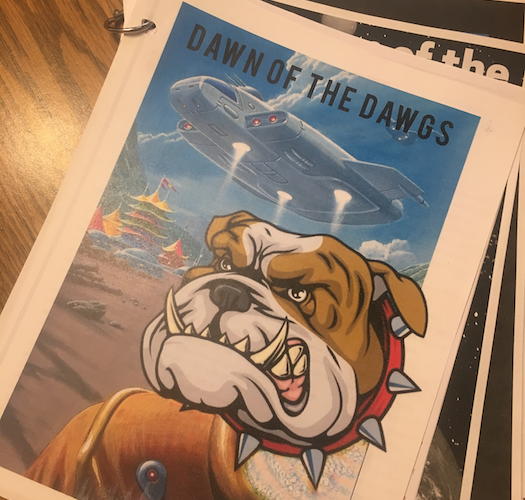
After the short papers were completed, students made two collaborative apazines and engaged directly in the communal process observed in the archives. The first apazine was made up of responses to archive resources. As a class, students drafted the rules of their apazine (i.e., entries can’t be over 500 words; Courier font only; graphics required), designed cover art, and voted on a title. Each student then revised one of their earlier papers, which became their apazine contribution. On the due date, each student brought 22 copies of their entry to class, which were then collated, and each student received a hard copy of the class apazine. The rest of class period was then spent in reading and conversation about the apazine. The second apazine was composed of responses to and interactions with their peers’ apazine writing. A student might write a response to a review of a story they hated but their peer loved, express admiration for a well-analyzed connection, or build on the research started by a peer. Each student entry had to be in conversation with an entry from the first apazine. In this way students were not just consumers of archival material but were producing writing that will itself be archived—at the end of semester, the apazines were donated to the University of Georgia’s Lamar Dodd Art Library. By making their own network of connected writing, students were able to experience the social nature of writing and produce a new archive of zine art.

Printed pages, bound with a ring; top page includes a landing spaceship and a bulldog mascot.

Figure 4. Finished class apazine. The title, “Dawn of the Dawgs,” is an amalgamation of science fiction and University of Georgia culture.

Davis’s ENGL 4832W: “Rare Books and Book Technology” in Writing for the World Wide Web

The relevance of archival research for many of the upper-level writing courses I teach was clear from the start of my time as an archival Teaching Fellow, but the course that I ultimately structured around a major archival research component was Writing for the World Wide Web. Writing for the web is not simply about content creation. I have to prepare students for a future in which machines join us as readers and writers in networks, engaging in processes of pattern recognition. Writing for the Web has to focus not just on content production but also on how to work with and against algorithms, software, data, and metadata, as well as helping digital media authors understand themselves as participants in a network of distributed cognition.

The Hargrett Rare Book and Manuscript Collection presented a wealth of material that would intersect nicely with one of our texts, Naomi Baron’s Words Onscreen: The Fate of Reading in a Digital World. My goal was to foreground the problem of writing for online readers—readers who, as Baron’s research indicates, aren’t so much reading as scanning, skimming, and clicking quickly away to the newest, the now-est, the next. I focused on this problem of “not-reading” (or, in web lingo, TL;DR) in this course as the major design problem for writers in the digital age to solve, a problem that will, if we do not think carefully and critically about how to foster effective reading onscreen, have significant consequences for literacy and knowledge. In past semesters, I have drawn extensively on Murray’s conception of the “Four Affordances” of digital media to foster a design thinking approach to digital textual composition. In this course, I put Murray and Baron’s ideas into conversation with the history of the book as a material object in hopes of creating productive thinking about digital textual design. In addition to Baron’s text, I included Nicole Howard’s The Book: The Life Story of a Technology, in order to provide students with an accessible history of the book and to emphasize the connection between technologies of reading and writing. This combination provided the framework for an examination of the examples of book technology and its evolution contained within UGA’s Hargrett Rare Book and Manuscript Collection. Essentially, the course would foreground the way technologies enable particular kinds of textual production which, in turn, produce particular kinds of reading and writing practices—practices that ultimately have wide-ranging cultural effects.

I developed a design project that asked students to use rare books from the collection as inspiration for an innovative digital textual design concept. The Hargrett holds a wide range of texts—everything from early print incunabula to conceptual artists’ books—that would require them to reconsider their understanding of what a book is, as well as the kind of literacy practices that different types of texts cultivate. The project involved several components including a depiction of the text’s design (visuals, description/explanation, written manuscript of text); an analysis of how the design plan remediated features of the inspiration text and drew on digital media affordances; and a critical reflection on their design process. Additionally, we needed to connect the dots between the inspiration texts from the archive. To achieve that aim, we created a digital exhibit using Omeka, not only because it allowed us to create a public-facing product, but also because it introduced students to metadata, both conceptually and practically. Collectively “curating” and framing an exhibit of the archival material and working with the common vocabulary of Dublin Core Metadata standards would give us a final collaborative project to present to the Special Collections Library faculty as well as other interested faculty members and students.

My own work as an instructor consisted largely of facilitation and research: I searched the archives, in consultation with a Hargrett librarian, for an initial collection of material that would represent a range of rare book items. On our first visit to the library, I gave each student an item to review along with a worksheet that asked them to consider several questions about the material aspects of the book they were examining and how it fostered or constrained different kinds of reading practices.

""

Figure 5. The prompt worksheet for Spring 2018 Writing for the Web students’ first visit to the Special Collections Library, asking them to explore and consider material properties and reading practices as they examine rare book items from the Hargrett Collection.

For our second visit, I asked students to tell me the kinds of texts they found most interesting from our first visit and, additionally, to provide an initial idea for their project that would help guide our archivist and me in curating a second collection of material for another round of hands-on exploration. We provided students with a tutorial on how to search the Hargrett collection themselves so that they could request additional material for viewing on their own. We also visited the Digital Arts Library Project, a collection of “legacy computers and video game systems as well as a collection of electronic literature pieces, digital interactive narrative pieces, and video games” (Digital Humanities, n.d.), and a copy of Raymond Queneau’s (1961) Cent mille milliards de poemes, a print precursor of digital media’s procedural affordance. Eventually, each student found a rare book (or two) that served as the primary inspiration for their design concept and they were each responsible for entering the information about the book (along with their own images taken during their time with the book at the library) into the Omeka site I set up at my web domain (having given each of them contributor access). For that exhibit, I also worked with the students to develop a conceptual frame for the project that would ground the exhibit in the concepts and scholarship that we were working with throughout the semester and, on the last day of class, we presented our work to an audience of interested colleagues. The event gave students a chance to engage in dialogue about their ideas and design process.

Title reads 'Translating, Transitioning, Transcending: Rebinding the book for digital reading.'

Figure 6. The collaboratively-produced promotional flyer for Writing for the Web’s end-of-semester exhibit of the design concepts inspired by rare book material.

Discussion

Our experiences suggest that archival work in the writing classroom facilitates greater interaction between the material properties of written texts and the students, while fostering collaborative curation. These collaborations add to or create new collections that are, in a sense, adaptations of the original archives. Reframing archival material in these ways makes new connections or linkages between seemingly disparate materials and reinforces the social and networked nature of knowledge production and a re-conception of how to use source material for remixing and remaking.

While our courses took us in diverse directions in terms of archival material and foci, the materiality of the archival texts played a large role early on for all of us. Pulps are characterized by colorful, larger-than-life covers that demand attention, as do the daring conceptual artists’ books and texts produced during the early days of printing press technology. These texts forced the students to reconsider how materiality affects reading practices. More eye-catching in a different way, the postcard that depicted Leo Frank’s lynching put students in physical contact with brutal history. This type of active learning pushes students outside their comfort zone and puts them in situations that require them to consider class content and apply that thinking toward course goals and their lives. Students began to see themselves as “scholar adventurers blowing dust off documents that could contain mysteries, answers, or maps of the past” (Norcia 2008, 107). It’s clear this technique relies heavily on critical and analytical thinking, which in turn improves and fosters strong writing skills (Bernstein and Greenhoot 2014; Gingerich et al. 2014). Perhaps even more important, it exposes students to a whole new world of composition. The inclusion of apazines, letters, and art projects in the archives showed students the legitimacy and value of such unconventional writing.

As each class progressed, students used the skills gained from archival research to recalibrate and restructure composition. Working with a physical text, as Kara Poe Alexander (2013) found when she incorporated scrapbooking into her first-year writing course, teaches “students the concept of affordance and demonstrates to them how materiality impacts design, composition, and rhetorical choices; it also provides a low-key, low-stakes entry into multimodal composing and reflexivity on the rhetorical decision making process.” A material example of the mingling of words and art/bookcraft gave students the tools they needed to compose their own multimodal projects and move from the page to the screen, without losing what made the original art projects unique. While Reeves’s students took advantage of the do-it-yourself nature of zines to produce their own, Davis’s students were unable to actually produce the digital texts they designed, lacking the advanced programming and coding skills necessary to bring those conceptual plans to life. This foregrounds again the social and collaborative nature of digital textual composition in which skilled programmers and visual artists might be required to actually produce an interactive digital text, just as a community of specialized craftsmen was needed to produce early print texts.

Ultimately, through both research and writing, the insistence on a more open, flexible network of knowledge remained key. This is perhaps best illustrated through one of the texts that several students in Writing for the Web found particularly compelling—a copy of Queneau’s (1961) Cent mille milliards de poemes. This mid-twentieth century precursor to the digital hypertext demonstrated the way that a single text can be remixed and reconfigured to provide an interactive experience for readers. That concept of interactivity became a key goal for Davis’s students’ design projects as they discussed the ways that the rare book material from the archives provoked a sense of pleasure in discovery and exploration. Janet Murray identifies this kind of pleasure in the text as an effect of careful design in her definition of the Procedural Affordance of digital media: “Procedurality and participation are the affordances that create interactivity and visible procedurality combined with transparent participation creates the experience of agency for the interactor, a key design goal for any digital artifact” (n.d.). In each of our classes, the experience of working with archival materials provided an experience not unlike that of “reading” Queneau’s text in which the ability to recombine and reconfigure the sonnets results in a sense of endless possibility for construction and reconstruction of meaning.

In her argument for “textual curation” as a unique “category of compositional craft,” Krista Kennedy cites Johndan Johnson-Eilola’s (2005, 134) contention that “Creativity is no longer the production of original texts, but the ability to gather, filter, rearrange, and construct new texts” (quoted in Kennedy 2016, 176). As in the Pop-Up Archives Project Jenny Rice and Jeff Rice facilitated at the University of Kentucky, our students curated experiences of archival material whose goals were “neither preservation nor a totalizing narrative” (2015, 247), but recontextualizations that, as in the conception of curation in the art world, put forward new arguments. Thoughtful curation requires immersion into larger conversations about issues and discernment about what is relevant and important in order to generate further discussion by “customiz[ing] archives toward their own ends” (Enoch and VanHaitsma 2015, 221). This year our students created their own handmade apazines, designed concepts for interactive digital texts, and performed reenactments of historical scandals. In each instance, they were asked to use historical materials throughout the compositional process, from the starting point of invention, all the way to the delivery of their ideas through curated performance, exhibits, and portfolios that present new understanding or expose new lines of inquiry.

We have come to consider archives-centered writing instruction as a pedagogy of remix, curation, and appropriation in which students are faced with a set of materials that may be vast and yet incomplete—an archive filled with gaps and unanswered questions that, like Queneau’s sonnets, can overwhelm with a sense of infinite possibility and insistent lack of closure. As scholars of digital culture have long insisted, remix is the foundation of knowledge construction and creative production. We each asked our students to discover ideas and compose new texts through a communal process of appropriation and reconfiguration that resulted in an awareness of what Neal Lerner (2010) has framed as the incompleteness of histories (203) and in, we hope, a reconsideration of what writing and textual form mean in the 21st century digital age. For student writers, exploring a variety of historical texts can decenter their conception of what constitutes writing or textual form, as Wells (2002) notes when she claims that “[a]rchival study of other kinds of texts also broadens our own sense of how difficult it is to write in new and untried ways” (59–60). That awareness is critical as we continue to chart the waters of digital writing at this particular technological moment. Digging into the past, we find in the archive a pedagogy well-suited to the future of writing.
Bibliography

Alexander, Kara Poe. 2013. “Material Affordances: The Potential of Scrapbooks in the Composition Classroom.” Composition Forum27 (Spring). http://compositionforum.com/issue/27/material-affordances.php.

Bernstein, Daniel, and Andrea Follmer Greenhoot. 2014. “Team-Designed Improvement of Writing and Critical Thinking in Large Undergraduate Courses.” Teaching & Learning Inquiry 2 (1): 39–61. https://doi.org/10.2979/teachlearninqu.2.1.39.

Center for Teaching and Learning. The University of Georgia. n.d. “Faculty Services & Programs: Special Collections Libraries Faculty Teaching Fellows.” Accessed June 15, 2018. http://ctl.uga.edu/pages/special-collections-libraries-faculty-fellows-program

Chitty, Andrew. 2011. “London Re-cut: Reclaiming History through the Co-curated Remixing of Film.” Curator: The Museum Journal 54, no. 4 (October): 413–418.

Digital Humanities, The University of Georgia. n.d. “Projects.” DIGI: The Digital Humanities Initiative of the Willson Center and UGA Libraries, accessed June 13, 2018. https://digi.uga.edu/projects/.

Enoch, Jessica, and Pamela VanHaitsma. 2015. “Archival Literacy: Reading the Rhetoric of Digital Archives in the Undergraduate Classroom.” College Composition and Communication 67, no. 2 (December): 216–242.

Fitzpatrick, Kathleen. 2007. “Commentpress: New (social) Structures for New (networked) Texts.” Journal of Electronic Publishing 10, no. 3. https://doi.org/10.3998/3336451.0010.305.

Gingerich, Karla J., Julie M. Bugg, Sue R. Doe, Christopher A. Rowland, Tracy L. Richards, Sara Anne Tompkins, and Mark A. McDaniel. 2014. “Active Processing via Write-to-Learn Assignments: Learning and Retention Benefits in Introductory Psychology.” Teaching of Psychology 41 (4): 303–308. https://doi.org/10.1177/0098628314549701.

Hayden, Wendy. 2015. “‘Gifts of the Archives: A Pedagogy for Undergraduate Research.” College Composition and Communication 66, no. 3 (February): 402–426.

Johnson-Eilola, Johndan. 2005. Datacloud. Cresskill, NJ: Hampton Press.

Kennedy, Krista. 2016. “Textual Curation.” Computers and Composition, 40 (June): 175–189. https://doi.org/10.1016/j.compcom.2016.03.005.

Lerner, Neal. 2009. “Archival Research as a Social Process.” In Working in the Archives: Practical Research Methods for Rhetoric and Composition, edited by Alexis E. Ramsey, Wendy B. Sharer, Barbara L’Eplattenier, & Lisa S. Mastrangelo, 195–205. Carbondale, IL: Southern Illinois University Press.

McLean, Adrienne. 2001. “Introduction.” In Headline Hollywood: A Century of Film Scandal, edited by Adrienne L. McLean and David A. Cook, 1–25. New Brunswick, NJ: Rutgers University Press.

Murray, Janet. n.d. “Glossary.” Janet H. Murray, accessed June 13, 2018. https://inventingthemedium.com/glossary/.

National Council of Teachers of English. 2013. “Definition of 21st Century Literacies.” Updated February 28, 2013. NCTE, accessed October 5, 2018. http://www2.ncte.org/statement/21stcentdefinition/

Norcia, Megan A. 2008. “Out of the Ivory Tower Endlessly Rocking: Collaborating across Disciplines and Professions to Promote Student Learning in the Digital Archive.” Pedagogy 8 (1): 91–114.

Queneau, Raymond. 1961. Cent mille milliards de poèmes. Paris, France: Gallimard.

Rice, Jenny and Jeff Rice. 2015. “Pop-Up Archives.” In Rhetoric and the Digital Humanities, edited by Jim Ridolfo and William Hart-Davidson, 245–254. Chicago: The University of Chicago Press.

Vetter, Matthew A. 2014. “Archive 2.0: What Composition Students and Academic Libraries Can Gain from Digital-Collaborative Pedagogies.” Composition Studies 42 (1): 35–53.

Wells, Susan. 2002. “Claiming the Archive for Rhetoric and Composition.” In Rhetoric and Composition as Intellectual Work, edited by Gary A. Olson, 55–64. Carbondale, IL: Southern Illinois University Press.

About the Authors

Elizabeth Davis is the Coordinator of the Interdisciplinary Writing Certificate Program at the University of Georgia. In her teaching and research, she focuses on experiential learning in the writing classroom, digital rhetoric and storytelling, and ePortfolio pedagogy and assessment.

Nancee Reeves is a lecturer at the University of Georgia, where she teach literature and writing. Her research interests include science-fiction and how it shapes and is shaped by social policies.

Teresa Saxton is a lecturer at the University of Dayton, where she teaches classes on writing and eighteenth-century literature. Her current pedagogical projects are interested in bringing together the archives, public writing and advocacy.

""
0

Collaboration Adventures with Primary Sources: Exploring Creative and Digital Outputs

Abstract

The Archives & Special Collections (A&SC) Department at the University of Pittsburgh endeavors to play a central role in instruction involving the use of primary source materials. Since 2013, A&SC developed and continues to build upon a dynamic instruction program through active outreach and recruitment to invite faculty to bring their classes to visit the reading room and engage with primary sources. We collaborated with faculty to design assignments and in-class exercises that incorporate primary sources and allow students to generate and share original research. By presenting a series of case studies, the authors will share how they experimented with new ways to present research using primary sources through social media, zines, data sets, and visualizations: what we call “creative outputs.” This article highlights the experiments, challenges, and lessons learned in hopes of advancing undergraduate research with primary sources and supporting an environment of student innovation.

Introduction

The Archives & Special Collections (A&SC) Department at the University of Pittsburgh endeavors to play a central role in instruction involving the use of primary source materials. In this article, Jeanann Haas, the Coordinator of Special Collections and Preservation, and Jennifer Needham, an archivist, discuss the variety of ways they have worked together to engage students in primary source research, including working with faculty to develop assignments that result in blogs, zines, data sets, and visualizations, what we call “creative outputs.” Since 2013, A&SC developed and continues to build upon a dynamic instruction program through active outreach and recruitment to invite faculty to bring their classes to visit the reading room and engage with primary sources. A&SC collaborate with faculty to design assignments and in-class exercises that incorporate primary sources and offer students the opportunity to generate and share their original research and discoveries in creative ways. This article presents a series of case studies in which students worked with primary sources and used digital humanities methods to present their research in creative ways.

Recent literature on archives and special collections reveals that the information literacy movement impelled the profession to champion participatory and collaborative learning with primary sources, thus departing from the show-and-tell model of instruction where students simply look at rare books and archives as librarians and archivists talk about them (Carini 2016, 192; Garland 2014, 326). Participatory and collaborative learning allows archivists and librarians to collaborate with faculty to support student researchers in analyzing primary sources to create, produce, innovate, and contribute to scholarship in creative and visual ways (Vong 2016, 150; DeSpain 2011, 30). Creating opportunities for students to engage with primary sources using digital humanities methods not only advances research-based learning but also fosters collaboration and communication among faculty, librarians, archivists, and digital humanists (Davis, McCullough, Panciera, and Parmer 2017, 482). In this article we share our experiences collaborating with faculty to support their pedagogical goals, design assignments that transcend the traditional research paper, and challenge students to produce creative outputs that further visualize and showcase their research.

Zines as Creative Outputs

In 2017, an English Department professor contacted A&SC to discuss possibilities for incorporating primary source research and creative projects in the two courses that she was teaching in the upcoming semester: “Women in Literature” and “Science Fiction.” The professor assigned students to create a zine or write a final paper about alternative publishing methods that would draw on class readings and discussion, personal interests, and materials consulted during their visit to A&SC.

During their visit to the A&SC reading room, students consulted science fiction fanzines, science fiction pulp magazines, feminist zines, and underground and alternative press newspapers in order to gain an understanding of pre-internet modes of communication and creative labor. As students explored the materials they completed a worksheet, designed by the professor, to prompt close examination of the materials. They were asked to consider the publisher, format, content, imagery, advertisements, and other interesting features.

Students enrolled in “Women & Literature” consulted feminist newspapers and newsletters from the 1970s including titles such as WomanSpirit, Broomstick, and Allegheny Feminist. They also reviewed lesbian feminist materials from the 1990s, comic books with women protagonists, and science fiction fanzines created by women. During their class visit, students studied the materials and considered the different literary approaches that female authors employed as well as women authors’ many perspectives on political upheaval, personal quandaries, and oppression in different literary and societal traditions. The “Science Fiction” course worked with a variety of science fiction and comic fanzines such as Cosmic Reflections, Granfalloon, Feinzine, and Cerebro. Students also worked with science fiction pulp magazines such as If and Galaxy, and superhero and science fiction comics like Superman, X-Men, Flash Gordon, and Buck Rogers.

Students in both courses returned to the reading room outside of their class time to perform a closer reading in preparation for their final assignment. The aim of the zine assignment was to encourage students to create a self-published and original work in response to the materials that they researched and consulted. Creating zines is a “reflection-based activity” that models a “student-centered approach to learning” (Vong 2016, 63). Students were challenged to think critically about the ideas, values, and events not necessarily covered by the mainstream media. In addition, those in “Science Fiction” considered the history of fandom and the subculture and emergence of the genre as a whole.

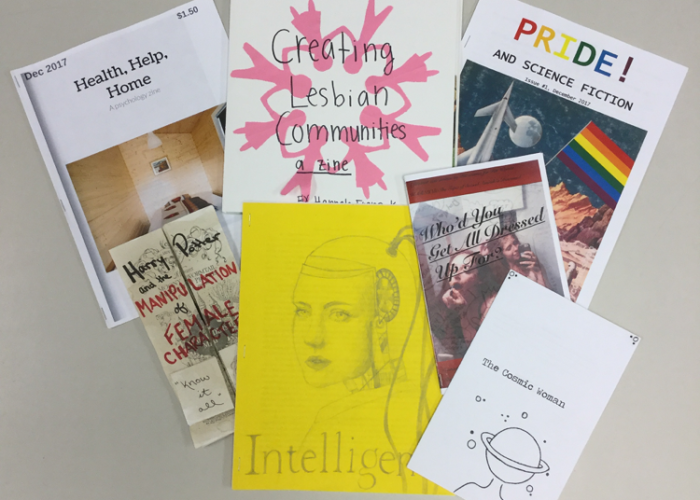
The students’ creative output was engaging and enlightening. The zines produced by students in both courses included reflections on class readings; editorials; original fiction, poetry, and art; and repurposed articles and headlines. Many of the zines modeled the common zine aesthetic and incorporated magazine clippings, repurposed illustrations, collage, and other DIY features. Students focused on gender representation in science fiction, women in the scientific community, lesbian culture and community, sexual harassment and assault, and mental illness. For the “Women & Literature” course, one zine addressed sexual harassment and the #MeToo movement, discussing the historical nature of contemporary debates. The author hopes that their zine will reach a wider audience and provide support for those who have experienced sexual assault.

A student in the “Science Fiction” course created their zine to address the lack of LGBTQ+ representation in mainstream science fiction and included a short story and reading list of what they believe to be quality queer content in books, television, and video games. They modeled the cover art after a specific issue of Cosmos Science Fiction and Fantasy Magazine that they consulted in A&SC and tried to emulate text produced on a typewriter. Elated by the final assignment, the faculty member showcased the zines at Pitt’s Digital and Handmade Showcase. She plans to explore this type of assignment in future courses. Taking inspiration from the professor and her assignment, A&SC hopes that this non-traditional method of scholarly output is something that can be further utilized by other professors. With the students’ permission, the class gifted the zines to the A&SC to enhance the zine collection, preserve their creative output, and serve as an example of student-produced work.

""

Figure 1. A selection of zines created by the classes, Women & Literature and Science Fiction

The zine collections also inspired another student who received a Brackenridge fellowship which provides undergraduates with a summer stipend so that they can devote themselves full-time to a creative or analytic research project. While other scholarship awardees were directed to submit a research paper as a final deliverable, this student negotiated to create a series of zines. She consulted with the science fiction, comic, and feminist zines as well as the contemporary zine holdings at Pitt’s Frick Fine Arts Library and Pittsburgh’s Carnegie Public Library. Interested in placing the zine, as a format, in historic context, she conducted research throughout the summer in order to publish a variety of zines based on her findings that outline zine history, how to make a zine, the social significance of the medium, and a personal zine reflecting upon her research experience. In addition, she hopes to start a zine club at the University in order to provide direction, resources, and space to students interested in self-publishing their own zines.

Digital Humanities Application

Many faculty have expressed interest in using digital humanities methods to provide opportunities for students to share research as an alternative to the traditional research paper.  Special collections, archives and rare books can provide students with the resources to inform compelling digital humanities projects. At the University of Pittsburgh, the Digital Scholarship Services (DSS), part of the library system, provides support for digital humanities teaching and research. They work closely with A&SC to recommend digital humanities applications to students and professors. For example, the Composing Digital Media course requires that students, “compose digital media while exploring the rhetorical, poetic, and political implications of multiple writing platforms. Students will learn how to compose a range of critical media objects using web-authoring languages, text, sound, images, and video in proprietary and open-source software” (University of Pittsburgh, 2018). The professor required students to visit A&SC to perform a close reading of science fiction fanzines, comic books, 1970s rock magazines, and feminist and gay press materials from the 1970s and 80s. The assignment asked students to categorize content based on a predetermined set of tags relating to gender and race, organized in the form of a digital timeline. She wanted the visual representation of the text to help students contextualize the categorized content over time. In addition, the faculty member wanted the final product to benefit A&SC. Many of these materials have not been digitized or indexed, so the professor hoped the project would render the materials more discoverable. DSS recommended that she use Timeline JS because it is a free, easy to learn software application that can quickly produce a digital timeline.

During the students’ initial visit to A&SC, the professor and archivist led a Timeline JS tutorial and introduced the content that would be incorporated into the timeline. After the students consulted the materials, the class regrouped and decided to assign tags including trans communities, objectification, sexual norms, diversity, empowerment, and animosity. Anticipating challenges, the professor required students to compose one timeline as practice before delving into the full assignment. Students voiced concern that the categories were too broad and difficult to tag and worked together to choose new tags that they believed would more accurately describe the content and settled on overcoming objectification, call to action, defying gender roles, verbal violence, and racial diversity. Although the new categories were still broad, they were nuanced enough to aid in the completion of the assignment.

The professor divided the class into groups of 3-4 students and directed them to work with a specific format such as fanzines, rock magazines, or feminist newspapers. Each student read three articles from their assigned format and assigned tags, took photographs, and entered metadata about these publications into a Google Spreadsheet. The spreadsheet detailed the bibliographic information along with the tag. Students also drafted a synopsis of each article that would position their chosen reading in the context of the tag. Timeline JS generated the timeline using the information on the spreadsheet. Examples of the timelines include Science Fiction Fanzines: A Collection of Thoughts, Theories, and other Things and Pop Rocks.

Battershill and Ross recognize that “many activities in the digital humanities require adaptability, creativity, and openness” (Battershill and Ross 2017, 5) and urge practitioners to keep an open mind and learn from those things that don’t always turn out as expected. Due to the complexity of the project, a data visualization tool may have been better suited, but visualization tools tend to require time and effort to learn beyond the two-week scope of the project. Nevertheless, this exercise still proved to be valuable in exposing students to a new digital humanities tool that challenged them to use close reading to produce a digital timeline. Furthermore, the assignment empowered students to participate in the decision-making process, negotiate and build consensus, and modify the categories based on their research and initial experiences with primary sources.

Social Media

While timelines are a great way of visualizing key events within the context of a specific period of time, multimodal social media blogs also serve as effective tools for telling a compelling narrative.  Composing a blog post is an important exercise in clear and concise writing, and it also allows students to share their work with a larger audience. In addition, when students compose multimodal blogs related to collections, they help to publicize these collections to potential future researchers.

Several years ago, A&SC started using the blog platform Tumblr to highlight collections in an engaging and visual way. Student employees served as the content creators and researched and wrote blogs based on their interests, drawing inspiration from A&SC collections. Recognizing that Tumblr could also be a great way to engage classes, A&SC invited faculty to consider assigning blog entries as alternatives to regular writing assignments.

In one example, we helped a professor design a multimodal blogging assignment in which students would collaborate with local community groups to help them memorialize their histories. This was part of a course offered in the History of Art and Architecture Department (HAA) titled, “Nationality Rooms: Visualizing Heritage in Pittsburgh.” The Nationality Rooms are thirty classrooms, located in the University of Pittsburgh’s historic Cathedral of Learning, that depict the national and ethnic groups that immigrated to Pittsburgh and also serve as University classrooms. Committees consisting of community representatives from across the world were formed to design, fundraise, and support the construction of the classrooms to represent different cultural heritages. The host committees’ planning, design, and construction for each of the Nationality Rooms are documented in the archives and include meeting minutes, correspondence, architectural drawings, and photographs. The course required each student to choose a specific room and research that room’s archive in order to identify how the host committee wanted to memorialize and represent themselves. Along with a paper and oral presentation, students wrote a short blog post using their paper abstract. For the last two weeks of the semester we featured one post per day on the A&SC Tumblr site. Some of the topics included, “Keeping Greek Heritage Alive during World War II,” “Showcasing Japan’s Cultural Past to Facilitate American Interest,” and “The Politics of the Syrian-Lebanese Nationality Room: Memorializing Unity and the Arabic-American Identity.”

The posts were written well, however, they focused more on the room as a whole and not on one aspect of the room in conjunction with a primary source from that room’s archive. Also, they did not include images of materials from the archives, but rather images of the rooms. From this experience, we learned that the students required more explicit directions. Although the instructions for the assignment were communicated to students verbally during the initial class visit, it would have been better to provide the students with written instructions outlining the requirements for the post.

Some faculty maintain their own class blogs and assign students to create posts using  A&SC materials. A&SC hosted an Introduction to Creative Writing class to look at scrapbooks from S. Leo Ruslander. Solomon Leo Ruslander (1879-1976) was a tax lawyer in Pittsburgh who compiled thirteen scrapbooks which document his professional and family life. The scrapbooks contain letters, photographs, event programs and invitations, postcards, newspaper clippings, and ephemera that document his wedding, family vacations, and material relating to local and regional associations[1]. Interacting with personal artifacts such as diaries draws researchers closer to the object’s history and cultural significance by evoking personal reflections and emotion (Lanning and Bengston 2016, 9). The professor asked students to spend time consulting with the scrapbooks and to each create their own, individual, creative portrait of Mr. Ruslander based on the information gleaned through the scrapbooks. Using WordPress, the class compiled their essays and created an online class magazine titled Seventeen Ways of Looking at S. Leo Ruslander. This project motivated students to embrace different roles throughout the creation process such as author, editor, reviewer, and publisher, while simultaneously establishing a meaningful connection with primary sources (DeSpain 2011, 26).

Faculty assign blogs to teach students how to articulate their research in shorter writing exercises that ask students to write succinctly and for a popular audience. In addition, assigning hashtags to their posts enable students to consider ways to enhance discoverability. Students often include links to their blog posts in job applications to demonstrate their writing skills. In addition, the blogs raise awareness of collections as posts are “liked” or “reblogged” by other individuals, libraries, or museums. They are indexed and discoverable through search engines such as Google, rendering these stories available to future researchers. To encourage faculty to incorporate blogging into their writing assignments, A&SC has created guidelines to assist faculty in scoping projects and has provided information about formatting, content length, and images.

Independent Student Research and Digital and Creative Outputs

In addition to class blogging assignments, independent student research opportunities teach students how to perform research using primary sources. As part of a larger library initiative and in partnership with Pitt’s Office of Undergraduate Research (OUR), A&SC offers the Archival Scholar Research Awards (ASRA) to encourage undergraduate scholars and researchers from the humanities to engage in original research using archives, special collections, and primary sources at the University of Pittsburgh. The ASRA program creates opportunities for students to connect with faculty mentors as well as with librarians, archivists, and curators who support student research and introduce students to collections. ASRA students also engage in collections work that supports their individual research projects and enhances the  discoverability of library and archival resources.  A&SC strives to find ways to incorporate creative outputs such as producing zines, timelines, social media, and other digital applications into the ASRA students’ collections work while simultaneously giving the faculty mentor a glimpse of what might be possible to include in their class assignments.

The ASRA program has made it possible for A&SC to witness the enthusiasm and passion that a researcher has when they detect a sign or clue that provides greater insight into their research. An undergraduate Biology and Philosophy major and ASRA recipient studied the archives of David Hull because it was a newer collection that had never been researched. Hull was one of the philosophers who founded the modern subdiscipline of Philosophy and Biology. The student began her research by focusing on the correspondence files in the Hull Papers to situate Hull’s thinking among twentieth-century philosophers of science within the century’s wider cultural movements. She carefully documented major themes, correspondents, events, locations, and dates that she encountered in the archive in a Microsoft Excel spreadsheet. The student also created Tumblr posts to raise awareness about the Hull papers and document the progress that she was making in her research.

Through her research, this student witnessed firsthand the debates among philosophers, and scientific philosophy theories that differed from the “winning” side. Based on this research, the student concluded that subject material taught in general philosophy classes is often from the viewpoint of the “winning” or most popular side of a theory. The correspondence files also revealed how the philosophers networked with one another, discussed ideas, and formulated their theories. From this data, she identified patterns in the letters and developed the thesis that Hull’s ideas synthesized the opinions of many different philosophers and that the best ideas are the products of cooperation. She worked closely with the DSS to find a tool that could visually support her theories and that she could embed in her poster for an end-of-term presentation. Figure 2 illustrates how she was able to carefully examine the manuscripts, recognize and interpret patterns in the author’s writings, create a narrative, and draw powerful conclusions about Hull’s work (Carini 2015, 194). In addition, she used the data in her Microsoft Excel spreadsheet to create a visualization using the data visualization and analytics application Tableau.

""

Figure 2. Visualization chart detailing themes in Hull’s correspondence

This student’s experiences and discoveries demonstrate the importance of original research with primary sources. This student is one of the first researchers to use the David Hull papers and she made some significant discoveries that other researchers can build upon; she and her Faculty Mentor published a paper titled “David Hull Through His Own Philosophical Lens” focusing on this research and made it available in D-Scholarship, the University of Pittsburgh’s institutional repository.

Another success story from the ASRA program revolves around three students who received the ASRA award to conduct research using the Black Panther, the newspaper published by the Black Panther Party. The students each conducted their own individual research using the Black Panther. They studied the Black Panther Party’s foreign involvement and support, the origins of the publication’s visual vocabulary, their use of propaganda, and the artwork of Emory Douglas, Minister of Culture for the Black Panther Party. At the same time, students consulted every issue of the physical newspaper that was held in Pitt’s archive and recorded information about the publication in a Google spreadsheet. Their goal was to create a dataset that would aid their research and provide insight into collections that are not necessarily discoverable through the library’s catalog and allow researchers to collect, process, and critically analyze data using quantitative methods. They recorded information about the inventory and missing issues, the cover art and accompanying headline, the back cover art, and any other art found within each issue. In addition, students noted articles about women’s health, women in prison, women’s leadership within the party, and the party’s international connections. The faculty mentor, who supervised the students’ research,  consulted this data set in order to design a new course on conflict and art. Further, this data set will also benefit A&SC in assisting other faculty interested in incorporating the newspaper into their curriculum.

The intent is to make this Black Panther newspaper dataset public so future researchers can better locate information. As Chester et al. recognize, “masses of data and statistics are no substitute for close reading, but they create an opportunity for individual scholars to pose new questions to sets of data never before assembled” (Chester 2018, 67). However, in retrospect, A&SC needed to coach the three students to adhere to the same format when entering their data.  As a result, the dataset is inconsistent and requires more revision before it can be released to the public. The project did successfully identify content for class visits and has the potential to feed into other digital humanities projects. When students engage in primary source research, they move away from being consumers of information to producing, creating, and contributing their theories and ideas to the greater body of scholarship. A&SC also supports students engaging in independent research or internships under the direction of faculty. These autonomous pursuits offer a little more freedom to experiment with creative outputs and are not necessarily confined to a specific class or curriculum. To this end, Pitt librarians seek out academic departments who wish to offer undergraduate students internship opportunities and place them in A&SC for course credit. These internships support original research and provide a mechanism for students to share their research in creative ways. For example, an undergraduate student focusing on Museum Studies focused her internship on Japanese printmaking and consulted Japanese prints in Pitt’s University Art Gallery, Carnegie Museum of Art, and in A&SC’s Walter and Martha Leuba’s print and broadside collection. The student compiled detailed information about selected prints; enumerated, re-housed, and labeled prints; and investigated unattributed prints for the eventual digitization of this material. She aimed to create a virtual exhibition of Japanese prints using Omeka, a free and open source web-publishing platform for content management and online exhibit creation, and to promote the Leuba collection prints and her research through Tumblr. Given her personal research focus on twentieth-century Japanese woodblock prints, she specifically took interest in a piece by Kiyoshi Saitō (1907-1997) titled Clay Image. The student realized that the people featured in the print were actually the hollow figures made from terracotta clay, called Haniwa, which she learned about that previous year in an Asian art class. She then shared this new insight on her blog and featured this print on her Omeka site. Through this internship, the student became familiar with the Japanese prints within Pitt’s collections and became proficient in using Omeka to help communicate her research discoveries. In addition, the student’s contributions will help lead to increased discoverability of the prints.

Digital Microscopes

In addition to encouraging creative outputs, A&SC encourages students to interact with collections through in-class exercises. When a professor teaching Making the Book brought his personal digital microscope to a class visit, A&SC immediately realized the potential to engage students in a method of active learning often reserved for the biological sciences. When the department purchased five microscopes[2] for class use, faculty enthusiastically requested that they be made available for their students. The ability to see cotton fiber threads in 17th-century paper or to distinguish a woodblock print from a lithograph allows students to identify and study the materiality of paper, ink, and printing methods.  Peter Carini notes that “Primary source materials come with special and unique challenges, particularly in an era when young people are increasingly electronically literate but have less and less interaction with physical documents” (Carini 2016, 193). Classes focusing on the history of the book appreciate being able to see and actually touch older books, compare paper to parchment, witness real evidence of animal skins in books, and study features like marginalia, decorations, watermarks, and clues to ownership and provenance such as library stamps, call numbers, annotations, etc. Faculty feedback indicated that the digital microscopes and physical interaction served as a wonderful complement to the theoretical discussions in the classroom by allowing this first-hand, philological experience. The microscopes helped students better observe examples of stereotyping, electrotyping, linotype, and rotogravure to understand how the press was mechanized. Similarly, they compared  different machine-made papers such as wood pulp, typescripts, dime novels, and mass market magazines to hand-made paper found books produced during the hand-press period and fine press books created during the Arts and Crafts movement.

""

Figure 3. Researcher using a digital microscope to view text from a 16th century book


""

Figure 4. Microscopic images of rubrication and a woodblock print[3]

Unfortunately, A&SC was not prepared for the demand for the microscopes (including out-of-class assignments which required students to come in on their own time to capture and save screenshots) and lacked the hardware needed to operate them.  The professor expressed serious concerns about asking students to use the digital microscopes on their own personal devices and download the software, but the library-owned devices proved unreliable and difficult to troubleshoot. We learned we must fully test equipment prior to implementation and we must manage expectations of faculty and students. The department will invest in dedicated devices to use with the digital microscopes and ask students to save captured images to a flash drive or upload them to Cloud storage.

Conclusion

By collaborating with other colleagues such as faculty, community organizations, subject specialists, and Digital Scholarship Services staff, A&SC facilitates and supports a wide variety of research endeavors in both traditional and creative formats. These collaborations support student research and allow students to explore not only how to perform research using primary sources, but how to disseminate their research through the creation of zines, digital humanities projects, and blogs. In addition, it helps us share information about our collections and services.

When learning new technological skills, students run the risk of concentrating on learning the new technology rather than prioritizing the research process. Based on these experiences, we advise others interested in these kinds of collaborative assignments to allow plenty of lead time in experimenting with innovative pedagogical approaches, especially when they involve new technologies. In the case of the digital microscopes, the microscopes were extremely popular, but we were not prepared for the hardware challenges. Make certain that the technology enhances the experience with primary sources and does not overshadow the lesson and become the focus.

A&SC wishes to build upon anecdotal feedback that we receive from faculty and students to create  a more formalized assessment program based upon the joint Association of College & Research Libraries/Rare Books & Manuscript Section–Society of American Archivists Joint Task Force on Primary Source Literacy. A&SC hopes to determine whether students are walking away with new knowledge of primary sources, how we can better collaborate with faculty, and how we can better reach ambitious goals around student success, retention, and graduation rates set by the University of Pittsburgh. Peter Carini argues that a standard is needed to “provide a collection of goals for planning class sessions for students…help shape conversations with faculty about fitting primary source teaching into the broader curriculum…and allow archivists and special collections librarians to better assess the work they do in their class sessions” (Carini 2016, 196).

Finally, A&SC acknowledges how important it is for students to become creators and producers who can make use of primary sources and digital applications in order to contribute their theories and ideas to the greater body of scholarship. Their discoveries and research outputs shed light on what modern archival research looks like in the 21st century.  Collaborations among librarians, archivists, and other experts improve student learning by encouraging innovative teaching through combined expertise and new technologies (Davis, McCullough, Panciera and Parmer, 2017, 483). These collaborations offer different perspectives, diverse ideas, and expertise from across disciplines and functions. After a series of collaborations with faculty to design assignments and in-class exercises that incorporate primary source research, we have discovered that encouraging creative outputs and the use of digital applications can foster student innovation.

Notes

[1]Description of collection taken from finding aid.
[2]Bodelin Technologies ProScope EDU 5MP High Resolution Desktop USB Microscope.
[3]Example of rubrication from Hugues of Fouilloy’s De Claustro Animae, 14–?, and Ptolemy’s Almagest, 1515.

Bibliography

Battershill, Claire, and Shawna Ross. 2017. Using Digital Humanities in the Classroom: A Practical Introduction for Teachers, Lecturers and Students. London; New York, NY: Bloomsbury Academic an imprint of Bloomsbury Publishing Plc.

Carini, Peter. 2016. “Information Literacy for Archives and Special Collections: Defining Outcomes.” Libraries and the Academy 16, no. 1: 191-206.

Davis, Ann Marie, Jessica McCullough, Ben Panciera, and Rebecca Parmer. 2017. “Faculty-Library Collaborations in Digital History: A Case Study of the Travel Journal of Cornelius B. Gold.” College & Undergraduate Studies 24, no. 2-4: 482-500.

DeSpain, Jessica. 2011. “On Building Things: Student-Designed Print and Digital Exhibits in the Book History Class.” Transformations: The Journal of Inclusive Scholarship and Pedagogy XXII, no. 1: 25-36.

Garland, Jessica. 2014. “Locating Traces of Hidden Culture in Rare Books and Special Collections: A Case Study in Visual Literacy.” Art Documentation: Journal of the Art Libraries Society of North America 33, no. 2: 313-326.

Lanning, Robbyn Gordon and Jonathan B. Bengston. 2016. “Traces of Humanity: Echoes of Social and Cultural Experience in Physical Objects and Digital Surrogates in the University of Victoria Libraries.” Cogent Arts & Humanities 3, 1-19.

MacDonald, Susan Peck. 2007. “The Erasure of Language.” College Composition and Communication 58, no. 4: 585-625.

Michelle Chester, et al. 2018. “Old Text and New Media: Jewish Books on the Move and a Case for Collaboration.” Digital Humanities, Libraries, and Partnerships: A Critical Examination of Labor, Networks, and Community. Edited by Robin Kear and Kate Joranson, 67.  Cambridge: Elsevier Ltd.

Miller, Kelly E. 2014. “Imagine! On the Future of Teaching and Learning and the Academic Research Library.” portal: Libraries and the Academy 14, no. 3: 329-351.

University of Pittsburgh. 2018. 2017-2018 Undergraduate Catalog.  Retrieved from https://catalog.upp.pitt.edu/

Vong, Sylvia. 2016. “Reporting or Reconstructing? The zine as a medium for reflecting on research experiences.” Communications in Information Literacy 10, no. 1: 62-80

About the Author

Jennifer Needham is a Research Librarian at Deerfield Academy in Deerfield, MA. After working five years at the University of Pittsburgh Archives & Special Collections as an archivist, in October of this year, she decided to move back to her native New England and accepted a position at Deerfield Academy. Jennifer earned her bachelor’s from Smith College in 2010 and her MLIS from the University of Pittsburgh in 2011.

Jeanann Croft Haas is the Special Collections Coordinator in the Archives & Special Collections (A&SC) Department at the University of Pittsburgh.

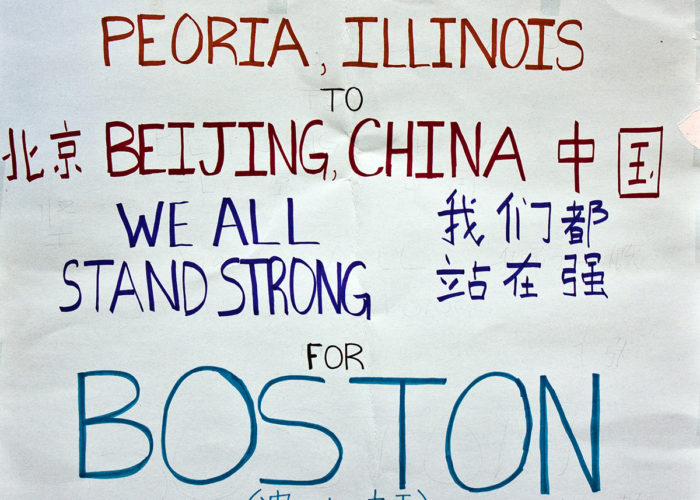
Figure 1. Digital image of a poster left at the Boston Marathon memorial in Copley Square. The poster reads “From Peoria Illinois to Beijing China, we all stand strong for Boston” in both English and Chinese (http://hdl.handle.net/2047/D20262219).
0

Crowdsourcing Traumatic History: Understanding the Historial Archive

Abstract

This article discusses the challenges and opportunities for digital archives that aim to both historicize and memorialize recent tragedies through crowdsourcing materials from the public. Using an archive built after the 2013 Boston Marathon bombings as an example, I offer the term “historial archive” as a distinction from the much-critiqued adoption of the word “(A)rchive(s)” that we see used throughout the disciplines. Although crowdsourcing in this type of archive works as a catalyst for community, the speed of collection operates (rhetorically at least) as an active buttress against the problems of provenance. That is, historical archives must go to great lengths to verify the veracity and historicity of their collections; in the historial archive’s more philosophic approach to history, the time-sensitive collection methods ensure the archive’s veracity and historicity. Using my own research, I model how students may approach historial archives and the ways these types of repositories can allow for various productive paths that go beyond simply aggregating primary materials.

Introduction

With the speed at which information travels today, there has been a shift in how we engage with news: we are more likely to hear about an event as it unfolds as opposed to hearing about it after it ends. As we (literally) see in our social media feeds, in the wake of a tragedy, memorialization happens rapidly both at the physical site of the event and in digital contexts. To capture such ephemera, there has been an uptick in digital archives that use crowdsourcing in order to populate these spaces. As various libraries continue to encourage instructors to engage with their digital collections (for examples see Duke, Vanderbilt, and The Newberry), it is important to pause and understand the unique aspects of creating a digital archive in real time that seeks to both historicize and memorialize an event. I offer the portmanteau “historialize” to acknowledge the ways these collections remain distinct from traditional archives in terms of their scope, rationale, and methods of collection.

In this article, I draw upon my experience working with a team to create a digital archive after the 2013 Boston Marathon bombings. First, I present some context, a brief exploration of the term archive(s), and a discussion of some ways the Boston Marathon archive departs from traditional archives. I then unpack the term “historial archive” as a name for digital repositories that aim to both historicize and memorialize an event. Next, to further expand upon how one might use a historial framework, I draw from primary research conducted with community members who shared their written accounts with the archive (NU-IRB Protocol # 15-04-09). I conclude by sharing one rhetorically rich arena that came about from my study. By offering samples of the kind of follow-up possible with the historial archive—in my case, surveys and interviews with contributors—my goal is to inspire instructors to compel their students to examine such archives based upon their own disciplinary backgrounds and to see what questions—and perhaps answers—they come up with.

Context

More than just an annual race, the Boston Marathon is an important community event: it brings together runners from around the world—both elite and amateur—and the Hopkinton-to-Boston course is a source of pride and tradition for spectators as well. On April 15, 2013, two homemade pressure-cooker bombs were detonated near the marathon’s finish line. The blasts killed three people and injured over 260 others. The days that followed this act of terror included an unprecedented shelter-in-place order that kept residents inside their homes as a manhunt for the two suspects took to the streets. In the end, the death toll reached five, including an MIT police officer and one of the suspects; the other suspect, eventually found hiding nearby, was arrested and charged for the crimes. This horrific week in Boston’s history touched people from all over as evidenced from the artifacts left at local makeshift memorials, the thousands received by the Mayor’s office, and the surge of #BostonStrong social media posts.

""

Figure 1. Digital image of a poster left at the Boston Marathon memorial in Copley Square. The poster reads “From Peoria Illinois to Beijing China, we all stand strong for Boston” in both English and Chinese (http://hdl.handle.net/2047/D20262219).

From mourning the victims to celebrating the first responders, many community members connected with one another and processed their emotions by sharing stories of their personal experiences both digitally and in person. Noting the historical importance of such communications, a group of professors and graduate students from the English and History departments at Northeastern University came together to create a digital repository of these materials. Our Marathon: The Boston Bombing Digital Archive defines itself as a community project that consists of pictures, videos, and stories related to the April 2013 Boston Marathon bombings and aftermath (McGrath et al 2018). The archive was crowdsourced, which meant that anyone with an Internet connection could have potentially participated in populating the archive. The spirit of the archive involved gathering as many artifacts as possible in order to capture an important moment in Boston’s history.

Understanding Our Marathon as an Archive

Outside of academia, rarely do we hear people talking about archiving—save for clearing up email inboxes—but even in academia, people in different disciplines don’t necessarily align. For example, Marlene Manoff (2004) explores the way the word “archives” has been taken up by scholars other than librarians and archivists and explains how this word can refer to anything from the general contents of a museum to specific repositories of documents and objects; moreover, when discussing digital archives, the term can range from anything found in a digital format to a more select collection of related digital documents (10). Despite the various qualifiers certain disciplines have developed—social archive, raw archive, postcolonial archive—scholars from the social sciences and humanities understand that archives have important scholarly and political functions especially for those interested in the recovery work that accompanies actions like rewriting women and minorities back into historical records.

Digital archives add another layer of complexity to the conversation. In her article “Archives in Context and as Context” archivist Kate Theimer (2012) explains her hesitations with the field of Digital Humanities co-opting the word archives in a fairly expansive way. Theimer endorses the Society of American Archivists’ definition of archives: “Materials created or received by a person, family, or organization, public or private, in the conduct of their affairs and preserved because of the enduring value contained in the information they contain or as evidence of the functions and responsibilities of their creator, especially those materials maintained using the principles of provenance, original order, and collective control” (Pearce-Moses 2005). Theimer discusses how there is a long history with specific values and practices when working with/in “archives.” Though she is appreciative of how words and meanings change, she is concerned with “the potential for a loss of understanding and appreciation of the historical context that archives preserve in their collections, and the unique role that archives play as custodians of materials in this context” (Theimer 2012).

To understand Theimer’s hesitations, it is useful to consider how a more traditional, physical archive functions differently from a digital archive like Our Marathon. For example when The Boston Globe started in 1872, photography was still a very expensive craft and the technology for mass printing photos was still to come. As technology progressed, and as the newspaper continued to grow, one might imagine that a system of curating their images became important. Thus, the artifacts themselves necessitated an archive, and the staff could create a system that made most sense for their anticipated work. On the other hand, some archives are less calculated. For example, Mary Hemingway donated crates of her deceased husband’s papers to the Kennedys upon suggestion of a mutual friend. Now housed at the JFK Memorial Library in Boston, The Ernest Hemingway Collection contains the initially donated drafts of his manuscripts and personal letters, but it has also collected other related materials such as newspaper clippings and audio recordings of the author. The archivists in charge of this collection have curated the materials in ways that make sense for potential researchers and have also created finding aids.

These two examples illustrate key terms for analyzing archives: purpose, audience, location and preservation, and overall access. In what follows, I use the example of Our Marathon to discuss how the digital impacts these terms.

Purpose: How does the digital affect the purpose of Our Marathon?

With the Photo Archive, the purpose is very clear: should a news story relate to something that happened in the past, the reporter can search for the appropriate photograph. With the Hemingway Collection, there are multiple purposes: to preserve an iconic author’s writing process, to educate people about this particular person and his life, and so on. With Our Marathon, collecting stories for historical purposes made a lot of sense, but the vision of the archive was not just for history: the archive was created as an instrument of healing and a place for all community members to feel free to add their voices and share their parts of the story.

Audience: How does the digital affect the audience(s) for Our Marathon?

Although there are intended and imagined audiences, public digital archives can be viewed by anyone, as the archive itself is not located in the dusty basement of a building, like The Boston Globe photo collection was in 2013, nor does it take much effort to access, like the Hemingway Collection, which necessitates “proof” that you have business there. When Our Marathon was built, there were two main audiences in mind who would be accessing the digital archive through their devices: community members (who possibly needed a space for healing) and future researchers. We quickly found that these two audiences would both complement and complicate each other: for example, while researchers would want to know about community members’ experiences, the nature of a public digital archive might dissuade certain people from participating. Because the creators intended for the archive to be mostly crowdsourced, the overall design of the archive needed to be clean and user-friendly. From the choice of words to the colors we used, there were many discussions on how our intended audiences would engage with the digital archive.

Location and Preservation: How does the digital affect senses of location and issues of preservation with Our Marathon?

With physical archives there is always the chance of an unavoidable disaster decimating a collection, but for the things archivists can control, there are plenty of best practices for handling archival material, such as temperature-controlled rooms that are under lock and key, and protocols for handling old paper so that the oils from one’s fingers do not affect the text. When it comes to digital archives we understand that technology is not infallible and digitized and born-digital artifacts are in no less danger than their physical counterparts.

In April 2018, Northeastern University moved the archive from its open-source content management system (Omeka) to a permanent home on its server space; however, Northeastern will need to be committed to updating the site as technology changes. In her article “Digital Preservation: A Time Bomb for Digital Libraries,” Margaret Hedstrom (1998) reminds us that digital forms are vulnerable to technological obsolescence: “Digital works which are created using new or emerging software applications are especially vulnerable to software obsolescence because standards for encoding, representation, retrieval, and other functions take time to develop” (191). Digital preservation remains challenging because one is not usually aware that a change will impact digital artifacts until it actually happens.

Access: How does the digital affect access to Our Marathon?

As discussed in terms of audience, Our Marathon was accessible should one have access to the Internet, but contributors also needed to have a certain level of digital fluency to engage with the archive and to follow the archive’s prompts for sharing stories. Contributors could submit a story, image, email, video, text message, audio recording, or website. The Our Marathon team also created guides for capturing/uploading social media updates, but at the time there was not a simple way to grab one’s own updates. Upon clicking a “Share” button on the website’s homepage, a potential contributor would be guided through a series of steps to submit an item. For the purposes of this article, I focus on how people submitted their stories and note that the linear model used was based on the same design style as Tumblr, a popular blogging platform at the time.

""

Figure 2. First step. The screenshot shows orange buttons that signify which type of item someone would like to submit (e.g. story, image). “Story” has been selected, and below are two text boxes asking for someone to type in a “Title” and to “Tell us your story.”

After writing the title and story (or copying and pasting the text into the box) and having the option to upload a photo with the story, the arrows guide the participant through the next steps, which includes selecting where the story took place, when the story took place, details about the contributor, and the final stages of sharing.

""

Figure 3. Second step. The screenshot shows a map where a contributor could place the location of their story using an address.

""

Figure 4. Third step. The screenshot shows a clickable calendar for when the story took place.

""

Figure 5. Fourth step. The screenshot shows the optional data a contributor could choose to submit alongside their story. The fields are zip code, name, age, ethnic/racial identity, gender, and Twitter handle.

""

Figure 6. Fifth, and final, step. The submission form requires the contributor’s email address, and then asks in a series of checkboxes whether it is ok to contact the contributor for further information, if the contributor wants their item shared publicly, and if the contributor agrees to the linked Terms and Conditions.

Historial Archives

Referring to Our Marathon as an “archive” establishes it as a certain type of repository and highlights a scholarly interest; however, the fact that this archive relied so heavily on crowdsourcing makes it different from the digital archives Theimer questions in her article, such as those which brought together the works of prominent cultural figures like William Blake and Dante Gabriel Rosetti. Our Marathon was interested in collecting materials from any person who experienced the events.

This type of archiving is not without challenges. Our Marathon came from a line of relatively new crowdsourced archives that aim to both historicize and memorialize recent traumatic histories, such as the terrorist attacks of September 11th (2001) and the devastation of Hurricanes Katrina and Rita (2005). As previously discussed, some librarians and archivists would resist naming such repositories archives. While other historical archives may bring together artifacts into one useable venue through specific curatorial practices, these “historial” archives aim to collect material in real time and focus on the ephemera of an event rather than on more authoritative, mediated artifacts.

Crowdsourcing, particularly in the case of Our Marathon, relies on individuals taking agency over their participation: there were no conventional expectations for public writing of this nature. Unlike a traditional archive where already-written stories might be pulled together into an historical repository, most of these stories were specifically written for the digital archive. In fact, most of the stories in Our Marathon would not exist in their current state if the archive staff had not prompted participants to share their stories. In line with its focus on collecting real-time stories specifically for the archive, the historial function gives power to those who participate. The memorial aspect invites participation that complements the philosophical approach to history the archive enacts, and the archive becomes a co-constructed space which, rather than see power remaining mostly with the archivist, grants agency through sharing personal accounts and documents.

In practice, as we were building the archive and crowdsourcing material, we were not sure what we were collecting that might be of interest to future scholars. Elizabeth Maddock-Dillon (2014), Professor of English and project co-founder, reflects, “Realizing that the archive could provide resources for multiple kinds of research was really exciting. It’s not just this is a historical record, but this gives us a whole body of material that people might use for research purposes that we haven’t even thought of yet. Nonetheless, it’s a way to create an archive/data set that will have real historical and research value.” In a way, this archive would be contributing to, if not controlling, the future historical record and public memory; however, who knows what scholars will be interested in learning from these artifacts 20, 50, or 100 years from now? For example, Dan Cohen, one of the leaders on the September 11th Digital Archive, has mentioned to us that linguists have been drawn to that archive’s collections because 2001 was about the time that “text speak”—internet shorthand like “OMG”—started to come about. At the time of collection, the archivists would not have been aware that they were capturing this linguistic moment.

Storytelling

At its heart, Our Marathon collects history through stories. Given the complex nature of storytelling within the discipline of history, it is helpful to think of the linguistic turn of the 1970s and 1980s marked by the work of scholars Louis Mink and Hayden White who both contend with narrative as a focus of history. Rather than relying on examples from the natural sciences to represent historical knowledge, these historians theorized that disciplinary artifacts like works of literature were also important links to historical understanding (Little 2016). Scholars like Mink and White emphasize historical narrative rather than historical causation and champion subjectivity and various interpretations over objectivity and singular truths. This falls directly in line with archives intending to capture the larger picture of something as it unfolds.

In this philosophical approach to historicizing a moment, subjectivity and its malleability are key; however, to memorialize something means to create an object that serves as a focus for the memory of an event or person(s) in a more static fashion. Memorialization becomes a shared space that necessitates more rigidity: “Memorial sites, by their very existence, create communal spaces. Although it is possible to describe an individual’s encounter with a site, it is almost always part of a collective experience” (Blair 1999, 48). Although Carol Blair (1999) writes about physical memorial sites, her attention to communal space and collective experience resonates with those who contributed their stories to Our Marathon.

Take, for example, the following story, titled “Laundry Mat” (story reprinted here with permission from the author; original contribution and photograph can be accessed in the online repository):

Following the Boston Marathon bombings, the hotel where my family and I were staying was evacuated. We passed time by grabbing a bite to eat and wandering around the surrounding neighborhoods, but as time went on, my sisters, who finished the marathon about 30 minutes before the bombs went off and were still wrapped in their foil blankets, started to get cold and all of our phones were dead or quickly running out of battery. We came across a small, underground laundry mat on Columbus Ave. called Five Star Laundry and asked the owners if we could sit inside to keep warm and use their outlets to charge our phones. The owners did not speak much English, but their little kids did, and they translated our explanation of what had happened and our request to the owners who immediately welcomed us in. The kids became increasingly curious about my sisters and the rest my family, and before we knew it, they were chatting up a storm with us, putting on my sisters’ medals, and even sitting on their laps. As a gesture of gratitude, my husband went to the convenience store down the road and came back with candy for the children. This picture shows my sisters with the children, candy in hand. During such a dark time, it was reassuring and comforting to experience the hospitality and friendliness of the people at Five Star Laundry (Katz 2013).

“Laundry Mat” represents a key moment for Our Marathon: submitted on May 22, 2013—less than a month after the archive was even conceptualized— it was the first publicly submitted artifact. More importantly, “Laundry Mat” represents a story that might be lost without an appropriate venue for safekeeping; it is part of a supplementary historical narrative about how members of a community experienced the Boston Marathon bombings. On its own, “Laundry Mat” offers one artifact of memorialization—the kindness of strangers following the events—but when also archived as part of the historical narrative of the Boston Marathon bombings, in the future this artifact may end up recontextualized among other temporally-based narratives where the focus could shift to any number of topics such as race, gender, or linguistics. As in traditional archives, in the historial archive, the meaning of such stories will shift as time moves on; however, much research can be done soon after these archives come into fruition, which means that students may be able to directly follow up with creators, builders, and contributors of such sites.

During my graduate work, I became interested in a seemingly simple question that I imagine any interested advanced undergraduate student could take up: why did people participate? In the anonymous survey data that I collected from 48 participants who contributed their stories, there were five main responses to the more specific question: “Why did you choose to share your story with Our Marathon?” In the table below I map out those five reasons—from most prevalent to least prevalent—and highlight representative responses.

Reason for Sharing Representative Responses
Closure The Boston Marathon 2013 was my 75th lifetime marathon and my 22nd consecutive Boston Marathon, however, any short lived celebration I experienced was immediately erased upon hearing the news of the bombings.  Sharing my experience was a way of dealing with the situation and moving on.

I needed to share my experience to basically clear the air so that I could move on.  I was running with two friends, and both went ahead when I stopped to talk to my daughter (a BU student) – they both finished as the 2nd bomb went off, and I was almost directly across from it at mile 26.  It could have ended a lot differently and I’m not upset by the coverage that the victims received at all, but others need to know that it touched others who were on the course as well.

I wanted to share my experience as a runner who was stopped 10k from the finish with a daughter waiting for me at the finish. I did this at the 2014 Marathon to help with closure of the 2013 experience.

It was part therapeutic and part fueled by the memories of our 2013 experience.  The Our Marathon space allowed me the chance to vocalize those feelings that I had kept bottled up for over a year.  Our daughter, the runner, was emotionally scarred by the experience as she watched the bombings from less than a block away, suffering from a leg cramp that saved her life.  She was not physically harmed but she carried the memories and carries them to this day.

Research and Historical Purposes The bombing was and is a part of history. It needs to be recorded from all who were impacted by the events of that fateful day.

I thought of this as an opportunity for my personal experience to be catalogued and capsuled in time.

I wanted people to know. It’s important for these stories to be remembered.

Particular Point of View I think that everyone’s story is important. I was the leader of the veterans group on campus and I wanted to show how veterans responded to the crisis. People usually have ideas of veterans as either being heroes or broken and I wanted to tell the real story.

Since I’m a Swede and was not in Boston during the bombing but read about it and followed the news from Sweden, I thought my views could be interesting as from someone not directly affected.

The bombings affected not only the individuals at the sites but also the community. As a community member, I wanted to share my perspective as a distant participant.

I wanted to contribute to the broad view and understanding of the impact of the marathon bombings on Boston and the surrounding community. I was fortunate not to be directly affected; a friend of a friend was injured, I was terrified for the few hours that my close friends in attendance were unreachable, and I was a part of the citywide lock down on Friday, but my life was not significantly altered by the bombings. I contributed because I thought I could add the voice of someone who as a student is not a permanent member of the community but nonetheless very involved.  

Personal Record I shared my story about the Marathon bombing because I felt deeply about the event.  I felt saddened and violated by the people who caused the bombing, and by the fact that a pall would forever be attached to what should be a joyous day.  As a Watertown resident I wanted to record my jetlag-induced confusion during a phone conversation with my son. I hoped recording that conversation would remind us that funny things still happened in the midst of deadly chaos.

I just wanted to document my story.  I was already at the hotel when I heard about the bombing, so it really didn’t affect me as much as it did to others.

For a Class (i.e. not optional) Contributed for Advanced Writing Class, had to for a grade

My English class had a project to create an archive about anything we wanted. I chose to do mine on the Boston Marathon. She showed us the Our Marathon archive and we became familiar with it. I chose to do it because I had so many connections with the marathon and because it really was so close to home, physically and mentally. My professor encouraged me to post my story on the actual archive.

I chose to share my story as a part of a classroom project.

I became interested in things like how respondents positioned themselves in relation to the archive, their verbiage, and their ideas of agency. But, as one may notice, the answers in this chart can be categorized in multiple ways and can raise different questions based on students’ interests. The temporal dimension of the historial archive offers research opportunities that are often impossible in traditional archives, particularly when it comes to understanding the motivations and considerations of both those who build such spaces and those who contribute to such spaces. In my research, I wanted to know more about who felt authorized to participate, and, in optional follow-ups from the survey, I conducted phone interviews where I could ask participants about their hesitations to participate. Here are two examples from “Dot” (2015) and “Colleen” (2015):

Interviewer: In your survey, you mentioned that you were a little concerned that your story didn’t matter since you weren’t impacted by the event. Could you say more about that?
Dot: It did have an impact to my friends, who knew I was there, but to the public I wasn’t one of the people on the streets or that got stopped by the running. I escaped pretty unscathed from the whole event. I didn’t experience the losses, or the danger, or really any of the negative effects that a lot of the other participants did.

Interviewer: In your survey you mentioned that you were hesitant to share your story because you hadn’t actually experienced physical trauma. What do you make of an archive that aims to capture all stories of different experiences?
Colleen: I think it’s valuable. I think overall we’re understanding of how different people experience things. It is helping me to come to accept the fact that there was not physical trauma, [but it] was something that I was still a part of. That’s just as valid as some other forms of trauma. I think it’s really good—it’s really good for other people who haven’t participated in experiences like that or something that can be…What am I looking for…not necessarily traumatic but challenging to understand that different people handle different things in different ways.

Interviewer: How would you describe the act of submitting your story to the archive, for you personally?
Colleen: It was hard. It was unexpected. I don’t know if I wrote this in my survey or not, but I was at the library that day for something else. Somebody had approached me and asked if I’d be willing to do it. I said, “Sure.” I had said to her the same thing, “Yes I was down there, but I wasn’t right there.” She said, “Well, that’s fine.” It started off OK, but the more writing I did, the more the emotions and the memories of the event started to come up. It was much harder for me than I thought it was going to be in the end.

Interviewer: In your survey, you mentioned that it might have been too soon to share your story and not the right environment.
Colleen: That was an afterthought. I hadn’t realized how deeply it had affected me until afterwards.

As Dot and Colleen highlight, the historial function of the archive allowed their voices to count: Dot—a lifelong marathon runner—and Colleen—someone who was clearly traumatized by the events despite not having any scars—were given a space to share for their own immediate benefit and the longer term benefit of future researchers. How might students studying Psychology analyze these responses? Or how might they follow up differently to these responses during the interviews? With proper guidance and/or ethical practices—a caveat I hope is clear to anyone working within topics of trauma—the historial archive can open up fascinating discussions and fruitful paths for researchers as long as we are mindful of our participants’ experiences and the potential benefits and drawbacks of such work.

Conclusion

When tragedy strikes, people often turn to digital forms to share their sentiments. While sometimes critiqued as a type of tourism wherein one’s digital actions become more of a souvenir than a true act of solidarity, these digital postings are part of a cultural moment that digital archivists remain interested in capturing. The slogan for Our Marathon—“no story too small”—represented a key motive for the creators of the archive: this site was meant to democratize. Anyone could participate and add their stories to the public history of the event; the more voices, the richer and more nuanced that formation of public memory would be. Story sharing is a legitimate form of history being born from devices every day, and this practice will continue to offer certain challenges as more and more historial archives come into fruition, but it also offers fascinating opportunities for research.

When it comes to research that followed up with Our Marathon’s story contributors, like many of the other story sharers, Dot and Colleen expressed gaining something from their experiences in contributing their stories to the archive; in fact, story sharers often expressed much gratitude to the archive’s staff in person. Even in my follow-up interviews years after the events, many expressed gratitude to me for listening to their stories and thoughts. In this way, the historial space may be reread as not just a repository for culture and memory but as an actual affirmation of self, knowledge, and worth. When thinking about the stakes involved in this historial archive through my own research lens, sharing a story was not just something nice to do: for some, it was a meaningful act of literacy and community. This is just one finding from one disciplinary lens; the historial archive can be read and reread as time goes on and continue to offer new meaning-making opportunities.

Bibliography

Blair, Carol. 1999. “Contemporary U.S. Memorial Sites as Exemplars of Rhetoric’s Materiality.” In Rhetorical Bodies, edited by Jack Selzer and Sharon Crowley, 16–57. Madison: University of Wisconsin Press.

Colleen [pseud.]. 2015. “Our Marathon Contributor Interview.” Interview by Kristi Girdharry. July 1, 2015. Audio.

Dot [pseud.]. 2015. “Our Marathon Contributor Interview.” Interview by Kristi Girdharry. June 30, 2015. Audio.

Hedstrom, Margaret. 1998. “Digital Preservation: A Time Bomb for Digital Libraries.” Computers and the Humanities 31 (1): 189–202.

Katz, Jean. 2013. “Laundry Mat.” Laundry Mat. Accessed June 15, 2018. http://hdl.handle.net/2047/D20261554.

Little, Daniel. 2016. “Philosophy of History.” Stanford Encyclopedia of Philosophy. Accessed June 15, 2018. https://plato.stanford.edu/entries/history/.

Maddock-Dillon, Elizabeth. 2014. “Our Marathon Creator Interview.” Interview by Kristi Girdharry. September 12, 2014. Audio.

Manoff, Marlene. 2004. “Theories of the Archive from Across the Disciplines.” Libraries and the Academy 4 (1): 9–25. https://doi.org/10.1353/pla.2004.0015.

McGrath, Jim, Alicia Peaker, Ryan Cordell, Elizabeth Maddock Dillon, et al. 2013–2015. “Our Marathon: The Boston Bombing Digital Archive.” Accessed June 15, 2018. https://marathon.library.northeastern.edu/.

McGrath, Jim and Alicia Peaker. 2018. “Our Marathon: The Role of Graduate Student and Library Labor.” In Digital Humanities, Libraries, and Partnerships: A Critical Examination of Labor, Networks, and Community, edited by Robin Kear and Kate Joranson, 19–29. Cambridge: Chandos Publishing.

Pearce-Moses, Richard. 2005. “A Glossary of Archival and Records Terminology.” Last modified May 20, 2016. Accessed October 14, 2018. https://www2.archivists.org/glossary.

Theimer, Kate. 2012. “Archives in Context and as Context.” Journal of Digital Humanities 1 (2). Accessed June 15, 2018. http://journalofdigitalhumanities.org/1-2/archives-in-context-and-as-context-by-kate-theimer/.

About the Author

Kristi Girdharry is an Assistant Professor of English at Johnson & Wales University in Providence, Rhode Island where she teaches writing, research, communication, and digital literacy courses. Her research interests also include community engagement and teaching for transfer.

A photo of shelves of paper files in an archive.
0

Narrating Memory through Rhetorical Reflections: CUNY Students and Their Archives

Abstract

This essay analyzes the importance of connection in teaching with archives: connections between our goals for our projects; between students and their research projects; between the past and the present; between students, faculty, and embedded librarians; and between the physical act of archival research and the digital writing to record that research. In this essay, two faculty and one librarian detail their projects assigning archival research in physical archives: the Abraham Lincoln Brigade Archives at the Tamiment Library at New York University and the Hunter College Archives. As our undergraduate students researched in physical archives and shared their research through digital platforms, they became active agents of generational transmission by publicly sharing the life histories and experiences of former CUNY students involved in activist movements. Through analysis of these collaborative, digital archival assignments, we show the role that students can play in transmitting institutional memory while learning about and engaging with primary sources.

“Internet searching doesn’t hold a candle to that visceral feeling of an old primary document. All of my senses were triggered on this archive visit, and I was only there for half a day. I would like to return to the archive—this archive, any archive—without an assignment or mission attached and just have some fun exploring.” —Elyse Orecchio[1]

“During our visit to Tamiment Library, I was moved by the fact that each box contained individual memories of an American volunteer in the Spanish Civil War. I wondered how much of one person’s life could fit in these boxes, and how these documents could help narrating the friendships among young soldiers, the making of improvised families, the experiences of the displaced children, and how some these lives might have survived the war. I wondered, finally, how much legacy can these archives preserve?” —Marcelo Agudo

In a class session announcing a visit to the Hunter College Archives, several students in a class of juniors and seniors admitted that they had never even been inside the Hunter College Library—or any library. We might all shudder at the thought, but it is quite common for students to have no reason for entering a physical library or speaking with a librarian face to face. It is not that students Google everything: they have extensive remote access to scholarly journals and primary sources through electronic databases, and digital holdings now outpace physical holdings at libraries. Furthermore, librarians are available through digital platforms to assist students with their research. As student reflections from our courses show, the experience of entering a library, working with physical primary sources, and interacting with librarians face-to-face became a positive practice that not only introduced students to a new method and approach to research, but also resulted in new attitudes towards libraries, librarians, and the relevance of institutional memory.

The central question of this essay focuses on the role of students in institutional memory: what does it mean for undergraduates to do the work of narrating memory? Here we elaborate our archival research assignments: María Hernández-Ojeda’s Narrating Memory assignment taught in her courses on Spanish literature, and Wendy Hayden’s Rhetorical Reflections assignment, taught in her courses on rhetoric and writing. We both assigned undergraduates at Hunter College-CUNY to perform archival research in physical archives and report on that research on digital platforms (all WordPress based sites): Narrating Memory, Rhetorical Reflections in the Hunter College Archives, and Archival Research and Rhetoric. Iris Finkel, Reference and Instruction Librarian at Hunter College, redefined the role of the librarian in classroom instruction as she assisted students and faculty with research assignments in both physical and digital archives and used her digital humanities expertise to help students and faculty understand the norms and creative approaches to digital presentation. Although the three of us began these projects separately, here we bring them together in order to illustrate the theme of connection in teaching with archives: connections between our goals for our projects; between students and their research projects; between the past and the present; between students, faculty, and librarians; and between the physical act of archival research and the digital writing to record that research.

Over twenty years ago, Randy Bass (1997) promoted active learning pedagogy that incorporated primary sources and new technologies. Bass illustrated how new technologies facilitated engagement and fostered collaboration among students, using examples of assignments where students interacted with “electronic primary source archives (on the World Wide Web, or CD-ROM)” (1997, 15). Through hypertext, then a revolutionary new feature of interactive media, students were readily able to explore outside the source to find other meaning-making connections. Using technologies such as email, listservs, electronic discussion lists, and teleconferencing, students discussed primary sources outside the classroom. Students collaborated, made new connections in the material, and communicated knowledge that added a different perspective. Students moved from knowledge “consumers to producers” (Bass 1997, 33). We show how emerging technologies continue to empower student voices.

Recent scholarship shows that more teachers are assigning physical archival research to undergraduates, a trend Hayden (2017) has called “The Archival Turn’s Pedagogical Turn.” Students have been assigned to research in institutional archives (Brand, Kendall, and Sanders 2012; Johnson and Mulder 2011), community archives (Grobman 2017; Mutnick 2018), and in larger repositories (Devos et al. 2012; Mock 2015). In addition, archivists are reaching out to teachers to form partnerships with specific classes, such as the Brooklyn Historical Society’s TeachArchives.org (Golia and Katz 2018). Recent books, including the collections Pedagogies of Public Memory: Teaching Writing and Rhetoric at Museums, Archives, and Memorials (Greer and Grobman 2016), In the Archives of Composition: Writing and Rhetoric in High Schools and Normal Schools (Ostergaard and Wood 2015), and the textbook Primary Research and Writing: People, Places, and Spaces (Gaillet and Eble 2016), reflect a focus on archival pedagogies in rhetoric and composition studies. This research demonstrates that teaching with archives facilitates active learning. In addition, teaching with archives provides an ideal opportunity to teach information literacy. And from a digital humanities perspective, archival material can be analyzed and repurposed in new ways for new audiences, as our projects demonstrate.

In previous articles, Hayden (2015; 2017) has enumerated the benefits of teaching with archives related to what Susan Wells (2009) calls the “gifts of the archives”: archival research teaches students 1) to resist simple answers to their research questions, 2) to contribute to ongoing conversations in a discipline through publishing undergraduate research, and 3) to connect with their research topics personally. In this essay, we focus on the third, to show what CUNY students learned by researching past CUNY students, and how encounters with archival materials can facilitate student-centered learning experiences in other institutions and contexts.

Composition and Rhetoric graduate students at the CUNY Graduate Center have produced several dissertations on the importance of CUNY to histories of the discipline (Molloy 2016; Savonick 2018). Anthony G. Picciano and Chet Jordan (2018) recently published CUNY’s First Fifty Years: Triumphs and Ordeals of a People’s University, which documents CUNY’s history in the context of free and open-admissions universities. The CUNY Digital History Archive not only aims to document the unique history of CUNY and its role in larger movements in higher education but also invites researchers, teachers, and students to collaborate on developing the archive and its uses for archival and digital humanities assignments in CUNY courses (Brier 2017). The CUNY Digital History Archive reflects both CUNY’s emphasis on archives and on publishing on digital platforms. All of these projects document CUNY’s history and the teachers and students who have shaped it. Students in our courses add to these histories while constructing a unique history of activist students and their roles in larger social movements. And it is important to us that undergraduate students rather than faculty do this work, both to highlight the value of archives and to involve undergraduate students in documenting institutional memory.

According to Ekaterina Haskins (2007), we need to go beyond memory work that is done by those in power. Haskins (2007, 402) notes, “relegating the task of remembering to official institutions and artifacts arguably weakens the need for a political community actively to remember its past.” When current CUNY students use archival research to narrate the memory of former CUNY students, they participate in a “continuous transmission of shared past through participatory performance” (Haskins 2007, 402).

Students in our courses performed research in the institutional archives at Hunter College and the Tamiment Library at New York University, exploring topics such as the efforts of Hunter women to establish free kindergarten in New York City, to organize the Lenox Hill Settlement House, and to become involved in CUNY student activism during the two World Wars and the Spanish Civil War. And in a “meta-analytic” topic, some students have researched and analyzed the research processes of past student researchers at Hunter, whose typewritten, whited-out drafts give insight into the revision processes of earlier generations of students. Whether they were collecting stories of women returning to college, documenting the involvement of students in the Abraham Lincoln Brigade during the Spanish Civil War, or processing archival collections, they were becoming both active agents of generational transmission and digital archivists themselves. These students not only recovered the voices of CUNY students, such as the “returning woman” and Abraham Lincoln volunteers, but they also extended the original goals of these past students in a new digital context, creating their own digital archives, either in written or multimedia form, blending the voices of the past and present students of CUNY.

Goals

Archives enable unique pedagogical approaches to the topics of our courses. María’s undergraduate courses concentrated on twentieth-century Spanish literature, where the Spanish Civil War (SCW) is a constant presence in class discussions, whether through the exiled poets of the 1927 generation, the novels of tremendismo, or the issues of memory and identity in today’s literary Spain. The SCW served as  a common subject uniting historical and fictional narratives in the course. The Abraham Lincoln Brigade Archives (ALBA), which include primary-source documents related to a group of Americans who volunteered to serve in the SCW, helped bring the past to life for contemporary CUNY students. The Lincoln Brigade, the American battalion that participated in the Spanish Civil War within the International Brigades, included about 2800 men and women who left the US between 1936 and 1938 to fight fascism in Spain. The Lincoln Brigade’s commitment was an act of disobedience to the US government, which remained neutral, while other Western nations signed a non-intervention pact when the Spanish Civil War began in 1936. Some of these volunteers were CUNY faculty and students themselves. In the Narrating Memory project, today’s students connected with the stories and experiences of American volunteers in the SCW and began to understand why fellow CUNY students left everything and sailed to Spain to fight a war the US government largely ignored.

Wendy’s undergraduate courses incorporated the Hunter College Archives to show the centrality of recovery of lost voices to the field of rhetoric. Researching activist students, teachers, and writers in a local context allowed students to enter scholarly conversations about historiography and institutional memory. The archive project introduced students to a new method of research and information literacy skills.

Initially, we both hoped assigning archival research would allow undergraduates to make their own historical discoveries, learn the skills of archival research, and reflect on the complexities of history as a subjective concept. The work that students produced in these courses exceeded our expectations.

The Archives

New York City provides teachers access to many physical archives, such as the Brooklyn Historical Society, the Lesbian Herstory Archives, and the Schomburg Center for Research in Black Culture, among others. We concentrate here on the pedagogical opportunities offered by institutional archives: the Hunter College Archives and the ALBA collection at the Tamiment Library at New York University.

The Hunter College Archives include collections dating back to Hunter’s founding in 1870 as the Normal School. Student projects have focused on Hunter College student communities, such as the newsletters Returning Woman (1981–1998) and Lesbians Rising (1976–1983); on writers and teachers at Hunter College, such as Kate Simon (1959–1989) and Helen Gray Cone (1859–1934); and on Hunter students’ roles in larger movements, such as the Women’s City Club (1915–2011) and the Lenox Hill Settlement House (1892–2015). In addition to researching existing materials in the archives, they added to the archives with documents from their own clubs, worked with unprocessed collections, and created a finding aid, all to tell the story of the students of CUNY and their roles in larger social movements.

The Abraham Lincoln Brigade Archives at the Tamiment Library contain materials related to American involvement in the Spanish Civil War. The Tamiment Library is a nationally-recognized space for scholars interested in researching labor history, civil rights movements, and left political ideology. The collection holds about 50,000 books, 15,000 periodicals, and about one million pamphlets and ephemera. The Tamiment Library contains letters, books, photographs, news, interviews, and other compelling information that is imperative to understand the contribution of the Lincolns.

Librarian Collaboration

At the Tamiment, María initially worked with former Public Services and Instruction Librarian Kate Donovan and currently works with Public Service Librarian Sara Moazeni, and Reference Associate Danielle Nista. The librarians reviewed the course syllabus and became familiar with the course goals prior to the first class visit. After introducing the students to the ALBA collection, the librarians provided an information sheet and instructional activities for students to discuss in groups in order to familiarize them with the archival material. In February 2018, librarian Danielle Nista arranged four sets of documents (posters, diaries, and photos) for our analysis. She organized four groups of approximately five students so they could rotate and discuss each item to provide a broad introduction to the archives.

At the Hunter College Archives, former head archivists Julio Hernandez-Delgado and Louise Sherby developed an introductory session where students read several articles on Hunter College history before their visit. During the class visit, the archivists led a discussion of the assigned articles, introduced the collections, and demonstrated how to use a finding aid. More than a “how to” session, the introduction was a discussion of the history of the college as documented in the archives. Students used that discussion to formulate research questions. Iris developed a library guide to the archives that includes general information about the types of materials held in archives, instructions on citing archival material, and links to online exhibitions.

As the project developed, Iris joined Wendy’s classes as an embedded librarian, and in that role integrated a digital humanities focus. Beyond the embedded librarian’s traditional responsibilities such as helping students with research and navigating physical and digital archives, for these archival assignments Iris guided students in using WordPress to communicate their work to a broader audience, thereby acting as knowledge producers. Iris introduced students to digital tools such as the timeline software Tiki Toki and Weebly, a content management system more user friendly than WordPress. She commented on students’ blog posts to point out information gaps and suggested resources to help fill those gaps. From her position within the classroom, Iris established relationships with students and met with them both in groups and individually during class time. Through this process she was able to determine the best fit for individual projects based on each student’s comfort level with new technologies and features of tools. Overall, collaboration among embedded librarians, archivists, students, and faculty was integral to the success of student projects and to the class.

The Assignments

The class visit to the Tamiment helped students to understand the role of the archive in their final project, and from then on they visited the archive on their own. Each student chose one Lincoln volunteer as the subject of their final essay and researched archival material to elaborate their motives to fight in the war. The final paper, posted individually on the Narrating Memory website, represented the culmination of the semester-long research they undertook at the Tamiment.

Students in the rhetoric courses were assigned to find a document or documents in the Hunter archives and tell that document’s story in relation to any theme in the course, such as women’s activism, silencing, writing, education, or civil rights rhetoric. They documented their findings and their research process on the Rhetorical Reflections blog (named by the students). They often detailed how they went into the archives interested in one topic and had to abandon that topic because it lacked material or because they found a more interesting topic. Wendy emphasized in class that they should document their entire process, even when it did not lead to anything. As Lynee Gaillet (2017, 109) points out, “Primary investigation often involves following a fun trail of clues … or a serendipitous find. Unfortunately, however, academicians often manage to stifle this most interesting aspect of our research in publications and rarely explain the process we find so engaging to either readers or students.” Based on these ideas, we asked students to include as many details as possible on their process, even when they found documents not relevant to their research topic, so future students can learn from their process and better locate materials relevant to their own projects. The class focus on process led to a publication in Young Scholars in Writing by student Esra Padgett (2015), whose article “Feminist Research as Journey (Or, Like, Whatever?)” asserts, “Rather than pinning down an answer, [this] essay attempts to follow the trajectory of the research itself, observing how perspectives can shift drastically depending on one’s method of inquiry.”

The digital aspects of our assignments aligned with digital humanities objectives of learning to locate, present, support, and cite research and scholarship. Through these assignments, students engaged with technology and considered different modes of presentation to support their scholarship. In addition to learning new ways to engage with content and enhance their digital literacy, students developed visual awareness through the process of finding appropriate images and media to complement textual content, and sometimes to represent content without text.

Both projects foreground the role of active learning. While we could teach students about the Spanish Civil War or rhetorical traditions using other methods such as assigning anthologies of primary or secondary sources, these methods would not engage students the same way. The true motivation to learn about the course material begins in the archives. From the moment students came into contact with the documents on the ALB volunteers at the Tamiment, everything they studied became meaningful. For example, we found that student writing improves through the projects, whether because of their passion for the topic or the blog format. Students also recognized the relevance of their writing style and accuracy, as their work was accessed by outside readers, some of whom have a connection with the material. All of the students began to understand how their voices were contributing to efforts to interrogate public memory. Writing, here, became a direct form of activism, as well as an academic exercise.

CUNY Connections

The archival visits generated a variety of connections for students and by students. Students connected with the stories and experiences of American volunteers in the SCW and began to understand why fellow CUNY students left everything and sailed to Spain to fight a war the US government largely ignored. Student Ashley Martinez found that the archive lacked information about David McKelvy White, a professor of English at Brooklyn College who unexpectedly left his teaching position in 1937 to fight in the SCW, so she expanded her search well beyond the Tamiment: “I have embarked on a nationwide search for information. I have found letters and stories [McKelvy White] wrote at the NYPL, additional documents from the Ohio Historical Society, which sent me the letters between David and his father, the Governor of Ohio, as well as documents he wrote during his political activism years after the SCW.” While Ashley began her project from an impartial position, keeping McKelvy White’s memory alive turned into an urgent task, a need to memorialize his life. Like many of the fictional characters discussed in the course, such as Lola and Javier Cercas in Soldiers of Salamis (Cercas 2001), Carlos Sousa in The Carpenter’s Pencil (Rivas 1998), or Minaya in Beatus Ille (Muñoz Molina 1986), Ashley became a young receptor of history, an interlocutor to an older generation keeping the memories of those who fought in the SCW alive.

Several students chose to research someone with a connection to their own life and academic interests. For instance, student Cody Butler wanted to study the life of Fernando Gerassi, the father of his professor at Queens College, John “Tito” Gerassi. Leon Ramotar wanted to learn about Hunter College alumna Helene Weissman, who joined the ALB as a medical administrative aid and interpreter. Pre-med student Kathleen Jedruszczuk wrote her final essay on the renowned Dr. Edward K. Barsky, a surgeon, political activist, and graduate from City College. In her project, Kathleen explained, “Reading about Edward Barsky’s life made me realize that he was more than just ‘aid to Spain’; he was an aid to humanity. Anyone who risks their life for people, goes to jail for the people, and becomes a doctor to help those people is an aid to humanity.” Student Rebecca Halff focused on Robert Klonsky and the relevance of Brownsville, Brooklyn, a diverse, working-class, and Jewish community with strong communist leanings, as a catalyst to join the ALB.

Through their research, students placed themselves into the stories told in the archives, both implicitly and explicitly. For example, Elyse Orecchio and Janice Johnson, both non–traditional-aged “returning women,”  researched the archives of the Returning Woman newsletter at Hunter and reflected on the connections they found. Janice perused the collection until she found work by a Puerto Rican woman like herself who was returning to college. Janice stated, “I was able to look and reflect on my own experience as a returning woman. I am that woman in the newsletter. I am the returning woman, the returning Hispanic woman, the returning student.” Elyse related, “I didn’t expect to get emotional when I looked through the first few issues of the newsletter. There was a lot of supportive, motivational writing that acknowledged this idea that you have a million other things going on, but you are doing this great thing for yourself.” Janice decided to create her own website that showcased her primary archival documents and video interviews with classmates—including Elyse—on the struggles of women returning to college.

The online format of the projects allowed students to write for audiences beyond the classroom and enabled explicit connections with those audiences. For example, student Haley Trunkett wrote her essay on May Levine Hartzman, a New Yorker who worked as an operating nurse during the SCW. She met her husband, Jacob Hartzman, in Spain, where he was an ambulance driver. Their son Peter provided information to Haley. Student Laura Montoya received feedback from Georgia Wever, the coordinator of the Friends and Family of the Abraham Lincoln Brigade Archives. Laura wrote about Jewish involvement in the SCW, and in particular, the story of volunteer Mark Strauss. In her comment, Georgia Wever wrote:

Dear Laura, What an interesting and inspiring story of a great person. With very little information, you manage to capture his humor and courage. I am disappointed that I never met him. I attended many reunions and banquets of the Veterans of the Abraham Lincoln Brigade at which all the veterans would stand, but I don’t recall him. I regret that you did not locate anyone who knew him because I would like to know more about his life after Spain. Perhaps someone will read this essay on our listserv and leave a reply. Thank you again for the affection you put into his story.

Students also wrote to former students and their families. For example, Carl Creighton wrote to the family of the president of the Hunter College Suffrage Clubs, who knew nothing of her suffrage activities. Elyse emailed the Hunter student who wrote the paper she found in the archives and received a response that connected the past and the present. As Deborah Mutnick (2016) explains, “Part of the archive’s appeal to my students is what Lucy Lippard refers to as the ‘lure of the local.’ Students encounter documents that reveal the history of the very streets they walk, and they gain a sense of empathy for the historical actors they study.” For our students, the people whose stories are told in the archives were more than only “historical actors,” but real people they interacted with through digital connections.

Melissa Hutton’s project in Wendy’s fall 2015 class prompted us to think of the blogs themselves as an archive. She responded to scholarship on digital writing by analyzing the writing and research practices of her peers as documented on their blogs. She concluded, “These blog posts are a perfect example of primary documents being born digitally and facilitating a place for online research.” Melissa’s work inspired revisions to the archive assignment. For example, Wendy added a requirement to link to other student blog posts on similar topics and tag the blogs with descriptors such as “World War II” for blogs discussing women’s activism during the war, thus  turning the website into a student-written and -researched history of a tradition at Hunter. In fall 2018, Wendy is approaching the archive assignment differently by having her first-year writing students read student blogs first, and then work with the same documents previous students did and develop new questions about those documents and compare different archival research processes. The blogging technology thus creates an archive of students’ research in archives, useful to future students researching in archives.

Conclusion

In the digital world, research can seem a disembodied and impersonal task for undergraduate students. We found that the physicality of archival research, far from being a burden to students, is the very thing that makes them connect with their research and their institution. Inviting a librarian into the classroom personalizes research and encourages students’ confidence in their work as they receive support to facilitate their research and present it in an appropriate format.

From a librarian’s perspective, the lessons students learn from archival research, particularly understanding the differences between primary and secondary sources and how one can provide support for the other, make them stronger researchers even when they are not researching in archives. Melissa and Iris discussed how this distinction between primary and secondary sources needs to be redefined in a digital context. For example, a student blog post may not be an authoritative source to cite, but Melissa noted the value of these blog posts to researchers in the field of library studies or composition studies: “While regarding student blog posts as secondary sources might not be wholly credible for authenticating an academic paper or constructing a historical narrative, viewing them as primary sources gives them new meaning as legitimate firsthand student accounts. … Student blog posts acquire a currency hard to find in finely-combed scholarly sources. In this case, student blog posts provide us with interpretations of rhetoric and archival research instruction.” They might be used as an archive to explore student research processes from an academic perspective or as a mode of communication between scholars. If someone were doing research on the ALB or on the struggles of women returning to college, the blogs on Narrating Memory or Rhetorical Reflections may be a useful window into those topics.

Researching CUNY students and professors through the ALBA collection and the institutional archives at Hunter placed students within a tradition of student activists as they contributed to the process of memorialization. The act of telling the story of someone unknown and becoming an intermediary of both primary and secondary internet research also meant their work was meaningful in ways that traditional research papers may not be (Keegan and McElroy 2015; Mutnick 2016). Students in our courses became active agents of generational transmission for the ALB volunteers and the history of CUNY by transmitting their life histories and shared experiences.

Our students directly benefited from the collaboration between their instructor and librarians, as well as Hunter College and the Tamiment’s commitment to making their collections available. The accessibility of archives to students, researchers, and the general reader can make them a democratic and pedagogical tool. Unfortunately, many archives are suffering from serious funding cuts and increasingly limited access. The future of archives depends on valuing historical materials and reimagining their purposes in the present. Eighty years after the SCW began, we continue to learn about the crucial role that the ALB volunteers played in the fight against fascism. Delmer Berg, the last Lincoln alive, died on February 28th, 2016. Thanks to the younger American generations who narrate their legacy, voices like Berg’s and those of former CUNY students will remain in history, and in our memory.

Notes

[1] All student work mentioned in this essay is used with permission. Students indicated that they would like their full names used to credit their work.

Bibliography

Abraham Lincoln Brigade Archives. 2018. Accessed June 10th, 2018.
http://www.alba-valb.org/resources/alba-collection.

Bass, Randy. 1997. “Introduction: Engines of Inquiry: Teaching, Technology, and Learner-centered Approaches to Culture and History.” In Engines of Inquiry: A Practical Guide for Using Technology in Teaching American Culture, edited by Randy Bass. Washington, D.C.: American Studies Crossroads Project. Accessed September 21, 2018.
https://ctl.baruch.cuny.edu/files/2013/09/Engines.pdf.

Brand, Cassie, Sarah Kendall, and Arnold Sanders. 2012. “Hands-On Research with Rare Books and Ephemera” Archive Journal 2. Accessed June 12, 2018.
http://www.archivejournal.net/essays/hands-on-research/.

Brier, Stephen. 2017. “Why the History of CUNY Matters: Using the CUNY Digital History Archive to Teach CUNY’s Past.” Radical Teacher 108: 28–35.
https://radicalteacher.library.pitt.edu/ojs/index.php/radicalteacher/article/view/357.

Cercas, Javier. 2001. Soldados de Salamina. Barcelona: Tusquets.

Devos, Dakota, et al. 2012. “Mapping the Provenance of Museum Objects” Archive Journal 2. Accessed June 12, 2018.
http://www.archivejournal.net/essays/mapping-the-provenance-of-museum-objects/.

Gaillet, Lynee Lewis. 2017. “Primary Research in the Vertical Writing Curriculum.” In Writing Pathways to Student Success, edited by Lillian Craton, Renee Love, and Sean Barnette, 109–116. Boulder: The WAC Clearing House, University Press of Colorado. Accessed on June 10, 2018.
https://wac.colostate.edu/docs/books/pathways/success.pdf#page=119.

Gaillet, Lynee Lewis, and Michelle F. Eble. 2016. Primary Research and Writing: People, Places, and Spaces. New York: Routledge.

Golia, Julie and Robin M. Katz. 2018. TeachArchives.org. Accessed June 10, 2018.
http://www.teacharchives.org/.

Greer, Jane and Laurie Grobman, eds. 2016. Pedagogies of Public Memory: Teaching Writing and Rhetoric at Museums, Archives, and Memorials. New York: Routledge.

Grobman, Laurie. 2017. “Disturbing Public Writing in Community Partnerships.” College Composition and Communication 69 (1): 35–60.

Haskins, Ekaterina. 2007. “Between Archive and Participation: Public Memory in a Digital Age.” Rhetoric Society Quarterly 37 (4): 401–422.

Hayden, Wendy. 2017. “And Gladly Teach: The Archival Turn’s Pedagogical Turn.” College English 80 (2): 133–158.

—. 2015. “‘Gifts’ of the Archives: A Pedagogy for Undergraduate Research.” College Composition and Communication 66 (3): 402–46.

Johnson, K. Vicki, and Megan Mulder. 2011. “Lights, Camera, Action! Using Archival Collections in Student Documentary Films at Wake Forest University.” Journal for the Society of North Carolina Archivists 9(1): 35–45.

Keegan, Tom, and Kelly McElroy. 2015. “Archives Alive!: Librarian–Faculty Collaboration and an Alternative to the Five-Page Paper.” In the Library with the Lead Pipe, August 26 2015. Accessed on June 7, 2018.
http://www.inthelibrarywiththeleadpipe.org/2015/archives-alive-librarian-faculty-collaboration-and-an-alternative-to-the-five-page-paper/.

Mock, Geoffrey. 2015. “Archives Alive: Students Dive into the Rubenstein.” Duke Today, August 31, 2015. Accessed June 8, 2018.
https://today.duke.edu/2015/08/archivesalive.

Molloy, Sean. 2016. A Convenient Myopia: SEEK, Shaughnessy, and the Rise of High-Stakes Testing at CUNY. PhD diss., The Graduate Center, CUNY. CUNY Academic Works. Accessed June 8, 2018.
https://academicworks.cuny.edu/gc_etds/1513.

Muñoz Molina, Antonio. 1986. Beatus Ille. Barcelona: Seix Barral.

Mutnick, Deborah. 2016. “The Appeal of the Archives: Engaging Students in More Meaningful Research.” TeachArchives.org. Accessed March 24, 2016.
http://www.teacharchives.org/articles/more-meaningful-research/.

—. 2018. “Pathways to Freedom: From the Archives to the Street.” College Composition and Communication 69 (3): 374–401.

Padgett, Esra. 2015. “Feminist Research as Journey (or, Like, Whatever?).” Young Scholars in Writing 12: 34–44. Accessed August 10, 2015.
https://arc.lib.montana.edu/ojs/index.php/Young-Scholars-In-Writing/article/view/36.

Picciano, Anthony G., and Chet Jordan. 2018. CUNY’s First Fifty Years: Triumphs and Ordeals of a People’s University. New York: Routledge.

Rivas, Manuel. 1998. El lápiz del carpintero. Madrid: Alfaguara.

Savonick, Danica B. 2018. Insurgent Knowledge: The Poetics and Pedagogy of Toni Cade Bambara, June Jordan, Audre Lorde, and Adrienne Rich in the Era of Open Admissions. PhD diss., The Graduate Center, CUNY. CUNY Academic Works. Accessed June 8, 2018.
https://academicworks.cuny.edu/gc_etds/2604.

Wells, Susan. 2009. “Claiming the Archive for Rhetoric and Composition.” The Norton Book of Composition Studies. Edited by Susan Miller, 911–918. NY: W. W. Norton & Co.

About the Authors

Wendy Hayden is Associate Professor of English at Hunter College, CUNY.

María Hernández-Ojeda is Associate Professor of Spanish at Hunter College, CUNY.

Iris Finkel is Reference and Instruction / Web Librarian at Hunter College, CUNY.

Watercolor showing bookstack with notes scattered nearby. A sign reads "pencils only."
0

Table of Contents: Issue Fourteen

Introduction
Danica Savonick, Jojo Karlin, and Stephen Klein

Possibly Impossible; Or, Teaching Undergraduates to Confront Digital and Archival Research Methodologies, Social Media Networking, and Potential Failure 
Rebekah Fitzsimmons and Suzan Alteri

From Page to Screen and Back Again: Archives-Centered Pedagogy in the 21st Century Writing Classroom
Elizabeth Davis, Nancee Reeves, and Teresa Saxton

Crowdsourcing Traumatic History: Understanding the Historial Archive
Kristi Girdharry

Digital Paxton: Collaborative Construction with Eighteenth-Century Manuscript Collections
Will Fenton, Kate Johnson, and Kelly Schmidt

The Space Between Researcher, Object, Institution: Building Collaborative Knowledge with Primary Sources
Mary Catherine Kinniburgh

Narrating Memory through Rhetorical Reflections: CUNY Students and Their Archives
Wendy Hayden, Maria Hernandez-Ojeda, and Iris Finkel

Engaging Women’s History through Collaborative Archival Wikipedia Projects  

Ariella Rotramel, Rebecca Parmer, and Rose Oliveira

Collaboration Adventures with Primary Sources: Exploring Creative and Digital Outputs
Jennifer Needham and Jeanann Croft Haas

Realizing the Past: Charting a Course for Sustainable Instruction and Engagement with Archival Materials Using Augmented and Virtual Reality Technologies
Amanda G. Pellerin, Ximin Mi, and Alison Valk

Branching Out: Using Historical Records to Connect with the Environment
Wendy Wasman, Thomas Beatman, Shanon Donnelly, Kathryn Flinn, Jeremy Spencer, and Ryan Trimbath

Views from the Field

Teaching Colonial Translations Through Archives: From Ink and Quill to XML (Or Not)
Allison Margaret Bigelow

Diving into the Wreck: (Re)Creating the Archive in the First Year Writing Classroom 
Maxine Krenzel and Daisy Atterbury

Born-Digital Archives in the Undergraduate Classroom
Mackenzie Brooks

How a Digital Collaboration at Oberlin College Between Archivists, Faculty, Students and Librarians Found Its Muse in Mary Church Terrell, Nineteenth-Century Feminist and Civil Rights Icon
Ken Grossi, Alexia Hudson-Ward, Carol Lasser, Sarah Minion, and Natalia Shevin

Issue Fourteen Masthead

Issue Editors
Danica Savonick
Jojo Karlin
Stephen Klein

Managing Editor
Patrick DeDauw

Copyeditors
Anne Donlon
Patrick DeDauw
Jojo Karlin
Benjamin Miller
Nicole Zeftel

Style and Structure Editor
Dominique Zino

Staging Editors
Teresa Ober
Lisa Brundage
Anne Donlon
Krystyna Michael
Benjamin Miller
Danica Savonick
sava saheli singh
Inés Vañó García
Luke Waltzer

Images are for demo purposes only and are properties of their respective owners. ROMA by ThunderThemes.net

Skip to toolbar