Weekly Roundup

Self-portrait of a female Celebes crested macaque (Macaca nigra) in North Sulawesi, Indonesia, who had picked up photographer David Slater's camera and photographed herself with it. Source: Wikimedia Commons
0

This Week: How Will the Changing Roles of Data and Media Affect Teaching and Learning?

Each week, a member of the JITP Editorial Collective assembles and shares the news items, ongoing discussions, and upcoming events of interest to us (and hopefully you). This week’s installment is edited by Sava Saheli Singh.


It was tough to pick links for this week’s round up because there is always so much going on. The following collection of a wide range of topics all point to one thing: we’re at a point in time where big decisions are being made about what we do with data and media, and these decisions can and will affect how we teach, learn, and live in a world that is well past being untouched by technology.

There have been a couple of interesting open access tools released recently that can have an impact on research efforts:

PRISONER is an interesting approach that takes ethics into consideration for conducting social network research, forcing data that is collected to adhere to particular ethical parameters that PRISONER has set. TACIT is an open source Text Analysis, Crawling, and Interpretation Tool developed by the Computational Social Science Lab at USC. This tool aims to provide a one-stop platform with which to gather, analyze, and manage data from online sources ranging from Reddit to US Supreme Court transcripts. Amanda Visconti provides a great round up of resources on data visualization tools as they relate to the digital humanities. And finally, if you want data visualizations to help you keep up with various occurrences across the ‘net, you might want to consider the Internet Monitor’s new Internet Dashboard.

Speaking of tacit, Aimée Morrison recently wrote about tacit knowledge in graduate education and calls for making implicit knowledge more explicit, including starting a twitter hashtag – #tacitPhD – so people can contribute to the different types of tacit knowledge they were given during the course of their graduate lives.

In news that will certainly affect how we access technology and media online, the Librarian of Congress is stepping down, bringing up the question of who is the right kind of person to take over. As Politico reports, the Library of Congress has been called out for seeming behind the times when it came to technology adoption and it appears that there is a push for a more “tech savvy” person to take the helm. Let’s hope that bringing more technology to the Library of Congress means increased access not only for researchers and academics but also for the general public.

Selfies are an undeniable part of our lives now, for better or for worse. They are an increasingly common topic in classrooms and research, but there is a case that may have some interesting ramifications for selfie ownership. In a twist to a story that started last year when the copyright of a monkey selfie was brought into question, Sarah Jeong provides an interesting look at PETA’s case against the photographer who claimed copyright of the monkey selfie. The outcome of lawsuits like this – while seemingly trivial at first – can have ramifications beyond animal selfies to affect digital media production and representation as a whole.


To round out this round-up, a few more interesting things to keep on your radar:


Featured Image: Self-portrait of a female Celebes crested macaque (Macaca nigra) in North Sulawesi, Indonesia, who had picked up photographer David Slater’s camera and photographed herself with it. Source: Wikimedia Commons.

Featured Image "Nucleus cochlear implant Graeme Clark" courtesy of Flickr user adrigu.
0

This Week: Issue 9 Submissions: Calling All Cyborgs!

Each week, a member of the JITP Editorial Collective assembles and shares the news items, ongoing discussions, and upcoming events of interest to us (and hopefully you). This week’s installment is edited by Carlos Hernandez and Tyler Fox.


Michael Chorost’s memoir Rebuilt: How Becoming Part Computer Made Me More Human is no cyborg valentine to technology. Chorost describes how, after he lost his hearing completely in 2001, he decided to undergo a radical surgery that would install a computer interface in his head that would interact with a computer he clipped onto his belt. With these, he would be able to hear again.

Well, “hear.” The interface between hardware and wetware took a long period of learning and adjustment. At the beginning of the process, the world Chorost heard made different sounds altogether: “In my experience,” writes Chorost, “paper made sounds like blap, snip,and vrrrrr, and if rudely treated, szzzzz. It didn’t go bingggg” (73). Different software for his computer-alternative hearing offered varying affordances; in a way, he was able to choose how he heard, which on the surface might sound like a cyber-blessing. But when every sound is a simulacrum, an ersatz version of the Platonic ideal of what you think sounds should sound like, you too might say, as Chorost does, “the implant [was] a tool that would enable me to do something which resembled hearing. It would not be hearing…. How bizarre” (79).

Chorost’s hearing never returned to what it had been prior to its loss. But his computer-assisted audition gave him a kind sound detection, one that proved useful, emotionally satisfying, and in the words of the book’s subtitle, humanizing. His vision for what humanity’s future could be–it’s a hard-one dream, arrived at only after a long katabasis–imagines a Haraway-esque incorporation (quite literally) of technology into our lives:

“When I think of the future of human potential in a hypertechnological age, I imagine a generation of people who have been educated to focus intensely on the world of matter and spirit, while also using powerful tools for mediating their perception of reality. They will bond with machines, but they will not be addicted to them. They will analyze while looking at art, and laugh while reading computer code. They will make exquisite use of floods of information, while not allowing themselves to be stunned into passivity” (181).

But such a thoughtful, critical, considered and salubrious relationship to technology will not happen by itself. Quite the contrary: we can expect Facebook to continue experimenting on its users (and issuing apologies after the fact); governments to continue tracking us through backdoors they pay corporations to create for them; and untold numbers of companies to continue collecting, in ways ranging from ignorant to willfully irresponsible, massive amounts of information from its users, only to have it stolen by hackers–to draw only three examples from the inexorable flood of news reports emerging about how increasingly, and how thoughtlessly, we lead our cyber lives.

As educators, our greatest ethical mandate is to create an informed and thinking citizenry. JITP exists to help us meet that obligation. We focus specifically on the interaction between technology and education, drawing from the educational traditions of critical pedagogy, constructivism, and the digital humanities. We are devoted leveraging both theory (writ large) and experimentation to serve as the twin foundations for best practices in the class. You can read more about our mission here.

We invite you to join us. We have a number of different formats to which you may submit your work to JITP, ranging in length and levels of formality. Full-length articles are peer-reviewed, but we don’t stop there; putting our own theories into practice, we work closely with authors in a pre-publication conversation about their work that our authors have found enriching and beneficial to their intellectual work (and you can see here and here [for the latter, jump to around 22:20 for soundbite!]).

Issue 9 has no theme; we welcome papers from all disciplines and all theoretical/experimental approaches. We promise you a thorough review process, and we seek not only to produce the best possible scholarship but to benefit you personally as a writer and researcher.

At one point in Rebuilt, Chorost reminds us that even chalk is technology. If we don’t believe him, he challenges us to try making our own. To my mind, that moment serves as not only a piece of wit, but a call to action: we are always already awash in technology. As educators, our job is to think critically about the technologies we employ, and to help our students understand our technology-inundated world. That’s why JITP exists, and why you should write with us.

P.S. Here’s an interview Michael Chorost conducted with NPR about Rebuilt.


Stark & Subtle Divisions
Graduate students from UMass Boston curate an Omeka site on desegregation in Boston.
http://bosdesca.omeka.net

Gender Equality in Science
A recent study indicates that poor nations are leading the way in gender equality in science.
http://www.scidev.net/global/gender/news/poor-nations-gender-equality-research.html

ECDS: 2016 Digital Scholarship Residency
ECDS is now accepting proposals for a 3-day digital scholarship residency at Emory University during the Spring semester 2016. Scholars from any discipline who use and promote digital scholarship methods in research and teaching are encouraged to apply.
https://scholarblogs.emory.edu/ecds/2015/09/09/ecds-2016-digital-scholarship-residency/

Editorial Violence…
http://www.theonion.com/article/4-copy-editors-killed-in-ongoing-ap-style-chicago–30806

Lastly, HASTAC/Futures Initiative is offering an online forum and live-streamed workshop on “Peer Mentoring and Student-Centered Learning,” part of The University Worth Fighting For #fight4edu series. http://bit.ly/peer-mentoring The forum will be open all month, and our live-streamed workshop will be this Thursday @ 1 pm EST.


Featured Image “Nucleus cochlear implant Graeme Clark” courtesy of Flickr user adrigu.


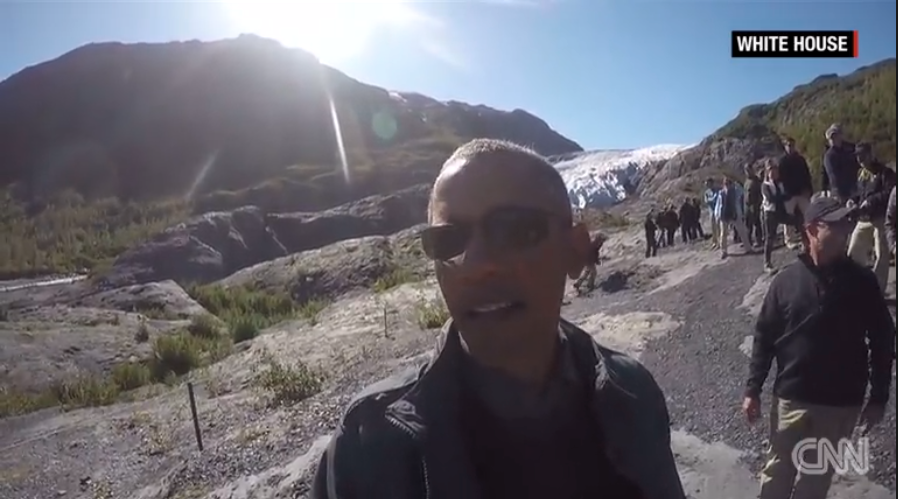
President Obama takes a 'Selfie' video with a glacier. Courtesy of CNN.com
2

This Week: Polar Bears and #ObamaSelfies: The Critical Intersections of Digital Humanities and Environmental Justice

Each week, a member of the JITP Editorial Collective assembles and shares the news items, ongoing discussions, and upcoming events of interest to us (and hopefully you). This week’s installment is edited by Amanda Starling Gould.


This week’s roundup looks at the intersections of digital humanities (DH) and environmental justice.

Polar bears are trending this week on my Twitter and Facebook feeds. Four in particular:


#Regram #RG @USInterior: How do you rescue a 1,000 pound #polarbear trapped in a fishing net? You untangle it. Well, actually, it’s pretty complicated, especially when it’s located in a remote Arctic location. Late yesterday @usgs and @usfws with help from the local community of Kaktovik, successfully freed a large male polar bear that was entangled in a fishing net on a small barrier island in the Beaufort Sea off #Alaska. The biologist’s first darted the bear from a helicopter and then local residents, using boats, kept the bear from drowning while the tranquilizers took effect. Once sedated the biologists worked to quickly untangle the bear from the net and after determining it appeared uninjured from its ordeal, released it back into the wild. A great effort by all to keep this magnificent animal in the wild. Photo by @USGS.

A photo posted by Leonardo DiCaprio (@leonardodicaprio) on

https://instagram.com/p/4kDKJvxJAM/


These polar bears have come to represent this week’s debates on climate change—especially those critiquing the ethical and political stakes of President Obama’s recent trip to Alaska to speak at the GLACIER Conference in Anchorage.

Debates aside, part of that trip included a heavy dose of Obama selfies.


President Obama even does a ‘selfie video’ with a glacier:

President Obama takes a 'Selfie' video with a glacier. Courtesy of CNN.com

President Obama takes a ‘Selfie’ video with a glacier. Courtesy of CNN.com


Though it is fun and perhaps noteworthy that our president is using social media, what is more exciting is the potential for this form of #Selfie + #ClimateChange (or #ActOnClimate as @WhiteHouse uses above) to be a digital call for environmental action.

This provokes several questions that are currently bubbling at the core of much of my own recent work and teaching: How can we use digital tools and methods to productively address environmental issues? How could we design classroom and research assignments that use digital media and DH methods to productively interrogate complex environmental issues? As we use DH tools to discuss environmental issues, how can we use the very materialities of the digital infrastructure—from its complex mineral composition to our resource-hungry data centers and toxic e-waste accumulations—to critically address both DH and environmental justice?

President Obama’s selfies are certainly one place to start. What if Californians began taking selfies with their drought-parched patches? What if Oregonians began taking selfies with their raging wildfire megablazes? What if we extended this #SelfieWithClimateChange challenge to commuters in Beijing or failing farmers in New Zealand? If we had our students use Instagram and Twitter to solicit such images, and then asked our students to work collaboratively to curate those images into a digital project, would this inspire reflection on climate change issues? I’m guessing so. And I’m guessing this is a small part of what President Obama was performing during his trip.

This week as California conserves water and the west coast fights wildfires caused by severe dryness, California governor Jerry Brown tells the state, in a trending online video, that “[t]his is the future, from now on. It’s going to get worse, just by the nature of how the climate’s changing.”

On Monday, @NYTScience tweeted a new NYTimes.com article on California’s ‘historic’ drought that quotes bioclimatoligist A Park Williams who two weeks ago released a report stating that “[a]nthropogenic warming has intensified the recent drought as part of a chronic trend toward enhanced drought that is becoming increasingly detectable and is projected to continue growing throughout the rest of this century.”

If this digital media environmentalism is making a persuasive impact on popular sentiment or is resulting in a heightened awareness of earth stewardship is not entirely known. What does seem to be increasingly evident, however, is the indication that digital interactive tools, from social media to more sophisticated DH projects, have as important a role to play in environmental justice as they do in social justice which seems to be the more prevalent current DH cause.

Knowing that the production, manufacture, waste, and energetic requirement of our digital media devices are actively contributing to the earth’s progressively detrimental state, those of us teaching with technologies, especially those of us teaching socially-minded DH-specific or DH-inflected courses, should take a moment to consider how we might ground those technologies in their own particular environmental contexts, and how we might use those technologies to interrogate—and effectively communicate—today’s important environmental issues.


-Amanda Starling Gould
@stargould


Featured image of President Obama courtesy of CNN.com.

It's Turtles all the way down. Image courtesy of Flickr user William Warby.
1

This Week: It’s Hyperlinks All the Way Down

Each week, a member of the JITP Editorial Collective assembles and shares the news items, ongoing discussions, and upcoming events of interest to us (and hopefully you). This week’s installment is edited by Benjamin Miller.

Turning to the trusty Twitter feed for this week’s roundup, I found a lot of recommendations for other people’s recommendations: a rabbit hole of suggested tools. Here, then, are a few other aggregations going on across my social network, and a few of what I see as this week’s highlights.

Over at ProfHacker, Adeline Koh extols the virtues of Reclaim Hosting as a space for launching customizable versions of interactive-pedagogy-friendly tools like WordPress, Scalar, and Omeka. If, like me a few months ago, you’ve heard good things about Reclaim and meant to try it but haven’t, you’ll want to read through to the bottom for an extra incentive.

Deanna Mascle maintains a collection of links at scoop.it related to Education and Learning, filled with click-bait for ed-tech enthusiasts: think “5 Fun Alternatives to Think-Pair-Share” and “What Do We Really Mean When We Say ‘Personalized Learning’?” She’s added a bunch of new posts this week, of which my favorite is Justin Pot’s “5 Easy Ways to Make Awesome Videos and Images Quickly”. It begins like this:

Stop making memes: they haven’t been funny for years, and using them makes you seem out of touch at this point. Besides, there are way more creative tools out there for creating pure doses of Internet-related delight.

Whether delight is the end-goal of education or not, there’s definitely fodder here for teachers and students who want to engage audiences visually instead of only through words — or to explore the effects of shifting among media.

Here’s one that isn’t a reference to a reference, but rather a foreign-language teacher reflecting on the increased role of writing in students’ daily lives, and how that has affected his pedagogy. As Gianfranco Conti puts it, in a post on his site, The Language Gym:


On a daily basis I find myself chatting on social media in four different languages and I find the linguistic challenges this poses quite taxing as it requires faster language processing ability and sociolinguistic competences that I do not always possess.

Whether we like it or not, the vast majority of our students communicate via social media or other forms of instant messaging. Hence, if we are to prepare them for communication in the real world this phenomenon cannot be ignored. Teaching interactional writing skills is therefore a must, in my opinion.

Conti includes seven interactive learning activities for his class, including a live Edmodo chat session with students assigned alternating roles of initiator and responder, all in the target language.

(Hat tip to Jim Ridolfo for retweeting the link. Okay, so maybe it was a reference to a reference, after all.)

Finally, the New York Times reported over the weekend about an app-enabled marketplace for lesson plans, TeachersPayTeachers, which they repeatedly billed as “an Etsy for educators.” Among the more striking pieces of information shared here? “By selling tens of thousands of items, [CEO Adam Freed] says, 12 teachers on the site have become millionaires and nearly 300 teachers have earned more than $100,000. On any given day, the site has about 1.7 million lesson plans, quizzes, work sheets, classroom activities and other items available, typically for less than $5.” It’s a useful reminder that the benefits of interactivity are not limited to students… and that capital incentives for teachers are more likely to come from other teachers spending out of their own pockets than from a more systematic realignment of salary structures.

What do you think, JITP readers: would you sell your lesson plans for a dollar each, if people were willing to pay for them?


“It’s Turtles all the way down.” Image courtesy of Flickr user William Warby.

@FuturesED mentors (CUNY undergrads) getting to know one another @GC_CUNY #FuturesED #fight4edu. Image courtesy of Twitter User Danica Savonick ‏@DanicaSavonick.
0

This Week: Justice and Equality at the University

Each week, a member of the JITP Editorial Collective assembles and shares the news items, ongoing discussions, and upcoming events of interest to us (and hopefully you). This week’s installment is edited by Renee McGarry.


This month the HASTAC project The University Worth Fighting For deals specifically with classroom pedagogies of equality and invites readers to comment on how they move toward more equal pedagogies in their own classroom practices. The initiative also hosted a live-streamed workshop on August 28, which was recorded and can be followed on Twitter at #fight4edu. Future months will deal with other issues facing the university of the 21st century, hopefully including the broader themes I discuss below.


In her opening essay, Futures Initiative fellow Danica Savonick asks, “What would a classroom look like if it were designed not to reproduce traditional hierarchies of privilege and power, but instead to produce justice and equity?” I’d like to make one simple change to this question to reframe the conversation: “What would a classroom university look like if it were designed not to reproduce traditional hierarchies of privilege and power, but instead to produce justice and equity?” Because while what we do in our classrooms matters, it matters less and less if the neoliberal university continues to reproduce power structures that disempower students and faculty while empowering administrators and donors in a way that interferes with teaching, learning, and research. It’s important that we develop a classroom dynamic “in which those historically marginalized and dispossessed by the social order can instead thrive and flourish” but we also must recognize that those in the front of the classroom may be, and increasingly should be, a part of the same historically disempowered groups and that the ways in which instructors (tenure-track and contingent alike) are associated with and participate in the neoliberal university are diverse and oftentimes involuntary.

And while I’m heartened by the focus on pedagogy in the past decade, we also need to address very concrete problems that come with it: the division this creates within universities between those who “care about” teaching and those who “don’t”, the feminization of this particular kind of labor and the association of women with teaching and its associated emotional labor, a divide between teaching schools where pedagogy is foregrounded and oftentimes more elite schools where it isn’t, and the fact that for most instructors – over 50% of them in fact – revising teaching methodologies and classroom structures is completely unpaid labor, as the neoliberal university continues to hire contingent instructors with no job security and pay them (often too little) by classroom hours. Our classrooms are microcosms of higher education, and the direction of higher education matters for our classrooms. When thinking about equality I encourage instructors to think narrowly about our classrooms, but also broadly about the system in which our classrooms exist. As the director of the Futures Initiative, Cathy Davidson, said during the workshop, “The only way you can counteract structural inequality is by structural equality.” This fight is multifaceted. We are rapidly losing the battle for a system that empowers faculty and students, and classrooms that aim for for equality can provide a three hour break for students and faculty alike, but it’s oftentimes just a break from a system that churns on without their well-being in mind.


  • Teaching Machines and Turing Machines: The History of the Future of Labor and Learning
    • “In all things, all tasks, all jobs, women are expected to perform affective labor – caring, listening, smiling, reassuring, comforting, supporting. This work is not valued; often it is unpaid. But affective labor has become a core part of the teaching profession – even though it is, no doubt, “inefficient.””
  • Grief Work
    • “Despite the tech-speculative fiction that posits a future of leisure, the future of work, so it seems, will increasingly be contingent, precarious; and as such, it’s hard to see how it will be anything other than an unhealthy one – physically, mentally.”

Images are for demo purposes only and are properties of their respective owners. ROMA by ThunderThemes.net

Skip to toolbar