Weekly Roundup

A stack of rolled drawings, viewed in profile.
0

Roundup: Community, Scholarship, and Digital Archives

Each Roundup, a member of the JITP Editorial Collective assembles and shares the news items, ongoing discussions, and upcoming events of interest to us (and hopefully you). This week’s installment is edited by Anne Donlon.

Reminder: Submissions for short, blog-length sections in The Journal of Interactive Technology and Pedagogy are open year-round on a rolling basis. If you would like to share a teaching fail, an opinion, a project blueprint, a tech tool, an assignment, or a review of a book or event, please see the short section submission guidelines.

I find myself re-reading Jerry Watts’s Open Letter to My Students and Anyone Else seeking a way to get unstuck. He first sent it out via the Africana Studies listserv at CUNY in 2010 and it was published soon after in the Graduate Center Advocate. Since his death from a stroke a few weeks ago, the letter has recirculated and was republished in Warscapes. Jerry was a mentor from my first days of graduate school, a member of my dissertation committee, and a person I expected to be in my life for a long time to come. As I struggle through processing the loss while trying to keep up with work I’ve committed to, I keep returning to Jerry’s letter for guidance, mostly ruminating on “The reasons why we become stuck are numerous and vary in complexities […] IN THE MEANTIME HOWEVER, WE NEED TO GET SOME WORK DONE!!!” I’m living in that balance between exploring the psychic roots of my relative stuck-ness and the more urgent directive to get down to the real intellectual work.

Jerry’s commentary on navigating academia and sustaining the life of the mind transcends discipline, and I’ve tried to suggest some through lines below for digital humanities and digital libraries. Thinking about his role as an advisor (formal and informal) to so many black students at the Graduate Center, and his scholarship on black intellectuals, I’m thinking about how to work for digital humanities that sustain scholars of color, refuse racism, and address intellectual questions that affect African American life. The demands of black student activists, initiatives to archive student activism such as this new project at Princeton, and this compilation of Chicago police disciplinary information suggest some recent contributions to this conversation.

“Any and all graduate students need support communities”

While the following resources won’t provide every kind of support a person needs, I’ve found they are good places to find community and learn about current digital humanities goings-on.

  • The Digital Humanities on Slack offers a venue to pose questions, ask for help, and share lessons learned. I’ve learned about a number of tools, publications, and DH projects in the few weeks I’ve been a member.
  • The just-launched Digital Library Federation Digital Library Pedagogy group promises to be a meeting place to ask for help and share knowledge. The group will host a #DLFteach Twitter chat on January 12, 2016, at 8 PM EST.

Newsletters offer a way to “plug in” to various conversations happening in online fora and on the ground conferences, helpfully curated by knowledgeable colleagues and arriving to your inbox.

  • I learned about Miriam Posner’s newsletter on the DH Slack. If you want incisive information about projects and tools arriving in your inbox, you can subscribe or browse the archive of previous newsletters. Miriam Posner’s students’ DH101 projects were also making appearances on my social media feeds this week, which are worth checking out for a model of assignment design as well as impressive examples of undergraduate student DH work.
  • I also recently learned about the HASTAC newsletter, which sends monthly updates about HASTAC initiatives, upcoming events, projects that have launched, as well as upcoming opportunities for employment, publication, or presentations.
  • I’ve been subscribed to the MIT Hyperstudio newsletter for a while. It includes links to recent publications, upcoming conferences, jobs, and publication opportunities, as well as recently launched project.

“the productive/creative scholar must immerse himself/herself in a body of literature”

Jerry was a seriously well- and widely-read scholar. I aspire to the scholarly immersion he urged in his letter (and embodied in his life). Instead, lately, my own immersion takes the form of fifty browser tabs open for days at a time. You may have a better system for managing your readings (feel free to add your tips in the comments), or undertaking immersive study, but in the mean time here are some recent readings I’ve found thought provoking:

I have also had a cluster of readings related to digital archives at hand. I realized, while attending Modernist Studies’ Association conference in November, that despite being on the Digital Archives team at the Rose Library, I am not always sure what “digital archives” means. In the archives world, I understood it to mean born-digital material (for instance, the contents of Alice Walker’s hard drives) or digitized materials belonging to a certain collection–photographs, digitized videotapes or records, or texts digitized for access in the reading room, and, when possible, to a wider community, with deliberate standards for security, access, and preservation. However, I picked up that “digital archives” is a term used more loosely in humanities contexts, to mean, seemingly, any collection of digitized materials.

Trevor Owens shared a draft of a forthcoming book chapter on Digital Sources & Digital Archives; the section “What are Digital Archives?” offers some clarity on “what the term means in different contexts.” Charlotte Nunes led a post-conference workshop on Modernism & Digital Archives at MSA, and the participant-annotated google doc is a rich collection of links to digital collections, tools, projects, and readings related to digital archives. In a pre-conference workshop, Shawna Ross shared a helpful workflow, “Archive by Smartphone: From Book to OCR with ScannerPro and Google Drive,” for creating digital OCR-ed texts from physical paper materials.

For the longer term aspirations of being productive, creative, and immersed in scholarship, I’m eyeing the playlists for focusing and meditation app recommended in ProfHacker’s 2015 gift guide; working on a simple daily routine; growing trees on the Forest app; and making time for reading in quiet and solitude. Here’s to resolutions.

Upcoming events

1

The Marriage of the Digital Humanities and Alt-Ac Positions

Each week, a member of the JITP Editorial Collective assembles and shares the news items, ongoing discussions, and upcoming events of interest to us (and hopefully you). This week’s installment is edited by Sarah Ruth Jacobs.

Announcement: This is a reminder that submissions for short, blog-length sections in The Journal of Interactive Technology and Pedagogy are open year-round on a rolling basis. If you would like to share a teaching fail, an opinion, a project blueprint, a tech tool, an assignment, or a review of a book or event, please see the short section submission guidelines.

This year I am one of 20 fellows in the Modern Language Association’s Connected Academics Proseminar, an enrichment seminar for graduate students who are interested in pursuing alternative career paths.

As part of the seminar, participants complete career development and networking activities, including attending group visits at potential employment sites (a more detailed description of what the proseminar entails can be found here).

One of the observations that has come out of the proseminar thus far is how those who are most qualified for alt-ac jobs are those that have had the chance to take on administrative, alt-ac, and technology-related jobs during grad school. In fact, technology skills in particular seem to be high in demand in potential alternative positions for academics.

This makes sense when one considers that the rising profile of alt-ac jobs coincided with the rise of the digital humanities, as well as with the increasingly dire job prospects for new Phd recipients.

Google Trends shows how the popularity of the search term “digital humanities” continually rose since 2007:

Figure 1. Popularity of the Google search term “digital humanities,” where the level over time is relative to the highest part of the chart.

In comparison, the term alt-ac wasn’t coined until 2009, when, as Brenda Bethman and C. Shaun Longstreet note, a Twitter conversation between Bethany Nowviskie and Jason Rhody used “alt-ac” as shorthand for alternative academic (Nowviskie publicized the conversation here).

However, the notion of academics in non-traditional roles, just like the notion of digital applications for the humanities, preceded their popular terminology. Collin Brooke’s 2005 reflection on being “a technology specialist working in the humanities” would be a fine example.

Just as digital technology is opening up job opportunities across a number of different sectors, it is hardly surprising that academia is one area of tech growth.

In the spirit of alt-ac, I would like to use this roundup to bring attention to a few new and ongoing alt-ac opportunities and resources.

In addition to the MLA’s Connected Academics proseminar for current and recently-graduated doctoral students, the NEH is offering institutional grants for graduate schools to improve their alt-ac student and faculty outreach, or even to change the requirements for the degree to be more alt-ac friendly.

On Twitter, accounts with info on #altac job searches include @altacliberation, @MLAConnect, @VersatilePHD, and @humanistsatwork. Brenda Bethman has a list of resources, and Josh Boldt solicited and received a great list of websites at the bottom of his piece in Vitae.

For reflections, stories, and tips on pursuing alt-ac jobs, check out @altacadvisor, @BeyondAcademia, @Phdsatwork, @0ffthebench, and @GradSquare. MediaCommons also has articles on its #alt-academy site, where Brian Croxall‘s alt-ac guide serves as a great example.

Please tweet to @srujacobs if you would like to add to this list. Thanks!

Image of the Society for the History of Technology (SHOT) Logo.
0

Reflecting on Technology, Information, Society, the Digital Humanities, and Pedagogy

Each week, a member of the JITP Editorial Collective assembles and shares the news items, ongoing discussions, and upcoming events of interest to us (and hopefully you). This week’s installment is edited by Kimon Keramidas.


This week marked the five year and one-month anniversary of the first gathering of the group that would make up JITP’s editorial collective. Because of this I’ve been reflecting on how far we’ve come and where this journal fits within an evolving academic landscape where technology and the digital are having an increasing impact on the lives of faculty, staff, and students. From within the collective there is a sense of accomplishment. We’re on the way to publishing our eighth issue and continue to strive to find new ways to promote alternative forms of publication (still a daunting challenge) and facilitate discourse amongst like-minded scholars and pedagogues. But after leading a roundtable on the digital humanities at the gathering of the Society for the History of Technology’s (SHOT) Special Interest Group in Computers, Information and Society (SIGCIS) earlier this month, I was reminded that there are many places where the work we at the journal see as self-evident and a logical progression in the evolution of the academy has yet to penetrate and/or still meets significant resistance.

First, a little background for those who may be unaware of the origins of the journal. JITP developed out of a certificate program in interactive technology and pedagogy at the CUNY Graduate Center that has been in existence for more than a decade, and has deep roots in significant work accomplished by the American Social History Project/Center for Media and Learning in digital public history. This work at CUNY predates the recent explosion of interest in digital humanities, and rather than focusing on the algorithmic analysis and visualization of literary corpora that has driven much DH work emphasizes a critical and theoretical awareness of how technology has impacted human endeavors throughout history.

This means that, much like SHOT, the journal’s lineage owes much to a social and cultural understanding of the history of technology and information. So, when I first attended SHOT’s annual conference and SIGCIS workshop in 2014 I thought I would find a technology-forward community committed to understanding how the tools they studied could best be deployed to improve academic work and the practice of teaching and learning. But, I in fact found the opposite as most of the SHOT community was not engaged actively in developing online communities and papers were structured and presented traditionally with read papers accompanied by Powerpoints. Nor was there significant backchannel chatter on social media or reflective posts online after the conference. I attended one panel where digital humanities was mentioned in the discussion, and as the conversation veered into the inevitable concerns over peer-review, a comment I made about post-publication peer review–which we use as a model for some short-form pieces on JITP–was quickly dismissed as a fleeting and unviable alternative. The orthodoxy of practice that acts as a barrier of entry to new inquiries into the potential use of interactive technology were apparent in the study of the history of technology, just as it still lingers in many sectors of English, history, art history, etc.

Things weren’t all bad, however, because what I found was that parts of the SHOT community were in fact engaged in questions concerning the digital humanities and interactive technology and pedagogy; they were just being very deliberate in their approach and uptake, because more than most they are keenly aware of the social, cultural, and economic ramifications of the introduction of technology into daily life both in and out of the academy. There has been a THATCamp at a previous annual gathering (although it has not been repeated since) and the SIGCIS community is more engaged and hopeful about the affordances of contemporary digital media to expand that group’s activity and constituency. With this in mind I organized a roundtable for the 2015 gathering that asked four historians of technology to discuss how SHOT and SIGCIS could more actively engage in the growing discourse surrounding digital humanities and provide it with a stronger base of history from which to understand the technologies being used to drive that movement. The resulting conversation between panelists and audience was telling. There was a combination of eagerness and apprehension as these scholars of technology, computation, and information were able to see the potentials of using these technologies but also recognized the intellectual and ideological pitfalls of using them without fully understanding them or championing them as saviors of the academy. We discussed algorithmic analysis, data visualization, internet culture, materiality of the virtual, and professionalization and were able to do so while avoiding the issues of copyright, tenure, and disciplinarity that usually bog down proceedings.

But, one thing I did not notice until after the panel was almost over was that we really had not broached the subject of alternative approaches to teaching and learning. It was only when a few of us were having a side conversation and were talking about how students handed in papers that we even touched upon the practice of teaching and learning. Where a minute before we were talking about Python web scraping, complex database queries, and chronographic visualizations, we were now back to “do you use email and print out your papers or do they post to Dropbox?” As Stephen Brier – a member of the JITP collective, founder of the CUNY ITP certificate program, and longtime ASHP/CML collaborator – has noted, “pedagogy is not totally ignored by DH’s growing cadre of practitioners; rather, teaching and learning are something of an afterthought for many DHers.”(1) This was the feeling I kind of left with after the roundtable. I was glad that SHOT and SIGCIS were starting to get invested in the digital humanities, as that community can definitely help historicize the too often sensationalized interest in this burgeoning sector of academic inquiry. But, as we have seen so often, in the march towards a greater understanding and implementing of these new technologies, the pedagogy once again was getting left behind.

So, looking back at five years of JITP I think we can say that we have accomplished a lot and we are encouraged by the near and long-term growth we see coming for the journal and the communities it serves. But, if my experiences earlier this month are any indication, there remain not just corners but entire swaths of the academy that have yet to engage with the possibilities that interactive technologies have to dramatically alter the experience of teaching and learning. One might wonder why after seventy years of modern computer programming, forty years of personal computing, and twenty years of the Internet there remains uncertainty and resistance about the potential for digital culture to impact educative practices, but the case remains that there is still work to be done and five years on JITP will continue to make whatever dents in can in the academic universe.


(1) Stephen Brier, “Where’s the Pedagogy? The Role of Teaching and Learning in the Digital Humanities,” in Debates in the Digital Humanities, ed. Matthew K. Gold (Minneapolis: Univ Of Minnesota Press, 2012), http://dhdebates.gc.cuny.edu/debates/text/8.

"Resource Development Kits for the ANT Project (1)" by Stephan Ridgway from Sydney, Australia - M-Audio MobilePre USB mixer and micsUploaded by shoulder-synth. Licensed under CC BY 2.0 via Wikimedia Commons.
0

This Week: Digital Pedagogy Institute Postmortem and a Podcast Potpourri

Each week, a member of the JITP Editorial Collective assembles and shares the news items, ongoing discussions, and upcoming events of interest to us (and hopefully you). This week’s installment is edited by Andrew Lucchesi


This week’s roundup is a bit of a grab bag.

First a quick report back on something I mentioned in my last weekly roundup. In August, I attended the first annual Digital Pedagogy Lab Summer Institute, hosted by Hybrid Pedagogy and the University of Wisconsin-Madison (among others). It was my first intensive digital humanities institute, and while I’m not sure I fully knew what I was getting myself into, I left with a bunch of tools and connections I’ll be glad to have going forward. You can check out the massive archive of resources generated from the various tracks at Praxis, Networks, and, the track I took, Identity. While you’re there, you might check out the new series of online courses being developed by the Digital Pedagogy Lab.

Next stop, podcasts. The world of academic podcasts is surprisingly vast, so I’ve selected out a few that are fairly young and perhaps attuned to some of our interests here at JITP. The advantage of digging into young podcasts is you can go back and listen to the archive of episodes pretty easily, and if you like them, subscribe for the new stuff as it comes out.

  • Masters of Text: Hosted by Ames Hawkins and Ryan Trauman, this podcasts aims to “foster discussion of alternative textual forms of scholarship, and to promote scholarship about alternative modes of textuality” (About). As of last week, they just posted their fourth episode, which explores the queer process Ames went through in translating a written text into an audio text.
  • HypridPod: Hosted by Chris Friend, this new podcast presents “the aural side” of the journal Hybrid Pedagogy. There are currently five episodes, the most recent features a stellar panel discussion on the topic of laptop policies in the classroom.
  • KairosCast: Hosted by Courtney Danforth and Harley Ferris, this podcast features interviews, tutorials, conference rundowns, and segments focused on topics relevant to the good folks at Kairos journal. They model great accessibility (a Kairos hallmark) by providing full transcripts for their episodes. Check out all six episodes up now.
  • From Students to scholars: a Graduate Center Peer Mentoring Podcast. This one’s a home-grown property developed this year by students in the CUNY Graduate Center. This podcasts aims at providing peer mentorship to grad students navigating the challenges of building professional identity, developing research projects, and surviving the turmoil of academia. The site just went live last week, and currently features three episodes for download.

Other quick highlights:

MLA members now get discounted attendance rates to the Digital Humanities Summer Institute.

CFP: Debates in the Digital Humanities 2017, Abstracts due November 2, 2015.

CFP: FemTechNet Distributed Open Collaborative Conference, Proposals due December 1, 2015.


the #transformDH logo; it was designed and crafted by Melissa Rogers and photographed by Reed Bonnet
0

This Week: #transformDH

Each week, a member of the JITP Editorial Collective assembles and shares the news items, ongoing discussions, and upcoming events of interest to us (and hopefully you). This week’s installment is edited by Amanda Licastro.


My weekly round-up consciously focuses on one inspiring event: the #transformDH conference at University of Maryland. In a week filled with violence, loss, heartache, political and economic strife around the world, this conference was a shining beacon of hope for me. TransformDH flipped the script on academic conferences in so many important ways: it was free to attend, the speakers were all from groups marginalized in academia, it included multimedia presentations from people outside of higher education, and it was intentionally accessible (including live-streaming, ASL interpreters, captioning on the media, and a location in an handicap accessible building).

this is a screenshot of a tweet from Lisa Nakamura that says ‘Fabulous start to #transformDH conference at #umd by Alexis lothian. Everyone and everything has been thought of.


Despite the impending hurricane, the room was filled with a small but passionate group of students, staff, and faculty members from all realms of the humanities broadly defined, in addition to the dozens of virtual attendees participating via livestream and twitter (see the Storify here). All of these participants believed in the mission that imbued this event: inclusion. And not just inclusion simpliciter, but inclusion that is transformative. This was demonstrated by the welcoming environment and the focus on providing – to borrow Jarah Moesch’s term – “care” for everyone involved.


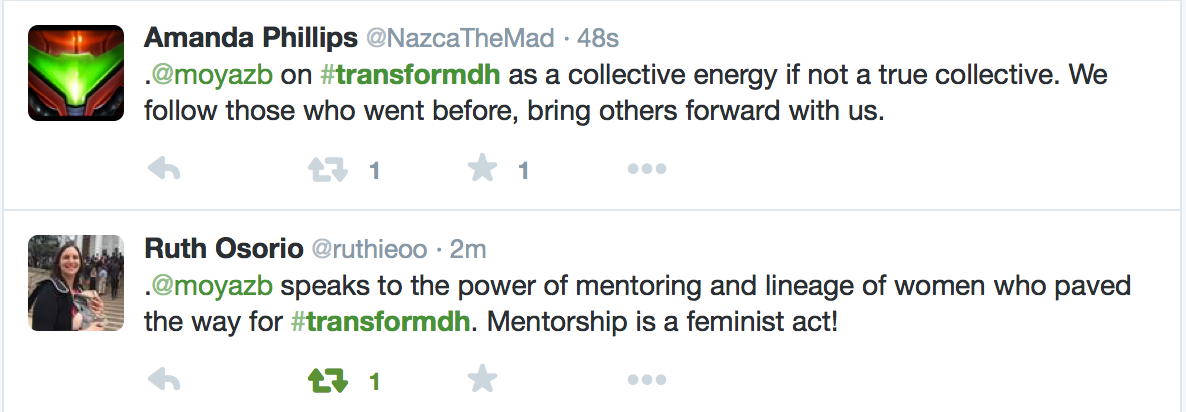
The #transformDH movement started in 2011 at the American Studies Association (ASA) conference in Baltimore, but the core team is adamant that anyone who uses the hashtag and contributes to the conversation is part of this collective. The concept “collective,” stressed and historicized in opening remarks by Martha Nell Smith, recurred throughout the presentations. “Collective” came to mean a collaboration that is not hierarchical, or a distributed network that crowdsources knowledge and labor toward a common end.

tweets from Amanda Phillips and Ruth Osorio that report on Martha Nell Smith’s opening remarks


This concept was enacted through panels of presenters and collections of projects that showcased a wide range of perspectives on how the digital humanities can be used as a tool for intervention (see full lineup here). The conference website (maintained by Alexis Lothian and by those mentioned here) proclaims the mission of #transformDH as

an academic guerrilla movement seeking to (re)define capital-letter Digital Humanities as a force for transformative scholarship by collecting, sharing, and highlighting projects that push at its boundaries and work for social justice, accessibility, and inclusion” (#transformDH Tumblr).

And this is precisely what happened over the course of the day. The first half of the day featured commentary and projects which raised awareness about the many issues facing those engaged in Digital Humanities (DH). For instance, panelist Anne Cong-Huyen voiced concerns about the increased reliance on contingent positions funded with “soft-money” in DH, and noted that we need to recognize the work done in marginalized locations such as small liberal arts colleges, community colleges, and outside of the academy. Moya Bailey and Amanda Phillips discussed the interdisciplinary nature of DH work, and noted that many scholars working in gender, queer, critical race, and ethnic studies do not identify DH as their home discipline, either because they do not feel welcome or because they are dedicated to legitimizing their fields without DH.

A sketch of presenters by Twitter user @katkingumd

The panel also discussed institutional barriers to working as a “collective,” such as the need for individual recognition and formalized mentoring structures that do not allow for a distributed network of collaboration. The room seemed to tangibly feel the tension between the need to recognize the labor of individuals, and the desire to acknowledge that none of us works alone.

a tweet from Jason Farman summarizing the emphasis on acknowledging labor and collaboration


Next, Martha Nell Smith prompted the panelist to share projects that exemplified the mission of #transformDH. Here is a short list of every link I could capture:

These projects are connected by their ability to give voice and recognition to marginalized populations through the use of digital technology, for which Moya Bailey provided this lovely metaphor:

This is a tweet about cyber quilting - stitching movements together using digital technology, by Twitter user @amandalicastro

This panel was followed by a video screening of #transformDH projects that I really cannot do justice with a short description. Fortunately, they are available for you to view here:

Video Showcase:http://transformdh.org/2015-video-showcase/

For audience reactions to these projects, check the Storify for the accompanying tweets, especially by Kathryn Kaczmawr, who captured the second video showcase incredibly well.

The second video showcase was followed by a question and answer session with the creators of the last video; the video and panel were almost entirely in ASL with translators for both panelists and audience members. The video, which consisted of interviews and footage of performances, was awe-inspiring: beautiful, powerful, and passionate. I highly recommend watching. The panel afterward announced that the American Sign Language (ASL) Shakespeare Project will be holding an month long celebration next October in DC, which will include performances of Shakespeare’s plays in ASL, exhibits of original manuscripts, and lectures about the project. The team fielded questions about which version of ASL would be used, why they chose the Bard, and what challenges the language of these texts presented. To find out more come to one of the many exciting event in October 2016.

Then it was time for final panel of the day, “Emergent Intersections of Disability and the Digital,” with M.W. Bychowski (George Washington), Angel Love Miles (UMD), Izetta Mobley (UMD), and Jarah Moesch (UMD), moderated by Beth Haller (Towson University). This panel was not livestreamed, but the discussion was mindblowing. I will respect the rights of everyone in this panel and not divulge too many details, but many of the thoughts expressed can be found on their sites:

  • Beth Haller began by quoting from bloggers who use social media for disability activism. Haller praised social media sites as a tool for those with disabilities to communicate the ways in which they face ableism everyday. https://bethhaller.wordpress.com/
  • Izetta Autumn Mobley, who asked: how are bodies entered into the digital archive? Whose bodies? Who is archiving? https://twitter.com/imobley1
  • Angel Love Miles who asked us to consider who determines ‘reasonable’ accommodations (hint: usually the able-bodied), and how digital tools designed for accessibility for some (such as Siri, fast processors, and keyboards) shut others out and cause many physical harm.

a screen capture of a tweet from Mary Sies who quotes from Mobley’s presentation


The keynote Keynote lecture was delivered by Lisa Nakamura (University of Michigan),

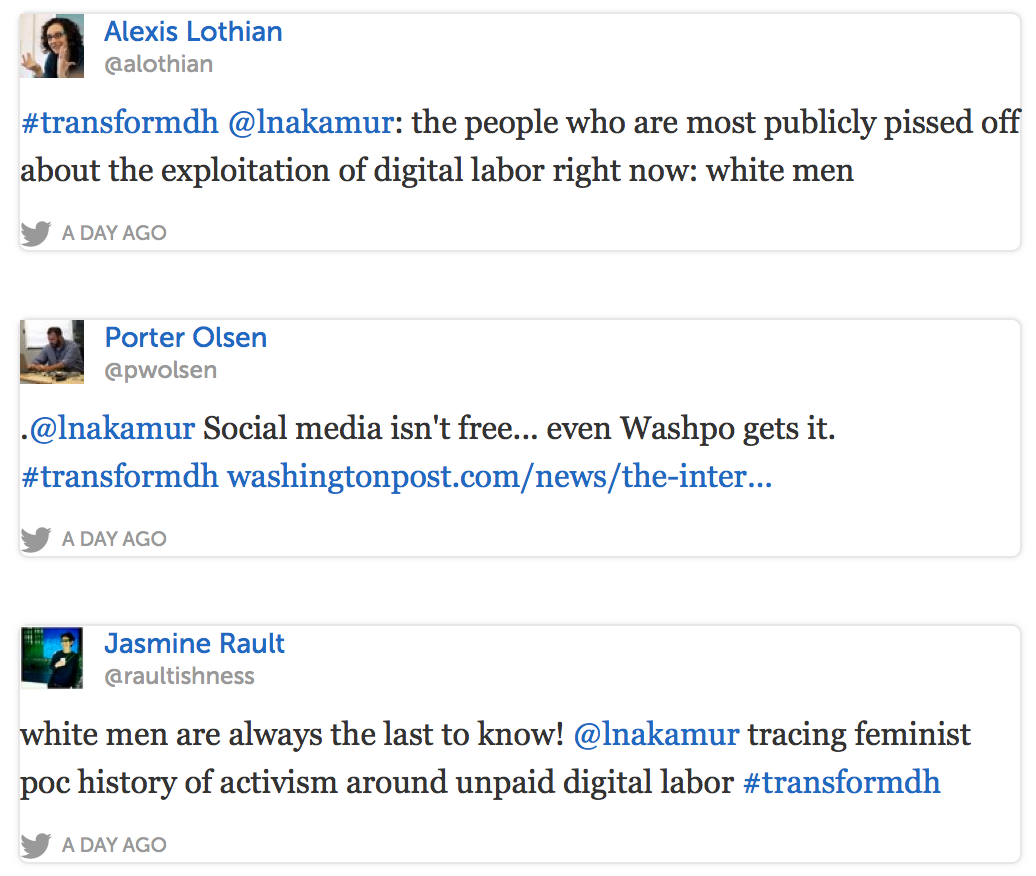
“The Unwanted Digital Labor of Social Justice: Race, Gender, and the Origins of Call Out Culture.” Nakamura was introduced by Jason Farman who asked us to tweet how Lisa influenced our work, which speaks to the immense impact Nakamura continues to have on this field. I was one of many who tweeted Nakamura’s first article, “Race In/For Cyberspace: Identity Tourism and Racial Passing on the Internet,” which I read in The Graduate Center’s Interactive Technology and Pedagogy program. Nakamura’s keynote focused on embodied experiences online, particularly how women who “call out” injustice in online forums face abuse wrought with physical rhetoric that has physical effects on the body. Nakamura notes that feminists have always been interested in the material, but that the “body” is left out of the digital conversation. Nakamura returned to Gloria Anzaldua’s “This Bridge Called My Back” to discuss digital labor, pointing to the “This Tweet Called My Back” movement. This led into a discussion of the labor of moderating content on the internet – by “volunteers,” by part-time underpaid housewives (Metaverse Mod Squad), and (as I pointed out in the Q&A) by the human moderators who remove offensive content for media corporations, but also as the free labor of creating content for social media sites to mine:

Several tweets about the exploitation of digital labor.

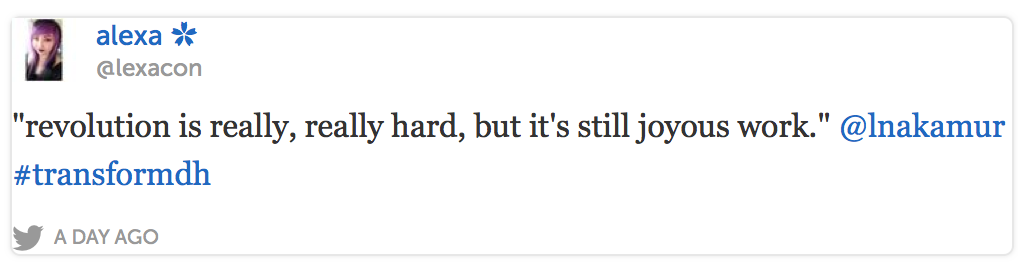
The concerns Nakamura expressed over the treatment of women online was really a call to action. How can we work together to moderate content on the internet without fear of physical and mental harm? It is time for a revolution.

This is a tweet by Twitter user @lexacon, "revolution is really, really hard, but it's still joyous work"

Thank you to the organizers, speakers, and participants of the #transformDH conference. Your words, actions, and ideas all speak loudly, and incite the desire for change.

I am left with these questions: What if, in our future, we cared for each other / took care of each other / cared about each other’s needs and worked together meet those needs? What would this revolution look like?

This post is dedicated to the victims of the #UCCShooting and their grieving families and friends. You are in my heart.

Images are for demo purposes only and are properties of their respective owners. ROMA by ThunderThemes.net

Skip to toolbar