Tagged pedagogy

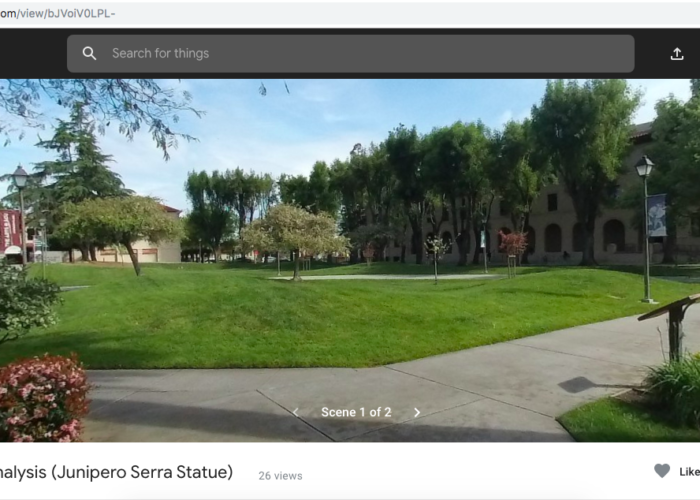
360° photograph of Junipero Serra statue and campus lawn, displayed in Google Tour Creator interface with digital annotation icons
0

Representing Indigenous Histories Using XR Technologies in the Classroom

In this article, we describe the major assignments from our team-taught course, Virtual Santa Clara, which drew on the affordances of extended reality (XR) technologies and public memory scholarship from the fields of rhetoric and anthropology to represent Native Ohlone history and culture on our campus. Based on our experience, we argue for the affordances of producing small-scale XR projects—using technologies such as 360° images and 3D models—to complement and contribute to larger-scale XR digital projects that are founded on deep community collaboration. In a landscape where exciting technological work so often tends to entail thoroughly developed, large-scale projects, we argue for the value of more modest contributions, both as scaffolded pathways into technology work for teachers and students and as a means of slowing down the process of technology adoption in order to better respond to ethical, humanistic, and decolonial considerations. Our own incremental process enabled us to proceed with more care, more caution, and, ultimately, a more collaborative framework going forward. Read more… Representing Indigenous Histories Using XR Technologies in the Classroom

0

Immersive Pedagogy: Developing a Decolonial and Collaborative Framework for Teaching and Learning in 3D/VR/AR

Abstract

In June 2019, a cohort of CLIR postdoctoral fellows convened Immersive Pedagogy: A Symposium on Teaching and Learning with 3D, Augmented and Virtual Reality at Carnegie Mellon University. The symposium sought to bring together a multidisciplinary group of collaborators to think through pedagogical issues related to using 3D/VR/AR technologies, as well as to produce and disseminate materials for teaching and learning. This essay presents the Immersive Pedagogy symposium as a model for interrogating and developing pedagogical practices and standards for 3D/VR/AR; we offer a decolonial, anti-ableist, and feminist pedagogical framework for collaboratively developing and curating humanities content for this emerging technology by summarizing the symposium’s keynotes, workshops, as well as its goals and outcomes. Workshops, keynotes, and participant conversations engaged with decolonial and feminist methodologies, practiced accessible design for universal learning, offered templates for humanistic teaching, and illustrated the possibilities of using 3D/VR/AR to extend critical thinking. While 3D/VR/AR technologies demonstrate real possibilities for collaborative, multidisciplinary learning, they are also fraught with broader concerns prevalent today about digital technologies, as well as complex issues specific to 3D/VR/AR. There is a clear need to assemble academic practitioners on a regular basis in order to facilitate an ongoing discussion about 3D/VR/AR technology and its responsible, meaningful use in teaching and learning.

Introduction

As access to three-dimensional (3D) technologies has become increasingly available in academic venues, the desire to teach with these emerging technologies, particularly augmented reality (AR) and virtual reality (VR), has outpaced digital humanists’ abilities to provide meaningful support for immersive projects. There is a growing and ongoing need to produce shared and open pedagogical materials adaptable to the needs of teachers in various professions and disciplines and are accessible to students without significant coding experience. This need is partially driven by the contingencies of relatively new and rapidly updating technologies, as well as the fact that support for commercially-available immersive tools are tailored for industry purposes. Game-driven tutorials, for example, do not always take into consideration the needs of humanities practitioners seeking to integrate critical thinking with technical mastery. Contemporary contexts for emerging technologies can structure our interactions with 3D/VR/AR. Though not always visible to users, these can have the effect of naturalizing problematic historical and political narratives through selective access to resources and functionality.

Nonetheless, game engines that offer free educational licenses have been repurposed for academic inquiry and teaching over the past decade. For example, Unity Technologies’ Unity 3D game engine is utilized by over 4.5 million users and has been at the forefront of historical and archaeological 3D visualizations in scholarly research. First available in 2005, the Unity 3D game engine has been used to make approximately 60% of all AR/VR applications and is used by 90% of AR/VR companies (“Public Relations” 2019, np). Educational licenses are available for students and educators seeking to use the engine for scholarly or creative use. Its main competitor, the Unreal Engine, while initially inaccessible beyond professional and academic institutions with licenses, dropped its paywall for educational use in September 2014. VR headsets, once a hypothetical fantasy or niche short-lived technology, are now commercially viable and relatively inexpensive for institutions to purchase. In a few years, the financial barrier for individuals may diminish; in the meantime, Google Cardboards and other stereoscopic viewers with fewer interactive features currently provide alternatives for students with access to smartphones. However, students are also increasingly able to make use of interactive 3D/VR/AR technology within dedicated spaces in academic libraries, maker spaces, media studios, and community outreach centers. Yet, we would be remiss not to point out that access is still mediated by other social hierarchies; 3D/VR/AR technology is still not accessible in much of the Global South, or in marginalized communities across the world. These aforementioned developments still privilege students at institutions that dedicated staff or faculty to maintain and encourage use of 3D/VR/AR technologies and facilities.

This is all to say that in our current 3D/VR/AR moment, digital humanists have a lot to navigate. Current 3D/VR/AR pedagogy and projects can pose problems related to accessibility and long-term preservation of projects and assets, and often run afoul of minimal computing recommendations. Yet the technology offers rich possibilities for multidisciplinary research and collaboration; many virtual reality projects combine art production, computing, archival research, network theory, and data visualization, among other practices. Given its potential for scholarship and teaching, understanding how to use the technology responsibly necessitates engaging with active practitioners to identify what is now possible and what still needs to be done to facilitate productive use of 3D/VR/AR. As many key problems are likely to persist through subsequent permutations of the technology and its use in educational settings, this conversation needs to be ongoing and open. What humanists within and beyond the academy have to say about 3D/VR/AR will probably not be unique to humanistic inquiry. This dialogue will provide crucial critical approaches to the emerging technologies’ advantages and limitations that will be of use to industry professionals as well as the casual creative user. A vocal contingent of humanists seeking to think and learn with 3D/VR/AR may, in fact, fill a wider sociocultural need by addressing these issues.

This is the context in which a small cohort of 2017–2019 Council on Library and Information Resources (CLIR) Postdoctoral Fellows organized Immersive Pedagogy: A Symposium on Teaching and Learning with 3D, Augmented and Virtual Reality at Carnegie Mellon University on June 26 and 27, 2019. The CLIR cohort included Lorena Gauthereau (University of Houston), Jessica Linker (Bryn Mawr College), Eric Kaltman (Carnegie Mellon University), Emma Slayton (Carnegie Mellon University), Neil Weijer (Johns Hopkins University), Alex Wermer-Colan (Temple University), and Chris Young (University of Toronto). The goal of this symposium was to assemble a wide range of stakeholders to develop teaching materials and strategies that considered problems inherent and specific to immersive technologies, as well as to address problems that affect but are not unique to 3D/VR/AR. It is for this reason the symposium was so attentive to decolonial and feminist methodologies in thinking about appropriate pedagogical applications. Building on the previous work of scholars such as María Cotera, Elizabeth Losh, Tara McPherson, Angel Nieves, Roopika Risam, and Jacqueline Wernimont, we have advocated for an intersectional digital humanities that interrogates a wide range of technologies through the critical methods developed by the fields of ethnic and feminist studies. Such methods, we argue, can highlight the ways that technologies often leave out marginalized people by replicating colonial hierarchical structures including race, ethnicity, class, gender, and disability.

The Immersive Pedagogy symposium offered an early—if not first-of-its-kind—opportunity to have productive conversations about what critical approaches to 3D/VR/AR could look like from a multidisciplinary and multi-professional perspective. Additionally, the symposium sought to seed collaborations within and beyond academic institutions and stand as a model for future conversations on these topics. In recounting our experiences with different applications of 3D/VR/AR technology in pedagogical spaces, the group tackled a number of thorny issues, such as accessibility in hardware and bias in asset stores, while acknowledging that we would need to continue the dialogue by reconvening. We sought to develop teaching materials collaboratively with the long-term plan of sharing these resources through a variety of means, including via open-access publications. In the remainder of this essay, the Immersive Pedagogy organizers describe the symposium’s theoretical foundation and methodological approaches as a model for structuring communities around 3D/VR/AR, summarize some of our group’s findings, and invite digital humanities practitioners to help us to continue this work.

Structuring a Symposium on Decolonial Models of Immersive Pedagogy

Because the initiative was organized by CLIR postdoctoral fellows, the symposium emphasized diverse ways that libraries participate in creating, curating, and preserving 3D/VR/AR pedagogical materials. We considered faculty, staff, and students as equal partners in 3D/VR/AR projects, and aimed to include early career researchers at the table. Overarching goals for the symposium included teaching faculty and librarians how to support and enable learning for students using 3D technologies, and to help students to disseminate skills within their own communities. By bringing together scholars from a wide range of disciplines and professions, we addressed problems while identifying new ones. Participants had the opportunity to share links and descriptions to their projects (current and in progress) with each other prior to the symposium via a Slack channel and Google Docs. They also shared information on their work during a lightning talk round as examples of the kinds of humanistic projects 3D/VR/AR could cultivate. The symposium began and ended with keynotes from experienced practitioners whose work modeled creative and responsible uses of the technologies.

Our opening keynote speaker, Angel Nieves (Associate Professor of History and Digital Humanities at San Diego State University), presented “Developing a Social Justice Framework for Immersive Technologies in Digital Humanities.” Nieves’s talk outlined strategies for achieving social justice through digital-supported inquiry, highlighting his own work on Mapping Soweto, a 3D reconstruction of apartheid South Africa. Nieves emphasized the need to ground digital work in women of color theory and argued that fields such as ethnic studies have developed a foundational structure that would benefit the field of digital humanities as a whole:

If we brought the sorts of methodological and practice-based questions about power, privilege, and access from ethnic studies to our work in immersive technologies, we might begin to see new ways of harnessing these tools–that originated as part of the military industrial complex–to serve our social justice needs. (Nieves 2019)

Mapping Soweto draws from Belinda Robtnett’s (1997) work on social movement theory, revealing the often messy, multilayered narratives of social movements by visualizing a map of spatial liberation. This 3D representation shows what Nieves terms an “intersectional cartography,” or a network of social activists—especially networks of women and young girls—across townships “and how those activist networks were embedded into the physical geography and vernacular architecture of individual houses, streets, and neighborhoods” (Nieves 2019). Attention to intersectionality further reveals the ways multiple identities—township, gender, sexual orientation, class, and race—came together to form a cohesive activist movement, whose complexities are often lost in the official retelling of history. In particular, Nieves identified immersive technologies as one way to “re-establish coalition-building potential” (2019) with local communities and reminded us that the important work of recovering marginalized histories for social justice is often messy.

Two image composite. Top image is of Angel Nieves standing behind a podium delivering his keynote speech. Bottom is a slide showing a Unity 3D model of Winnie and Nelson Mandela House, in Soweto South Africa (generated September 2018).
Figure 1. Angel Nieves presents “Developing a Social Justice Framework for Immersive Technologies in Digital Humanities” at the Immersive Pedagogy symposium.

Our closing keynote speaker, Juliette Levy (Associate Professor of History at the University of California, Riverside), presented “How Not to be a Replicant: Working Towards a Useful VR.” Working with a team of women programmers, Levy has developed VR simulations for teaching abstract concepts related to historical thinking, interpretation, and writing. Levy’s keynote presentation focused on the question of gaming and interactivity; and she traced the origin of her experimentations in VR from teaching large lecture classes numbering in the hundreds in hybrid and online courses. Rather than approach VR in the mode of cultural heritage projects, reproducing a historical location, to deal with pedagogical problems commonly experienced in online learning, Levy’s team built Digital Zombies (see Levy 2017), an abstract simulation meant to introduce students to the hierarchy of library information and assessment of primary and secondary resources through game-based learning. Levy envisioned a VR environment for her historical research methods class that not only encouraged students to follow a written outline of research steps, but to extend their library experience in a more immersive, playful way by completing a series of game-like missions related to research that students would be more likely to remember. Levy argued that the cognitive effect of a VR experience has a lasting impact on users: “What matters about doing something in VR isn’t about what happens in VR, but what happens outside of VR, after the VR experience” (Levy 2019). Yet, despite the advantages of VR, Levy warned that a lack of critical conversation and pedagogy around digital literacy can have dire consequences, as increasingly ubiquitous immersive technologies become exploited to misrepresent historical events. The stakes for fomenting critical conversations between technology creators, consumers, and scholars, therefore, are quite high, as they could have lasting effects on how people choose to build and interpret virtual representations of historical events and people.

Juliette Levy stands at the podium while presenting a slide reading “fake news, fake history, alternative facts, virtual reality or fake reality” in front of an image of John Lennon and Che Guevara playing the guitar.
Figure 2. Juliette Levy presents “How Not to be a Replicant: Working Towards a Useful VR” at the Immersive Pedagogy symposium.

The symposium included five workshops that centered on theory, methods, and practices significant to and capable of incubating pedagogy related to US Latinx, Latin American, and Caribbean studies, which we prioritized when considering applicants. The workshop topics were: (a) Decolonial Methodology and Theory; (b) Accessible Immersive Pedagogy; (c) Integrating Immersive Technology in the Classroom; (d) Critical Writing for Immersive Tech; and (e) Collaboratively Designing 3D/VR Experiences. The Immersive Pedagogy organizers, joined by Jasmine Clark (Temple University) and Juliette Levy, led the participants through these interactive workshops (“Program” 2019). Pedagogical content crafted by participants before, during, and after the symposium included a bibliography of 3D/VR/AR-related readings, an archive of workshop slides, video recordings of keynote presentations, adaptable templates for pedagogical activities, and working models of 3D/VR/AR pedagogical applications. For example, Kat Hayes and Samantha Porter submitted a video walkthrough of their IOS app Virtual MISLS that explores historic buildings at Fort Snelling, while Meaghan Moody and Carol Salmon submitted a description of their work with students using a virtual map of historic Paris to better understand life under German occupation during World War II.

Carnegie Mellon University (CMU) Libraries hosts the symposium’s materials on its institutional repository, KiltHub. KiltHub provides stable, long-term global open access storage for 3D/VR/AR assets, and functional applications, as well as pedagogical and technical documentation. Materials in this repository are held for a minimum of ten years, ensuring that what is submitted will remain available past typical terms of software updates. The teaching materials produced during and following the symposium will also be published in the Digital Library Federation’s Pedagogy Working Groups open-access series, the DLF Teach Toolkit. The materials will be revised and tested, including during a pre-conference workshop at DLF’s Annual Forum 2020, pending acceptance.

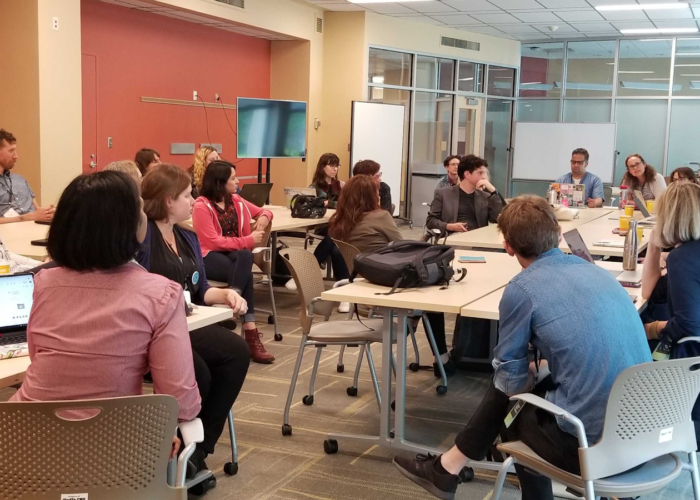
Group of twenty-one symposium attendees sitting in a circle actively engaged in a workshop discussion session.
Figure 3. Immersive Pedagogy symposium participants in discussion.

The following essay sections explore the key components of the symposium, which outlined the theoretical foundations to decolonizing development and curation of 3D/VR/AR tech, before guiding participants through workshops on decolonial critique and accessible design, on integrating immersive technology into the classroom and beyond, and on collaboratively designing 3D/VR projects.

Decolonial Foundations: Critical Approaches to the Development and Curation of 3D/VR/AR Technologies

To practically introduce the decolonial methodologies and theories crucial to our workshops on developing and curating 3D/VR/AR materials, the Immersive Pedagogy symposium opened with a workshop, led by Gauthereau and Young on the “walkthrough method” (Light, et. al. 2018, 881–900), a critical analysis of technology using the Unity Asset Store as an example. This exercise was contextualized through a theory of decolonial pedagogy and a discussion on the critical analysis of the game platforms that curate content for 3D modeling and representation.

The application of decolonial theory and methods to digital pedagogy allows students to interrogate and resist colonial, hierarchical epistemologies, especially the privileging of Western European and Anglocentric knowledge structures. Such an approach is increasingly necessary as 3D/VR/AR technologies become integral to Western education systems and overwhelmingly applied to cultural heritage projects by and for Western consumers. While colonialism refers to the “political and economic relation in which the sovereignty of a nation or people rests on the power of another nation,” making that nation an “empire,” coloniality “refers to long-standing patterns of power that emerged as a result of colonialism, but that define culture, labor, intersubjective relations, and knowledge production well beyond the strict limits of colonial administration” (Maldonado-Torres 2007, 243). Thus, coloniality denotes the ways in which colonial hierarchies of power continue to structure our everyday lives (i.e. racialized class hierarchies, labor hierarchies, gender hierarchies, the gender binary, racism, etc.). Decolonialism urges us to actively de-link from colonial epistemologies and ontologies in order to avoid re-creating colonial worldviews and hierarchies.

Considering the ways that 3D/VR/AR technologies allow users to create immersive worlds and environments, the symposium sought to stress the need to avoid replicating the colonial gaze. Representing marginalized people through this gaze continues to enforce racialized and gendered hierarchies of power. Colonial epistemologies continue to control knowledge production, not only through institutional archives, but also through academic research, digital projects, and 3D/VR/AR environments. Jacqui Alexander and Chandra Talpede Mohanty argue that decoloniality has a “pedagogical dimension” as it obligates us “to understand, to reflect on, and to transform relations of objectification and dehumanization, and to pass this knowledge along to future generations” (1997, xxviii-xxix). For this reason, the symposium’s first workshop exercise involved guiding participants through a decolonial walkthrough of the Unity Assets Store. The walkthrough method requires researchers to directly engage with “an app’s interface to examine its technological mechanisms and embedded cultural references to understand how it guides users and shapes their experiences” (Light, et. al. 2018, 882). We asked participants to browse and search the Unity Assets Store for 2D, 3D, audio, and animation assets and interrogate them using a decolonial approach, as well as to document their walkthrough by taking notes, taking screenshots, and recording audio-visual content.

To guide the decolonial inquiry, we asked participants to consider a set of questions adapted from Roopika Risam’s discussion of the stakes of postcolonial and decolonial digital humanities (2019, 35–46):

  • What are compulsory activities within the Unity Asset Store?
  • What are the social hierarchies within the menu system?
  • To whom and which types of users is this knowledge accessible?
  • What is considered a “legitimate” asset within the Asset Store?
  • Whose epistemologies, such as histories, languages and memories, are considered important enough to archive in the Asset Store?
  • What knowledge or assets are privileged within the Asset Store?
  • Does the asset avoid the exoticization or fetishization of a people/cultures?

This inquiry resulted in participants recognizing the disproportionate representation of a Eurocentric worldview. For example, they noticed that the search term “Viking” yielded twice as many results as “Native American,” whereas the term “Indigenous” yielded zero. Among results for the search term “Mexican,” participants discovered a Mexican Restaurant Pack that reflected generalized stereotypes of Mexican aesthetics and cuisine, reduced to bottled hot sauce, chips and salsa, and a decorative green parrot. Assets also reduced the multiple and varied cultures, nations, flora, and fauna of the entire African continent to the myopic colonial imaginary of only the Serengeti, populated by wild animals. During group break-out sessions exploring the Asset Store, participants discovered a potential intervention through editing crowdsourced user tags. Like during Wikipedia Edit-a-Thons, users could challenge the authenticity of colonial representations of people, cultures, and nations by tagging or reviewing assets as not authentic, representing stereotypes, reproducing colonial views, etc. Since the symposium, unfortunately, Unity has removed the user tagging option and currently limits metadata generation to the individual uploading the asset.

This workshop stressed that engaging in decolonial work requires a constant questioning of how knowledge (3D/VR/AR environments, research, stories, syllabi, etc.) is being produced, who is producing it, whose stories are being told, and how these stories are being told. Not only should we consider what histories are told in the digital world, but we must also attend to the ways in which they are produced. As a result, the participants learned that generating and interacting with 3D/VR/AR environments they must use decolonial methods to acknowledge their role as world-creators and reflect on the ways that these technologies often replicate colonialism.

In the following workshop, Clark foregrounded the ableism endemic to technological innovation in the West, introducing participants to accessible user design for virtual reality. This involved a tutorial on developing alternate access plans for disabled students in classrooms. Clark’s work with Temple Libraries’ colleagues Jordan Hample and Wermer-Colan has prioritized research into and creation of accessible features for VR during their development of the Virtual Blockson: A Primary Source Teaching Tool for Secondary Education (Clark 2018, np). Clark’s workshop overviewed the standards of the World Wide Web Consortium’s Web Content Accessibility Guidelines in order to showcase the problems with applying standards created for web-based screens to virtual reality environments and experiences. She related an overview of key advancements that can be made to enable universal design for this emerging technology ranging from innovations in haptic feedback to caption legibility. Clark’s talk focused on guiding participants through strategies for accessing resources for disabled students at their universities. She led participants through an exercise with a template she created for developing “alternate access plans” that enable teachers to offer comparable options for students who cannot use the available VR and/or AR hardware and software. This approach to accommodating students with different learning styles provides a realistic way for teachers to work with emerging technologies in academic institutions, most of which still lack sufficient resources to support disabled students in the use of analog technologies.

Virtual Lessons: Integrating Immersive Technology in the Traditional Classroom and Beyond

After the symposium’s opening workshops on decoloniality and anti-ableism in immersive pedagogy, Levy’s workshop put to practice the principles she laid out in her closing keynote address on the idiosyncratic game mechanics for simulating virtually interactive dialogue and exam questions involving classification. VR offers, Levy argued, a unique pedagogical opportunity, functioning as a distraction-free zone where her students were able to recollect experiences at a much higher rate compared to other learning activities. During the workshop, Levy asked symposium participants to select several library books from various library collections and work in groups to think about how to put the texts in conversation with each other based on titles, subject headings, table of contents listing, and a quick skim of their contents. Levy demonstrated how and why she constructed a VR environment that simulated this activity, as her students had to physically place boxes with various titles onto empty shelves in an order that reflected connections. The application of VR to this type of historiographical exercise, Levy maintained, left a lasting impression on the students that they were able to put into practice for essay assignments. Levy’s emphasis throughout her workshop on the pedagogical significance of “what happens before and after” the virtual experience, furthermore, offered a valuable foundation for the subsequent workshop on integrating writing exercises to guide student learning during virtual and augmented reality experiences.

Wermer-Colan’s workshop modeled how to guide undergraduate students across the disciplines through a structured composition exercise for reflection, in particular, by guiding the participants through a reflection on what they hoped to learn and do in the coming school year as they sought to develop their immersive pedagogy projects. To provide a context and model for students before their writing reflections, Wermer-Colan summarized his current projects employing 3D technologies for Temple University Libraries’ Digital Scholarship Center (now the Loretta C. Duckworth Scholars Studio). Temple Libraries has experimented with transforming the purposes of library collections, development, and reference work to enhance its learning and technology outreach, including through its Innovative Teaching with Makerspace Technology Grant and its newly constructed VR Lab in the new Charles Library. Wermer-Colan’s past experiences working in the Medgar Evers College Writing Center in the City University of New York (CUNY) system helped him to think about ways the Digital Scholarship Center can use 3D/AR/VR technology to enhance learning across the disciplines.

As an example of Temple Libraries’ supporting the use of immersive technologies in class-room projects, Wermer-Colan detailed a collaborative project with Ajima Olaghere, Assistant Professor of Criminology working with her ethnography students to do “systematic social observation” of Philadelphia neighborhoods. This project used 360 cameras to record neighborhoods affected by Temple’s gentrification of North Philadelphia. The recordings were later viewed on twenty-dollar Desktek smartphone headsets that allowed students to remotely examine environments to understand what contributes to disorder and crime, while the instructor facilitated ways to maintain a critical understanding of what they were viewing. The accompanying writing exercises guided students to reflect on their mediated experiences of urban space and call into question the “broken windows theory,” common assumptions that visible signs of public disorder exacerbate criminal behaviors. The use of phone-based headsets also invited an opportunity for students to consider the physical processes that enable virtual technology. Instructors were faced with the problem of scaling pedagogical uses of VR; as this project used relatively inexpensive headsets, workshop participants considered how to create immersive experiences similar in quality to those offered by state-of-the-art VR headsets like the HTC VIVE or the Oculus Rift that, as of 2020, cost hundreds of dollars.

To illustrate the role libraries and digital scholarship centers can play in the curation of 3D content for teaching and learning, Wermer-Colan overviewed a complementary use of immersive technologies. His collaboration on the Virtual Blockson project with Digital Scholarship Librarian Jasmine Clark, Academic Technician and Developer, Jordan Hample, and Blockson Archivist Leslie Willis-Lowry aims to recreate Temple’s Charles L. Blockson Afro-American Collection as a virtual reality game for innovating the teaching of primary source literacy in high schools across Philadelphia. The project at its heart allows a small, fixed collection and its reading room to be available to students remotely, lowering the intimidation factor and physical limitations of these spaces, while enabling interactive explorations of historical artefacts. The Virtual Blockson offered an opportunity to discuss how libraries can help curate interactive gaming environments for remediating archival collections and cultural heritage sites to foreground previously marginalized histories. In these contexts, virtual reality offers affordances for lowering the barrier for students to use archival sources and spaces, facilitating access and accessibility, and offering students a novel medium through which to conceptualize analog and digital literacies necessary to navigate the changing new media world today.

3D-rendering of the Charles L. Blockson Afro-American Collection, a few sculptures and a painting on display in the reading room.
Figure 4. Screenshot of the Virtual Blockson designed by Jordan Hample using Unity 3D. For more, see Jasmine Clark’s “Progressing Towards an Accessible VR Experience”: https://sites.temple.edu/tudsc/2018/11/07/progressing-towards-an-accessible-vr-experience/.

Wermer-Colan foregrounded in both these projects the use of writing exercises to help students reflect on their virtual experiences in meaningful ways. The 360 SSO writing exercise encouraged humanistic thinking about the technology by asking students to compare their field work exercises with the virtual experience, as well as writing reflections that asked the students to identify various ways the 360/VR technology mediated said experience. Similarly, humanistic writing exercises were designed to guide students before and after their experience of the Virtual Blockson’s introduction to archival spaces, etiquette, and practices through game-based, interactive experiences. Drawing upon the Society of American Archivists’ Standards for Primary Source Literacy and the Common Core Standards for historical understanding, digital literacy, and critical thinking, these critical writing questions ensure students reflect upon the virtual experience of library collections’ historical artifacts from the African diaspora. After offering these models to the Immersive Pedagogy participants, Wermer-Colan guided the group through a critical writing exercise to reflect on their own plans to implement the 3D/VR/AR technology for various pedagogical purposes. Wermer-Colan encouraged participants to think of resources at their local institutions, pedagogical standards in their disciplines, and affordances in the spatialized medium of VR for enhancing their approaches to teaching. The writing exercise simulated the kind of exercise participants could implement in their own pedagogy, while offering an opportunity for the symposium participants to reflect on what they had learned during the workshops.

Feminist Reconstructions: Collaboratively Designing 3D/VR Experiences

The concluding workshop, run by Linker and Young, offered a sustainable model for including students as partners in the creation of 3D/VR pedagogical materials, through an overview of Linker’s time creating the Bryn Mawr Women in Science project with her various undergraduate partners: Elia Anagnostou, Courtney Dalton, Jocelyn Dunkley, Tanjuma Haque, Arianna Li, and Linda Zhu. From 2017 to 2019, Linker taught undergraduate students how to integrate historical inquiry with 3D technology in order to think about women’s invisible scientific labor, the spaces they occupied, the tools they used, and their everyday lived experiences. The project considers Margaret Rossiter’s “The Matthew Matilda Effect in Science,” which articulates a systematic disparity in affording women scientists credit for sophisticated and important discoveries, which in turn necessitates that historians find ways to tell stories in order to make their labor visible. It likewise adapts aspects of Pamela Smith’s Making and Knowing Project by taking seriously the need to consider scientific processes. However, rather than engaging in physical reenactment, students offered up women’s processes in a modern, digital format, contextualized by a recreation of spaces that were no longer intact or available for historical analysis.

3D rendering of a biology lab created for the Bryn Mawr Women in Science Project. Rendering contains depictions of glassware, scientific artifacts, equipment, and laboratory furniture.
Figure 5. Screenshot of the 3D-rendered Advanced Biology Lab c. 1900, from Bryn Mawr Women in Science.

Linker and her students recreated two laboratory spaces that had once existed at Bryn Mawr College in the late nineteenth and early twentieth centuries, the Major Chemistry Lab and the Advanced Biology Lab.[1] Students learned a variety of 3D skills, including 3D modeling, photogrammetry, various mechanics of the Unity 3D game engine, and the Oculus Rift. Interactive WebGL versions of the project are available online, and a VR demo of Bryn Mawr’s Advanced Biology Lab was available at the conference. The Advanced Biology Lab was the site of early genetic research and a place once utilized by Nettie M. Stevens, the subject of Stephen Brush’s Nettie M. Stevens and the Discovery of Sex Determination by Chromosomes. Years before Margaret Rossiter coined the phrase “the Matilda Effect,” Brush identified that Stevens’ discoveries had been overshadowed by male collaborators or individuals working concurrently on the same subject. Her contributions had likely been diminished because she was a woman. Students researched each space by spending time in Bryn Mawr’s Special Collections. Through building each laboratory, the students became aware of how to put historical materials in conversation, as no resource could tell them everything they needed to know to build and contextualize the 3D models. Pedagogically, the two-year process of building was designed to seed humanistic deployment of 3D technologies by undergraduate collaborators. Afterward these students participated in professional presentations of the digital and historical work, and served as ambassadors to various communities in order to disseminate the skills the project cultivated to a wider audience.

Linker enabled her students to accomplish a lot in a short period of time; no student was an expert in the technology or in historical research prior to their tenure on the project. This was intentional, as she sought to teach rather than to employ experts. Students represented a diverse range of interests and majors, and all students participated in each phase of production (rather than assigning humanities majors to research and STEM majors to coding) so that afterwards, they could create projects similar to this on their own. Part of what facilitated their success is that she treated them as equal partners in the project, making decisions with them throughout the two years they worked together.

To prepare her students to participate as equals, she devised a plan that would serve as an introduction to using 3D technology to address social and pedagogical problems, and would also serve as a diagnostic tool for assessing student strengths and interests. Essentially, students were asked to propose and implement a 35-hour project (which could be run over the course of days or weeks, depending on individual need) that used an aspect of the Unity 3D game engine’s functionality to teach users about something the students cared about. Students drafted plans that identified what they knew, what they needed to learn, and were prompted to think about modularity, such that students could scale the project if they were running out of time. Students who were not familiar with coding at first could use Unity’s GUI interfaces to produce fully functional scenes, allowing for students with varying levels of proficiency with computer science to produce something useful by the end of the exercise. By the end of the 35-hour period, students not only had a small project they could put in professional portfolios, but had become proficient in a particular aspect of Unity, thought about the technology as a means to serve others, and in implementing their projects, had a better sense of what they would need to do going forward. It also convinced them that they were capable of using the technology in a way the Unity tutorials did not engender. Linker and Young guided the participants in thinking through how symposium participants might adapt this exercise for their own project teams.

Conclusion

Through the symposium and the workshops described above, participants engaged in conversations around designing socially-conscious pedagogy for 3D/VR/AR. Building a framework for teaching and learning with 3D/VR/AR technologies founded in decolonial theory and practices resonated with our participants. This enabled the group to evaluate how projects and assignments fit into an ethical model for cultural heritage pedagogies. The symposium closed with a productive discussion about what the participants learned, with a focus on planning for future steps.[2] Several participants suggested the importance of backward design, which would specifically place the learning outcomes as the first step in creating 3D/VR/AR and related assignments.

Conversations among group members brought up multiple questions, such as: how do we anticipate student use? How do we adjust our use of 3D/VR/AR in response to unexpected circumstances? How do we introduce emerging technologies in the classroom while accommodating individuals unable to take advantage of the intended purposes of ready-made hardware and software? How can these technologies enhance hybrid and online learning? Are students (or faculty) distracted by the freedom of immersive environments? Can we create bilingual metadata in a VR environment? If one could, where would you display subtitles or transcriptions in a virtual or augmented environment?

These conversations confirmed that digital humanists would benefit from future cross-institution discussions of 3D/VR/AR, as well as from shared access to teaching materials, which are often siloed within institutions and departments. Students engage differently with course concepts and each other, depending on the application of the technology within that course. Student learning is dependent on the skills and interests of individual instructors; collaboration is necessary for producing robust materials and responsible projects. Perhaps the most challenging task is creating accessible and sustainable materials applicable to multiple modes of disciplinary learning outcomes at a time of rapid technological and institutional transformation.

In an effort to increase the reach of the conversations that arose out of Immersive Pedagogy, the symposium organizers are working to produce an open-access, peer-reviewed publication containing lesson plans and educational material to facilitate disciplinary and interdisciplinary work that engages 3D/VR/AR technologies. This project aims to extend the work of the Digital Library Federation (DLF) Pedagogy Working Group’s Teach Toolkit that provides lesson plans for digital library instruction.[3] To guide educators to adapt immersive technologies to the needs of diverse disciplines, the Immersive Pedagogy teaching materials will introduce a range of 3D hardware and software, including asset or game repositories. The teaching materials will include diverse lesson plans with tailored learning outcomes, introducing a representative sample of available immersive technologies and resources while addressing humanistic pedagogical goals. Because this project was born out of the CLIR postdoctoral fellowship program, it aims to contribute to the growing field of scholarship on the crucial role that academic libraries or research and teaching centers can play in the integration of immersive technologies across the curriculum.

The Immersive Pedagogy symposium’s prioritization of decolonialism, feminism, and accessibility speak to a radical and critical perspective that can apply to a range of 3D/VR/AR applications and instruction methods. Indeed, in starting conversations on how to promote making immersive experiences accessible and inclusive, there is an opportunity to move beyond operational concerns to lasting pedagogical practices. For decades, contingencies have transformed education and cultural heritage, requiring us to rethink the potential of emerging communication technologies through a critical lens. More evident in the midst of the COVID-19 global pandemic, which has spurred the need for digital ways of teaching and learning, is the critical pedagogical use of virtual surrogates. These include 360° museum spaces and objects, 3D virtual meeting spaces, photogrammetry models, and interactive exhibits. By addressing upfront, rather than through remediation, the issues of social justice, accessibility, and decolonial pedagogies in immersive technology, educators can leverage these tools to respond to a transformative period in the education system.

Notes

[1] For a discussion of problems and considerations specifically related to the construction of historical 3D spaces, see Sullivan, Nieves, and Snyder 2017.

[2] For more detail, see the Immersive Pedagogy collaborative notes: “Shared Notes Wrap Up Session.” 2019. https://drive.google.com/drive/folders/1TSv8jrQlOlbPwi-TyvyOfV1_ZvA9I4y8.

[3] See the #DLFteach Toolkit 1.0: Lesson Plans for Digital Library Instruction.

Bibliography

Alexander, Jacqui M. and Chandra Talpede Mohanty, eds. 1997. “Introduction.” In Feminist Geneologies, Colonial Legacies, Democratic Futures: xxvii-xxiv. New York and London: Routledge.

Brush, Stephen G. 1978. “Nettie M. Stevens and the Discovery of Sex Determination by Chromosomes.” Isis 69, no. 2: 163–172. https://www.jstor.org/stable/230427.

Cotera, María. 2018. “Nuestra Autohistoria: Toward a Chicana Digital Praxis.” American Quarterly 70, no. 3: 483–504. https://muse.jhu.edu/article/704334.

Clark, Jasmine. 2018. “Progressing Towards an Accessible VR Experience.” Loretta C. Duckworth Scholars Studio. https://sites.temple.edu/tudsc/2018/11/07/progressing-towards-an-accessible-vr-experience/.

Digital Zombies. n.d. http://digitalzombies.ucr.edu.

“Guidelines for Primary Source Literacy.” 2018. Society of American Archivists. https://www2.archivists.org/standards/guidelines-for-primary-source-literacy.

Grayburn, Jennifer, Zach Lischer-Katz, Kristina Golubiewski-Davis, and Veronica Ikeshoji-Orlati, eds. 2019. 3D/VR in the Academic Library: Emerging Practices and Trends. Arlington, VA: Council on Library and Information Resources.

KiltHub Repository. n.d. Carnegie Mellon University. https://www.library.cmu.edu/kilthub/about.

Levy, Juliette. 2017. “‘Digital Zombies’– A Learner-Centered Game: Social Knowledge Creation at the Intersection of Digital Humanites and Digital Pedagogy.” In Social Knowledge Creation in the Humanities: An Open Anthology, edited by Alyssa Arbuckle, Aaron Mauro, and Daniel Powell. ITER Press. https://ntmrs-skc.itercommunity.org/.

———. 2019. “How Not to be a Replicant: Working Towards a Useful VR.” Keynote address, Carnegie Mellon University Symposium, Pittsburgh, PA, June 28.

Light, Ben, Jean Burgess, and Stefanie Duguay. 2018. “The walkthrough method: An approach to the study of apps.” New Media & Society 20, no. 3: 881–900.

Linker, Jessica, Elia Anagnostou, Courtney Dalton, Jocelyn Dunkley, Stella Fritzell, Tanjuma Haque, Arianna Li, Rachel Starry, and Linda Zhu. 2019. Bryn Mawr Women in Science. https://digitalscholarship.brynmawr.edu/howis/.

Losh, Elizabeth and Jacqueline Wernimont, eds. 2019. Bodies of Information: Intersectional Feminism and Digital Humanities. Minneapolis, MN: University of Minnesota Press.

Maldonado-Torres, Nelson. 2007. “On the Coloniality of Being.” Cultural Studies 21, no. 2: 240–270.

McPherson, Tara. 2012. “Why Are the Digital Humanities So White? or Thinking the Histories of Race and Computation.” In Debates in Digital Humanities, edited by Matthew K. Gold. Minneapolis: University of Minnesota Press.

Nieves, Angel David. 2019. “Developing a Social Justice Framework for Immersive Technologies in Digital Humanities.” Keynote address, Carnegie Mellon University Symposium, Pittsburgh, PA, June 27.

“Program.” 2019. Immersive Pedagogy: A Symposium on Teaching and Learning with 3D, Augmented and Virtual Reality. https://events.library.cmu.edu/immersive-pedagogy/program/.

“Public Relations.” 2019. Unity. https://unity3d.com/public-relations.

Risam, Roopika. 2019. New Digital Worlds: Postcolonial Digital Humanities in Theory, Praxis, and Pedagogy. Evanston, IL: Northwestern University Press.

Robnett, Belinda. 1997. How Long? How Long?: African American Women in the Struggle for Civil Rights. Oxford: Oxford University Press.

Rossiter, Margaret. 1993. “The Matthew Matilda Effect in Science.” Social Studies of Science, 23, no. 2: 325–341. http://www.jstor.org/stable/285482.

Sayers, Jentery, ed. 2017. Making Things and Drawing Boundaries: Experiments in the Digital Humanities. Minneapolis: University of Minnesota Press.

Smith, Pamela. n.d. The Making and Knowing Project: Intersections of Craft Making and Scientific Knowing. https://www.makingandknowing.org/. Accessed Dec. 13, 2019.

Sullivan, Elaine, Angel David Nieves, and Lisa M. Snyder. 2017. “Making the Model: Scholarship and Rhetoric in 3D Historical Reconstructions.” In Making Things and Drawing Boundaries: Experiments in the Digital Humanities, edited by Jentery Sayers, 301–316. Minneapolis: University of Minnesota Press.

Unity Assets Store. 2020. https://assetstore.unity.com/.

Acknowledgments

We would like to acknowledge The Andrew W. Mellon Foundation and the Council on Library and Information Resources (CLIR) for the microgrant that funded the Immersive Pedagogy symposium, as well as Carnegie Mellon University Libraries for hosting the event. Thank you to the entire Immersive Pedagogy team, including Eric Kaltman, Neil Weijer, and Chris Young for making the symposium possible. Last, but certainly not least, thank you to all the Immersive Pedagogy participants and keynote speakers, who created a positive, productive community of practice: Andy Anderson, DB Bauer, Katie Chapman, Elena Foulis, Kat Hayes, Juliette Levy, Juan Llamas-Rodriguez, Meaghan Moody, Angel Nieves, Samantha Porter, Coral Salomón, Julia Troche, Jordan Tynes, and Christa Williford.
About the Authors

Lorena Gauthereau is the Digital Programs Manager for the US Latino Digital Humanities program at the University of Houston’s Recovering the US Hispanic Literary Heritage. She received her Ph.D. in English and her M.A. in Hispanic Studies, both from Rice University. Her research interests include US Latinx studies, digital humanities, and decolonial theory. Orcid ID: orcid.org/0000-0002-7185-8982.

Jessica Linker is an Assistant Professor of History at Northeastern University. She was previously a Postdoctoral Fellow and Program Coordinator at the Consortium for History of Science, Technology and Medicine, a Visiting Assistant Professor at Bryn Mawr College, and the Director of Bryn Mawr Women in Science. She researches women’s scientific practices in early America.

Emma Slayton is the Data Curation, Visualization, and GIS specialist at Carnegie Mellon University Libraries. She obtained an MPhil from the University of Oxford in 2013 and completed her Ph.D. at the Faculty of Archaeology, Leiden University in 2018. Her current work centers around improving and supporting digital literacy efforts. Orcid ID: https://orcid.org/0000-0003-2230-3101.

Alex Wermer-Colan is a postdoctoral fellow in Temple University Libraries’ Loretta C. Duckworth Scholars Studio, where he coordinates research and pedagogical projects in cultural analytics and digital media arts. His editorial and scholarly criticism have appeared in PAJ: A Journal of Performance and Art, Twentieth Century Literature, The Yearbook of Comparative Literature, Lost & Found, Indiana University Press, and The Los Angeles Review of Books. Orcid ID: https://orcid.org/0000-0001-7030-6070.

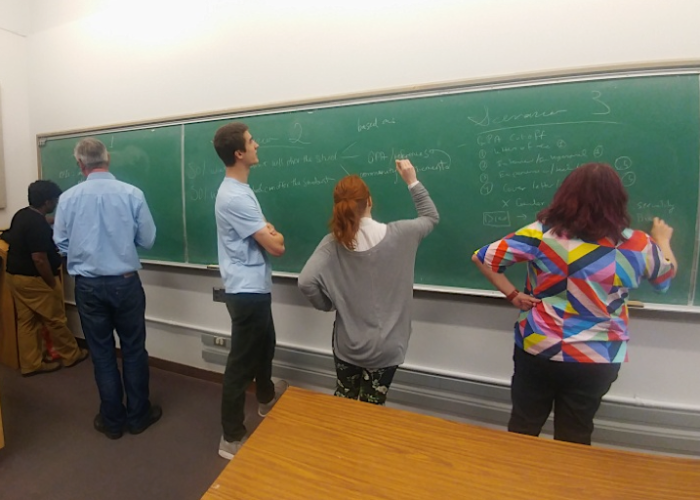
This photograph shows several students from behind, collaborating on the DHSI privacy plan by writing on a chalkboard.
0

Finding Fault with Foucault: Teaching Surveillance in the Digital Humanities

Abstract

This article outlines the risks posed by Foucauldian logics and provides alternative pedagogical strategies grounded in a culture of care. Failing to address surveillance culture through this critical framework exacerbates its effects by encouraging its continuation and intensification. Modern surveillance tools make it challenging, if not impossible, to pinpoint the characteristic(s) against which the tool has been programmed to discriminate. The treatment of such automated surveillance decisions as impossible to question has enabled the further entrenchment of inequality and injustice. As such, scholars, activists, and the public need to band together to fight against unethical surveillance practices; one effective way is by providing our students with the tools needed to critique the surveillance machine and to envision more equitable futures. Teaching them to question Foucault, and thereby the premises of Western surveillance, is vital to this process.

“Where are the digital humanists critiquing the growing surveillance state?” 
       —Michael Widner, 2013

Citing events such as Edward Snowden’s whistleblowing and the passing of the PATRIOT Act in the US Congress, Widner argues that digital humanists are doing little to nothing to intervene in the ever-increasing infringements on privacy in the Western world. His argument, however, is framed around a specific type of DH—male-dominated, highly computational scholarship that emulates the data mining projects of organizations such as the NSA. For critical digital humanists, surveillance is a site where issues surrounding race, gender, and sexuality intersect with our digital lives. Works such as Safiya Noble’s Algorithms of Oppression: How Search Engines Reinforce Racism (2018), Miriam Posner’s “See No Evil” (2018), and  Jacqueline Wernimont’s Numbered Lives: Life and Death in Quantum Media (2018) reveal a growing concern with surveillance, with groups such as SurvDH and the Digital Library Federation’s Technologies of Surveillance working group providing outlets for digital humanists to explore these topics in more depth. Similarly, rhetoric and composition scholars are developing new work on the effects of surveillance in the university by examining how digital composition tools, data-sharing platforms, social media networks, and learning management tools place our students’ data at risk. Although these fields have distinct approaches, they articulate the ethical concerns raised by surveillance culture’s pervasive invasion into our classrooms and our lives.

Since 2016, I have taught four courses focused on surveillance and data ethics. Two were geared towards undergrads—one in a women’s and gender studies department at a large public university and one in an American studies department at an elite, small private college. The other two iterations were taught at the Digital Humanities Summer Institute in Victoria, BC, a program that provides graduate students, faculty members, librarians, and technologists a chance to learn about a key theory or methodology within the digital humanities. While the course has seen slight variations over time, its overarching goal has always been to interrogate the ethical issues of state, corporate, and social surveillance mechanisms. To that end, I included texts written largely by women and BIPOC to demonstrate the ways in which surveillance culture exacerbates ongoing discrimination against marginalized groups. Some of these texts include Simone Browne’s Dark Matters: On the Surveillance of Blackness (2015), Kim Tallbear’s Native American DNA: Tribal Belonging and the False Promise of Genetic Science (2013), and Shoshana Amielle Magnet’s When Biometrics Fail: Gender, Race and the Technology of Identity (2011).

While my goal has always been to advocate for decolonial and anti-colonial approaches to surveillance, the first iteration of the course began with a discussion of Foucault’s panopticism. At the time, I argued that Foucault provides a foundation for understanding the structures of Western surveillance, which, once understood, can be applied to the U.S. imperial enterprise and can shape our analysis of events such as the Standing Rock protests or the #BlackLivesMatter movement. Although I sought to demonstrate the inequities of the surveillance machine, structuring the course in this way elided many of the flaws within Foucault’s argument. Perhaps most damaging is Foucault’s (1995) assertion that surveillance, by virtue of being everywhere, affects everyone similarly. He states, “Bentham dreamt of transforming into a network of mechanisms that would be everywhere and always alert, running through society without interruption in space or in time. The panoptic arrangement provides the formula for this generalization” (Foucault 1995, 209). In other words, the panopticon is designed to penetrate all communities, spaces, and cultures; causing many to ask, “If the panopticon is everywhere, then aren’t we all the equal victims of its repressive machinations?”

Students are incredibly responsive to this argument. They love to expound upon how their homes, schools, sports teams, and extra-curricular activities are all part of the system that Foucault describes, and who can blame them? It helps to clarify the basic tenets of Foucault’s argument, and it gets them excited about surveillance and privacy issues. Yet, it is only now after many years that I realize the extreme disservice this has done to my students. By allowing them to conflate varied surveillance mechanisms and contexts, I failed to implement a culture of care in the classroom. At that moment, I did not explicitly affirm the central premise of the course—surveillance is a tool of state and corporate oppression that has disproportionate consequences for women and people of color. This had one of two possible consequences: it either overstated the severity of their experiences or downplayed real (and unspoken) traumas. Conversations on surveillance tend to be problematic because much of the canon encourages readers to believe in two false premises—that all surveillance is equal and that surveillance is inescapable. These premises are not only dangerous for readers of Foucault, but also for our culture at large. As the foundational theory surrounding Western surveillance culture, Foucault’s views have pervaded our daily lives, making us docile when we experience monitoring from our co-workers, classmates, employers, retailers, and devices and reinforcing colonialist hierarchies of power and marginalization.

 This image depicts a chalkboard with the question, “What is surveillance?” written in the top left. Below this are a variety of answers written in multiple people’s handwriting.
Figure 1. Classroom explorations of surveillance.

To push back against these misconceptions, it is crucial that we present students with different perspectives on surveillance, privacy, and power. As Eve Tuck and K. Wayne Yang (2012) note in their groundbreaking work, “Decolonization is not a Metaphor,” language is a powerful tool by which to address inequalities pervasive within surveillance culture and inherent to the colonial enterprise. They note:

One trend we have noticed, with growing apprehension, is the ease with which the language of decolonization has been superficially adopted into education and other social sciences, supplanting prior ways of talking about social justice, critical methodologies, or approaches which decenter settler perspectives. Decolonization, which we assert is a distinct project from other civil and human rights–based social justice projects, is far too often subsumed into the directives of these projects, with no regard for how decolonization wants something different than those forms of justice. (2)

By adopting the language of decolonialism into our social justice initiatives, settler scholars (myself included) are allowed to ignore the long histories of settler colonialism that have shaped our perceptions of justice, allyship, and activism both inside and outside the academy. Our reliance upon teaching surveillance theory through Foucauldian principles similarly is flawed, as his discussion of surveillance negates the settler enterprise by eliding it entirely.

One of the ways Foucauldian logic contributes to this elision is through its choice of analogies. Instead of structuring his core discussion of surveillance around strategies of conquest and colonialism, Foucault references a seventeenth-century document that outlines procedures for towns affected by the plague. According to these rules, citizens are coerced to acquiesce to surveillance upon pain of death. By describing surveillance through this metaphor, Foucault (1995) explicitly misrepresents the harm wrought by state surveillance and ultimately enables its continuation. His discussion of panopticism begins as follows:

First, a strict spatial partitioning: the closing of the town and its outlying districts, a prohibition to leave the town on pain of death, the killing of all stray animals; the division of the town into distinct quarters, each governed by an intendant. Each street is placed under the authority of a syndic, who keeps it under surveillance; if he leaves the street, he will be condemned to death. On the appointed day, everyone is ordered to stay indoors: it is forbidden to leave on pain of death. (195)

Without context, his narrative is one of conquest—citizens are cut off from neighboring communities, their resources are destroyed or placed under foreign control, and individuals are forced to acquiesce to this system upon pain of death. These characteristics are not relegated to one particular colonial experience, but are inherent to processes of conquest. Moreover, Foucault would have been familiar with the processes of colonialism. In The History of Sexuality, he asserts that the rise of repression occurred in the seventeenth century, but his argument focuses on the cultural repression of sexuality. He fails to mention that the seventeenth century also marks the peak of the African slave trade, the expansion of Spanish missions, and the founding of Jamestown. Each of these events is a key component of settler culture’s colonial enterprise.

Indigenous peoples across the globe were subjected to the surveillance systems embedded within the conquest apparatus. In the United States, the conquest of indigenous peoples occurred in many forms—through the development of reservations, the allotment of land, and the use of residential schools. Similarly, indigenous resources were killed off to ensure that each nation’s way of life was no longer sustainable. One of the most common misconceptions is that all indigenous peoples were treated similarly during these processes, but this is patently untrue. Some indigenous nations, such as the Miami and Delaware, lost their federal status, meaning that their economies, customs, cultures, and homelands were stripped from them entirely. The Dakota, Lakota, and Nakota’s economies were toppled by the killing of the buffalo in the Great Plains; however, many other communities faced similar economic devastation. The Osage, who maintained mineral rights over their federally appointed lands in Oklahoma, garnered great wealth during the oil boom; however, they were only allowed to access these profits through their government-appointed guardians, each of whom was white. As such, few Osage received the money owed to them for use of their land; instead, the federal government developed a system that systematically stripped them of their economic well-being. Although many indigenous nations filed lawsuits against the United States government, noting the particularly cruel and discriminatory nature of many federal laws pertaining to indigenous peoples, the vast majority of these systems are still in place. Those who have rebelled against this mistreatment via force have been sentenced to death. Similar processes were implemented in the United States colonies, including Puerto Rico, the U.S. Virgin Islands, Guam, the Marshall Islands and Hawai’i. In each case, the islands were cut off from neighboring communities and forced to acquiesce to U.S. rule upon pain of death. Military bases were established across the islands, and indigenous ways of life were subsumed by industries beneficial to the colonial enterprise, particularly sugar and coffee. In some cases, such as in Puerto Rico, multiple waves of colonial rule sought to eradicate indigenous communities and identities.

So, why is it important to discuss indigenous peoples in the context of the panopticon? Indigenous peoples have been subjected to the harshest forms of surveillance, yet they appear nowhere in Foucault’s analysis or in the work of his intellectual descendents. Andrea Smith (2015) notes that “the manner in which Foucaldian analyses of the state tend to temporally situate biopower during the era of the modern state disappears the biopolitics of settler colonialism and transantlantic slavery” (23).[1] In other words, many scholars of surveillance, either implicitly or explicitly, erase the ways in which the formation of the state was dependent upon the subjugation of indigenous and black bodies.

To counteract these texts, scholars such as Simone Browne, Virginia Eubanks, Shoshana Amielle Magnet, and Safiya Noble theorize about the relationship between surveillance and colonialism by demonstrating the ways in which marginalized peoples often experience the greatest consequences of surveillance culture. Browne (2015) notes that “When particular surveillance technologies, in their development and design, leave out some subjects and communities for optimum usage, this leaves open the possibility of reproducing existing inequalities (162–3). At other times, communities are more explicitly targeted by surveillance culture for speaking out against the colonial machine. Andrew Crosby and Jeffrey Monaghan (2018) note that “Indigenous activists are policed using the powers and resources of the national security apparatus, demonstrating the extensive reach of the ‘war on terror’ into the traditional domain of colonial governance.” Groups such as #BlackLivesMatter and the protesters at Standing Rock have faced similar scrutiny, with critics using the rhetoric of terrorism to incite their critiques of what bell hooks terms “imperialist white supremacist capitalist heteropatriarchy” (1984, xv). To address this marginalization, Browne (2015) offers up the framework of “dark sousveillance” which “speaks not only to observing those in authority (the slave patroller or the plantation overseer, for instance) but also to the use of a keen and experiential insight of plantations surveillance in order to resist it” (22). She then extends this framework to contemporary physical and digital environments that continue to discriminate against black bodies. Looking at historical sites of surveillance and resistance can help us develop strategies for countering discrimination in the modern world.

This image lists the biographical information students located about Joyce Semmler displayed on a dry erase board.
Figure 2. Learning about the Missing and Murdered Indigenous Women and Girls (MMIWG) movement by remembering the life and death of Joyce Semmler.

Analysis, however, is not enough. We must imagine possibilities for pedagogy and activism that operate outside of surveillance culture. We can only do so if we interrogate the second false premise offered by Foucault’s model: the panopticon is inescapable. According to his analysis, citizens of the modern world always operate within the realm of surveillance, and individuals can only move from one controlled environment into another. This view normalizes surveillance culture in unhealthy and unethical ways; by claiming that surveillance is inescapable, we tacitly agree that corporations, predators, and the state do not need our consent or our approval to monitor us. According to Smith (2015), “reliance on state surveillance prevents us from seeing other possibilities for ending violence, such as through communal organization that might be able to address violence more effectively” (36). Although numerous alternatives to surveillance culture exist, most seem to rely on a sense of communal ties. Foucault himself posits the antithesis of the panopticon to be carnival—a celebration in which citizens are free from surveillance, monitoring, and order. While living in a permanent state of celebration may not be conducive to the functioning of society, adopting an explicit set of communal values does subvert surveillance culture by resisting individualization, isolation, resource allocation, and assimilation. Organizations dedicated to studying the ethics of surveillance, such as the Electronic Frontier Foundation, provide a series of best practices—consent, revocation, decentralization, and protection. By giving individuals the opportunity to control when and how they are surveilled, and by protecting the information they choose to provide, they suggest that we can develop a culture that values human health and well-being over power and profits. But how do we implement these strategies in our classrooms? Below, I outline a number of strategies I have used to counteract Foucauldian logics and to emphasize the injustice created by surveillance culture.

Start with something other than Foucault

Consider what voices you are centering and what effects this has on your pedagogy. All subsequent iterations of this course have begun with settler colonialism. By examining the surveillance mechanisms deployed against indigenous peoples—relocation, allotment, assimilation, and erasure to name a few—students begin to understand the varied contexts in which humans experience surveillance. Course readings include excerpts from Tommy Orange’s There There (2018), Sandy Grande’s introduction to Red Pedagogy: Native American Social and Political Thought (2015), and Andrea Smith’s article “Not-Seeing: State Surveillance, Settler Colonialism, and Gender Violence” (2015).

In class, I demonstrate the undue surveillance experienced by indigenous peoples by talking through problematic laws such as the Dawes Act (1887), the Indian Citizenship Act (1924), and the Indian Relocation Act (1956). During the discussion, I tape off sections of the floor to depict the ways in which indigenous lands were systematically privatized, stolen, and/or devalued for the sake of settler profit. Seeing the classroom broken into pieces, with each one subject to unique rules and governance, helps students gain an understanding of settler surveillance and the ways it was used to destabilize, destroy, and decimate indigenous communities across the United States. This framework also provides opportunities for challenging Western knowledge systems. One way to do so is by highlighting organizations that resist surveillance by upholding indigenous values and data practices. The Sovereign Bodies Institute, an organization that “builds on Indigenous traditions of data gathering and knowledge transfer to create, disseminate, and put into action research on gender and sexual violence against Indigenous people,” is one such example. Their model challenges many forms of settler culture; in particular, they collect data on Missing and Murdered Indigenous Women and Girls (MMIWG) and share it with organizations fighting against the mistreatment of indigenous women. Additionally, they refuse to share their data with settler enterprises—including police, academic researchers, and colonial governments. They even go so far as to refuse funding from settler agencies, ensuring that they retain sovereignty over all elements of their work. As such, the Sovereign Bodies Institute serves as a powerful model for engaging in anti-surveillance work that is communally-engaged, socially-conscious, and intentionally indigenous.

There are many other valuable pedagogical strategies to consider. Simone Browne’s work interrogates the trafficking of enslaved peoples, noting that many surveillance mechanisms were deployed to control the movements, bodies, wealth, and opportunities for black bodies. Her work, Dark Matters: On the Surveillance of Blackness (2015) pairs well with texts such as Safiya Noble’s Algorithms of Oppression: How Search Engines Reinforce Racism (2018) and Shoshana Amielle Magnet’s When Biometrics Fail: Gender, Race and the Technology of Identity (2011). Each explores the ways in which surveillance technology disproportionately targets black bodies and provides useful strategies for subversion and resistance.

Skip Foucault entirely

I have taught four iterations of this course, two as undergraduate seminars and two as special topics courses at the Digital Humanities Summer Institute (DHSI), which is geared toward graduate students, librarians, faculty members, and technologists. In most of these cases, Foucault has been unnecessary for the function of the course. Undergraduates are well aware of the omniscience of the surveillance machine and are happy to engage with other theories or examples. Professionals in the field, on the other hand, have often read Foucault already and are interested in analyses that move beyond his arguments. In either case, Foucault is unnecessary and may even hinder students’ ability to engage in meaningful critiques of surveillance culture.

Conduct surveillance self-assessments

One strategy surveillance specialists use to assess their physical and digital vulnerabilities is threat modeling, a technique that helps to identify, analyze, and prioritize security risks. In Dragnet Nation: A Quest for Privacy, Security, and Freedom in a World of Relentless Surveillance (2015), Julia Angwin uses threat modeling to assess her own security practices. Using her work as a model, I ask students to think through how their positionality, employment, family, peer group, shopping habits, and social media all influence their participation in surveillance culture. This helps students untangle the numerous and overlapping modes of surveillance woven into their day-to-day experiences as well as to identify often overlooked components of their privacy practices.

Discuss more than digital surveillance

Scholars such as Safiya Noble and Cathy O’Neil note that the biases within digital systems are often obscured or invisible. One reason algorithms are so harmful is that they discriminate along many vectors simultaneously. Algorithms can weigh factors including race, ethnicity, gender, sexuality, income, education, and age within a single formula, making it difficult to determine the source of their biases. To help students understand the function of these networks more clearly, it can be beneficial to point out their operation in the physical world. Often, physical surveillance is designed around one or two vectors, which can be traced through data collection, observation, and/or analysis. Our world is rife with examples—the disproportionate policing of black and brown bodies, the undue violence experienced by protestors and dissidents, the illegal detainment of migrants at the U.S.-Mexico border, and the harassment experienced by othered bodies at Transportation Security Administration (TSA) checkpoints. Once students begin to understand these forms of surveillance, they can more easily apply this knowledge to our digital systems.

Implement an ethic of care

When teaching surveillance related topics, remember that your students may experience anxiety or trauma around certain topics. Do not ask students to expound upon invasions to their own privacy unless they offer them up freely. Talk to them about stress-management techniques and mental health resources in addition to privacy practices.

Similarly, be sure not to place others at risk for the sake of learning. In March 2019, the following privacy assignment went viral on Twitter:

This image depicts an assignment developed by Kate Klonick, an Assistant Professor at St. John's University Law School, which asks students to observe and identify members of the community using surveillance strategies.
Figure 3. Learning how surveillance pedagogies can place vulnerable communities at risk.
Numerous individuals expounded on the creativity of this assignment, and the professor was even featured in NPR.[2] What Klonick failed to consider; however, were the ways in which this assignment infringes upon the privacy of others and disproportionately polices bodies deemed to be divergent and/or diverse. Picture yourself walking into a coffee shop. Who do you expect to be there? What do they look like? Who would be out of place? What do they look like? In a culture dominated by Western thought, many are likely to be perceived as “out of place” in public spaces, including people of color, the itinerant, and the differently abled. Klonick’s assignment therefore invites increased scrutiny of people who are already policed in public spaces. Instead of serving as innovative pedagogy, this assignment reinforces the discriminatory practices baked into all aspects of surveillance culture. Countering harmful surveillance practices is harder than it sounds. Discriminatory practices are so ingrained in our behaviors that it takes careful and intentional planning to design assignments that are built upon an ethic of care. We must constantly assess and re-assess the risks our pedagogies pose to our students and update our methodologies as the affordances of surveillance mechanisms grow and change.

Imagine different possible futures

One of the greatest tools we have for resisting surveillance culture is speculative thinking. By imagining new possible futures we allow ourselves to think outside the restrictive structures of modern society, such as capitalism, colonialism, or consumerism. In fact, futurisms have long been a tool of critical race scholars working at the intersections of race and technology. Grace Dillion (2012), who coined the term “indigenous futurisms,” notes that this technique “can create estranged worlds of the future in which the writer can foreground … the intersection of indigenous nations with other sovereignties, race, technology, and power” (11). In the same way, futuristic thinking can provide our students with a means of escaping the oppressive elements of surveillance culture and imagining new strategies for resisting its machinations.

This photograph shows several students from behind, collaborating on the DHSI privacy plan by writing on a chalkboard.
Figure 4. Students developing the ideal privacy plan for DHSI. This process encouraged students to speculate about new possibilities for responding to surveillance culture.

We must give our students the tools to speculate about such futures. Teaching them to question Foucault, and thereby the premises of Western surveillance, is vital to this process. As Kari Kraus (2018) notes, speculative thinking requires that we segment existing structures into their component parts: “Without the ability to segment an everyday object into its constituent parts, each of which can be manipulated independently of the others, Morse could never have conceived of his invention, let alone built it. Fault lines yield the fragments that artists, inventors, designers, writers, and conservators use to make, unmake, and remake the world” (163). One of the ways we can start to break surveillance culture into fragments is by challenging the primacy of Foucault. We must fight against the false premises presented in Foucault’s argument or risk becoming complacent to the inequalities proliferated by surveillance culture. Failing to address the harms of surveillance in our communities only exacerbates their effects by encouraging their continuation and intensification. Modern surveillance tools make it challenging, if not impossible, to pinpoint the characteristic(s) against which the tool has been programmed to discriminate. Cathy O’Neil (2016) notes that “Like gods, these mathematical models were opaque, their workings invisible to all but the highest priests in their domain: mathematicians and computer scientists. Their verdicts, even when wrong or harmful, were beyond dispute or appeal. And they tended to punish the poor and the oppressed in our society, while making the rich richer” (8). As such, scholars, activists, and the public need to band together to fight against unethical surveillance practices; one effective way is by providing our students with the tools needed to critique the surveillance machine and to envision more equitable futures.

Notes

[1] To quote Sandy Grande in her book Red Pedagogy: Native American Social and Political Thought, “I would feel remiss if I did not mention the controversy regarding Smith’s claim to indigenous identity. As someone who is neither a citizen of Cherokee nation, nor her relation, I don’t see it as my place to comment on her identity but I am compelled to speak to the impact of the controversy on the field of Native studies” (10). Smith’s scholarship, particularly on indigenous feminisms, has been widely cited by indigenous and non-indigenous scholars alike. The challenges faced by indigenous communities, and especially indigenous women, ring true regardless of Smith’s identity.
[2] The feature can be found here https://www.npr.org/2019/03/10/702028545/googling-strangers-one-professors-lesson-on-privacy-in-public-spaces.

Bibliography

Angwin, Julia. 2014. Dragnet Nation: A Quest for Privacy, Security, and Freedom in a World of Relentless Surveillance. New York: St. Martin’s.

Browne, Simone. 2015. Dark Matters: On the Surveillance of Blackness. Durham, NC: Duke University Press.

Crosby, Andrew and Jeffrey Monaghan. 2018. Policing Indigenous Movements: Dissent and the Security State. Halifax, Nova Scotia: Fernwood Books.

Dillion, Grace L. 2012. Walking the Clouds: An Anthology of Indigenous Science Fiction. Tucson, AZ: University of Arizona Press.

Eubanks, Virginia. 2018. Automating Inequality: How High-Tech Tools Profile, Police, and Punish the Poor. London, St. Martin’s Press.

Foucault, Michel. 1990. The History of Sexuality, Vol. 1: An Introduction. Reissue edition. New York: Vintage Books.

———. 1995. Discipline and Punish: The Birth of the Prison. Trans. Alan Sheridan. New York: Vintage Books.

Grande, Sandy. 2015. Red Pedagogy: Native American Social and Political Thought. 10th ed. Lanham: Rowman & Littlefield.

hooks, bell. 1984. Feminist Theory: From Margin to Center. Boston: South End Press.

Kraus, Kari. 2018. “Finding Fault Lines: Approach to Speculative Design.” The Routledge Companion to Media Studies and Digital Humanities, edited by Jentery Sayers. London and New York: Routledge, 162–73.

Magnet, Shoshana Amielle. 2011. When Biometrics Fail: Gender, Race, and the Technology of Identity. Durham: Duke University Press.

“New ‘Technologies of Surveillance’ Group,” Digital Library Federation, accessed 15 May 2019, https://www.diglib.org/technologies-surveillance-dlf-group/.

Noble, Safiya. 2018. Algorithms of Oppression: How Search Engines Reinforce Racism. New York: NYU Press.

O’Neil, Cathy. 2016. Weapons of Math Destruction: How Big Data Increases Inequality and Threatens Democracy. New York: Crown.

Smith, Andrea. 2015. “Not-Seeing: State Surveillance, Settler Colonialism, and Gender Violence.” In Feminist Surveillance Studies, edited by Rachel E. Dubrofsky and Shoshana Amielle Magnet. Durham: Duke University Press, 21–38.

Sovereign Bodies Institute, accessed 28 September 2019, https://www.sovereign-bodies.org/.

SurvDH, accessed 15 May 2019, cboyles.msu.domains/suvdh.

Tuck, Eve and K Wayne Yang. 2012. “Decolonization is not a metaphor.” Decolonization: Indigeneity, Education & Society 1, no. 1: 1–40.

Widner, Michael. “The Digital Humanists’ (Lack of) Response to the Surveillance State,” accessed 28 September 2019, https://outline.com/TSMafb.

About the Author

Christina Boyles is an Assistant Professor of Culturally Engaged Digital Humanities at Michigan State University. Her research explores the relationship between disaster, social justice, and the environment. She is the director of the María Memory Bank, a project that works with community organizations in Puerto Rico and the Caribbean to collect and preserve stories about Hurricane María. Her published work appears in Digital Humanities Quarterly, Bodies of Information: Feminist Debates in the Digital Humanities, American Quarterly, Studies in American Indian Literatures, The Southern Literary Journal, The South Central Review, and Plath Profiles.

0

Weigh of Showing

Abstract

“Weigh of Showing” is a zine originally written for an Interactive Technology and Pedagogy class taught by Steve Brier and Michael Mandiberg at the CUNY Graduate Center. Through introspection, exploration, and engagement with education readings, the author considers the education process, research papers, and alternative methods of showing scholarly mastery.

To download a pdf of Weigh of Showing, click here. For best printing results, choose the “print-as-booklet” option if available.

To download a line-by-line, textual description of Weigh of Showing, click here.

About the Author

Jenna Freedman is finishing up her MA in Digital Humanities (MADH) from the CUNY Graduate Center (February 2020), working with fellow MADH student Lauren Kehoe on building a union catalog for zines (zinecat.org). By weekday she is the Associate Director of Communications and Zine Librarian at Barnard College. She makes zines and writes and presents here and there about zines, library activism, and other topics.

""
0

“Diving Into the Wreck”: (Re)Creating the Archive in the First Year Writing Classroom

Abstract

“I came to explore the wreck,” Adrienne Rich begins in her poem “Diving into the Wreck,” and tumbles to the depths of her questions about efficacy—of speaking, of writing, and of teaching—during a time when students activists shut down campuses across the country, striking for anti-racist education policies from curriculum design to admissions. With a desire to connect our students at Brooklyn and Queens College with the history of student activism at CUNY, we developed a semester long peer-peer writing exchange to take place between our composition classes where our students developed and exchanged writing prompts inspired by Rich’s archival teaching material. By having our students document and record the unfolding of their written exchange, we argue that this type of collaborative project offers a new way of conceiving how participants in a classroom can build, envision, and record new ways of learning. As every classroom leaves behind an archive of writing, notes, and lesson plans, we ask, what do we do with the written materials we and our students leave behind, the materials that signal the embodied work of building a space of learning? How can the work that students leave behind inspire and enact its own unique pedagogy? This paper will present the unfolding of our students’ writing exchange, ultimately demonstrating that the archive of materials left behind by Rich and our own project can further inspire students and instructors to question what is possible while living and working in the ever-shifting space of the writing classroom.

I came to explore the wreck.

The words are purposes.

The words are maps.

I came to see the damage that was done

and the treasures that prevail.

-Adrienne Rich, “Diving Into the Wreck”(2013, 22)

""

Figure 1. The image above shows a writing prompt created by a first year writing student at CUNY for the intra-classroom writing exchange between Brooklyn and Queens College.

“I came to explore the wreck,” Adrienne Rich begins her poem, and tumbles to the depths of her questions about efficacy—of speaking, writing, and teaching—during a time when student activists shut down campuses across the country, striking for antiracist education policies from curriculum design to admissions. When, as instructors of writing at Queens College and Brooklyn College, CUNY, we realized that we’d independently assigned our first-year writing classrooms selections from Rich’s recently published archive of teaching materials, we knew that beyond reading and analyzing her writing exercises, syllabi, or notes, our students would need to produce an archive of teaching materials of their own. We wondered, what could the process of recording and collecting their own work teach our students about the archive itself?

Designed as a collaboration between our students, ourselves, and Adrienne Rich’s teaching materials from Basic Writing at City College, we created an intra-classroom writing exchange in Spring 2018 which drew on the recent publication, ‘What We Are Part Of’: Teaching at CUNY: 1968-1974, (Parts I & II), published by Lost & Found: the CUNY Poetics Document Initiative in 2013. The project involved a total of forty-nine students, twenty-five at Queens and twenty-four at Brooklyn; half of the twenty-four Brooklyn College students were in CUNY’s SEEK (Search For Education, Elevation, and Knowledge) Program. Working simultaneously with other primary documents circulating during Adrienne Rich’s time at CUNY, our classes used digital file-sharing technology to eventually create an archive of their own writings. While discussing that no archive is ever complete–that any written record is a reconstruction of a lived context–we approached the archive as an evolving and contingent pedagogical map. Adrienne Rich’s poem “Diving Into the Wreck” was an important locus for this conversation because of the ways we were able to evoke the poem in the classroom as a living archive in a critically contingent digital space such as PennSound. Both classes listened to audio recordings hosted on UPenn’s poetry archive, giving students the chance to hear a recording of Adrienne Rich reading “Diving into the Wreck” at Stanford in the 1970s. The resonance of the poem’s themes in our own classrooms emphasized how the archive is kept alive and determined by the spaces in which it is contained. Ultimately, this allowed students to envision themselves as doing the work of both institutional critique and self archiving.

Tracing the Archive through CUNY’s History of Teacher & Student Activism

Lost & Found: the CUNY Poetics Document Initiative, published by the Center for the Humanities at The Graduate Center, CUNY, publishes “extra-poetic” material such as correspondence, journals, notes, transcriptions of letters and syllabi and pedagogical residue related to New American Poetry. Lost & Found “finds” the archive in sites which concretely include personal and institutional collections, raw materials gathered by editors, in interviews with living writers and selections from their material records, documents which circulate among poets, scholars, educators and fans, and in recirculated volumes which find their homes in collections, in libraries and in the classroom. More abstractly, the project locates the archive in person-to-person contact, verbal and non-quantifiable exchange, affective registers and especially in friendship.

The extent to which the classroom and the archive are considered together in the Lost & Found project cannot be understated. The publication collects pedagogical materials from a generation of poet educators teaching at CUNY in the 1960s and ‘70s. The Center for Humanities curates suggested groupings on their website for contemporary educators engaged in the building of syllabi for courses across CUNY and beyond with themed collections such as “Feminist Practice and Writing”; “Teaching Pedagogies/Methodologies”; “Resistance”; “Friendship and Politics”; “Radical Poetics”; “Queer Poetics,” and more.

Series IV’s “What We Are Part Of”: Teaching at CUNY: 1968-1974, Adrienne Rich (Parts I & II), collects the material traces of poet Adrienne Rich’s teachings at City College, and the series’ pedagogical focus continues with Series VII’s publication of investigations into other CUNY poets and educators: June Jordan: ‘Life Studies,’ 1966-1976, Audre Lorde: I teach myself in outline, Notes, Journals, Syllabi, & an Excerpt from Deotha, and Toni Cade Bambara: “Realizing the Dream of a Black University” & Other Writings (Parts I & II).

In the volume we introduced to our CUNY classrooms, we discussed how the notes, syllabi, and writing assignments created by Adrienne Rich exist not only as a record of poetic inquiry and pedagogical theory that Rich engaged with while teaching at City College, but also as a testament to the relationships formed through Rich’s commitment to deploying the “classroom” as a performative space in which writing, protest, and embodied action intersected. In designing an assignment sequence of our own, we noted the contingency inherent to the notion of the “classroom” for Rich: with classes closed frequently during the period due to student strikes and institutional flux, letters exchanged in the mail and individual meetings off-campus became the learning environments for Rich’s composition students.

(Dis)Locating the Classroom

The ontological designation that comes with naming helps us understand that Rich often called the classroom into being through an act of naming alone: to declare an exchange a “classroom” makes it so, whether in a basement cafeteria or by way of the U.S. Postal Service. In fact, where Rich locates the classroom is as important as how and where she dislocates it, for to her the classroom is also “cell–unit–enclosed & enclosing space in which teacher & students are alone together / Can be a prison cell / commune / trap / junction–place of coming-together / torture chamber”(Rich 2013, vol. 1, 15). In our own writing exchange, the use of file-sharing technology facilitated the exchange of student writing outside and between our two classrooms. Each classroom was able to create a folder of student work in Dropbox that functioned as an online dossier. So while our classrooms were separated across two different physical campuses, our students’ works were collected in this temporary digital classroom.

Printout: Notes, Statements, & Memos on SEEK 1969–1972. Introductory: What we are a part of. Classroom as cell—unit—enclosed & enclosing space in which teacher & students are alone together. Can be prison cell, commune, trap, junction—place of coming-together, torture chamber. But also part of much bigger nationwide cultural revolution: "Compensatory" education increasingly important aspect of "higher" education. a) movement for social change—break down false barriers of class & color to make all education truly open to all people who want it. b) movement for educational reform—such programs are surely going to effect changes in nature of teaching at all levels. c) At present, we are involved in THE key area of university teaching new territory—few if any proven "methods". Many inherited prejudices & rigidities stand in our way. a) in the educational hierarchy which has a vested interest in old methods. b) in students who have been taught that the classroom is something apart from "life" except that it will eventually either help you or prevent you from getting paycheck—are unaccustomed to relating classroom experience to larger whole.

Figure 2. Image from Adrienne Rich, “What We are Part Of”: Teaching at CUNY: 1968-1974 ed. Iemanjá Brown, Stefania Heim, erica kaufman, Kristin Moriah, Conor Tomás Reed, Talia Shalev and Wendy Tronrud, (Lost & Found: The CUNY Poetics Document Initiative Series IV, 2013), 15.

In a memo on SEEK from 1969 or 1970 (exact date unknown), Rich goes on to suggest that the classroom is “also part of much bigger nationwide cultural revolution,” elaborated as such

a. movement for social change–break down false barriers of class & color to
make all education truly open to all people who want it b. movement for educational reform–such programs are surely going to effect changes in nature of teaching at all levels […]. (Rich 2013, vol. 1, 15).

To locate the classroom in the exchange between teacher and student and simultaneously in the nationwide cultural revolution is to bring politics to the classroom and the classroom to the world. Rich knew that to teach in the classroom was to engage the world from close proximity, a paradox because such engagement allowed her to tap into much more far-reaching social and political engagements than she’d found through poetry alone.

CUNY Students and the Archive

Focusing on Rich’s Writing Exercises, the first written component of the assignment sequence asked students to respond to a “Dream Course” exercise in which Rich prompted her students with the following:

Writing exercises drawn from various classes 1969–1974: "Write a description of a course you would like to take some day—on any subject, or covering any kind of material. Talk about how you feel this material could best be taught, and what you would hope to be doing in the course. (It might be film-making, writing, history, some technical skill, contemporary issues, art, etc.) Talk about how you'd like this course to be run, under what conditions you would most enjoy and profit from it—how much classroom time how much reading and writing, how much individual work with a teacher, field trips, etc. If you know books you would like to be reading in such a course, name them, telling why you chose them. Also tell why this particular course would seem valuable to you, what you hope to gain from it for your life."

Figure 3. Image from Adrienne Rich, “What We are Part Of”: Teaching at CUNY: 1968-1974 ed. Iemanjá Brown, Stefania Heim, erica kaufman, Kristin Moriah, Conor Tomás Reed, Talia Shalev, and Wendy Tronrud, (Lost & Found: The CUNY Poetics Document Initiative Series IV, 2013), 7–8.

This first part of the assignment sequence asks students to put themselves in Rich’s classroom and imagine how the stakes of writing changed when the campus was transformed by protests. Our students were asked to read the “5 Demands” distributed in 1969 by a group of Black and Puerto Rican students at City College asking for equal representation and anti-racist admissions processes, as well as flyers, pamphlets, and notes that circulated across CUNY. Some of these materials can be found in the CUNY Digital History Archive, an online archive that collects digitized materials from CUNY’s history beginning in 1847 with the creation of the Free Academy in New York City and continuing to the present moment. To help students conceptualize their relationship to wider CUNY history, the CDHA offers a rich entry into the history of CUNY’s infrastructure, policies, and impact as a public institution, a history that implicates each student and determines their experience of education in the present. For instance, in order to access the “5 Demands,” students had to locate a link titled the “Creation of CUNY–Open Admissions Struggle” from a longer timeline, which ushered them to a page presenting wider archival materials from the late 1960s (oral histories, articles from student newspapers, and faculty memos). The CDHA’s Project History, which we also explored in the classroom setting, emphasizes that the CHDA emerged out of “gaps in the knowledge of CUNY faculty, students, staff, and alumni about that history,” a mission that resonated with our class’ focus on the archive as a means of generating engagement in the present with activism in the past.

Typewritten list of demands and justifications. Demand 1: A School of Black and Puerto Rican Studies. Demand 2: A Freshman Orientation for Black and Puerto Rican Students. Demand 3: That the SEEK Students have a Determining Voice in the Setting of Guidelines for the SEEK Program, Including the Hiring and Firing of SEEK Personnel. Demand 4: That the Racial Composition of the Entering Freshman Class be Racially Reflective of the High School Population.


Typewritten list of demands and justifications, continued. Demand 5: That All Education Majors be Required to take Black and Puerto Rican History and the Spanish Language. Followed by a summary of the events of the April 1969 City College occupation.

Figure 4. Unknown, “Five Demands,” CUNY Digital History Archive, accessed September 26, 2018, http://cdha.cuny.edu/items/show/6952.

The next component of the assignment sequence had students compose their own writing prompts to be exchanged through the same Dropbox folder with a student at a different campus. Giving students the option to use the Dream Course they designed as inspiration for their exercise, we randomly assigned partners to students at Queens and Brooklyn Colleges. Two weeks later, after our students received their completed assignments, each class discussed their initial reactions to their partners’ responses and to the assignment sequence more broadly. Finally, our students reflected on their experience on their own and turned in a portfolio of the whole exchange, including a final reflection essay.

Documenting the Present

The exchange took place in a dialogic space in which students used their own assignment to deepen their understanding of Adrienne Rich’s pedagogy as emerging out of a moment when students were calling their education into question. After discussing the “5 Demands,” current Brooklyn and Queens students prompted their partners to speak about contemporary debates including discussions around tuition-free higher education. One student wrote to his partner:

Writing Prompt: "The topic of tuition, free tuition, how high or low tuition should be, is constantly being discussed by students, professors, institutions, as well as law makers, and politicians. For this assignment you are asked to give your take on this debate. What do you believe you should be paying for a degree? Should students who cannot afford College be forced into taking out loans that will take them years to pay off? Be sure to not only discuss your opinion but why this will be most beneficial for everyone."

Figure 5. The above image shows a student prompt created for the writing exchange.

In asking each other to use writing as means of interrogating the wider education system in their current moment, these students performed—and, in turn, affirmed—continuities between the historical conditions of Rich’s archive and the present moment. Linking student activism in the late 1960s to debates around Free Tuition at CUNY in early 2018, another student used the assignment to prompt questions about education and access:

Writing Prompt: "Write a 1-2 page response, size 12 Times New Roman, double spaced. Describe what would your life be like if you did not have a college education and in what ways would it affect your life as it is now. Explain and give examples on how your attitude towards education would be and how would you view people who do not have the privilege to have an education."

Figure 6. The above image shows a student prompt created for the writing exchange.

Adrienne Rich’s Writing Exercises are opportunities for “reflection and action,” each assignment prompting students to tease out a “relationship to his [her/their] world, to his identity, to his sense of time and space, his trust in and suspicion of others, his ways of identifying others” (Rich 2013, vol. 1, 30) By  designing their own writing prompts and then documenting the unfolding of an epistolary exchange, students came to a new way of conceiving of how participants in a classroom can build, envision, and also leave a record of the work that can move beyond the space and time of a single classroom.

Remarking on the experience of working with partners they have never met in person, a student at Brooklyn College observed that the structure of the assignment performs the process of community building and activism: “[The exchange] could be seen as a performance from Adrienne Rich’s notes on teaching…it could resemble the strike from the 70s and us having to always engage even with students we have not interacted with.” During the university-wide strike, solidarity meant connecting students from different CUNY institutions through a circulation of flyers, memos, and other written material; community was created through shared embodied demonstrations and exchanges across CUNY’s disparate campuses. As this student points out, this project forged connections between students from Queens and Brooklyn, which helped students feel embedded in CUNY, a public university comprised of twenty-five campuses across New York City’s five boroughs. Now as the complexity of our students’ exchange is embodied in—and reduced to—a folder of written documents, our students experienced how the archive is always incomplete in so far as it is only a fragment of a dynamic and living context; furthermore, the archive is always changing as it is part of an ongoing dialogue between the moment of its creation and the work it inspires today.

Next Steps

When we envision future iterations of this assignment, we realize we as instructors need to account for how the habits and codes we used to relate to students influenced the structure of the exchange. As one student suggests, allowing students to contact each other on their own terms—rather than through the instructors—would emphasize the importance of writing for one another rather than depending on the instructors’ authority. Beyond putting students in direct contact with one another in both public and private platforms for exchange, we conceptualize a means of engaging a wider public by collaborating more directly with existing digital platforms such as Lost & Found, CDHA, and PennSound. Since these public archives served as key pedagogical material and framing devices for students, we envision the next steps of this project as not just engaging with but contributing to their form and content. Projects that allow students to engage with the historical record through a practice of self-archiving challenge us to restructure existing hierarchies and rethink where and how learning takes place. By envisioning a type of study rooted in investigating and enacting the process of building an archive, this project produces an immaterial space within the university where students shift the power and become the interlocutors for each other.

It is in this not-yet-mediated space of connectivity and exchange that we were able to honor and continue the work of CUNY’s student-activists; it is here that we can build new archives of learning in and beyond the classroom, to “reexamine all that we’ve been doing, try untested things, put ourselves on the line, be willing to take risks” (Rich 2013, vol. 1, 16).

Bibliography

Rich, Adrienne. 1973. Diving into the Wreck: Poems, 1971–1972. 1st ed. New York: Norton.

Rich, Adrienne. 2013. “What We Are Part Of.” In Teaching at CUNY: 1968-1974, vol. 1–2, ed. Iemanja Brown et al. New York: Lost and Found.

Lost & Found. n.d. “About Lost & Found.” Accessed June 15, 2018. https://www.centerforthehumanities.org/lost-and-found/about-lost-and-found.

About the Authors

Marguerite Daisy Atterbury is a writer and doctoral student at The Graduate Center, CUNY. Her research centers on 20/21st C. poetry with an interest in gender, race and coloniality. She is the co-director of NM Poetics, an annual summer program founded in 2010 to support conversation around aesthetics and politics in northern New Mexico. Her work engages audiences through various media including film, installation and performance as well as more traditional outlets of production and publication. She received her MFA from the Milton Avery School of the Arts at Bard College.

Maxine Krenzel is a doctoral student in English at CUNY’s Graduate Center. Her research interests are in composition-rhetoric theory, focusing on the history and pedagogy of first year writing programs, as well as feminist theory and autobiography. She teaches writing, literature, and ESL courses at Brooklyn College.

Images are for demo purposes only and are properties of their respective owners. ROMA by ThunderThemes.net

Skip to toolbar