Tagged pedagogy

0

From Page to Screen and Back Again: Archives-Centered Pedagogy for the 21st Century Writing Classroom

Abstract

This paper describes the efforts of three instructors to incorporate archival research into first-year and advanced undergraduate writing courses. Inspired by recent scholarship on the value of archives-centered pedagogy in rhetoric and composition, we participated in the second cohort of the University of Georgia’s Special Collections Libraries Faculty Teaching Fellowship program, an effort to help faculty learn best practices and methods for using primary source material held in our Special Collections Libraries. In the program we developed courses that ran during Academic Year 2017–18: two First-Year Composition II courses and one upper level writing course, Writing for the World Wide Web. We found that working with archival material in writing courses allowed students to remix, appropriate, and curate the past as they identified new avenues for exploration in the unanswered questions and creative provocations presented by the historical record. In addition, the collaborative and active nature of the archives-based composition process helped build an awareness of the social nature of writing and the material properties of texts that are essential for critical 21st-century literacy.

Introduction

In 2017, we participated in the University of Georgia’s (UGA) Special Collections Libraries Faculty Teaching Fellowship (SCLFTF) with a common goal of using archival collections and research methods to improve student writing. The fellowship offered us access to the expertise of the archivists and the space of the library for our student population in courses that we developed over the course of the program. As Wendy Hayden (2015, 404) has noted, “One challenge to integrating archival research into undergraduate courses has been the lack of practical advice and training in archival research provided by the field.” UGA’s archival Teaching Fellowship  program provided us with crucial training in navigating the collections, working with finding aids, and understanding the “archival and library principles that support robust discovery and integration of relevant special collections materials” (Center for Teaching and Learning, n.d). During Spring 2017 semester, we each developed writing courses that would introduce students—both first-years and upper-level English majors—to archival research.

In this article, we describe the resulting archives-centered courses that we ran during Academic Year 2017–18 and discuss what we see as the most significant implications and opportunities for writing pedagogy that emerged from our experience. More specifically, we focus on the way this work foregrounded the technologies and materialities of texts and the collaborative and social nature of writing activities. In our courses, students, instructors, and librarians worked together to assemble and recontextualize archival materials through varied lenses and to produce new collaborative and multimodal texts that drew on that material in different ways, not necessarily simply as sources to be cited, but as inspirations for new ways of thinking about the past and future. Using archival research also gave our students the opportunity to think in new ways about how library-based material can produce new questions for exploration and how rare books and manuscripts can inform and inspire textual form and delivery systems in the digital age.

A key question for us was, “What does this kind of focus on textual materiality and physical interaction with primary texts bring to the table for writing pedagogy?” We observed that archival work is not, as typically depicted, solitary. As Matthew A. Vetter has noted, instructors who use the archives must collaborate with the librarians and often with outside organizations in charge of the archives as well; as such the authority in the classroom is dispersed throughout a community that is able to include and inspire the students (2014, 36–37). In each of our courses, we, the instructors, could provide some guidance but not prescribed rules for interaction with the archive, nor could we predict the outcomes of the class research.

The instructor generally curates the archive in an undergraduate setting, encouraging the students to work collaboratively with the texts to decode unfamiliar media. In addition, all work must be done at the archive, in reading rooms with strict rules, all of which takes reading out of the private space and into a social one. In her consideration of how to tap into the social affordances of digital media in scholarly publishing, Kathleen Fitzpatrick (2007) reminds us that “the technology of the book, and the literate public with which it interacted, produced a general trend toward individualizing the reader, shifting the predominant mode of reading from a communal reading-aloud to a more isolated, silent mode of consumption.” Classroom archival work shifts the focus back to reading as a communal act, serving as a model for cooperative writing. Fitzpatrick notes that “texts have thus never really operated in isolation from their readers, and readers have never been fully isolated from one another, but different kinds of textual structures have given rise to and interacted within different kinds of communication circuits.” One of these communication circuits is the work the archivist put into developing an archival collection. A well-developed collection has been built with an eye toward how the material is connected. So, by the time the collection is available to the public, the networks between the materials have already been established. Thus, archival work allows for an alternative “communication circuit” between readers and writers—both a return to more traditional (communal) modes and forward movement toward new modes of communication enabled by new media. In addition, by bringing different but related materials together, the archive allows students to see how diverse texts and types of media are in conversation with one another.

Following these textual considerations, we wondered, “How does archives-centered writing pedagogy promote the kinds of collaborative, curatorial, and recombinatory skills that are critical to digital age composition and literacy?” Building on the idea of archives-centered pedagogy as social and networked production and dissemination of knowledge, archival work in the undergraduate writing classroom also engages students in developing what the National Council of Teachers of English defines as 21st century literacies, including collaborative problem-solving, information management, and multimodal textual analysis and production skills. We were also inspired by the London Recut project, which uses digital film archives to allow communities to co-curate and remix archival material based on affinity and interest. As Recut’s Andrew Chitty notes (2011, 418), “Opening up film and video archives for use (not just viewing) by the wider public may create new narratives and interpretation, but it might also create new uses discovered by the users themselves.”

All of our courses were engaged in a kind of “meta-remix” composing process in that we asked students to mash up, combine, and translate primary source materials in a variety of ways, whether through historical reenactments, creation of mini collections/exhibits, or inspiration for digital textual design plans or their own zine compositions. These meta-remixes pressed students to find sources that provoked them to rethink their preconceptions rather than simply finding sources to use as evidence for preconceived arguments. In what follows, we provide individual case studies of our courses and conclude with some final thoughts on the benefits of archival work in writing courses.

Saxton’s ENGL 1102: “Scandal in the Archives” in First-Year Composition II

I was drawn to the archives and the archival Teaching Fellowship because of the ways in which archival materials demand investigative and engaged interaction. Susan Wells (2002, 58) has posited that the archives “prompt us … to resist early resolutions of questions that should not be too quickly answered”; this resistance might take the form of refusing answers, unearthing new depths or expanses for research, or necessitating new forms of expression to encapsulate its contents. My hope was to find materials that might inspire students to dig deeper into their sources to better analyze and contextualize them, but also to become comfortable with more open-ended research.

I coupled the archive’s lack of closure with the similarly open theme of scandal. Scandals, by their nature, offer a sense of mystery; even from the same smattering of facts, the connections between those facts and conclusions from them vary. Scandals disrupt modes of meaning and, as such, are interesting sites to examine rhetorical and contextual meaning. As Adrienne McLean notes, scandals are “discursive constructions as well as events, and it matters who controls the selection and omission of their narrative details” (2001, 2). Moreover, the culture in which the scandal occurs matters; what might be a scandal in 1900 might not elicit a reaction in 2018. In this way, scandal allows for a thorough investigation of who controls the narrative and how it is received; scandals, the students learn, resist fixed facts but instead show the ways in which meaning is constructed.

The archives and the focus on scandal forced my students to grapple directly with this openness but also to rely on their classmates to build a new network of knowledge. For example, the first scandal we investigated followed the archived media flurry surrounding the disappearance of an 18-year-old servant, Elizabeth Canning, in London in January 1753. Despite the hundreds of witness statements, thousands of pages of speculation, and incredibly detailed court documents, there is no authoritative document revealing the truth of what happened to Canning during the 28 days she was missing. Working in teams, students shared responsibility for the hundreds of pages of texts on the event. Yet, even with the accumulation of information, my students noted that their sources required them to read with a critical and active eye to determine what was important. Such analysis was built through collaboration as each group had to work together to create meaning—filling in factual background for their peers but also offering theories of how best to understand the event.

""

Figure 1. Students encounter a carefully preserved edition of Henry Fielding’s treatise supporting Elizabeth Canning as well as Crisp Gascoyne’s defense of Mary Squires. (Image courtesy of Hargrett Rare Book and Manuscript Library/University of Georgia Libraries.)

In addition to researching the scandal, the students were asked to inhabit the texts, taking on the roles of Canning supporters, defenders of the accused Mary Squires, or undecided “jury” members. Borrowing from the Reacting to the Past model, students searched the documents to find evidence and viewpoints that would cast doubt or bolster Canning’s story. Because of the breadth of the archive, group members were forced to collaborate, sharing information and determining a “narrative” of the event or, in the jury’s case, questions about the most puzzling parts of the evidence. This research culminated in a day of gossip as the Canning and Squire supporters attempted to sway the jury. The exercise asked students to take control of the archives and experience the scandal. Ultimately, students reported feeling overwhelmed by the ways archives pushed them to decide what was important in the reading and when their research was “finished” but such ownership of the work also inspired them to more and better research. Likewise, they were able to experience how the Canning scandal spiraled through the act of gossiping. The nature of scandal and the extensiveness of the archive resulted in a break in the pyramid structure of the classroom hierarchy and isolated writing; instead students built a network of information they then accessed in the process of creating new analyses of how the Canning event was reported.

Throughout the semester I repeatedly struggled with how to facilitate student interactions with the physical archive; however, student responses indicated that the physicality of the text was crucial because of its unique ways of provoking questions and revealing gaps in knowledge. Because the 60 total students could not all fit in the archives at the same time and because the archives had more limited access hours, my class used a combination of physical and digital archives, beginning in the special collections and moving into online replications or additions. While the blended method has significant logistical and access benefits, the students preferred their interactions with the hard texts. Looking at the online versions of 1913–1915 newspapers that covered the Leo Frank case, one student complained that the search functions “ruined” the research. The online versions cut out the surrounding articles to show only the searched-for material. The time in the archives, however, had shown the students that not all articles pertaining to the case mentioned Leo Frank but the extensive coverage would often give head-scratching in-depth coverage of a wide range of characters, such as the “Epps boy” who may or may not have seen Mary Phagan on a trolley or the long character pieces on the lawyers involved in the case. The search function, by taking over the investigation, limited the contextual range and sense of discovery the archives provided.

""

Figure 2. Image on left shows a full-page view of The Atlanta Constitution; image on right shows the screen view of a targeted search. The targeted search cut out three related articles. (Image courtesy of Hargrett Rare Book and Manuscript Library/University of Georgia Libraries.)

For each scandal, the students strove not just to understand the archives but also to comprehend the ways in which the archives interact with a larger sense of history and culture. The performative aspects of embodying the Canning case forced students to consider contemporary and historical values. Likewise, the class read and created adaptations to continue these discussions. We read a 1947 novel adaptation of the Canning case—Josephine Tey’s The Franchise Affair—and a 1937 film adaptation of the Frank case: Mervyn LeRoy’s They Won’t Forget. In working with these adaptations, students were able to note how each creator approached the archive; Tey shared an anxiety about young women’s sexuality with the original Squires supporters while LeRoy worried about the impartiality of Southern courts as did the northern journalists covering the Frank case. From these adaptations, the students recognized the importance of perspective and audience and the weight that interpretive power can have on the present. They, too, were asked to perform this curation of the archive—creating their own adaptation of one of the scandals. Throughout the semester, the students were asked to remix or immerse themselves into the scandals; in doing so, they engaged in deeper levels of analysis and application in their writing.

Reeves’s ENGL 1102: “Aliens in the Archives” in First-Year Composition II

My objective was to show students the collaborative and symbiotic nature of writing, how composition begets composition, and encourage students to become not just consumers but also active members of writing communities. To do this, I turned to the Hargrett Rare Book and Manuscript Collection and its store of pulp magazines and apazines. Pulp magazines proliferated in the first half of the 20th century and were made up of genre fiction printed on cheap wood pulp paper. In these circulations science-fiction fan culture started. Like all fan cultures, community was a key component, and in this community, the written word became a means of connection. Fans started out writing letters to the editors, then moved to writing letters to each other based on the published fan letters, and graduated to the creation of apazines. Apazines, or amateur press association magazines, are handmade magazines with parts written by individual members, which are then sent to a predetermined editor, who collates the entries and then mails the completed apazine out to members. Science-fiction apazines became an important way for fans and budding fiction writers to communicate about their favorite authors and pulps, plan fan conventions, and make personal and professional connections. Ultimately, the pulps and magazines offer students the chance to look beyond academia and see how composition has shaped culture and how they might join such conversations.

""

Figure 3. This issue of Super Science Stories, November 1941, is of particular interest to my students as it includes the first story renowned author Ray Bradbury was paid for. (Image courtesy of Hargrett Rare Book and Manuscript Library/University of Georgia Libraries.)

This science fiction fan community and its connections between pulps, apazines, and authors was new territory for my students. As this contextual investigation is not the focus of FYC, I curated my students’ archive visits. Prior to our first visit, I divided students into six groups, with each focusing on a specific pulp writer. When they arrived at the library, the pulps that contained their author’s writing were waiting for them. For this first visit I had them focus on the pulp as an item. They examined the construction, paper and font type, use of color and art, and type and placement of ads. As a group they analyzed what these elements told them about the time period in which the pulp had been published and the intended audience. Such close interaction with the materiality of the text disrupted students’ conceptions of “acceptable” writing communities and forms, providing a clear example of how writing communities create their own ethos and voice.

This wide-ranging first visit was coupled with an in-depth read of a full pulp. The students returned to the reading room on their own and read their pulp from cover to cover in preparation for two short papers: a starred review of the pulp and an analysis of the part their pulp played in building a writing community. Before they began this second paper they were introduced to the libraries’ apazine collection. As Hayden (2015, 421) notes, one way to include the productive pedagogy of the archive in first year composition courses is through “smaller-scale projects … [involving] primary research or work with particular documents or collections.” As with the first visit, I curated their interaction with the apazines, so they would be looking at issues that had connections to their pulp. Both the apazine and the pulp collections have thousands of entries and no guiding information. While the possibility of not finding what you are searching for is an important part of archive learning, the goal of this class is to improve student writing through the archives—being able to navigate the archives is secondary. To do otherwise at this level and with these time constraints would result in students’ frustration, failure, and resentment toward the archives and composition.

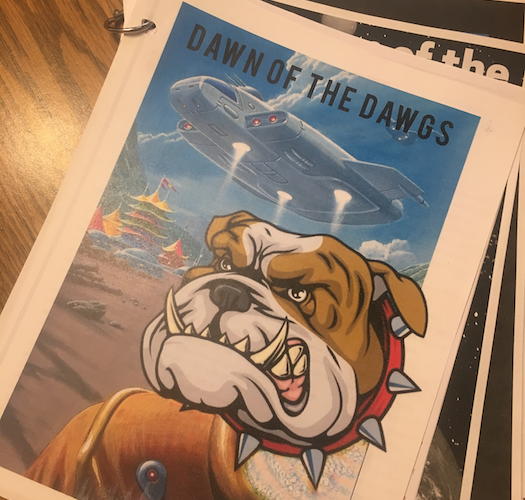
After the short papers were completed, students made two collaborative apazines and engaged directly in the communal process observed in the archives. The first apazine was made up of responses to archive resources. As a class, students drafted the rules of their apazine (i.e., entries can’t be over 500 words; Courier font only; graphics required), designed cover art, and voted on a title. Each student then revised one of their earlier papers, which became their apazine contribution. On the due date, each student brought 22 copies of their entry to class, which were then collated, and each student received a hard copy of the class apazine. The rest of class period was then spent in reading and conversation about the apazine. The second apazine was composed of responses to and interactions with their peers’ apazine writing. A student might write a response to a review of a story they hated but their peer loved, express admiration for a well-analyzed connection, or build on the research started by a peer. Each student entry had to be in conversation with an entry from the first apazine. In this way students were not just consumers of archival material but were producing writing that will itself be archived—at the end of semester, the apazines were donated to the University of Georgia’s Lamar Dodd Art Library. By making their own network of connected writing, students were able to experience the social nature of writing and produce a new archive of zine art.

Printed pages, bound with a ring; top page includes a landing spaceship and a bulldog mascot.

Figure 4. Finished class apazine. The title, “Dawn of the Dawgs,” is an amalgamation of science fiction and University of Georgia culture.

Davis’s ENGL 4832W: “Rare Books and Book Technology” in Writing for the World Wide Web

The relevance of archival research for many of the upper-level writing courses I teach was clear from the start of my time as an archival Teaching Fellow, but the course that I ultimately structured around a major archival research component was Writing for the World Wide Web. Writing for the web is not simply about content creation. I have to prepare students for a future in which machines join us as readers and writers in networks, engaging in processes of pattern recognition. Writing for the Web has to focus not just on content production but also on how to work with and against algorithms, software, data, and metadata, as well as helping digital media authors understand themselves as participants in a network of distributed cognition.

The Hargrett Rare Book and Manuscript Collection presented a wealth of material that would intersect nicely with one of our texts, Naomi Baron’s Words Onscreen: The Fate of Reading in a Digital World. My goal was to foreground the problem of writing for online readers—readers who, as Baron’s research indicates, aren’t so much reading as scanning, skimming, and clicking quickly away to the newest, the now-est, the next. I focused on this problem of “not-reading” (or, in web lingo, TL;DR) in this course as the major design problem for writers in the digital age to solve, a problem that will, if we do not think carefully and critically about how to foster effective reading onscreen, have significant consequences for literacy and knowledge. In past semesters, I have drawn extensively on Murray’s conception of the “Four Affordances” of digital media to foster a design thinking approach to digital textual composition. In this course, I put Murray and Baron’s ideas into conversation with the history of the book as a material object in hopes of creating productive thinking about digital textual design. In addition to Baron’s text, I included Nicole Howard’s The Book: The Life Story of a Technology, in order to provide students with an accessible history of the book and to emphasize the connection between technologies of reading and writing. This combination provided the framework for an examination of the examples of book technology and its evolution contained within UGA’s Hargrett Rare Book and Manuscript Collection. Essentially, the course would foreground the way technologies enable particular kinds of textual production which, in turn, produce particular kinds of reading and writing practices—practices that ultimately have wide-ranging cultural effects.

I developed a design project that asked students to use rare books from the collection as inspiration for an innovative digital textual design concept. The Hargrett holds a wide range of texts—everything from early print incunabula to conceptual artists’ books—that would require them to reconsider their understanding of what a book is, as well as the kind of literacy practices that different types of texts cultivate. The project involved several components including a depiction of the text’s design (visuals, description/explanation, written manuscript of text); an analysis of how the design plan remediated features of the inspiration text and drew on digital media affordances; and a critical reflection on their design process. Additionally, we needed to connect the dots between the inspiration texts from the archive. To achieve that aim, we created a digital exhibit using Omeka, not only because it allowed us to create a public-facing product, but also because it introduced students to metadata, both conceptually and practically. Collectively “curating” and framing an exhibit of the archival material and working with the common vocabulary of Dublin Core Metadata standards would give us a final collaborative project to present to the Special Collections Library faculty as well as other interested faculty members and students.

My own work as an instructor consisted largely of facilitation and research: I searched the archives, in consultation with a Hargrett librarian, for an initial collection of material that would represent a range of rare book items. On our first visit to the library, I gave each student an item to review along with a worksheet that asked them to consider several questions about the material aspects of the book they were examining and how it fostered or constrained different kinds of reading practices.

""

Figure 5. The prompt worksheet for Spring 2018 Writing for the Web students’ first visit to the Special Collections Library, asking them to explore and consider material properties and reading practices as they examine rare book items from the Hargrett Collection.

For our second visit, I asked students to tell me the kinds of texts they found most interesting from our first visit and, additionally, to provide an initial idea for their project that would help guide our archivist and me in curating a second collection of material for another round of hands-on exploration. We provided students with a tutorial on how to search the Hargrett collection themselves so that they could request additional material for viewing on their own. We also visited the Digital Arts Library Project, a collection of “legacy computers and video game systems as well as a collection of electronic literature pieces, digital interactive narrative pieces, and video games” (Digital Humanities, n.d.), and a copy of Raymond Queneau’s (1961) Cent mille milliards de poemes, a print precursor of digital media’s procedural affordance. Eventually, each student found a rare book (or two) that served as the primary inspiration for their design concept and they were each responsible for entering the information about the book (along with their own images taken during their time with the book at the library) into the Omeka site I set up at my web domain (having given each of them contributor access). For that exhibit, I also worked with the students to develop a conceptual frame for the project that would ground the exhibit in the concepts and scholarship that we were working with throughout the semester and, on the last day of class, we presented our work to an audience of interested colleagues. The event gave students a chance to engage in dialogue about their ideas and design process.

Title reads 'Translating, Transitioning, Transcending: Rebinding the book for digital reading.'

Figure 6. The collaboratively-produced promotional flyer for Writing for the Web’s end-of-semester exhibit of the design concepts inspired by rare book material.

Discussion

Our experiences suggest that archival work in the writing classroom facilitates greater interaction between the material properties of written texts and the students, while fostering collaborative curation. These collaborations add to or create new collections that are, in a sense, adaptations of the original archives. Reframing archival material in these ways makes new connections or linkages between seemingly disparate materials and reinforces the social and networked nature of knowledge production and a re-conception of how to use source material for remixing and remaking.

While our courses took us in diverse directions in terms of archival material and foci, the materiality of the archival texts played a large role early on for all of us. Pulps are characterized by colorful, larger-than-life covers that demand attention, as do the daring conceptual artists’ books and texts produced during the early days of printing press technology. These texts forced the students to reconsider how materiality affects reading practices. More eye-catching in a different way, the postcard that depicted Leo Frank’s lynching put students in physical contact with brutal history. This type of active learning pushes students outside their comfort zone and puts them in situations that require them to consider class content and apply that thinking toward course goals and their lives. Students began to see themselves as “scholar adventurers blowing dust off documents that could contain mysteries, answers, or maps of the past” (Norcia 2008, 107). It’s clear this technique relies heavily on critical and analytical thinking, which in turn improves and fosters strong writing skills (Bernstein and Greenhoot 2014; Gingerich et al. 2014). Perhaps even more important, it exposes students to a whole new world of composition. The inclusion of apazines, letters, and art projects in the archives showed students the legitimacy and value of such unconventional writing.

As each class progressed, students used the skills gained from archival research to recalibrate and restructure composition. Working with a physical text, as Kara Poe Alexander (2013) found when she incorporated scrapbooking into her first-year writing course, teaches “students the concept of affordance and demonstrates to them how materiality impacts design, composition, and rhetorical choices; it also provides a low-key, low-stakes entry into multimodal composing and reflexivity on the rhetorical decision making process.” A material example of the mingling of words and art/bookcraft gave students the tools they needed to compose their own multimodal projects and move from the page to the screen, without losing what made the original art projects unique. While Reeves’s students took advantage of the do-it-yourself nature of zines to produce their own, Davis’s students were unable to actually produce the digital texts they designed, lacking the advanced programming and coding skills necessary to bring those conceptual plans to life. This foregrounds again the social and collaborative nature of digital textual composition in which skilled programmers and visual artists might be required to actually produce an interactive digital text, just as a community of specialized craftsmen was needed to produce early print texts.

Ultimately, through both research and writing, the insistence on a more open, flexible network of knowledge remained key. This is perhaps best illustrated through one of the texts that several students in Writing for the Web found particularly compelling—a copy of Queneau’s (1961) Cent mille milliards de poemes. This mid-twentieth century precursor to the digital hypertext demonstrated the way that a single text can be remixed and reconfigured to provide an interactive experience for readers. That concept of interactivity became a key goal for Davis’s students’ design projects as they discussed the ways that the rare book material from the archives provoked a sense of pleasure in discovery and exploration. Janet Murray identifies this kind of pleasure in the text as an effect of careful design in her definition of the Procedural Affordance of digital media: “Procedurality and participation are the affordances that create interactivity and visible procedurality combined with transparent participation creates the experience of agency for the interactor, a key design goal for any digital artifact” (n.d.). In each of our classes, the experience of working with archival materials provided an experience not unlike that of “reading” Queneau’s text in which the ability to recombine and reconfigure the sonnets results in a sense of endless possibility for construction and reconstruction of meaning.

In her argument for “textual curation” as a unique “category of compositional craft,” Krista Kennedy cites Johndan Johnson-Eilola’s (2005, 134) contention that “Creativity is no longer the production of original texts, but the ability to gather, filter, rearrange, and construct new texts” (quoted in Kennedy 2016, 176). As in the Pop-Up Archives Project Jenny Rice and Jeff Rice facilitated at the University of Kentucky, our students curated experiences of archival material whose goals were “neither preservation nor a totalizing narrative” (2015, 247), but recontextualizations that, as in the conception of curation in the art world, put forward new arguments. Thoughtful curation requires immersion into larger conversations about issues and discernment about what is relevant and important in order to generate further discussion by “customiz[ing] archives toward their own ends” (Enoch and VanHaitsma 2015, 221). This year our students created their own handmade apazines, designed concepts for interactive digital texts, and performed reenactments of historical scandals. In each instance, they were asked to use historical materials throughout the compositional process, from the starting point of invention, all the way to the delivery of their ideas through curated performance, exhibits, and portfolios that present new understanding or expose new lines of inquiry.

We have come to consider archives-centered writing instruction as a pedagogy of remix, curation, and appropriation in which students are faced with a set of materials that may be vast and yet incomplete—an archive filled with gaps and unanswered questions that, like Queneau’s sonnets, can overwhelm with a sense of infinite possibility and insistent lack of closure. As scholars of digital culture have long insisted, remix is the foundation of knowledge construction and creative production. We each asked our students to discover ideas and compose new texts through a communal process of appropriation and reconfiguration that resulted in an awareness of what Neal Lerner (2010) has framed as the incompleteness of histories (203) and in, we hope, a reconsideration of what writing and textual form mean in the 21st century digital age. For student writers, exploring a variety of historical texts can decenter their conception of what constitutes writing or textual form, as Wells (2002) notes when she claims that “[a]rchival study of other kinds of texts also broadens our own sense of how difficult it is to write in new and untried ways” (59–60). That awareness is critical as we continue to chart the waters of digital writing at this particular technological moment. Digging into the past, we find in the archive a pedagogy well-suited to the future of writing.
Bibliography

Alexander, Kara Poe. 2013. “Material Affordances: The Potential of Scrapbooks in the Composition Classroom.” Composition Forum27 (Spring). http://compositionforum.com/issue/27/material-affordances.php.

Bernstein, Daniel, and Andrea Follmer Greenhoot. 2014. “Team-Designed Improvement of Writing and Critical Thinking in Large Undergraduate Courses.” Teaching & Learning Inquiry 2 (1): 39–61. https://doi.org/10.2979/teachlearninqu.2.1.39.

Center for Teaching and Learning. The University of Georgia. n.d. “Faculty Services & Programs: Special Collections Libraries Faculty Teaching Fellows.” Accessed June 15, 2018. http://ctl.uga.edu/pages/special-collections-libraries-faculty-fellows-program

Chitty, Andrew. 2011. “London Re-cut: Reclaiming History through the Co-curated Remixing of Film.” Curator: The Museum Journal 54, no. 4 (October): 413–418.

Digital Humanities, The University of Georgia. n.d. “Projects.” DIGI: The Digital Humanities Initiative of the Willson Center and UGA Libraries, accessed June 13, 2018. https://digi.uga.edu/projects/.

Enoch, Jessica, and Pamela VanHaitsma. 2015. “Archival Literacy: Reading the Rhetoric of Digital Archives in the Undergraduate Classroom.” College Composition and Communication 67, no. 2 (December): 216–242.

Fitzpatrick, Kathleen. 2007. “Commentpress: New (social) Structures for New (networked) Texts.” Journal of Electronic Publishing 10, no. 3. https://doi.org/10.3998/3336451.0010.305.

Gingerich, Karla J., Julie M. Bugg, Sue R. Doe, Christopher A. Rowland, Tracy L. Richards, Sara Anne Tompkins, and Mark A. McDaniel. 2014. “Active Processing via Write-to-Learn Assignments: Learning and Retention Benefits in Introductory Psychology.” Teaching of Psychology 41 (4): 303–308. https://doi.org/10.1177/0098628314549701.

Hayden, Wendy. 2015. “‘Gifts of the Archives: A Pedagogy for Undergraduate Research.” College Composition and Communication 66, no. 3 (February): 402–426.

Johnson-Eilola, Johndan. 2005. Datacloud. Cresskill, NJ: Hampton Press.

Kennedy, Krista. 2016. “Textual Curation.” Computers and Composition, 40 (June): 175–189. https://doi.org/10.1016/j.compcom.2016.03.005.

Lerner, Neal. 2009. “Archival Research as a Social Process.” In Working in the Archives: Practical Research Methods for Rhetoric and Composition, edited by Alexis E. Ramsey, Wendy B. Sharer, Barbara L’Eplattenier, & Lisa S. Mastrangelo, 195–205. Carbondale, IL: Southern Illinois University Press.

McLean, Adrienne. 2001. “Introduction.” In Headline Hollywood: A Century of Film Scandal, edited by Adrienne L. McLean and David A. Cook, 1–25. New Brunswick, NJ: Rutgers University Press.

Murray, Janet. n.d. “Glossary.” Janet H. Murray, accessed June 13, 2018. https://inventingthemedium.com/glossary/.

National Council of Teachers of English. 2013. “Definition of 21st Century Literacies.” Updated February 28, 2013. NCTE, accessed October 5, 2018. http://www2.ncte.org/statement/21stcentdefinition/

Norcia, Megan A. 2008. “Out of the Ivory Tower Endlessly Rocking: Collaborating across Disciplines and Professions to Promote Student Learning in the Digital Archive.” Pedagogy 8 (1): 91–114.

Queneau, Raymond. 1961. Cent mille milliards de poèmes. Paris, France: Gallimard.

Rice, Jenny and Jeff Rice. 2015. “Pop-Up Archives.” In Rhetoric and the Digital Humanities, edited by Jim Ridolfo and William Hart-Davidson, 245–254. Chicago: The University of Chicago Press.

Vetter, Matthew A. 2014. “Archive 2.0: What Composition Students and Academic Libraries Can Gain from Digital-Collaborative Pedagogies.” Composition Studies 42 (1): 35–53.

Wells, Susan. 2002. “Claiming the Archive for Rhetoric and Composition.” In Rhetoric and Composition as Intellectual Work, edited by Gary A. Olson, 55–64. Carbondale, IL: Southern Illinois University Press.

About the Authors

Elizabeth Davis is the Coordinator of the Interdisciplinary Writing Certificate Program at the University of Georgia. In her teaching and research, she focuses on experiential learning in the writing classroom, digital rhetoric and storytelling, and ePortfolio pedagogy and assessment.

Nancee Reeves is a lecturer at the University of Georgia, where she teach literature and writing. Her research interests include science-fiction and how it shapes and is shaped by social policies.

Teresa Saxton is a lecturer at the University of Dayton, where she teaches classes on writing and eighteenth-century literature. Her current pedagogical projects are interested in bringing together the archives, public writing and advocacy.

A photo of shelves of paper files in an archive.
0

Narrating Memory through Rhetorical Reflections: CUNY Students and Their Archives

Abstract

This essay analyzes the importance of connection in teaching with archives: connections between our goals for our projects; between students and their research projects; between the past and the present; between students, faculty, and embedded librarians; and between the physical act of archival research and the digital writing to record that research. In this essay, two faculty and one librarian detail their projects assigning archival research in physical archives: the Abraham Lincoln Brigade Archives at the Tamiment Library at New York University and the Hunter College Archives. As our undergraduate students researched in physical archives and shared their research through digital platforms, they became active agents of generational transmission by publicly sharing the life histories and experiences of former CUNY students involved in activist movements. Through analysis of these collaborative, digital archival assignments, we show the role that students can play in transmitting institutional memory while learning about and engaging with primary sources.

“Internet searching doesn’t hold a candle to that visceral feeling of an old primary document. All of my senses were triggered on this archive visit, and I was only there for half a day. I would like to return to the archive—this archive, any archive—without an assignment or mission attached and just have some fun exploring.” —Elyse Orecchio[1]

“During our visit to Tamiment Library, I was moved by the fact that each box contained individual memories of an American volunteer in the Spanish Civil War. I wondered how much of one person’s life could fit in these boxes, and how these documents could help narrating the friendships among young soldiers, the making of improvised families, the experiences of the displaced children, and how some these lives might have survived the war. I wondered, finally, how much legacy can these archives preserve?” —Marcelo Agudo

In a class session announcing a visit to the Hunter College Archives, several students in a class of juniors and seniors admitted that they had never even been inside the Hunter College Library—or any library. We might all shudder at the thought, but it is quite common for students to have no reason for entering a physical library or speaking with a librarian face to face. It is not that students Google everything: they have extensive remote access to scholarly journals and primary sources through electronic databases, and digital holdings now outpace physical holdings at libraries. Furthermore, librarians are available through digital platforms to assist students with their research. As student reflections from our courses show, the experience of entering a library, working with physical primary sources, and interacting with librarians face-to-face became a positive practice that not only introduced students to a new method and approach to research, but also resulted in new attitudes towards libraries, librarians, and the relevance of institutional memory.

The central question of this essay focuses on the role of students in institutional memory: what does it mean for undergraduates to do the work of narrating memory? Here we elaborate our archival research assignments: María Hernández-Ojeda’s Narrating Memory assignment taught in her courses on Spanish literature, and Wendy Hayden’s Rhetorical Reflections assignment, taught in her courses on rhetoric and writing. We both assigned undergraduates at Hunter College-CUNY to perform archival research in physical archives and report on that research on digital platforms (all WordPress based sites): Narrating Memory, Rhetorical Reflections in the Hunter College Archives, and Archival Research and Rhetoric. Iris Finkel, Reference and Instruction Librarian at Hunter College, redefined the role of the librarian in classroom instruction as she assisted students and faculty with research assignments in both physical and digital archives and used her digital humanities expertise to help students and faculty understand the norms and creative approaches to digital presentation. Although the three of us began these projects separately, here we bring them together in order to illustrate the theme of connection in teaching with archives: connections between our goals for our projects; between students and their research projects; between the past and the present; between students, faculty, and librarians; and between the physical act of archival research and the digital writing to record that research.

Over twenty years ago, Randy Bass (1997) promoted active learning pedagogy that incorporated primary sources and new technologies. Bass illustrated how new technologies facilitated engagement and fostered collaboration among students, using examples of assignments where students interacted with “electronic primary source archives (on the World Wide Web, or CD-ROM)” (1997, 15). Through hypertext, then a revolutionary new feature of interactive media, students were readily able to explore outside the source to find other meaning-making connections. Using technologies such as email, listservs, electronic discussion lists, and teleconferencing, students discussed primary sources outside the classroom. Students collaborated, made new connections in the material, and communicated knowledge that added a different perspective. Students moved from knowledge “consumers to producers” (Bass 1997, 33). We show how emerging technologies continue to empower student voices.

Recent scholarship shows that more teachers are assigning physical archival research to undergraduates, a trend Hayden (2017) has called “The Archival Turn’s Pedagogical Turn.” Students have been assigned to research in institutional archives (Brand, Kendall, and Sanders 2012; Johnson and Mulder 2011), community archives (Grobman 2017; Mutnick 2018), and in larger repositories (Devos et al. 2012; Mock 2015). In addition, archivists are reaching out to teachers to form partnerships with specific classes, such as the Brooklyn Historical Society’s TeachArchives.org (Golia and Katz 2018). Recent books, including the collections Pedagogies of Public Memory: Teaching Writing and Rhetoric at Museums, Archives, and Memorials (Greer and Grobman 2016), In the Archives of Composition: Writing and Rhetoric in High Schools and Normal Schools (Ostergaard and Wood 2015), and the textbook Primary Research and Writing: People, Places, and Spaces (Gaillet and Eble 2016), reflect a focus on archival pedagogies in rhetoric and composition studies. This research demonstrates that teaching with archives facilitates active learning. In addition, teaching with archives provides an ideal opportunity to teach information literacy. And from a digital humanities perspective, archival material can be analyzed and repurposed in new ways for new audiences, as our projects demonstrate.

In previous articles, Hayden (2015; 2017) has enumerated the benefits of teaching with archives related to what Susan Wells (2009) calls the “gifts of the archives”: archival research teaches students 1) to resist simple answers to their research questions, 2) to contribute to ongoing conversations in a discipline through publishing undergraduate research, and 3) to connect with their research topics personally. In this essay, we focus on the third, to show what CUNY students learned by researching past CUNY students, and how encounters with archival materials can facilitate student-centered learning experiences in other institutions and contexts.

Composition and Rhetoric graduate students at the CUNY Graduate Center have produced several dissertations on the importance of CUNY to histories of the discipline (Molloy 2016; Savonick 2018). Anthony G. Picciano and Chet Jordan (2018) recently published CUNY’s First Fifty Years: Triumphs and Ordeals of a People’s University, which documents CUNY’s history in the context of free and open-admissions universities. The CUNY Digital History Archive not only aims to document the unique history of CUNY and its role in larger movements in higher education but also invites researchers, teachers, and students to collaborate on developing the archive and its uses for archival and digital humanities assignments in CUNY courses (Brier 2017). The CUNY Digital History Archive reflects both CUNY’s emphasis on archives and on publishing on digital platforms. All of these projects document CUNY’s history and the teachers and students who have shaped it. Students in our courses add to these histories while constructing a unique history of activist students and their roles in larger social movements. And it is important to us that undergraduate students rather than faculty do this work, both to highlight the value of archives and to involve undergraduate students in documenting institutional memory.

According to Ekaterina Haskins (2007), we need to go beyond memory work that is done by those in power. Haskins (2007, 402) notes, “relegating the task of remembering to official institutions and artifacts arguably weakens the need for a political community actively to remember its past.” When current CUNY students use archival research to narrate the memory of former CUNY students, they participate in a “continuous transmission of shared past through participatory performance” (Haskins 2007, 402).

Students in our courses performed research in the institutional archives at Hunter College and the Tamiment Library at New York University, exploring topics such as the efforts of Hunter women to establish free kindergarten in New York City, to organize the Lenox Hill Settlement House, and to become involved in CUNY student activism during the two World Wars and the Spanish Civil War. And in a “meta-analytic” topic, some students have researched and analyzed the research processes of past student researchers at Hunter, whose typewritten, whited-out drafts give insight into the revision processes of earlier generations of students. Whether they were collecting stories of women returning to college, documenting the involvement of students in the Abraham Lincoln Brigade during the Spanish Civil War, or processing archival collections, they were becoming both active agents of generational transmission and digital archivists themselves. These students not only recovered the voices of CUNY students, such as the “returning woman” and Abraham Lincoln volunteers, but they also extended the original goals of these past students in a new digital context, creating their own digital archives, either in written or multimedia form, blending the voices of the past and present students of CUNY.

Goals

Archives enable unique pedagogical approaches to the topics of our courses. María’s undergraduate courses concentrated on twentieth-century Spanish literature, where the Spanish Civil War (SCW) is a constant presence in class discussions, whether through the exiled poets of the 1927 generation, the novels of tremendismo, or the issues of memory and identity in today’s literary Spain. The SCW served as  a common subject uniting historical and fictional narratives in the course. The Abraham Lincoln Brigade Archives (ALBA), which include primary-source documents related to a group of Americans who volunteered to serve in the SCW, helped bring the past to life for contemporary CUNY students. The Lincoln Brigade, the American battalion that participated in the Spanish Civil War within the International Brigades, included about 2800 men and women who left the US between 1936 and 1938 to fight fascism in Spain. The Lincoln Brigade’s commitment was an act of disobedience to the US government, which remained neutral, while other Western nations signed a non-intervention pact when the Spanish Civil War began in 1936. Some of these volunteers were CUNY faculty and students themselves. In the Narrating Memory project, today’s students connected with the stories and experiences of American volunteers in the SCW and began to understand why fellow CUNY students left everything and sailed to Spain to fight a war the US government largely ignored.

Wendy’s undergraduate courses incorporated the Hunter College Archives to show the centrality of recovery of lost voices to the field of rhetoric. Researching activist students, teachers, and writers in a local context allowed students to enter scholarly conversations about historiography and institutional memory. The archive project introduced students to a new method of research and information literacy skills.

Initially, we both hoped assigning archival research would allow undergraduates to make their own historical discoveries, learn the skills of archival research, and reflect on the complexities of history as a subjective concept. The work that students produced in these courses exceeded our expectations.

The Archives

New York City provides teachers access to many physical archives, such as the Brooklyn Historical Society, the Lesbian Herstory Archives, and the Schomburg Center for Research in Black Culture, among others. We concentrate here on the pedagogical opportunities offered by institutional archives: the Hunter College Archives and the ALBA collection at the Tamiment Library at New York University.

The Hunter College Archives include collections dating back to Hunter’s founding in 1870 as the Normal School. Student projects have focused on Hunter College student communities, such as the newsletters Returning Woman (1981–1998) and Lesbians Rising (1976–1983); on writers and teachers at Hunter College, such as Kate Simon (1959–1989) and Helen Gray Cone (1859–1934); and on Hunter students’ roles in larger movements, such as the Women’s City Club (1915–2011) and the Lenox Hill Settlement House (1892–2015). In addition to researching existing materials in the archives, they added to the archives with documents from their own clubs, worked with unprocessed collections, and created a finding aid, all to tell the story of the students of CUNY and their roles in larger social movements.

The Abraham Lincoln Brigade Archives at the Tamiment Library contain materials related to American involvement in the Spanish Civil War. The Tamiment Library is a nationally-recognized space for scholars interested in researching labor history, civil rights movements, and left political ideology. The collection holds about 50,000 books, 15,000 periodicals, and about one million pamphlets and ephemera. The Tamiment Library contains letters, books, photographs, news, interviews, and other compelling information that is imperative to understand the contribution of the Lincolns.

Librarian Collaboration

At the Tamiment, María initially worked with former Public Services and Instruction Librarian Kate Donovan and currently works with Public Service Librarian Sara Moazeni, and Reference Associate Danielle Nista. The librarians reviewed the course syllabus and became familiar with the course goals prior to the first class visit. After introducing the students to the ALBA collection, the librarians provided an information sheet and instructional activities for students to discuss in groups in order to familiarize them with the archival material. In February 2018, librarian Danielle Nista arranged four sets of documents (posters, diaries, and photos) for our analysis. She organized four groups of approximately five students so they could rotate and discuss each item to provide a broad introduction to the archives.

At the Hunter College Archives, former head archivists Julio Hernandez-Delgado and Louise Sherby developed an introductory session where students read several articles on Hunter College history before their visit. During the class visit, the archivists led a discussion of the assigned articles, introduced the collections, and demonstrated how to use a finding aid. More than a “how to” session, the introduction was a discussion of the history of the college as documented in the archives. Students used that discussion to formulate research questions. Iris developed a library guide to the archives that includes general information about the types of materials held in archives, instructions on citing archival material, and links to online exhibitions.

As the project developed, Iris joined Wendy’s classes as an embedded librarian, and in that role integrated a digital humanities focus. Beyond the embedded librarian’s traditional responsibilities such as helping students with research and navigating physical and digital archives, for these archival assignments Iris guided students in using WordPress to communicate their work to a broader audience, thereby acting as knowledge producers. Iris introduced students to digital tools such as the timeline software Tiki Toki and Weebly, a content management system more user friendly than WordPress. She commented on students’ blog posts to point out information gaps and suggested resources to help fill those gaps. From her position within the classroom, Iris established relationships with students and met with them both in groups and individually during class time. Through this process she was able to determine the best fit for individual projects based on each student’s comfort level with new technologies and features of tools. Overall, collaboration among embedded librarians, archivists, students, and faculty was integral to the success of student projects and to the class.

The Assignments

The class visit to the Tamiment helped students to understand the role of the archive in their final project, and from then on they visited the archive on their own. Each student chose one Lincoln volunteer as the subject of their final essay and researched archival material to elaborate their motives to fight in the war. The final paper, posted individually on the Narrating Memory website, represented the culmination of the semester-long research they undertook at the Tamiment.

Students in the rhetoric courses were assigned to find a document or documents in the Hunter archives and tell that document’s story in relation to any theme in the course, such as women’s activism, silencing, writing, education, or civil rights rhetoric. They documented their findings and their research process on the Rhetorical Reflections blog (named by the students). They often detailed how they went into the archives interested in one topic and had to abandon that topic because it lacked material or because they found a more interesting topic. Wendy emphasized in class that they should document their entire process, even when it did not lead to anything. As Lynee Gaillet (2017, 109) points out, “Primary investigation often involves following a fun trail of clues … or a serendipitous find. Unfortunately, however, academicians often manage to stifle this most interesting aspect of our research in publications and rarely explain the process we find so engaging to either readers or students.” Based on these ideas, we asked students to include as many details as possible on their process, even when they found documents not relevant to their research topic, so future students can learn from their process and better locate materials relevant to their own projects. The class focus on process led to a publication in Young Scholars in Writing by student Esra Padgett (2015), whose article “Feminist Research as Journey (Or, Like, Whatever?)” asserts, “Rather than pinning down an answer, [this] essay attempts to follow the trajectory of the research itself, observing how perspectives can shift drastically depending on one’s method of inquiry.”

The digital aspects of our assignments aligned with digital humanities objectives of learning to locate, present, support, and cite research and scholarship. Through these assignments, students engaged with technology and considered different modes of presentation to support their scholarship. In addition to learning new ways to engage with content and enhance their digital literacy, students developed visual awareness through the process of finding appropriate images and media to complement textual content, and sometimes to represent content without text.

Both projects foreground the role of active learning. While we could teach students about the Spanish Civil War or rhetorical traditions using other methods such as assigning anthologies of primary or secondary sources, these methods would not engage students the same way. The true motivation to learn about the course material begins in the archives. From the moment students came into contact with the documents on the ALB volunteers at the Tamiment, everything they studied became meaningful. For example, we found that student writing improves through the projects, whether because of their passion for the topic or the blog format. Students also recognized the relevance of their writing style and accuracy, as their work was accessed by outside readers, some of whom have a connection with the material. All of the students began to understand how their voices were contributing to efforts to interrogate public memory. Writing, here, became a direct form of activism, as well as an academic exercise.

CUNY Connections

The archival visits generated a variety of connections for students and by students. Students connected with the stories and experiences of American volunteers in the SCW and began to understand why fellow CUNY students left everything and sailed to Spain to fight a war the US government largely ignored. Student Ashley Martinez found that the archive lacked information about David McKelvy White, a professor of English at Brooklyn College who unexpectedly left his teaching position in 1937 to fight in the SCW, so she expanded her search well beyond the Tamiment: “I have embarked on a nationwide search for information. I have found letters and stories [McKelvy White] wrote at the NYPL, additional documents from the Ohio Historical Society, which sent me the letters between David and his father, the Governor of Ohio, as well as documents he wrote during his political activism years after the SCW.” While Ashley began her project from an impartial position, keeping McKelvy White’s memory alive turned into an urgent task, a need to memorialize his life. Like many of the fictional characters discussed in the course, such as Lola and Javier Cercas in Soldiers of Salamis (Cercas 2001), Carlos Sousa in The Carpenter’s Pencil (Rivas 1998), or Minaya in Beatus Ille (Muñoz Molina 1986), Ashley became a young receptor of history, an interlocutor to an older generation keeping the memories of those who fought in the SCW alive.

Several students chose to research someone with a connection to their own life and academic interests. For instance, student Cody Butler wanted to study the life of Fernando Gerassi, the father of his professor at Queens College, John “Tito” Gerassi. Leon Ramotar wanted to learn about Hunter College alumna Helene Weissman, who joined the ALB as a medical administrative aid and interpreter. Pre-med student Kathleen Jedruszczuk wrote her final essay on the renowned Dr. Edward K. Barsky, a surgeon, political activist, and graduate from City College. In her project, Kathleen explained, “Reading about Edward Barsky’s life made me realize that he was more than just ‘aid to Spain’; he was an aid to humanity. Anyone who risks their life for people, goes to jail for the people, and becomes a doctor to help those people is an aid to humanity.” Student Rebecca Halff focused on Robert Klonsky and the relevance of Brownsville, Brooklyn, a diverse, working-class, and Jewish community with strong communist leanings, as a catalyst to join the ALB.

Through their research, students placed themselves into the stories told in the archives, both implicitly and explicitly. For example, Elyse Orecchio and Janice Johnson, both non–traditional-aged “returning women,”  researched the archives of the Returning Woman newsletter at Hunter and reflected on the connections they found. Janice perused the collection until she found work by a Puerto Rican woman like herself who was returning to college. Janice stated, “I was able to look and reflect on my own experience as a returning woman. I am that woman in the newsletter. I am the returning woman, the returning Hispanic woman, the returning student.” Elyse related, “I didn’t expect to get emotional when I looked through the first few issues of the newsletter. There was a lot of supportive, motivational writing that acknowledged this idea that you have a million other things going on, but you are doing this great thing for yourself.” Janice decided to create her own website that showcased her primary archival documents and video interviews with classmates—including Elyse—on the struggles of women returning to college.

The online format of the projects allowed students to write for audiences beyond the classroom and enabled explicit connections with those audiences. For example, student Haley Trunkett wrote her essay on May Levine Hartzman, a New Yorker who worked as an operating nurse during the SCW. She met her husband, Jacob Hartzman, in Spain, where he was an ambulance driver. Their son Peter provided information to Haley. Student Laura Montoya received feedback from Georgia Wever, the coordinator of the Friends and Family of the Abraham Lincoln Brigade Archives. Laura wrote about Jewish involvement in the SCW, and in particular, the story of volunteer Mark Strauss. In her comment, Georgia Wever wrote:

Dear Laura, What an interesting and inspiring story of a great person. With very little information, you manage to capture his humor and courage. I am disappointed that I never met him. I attended many reunions and banquets of the Veterans of the Abraham Lincoln Brigade at which all the veterans would stand, but I don’t recall him. I regret that you did not locate anyone who knew him because I would like to know more about his life after Spain. Perhaps someone will read this essay on our listserv and leave a reply. Thank you again for the affection you put into his story.

Students also wrote to former students and their families. For example, Carl Creighton wrote to the family of the president of the Hunter College Suffrage Clubs, who knew nothing of her suffrage activities. Elyse emailed the Hunter student who wrote the paper she found in the archives and received a response that connected the past and the present. As Deborah Mutnick (2016) explains, “Part of the archive’s appeal to my students is what Lucy Lippard refers to as the ‘lure of the local.’ Students encounter documents that reveal the history of the very streets they walk, and they gain a sense of empathy for the historical actors they study.” For our students, the people whose stories are told in the archives were more than only “historical actors,” but real people they interacted with through digital connections.

Melissa Hutton’s project in Wendy’s fall 2015 class prompted us to think of the blogs themselves as an archive. She responded to scholarship on digital writing by analyzing the writing and research practices of her peers as documented on their blogs. She concluded, “These blog posts are a perfect example of primary documents being born digitally and facilitating a place for online research.” Melissa’s work inspired revisions to the archive assignment. For example, Wendy added a requirement to link to other student blog posts on similar topics and tag the blogs with descriptors such as “World War II” for blogs discussing women’s activism during the war, thus  turning the website into a student-written and -researched history of a tradition at Hunter. In fall 2018, Wendy is approaching the archive assignment differently by having her first-year writing students read student blogs first, and then work with the same documents previous students did and develop new questions about those documents and compare different archival research processes. The blogging technology thus creates an archive of students’ research in archives, useful to future students researching in archives.

Conclusion

In the digital world, research can seem a disembodied and impersonal task for undergraduate students. We found that the physicality of archival research, far from being a burden to students, is the very thing that makes them connect with their research and their institution. Inviting a librarian into the classroom personalizes research and encourages students’ confidence in their work as they receive support to facilitate their research and present it in an appropriate format.

From a librarian’s perspective, the lessons students learn from archival research, particularly understanding the differences between primary and secondary sources and how one can provide support for the other, make them stronger researchers even when they are not researching in archives. Melissa and Iris discussed how this distinction between primary and secondary sources needs to be redefined in a digital context. For example, a student blog post may not be an authoritative source to cite, but Melissa noted the value of these blog posts to researchers in the field of library studies or composition studies: “While regarding student blog posts as secondary sources might not be wholly credible for authenticating an academic paper or constructing a historical narrative, viewing them as primary sources gives them new meaning as legitimate firsthand student accounts. … Student blog posts acquire a currency hard to find in finely-combed scholarly sources. In this case, student blog posts provide us with interpretations of rhetoric and archival research instruction.” They might be used as an archive to explore student research processes from an academic perspective or as a mode of communication between scholars. If someone were doing research on the ALB or on the struggles of women returning to college, the blogs on Narrating Memory or Rhetorical Reflections may be a useful window into those topics.

Researching CUNY students and professors through the ALBA collection and the institutional archives at Hunter placed students within a tradition of student activists as they contributed to the process of memorialization. The act of telling the story of someone unknown and becoming an intermediary of both primary and secondary internet research also meant their work was meaningful in ways that traditional research papers may not be (Keegan and McElroy 2015; Mutnick 2016). Students in our courses became active agents of generational transmission for the ALB volunteers and the history of CUNY by transmitting their life histories and shared experiences.

Our students directly benefited from the collaboration between their instructor and librarians, as well as Hunter College and the Tamiment’s commitment to making their collections available. The accessibility of archives to students, researchers, and the general reader can make them a democratic and pedagogical tool. Unfortunately, many archives are suffering from serious funding cuts and increasingly limited access. The future of archives depends on valuing historical materials and reimagining their purposes in the present. Eighty years after the SCW began, we continue to learn about the crucial role that the ALB volunteers played in the fight against fascism. Delmer Berg, the last Lincoln alive, died on February 28th, 2016. Thanks to the younger American generations who narrate their legacy, voices like Berg’s and those of former CUNY students will remain in history, and in our memory.

Notes

[1] All student work mentioned in this essay is used with permission. Students indicated that they would like their full names used to credit their work.

Bibliography

Abraham Lincoln Brigade Archives. 2018. Accessed June 10th, 2018.
http://www.alba-valb.org/resources/alba-collection.

Bass, Randy. 1997. “Introduction: Engines of Inquiry: Teaching, Technology, and Learner-centered Approaches to Culture and History.” In Engines of Inquiry: A Practical Guide for Using Technology in Teaching American Culture, edited by Randy Bass. Washington, D.C.: American Studies Crossroads Project. Accessed September 21, 2018.
https://ctl.baruch.cuny.edu/files/2013/09/Engines.pdf.

Brand, Cassie, Sarah Kendall, and Arnold Sanders. 2012. “Hands-On Research with Rare Books and Ephemera” Archive Journal 2. Accessed June 12, 2018.
http://www.archivejournal.net/essays/hands-on-research/.

Brier, Stephen. 2017. “Why the History of CUNY Matters: Using the CUNY Digital History Archive to Teach CUNY’s Past.” Radical Teacher 108: 28–35.
https://radicalteacher.library.pitt.edu/ojs/index.php/radicalteacher/article/view/357.

Cercas, Javier. 2001. Soldados de Salamina. Barcelona: Tusquets.

Devos, Dakota, et al. 2012. “Mapping the Provenance of Museum Objects” Archive Journal 2. Accessed June 12, 2018.
http://www.archivejournal.net/essays/mapping-the-provenance-of-museum-objects/.

Gaillet, Lynee Lewis. 2017. “Primary Research in the Vertical Writing Curriculum.” In Writing Pathways to Student Success, edited by Lillian Craton, Renee Love, and Sean Barnette, 109–116. Boulder: The WAC Clearing House, University Press of Colorado. Accessed on June 10, 2018.
https://wac.colostate.edu/docs/books/pathways/success.pdf#page=119.

Gaillet, Lynee Lewis, and Michelle F. Eble. 2016. Primary Research and Writing: People, Places, and Spaces. New York: Routledge.

Golia, Julie and Robin M. Katz. 2018. TeachArchives.org. Accessed June 10, 2018.
http://www.teacharchives.org/.

Greer, Jane and Laurie Grobman, eds. 2016. Pedagogies of Public Memory: Teaching Writing and Rhetoric at Museums, Archives, and Memorials. New York: Routledge.

Grobman, Laurie. 2017. “Disturbing Public Writing in Community Partnerships.” College Composition and Communication 69 (1): 35–60.

Haskins, Ekaterina. 2007. “Between Archive and Participation: Public Memory in a Digital Age.” Rhetoric Society Quarterly 37 (4): 401–422.

Hayden, Wendy. 2017. “And Gladly Teach: The Archival Turn’s Pedagogical Turn.” College English 80 (2): 133–158.

—. 2015. “‘Gifts’ of the Archives: A Pedagogy for Undergraduate Research.” College Composition and Communication 66 (3): 402–46.

Johnson, K. Vicki, and Megan Mulder. 2011. “Lights, Camera, Action! Using Archival Collections in Student Documentary Films at Wake Forest University.” Journal for the Society of North Carolina Archivists 9(1): 35–45.

Keegan, Tom, and Kelly McElroy. 2015. “Archives Alive!: Librarian–Faculty Collaboration and an Alternative to the Five-Page Paper.” In the Library with the Lead Pipe, August 26 2015. Accessed on June 7, 2018.
http://www.inthelibrarywiththeleadpipe.org/2015/archives-alive-librarian-faculty-collaboration-and-an-alternative-to-the-five-page-paper/.

Mock, Geoffrey. 2015. “Archives Alive: Students Dive into the Rubenstein.” Duke Today, August 31, 2015. Accessed June 8, 2018.
https://today.duke.edu/2015/08/archivesalive.

Molloy, Sean. 2016. A Convenient Myopia: SEEK, Shaughnessy, and the Rise of High-Stakes Testing at CUNY. PhD diss., The Graduate Center, CUNY. CUNY Academic Works. Accessed June 8, 2018.
https://academicworks.cuny.edu/gc_etds/1513.

Muñoz Molina, Antonio. 1986. Beatus Ille. Barcelona: Seix Barral.

Mutnick, Deborah. 2016. “The Appeal of the Archives: Engaging Students in More Meaningful Research.” TeachArchives.org. Accessed March 24, 2016.
http://www.teacharchives.org/articles/more-meaningful-research/.

—. 2018. “Pathways to Freedom: From the Archives to the Street.” College Composition and Communication 69 (3): 374–401.

Padgett, Esra. 2015. “Feminist Research as Journey (or, Like, Whatever?).” Young Scholars in Writing 12: 34–44. Accessed August 10, 2015.
https://arc.lib.montana.edu/ojs/index.php/Young-Scholars-In-Writing/article/view/36.

Picciano, Anthony G., and Chet Jordan. 2018. CUNY’s First Fifty Years: Triumphs and Ordeals of a People’s University. New York: Routledge.

Rivas, Manuel. 1998. El lápiz del carpintero. Madrid: Alfaguara.

Savonick, Danica B. 2018. Insurgent Knowledge: The Poetics and Pedagogy of Toni Cade Bambara, June Jordan, Audre Lorde, and Adrienne Rich in the Era of Open Admissions. PhD diss., The Graduate Center, CUNY. CUNY Academic Works. Accessed June 8, 2018.
https://academicworks.cuny.edu/gc_etds/2604.

Wells, Susan. 2009. “Claiming the Archive for Rhetoric and Composition.” The Norton Book of Composition Studies. Edited by Susan Miller, 911–918. NY: W. W. Norton & Co.

About the Authors

Wendy Hayden is Associate Professor of English at Hunter College, CUNY.

María Hernández-Ojeda is Associate Professor of Spanish at Hunter College, CUNY.

Iris Finkel is Reference and Instruction / Web Librarian at Hunter College, CUNY.

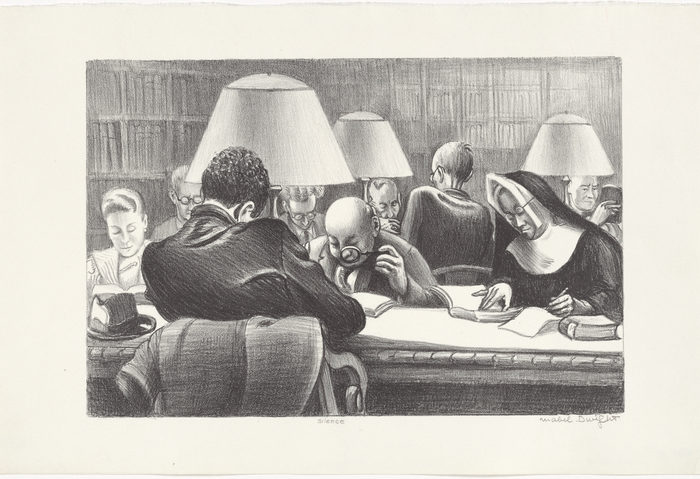
1939 cartoon of caricatures at the NYPL reading room
0

The Space Between Researcher, Object, Institution: Building Collaborative Knowledge with Primary Sources

Abstract

As archival and special collections resources become increasingly available in digital environments, our need to understand these documents in the context of their original material forms remains. As a result, techniques for teaching primary source literacy are a topic of rich discussion in special collections, archives, and library institutions, especially as information professionals consider ways to expand both research and readership. In light of the significant focus on undergraduate populations in many case studies on special collections pedagogy, this article discusses a year-long pilot program titled “The Collaborative Research Seminar on Archives and Special Collections” between the Graduate Center, CUNY, and the New York Public Library. To frame this interdisciplinary graduate seminar, which addressed both the theory and praxis of primary source research, I first discuss pedagogical frameworks, including Jacques Rancière’s critique of explication and Paulo Freire’s “banking model,” alongside Adrienne Rich’s teaching notes from her time at CUNY and Patrick Williams’ work on embodiment and archives. I then explore participant responses that address imagination, experimentation, and identification in the reading room—especially after the methods of Lost & Found: The CUNY Poetics Document Initiative, a key contributor to this program. By enumerating the practices that informed and constituted the Seminar, I suggest that we might consider conversation, experience, and experimentation as fundamental values in special collections pedagogy.

As we envision the digital futures of books, manuscripts, and archives, there is no substitute for historicization: books and manuscripts are technologies too, and foregrounding this perspective allows us to contextualize our work with digital facsimiles, metadata, and resources. This conversation far predates our current moment of digital profusion; in Orality and Literacy (1982), Walter J. Ong compares Plato’s critique of writing to contemporaneous critiques of computation, noting that “once the word is technologized, there is no effective way to criticize what technology has done with it without the aid of the highest technology available.” Ong continues, arguing that this technology is not “merely used to convey the critique” but rather brings “the critique into existence” (78). To corroborate this: when we explore the implications of our material history, our work increasingly, though not exclusively, occurs within or alongside digital context. We write about rare and archival materials in digital spaces, create digital repositories of items, and use digital methods to analyze documents, from transcription services to x-ray spectroscopy. Yet handling, working with, and conceptualizing primary source materials are skills that can be gained through a combination of experience and instruction. Forms of digital access to these items do not circumvent the need for these skills, but only expand their value.

While there are decades of research on the concept of information literacy, the idea of “primary source literacy” is relatively nascent both as a professional term and as a template for specific pedagogical strategies (Carini 2016, 191). Elizabeth Yakel and Deborah Torres’ “AI: Archival Intelligence and User Expertise” (2003) posits an influential three-part standard: domain or subject-focused knowledge, artifactual literacy, and the idea of “archival intelligence,” which consists of understanding archival theory and practices, negotiating strategies to handle the ambiguity of primary sources, and creating meaning from the artifactual or material qualities of a source. In addition, professional organizations for libraries such as the Society of American Archivists (SAA), the Association of College and Research Libraries (ACRL) and ACRL’s Rare Books and Manuscripts Section (RBMS) have formed a “Joint Task Force on Primary Source Literacy” (2015), whose guidelines have been approved as of 2018. These guidelines, which consolidate decades of work among information professionals in these organizations, attest to the growing importance of quantifying and understanding the ways in which we teach within special collections, archives, and libraries.

Today, teaching techniques that animate these guidelines are most visible in case studies or digital toolkits (such as Brooklyn Historical Society’s “Teach Archives” in 2013), designed to illuminate the pedagogy of specific institutions, as well as the Society of American Archivists’ recent publication series, “Case Studies on Teaching with Primary Sources (TWPS)” (2018), which animates the “Guidelines for Primary Source Literacy” by the same organization. These resources are often extensive, such as Using Primary Sources: Hands-On Instructional Exercises (Bahde, Smedberg, and Taormina 2014), a text designed to share both activities and types of learning goals across a range of collections and populations (vii). These techniques and examples often emphasize hands-on, lesson-based learning, as opposed to presentations or “show-and-tells” that exhibit materials but do not provide instruction on how to analyze them or access them in the context of a research visit. As embodied by Past or Portal?: Enhancing Undergraduate Learning through Special Collections and Archives (Mitchell, Seiden, and Taraba 2012), the increasing volume of specific case studies across materials and institutions contributes to the robust conversation on pedagogy in special collections, particularly at the undergraduate level. However, beyond resources such as the Council on Library and Information Resources (CLIR) report, Terra Cognita: Graduate Students in the Archives (2016), which surveys the findings of the CLIR Mellon Fellowships for Dissertation Research in Original Sources, few resources or literature exists for teaching primary source literacy to graduate populations, especially in a multidisciplinary context.[1]

At the graduate level, students often seek basic training that echoes aspects of Yakel and Torres’ (2003) idea of primary source literacy and includes negotiating materials in special collections and archives, navigating catalogs and finding aids that are primarily hosted in digital spaces, and managing information and notes once in the reading room. The types of questions that accompany graduate-level primary source literacy align with Yakel and Torres’ concept of “archival intelligence,” and are enumerated in the CLIR report Terra Cognita (2016): “Navigating Institutions,” “Negotiating Expectations,” “Documenting Processes,” and “Finding What You Need”—all essential aspects of archival research that involve technical knowledge, critical thinking, project management, and interpersonal skills. However, particularly in fields with a strong theoretical component, or in programs that require teaching, graduate students are also often primed for conversations not just on resources or skill development but also on special collections pedagogy itself. Special collections-based classes with graduate students are not just an opportunity to impart skills or information, but to critically examine “the archive” as a theoretical, conceptual, and literal space. As a result of the so-called “archival turn” in literary studies, for instance, sparked in part by Jacques Derrida’s Archive Fever: A Freudian Impression (1995), the idea of the archive, which graduate students often theorize in their work, may have little in common with an institution they visit to conduct research that is staffed by humans (not theories), with unique management and custodial procedures, reflecting a history all its own. In particular, scholars and archivists have different stakes in their definitions of what constitutes an archive or special collection, and how these sites signify critically, conceptually, and literally. By speaking across these disciplinary boundaries, we can more equitably offer credit and share responsibilities for making the material traces of history visible and accessible to those who need them. And given the critical possibilities of this interaction, special collections pedagogy stands to benefit from a model in which knowledge of primary source work is not just transmitted, but actively co-created with a highly proficient and critically engaged population.

To frame key features of critical pedagogy specifically for work in special collections,[2] we might consider the standard “show-and-tell” class visit, in which a librarian or curator imparts information about objects on display, as an example of Paulo Freire’s “banking model” of education from his canonical Pedagogy of the Oppressed (1970). In this model, knowledge is “bestowed” by those in possession of it unto those who do not, and students may only participate in “receiving, filing, and storing the deposits” of knowledge they are granted within the educational context (72). While these “show-and-tells” often have a highly affective component—since generally the most striking or historically important objects are featured, which can feel special or exclusive—they rhetorically foreground a teaching model in which the instructor is the gatekeeper or expert, and students the initiates. This model, based on explication, is the target of Jacques Rancière’s The Ignorant Schoolmaster (1987), in which he argues that a student who “is explained to” is susceptible to submit to a “hierarchical world of intelligence,” in which an explanation can always be obtained or offered as superior to the student’s own intuition and research (8). Rancière suggests that by explicating, instead of fostering the development of communal knowledge and conversation that he terms “universal learning,” we may well reinstate hierarchies of knowledge that certainly apply to the special collections reading room and should be challenged: the trope of the omniscient librarian, or the equally inaccurate librarian who solely pages items without interest or understanding.

If we consider the dynamic of the reading room—the physical space in which archival encounters occur—they are not dissimilar to the hierarchies of access that Rancière (1987) describes within learning: the uneven distribution of knowledge in the room, the presence of obstacles or facilitators that mediate the flow of materials that may yield knowledge, the differing institutional and disciplinary vocabularies on either side of the reference desk. Many of these discrepancies may have practical and professional purpose; for instance, security considerations require material to be distributed according to certain protocols, and standards for metadata and cataloging are often in place to facilitate physical access and storage of materials. In addition, many misperceptions about the figure of librarian or archivist as all-knowing or gatekeeping conceal the fact that staff often work with little resources, within hierarchies of supervision, and in light of their own interests or challenges regarding the material in their care.

However, the presence of these limitations offers us critical possibility, and likewise opportunity to re-examine their usefulness as policies. For instance, Patrick Williams’ (2016) work on critical library pedagogy cites Audre Lorde’s exhortation to examine not just books, but also our interactions with them, and asks what possibilities might unfold if we approach special collections work in this embodied way (111). Continuing in this critical pedagogical vein, we might also consider Rancière’s (1987) idea of intelligence as “the power to make oneself understood through another’s verification,” which includes dialogue, participation, and experimentation (73). Together, these theories suggest that rather than a pedagogical model that views student knowledge, particularly at the graduate level, as deficient and in need of augmentation, teaching models within special collections might collaboratively cover the technical basics expressed by Yakel and Torres (2003)—such as negotiating discovery systems, reading a finding aid, or mastering a research statement in the reference interview—while also allowing students and facilitators to build and develop collective knowledge that addresses both practical and conceptual considerations for primary source work in a digital era. In doing so, we can reframe teaching and outreach as acts of equity and access, expanding the historically narrow range of who feels empowered to conduct primary source work.

In what follows, I will suggest how this teaching model applies specifically to interdisciplinary graduate populations, and will discuss the technical and conceptual underpinnings of a year-long project titled the “Collaborative Research Seminar on Archives and Special Collections,” conducted with staff and support from the Graduate Center, CUNY and the New York Public Library. This project entailed numerous group meetings to discuss institutional partnerships, pedagogy, and student research, and culminated in two two-hour long seminars each semester, each hosting under twenty students, faculty, and staff that had been selected by application. While many aspects of this project used digital platforms—for promotion of the event, for applications, for communicating with participants, for locating relevant materials, and for follow-up communication with participants who elected to write blog posts about the experience—the core of this program was conversational, in-person, and interactive with materials. And after Ong’s (1982) discussion of using the highest technology available to understand those prior, this project uses digital methods—such as this article, as well as student blogs—to make its non-digital elements visible. Not as a preliminary to digital work, but as an essential interlocutor for it, the Seminar focused on cultivating the in-person conversations, relationships, and experiences that prepare participants for confident and critical engagement with primary source materials. Thus, I present this project as a case study, for the specificity the genre offers, but also invested in developing a pedagogical frame that considers two core principles—conversation and experience—that allow us to not only impart primary source literacy skills, but also reconsider the possibilities of what counts as “research” in our embodied encounters with primary sources.[3]

The Seminar

Background

The Collaborative Research Seminar on Archives and Special Collections began as a project in the spring of 2017 to engage graduate students, faculty, and staff in academic and cultural institutions with primary source research methods, and to increase dialogue between the Graduate Center, CUNY, and the New York Public Library.[4] In early 2017, I developed the idea for the Seminar with Alycia Sellie, Assistant Professor and Associate Librarian for Collections at the Graduate Center, CUNY, as well as subject specialist for the English program. Adam Rosenkranz, Gale Burrow, and Lisa Crane (2016) at Claremont University, who document their own “Primary Source Lab Series” begun in 2012, cite this type of collaboration—between subject specialist and librarians—as an effective model for graduate-level primary source teaching. However, like many projects, this one began not with a literature review but with an immediate concern: as a specialist, my daily work consisted of collaborating with a variety of researchers and materials, while my evenings were spent working as a graduate student in the Graduate Center, CUNY’s English Ph.D. program. I wanted to consider a structure to share my experiences as a library specialist with my academic colleagues and also to create a platform for my Library colleagues to share their expertise, ideas, and sentiments about their work. This commitment to representing voices across institutions was comprehensive, and involved a Seminar committee that included the Graduate Center Library’s Alycia Sellie, Roxanne Shirazi, and Polly Thistlethwaite, the New York Public Library’s Jessica Pigza and Thomas Lannon, faculty advisors Ammiel Alcalay (Lost & Found: The CUNY Poetics Document Initiative) and Duncan Faherty (The Early Research Initiative), the Center for the Humanities’ Kendra Sullivan and Sampson Starkweather, and Matthew K. Gold and Lisa Rhody from Graduate Center Digital Initiatives. Together, the committee negotiated pedagogical structure, the application process, and decisions that ultimately contributed to the collaborative nature of the program.[5] The Seminar was designed for the needs of an interdisciplinary and varied applicant pool, with the perspectives of numerous committee members, facilitators, and participants whose work addresses academia, radical archives, publishing, and special collections librarianship. As Marcus C. Robyns (2001) indicates, teaching primary sources beyond discipline-specific skills and knowledge allows us to envision “the archives [as] not only a repository of the past but also a challenging center of critical inquiry” with multiple interlocutors and facets, and the Collaborative Research Seminar sought to create an experience that spoke to this concept (365).

A key part of the Seminar’s pedagogy took up the primary source principles of Lost & Found: The CUNY Poetics Document Initiative, begun in 2010. This publishing initiative, under the editorship of Ammiel Alcalay and consulting editorship of Kate Tarlow Morgan, in conjunction with staff from the Center for the Humanities, connects doctoral students and guest editors with projects that explore the archives of under-published and underrepresented authors of the twentieth century, as well as lesser or unknown aspects of well-known authors. The results are published annually and draw on a variety of authors from Langston Hughes to William S. Burroughs, Kenneth Koch to Toni Cade Bambara, Diane di Prima to Ed Dorn. As editor Megan Paslawski (2013) notes, the principle of Lost & Found is to “follow the person,” an ethos that Alcalay and the editors take literally—as in, visiting poets or the unexpected institutional and personal places their works lead—and also archivally. Instead of privileging scholarly conversations and secondary knowledge that categorizes materials, Lost & Found editors are encouraged to listen closely to the documents, engaging what their primary materiality might mean (8). Given Rancière’s (1987) Jacotot, whose teaching method rests on distributing literature and then engaging with it closely, carefully, and extensively without explication, Lost & Found’s exhortation to “follow the person” models a mode of both pedagogy and academic research centered on fidelity, community, connection. As Paslawski (2013) notes, this method “allow[s] more than words to be found” in its requirement that we examine what is there, listen to it on its own terms, and forsake traditional narratives about materials for the paths they indicate (9). This method encourages a different practice of engaging with archival materials, by fostering personal relationships with heirs and literary estates, former colleagues, and other archivists, editors, and scholars to generate new insights and interest in the subject. In particular, this entails “rescuing” literary figures from the way they have been historicized (or forgotten), in order to understand the person who actually was, and restoring the live-wire network of authors and collaborators instead of siloing authors by style or literary movement. While Lost & Found focuses on twentieth-century poetry that might broadly be considered as part of the New American poetry milieu (even as it challenges the value of such a categorization), its methods are applicable to a variety of primary sources—many of which we examined in the Collaborative Research Seminar itself.

As an essential teaching resource, Lost & Found has published archival materials on pedagogy that were generated by poets who taught at City University of New York, including Adrienne Rich, June Jordan, and Toni Cade Bambara. These poets were hired as instructors by Mina Shaughnessy, the Director of the CUNY SEEK Program (Search for Education, Elevation, and Knowledge) in the late 1960s. This program, which came to City College in 1965 as a pre-baccalaureate program, sought to provide additional instruction and educational support to students from a more diverse range of communities, and to increase the percentage of African-American and Puerto Rican students at City College (Rich et al. 2013, 1). In a chapbook of her archival materials from this era, Lost & Found editors include quotations by Adrienne Rich of Paulo Freire, among numerous other critical pedagogy voices, as she writes her own powerful methods of teaching. In her “Notes, Statements & Memos on SEEK, Basic Writing & the Interdisciplinary Program (1962-1972),” Adrienne Rich writes of her class English 1.8:

The problem for the teacher is to make the term’s work supportive and relevant for each and every student: to help dislocate ‘blocks,’ to open possibilities of expression, to help each student as much as possible to become the kind of writer he is meant to be. It is not simply to turn out 15 people who can pass the English proficiency examination, although we hope that that will inevitably result. (Rich et al 2013, 18-19)

While Rich’s subject is writing, this type of pedagogy is widely applicable. Rancière (1987) expresses similar sentiments—“the problem is to reveal an intelligence to itself”—but Rich’s model is distinctly expressive and supportive, beyond a baseline of fostering student self-motivation and independence (28). As with the Seminar, we might think beyond activities designed to produce proficiencies (like Rich, while acknowledging that these are essential), but look ahead to the outcome of fostering the unique type of primary source researcher our students want to and need to be. As with Rich’s pedagogy, this type of mentorship is an act of equity in its potential to expand who believes themself to be a writer, or an archival researcher—and thus, a custodian and author of our material history.

Implementation

As with any conversation on pedagogy, theoretical robustness depends on good implementation: this starts with understanding both learning goals and student needs. To learn more about self-reported student needs and interests, as well as manage enrollment numbers, the Seminar began its pilot year with an application process. Both the Graduate Center, CUNY, and the New York Public Library are considering how to contribute the resources necessary to continue, given that 117 students, faculty, and staff from primarily the Graduate Center, CUNY applied over the course of the pilot year in two application cycles. The volume of applicants attests to the need for this type of programming, and while the demand for the Seminar far exceeded our instructional capacity at the time, I connected with all applicants to provide additional resources and support for their work.[6] Expressing interest across a wide swath of disciplines, skill levels, and even academic status, the application results of the Collaborative Research Seminar foregrounded the need for pedagogy with an interdisciplinary audience in mind. Given that most case studies for special collections pedagogy focus on class-specific visits that have a set subject or topic, the Collaborative Research Seminar explores a teaching model that challenges us to give voice to interdisciplinary archival experiences.

The first iteration of the Seminar in Spring 2017 was hosted jointly at the Graduate Center Library and the Brooke Russell Astor Reading Room of the New York Public Library, with a cohort of 12 participants selected from 58 applicants. The second iteration involved 19 participants from 59 applicants, as an experiment to determine scalability of the pedagogical model. Most of the participants were graduate students, with one or two faculty members at each Seminar; the committee decided to prioritize graduate student applications and work towards a different model to specifically address the different needs of faculty. All participants from both sessions were given the opportunity to publish a blog, funded by the Center for the Humanities, about their experience and the items they examined at the New York Public Library, and to join the working group Primary Source, also through the Center for the Humanities. Given also the inability of the program’s structure to accommodate all applicants due to staffing and resources—a conflict at odds with the very mission of the program to increase access to special collections work—much remains to be seen as to the possibilities of this model.[7]

Each Seminar consisted of two sessions—held for two hours in the evening, two weeks apart. The first session was hosted by the Graduate Center Library and oriented participants towards specific questions and concerns in archival work. The second session was hosted in the Brooke Russell Astor Reading Room at the New York Public Library, and consisted of hands-on experiences with collection holdings. I worked with staff from the New York Public Library to curate objects from the second session in response to conversations and feedback from the first session, either around an area of research interest or a theme in archival work. Each session concluded with a short exit survey that participants completed on paper, containing basic response questions, including hopes for future sessions or information that was helpful or still being digested. To accommodate the variety of skill levels in the Seminar, participants also received a sheet on how to handle special collections material, as well as a hand-out on other Graduate Center and New York Public Library collections and resources available to them as their research progresses.

In the Spring Seminar, with a cohort of 12 students, Alycia Sellie and I led the initial session of the first Seminar with an open-ended discussion on archival work. Topics discussed included challenges with finding relevant resources, negotiating expectations in reading rooms, and collaborating with archival staff. The session concluded with small group work browsing NYPL’s Archives Portal and digital catalog to find items of interest for the second session. Participants wrote suggestions for second session on notecards and submitted them before leaving. After a debriefing meeting that included feedback from the Seminar committee, I worked with Thomas Lannon and Jessica Pigza to lead the second session. Using New York Public Library collection materials from multiple curatorial units, we conceived of research tables as “stations” that addressed specific fields of knowledge or types of archival materials—including institutional records, books and annotation, serial publications, family papers, lightly processed archival boxes, and others. Items were arranged by their designated theme on a table, where participants were invited to rotate either solo or with colleagues to examine the materials. After rotating through stations, participants reconvened for a large group discussion about materials they encountered. The session ended with completion of feedback forms, and an invitation for participants to stay involved by writing a blog post or joining the working group for Primary Source at the Center for the Humanities.

The Fall Seminar operated on a similar principle, although with a slightly larger cohort of 19 participants. In advance of the first session, the Collaborative Research Seminar committee distributed a list of readings to participants to assist in framing their Seminar experience, including introductions to the field of archives as well as accounts of specific experiences with primary source work (Appendix A). To accommodate a larger cohort of students, the first session drew on the rotating station model of the second session of the first Seminar. Staffed by Meredith Mann (NYPL), Tal Nadan (NYPL), Alycia Sellie (GC CUNY), Roxanne Shirazi (GC CUNY), Thomas Lannon (NYPL), and myself, the rotating stations covered four main themes. These themes, collaboratively developed and inspired by Roxanne Shirazi’s sharing of the CLIR report Terra Cognita (2016), included “Navigating Institutions,” “Negotiating Expectations,” “Documenting Processes,” and “Finding What You Need.” Participants rotated through the first three stations for short amounts of time, and then remained as a whole group in the final station—an exploration of archival vocabulary, New York Public Library discovery tools, and a working session where the group populated a shared Google Doc with items of interest as a way to experiment with collections discovery. The relatively high ratio of facilitators to participants allowed for a variety of pedagogical approaches within each station—from small activities to open discussion—as well as offered participants an opportunity to meet and connect with librarians at the Graduate Center and the New York Public Library.

The second session of the Fall Seminar followed the model of the Seminar’s first iteration, featuring a series of curated stations designed around groups of documents from the New York Public Library’s curatorial units of the Stephen A. Schwarzman Building. After rotating through a few stations, either collaboratively or solo, participants convened for a larger follow-up discussion. The session ended with completion of feedback forms, and an invitation for participants to stay involved by writing a blog post or joining Primary Source at the Center for the Humanities.

For both of the second sessions of the Seminar, material selection was an especially important component. We sought to not only choose generative items that spoke to multiple research possibilities, but to create a pedagogical framework in which participants could encounter these items with as little predetermination as possible. Given the interdisciplinary nature and varied skill levels of the participants, the principle of “listening closely” to documents on their own terms was key to the success of the hands-on portion of the Seminar. This was accomplished in part by mitigating expectations: in the application phase of the program, we asked participants to submit research interests, but reinforced that the Seminar was not a reference consultation and they were likely to encounter materials that did not speak to their current research topics. This openness was also facilitated by the manner in which participants were invited to encounter the materials themselves in the second session—by roaming from table to table, alone or among colleagues, for suggested ten-minute intervals.

Curated stations in the reading room had minimal didactics, generally only including a small slip that indicated whether or not items could be photographed for online distribution (as on social media networks, such as Twitter). For some archival materials, we would supply the finding aid or the catalog record as an additional object on the table in its own right, to facilitate the iterative practice of negotiating the physical object alongside its metadata. Participants were encouraged to learn about the materials in this exploratory manner by speaking with the session’s facilitators and their colleagues, as well as being attentive to the nature of the encounter itself, beyond how the item might apply to their specific research. We ended the second session with a framing discussion, that allowed us as a group to consider the possibilities and limitations of such an interdisciplinary openness to materials, and what types of encounters encourage increased comfort and skill with primary source work.

Specific examples of collection items from the first Seminar included Isaac Newton’s assistant’s edits on the Principia (1687), Wallace Berman’s innovative literary mail-magazine Semina, Sylvia Plath’s annotations of The Four Quartets, a copy of William Makepeace Thackeray’s Vanity Fair as a book-in-parts, Patti Smith’s notebooks juxtaposed alongside nineteenth-century commonplace books, a single box from the Timothy Leary Papers, Noah Webster’s correspondence with his daughters, among many others. These items, which range from rare books to periodicals, archival material to unique manuscript items, offered participants a variety of archival encounters to experience and discuss. Likewise, in the second session, selections included Muriel Rukeyser’s reading notes on Willard Gibbs, a collection of archival research done by Rukeyser; the mimeographed biweekly magazine, The Floating Bear, edited by Diane di Prima and LeRoi Jones; the San Quentin execution register; photographs by Jessie Tarbox Beals of the Health School at P.S. 40 in New York City in 1918, from the People’s Institute records; affidavits and inspector’s reports from Brooklyn and East Harlem from the Committee of Fifteen records; as well as documents relating to early printing in Peru, 1584-1628. Each of these stations presented a range of materials that, whether or not they directly addressed participants’ research field, afforded increased experience with the first steps of meaning-making with primary sources—to look closely, and listen to the documents.

This type of close attention was modeled in multiple ways across a single collection. The New Yorker records station, curated by Tal Nadan and Meredith Mann, contained a typescript of Rachel Carson’s Silent Spring and letters to the editor in response, a print copy of The New Yorker from the Library’s general research division, and a computer opened to the New Yorker Digital Archive database. Here, we encouraged participants to think of the different digital and paper materialities of these items and how they might serve varying forms of research. For instance, sometimes a searchable database of digitized items is far more expedient than searching individual items, depending on the research question. Through printouts of the digital catalog records and discussion of digital resources, we sought to underscore how different materialities address different research needs.

With material selections for special collections teaching, it is difficult to avoid the act of curation, which is traditionally associated with the “show-and-tell” format. Expertise and knowledge of collections is a valuable pedagogical resource, to frame disciplinary and methodological approaches to materials widely, as well as suggest the sheer variety of encounters that can occur in special collections. While the very act of creating stations constituted curation in the Seminar’s pedagogical model, the approach to material selection in conversation—noting its arbitrariness, its relationship to a librarian’s personal interest, and its value as an example of a type of record group—opened the idea of selection for questioning. In this way, by understanding that one must start somewhere for hands-on primary source work but that this act nevertheless predetermines the experience, the pedagogy of the Seminar used discussion to reframe and question the authority of material selection.

The final aspect of each iteration of the Seminar was post-assessment, a practice that is encouraged by Anne Bahde and Heather Smedberg (2012), who advocate for “measuring the magic” as an essential component to facilitate primary source literacy and build on Esther Grassian and Joan Kaplowitz’s (2009) instructional literacy assessments of reaction, learning, and performance assessments. These translate to three rhythmic questions: “did they like it?” “did they get it?” and “can they do it?” (156). To address this, the Seminar used a questionnaire assessment, which entailed completion of a paper exit survey after each session. For the initial session, questions focused on clarifying learning objectives and understanding how participants felt about the experience, and for the second session, the questions focused on the entire Seminar structure more broadly.

In terms of “did they like it”: all participants said they would recommend the program to a colleague, and when the second Seminar cohort was asked if their likelihood of using New York Public Library materials increased as a result of the Seminar, all answered affirmatively. The question of whether participants “got it” creatively appears in the resulting blog posts published through the Center for the Humanities, which I will address shortly. As for “can they do it”: the nature of graduate research is long and winding, with results diffused across publications, papers, and dissertations. Thus, while assessment is a key consideration, given the complexity of the materials and subjects we teach, metrics for assessment in graduate populations may ultimately constitute very long-term and qualitative information. In the case of the Seminar, while we have provisional information as to its reception and success, it may be too early to understand the impact on its participants and facilitators. What does offer extensive insight, however, are participant-generated blog posts that reflect on the experience.

Conversation and Archival Encounter

While the success of these Seminars in terms of quality of conversation, depth of thought, and general demand and interest is due to a special alchemy of enthusiastic instructors, participants, and diverse expertise, I observed two fundamental pedagogical features within the structure of the Collaborative Research Seminar. These two features—conversation, and what I will term the “archival encounter”—challenge the general protocols of the reading room in ways that are productive for both participants and instructors. In doing so, they offer an opportunity to rethink what is in fact occurring when we teach with special collections or work with primary source materials.

“The archive” is often an archetype of rules, silence, and prowess—quiet rooms with careful pencils, researchers with well-formulated questions, librarians as gatekeepers to the treasures. Even with proper training on and permission to handle rare items, students may, as Patrick Williams (2018) notes, appear “almost scared to move” (118). We might consider this timidity as a result of the aura of the materials themselves, as Williams discusses, and also the imposing aura of the institution—including reading room, policies, and atmosphere. These archetypes (and indeed, stereotypes) obscure many of the realities of reading rooms, from the intellectual labor of staff to institutional hierarchies and pressures, and deserve to be thoroughly questioned (if not outright debunked). Thus, to encourage conversation around methods, to invite participants to encounter materials without research questions, context, or any hope of being an instant expert, is to de-center the authority of the reading room and reference model of special collections. This act not only demystifies, but also reimagines what parts of the archival encounter might be considered research: emotion alongside analysis, touch alongside historical knowing.

In their assessment of an undergraduate-based special collections program, Melissa Hubbard and Megan Lotts (2013) reiterate the importance of responsiveness and experience in their program’s success, encouraging students to relate materials to their “own thoughts and feelings” as a way to “view themselves not only as consumers of information, but also as interpreters and creators” (32). Hubbard and Lotts describe a relatively familiar process to those who have worked in special collections: the realization that authority and answers are not to be uncovered and “consum[ed],” but rather forged. Like the methods of Rancière’s Jacotot, the experience of encountering primary sources—especially during a class visit, in the context of a seminar, or in early stages of research—defies simple explication or understanding and instead asks for more of the researcher: thinking, feeling, creating context. As Patrick Williams (2016) notes, the general focus on explication, or the “supplying [of] answers” in response to materials, is often transformed when the reading room becomes a classroom space, “relieved by the overwhelming impulse to notice the odd or unexpected attributes of the materials with which we share space” (118). Williams’ word, “relieved,” is critical to the affective experience of this type of encounter—when we examine items that are not part of our fieldwork, that float without context for that initial moment of encounter, the experience of archival work is suddenly not about context or answers, but about immediacy. The moment of the encounter becomes a close orbit between the object and the ability to make sense of its form, our feeling.

This intensity of encounter often leads to imagination and identification as powerful forms of archival knowing, such as those described by Iris Cushing (2017), a participant in the first Seminar who returned to the Berg Collection to work on The Floating Bear, a rapidly and frequently published mimeograph newsletter edited by Diane di Prima and Amiri Baraka from 1961 to 1971. As part of her investigation, Cushing considers the question of context by examining the variety of authors represented in The Floating Bear, noting how the material document collapses the temporal distance between her and her subject, as well as creates a force-field of focus unto itself. Writing about these poets, she notes:

Those people are very close (their work is in my hands) and yet very far away (as it was made over half a century ago). In the Bear the names of the authors are placed after their work, so if I didn’t recognize the poem, I wouldn’t know who wrote it unless I turned a few pages. There’s no table of contents. The poem is the total focus of attention. I begin to read, my eyes wandering over the plain, uncluttered space of the page. (Cushing 2017)

While Cushing’s observations are specific to The Floating Bear’s decisions in layout and publishing, her statement that “the poem is the total focus of attention,” in the absence of paratextual information such as a table of contents, author biographies, or even secondary research in the moment of the encounter, might be a metaphor for the type of archival encounter that occurred in the Collaborative Research Seminar more generally. Cushing follows the imperative of the poem as “total focus of attention” as she states, “I begin to read,” offering a succinct methodology for archival work: find the focus in the material itself and encounter it on its own terms. Doing so, as she finds, leads to imaginative possibilities, generated by this specific materiality:

Sliding the very first issue of the Bear out of its white envelope, I found myself holding a stapled packet of 8 ½ x 11” pages, creased long ago from being folded in half for mailing. There was a purple 3-cent stamp in the top right corner, and a typed mailing label above the masthead, bearing the address of the poet John Wieners. Instantly I envisioned the young poet on a day 56 years ago, checking his mail, loosening the staple holding the newsletter closed (a staple now rusty with age) and sitting down to read it. (Cushing 2017)

Here, Cushing demonstrates not only the act of physically investigating the material for signs of its context—the fold in the paper, the stamp, the address—but also a key recipient, the poet John Wieners, wiggling the staple that holds the mimeographed pages closed. This act of imagination requires context—such as knowledge of Wieners’ status as a poet in the New American milieu, as well as the importance of The Floating Bear for creating poetic community when poets were far-flung, often broke, and hungry for each others’ work. However, as Cushing narrates, the act of sitting in a special collections reading room, imagining the addressee at a kitchen table, attests to the particular magic of primary source work—like crystals, these objects may hold energy of eras prior, memories, and experiences that we might tap into through imagination and experience. This collapse of boundaries is critical in the archival encounter, and the implementation of stations in the Collaborative Research Seminar intends to create space for these moments.

Writing on Valerie Solanas’s annotated SCUM Manifesto held in the Manuscripts Division, Collaborative Research Seminar participant Cory Tamler (2017) notes that

During the Collaborative Research Seminar we tried to think beyond the limitations of the practical and to imagine what might be possible within archives. I got fired up by instances of time leaving marks in an archive, on an object; an object’s temporal layers. What drew me to the annotated SCUM Manifesto is the way it contains two characters who are the same person. It’s a record of a conversation between the author and herself, but it’s a performative conversation, enacted for an audience (but what audience?) that was already historicizing her through public characterizations of her sexuality and mental health. It resists the freezing action of historicization, existing within time dynamically.

Together, conversation and “the encounter” in the Collaborative Research Seminar might echo Rancière’s (1987) idea of the material book as a site for “verification” based on its material qualities: “the materiality of each word, the curve of each sign” (15). When enmeshed as a pedagogical strategy, conversation and experience focus the instructors or facilitators not on verification of the student’s “knowledge, but the attention he gives to what he is doing and saying” (32). The second session is particularly instrumental for this process, since materials are presented as stations that participants can engage at will. Instructors may choose to circulate and linger around their favorite stations, sharing conversation with participants, or might abstain from revealing contextual details. The focus is not on transmitting knowledge, but on framing our experiences in terms of the material conditions that inspire them.

Conclusion

At its core, the move to create practical resources and theoretical constructs around the particulars of special collections pedagogy rests on a political and ethical imperative. The movement to reconsider radical, inclusive pedagogy and decenter the economic and cultural hierarchies that restrict access to education reminds us of important precedent for destabilizing the idea of who certain institutions are meant to serve. Libraries, from the nineteenth century onward, have served as symbols of democracy (even though they may be more accurately seen as testaments to benevolent capitalism)—the New York Public Library’s latest slogan is “Libraries are for Everyone,” and now, “Knowledge is Power.” At the same time, a public institution like the New York Public Library also contains reading rooms for rare books and archives, whose use is governed under significantly different conditions than the rest of the Library. While these practices are ultimately important for the safe preservation of materials, they nevertheless create mystique, and in some cases intimidation, for those who are not used to the rhythms of special collections—students who have not been told or taught that the materials of primary sources are theirs to examine, analyze, and place within history.

For instance, Cecilia Caballero’s (2017) “Mothering While Brown in White Spaces, Or, When I Took My Son to Octavia Butler’s Exhibit,” raised extensive conversation around institutional knowledge as a fundamental gatekeeping concern in primary source literacy, and in particular the political stakes of such uneven distribution of this knowledge. Caballero notes that while she applied to a fellowship to gain access to the Octavia Butler material at the Huntington Library, she took her unsuccessful application as an indication that she was not able to access the archive as a researcher and had to instead attend an exhibition of Butler’s work to examine it in person. While the Huntington Library, as well as many other major collections, permit researchers with a reference application alone, the fact that this only transparent to those already “in-the-know” poses a challenge to truly diversifying the researchers and research that occurs in special collections. Thus, to reconsider the role of special collections pedagogy as a fundamental act of access, and an act of making reading rooms more diverse and equitable, we must think critically about ways we might teach primary source research skills, including how to make meaning around objects, the institutions that hold them, and the community of people they engage.

As special collections continue to invest in digitization—whether that means making catalog records or finding aids available online, digitizing images of collection materials with accompanying metadata, or sharing born-digital materials in reading rooms and through online reference correspondence—we must consider how these materials are currently being used and also how they might possibly be used in the future. In determining the future of digitally-inflected archives and special collections, there is no substitute for conversations with the research populations we hope to serve and expand. To that end, the Seminar demonstrates through its teaching model, through student blogs, and through this very article, that the fundamental piece of context for primary materials is not necessarily secondary sources, nor is it an understanding of the differences between digital and analog archival objects. Rather, by understanding our embodied selves, we might collectively acknowledge the depth of knowledge that primary source practices afford.

It is my hope that the Collaborative Research Seminar might serve as an extensible and adaptable format for creating community and conversation between libraries and graduate institutions, as well as a model for an interactive approach to special collections pedagogy. While this collaborative model is an investment, for both institutions as participants, and requires extensive administrative support, as well as time spent teaching, coordinating student blogs, and following up with individual reference support, it nevertheless affords a starting point for thinking through specific practices of special collections pedagogy with graduate populations. In particular, it suggests that special collections pedagogy for graduate students is well-served by taking full advantage of methods that foreground conversation and experience, so that we might use interdisciplinary and multi-level classrooms as an occasion to listen closely to our primary sources and the ways they challenge institutional and disciplinary categories. In doing so, we will expand the possibilities of primary source work for our next generation of researchers, and welcome their fresh insights to conversations in higher education and cultural institutions alike.

Notes

[1] While this may be in part a result of changing disciplinary training, or lack of institutional resources on both sides, it may also be in part because of the high expectations of professionalization in graduate programs today—that graduate students should already have these abilities, even though the literature on undergraduate primary source literacy strongly indicates that these skills are not taught at that level evenly or consistently.

[2] While special collections, archives, libraries, and even museums all constitute different repositories for artifacts and records that we might consider primary sources, I refer specifically to library contexts in this article, and use the term “special collections” as the most capacious and broadly-applicable term, since they often contain a mixture of rare books, literary manuscripts, and archives as part of research collections curated and designated for primary source work.

[3] During this article, at times I may foreground the first person “I” to indicate aspects of my professional and personal experience that shaped this program as well as my critical response to it, including my status as a doctoral candidate at the Graduate Center, City University of New York (CUNY), during planning; as a literary manuscripts specialist at the New York Public Library’s Henry W. and Albert A. Berg Collection of English and American Literature; and as an editor of Lost & Found: The CUNY Poetics Document Initiative, a publishing collective for primary source materials. It is my hope that this specificity will make clear the veritable alchemy that constitutes primary source pedagogy, as well as encourage others to reflect on their unique capacity to create similar projects with their own strengths and intentions.

[4] While the special collections of the New York Public Library have a longstanding relationship with CUNY students, and for decades have partnered with professors and staff to facilitate class visits, no formal structure exists to consistently and annually link the Graduate Center, CUNY, and the New York Public Library on the specific topic of primary source literacy and practices. Given the size and scope of both of these institutions, as well as the variety of student and instructor needs from special collections class visits, this is of course understandable. At the same time, the Seminar’s collaborative design, with two sessions that span the Graduate Center Library and the manuscript and print-based special collections of the Stephen A. Schwarzman Building, fills a gap in graduate and professional-level instruction on primary source research methods across these institutions, and considers how a sustainable model of engagement might look in future iterations.

[5] Additional teaching was provided by Tal Nadan, Meredith Mann, and Emilie Yardley-Hodges from the New York Public Library.

[6] This additional support took the form of a digital resource with a list of New York Public Library and Graduate Center resources, individual reference consultations via email or in person, and an invitation to join an open-ended working group titled “Primary Source,” with the Center for the Humanities.

[7] This Seminar is not a sole effort within the New York Public Library or the Graduate Center Library to consider special collections pedagogy; numerous staff are engaged with this question, across divisions and disciplines, at any given time. Rather, I intend to examine the practical and theoretical considerations of this particular event while making visible as much as possible the labor contributed by staff members from both institutions.

Bibliography

American Library Association (ALA). 2000. “Information Literacy Competency Standards for Higher Education.” American Library Association. Accessed June 8 2018. http://www.ala.org/Template.cfm?Section=Home&template=/ContentManagement/ContentDisplay.cfm&ContentID=26962

Badhe, Anne and Heather Smedberg. 2012. “Measuring the Magic: Assessment in the Special Collections and Archives Classroom.” RBM: A Journal of Rare Books, Manuscripts, and Cultural Heritage 13 (2): 152–174.

Bahde, Anne, Heather Smedberg, and Mattie Taormina. 2014. Using Primary Sources: Hands-On Instructional Exercises. Santa Barbara, California: Libraries Unlimited.

Brooklyn Historical Society. 2013. TeachArchives.org. Julie Golia and Robin M. Katz, Co-Directors. Accessed June 8 2018. http://www.teacharchives.org/

Caballero, Cecilia. 2017. “Mothering While Brown in White Spaces, Or, When I took My Son to Octavia Butler’s Exhibit,” Chicana M(other)work. Accessed June 9 2018. https://www.chicanamotherwork.com/single-post/2017/08/23/Mothering-While-Brown-in-White-Spaces-Or-When-I-Took-My-Son-to-Octavia-Butler%E2%80%99s-Exhibit

Carini, Peter. 2016. “Information Literacy for Archives and Special Collections: Defining Outcomes.” portal: Libraries and the Academy 16 (1): 191–206. https://doi.org/10.1353/pla.2016.0006

Council on Library and Information Resources (CLIR). 2016. “Terra Cognita: Graduate Students in the Archives, A Retrospective on the CLIR Mellon Fellowships for Dissertation Research in Original Sources.” CLIR Publication No. 170 (Washington, DC: Council on Library and Information Resources). https://www.clir.org/pubs/reports/pub170

Cushing, Iris. 2017. “A Labor of Freedom: Reading the Floating Bear at the Berg Collection.” The Graduate Center, CUNY: Center for the Humanities. https://www.centerforthehumanities.org/blog/a-labor-of-freedom-reading-the-floating-bear-at-the-berg-collection

Derrida, Jacques, and Eric Prenowitz. 1996. Archive fever: a Freudian impression. Chicago: University of Chicago Press.

Ferraiolo, Nicole et al. 2016. Terra Cognita: Graduate Students in the Archives, A Retrospective on the CLIR Mellon Fellowships for Dissertation Research in Original Sources. Council on Library and Information Resources. Accessed June 8 2018. https://www.clir.org/pubs/reports/pub170/

Freire, Paulo. 1970. Pedagogy of the Oppressed. Translated by Myra Bergman Ramos. New York, London: Continuum Press. Published 2005.

Grassian, Esther S. and Joan R. Kaplowitz. 2009. Information Literacy Instruction: Theory and Practice. New York, NY: Neal-Schuman Publishers.

Hubbard, Melissa and Megan Lotts. 2013. “Special Collections, Primary Resources, and Information Literacy Pedagogy.” Communications in Information Literacy 7 (1): 24–38.

Mitchell, Eleanor, Peggy Seiden, and Suzy Taraba. 2012. Past or Portal?: Enhancing Undergraduate Learning through Special Collections and Archives. Chicago: Association of College and Research Libraries, a division of the American Library Association.

Ong, Walter J. 1982. Orality and Literacy: Technologizing the Word. London and New York: Routledge, Taylor and Francis Group. Reprinted 2002.

Paslawski, Megan. 2013. “Publishing’s Restorative Properties.” American Book Review 34 (3): 8–9.

Rancière, Jacques. 1987. The Ignorant Schoolmaster: Five Lessons for Intellectual Emancipation. Translated by Kristin Ross. Stanford: Stanford University Press. Published 2001.

Rich, Adrienne, Iemanjá Brown, Stefania Heim, Erica Kaufman, Kristin Moriah, Conor Tomás Reed, et al. 2013. “What we are part of”: Teaching at CUNY: 1968-1974, Adrienne Rich. New York: Center for the Humanities, the Graduate Center, City University of New York. Lost & Found: The CUNY Poetics Document Initiative.

Robyns, Marcus C. 2001. “The Archivist as Educator: Integrating Critical Thinking Skills into Historical Research Methods Instruction.” In The American Archivist, 363–384.

Rosenkranz, Adam, Gale Burrow, and Lisa Crane. 2016. “Developing a Primary Source Lab Series: A Collaboration Between Special Collections and Subject Collections Librarians.” In Collaborating for Impact: Special Collections and Liaison Librarian Partnerships, edited by Kristen Totleben and Lori Birrell. 163–86. Chicago: ACRL/ALA.

Society of American Archivists (SAA). 2018. Case Studies on Teaching With Primary Sources. Bill Landis, Series Editor. https://www2.archivists.org/publications/epubs/Case-Studies-Teaching-With-Primary-Sources

“SAA-ACRL/RBMS Joint Task Force on Primary Source Literacy.” 2015. Society of American Archivists. Accessed June 8 2018. https://www2.archivists.org/groups/saa-acrlrbms-joint-task-force-on-primary-source-literacy

Tamler, Cory. 2017. “Annotating and Becoming: Valerie Solanas on Valerie Solanas.” The Graduate Center, CUNY: Center for the Humanities. https://www.centerforthehumanities.org/blog/annotating-and-becoming-valerie-solanas-on-valerie-solanas

Yakel, Elizabeth and Deborah Torres. 2003. “AI: Archival Intelligence and User Expertise.” The American Archivist 66 (1): 51–78. https://doi.org/10.17723/aarc.66.1.q022h85pn51n5800

Williams, Patrick. 2016. “What Is Possible Setting the Stage for Co-Exploration in Archives and Special Collections.” In Critical Library Pedagogy Handbook Volume 1, edited by Kelly McElroy and Nicole Pagowsky, 111–120. American Library Association.

———. 2018. “& lo yr letter hit me hard: Live(s) and Work(s) in Special Collections and Archives.” In Poet-Librarians in the Library of Babel: Innovative Meditations on Librarianship, edited by Sommer Browning and Shannon Tharp, 115–134. Library Juice Press. http://dx.doi.org/10.17613/M6PN8XD8B

APPENDIX A: Advance reading list for Fall 2017 first session of Collaborative Research Seminar.

Caballero, Cecilia. August 23, 2017. “Mothering While Brown in White Spaces, Or, When I took My Son to Octavia Butler’s Exhibit,” Chicana M(other)work (blog). https://www.chicanamotherwork.com/single-post/2017/08/23/Mothering-While-Brown-in-White-Spaces-Or-When-I-Took-My-Son-to-Octavia-Butler%E2%80%99s-ExhibitCouncil on Library and Information Resources. 2016. “Terra Cognita: Graduate Students in the Archives, A Retrospective on the CLIR Mellon Fellowships for Dissertation Research in Original Sources.” CLIR Publication No. 170 (Washington, DC: Council on Library and Information Resources). https://www.clir.org/pubs/reports/pub170

Hardesty, Michele. October 2016. “Digital Tools for Archival Research.” Archive Journal. http://www.archivejournal.net/notes/digital-tools-for-archival-research/

Manoff, Marlene. 2004. “Theories of the Archive from Across the Disciplines.” Portal: Libraries and the Academy 4: 9-25. http://hdl.handle.net/1721.1/35687

Rusert, Britt. 2015. “Disappointment in the Archives of Black Freedom.” Social Text 33:4: 19-33. https://doi.org/10.1215/01642472-3315874

About the Author

Mary Catherine Kinniburgh is a doctoral student in the English Program. Her research focuses on book history and the digital humanities, with particular interest in embodied readership, materiality, and critical posthumanism. She is currently working on a maker project titled “Digital Alchemy,” funded by a Provost’s Grant for Digital Innovation, as well as archival research on the contemporary poet Diane di Prima as part of Lost and Found: The CUNY Poetics Document Initiative. Prior to The Graduate Center, CUNY, Mary Catherine served as a Digital Fellow at Columbia University Libraries in the Digital Social Sciences Center during the completion of her M.A. in the Department of English and Comparative Literature. There, she completed a geospatial and networked map of place names in the medieval Icelandic outlaw sagas, and taught workshops on TEI for library applications. She is a former contributor to Archipedia at the University of Virginia, where she received her B.A. as a Jefferson Scholar.

Sample concept map of ‘junk food’ and its related issues, complete with details and examples of each.
0

Advancing Information Literacy in a Semester-Long Library Instruction Course: A Case Study

Abstract

The following case study investigated the efficacy of Information Literacy (IL) pedagogy on undergraduate research in a credit-bearing library instruction class. More specifically, the study analyzed student success and sought to determine whether written reflection and practice strengthen IL skills, including the fundamental ability to develop a research question and thesis statement. Developing research questions and formulating thesis statements are among the most challenging duties of a young researcher. From high school through undergraduate, students often have minimal experience conducting research. They may not know where to begin the research process and what steps are necessary. Student frustration is exacerbated by the fact that typically IL instruction is one-shot guidance, given only once in a semester, making it difficult for a librarian to cover all that is needed. Can a semester long, credit-bearing course aid student success in research and improve IL skills? The instructors introduced several techniques to improve IL skills, and instructors evaluated three class assignments based on their college’s core competencies. Additionally, instructors collected and analyzed students’ written reflections of their progress and an end of semester survey as both qualitative and quantitative data.

Introduction

Information Literacy (IL) is one of the defining concepts of academic librarianship. It influences core functions including reference, collection development and especially library instruction. However, the definition of IL is malleable and influenced by the proliferation of online resources, developments in information technology, and trends in academic publishing, all of which have dramatically altered research methods. In January 2016, the Association of College and Research Libraries (ACRL), a division of the American Library Association (ALA), adopted the Framework for Information Literacy (Framework) for Higher Education. Its six core concepts afford librarians maximum flexibility when teaching IL (American Library Association 2015). This adoption was shortly followed by ACRL rescinding the Information Literacy Competency Standards for Higher Education (American Library Association 2000), which had served as the defining IL document for professional librarianship since 2000. The ACRL Framework defines IL as, “the set of integrated abilities encompassing the reflective discovery of information, the understanding of how information is produced and valued, and the use of information in creating new knowledge and participating ethically in communities of learning.” Moreover, the framework is based on interconnected core concepts with flexible options for implementation, rather than a set of prescriptive standards or learning outcomes.

The Library Media Resources Center (hereafter Library) at LaGuardia Community College, part of the City University of New York (CUNY) founded in 1971, maintains an active and evolving IL program that impacts reference services, library instruction, and credit-bearing courses. The latter is exemplified by LRC103: Internet Research Strategies, a one-credit, liberal arts elective offered by the Library; it has been offered since 2004, and IL is central to the course’s syllabus (Keyes and Namei 2010, 29). The course teaches students “analytical thinking, problem-solving, and information literacy skills necessary for academic research and digital citizenship” (LaGuardia Community College Catalog 2017-2018). Students receive one hour of face-to-face instruction each week, covering concepts (concept mapping, research question development, citation) and resources (subscription databases, digital images, digitized primary sources) central to developing IL. While LaGuardia is not unique in offering a credit-bearing IL course, a 2016 study concluded that only 19% of higher education institutions surveyed offer such courses (Cohen et al. 2016, 566). Due to this small percentage, credit-bearing IL courses present a relatively unique opportunity to teach IL to students. This is particularly true when compared to traditional library instruction sessions, which are typically one hour long and offered once each semester for select courses (e.g. English 101).

The following case study investigated the efficacy of IL pedagogy on undergraduate research in a section of LRC103 offered during the Spring 2017 semester at LaGuardia. More specifically, the study analyzed student success and sought to determine whether written reflection and practice strengthen IL skills, including the fundamental ability to develop a research question and thesis statement. In fact, the ACRL Framework recognizes the importance of research question advancement. As outlined in Research as Inquiry, research “depends upon asking increasingly complex or new questions whose answers in turn develop additional questions” (The Association of College and Research Libraries 2015). Developing research questions and formulating thesis statements are among the most challenging duties of a young researcher. From high school through undergraduate, students often have minimal experience conducting research. They may not know where to begin the research process and what steps are necessary (Fernando and Hulse-Killacky 2006, 103-104). Student frustration is exacerbated by the fact that typically IL instruction is one-shot guidance, given only once in a semester, making it difficult for a librarian to cover all that is needed. Can a semester long, credit-bearing course aid student success in research and improve IL skills? The instructors introduced several techniques to improve IL skills, and instructors evaluated three class assignments based on the college’s core competencies. Additionally, instructors collected and analyzed students’ written reflections of their progress and an end of semester survey as both qualitative and quantitative data. As a platform to post reflection, the authors implemented electronic portfolio (ePortfolio) practice for the course. Deeply embedded in LaGuardia’s academic culture, its current ePortfolio program utilizes Digication software in both pedagogy and assessment (LaGuardia Community College, “About ePortfolio”, 2017). All twelve enrolled students were eligible to participate, and eleven elected to take part in the study.

Literature Review

The following literature review reflects the goals of this study and is not intended to be comprehensive. Unlike conventional library instruction, the uniqueness of this study was that it examined students’ IL skills over the course of an entire semester. The research was empirical, using outcomes-based and affective analysis to study IL pedagogy. This case study expanded on the term project for LaGuardia’s LRC102, Information Strategies: Managing the Revolution, a credit-bearing course previously taught at LaGuardia, which called for an annotated bibliography, accompanied by a narrative of research where students describe the process used to find each item in the bibliography and explain its inclusion. In a study of LRC102, Fluk concluded that further research should be done into how research logs and journal writing affect student learning and how logs and journals should best be assigned (Fluk 2009, 50).

Colleges and universities have targeted the following learning objectives when creating or redesigning credit-bearing IL courses: developing research topics research questions, and thesis statements (Mulherrin, Kelley, Fishman, Orr 2004, 24; Frank and MacDonald 2016, 17). Broadly considered, the literature on measuring and assessing the impact of IL instruction on educational outcomes is varied, especially in the wake of the 2015 adoption of the ACRL Framework, which omitted specific standards, competencies, and learning outcomes. Examples from community colleges and/or credit bearing IL courses were sought for this literature review. Longitudinal studies of students at Hostos Community College, a CUNY school with comparable demographics to LaGuardia’s, and Western Georgia University demonstrated that students taking IL workshops and a credit-bearing IL course, respectively, resulted in higher graduation rates, higher pass rates on reading and writing tests, and higher cumulative grade point averages. The Hostos Community College study results determined that students taking IL workshops experienced a 35.3% graduation rate, compared with 9.8% for students who did not take the workshops. Additionally, students who completed the IL workshop passed the CUNY Proficiency Exams for Reading at a rate of 78.5% and for Writing at a rate of 73.5%; the students who did not take the workshops passed the exams at a rate of 57.6% and 47.2% (Laskin and Zoe 2017, 13-16; Cook 2014, 276-279). Similarly, University of Western Georgia concluded that overall graduation rates for students in the study who completed their credit-bearing IL course graduated within six years at significantly higher rates than those who did not, 56% versus 30% (Cook 2014, 277-278).

In their discussion of CUNY’s Critical Thinking Skills Initiative, Gashurov and Matsuuchi stressed the importance of IL for LaGuardia’s LRC103 course to ensure CUNY students are prepared for today’s competitive job market (Gashurov and Matsuuchi 2013, 70-71). The Critical Thinking Skills Initiative was in part a reaction to the financial crisis of 2007-2008, but LaGuardia’s commitment to IL can be traced back to 1991 when it began offering LRC102. As mentioned above, LRC103 was first offered in 2004 and is central to the Library’s IL program (Keyes and Namei 2013, 29). More recently, the Citation Project, a multi-institutional study on source usage in college writing, has concluded that students struggle with all aspects of citation and comprehending sources: summarizing, paraphrasing, and quotation, to name a few (Jamieson and Howard 2013, 125-126). Jamieson’s further research claims that IL pedagogy based on the ACRL Framework, more so than the older ACRL IL competencies, may help students better understand their sources (Jamieson 2017, 128-129), which matches the goals of the present study.

At the postsecondary level, ePortfolio use has matured from a tool to document professional development to a web portal for accessing work, tracking academic growth, and planning a career, acting as a record of skills, achievements, and learning (LaGuardia Community College, “Introduction: What is an ePortfolio?”, 2017). Nevertheless, academic libraries have been slow implementing ePortfolios as compared to other campus departments, due in part because IL instruction is typically offered once per semester, in one class, and tailored to a specific assignment. However, a few have administered ePortfolios as a method of improving research and critical thinking. In 2008, Three Rivers Community College designed a plan whereby students searched for scholarly articles and then discussed the techniques used to retrieve them in a written reflection of their online learning experience posted into their ePortfolio (Florea 2008, 424-425). More recently, in collaboration with another campus department, the Otis College Library in 2014 created a research assignment that students uploaded to their ePortfolio and that instructors graded using the college’s core competencies (Giuntini and Venturini 2014, 11-15).

Methods and Analysis

Instructed by the authors, the LRC103 class in this study met weekly in one-hour face-to-face sessions for twelve weeks in the spring 2017 semester. Class lessons and assignments aimed to advance student research ability by fostering IL skills. The first class lesson introduced fundamental database tools, such as subject headings and subject term delimiters, to narrow a broad topic down to specific issues and subjects. The technique helps students comprehend article indexing and focuses student research to an elemental concept. For example, a search for “global warming” in a standard database yields thousands of results. However, the recommended subject headings “global warming & politics” and “global warming & the environment” generates a more manageable list. Subject term delimiters, custom to databases, refine this list to specifics.  The assignment accompanying the lesson sought to discover if database tools support critical thinking development. First, it prompted students to write a 200-word description of an article found in a research database, summarizing the author’s viewpoint and any evidence provided in their argument. Next, it asked students to frame and develop a research question for further inquiry related to the article’s topic. Lastly, in a reflection, students explained if writing the summary helped them review and disseminate the material to forge a unique and specific area to research (See Appendix A).

The second lesson demonstrated use of an online encyclopedia, illustrating the expansive subject list available. Then, students read an article on a select topic and gathered keywords. Students made note of words that they felt were key to understanding the topic. The final part of the lesson introduced concept maps, a graphical tool for organizing and representing knowledge. Concept maps break down a topic into related issues, with details or examples for each issue (Appalachian State University: Belk Library and Information Commons 2017). Words are usually “enclosed in circles or boxes of some type, and relationships between concepts [are] indicated by a connecting line linking two concepts” (Novak and Cañas 2008). Using the words marked in the encyclopedia article, students created concept maps. Following this lesson, students completed the second assignment, the class midterm, which asked them to develop a topic and their own argument using methods learned in class. Students had the option to use the first assignment topic or to select a new one. Suggestions provided were affordable housing, human trafficking, and junk food. The instructors recommended that students first break down the topic using a concept map and then develop a related viewpoint or argument from one issue or concept in the map.  For the first part of the midterm, each student needed to find one scholarly article in support of their thesis argument and give a thirty-second, persuasive pitch in class to argue their viewpoint. In their ePortfolio, they provided an MLA citation of the article and wrote a one-paragraph description, which included their thesis statement, an explanation of the topic, and the reason they selected it. In the second part of the midterm, students supported their arguments with two additional scholarly articles, one in support of their thesis and one counterpoint. To showcase their evidence, students created an annotated bibliography. For this class, an annotated bibliography referred to a list of resources, each with a reference citation in Modern Language Association (MLA) style and a summary or evaluation (Stacks, et al. 2017). Finally, in a one-paragraph reflection, students considered whether or not the lesson and midterm helped them narrow down their research and develop their arguments (See Appendix B).

Sample concept map of ‘junk food’ and its related issues, complete with details and examples of each.

Figure 1: Sample concept map of ‘junk food’ and its related issues, complete with details and examples of each.  Concept maps break down a topic or main idea into related issues or concepts, and onto details or examples.

The class final required students to explain the most successful ways to develop a research question based on skills learned in class, in either a five-minute video, five-minute audio recording, or Microsoft PowerPoint presentation of at least five slides. As part of their work, they needed to describe if they will use the skills learned in other classes and assignments (See Appendix C). Lastly, an eight-question survey given to students on the last day of class provided a means to quantitatively measure success of class pedagogy. It was optional and anonymous (See Appendix D).

To evaluate student work, the instructors created an assessment rubric based on one of LaGuardia’s four core competencies, inquiry and problem solving. Inquiry and problem solving is comprised of the ability to design, evaluate, and implement a strategy or strategies to answer an open-ended question or achieve a desired goal. Students advance this competency by framing an issue, gathering evidence, analyzing material, and formulating conclusions (LaGuardia Community College, “Outcomes Assessment”, 2017). Based on this framework, the instructors assessed student work on ability to: 1) analyze and synthesize research material, 2) formulate conclusions to develop research questions and thesis arguments, and 3) understand and integrate IL skills.

Therefore, students who received a letter grade of A on an assignment demonstrated proficient IL skills. A letter grade of B signified competent skills, a C denoted developing skills, and a grade under C deemed the student a novice. In addition to a grade, the instructors also provided constructive feedback to advise students how they could improve their work.
Since each of the three assignments weighed differently towards the student’s final grade, all grades in this article were proportioned based on one-hundred points. For example, if a student assignment received fifteen out of twenty points, the grade was seventy-five, or a C, and the student demonstrated developing IL skills. In addition to grades, the authors analyzed student reflections to draw conclusions on student progress in class and uncover what pedagogies best helped.

Results

In the first assignment, seven students demonstrated proficient skills, two had competent skills, one showed developing skills, and one was a novice, for a class average of 89.5. In a combined midterm grade, six students were proficient, three were competent, one was developing, and one was a novice, for a class average of 89.1. While student work remained at the competent stage in the first two assignments overall, performance improved to proficient on the final, for a class average of 96.7, as students displayed a deeper understanding of research concepts and were able to express them in presentation and reflection.

A line graph shows student progress, from 89.5 in the first assignment, to 89.1 in the midterm, and to 96.7 in the final exam.

Figure 2: The line graph shows student progress in each of the four class assignments based on 100 points.  The class average changed from 89.5 in the first assignment, to 89.1 in the midterm, and to 96.7 in the final exam.


Student obstacles in the first two assignments were inability to narrow down a topic in a focused research question and lack of solid arguments in thesis statements. For example, the research questions “are artists overly-hypocritical of other artists’ work for biased reasons?” and “is society to blame for engraving the idea that men were/are much more superior than women?” were not open-ended but rather took a position. Similarly, the question “what are the causes of animal extinction?” could be improved by selecting a specific animal or animal habitat.

Conversely, the question “how did Edgar Allan Poe’s life affect his writing?” was open-ended and focused but could be revised by concentrating on one event in Poe’s life. In the midterm, the statement “[weight gain and disease due to junk food intake] has been a problem that has been occurring for many years and there is a solution to the problem” was not a solid thesis but rather only stated there was a solution. On the other hand, the thesis “college students should get free tuition” suggested a solution but didn’t offer any justification. Lastly, the complete statement “due to the highly addictive nature of junk food and food manufacturers reluctance to alter their products or marketing, only some type of severe intervention will improve the quality of the food made in America and lessen the rates of obesity and diabetes” demonstrated a strong thesis and highlighted student learning progress, acknowledging the complexity of the issue while taking a side.

Another student challenge was inability to follow directions. Some failed to provide an opposing viewpoint in the annotated bibliography while others placed too much opinion in a summary. For example, one student wrote: “[with this article] I came up with many more questions than answers.” Still, another student didn’t provide summaries at all, but rather simply listed citations. While most students explained class pedagogy well in the final exam, some didn’t explain it thoroughly enough or didn’t provide examples in relation to assignments. For example, one student simply added a bullet list on the final to support the best ways to successfully develop a research question rather than explaining them. Several students neglected to distinguish between their assignments, making it uncertain where one assignment ended and another began.

Student reflection on progress was generally positive. In fact, a student suggested that one skill learned in the course was the “ability to think critically about information found” in research. In a first assignment reflection, a student commented, “after laying out all the information and my personal thoughts, I felt that I had a better understanding of the article, making it easier to develop my own research question.” Another submitted that in summarizing the article they “started to really absorb the information.” In midterm reflections, concept maps most successfully aided student success. One wrote: “[concept maps] helped narrow down the possibilities of creating research questions and starting my search with general keywords where I could find articles.” Another added: “it allows me to develop a cohesive structure for the ideas that I want to present and analyze the relationship between the ideas and the main concepts as well as how the ideas complement the concept.” Reflections on the annotated bibliography were also positive and suggested that students not only developed IL skills but planned to integrate concepts in other classes. “It breaks down the articles and picks apart key details,” one student suggested. Another delved deeper, adding that they will retain class work for reference in case they need citation assistance: “It will come in handy in classes where the professor prefers MLA8 style.”

Results of the final survey indicated that students were generally pleased with pedagogy and instruction provided, and they generally agreed that reflection aided research. All participants identified both making a concept map and using fundamental database tools as the most useful approaches to develop research questions. Written feedback was also primarily positive, indicating satisfaction in semester-long IL course. One student said: “I thought this class was really helpful and should have been one of the first classes that I took here at LaGuardia because it helped a lot with writing research papers and finding information.” Another said: “the topics helped with my knowledge and expanded my experience with different databases.”

Discussion

This semester-long case study provides an argument that the course helped students develop IL skills and that further research is warranted. Its limitations were that it was conducted on one class with a low enrollment. The ideal case is either a class with a larger enrollment in a longitudinal study or a comparative study of two class sections, one section using reflection as a learning practice and one without. The authors hope their work can serve as a framework for subsequent studies at LaGuardia and elsewhere to foster IL skills.

While grade success may suggest that students gained academic proficiency in the class, student reflection provides the best argument for credit-bearing IL courses. In their own words, students reflected how they integrated key concepts into their academic work that will be used in both future classes and in life. Students suggested the concept map as the key method to success in the course, making this graphical tool a vital part of library instruction. It allows students to break down a topic and make conclusions about what area to research. Reflections also provided an opportunity to connect class pedagogy to lifelong learning. In a final study feedback response, a student summarized the need for semester-long instruction, and that the course should have been one of the first classes that they took at LaGuardia to guide their research and IL skills.

Conclusion

Student achievement in the course demonstrates that when applied in a credit-bearing IL course, strong IL pedagogy and effective use of instructional technology aids and enhances student success. Students generally felt that the IL skills they developed in LRC103 can be utilized in other courses. However, for IL instruction to be successful, strong pedagogy is tantamount in concert with thoughtful implementation of instructional technology, in this case ePortfolio. Ideally, credit-bearing IL instruction would be offered when a student begins college. The following is a list of considerations when making IL pedagogy decisions generally and possible next steps for LRC103.

Prepare useful lessons and select appropriate assignments

Nothing replaces solid pedagogy. Constructive assignments foster student learning. The lesson on concept maps as a method to develop focused research topics spurred the greatest jump in level of the inquiry and problem-solving competency. Assignments that encouraged metacognition — Student midterm reflections and answers in the final survey — also suggest concept maps as a useful method to help narrow a research topic.

Instructional technology best practices

There is no ideal course management platform.  An easy-to-use format where material and information can be added and retrieved is ideal. Naturally, the library may not be the final voice in what platform software a campus uses. However, it can suggest recommendations based on feedback from students. It is recommended that class time should be allotted at the beginning of the semester for course software instruction. Subsequent instruction should also be considered at the time assignments are introduced or prior to due dates, in order to model best practices.

Finally, organization and maintenance of a platform is key to success, and, as with any electronic tool, ePortfolio is only as good as the effort put to its use. Things to avoid are unlabeled assignments, irrelevant material, uploads that require additional software, broken links, and incomplete evidence.

Gather Qualitative Data

Since LRC103 is a one-credit course with modest enrollment, the sample size will remain small thereby limiting the impact of quantitative data. Gathering more qualitative data in the form of written reflections and student interviews could benefit the ongoing development of IL pedagogy for librarians teaching this course. Regardless of the instructional technology utilized, student reflection and metacognition are essential for credit-bearing IL instruction courses.

Collaborate with other academic departments

To promote library resources and services, collaborate with other departments. The English department is one option. Developing a research question, finding information, formulating a thesis, and then writing an argumentative paper are the basis for a common English class paper. Beyond English, there are ample opportunities incorporate IL pedagogy in various disciplines: history, social sciences, and STEM programs. An essential feature of the ACRL Framework is its flexibility. “Research as Inquiry,” “Information has Value,” and “Searching as Strategic Exploration,” three of the six frames, are central to academic research regardless of discipline. For example, LaGuardia’s Library has collaboratively developed a curriculum of one-hour, one-shot library instruction sessions for the college’s First Year Seminars, introductory, discipline-specific courses that provide remediation (LaGuardia Media Resource Center, FYS Library Instruction, 2017). The curriculum maps from LaGuardia’s core competencies (e.g. global learning, integrative learning) to related concepts in the ACRL Framework and library instruction lesson plans for each seminar; the entire curriculum is hosted on the LibGuides platform. This type of collaboration could be expanded to the Library’s credit-bearing courses to incorporate discipline-specific IL pedagogy. One way to incorporate is participation in LaGuardia’s Learning Communities, which pair two or more courses around a common theme (LaGuardia Community College, “Liberal Arts Learning Communities,” 2018). These learning communities could give LaGuardia librarians an opportunity to teach discipline-specific versions of LRC103 that would implement the conclusions from this case study and supporting research.

Bibliography

American Association of Colleges and Universities. 2017. “High-Impact Educational Practices.” http://www.aacu.org/leap/hips.

Appalachian State University: Belk Library and Information Commons. 2017. “Concept Mapping.” Accessed on October 9, 2017. https://library.appstate.edu/research-help-guides/video-tutorials/concept-mapping.

The Association of College and Research Libraries. 2010. “Information Literacy Competency Standards for Higher Education.” Accessed on October 9, 2017. https://alair.ala.org/handle/11213/7668?show=full.

The Association of College and Research Libraries. 2015. “Framework for Information Literacy for Higher Education.” Accessed on October 9, 2017. http://www.ala.org/acrl/standards/ilframework#introduction.

Beagle, Donald. 2010. “The Emergent Information Commons: Philosophy, Models, and 21St Century Learning Paradigms.” Journal of Library Administration 50, no. 1: 7-26.

Bryant, Lauren H. and Jessica R. Chittum. 2013. “ePortfolio Effectiveness: A(n Ill-Fated) Search for Empirical Support.” International Journal of ePortfolio 3, no. 2: 189-198.

Clark, J. Elizabeth, and Bret Eynon. “E-portfolios at 2.0–Surveying the Field.” Peer Review 11, no. 1 (2009): 18-23.

Cohen, Nadine, Liz Holdsworth, John M.Prechtel, Jill Newby, Yvonne Mery, Jeanne Pfander, and Laurie Eagleson. 2016. “A Survey of Information Literacy Credit Courses in US Academic Libraries.” Reference Services Review 44, no. 4: 564-582.

Cook, Jean Marie. 2014. “A Library Credit Course and Student Success Rates: A Longitudinal Study.” College & Research Libraries, 75, no. 3: 272-283.

Duvall, Sara, and Peter Pasque. 2013. “The 21st Century Literacies Gap: A Case for Adoption of the Student Learning Networks Model Grades 9-16.” Public Services Quarterly 9, no. 1: 70-80.

Fernando, Delini M., and Diana Hulse-Killacky. 2006. “Getting to the Point: Using Research Meetings and the Inverted Triangle Visual to Develop a Dissertation Research Question.” Counselor Education & Supervision 46, no. 2 (December): 103-115.

Florea, Mona. 2008. “Using WebCT, Wiki Spaces, and ePortfolios for Teaching and Building Information Literacy Skills.” Journal of Library Administration 48, no. 3-4: 411-430.

Fluk, Louise. 2009. “The Narrative of Research as a Tool of Pedagogy and Assessment: A Literature Review.” In-Transit: The LaGuardia Journal on Teaching and Learning 4: 40-56.

Frank, Emily and Amanda MacDonald. 2016. “Eyes Toward the Future: Framing For-credit Information Literacy Instruction.” Codex (2150-086X) 4, no. 4: 9-22.

Giuntini, Parme and Jean-Marie Venturini. 2014. “Learning by Doing: Using Eportfolios for Assessment at Otis College of Art and Design.” Library Hi Tech News 31, no. 7 (August): 11-15.

Guder, Christopher. 2013. “The Eportfolio: A Tool for Professional Development, Engagement, and Lifelong Learning.” Public Services Quarterly 9, no. 3 (July-September): 238-245.

Hampe, Narelle, and Suzanne Lewis. 2013. “E-portfolios Support Continuing Professional Development for Librarians.” Australian Library Journal 62, no. 1: 3-14.

Hsieh, Ting-Chu1, et al. 2015. “Longitudinal Test of Eportfolio Continuous Use: An Empirical Study on the Change of Students’ Beliefs.” Behaviour & Information Technology 34, no. 8 (August): 838-853.

Jamieson, Sandra. 2017. “What the Citation Project Tells Us About Information Literacy in College Composition.” In Information Literacy: Research and Collaboration across Disciplines. Perspectives in Writing Series. Edited by Barbara D’Angelo, Sandra Jamieson, Barry Maid, & Janice R. Walker, 119-143. Fort Collins, Colorado: WAC Clearing House & University Press of Colorado, 2017.

Jamieson, Sandra, and Rebecca Moore Howard. 2013. “Sentence-Mining: Uncovering the Amount of Reading and Reading Comprehension In College Writers’ Researched Writing” in The New Digital Scholar: Exploring and Enriching the Research and Writing Practices of NextGen Students. Edited by Randall McClure and James P. Purdy, 111-133. Medford, NJ: American Society for Information Science and Technology.

Kehoe, Ashley and Michael Goudzwaard. 2015. “ePortfolios, Badges, and the Whole Digital Self: How Evidence-Based Learning Pedagogies and Technologies Can Support Integrative Learning and Identity Development.” Theory into Practice 54, no. 4: 343-351.

Kuh, George and Carol Geary Schneider. 2008. High-Impact Educational Practices: What They Are, Who Has Access to Them, and Why They Matter. Washington, DC: American Association of Colleges and Universities.

LaGuardia Community College. 2017. “About ePortfolio.” Accessed on October 9, 2017. http://www.eportfolio.lagcc.cuny.edu/about/.

LaGuardia Community College. 2016. “Fast Facts.” http://www.laguardia.edu/About/Fast-Facts/.

LaGuardia Community College. 2017. “Frequently Asked Question.” Accessed on October 9, 2017. http://www.laguardia.edu/ssm/faq.

LaGuardia Community College. 2017. “Introduction: What is an ePortfolio?” Accessed on October 9, 2017. http://www.eportfolio.lagcc.cuny.edu/students/default.htm.

LaGuardia Community College. 2018. “Liberal Arts Learning Communities.” Accessed on March 6, 2018. http://www.laguardia.edu/clusters/.

LaGuardia Community College. 2017. “Outcomes Assessment.” Accessed on October 9, 2017. http://www.laguardia.edu/Assessment/Resources.

LaGuardia Community College, Library Media Resources Center. 2017. “First Year Seminar Curriculum Map.” Accessed on March 6, 2018. http://guides.laguardia.edu/fys.

Laskin, Miriam and Lucinda Zoe. 2017. “Information Literacy and Institutional Effectiveness: A Longitudinal Analysis of Performance Indicators of Student Success.” CUNY Academic Works. https://academicworks.cuny.edu/ho_pubs/60.

Mulherrin, Elizabeth, Kimberly B. Kelley , Diane Fishman & Gloria J. Orr. 2004. “Information Literacy and the Distant Student.” Internet Reference Services Quarterly 9, no. 1-2: 21-36.

Novak, Joseph D. and Alberto J. Cañas. 2008. “The Theory Underlying Concept Maps and How to Construct and Use Them.” Florida Institute for Human & Machine Cognition. Accessed on October 9, 2017. https://cmap.ihmc.us/docs/theory-of-concept-maps.

Osborn, Jennifer. 2009. “E-Portfolios: Personal Learning, Professional Development.” Incite 30, no. 6: 18.

Stacks, Geoff, et al. 2017. “Annotated Bibliographies.” Purdue Online Writing Lab. Accessed on October 9, 2017. https://owl.english.purdue.edu/owl/resource/614/01.

Appendix A: Prompt for Assignment 1

Prompt for Assignment #1.  First, students were asked to write a 200-word description of an article found in class.  Next, they were asked to develop their own research question based on the article. Lastly, they needed to explain in 100 words if writing the summary helped them develop the research question.

Appendix B: Prompt for Midterm

Prompt for the midterm, which was divided into two parts.  In the first part, based on the thesis from Assignment #1 or another thesis on a topic of their own choosing, students needed to first, find one article in support of their thesis and then upload a citation of the article to their ePortfolio.  Secondly, they worked on 30-second, persuasive pitch of their viewpoint, which they later delivered in class. Lastly, they wrote a 50-100 word paragraph in their ePortfolio, explaining why they selected the topic. In second part, students found two additional articles, one in support of their argument and one opposed to it.  Then, the created an annotated bibliography of all three articles and posted it their ePortfolio. Lastly, in a short paragraph in their ePortfolio, they reflected on the assignment and explained if it helped them narrow down and develop a research question.

Appendix C: Prompt for Final

Prompt for the final.  Using a five-minute video, five minute audio recording, or PowerPoint presentation, students were asked to explain the best ways to successfully develop a research question based on the skills learned in class.  In their answer they need to first, describe whether using ePortfolio as a reflective tool helped them develop a research question, then determine if the class assignments help you make connections to other classes, and lastly if they will use the skills you learned in class in future assignments.

Appendix D: Final Survey

Eight-question, student questionnaire to determine success of class pedagogy.  Questions sought to determine both which class lesson for developing research questions worked best to developing a research question and which ePortfolio reflection was most helpful.

About the Authors

Derek Stadler is the Web Services Librarian at CUNY LaGuardia Community College. Derek holds a B.S. in Computer Science, as well as an M.S. in Library Science and a M.A. in History. In addition to library research, Derek is also an avid history researcher, with a focus on New York City and urban studies.

Ian McDermott is an Assistant Professor and Instruction Librarian at LaGuardia Community College, City University of New York. His teaching and research focuses on information literacy and open educational resources. He is particularly interested in exploring the intersection of information literacy and critical pedagogy. He received an MLIS from the University of Pittsburgh, an MA in Art History from Purchase College, SUNY, and a BFA in Photography from the University of Illinois, Urbana-Champaign.

The author in 1980 doing research for an educational television project on NYC history at the Columbia Univ. library. (Picture credit: Julie List)
0

Confessions of a Premature Digital Humanist

Abstract

Traditional interpretations of the history of the Digital Humanities (DH) have largely focused on the field’s origins in humanities computing and literary studies. The singular focus on English departments and literary scholars as progenitors of DH obscures what in fact have been the DH field’s multidisciplinary origins. This article analyzes the contributions made by the US social, public, and quantitative history subfields during the 1970s and 1980s to what would ultimately become the Digital Humanities. It uses the author’s long career as a social, quantitative, and public historian (including his early use of mainframe computers in the 1970s to analyze historical data) and his role and experiences as co-founder of CUNY’s pioneering American Social History Project to underscore the ways digital history has provided a complementary pathway to DH’s emergence. The piece also explores the importance of digital pedagogy to DH’s current growth and maturation, emphasizing various DH projects at the CUNY Graduate Center that have helped deepen and extend the impact of digital work in the academy.

“And you may ask yourself—Well… How did I get here?”
Talking Heads, “Once In a Lifetime” (1981)

 
Much actual and virtual ink has been spilled over the past few years recounting how the field of Digital Humanities came into being. As a social historian and someone who has been involved in digital work of one sort or another since the mid 1970s, I am somewhat bemused by what Geoffrey Rockwell has aptly termed the “canonical Roberto Busa story of origin” offered by English department colleagues (Rockwell 2007). That canonical DH history usually starts with the famous Father Roberto Busa developing his digital concordances of St. Thomas Aquinas’s writings beginning in 1949 (the first of which was published in 1974) with critical technical support provided by Thomas Watson, head of IBM.[1] It quickly moves from there to recount the emergence of humanities computing (as it was originally known) in the 1980s, followed by the development of various digitized literary archives launched by literary scholars such as Jerry McGann (Rossetti) and Ed Folsom (Whitman) in the 1990s (Hockey 2004). In this recounting, academics in English, inspired by Father Busa, pushed ahead with the idea of using computers to conceive, create, and present the digital concordances, literary editions, and, ultimately, fully digitized and online archives of materials, using common standards embodied in the Text Encoding Initiative (TEI), which was established in 1987.[2] The new field of Digital Humanities is said to have emerged after 2004 directly out of these developments in the literary studies field, what Willard McCarty terms “literary computing” (McCarty 2011, 4).[3]

As a historian who believes in multi-causal explanations of historical phenomena (including what happens intellectually inside of universities), I think there are alternative interpretations of this origin story that help reveal a much more complicated history of DH.[4] I will argue in this piece that the history field—particularly historians working in its social, public, and quantitative history sub-fields—also made a substantial and quite different contribution to the emergence of the Digital Humanities that parallels, at times diverges from, and even anticipates the efforts of literary scholars and literary studies.[5] I will first sketch broader developments in the social, public, and quantitative history sub-fields that began more than four decades ago. These transformations in the forms and content of historical inquiry would ultimately lead a group of historians to contribute to the development of DH decades later. I will also use my own evolution over this time period (what I dub in the title of this piece my “premature” Digital Humanism), first as a social and labor historian, then as a media producer, digital historian, and finally now as a teacher of digital humanities and digital pedagogy, to illustrate the different pathways that led many historians, myself included, into contributing to the birth and evolution of the Digital Humanities. I will use my ongoing collaborations with my colleagues at the American Social History Project (which I co-founded more than 35 years ago) as well as with Roy Rosenzweig and the Center for History and New Media to help tell this alternate DH origins story. In the process, I hope to complicate the rather linear Father Busa/humanities computing/TEI/digital literary archives origin story of DH that has come to define the field.

Social and Labor History

Social history first emerged in the pre-World War II era with the founding in 1929 in France of the Annales school of historical inquiry by Lucien Febvre and Marc Bloch and carried forward by Fernand Braudel in the 1950s and Emmanuel Le Roy Ladurie in the 1970s. The field of social history found fertile new ground in the United States during the 1960s and 1970s. The “new” social history was very much a product of the rejection of traditional political history narratives and a search for new methodologies and interdisciplinary connections. Social history examined the lives and experiences of “ordinary people”—workers, immigrants, enslaved African Americans, women, urban dwellers, farmers, etc.—rather than the narrow focus on the experiences of Great White Men that had dominated both academic and popular history writing for decades if not centuries. This changed historical focus on history “from the bottom up” necessitated the development of new methodological approaches to uncover previously unused source materials that historians needed to employ to convey a fuller sense of what happened in the past. Archives and libraries had traditionally provided historians access to large collections of private and public correspondence of major politicians, important military leaders, and big businessmen (the gendered term being entirely appropriate in this context) as well as catalogued and well-archived state papers, government documents, and memoirs and letters of the rich and famous. But if the subject of history was now to change to a focus on ordinary people, how were historians to recount the stories of those who left behind few if any traditional written records? New methodologies would have to be developed to ferret out those hidden histories.[6]

The related sub-field of labor history, which, like social history, was also committed to writing history “from the bottom up,” illustrates these methodological dilemmas and possibilities. Older approaches to US labor history had focused narrowly on the structure and function of national labor unions and national political parties, national labor and party leaders, and what happened in various workplaces, drawing on government reports, national newspapers, and union records. The new labor history, which was pioneered in the early 1960s, first by British Marxist historians such as Eric Hobsbawm and E. P. Thompson, sought to move beyond those restricted confines to tell the previously unknown story of the making of the English working class (to appropriate the title of one of Thompson’s most important works). Hobsbawm and especially Thompson relied heavily in their early work on unconventional local and literary sources to uncover this lost history of English working people. The new labor history they pioneered was soon adapted by US labor historians, including David Montgomery, David Brody, and Herbert Gutman and by graduate students, deploying an array of political and cultural sources to reveal the behaviors and beliefs of US working people in all of their racial and ethnic diversity. The new US labor history embraced unorthodox historical methodologies including: oral history; a close focus on local and community studies, including a deep dive into local working-class newspapers; broadened definitions of what constituted work (e.g. women’s housework); and working-class family and community life and self-activity (including expressions of popular working-class culture and neighborhood, political, and religious associations and organizations). I committed myself to the new labor history and its innovative methodologies in graduate school at UCLA in the early 1970s when I began to shape my doctoral dissertation, which sought to portray the ways black, white, and immigrant coal miners in the West Virginia and Colorado coal fields managed to forge interracial and interethnic local labor unions in the late nineteenth and early twentieth centuries (Brier 1992).

Public History

A second activist and politically engaged approach to communicating historical scholarship—public history—also emerged in the 1970s. Public history grew in parallel to and was made possible by the new academic field of social history. To be sure, while social history spoke largely to the history profession, challenging its underlying methodological and intellectual assumptions, public history and the people who self-identified as public historians often chose to move outside the academy, embedding themselves and their public history work inside unions, community-based organizations, museums, and political groups. Public historians, whether they stayed inside the academy or chose to situate themselves outside of it, were committed to making the study of the past relevant (to appropriate that overused Sixties’ phrase) to individuals and groups that could and would most benefit from exposure to and knowledge about their “lost” pasts (Novick 1988, 512–21).

Public history’s emergence in the mid-1970s signaled that at least one wing of the profession, albeit the younger, more radical one, was committed to finding new ways and new, non-print formats to communicate historical ideas and information to a broad public audience through museum exhibits, graphic novels, audio recordings and radio broadcasts, and especially film and television. A range of projects and institutions that were made possible by this new sub-field of public history began to take shape by the late 1970s. I worked with fellow radical historians Susan Porter Benson and Roy Rosenzweig and the three of us put together in 1986 the first major collection of articles and reports on US public history projects and initiatives. Entitled Presenting the Past, the collection was based on a special theme issue of the Radical History Review (the three of us were members of the RHR editorial collective) that we had co-edited five years earlier.[7] Focusing on a range of individual and local public history projects, Presenting the Past summarized a decade of academic and non-academic public history work and projects in the United States (Benson, Brier, and Rosenzweig 1986).[8]

Stephen Robertson, who now heads the Roy Rosenzweig Center for History and New Media (CHNM)[9] at George Mason University, has correctly noted, in a widely read 2014 blog post,[10] that we can and should trace the origins of the much newer sub-field of digital history, a major contributor to the Digital Humanities’ growth, to the public history movement that was launched a quarter century earlier (Robertson 2014). Robertson goes on to suggest that this early focus on public history led digital historians to ask different questions than literary scholars. Historians focused much more on producing digital history in a variety of presentational forms and formats rather than literary scholars’ emphasis on defining and theorizing the new Digital Humanities field and producing online literary archives. This alternative focus on public presentations of history (i.e., intended for the larger public outside of the academy and the profession) may explain why digital historians seem much less interested in staking out their piece of the DH academic turf while literary scholars seem more inclined both to theorize their DH scholarship and to assert that DH’s genesis can be located in literary scholars’ early digital work.

Quantitative History

A third, and arguably broader, methodological transformation in the study and writing of US history in these same years was the emergence of what was called quantitative history. “Cliometrics” (as some termed it, a bit too cutely) held out the possibility of generating new insights into historical behavior through detailed analyses of a myriad of historical data available in a variety of official sources. This included, but was certainly not limited to, raw data compiled by federal and state agencies in resources like census manuscripts.[11] Quantitative history, which had its roots in the broader turn toward social science taken by a number of US economic historians that began in the late 1950s, had in fact generated by the early 1970s a kind of fever dream among many academic historians and their graduate students (and a raging nightmare for others) (Thomas 2004).[12] Edward Shorter, a historian of psychiatry (!), for example, authored the widely-read The Historian and The Computer: A Practical Guide in 1971. Even the Annales school in France, led by Ladurie, was not immune from the embrace of quantification. Writing in a 1973 essay, Laurie argued that “history that is not quantifiable cannot claim to be scientific” (quoted in Noiret 2012). Quantitative history involved generating raw data from a variety of primary source materials (e.g., US census manuscripts) and then using a variety of statistical tools to analyze that data. The dreams and nightmares that this new methodology generated among academic historians were fueled by the publication of two studies that framed the prominence and ultimate eclipse of quantitative history: Stephan Thernstrom’s Poverty and Progress, published in 1964, and Robert Fogel and Stanley Engerman’s Time on the Cross, which appeared a decade later (Thernstrom 1964; Fogel and Engerman 1974).

Thernstrom’s study used US census manuscripts (the original hand-coded forms for each resident produced by census enumerators) from 1850 to 1880 as well as local bank and tax records and city directories to generate quantitative data, which he then coded and subjected to various statistical measures. Out of this analysis of data he developed his theories of the extent of social mobility, defined occupationally and geographically, that native-born and Irish immigrant residents of Newburyport, Massachusetts enjoyed in those crucial years of the nation’s industrial takeoff. The critical success of Thernstrom’s book helped launch a mini-boom in quantitative history. A three-week seminar on computing in history drew thirty-five historians in 1965 to the University of Michigan; two years later a newsletter on computing in history had more than 800 subscribers (Graham, Milligan, and Weingart 2015). Thernstrom’s early use of quantitative data (which he analyzed without the benefit of computers) and the positive critical reception it received helped launch the quantitative history upsurge that reshaped much US social and urban history writing in the following decade. Without going into much detail here or elaborating on my own deep reservations about Thernstrom’s methodology[13] and the larger political and ideological conclusions he drew from his analysis of the census manuscripts and city directories, suffice it to say that Thernstrom’s work was widely admired by his peers and emulated by many graduate students, helping him secure a coveted position at Harvard in 1973.[14]

The other influential cliometric study, Fogel and Engerman’s Time on the Cross, was widely reviewed (including in Time magazine) after it appeared in early 1974. Though neither author was a social historian (Fogel was an economist, Engerman an economic historian), they were lavishly praised by many academics and reviewers for their innovative statistical analysis of historical data drawn from Southern plantation records (such as the number of whippings meted out by slave owners and overseers to enslaved African Americans). Their use of statistical data led Fogel and Engerman to revise the standard view of the realities of the institution of slavery. Unlike the conclusions reached by earlier historians such as Herbert Aptheker and Kenneth Stampp that centered on the savage exploitation and brutalization of slaves and their active resistance to the institution of slavery, Fogel and Engerman concluded that the institution of slavery was not particularly economically inefficient, as traditional interpretations argued, that the slaves were only “moderately exploited,” and that they were only occasionally abused physically by their owners (Aptheker 1943 [1963]; Stampp 1956 [1967]). Time on the Cross was the focus of much breathless commentary both inside and outside of the academy about the appropriateness of the authors’ assessments of slavery and how quantitative history techniques, which had been around for several decades, would help historians fundamentally rewrite US history.[15] If this latter point sounds eerily prescient of the early hype about DH offered by many of its practitioners and non-academic enthusiasts, I would argue that this is not an accident. The theoretical and methodological orthodoxies of academic disciplines are periodically challenged from within, with new methodologies heralded as life- (or at least field-) changing transformations of the old. Of course, C. Vann Woodward’s highly critical review of Fogel and Engerman in the New York Review of Books and Herbert Gutman’s brilliant book-length takedown of Time on the Cross soon raised important questions and serious reservations about quantitative history’s limitations and its potential for outright distortion (Woodward 1974; Gutman 1975; Thomas 2004). Gutman’s and Woodward’s sharp critiques aside, many academic historians and graduate students (myself included) could not quite resist dabbling in (if not taking a headlong plunge into) quantitative analysis.

Using a Computer to do Quantitative History

Though I had reservations about quantitative history—my skepticism stemming from a general sense that quantitative historians overpromised easy answers to complex questions of historical causation—I decided to broaden the fairly basic new labor history methodology that I was then using in my early dissertation research, which had been based on printed historical sources (government reports, nineteenth-century national newspaper accounts, print archival materials, etc.). I had been drawn to coal miners and coal mining unionism as a subject for my dissertation because of the unusual role that coal miners played historically as prototypical proletarians and labor militants, not only in the United States, but also across the globe. I was interested in understanding the roots of coal miners’ militancy and solidarity in the face of the oppressive living and working conditions they were forced to endure. I also wanted to understand how (or even if) white, black, and immigrant mineworkers had been able to navigate the struggle to forge bonds of solidarity during trade union organizing drives. I had discovered an interesting amount of quantitative data in the course of my doctoral dissertation research: an enumeration of all coal strikes (1,410 in number) that occurred in the United States in the 1881–94 period detailed in the annual reports of the US Commissioner of Labor.[16] This was what we would now call a “dataset,” a term that was not yet used in my wing of the academy in 1975. This critical fourteen-year historical period witnessed the rise and fall of several national labor union organizations among coal miners, including the Knights of Labor, the most consequential nineteenth-century US labor organization, and the birth of the United Mine Workers of America, the union that continues to represent to this day the rapidly dwindling number of US coal miners.

In my collaboration with Jon Amsden, an economic and labor historian and UCLA faculty member, the two of us decided to statistically analyze this data about the behavior and actions of striking coal miners in these years. The dataset of more than 1,400 strikes statistically presented in large tables was simply too large, however, to analyze through conventional qualitative methods to divine patterns and trends. Amsden and I consequently made a decision in 1975 to take the plunge into computer-assisted data analysis. The UCLA Computer Center was a beehive of activity in these early years of academic computing, especially focused on the emerging field of computer science.[17] The center was using an IBM 360 mainframe computer, running Fortran and the Statistical Package for the Social Sciences (the now venerable SPSS, originally released in 1968, and first marketed in 1975) to support social scientific analyses (Noiret 2012).

IBM 360 Computer, circa 1975
Figure 1: IBM 360 Computer, circa 1975

 
Amsden and I began by recording some of the characteristics involved in each of the 1,410 coal strikes that occurred in those 14 years: year of the strike, cause or objective of the strike, and whether a formal union was involved. To make more detailed comparisons we drew a one-in-five systematic random sample of the coal strikes. This additional sampled data included the number of workers involved in each strike, strike duration, and miners’ wages and hours before and after the strike. We laboriously coded each strike by hand on standard 80-character IBM Fortran coding sheets.

IBM Fortran Coding Sheet
Figure 2: IBM Fortran Coding Sheet

 
We then had a keypunch operator at the UCLA Computer Center (no doubt a woman, sadly unknown and faceless to us, righteous labor historians though we both were!)[18] transfer the data on each strike entry to individual IBM Fortran punch cards, originally known at Hollerith cards (Lubar 1992). That process generated a card stack large enough to carry around in a flat cardboard box the size of a large shoe box.

Fortran Punch Card
Figure 3: Fortran Punch Card

 
We regularly visited the UCLA Computer Center in the afternoon to have our card stack “read” by an IBM card reading machine and then asked the IBM 360 to generate specific statistical tabulations and correlations we requested, trying to uncover trends and comparative relationships among the data.[19] The nature of this work on the mainframe computer did not require us to learn Fortran (I know DHer Steve Ramsay would disapprove![20]), though Amsden and I did have to brush up on our basic statistics to be able to figure out how to analyze and make sense of the computer output. We picked up our results (the “read outs”) the next morning, printed on large, continuous sheets of fanfold paper.

IBM 360 Fanfold Paper
Figure 4: IBM 360 Fanfold Paper

 
It was a slow and laborious process, with many false starts and badly declared and pointless computing requests (e.g., poor choices of different data points to try to correlate).

Ultimately, however, this computerized data analysis of strike data yielded significant statistical correlations that helped us uncover previously unknown and only partially visible patterns and meanings in coal miners’ self-activity and allowed us to generate new insights (or confirm existing ones) into the changing levels of class consciousness exhibited by miners. Our historical approach to quantitative analysis was an early anticipation, if I can be permitted a bit of hyperbole, of Franco Moretti’s “distant reading” techniques in literary scholarship (Moretti 2005), using statistical methods to examine all strikes in an industry, rather than relying on a very “close reading” of one, two, or a handful of important strikes that most labor historians, myself included, typically undertook in our scholarly work. Amsden and I wrote up our results in 1975 and our scholarly article appeared in the Journal of Interdisciplinary History in 1977, a relatively new journal that featured interdisciplinary and data-driven scholarship. The article received respectful notice as a solid quantitative contribution to the field and was reprinted several times over the next three decades (Amsden and Brier 1977).[21]

One of our key statistical findings was that the power and militancy of coal miners increased as their union organizations strengthened (no surprises there) and that heightened union power between 1881 and 1894 (a particularly contentious period in US labor history) generated more militant strikes in the coal industry. Our data analysis revealed that these militant strikes often moved away from narrow efforts to secure higher wages to allow miners across the country to pose more fundamental challenges to the coal operators’ near total control over productive relations inside coal pits. Below are two screen shots, both generated by SPSS, from the published article: a scatter diagram (a new technique for historians to employ, at least in 1975) and one of the tables. The two figures convey the kinds of interesting historical questions we were able to pose quantitatively and how we were able to represent the answers to those questions graphically.

Scatter Diagram of Multi-establishment US Coal Strikes, 1881 to 1894
Figure 5: Scatter Diagram of Multi-establishment US Coal Strikes, 1881 to 1894

 
Figure 5 above shows the growth in the number of multi-establishment coal strikes and the increasing number of mines involved in strike activity over time, a good measure of increasing union power and worker solidarity over the critical 14-year period covered in the dataset.

Table 3: Index of Strike Solidarity, comparing Union-Called Coal Strikes with Non-Union Strikes

 
Table 3 employs a solidarity index that Amsden and I developed out of our analysis of the coal strike statistics, based on the ratio of the number of strikers to the total number of mine employees in a given mine whose workers had gone out on strike. The data revealed that union-called strikes were consistently able to involve a higher percentage of the overall mining workforce as compared to non-union strikes and with less variation from the norm. This table lay at the heart of why I had decided to study coal miners and their unions in the first place. I hoped to analyze why and how miners consistently put themselves and their unions at the center of militant working-class struggles in industrializing America. I might have reached some of these same conclusions by analyzing traditional qualitative sources or by looking closely at one or a handful of strikes. However, Amsden and I had managed to successfully employ a statistical analysis in new ways (at least in the history field) that allowed us to “see” these developments and trends in the data nationally and regionally. We were able therefore to argue that the evolving consciousness of miners over time was reflected in their strike demands and in their ability to successfully spread the union message across the country. I should note here that the United Mine Workers of America had become the largest union by far in these early years of the American Federation of Labor. In sum, we believed we had developed a new statistical methodology to analyze and understand late nineteenth-century working-class behavior. We had used a computer to help answer conceptual questions that were important in shaping our historical interpretation. This effort proved to be a quite early instance of the use of digital techniques to ask and at least partially answer key historical (and, by definition, humanities) questions.

From Quantitative History to the American Social History Project

Around the time of the 1977 publication of the coal miners on strike article I decided to follow my public history muse, morphing from a university-based history scholar and professor-in-training, albeit one who had begun to use new digital technologies, into an activist public historian. I had moved to New York City soon after completing the computer-aided project on coal mining strikes to learn how to produce history films. This was a conscious personal and career choice I made to leave the academy to become an independent filmmaker. My commitment to historical ideas having a greater public and political impact drove my decision to change careers. On my first job in New York in 1977 as research director for a public television series of dramatic films on major moments in US labor history I met Herbert Gutman, one of the deans of the new labor and social history whose work I had read and admired as a graduate student. I spent the next two years researching and producing historical documentaries and other kinds of dramatic films.

The author in 1980 doing research for an educational television project on NYC history at the Columbia Univ. library. (Picture credit: Julie List)
Figure 7: The author in 1980 doing research for an educational television project on NYC history at the Columbia Univ. library. (Picture credit: Julie List)

 
Two years after meeting Gutman I was invited by Herb, who taught at the CUNY Graduate Center, to co-teach a summer seminar for labor leaders for which he had secured funding from the National Endowment for the Humanities (NEH). The NEH summer seminars, in an innovative combination of academic and public history, were designed to communicate to unionized workers the fruits of the new social and labor history that Herb had done so much to pioneer and to which I had committed my nascent academic career in graduate school at UCLA. With the success of these summer seminars, which we taught at the CUNY Graduate Center in 1979 and 1980, Gutman and I decided to create the American Social History Project (ASHP) at CUNY. We reasoned that reaching 15 workers each summer in our seminars, though immensely rewarding for all involved (including the two teachers), was not as efficient as creating a new curriculum that we could make available to adult and worker education programs and teachers across the country. The project quickly received major grants in 1981 and 1982, totaling $1.2 million, from the NEH and the Ford Foundation, and under Herb’s and my leadership we rapidly hired a staff of a dozen historians, teachers, artists, and administrators to create a multimedia curriculum, entitled “Who Built America?” (WBA?). The curriculum mixed the writing of a new two-volume trade book focused on working people’s contributions to US history with a range of new multimedia productions (initially 16mm films and slide/tape shows, VHS videos and, later, a range of digital productions, including two Who Built America? CD-ROMs and several web sites such as “History Matters”). ASHP also had a second, clear orientation, in addition to developing multimedia materials: We built a vibrant education program that connected the project in its first few years with CUNY community college faculty and also New York City high school teachers who used our media materials (including specially designed accompanying viewer guides) in their classes that helped deepen and refine Who Built America?’s pedagogical impact on students. We hoped this multimedia curriculum and ASHP’s ongoing engagement with teachers would broaden the scope and popular appeal of working-class and social history and would be widely adopted in high school, community college, and worker education classrooms around the country as well as by the general public.[22]

I should note here that my early exposure to electronic tools, including being a “ham” radio operator and electronics tinkerer in high school in the early 1960s and using mainframe computers at UCLA in 1975, inclined me to become an early and enthusiastic adopter of and proselytizer for personal computers when they became publicly available in the early 1980s. I insisted in 1982, for example, against resistance from some of my ASHP colleagues who expected to have secretarial help in writing and editing their WBA? chapter drafts, that we use personal computers (I was Kaypro II guy!) to facilitate the drafting and editing of the Who Built America? textbook, work on which began that year (ASHP 1990, 1992).[23]

Kaypro II Computer
Figure 8: Kaypro II Computer

 
ASHP stood outside of the academic history profession as traditionally understood and practiced in universities at that time. As a grant-funded, university-based project with a dozen staff members, many of us with ABDs in history who worked on the project full-time (not on traditional nine-month academic schedules), ASHP staff were clearly “alt-ac”ers several decades before anyone coined that term. We wore our non-traditional academic identities proudly and even a bit defiantly. Gutman and I also realized, nonetheless, that ASHP needed a direct link to an academic institution like CUNY to legitimize and to establish an institutional base that would allow the project to survive and thrive, which led us to instantiate ASHP inside of CUNY. The American Social History Project, in fact, celebrated its 35th anniversary in CUNY in October 2016.[24] That was a consequential decision, obviously, since ASHP might not have survived without the kind of institutional and bureaucratic support that CUNY (and the Graduate Center) have provided over the past three and a half decades. ASHP, at the same time, also stood outside of the academic history profession in believing in and in producing our work collaboratively, which militated against the “lone scholar in the archive” cult that still dominates most academic scholarship and continues to fundamentally determine the processes of promotion and tenure inside the academy. Public history, which many ASHP staff members came out of, had argued for and even privileged such collaborative work, which in a very real sense is a precursor to the more collaborative work and projects that now define much of the new digital scholarship in the Digital Humanities and in the “alt-ac” careers that have proliferated in its wake. Well before Lisa Spiro (2012) enumerated her list of key DH “values”—openness, collegiality and connectedness, diversity, and experimentation—we had embodied those very values in how we structured and operated the American Social History Project (and continue to do so), a set of values that I have also tried to incorporate and teach in all of my academic work ever since.

ASHP’s engagement with collaborative digital work began quite early. In 1990 we launched a series of co-ventures with social historian Roy Rosenzweig (who had been a valued and important ASHP collaborator from the outset of the project a decade earlier, including as a co-author of the Who Built America? textbook) and Bob Stein, the head of The Voyager Company, the pioneering digital publisher. Roy and I had begun in the late 1980s to ruminate about the possibilities of computer-enhanced historical presentations when Bob Stein approached me in 1990 with a proposal to turn the first volume of the WBA? trade book (which had just been published) into an electronic book (ASHP 1990).[25] Applying the best lessons Roy and I and our ASHP colleagues had learned as public historians who were committed to using visual, video, audio, and textual tools and resources to convey important moments and struggles in US history, we worked with Voyager staff to conceive, design, and produce the first Who Built America? CD-ROM in 1993, covering the years 1876 to 1914 (ASHP 1993).[26] As noted earlier, our use of multimedia forms was an essential attribute that we learned as practitioners of public history, a quite different orientation than that relied on by literary DHers who work with text analysis.

The disk, which was co-authored by Roy Rosenzweig, Josh Brown, and me, was arguably the first electronic history book and one of the first e-books ever to appear. The WBA? CD-ROM won critical popular acclaim and a number of prestigious awards, inside in the academy and beyond (Thomas 2004). It also generated, perhaps because of its success, a degree of political notoriety when its inclusion by Apple in the tens of thousands of educational packs of CD-ROMs the company gave away to K-12 schools that purchased Apple computers in 1994-95 led to a coordinated attack on WBA?, ASHP, and Apple by the Christian Right and the Moral Majority. The Radical Right was troubled by the notion conveyed in several of the literally hundreds of primary historical documents we included in the CD-ROM that “gay cowboys” might have been involved in the “taming” of the West or that abortion was common in early twentieth-century urban America. The right-wing attacks were reported in the mainstream press, including the Wall Street Journal and Newsweek.

Putting the ‘PC’ in PCs,” Newsweek, February 20, 1995
Figure 9: “Putting the ‘PC’ in PCs,” Newsweek, February 20, 1995

 
The Right, however, ironically failed in all the furor to notice the CD-ROM’s explicitly pro-worker/anti-capitalist politics! The Right tried to get Apple to remove the WBA? CD-ROM from the education packs, but Apple ultimately backed ASHP and WBA?, though only after much contention and negative publicity.[27]

Despite this political controversy, the first WBA? CD-ROM and early historical web projects like Ed Ayers’s Civil War-era The Valley of the Shadow (1993) helped imagine new possibilities for digital scholarship and digital presentations of historical work. I would suggest that the appearance of the first WBA? CD-ROM nearly a quarter century ago was one of the pioneering instances of the new digital history that contributed a decade later to the emergence of the Digital Humanities, making Roy, Josh, and me and our ASHP colleagues what I have termed in the title of this article and elsewhere in print “premature digital humanists.”[28] That said, I do believe we missed an opportunity to begin to build connections to other scholars outside of history who were undertaking similar digital work around the same time that we completed the WBA? CD-ROM in 1993. Jerry McGann, for example, was beginning his pioneering work at the University of Virginia on the Rossetti Archive and was writing his landmark study “The Rationale of HyperText” (McGann 1995). And while we became aware of each other’s work over the next half dozen years, we never quite came together to ponder the ways in which our very disparate disciplinary approaches to digital scholarship and presentation might have productively been linked up or at least put into some kind of active dialogue. As a result, digital history and digital literary studies occupied distinct academic silos, following quite different paths and embracing very different methodologies and ideas. And neither digital history nor digital literary studies had much in common with the digital new media artists who were also working in this same period and even earlier, grouped around the pioneering journal Ars Electronica.[29] This was a missed opportunity that I believe has hindered Digital Humanities from being more of a big tent and, more importantly, allowing it to become a more robust interdisciplinary force inside the academy and beyond.

In any case my digital history colleagues and I continued to pursue our own digital history work. Roy Rosenzweig, who taught at George Mason University, founded the Center for History and New Media in 1994 a year after the first WBA? CD-ROM appeared. Our two centers next collaborated on several award-winning digital history projects, including the History Matters website mentioned earlier, which made many of the public domain primary source documents presented originally in the WBA? CD-ROM available online. This proved to be a particularly useful and accessible way for teachers at both the high school and college levels to expose their students to a rich array of primary historical sources. And, following the September 11, 2001 terrorist attacks in New York and Washington, DC, our two centers were invited by the Sloan Foundation to collaborate on the development of the September 11 Digital Archive (9/11DA). As Josh Brown and I argued in an article on the creation of the 9/11DA, September 11th was “the first truly digital event of world historical importance: a significant part of its historical record—from e-mail to photography to audio to video—was expressed, captured, disseminated, or viewed in (or converted to) digital forms and formats” (Brier and Brown 2011, 101). It was also one of the first digital projects to be largely “crowdsourced,” given our open solicitation of ordinary people’s digital reminiscences, photos, and videos of the events of September 11th and its aftermath. As historians faced with the task of conceiving and building a brand new digital archive from scratch that focused on a single world historical event, we were also forced to take on additional roles as archivists and preservationists, something we had previously and happily left to professional librarians. We had to make judgments about what to include and exclude in the 9/11 archive, how and whether to display it online, how to contextualize those resources, and, when voluntary online digital submissions of materials by individuals proved insufficient to allow us to offer a fully-rounded picture of what happened, how to target particular groups (including Muslims, Latinos, and the Chinese community in lower Manhattan) with special outreach efforts to be able to include their collective and individual stories and memories in the 9/11DA. Our prior work in and long-term engagement with public history proved essential in this process. We ended up putting the archive online as we were building it, getting the initial iteration of the site up on the web in January 2002 well before the lion’s share of individual digital submissions started pouring in. The body of digital materials that came to constitute the September 11 Digital Archive ultimately totaled nearly a quarter million discrete digital items, making it one of the largest and most comprehensive digital repositories of materials on the September 11 attacks.[30]

While literary scholars confront similar issues of preservation of and access to the materials they are presenting in digital archives, they usually have had the good fortune to be able to rely on extant and often far more circumscribed print sources as the primary materials they are digitizing, annotating, and presenting to fellow scholars and the general public. Public historians who are collecting digital historical data to capture what happened in the recent past or even the present, as we were forced to do in the September 11 Digital Archive, do not have the luxury of basing our work on a settled corpus of information or data. We also faced the extremely delicate task of putting contemporary people’s voices online, making their deepest and most painful personal insights and feelings available to a public audience. Being custodians of that kind of source material brings special responsibilities and sensitivities that most literary digital humanists don’t have to deal with when constructing their digital archives. Our methodologies and larger public imperatives as digital historians are therefore different from those of digital literary scholars. This is especially true given our commitment in the 9/11DA and other digital history archiving projects like the CHNM’s “Hurricane Digital Memory Bank” (on the devastating 2005 Gulf Coast hurricanes Katrina and Rita), as well as ASHP’s current CUNY Digital History Archive project. The latter focuses on student and faculty activism across CUNY beginning in the late 1960s and on presenting historical materials that are deeply personal and politically consequential.[31]

It is important to note that while ASHP continued to collaborate on several ongoing digital history projects with CHNM (headed first by Dan Cohen and Tom Scheinfeldt after Roy’s death in 2007, and, since 2013, by Stephen Robertson), the two centers have moved in different directions in terms of doing digital history. CHNM’s efforts have focused largely on the development of important digital software tools. CHNM’s Zotero, for example, is used to help scholars manage their research sources, while its Omeka software offers a platform for publishing online collections and exhibitions. CHNM has also established a strong and direct connection to the Digital Humanities field, especially through its THATCamps, which are participant-directed digital skills workshops and meetings.[32] On the other hand, ASHP has stayed closer to its original purpose of developing a range of well curated and pedagogically appropriate multimedia historical source materials for use by teachers and students at both the high school and college levels, intended to help them understand and learn about the past. Emblematic of ASHP’s continuing work are The Lost Museum: Exploring Antebellum American Life and Culture and HERB: Social History for Every Classroom websites as well as Mission US, an adventure-style online series of games in which younger players take on the role of young people during critical moments in US history.[33]

From ASHP to ITP and the Digital Humanities

I moved on in my own academic career after formally leaving ASHP as its executive director in 1998, though I remained actively involved in a number of ongoing ASHP digital projects. These included the development of a second WBA? CD-ROM, covering the years from 1914 to 1946, which was published in 2001 (ASHP 2001) and is still available, as well as the aforementioned 9/11 Digital Archive and the CUNY Digital History Archive. As I morphed over three decades from analog media producer, to digital media producer, to digital archivist/digital historian, I became keenly aware of the need to extend the lessons of the public and digital history movements I helped to build to my own and my graduate students’ classroom practices. That was what drove me to develop the Interactive Technology and Pedagogy (ITP) certificate program at the CUNY Graduate Center in 2002. My goal was to teach graduate students that digital tools offered real promise beyond the restricted confines of academic research in a single academic field to help us reimagine and to reshape college classrooms and the entire teaching and learning experience, as my ASHP colleagues and I began doing more than 30 years ago with the Who Built America? education program. I always tell ITP students that I take the “P” in our name (“Pedagogy”) as seriously as I take the “T” (“Technology”) as a way to indicate the centrality of teaching and learning to the way the certificate program was conceived and has operated. I have coordinated ITP for almost 15 years now and will be stepping down as coordinator at the end of the spring 2017 term. I believe that the program has contributed as much to digital pedagogy and to the Digital Humanities as anything else I’ve been involved in, not only at the CUNY Graduate Center where I have been fortunate to have labored for almost all of my academic career, but also in the City University of New York as a whole.[34] One of the ITP program’s most important and ongoing contributions to the Digital Humanities and digital pedagogy fields has been the founding in 2011 of the online Journal of Interactive Technology and Pedagogy, which is produced twice-yearly and is directed by an editorial collective of digital scholars and digital pedagogues, including faculty, graduate students, and library staff.

Working with faculty colleagues like Matt Gold, Carlos Hernandez, Kimon Keramidas, Michael Mandiberg, and Maura Smale, with many highly motivated and skilled graduate students (too numerous to name here), and committed digital administrators and leaders like Luke Waltzer, Lisa Brundage, and Boone Gorges, as well as my ongoing work with long-time ASHP colleagues and comrades Josh Brown, Pennee Bender, Andrea Ades Vasquez, and Ellen Noonan, I have been blessed with opportunities to help create a robust community of digital practice at the Graduate Center and across CUNY. This community of scholars and digital practitioners has helped develop a progressive vision of digital technology and digital pedagogy that I believe can serve as a model for Digital Humanities work in the future. Though far from where I began forty years ago as a doctoral student with an IBM 360 computer and a stack of Fortran cards, my ongoing digital work at CUNY seems to me to be the logical and appropriate culmination of a career that has spanned many identities, including as a social and labor historian, public historian, digital historian, digital producer, and, finally, as a digital pedagogue who has made what I hope has been a modest contribution to the evolution and maturation of the field of Digital Humanities.

Notes

[1] Busa, an Italian Jesuit priest, traveled to New York City in 1949 and convinced IBM founder Thomas Watson to let him use IBM’s mainframe computer to generate a concordance of St. Thomas Aquinas’s writing, Busa’s life work. The best book on the key role of Father Busa is Steven E. Jones. 2016. Roberto Busa, S.J., and The Emergence of Humanities Computing: The Priest and the Punched Cards. New York: Routledge. Geoffrey Rockwell argues that an alternative to starting the history of DH with Busa is to look to the work of linguists who constructed word frequency counts and concordances as early as 1948 using simulations of computers (Rockwell 2007). Willard McCarty, one of the founders of humanities computing, has recently suggested that we could probably trace DH’s origins all the way back to Alan Turing’s “Machine” in the 1930s and 1940s. See McCarty, Willard. 2013. “What does Turing have to do with Busa?” Keynote for ACRH-3, Sofia Bulgaria, December 12. http://www.mccarty.org.uk/essays/McCarty,%20Turing%20and%20Busa.pdf.

[2] The origins of the TEI are described at http://www.tei-c.org/About/history.xml.

[3] See especially the following contributions on DH’s origins in Debates in the Digital Humanities: Matthew Kirschenbaum’s “What is DH and What’s It Doing in English Departments?” http://dhdebates.gc.cuny.edu/debates/text/38; and Steven E. Jones’s “The Emergence of the Digital Humanities (as the Network Is Everting)” http://dhdebates.gc.cuny.edu/debates/text/52. Kenneth M. Price and Ray Siemens reproduce a similar chronology of the literary origins of DH in their 2013 introduction to Literary Studies in the Digital Age (https://dlsanthology.commons.mla.org/introduction/). Willard McCarty is apparently working on his own history of literary computing from Busa to 1991. It is interesting to note, on the other hand, that Franco Moretti, a literary scholar, a key player in DH, and author of one of the field’s foundational texts, Graphs, Maps, Trees: Abstract Models for Literary History, readily acknowledges that academic work in quantitative history (which I discuss later in this essay) helped shape his important concept of “distant reading” (Moretti 2005, 1-30). Distant reading is a fundamental DH methodology at the core of digital literary studies.

[4] I am obviously not tilling this ground alone. There are several major projects underway to dig out the origins/history of Digital Humanities. One of the most promising is the efforts of Julianne Nyhan and her colleagues at the Department of Information Studies, University College London. Their “Hidden Histories: Computing and the Humanities c.1949-1980” project is based on a series of more than 40 oral history interviews with early DH practitioners with the intention of developing a deeper historical understanding of the disciplinary and interdisciplinary starting and continuation points of DH (Nyhan, et al. 2015; Nyhan and Flinn 2016).

[5] My colleague Michael Mandiberg has astutely noted that DH has other important origins and early influences besides literary studies and history. He suggests that DH “has been retracing the steps of new media art,” evidenced by the founding of Ars Electronica in 1979. https://www.aec.at/about/en/geschichte/.

[6] One of the pioneers of this new social history methodology, the Philadelphia Social History Project, based at the University of Pennsylvania, employed early mainframe computers in the late 1970s to create relational databases of historical information about the residents of Philadelphia (Thomas 2004).

[7] Radical History Review 25 (Winter 1980-81). The RHR issue had two other co-editors: Robert Entenmann and Warren Goldstein.

[8] The Presenting the Past collection included essays by Mike Wallace, Michael Frisch, and Roy Rosenzweig analyzing how historical consciousness has been constructed by history museums and mainstream historical publications, as well as essays by Linda Shopes, James Green, and Jeremy Brecher on how local groups in Baltimore, Boston, and in Connecticut’s Brass Valley created alternative ways and formats to understand and present their community’s history of oppositional struggles.

[9] Roy founded CHNM in 1994. The center was appropriately named for him following his death in 2007.

[10] A much-expanded version of Robertson’s original blog post appeared in the 2016 edition of Debates in the Digital Humanities (Gold and Klein 2016): http://dhdebates.gc.cuny.edu/debates/text/76.

[11] A useful introduction to quantification in history can be found at “What Is Quantitative History?” on the History Matters website: http://historymatters.gmu.edu/mse/numbers/what.html. Historian Cameron Blevins also discusses the origins of quantitative history in his essay in Debates in the Digital Humanities 2016: http://dhdebates.gc.cuny.edu/debates/text/77.

[12] Carl Bridenbaugh, a traditional historian of colonial American history, sharply attacked those who would “worship at the shrine of the Bitch goddess QUANTIFICATION” (quoted in Novick 1988, 383–84; capitalization in the original).

[13] I devoted a chapter of my dissertation to a critique of Thernstrom’s conclusions in Poverty and Progress and subsequent publications about the political impact of a large “floating proletariat” on working-class social mobility in US history, which he concluded served to undercut working-class consciousness. My dissertation argued otherwise.

[14] Thernstrom had been teaching at UCLA, where I first encountered him while working on my doctorate. He departed for Harvard in 1973 just in time for Roy Rosenzweig to become one of his doctoral students. Roy completed his dissertation in 1978 on workers in Worcester, Massachusetts, which incorporated little of Thernstrom’s quantitative methodology, but instead employed much of Herbert Gutman’s social and labor history approach. See Rosenzweig, Roy. 1985. Eight Hours for What We Will: Workers and Leisure in an Industrial City, 1870-1920. New York: Cambridge Univ. Press.

[15] Peter Passell, a Columbia economist, in a review of Time on the Cross, declared: “If a more important book about American history has been published in the last decade, I don’t know about it” (Passell 1974). The authors, Passell concluded, “have with one stroke turned around a whole field of interpretation and exposed the frailty of history done without science.”

[16] The strikes were detailed in the third and tenth printed annual reports of the US Commissioner of Labor. U.S. Commissioner of Labor, Third Annual Report. . .1887: Strikes and Lockouts (Washington D.C.: U.S. GPO, 1888); U.S. Commissioner of Labor, Tenth Annual Report. . .1894: Strikes and Lockouts (Washington D.C.: U.S. GPO, 1896).

[17] UCLA was one of the first campuses on the West Coast to develop a computer center, growing out of its early ARPANET involvement. With Stanford, UCLA had participated in the first host-to-host computer connection on ARPANET in October 1969. See http://internetstudies.ucla.edu/. I have no idea what model number of IBM 360 UCLA was using in 1975, but it may well have been the last in the line, the Model 195. See http://www-03.ibm.com/ibm/history/exhibits/mainframe/mainframe_FS360.html. See also Roy Rosenzweig’s (1998) important review essay on the history of the Internet, “Wizards, Bureaucrats, Warriors, and Hackers: Writing the History of the Internet”: http://rrchnm.org/essay/wizards-bureaucrats-warriors-hackers-writing-the-history-of-the-internet/.

[18] Melissa Terras and Julianne Nyhan, in an essay in Debates in the Digital Humanities 2016, tell a similar story about the unknown female keypunch operators Father Busa employed. http://dhdebates.gc.cuny.edu/debates/text/57.

[19] These included regression analyses, standard deviations, and F and T tests of variance.

[20] In a short blog post, Ramsay argued that DHers needed to “make things,” to learn how to code to really consider themselves DHers; it caused quite a flap. See Ramsay, Stephen. 2011. “Who’s In and Who’s Out.” Stephen Ramsay Blog. http://stephenramsay.us/text/2011/01/08/whos-in-and-whos-out/.

[21] The 1977 article was reprinted in Rabb, Theodore and Robert Rotbert, eds. 1981. Industrialization and Urbanization: Studies in Interdisciplinary History. Princeton, NJ: Princeton University Press and in excerpted form in Brenner, A., B. Day and M. Ness, eds. 2009. The Encyclopedia of Strikes in American History. Armonk, NY: M.E. Sharpe. One of the deans of U.S. labor history, David Montgomery, referenced our data and article and employed a similar set of statistical measures in his important article on nineteenth-century US strikes. Montgomery, David. 1980. “Strikes in Nineteenth-Century America.” Social Science History 4: 91-93.

[22] I continued to serve as ASHP’s executive director until 1998, when my shoes were ably filled by my long-time ASHP colleague, Joshua Brown, who continues to head the project to this day. I went on to serve as a senior administrator (Associate Provost and then Vice President) at the Graduate Center until 2009, when I resumed my faculty duties there.

[23] I needed special permission from our funder, the Ford Foundation, to spend ten thousand dollars of our grant to buy four Kaypro II computers (running the CPM operating system and the Wordstar word processing program) on which the entire first volume of WBA? was produced. I keep my old Kaypro II, a 30-pound “luggable,” and a large box of 5.25” floppy computer disks to show my students what early personal computers looked and felt like. My fascination with and desire to hold on to older forms of technology (I also drive a fully restored 1972 Oldsmobile Cutlass Supreme as well) apparently resonates with contemporary efforts to develop an archeology of older media formats and machines at places like the Media Archaeology Laboratory at the University of Colorado. See http://mediaarchaeologylab.com/.

[24] This decision to formally establish ASHP as part of the CUNY Graduate Center proved particularly important, given Herb Gutman’s untimely death in 1985 at age 56. ASHP became part of the Center for Media and Learning (CML) that we founded at CUNY in 1990, which has also provided the institutional home for the Graduate Center’s New Media Lab (NML), which I co-founded in 1998 and continue to co-direct. The NML operates under the aegis of the CML.

[25] I recounted Roy’s and my visit in 1989 to a Washington, DC trade show of computer-controlled training modules and programs in my tribute to him after his death in 2007. See http://thanksroy.org/items/show/501.

[26] Because the first WBA? CD-ROM was produced for earlier Mac (OS9) and PC (Windows 95) operating systems, it is no longer playable on current computer systems, yet another orphaned piece of digital technology in a rapidly evolving computing landscape.

[27] Michael Meyer, “Putting the ‘PC’ in PCs,” Newsweek (February 20, 1995): 46; Jeffrey A. Trachtenberg, “U.S. History on a CD-ROM Stirs Up a Storm,” Wall Street Journal (February 10, 1995): B1-B2; and Juan Gonzalez. “Apple’s Big Byte Out of History.” New York Daily News (February 8, 1995): 10. We managed to fend off the Right-wing attack with what was then an unheard of barrage of email messages that we were able to generate from librarians and school teachers all over the world. It’s important to recall that email was still a relatively new technology in 1995 (AOL, Prodigy, and CompuServe were all launched in that year). The librarians emailed Apple in droves, convincing the company that unless it kept the WBA? CD-ROM in its education packs, the librarians would be unable to recommend future purchases of Apple computers for their schools. After the appointment of a panel of unnamed educators had endorsed the value of the WBA? CD-ROM, Apple resumed distributing copies of the disk in their education bundles for another year, with the total number of distributed WBA? CD-ROMs reaching almost 100,000 copies.

[28] I appropriated the “premature” phrase and explained its historical origins in the mid-1930s fight against fascism in a footnote to my article, “Where’s the Pedagogy? The Role of Teaching and Learning in the Digital Humanities” (Gold 2012, fn12). The standard work on digital history is Dan Cohen and Roy Rosenzweig. 2005. Digital History: A Guide to Gathering, Preserving, and Presenting the Past on the Web. Philadelphia: University of Pennsylvania Press.

[29] Lev Manovich (2001) in The Language of New Media notes that artists began using digital technology during the 1990s to extend and enhance their work, a key moment in what he describes as “the computerization of culture” (221).

[30] It remains, to this day, in the top 15 results one gets out of the nearly 200 million results in a Google search for “September 11.”

[31] See CHNM’s Sheila Brennan and Mills Kelly’s essay on the Hurricane Digital Memory Bank, “Why Collecting History Online is Web 1.5,” on the CHNM website at http://chnm.gmu.edu/essays-on-history-new-media/essays/?essayid=47. The initial online iteration of the CUNY Digital History Archive can be found at http://cdha.cuny.edu/.

[32] Descriptions and details about CHNM’s various projects described here can be found at http://chnm.gmu.edu/.

[33] Descriptions and details about ASHP’s various projects described here can be found on the ASHP website: http://ashp.cuny.edu/.

[34] My contribution to the 2012 edition of Debates in the Digital Humanities was an article entitled “Where’s the Pedagogy? The Role of Teaching and Learning in the Digital Humanities,” which argued that DHers need to pay more attention to pedagogy in their work. http://dhdebates.gc.cuny.edu/debates/text/8.

Bibliography

American Social History Project. 1990, 1992. Who Built America? Working People and Nation’s Economy, Politics, Culture and Society. New York: Pantheon.

———. 1993. Who Built America: From the Centennial Celebration of 1876 to the Great War of 1914 (CD-ROM). Santa Monica, CA: Voyager Co.

———. 2001. Who Built America? From the Great War of 1914 to the Dawn of the Atomic Age (CD-ROM). New York: Worth Publishers.

American Social History Project and Center for History and New Media. 1998. History Matters: The U.S. History Survey on the Web. http://historymatters.gmu.edu.

Amsden, Jon and Stephen Brier. 1977. “Coal Miners on Strike: The Transformation of Strike Demands and the Formation of a National Union.” The Journal of Interdisciplinary History: 8, 583–616.

Aptheker, Herbert. 1943 (1963). American Negro Slave Revolts. New York: International Publishers.

Benson, Susan Porter, Stephen Brier, and Roy Rosenzweig. 1986. Presenting the Past: Essays on History and the Public. Philadelphia: Temple University Press.

Brier, Stephen. 1992. “‘The Most Persistent Unionists’: Class Formation and Class Conflict in the Coal Fields and the Emergence of Interracial and Interethnic Unionism, 1880 –1904.” PhD diss., UCLA.

Brier, Stephen and Joshua Brown. 2011. “The September 11 Digital Archive: Saving the Histories of September 11, 2001.” Radical History Review 111 (Fall 2011): 101-09.

Fogel, Robert William and Stanley L. Engerman. 1974. Time on the Cross: The Economics of American Negro Slavery. Boston: Little, Brown and Company.

Gold, Matthew, ed. 2012. Debates in the Digital Humanities. Minneapolis: University of Minnesota Press.

Gold, Matthew and Lauren Klein, eds. 2016. Debates in the Digital Humanities 2016. Minneapolis: University of Minnesota Press.

Graham, S., I. Milligan, and S. Weingart. 2015. “Early Emergences: Father Busa, Humanities Computing, and the Emergence of the Digital Humanities.” The Historian’s Macroscope: Big Digital History. http://www.themacroscope.org/?page_id=601.

Gutman, Herbert. 1975. Slavery and the Numbers Game: A Critique of Time on the Cross. Urbana, IL: University of Illinois Press.

Hockey, Susan. 2004. “The History of Humanities Computing.” In A Companion to Digital Humanities, edited by Susan Schreibman, Roy Siemens, and John Unsworth. Oxford: Blackwell. http://www.digitalhumanities.org/companion/view?docId=blackwell/9781405103213/9781405103213.xml&chunk.id=ss1-2-1.

Lubar, Steven. 1992. “ ‘Do Not Fold, Spindle or Mutilate’: A Cultural History of the Punch Card.” Journal of American Culture 15: 43–55.

Manovich, Lev. 2001. The Language of New Media. Cambridge: The MIT Press.

McCarty, Willard. 2011. “Beyond Chronology and Profession: Discovering How to Write a History of the Digital Humanities.” Willard McCarty web page. University College London. http://www.mccarty.org.uk/essays/McCarty,%20Beyond%20chronology%20and%20profession.pdf.

McGann, Jerome. 1995. “The Rationale of Hypertext.” http://www2.iath.virginia.edu/public/jjm2f/rationale.html.

Moretti, Frank. 2005. Graphs, Maps, Trees: Abstract Models for Literary History. Brooklyn, NY: Verso.

Noiret, Serge. 2012 [2015]. “Digital History: The New Craft of (Public) Historians.” http://dph.hypotheses.org/14.

Novick, Peter. 1988. That Noble Dream: The ‘Objectivity Question’ and the American Historical Profession. New York: Cambridge Univ. Press.

Nyhan, Julianne, Andrew Flinn, and Anne Welsh. 2015. “Oral History and the Hidden Histories Project: Towards Histories of Computing in the Humanities.” Digital Scholarship in the Humanities 30: 71-85. Oxford: Oxford University Press. http://dsh.oxfordjournals.org/content/30/1/71/.

Nyhan, Julianne and Andrew Flinn. 2016. Computation and the Humanities: Towards an Oral History of Digital Humanities. Cham, Switzerland: Springer Open. http://link.springer.com/book/10.1007%2F978-3-319-20170-2.

Passell, Peter. 1974. “An Economic Analysis of that Peculiarly Economic Institution.” New York Times. April 28. http://www.nytimes.com/1974/04/28/archives/an-economic-analysis-of-that-peculiarly-economic-institution-vol-ii.html.

Robertson, Stephen. 2014. “The Differences between Digital History and Digital Humanities.” Stephen Robertson’s Blog. May 23. https://drstephenrobertson.com/blog-post/the-differences-between-digital-history-and-digital-humanities/.

Rockwell, Geoffrey. 2007. “An Alternate Beginning to Humanities Computing.” Geoffrey Rockwell’s Research Blog. May 2. http://theoreti.ca/?p=1608.

Rosenzweig, Roy. 1998. “Wizards, Bureaucrats, Warriors, and Hackers: Writing the History of the Internet.” American Historical Review 103: 1530-52. http://rrchnm.org/essay/wizards-bureaucrats-warriors-hackers-writing-the-history-of-the-internet/

Shorter, Edward. 1971. The Historian and the Computer:  A Practical Guide. Englewood Cliffs, NJ: Prentice-Hall.

Spiro, Lisa. 2012. “‘This is Why We Fight’: Defining the Values of the Digital Humanities.” In Debates in the Digital Humanities, edited by Matthew Gold. Minneapolis: University of Minnesota Press. http://dhdebates.gc.cuny.edu/debates/text/13.

Stampp, Kenneth. 1956 (1967). The Peculiar Institution: Slavery in the Ante-Bellum South. New York: Knopf.

Thernstrom, Stephan. 1964. Poverty and Progress: Social Mobility in a Nineteenth Century City. Cambridge: Harvard University Press.

Thomas. William G. II. 2004. “Computing and the Historical Imagination.” In A Companion to Digital Humanities, edited by Susan Schreibman, Ray Siemens, and John Unsworth. Oxford: Blackwell.

Woodward, C. Vann. 1974. “The Jolly Institution.” New York Review of Books. May 2.

Acknowledgments

The author thanks Jon Amsden, Josh Brown, Matt Gold, Steven Lubar, Michael Mandiberg, Julianne Nyhan, Stephen Robertson, and Luke Waltzer for helpful comments and suggestions on an earlier draft of this essay.

About the Author

Stephen Brier is a social and labor historian and educational technologist who teaches in the PhD program in Urban Education and is the founder and coordinator of the Interactive Technology and Pedagogy doctoral certificate program, both at the CUNY Graduate Center. He served for eighteen years as the founding director of the American Social History Project/Center for Media and Learning and as a senior administrator for eleven years at the Graduate Center. Brier helped launch the Journal of Interactive Technology and Pedagogy in 2011 and served as a member of the journal’s editorial collective until 2017.

Images are for demo purposes only and are properties of their respective owners. ROMA by ThunderThemes.net

Skip to toolbar