Andrew Wilson, University of Illinois at Urbana-Champaign’s University Laboratory High School
This article details a student-centered assignment that integrates primary source analysis and the immersive medium of virtual reality. The goal of the activity was to increase student spatial familiarity and geographic knowledge of historic spaces, as well as expand their interest in primary sources.
Assignment
In the fall of 2018, I began testing a virtual reality system in my 9th-grade world history classroom at the University of Illinois at Urbana-Champaign’s University Laboratory High School. The objective was to develop projects that were both student centered and digitally inflected. It was essential that students have a large degree of autonomy and agency in the development and execution of the digital project (Rogers and Freiberg 1994). Ultimately, I created two assignments that encouraged student creation while bringing together primary source analysis and the immersive medium of virtual reality. For the purposes of this article, I will focus on an assignment where the students used primary sources as the essential texts in the development of a tour of a historic space in Google Earth VR with an HTC VIVE virtual reality system. Using this application and system created a unique set of opportunities and challenges in how we understand and process historical texts. I found that virtual reality facilitated student engagement with the primary sources and allowed for the examination of historical spaces from new perspectives. Placing locations from a historical text on a modern map helped students think about change over time while granting them the ability to explore a map or space in a novel way. In addition, the assignment allowed the students to move beyond the two dimensions of a map or the limited interactivity of a video to create and present information in a uniquely immersive environment. Despite the assignment suffering from some challenging accessibility and collaboration limitations, the students ultimately enjoyed the project and appreciated the opportunity to learn about history while using a new classroom technology.
Figure 1. Students demonstrating virtual projects during a “Museum Day” activity.
As a classroom tool, the potential for virtual reality is substantial (Thompson 2018). Both low-end (Google Earth VR) and high-end (HTC VIVE or Oculus Rift) systems allow students to experience media with an unprecedented level of immersion. In comparison to traditional fixed-media, students can explore space in 360 degrees and engage content with a greater level of agency since they are less limited by the viewpoint of the camera. They can take in peripheral details and examine things that might otherwise fall outside the observer’s perspective. They can also visit places that would be too difficult or expensive to travel to. This is particularly useful when teaching world history and addressing topics connected to how humans have historically used space.
With the potential of the VR system and the application in mind, I went about creating a student-centered assignment that would facilitate student agency and autonomy. Although the medium of virtual reality already granted the students a comparatively significant amount of freedom in exploring a space, Google Earth VR does not necessarily encourage student creation. This led me to the idea of using virtual reality as a tool in the development and presentation of a historical tour. Because Google Earth VR has a number of spiritually significant locations fully rendered in 3D, I decided to make this assignment the capstone project of our unit on religion and philosophy.
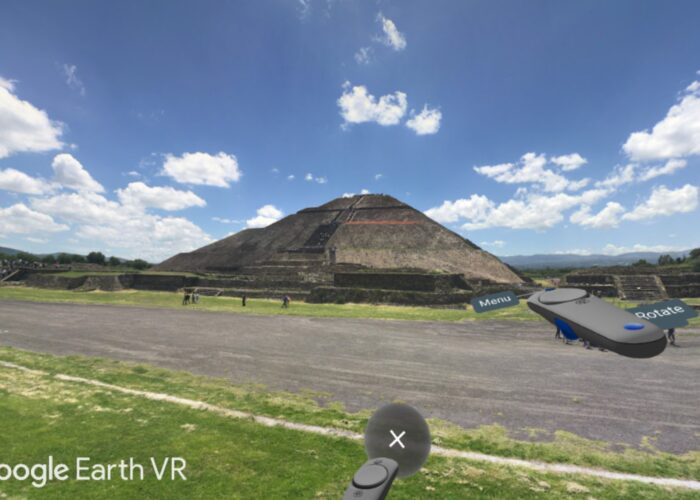
Figure 2. A demonstration of a student project in Google Earth VR highlighting significant landmarks.A virtual simulation of Teotihuacán. A user navigates to the Pyramid of the Moon and followed by the Pyramind of the Sun. The user enters a 360 degree photo of the base of the Pyramid of the Sun followed by another photo from the pyramid’s top. The user leaves the photos and conducts a brief birdseye view tour of the site.
Over the course of six weeks, the students and I explored a series of texts (primary and secondary sources) through class discussion that highlighted the central beliefs of various world religions and philosophies. With these texts in mind, I envisioned my students creating a virtual tour in which they guided their peers through the narrow streets of Jerusalem or along the treacherous path to the top of China’s sacred Mount Emei. After engaging with these foundational texts, the students then began a three-week period of research and development. For the unit’s capstone project, I curated a list of primary and secondary sources specifically for the project and asked the students to choose a topic based on the available texts. However, I also encouraged the students to think of additional locations and develop their own source lists if they were interested in a topic not represented. Ultimately, the students chose to research a wide variety of sites, including a pilgrim’s guide of the Chār Dhām, Ibn Battuta’s account of the Hajj, a travel guide to Renaissance Rome, and an archeological map of Teotihuacán (Venkatraman 1988; Gibb 2010; Gardiner and Nichols 1986; Millon 1973).
Figure 3. A screenshot of a student itinerary in Google Earth VR.
I then encouraged the students to create an itinerary of important locations that provided the relevant historical context. Students consulted secondary sources while keeping in mind a series of questions: What characteristics make/made these locations so meaningful to adherents? What insights do the texts provide that could not be gained from observing the space in VR? What characteristics of the structures, buildings, or natural features provide insights into the worldview being studied? The itinerary would operate as the script for the tour and be where the students cited their sources. I did not place a page limit on the itinerary; however, I suggested that the tour should be no longer than 35 minutes since we have 45-minute periods. Once they completed their itineraries, the students began practicing with the virtual reality system, learning how to manipulate the controllers and mapping their locations. Finally, the students then spent a few weeks giving their tours as groups. Each group consisted of four members, and the students alternated between the role of guide and operator. The guide would present the information from the itinerary while the operator helped their classmates view locations in VR. This ensured that each student had the opportunity to present and, more importantly for the students, spend time in virtual reality.
Figure 4. Students mapping their locations in Google Earth VR using an archeological map of Teotihuacán.
The students wrapped up the project with a critical reflection of their own work, their group’s dynamics, and the project as a whole. Overall, the students reported generally positive impressions of the project. When surveyed about their experience, the students commented that using VR helped them better conceptualize, in terms of scale and proximity, the locations that they toured as both a guide and an observer. Multiple students reported being better able to “visualize” the location that they guided their classmates or were guided through. In their survey responses, they expressed an improved ability to “visualize the important architectural aspects of various historical buildings,” develop “a better geographical understanding of what places looked like and how they look now,” and experience “certain ancient locations which otherwise could only be described by models or drawings.” The student feedback demonstrates a clear form of “lived learning” comparable to field trips and other types of experiential learning (Coughlin 2010). Although it cannot replace the experience of a field trip, using virtual reality may provide opportunities to experience locations that would otherwise be inaccessible to most students.
Figure 5. Students presenting their itineraries to their classmates.Students standing in front of a classroom of their peers. One student wears virtual reality equipment. Another students describes what the student in VR sees.
Despite the expressed student excitement about using a state-of-the-art VR system, there are some significant limitations to the use of virtual reality in the classroom. Some students voiced frustrations in their end-of-project reflections about learning to operate the controls while others experienced some minor motion sickness, which is not uncommon with VR. Perhaps, the largest limitation for using virtual reality is accessibility. The expense of purchasing a virtual reality-capable PC and a VR system would likely be cost prohibitive for many teachers. However, the project could be modified to be significantly less costly by integrating Google Cardboard headsets and the Google Tour Creator application. This would limit some of the immersive experience but still capture a significant portion of the experiential qualities that students found so appealing.
Overall, the project highlighted the pedagogical potential for virtual reality and other immersive technologies in the history classroom. Moving towards a more interactive mode of engagement allowed my students to analyze and synthesize sources in new and exciting ways. Despite its accessibility limitations, virtual reality allows students to engage in forms of “lived learning” that they might otherwise not be able to access. However, it is important to maintain an emphasis on the hard work of the historian and not become overly reliant on any new technology. When paired with traditional pedagogical practices, like primary source analysis, immersive technologies can be a useful educational tool. As virtual reality systems and the hardware required to run them become more affordable, virtual reality will likely become more ubiquitous in the classrooms.
Bibliography
Coughlin, Patricia K. 2010. “Making Field Trips Count: Collaborating for Meaningful Experiences.” Social Studies 101, no. 5 (August): 200–210.
Gardiner, Eileen, and Francis Morgan Nichols. 1986. The Marvels of Rome: Mirabilia Urbis Romae. New York: Italica Press.
Gibb, H.A.R. 2010. The Travels of Ibn Battuta, A.D. 1325–1354. Farnham, England: Ashgate.
Millon, René. 1973. The Teotihuacán Map. Austin: University of Texas Press.
Rogers, C.R., and H.J. Freiberg. 1994. Freedom to Learn. Columbus: Merrill/Macmillan.
Venkatraman, G. R. 1988. Chār Dhām Yātra: Ecstatic Flight into Himalayas. Bombay: Bharatiya Vidya Bhavan.
About the Author
Andrew Wilson holds a PhD in history from the University of Nebraska-Lincoln. He is currently a teaching associate at the University of Illinois at Urbana-Champaign’s University Laboratory High School and was named a Levenick iSEE Teaching Sustainability Fellow for 2020 by the Institute for Sustainability, Energy, and Environment (iSEE) at the University of Illinois Urbana-Champaign.
Virtual Reality Design has been co-taught annually at Vanderbilt University since 2017 by professors Bobby Bodenheimer (Computer Science) and Ole Molvig (History, Communications of Science and Technology). This paper discusses the pedagogical and logistical strategies employed during the creation, execution, and subsequent reorganization of this course through multiple offerings. This paper also demonstrates the methods and challenges of designing a team-based project course that is fundamentally structured around interdisciplinarity and group work.
Introduction
What is virtual reality? What can it do? What can’t it do? What is it good/bad for? These are some of the many questions we ask on the first day of our course, Virtual Reality Design (Virtual Reality for Interdisciplinary Applications from 2017–2018). Since 2017, professors Ole Molvig of the History Department and Bobby Bodenheimer of Computer Science and Electrical Engineering have been co-teaching this course annually to roughly 50 students at a time. With each offering of the course, we have significantly revamped our underlying pedagogical goals and strategies based upon student feedback, the learning literature, and our own experiences. What began as a course about virtual reality has become a course about interdisciplinary teamwork.
Both of those terms, interdisciplinarity and teamwork, have become deeply woven into our effort. While a computer scientist and a historian teach the course, up to ten faculty mentors from across the university participate as “clients.” The course counts toward the computer science major’s project-class requirement, but nearly half the enrolled students are not CS majors. Agile design and group mechanics require organizational and communication skills above all else. And the projects themselves, as shown below, vary widely in the topic and demands, requiring flexibility, creativity, programming, artistry, and most significantly, collaboration.
This focus on interdisciplinary teamwork, and not just in the classroom, has led to a significant, if unexpected, outcome: the crystallization of a substantial community of faculty and students engaging in virtual reality related research from a wealth of disciplinary viewpoints. Equipment purchased for the course remain active and available throughout campus. Teaching projects have grown into research questions and collaborations. A significant research cluster in digital cultural heritage was formed not as a result of, but in synergy with, the community of class mentors, instructors, and students.
Evolution of the Course
Prior to offering the joint course, both Bodenheimer (CS) and Molvig (History) had previously offered single-discipline VR based courses.
From the Computer Science side, Bodenheimer had taught a full three-credit course on virtual reality to computer science students. In lecture and pedagogy this course covered a fairly standard approach to the material for a one semester course, as laid out by the Burea and Coiffet textbook or the more recent (and applicable) Lavalle textbook (Lavalle 2017). Topically, the course covered such material as virtual reality hardware, displays, sensors, geometric modeling, three-dimensional transformations, stereoscopic viewing, visual perception, tracking, and the evaluation of virtual reality experiences. The goal of the course was to teach the computer science students to analyze, design, and develop a complex software system in response to a set of computing requirements and project specifications that included usability and networking. The course was also project-based with teams of students completing the projects. Thus it focused on collaborative learning, and teamwork skills were taught as part of the curriculum, since there is significant work that shows these skills are best taught and do not emerge spontaneously (Kozlowski and Ilgen 2006). This practice allowed a project of significant complexity to be designed and implemented over the course of the semester, giving a practical focus to most of the topics covered in the lectures.
From History, Molvig offered an additional one credit “lab course” option for students attached to a survey of The Scientific Revolution. This lab option offered students the opportunity to explore the creation of and meaning behind historically informed re-constructions or simulations. The lab gave students their first exposure to a nascent technology alongside a narrative context in which to guide their explorations. Simultaneous to this course offering, Vanderbilt was increasing its commitment to the digital humanities, and this course allowed both its instructor and students to study the contours of this discipline as well. While this first offering of a digital lab experience lacked the firm technical grounding and prior coding experience of the computer science offering, the shared topical focus (the scientific revolution) made for boldly creative and ambitious projects within a given conceptual space.
Centering Interdisciplinarity
Unlike Bodenheimer, Molvig did not have a career-long commitment to the study of virtual reality. Molvig’s interest in VR comes rather from a science studies approach to emergent technology. And in 2016, VR was one of the highest profile and most accessible emergent technologies (alongside others such as artificial intelligence, machine learning, CRISPR, blockchain, etc). For Molvig, emergent technologies can be pithily described as those technologies that are about to go mainstream, that many people think are likely to be of great significance, but no one is completely certain when, for whom, how, or really even if, this will happen.
For VR then, in an academic setting, these questions look like this: Which fields is VR best suited for? Up to that point, it was reasonably common in computer science and psychology, and relatively rare elsewhere. How might VR be integrated into the teaching and research of other fields? How similar or dissimilar are the needs and challenges of these different disciplines pedagogical and research contexts?
Perhaps most importantly, how do we answer these questions? Our primary pedagogical approach crystallized around two fundamental questions:
How can virtual reality inform the teaching and research of discipline X?
How can discipline X inform the development of virtual reality experiences?
Our efforts to answer these questions led to the core feature that has defined our Virtual Reality Design course since its inception: interdisciplinarity. Rather than decide for whom VR is most relevant, we attempted to test it out as broadly as possible, in collaboration with as many scholars as possible.
Our course is co-taught by a computer scientist and a humanist. Furthermore, we invite faculty from across campus to serve as “clients,” each with a real-world, disciplinary specific problem toward which virtual reality may be applicable. While Molvig and Bodenheimer focused on both questions, our faculty mentors focused on question 1: is VR surgery simulation an effective tool? Can interactive, immersive 3D museums provide users new forms of engagement with cultural artifacts? How can VR and photogrammetry impact the availability of remote archeological sites? We will discuss select projects below, but as of our third offering of this course, we have had twenty-one different faculty serve as clients representing twelve different departments or schools, ranging from art history to pediatrics and chemistry to education. A full list of the twenty-four unique projects may be found in Appendix 1.
At the time of course planning, Vanderbilt began a program of University Courses, encouraging co-taught, cross disciplinary teaching experiments, incentivizing each with a small budget, which allowed us to purchase the hardware necessary to offer the course. One of our stated outcomes was to increase access to VR hardware, and we have intentionally housed the equipment purchased throughout campus. Currently, most available VR hardware available for campus use is the product of this course. Over time, purchases from our course have established 10 VR workstations across three different campus locations (Digital Humanities Center, The Wond’ry Innovation Center, and the School of Engineering Computer Lab). Our standard set up has been the Oculus Rift S paired with desktop PCs with minimum specs of 16GB RAM and 1080GTX GPUs.
As the design of the joint, team-taught and highly interdisciplinary course was envisioned, several course design questions presented themselves. In our first iteration of the course, a condensed and more accessible version of the computer science virtual reality class was lectured on. Thus Bodenheimer, the computer science instructor, lectured on most of the same topics he had lectured on but at a more general level, and focused on how the concepts were implemented in Unity, rather than from a more theoretical perspective that was present in the prior offering. Likewise, Molvig brought with him several tools of his discipline, a set of shared readings (such as the novel Ready Player One (Cline 2012)) and a response essay to the moral and social implications of VR. The class was even separated for two lectures, allowing Bodenheimer to lecture in more detail on C#, and Molvig to offer strategies on how to avoid C# entirely within Unity.
Subsequent offerings of the course, however, allowed us to abandon most of this structure, and to significantly revise the format. Our experience with how the projects and student teams worked and struggled led us to re-evaluate the format of the course. Best practices in teaching and learning recommend active, collaborative learning where students learn from their peers (Kuh et al. 2006). Thus, we adopted a structured format more conducive to teamwork, based on Agile (Pope-Ruark 2017). Agile is a framework and set of practices originally created for software development but which has much wider applicability today. It can be implemented as a structure in the classroom with a set of openly available tools that allow students to articulate, manage, and visualize a set of goals for a particular purpose, in our case, the creation of a virtual experience tailored to their clients specific research. The challenge for us, as instructors, was to develop methods to instrument properly the Agile methods so that the groups in our class can be evaluated on their use of them, and get feedback on them so that they can improve their practices. This challenge is ongoing. Agile methods are thus used in our class to help teams accomplish their collaborative goals and teach them teamwork practices.
Course Structure
We presume no prior experience with VR, the Unity3D engine, or C# for either the CS or non-CS students. Therefore the first third of the course is mainly focused on introducing those topics, primarily through lecture, demonstration, and a series of cumulative “daily challenges.” By the end of this first section of the course, all students are familiar with the common tools and practices, and capable of creating VR environments upon which they can act directly through the physics engine as well as in a predetermined, or scripted, manner. During the second third of the course, students begin working together on their group projects in earnest, while continuing to develop their skills through continued individual challenges, which culminate in an individual project due at the section’s end. For the second and third sections of the course, all group work incorporates aspects of the Agile method described above, with weekly in-class group standups, and a graded, bi-weekly sprint review, conducted before the entire class. The final section of the course is devoted entirely to the completion of the final group project, which culminates in an open “demo day” held during final examinations, which has proven quite popular.
Three-fifths of our students are upper level computer science students fulfilling a “project course” major requirement, while two-fifths of our students can be from any major except computer science. Each project team is composed of roughly five students with a similar overall ratio, and we tend to have about 50 students per offering. This distribution and size are enforced at registration because of the popularity of the CS major and demand for project courses in it. The typical CS student’s experience will involve at least three semesters of programming in Java and C++, but usually no knowledge of computer graphics or C#, the programming language used by Unity, our virtual reality platform. The non-CS students’ experience is more varied, but currently does not typically involve any coding experience. To construct the teams, we solicit bids from the students for their “top three” projects and “who they would like to work with.” The instructors then attempt to match students and teams so that everyone gets something that they want.
It is a fundamental assertion of this course that all members of a team so constructed can contribute meaningfully and substantially to the project. As it is perhaps obvious what the CS students contribute, it is important to understand what the non-CS students contribute. First, Unity is a sophisticated development platform that is quite usable, and, as mentioned, we spend significant course time teaching the class to use it. There is nothing to prevent someone from learning to code in C# using Unity. However, not everyone taking our class wants to be a coder, but they are interested in technology and using technical tools. Everyone can build models and design scenes in Unity. Also, these projects must be robust. Testing that incremental progress works and is integrated well into the whole project is key not only to the project’s success as a product, but also to the team’s grade. We also require that the teams produce documentation about their progress, and interact with their faculty mentor about design goals. These outward-facing aspects of the project are key to the project’s success and often done by the non-CS students. Each project also typically requires unique coding, and in our experience the best projects are one in which the students specialize into roles, as each project typically requires a significant amount of work. The Agile framework is key here, as it provides a structure for the roles and a way of tracking progress in each of them.
Since each project is varied, setting appropriate targets and evaluating progress at each review is one of the most significant ongoing challenges faced by the instructors.
Projects
A full list of the twenty-four projects may be found in Appendix 1.
Below are short descriptions and video walkthroughs of four distinctive projects that capture the depth, breadth, and originality fostered by our emphasis on interdisciplinarity in all aspects of the course design and teaching.
Example Project: Protein Modeling
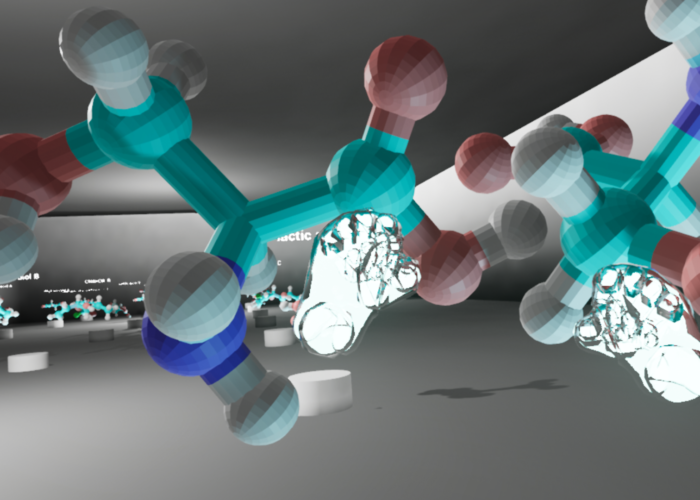
The motivation for this project, mentored by Chemistry Professor Jens Meiler, came from a problem common to structural chemistry: the inherent difficulty of visualizing 3D objects. For this prototype, we aimed to model how simple proteins and molecules composed of a few tens of atoms interact and “fit” together. In drug design and discovery, this issue is of critical importance and can require significant amounts of computation (Allison et al. 2014). These interactions are often dominated by short-range van der Waals forces, although determining the correct configuration for the proteins to bind is challenging. This project illustrated that difficulty by letting people explore binding proteins together. Two proteins were given in an immersive environment that were graspable, and users attempted to fit them together. As they fit together, a score showing how well they fit was displayed. This score was computed based on an energy function incorporating Van der Waals attractive and repulsive potentials. The goal was to get the minimum score possible. The proteins and the energy equation were provided by the project mentor, although the students implemented a Van der Waals simulator within Unity for this project. Figures 1 and 2 show examples from the immersive virtual environment. The critical features of this project worth noting are that the molecules are three-dimensional structures that are asymmetric. Viewing them with proper depth perception is necessary to get an idea of their true shape. It would be difficult to recreate this simulation with the same effectiveness using desktop displays and interactions.
While issues of efficiency and effectiveness in chemical pedagogy drove our mentor’s interest, the student creators and demo day users were drawn to this project for its elements of science communication and gamification. By providing a running “high score” and providing a timed element, users were motivated to interact with the objects and experience far longer than with a 2D or static 3D visualization. One student member of this group did possess subject matter familiarity which helped incorporate the energy function into the experience.
Figure 1. Two proteins shown within the simulation. The larger protein on the left is the target protein to which the smaller protein (right) should be properly fit. A menu containing the score is shown past the proteins. Proteins may be grabbed, moved, and rotated using the virtual reality controllers. Embedded video: Figure 1. Two proteins shown within the simulation. The larger protein on the left is the target protein to which the smaller protein (right) should be properly fit. A menu containing the score is shown past the proteins. Proteins may be grabbed, moved, and rotated using the virtual reality controllers.
Example Project: Vectors of Textual Movement in Medieval Cypress
Professor of French Lynn Ramey served as the mentor for this project. Unlike most other mentors, Prof. Ramey had a long history of using Unity3D and game technologies in both her research and teaching. Her goal in working with us was to recreate an existing prototype in virtual reality, and determine the added values of visual immersion and hand tracked interactivity. This project created a game that simulates how stories might change during transmission and retelling (Amer et al. 2018; Ramey et al. 2019). The crusader Kingdom of Cyprus served as a waypoint between East and West during the years 1192 to 1489. This game focuses on the early period and looks at how elements of stories from The Thousand and One Nights might have morphed and changed to please sensibilities and tastes of different audiences. In the game, the user tells stories to agents within the game, ideally gaining storytelling experience and learning the individual preferences of the agents. After gaining enough experience, the user can gain entry to the King’s palace and tell a story to the King, with the goal of impressing the King. During the game play, the user must journey through the Kingdom of Cyrus to find agents to tell stories to.
This project was very successful at showcasing the advantages of an interdisciplinary approach. Perhaps the project closest to a traditional video game, faculty and students both were constantly reminded of the interplay between technical and creative decisions. However, this was not simply an “adaption” of a finished cultural work into a new medium, but rather an active exploration of an open humanities research project asking how, why, when, and for whom are stories told. No student member of this group majored in the mentor’s discipline.
A video walkthrough of the game can be seen below.
Figure 2. Video walk-through of gameplay. Embedded video: Fig 2. Video walk-through of medieval storytelling project gameplay. Video shows gameplay in main screen, with small inset filming user in VR headset. Gameplay shows the goal and user interface by which players tell stories and explore medieval village. Scenes include a market, a castle, and a village environment.
Example Project: Interactive Geometry for K–8 Mathematical Visualization
In this project, Corey Brady, Professor of Education, challenged our students to take full advantage of the physical presence offered by virtual environments, and build an interactive space where children can directly experience “mathematical dimensionality.” Inspired by recent research (Kobiela et al. 2019; Brady et al. 2019) examining physical geometrical creation in two dimensions (think paint, brushes and squeegees), the students created a brightly lit and colored virtual room, where the user is initially presented with a single point in space. Via user input, the point can be stretched into a line, the line into a plane, and the plane into a solid (rectangles, cylinders, and prisms). While doing so, bar graph visualizations of length, width, height, surface area, and volume are updated in real-time while the user increases or decreases the object along its various axes.
Virtual Reality as an education tool has proven very popular, both amongst our students and in industry. No student member of this group specialized in education, but all members had of course first hand experience learning these concepts themselves as children. The opportunity to reimagine a nearly universal learning process was a significant draw for this project. After this course offering, Brady and Molvig have begun a collaboration to expand its utility.
A video demonstration of the project can be seen below.
Figure 3. User manipulates the x, y, and z axes of a rectangle. Real-time calculations of surface area and volume are shown in the background. Embedded video: Figure 3. Video demonstration of geometry visualization project gameplay. User manipulates the x, y, and z axes of a various shapes, including regular polygons and conic sections. Real-time calculations of surface area and volume are shown in the background.
Example Project: Re-digitizing Stereograms
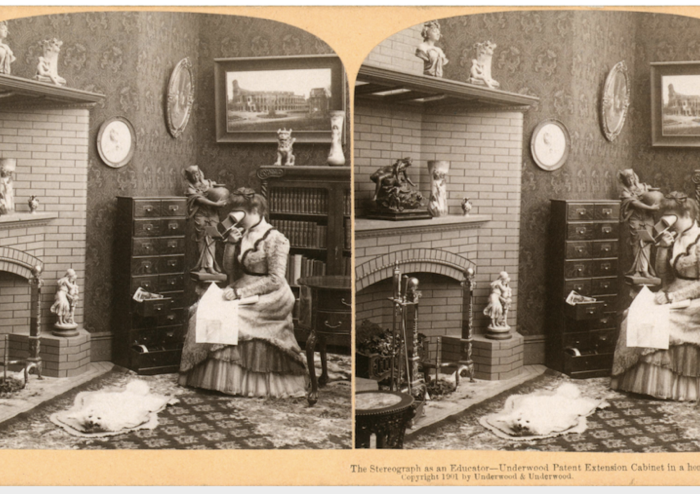
For this project, Molvig led a team to bring nineteenth-century stereographic images into 21st century technology. Invented by Charles Wheatstone in 1838 and later improved by David Brewster, stereograms are nearly identical paired photographs that when viewed through a binocular display, a single “3D image” [1] was perceived by the viewer, often with an effect of striking realism. For this reason, stereoscopy is often referred to as “Victorian VR.” Hundreds of thousands of scanned digitized stereo-pair photos exist in archives and online collections, however it is currently extremely difficult to view these as intended in stereoscopic 3D. Molvig’s goal was to create a generalizable stereogram viewer: capable of bringing stereopair images from remote archives for viewing within a modern VR headset.
Student interest quickly coalesced around two sets of remarkable stereoscopic anatomical atlases, the Edinburgh Stereoscopic Atlas of Anatomy (1905) and Bassett Collection of Stereoscopic Images of Human Anatomy from the Stanford Medical Library. Driven by student interest, the 2019 project branched into a VR alternative to wetlab or flat 2D medical anatomy imagery. This project remains ongoing, as is Molvig’s original generalized stereo viewer, which now includes a machine learning based algorithm to automated the import and segmentation of any stereopair photograph.
Two demonstrations of the stereoview player are below, the first for medical anatomy images, the second are stereophotos taken during the American Civil War. All images appear in stereoscopic depth when viewed in the headset.
Figure 4. Demonstration of anatomy stereoscopic viewer. Images from the Bassett Collection of Stereoscopic Images of Human Anatomy, Stanford Medical Library. Embedded video: Figure 4. Video demonstration of medical anatomy stereoscopic viewer project gameplay. User selects and relocates various stereoscopic images of cranial anatomy. Images from the Bassett Collection of Stereoscopic Images of Human Anatomy, Stanford Medical Library.Figure 5. Demonstration of Civil War stereoviews. Images from the Robert N. Dennis collection of stereoscopic views, New York Public Library Digital Collection. Embedded video: Figure 5. Video demonstration of Civil War stereoview project gameplay. User selects and and relocated various stereoscopic images taken during the American Civil War. Images depict scenes from battlefields, army encampments, and war material preparations. Images from the Robert N. Dennis collection of stereoscopic views, New York Public Library Digital Collection.
Challenges
This course has numerous challenges, both inside and outside of the classroom, and we have by no means solved them all.
Institutional
Securing support for co-teaching is not always easy. We began offering this course under a Provost level initiative to encourage ambitious teaching collaborations across disciplines. This initiative made it straightforward to count co-teaching efforts with our Deans, and provided some financial support for the needed hardware purchases. However, that initiative was for three course offerings, which we have now completed. Moving forward, we will need to negotiate our course with our Deans.
We rely heavily on invested Faculty Mentors to provide the best subject matter expertise. So far we have had no trouble finding volunteers, and the growing community of VR engaged faculty has been one of the greatest personal benefits, but as VR becomes less novel, we may experience a falloff in interest.
Interdisciplinarity
This is both the most rewarding and most challenging aspect of this course. Securing student buy-in on the value of interdisciplinary teamwork is our most consistent struggle. In particular, these issues arise around the uneven distribution of C# experience, and perceived notions of what type of work is “real” or “hard.” To mitigate these issues, we devote significant time during the first month of the course exposing everyone to all aspects of VR project development (technical and non-technical), and require the adoption of “roles” within each project to make responsibilities clear and workload distributed.
Cost
Virtual reality is a rapidly evolving field, with frequent hardware updates and changing requirements. We will need to secure new funding to significantly expand or update our current equipment.
Conclusions and Lessons Learned
Virtual reality technology is more accessible than ever, but it is not as accessible as one might wish in a pedagogical setting. It is difficult to create even moderately rich and sophisticated environments, without the development expertise gleaned through exposure to the computer science curriculum. A problem thus arises on two fronts. First, exposure to the computer science curriculum at the depth currently required to develop compelling virtual reality applications should ideally not be required of everyone. Unfortunately, the state of the art of our tools currently makes this necessary. Second, those who study computer science and virtual reality focus on building the tools and technology of virtual reality, the theories and algorithms integral to virtual reality, and the integration of these into effective virtual reality systems. Our class represents a compromise solution to the accessibility problem by changing the focus away from development of tools and technology toward collaboration and teamwork in service of building an application.
Our class is an introduction to virtual reality in the sense that students see the capability of modern commodity-level virtual reality equipment, software, and these limitations. They leave the class understanding what types of virtual worlds are easy to create, and what types of worlds are difficult to create. From the perspective of digital humanities, our course is a leveraged introduction to technology at the forefront of application to the humanities. Students are exposed to a humanities-centered approach to this technology through interaction with their project mentors.
In terms of the material that we, the instructors, focus most on in class, our class is about teamwork and problem-solving with people one has not chosen to work with. We present this latter skill as one essential to a college education, whether it comes from practical reasons, e.g., that is what students will be faced with in the workforce (Lingard & Barkataki 2013), or from theoretical perspectives on best ways to learn (Vygotsky 1978). The interdisciplinarity that is a core feature of the course is presented as a fact of the modern workforce. Successful interdisciplinary teams are able to communicate and coordinate effectively with one another, and we emphasize frameworks that allow these things to happen.
Within the broader Vanderbilt curriculum, the course satisfies different curricular requirements. For CS students, the course satisfies a requirement that they participate in a group design experience as part of their major requirements. The interdisciplinary nature of the group is not a major requirement, but is viewed as an advantage, since it is likely that most CS majors will be part of interdisciplinary teams during their future careers. For non-CS students, the course currently satisfies the requirements of the Communication of Science and Technology major and minor.[2]
Over the three iterations of this course, we have learned that team teaching an interdisciplinary project course is not trivial. In particular, it requires more effort than each professor lecturing on their own specialty, and expecting effective learning to emerge from the two different streams. That expectation was closer to what we did in the first offering of this course, where we quickly perceived that this practice was not the most engaging format for the students, nor was it the most effective pedagogy for what we wanted to accomplish. The essence of the course is on creating teams to use mostly accessible technology to create engaging virtual worlds. We have reorganized our lecture and pedagogical practices to support this core. In doing this, each of us brings to the class our own knowledge and expertise on how best to accomplish that goal, and thus the students experience something closer to two views on the same problem. While we are iteratively refining this approach, we believe it is more successful.
Agile methods (Pope-Ruark 2017) have become an essential part of our course. They allow us to better judge the progress of the projects and determine where bottlenecks are occurring more quickly. They incentivize students to work consistently on the project over the course of the semester rather than trying to build everything at the end in a mad rush of effort. By requiring students to mark their progress on burn down charts, the students have a better visualization of the task remaining to be accomplished. Project boards associated with Agile can provide insight into the relative distribution of work that is occurring in the group, ideally allowing us to influence group dynamics before serious tensions arise.
This latter effort is a work in progress, however. A limitation of the course as it currently exists is that we need to do a better job evaluating teams (Hughes & Jones 2011). Currently our student evaluations rely too heavily on the final outcome of the project and not enough on the effectiveness of the teamwork within the team. Evaluating teamwork, however, has seemed cumbersome, and the best way to give meaningful feedback to improve teamwork practices is something we are still exploring. If we improved this practice, we could give students more refined feedback throughout the semester on their individual and group performance, and use that as a springboard to teach better team practices. Better team practices would likely result in increased quality of the final projects.
Notes
[1] These images are not truly three dimensional, as they cannot be rotated or peered behind. Rather two images are created precisely to fool the brain into adding a perception of depth into a single combined image. [2]https://as.vanderbilt.edu/cst/. There is currently no digital humanities major or minor at Vanderbilt.
References
Allison, Brittany, Steven Combs, Sam DeLuca, Gordon Lemmon, Laura Mizoue, and Jens Meiler. 2014. “Computational Design of Protein–Small Molecule Interfaces.” Journal of Structural Biology 185, no. 2: 193–202.
Amer, Sahar, and Lynn Ramey. 2018. “Teaching the Global Middle Ages with Technology.” Parergon: Journal of the Australian and New Zealand Association for Medieval and Early Modern Studies 35: 179–91.
Cline, Ernest. 2012. Ready Player One. New York: Broadway Books.
Hughes, Richard L., and Steven K. Jones. 2011. “Developing and assessing college student teamwork skills.“ New Directions for Institutional Research 149: 53–64.
Kobiela, Marta, and Richard Lehrer. 2019. “Supporting Dynamic Conceptions of Area and its Measure.” Mathematical Thinking and Learning: 1–29.
Kozlowski, Steve W.J., and Daniel R. Ilgen. 2006. “Enhancing the Effectiveness of Work Groups and Teams.” Psychological Science in the Public Interest 7, no.3: 77–124.
Kuh, George D., Jillian Kinzie, Jennifer A. Buckley, Brian K. Bridges, and John C. Hayek. 2006. What Matters to Student Success: A Review of the Literature. Vol. 8. Washington, DC: National Postsecondary Education Cooperative.
LaValle, Steve 2017. Virtual Reality. Cambridge, UK: Cambridge University Press.
Lingard, Robert, and Shan Barkataki 2011. “Teaching Teamwork in Engineering and Computer Science.” 2011 Frontiers in Education Conference. Institute of Electrical and Electronics Engineers.
Pope-Ruark, Rebecca. 2017. Agile Faculty: Practical Strategies for Managing Research, Service, and Teaching. Chicago: University of Chicago Press.
Ramey, Lynn, David Neville, Sahar Amer, et al. 2019. “Revisioning the Global Middle Ages: Immersive Environments for Teaching Medieval Languages and Culture.” Digital Philology 8: 86–104.
Takala, Tuukka M., Lauri Malmi, Roberto Pugliese, and Tapio Takala. 2016. “Empowering students to create better virtual reality applications: A longitudinal study of a VR capstone course.” Informatics in Education 15, no. 2: 287–317.
Zimmerman, Guy W., and Dena E. Eber. 2001. “When worlds collide!: an interdisciplinary course in virtual-reality art.” ACM SIGCSE Bulletin 33, no. 1.
Appendix 1: Complete Project List
Project Title (Mentor, Field, Year(s))
Aristotelian Physics Simulation (Molvig, History of Science, 2017, 2018).
Peripersonal Space (Bodenheimer, Computer Science, 2019).
Solar System Simulation (Weintraub, Astronomy, 2019).
Accessing Stereograms (Molvig, History, 2019).
About the Authors
Ole Molvig is an assistant professor in the Department of History and the Program in Communication of Science and Technology. He explores the interactions among science, technology, and culture from 16th-century cosmology to modern emergent technologies like virtual reality or artificial intelligence. He received his Ph.D. in the History of Science from Princeton University.
Bobby Bodenheimer is a professor in the Department of Electrical Engineering and Computer Science at Vanderbilt University. He also holds an appointment in the Department of Psychology and Human Development. His research examines virtual and augmented reality, specifically how people act, perceive, locomote, and navigate in virtual and augmented environments. He is the recipient of an NSF CAREER award and received his Ph.D. from the California Institute of Technology.
Tracy Dorrington-Skinner, Victims of Institutional Childhood Exploitation Society (VOICES)
Gerald Morrison, Victims of Institutional Childhood Exploitation Society (VOICES)
Tony Smith, Victims of Institutional Childhood Exploitation Society (VOICES)
and
The DOHR Team
Abstract
Relational presence is the core principle of a new approach to designing virtual learning environments (VLEs), which has been developed by the Digital Oral Histories for Reconciliation (DOHR) project (dohr.ca). Presence, normally understood as the sense of being in a virtual environment to the extent that one forgets the environment is virtual, is thought to have significant pedagogical benefits in K–12 experiential learning projects aiming to develop spatial and social competencies that learners can translate into actual-world contexts. DOHR, by contrast, aims to build the understanding needed for learners to address systemic racism in Nova Scotia, through an oral history and restorative justice–based curriculum. To serve this alternative learning goal, relational presence replaces presence. The usual emphasis in VLE design on simulation, interactivity, identity construction, agency, and satisfaction is replaced with new values of impression, witnessing, self-awareness and awareness of difference, interpretation and inquiry, and affective dissonance. This paper introduces relational presence in order to help establish, in the field of VLE design, a productive discourse around issues of justice, representation of marginalized communities, and pedagogy-led design.
Introduction
This article introduces relational presence, the core principle of a new approach to designing virtual learning environments (VLEs) that has been developed by the Digital Oral Histories for Reconciliation (DOHR) project (dohr.ca). DOHR has worked in partnership with the Nova Scotia Home for Colored Children Restorative Inquiry (restorativeinquiry.ca). The Restorative Inquiry was a four-year, provincially-mandated public inquiry into the history and legacy of the Nova Scotia Home for Colored Children (NSHCC), including the lived experiences of its residents. The Home was a segregated care institution for African Nova Scotian children that operated in Dartmouth, Nova Scotia from 1921 until the early 2000s. Established to meet the care needs of African Nova Scotian children, the Home was a site of significant abuse and harm for many of its residents. Over the decades of its operations, former residents experienced neglect and abuse (Province of Nova Scotia 2019, 153–172). The Restorative Inquiry was established to examine the experience of the Nova Scotia Home for Colored Children in relation to systemic and institutionalized racism, both historic and current, in Nova Scotia. In order to “contribute to the goal of social change to end the harmful legacy of abuse and ensure the conditions, context and causes that contributed to it are not repeated” (Province of Nova Scotia 2015, 4–5), among its goals the Inquiry aimed to:
(a) Empower those involved in, and affected by, the history and legacy of the NSHCC to learn about what happened and the contexts, causes, circumstances and ongoing legacy of the harms related to the NSHCC.
(b) Educate the public about the history and legacy of the NSHCC.
(c) Publicly share the truth and understanding established through the RI and the actions taken, planned, and recommended to address systemic and institutionalized racism and build more just relationships for the future (Province of Nova Scotia 2019, 23).
The DOHR project was an important mechanism through which the Inquiry pursued this part of its mandate (Province of Nova Scotia 2019, 504–505). The DOHR project has brought former residents of the Home, representatives of the Nova Scotia education system, and members of the Inquiry’s Council of Parties together with artists and researchers from seven universities across Canada (Waterloo, Dalhousie, New Brunswick, McGill, Ottawa, Alberta, and British Columbia) to develop a two-week grade eleven Canadian History curriculum unit that supports students in learning about the historical harms experienced by former residents of the Home. In this way, it has served to support the mandate of education and the broader goal of moving toward reconciliation by building the understanding needed to address systemic racism in Nova Scotia.
DOHR is thus a community-driven project. It arises from a need articulated by a community and works to co-create the project with community members. This community mandate is central to the need for designing relational presence in the virtual reality (VR) experience. The Restorative Inquiry, from which the DOHR project was created, pursued a restorative vision of justice that was reflective of a relational worldview focused on connectedness. It sought justice in the form of just relations between individuals, groups, communities, and at the level of institutions and systems (Llewellyn 2011). As a restorative process, the Inquiry was “future focused, yet concerned with getting a comprehensive understanding of the past in order to know how to move forward toward a just future” (Province of Nova Scotia 2019, 26). It focused on learning about past harms in order to build more just relations going forward. This is, in simplistic terms, the impetus for a restorative approach to learning in the DOHR curriculum. A restorative approach, as DOHR members Jennifer Llewellyn and Kristina Llewellyn have articulated, is grounded in relational theory. Relational theory holds that human beings exist in and through relationship with one another (Llewellyn, J. 2011; Llewellyn and Llewellyn 2015). The DOHR project reflects the premise that relationality is at the core of learning about such difficult knowledge as systemic racism in the Home and its legacy. Learning requires attention to the fact that we exist in and through relations, and this fact has implications for justice. Recognizing the relational nature of the historical harms of the Home, requires that learners listen to the lived experiences of former residents.
The DOHR project therefore co-created, as part of its curriculum, a placed-based oral history experience in virtual reality, with three former residents—Gerry Morrison, Tony Smith, and Tracy Dorrington-Skinner—who are recognized leaders and activists in the community.[1] Scholars have demonstrated the many ways that oral history in education, both in conducting interviews and in listening to pre-recorded interviews, builds relational connections that are intergenerational and support reconciliation across divides (Llewellyn and Ng-A-Fook 2017; 2019). Unlike other oral history projects in schools, however, the DOHR project required that learners listen to stories in a contextual way that would connect them to a sense of place and the human experience of it—specifically, to the Home. Yet the DOHR team knew that former residents could not, nor should they be expected to, share their stories in-person with all students. The DOHR team also knew that not all students could visit the site of the Home and, even if it were possible, the site of the Home itself has changed significantly over the decades. While part of the Home’s building still stands, its present structure is considerably different from the structures in which the former residents lived (Morrison from 1954–60, Smith from 1965–68, and Dorrington-Skinner, who lived in the original Home building from 1972–78, and in the newer building now known as the Akoma Family Centre from 1978–84). Indeed, since early 2019, the site of the Old Home has been undergoing yet another phase of major renovations (see Figure 1). Since students cannot interact with the former residents or the site of the Home directly, the DOHR curriculum exemplifies the kind of experiential learning that is consistently identified in the VLE literature as likely to benefit from a virtual learning environment (VLE), and ideally one that is VR-based. DOHR wants to deliver experiential “learning tasks which are expensive” (Dalgarno and Lee 2010, 19) or even “impossible” (Bulu 2012, 153; Kwon 2019, 105) in real life. In order to provoke new, relational understandings of the Home and of systemic racism, which are further supported in the fuller DOHR curriculum, the former residents’ oral histories are shared in DOHR’s VR-based VLE.
Figure 1. At top left, the original Nova Scotia Home for Colored Children (the “Old Home”) on the occasion of its official opening in June 1921. Top right, a large brick extension was added in 1961. Bottom left, the “New Home” building built in 1978 (now the site of the Akoma Family Centre). At bottom right, the Old Home as it appeared during the DOHR research team’s site visit in April 2019. (For further details see Chapter 3 of the Restorative Inquiry Report [Province of Nova Scotia 2019].)
However, DOHR has taken an unusual approach to the design of its VR-based VLE, because the learning outcomes that the DOHR project fosters—grounded in the commitment to restorative justice which seeks to foster just relations (Llewellyn 2011; Llewellyn and Llewellyn 2015)—are unusual in the context of VR-based VLE design. Specifically, we have developed a different approach to presence, which is broadly understood to be the element of VR design that contributes most to student learning in VLEs, and is hence the principal design aim of most VLE projects. Presence is the sense of “being there” (Slater and Wilbur 1997) in a virtual experience or “the psychological state where virtual experiences feel authentic” (McCreery, Schrader, Krach, and Boone 2013, 1635). Outside of the context of VLE design for experiential education, virtual environments have been designed with quite different aims. The digital humanities, for example, has emphasized the use of virtual reconstruction in research contexts as “not a neutral representation of ‘the past,’ but the scholar’s interpretation of specific aspects of a place at a certain time—an interpretation that can be challenged, revised, or rejected” (Sullivan, Nieves, and Snyder 2017, 301; emphasis original). Since the goal of creating a virtual environment in the digital humanities has been to make an argument and provide the locus for future argumentation (Sullivan, Nieves, and Snyder 2017, 301; see Roberts-Smith et al. 2016; Roberts-Smith 2017), attention has been paid to VLE design that encourages critical creativity rather than presence (Roberts-Smith et al. 2013). There is also some very recent, parallel work in VR design for K–12 education exploring the ways students productively fill in the gaps in imperfect historical simulations without compromising their sense of historicity (Papanastasiou et al. 2019). By contrast, in what has come to be known as “immersive journalism” (de la Peña et al. 2010; Reis and Coelho 2018), the use of 360º video to place the viewer in the “center” of a documented event is designed not to help participants learn to do anything specific, but to encourage them to empathize with victims of injustices (see for example Torsei and Philippe 2019). To date, however, neither these alternative approaches to virtual environment design nor their critiques (e.g. Reis and Coelho 2018; Mabrook and Singer 2019) are well integrated into the discourse around VLE design for experiential education. Similarly, 3D graphical approaches to the representation of marginalized communities remain under-interrogated in the VLE design literature, despite some robust work in this area emerging from game studies (e.g. Reis and Coelho 2018; Malkowski, Russwork, and Trea 2017; Taylor and Voorhees 2018).
Our aim for the DOHR project and this paper is to broaden the conversation about VLE design—which has largely followed technology- and psychology-driven lines of thought originating in the early 1990s[2]—to accommodate issues that have arisen more recently in fields outside of VLE design, through a discussion of the DOHR VLE. Since perspectives on how to achieve presence in VLEs, and why such presence is effective, are quite dispersed even in the VLE literature, we begin our discussion here with a synthesis of the most influential concepts. We then provide a description of the DOHR VR experience, and a discussion of how it approaches presence differently, consistent with the relational principles of a restorative approach. In conclusion, we offer some preliminary reflections on the DOHR VR experience’s effectiveness as a learning tool and suggest next steps for future development.
Presence and Learner Engagement in VLE Design for Experiential Learning
VR-based VLEs are most commonly designed to help learners (whether in school contexts or in public education contexts) to develop either spatial or social competencies that are impractical and/or dangerous to teach, especially at introductory levels, in the actual world. Widely-publicized examples include VR-based small motor-skill training for surgeons, in which learners use physical surgical instruments as controllers of avatars of the same instruments, to perform virtual surgeries on digitally-simulated bodies; such systems are increasingly used not just to train new surgeons but also to refresh the skills of practicing surgeons before performing actual-world surgeries (as in Surgical Science’s VR training system for laproscopy and endoscopy). In socially oriented VLEs, students typically learn how to avoid or respond positively to harmful behaviors, such as racial stereotyping, by rehearsing actions in virtually simulated scenarios (as in Kaplana’s 2015 Injustice); or how to develop empathy for the suffering of others by experiencing a simulation of their hardships (as in Kors et al.’s 2016 A Breathtaking Journey). Since the expectation in both kinds of VLE is that students will be able to transfer competencies developed in virtual reality into actual-world situations, these VLEs strive to simulate real-world experiences as vividly and accurately as possible, often incorporating actual-world material objects as well as virtual simulations, such as the surgical instruments used by Surgical Science. Kwon (2019) argues that immersive VLEs are especially relevant to the first stage of Kolb’s (1984) model of the four circulative processes of experiential learning, “concrete experience,” which could be followed by “reflective observation, abstract conceptualization, and active experimentation” in the classroom.[3]
There is general agreement in the literature on VLE design for experiential learning that the closer a simulated experience is to an actual-world experience, the better it functions as a replacement for real-world experience. When a simulation is effective, it produces in the participant the feeling referred to as “telepresence,” which is usually abbreviated to “presence”: “the psychological state where virtual experiences feel authentic” (McCreery, Schrader, Krach, and Boone 2013, 1635). If a technologically mediated experience is effective in generating the sense of presence, the perception of the person experiencing it “fails to accurately acknowledge the role of the technology in the experience” (International Society of Presence Research). In other words: it is generally accepted in the field that if a VR experience is effective in generating presence, the participant forgets they have a VR headset on, and instead feels like they are “there” in the illusion the headset is creating. In education, this experience of forgetting you are in a VLE has been seen as an advantage for experiential learning. Since experiential learning is thought to have been achieved when virtual experience is recognized as similar to an actual experience, “enhanced presence” is an ambition of VR-based VLE design (Kwon 2019, 105).
The sense of presence in VR-based VLE design is often understood to arise from immersive hardware systems (Fowler 2015, 416). Immersion here is understood as the “degree to which a virtual environment submerges the perceptual system of the user in computer-generated stimuli” (Biocca and Delaney 1995). In this understanding, the perceptual system is submerged physically, by the technical hardware employed to create the illusion of the virtual environment. For example, we might think of a VR headset as more immersive than a desktop computer screen, because it excludes the perception of visual stimuli that are not part of the virtual illusion (Dalgarno and Lee 2010, 11). However, as the examples of Surgical Science and Injustice demonstrate, hardware alone is not the greatest determiner of perceptual submersion in immersive systems (Archer and Finger 2018); rather, perceptual submersion is achieved by the degree to which a virtual illusion explicitly mimics the actual world. Although there is no consensus in the literature on the most effective design practices for achieving presence in VR-based VLEs, three design factors are regularly identified as having a significant ability to increase perceptual submersion: representational fidelity (the degree to which a virtual illusion looks or sounds like reality), interactivity (the degree to which the virtual illusion responds realistically to the embodied actions of a spectator), and identity construction (the degree to which spectators can associate themselves with characters represented in the virtual environment).[4] These factors are normally differentiated from one another in the literature, but are also understood to be interdependent in ways that are not yet consistently articulated.
Representational fidelity, for example, is often understood to be achieved by one or more of the following four factors:
(a) The vividness, or “abundance of reenactment … providing information to the senses” (Kwon 2019, 102; see Steuer 1992). On a sliding scale, at the low end of what VR systems can deliver, only the sense of sight is engaged; in more sophisticated systems, hearing is engaged; then at the cutting edge of what is currently possible, touch is manipulated. Taste and smell remain beyond the capacity of existing virtual systems, available only in “actual reality” (see Figure 3).
(b) The realism of the virtual illusion (Bessa, Melo, Sousa, and Vasconcelos-Raposo 2018, 35; Bulu 2012, 156), including its three-dimensionality (Bulu 2012, 154; Dalgarno and Lee 2010, 11); the ways in which it represents users (Fowler 2015, 413); and “the consistency of object behaviour” (Fowler 2015, 413; see Dalgarno and Lee 2010).
(c) The plausibility and dynamics of the virtual environment, including such technical effects as reflecting mirrors or shadows (Sanchez-Vives and Slater 2005).
(d) The “quality of the display, with high-fidelity displays being most realistic or photorealistic” (Fowler 2015, 413; see Dalgarno and Lee 2010). In other words, the sophistication of the equipment used to deliver a VR experience.
Similarly, interactivity is often understood to be achieved by one or more of the following:
(a) The range of embodied actions available to the VR participant (Dalgarno and Lee 2010; Kwon 2019); in other words: the degree to which a participant can use their body in the ways they would in actual reality, by touching, speaking, or moving around, for example.
(b) The degree to which the virtual illusion responds to the participant’s actions (Murray 1997; Dalgarno and Lee 2010; Kwon 2019), when, for example, objects move or other avatars engage in conversation.
(c) The degree to which the participant can create new elements of the virtual illusion (Dalgarno and Lee 2010; Kwon 2019).
(d) The technical ability of the system to respond to action through, for example, head-tracking (Sanches-Vives and Slater 2005) or update rate (Barfield and Hendrix 1995, 3).
However, the first of the four principles thought to contribute to representational fidelity is also sometimes treated independently as a factor that interacts with interactivity to increase a virtual illusion’s ability to simulate reality. Kwon, for example, sees VR-based VLEs that leverage the sense of touch and enable a wide range of bodily gestures as more “authentic” in the sense that they provide a more vivid experience closer to actual reality (see Figure 2). VR that is “authentic” in this way is particularly good at generating a sense of “place illusion” or “place presence” (Bulu 2012), the sensation of being and operating at a remote or virtual place (Slater 2009), or “being there” in the place depicted by the virtual display (Slater and Wilbur 1997). Hence “place presence” is often a design goal of VLEs whose intended learning outcomes include spatial competencies that can be translated to actual-world scenarios (such as, for example, Surgical Science).
Figure 2. “Relationship between virtual reality and actual reality based on the degree of presence” (Kwon 2019, Figure 2).[5]
The third major design factor, identity construction, by comparison, is often understood to be an outcome of the first two, representational fidelity and interactivity (see Figure 3). Identity construction normally refers to the sense of personal “body ownership” (Slater 2009) that learners develop by associating themselves with a manipulable avatar in a virtual environment (Bulu 2012, 154; Fowler 2015, 414). It can also refer to a learner’s ability to construct identities for other player-participants through their respective avatars (Fowler 2015, 414; Bulu 2012, 155; Biocca et al. 2003; Schroeder 2002). Identity construction is often leveraged in educational contexts to help generate a sense of “co-presence”, or “being there together” (Fowler 2015, 414) in a virtual environment. Co-presence has two dimensions: “perceiving others and having a sense or feeling that others [are] actively perceiving us and being part of a group” (Goffman 1963; Slater, Sadagic, Usoh, and Schroeder 2000). Co-presence is normally understood to involve a sense that there is “psychological interaction” among individuals (Nowak 2001; Schroeder 2002; Bulu 2012, 155). As a result, identity construction is often a design goal of VLEs whose intended learning outcomes include social competencies that can be translated to actual-world scenarios (such as Injustice).
Figure 3. Dalgarno and Lee’s elaborated model of learning in a 3D VLE (Dalgarno and Lee 2010, Figure 1).
In general, however, whether designed for spatial or social learning tasks, presence is thought to have three major pedagogical benefits for learners. First, presence helps students focus on the learning tasks they are encountering in a VLE, developing a task-oriented “flow.” When students experience “flow”—the term used in the literature to describe “the state of being absorbed by an activity” (Scoresby and Shelton 2011, 227), which “mediates the relationship between presence and enjoyment” (Weibel, Wissmath, et al. 2008, 2274)—they learn better (Kwon 2019; see Figure 4).
Figure 4. Influence relations among vividness, tactile interactivity, locomotive interactivity, simulator sickness, presence, flow, and learning effect (Kwon 2019, Figure 8). Note that simulator sickness is a counter-indicator of flow here.
Second, presence helps create the sense of agency that learners need to have in order for learning to be experiential. Triberti and Riva, for example, describe presence as “a core neuropsychological phenomenon whose goal is to produce a sense of agency and control: I am present in a real or virtual space if I manage to put my intentions into action (enacting them)” (2016, 2). As Janet Murray puts it, agency is “the satisfying power to take meaningful action” (1997). The third benefit, which arises from the first and second, is that presence is also frequently associated with students’ satisfaction with their own learning (e.g. Bulu 2012). Student satisfaction is a measure frequently used to determine the effectiveness of a virtual learning activity (see Kwon 2019, for example).
If we were to extract the best practices for VR-based VLE design from the literature survey above, we might end up with something like: Make a high-fidelity simulation of the relevant actual-world environment; give learners a way of affecting the virtual learning environment and make the environment respond; and provide representations of learners themselves in the world. Thanks to the resulting sense of agency they will then feel, learners will forget they are in a virtual environment, getting into a flow where they are totally focused on their learning tasks. The outcome will be that they learn effectively and feel satisfied with their learning experience. According to the current state of the VLE literature, then, in an effective VR-based VLE a learner perceives themselves acting in a simulation and perceives the simulation responding; the resulting agency, presence, and flow lead to learning and satisfaction. While the literature describes best practices for VLE design to support the kinds of spatial and social learning outcomes commonly intended in experiential learning curricula, it does not support the DOHR curriculum’s intended learning outcomes.
Designing Presence in the DOHR VR Experience
The DOHR VR experience is a thirteen- to fifteen-minute individual learning activity that is embedded early in a five-lesson curriculum designed to run, typically, over the course of ten history classes. The VR experience was designed to support learning activities outside of the VLE that are constructed based on the principles of historical thinking and oral history education, and on a restorative approach to learning (Llewellyn and Llewellyn 2015; Llewellyn and Ng-A-Fook 2017; 2019; see also Gibson and Case 2019; Epstein and Peck 2019; and the Historical Thinking Project). The first two lessons invite students to join the former residents in their decades-long journey to bring their stories of the Home to light in order to build a better future. Students are introduced to a brief history of the Home and then asked to actively inquire about the historical significance, causes, and consequences of the Home. Their engagement in this inquiry is centered on an examination of oral history as a primary source in itself and in relation to other primary historical evidence (such as social worker reports, newspaper articles, and photographs). The lessons culminate with students developing a “restorative plan” that asks them, among other aims, to share what they have learned in a way that will do justice to the historical experiences of the former residents and contribute to the future-focused goal of reconciliation.
In the third lesson, learners are on-boarded in small groups to the DOHR VR experience in person, by a trained facilitator, at individual stations. The facilitator advises students how to end the experience if they find its content distressing. The facilitator leads a short “sharing circle” (a key activity in a restorative approach to learning) to debrief about the experience afterwards. The VR experience itself begins with a short, documentary-like 360º video segment in which learners see the storytellers, Smith, Morrison, and Dorrington-Skinner, and hear their voices in voiceover. The introduction of the storytellers is followed by a set of oral histories rendered in a multi-modal blend of 3D graphics, 360º and 2D video, 2D images, environmental and spatially-located sound, voiceover narrative, and text. There are 12 stories in total, but each learner can only choose to witness three, one from each storyteller. Following those three stories, all learners witness a short sequence in which the three storytellers reflect together about their memories of one common room in the Home. Finally, learners witness another 360º, documentary-like video for a concluding sequence in which the storytellers describe directly (that is, without the use of voiceover) how they came to be the activists they are today.
From its inception, then, the challenge for the DOHR team in developing the VR experience has been that it is intended for a different kind of use-case than other VR-based VLE projects. DOHR is a project that seeks for students to build a relational understanding of the historical harm of the Home by hearing the oral histories of former residents. The intent of the curriculum is for students to ask: What relationship do they have to, and thus what responsibility do they have to address, the history of harm, based on systemic racism, that is the legacy of the Nova Scotia Home for Colored Children? The aim of the curriculum, including the VR experience, is for students to build a sense of relationship to the lived experience of a place, even though they will never likely be in the actual Home nor meet the former residents in person. This means, in part, that a traditional sense of place presence in the VR experience is not important, since spatial awareness and spatial skills are not primary learning outcomes. Similarly, traditional social presence is not useful, since our aim is not to help students practice social behaviors in a virtual environment so that they can adopt them more confidently or consistently in the real world. What we need students to do is to consider their stance in relation to the stories of the former residents in order to inform their understanding and efforts toward just relations with those whose lived experiences are different from their own. In other words, instead of generating a sense of presence as it is traditionally understood, where a virtual experience feels like an experience that could be replicated in the real world, we need students to remember that they are witnessing a story being told through the perspective of another person, which they could never experience themselves in the real world. The term we are using to describe this form of presence is relational presence.
Relational presence has had several concrete implications for the design of the DOHR VR experience. Since we need to help foster an understanding of what it was like to live in the Home, for different people at different times, we are not invested in representational fidelity in the way that other projects are. Although we have worked extensively with architectural drawings, photographs, and other archival and archaeological evidence of the past structure of its site and buildings, in our renderings, we express the Home in a multi-modal, impressionist aesthetic that reinforces the former residents’ oral histories. Most stories, for example, begin in a line-drawn, white-on-blue rendering of the site of the Home that is intended to evoke a three-dimensional version of the architectural drawings used to structure 3D space at each point in the narrative. The invocation of the documentary record only becomes substantial—opaque 3D graphics, 360º video, light, and environmental sounds helping to establish a more specific impression of place, time, mood, and activities—as the voice of the storyteller (the sound that appears closest to a participant’s ear) begins to recount the story. The representational media are in turn combined in ways that neither attempt to mask the differences among them, nor their individual differences from the actual-world phenomena they evoke. Our aim is to privilege lived experience over the fragmentary documentary record, making it clear that the world learners are encountering is not an attempt to reconstruct the past through simulation. Instead, it is an attempt to construct a present encounter with oral histories about past experiences in the Home and the long-term impacts of those experiences. In contrast to the traditionally sought sense of “place presence”, then, the DOHR VR experience seeks to foster a sense of what we are calling “relational place.” Relational place is an invocation of what a place means—in the case of the DOHR VR experience, what it means for storytellers and learners—rather than a simulation of how a place looked or was configured at any given point time (see Figure 5).
Figure 5. Screen captures showing three different approaches to multi-modal impressionist rendering in excerpts from Morrison’s story, “Swamp Water” (top left); Dorrington-Skinner’s story, “Mrs. Johnson’s Helper” (top right); and Smith’s story, “The Switch” (bottom). See Roberts-Smith et al. 2019.
Since learners need to maintain a sense of the difference between their own perspectives and the perspectives they are learning about, we are, similarly, not invested in identity construction in the sense of the identification of self or others with avatars to enhance social presence as it is understood in the VLE literature. Rather, we seek to support in students the development of a sense of relation to the stories rendered in our VR experiences and the storytellers from their own position and perspective. The VR experience does not create the illusion that the storytellers are really “there” with learners in the virtual environment. This means there are no anthropomorphic avatars in our VLE, and we make no attempt to create roles or characters for the storytellers or for learners to “play.” Learners are characterized by means of an avatar that is a literal representation of the story-selection controller held in the learner’s hand—the only avatar in the entire build—only as the force that uses the controller to select a story. Instead of creating virtual representations of either storyteller or student, we make space for each to occupy their own, actual-world perspectives. For storytellers, that means that their oral histories are told in recordings of the adult storytellers themselves, and for learners, it means witnessing those stories as grade eleven Canadian History students themselves, and not in the kind of role-play scenario that is common in social competency VLEs.
The emphasis on witnessing oral histories of the Home, then, means that there is also very little traditional interactivity in the DOHR VR experience. Since the world of our VLE represents the lived experiences of the storytellers, students do not need agency in the sense of being able to take action that initiates a response from objects or characters in the virtual world. If they were able to do that, the world would no longer represent the storytellers’ perspectives, and would not help learners understand the difference between their own perspectives and those of the storytellers. It would also give students the illusion of having power to change the stories, which, since justice in the DOHR project depends on hearing stories that have not been heard before, would subvert the project’s aim of encouraging an active listening that may provoke new understandings of the past. It would undermine the students’ ability to consider how lessons from the past can contribute to future just relations, as required of them in the restorative plan they develop as part of the curriculum. In the DOHR VLE, interactivity is hence extremely limited in traditional VLE design terms. To the extent that it is available at all, it is designed to characterize learners as witnesses to the stories. Students are able to choose one story from each of the three former residents whose stories are represented, and then listen to it. However, learners are not inactive, because listening to the stories is itself an important cognitive activity that has been recognized, for example, in Indigenous studies as an active “inhabiting” of representational worlds (Ridington 1998), and in performance studies as an active self-reflection on one’s “role and experience as a spectator” (Rokem 2002). Bronwen Low, a member of the DOHR research team, has written about “the pedagogy of listening” in similar terms (Low 2015). Drawing upon the work of Jean-Luc Nancy, Low describes listening as a learning process that extends the ear towards the other. This is not a silent nor passive process, but rather, one that builds relations of deep listening between storyteller and listener (Low 2015, 270–75; Llewellyn and Cook 2017). We differentiate this form of “witnessing” from “co-presence” as it is understood in the field of VLE design: namely, as the perception of others in a virtual environment, and the perception that others perceive us, giving us the sense that we are “part of a group” (Bulu 2012, 155; see Goffman 1963; Slater, Sadagic, Usoh, and Schroeder 2000). In VLE design, “co-presence” normally refers to the presence of other users in the virtual environment, and it is achieved through synchronous user-manipulated avatar interactions. By contrast, we are interested in giving students a sense of relation not to other VR participants, but to the lived experience of the non-player characters of the storytellers, Gerry, Tony, and Tracy, who are not simultaneously present, but represented through pre-recorded media and pre-fabricated digital assets. Relational interactivity, then—the invitation to witness—places agency in the context of relationship. The learner’s power is to relate across differences in perspective.
In these different approaches to representational fidelity, identity construction, and interactivity, DOHR takes an approach that is also different from precedents in fields outside VLE design. For example, despite a shared lack of interest in in-world interactivity, our conception of “witnessing” also differs significantly from the concept of non-interactive “immersive witness” (Nash 2018) that has been taken up in 360º video-based journalism inspired by the work of Nonny de la Peña (2010). In this context, 360º video is understood as a means of simulating a distant event, and consequently as offering the experience, rather than a representation, of that event; this experience is “immersive witnessing” (Nash 2018). While immersive witnessing has been critiqued for its relative lack of interest in the distance or disinterestedness normally expected in journalistic reporting (Nash 2018; Reis and Coelho 2018), it has been taken up by activist and humanitarian organizations because it was thought to instill a sense of responsibility for others. However, immersive witness makes different assumptions than the DOHR project does about the nature and aims of witnessing. Immersive witness is interested in “providing the audience with something of an experience that is linked in various ways to the experiences of others” (Nash 2018) through passive reception of a photo-realistic simulation. DOHR, by contrast, avoids simulation to encourage the active exploration of differences of perspective arising from differences in lived experience.
Finally, another important difference between the DOHR VLE and other VLEs is that witnessing the different perspectives of former residents of the Home can be an uncomfortable experience. The stories are about the harms that former residents suffered there, and the resilience that they and other children drew upon to survive those harms. So, another difference between relational presence and traditional presence is that, although relational presence can be absorbing and lead to the kind of “flow” where students are fully engaged in their learning task, it does not necessarily offer the pleasant kind of self-satisfaction related to taking action within the VLE intended by Janet Horowitz Murray (1997) and others. Instead, relational presence can lead to affective dissonance, which is the discomfort we feel when we experience difficult knowledge (Zembylas 2015; Zembylas and Bekerman 2008; Simon 2015). That discomfort prompts thought-provoking questions for learners, providing a different opportunity and experience of agency, which learners explore in the fuller classroom curriculum. These questions include: How could this have happened? Why didn’t I know about this before? What is my responsibility now that I know these stories? That kind of questioning is a learning agency—the agency to inquire and to reconsider how we act in and through relationship with others in the world.
Designing the DOHR VR experience has suggested to us that presence need not necessarily be understood as a simulation-based forgetting that we are witnessing an illusion, nor as an erasure of our awareness of the technology that delivers it. The project does not use a model of presence that requires the reconstruction of spaces for us to “be” in, identifying with representations of ourselves or others, and feeling satisfying agency by interacting with place and social context. Instead, we think of presence as the unsettling agency to witness a different perspective on meaning, which offers an opportunity to consider, and possibly change, our actual-world understanding and behavior as a result. If presence is thought of relationally, an alternative model of effective VLE design emerges. Instead of acting in a simulation, a learner occupies a relational place to witness a story. The resulting sense of relational presence fosters forms of agency and affect that are critical for learners to inquire further and seek restorative actions for justice in their actual-world contexts. For DOHR to achieve relational presence, our VLE needed to offer the opportunity to witness a past world described by those who lived it and provoke questions, based on the opportunity to witness, that would otherwise be impossible to formulate. In the case of the DOHR project, relational presence was achieved by means of a mixed-mode, impressionistic representation of the lived experience of a real-world environment, which avoided avatars, and limited interactivity to opportunities to witness (see Table 1).
Traditional Presence
Relational Presence
simulation (representational fidelity)
impression (representation of meaning)
interactivity
witnessing
identity construction (recognizing self)
self-awareness, awareness of difference
agency
interpretation, inquiry
satisfaction
affective dissonance
Table 1. A comparison of traditional and relational approaches to presence in VR-based VLE design.
Conclusion
In the DOHR VR experience, we have developed a theory of relational presence, and one approach to achieving it, which have yet to be validated through empirical study of student learning, or in other VR-based VLE design projects. At the time of this publication, the DOHR team has conducted a study of the DOHR curriculum, including the VR experience, and is analyzing the data. Preliminary results from the data indicate positive learning outcomes. Students reported sensations that indicated they did experience a strong sense of flow, and acquired important new knowledge, despite our unconventional approach to designing the VLE. Future study of the delivery of the curriculum will help the team to understand how diverse social and geographical factors affect learning outcomes, and the need to address the accessibility limitations of our current design, beyond physical and auditory enhancements. An analysis of the data from classroom implementation will provide us with the evidence required to determine how the VR experience with a focus on relational presence, embedded within the curriculum as a whole, may lead to learners’ increased relational competency; that is, to an increase in students’ ability to engage in the work of building more just relations in their worlds.
Two avenues for further research have already suggested themselves to the DOHR team. First, there may be productive research to be done on the role of aesthetics as a support for learning in VLEs. The concept of representational fidelity has so far been limited to a very narrow subsection of what might be more fully understood as the representational aesthetics of a virtual learning experience (by which we mean the intentional manipulations of the media of expression to both represent and generate experiential phenomena). This may be a result of the strong influence, to date, of STEM disciplines on the development of existing VLEs; STEM-based work typically thinks of aesthetics as a means of enhancing user experience and usability (e.g. Tuch et al. 2012). In the DOHR VR experience, we found that a significant investment in representational aesthetics was essential to the pedagogical goals of the project—both in terms of the theatre-based design experts gathered to work with former residents of the Home and other members of the DOHR steering committee on the VR development team, and also in terms of financial and material resources. What the DOHR build lacks in traditional presence-inducing features, it perhaps makes up for in aesthetic features. This may also explain why the DOHR team found some preliminary precedents for some components of relational presence in Indigenous studies and performance studies, two fields that are deeply invested in what we might think of as a twenty-first century development of what Nicholas Bourriaud first termed “relational aesthetics.” For Bourriaud, “the possibility of a relational art (an art taking as its theoretical horizon the realm of human interactions and its social context, rather than the assertion of an independent and private symbolic space), points to a radical upheaval of the aesthetic, cultural and political goals introduced by [its predecessor] modern art” (2002, 14; emphases original). The DOHR VR experience’s stylistic gesture of intermedial, impressionist representation to achieve relational presence may be one way VLEs can begin to explore social systems (or “formations,” as Bourriaud calls them) in much richer ways than the field of VLE design has yet done. Similarly, DOHR’s engagement of a relational approach may encourage others to explore the ways in which Bourriaud’s articulation of “relational aesthetics” might be altered or expanded to better serve the aims of projects fostering restorative justice.
In addition, there is certainly more work to be done on the contextualization of VR-based VLEs within classroom-based curricula and with reference to in-class teaching strategies. Work in this area currently consists of a decade or more of advocacy in pedagogical game studies (see, most recently, Hébert and Jenson 2019 for both context and evidence of best practices). Although VLE designers have devoted a great deal of energy to the technical design of stand-alone VLEs, the field has not yet taken full advantage of the opportunity to apply best practices in pedagogical design to VLEs (Fowler 2015). This could be done in stand-alone VLEs but could also be approached by situating a VLE as one in a series of classroom learning activities, as the DOHR project has done. A significant advantage of considering VLEs in the context of an overall blended (in-person and virtual) curriculum design is that it avoids “technological determinism” (Reis and Coelho 2018, 1093) whereby virtual experiences are “considered both a product and an outcome of technology” (Reis and Coelho 2018, 1093), rather than an outcome of the ways designers have manipulated the technologies in question. Understanding a VLE as one learning activity in the context of a larger curriculum necessarily makes its technology secondary and emphasizes the agency of educators to design and use the VLE in the ways that best serve their students. Relational presence is one offering that DOHR can make to the larger project of reconsidering the role of VLEs in K–12 and public education, with a view to addressing issues of pedagogy, representation, and justice that are not yet well accounted-for in the field.
Notes
[1]The DOHR VR experience was designed using a process that aligns generally with the principles of “co-design” articulated in the seminal work of Steen (2013), whereby parties characterized as “stakeholders” are actively involved throughout the design process and afterwards (Steen 2013); as distinct from “participatory design,” in which stakeholders are consulted only at key points (Schuler and Namoika 1993; Björgvinsson, Pelle, and Hillgren 2010). However, DOHR’s process differs from this and other activist, participatory artistic practices leveraging digital media (e.g. Gubraim, Harper, and Otañez 2015) in its centering of a relational approach to all project activities. The full citation for the DOHR VR experience, acknowledging specific roles of individual co-design participants, can be found in our reference list under Roberts-Smith et al. 2019.
[2]See Steuer 1992 (also cited below) for an example of an influential early technology-focused work; Chittaro 2013 for an example of work using psychological concepts to better understand human-computer action; and Riva 2018 for a compelling example of the integration of philosophy, human-computer interaction, and psychology in current work. Lombard and Ditton 1997 offer a survey of early 1990s trends; Fowler 2015 and Reis and Coelho 2018 critique the outcomes of the emphasis on technology in particular.
[3]We note, however, that the classical conditions under which virtual experience is advantageous (i.e. where embodied experience is “expensive, dangerous, or impossible” [Dalgarno and Lee 2010]) may be as likely to occur at the active experimentation stage as at the concrete experience stage.
[4]An important additional factor, beyond the scope of our discussion here, is immersive tendency, which operates outside of the context of the VLE itself. Immersive tendency refers both to the pre-disposition of some participants “to involve and focus on the [sic] common activities in real life” (Bulu 2012, 159), and also to participants’ desire to immerse because they “have specific expectations about what the outcome should be” (Shin 2017, 71; citing Weibel et al. 2010; Burns & Fairclough 2015; Hou, Nam, Peng, and Lee 2012).
[5]Kwon’s scale addresses only the five most familiar senses. There is also a great deal of work being done on proprioception in research related to motion sickness in VR, which Kwon acknowledges as a counter-indication of presence. For a substantial review of the relevant literature, see Weech, Kenny, and Barnett-Cowan 2019.
Bibliography
Archer, Dan and Katharina Finger. 2018. “Walking in Another’s Virtual Shoes: Do 360-degree Video News Stories Generate Empathy in Viewers?” TOW Reports. Columbia Journalism Review. Tow Center for Journalism, Columbia University Graduate School of Journalism. March 18.
Barfield, Woodrow, and Claudia Hendrix. 1995. “The Effect of Update Rate on the Sense of Presence within Virtual Environments.” Virtual Reality 1, no. 1: 3–15. https://doi.org/10.1007/BF02009709.
Bessa, Maximino, Miguel Melo, A. Augusto de Sousa, and José Vasconcelos-Raposo. 2018. “The Effects of Body Position on Reflexive Motor Acts and the Sense of Presence in Virtual Environments.” Computers & Graphics 71 (April): 35–41. https://doi.org/10.1016/j.cag.2017.11.003.
Biocca, Frank, and Ben Delaney. 1995. “Immersive Virtual Reality Technology.” In LEA’s Communication Series: Communication in the Age of Virtual Reality, 57–124. Hillsdale, New Jersey: Lawrence Erlbaum Associates, Inc.
Björgvinsson, Erling, Pelle Ehn, and Per-Anders Hillgren. 2010. “Participatory Design and ‘Democratizing Innovation.’” PDC ’10: Proceedings of the 11th Biennial Participatory Design Conference (November): 41–50. https://doi.org/10.1145/1900441.1900448.
Bulu, Saniye Tugba. 2012. “Place Presence, Social Presence, Co-Presence, and Satisfaction in Virtual Worlds.” Computers & Education 58, no. 1: 154–61. https://doi.org/10.1016/j.compedu.2011.08.024.
Dalgarno, Barney, and Mark J W Lee. 2010. “What Are the Learning Affordances of 3‐D Virtual Environments?” British Journal of Educational Technology 41, no. 1: 10–32. https://doi.org/10.1111/j.1467-8535.2009.01038.x.
Epstein, Terrie, and Carla L. Peck. 2018. Teaching and Learning Difficult Histories in International Contexts a Critical Sociocultural Approach. New York: Routledge.
Fowler, Chris. 2015. “Virtual Reality and Learning: Where Is the Pedagogy?” British Journal of Educational Technology 46, no. 2: 412–22. https://doi.org/10.1111/bjet.12135.
Gibson, Lindsay, and Roland Case. 2019. “Reshaping Canadian History Education in Support of Reconciliation.” Canadian Journal of Education 42, no. 1: 251.
Goffman, Erving. 1963. Behavior in Public Places. New York: The Free Press.
Gubrium, Aline, Krista Harper, and Marty Otañez, eds. 2015. Participatory Visual and Digital Research in Action. Walnut Creek, California: Left Coast Press, Inc.
Kwon, C. 2019. “Verification of the possibility and effectiveness of experiential learning using HMD-based immersive VR technologies.” Virtual Reality 23: 101–118.
Llewellyn, Jennifer J. 2011. “Restorative Justice: Thinking Relationally about Justice.” In Being Relational: Reflections on Relational Theory & Health Law, edited by Jocelyn Downie and Jennifer J. Llewellyn, 89–108. Vancouver: UBC Press.
Llewellyn, Kristina R. and Sharon Cook. 2017. “Oral History as Peacebuilding Pedagogy.” In Oral History and Education: Theories, Dilemmas, and Practices, edited by Kristina Llewellyn and Nicholas Ng-A-Fook, 17–41. New York: Palgrave Macmillan.
Llewellyn, Kristina R. and Jennifer J. Llewellyn. 2015. “A Restorative Approach to Learning: Relational Theory as Feminist Pedagogy in Universities.” In Feminist Pedagogy in Higher Education, edited by Tracy Penny Light, Jane Nicholas, and Renee Bondy, 11–31. Waterloo, Ontario: Wilfrid Laurier UP.
Llewellyn, Kristina R. and Nicholas Ng-A-Fook, eds. 2017. Oral History and Education: Theories, Dilemmas, and Practices. New York: Palgrave Macmillan.
Llewellyn, Kristina R. and Nicholas Ng-A-Fook, eds. 2019. Oral History, Education, and Justice: Limitations and Possibilities for Redress and Reconciliation. New York: Routledge.
Low, Bronwen E., and Emmanuelle Sonntag. 2015. “Towards a Pedagogy of Listening: Teaching and Learning from Life Stories of Human Rights Violations.” In The Canadian Oral History Reader, edited by Kristina Llewellyn, Alexander Freund, and Nolan Reilly, 266–281. Montreal and Kingston: McGill-Queen’s University Press.
Mabrook, Radwa, and Jane B. Singer. 2019. “Virtual Reality, 360° Video, and Journalism Studies: Conceptual Approaches to Immersive Technologies.” Journalism Studies 20, no. 14: 2096–112. https://doi.org/10.1080/1461670x.2019.1568203.
Malkowski, Jennifer, and Treaandrea M. Russworm. 2017. Gaming Representation: Race, Gender, and Sexuality in Video Games. Bloomington: Indiana University Press.
McCreery, Michael P., P. G. Schrader, S. Kathleen Krach, and Randy Boone. 2013. “A Sense of Self: The Role of Presence in Virtual Environments.” Computers in Human Behavior 29, no. 4: 1635–40. https://doi.org/10.1016/j.chb.2013.02.002.
Murray, Janet Horowitz. 1997. Hamlet on the Holodeck: The Future of Narrative in Cyberspace. Cambridge, Massachusetts: MIT Press.
Nash, Kate. 2018. “Virtual Reality Witness: Exploring the Ethics of Mediated Presence.” Studies in Documentary Film 12, no. 2: 119–31. https://doi.org/10.1080/17503280.2017.1340796.
Nowak, Kristine. 2001. “Defining and Differentiating Copresence, Social Presence, and Presence as Transportation.” A Comparison of Four New Communication Technologies, Proceedings of HCI International Conference on Human-Computer Interaction, Lawrence Erlbaum Associates.
Papanastasiou, George, Athanasios Drigas, Charalabos Skianis, Miltiadis Lytras, and Effrosyni Papanastasiou. 2018. “Virtual and Augmented Reality Effects on K-12, Higher and Tertiary Education Students’ Twenty-First Century Skills.” Virtual Reality 23, no. 4: 425–36. https://doi.org/10.1007/s10055-018-0363-2.
Reis, António Baía, and António Fernando Vasconcelos Cunha Castro Coelho. 2018. “Virtual Reality and Journalism: A Gateway to Conceptualizing Immersive Journalism.” Digital Journalism 6, no. 8: 1090–100. https://doi.org/10.1080/21670811.2018.1502046.
Roberts-Smith, Jennifer, Paul Cegys, William Chesney, Arda Kizilkay, Colin Labadie, Robert Plowman, Tracy Dorrington-Skinner, Gerald Morrison, Tony Smith, Kristina Llewellyn, Jennifer Llewellyn, and the DOHR Team. The Home: The Digital Oral Histories for Reconciliation Virtual Reality Experience. Pilot Release. Auburn Drive High School, Dartmouth, and Hants North Rural High School, Kennetcook, Nova Scotia, Canada, Oct 28–Nov 8, 2019. Beta Release. Nova Scotia Home for Colored Children Restorative Inquiry and Nova Scotia Black Cultural Centre, Dartmouth, Nova Scotia, Canada, Apr 11–12, 2019. Alpha Release. Halifax, Nova Scotia, Canada, July 2018.
Roberts-Smith, Jennifer. 2017. “Théâtre et humanités numériques. Du développement des outils au design expérimental. [Theatre and the Digital Humanities: From Tool Development to Experience Design].” Trans. Ioana Galleron. Revue d’Historiographie du Théâtre 4. Special Issue: Études théâtrales et humanités numériques.
Roberts-Smith, Jennifer, Shawn DeSouza-Coelho, Paul Stoesser, and the SET Research Team. 2016. “Cambridge Revisited? Methodological and Phenomenological Theatricalities in Simulated Environments for Theatre History Research.” In Early Modern Studies and the Digital Turn: New Technologies in Medieval and Renaissance Studies, edited by Laura Estill, Diane Jakacki, and Michael Ullyot, 318–44. Toronto: Iter Press.
Roberts-Smith, Jennifer, and the SET Research Team. 2013. “Visualizing Theatrical Text: From Watching the Script to the Simulated Environment for Theatre (SET).” Digital Humanities Quarterly 7, no. 3.
Sanchez-Vives, Maria V., and Mel Slater. 2005. “From Presence to Consciousness through Virtual Reality.” Nature Reviews Neuroscience 6, no. 4: 332–39. https://doi.org/10.1038/nrn1651.
Schroeder, Ralph. 2002. The Social Life of Avatars: Presence and Interaction in Shared Virtual Environments. Berlin: Springer Verlag.
Schuler, Douglas, and Aki Namioka. 1993. Participatory Design: Principles and Practices. Hillsdale, NJ: L. Erlbaum Associates Inc.
Scoresby, Jon, and Brett E. Shelton. 2011. “Visual Perspectives within Educational Computer Games: Effects on Presence and Flow within Virtual Immersive Learning Environments.” Instructional Science 39, no. 3 (May): 227–54. https://doi.org/10.1007/s11251-010-9126-5.
Simon, Roger I. 2015. A Pedagogy of Witnessing: Curatorial Practice and the Pursuit of Social Justice. Albany: SUNY Press.
Slater, Mel. 2009. “Place Illusion and Plausibility Can Lead to Realistic Behaviour in Immersive Virtual Environments.” Philosophical Transactions of the Royal Society B: Biological Sciences 364 (1535): 3549–57. https://doi.org/10.1098/rstb.2009.0138.
Slater, Mel, and Sylvia Wilbur. 1997. “A Framework for Immersive Virtual Environments (FIVE): Speculations on the Role of Presence in Virtual Environments.” Presence: Teleoperators and Virtual Environments 6, no. 6: 603–16. https://doi.org/10.1162/pres.1997.6.6.603.
Slater, Mel, Amela Sadagic, Martin Usoh, and Ralph Schroeder. 2000. “Small-Group Behavior in a Virtual and Real Environment: A Comparative Study.” Presence: Teleoperators and Virtual Environments 9, no. 1: 37–51. https://doi.org/10.1162/105474600566600.
Steen, Marc. 2013. “Co-Design as a Process of Joint Inquiry and Imagination.” Design Issues 29, no. 22: 16–28. https://doi.org/10.1162/DESI_a_00207.
Sullivan, Elaine, Angel David Nieves, and Lisa M. Snyder. 2017. “Making the Model: Scholarship and Rhetoric in 3-D Historical Reconstructions.” In Making Things and Drawing Boundaries: Experiments in the Digital Humanities, edited by Jentery Sayers. Minneapolis: University of Minnesota Press.
Taylor, Nicholas, and Gerald Voorhees, eds. 2018. Masculinities in Play. Cham, Switzerland: Palgrave Macmillan.
Triberti, Stefano, and Giuseppe Riva. 2016. “Being Present in Action: A Theoretical Model About the ‘Interlocking’ Between Intentions and Environmental Affordances.” Frontiers in Psychology 6. https://doi.org/10.3389/fpsyg.2015.02052.
Tuch, Alexandre N., Sandra P. Roth, Kasper Hornbæk, Klaus Opwis, and Javier A. Bargas-Avila. 2012. “Is Beautiful Really Usable? Toward Understanding the Relation between Usability, Aesthetics, and Affect in HCI.” Computers in Human Behavior 28, no. 5: 1596–607. https://doi.org/10.1016/j.chb.2012.03.024.
Weech, Séamas, Sophie Kenny, and Michael Barnett-Cowan. 2019. “Presence and Cybersickness in Virtual Reality Are Negatively Related: A Review.” Frontiers in Psychology 10 (April). https://doi.org/10.3389/fpsyg.2019.00158.
Weibel, David, Bartholomäus Wissmath, Stephan Habegger, Yves Steiner, and Rudolf Groner. 2008. “Playing Online Games against Computer- vs. Human-Controlled Opponents: Effects on Presence, Flow, and Enjoyment.” Computers in Human Behavior 24, no. 5: 2274–91. https://doi.org/10.1016/j.chb.2007.11.002.
Zembylas, Michalinos. 2015. Emotion and Traumatic Conflict: Reclaiming Healing in Education. New York: Oxford University Press.
Zembylas, Michalinos and Zvi Bekerman. 2008. “Education and the Dangerous Memories of Historical Trauma: Narratives of Pain, Narratives of Hope,” Curriculum Inquiry 38, no. 2: 125–54.
About the Authors
Jennifer Roberts-Smith (Associate Professor, Theatre Performance, University of Waterloo) is an award-winning artist-researcher, whose transdisciplinary work in performance, digital media, design, education, and social justice has appeared in theatres, exhibitions, and scholarly publications internationally. She is currently director of the qCollaborative (the intersectional feminist design research lab housed in the University of Waterloo’s Games Institute), and of the Social Sciences and Humanities Research Council-funded Theatre for Relationality and Design for Peace projects. Since 2017, JRS has served as creative director and virtual reality cluster lead for the Digital Oral Histories for Reconciliation project.
Justin Carpenter is a PhD Candidate in English Language and Literature at the University of Waterloo. His current research traces the use of the term “generative” from literary to computational contexts, arguing that an understanding of this term opens up a variety of arguments around concepts such as authorship, agency, and emergence. He argues that such a genealogy can help situate game studies scholarship in dialogue with modernist and postmodernist literary studies, as well as cinema and other media. His other research interests include poetry, philosophy of technology, and aesthetics.
Kristina R. Llewellyn is Associate Professor of Social Development Studies at Renison University College, University of Waterloo. She is an expert in oral history, history education, history of education, and women’s history. Llewellyn has numerous award-winning publications, including The Canadian Oral History Reader (MQUP, 2015), Oral History and Education: Theories, Dilemmas, and Practices (Palgrave, 2017), and Oral History, Education, and Justice: Possibilities and Limitations for Redress and Reconciliation (Routledge, 2019). Llewellyn is a co-investigator on the SSHRC-funded project Thinking Historically for Canada’s Future, which is working to revise history education across Canada. She is the Principal Investigator and Director for Digital Oral Histories for Reconciliation: The Nova Scotia Home for Colored Children History Education Initiative project.
Jennifer J. Llewellyn is a Professor of Law and the Yogis and Keddy Chair in Human Rights Law at the Schulich School of Law, Dalhousie University. She is an expert in relational theory and a restorative approach. She served as a Commissioner on the Restorative Inquiry for the Nova Scotia Home for Colored Children. She directs the Restorative Approach International Learning Community and the Restorative Research, Innovation and Education Lab at Dalhousie University. She is a member of the Steering Committee for the Digital Oral Histories for Reconciliation project.
Tracy Dorrington-Skinner is a member and former co-chair of Victims of Institutional Childhood Exploitation Society (VOICES). She was a resident of the Nova Scotia Home for Colored Children. A member of the DOHR Team she was one of the three storytellers. Tracy was a member of the UJIMA Design Team for the Restorative Inquiry and a member of the Advisor Group for the Restorative Inquiry.
Gerald “Gerry” Morrison is a co-chair of Victims of Institutional Childhood Exploitation Society (VOICES). He was a resident of the Nova Scotia Home for Colored Children. A member of the DOHR Team, he was one of the three storytellers. Gerry was also a member of the UJIMA Design Team for the Restorative Inquiry and a Commissioner on the Restorative Inquiry.
Tony Smith is a co-chair of Victims of Institutional Childhood Exploitation Society (VOICES). He was a resident of the Nova Scotia Home for Colored Children. A member of the DOHR Team, he was one of the three storytellers. Tony was also a member of the UJIMA Design Team for the Restorative Inquiry and a Commissioner on the Restorative Inquiry. He served as the co-chair of the Council of Parties (Commissioners) for the Restorative Inquiry.
Extended reality (XR) is a growing interest in academia as instructors seek out new ways to engage students beyond traditional learning material. At the University of Florida, a team of library workers at Marston Science Library identify and design virtual reality (VR) learning objects for faculty and staff across campus. In summer 2019, the team at Marston Science Library and faculty in the Department of Chemistry partnered to pilot the implementation of a VR learning object into a general chemistry course. The Library team met with chemistry faculty and teaching assistants and developed a corresponding experience in virtual reality using the Unreal Engine, a game engine used in VR development. The VR learning object was designed for the section of the course related to chirality, an important chemistry concept that requires spatial awareness to understand. This article will explore VR as an approach to constructivist pedagogy and its application in chemistry education, specifically as a tool to positively impact spatial awareness. The results of the pilot implementation of the VR learning object was successful as chemistry faculty anecdotally noted increased student engagement and understanding of the course material. After a successful pilot, the learning object was also deployed in two organic chemistry courses. A survey was used to collect information from the students’ perspectives and demonstrated that the experience was beneficial for users developing spatial awareness of molecules for chemistry education.
Introduction
Extended reality (XR) and its subsets, virtual reality (VR), augmented reality (AR), and mixed reality (MR), have expanded their roles in academia as researchers continue to seek out emerging technologies to solve modern problems. In the realm of teaching and learning, instructors are turning to XR learning objects as potential improvements on traditional learning objects. In response to this interest, universities have grappled with deploying VR learning objects in spite of associated costs and complicated logistics (Kavanagh et al. 2017). At the University of Florida (UF), Marston Science Library (hereafter Library) created MADE@UF, a virtual reality development space run by library staff, with the vision of providing VR technology to all of campus. The Library’s mission for MADE@UF is two-fold: supporting student learning and development of virtual reality, and aiding faculty in identifying, developing, and implementing VR experiences in curriculum.
In maintaining and coordinating a VR development space, the Library collaborates with faculty across campus from various disciplines including English, medieval studies, astronomy, psychology, and tourism, to name a few. These collaborations can involve identifying existing VR experiences to deploy as well as creating VR experiences for specific courses. In summer 2019, faculty from the Department of Chemistry approached the Library with an idea for VR experience to be designed for an Accelerated General Chemistry course in fall 2019. The Library assembled its team of experts, consisting of the Engineering Education Librarian, who is also the director of MADE@UF, the Chemical Sciences Librarian, and the 3D and Emerging Technologies Manager. Each Library team member brought their individual expertise in learning theories and pedagogies, chemistry education, and virtual reality development, respectively, to consider how creating a virtual simulation would benefit teaching and learning in this Accelerated General Chemistry course.
Constructivist Pedagogy in Virtual Reality
Constructivism as a learning theory involves the learner constructing their knowledge based out of their experiences in which the learner is an active participant (Glasersfeld 2003). Most VR experiences discussed in scholarly literature are not built on constructivist pedagogy; rather, most practitioners focus on and research intrinsic factors, such as immersion, motivation, and enjoyment, as essential to using virtual reality applications in teaching and learning (Kavanagh et al. 2017). This initial oversight is understandable, as before establishing the pedagogy of a virtual reality experience, the most fundamental aspects of virtual reality must be established. However, early VR researchers reference the importance of presence, accommodation, and collaboration while advocating for VR as a framework for constructivism (Bricken 1990). Immersion, another intrinsic factor, is fundamental in creating a virtual reality experience that is compatible with constructivism, specifically that “immersion in a virtual world allows us to construct knowledge from direct experience, not from descriptions of experience” (Winn 1993). These fundamental aspects of a VR framework must emphasize the importance of establishing identity, presence, and collaboration within a virtual space, all of which would be self-evident in physical spaces; this would then allow the learner to experience conceptualization, construction, and dialogue, which are staples of constructivist pedagogy (Fowler 2015). These intrinsic factors guide the creation and implementation of VR learning environments as frameworks for pedagogies to build upon (O’Connor and Domingo 2017).
In addition to focusing on intrinsic factors, researchers are also attempting to categorize VR learning objects retroactively under various pedagogies and learning theories such as experiential learning, situated cognition, or constructivism (Johnston et al. 2018). Of all the pedagogies and learning theories used in VR, constructivism is the most referenced pedagogy to accompany virtual reality experiences in education (Kavanagh et al. 2017). Constructivism is not inherent to all virtual reality experiences as it requires more than VR can independently provide. Rather, constructivist VR experiences should aim to provide feedback that results in revision and restructuring of previous knowledge constructs (Aiello et al. 2012). The VR experience also needs to include active learning, a component of constructivism in which learners derive meaning from their sensory inputs, so learners can freely explore and manipulate their environment while receiving sensory feedback (Chen 2009). VR experiences using a constructivist approach can facilitate knowledge construction and reflection as well as social collaboration (Neale et al. 1999). A benefit of a constructivist approach in virtual reality is improving the learners’ perceived usefulness of the learning material, which is the most significant contributor to positive learner attitude (Huang and Liaw 2018). A constructivist approach to VR has also led to gains in knowledge, skills, and personal development in a VR learning environment (Bair 2013). Spatial visualization, an important factor in chemistry education, has proven malleable and positively impacted by VR designed with constructivism pedagogy (Samsudin et al. 2014).
Chemistry Education Background
The molecular properties and chemical reactivity of compounds rely heavily on the way molecules are arranged and oriented in three-dimensional space, which is referred to as the stereochemistry of a molecule (Brown et al. 2018). A fundamental skill for chemistry students is the development of spatial awareness at the molecular level: understanding the structural geometries and relative sizes of molecules, as well as how to mentally translate between different visual representations of molecules, is a prerequisite to understanding and predicting chemical phenomena (Oliver-Hoyo and Babilonia-Rosa 2017). Teaching students how to visualize molecules in space is one of the quintessential challenges in chemistry education, particularly because the nebulous nature of chemistry concepts can be difficult to make tangible. Because there is no way to directly observe a molecule or molecular interactions at the sub-nanometer scale, models are used to represent chemistry concepts in both chemistry education and practice. A particular stereochemistry concept introduced at the undergraduate level is the chirality, or handedness, of organic molecules. Chirality refers to the relationship between objects that are mirror images of one another but cannot be perfectly aligned (or “superimposed”) on top of each other (Brown et al. 2018). This property is visible in all everyday objects that aren’t perfectly symmetric, such as a person’s left and right hands, threaded screws, and headphone earbuds. At the molecular level, organic compounds have a chiral center at any carbon atom with four different groups attached to it. Recognizing chirality and systematically naming chiral molecules are particularly troublesome tasks for undergraduate students due in large part to the difficulty of mental 3D visualization required to “see” these properties (Ayorinde 1983; Beauchamp 1984).
Research has indicated that handling concrete and pseudo-concrete representations of molecules (tactile models and computer-generated graphics) improves students’ spatial understanding of molecular structures in comparison to abstract 2D representations (Ferk et al. 2003). Educators have deployed a variety of visualization tools to help students translate the 2D representations of compounds in the pages of their textbooks into visualized 3D objects, including handheld “ball-and-stick” modeling kits and computer-based modeling programs. Ball-and-stick models were first employed in the mid-nineteenth century (Matthew F. Schlecht 1998) and are still the most widely used method for 3D visualization in undergraduate chemistry curricula. However, these model kits make a number of assumptions about molecular structures that are not accurate, including that bond lengths and atom sizes are all uniform. Commercially available modeling kits vary widely and leave more advanced visualization nuances to the imagination of the students. Computer modeling programs have the ability to represent individual molecules more accurately in terms of bond lengths, bond angles, and atom sizes because they do not rely on fixed physical pieces that the user assembles. Most of these programs are streamlined for ease of use and there are many free and open source software options for students to access (Pirhadi, Sunseri, and Koes 2016), including the popular programs Avogadro, JMol, MolView, and Visual Molecular Dynamics. The largest drawback of computer graphic representations for student learning is that they are not tactile and are typically viewed on a computer screen. A comparison of the 2D structural drawings common in chemistry materials, 3D models built with ball-and-stick model kits, and pseudo-3D digital images generated by computer software are shown in Figure 1.
Figure 1. The chiral molecule bromochlorofluoromethane (CHBrClF) as represented by (a) the typical 2D line-angle formula created in ChemDraw; (b) two different commercial ball-and-stick model kits; and (c) computer modeling generated in MolView.
Now that the costs of developing XR learning objects and obtaining the equipment necessary for students to experience them are becoming more obtainable, chemistry educators are exploring the use of AR, MR, and VR in the classroom. A review on the use of XR in education highlighted that course content being presented in a novel and exciting way, the ability to physically interact with the media, and the direction of students’ attention to the important learning objectives were all positive factors in the success of XR lessons (Radu 2014). Some examples specific to the chemistry domain include laboratory experiments designed in game engines like Second Life (Pence, Williams, and Belford 2015), AR smartphone applications that allow molecules to jump off the pages of lecture notes as 3D structures (Borrel and Fourches 2017), molecule building and structure interactions with AR (Singhal et al. 2012), environmental chemistry fieldwork simulated through VR (Fung et al. 2019), and VR experiences involving interactive computational chemistry (Ferrell et al. 2019). For teaching students about stereochemistry and chirality, the power of VR to bridge the divide between the structural accuracy of computer modeling and the tactile advantage of ball-and-stick model kits seems promising.
Many chemistry-education protocols have proposed that using multiple model types is the most beneficial approach for teaching students who may learn in different ways (Dori and Barak 2001). While there is evidence that viewing instructors manipulate computer models on a screen does improve student understanding in large chemistry lecture courses (Springer 2014), allowing for students to directly manipulate the model themselves has been suggested as the ideal approach to implementing computer modeling whenever feasible (Wu and Shah 2004). Encouraging students to translate between 2D and 3D representations during a facilitated interaction with 3D models has also been suggested to improve students’ ability to reason with chemical formulae, as opposed to students using models on their own with no instructor intervention (Abraham, Varghese, and Tang 2010). Combining these constructivist and chemistry education pedagogical insights, we chose to design and implement a lesson on visualizing, handling, and naming chiral organic molecules using an in-house built VR experience. During this lesson, the following strategies were employed:
Undergraduate chemistry students in the class were previously instructed on the concept of chirality in their lecture course and had been exposed to 2D representations of chiral molecules.
Each student had the opportunity to individually participate in the VR experience.
Students were able to freely handle, rotate, and superimpose the molecules in the 3D virtual space.
Students in groups were asked to make observations and explain the chemical phenomena in the virtual experience.
Design and Implementation of the VR Learning Object
The VR chirality experience was designed for CHM 2047, a one-semester, accelerated undergraduate General Chemistry course designed for students with a strong high school chemistry background who are interested in moving into upper-level chemistry courses. The course met three times a week with two lecture periods and one discussion period. The faculty member led the weekly lectures and split the students into five groups for the weekly discussion periods; each of the discussion groups was led by a peer mentor, an undergraduate student who had recently completed CHM 2047 and finished at the top of the class. Chemistry doctoral students were also involved in the course as teaching assistants (TAs) and participated in some supervised instruction as well as oversaw the undergraduate peer mentors. For the discussion period related to chirality, the faculty member for CHM 2047 solicited the expertise of the Library team to incorporate a virtual reality learning object. The Library team created a virtual reality template for classes to use in an assignment that allows learners to interact with 3D molecular models using virtual tactility and physics. During this interaction, the Library team devised a constructivist approach for the learning object.
Learners would recall knowledge learned in prior and current chemistry courses, specifically knowledge related to chirality and systematically describing chiral geometries. Drawing on this knowledge, students in groups would hypothesize and discuss their observations of the virtual environment and the molecules within it. Students would interact with other group members, testing their ideas about the virtual experience, and constructing an understanding of the learning object. Ultimately the objective for the students is to locate the chiral center of a molecule, describe the geometry of this chiral center, and realize the non-superimposable nature of chiral pairs. Additionally, students may be able to create a mental visualization of the molecules and improve their spatial awareness.
In order to prepare the VR template for use in the course, the instructing professors were asked to compile a list of relevant chiral molecule examples, generate computer models of these molecules using the software of their choice, and provide the models to the Library team in .PBD file type form. Although this activity was focused on small organic molecules, the Library team proposed this workflow because .PBD file types can accommodate small molecules as well as large macromolecules, such as proteins and polymers. This practice would allow for the use of protein structures from the Protein Data Bank (PDB), a global archive of 3D structure data of biological macromolecules (wwPDB consortium 2019), in future VR activities with ease. It is also possible to allow students to directly generate structures and provide them to the Library team, rather than the course instructors, as a part of the chirality lesson. The Library team was then able to import these 3D models into the game engine while retaining all color information provided in the original software. The Library team used an in-browser file converter designed by chemists to rapidly generate XR files from chemical structure files called RealityConvert (Borrel and Fourches 2017) to process the models from their original filetype (.PDB) to .OBJ 3D models with associated .PNG and .MTL files for mapping color to the model’s topography.
The team chose Unreal Engine V 4.20 because it is free to use for educational purposes and boasts pre-built VR interactive tools. Aside from its practicality, Unreal Engine can reproduce a project for Windows, Mac, mobile, HTML5, and other platforms. Once the VR template is set, it is relatively easy to drag and drop a new molecule model into the program and view it in immersive VR. The template was designed to show every loaded model in a museum-style room on a pedestal with the name of the molecule displayed above. The learner can approach each model, walk around it, and see from every angle. They can pick it up using motion controls and rotate the model in their hands. They can also grab a model in each hand to freely move the models around and compare. Once released, the model snaps back to its original position. For increased usability, the team felt it was necessary to design a physics object that had a natural feel when the viewer grabbed the model and rotated it using their own wrist and controller movement; this is notable as the team removed any physics interaction created by overlapping objects as well as the game engine’s own preset “gravity.”
The team chose a very plain room to model, using rectangular topography so as not to distract the learner from the molecules placed throughout the space; ample lighting was generated to create a well-lit space to explore. Additional lights were added below each of the models to highlight the topography and heighten the sense of three-dimensionality. The experience allowed the learner to move around the room by two separate methods depending upon the configuration of the VR experience. Either the learner could physically move through the space if using a VR setup that allows for full-range motion tracking; or the learner could use a trigger on the hand controller to point to a specific point in the virtual space and “jump” to it when releasing the trigger. A simple text document was provided to explain the controls.
The pedestals in the room were arranged according to a grid with three pedestals in each row. The learning objective of the VR experience was for students to compare the two versions of chiral arrangement for each molecule selected by the instructor. Chiral molecules are systematically classified as either R (“Rectus,” right-handed) or S (“Sinister,” left-handed) configurations. In each row of three pedestals, the R and S versions of the molecule were placed on the far left and right sides of the row. On the center pedestal of each row, a side-by-side display of both R and S versions was shown for the students to view. Because students were expected to determine and assign R or S configuration to the molecules they viewed, the R and S structures were intentionally randomized in regard to their positions on the “left” or “right” side of the room so as not to indicate chiral configuration. For example, one molecule might be arranged as R, R and S, S in its row in the room, while another might be arranged as S, R and S, R.
It is worthy of note that because the 3D models were placed in the VR space as non-rigid bodies—meaning that the objects can clip through one another and occupy the same virtual space—students were able to experience the non-superimposability of chiral molecules in a unique way. The defining feature of chiral molecules is that they cannot be perfectly aligned on top of one another, and typically ball-and-stick models of the two versions are held side-by-side as closely as possible to demonstrate this property. However, in this VR environment, students were able to hold one version in the same space as the other version for each chiral pair and see that no matter how they manipulated the models, they could not align all atoms in a way that matched.
Figure 2. Screenshot of the Chirality VR experience displaying two 3D models being manipulated by virtual hands.
Once the template was updated to include the student-created models, the VR learning object was installed on VR-ready computers in the MADE@UF space at Marston Science Library. Library workers set up three Oculus Rifts on VR-ready computers in MADE@UF for five consecutive class periods on the day of a discussion period. Groups of two to four students moved to the VR stations, each with an Oculus Rift headset for the student and a monitor for the supervisor, a role filled by the peer mentor, teaching assistant, faculty member, or chemistry librarian. The role of the supervisor was to explain logistical questions with minimal input about the content of the experience, although supervisors would intervene if the students’ conclusions about the virtual experience were incorrect. The students interacted with the five sets of molecules, each set increasing in complexity as the student progressed through the virtual space. The students were able to manipulate, compare, and superimpose the two models in order to assign R/S configuration.
Further Use and Assessment
The CHM 2047 course instructor was looking to expose students to more advanced chemical concepts beyond the typical first-year general chemistry curricula in an innovative way. Chirality is a concept that may sometimes be introduced at the general chemistry level but is universally taught during the subsequent organic chemistry sequence. After the VR program was created and implemented in CHM 2047 during the fall of 2019, the same program was used for facilitated VR experiences in Fundamentals of Organic Chemistry (CHM 2200) and Organic Chemistry and Biochemistry 1 (CHM 3217) during the spring 2020 semester.
After these VR sessions were completed, a brief survey instrument (see Appendixes) was deployed in order to assess the student’s perceptions of the VR experience’s effectiveness in improving their understanding of chirality, including in comparison with other chemistry model types, and whether the students experienced any accessibility barriers during the process. Responses were collected from twenty-one students in total from the three chemistry courses.
Students were asked which molecular visualization methods they have used while studying chemistry and which they found most valuable to their understanding of chemical concepts. The four methods were VR (used by nineteen), ball-and-stick models (used by sixteen), drawings (used by nineteen), or a non-VR computer model (used by nine).
Figure 3. Student use of visualization methods in chemistry.
In terms of ranking how valuable each visualization method was, VR was ranked as the top choice with ten of twenty-one students, followed by drawings (seven students) and ball-and-stick models (four students). Two students ranked VR as their lowest choice method. Although nine students answered that they have used non-VR computer modeling before, none of the respondents ranked computer modeling as their top preferred visualization tool, which may be related to the intangible nature of computer modeling for novice chemistry learners.
Figure 4. Student ranking of preferred visualization method while studying chemistry.
The majority of students believed that virtual reality was a benefit to their spatial awareness of molecules. Eighteen of twenty-one students believed that manipulating the molecules in the virtual reality experience improved their ability to make R/S assignments. Sixteen of twenty-one students believed that manipulating the molecules in the virtual reality experience improved their understanding of the non-superimposibility of enantiomers. Lastly, seventeen of twenty-one students believed that manipulating the molecules in the virtual reality experience improved their ability to mentally visualize molecules. Students who answered in the affirmative to these questions often referenced that being able to see, visualize, move, hold, and touch the molecules was a benefit. One student described the experience as “incredibly helpful experience for someone like me that isn’t the best at spatial configurations,” while another mentioned that they “can still visualize how the molecules looked in the virtual reality experience and it has helped me to visualize molecules in my head.” A small group of students did not believe the VR experience was helpful. These students indicated that they already had an understanding of the concepts or that ball-and-stick models were superior. One student noted that “ball and stick models do the same without all the fancy equipment.”
The student responses to the survey highlight a need for improved methods for teaching content that requires spatial reasoning. While some students already have the requisite spatial reasoning skills, other students struggle with converting 2D, non-tangible drawings to a 3D mental construction. VR in chemistry can then serve as a tool to create more accessible content for a subset of students who historically have struggled with spatial reasoning. VR could then be used in conjunction with the traditional 2D drawings and ball-and-stick models.
One area of improvement for the VR experience was related to the visual accessibility of the program. Survey responses recorded that one out of the twenty-one respondents experienced “barriers” during the lesson, but this respondent did not disclose specific details of the accessibility issue. However, during one of the sessions hosted in the library, a library facilitator was needed to dictate the colors of specific atoms and indicate their identities to a user with color blindness. This accessibility concern is widespread in chemistry and chemistry education because periodic table elements are typically designated by a common color scheme and visualized molecules usually do not contain textures or patterns in addition to color coding. In future iterations of this VR experience, finding ways to depict atom identities that do not rely on color perception will increase user accessibility.
Reflection and Conclusion
Overall, the VR experience was successful. Chemistry faculty and TAs conducted informal debriefing sessions with the students following the Library VR session. Students provided positive feedback, with several noting an increased understanding of chirality following the VR experience. The faculty and instructors noticed the students were more engaged during the VR session than during other discussion or lecture periods, a feat that was observed to be uncommon for undergraduate chemistry courses. The course instructor mentioned that in previous years, the typical assignment on chirality involved students drawing 2D representations of 3D structures on paper; after the VR experience this semester, students commented on the ease of model manipulation the experience granted and said that they “truly understood” what the concept of chirality meant. The professor also noted that the undergraduate peer mentors (who had previously been students in the course before the VR lesson was implemented) “were particularly content on the new way to look at molecules, describing it as a more direct way to understand the role of 3D in chemistry.” The chemistry faculty are already interested in using the experience again for their Fall 2020 coursework, and several other chemistry faculty have also contacted the Library about deploying a similar VR learning object for their classes. The CHM 2047 professor commented that “it is clear from the success of this assignment that teaming up chemistry instructors with experienced librarians is the best combination to implement new technologies within the chemistry curricula.”
Bibliography
Abraham, Michael, Valsamma Varghese, and Hui Tang. 2010. “Using Molecular Representations To Aid Student Understanding of Stereochemical Concepts.” Journal of Chemical Education 87, no. 12: 1425–29. https://doi.org/10.1021/ed100497f.
Aiello, P., F. D’Elia, S. Di Tore, and M. Sibilio. 2012. “A Constructivist Approach to Virtual Reality for Experiential Learning.” E-Learning and Digital Media 9, no. 3: 317–24. https://doi.org/10.2304/elea.2012.9.3.317.
Ayorinde, F. O. 1983. “A New Gimmick for Assigning Absolute Configuration.” Journal of Chemical Education 60, no. 11: 928. https://doi.org/10.1021/ed060p928.
Beauchamp, Philip S. 1984. “‘Absolutely’ Simple Stereochemistry.” Journal of Chemical Education 61, no. 8: 666–67. https://doi.org/10.1021/ed061p666.
Borrel, Alexandre, and Denis Fourches. 2017. “RealityConvert: A Tool for Preparing 3D Models of Biochemical Structures for Augmented and Virtual Reality.” Bioinformatics 33, no. 23: 3816–18. https://doi.org/10.1093/bioinformatics/btx485.
Dori, Yehudit Judy, and Miri Barak. 2001. “Virtual and Physical Molecular Modeling: Fostering Model Perception and Spatial Understanding.” Educational Technology & Society 4 no. 1: 61–74.
Ferk, Vesna, Margareta Vrtacnik, Andrej Blejec, and Alenka Gril. 2003. “Students’ Understanding of Molecular Structure Representations.” International Journal of Science Education 25, no. 10: 1227–45. https://doi.org/10.1080/0950069022000038231.
Ferrell, Jonathon B., Joseph P. Campbell, Dillon R. McCarthy, Kyle T. McKay, Magenta Hensinger, Ramya Srinivasan, Xiaochuan Zhao, Alexander Wurthmann, Jianing Li, and Severin T. Schneebeli. 2019. “Chemical Exploration with Virtual Reality in Organic Teaching Laboratories.” Journal of Chemical Education 96, no. 9: 1961–66. https://doi.org/10.1021/acs.jchemed.9b00036.
Fowler, Chris. 2015. “Virtual Reality and Learning: Where Is the Pedagogy?” British Journal of Educational Technology 46, no. 2: 412–22. https://doi.org/10.1111/bjet.12135.
Fung, Fun Man, Wen Yi Choo, Alvita Ardisara, Christoph Dominik Zimmermann, Simon Watts, Thierry Koscielniak, Etienne Blanc, Xavier Coumoul, and Rainer Dumke. 2019. “Applying a Virtual Reality Platform in Environmental Chemistry Education To Conduct a Field Trip to an Overseas Site.” Journal of Chemical Education 96, no. 2: 382–86. https://doi.org/10.1021/acs.jchemed.8b00728.
Glasersfeld, Ernst von. 2003. Radical Constructivism: A Way of Knowing and Learning. Vol. 6. Studies in Mathematics Education Series. London: Routledge Falmer. EBSCOhost. https://eric.ed.gov/?id=ED381352.
Huang, Hsiu-Mei, and Shu-Sheng Liaw. 2018. “An Analysis of Learners’ Intentions Toward Virtual Reality Learning Based on Constructivist and Technology Acceptance Approaches.” The International Review of Research in Open and Distributed Learning 19, no. 1. https://doi.org/10.19173/irrodl.v19i1.2503.
Johnston, Elizabeth, Gerald Olivas, Patricia Steele, Cassandra Smith, and Liston Bailey. 2018. “Exploring Pedagogical Foundations of Existing Virtual Reality Educational Applications: A Content Analysis Study.” Journal of Educational Technology Systems 46, no. 4: 414–39. https://doi.org/10.1177/0047239517745560.
Kavanagh, Sam, Andrew Luxton-Reilly, Burkhard Wuensche, and Beryl Plimmer. 2017. “A Systematic Review of Virtual Reality in Education.” Themes in Science and Technology Education 10, no. 2: 85–119. https://eric.ed.gov/?id=EJ1165633.
Matthew F. Schlecht. 1998. “Historical Overview of Molecular Modeling.” In Molecular Modeling on the PC, edited by Matthew E. Schlecht, 3–10. New York: Wiley-VCH.
Neale, H. R., D. J. Brown, S. V. G. Cobb, and J. R. Wilson. 1999. “Structured Evaluation of Virtual Environments for Special-Needs Education.” Presence: Teleoperators and Virtual Environments 8, no. 3: 264–82. https://doi.org/10.1162/105474699566224.
O’Connor, Eileen A., and Jelia Domingo. 2017. “A Practical Guide, With Theoretical Underpinnings, for Creating Effective Virtual Reality Learning Environments:” Journal of Educational Technology Systems 45, no. 3: 343–64. https://doi.org/10.1177/0047239516673361.
Oliver-Hoyo, Maria, and Melissa A. Babilonia-Rosa. 2017. “Promotion of Spatial Skills in Chemistry and Biochemistry Education at the College Level.” Journal of Chemical Education 94, no. 8: 996–1006. https://doi.org/10.1021/acs.jchemed.7b00094.
Pence, Harry E., Antony J. Williams, and Robert E. Belford. 2015. “New Tools and Challenges for Chemical Education: Mobile Learning, Augmented Reality, and Distributed Cognition in the Dawn of the Social and Semantic Web.” In Chemistry Education, edited by Javier García-Martínez and Elena Serrano-Torregrosa, 693–734. Weinheim, Germany: Wiley-VCH Verlag GmbH & Co. KGaA. https://doi.org/10.1002/9783527679300.ch28.
Pirhadi, Somayeh, Jocelyn Sunseri, and David Ryan Koes. 2016. “Open Source Molecular Modeling.” Journal of Molecular Graphics and Modelling 69 (September): 127–43. https://doi.org/10.1016/j.jmgm.2016.07.008.
Radu, Iulian. 2014. “Augmented Reality in Education: A Meta-Review and Cross-Media Analysis.” Personal and Ubiquitous Computing 18, no. 6: 1533–43. https://doi.org/10.1007/s00779-013-0747-y.
Samsudin, Khairulanuar, Ahmad Rafi, Ahmad Zamzuri Mohamad Ali, and Nazre ABD Rashid. 2014. “Enhancing a Low-Cost Virtual Reality Application through Constructivist Approach: The Case of Spatial Training of Middle Graders.” The Turkish Online Journal of Educational Technology 13, no. 3: 8. https://files.eric.ed.gov/fulltext/EJ1034227.pdf.
Singhal, Samarth, Sameer Bagga, Praroop Goyal, and Vikas Saxena. 2012. “Augmented Chemistry: Interactive Education System.” International Journal of Computer Applications 49, no. 15: 1–5. https://doi.org/10.5120/7700-1041.
Springer, Mike T. 2014. “Improving Students’ Understanding of Molecular Structure through Broad-Based Use of Computer Models in the Undergraduate Organic Chemistry Lecture.” Journal of Chemical Education 91, no. 8: 1162–68. https://doi.org/10.1021/ed400054a.
Samuel R. Putnam is the Engineering Education Librarian at the University of Florida, where he is the mechanical and aerospace engineering and engineering education liaison and directs the MADE@UF virtual reality development space. He received his MLIS from Florida State University in 2009, focusing on library management and leadership. Samuel’s current research focuses on multimodal and multimedia instruction as a means to promote information literacy and active learning.
Michelle Nolan is the Chemical Sciences Librarian at the Marston Science Library in the University of Florida, where she serves as the reference and instruction specialist for users pursuing chemical research. She received her PhD in chemistry from the University of Florida in 2018, where her doctoral studies focused on organometallic synthesis and materials deposition, and she transitioned from bench scientist to library employee later that year. Michelle’s current interests include student-centered learning related to chemical information and the promotion of social justice in STEM disciplines.
Ernie Williams-Roby is a visual artist and designer based in Gainesville, Florida. He holds an MFA in Art + Technology from the University of Florida. He has contributed internationally to digital media artmaking and invention in the academic and public spheres for over a decade.
Grinnell College has established a lab for teaching undergraduate liberal arts students the hard and soft skills necessary to develop extended reality (XR) experiences. This lab helps the College respond to external social and economic pressures while retaining its core liberal arts values. Within the lab, students develop the metacognitive skills, technical training, and problem-solving strategies that will make them competitive candidates in a global twenty-first–century marketplace. For other institutions interested in implementing an XR lab on their campuses, we provide key takeaways in the following areas: how we launched our lab, the funding instruments that support lab activities, the hardware and software used to develop XR experiences, the development team structure and member responsibilities, lessons learned from the pilot project, and projects currently in development.
Background
Grinnell College, like many small liberal arts colleges, has questioned how to remain robust and relevant in a digital age (Selingo 2013; 2017). We value knowledge for its own sake, social justice, and critical thinking; yet, we accept responsibility for equipping our students with the skills that allow them to adapt to a world of rapidly changing professional opportunities. We refused to sacrifice the former for the latter. Instead, we created a learning environment to promote both our traditional values and practical job skills. In our lab, when students research, create, and evaluate extended reality (XR) experiences, they develop the technical, social-awareness, and problem-solving skills that make them attractive candidates for twenty-first–century jobs while exhibiting liberal arts sensibilities. By developing marketable skills within the framework of core liberal arts questions and experiences, the College moves toward a future in which our educational offerings are both highly relevant and eminently sustainable.
Various characteristics of and cultures within the institution have influenced how the College has responded to the pressures of a changing academic and digital landscape. Grinnell College is a small, residential, undergraduate-only liberal arts college in rural central Iowa. The College was established in 1846 with a basis in individual intellectual pursuit for the betterment of humankind that has remained strong to today and is in evidence with the individually advised curriculum. The teaching culture is centered around small, face-to-face, discussion-based classes that explore topics according to professor interests. The College includes disciplines in the arts, social sciences, and natural sciences; but we do not have professional programs such as journalism, business, and nursing, perhaps because corporate or practical pursuits are viewed as less intellectually rigorous. The College also functions with a conservative curriculum and traditional views of faculty, who are the College employees and experts primarily responsible for helping students to grow in their own knowledge. Challenges arise when new developments conflict with traditional conditions. For example, we have seen the professionalization of College staff, with highly educated, non-faculty employees taking on more significant roles in students’ educational experiences. Additionally, we have seen changes in what students need and want from their college experience to help them succeed beyond school. Similar to other institutions and labs developing projects in XR, the College wrestles with how to remain true to our essential values while accommodating emerging needs (Szabo 2019).
The Grinnell College Immersive Experiences Lab (GCIEL) emerged from discussions at the administrative level, which identified a need to synthesize a twenty-first–century liberal arts education using emerging digital visualization technologies. GCIEL is an interdisciplinary community of inquiry and practice that allows students, faculty, and staff at the College to explore the liberal arts through XR technologies (Brown, Collins, and Duguid 1989; Wenger 1998; Wenger, McDermott, and Snyder 2002). XR is an umbrella term encapsulating immersive technologies such as virtual reality (VR), augmented reality (AR), and mixed reality (MR). Of these technologies, lab activity started with a focus on developing VR experiences that completely immerse the user in a simulated three-dimensional (3D) environment (Bailenson 2019; Greengard 2019; Rubin 2018; Jerald 2015); we plan on expanding into AR and MR in the future.
Participating in the hands-on process of developing VR experiences has resulted in educational benefits for students. First, students gain critical-thinking and technical skills. When working in project teams to create immersive digital content, students experience an authentic development environment using industry-standard hardware and software, which prepares them to succeed in a rapidly changing job market. From a liberal arts perspective, the development process challenges students to explore deep questions and make interdisciplinary connections. The research required for developing culturally sensitive, ethical, and historically accurate immersive digital content is both demanding and comprehensive. Compared to research methodologies privileging linear subject matter presentations, such as a term paper or a video, research for VR projects compels students to consider how elements of their chosen topic function together as an interconnected, object-oriented activity system (Engeström, Miettinen, and Punamäki 1999; Jonassen and Rohrer-Murphy 1999). To do this, students must consider multiple context-specific variables for the system they investigate, how these variables interact within historical, spatial, and social contexts, and how end users will ultimately interact with the variables in an VR environment. Second, students develop soft skills including communication and collaboration. Interdisciplinary teamwork between students, faculty, and staff is a key feature of the problem-solving experience and establishes a collaborative knowledge-generation framework. The faculty role shifts from a lecturer focused on content coverage to a coach who guides students as they navigate the “real world” challenges they encounter. Staff member roles shift from assistant to technical advisors and mentors. Student roles shift from being passive recipients of knowledge to co-creators in the learning experience. These shifts allow team members to learn from each other as they integrate their own discipline knowledge and methods into the project.
Narrative
Pedagogical approaches
Inspired by Jonassen’s concepts about teaching for solving ill-structured problems and active learning (Jonassen 2000), GCIEL’s pedagogical practices guide students through a problem-solving process in which they integrate several content domains and negotiate the unpredictable paths that emerge along the way. Jonassen, Carr, and Yueh (1998) conceptualize technology as knowledge construction “Mindtools” that students learn with, not from. Using this framework, GCIEL allows learners to function as designers using VR technologies to explore their subject matter, critically evaluate the content they are studying, and represent their knowledge in a meaningful way. This approach challenges certain traditional liberal arts attitudes about what kinds of learning are valued. While the liberal arts shies away from anything that resembles “vocational” training, GCIEL fully embraces training in practical hard and soft skills as an integrated part of content knowledge acquisition and critical thinking. We recognize skills such as software and hardware competence, digital file management, project and time management, troubleshooting, and team communication as foundations for the higher-order thinking skills that liberal arts college graduates will need throughout their lives. Thus, we intentionally teach these competencies alongside more traditional humanities topics rather than hope that learners acquire them incidentally through trial and error. In this way, GCIEL builds effective learning experiences that result in students thinking critically about VR technologies and using these technologies to examine, interrogate, and represent core liberal arts topics.
GCIEL seeks to optimize learning by maintaining a flexible, inclusive, and student-centered educational environment in which instructors “pay close attention to the knowledge, skills, and attitudes that learners bring” (National Research Council 2000, 23) to the research and development experience. By treating learners “as cocreators in the teaching and learning process, as individuals with ideas and issues that deserve attention and consideration” (McCombs and Whistler 1997, 11), GCIEL allows students to take an active role in reinventing their liberal arts experience. Heeding advice that “supplementing or replacing lectures with active learning strategies and engaging students in discovery and scientific process improves learning and knowledge retention” (Handelsman et al. 2004, 521), GCIEL emphasizes hands-on, authentic learning. Students develop products aligned with their interests and wield digital technologies in socially conscious ways within widely-ranging content domains. Students, in a focus group interview, viewed the experience as highly beneficial to their overall education. One student team member particularly valued the opportunity to learn “interdisciplinary communication on a long-term project” of a scale and duration that far exceeded what could be done within just one semester of a class (GCIEL Focus Group 2018). Another student observed that one of the most important parts of the project was how, “It feels like we’re on a team with our bosses…instead of it being very much top down” (GCIEL Focus Group 2018).
When developing VR experiences in GCIEL, Grinnell College students cultivate skills which help them adapt to rapidly-changing professional opportunities and contribute to others’ learning. Because the student-developed VR products are released as open educational resources (OER) under a Creative Commons Attribution-NonCommercial-ShareAlike 4.0 International License, students anywhere in the world can augment their education by using and contributing to the custom-built immersive experiences. As an educational tool, VR is particularly useful for enhancing spatial knowledge representation, promoting experiential learning opportunities, increasing motivation and engagement, and contextualizing the learning experience (Dalgarno and Lee 2010; Steffen et al. 2019). The embodied experiences in VR have been found to promote empathy (Herrera et al. 2018; van Loon et al. 2018) and perspective taking (Ahn, Le, and Bailenson 2013; Yee and Bailenson 2006), both of which are particularly important within liberal education contexts that focus on preparing students to deal with complexity, diversity, and change and to promote social responsibility (“What Is Liberal Education” n.d.). The VR projects developed in GCIEL (detailed below) offer new ways to engage students in various learning experiences across widely ranging domains from history (Ijaz, Bogdanoych, and Trescak 2017; Taranilla et al. 2019; Wood, William, and Copeland 2019; Yildirim, Elban, and Yildirim 2018), second language and culture acquisition (Blyth 2018; Dolgunsoz, Yildirim, and Yildirim 2018; Legault et al. 2019), and mathematics (Sundaram et al. 2019; Nathal et al. 2018; Putman and Id-Deen 2019).
Funding instruments
Dr. David Neville, a Digital Liberal Arts Specialist at Grinnell College, spearheaded the GCIEL initiative. Dr. Neville’s background in instructional technology and design, digital game-based learning, 3D modeling, and Unity development gives him the expertise to serve as the director of the lab and act as the technical advisor on all GCIEL projects. In Fall 2016, Dr. Neville received a $10,000 planning grant from Grinnell College’s Innovation Fund (IF) to investigate the feasibility of implementing a VR lab at the College. He used the grant funds to educate faculty and staff, bring in external experts, purchase equipment, and hire students with the following financial breakdown: First, about 45% of the IF monies supported participant stipends for a summer workshop led by Dr. David Neville and Dr. Damian Kelty-Stephen. This workshop helped 10 faculty and staff members at Grinnell College learn how to use VR technologies in a curricular setting. Tweets about the workshop are archived under the #gcielsw17 hashtag. Because more people showed interest in the topic than originally anticipated, the Center for Teaching, Learning, and Assessment provided an additional $1,920 to support the extra participants who registered for the workshop. Second, about 4% of the funds paid for VR experts to present their research at the workshop. Dr. Joel Beeson, Associate Professor in West Virginia University’s Reed College of Media, presented his work on the Bridging Selma Project and the Fractured Tour app. Dr. Glenn Gunhouse, Senior Lecturer of Art History in the School of Art and Design at Georgia State University, presented a general introduction to his cultural heritage projects in virtual reality, with observations about how the technology can provide access to otherwise inaccessible objects of study (Sinclair and Gunhouse 2016). Third, roughly 15% went towards purchasing new VR hardware and software (e.g., Dell Precision 5810 with NVIDIA Quadro M5000 GPU, Oculus Rift, and Wacom tablet). Finally, about 37% of IF monies paid wages for students working on the development team for the lab’s first VR project. Supporting student development work on this project, the Institute for Global Engagement at Grinnell College contributed $6,200 to fund a one-week visit to Louisiana for site-based research.
In Fall 2018, GCIEL received $144,000 for a three-year pilot project IF grant. These monies were utilized in ways which allowed the lab to expand its influence on campus and widen its project portfolio. First, about 10% of the IF award supported a new XR speaker series, which involved bringing academics and industry representatives to Grinnell College. These experts presented on the current state of XR in their fields, shared their vision for how XR will grow in the future, and demonstrated how a liberal arts education can prepare students for a career in XR. Students gained networking opportunities with these influential thought and industry leaders. Second, about 78% of the award paid personnel costs for the development teams, including student wages (72%) for four development teams and site-based research costs (6%). Finally, GCIEL used the remaining 12% of IF monies to purchase software and hardware necessary for developing VR experiences. These included software licenses, online training, digital assets, an additional VR-capable workstation with associated hardware, and an HTC Vive. This IF support ends in Summer 2021, at which time the College will consider whether to provide permanent institutional funding for GCIEL.
Team structure and technology pipeline
After confirming faculty interest in VR at the summer workshop, we began to assemble a VR development team for a pilot project. Forming the team proved that our small liberal arts college had sufficient resources and talent on site to shoulder an ambitious digital project. This was a considerable achievement considering that larger game design studios typically have development teams with hundreds of members, each contributing deep subject-matter knowledge, software and programming expertise, visual and 3D design capabilities, technical support, and project guidance. Echoing the development team experience that students might encounter in the XR industry, we envisioned our scaled-down version of the team to include a faculty adviser, a technical staff member, and students functioning as Subject-Matter Experts (SMEs), 3D Artists, and Unity Developers. The faculty adviser would come from a field related to the project’s topic and focus on helping students learn the subject matter. The technical staff member would help students manage the project and learn essential technological skills. Each student role had unique requirements.
Typically, we recruited the project SME through the faculty member, who invited an advanced undergraduate student major from their discipline. This student may have demonstrated relevant skills while working with the faculty member on prior academic projects. Only the SME had a personal invitation to join the VR development project, unlike the 3D Artist and Unity Developer, who were recruited using an open application and interview process through the student employment portal. The SME was responsible for (a) finding, evaluating, and utilizing resources to guide project development; (b) disseminating research findings to other team members in an understandable manner; and (c) leading the team’s process and progress. We considered giving SMEs more responsibilities in directing and managing a project in order to offset the marginalization that SMEs from humanities fields may feel during the coding-heavy portions of the project when they lack technical experience compared to their teammates. This may require the SME to learn and apply instructional design theories and models, Agile software development methods (e.g., Scrum), and the Unified Modeling Language (UML) to the project.
We selected a 3D Artist based on this individual’s technical experience or interests. The Artist needed to be able to use software such as Autodesk 3ds Max, Substance Painter, and Adobe Creative Cloud software platforms (e.g., Illustrator and Photoshop), and also be willing to engage in 3D modeling and texturing, UV mapping and unwrapping, model rigging and animation, developing concept art, and storyboarding. We chose 3ds Max because it is an industry-recognized tool, and familiarity with this system should better prepare students for internships and employment opportunities. The Artist is primarily responsible for 3D asset development and animation in 3ds Max and texture creation in Substance Painter. Artists may also contribute to other aspects of the project such as writing entries for a project blog, creating turntable animations of project assets for the GCIEL YouTube channel, or presenting to students and faculty about the lessons learned during project development. The Artist’s workflow included (a) evaluating primary and secondary resources identified by the Subject-Matter Expert and any data collected through site-based research; (b) utilizing these resources and data to create 3D models and animations in 3ds Max for the VR experience; and (c) importing the FBX file of the models into Substance Painter and Unity. Within Substance Painter, the Artist uses the physically based rendering and shading (PBR) capabilities of the software platform to create albedo transparency, specular smoothness, normal, occlusion, and emission texture maps. Within Unity, the Artist creates materials with a standard specular shader and then applies the texture maps to the 3D models. The Artist may also create lighting and particle effects for the VR experience inside Unity.
We selected Unity Developers based on their technical experience or interests in the Unity integrated development environment (IDE), object-oriented design and programming principles, Unity script writing in the C# programming language, and version control and collaboration with Git and GitHub. The Unity Developers were primarily responsible for writing the code that drives the VR experience; the information provided from the SME and the team’s site-based research informs how the Unity Developer programs the functionality of the experience. The Unity Developer also needed to be familiar with or willing to learn the SteamVR Unity plugin, which allows Unity to interact with and receive input from attached VR hardware (e.g., Oculus Rift-S and HTC Vive). The workflow for the Unity Developers entailed (a) brainstorming the interactivity in the VR experience; (b) bodystorming the experience with the team to flesh out what the user experience (UX) should look and feel like and how users would potentially interact with the experience; (c) utilizing whiteboxing and method stubbing to quickly make experience prototypes; (d) running through prototype tests of the VR experience to elicit user feedback; and (e) producing a minimal viable product (MVP) that could be used to secure external grant funding or to gather data in research experiments. The MVP is a version of the VR experience with just enough features to demonstrate proof of concept and provide feedback for future product development. We uploaded major versions of the VR experiences and their MVPs to the lab GitHub repos to serve as our backups, include in students’ portfolios, and share open source resources with other educational institutions interested in developing VR experiences.
Pilot project
Dr. Sarah Purcell, the L. F. Parker Professor of History at Grinnell College, and Dr. David Neville, Director of GCIEL, launched the pilot project in late Spring 2017. They hired four students for the project development team including history student Sam Nakahira as the SME, studio art student Rachel Swoap as the 3D Artist, and computer science students Zachary Segall and Eli Most as the Unity Developers. The project began as an ambitious attempt to build a VR experience of the Uncle Sam Plantation, a nineteenth-century Louisiana sugar plantation. Unfortunately, the project had an unintentionally slow, rolling start as two team members went to study in Europe for a semester. In Summer 2017, Sam Nakahira worked with Dr. Sarah Purcell to research and write about the Uncle Sam Plantation and its inhabitants, the 19th-century sugar production methods, and the historical context that would guide the team’s development process. During Fall 2017, Zachary Segall began prototyping the VR experience, deepening proficiency in the Unity IDE, and choosing a VR interaction system for the project. Based on development problems at the time with the Virtual Reality Toolkit (VRTK), Zachary Segall chose SteamVR v. 1.2.3 as the VR interaction system. With all the team members back on campus by early 2018, the full development team visited Louisiana in January 2018 for site-based research (see Figure 1). They met immediately afterwards to begin building the VR experience. At this point, we encountered a brand new series of challenges.
Figure 1. Site-based research. Members of the GCIEL student development team (from left to right: Sam Nakahira and Zachary Segall) conduct site-based research of a double-pen slave cabin at Laura Plantation in Vacherie, Louisiana (January 2018). Photo by David Neville.
Initially, the team intended to simulate the 19th-century sugarhouse and steam-powered sugar mill that had operated on the Uncle Sam Plantation. The team could access the plot plan and survey data of the plantation mansion and larger outbuildings (see Figure 2); however, we had difficulty locating documentation for the sugarhouse and sugar mill. Additionally, modeling and animating the sugar mill exceeded the skill level of our 3D Artist, who was new to the 3ds Max modeling software. We soon realized the project’s scale was far beyond what we could reasonably handle with our current resources and timeframe; so, we opted to start small and then iterate toward the larger-scale goal.
Figure 2. Plot plan of the Uncle Sam Plantation. Plot plan of the Uncle Sam Plantation (Leimkuehler 1940) made by the Historic American Buildings Survey (HABS) in 1940 and one of the historical documents utilized by the GCIEL student development team for developing the VR experience.
To provide a common ground for historical understanding across team members, all participated in Dr. Sarah Purcell’s two credit-hour guided-reading course on the history of American slavery that focused on Louisiana, museum curation, and public history theory. Course readings inspired the new direction for our project. To honor the humanity of the enslaved people who lived on the plantation, the team decided to refocus the project on teaching users how to interpret the home life of the enslaved. Having agreed on a new approach, the team began recreating a double-pen slave cabin, which our site-based research provided sufficient data for a digital model (see Figures 3 and 4), and designing plans for structuring the VR experience itself (see Figures 5 and 6).
Figure 3. The 3ds Max interface. This screenshot shows a high quality render of the double-pen slave cabin currently in development. The render uses the NVIDIA Mentalray Renderer with Sunlight and Daylight Systems set to 7 AM on 21 October 1868 in Baton Rouge, Louisiana. A turntable render of this 3D model is available on the GCIEL YouTube channel. Screenshot and model by David Neville.Figure 4. Importing models into the Unity game engine. GCIEL student development team members import the models they developed in 3ds Max into the Unity game engine for programming user interactivity. The HABS plot plan is used as a reference image to ensure proper scale of the VR experience and approximate distances between its features. Screenshot by David Neville.Figure 5. Development team discussion. GCIEL student development team members (from left to right: Sam Nakahira, Zachary Segall, and Rachel Swoap) reflect on how to reconstruct the lived spaces of the plantation complex as authentically and sensitively as possible, and brainstorm possible directions that a VR experience could take. Photo by David Neville.Figure 6. VR experience flowchart for the proposed structure of prototype Uncle Sam Plantation VR experience. Image by David Neville.
We came to four critical insights as we found ourselves frequently adjusting our development pipeline. First, we needed to design the curricular content around the problems arising in the project. We initially held the course meetings separate from project-development meetings to prevent talk about the project’s technical details from overshadowing discussion about the historical topics. However, we discovered that the course topics could easily become divorced from and less relevant to the specific historical challenges that emerged naturally from the project work. We actually needed to let the project work and the historical topics inform one another in real time. Second, working together closely as an interdisciplinary team to identify problems and brainstorm solutions was essential. At first, everyone worked on their own and within their own disciplinary perspective in a disconnected divide-and-conquer approach. This left little overlap for noticing how the separate parts were not quite fitting together as a whole. Had the team been working together more closely, we could have saved time by realizing sooner that researching the sugar production was a dead end. Third, we needed alignment between the project goals and the team members’ skills, especially for technology-heavy projects. If the team members did not already have the skills when they started, the team needed to re-think the goal or to devote time and resources to help the team members acquire the necessary skills.
Fourth, and perhaps most crucially, we discovered that team members must adapt themselves to different disciplinary expectations and research styles. In particular, the approaches used in computer science and history were quite different and led to some tension. Computer science professionals reduce a design problem into small, manageable components and then rapidly iterate through prototypes to find the most effective and efficient solution. In contrast, history professionals start with library and archival research to shape the research questions, then they produce a polished document with the conclusions about the subject of inquiry. Risking oversimplification, it was as if the computer science approach tried building a complex whole from smaller, simpler parts and the history approach tried contemplating a complex whole to extract a few smaller, concrete understandings. Puzzling over how to merge these distinctly different problem-solving approaches, we began implementing a new project workflow based loosely on Scrum with two-week sprints (Ashmore and Runyam 2015; Deemer et al. 2009; Rubin 2013). This process provided a common framework for approaching the problem by breaking the whole project into smaller chunks so the SME would have a more narrow issue to explore and the Unity Developers had more tangible components to start building.
Scrum is a software development project framework that embraces iterative and incremental practices, collaborative teamwork, and self-organization. A Scrum sprint is a fixed space of time in which a product of the highest possible value is created. The sprint began with team members meeting in the GCIEL space to brainstorm and assign project tasks (see Figure 7). Members tracked their progress on these tasks using Trello, a web-based project management platform, and a whiteboard located in the team space and collaboratively addressed questions as they arose (see Figures 8 and 9). At the end of the sprint, team members met to debrief, identify new areas that needed to be developed, and reflect on what they learned with regard to both the historical subject matter and project technical skills. At appropriate stages in developing the VR experience, the development team included prototype testing in their workflow to ensure the end-users would have a favorable experience (see Figure 10). By involving all team members in this process, we improved the interdisciplinary communication and problem solving.
Figure 7. Two-week Scrum sprint. The start of a two-week Scrum sprint utilized the community-building spaces of the Digital Liberal Arts Lab (DLAB) at Grinnell College, as well as the Media:Scape technology available there. GCIEL student dev team members (clockwise around the table): Rachel Swoap, Sam Nakahira, Zachary Segall, and Eli Most. Photo by David Neville.Figure 8. High-tech project management. Trello, a web-based project management platform, was critical for implementing a Scrum framework that included brainstorming new ideas for the project and who was in charge of completing assigned tasks. Screenshot by David Neville.Figure 9. Low-tech project management. In addition to Trello, a Scrum board located in the GCIEL space helped student development team members keep track of project-related tasks, who they were assigned to, and their status. Photo by David Neville.Figure 10. Prototype testing. Zachary Segall tests a prototype VR experience with an unidentified Grinnell College computer science student. User testing allows GCIEL development teams to think critically about their own work. Photo by David Neville.
Second-generation projects
Having learned valuable lessons about the VR design process through the pilot project, GCIEL moved forward with three new VR projects spanning the liberal arts disciplines at Grinnell College, including recreating a Viking meadhall, creating an environment to help students visualize mathematical ideas, and creating an immersive experience to teach German language and culture.
Dr. Tim D. Arner, Associate Dean and Associate Professor of English, and Dr. David Neville lead the Envisioning Heorot Project that is building a VR experience of Heorot, the meadhall from the Old English poem Beowulf where much of the narrative happens. This immersive experience is modeled on archeological excavations of meadhalls in Denmark, England, and Iceland (see Figure 11) and on accounts from historical and poetic records from the early Middle Ages. Grinnell College students involved in the project include Ethan Huelskamp, Joseph Robertson, Maddy Smith, Anna Brew, Brenna Hanlon, Zoe Cui, Tal Rastopchin, and Michael Andrzejewski. The team plans to fill the VR meadhall with people and objects from the poem in order to help the participants exploring the space sense how the room’s layout contributes to its function as a political and social arena. The Envisioning Heorot Project will help student researchers and people reading Anglo-Saxon poetry, especially Beowulf, to understand how such civic spaces functioned in Anglo-Saxon and medieval Scandinavian culture and helped shape Anglo-Saxon social structures. While building or exploring this virtual space, students will learn to analyze how the meadhall functions in Beowulf and its analogues, to locate northern European cultures within a global network of trade and cultural influence, and to consider how movement through physical space is defined by and reinforces social roles in a particular cultural context.
Figure 11. Site-based research in Iceland. Site-based research in Iceland and Denmark has been invaluable for students working on the Envisioning Heorot Project: Development work in 3ds Max and Substance Painter has been strongly influenced by findings and impressions made on these trips. Here students (from left to right) Ethan Huelskamp, Joseph Robertson, Maddy Smith, and Megan Gardner, examine a Viking hearth in Iceland with a representative from The Settlement Exhibition at the Reykjavik City Museum, Iceland. Photo by Tim Arner.
Dr. Chris French, Professor of Mathematics, and Dr. David Neville lead the Math Museum Project, which allows participants to explore and interact with mathematical ideas in VR. Grinnell College students involved in this project are Nikunj Agrawal, Ziwen Chen, Alexander Hiser, Yuya Kawakami, HaoYang Li, Robert Lorch, Tal Rastopchin, Lang Song, Charun Upara, and Hongyuan Zhang. This project is inspired by the mathematical models from the late 19th century when mathematicians partnered with industrialists to model new kinds of surfaces out of plaster, cardboard, or wire. These models brought new developments in algebraic geometry and new notions of non-Euclidean geometry. Immersed within the virtual Math Museum, students can interact with visualized mathematical concepts thereby experiencing greater enjoyment and comprehension of mathematical ideas.
In one room of the virtual museum, players walk around on a large ellipsoid surface, so they experience the shape in much the same way as an insect might move around on a plaster model. The player can find the umbilic points of the shape by using a tool that measures the curvature of the ellipsoid at the current location whenever the player triggers the measuring device. Another room is inspired by models created by the German mathematician Kummer. In this space, the player can manipulate a surface by adjusting certain parameters and then can watch how the surface evolves. The player’s task is to find the values for the surfaces that Kummer built. In a third room, the player must assign colors to the vertices of a graph consisting of edges and vertices so adjacent vertices take different colors. The goal is to use the minimal number of colors. This activity teaches the notion of the chromatic number of a graph. Also, students are currently developing another room in which the player learns about graph isomorphisms by manipulating the vertices of a graph to make it look like another graph.
Dr. David Neville leads the German VR Project, a game for teaching environmentalism in authentic German linguistic and sociocultural contexts. Originally developed as a flat screen 3D game focusing on glass recycling and waste management systems in German public spaces, Zachary Segall and Eli Most ported the game in 2018 to create an alpha-level VR prototype (see Figure 12). Grinnell College students involved in the project include Savannah Crenshaw, Martin Pollack, Yinan Hui, Bojia Hu, Jin Hwi, Tal Rastopchin, and Michael Andrzejewski. Research on the 3D game found that goal-directed player activity provided learners of a second language and culture with a more nuanced view of the activity systems that constitute a target culture, and also apparently influenced how learners invoked and structured language in order to describe these systems (Neville 2014). The VR version of the game will expand the scope of the 3D game by including more narrative to situate the user in an authentic German cultural situation and more in-game tasks related to recycling and waste management practices. We hope that increased immersion and sense of presence in a completely virtual environment will target greater learning outcomes in second language and culture acquisition, and perhaps even realize outcomes that were not discovered in the 3D version of the game.
Figure 12. Screen capture from the German VR project. The German VR project situates second language and culture acquisition within authentic sociocultural contexts and activities. Screenshot by David Neville.
Next steps
We are currently refining the teams’ workflows to use Scrum methods for project management and incorporating problem-based learning theory to intentionally teach metacognitive skills (Barrows 1996; Edens 2000; Hmelo-Silver 2004; Dunlop 2005; Yew and Schmidt 2011). A victim of our own success, we face a number of challenges while scaling up the lab to support multiple VR projects simultaneously. It has been difficult to find a dedicated physical space on campus which can support a growing community of practice. As a result, GCIEL’s work remains somewhat decentralized. It also remains to be seen how much these discrete cross-curricular VR projects will transform Grinnell College’s core curricula. Likely, GCIEL’s future projects will rely on external grant support, and it may be difficult for small-scale liberal arts teams to compete with large R1 research and development labs for funding. While we are excited to see our established team members graduate and move on to high-powered tech jobs and graduate schools, this leaves recurring gaps in our project teams, so we must constantly train new students to join the project teams. Successful project teams need consistent faculty and staff time and attention; yet, College employees find themselves increasingly burdened with competing responsibilities. Overcoming these challenges depends on our ability to convince the College to change some traditional structures and to provide sufficient time and resources for experimentation. Success is not guaranteed, but we believe the effort is worthwhile.
The future of GCIEL beyond our grant funding is still in discussion. As a well-resourced institution with an individually advised curriculum, Grinnell College has a few options that we can harness to secure GCIEL’s future. For example, the Writing Lab pays student writing mentors out of their general operations budget and these students do not receive academic credit, though they do take an introductory writing course to ensure they have the necessary skills. GCIEL could adopt a similar model and teach an VR basics course to develop a pool of potential student employees as VR mentors. Another possibility is integrating the lab into existing or emerging curricular structures. VR project development would fit most seamlessly into the Mentored Advanced Project (MAP) structure as a group research project supervised by a faculty member. These MAP experiences allow students to register for 2- or 4-credit MAP research credits and work closely with faculty advisers on independent research projects. We might also be able to utilize the “Plus 2” option, which allows professors and individual students enrolled in a regularly scheduled course to plan work that would go beyond the standard syllabus. GCIEL and student VR projects may also find a place within the emerging Digital Studies Concentration or the new Film and Media Studies Program. Grinnell College’s concentrations typically involve a cross-departmental listing of various courses that meet the concentration’s themes and goals, but GCIEL could provide the seed for a concentration-specific seminar that is listed as a requirement or additional way for the students to complete credits towards the concentration. Ultimately, we want to find ways to leverage the benefits of housing GCIEL within the curriculum (e.g., rewarding students with class credits and guaranteed team members) along with the benefits of being independent from the curriculum (e.g., freedom from semester limits and ability to form multidisciplinary collaborations with skilled students, staff, and faculty). Fortunately, Grinnell College has a history of offering student learning opportunities that take many forms, including those that exist outside of traditional classroom environments.
We think all these efforts will pay off in the long run. Opening the traditional classroom format to integrate technological expertise and domain-specific content across disciplinary divides will expand student assessments beyond term papers to include scholarly products that will excite and engage a new generation of scholars in the twenty-first century. We will also have to ask: what is the best way to assess learning outcome achievement for interdisciplinary projects related to creating VR experiences? Can we identify meaningful learning outcomes we should expect of all students, such as project management and effective communication? Do we need to assess students on their domain-specific skills and knowledge, such as software troubleshooting, graphical design, or archival research? Who would be responsible for designing and evaluating these assessments? How do we more closely integrate staff and faculty roles in collaborative curriculum design, which breaks down the traditional barriers between faculty and staff roles? How do we challenge College organizational structures to harness staff expertise alongside faculty domain knowledge?
Learning from the successes of vocational and professional schools, we can reinvigorate liberal arts education with hands-on cooperative training, yet retain the focus on our traditional values that makes us unique. This new model could help to transform liberal arts institutions into laboratories for innovation in solving twenty-first–century problems. In the end we believe liberal arts graduates can—and should—have the best of both worlds: knowledge and the skills to apply it.
Key Takeaways
Complex projects, especially ones using technology, require teams consisting of people with different technical and subject-matter competence. These projects provide excellent opportunities for interdisciplinary collaboration and teaching.
To develop transferable skills and knowledge, model the project experience on “real-world” structures. This includes treating student collaborators as equals who participate in decision-making and receive compensation (e.g., stipends or academic credit).
Time-intensive projects will require focused, concentrated effort by team members. These projects may require institutional support for faculty involvement (e.g., reassigned time) and students to commit at least 10 hours a week to project development.
Long-term, complex projects benefit from a permanent physical space that is equipped to support the technology, comfortably hold team meetings, and accommodate team members’ work styles, including access outside of business hours.
The project curriculum must provide team members with the necessary prerequisite technical and subject-matter knowledge to start the project, and it must also be flexible enough in time and resources to adapt to questions that emerge during project development. As VR projects require new ways of configuring faculty-staff-student interaction and budgets to support developments, they provide excellent opportunities for institutional growth and external funding.
When properly configured teams work on developing well-designed VR experiences, students learn valuable skills related to communication, self-directed learning, attention to detail, problem solving, negotiation, and time management.
Development team members need to be well-versed in the ethical, psychological, and pedagogical affordances of VR and how these impact the project.
Start small with complex projects and iterate towards larger goals.
Open lines of communication between all team members—staff, faculty, and students—are essential to project success. Avoid isolation by encouraging teammates to pair up, even when working on components that traditionally involve many hours of individual work, such as archival research or programming. In this way, teammates can learn from the others’ processes. This supports cross-training and allows cross-pollination from diverse backgrounds/expertises. Web-based project management platforms, when used appropriately, help to facilitate this communication.
To truly transform, institutions will have to examine deep structures: curricula, staff/faculty time, majors, and funding.
Bibliography
Ahn, Sun Joo (Grace), Amanda Minh Tran Le, and Jeremy Bailenson. 2013. “The Effect of Embodied Experiences on Self-other Merging, Attitude, and Helping Behavior.” Media Psychology 16, no. 1: 7–38.
Ashmore, Sondra, and Kristin Runyan. 2015. Introduction to Agile Methods. New Jersey: Pearson Education.
Bailenson, Jeremy. 2019. Experience on Demand: What Virtual Reality Is, How It Works, and What It Can Do. New York: W. W. Norton & Company.
Barrows, Howard. 1996. “Problem-Based Learning in Medicine and Beyond: A Brief Overview.” New Directions for Teaching and Learning 68 (Winter): 3–12.
Blyth, Carl. 2018. “Immersive Technologies and Language Learning.” Foreign Language Annals 51: 225–232.
Brown, John Seely, Allan Collins, and Paul Duguid. 1989. “Situated Cognition and the Culture of Learning.” Educational Researcher 18, no. 1 (January–February): 32–42.
Dalgarno, Barney, and Mark J. W. Lee. 2010. “What are the Learning Affordances of 3-D Virtual Environments?” British Journal of Educational Technology 41, no.1 (January): 10–32.
Deemer, Pete, Gabrielle Benefield, Craig Larman, and Bas Vodde. 2012. The Scrum Primer: A Lightweight Guide to the Theory and Practice of Scrum. Version 2.0. http://scrumprimer.org.
Dolgunsoz, Emrah, Gurkan Ylidirim, Serkan Yildirim. 2018. “The Effect of Virtual Reality on EFL Writing Performance.” Journal of Language and Linguistic Studies 14, no. 1: 278–292.
Dunlop, Joanna C. 2005. “Problem-Based Learning and Self-Efficacy: How a Capstone Experience Prepares Students for a Profession.” Educational Technology Research and Development 53, no. l (March): 65–85.
Edens, Kellah M. 2000. “Preparing Problem Solvers for the 21st Century through Problem-Based Learning.” College Teaching 48, no. 2: 55–60.
Engeström, Yrjö, Reijo Miettinen, Raija-Leena Punamäki. 1999. Perspectives on Activity Theory. New York: Cambridge University Press.
GCIEL Focus Group. 2018. Interview by Vanessa Preast. Report of Interviews with Student Team Members. Grinnell College, April 2.
Handelsman, Diane Ebert-May, Robert Beichner, Peter Bruns, Amy Chang, Robert DeHaan, Jim Gentile, Sarah Lauffer, James Stewart, Shirley M. Tilghman, and William B. Wood. 2004. “Scientific Teaching.” Science 304, no. 5670 (April): 521–22.
Hmelo-Silver, Cindy E. 2004. “Problem-Based Learning: What and How Do Students Learn?” Educational Psychology Review 16, no. 3 (September): 235–66.
Ijaz, Kiran, Anton Bogdanovych, and Tomas Trescak. 2017. “Virtual Worlds vs Books and Videos in History Education.” Interactive Learning Environments 25, no. 7: 904–929.
Jerald, Jason. 2015. The VR Book: Human-Centered Design for Virtual Reality. Williston, VT: Morgan & Claypool Publishers.
Jonassen, David H. 2000. “Toward a Design Theory of Problem Solving.” Educational Technology Research and Development 48, no. 4 (December): 63–85.
Jonassen, David H., Chad Carr, and Hsiu-Ping Yueh. 1998. “Computers as Mindtools for Engaging Learners in Critical Thinking.” TechTrends 43, no. 2 (March): 24–32.
Jonassen, David H., and Lucia Rohrer-Murphy. 1999. “Activity Theory as a Framework for Designing Constructivist Learning Environments.” Educational Technology Research and Development 47, no. 1 (March): 61–79.
Legault, Jennifer, Jiayan Zhao, Ying-An Chi, Weitao Chen, Alexander Klippel, and Ping Li. 2019. “Immersive Virtual Reality as an Effective Tool for Second Language Vocabulary Learning.” Languages 4, no. 13: https://www.mdpi.com/2226-471X/4/1/13.
Leimkuehler, F. Ray, field team supervisor. 1940. Uncle Sam Plantation. From the Library of Congress, Historic American Building Survey. https://www.loc.gov/pictures/item/la0030.
McCombs, Barbara L. and Jo Sue Whistler. 1997. The Learner-Centered Classroom and School: Strategies for Increasing Student Motivation and Achievement. San Francisco: Jossey-Bass Publishers.
Nathal, Karla Liliana Puga, María Eugenia Puga Nathal, Humberto Bracamontes del Toro, Marco Antonio Guzmán Solano, and Juan Carlos Martínez Sandoval. 2018. “The Immersive Virtual Reality: A Study in Three-dimensional Euclidean Space.” American Journal of Educational Research 6, no. 3: 170–174.
Neville, David. 2014. “The Story in the Mind: The Effect of 3D Gameplay on the Structuring of Written L2 Narratives.” ReCALL: The Journal of the European Association for Computer Assisted Language Learning 27, no. 1: 1–17.
Putman, Shannon, and Lateefah Id-Deen. 2019. “I Can See It! Math Understanding through Virtual Reality.” Educational Leadership 76, no. 5 (February): 36–40.
Rubin, Kenneth. 2013. Essential Scrum: A Practical Guide to the Most Popular Agile Process. New Jersey: Pearson Education.
Rubin, Peter. 2018. Future Presence: How Virtual Reality Is Changing Human Connection, Intimacy, and the Limits of Ordinary Life. New York: Harper Collins.
Selingo, Jeffrey. 2013. College (Un)bound: The Future of Higher Education and What It Means for Students. New York: Houghton Mifflin Harcourt.
———. 2017. There Is Life after College. New York: William Morrow.
Steffen, Jacob, James E. Gaskin, Thomas O. Meservy, Jeffrey L. Jenkins, and Iopa Wolman. 2019. “Framework of Affordances for Virtual Reality and Augmented Reality.” Journal of Management Information Systems 36, no. 3: 683–729.
Sundaram, Shirsh, Ashish Khanna, Deepak Gupta, and Ruby Mann. 2019. “Assisting Students to Understand Mathematical Graphs Using Virtual Reality Application.” In Advanced Computational Intelligence Techniques for Virtual Reality in Healthcare, edited by Deepak Gupta, Aboul Ella Hassanien, and Ashish Khanna, 49–62. Studies in Computational Intelligence, vol 875. Cham, Switzerland: Springer.
Szabo, Victoria. 2019. “Collaborative and Lab-Based Approaches to 3D and VR/AR in the Humanities.” In 3D/VR in the Academic Library: Emerging Practices and Trends, edited by Jennifer Grayburn, Zack Lisher-Katz, Kristina Golubiewski-Davis, and Veronica Ikeshoji-Orlati, 12–23. Council on Library and Information Resources Report 176. https://www.clir.org/wp-content/uploads/sites/6/2019/02/Pub-176.pdf.
Villena Taranilla, Rafael, Ramón Cózar-Gutiérrez, José Antonio González-Calero, and Isabel López Cirugeda. 2019. “Strolling through a City of the Roman Empire: An Analysis of the Potential of Virtual Reality to Teach History in Primary Education.” Interactive Learning Environments. https://www.tandfonline.com/doi/full/10.1080/10494820.2019.1674886.
Wenger, Etienne. 1998. Communities of Practice: Learning, Meaning, and Identity. Cambridge: Cambridge University Press.
Wenger, Etienne, Richard McDermott, William M. Snyder. 2002. Cultivating Communities of Practice. Cambridge, MA: Harvard Business Press.
Wood, Zebulon M., Albert William, and Andrea Copeland. 2019. “Virtual Reality for Preservation: Production of Virtual Reality Heritage Spaces in the Classroom.” In 3D/VR in the Academic Library: Emerging Practices and Trends, edited by Jennifer Grayburn, Zack Lisher-Katz, Kristina Golubiewski-Davis, and Veronica Ikeshoji-Orlati, 39–53. Council on Library and Information Resources Report 176. https://www.clir.org/wp-content/uploads/sites/6/2019/02/Pub-176.pdf.
Yew, Elaine H. J. and Henk G. Schmidt. 2011. “What Students Learn in Problem-Based Learning: A Process Analysis.” Instructional Science 40, no. 2 (March): 371–95.
Yildirim, Gürkan, Mehmet Elban, and Serkan Yildirim. 2018. “Analysis of Use of Virtual Reality Technologies in History Education: A Case Study.” Asian Journal of Education and Training 4: 62–69.
About the Authors
David O. Neville (PhD, Washington University in St. Louis; MS, Utah State University) is a Digital Liberal Arts Specialist and Director of the Immersive Experiences Lab at Grinnell College.
Vanessa Preast (PhD, Iowa State University; DVM, University of Florida) is Associate Director of the Center for Teaching, Learning, and Assessment at Grinnell College.
Sarah J. Purcell (PhD, Brown University) is the L.F. Parker Professor of History at Grinnell College.
Damian Kelty-Stephen (PhD, University of Connecticut-Storrs) is Assistant Professor of Psychology at Grinnell College.
Timothy D. Arner (PhD, Pennsylvania State University) is Associate Dean of Curriculum and Academic Programs and Associate Professor of English at Grinnell College.
Justin Thomas (MFA, University of Maryland) is Associate Professor of Scenic and Lighting Design and Chair of the Theatre and Dance Department at Grinnell College.
Christopher P. French (PhD, University of Chicago) is Professor of Mathematics at Grinnell College.
Email us at [email protected] so we can respond to your questions and requests. Please email from your CUNY email address if possible. Or visit our help site for more information: