Tagged digital pedagogy

Distorted image of institutional logo
0

Born-Digital Archives in the Undergraduate Classroom

Abstract

This case study describes a first-year seminar titled “Born Digital,” taught by a university library faculty member within a digital humanities curricular initiative at a small liberal arts college. This course explored the concept of “born-digital archives” and asked the following questions: How will future scholars understand the twenty-first century world of fragmented and fragile knowledge production and storage? What can creators do to ensure their content will continue to serve as record of their community? How do archivists adjust to a new paradigm where collecting decisions must be made in an instant?

The course embedded significant training in digital competencies and information literacy skills within a seminar on digital memory and archival theory. We examined issues related to the ethics of appraisal, privacy, digital obsolescence, underrepresented communities, media studies, and collective memory. A series of hands-on lab sessions gave students the technical skills to create their own web archives on the Archive-It platform. For undergraduates, a course on born-digital archives can provide a critical window into understanding modern archival practices and concerns, as well as our personal and collective responsibilities as media producers and consumers. This article addresses the lessons learned when adapting professional practices for an undergraduate audience.

Introduction

“The average lifespan of a webpage is 100 days.” This striking statistic has made its way into several popular magazine articles in the last few years. These articles, published in places like The Atlantic (LaFrance 2015) and The New Yorker (Lepore 2015) are alarmist in tone, but they do dispel the notion that the web is a place of permanence. The mourning period for Geocities may be over, but the recent shuttering of Storify, and Photobucket’s “breaking of the Internet” by blocking image links for thousands of users following a subscription restructuring (Notopoulos 2017) remind us that our content will not be available in perpetuity. Even the source of this statistic was hard to track down due to link rot.[1]

It was experiences similar to this one—the troublesome journey through dead links to verify a citation—that inspired the creation of a first-year undergraduate seminar on the topic of born-digital archives, as a way to engage students in the realities of accessing and constructing a historical record. One of the exciting outcomes of the popularity of digital humanities projects in the undergraduate classroom is the increased engagement with the material and staff of local archives and special collections. For college students born in the twenty-first century, these DH projects create a tangible connection with a past where letters, ledgers, and newspapers were the primary modes of mass communication and record keeping. But what about the artifacts of our time? We produce millions of records on a daily basis in the form of email, social media, and the detritus of a 24-hour news cycle. Will these records even survive 100 days? How will future scholars understand the twenty-first century world of fragmented, fragile, and ephemeral knowledge production and storage? What can creators do to ensure their content will survive as a record of their community? How do archivists adjust to a new paradigm where collecting decisions must be made in an instant? Digital archivists are starting to figure out how to handle the vast volumes of data at risk. Just as importantly, they are working to establish best practices for ethical collecting. Is anything on the web fair game for capture? Is it right to ignore robots.txt? For undergraduates, a course on born-digital archives can provide a critical window into understanding modern archival practices, as well as their own responsibilities as media producers and consumers.

This View from the Field will describe a first-year seminar titled “Born Digital,” taught by a university library faculty member within a digital humanities curricular initiative at Washington and Lee University.[2] Since this course was taught at the introductory level in a multi-disciplinary environment, its methods and assignments could be adapted to a variety of classes. The course embedded significant training in digital competencies and information literacy skills within a seminar on digital memory and archival theory. We began with reflective conversations on the experience of being a “digital native,” and then moved on to exploring the concepts and skills necessary to create a born-digital archive using the Archive-It platform.[3] This case study will share the lessons learned while adapting professional archival practices for an undergraduate audience.

Course Design and Framing

How do born-digital objects and records change the way we approach teaching? There is an abundance of literature on teaching with archival material and digital technologies. A search for model courses returns digital history courses similar to Shawn Graham’s “Crafting Digital History”[4] and graduate-level courses on digital preservation from library and information programs. Creating a seminar on born-digital archives required adapting these graduate-level models to an undergraduate audience unfamiliar with the professional and methodological practices of archivists and historians.

Because our course explored new territory, it was essential to find readings that exposed students to the rich scholarly conversation around archival principles without weighing them down with jargon. Several texts met these criteria and were instrumental in shaping the course. Abbey Smith Rumsey’s When We Are No More (2016) provides a high-level view of our relationship with information. From the ancient Greeks to the development of modern science, Rumsey contextualizes the modern information revolution for students who were born after the invention of Google and reminds us that “we have a lot of information from the past about how people have made these choices before” (Rumsey 2016, 7). For the nuts and bolts of digital preservation, we relied on Trevor Owens’s Theory and Craft of Digital Preservation (2017), available as a pre-print at the time of the course. Not only is Owens well respected in the digital preservation world, his writing is engaging and approachable for undergraduates. Owens’s purpose for the text, offering “a path for getting beyond the hyperbole and the anxiety of ‘the digital’ and establish[ing] a baseline of practice” (Owens 2017, 6) fit well with the goals of the course. Our final course text, The Web as History: Using Web Archives to Understand the Past and Present (Brügger and Schroeder 2017), was essential for modeling the way scholars make meaning from born-digital archives. Ian Milligan’s chapter, “Welcome to the web: The online community of Geocities during the early years of the World Wide Web,” contextualizes Geocities in its time and provides examples of computational approaches to web archives (Brügger and Schroeder 2017).

The learning objectives for the course, listed below, drew from overlapping frameworks.

  • Students will learn and be able to apply the principles of archival theory and practice.
  • Students will think critically about the use and creation of digital records in their own lives and communities.
  • Students will analyze “born digital” archives through the lens of their chosen discipline(s).
  • Students will practice methods for collecting and preserving born-digital archives by conducting their own digital preservation project.

These objectives gesture toward the established digital humanities learning outcomes from A Short Guide to the Digital_Humanities[5] (Burdick et al. 2012), adopted by our curricular initiative. These outcomes emphasize the ability to assess information technologies and practice design thinking. The Association of College and Research Libraries’ Framework for Information Literacy for Higher Education served as this course’s backbone (Association of College and Research Libraries 2015).[6] Students were asked to think critically about information in every assignment. From writing an annotated bibliography to creating metadata for their web archive, students moved from savvy information consumers to thoughtful information producers. The lab exercises drew from Bryn Mawr’s Digital Competencies initiative and framework. Students developed “digital survival skills” like file structure navigation, troubleshooting, and digital writing and publishing skills like HTML and CSS (Bryn Mawr College n.d.).

Structure and Assignments

This course[7] took place during a twelve-week term in the winter of 2018. We met for ninety minutes twice a week and divided the week into discussion and lab days. Thematically, the course began with three weeks of introductions to the major concepts of the course: the idea of the “digital native,” collective memory, record keeping, and archives as institutions. The first assignment was a personal essay on these concepts and provided an initial indication of students’ comprehension and writing ability. Starting with this framing gave students an opportunity to share personal information and ultimately created a strong sense of community within the class.

In week four, we transitioned out of the personal sphere with a visit to the university library’s Special Collections and Archives department. After an introduction to the unit and its operations, students formed small groups and selected from a small pool of manuscript collections. For the second assignment, students unpacked each collection to learn about its creator, context, and provenance. The hands-on experience with archival sources readied them to consider individual archival principles like original order and respect des fonds (the idea that archival records should be grouped by creator). We even discussed the role and resources of the Special Collections and Archives department within our institutional context.

After week seven, we devoted each week to discussing one aspect of the records management lifecycle—appraisal, acquisition, arrangement and description, access, and outreach. Students worked toward their final project through a series of assignments: an annotated bibliography of existing born-digital collections and scholarly articles on a potential topic, a proposal for their born-digital collection, a process log, a short presentation, and a final reflection. Their final project was conducted through an educational partnership with Archive-It, a web archiving service. For a fee, we received 15GB of space in an Archive-It account and a live training session from an Archive-It staff member. Students selected ten websites on a topic of their choosing, from NFL protests to cryptocurrency.[8] They crawled each of their URLs to create a snapshot that would be preserved by the Internet Archive. The process log was the primary graded product to ensure that platform difficulties did not unevenly affect students.

Labs and Technical Skills

Throughout the course, we held a series of lab days to learn the technical skills necessary for the web archiving project. Lab days were relaxed and instructions were available on the course website so students could work at their own pace. Grouping students by operating system helped with peer-to-peer problem solving when technical errors occurred. On the first day, we built simple websites with HTML and CSS—essential languages for troubleshooting captured websites in Archive-It. Another lab session focused on the command line, using existing tutorials like “The Command Line Crash Course (Shaw n.d.).[9] This skill came in useful when a guest speaker led a workshop on Twarc, a command line tool for capturing social media data (specifically Twitter), created by Documenting the Now.[10] One of the most engaging lab days was spent making glitch art to complement our discussion of file fixity in digital objects. We modified images and audio by opening the files in a text editor and scrambling the content to demonstrate the fragility of digital files.

All of the labs contributed to improving computer and web literacies. Despite their reputation as digital natives, most of the first-year students did not know much about how the web worked. Working with HTML or the command line was an exciting look behind the curtain. Not only did the labs improve specific skills, they helped students become comfortable learning and troubleshooting digital tools.

Results

Students successfully achieved the goals of this course. The primary challenge from the instructor’s point of view was translating professional concepts to a first-year audience. The projects and lab activities were essential in bringing archival principles to life. The opportunity to work with manuscript collections was a highlight for many students and let them experience the realities of archival work. By using the Archive-It platform, students created something that would live beyond them and the bounds of the course. Working with their own topic was both exciting and challenging. It created a strong level of investment, but required explicit training in generating an appropriate research agenda.

Overall, most students easily met the first two learning objectives of learning archival principles and thinking critically about their own digital footprint. Student performance was uneven regarding the more analytical objectives, such as analyzing existing born-digital archives and creating their own collection. Project-based assignments were new to these first-year students, as was the emphasis on process over product. Student evaluations were positive, with most citing the value of learning about an underrepresented field and gaining a new perspective. However, from the instructor perspective, the best method of assessment would be to track the information literacy practices of the students throughout their college career. As the digital humanities curriculum initiative transitions into a digital culture and information minor, hopefully this type of assessment will be possible.

Conclusion

A course centered on archival research, whatever form it may take, is an ideal vehicle for teaching a range of scholarly practices and content areas. It is important for current students to be able to assess and understand the digital content they consume and produce every day. A course on born-digital archives opens the possibilities beyond specific manuscript collections or institutional records to anything on the web. Students held a range of opinions on the trustworthiness of the government and private institutions as preservers of the cultural record, but they all recognized the value in taking ownership of your data and preventing gaps and biases in collections. Their reflections consistently mentioned the importance of community-created and -controlled archives. Hopefully this case study inspires other instructors to make use of born-digital archives in their teaching.

Notes

[1] “The Signal,” the Library of Congress’s blog on digital stewardship, cites a Washington Post article (Ashenfelder 2011) as the source for this statistic, but their embedded link results in a 404 for an individual’s blog. Tracking down the Washington Post article in a subscription-based newspaper database indicates that the quote was attributed to Brewster Kahle, founder of the Internet Archive, though no context or evidence is given.

[2] More information is available at https://digitalhumanities.wlu.edu/.

[3] Archive-It is a subscription-based web archiving service offered by the Internet Archive. The university library sponsored an “Educational Partnership” account for this course. Archive-It works with a variety of partners, including K-12 schools. They can be found at http://archive-it.org/.

[4] Available at http://site.craftingdigitalhistory.ca/.

[5] Available at http://jeffreyschnapp.com/wp-content/uploads/2013/01/D_H_ShortGuide.pdf.

[6] Available at http://www.ala.org/acrl/standards/ilframework.

[7] The course website is hosted on the GitBook platform and synced with the instructor’s GitHub account: https://mackenziekbrooks.gitbooks.io/dh-180-born-digital/content/.

[8] The final projects can be accessed here: https://archive-it.org/organizations/1374.

[9] Available at https://learnpythonthehardway.org/book/appendixa.html.

[10] Documenting the Now is a collaborative effort to build community and tools around social media preservation. It can be accessed at https://www.docnow.io/.

Bibliography

Ashenfelder, Mike. 2011. “The Average Lifespan of a Webpage” The Signal. November 8, 2011. http://blogs.loc.gov/thesignal/2011/11/the-average-lifespan-of-a-webpage/.

Association of College and Research Libraries. 2015. “Framework for Information Literacy for Higher Education.” February 9, 2015. http://www.ala.org/acrl/standards/ilframework.

Brügger, Niels, and Ralph Schroeder, eds. 2017. The Web as History: Using Web Archives to Understand the Past and the Present. London: UCL Press. http://discovery.ucl.ac.uk/1542998/1/The-Web-as-History.pdf.

Bryn Mawr College. n.d. “Digital Competencies” Accessed June 29, 2018. https://www.brynmawr.edu/digitalcompetencies.

Burdick, Anne, Johanna Drucker, Peter Lunenfeld, Todd Presner, and Jeffrey Schnapp, eds. 2012. Digital Humanities. Cambridge, Mass: MIT Press.

LaFrance, Adrienne. 2015. “Raiders of the Lost Web.” The Atlantic, October 14, 2015. https://www.theatlantic.com/technology/archive/2015/10/raiders-of-the-lost-web/409210/.

Lepore, Jill. 2015. “What the Web Said Yesterday.” The New Yorker, January 19, 2015. https://www.newyorker.com/magazine/2015/01/26/cobweb.

Notopoulos, Katie. 2017. “Photobucket Is Holding People’s Photos For ‘Ransom.’” BuzzFeed. July 7, 2017. https://www.buzzfeed.com/katienotopoulos/photobucket-just-killed-a-chunk-of-internet-history.

Owens, Trevor. 2017. The Theory and Craft of Digital Preservation. Baltimore: Johns Hopkins University Press. https://osf.io/preprints/lissa/5cpjt.

Rumsey, Abby Smith. 2016. When We Are No More: How Digital Memory Is Shaping Our Future. New York: Bloomsbury Publishing USA.

Shaw, Zed A. n.d. “Appendix A: Command Line Crash Course.” Learn Python the Hard Way. Accessed November 25, 2018. https://learnpythonthehardway.org/book/appendixa.html.

About the Author

Mackenzie Brooks is Assistant Professor and Digital Humanities Librarian at Washington and Lee University. There, she teaches in the Digital Culture and Information minor and coordinates Digital Humanities initiatives. Her research focuses on digital pedagogy, scholarly text encoding, and metadata.

""
0

Digital Paxton: Collaborative Construction with Eighteenth-Century Manuscript Collections

Abstract

Digital Paxton is a digital collection, scholarly edition, and, most crucially for this issue, a burgeoning teaching platform devoted to the archives of Pennsylvania’s first major pamphlet war. In this co-authored piece, Will Fenton will introduce the massacre that sparked that debate, the limitations of the existing approach, and the affordances of his digital humanities project. Following Fenton’s comments on collaboration and acknowledgement, Kate Johnson and Kelly Schmidt will provide a case study in digital humanities pedagogy, demonstrating how they used a class transcription assignment as an opportunity to improve and expand the educational offerings of Digital Paxton. Through their analyses, Fenton, Johnson, and Schmidt will show how their collaboration demonstrates the value of digital projects and transcription assignments for students’ critical thinking and media literacy.

The Paxton Massacre

In December 1763, following years of backcountry warfare, a mob of settlers in the Paxton Township—just outside what is today Harrisburg—murdered twenty unarmed Conestoga Indians along the Pennsylvania frontier. Soon after, hundreds of these “Paxton Boys” marched on Philadelphia to menace a group of Moravian Indians who had, in response to the violence, been placed under government protection. Although the confrontation was diffused through the diplomacy of Benjamin Franklin, the incident ventilated long-festering religious and ethnic grievances, pitting the colony’s German and Scots-Irish Presbyterian frontiersmen against Philadelphia’s English Quakers and their Susquehannock trading partners.

Supporters and critics of the Paxton Boys spent the next year battling in print: the resulting public debate constituted one-fifth of the Pennsylvania’s printed material in 1764 (Olson 1999, 31). Pamphlets, which were inexpensive and quick to produce, were the medium of choice—hence the debate is often called the Paxton pamphlet war. But many other printed and unprinted materials circulated simultaneously, including broadsides, political cartoons, letters, diaries, and treaty minutes. Although this debate was ostensibly about the conduct of the Paxton vigilantes, it quickly migrated to other issues facing colonial Pennsylvania, including suspicions of native others, anxieties about porous borders, a yawning divide between urban and rural populations, and the proliferation of what we might today call “fake news.”

While most researchers explore the pamphlet war through John Raine Dunbar’s scholarly edition, The Paxton Papers (1957), much of the debate cannot be found in Dunbar’s edition.[1] There are dozens of alternate editions, answers, and responses to the pamphlets identified by Dunbar, and, if one examines the originals, one uncovers engravings, artworks, and other forms of materiality that could not be examined through textual transcriptions alone. Perhaps most importantly, the current approach to the Paxton debate, which prioritizes printed materials—namely pamphlets, broadsides, and political cartoons— inadvertently reinforces colonial and cosmopolitan biases. That is, much of the Paxton debate happened outside Philadelphia printers. If researchers are to reckon with the massacre’s geographic, ethnic, and class complexities, they ought to consider manuscript collections that give voice to backcountry settlers and the indigenous peoples at the center of this tragic episode.

Digital Paxton

Digital Paxton seeks to expand awareness of and access to such heterogeneous records. The project began as a digital collection of pamphlets available through the Library Company of Philadelphia and Historical Society of Pennsylvania. As partners in the project, those institutions are responsible for digitizing at their own expense more than half of the records available in Digital Paxton. Subsequent partnerships have brought scans of contemporaneous Pennsylvania Gazette issues at the American Antiquarian Society; Friendly Association correspondence from the Haverford College Quaker and Special Collections; letters from the John Elder and Timothy Horsfield Papers at the American Philosophical Society; and congregational diaries from the Moravian Archives of Bethlehem. Each expansion has underscored that the 1764 pamphlet war included much more than pamphlets.[2]

As important as the diversity of materials is the structure of the collection. The design of online publishing platform Scalar encourages researchers to draw connections between and across collections. Specifically, Scalar’s flat ontology enables all objects (images, transcriptions, sequences of images) to occupy the same hierarchy: no object is more of a subject than another object. In practical terms, this means that researchers encounter Governor Penn’s letters in the same pathway as they do letters between Quaker leaders and native partners, accounts of diplomatic conferences, and the writings of Wyalusing leaders. At a technical level, then, the platform supports the philosophical goals articulated by the editors of the Yale Indian Papers Project: the digital collection as a common pot, a “shared history, a kind of communal liminal space, neither solely Euro-American nor completely Native” (Grant-Costa, Glaza, and Sletcher 2012, 2). This is the allure of the digital edition: when thoughtfully structured, digital editions better accommodate a constellation of material forms, voices, and perspectives than traditional print editions.

Although Digital Paxton is foremost a digital collection, the project includes a scholarly apparatus similar to Dunbar’s Paxton Papers. However, whereas Dunbar’s introduction is singular and possesses the patina of definitiveness, this project is multi-authored, interdisciplinary, and less didactic. Practically speaking, each of the project’s twelve historical overviews, lesson plans, and conceptual keyword essays serve as freestanding entry points to the digital collection. That is, if a history student were interested in Conestoga Indiantown, she might choose to read Darvin Martin’s essay, “A History of Conestoga Indiantown,” use its links to explore the digital collection, and perform additional research using the various linked resources listed below further reading. Or, if a literature student wanted to think more carefully about what “elites” meant in the eighteenth-century, she might begin with Scott Paul Gordon’s essay, “Elites.”

Students may use the project’s introduction or interpretative pathways to traverse the project; however, rather than promoting a singular, definitive approach to the massacre and pamphlet war, Digital Paxton embraces what Adele Perry (2005) and others have called polyvocality. By layering materials and contexts, each is made less definitive, more partial, contingent, and subject to scrutiny. This approach guards against rote thinking: the Paxton massacre is a story of genocidal violence and indigenous dispossession, but it is also a story of identity politics, self-governance, resistance, and active peace-making.

As Chimamanda Ngozi Adichie argued in a famous TED talk, narrative multiplicity acknowledges the complexity and dignity of human experience. “Stories matter. Many stories matter. Stories have been used to dispossess and to malign, but stories can also be used to empower and to humanize. Stories can break the dignity of a people, but stories can also repair that broken dignity,” explained Adichie. “[W]hen we reject the single story, when we realize that there is never a single story about any place, we regain a kind of paradise” (Adichie 2009). While regaining paradise is well beyond the scope of this project, grappling with the complexities, erasures, and ambiguities of historical memory falls within its purview, thanks to the generous contributions of scholarly and archival collaborators.

Collaboration and Acknowledgement

Given that Digital Paxton is very much a bootstrap operation—cobbled together without any significant external funding—recognition of labor is the least that can be offered collaborators. To this point, the first two points of the “Collaborators’ Bill of Rights” have informed the project’s approach to collaboration and acknowledgement:

1) All kinds of work on a project are equally deserving of credit (though the amount of work and expression of credit may differ). And all collaborators should be empowered to take credit for their work.

2a) Descriptive Papers & Project reports: Anyone who collaborated on the project should be listed as author in a fair ordering based on emerging community conventions.

2b) Websites: There should be a prominent ‘credits’ link on the main page with primary investigators (PIs) or project leads listed first. This should include current staff as well as past staff with their dates of employment (Clement, Croxall, et al. 2011).

Digital Paxton is the fruition—however nascent—of contributions from dozens of archivists, curators, scholars, and technologists, whose labor is subsidized by archives, cultural institutions, research libraries, and universities. Although this project was sparked by personal research interests, little would be available today without the resources, labor, and expertise of those individuals and institutions. Acknowledgement, on the project’s Credits page and in the publications and talks, is one form of (admittedly paltry) recompense.

Collaborators take many forms, and there is perhaps no cohort more vital to this project’s future—and that of the humanities more broadly—than that of student-collaborators. This project embraces Mark Sample’s notion of “collaborative construction,” through which students produce new knowledge in concert with one another, their professor, and the project, broadly conceived. “A key point of collaborative construction is that the students are not merely making something for themselves or their professor,” explains Sample. “They are making it for each other, and in the best scenarios, for the outside world” (Sample 2011).

The second half of this article seeks to put this philosophy into practice using a case study. In the spring 2017, two faculty members, Benjamin Bankhurst (Shepherd University) and Kyle Roberts (Loyola University Chicago), who were co-teaching an undergraduate history course, “Digitizing the American Revolution,” sought to introduce students to digital humanities tools and methods. They opted to create an assignment through which students would learn to transcribe eighteenth-century letters using scanned manuscript materials from Digital Paxton. Each student was responsible for transcribing a page of manuscript. After Bankhurst or Roberts vetted students’ work, transcriptions were loaded into Digital Paxton, with a credit to each student-transcriber.[3]

The project was successful on several accounts. First, it expanded the number of transcribed (and searchable) resources in Digital Paxton. Second, it required teaching materials that can be repurposed in future transcription assignments. And third, it attracted a new community of researchers to the site. This interest is certainly measurable in the students who participated in the assignment, many of whom now regularly share Digital Paxton updates on social media platforms. Perhaps most importantly, Roberts’s graduate students—Kate Johnson, Marie Pellissier, and Kelly Schmidt—took ownership of the project in ways that made it both more effective and more scalable. Using their experience within the classroom and reviews of transcription pedagogy best practices, they offered recommendations on how to modify the Digital Paxton site to facilitate easier transcription, created documents guiding students through some of the hurdles in the transcription process, and offered feedback on improving the exercise as a classroom assignment. Johnson and Schmidt will now describe their experience with the transcription project, and the challenges and opportunities it provided.

A Case Study in Digital Pedagogy

As members of Roberts’s class, we were asked to transcribe a page from Digital Paxton’s digital collection. We enjoyed the process of learning how to identify and transcribe unfamiliar eighteenth-century characters consistently, as well as the sense that we were contributing to a larger project of significant historical value to scholars and the general public. However, along with our undergraduate classmates, we encountered challenges as we struggled to interpret the manuscripts. We felt that we could help expand the project by creating a guide for people planning to transcribe individually or in a crowdsourced or classroom setting.

The assignment began with an introduction to Digital Paxton from its creator, Will Fenton (via Skype). As a class we explored the site together and received a contextual overview of the Paxton pamphlet war. The contextual information helped us better understand the significance of our assignment in relation both to our course and to the work of historians more broadly. Moreover, the personal touch of talking to the website’s creator cultivated greater interest in the project.

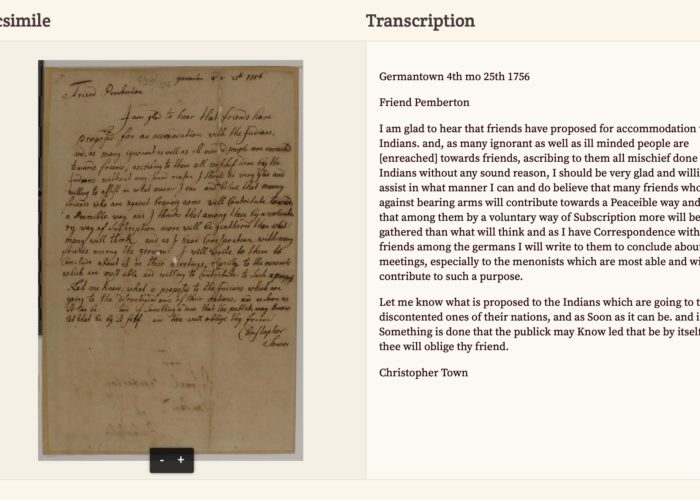
The directions for the assignment were simple: transcribe one page assigned from the Friendly Association manuscripts (Haverford College Quaker and Special Collections) and write a three-paragraph essay about what the page contained, whose voice it was written in, and who it excluded, and how it felt to participate in this transcription process as a historian. Students did not use any transcription aids. We each viewed the manuscript page in a web browser (or printed it out), then typed transcriptions using a word processor. However, these seemingly simple directions proved more complicated to students who were uncertain how to format their transcription consistently or account for peculiar eighteenth-century abbreviations. Some students opted to peer-review one another’s assignments before turning them in, which helped improve consistency and their understanding of the materials with which they were working.

For some students, the public nature of the transcription increased their commitment to the assignment. In her essay on “Teaching the Digital Caribbean,” Kelly Baker Josephs discusses how adding the public as an audience for coursework creates a “performance” aspect that changes the course experience (Josephs 2018). We saw this with our class, as several students put more time and effort into the assignment, such as peer reviewing each others transcriptions, expressly because it would be shared publicly on a website.

Student Responses

Each student turned in a short essay detailing the content of their transcription, its biases, and their experience transcribing it. In addition, we had a class discussion on the greatest challenges in transcribing and practices that might improve the transcription process and make the final product more useful. One student, who described working with the source as both “tedious and exciting,” encapsulated the gist of most anonymous student responses to the assignment.[4] The most frequent obstacles identified were difficulty reading the handwriting, deciphering inconsistent capitalization and spelling, differentiating between vowels as well as lowercase “L’s” and “F’s,” and unfamiliarity with the long “S.” While the scans were clear, some students had trouble reading their assigned text because authors often used both sides of the page, the ink bleeding through from one side to the other. One student suggested that reading the text and then rereading it before transcribing made it easier to understand the content. Others said that they needed more knowledge not only of paleography and period syntax, but also context about the history of the time period, region, and specific event in which these papers were situated. Without such broader knowledge, students sometimes struggled to transcribe local place names, like “Minisinks,” and the names of subjects in the documents, especially Native Americans, such as “Scarroyada.”

Nevertheless, many of the same students who struggled to decipher the eighteenth-century English and handwriting still expressed an appreciation for, and a better understanding of, the work of historians. One student wrote, “I’m quite honored and impressed that I had the opportunity to participate in the understanding and detailing of history, especially in the turn of the Revolution.” Several others professed a “newfound respect for historians” and claimed that they felt like they were “doing the work of a real historian.”

Most of the students were not history majors, and for many, this was the first time they had engaged with primary sources. Most of their previous coursework in history had focused on secondary source readings about big ideas and events, which students assessed through essay-writing assignments. One respondent noted that, “working with primary sources feels much more immersive and enlightening, in terms of being able to see a glimpse of what their life was like and the issues they dealt with in their time.”

While the process of transcribing manuscripts was monotonous, students said that work with handwritten letters changed the way they engaged with materials. One student said, “It felt good to work with a primary source such as this letter, and be able to see the firsthand view of the writer and a glimpse of their world.” Several students also welcomed access to Native American voices, who are often silenced in settlement narratives. This recognition encouraged them to grapple with the possibility that some of these documents may not have been telling the whole truth about the event. One student even mused that soon historians might have to decipher audio sources rather than interpret handwriting.

These student responses align with pedagogical scholarship. Notably, William Kashatus posits that close analysis of primary sources gives students a more personal understanding of history. Because primary sources can “evoke emotional responses,” students are better able to “identify with the human factor in history, including the risks, frailties, courage, and contradictions of those who shaped the past” (2002, 7). According to Kashatus, students are better able to recognize the biases in historical records and assess their own contemporary biases, and those of modern-day media, when they have engaged with close-readings of historical sources in the classroom (2002, 7–8). Student feedback from our classroom assignment reflects that students felt they gained a sense of intimacy with historical writers. Avishag Reisman and Sam Wineburg, writing about the new common core standards, have argued that working with primary source materials challenges students to think carefully about what does and does not count as evidence. Reisman and Wineburg argue that primary source materials compel students to “interrogate the reliability and truth claims” rather than to simply “cull” evidence (2012, 25-26). Through transcription work, students must read the text word-for-word, compelling them to think more critically about what is being expressed and not to take a document’s message at face value.

Gathering Survey Data

Although the students’ comments were helpful, we realized we needed more feedback before we pursued any future crowdsourced transcription projects. To that end, we administered an anonymous one-page survey to the participants of a transcribe-a-thon event at Loyola organized by the Center for Textual Studies and Digital Humanities in conjunction with a nationwide event. Approximately 70 students, staff, and faculty attended, 43 of whom elected to complete the survey. Additionally, we administered the survey to 21 students enrolled in a 100-level “Interpreting Literature” class. For the transcribe-a-thon, participants used a subscription-based transcription program called FromThePage.

The survey consisted of nine total questions, with six multiple choice and three open-ended questions. Questions solicited feedback on the ease of participants’ use of the transcription program and the experience of transcribing itself. Two questions asked about the participants’ perceived value of the experience of transcribing. At the end, participants were asked to provide an email if interested in future transcription projects. The anonymous survey results highlighted what elements of transcription work most engaged participants and what challenges or barriers thwarted their participation. Thus, the survey offered concrete data to support ideas that emerged from student feedback in the Loyola/Shepherd assignment. From these conclusions we gained insights into what would make a successful transcription project for interacting with digitized early American documents, and those insights informed the guides we created for Digital Paxton.

One key difference was experiential: students preferred the communal work of a transcribe-a-thon to the solitary work of a for-credit assignment. While the majority of both sets of students said that they found the experience valuable, more transcribe-a-thon participants recorded satisfaction. Additionally, a much higher percentage of transcribe-a-thon participants expressed interest in future transcription projects (82% of event participants compared to 38% of classroom participants).

We evaluated these discrepancies using responses to the open-ended questions, which included a question about what was the most valuable part of the experience. The classroom included some but not all of the additional contextualizing elements that were included in the event, such as the talks and recitations of historical speeches and songs. These elements, combined with the celebratory atmosphere of the event (held as a birthday celebration for Frederick Douglass), helped to affirm the sense that participants were both learning and contributing to a living project. The survey results and our experience with the transcribe-a-thon show us that transcription projects not only get students working with primary materials, contributing to scholarly work, and learning to use digital tools, but they also inspire students to participate in future projects.

Translating Feedback into Practice

Student feedback and survey responses provided some clear takeaways for Digital Paxton. Although incorporating a transcription project into a class’s curriculum and awarding class credit and public access incentivized students’ contributions, assignments needed to be structured to foreground both historical and logistical context for transcriptions. Additionally, assignments needed to emphasize the importance of student transcriptions to the long-term goals of the project. When we began contributing transcriptions to Digital Paxton, the project did not have guidelines for transcriptions or a built-in transcription platform.

We developed a “Transcription Best Practices” guide for Digital Paxton, now available in both the Transcription and Pedagogy sections of the site for educators who want to introduce similar assignments in their classrooms. In it, we attempted to anticipate contextual questions that might arise during an assignment. We used the feedback from the Loyola/Shepherd assignment to pinpoint the most important contextual clues needed. We included images of eighteenth century writing conventions, such as the elongated “s” and the shortening of common words like “which” to “w/ch.”By equipping potential transcribers with the materials they need to understand the papers in their historical and cultural context—the guidelines, site introduction, and historical overviews—we met a need expressed in our survey results.

Digital Paxton’s overview of the conflict provides contexts for an event with which students are only vaguely familiar, but it does not necessarily supply students with definitive answers. Students build intimacy with the text by describing it, having to assess as they go along the choice of language and style used. Writing out the text seemed to improve students’ reading comprehension. By adding transcription guidelines, we further sought to help students avoid getting bogged down by the complication of language or handwriting. In their response essays, students use the text they transcribed as “evidence” about where the author stood ideologically within the conflict and how the conflict unfolded. As one student described, the source was a piece to their understanding of the larger puzzle.

Selecting a platform and developing a process through which future cohorts could contribute to the project were more complicated. After all, our approach—toggling between a web browser and word processor—would not work well for larger classes or transcription projects. We had three key stipulations for a prospective transcription platform: it had to be easily accessible to and usable for transcribers, well-supported, and interoperable with Scalar. We identified two platforms that met most of our requirements: Scripto and FromThePage. Both enabled users to record transcriptions alongside scanned pages, a priority, for students in the “Digitizing the Revolution” course. Scripto offered a free, open-source transcription tool, but it was not being fully supported by the developers, and we did not know if it would continue to be supported in the future. Moreover, Scripto required scanned pages to be migrated from Scalar to Omeka. We selected FromThePage because it was well-supported, did not require an Omeka installation, and Fenton could use his university library’s subscription (Fordham University).

On a logistical side, the survey responses also helped us understand the barriers to using online transcription tools. The most prevalent issue was readability of the scanned text, followed by challenges navigating the transcription platform. While there are limitations to how much can be done to address manuscript readability, especially when it comes to eighteenth-century manuscript material, we took the latter concern into account when we created “Using FromThePage.” In that documentation we sought to create clear, concise instructions on how to use FromThePage in conjunction with Digital Paxton. This effort included screenshots illustrating how to register as a user and how to locate pages available for transcribing, a key issue for participants at the transcribe-a-thon. By anticipating user experience issues, we hope to enable students to lose themselves in the rich texts and contexts on Digital Paxton, rather than spend valuable time and energy troubleshooting the mechanics of the process.

Future Collaborations

While our experiment in student manuscript transcription was not without its limitations, the process of pursuing student involvement and recording student feedback have made Digital Paxton a more effective teaching tool. Thanks to the labors of Kate Johnson, Kelly Schmidt, and Marie Pellissier, the project now includes best practices for transcribing eighteenth-century manuscripts (Transcription Best Practices), an assignment for integrating a similar exercise into a university classroom (Transcription Assignment), and a platform through which any educator may bring Friendly Association manuscripts into her classroom (Transcriptions).

From our research and practical experience, we have found that transcription of primary sources encourages students to read texts more closely, to view writers as human beings (rather than detached historical figures), to confront archival gaps, silences, and erasures, and to view their work as contributory to a collaborative project. In her recent post at the National Archives, Meredith Doviak wrote that with increased digital access to collections, students now have more opportunity to become “active critics and curators of those literary productions rather than mere explicators of them” (2017). Transcription projects can serve as vehicles through which students act as participants in knowledge creation, honing valuable critical thinking skills and a historically-informed sense of media literacy that will serve them well inside and outside the classroom.

Notes

[1] Nearly every study of the Paxton crisis cites Dunbar’s 60-year-old edition, and for good reason: it collects 28 noteworthy pamphlets and provides a useful introduction to the debate. Time has, however, revealed the edition’s limitations, foremost, its narrow selection of materials. Alison Gilbert Olson (1999) has since identified at least 63 pamphlets and 10 cartoons, and the distinction between pamphlets and political cartoons is itself ambiguous, given that many cartoons were nested inside of pamphlets, many of which circulated in multiple editions.
[2] Students can surface new perspectives from indigenous peoples and backcountry settlers by attending to a diverse set of records, all of which are available as open-access, print-quality images. Today, the project features more than 2,500 images, including 16 artworks, three books, 17 broadsides, 128 manuscripts, 26 newspaper and periodical issues, 69 pamphlets, and nine political cartoons, many of which have never before been digitized.
[3] For example, visitors will find a credit to Emina Hadzic at the bottom of her transcription of “Various Memoranda” (http://digitalpaxton.org/works/digital-paxton/various-memoranda-1760—1-1). She was also acknowledged (and tagged) in social media posts on Facebook, Twitter, and Instagram.
[4] Quotations in this section come from anonymous student answers to a course survey and are reproduced with names withheld by mutual agreement. “Explore Common Sense Survey,” administered by Kate Johnson, Marie Pellissier, and Kelly Schmidt. February 1, 2018.

Bibliography

Adichie, Chimamanda Ngozi. 2009. “The Danger of a Single Story.” Filmed July 2009 at TED Global. TED video, 18:43.
https://www.ted.com/talks/chimamanda_adichie_the_danger_of_a_single_story/transcript.

Clement, Tanya, Brian Croxall, et al. 2011. “Collaborators’ Bill of Rights.” Off the Tracks: Laying New Lines for Digital Humanities Scholars. Media Commons Press.
http://mcpress.media-commons.org/offthetracks/part-one-models-for-collaboration-career-paths-acquiring-institutional-support-and-transformation-in-the-field/a-collaboration/collaborators’-bill-of-rights.

Doviak, Meredith. 2017. “Teaching from the Archives.” Education Updates(blog). National Archives. February 9, 2017.
https://education.blogs.archives.gov/2017/02/09/teaching-from-archives/.

Grant-Costa, Paul and Tobias Glaza, and Michael Sletcher. 2012. “The Common Pot: Editing Native American Materials.” Scholarly Editing: The Annual of the Association for Documentary Editing 33: 1–17.
http://scholarlyediting.org/2012/pdf/essay.commonpot.pdf.

Josephs, Kelly Baker. 2018. “Teaching the Digital Caribbean: The Ethics of a Public Pedagogical Experiment.” The Journal of Interactive Technology & Pedagogy 13.
https://jitp.commons.gc.cuny.edu/teaching-the-digital-caribbean-the-ethics-of-a-public-pedagogical-experiment/.

Kashatus, William C. 2002. Past, Present & Personal: Teaching Writing in U.S. History. Portsmouth: Heinemann Educational Books.

Olson, Alison Gilbert. 1999. “The Pamphlet War over the Paxton Boys.” The Pennsylvania Magazine of History and Biography 123, no. 1/2: 31–55. http://www.jstor.org/stable/20093260.

Perry, Adele. 2005. “The Colonial Archive on Trial: Possession, Dispossession, and History in Delgamuukw v. British Columbia.” Archive Stories: Facts, Fictions, and the Writing of History: 325–50. https://doi.org/10.1215/9780822387046-015.

Reisman, Avishag, and Sam Wineburg. 2012. “Text complexity in the history classroom: Teaching to and beyond the common core.” Social Studies Review 51, no. 1: 24–29.

Sample, Mark. 2011. “Building and Sharing (When You’re Supposed to Be Teaching).” Journal of Digital Humanities 1, no. 1 (Winter).
http://journalofdigitalhumanities.org/1-1/building-and-sharing-when-youre-supposed-to-be-teaching-by-mark-sample.

About the Authors

Will Fenton is the Director of Scholarly Innovation at the Library Company of Philadelphia, the Creative Director of Redrawing History: Indigenous Perspectives on Colonial America, funded by The Pew Center for Arts and Heritage, and the founder and editor of Digital Paxton. Will earned his Ph.D. at Fordham University, where he specialized in early American literature and the digital humanities. He is the recipient of prestigious fellowships from the American Philosophical Society; Haverford College Quaker and Special Collections; the Humanities, Arts, Science, and Technology Alliance and Collaboratory; the Library Company of Philadelphia; the Modern Language Association; and the Omohundro Institute of Early American History & Culture. His writings have appeared in American QuarterlyCommon-Place, and ESQ and in numerous public platforms, including Inside Higher Ed, Slate, and PC Magazine.

Kelly Schmidt, co-creator of ExploreCommonSense.comis Research Coordinator for the Slavery, History, Memory, and Reconciliation Project, co-sponsored by Saint Louis University and the Jesuits of the Central and Southern United States. She is a PhD candidate at Loyola University Chicago, where her research focuses on slavery, race, and abolition. Kelly has pursued her interests in museum work, public history, and digital humanities at several institutions, including the Heritage Village Museum, Cincinnati Museum Center, National Underground Railroad Freedom Center, Auschwitz-Birkenau State Museum, and the Colonial Williamsburg Foundation.

Kate Johnson is an archival assistant at the University of Northern Colorado’s Archives and Special Collections. She earned her M.A. in Public History from Loyola University Chicago, and her B.A. in History and German from the University of Northern Colorado. Her research interests are in women’s history, cultural history, and early America. She has worked in museums and public history institutions for over ten years, including holding positions at the Thomas Jefferson’s Monticello, The Women and Leadership Archives, and the Frances Willard House Museum. She is a co-creator of the site, ExploreCommonSense.com and also currently serves as an appointed member of the National Council on Public History’s Digital Media Group.

0

Teaching the Digital Caribbean: The Ethics of a Public Pedagogical Experiment

Abstract

In this essay, I discuss my methodology in choosing course content for a “Digital Caribbean” course at the CUNY Graduate Center and some of the challenges, expected and unexpected, that I encountered with my approach. In particular, I focus on some of the ethical and methodological questions I grappled with in melding the study of digital technologies with interdisciplinary study of the Caribbean. Formally a narrative assessment of the ways “not to” build a graduate humanities course that engages digital content, this essay primarily explores what it means to work publicly, in a digital format, with graduate-level research on the Caribbean in academia.

You have to be sure about a position in order to teach a class, but you have to be open-ended enough to know that you are going to change your mind by the time you teach it next week.
— Stuart Hall

In the spring of 2014, I taught a course entitled “The Digital Caribbean” at the CUNY Graduate Center. The course was run by the M.A. in Liberal Studies program (MALS) and cross-listed for the PhD certificates in American Studies and Africana Studies. As far as I could tell in doing my research for the course, it was the first of its kind to be taught at either the graduate or undergraduate level. As such, I found myself cobbling together materials for the course with no precedents or guidelines. This was somewhat easier when I taught the course a year later in the doctoral program in English (again at the CUNY Graduate Center) and then again in Spring 2017 as an undergraduate course at Williams College. In the patchwork essay that follows, I focus on that initial creation for the MALS course, discussing my methodology in choosing content and some of the challenges, expected and unexpected, that I encountered with my approach. In particular, I focus on some of the ethical and methodological questions I grappled with in melding the study of digital technologies with interdisciplinary study of the Caribbean. In part, this is a narrative assessment of the ways “not to” build a graduate humanities course that engages digital content. Mostly, however, it is an exploration of what it means to work publicly with graduate-level research on the Caribbean in academia, particularly with students who have set ideas about their own personal and intellectual relationships to digital technology and to the region.

There were several considerations in both setting up and running the course. Some were foreseeable at the outset, but others part of the learning process of working with living, variable (and often ephemeral) material. In building the initial version of the course, I worked from what at the time was the fifth chapter of a book in progress on Caribbean cosmology. That project has since changed, primarily I believe because of my experience creating and teaching the course. There was a symbiotic relationship such that what was once merely a chapter became pretty much the book. Nevertheless, the former project did shape my approach to the course in that the idea of cosmology (in the most general, universal, sense of the word) helped me to draw together material I was already comfortable teaching – on Caribbean literature and culture – with the Digital Humanities material that was either entirely new to me or new to me in a classroom setting.

Pedagogy: Teaching and Learning the Digital Caribbean

During the course proposal stage, I was not entirely sure what direction the syllabus would take, so, as many of us do at this stage, I left the course description relatively open. The following course description was part of that proposal and appears in slightly abbreviated form on the course website:

Text of course description for Digital Caribbean course

Figure One: Course Description for Digital Caribbean

Much like a presentation abstract months before a conference, the course description above sounded great ahead of time, but in reality I had no template ready for the course. I had not previously appreciated how much I rely on a literary tradition in my pedagogy. In teaching courses like “Caribbean Literature,” “Literary Theory,” and “Women Writers,” I had always had sample syllabi available to me either via the internet or departmental archives. I had also taken similar courses myself as a graduate student. With the digital component, I was charting new ground in Caribbean Studies; and I was teaching in an interdisciplinary program. Thankfully, there was a relatively established body of work on the intersection of race and digital culture by scholars such as Anna Everett and Lisa Nakamura, as well as a newer but also visible and growing body of work on global digital cultures by scholars such as Jennifer Brinkerhoff and Karim H. Karim. However, work that directly addressed digital technology and the Caribbean was much more difficult to find in 2013. Prior to teaching the class, I knew only of very few sources, most notably, Curwen Best’s 2008 monograph, The Politics of Caribbean Cyberculture, articles in the 2011 sx salon discussion “Caribbean Culture Online,” and Annie Paul’s essay in the 2011 Routledge Companion to Anglophone Caribbean Literature, “Log On: Toward Social and Digital Islands.”

Though few and limited to the Anglophone Caribbean, these texts spanned the disciplinary spectrum and so formed a good base from which to begin. My approach to interdisciplinarity has always been to begin with my strength – literature and close reading – and branch out from there. I was also guided by the description of the “second wave” of digital humanities posited in the “Digital Humanities Manifesto 2.0”:

The first wave of digital humanities work was quantitative, mobilizing the search and retrieval powers of the database, automating corpus linguistics, stacking hypercards into critical arrays. The second wave is qualitative, interpretive, experiential, emotive, generative in character. It harnesses digital toolkits in the service of the Humanities’ core methodological strengths: attention to complexity, medium specificity, historical context, analytical depth, critique and interpretation.[1]

Though I am sure there are scholars who would argue with the portrayal of the “first wave,” the rest of the description resonated with me because it spoke so directly to what I wished to achieve in the classroom and in whatever scholarship I produced on the topic. This class, this project, was to be generative in nature, for my students, my colleagues, my field, and myself.

But how to pull these varied texts together in a coherent way for these varied audiences? I began with a provisional syllabus that covered only the first three weeks. This decision was motivated by two realities: 1) I simply was not sure what to put in the following weeks as I was still hoping to seamlessly meld Caribbean studies and digital humanities, 2) I wanted to be transparent with my students about the experimental nature of the course and the need for their active participation in generating course content. For various reasons – professional and personal – I was hesitant about this as a pedagogical strategy, but later in the semester some of the students expressed appreciation for this contingent beginning. My openness about the course as an experiment allowed them to feel part of the creation of the course. Throughout the semester the students were comfortable enough to suggest sites, though not readings, for us to analyze. It also helped that I left space in the syllabus for them to do so and designed some of the assignments to require that they find their own examples to illustrate connections between the readings.

At the time, I was unaware of the wealth of research, case studies, and practical advice regarding co-creating course syllabi with students already amassed by scholars steeped in learner-centered pedagogy. The experimental nature of the Digital Caribbean course was not entirely student-centered, but the openness of the syllabus did allow for a foregrounding of some of the students’ interests throughout the semester. In particular, in response to our first class discussion about topics, I scheduled weeks for us to focus on Caribbean tourism online and queer sexualities in Caribbean digital representation(s), topics I had not previously planned to cover. For these especially, but generally throughout the semester, I became a “co-learner” with my students as the course progressed. Much of what I learned from students in this first iteration of the course shaped the next two versions, which were not quite so experimental in syllabus creation.[2]

Our first day was organized around the traditional discussion of the syllabus, texts, and what students hoped to get out of the class; however, I left the second half of class for setting up the course website. We used the CUNY Academic Commons, which is a robust network that offers members not only WordPress-based websites, but also backend privacy for file-sharing and discussion; this helped to avoid the question of copyright with the readings for the course and gave students a space to communicate as a group.[3] We had a lively discussion about what the URL should be for the site as we tried to take into account our current needs, the potential needs of future scholars, and the ways the site might be accessed and for what reasons. The discussion extended to a consideration of what dependencies we had on such tools as search engines, link condensers, and social media. In the end, we decided that though it may be long (so much so that the Commons site creation tool warned us that we would be better off with something shorter), we would choose digitalcaribbean.commons.gc.cuny.edu. It was easy to remember and had a distinct clarity of purpose – two qualities important for both current and potential future users.[4]

Platforms and Privacy: The CUNY Academic Commons

The decision that seemed in those early days to be the easiest – that of which platform to use – became in time one of the most troubling. The CUNY Commons has been a model for several organizations’ digital platforms in the near-decade since launching in 2009. Though there are always improvements to be made, the platform is well-developed and the community is welcoming and supportive. I had no doubts about it being the proper home for our course site. However, as the semester wore on, many of the assumptions that led to my choice of this platform – some of them about the very topic we were studying – proved to be short-sighted.

First, there was my assumption about students’ (and by extension other professors’) usage of the CUNY Academic Commons. During that first class I realized that several of the students had not yet set up their Commons accounts, even though this was the Spring semester and so all but one of them had been enrolled at the Graduate Center for at least one semester of classes. This highlighted the assumption I had made about my students’ technological savvy. It would become more clear throughout the rest of the semester that I would need to set aside time for a “practicum” at the end of some classes to cover some of the technical details of using the WordPress-based Commons to complete assignments. Of the eight students, about half had never blogged, even more had never blogged using WordPress, and the CUNY Academic Commons was new to the majority.[5]

As scholars we are inundated with information (and in some cases exhortations) about digital pedagogy and digital scholarship. Regardless of our field and topic, our research is increasingly done via screens rather than via printed material. According to David M. Berry in Understanding Digital Humanities,

Across the university the way in which we pursue research is changing, and digital technology is playing a significant part in that change. Indeed, it is becoming more and more evident that research is increasingly being mediated through digital technology. Many argue that this mediation is slowly beginning to change what it means to undertake research, affecting both the epistemologies and ontologies that underlie a research programme […] it is rare to find an academic today who has had no access to digital technology as part of their research activity.[6]

As such, we can easily make assumptions about not only about our colleagues’ usage of digital technology, but also the digital readiness of our students; we know they use computers to write for us and we observe them (sometimes during class) utilizing their ever-smarter phones. Additionally, advertising and mass media in general would have us believe that everyone is accessing the internet to conduct business and pleasure. But in truth, access does not mean use, and use does not mean full engagement.

This question of engagement, my first hurdle beyond creating a syllabus, was a peculiar reflection of what we were to study in the class. Six of my eight students were of Caribbean descent and the ways in which they used the internet to enhance their understandings of Caribbean culture was repeatedly a topic of discussion across the semester. More relevant for my purposes here, however, is the way in which they did not use the internet. The students’ lack of engagement with the CUNY Academic Commons spoke to their concerns about privacy and the distinction they imagined (or ignored) between their professional and personal digital lives.

Because the field of Caribbean digital studies could, at best, be termed small, one of my objectives was to build a resource for future teachers, students and scholars of similar material, a group that was at that time, and still is, noticeably increasing in number and visibility. This envisioned resource included, in large part, my students’ blogging activity, depending on these posts to convey some of the content of our discussion and the nature of possible connections between the materials. I had once before, as an extra credit exercise, assigned public blogging as part of a course, but that was with undergraduates, and optional. For this course I had, without proper forethought, made public blogging a requirement for students who were more invested in academia than my undergraduates and still had further to go on the track (I had one PhD student and the others were Master’s students, most of whom were planning to apply to doctoral programs). One student was vocally hesitant about blogging publicly, especially since our use of the CUNY Academic Commons meant he could not write pseudonymously.[7] I encouraged him to continue to participate, but I offered the option to delete the blogs after the course, which made him much more comfortable. In later discussions with colleagues I found that many offered the opportunity to blog privately. I could have offered this option, but I wanted the “pressure” of public writing to shape the students’ responses. I also, selfishly, wanted to build the site with curated content.

Despite this choice to stick with my original plan, I was torn about the decision as the unevenness of my students’ writing and abilities became more apparent. Public writing is its own genre and the students approached it in different ways; some with previous blogging experience took to the writing requirement easily, as did others comfortable with writing and/or public performance. The distance between these students and those more hesitant about blogging grew as the course went on. Included in my original course description was the objective to “consider the pedagogical and professional aspects of working with not only digital texts, but specifically those produced to represent a minority culture, particularly given the increasing digitization of academic work.” Somehow, I had not envisioned the work produced in the class itself to be part of this objective, but learned quickly that I needed to treat my students’ work as part of these “digital texts” as well. As Trevor Owens writes of his course site in “The Public Course Blog: The Required Reading We Write Ourselves for the Course That Never Ends,” my students’ blogging “was not simply a supplement to the course; rather, it played a cognitive role in the distributed structure of the class, moving it from knowledge consumption to knowledge production.”[8] Their blog posts were producing knowledge not just for our little community in the course, but for a larger (albeit still largely imagined) community beyond the classroom.

On the first day of class we had been optimistic enough to choose a hashtag for sharing our course materials on social media but my concerns about my students’ right to relative privacy kept me from directly linking to their work until the final projects at the end of the semester. The question that repeatedly haunted me was: to what extent are we responsible for shielding our students in this manner? It seems a bit silly to think of myself as “shielding” my students when their work was available on the World Wide Web, but given the relative obscurity of some (even most) web content, it is easy to forget about the public nature of material created for a small group. Could I strike some balance between public encouragement of their work and the traditional private safe space of the classroom? A related concern was that all my students were students of color and I did not know which approach to public writing would most benefit them in an academic system and space ill-designed for their success.  As a compromise, I began to suggest revisions in my reading of their blogs. Though I occasionally commented on their blogs publicly, I also periodically “graded” the blogs privately with comments about each. This resulted in more work but sat well with me ethically as it gave my students the option of going back to revise the blog posts both before and after the “grading.”[9] In retrospect, this was the best approach possible given the varied rationales for the course site: a conversation between the course participants, a contemporary resource for interested readers, and an archive for potential future scholars.

Sooner than expected, I had cause to question the ways in which the course was framed on the site for this latter audience. That summer, after the course had closed, I was contacted by Elena Machado Sáez, who was doing research on Robert Antoni’s As Flies to Whatless Boys. Her project was on reader responses to the text and its accompanying website and in doing research she encountered my students’ posts on the Digital Caribbean site. Antoni was one of our class visitors and so there had been significant activity on the blog surrounding his novel and its experimental website. Because many reviewers were ignoring the website (possibly due to how unusual and “out there” it is), my students’ online conversation represented the largest resource of rigorous engagement with both the novel and its website that a scholar could access at the time. Machado Sáez contacted me about the posts and the site in general. Her email and her subsequent usage of material from the site brought me up short and made me realize the ways in which I had not been careful enough in my creation of the site and contextualization of the course.

The irony here is that our last class was on how search engine optimization (SEO) – via Google in particular – affects one’s exposure to information. Therefore, I should have been more cognizant of how the site appeared to an outsider. But I was, again, operating under myopic assumptions about internet usage. Unfortunately, I did not fully realize this until my students’ work had already made it into Machado Sáez’s book. Her reference to the students’ writings begin: “The digital marginalia accessible via CUNY Academic Commons and produced within a classroom setting indicates the discomfort of readerships with the (im)possible intimacy of Antoni’s online archive, as well as its appeal.”[10] This was footnoted with reference to our email exchange:

Kelly Josephs taught a Spring 2014 graduate course at the CUNY Graduate Center on the “Digital Caribbean,” which produced the blog postings on CUNY Academic Commons (“Introduction”). Since I accessed the blog commentary via Google and the classroom context was not directly acknowledged by the posts, I contacted Josephs via e-mail on June 2, 2014, to see if she knew who had generated the posts. Josephs was kind enough to provide me with her course syllabus and a description of the blog post assignment, but she was unaware that the posts could be disconnected from the course content, or rather, read without accessing the relevant online course description and materials. As she noted, “The CUNY Academic Commons is a large conglomerate and this is just one site within it” (“Re: CUNY Academic Commons,” 2 June 2014). Our academic exchange speaks to how classwork may circulate digitally in ways that we as teachers might not imagine, namely, decontextualized from the pedagogical frame that produced that work.[11]

I quote the note in full here because it speaks to the various ethical, archival, and pedagogical dilemmas I highlight above. Machado Sáez raises a salient point about the circulation of digital material. My disconcertion here is not that the student posts were accessed without context, but that the content of the course could then be “decontextualized from the pedagogical frame that produced that work.” This was in part due to my neglecting to properly “brand” the course and its proliferating content, relying too much on the assumption that readers would navigate their way to the syllabus and the course description. Indeed, we had the public in mind when creating the site – that was in large part the point of our first class discussion about what to name the site and how to frame it – however, the prominence of the “CUNY” branding vis-à-vis the name of the site itself had not been part of that initial discussion (nor had it occurred to me during the course). The potential divorcing of student work from the entirety of the course experience raises for me the following questions:

  • What assumptions do we make about the holistic nature of a course when building a public site to house student work? Do these assumptions really matter to future “use” of the work?
  • What does it do to add the public as an audience for coursework? How does that reflect on content choices? How does this additional component shape assignments and “performance” in the course?
  • How does the choice of platform affect reception of the work? If we rely on platforms provided by our academic institutions, how does the institution continue to own our intellectual labor in ways we did not envision – or ways we do not mean to occur?

Three iterations of the course later, I am still grappling with these questions.[12] Before teaching the course again in 2015, I made small revisions to the course site in an effort to more clearly signal the course context for public readers, but kept the general structure and all the previous student work as part of the archive. For the 2017 undergraduate course I decided to build a new site with a different theme and organization, partly to speak to the distinct needs of my undergraduate students but also in an effort at embracing the ephemerality of a site hosted by an institution within which I was contingent faculty.[13] Rather than answering the questions above, teaching the course again has simply nuanced them, foregrounding for me the ethics of scholarship vs pedagogy, particularly when the Caribbean as subject matter and identity politics in the classroom – engaging underrepresented peoples and places – underlie these questions of ethics and public distribution.

We learn as we teach. As I teach this course, I am learning to err on the side of impermanence whenever my drive to build a site as part of the “product” of the course seems to be in tension with the needs of my students to learn in a private, safe space. I am learning to incorporate space and time for opacity in such ventures; space and time for students to create, and revise, and perhaps even refuse work in ways ultimately invisible behind the screens of outsiders. Impermanence and opacity – these are not easy choices for a Caribbeanist in the age of livestreamed conferences, recorded lectures, and hashtagged events. In the digital age, we want access to everything, archives of everything. As a Caribbean scholar, I also desire to build evidence of the complexities, the very existence, of our cultures; evidence against, as Derek Walcott phrases it: “the way that the Caribbean is still looked at, illegitimate, rootless, mongrelized. ‘No people there,’ to quote Froude, ‘in the true sense of the word.’ No people. Fragments and echoes of real people, unoriginal and broken.”[14] The lure of digital archives is their potential to make such evidence of history, of humanity, accessible in all senses of the word. I am learning to weigh this drive toward visibility against my students’ needs for invisibility, reminding myself each time that impermanence and opacity, difficult as they may be for a digital humanist, are longstanding strategies of resistance in Caribbean cultures.

Notes

[1] Jeffrey Schnapp, Todd Presner, and Peter Lunenfeld, “Digital Humanities Manifesto 2.0,” http://www.humanitiesblast.com/manifesto/Manifesto_V2.pdf. Emphasis in original. This citation is limited as according to Presner, “Parts of the manifesto were written by Jeffrey Schnapp, Peter Lunenfeld, and myself, while other parts were written (and critiqued) by commenters on the Commentpress blog and still other parts of the manifesto were written by authors who participated in the seminars. This document has the hand and words of about 100 people in it.” (Todd Presner, “Digital Humanities Manifesto 2.0 Launched” 22 June 2009, http://www.toddpresner.com/?p=7, accessed 15 November 2017). Thus, while I note all three authors in the bibliographic record, I wish to also acknowledge that, in keeping with the gestalt of DH work, it is a collaborative document.

[2] For an illustrative discussion of the hows and whys of co-creating syllabi and course assignments with students, see Cathy Davidson’s 2015 HASTAC series “How Do I Get Started? A Step-by-Step Guide to Designing a Student-Centered Classroom,” https://www.hastac.org/blogs/cathy-davidson/2015/08/04/how-do-i-get-started-step-step-guide-designing-student-centered

[3] The Journal of Interactive Technology and Pedagogy is also part of the CUNY Academic Commons, though the site does not have a Commons URL or the Commons header.

[4] I was already using the simpler URL caribbean.commons.gc.cuny.edu for another site. It pays to be an early adopter in this field.

[5] The Commons team has since focused some of their resources on orienting new CUNY Graduate Center students to the platform and so both knowledge and usage of the Commons has increased in the past four years.

[6] David M. Berry, ed. Understanding Digital Humanities (New York: Palgrave Macmillan, 2012), 1.

[7] I learned afterward that this is a possibility with the CUNY Academic Commons and have since offered the option to students, though none have yet chosen to blog under a pseudonym. In an unexpected turn of events, the student most hesitant about public blogging in this first version of the course later included his posts as part of his online resume of writings.

[8] Trevor Owens, “The Public Course Blog: The Required Reading We Write Ourselves for the Course That Never Ends.” In Debates in the Digital Humanities, ed. Matthew K. Gold (Minneapolis: University of Minnesota Press, 2012). http://dhdebates.gc.cuny.edu/debates/text/6

[9] The course site remains public and as of this writing – as far as I could tell from the dashboard – none of the students have erased their blogs. This may, of course, speak more to their forgetting to remove them than any considered decision about their academic portfolio.

[10] Elena Machado Sáez, Market Aesthetics: The Purchase of the Past in Caribbean Diasporic Fiction (Charlottesville: University of Virginia Press, 2015), 207.

[11] Ibid, 228.

[12] The initial course ended with student digital projects (though I gave the option of a traditional paper, six of the eight students chose to build digital projects). The projects were extremely gratifying for me and I felt much more comfortable sharing these projects via social media because the students had “owned” them in a way they had not “owned” the blog posts for the course. What I found most interesting was that each of these projects was built “elsewhere.” That is, none of the students chose the CUNY Academic Commons to house their work. Perhaps they were much more aware of these questions of ownership and reception than I was at the time.

[13] This course was part of my teaching responsibilities as a visiting professor at Williams College. As of this writing, the site is still accessible, but my access to the administration of it will expire when my Williams College email account expires.

[14] Derek Walcott, “The Antilles: Fragments of Epic Memory” Nobel Lecture, December 7, 1992. https://www.nobelprize.org/nobel_prizes/literature/laureates/1992/walcott-lecture.html

About the Author

Kelly Baker Josephs is Associate Professor of English at York College, CUNY. She is the author of Disturbers of the Peace: Representations of Insanity in Anglophone Caribbean Lit­erature (2013), editor of sx salon: a small axe literary platform, and manager of The Caribbean Commons website. Her current project, “Caribbean Articulations: Storytelling in a Digital Age,” explores the intersections between new technologies and Caribbean cultural production.

Image courtesy of Flickr user Andrea Hernandez
2

Participatory Culture and Distributed Expertise: Breaking Down Pedagogical Norms or Regulating Neoliberal Subjectivities?

Kimberly Mair, University of Lethbridge

Abstract

While participatory pedagogies and inverted classrooms contest the norms and forms authority that operate in the conventional classroom and attempt to respond creatively to the challenge that Web 2.0 presents to higher education, they may also reinforce the requisite affect and rhythms of production that are characteristic of flexible labor. Drawing upon observations from a course on digital culture delivered in an inverted and participatory classroom, this article discusses the effectiveness of experiential, decentered, and collaborative classroom environments for meeting the demands of early twenty-first century higher education but examines contradictions inherent to these critical pedagogies. This paper argues that the intensive labor and constant affect-based interactions that participatory pedagogies demand may inadvertently undermine their critical force by enacting forms of neoliberal governance. The discussion concludes with provisional thoughts about how to navigate these contradictions by building a critique of the pedagogy into the course structure.


Critical pedagogies that emphasize performative and participatory activity are effective in breaking down and contesting the norms and forms of authority operative in the conventional classroom that otherwise tend toward passive absorption and recall on demand. The move away from both older banking (Freire [1970] 1997, 61) and newer information exchange models in education is even more urgent when we take seriously that “knowledge and information in their exchangeable form are easily accessible on the internet and Wikipedia,” an observation that prompted Groot, Pape, and Vilvang (2015) to ask: “What, then, is the singular project of higher education that stands out from a mass of knowledge traders?” (1). For them, that project would entail the generation of “movements of thought,” in which “it is not a stable piece of information that moves from point A to point B” (1), but one that engages directly the problem of “how to make different modes of thought resonate, how to think with another thinking” (2).

In preparation for a third-year undergraduate course entitled Digital Culture and Society, I attempted to shape its curriculum into a metaphorical platform for experiential engagements that would disrupt conventional assumptions of the economy of knowledge in the classroom by positioning the students as collaborative knowledge producers who each bring plural knowledges into the space for reworking, rather than as receivers of ostensibly crystallized, knowledge. Since I gave the course a thematic focus on Participatory Culture in Web 2.0, I wanted its form to make operative the social processes of concern in the course, such as shifts in communicative practice and values, the withdrawal of the singular author or originator of knowledge claims, and so forth. Making such processes operative indeed made space for “movements of thought” (Groot, Pape, and Vilvang 2015, 1). I noted how easily the values of critical pedagogies, such as those central to the inversion of classrooms, synthesized with the unique concerns of the course topic of digital culture, as these are in many ways consistent with the emergent norms of Web 2.0 culture and its “central cultural logic” of sharing (Shifman 2014, 19). Yet, over the duration of the course, I became aware of inherent contradictions in the participatory and performative potential of inverted pedagogies.

Concerns have been raised about inverted models, particularly in the context of fiscal pressures on education that may emphasize technology as a solution to increased demands with fewer resources, while de-emphasizing the value of immediate engagement with instructors. As Harden (2015) has observed, however, the critical focus of inverted models does provide “means for educators to resist that outcome” (378). Perhaps this danger pivots on where the imperative to invert classrooms emerges, with the institution or with the educator, and whether it is administratively or conceptually driven. But, my immediate concerns depart from the possible administrative exploitation of what are meant to be critical learning models that, done well, are usually more, not less, labor intensive. That these learning models are more labor intensive, not only for faculty but for students as well, is my point of departure. With the learning strategies and forms that my course implemented, student labor was both extensive and sometimes invisible as work. I argue that, as much as these forms rework and disrupt conventional classroom practices, they may inadvertently contribute to the regulation of subjectivity in preparation for entrenching flexible labor arrangements. Following this, I will conclude with a brief preliminary reflection upon how I have attempted to activate this critique as part of the content in a subsequent offering of this course. Before developing my critique, I will situate my discussion in the course’s pedagogical underpinnings.

Participatory and Web 2.0 Cultures as Content and Pedagogy

The course’s thematic focus on Participatory Culture in Web 2.0 culture followed Henry Jenkins’ work in both of its streams: fandom studies and participatory classrooms. Henry Jenkins, Wyn Kelley, et al (2013) advocate the “participatory classroom,” which acknowledges the emergent shift from the expert paradigm of one-directional knowledge transfer to a collaborative model of knowledge production known as distributed expertise (188–189). Distributed expertise anticipates that each participant has knowledge and experiences to contribute. It favors course designs that enable and encourage the active mobilization of each participant’s expertise in both learning and teaching, although the latter often occurs through informal mentorship—a central value of some fandoms [1] and one that is consistent with the positive popular discourse of so-called Web 2.0 culture generally.

The respective characteristics of Web 2.0 culture and participatory culture overlap but are distinct (Hadas 2009, 1.2). Web 2.0 culture denotes the practices that emerge from the platform infrastructure of the Internet that provides sites to be filled with users’ content and generates sharing and interactivity that the read-only websites of Web 1.0 were not equipped to support. The ideological promise of Web 2.0 culture, however, recasts consumers as participants and creators and, therefore, it elides the distinction between producers and consumers (Hadas 2009; Jenkins [1992] 2013). More significantly, the discourses that surround Web 2.0 culture suggest a democratic communicative sphere by emphasizing its ostensible decentralization. Tim O’Reilly, who acknowledged the “interactivity, flexibility, and participation” (Coleman 2013, 207) of platform-based applications on the Internet by proposing the name Web 2.0, stresses its potential to foster “collective intelligence” (Hadas 2009). Web 2.0 also purportedly has the capacity to endow the speculative “noosphere” of the fused global mind (Manivannan 2012) with a “perfect memory” (Mayer-Schönberger quoted in Manivannan 2012). Tensions reside here due to the broad signifying force that the name Web 2.0 has taken on in a “constant conflation” of technologies and practices that “obscures the sociology and history of some digital projects” (Coleman 2013, 208). While the appeal to the supposed decentralization of Web 2.0 is often challenged (Mayorga 2014; Shifman 2014; Lanier 2011), Coleman asserts the distinction between “corporate-owned, proprietary platforms” and free software development or collective projects (208). So, while the promise and potential of so-called Web 2.0 cannot reside above critique, Coleman reminds us to give attention to which efforts and technologies we mean and how they operate “ethically, politically, and economically” (209) when we use this term.

The concept of participatory culture, however, speaks to long-time fandom practices, involving both affective and critical reading (Jenkins [1992] 2013, 277–278); the production of “borderlands” between texts and everyday life (3); cultural activism; aesthetic production that blurs the creator-consumer distinction; and the making of alternative communities (278–282). It long precedes the advent of digital platform infrastructures, but its characteristics overlap with the creative, non-hierarchical promise of the Web 2.0 culture of sharing. Jenkins and Kelley, et al (2013) outline the characteristics of a participatory culture as follows: “low barriers to artistic expression and civic engagement”; mutual “support for creating and sharing”; “informal mentorship”; members’ belief that their contributions are significant; members’ feelings of social connection that extend to contributions made by members of the group (8).

In several respects, contemporary understandings and practices of participatory culture, now extending to more anonymous and ephemeral digital communities, rely upon the technological infrastructures of Web 2.0. Paul J. Booth’s (2012) study of video mash-ups forwards that today’s remix culture relies heavily on the use and re-working of different texts and genres to produce cultural “rupture” (5.4). In the context of the digital sphere and its reconfigurations of communication, participatory culture promises to re-work cultural logics and social arrangements, giving the impression of control to participants who make up networked communities. This control, however, is highly dependent upon the digital spaces in which activities occur. Financial and digital capitals, as well as membership in new social arrangements, are unevenly distributed (Mayorga 2014).

Having made this distinction between these overlapping concepts, I will elaborate how they inform and mirror my pedagogical assumptions in the design of this course. Like digital spaces and networks, classrooms are marked by uneven distributions of various capitals, and while a participatory course design does not level this terrain, it does make interventions into models of teaching that appeal to the image of a knowledge economy. As with Freire’s critical use of the word “banking” to describe one-directional teaching strategies, a course that is designed to participate in the knowledge economy assumes its material in terms of units possessed by teachers or books, consumed by students, and then exchanged for credit in examinations and assignments. A course that approximates a participatory culture emphasizes experiential learning by having students engage directly in the processes relevant to the course topic rather than primarily consume course materials that explain them. By focusing on processes, knowledge is then understood as ways of thinking and making rather than information or facts that are today readily available, and even debated, without classrooms of higher learning.

In this course, students’ experiences were supposed to be much like those in Web 2.0, as students ‘shared’ their ideas and took control of their activities through the collaborative production of their term projects. Groups were also to approximate participatory culture by fulfilling the characteristics outlined above. Although I assigned scholarly literatures, the experience of working in this way was intended to be a central ‘text’ of the course by which emergent social arrangements, communicative practices, and values in digital culture could be felt and negotiated rather than merely read about. Finally, this pedagogical approach assumes that learning is not an interior process but happens through active meetings among thinkers, objects, and environments. Having elaborated the critical pedagogical assumptions that draw from inverted models as well as from the scholarship on participatory classrooms and distributed expertise (Jenkins and Kelley et al., 2013) that guided the development of this course, I will provide some details about it before moving on to my critical observations about the contradictions presented with this approach in terms of its inadvertent complicity in preparing students for neoliberalism’s flexible labor arrangements.

The Participatory Course and Fan-Fic as Scholarly Activity

I responded to the official course title of Digital Culture and Society with a thematic of participatory culture, using scholarly readings to emphasize the following in the content: oscillations between materialization and dematerialization (Hayles 2012); new modes of communication; emergent norms and values; and new forms of subjectivity that are tension-ridden between, on the one hand, Barry Wellman’s concept of “networked individualism,” concerned with self-branding and production of social connectivity and communion, which is often used to describe contemporary social production (Shifman 2014, 30, 33–34), and, on the other hand, the economy of unreality that David Auerbach observes on 4chan message boards, which minimizes identity, trading subjects for knowledges and experiences (Manivannan 2012). In the course’s formal organization, I primarily used an inverted, or ‘flipped’, classroom model. I did minimal lecturing each week. Lectures focused on the most challenging aspects of theoretical matter in scholarly literature, and students were required to engage with learning materials and do preliminary work outside of class. Given its thematic, the course was participatory in its content and form. Mirroring the conceptual content of the course, students engaged directly in creative fan culture production in collaborative groups online outside of class time and face-to-face in the classroom over a period of three months.

Fandom production that values free space to create resonates with the ways in which communication ideally occurs in Web 2.0. The perceived gap between students’ routine communication practices and the scholarly conventions expected in the academy has perhaps never been greater. Instructors can build upon the ways that students communicate, and students can also be positioned to see how their communicative practices implicitly cross into scholarly conventions. I suggest that fandom practices, such as fan-fic, offer a productive meeting ground. Fandom strategies displace the authority of primary texts and offer creative license to students making their own texts using informal types of citation through intertextuality. More crucially, fandom strategies encourage active reading and re-writing practices that extend or question, fill in gaps, and posit cultural critiques of dominant narratives (Jenkins [1992] 2013). I used fan-fic prompts from the second class meeting on to unsettle classroom routines, initiate collaborative work, develop relationships, and explore assigned texts.[2]

The novel S. by J.J. Abrams and Doug Dorst (2013) provided a common point of departure for the collaborative projects. S is an example of an ergodic novel because it requires unusual and laborious reading practices. It was particularly relevant to the course because it demands reading practices that mimic and amplify the non-linear experience of reading online, while calling for supplemental searching that crosses into other media external to the book to meet its intertextual knowledge requirements. Yet S also exaggerates the sensorial experiences of reading a material, hardcover book. The book is heavy, difficult to handle, and its specifically placed interleaved objects will fall out if the reader is not careful with every movement. The pages are artificially aged and seem to have been treated with the subtle scent of old books. Its content is broadly concerned with communication technologies and reading as authorship.

The students’ ongoing task was to work intertextually between scholarly literature, the novel, and their experiences of participatory culture in various modes. Many of their assignments, including the central collaborative project, demanded that they relinquish attachments to individual ownership and authorship of their production. In a limited sense, their contributions were ideally anonymous, as on 4chan, but not quite, obviously. I gave no specifications about what the final products should be. In terms of content, they were simply instructed to respond to S., while drawing from the conceptual materials in weekly academic readings. Evaluation was process-based and focused on groups’ routine practice of the principles of a participatory culture, as observed on their discussion and planning blogs and in participatory group time, for which they had between fifty and one hundred minutes per week over the term.

In addition to the attempt to subvert conventional authority emanating from the instructor and from assigned texts by animating participation in active knowledge production and contestation, the submitted assignments were creative, and relied upon popular cultural texts as well as on experiences. One aspect of Henry Giroux’s notion of border pedagogy as a “counter-text” (1991, 52) to traditional forms of pedagogical authority involves the treatment of official texts and popular cultural texts—not as the conduits for knowledge transmission, but as objects of study in themselves. Border pedagogy also enables students to “create their own texts” (54) under “conditions that allow students to write, speak, and listen in a language in which meaning becomes multi-accentual, dispersed, and resists permanent closure” (52).

The participatory modes operating within and outside of the classroom produced a high-level of solidarity among the students, and fostered intense friendships among many of them. Of the six groups, social connectivity was indeed achieved in all but one group that organized their activity with a means-ends logic. Having individual work from the students in the course from which to draw comparisons, the scholarly and creative quality of the works produced were, in most cases, higher than what would have been produced by individuals, as they were marked with the different strengths and interests of each group’s various members, which had dialogical mobility within the strongest groups over the duration of the term.

Despite the successes of the course, it became evident to me that the participatory modes of learning embedded into the course design presented inherent contradictions. While the pedagogical practices associated with distributed expertise and participatory collaboration break down the norms and forms of authority operative in the conventional classroom, they also appear to contribute to the regulation of subjectivity in preparation for immaterial and flexible labor arrangements. I observed that these strategies encourage practices that are consistent with the policy and human resource buzzwords of “creativity,” “participation,” and “community” that art historian Claire Bishop notes have been borrowed from 1960s discourses and deployed in service of self-sufficiency in the so-called “new economy” (2012, 14).

Do Participatory Classrooms Produce Post-Fordist Laborers?

Alexander R. Galloway has argued that, in post-Fordist arrangements, we can no longer distinguish between leisure and labor activities. Drawing upon Galloway’s observation, as well as Tim O’Reilly’s uncritical concept of “algorithmic regulation,” which denotes a process by which algorithmic adjustments respond to immediate data that evaluate whether algorithmic outcomes are aligned with preferred ones, Steve Holmes (2014) addressed the practice of bitcoin mining as a “hybrid game-like” environment that directly “participate[s] in structures of knowledge/power” that appropriate not only game play, but also browsing activities, social media posting, blogging, and so many of the routine activities that many of us do in daily life. He shows how these leisure activities are submitted to the surveillance of algorithms and become acts of immaterial labor that convert “play into [someone else’s] profit”. Holmes’s aim is to extend critiques that focus on game play that simulates other environments to show that “global communications networks have converted all of space and time to gamespace” and produce a sort of “algorithmic subjectivity” that responds to neoliberal demands both economically and at the level of conscious desires. It is a surveilled and regulated subjectivity, but it gives the appearance of individual agency. While we learn from Holmes that the mining of crypto-currencies brings into sharper focus the relationship between leisure and labor—a relationship which is more subtle in the context of browsing on Google Books, being engaged in what Mayorga (2014) describes as the “playful labor of participation in Facebook, Twitter, Instagram, and other social media platforms,” or even in gaming where informal markets flourish—this presents an intractable contradiction to the subversive potentials of new modes of communication in digital space, as well as to the emergent values that are associated with these modes.

These participatory and inverted pedagogical tactics also creatively blur the lines between leisure and labor for students. While this animates the class and the course material, it also normalizes patterns of self-exploitive labor (Bishop 2012, 236) for the precariat of the new economy. Related to this, the participatory principles of social connectivity and mutual valuing of contributions make affect, an integral aspect of what mobilizes the emergent flexible immaterial laborer, central to the student experience. When the collaborative groups achieved strong social connectivity, something that could only be accomplished through sustained attention to the building of relationships, their work sometimes appeared less like work and perhaps felt like mere play or social activity. Sometimes, their work took the form of care and mutual support, as a couple of students encountered personal life challenges and sorrows over the course of the term, which seemed to become part of the groups’ interactions. Given that the participatory form of the work was so relationship-based, personal grief could not be tidily externalized, as it is in most conventional classrooms. At the same time, the digitized, inverted learning arrangement that supported these participatory collaborative projects could, in fragmentary and undifferentiated time-space, intrude upon the most precious aspects of whatever could be said to be left of personal time or existence in always unanticipated moments. As Italian Autonomist scholars have been warning, work time in post-Fordist arrangements is increasingly separated from the physical laborer: “When we move into the sphere of info-labor, Capital no longer recruits people, it buys packets of time, separated from their interchangeable and contingent bearers. De-personalized time is now the real agent of the process of valorization, and de-personalized time has no rights” (Berardi 2009, 192). But, while time is separated from the physical laborer, work is not. The present structure of labor, Marazzi (2008) observes, is one that aims “to fuse work and worker, to put to work the entire lives of workers,” including or especially their “emotions, feelings, their after-work lives” (50), under the relentless demand for the worker “to respond to unforeseen and unforeseeable situations, emergent situations, those situations which make any sort of planning impracticable, assigning a central role to occasionality” (51).

I saw students attempting to respond to the paradox presented by the simultaneous separation of time and fusing of work. It was common for students to log on to group blogs well into the night to produce complex contributions and detailed, personalized, and affirmative responses to other contributions that had accumulated over the day. This was, after all, what I had hoped for, but I did not anticipate the ways and extent to which it would draw students into the temporal rhythms and the hijacking of care that is characteristic of the new shape of labor. Alternative pedagogical models are indeed grounded in critical perspectives, but the practical effects of their forms may support kinds of learning and practice contrary to the critical spirit of such models.

Bishop (2012) observes similar political ambiguities in the rise of post-studio participatory art since the 1990s. Some of the observations that Bishop makes about participatory art resonate with the kinds of pedagogy I am describing. She notes that both contemporary participatory artistic and curatorial production re-work conventional ways in which artistic production and consumption have been conceived; involve “post-objects,” which are situational, process-based, and conceptual; and disrupt the positions of artist and spectator to make all positions into those of participation (2).

Participatory and creative pedagogies can make similar interventions into knowledge formations. First, participatory classrooms overturn the expert model of knowledge production that assumes only an elite few possess knowledge to be imparted to others (Jenkins and Kelley, et al 2013). Second, these pedagogies involve process-based collaborations that are assumed to translate into flexible skills and knowledges that extend beyond the classroom context, rather than conventional pedagogies that focus on completed assignment-objects. Third, in some ways, they flatten and disrupt the positions of instructor and students and make them all participants (with the significant exceptions of course design and evaluation).

On the surface, these interventions into the dynamics of one-directional models seem positive, but Bishop argues that artistic practices are increasingly blurring with those of formal social institutions under the demands of the current neoliberal political context of fiscal austerity, privatization, and individualism. She considers how public arts funding criteria, coupled with the receding of social institutions, has meant that art is increasingly evaluated and publicly supported in terms of its achievement of a desired “social task” previously pursued by social services agencies, education departments, and so forth, rather than by its achievement of formal aesthetic properties. One of her concerns about the assumption that artistic production ought to fulfill social tasks is that it relies upon “‘post-political’ consensus” (277) to legitimate art. Bishop remarks that:

this is a story that runs in parallel with the rocky fate of democracy itself, a term to which participation has always been wedded: from a demand for acknowledgement, to representation, to the consensual consumption of one’s own image – be this a work of art, Facebook, Flickr, or reality TV. (277)

Similarly, participatory pedagogies and their collaborative assignments may rely upon a student-driven consensus that hastily resolves contradictions (Marlow 2012), erases dissent, and produces difficult contributions as refuse rather than as potential generations of “movements of thought” that provoke us “to think with another thinking” (Groot, Pape, and Vilvang 2015, 1-2).

Activating Critique within the Course Structure

Having acknowledged the unwitting complicity of this course design with the regulation of “good” neoliberal subjects, the outstanding task is to discover how to turn that complicity into an object of critical interrogation, without losing the animating potentials of alternative learning practices. This is one of the ubiquitous tensions that university workplaces present to instructors: how to assert a boundary between work and life while still activating your care in your work. For instructors, one way of activating care (but not necessarily boundaries) is to experiment with learning models, but when that experimentation seems to support the most exploitative aspects of contemporary work conditions in the structure of student learning, this calls for further intervention. A possible route for navigating this contradiction would be to retain the form of the course but to activate the critique within its content—it is after all inherent to the topic of digital culture—to prompt engagement with the ways in which the course has enacted forms of neoliberal governance and normalizes flexible rhythms of labor.

In a more recent iteration of this course, I incorporated this critique by assigning texts that underline the connections between digital leisure and flexible labor to show how activities in the course participated in the simulation of neoliberalism that Holmes discusses. For instance, since collaborative groups communicated outside of class time using a free blog platform that featured advertising space, which would be populated if their sites attracted enough visitors, they were prompted to consider how their posts to each other could make profit for other organizations. Further, not only did groups use texting and social media to keep in touch between meetings, several incorporated Twitter, Pinterest, and Instagram into their final projects. All of these forms of communication, whether used instrumentally or aesthetically, provided opportunities to examine the production of value and leisure-labor blur, as well as the de-differentiation of labor and subjectivity in new flexible forms of production.

Relative to the students in the first version of the course, for whom I initiated the critique only in the closing reflections at the end of the term, students in the second version, for whom this critique was part of their curriculum, seemed unmoved by it. The first class was reflective about the critique; the second class seemed to ask: So what? Many of the latter stressed the convenience of working in groups using plural digital platforms, even when their communications and work unpredictably crossed well into the evenings and weekends. It is unclear what contributed to the difference in the responses, other than that, in general, the first class was more diversely digitally immersed and thus more attuned and invested in the implications than the second one. While student life is generally marked by fragmented time, the force of the critique relies upon students to imagine their indefinite futures structured by this de-differentiation between labor and affective subjectivity. Yet, this de-differentiation may be pervasive enough that it now appears neutral. If so, this neoliberal commonsense poses a unique challenge to animating this critique.

If flexible forms of teaching and learning respond to the demands of early twenty-first-century education by engaging emergent modes of communication and production, they also enact the “friendly” relations of power of those modes, which are affect-based and threaten to exploit students’ social bonds or to coerce students into performing bonds that they may not feel. Perhaps this critique of the pedagogy could be forceful if it were initially displaced from the students’ immediate experiences by putting the fictional novel and fan-fic writing exercises to use. Since the critique is also relevant to the protagonists in the novel S, it could be explored creatively through collective writing exercises that respond to key moments in the narrative. In a follow-up reflective exercise, students could be prompted to examine the similar structure of their own activities in the course. While it may seem counter-intuitive to build in a critique of pedagogy as it is delivered, it offers a rare experiential opportunity to examine contemporary neoliberal conditions that seem natural and convenient.

Acknowledgements

This work would not exist without the highly engaged students of the Digital Culture course. I wish to thank the University of Lethbridge Teaching Centre, especially Victoria Holec and Bernie Wirzba of the Learning Environment Evaluation Project. Finally, I am grateful to the editors and reviewers for constructive suggestions and feedback.

Bibliography

Abrams, J. J. and Doug Dorst. 2013. S. New York: Mulholland Books.

Berardi, Franco “Bifo.” 2009. The Soul at Work: From Alienation to Autonomy. Translated by Francesca and Giuseppina Mecchia. Los Angeles: Semiotext(e).

Bishop, Claire. 2012. Artificial Hells: Participatory Art and the Politics of Spectatorship. London and New York: Verso.

Booth, Paul J. 2012. “Mash-up as temporal amalgam: Time, Taste, and Textuality.” In “Fan/Remix Video,” edited by Francesca Coppa and Julie Levin Russo, special issue, Transformative Works and Culture 9. http://journal.transformativeworks.org/index.php/twc/article/view/297/285

Coleman, E. Gabriella. 2013. Coding Freedom: The Ethics and Aesthetics of Hacking. Princeton and Oxford: Princeton University Press.

Freire, Paulo. (1970) 1997. Pedagogy of the Oppressed. Revised 20th-Anniversary Edition. New York: Continuum.

Giroux, Henry A. 1991. “Border Pedagogy and the Politics of Postmodernism.” Social Text 28: 51-67. http://www.jstor.org/stable/466376

Groot, Jorrit, Toni Pape and Chrys Vilvang. 2015. “Diagramming Double Vision.” Inflexions 8. Citations refer to pdf version. http://www.inflexions.org/radicalpedagogy/main.html#GrootPapeVilvang

Hadas, Leora. 2009. “The Web planet: How the changing Internet divided Doctor Who fan fiction writers.” Transformative Works and Culture 3. http://journal.transformativeworks.org/index.php/twc/article/view/129/101

Harden, Joel D. 2015. “Learning without Sages?: Reflections on ‘Flipping’ the University Classroom.” In Neoliberalism and the Degradation of Education, edited by Carlo Fannelli and Bryan Evans, special issue, Alternate Routes: A journal of critical social research 26: 376-389. http://www.alternateroutes.ca/index.php/ar/article/viewFile/22327/18119

Hayles, N. Katherine. 2012. How We Think: Digital Media and Contemporary Technogenesis. Chicago: Chicago University Press.

Holmes, Steve. 2014. “Rhetorical Allegorithms in Bitcoin.” Enculturation: a journal of rhetoric, writing, and culture 18. http://www.enculturation.net/rhetoricalallegorithms

Jenkins, Henry. (1992) 2013. Textual Poachers: Television Fans and Participatory Culture. Updated Twentieth Anniversary Edition. New York and London: Routledge.

Jenkins, Henry and Wyn Kelley, eds. 2013. Reading in a Participatory Culture: Remixing Moby-Dick in the English Classroom. Edited with Katie Clinton, Jenna McWilliams, Ricardo Pitts-Wiley, and Erin Reilly. New York and London: Teachers College Press; Berkeley, CA: National Writing Project.

Lanier, Jaron. 2011. You are not a gadget: A Manifesto. New York: Vintage Books.

Manivannan, Vyshali. 2012. “Attaining the Ninth Square: Cybertextuality, Gamification, and Institutional Memory on 4chan.” Enculturation: A journal of rhetoric, writing, and culture 14. http://www.enculturation.net/attaining-the-ninth-square

Marazzi, Christian. 2008. Capital and Language: From the New Economy to the War Economy. Translated by Gregory Conti. Los Angeles: Semiotext(e).

Marlow, Jennifer. 2012. “Wiki Wars: Conversation, Negotiation, and Collaboration in Online Spaces.” Journal of Interactive Technology and Pedagogy 2. https://jitpstaging.commons.gc.cuny.edu/wiki-wars-conversation-negotiation-and-collaboration-in-online-spaces

Mayorga, Edwin. 2014. “Toward Digital, Critical, Participatory Action Research: Lessons from the #BarrioEdProj.” Journal of Interactive Technology and Pedagogy 5. http://www.jitp.commons.gc.cuny.edu/toward-digital-critical-participatory-action-research/

Shifman, Limor. 2014. Memes in Digital Culture. Cambridge and London: The MIT Press.

Notes

[1] Hadas has challenged the simple conflation of participatory culture and fandom by acknowledging multiple logics in fandoms. Notably, Hadas has observed a discourse of “organized-community” that appeals to “the rhetoric of private enterprise and stresses the importance of norms and standards” that stands in contrast to a discourse of “free-space” that calls for constructive and supportive contexts for production and mentorship (1.2).

[2] The second offering of this course included exploration of the similarities and differences between these strategies and academic conventions.

About the Author

Kimberly Mair is Associate Professor of Sociology and a Teaching Fellow (2016-17) at the University of Lethbridge, Canada. Her research is concerned with the aesthetics of communication and social theory. Her book Guerrilla Aesthetics: Art, Memory, and the West German Urban Guerrilla was recently published by McGill-Queen’s University Press.

Images are for demo purposes only and are properties of their respective owners. ROMA by ThunderThemes.net

Skip to toolbar