Tagged introductions

Introduction

We are now nearing the two-year mark of a global pandemic that has had such a profound effect on every aspect of our lives. As students, educators, administrators, and researchers, we have had to adapt our academic practice in ways that blurred the lines between our public personas and our private lives. We have had to learn about and embrace various forms of technology in order to enable remote teaching, learning, and collaborations, all with little control over the scale and extent of the invasiveness made possible by these technologies.As we said in the call for papers for this issue: “The COVID-19 pandemic has served as a magnifying glass, revealing all the ways our systems are broken.” Indeed, social fault lines have not only been exposed and exacerbated in the harsh light of the pandemic response, but even more so through the ways many institutions chose to ignore it while hoping to continue with some version of business as usual. But, just as a magnifying glass reveals faults, it shows us opportunities for repair: we cannot simply fix what is broken, but also must work toward eliminating systems that are not “broken” but working as designed—to the detriment of marginalized and vulnerable populations. Thus, while we develop counternarratives and critiques, we can also draw on more expansive visions of abolition, which demand “that we change one thing, which is everything” (Gilmore 2018).

Bluntly, many of these surveillance systems and computational tools shouldn’t exist. While the emergency circumstances under which people and institutions have adopted them during the pandemic make such developments somewhat understandable, now that we have a better understanding of the concrete consequences in our pedagogy and in our students’ lives, we really have no justification to continue using these tools in these ways. We must change not only the punitive technology we use, but the educational mindset and broader world that rationalizes it.

This issue is not the first, nor will it be the last, collection of such critical work, but as we spend more time within this pandemic paradigm, we are accumulating clearer and stronger evidence and narratives of the harms surveillance-oriented educational technology brings, making it much less understandable for justice-oriented educators to excuse their use. The pandemic has crucially highlighted the need for consent, compassion, and care, and one of the striking things about many of the pieces in this issue is that they are self-reflective rather than analytical. Many of the authors situate themselves in a fraught system of monitoring and punishment and analyze or question their roles in bringing potentially harmful surveillance to bear on others, especially the students they are meant to nurture. It’s also notable how many of these projects address remote proctoring and Learning Management Systems (LMSs). For many institutions, the pandemic supercharged the already pervasive use of LMSs and proctoring systems in the transition to remote instruction. As the uptake of these tools and protocols increased, so did the outcry around the invasiveness and consequences of their use. Consider these pieces both as scholarly research, and as a call to action for justice, within and beyond education.

In “Toward Abolishing Online Proctoring: Counter-Narratives, Deep Change, and Pedagogies of Educational Dignity,” Charles Logan invokes Audrey Watters’ notion of the “edtech imaginary” as a way of exploring how remote-proctoring companies develop powerful narratives about the necessity and usefulness of their products, and how we might establish counternarratives that move us closer to the abolition of these discriminatory technologies and their effects.

In “Back Doors, Trap Doors, and Fourth-Party Deals: How You End up with Harmful Academic Surveillance Technology on Your Campus without Even Knowing,” Autumm Caines and Sarah Silverman alert us to the dangers and complications of allowing fourth-party vendors access to institutional data through backdoors created by third-party relationships. With Proctorio as the primary example, they unpack these relationships in an accessible and clear way, while outlining the different kinds of fourth-party partnerships that institutions might unknowingly find themselves in. Caines and Silverman also lay out a harm index, a useful framework to measure the levels and scale of harms that remote proctoring services can cause. The authors include an example of their collaborative autoethnographic reflection, which provides a glimpse into the tedious but necessary steps needed to thwart corporate control over faculty and student data.

Jessica Kester and Joel Schneier’s “Soft Surveillance: Social Media Filter Bubbles as an Invitation to Critical Digital Literacies” discusses having students engage with the surveillance-derived filter bubbles of their own social media feeds in order to develop critical digital literacies—a way for students to “critically look at their digital practices through their own digital practices.”

In “Resisting Surveillance, Practicing/Imagining the End of Grading,” Marianne Madoré, Anna Zeemont, Joaly Burgos, Jane Guskin, Hailey Lam, and Andréa Stella assert that grading systems are an element of larger systems of surveillance at educational institutions and that grading is incompatible with antiracist pedagogies. They offer a variety of experiences where they either individually or collectively operated against or outside the schema of grading, and push us to “reimagine the purpose of schooling” in light of these struggles.

For Issue 20, we also wanted to create space to explore issues around educational surveillance that wasn’t constrained by the formality of more traditional journal articles, so we invited submissions to our Views from the Field section. We are very pleased to present five thought-provoking pieces that critically engage with the experience of being surveilled by educational technology and the potential consequences of this surveillance on our collective wellbeing.

We start off with “Why Don’t You Trust Us?”, a compelling piece from undergraduate student Sinéad Doyle, who generously shares her own experience of being subjected to additional surveillance during the pandemic and how this sort of invasive surveillance can blur the lines between public and private in counterproductive ways. Lance Eaton’s “The New LMS Rule: Transparency Working Both Ways” imagines what it would look like if we turned the tables and gave students the same level of access to instructor activity on LMSs as these platforms give instructors to student activity, noting the power imbalances built into conventional LMSs. In “Pedagogy and the Expansion of Surveillance at the City University of New York,” Marc Kagan continues the exploration of the potentially insidious nature of LMSs by pointing out the dangers of allowing unfettered and unregulated administrative access to online courses, highlighting the potential role of labor organizations in challenging this threat. “Black Mirror Pedagogy: Dystopian Stories for Technoskeptical Imaginations,” by Daniel G. Krutka, Autumm Caines, Marie K. Heath, and K. Bret Staudt Willet, provides a way to help students interrogate their own techno-optimism through the use of Black Mirror-inspired speculative-fiction narrative building. And finally, Chris Miciek’s creative text, “Field Notes from the Education to Employment Pipeline: A Career Development Perspective,” gives us a bird’s-eye view history of the contested imbrication of education and labor-market requirements, highlighting the historical and ongoing processes wherein students are inured to the use of technological surveillance in readiness for workplace surveillance.

In addition to the pieces on surveillance in education, we are pleased to include two general-interest articles before we pause publication for our migration to a new publishing platform.

The first, “Authoring an Open-Source Game for a Faculty Open Educational Resources Workshop: A Case Study” by Katherine Foshko Tsan, is an excellent piece on using Twine, an open-source interactive narrative building tool, for faculty development focused on OER. This piece highlights how using these sorts of narrative tools can be a compelling way to engage with faculty while opening new space for them to learn about OER.

Our second general-interest article, “Poetry in Your Pocket: Streaming Playlists and the Pedagogy of Poetic Interpretation” by Stephen Grandchamp, shares how the use of Spotify playlists made poetry more accessible to students and helped to recontextualize poetry in a more contemporary setting. This approach helped students understand and participate in the shifting meaning and significance of poetry, and gives hope for those of us who find interpreting poetry a little intimidating.

We want to acknowledge the patient and incredible work that managing editor, Patrick DeDauw, and editorial assistant, Chanta Palmer, have done to keep us on track and wrangle the many moving pieces that needed to come together to produce this issue. Our deep gratitude to the members of the JITP editorial collective for all their behind-the-scenes work and support. We also want to acknowledge the reviewers who took time out of their busy schedules to provide valuable feedback to our authors and note that it has been a privilege to be able to work with the authors to bring you Issue 20. We are deeply grateful that we were all able to come together during this pandemic to give shape and space to this important conversation, and we hope you will join us in doing what we can to ensure an equitable and surveillance-free educational future.

References

Gilmore, Ruth Wilson. 2018. “Making Abolition Geography in California’s Central Valley.” Interview with Léopold Lambert. The Funambulist 21. https://thefunambulist.net/magazine/21-space-activism/interview-making-abolition-geography-california-central-valley-ruth-wilson-gilmore.

About the Editors

Chris Gilliard is a Visiting Research Fellow at the Harvard Kennedy School Shorenstein Center. His ideas have been featured in The New York Times, The Washington Post, Wired Magazine, The Chronicle of Higher Ed, and Vice Magazine. He is a member of the UCLA Center for Critical Internet Inquiry Scholars Council, and a member of the Surveillance Technology Oversight Project community advisory board.

sava saheli singh is an independent researcher who just completed a postdoctoral fellowship with the eQuality Project and the AI + Society Initiative, both at the University of Ottawa. She created the award-winning Screening Surveillance, a series of short, near-future speculative fiction films. This public education and knowledge translation project calls attention to the potential human consequences of big data surveillance. She co-produced the first three films as a postdoctoral fellow with the Surveillance Studies Centre at Queen’s University in Kingston, Ontario, and is currently in post-production on the fourth film in the series which she also co-wrote and co-produced. sava received her PhD from New York University’s Educational Communication and Technology program. As an interdisciplinary scholar, her current research interests include educational surveillance; digital labour and surveillance capitalism; restorative justice and abolition; speculative fiction; and critically examining the effects of technology and techno-utopianism on society.

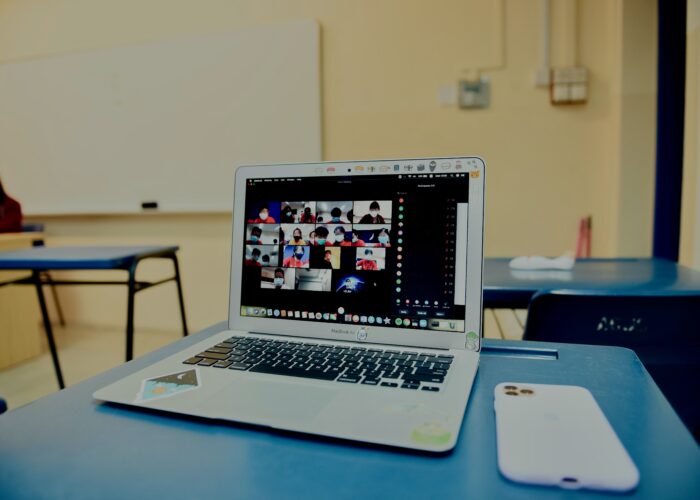
A laptop in an empty classroom displays Zoom classroom on its screen.
0

Introduction

Normal teaching and learning processes are occurring amidst difficult and confusing times: the ever-intensifying impact of the COVID-19 pandemic, the growing awareness and recognition of racial and social injustices, and the looming emergency of climate disasters threatening to dismantle entire communities. Despite the increasingly precarious circumstances, instructors and students have adapted, relying intensively on digital tools to replace some or all face-to-face instruction. There is little doubt that the changes brought about in the past 15 months will affect the future of teaching and learning, yet how exactly remains to be negotiated.

In this issue of the Journal of Interactive Technology & Pedagogy, we sought to continue the conversations taking place in our general issues while likewise providing a special forum for instructors to reflect directly on the experience of teaching amidst COVID-19 and its rippling aftermath.

The pandemic brought to the forefront for many the importance of considering how digital technologies shape teaching practices and afford opportunities for learning that do not and need not replicate “analog” modes of instruction. This very set of concerns has driven the JITP editorial collective from the founding of the journal, and we therefore felt duty-bound to create a space for authors to share their creative and critical reflections on this potentially decisive moment in the development of online and distanced modes of instruction. We intended for this issue’s featured section to not only serve as a reminder of the resilience of teachers and students working and learning through the crisis, but also as an opportunity to rethink the structures of mentorship and teaching that drew many instructors to the academic context in the first place. In this regard, a broader question that is implicit through many of the articles in this issue is whether the conventional structure of the academy is tenable when public health—the very fabric of society—unravels. We hope this issue provides an opportunity to rethink existing instructional practices and improve upon them.

General Issue

The articles in this issue touch on a variety of themes related to online communication, digital privacy, pedagogy of culture and representation, as well as online collaboration. Sean Molloy and Carissa Kelly consider assignments in which students create YouTube videos as a way of thinking about writing to various audiences in “Classmates, Family, Friends, Followers, Allies, Opponents, Enemies, Bosses, Trolls, Haters, Users, and Google: Understanding Digital Audiences On YouTube.” The authors explore how students can mobilize YouTube to transform essays into an audio-visual medium and expand possibilities for communication across space and time. Through publicly hosted video essays, students can reach larger—though not always friendly—audiences well beyond their instructor and, through this, participate in diverse cultural conversations across social media.

Charles Woods and Noah Wilson argue in “The Rhetorical Implications of Data Aggregation: Becoming a ‘Dividual’ in a Data-Driven World” that social media users do not have “meaningful access” to privacy policies (and thus to the platforms governed by them) if they lack a genuine understanding of the ways their data is aggregated and used by platform providers. Using key insights from contemporary scholarship on the politics of algorithmic user profiling, the authors provide guidelines for a scaffolded assignment sequence that begins with rhetorical analysis and then uses peer collaboration to understand and integrate key concepts.

In “Experiential Approaches to Teaching African Culture and the Politics of Representation: Building the ‘Documenting Africa’ Project with StoryMapJS,” Mary Anne Lewis Cusato and Nancy Demerdash-Fatemi propose a digital solution to the problem of U.S. student reliance on stereotypes and misinformation about Africa and African peoples and cultures. Through a creative collaboration between two courses, students confronted biases and misrepresentations permeating Western perceptions of Africa. Here, collaboration serves as a way to challenge student assumptions and produce a better collective understanding.

Spencer D. C. Keralis, Courtney E. Jacobs, and Matthew Weirick Johnson showcase the platform TimelineJS in “Collaborative Digital Projects in the Undergraduate Humanities Classroom: Case Studies with Timeline JS,” highlighting the intuitive aspects of the technology, and exploring how it can enhance student learning experiences in classes like a World Literature survey by providing a way to actively and collaboratively engage with primary source material. In its multimodal functionality, TimelineJS is a unique learning tool for both processing and presenting information, the authors argue, and students can use it to think about the temporal and spatial relationships between moments in history and in fiction. Many of these themes, particularly that of collaboration, are echoed in the dialogues driving our editing process at the JITP. Our open review process establishes conversations among authors, reviewers, and editors, providing mentorship and opportunities for reflection.

Forum on Teaching in the Time of the COVID-19 Pandemic

While the articles included in the forum for this issue cover a range of topics, two distinct themes emerged from the submissions. First, any semblance of instructional continuity has clearly depended on maintaining social engagement and support for students while teaching in remote and online learning environments. Second, our online pedagogies, even when cobbled together in the midst of crisis, should be used as opportunities to interrupt the reproduction of social inequality. These concerns emerge in large part from the growing general consciousness about social injustices spurred by the continued development of movements like Black Lives Matter (BLM) and others, forcing a general reckoning with questions of racism, policing, and oppression beyond the public denialism that has long characterized mainstream discourse.

Maintaining social engagement and support online

Many instructors faced the reality of teaching during a period of intense emotional and psychological trauma, as the height of the pandemic has claimed the lives of friends and loved ones. Our daily routines have been upended, and commonplace social practices of care have moved out of reach, prompting extended periods of isolation and leaving little time for the work of grief and mourning. Like never before, instructors of all educational levels had to consider techniques for encouraging social engagement, not only as a means of learning content but also as a means of coping with the trauma inflicted simply by living during a pandemic. Several of the authors in the forum describe approaches they have adopted to foster resilience among students, like developing tools to promote online engagement, relationship-building, and coping strategies.

Adhering to social-distancing practices also created challenges in providing students real-time feedback for effective learning. In “Assessing the Effectiveness of Using Live Interactions and Feedback to Increase Engagement in Online Learning,” Beth Porter, John Doucette, Andrew Reilly, Dan Calacci, Burcin Bozkaya, and Alex Pentland describe the use of an in-browser video chat app that provides metrics of users’ participation, and discuss the implications and current limitations of using the app to promote engagement, feedback, and learning even when collaborating across distance.

Salome Apkhazishvili, Serene Arena, and Renee Hobbs explore how teacher professional development can take place in online environments in “The Help Desk as a Community-Building Tool for Online Professional Development.” The authors found that relationship-building strategies that emphasized participants as co-learners empowered instructors with a sense of interconnectedness, agency, and community—as well as the technical and pedagogical support—during the dramatic pivot to online learning.

Recognizing the trauma students were likely to face during the pandemic, Antigoni Kotsiou, Erica Juriasingani, Marc Maromonte, Jacob Marsh, Christopher R. Shelton, Richard Zhao, and Lisa Jo Elliott describe a collaborative and interdisciplinary process of creating a mobile app for students to track their emotions and develop coping strategies in “Interdisciplinary Approach to a Coping Skills App: A Case Study.”

Teaching toward social justice

The COVID-19 crisis not only necessitated that we as educators consider how learning can take place through technology, but also, in its clear interconnection with crises of racial and social justice more broadly, the need for antiracist and social-justice–informed pedagogy has become even more urgent. Many of the authors here look at how we can move from thinking theoretically about questions of inclusivity to designing digital classrooms, courses, and assignments that put these theoretical concerns into concrete practice, centering trauma-informed pedagogy and racial justice.

In “‘The Future Started Yesterday and We’re Already Late’: The Case for Antiracist Online Teaching,” David L. Humphrey and Camea Davis note the potential for educational technology to serve as a tool of academic liberation, while critically evaluating not only the shortcomings of purely technical fixes in achieving this aim, but also how the use of such technology can serve to maintain control and reinforce existing oppressive societal structures. The authors direct attention to the conspicuous absence of antiracist pedagogy in mainstream theories of online learning, and call for a shift that centers antiracist pedagogy to the benefit of all.

Also noting the inequities that became even more apparent amidst the pandemic, Michael Mandiberg considers how feminist theories of care might help us in achieving these goals.In their piece, “Trauma-Informed Pedagogy in the Digital Media Pandemic Classroom,” Mandiberg brings the insights of trauma-informed pedagogy to bear on the use of technologies like Adobe Creative Cloud technologies and their web-based clones.

These adaptations seeking to humanize the differently technologized pandemic classroom have a great deal to offer to broader projects of rethinking the current structure of teaching and learning from pre-K through college. Mary Frances (Molly) Buckley-Marudas and Shelley E. Rose describe one such model of post-pandemic pedagogy that aims to do just that: in “Collaboration, Risk, and Pedagogies of Care: Looking to a Postpandemic Future,” the authors describe their work founding the Cleveland Teaching Collaborative and, as the title implies, three primary pedagogical thematics that may help set the stage for important changes in the future of education.

Final Thoughts

Although this is one of many forums for reflection on teaching during the COVID-19 pandemic, JITP has sought to provide creative and research-based ways to incorporate and center digital technologies in responsive and responsible pedagogy for nearly a decade. Whether included in the special forum on teaching during the COVID-19 pandemic or not, many of the articles included here consider the ways instructors can craft or maintain more equitable digital spaces for students’ individual and collective reflection. The pandemic forced many instructors to adopt instructional technologies for the first time or reevaluate tools they were already using, driving us all to consider which platforms and methodologies are most accessible and useful for this new and not-so-new world of teaching. Such considerations have shed light on larger pedagogical practices that will continue to inform and change our approaches to teaching in the future, asking us to reimagine our classrooms both within and outside of emergencies like this.

About the Editors

Anna Alexis Larsson is a PhD candidate in English at the Graduate Center, CUNY, and adjunct lecturer in English at Queens College and LaGuardia Community College, CUNY. She serves as program manager of BlabRyte, a community writing web app, in addition to being a member of the editorial collective of The Journal of Interactive Technology and Pedagogy. Her research interests include ecological theories of writing, transnational literacy and translingualism, and feminist rhetorical studies. Her dissertation investigates the tension between inquiry and performance in the composition process—particularly within First Year Writing programs—to build a theory of reparative practice and apply it through a grant-funded and award-winning online writing environment.

Teresa Ober is a Postdoctoral Research Associate at the University of Notre Dame working in the Learning Analytics and Measurement in Behavioral Sciences (LAMBS) Lab. Teresa completed her PhD in Educational Psychology from the Graduate Center, CUNY, specializing in Learning, Development, and Instruction. Teresa’s present and intended future research interests broadly overlap with developmental and cognitive psychology, and the learning sciences. More information about her most current work can be found here: https://tmober.github.io.

Nicole Zeftel is a Clinical Assistant Professor of composition and professional writing at the University at Buffalo and received a PhD in Comparative Literature with a Certificate in American Studies from the Graduate Center, CUNY, in 2018. In her previous position as an Instructional Technology Fellow at the Macaulay Honors College, CUNY, Nicole studied how creative digital projects promote active learning. In addition to her work in the digital humanities and composition pedagogy, Nicole’s research focuses on the intersection between nineteenth-century American women’s literature, religion, and medical discourse, and she is currently working on a book about the impact of spiritualism on women’s writing.

An autumn leaf in sharp focus before a vibrant autumnal background.
0

Introduction

In their introduction to the previous issue of The Journal of Interactive Technology and Pedagogy, the editors wrote of the profound and ongoing loss they felt assembling a collection of essays as the global crisis of COVID-19 unfolded. We have built Issue 18 under these same circumstances. This issue is a testament to the efforts of the JITP editorial community and our authors, who continued to collaborate on pedagogy scholarship amid increased burden. Its contributors, reviewers, editors, and stagers have endured radical shifts in their work and family lives—especially true for those who are caregivers and members of marginalized communities—and have fielded the emotional, economic, and physical toll of the pandemic. To be mindful of our colleagues’ current realities and our own, and to try to mitigate the pandemic’s often inequitable impacts, we attempted to be flexible with deadlines and offer increased opportunities for feedback where we could. We balanced this commitment with retaining JITP’s editorial workflow and publication schedule, which aims to provide space for the needs of early-career scholars as both editors and authors.

While these articles in some cases represent several years of work, a number of them speak specifically to how our teaching responds to such immediate external pressures. The COVID-19 pandemic has resurfaced some long-standing tensions about the role of educational technologies in teaching and learning. Instructors may be forced to adopt proprietary platforms that come with troubling implications for data privacy. An increasingly shifting landscape drives us to learn these new technologies while anticipating the continual changes in data standards, provenance practices, and platform ubiquity and ownership that will require future time and effort. Since exciting new research and teaching methods require extensive training, instructors set out to extend their network of collaborators and provide supportive infrastructure to this challenge. Individual scholars continue to incorporate technological and data literacy into their classes, impelling students to experiment with analytical practices that vary with institutional context and intellectual tradition.

A number of the articles deal explicitly with questions of loss, recovery, and intervention. In “Reading Texts in Digital Environments: Applications of Translation Alignment for Classical Language Learning,” Chiara Palladino argues for the creative use of translation alignment technologies as a means of facilitating Classical language learning. Classical studies requires that scholars attempt to synthesize information themselves without the benefit of consulting native speakers, and so Palladino offers translation pedagogy involving the comparison of multiple sources as a unique way of teaching slow, methodical information processing, a skill set particularly relevant to our present moment of information saturation. Palladino discusses a series of digital tools and assignments from her own course that, together, carry the pedagogical lesson that all reading is a reflective process. The translation process she describes does not establish one-to-one equivalences, but, rather, requires students to consider the “continuous dialogue between cultural and linguistic systems.”

In “Back in a Flash: Critical Making Pedagogies to Counter Technological Obsolescence,” Sarah Whitcomb Laiola seeks a similar remedy in the face of software expiration. As 2020 ends, so too does Adobe’s support of Flash, a medium in which e-lit has thrived. An NEH-funded project, AfterFlash, offers some balm to the loss, preserving access to texts born digitally in Flash and Shockwave, but it fails to preserve a means for generating them, and such generation, Laiola argues, is essential to student understanding of the texts themselves. She shares her experimentation to simulate that creative process, specifically investigating Stepworks as a classroom alternative, but also suggesting a path forward as one technology inevitably gives way to another. Preservation, after all, isn’t about rescuing only artifacts, but also the processes and pedagogies those artifacts enable.

Courtney Jacobs, Marcia McIntosh, and Kevin M. O’Sullivan are on a rescue mission of their own to collect and provide access to models of the printmaking tools of the past. In “Make Ready: Fabricating a Bibliographic Community,” they share their experiences creating 3Dhotbed, a repository of 3D-printable models, to investigate book production and printmaking. For scholars of book history, the files themselves can enable the critical hands-on work that has informed the discipline for nearly seventy years. The collection, though, is greater than the sum of its replicated parts. As the authors put it, “The future success of 3Dhotbed is not solely based on the volume, diversity, or rarity of individual items, but also on the ability of the platform to put these items in conversation.” Jacobs, McIntosh, and O’Sullivan’s work is meaningful to those outside their fields as well. In constructing 3Dhotbed, they have identified pitfalls and opportunities in navigating institutional partnerships, striking the balance between academic protocols and broader access, and continuing to expand the field beyond the Global North.

In “Using Wikipedia in the Composition Classroom and Beyond: Encyclopedic ‘Neutrality,’ Social Inequality, and Failure as Subversion,” Cherrie Kwok explores a different kind of loss—the damaging effects that can occur when attempts at neutrality gloss over difficult truths. Kwok invites instructors and students alike to leverage the power of failure to explore the very nature of language. Like others in her field, Kwok notes that Wikipedia can serve as a tool for teaching tight writing and edit-a-thons can generate deep student investment in intervening in the cultural record. But Kwok sees even greater value in what her students learn as they try to achieve Wikipedia’s second foundational principle of writing articles “from a neutral point of view.” They learn that language is not neutral and our attempts to make it seem so only cloak the systematic biases and issues of positionality.

As much of this issue makes clear, the people engaged in digital-pedagogy teaching and research provide essential infrastructure for this work. In “Interdisciplinarity and Teamwork in Virtual Reality Design,” Ole Molvig and Bobby Bodenheimer describe the evolution in logistics and pedagogy of a course they taught, Virtual Reality Design, at Vanderbilt University. In particular, they note that the interdisciplinary and collaborative requirements of their team-based course gave rise to a community of like-minded researchers over time. Regarding a growing demand for support of data visualization, Negeen Aghassibake, Justin Joque, and Matthew L. Sisk offer a different approach to cultivating such interdisciplinary collaboration: leveraging the library. In “Supporting Data Visualization Services in Academic Libraries,” the authors identify a host of factors that can lead to more successful support of responsible data visualization and the fundamental literacies that underpin it. Data visualization, they note, is not just about products, but about the scholarly processes that require well-aimed questions, research, data and data management, ethical practices, and design—in addition to software and hardware decisions.

The articles in our Forum on Data and Computational Pedagogy attend to how these concerns arise in the classroom when using computational methods to teach processes of data collection, transformation, and presentation. In our call for papers, we asked submitters to address the challenges and opportunities that arise when teaching with data and promoting data literacy. We were especially interested in how students and instructors grappled with issues of power and agency when acting as “data users” (Gonzalez and DeVoss 2016). The authors of the articles in this Forum span academic job roles and work in a wide variety of institutional contexts that inform their data pedagogy. What coheres their contributions is a humanistic approach to data analysis—one that understands working with data as an exploratory and iterative analytical process of regularization, and which foregrounds data’s context-embeddedness and malleability. As Katie Rawson and Trevor Muñoz (2016) remind us, this feature of data is too often obscured when we think about data “cleaning” as its preparation for scholarly work rather than recognizing “messiness” as an integral part of the work itself. By recognizing the analytical agency we have to remediate data, we may develop the commitment to using data-driven methods for justice, resisting the potential of data analysis’s associations with correctness and order to propagate bias and do harm (D’Ignazio and Klein 2020).

In “Ethnographies of Datasets: Teaching Critical Data Analysis through R Notebooks,” Lindsay Poirier writes on how her students confront datasets as cultural objects in an undergraduate course called Data Sense and Exploration at the University of California, Davis. Here, she draws from cultural anthropology’s experimental ethnography to guide students through a series of weekly lab assignments in which students record field notes while performing analysis of dataframes in R. Each of these labs invokes a concept: routines and rituals, semantics, classifications, calculations and narrative, chrono-politics, and geo-politics. She characterizes her students’ work with data as “ethnography” because of “their consistent, hands-on engagement with the data” and the opportunity it provides for “reflections on their own positionality.” This approach encourages students to see themselves as “critical data practitioners” who can account for, as well as critique, the “incompleteness, inconsistencies and biases” of publicly available data.

In “Thinking Through Data in the Humanities and in Engineering,” Elizabeth Alice Honig, Deb Niemeier, Christian F. Cloke, and Quint Gregory assess how students in two disparate fields engage with data’s embedded context. The authors describe an interdisciplinary effort at the University of Maryland, College Park, to teach the same historical network dataset to students in art history and engineering, as each group of students brought their entrenched disciplinary assumptions about data analysis and visualization to the same assignments. While the authors’ engineering students tended to value consistent design conventions in an approach framed by a pre-set analytical objective, their art history students tended to want to bring insights from visualization back to the dataset. On the flip side, the engineering students were less likely to incorporate context and “texture” in their visualizations, while the art history students tended to be less adept at properly labeling their graphs or ensuring their visualizations made effective communication choices. From the authors’ exploratory study, they conclude that emphases on digital training within humanities courses and project-based learning in engineering courses may not be enough alone for students to overcome these tendencies, and that additional formal training may be required.

In “Numbering Ulysses: Digital Humanities, Reductivism, and Undergraduate Research,” Erik Simpson describes the pedagogical implications of humanities data creation for Ashplant, a collaborative digital project developed in conjunction with Grinnell College students. As the students worked to describe James Joyce’s Ulysses in tabular form for presentation online, they were forced to reckon with the frustrations posed by data entry involving complex humanities materials. In the process, students found their digital humanities work placed in dialogue with analog methods of analyzing Ulysses, which already used numerical and hierarchical systems of classification. The piece closes by building on these pedagogical lessons to suggest a series of ways that undergraduate research might engage with the “creativity, resistance, and questioning” of digital work.

In “Data Fail: Teaching Data Literacy with African Diaspora Digital Humanities,” Jennifer Mahoney, Roopika Risam, and Hibba Nassereddine reflect, too, on the frustrations and failures of a data curation and visualization project. Situating their work within scholarship on Black Digital Humanities, they articulate the difficulty of reconciling “fragments of information” when trying to avoid reproducing or amplifying gaps in the archives they used for research. Having set out to plot networks of participation in Pan-Africanist intellectual and social movements, the authors describe the “virtually meaningless” initial results that revealed some flawed assumptions of their project’s methodology. Their writing, however, exceeds mere process narrative by reflecting on this realization’s implications for their own and others’ projects—their non-result, it turns out, provided an opportunity to reappraise their methods and identify the aspects of their dataset the methods didn’t capture. Moreover, as secondary-education teachers and students, the authors argue that high school students might have similar data epiphanies were such digital humanities projects featured in high school English language arts curricula, using students’ development of data literacy to promote inclusivity by way of representation and equity in the cultural record.

Data Literacy in Media Studies: Strategies for Collaborative Teaching of Critical Data Analysis and Visualization” addresses intra-institutional partnerships between librarians and faculty to support teaching critical data literacy. In this article, Andrew Battista, Katherine Boss, and Marybeth McCartin provide a template they use to encourage a variety of instructors to teach visualization instruction sessions each term. The model distributes the labor of teaching across a set of collaborators and supports the professional development of these instructors as they create shared and reproducible pedagogical materials. The program they describe is one that is ultimately more sustainable and “has a broad and demonstrated impact on student learning, strengthens ties between the library and the departments we serve, and allows librarians and data services specialists the opportunity to learn and grow from each other.” While directed toward teaching librarians, the piece also proves useful for faculty considering library partnerships to enrich the data or information literacy offerings of their programs.

Like teaching, this issue results from the work of many hands. The editors would like to thank every member of JITP’s editorial board who contributed energy to its publication under such difficult circumstances. An issue of this size required an especially large number of reviewers, and the editors deeply appreciate their willingness to entertain the unexpected requests. And, of course, we are grateful to all the authors who shared their work with us for consideration. Future issues of JITP will, undoubtedly, share work specific to the particular pedagogies of the pandemic itself. Nonetheless, we hope that this collection of essays will encourage reflection on how our teaching has always been called upon to respond to changing circumstances and must continue to do so. What we need, especially now, is more teachers sharing what works and what doesn’t, more authors responding to change as they see it happening in their work, and more voices calling out for change where it is not yet happening.

Bibliography

D’Ignazio, Catherine, and Lauren F. Klein. 2020. Data Feminism. Cambridge: The MIT Press.

Gonzales, Lauren and Dànielle Nicole DeVoss. 2016. “Digging into Data: Professional Writers as Data Users.” In Writing in an Age of Surveillance, Privacy, and Net Neutrality, edited by Cheryl E. Ball, special issue, Kairos: A Journal of Rhetoric, Technology, and Pedagogy 20, no. 2 (Spring). http://technorhetoric.net/20.2/topoi/beck-et-al/gon_devo.html.

Rawson, Katie, and Trevor Muñoz. 2016. “Against Cleaning.” Curating Menus (blog), July 6. http://curatingmenus.org/articles/against-cleaning/.

About the Editors

Kelly Hammond has focused on the intersection of humanities and technology in the classroom for over twenty years. She is currently the Director of Digital Pedagogy at the Chapin School in New York City. She is also pursuing her master’s degree in Digital Humanities at the City University of New York’s Graduate Center, and she serves on the editorial collective of The Journal of Interactive Technology and Pedagogy. Kelly is particularly interested in building online communities to facilitate dialogue and collaboration within the small but growing number of DH practitioners in K–12 environments. She is developing and testing the efficacy of micro-pd—tiny and targeted professional development to help faculty grow, even in times of crisis. She’s also a budding writer. Her fiction has appeared in online journals such as drafthorse and earned an Editor’s Prize from the Chautauqua Journal.

Gregory J. Palermo is a PhD candidate in English at Northeastern University. His research and teaching focus on the metaphors for disciplinary knowledge that structure digital methods used for plotting academic fields. His dissertation argues that citation analysis can be a tactical means of bringing together work from disparate traditions and promoting equity in scholarly publishing. His pedagogy foregrounds the implications of borrowing methods, rhetorical choices with data, and how algorithmic processes increasingly used for pattern-seeking analysis and surveillance can be useful for remix, intervention, and resistance. He has been a Research Associate and Project Manager for the Digital Scholarship Group in Northeastern University Library, a Graduate Fellow of the NULab for Texts, Maps, and Networks, and a co-instructor at the Digital Humanities Summer Institute (DHSI). His work has appeared in the Journal of Writing Analytics and Digital Humanities Quarterly (DHQ). He has been a managing editor of DHQ and now serves as an editor of The Journal of Interactive Technology and Pedagogy.

Brandon Walsh is Head of Student Programs in the Scholars’ Lab in the University of Virginia Library. Prior to that, he was Visiting Assistant Professor of English and Mellon Digital Humanities Fellow in the Washington and Lee University Library. He received his PhD and MA from the Department of English at the University of Virginia, where he also held fellowships in the Scholars’ Lab and acted as Project Manager of NINES. His dissertation examined modern and contemporary literature and culture through the lenses of sound studies and digital humanities, and these days he works primarily at the intersections of digital pedagogy and digital humanities. He serves on the editorial boards of The Programming Historian and The Journal of Interactive Technology and Pedagogy. He is a regular instructor at HILT, and he has work published or forthcoming with Programming Historian, Insights, the Digital Library Pedagogy Cookbook, Pedagogy, Digital Pedagogy in the Humanities, and Digital Scholarship in the Humanities, among others.

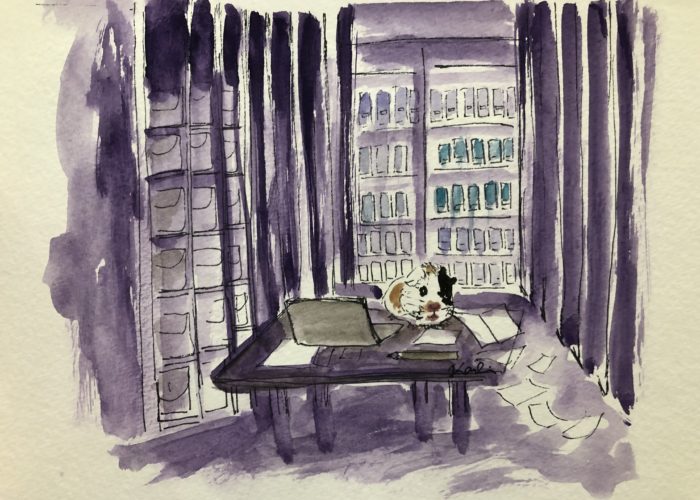
Water-color image of guinea pig conducting archival research.
0

Introduction: Issue Fourteen

From projects like the SNCC Digital Gateway to Colored Conventions, digital technologies are prompting renewed attention to archival research and teaching practices and creating new opportunities for engaging primary sources. At the same time, digital technologies are raising ethical questions about how archives are created, organized, shared, accessed, and preserved. Increased access has coincided with what Wendy Hayden calls “The Archival Turn’s Pedagogical Turn,” as instructors explore how archival encounters can catalyze student-centered, experiential, collaborative, and project-based learning experiences. With this issue, we sought to address several questions: How do scholars locate authoritative information and guarantee continued access in the current media landscape? How do we teach undergraduate students to perform archival research, evaluate digital sources, and even compose and curate their own archives?As a graduate student researching letter writing, special issue editor Jojo Karlin worked on a digital edition of her grandparents’ wartime overseas correspondence. From this experience, she saw the necessity for contemporary scholars to receive training in efficient and ethical digital asset management, including how to organize digital files and metadata. She realized that conversations about digital archives were occurring among librarians (who often see firsthand the transitions between technologies and the simultaneous organization of analog and digital materials) and among educators who teach with archives and want to leverage new technologies to help students create their own. She wondered how we could bring these conversations together.

As a newly-minted PhD, Danica Savonick recognized that her research on feminist literature and pedagogy was transformed by long hours spent in archives with the syllabi, lesson plans, and assignments of activist educators from previous generations. When performing research on pedagogical archives, what we often encounter is labor: the letters to administrators, budgets, and grant requests (interspersed with grocery lists) that remind us how much unseen work goes into producing the scene of teaching and learning. As she sought to develop similarly transformative archival assignments for her students, she realized how difficult it is to set the stage for a meaningful encounter with primary source documents. She wanted to work on this special issue to learn more about how other teacher-scholars are facilitating archival encounters in their classrooms.

As a former history student, Stephen Klein felt a guilty pleasure for archives even before he decided to become a librarian. Some of his most epiphanic moments of inquiry occurred when combing through archives and discovering a unique primary source that either supported his suspicions or fundamentally altered existing views. Despite maintaining some generalized best practices that he uses in his everyday work-life as a librarian, Stephen is interested in how archiving processes are often specific to the actual, unique objects being archived.

As co-editors we were delighted (and somewhat shocked) to receive an unprecedented number of submissions for this special issue, roughly 3 to 4 times more than an average JITP issue. Given the abundance of submissions, we added a section called “Views from the Field” to highlight short, praxis-based examples of archival research and teaching in action.

Several of the articles in this issue address how digital technologies are changing how we define, curate, and access archives. In “Crowdsourcing Traumatic History: Understanding the Historial Archive” Kirsti Girdharry analyzes Our Marathon: The Boston Bombing Digital Archive to consider what it means to collaborate with the public in crowdsourcing a digital archive. Girdharry analyzes how the digital impacts our understanding of archives, especially those that aim both to historicize and memorialize recent tragedies. In “Realizing the Past: Charting a Course for Sustainable Instruction and Engagement with Archival Materials Using Augmented and Virtual Reality Technologies” Amanda G. Pellerin, Ximin Mi, and Alison Valk describe the opportunities and limitations that augmented and virtual reality provide for accessing archival objects. While these technologies may help democratize access to archival materials, the authors also consider what might get lost in digitizing a rich three-dimensional object. (And for those interested in similar projects, keep an eye out for the CFP for an upcoming special themed issue of JITP on virtual reality edited by Amanda Licastro and Angel David Nieves.)

The majority of articles in this special issue focus on how “teaching and research with archives,” centers the work of collaboration. As scholars have noted, digital projects require many hands on deck—what Cathy N. Davidson calls “collaboration by difference”—prompting the creation of new academic procedures and protocols like “Guidelines for Evaluating Work in Digital Humanities and Digital Media.” Similarly, teaching with archives requires carefully scaffolded collaborations among faculty, staff, librarians, archivists, and instructional technologists that dispel the mythical notion of the genius scholar toiling away in isolation.

Several of the articles take up collaboration by demonstrating how work across institutions can be mutually beneficial. In “The Space Between Researcher, Object, Institution: Building Collaborative Knowledge with Primary Sources,” Mary Catherine Kinniburgh advocates for graduate-level archival training to support students using primary source research for their dissertations and theses. Kinniburgh discusses the Collaborative Seminar she organized in conjunction with the CUNY Graduate Center Library, the New York Public Library, and others, to generate a community of primary source researchers. While Kinniburgh focuses primarily on the humanities, authors Wendy Wasman, Thomas R. Beatman, Shanon Donnelly, Kathryn M. Flinn, Jeremy Spencer, and Ryan J. Trimbath show how institutional collaborations around archival projects can flourish in the natural sciences as well. In “Branching Out: Using Historical Records to Connect with the Environment,” Wasman et al. analyze the digitized archives of Cleveland naturalist A.B. Williams to show how inter-institutional collaboration can mobilize resources for educational use, from primary school exercises to graduate research.

Another cluster of articles describes collaboration in the context of joint efforts among faculty, students, and archivists to co-create digital archives. In “Digital Paxton: Collaborative Construction with Eighteenth-Century Manuscript Collections,” Will Fenton, Kate Johnson, and Kelly Schmidt describe a collaboration between faculty and students to produce a digital archive as a way of introducing students to concepts of knowledge production and archival construction. Drawing on the Collaborators’ Bill of Rights, they describe an assignment that involved students in knowledge production by contributing to the Digital Paxton project. In “Teaching Colonial Translations Through Archives: From Ink and Quill to XML (Or Not),” Allison Bigelow describes an assignment in which students helped to translate and edit colonial documents from the Early Americas Digital Archive. Through the assignment, “students learn about colonial archives by approaching them as public-facing, meaning-making sites of translation, interpretation, and textual editing, and by remediating print materials from the archives into annotated translations.”

Several articles consider these student-centered archival practices in the context of writing classrooms. In “From Page to Screen and Back Again: Archives-Centered Pedagogy for the 21st Century Writing Classroom,” Elizabeth Davis, Nancee Reeves, and Teresa Saxton analyze how archival research can help students better understand composition as a process of remixing, recontextualizing, collaborating, and curating. Through carefully scaffolded assignments, their students developed an “archives-based composition process” that improved their understanding of the social nature of writing and the material properties of texts, both of which are essential components of twenty-first-century literacies. In “‘Diving Into the Wreck’: (Re)Creating the Archive in the First-Year Writing Classroom” Maxine Krenzel and Daisy Atterbury describe a semester-long peer writing exchange across institutions based on poet Adrienne Rich’s archival teaching materials. With digital file sharing, they dislocate the classroom across campuses and ask, “How can the work that students leave behind inspire and enact its own unique pedagogy?”

Many of these articles consider how archival materials—zines, campus newsletters, correspondence—can help students address important questions about who gets to write history, whose stories are included, and whose are left out. In “Narrating Memory through Rhetorical Reflections: CUNY Students and Their Archives,” Wendy Hayden, María Hernández-Ojeda, and Iris Finkel describe a series of assignments in which undergraduates performed research in physical, institutional archives and shared their findings on digital platforms. In doing so, students became “active agents of generational transmission” who learned about history through the process of contributing to institutional memories. In “Collaboration Adventures with Primary Sources: Exploring Creative and Digital Outputs,” Jennifer Needham and Jeanann Croft Haas analyze the collaborative efforts among University of Pittsburgh librarians and faculty to incorporate the institution’s archival collections into the classroom. Through a series of case studies, Needham and Haas show how archival pedagogy can support an environment of student innovation through the production of what they call “creative outputs,” including websites, blog posts, zines, data sets, and visualizations.

Archives have long been central to feminist, antiracist, and justice-oriented research that recovers the historical contributions of women, people of color, and LGBTQ people. Several articles in this special issue extend this work to the undergraduate classroom. In “Engaging Women’s History through Collaborative Archival Wikipedia Projects,” Ariella Rotramel, Rebecca Parmer, and Rose Oliveira show how archivists, students, and faculty can facilitate knowledge production guided by feminist theory. Together they worked to leverage Wikipedia’s global reach “while struggling with editorial criteria that value objectivity and notoriety.” In “Possibly Impossible; Or, Teaching Undergraduates to Confront Digital and Archival Research Methodologies, Social Media Networking, and Potential Failure,” Rebekah Fitzsimmons and Suzan Alteri analyze an assignment that involved students in recovering the biographies of under-represented women science writers of the 19th century. The authors emphasize the potential and possible failure inherent in original research and found that “[s]tudents felt successful regardless of how much information they located; even [those] with no results reported feeling they had learned a significant amount from the project.” Recovery is also central to the feminist and antiracist projects described in a View by Ken Grossi, Alexia Hudson-Ward, Carol Lasser, Sarah Minion, and Natalia Shevin titled “How a Digital Collaboration at Oberlin College Between Archivists, Faculty, Students and Librarians Found its Muse in Mary Church Terrell, Nineteenth-Century Feminist and Civil Rights Icon.” In this View, the authors describe how faculty, students, and an archivist collaborated to help students co-author digital mini-editions for the Digitizing American Feminisms project.

Considered together, these articles demonstrate that historical inquiry is thriving. Students nationwide are learning how to access primary source documents and to consider the mechanisms of power that underscore how archives are constructed and accessed. We hope these articles will inspire researchers and educators to try something new or different, and share what they learn from the experience. And we hope you enjoy reading these articles as much as we enjoyed collaborating across time, space, and institutions to edit them.

About the Issue Editors

Danica Savonick is Assistant Professor of English at SUNY Cortland. She holds a PhD in English and a Certificate in American Studies from the CUNY Graduate Center. Danica blogs regularly about pedagogy and social justice and her work has appeared in American Literature, Digital Humanities Quarterly, Modern Fiction Studies, and Hybrid Pedagogy. Her current manuscript, Insurgent Knowledge, analyzes the activist pedagogies of Audre Lorde, June Jordan, Adrienne Rich, and Toni Cade Bambara. Danica serves on the Steering Committee for HASTAC.org and is lead author of “Gender Bias in Academe.”

Jojo Karlin, a PhD candidate in English at the Graduate Center, City University of New York, is dedicated to ideas about books, letters, and communication. As the Manifold Scholarship fellow, she is helping to develop Open Education Resources on the Mellon-funded, open source, hybrid publishing platform. As outreach coordinator for the NEH-funded DH Box, she co-led a course in Web APIs with Python at the Digital Humanities Summer Institute. An actress and an artist, she continually seeks creative ways of engaging the academy and the public, whether through drawing, performance, or posted letter.

Stephen I. Klein, the Digital Services Librarian at the Mina Rees CUNY Graduate School Library, spends much of his work-life behind the scenes insuring that the pulse of the GC’s library systems continue to work seamlessly for library users. He also spends time ‘freaking-out’ about the crisis of how our cultural heritage is quickly disappearing, because of the acceleration of modern ephemera with the advent of the web as one of the central forums for popular conversation and academic scholarship.

0

Introduction: Issue Thirteen

The current technological moment is perhaps best defined by a recent collective and critical awareness of the ways technology shapes our lives and practices both explicitly and implicitly. These technologies are so embedded in our daily practices that they are no longer ‘new’ or ‘surprising’, but commonplace—an assumed facet of modern life. In this moment where we are so deeply entwined with our technologies, it is important to evaluate and reflect on the affordances and challenges of digital technologies in the context of our curriculums, classrooms, and research. Unprecedented access to a wealth of multimodal information about the world has deepened university curricula in ways unimaginable only a decade ago, yet it has also blurred the boundaries of reality, giving rise to a cultural climate in which the very notion of truth has come into question. In his now classic schema on the intellectual and ethical development of college students, William Perry proposed that students evolve from dualistic thinking to multiplicity, then to relativism and, finally, to making commitments to their ideas (Perry 1970). Considered through the lens of this schema, our technological moment is emblematic of a state of relativism, where knowledge, truth, and reality are viewed as relative to the speaker’s own positionality. And it is in this moment, in this climate, that we are asking our students to actively participate in the construction and production of knowledges—a process that realizes the profound power and reach of technology, yet is also in tension with students’ vast access to information and computing power. So, while the majority of students have enough computing power in their pockets to research, create, and publish a variety of media with incredible quality, this power has become overwhelming to some, leading to fractured or distant relationships with others and confusion about what constitutes a reality they can trust, engage with, and contribute to. As the scale of information around the globe increases exponentially, and with it the ease of access to that information, it is our job as educators to guide students as they grapple with the realities of a hyper-connected world—a unique challenge, as many educators are grappling with their place in this new world themselves.

Issue 13 of the Journal of Interactive Technology and Pedagogy features a series of articles that can help us, as educators, think through how we utilize the affordances of digital technologies, while also revising our pedagogical practices to respond effectively to the associated challenges. Although Issue 13 is a General Issue and the topics covered by these articles are diverse, they remain centered around three themes: using digital content to broaden and deepen materials for consumption, using digital tools to contextualize relationships and expand communicative methods, and developing digital literacy across the curriculum. Each piece on its own invites the reader to consider digital pedagogies as essential to students’ educational experiences; taken together they highlight the benefits students can derive from engaging critically in both the consumption and production of digital media.

The Issue begins with David Haeselin’s essay, “Beyond the Borders of the Page: Mapping The Brief Wondrous Life of Oscar Wao.” In it, he describes a course in which he invites students to construct maps of both the characters’ and their own lived experiences, drawing on the spatial narrative detailed in Junot Díaz’s Pulitzer Prize-winning novel. Where the novel draws the reader’s attention to the porousness of national, linguistic, stylistic, and generic borders, the practice of mapping is itself an exercise in drawing and redrawing points, lines, and polygons. In this context, Haeselin argues that the process of map making allows students to engage more deeply in the experiences of Junot Díaz’s characters and, correspondingly, draw connections between the characters’ perspectives and their own. By implementing multi-modal deep mapping projects in undergraduate core curriculum courses, Haeselin invites us to consider the potential of the digital humanities to help students from across institutional disciplines see the world in novel ways.

Kelly Josephs articulates a different perspective concerning the relationship between multi-modal production and the classroom in her article, “Teaching the Digital Caribbean: The Ethics of a Public Pedagogical Experiment.” In this piece, Josephs discusses both the methodology of developing an interdisciplinary course about digital humanities (“The Digital Caribbean,” at the Graduate Center at the City University of New York) as well as the challenges she faced in teaching such a course. By focusing on the ethical considerations of designing this course as well as the impact that a single course can have, Josephs encourages us to reflect on the broader implications of all our teaching, both digital and analogue (a division that is increasingly nonexistent). While both Haeselin’s and Joseph’s articles chronicle interdisciplinary courses, and both draw on digital technologies as a means to enhance students’ experience of the content, Josephs is using these methodologies at the graduate level rather than the undergraduate, and exploring the ethical implications of requiring public-facing work as a part of a graduate education. Josephs invites us to consider how both the collection and production of digital work in an educational setting has broader impact not only for students, but the communities being studied. Throughout the article, she returns to this theme: exploring what it means to “work publicly with graduate-level research on the Caribbean in academia, particularly with students who have set ideas about their own personal and intellectual relationships to both digital technology and the region.”

The theme of exploring one’s intellectual relationship with digital technology continues in Trevor Hoag’s article, “From Addiction to Connection: Questioning the Rhetoric of Drugs in Relation to Student Technology-Use,” where Hoag discusses how educators, unsure of how to describe students’ relation to technology, typically employ the rhetorics of drugs and addiction by claiming their students are “hooked” on technology. This assessment prompts educators to adopt restrictive in-class device-use policies and creates an environment where technology is seen as an impediment to critical thinking. In an effort to dispel some of these negative assessments, Hoag asks his students to describe themselves and their relation to different media platforms. While some students did describe themselves as “addicts,” many students highlighted the importance of connection in their lives in terms that reflected a healthier attitude about the use of technology. Hoag suggests that, at the very least, students and teachers need to work together to create a new narrative around technology use in the classroom that captures these alternative assessments.

In a similar vein, the article, “Video Essays and Virtual Animals: An Approach to Teaching Multimodal Composition and Digital Literacy” by Christina Colvin explores how the design of social media platforms and video games influence one’s understanding of the world by persuading players to act in certain ways during gameplay. Colvin assigns students a video essay project that requires them to analyze how video games represent nonhuman animals. The project asks students to engage with the architectural designs of video games to recognize how they are constructed to achieve certain rhetorical ends by representing (in this case) nonhuman animals as related to players in particular ways. Through the recognition that game design can encourage players to adopt certain behaviors and understandings, students begin to understand that other artifacts, including texts, are constructed to achieve rhetorical ends as well. As such, immersive technology can be used to enhance the classroom experience for students.

If immersive technology can be used to improve students’ classroom experiences, it can also be used to improve students’ written work. In “Using Digital Rhetoric in a Multimodal Assignment to Disrupt Traditional Academic Writing Conventions in a First-Year Writing Classroom,” Melanie Gagich suggests that educators use digital rhetoric as an analytic tool to critique traditional writing assignments. She argues that students’ anxiety about writing academically for college audiences results from students framing it as “writing to the teacher.” This construction of a particular kind of audience hinders students’ abilities to write academically. Gagich argues that using digital rhetoric as a framework creates an environment for multimodal composition practices, and this new environment provides opportunities for students to engage with “real” audiences. Structuring assignments this way, Gagich argues, promotes student agency and teaches them how to effectively integrate rhetorical strategies that connect with real audiences.

Building on this theme, Stadler and McDermott highlight the importance of information literacy as a key outcome of higher education and writing instruction. In their article, “Advancing Information Literacy in a Semester-Long Library Instruction Course: A Case Study,” they investigate the efficacy of explicitly teaching Information Literacy (IL) through teaching internet research strategies at the lower undergraduate level. Where they argue that IL is a critical component of higher education, and a central tenet of librarianship, they also acknowledge that instruction in IL and internet research is often implied rather than explicit in higher education. Drawing on their experiences in teaching such a course at LaGuardia Community College and using ePortfolio as the primary platform for student production of work, they highlight both the successes and the challenges of teaching IL. This piece serves as both a guide and a reflection on the importance of IL in a quickly changing and evolving world.

Taken together, these articles invite us to consider the ways that we can prepare students for the technological moment they have inherited. The enterprise of education is grappling with a constantly evolving technological landscape that mirrors society’s larger struggle to balance the benefits of technological innovation with the challenges such rapid innovation poses. With this in mind, as well as with the recognition that there are ethical implications to the kinds of technology we employ inside and outside of the classroom, this issue of JITP presents an opportunity for each of us as educators to share our knowledge and experiences with the goal of refining our pedagogical practices to reflect the needs of our current techno-cultural realities. So, as we define and redefine the relationships between technology, the classroom, and the societies in which these structures exist more broadly, we take these essays as an opportunity to iterate on the methods that shape not only our classrooms and students, but the societies and global publics we enter into every day.

Bibliography

Perry, William G., Jr. 1970. Forms of Intellectual and Ethical Development in the College Years: A Scheme. New York: Holt, Rinehart, and Winston.

About the Authors

Laura Wildemann Kane is an Assistant Professor of Philosophy at The University of Tampa. Her research focuses upon issues central to Social & Political Philosophy, Ethics, and Feminist Philosophy. She is primarily interested in how different conceptions of the family affect the relationship between the family and the state, and the responsibility both institutions have to provide care for citizens. She received her Ph.D. in Philosophy and a certificate in Interactive Technology and Pedagogy from The Graduate Center of the City University of New York in 2017.

Michelle A. McSweeney is a Research Scholar in the Center for Spatial Research at Columbia University. She is the author of The Pragmatics of Texting: Making Meaning in Messages (Routledge 2018), and co-host of the podcast, Subtext. Her research focuses on digital writing in romantic relationships, particularly how we establish intimacy and trust through text messaging. She received her Ph.D. in Linguistics and a certificate in Interactive Technology and Pedagogy from the Graduate Center of the City University of New York in 2016.

Images are for demo purposes only and are properties of their respective owners. ROMA by ThunderThemes.net

Skip to toolbar